Accurate Learning of Graph Representations
with Graph Multiset Pooling
Jinheon Baek1*, Minki Kang1*, Sung Ju Hwang1,2
(*: equal contribution)
1Graduate School of AI, KAIST, South Korea
2AITRICS, South Korea
Graph Representation Learning
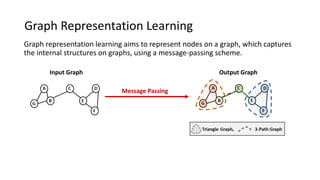
Graph representation learning aims to represent nodes on a graph, which captures
the internal structures on graphs, using a message-passing scheme.
Input Graph Output Graph
Message Passing
Graph Representation Learning
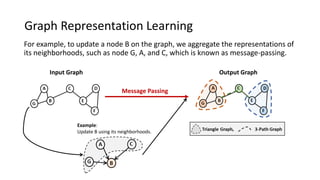
For example, to update a node B on the graph, we aggregate the representations of
its neighborhoods, such as node G, A, and C, which is known as message-passing.
Input Graph Output Graph
Message Passing
Example:
Update B using its neighborhoods.
Graph Pooling for Entire Graph Representations
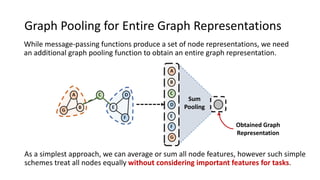
As a simplest approach, we can average or sum all node features, however such simple
schemes treat all nodes equally without considering important features for tasks.
While message-passing functions produce a set of node representations, we need
an additional graph pooling function to obtain an entire graph representation.
Obtained Graph
Representation
Sum
Pooling
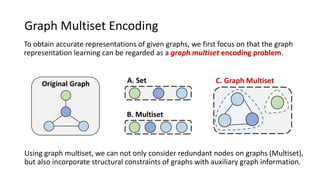
Graph Multiset Encoding
Using graph multiset, we can not only consider redundant nodes on graphs (Multiset),
but also incorporate structural constraints of graphs with auxiliary graph information.
To obtain accurate representations of given graphs, we first focus on that the graph
representation learning can be regarded as a graph multiset encoding problem.
A. Set
B. Multiset
C. Graph Multiset
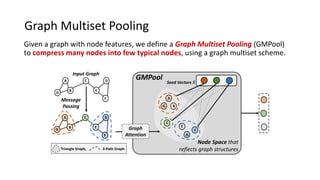
Graph Multiset Pooling
Given a graph with node features, we define a Graph Multiset Pooling (GMPool)
to compress many nodes into few typical nodes, using a graph multiset scheme.
Input Graph
Message
Passing
Triangle Graph, 3-Path Graph
Node Space that
reflects graph structures
Seed Vectors 𝑺
GMPool
E
A
B
C D
F
G
E
A
B
C D
F
G
C
E
D
F
A
B
G
Graph
Attention
Graph Multiset Transformer
To further consider the interactions among 𝑛 or condensed 𝑘 different nodes,
we propose a Self-Attention function (SelfAtt), inspired by Transformer [1].
[1] Vaswani et al. Attention Is All You Need. NIPS 2017.
Notably, the full structure of our model, namely Graph Multiset Transformer (GMT),
consists of GMPool for compressing nodes, and SelfAtt for considering interactions.
Connection with Weisfeiler-Lehman (WL) Test
Weisfeiler-Lehman (WL) test is known for its ability to distinguish two different
graphs, and our overall architecture can be at most as powerful as the WL test:
Please see the Theorem 1, Lemma 2, and Proposition 3 in section 3.3 of main paper.
• Theorem 1 (Non-isomorphic Graphs to Different Embeddings).
• Lemma 2 (Uniqueness on Graph Multiset Pooling).
• Proposition 3 (Injectiveness on Pooling Function).
Connection with Node Clustering
While the proposed Graph Multiset Pooling needs a linear space 𝑶(𝒏) for 𝑛 nodes,
it can be further approximated to the node clustering approach with 𝑘 clusters:
Please see the Theorem 4, and Proposition 5 in section 3.4 of main paper.
• Theorem 4 (Space Complexity of Graph Multiset Pooling).
• Proposition 5 (Approximation to Node Clustering).
Experiments
We validate the proposed Graph Multiset Pooling on graph classification,
reconstruction, and generation tasks of synthetic and real-world graphs.
• Graph Classification
: The goal is to predict a label of a given graph.
• Graph Reconstruction
: The goal is to reconstruct the node features of graphs from their pooled representations.
• Graph Generation
: The goal is to generate a valid graph with desired properties.
Graph Classification
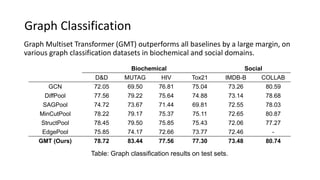
Graph Multiset Transformer (GMT) outperforms all baselines by a large margin, on
various graph classification datasets in biochemical and social domains.
Biochemical Social
D&D MUTAG HIV Tox21 IMDB-B COLLAB
GCN 72.05 69.50 76.81 75.04 73.26 80.59
DiffPool 77.56 79.22 75.64 74.88 73.14 78.68
SAGPool 74.72 73.67 71.44 69.81 72.55 78.03
MinCutPool 78.22 79.17 75.37 75.11 72.65 80.87
StructPool 78.45 79.50 75.85 75.43 72.06 77.27
EdgePool 75.85 74.17 72.66 73.77 72.46 -
GMT (Ours) 78.72 83.44 77.56 77.30 73.48 80.74
Table: Graph classification results on test sets.
Graph Classification
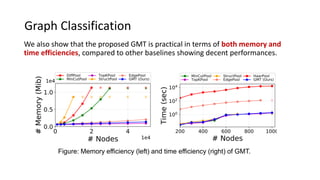
We also show that the proposed GMT is practical in terms of both memory and
time efficiencies, compared to other baselines showing decent performances.
Figure: Memory efficiency (left) and time efficiency (right) of GMT.
Graph Reconstruction
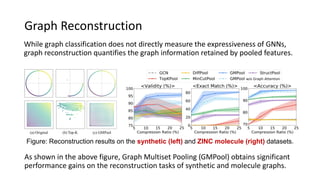
While graph classification does not directly measure the expressiveness of GNNs,
graph reconstruction quantifies the graph information retained by pooled features.
As shown in the above figure, Graph Multiset Pooling (GMPool) obtains significant
performance gains on the reconstruction tasks of synthetic and molecule graphs.
Figure: Reconstruction results on the synthetic (left) and ZINC molecule (right) datasets.
Graph Generation
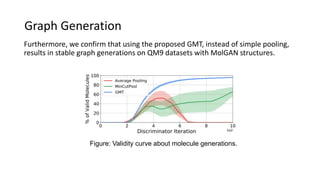
Furthermore, we confirm that using the proposed GMT, instead of simple pooling,
results in stable graph generations on QM9 datasets with MolGAN structures.
Figure: Validity curve about molecule generations.
Conclusion
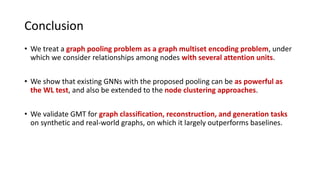
• We treat a graph pooling problem as a graph multiset encoding problem, under
which we consider relationships among nodes with several attention units.
• We show that existing GNNs with the proposed pooling can be as powerful as
the WL test, and also be extended to the node clustering approaches.
• We validate GMT for graph classification, reconstruction, and generation tasks
on synthetic and real-world graphs, on which it largely outperforms baselines.

Accurate Learning of Graph Representations with Graph Multiset Pooling

  • 1.
    Accurate Learning ofGraph Representations with Graph Multiset Pooling Jinheon Baek1*, Minki Kang1*, Sung Ju Hwang1,2 (*: equal contribution) 1Graduate School of AI, KAIST, South Korea 2AITRICS, South Korea
  • 2.
    Graph Representation Learning Graphrepresentation learning aims to represent nodes on a graph, which captures the internal structures on graphs, using a message-passing scheme. Input Graph Output Graph Message Passing
  • 3.
    Graph Representation Learning Forexample, to update a node B on the graph, we aggregate the representations of its neighborhoods, such as node G, A, and C, which is known as message-passing. Input Graph Output Graph Message Passing Example: Update B using its neighborhoods.
  • 4.
    Graph Pooling forEntire Graph Representations As a simplest approach, we can average or sum all node features, however such simple schemes treat all nodes equally without considering important features for tasks. While message-passing functions produce a set of node representations, we need an additional graph pooling function to obtain an entire graph representation. Obtained Graph Representation Sum Pooling
  • 5.
    Graph Multiset Encoding Usinggraph multiset, we can not only consider redundant nodes on graphs (Multiset), but also incorporate structural constraints of graphs with auxiliary graph information. To obtain accurate representations of given graphs, we first focus on that the graph representation learning can be regarded as a graph multiset encoding problem. A. Set B. Multiset C. Graph Multiset
  • 6.
    Graph Multiset Pooling Givena graph with node features, we define a Graph Multiset Pooling (GMPool) to compress many nodes into few typical nodes, using a graph multiset scheme. Input Graph Message Passing Triangle Graph, 3-Path Graph Node Space that reflects graph structures Seed Vectors 𝑺 GMPool E A B C D F G E A B C D F G C E D F A B G Graph Attention
  • 7.
    Graph Multiset Transformer Tofurther consider the interactions among 𝑛 or condensed 𝑘 different nodes, we propose a Self-Attention function (SelfAtt), inspired by Transformer [1]. [1] Vaswani et al. Attention Is All You Need. NIPS 2017. Notably, the full structure of our model, namely Graph Multiset Transformer (GMT), consists of GMPool for compressing nodes, and SelfAtt for considering interactions.
  • 8.
    Connection with Weisfeiler-Lehman(WL) Test Weisfeiler-Lehman (WL) test is known for its ability to distinguish two different graphs, and our overall architecture can be at most as powerful as the WL test: Please see the Theorem 1, Lemma 2, and Proposition 3 in section 3.3 of main paper. • Theorem 1 (Non-isomorphic Graphs to Different Embeddings). • Lemma 2 (Uniqueness on Graph Multiset Pooling). • Proposition 3 (Injectiveness on Pooling Function).
  • 9.
    Connection with NodeClustering While the proposed Graph Multiset Pooling needs a linear space 𝑶(𝒏) for 𝑛 nodes, it can be further approximated to the node clustering approach with 𝑘 clusters: Please see the Theorem 4, and Proposition 5 in section 3.4 of main paper. • Theorem 4 (Space Complexity of Graph Multiset Pooling). • Proposition 5 (Approximation to Node Clustering).
  • 10.
    Experiments We validate theproposed Graph Multiset Pooling on graph classification, reconstruction, and generation tasks of synthetic and real-world graphs. • Graph Classification : The goal is to predict a label of a given graph. • Graph Reconstruction : The goal is to reconstruct the node features of graphs from their pooled representations. • Graph Generation : The goal is to generate a valid graph with desired properties.
  • 11.
    Graph Classification Graph MultisetTransformer (GMT) outperforms all baselines by a large margin, on various graph classification datasets in biochemical and social domains. Biochemical Social D&D MUTAG HIV Tox21 IMDB-B COLLAB GCN 72.05 69.50 76.81 75.04 73.26 80.59 DiffPool 77.56 79.22 75.64 74.88 73.14 78.68 SAGPool 74.72 73.67 71.44 69.81 72.55 78.03 MinCutPool 78.22 79.17 75.37 75.11 72.65 80.87 StructPool 78.45 79.50 75.85 75.43 72.06 77.27 EdgePool 75.85 74.17 72.66 73.77 72.46 - GMT (Ours) 78.72 83.44 77.56 77.30 73.48 80.74 Table: Graph classification results on test sets.
  • 12.
    Graph Classification We alsoshow that the proposed GMT is practical in terms of both memory and time efficiencies, compared to other baselines showing decent performances. Figure: Memory efficiency (left) and time efficiency (right) of GMT.
  • 13.
    Graph Reconstruction While graphclassification does not directly measure the expressiveness of GNNs, graph reconstruction quantifies the graph information retained by pooled features. As shown in the above figure, Graph Multiset Pooling (GMPool) obtains significant performance gains on the reconstruction tasks of synthetic and molecule graphs. Figure: Reconstruction results on the synthetic (left) and ZINC molecule (right) datasets.
  • 14.
    Graph Generation Furthermore, weconfirm that using the proposed GMT, instead of simple pooling, results in stable graph generations on QM9 datasets with MolGAN structures. Figure: Validity curve about molecule generations.
  • 15.
    Conclusion • We treata graph pooling problem as a graph multiset encoding problem, under which we consider relationships among nodes with several attention units. • We show that existing GNNs with the proposed pooling can be as powerful as the WL test, and also be extended to the node clustering approaches. • We validate GMT for graph classification, reconstruction, and generation tasks on synthetic and real-world graphs, on which it largely outperforms baselines.