LAB SEMINAR
Nguyen Thanh Sang
Network Science Lab
Dept. of Artificial Intelligence
The Catholic University of Korea
E-mail: sang.ngt99@gmail.com
Accurate Learning of Graph Representations with
Graph Multiset Pooling
--- Jinheon Baek, Minki Kang, Sung Ju Hwang ---
2023-07-10
Content
s
1
⮚ Paper
▪ Introduction
▪ Problem
▪ Contributions
▪ Framework
▪ Experiment
▪ Conclusion
2
Introduction
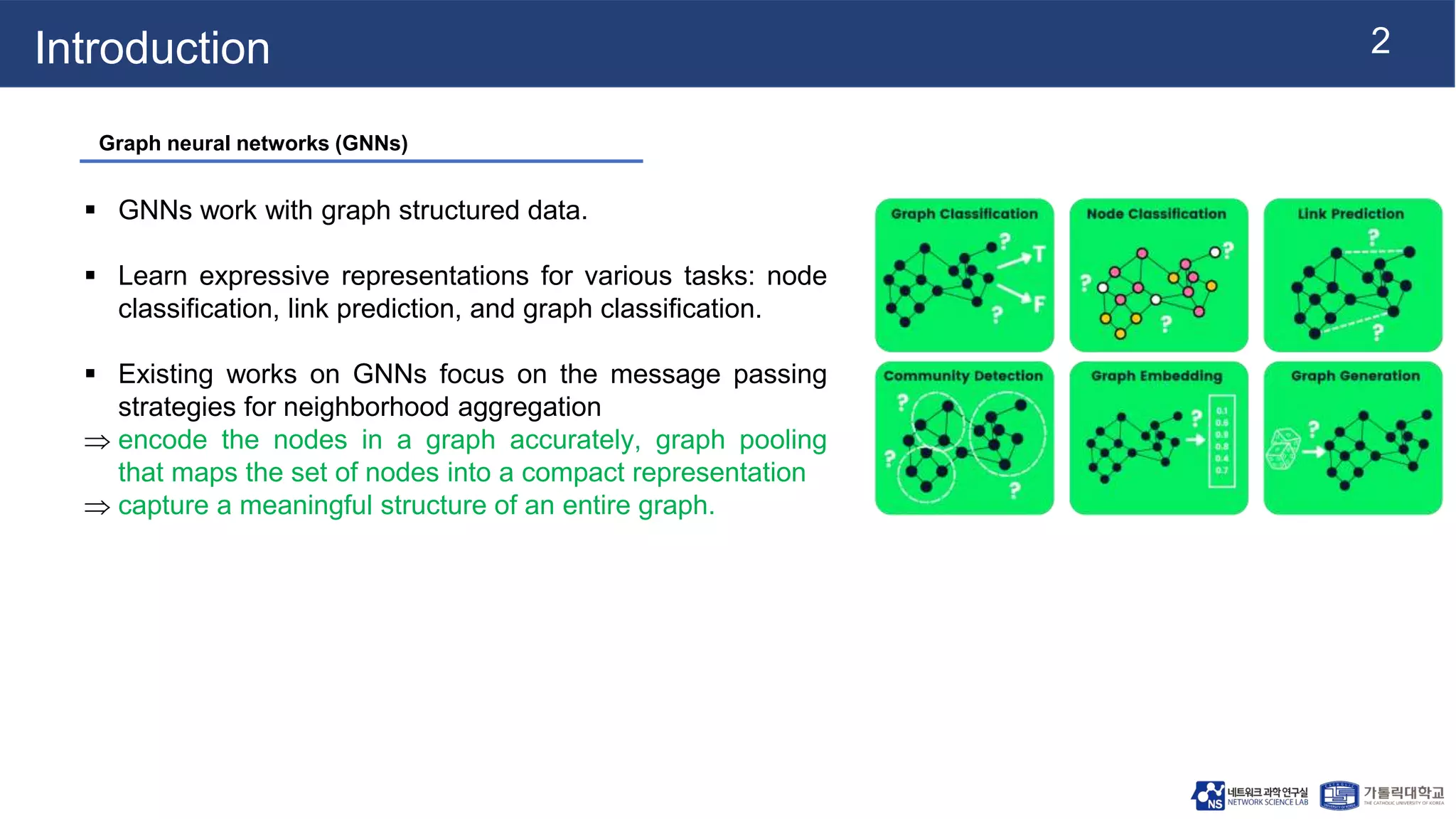
 GNNs work with graph structured data.
 Learn expressive representations for various tasks: node
classification, link prediction, and graph classification.
 Existing works on GNNs focus on the message passing
strategies for neighborhood aggregation
 encode the nodes in a graph accurately, graph pooling
that maps the set of nodes into a compact representation
 capture a meaningful structure of an entire graph.
Graph neural networks (GNNs)
3
Introduction
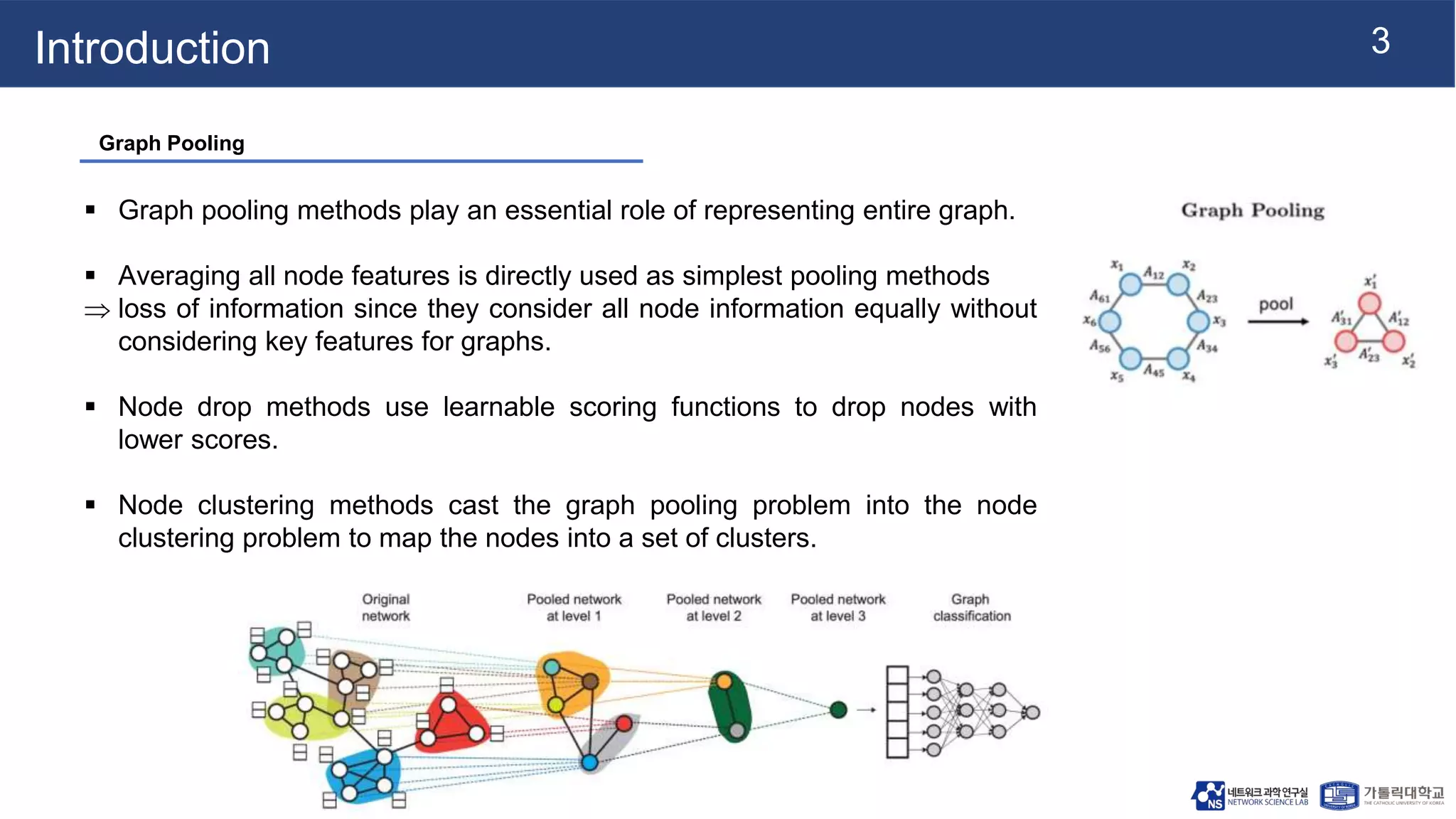
 Graph pooling methods play an essential role of representing entire graph.
 Averaging all node features is directly used as simplest pooling methods
 loss of information since they consider all node information equally without
considering key features for graphs.
 Node drop methods use learnable scoring functions to drop nodes with
lower scores.
 Node clustering methods cast the graph pooling problem into the node
clustering problem to map the nodes into a set of clusters.
Graph Pooling
4
Introduction
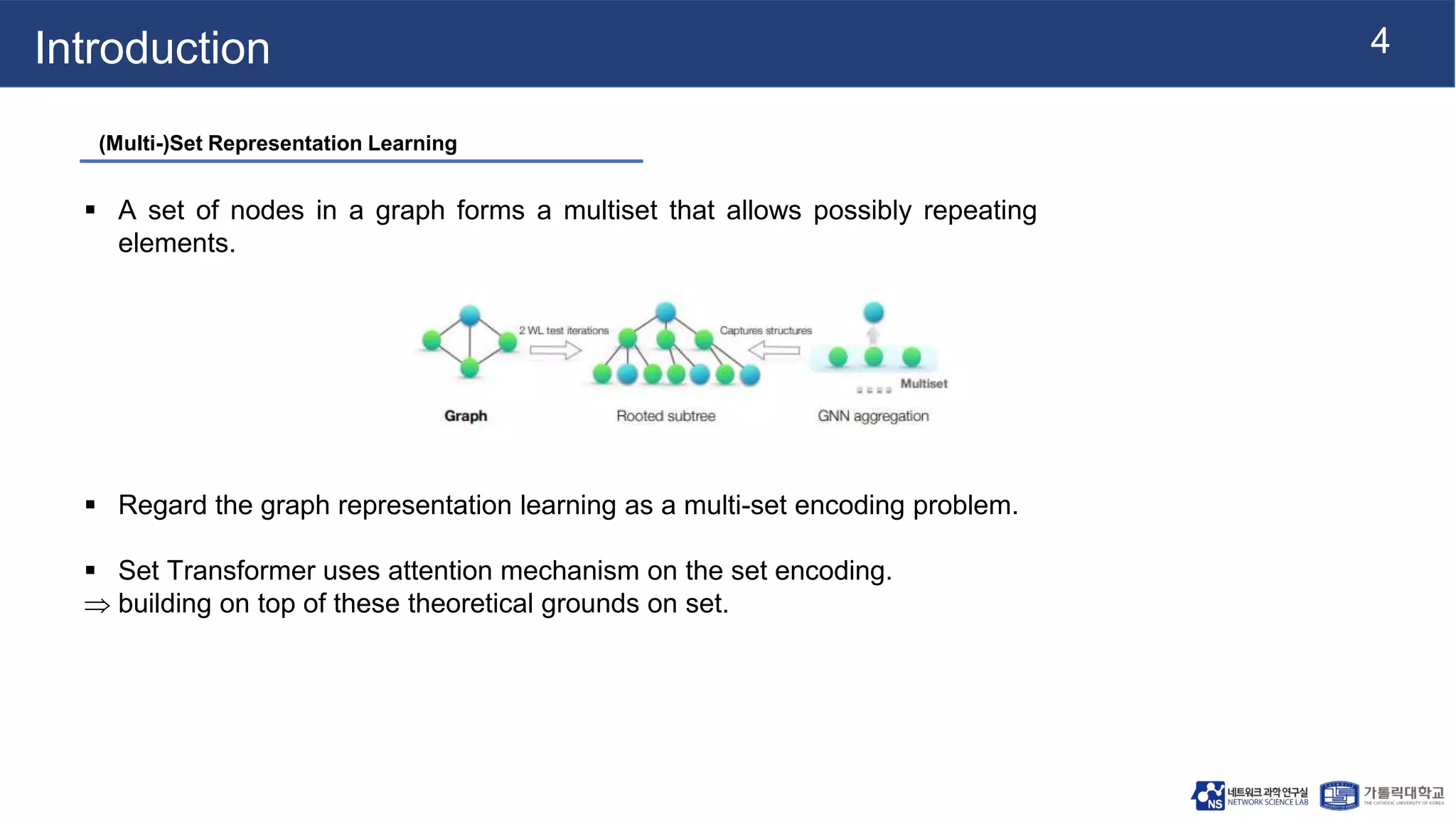
 A set of nodes in a graph forms a multiset that allows possibly repeating
elements.
 Regard the graph representation learning as a multi-set encoding problem.
 Set Transformer uses attention mechanism on the set encoding.
 building on top of these theoretical grounds on set.
(Multi-)Set Representation Learning
5
Problems
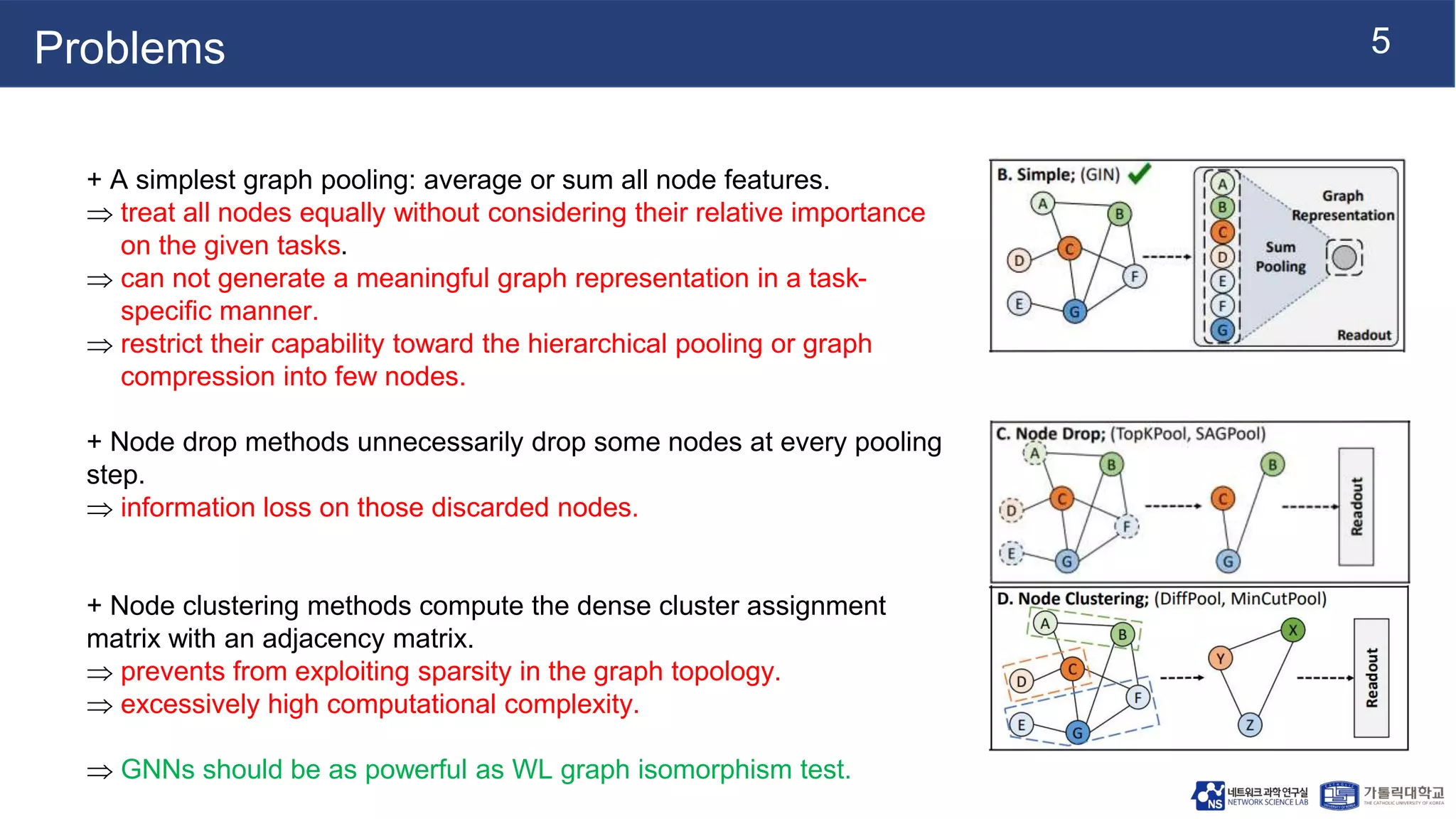
+ A simplest graph pooling: average or sum all node features.
 treat all nodes equally without considering their relative importance
on the given tasks.
 can not generate a meaningful graph representation in a task-
specific manner.
 restrict their capability toward the hierarchical pooling or graph
compression into few nodes.
+ Node drop methods unnecessarily drop some nodes at every pooling
step.
 information loss on those discarded nodes.
+ Node clustering methods compute the dense cluster assignment
matrix with an adjacency matrix.
 prevents from exploiting sparsity in the graph topology.
 excessively high computational complexity.
 GNNs should be as powerful as WL graph isomorphism test.
6
Contributions
+ Treat a graph pooling problem as a multiset encoding problem.
 consider relationships among nodes in a set with several attention units, to make a compact
representation of an entire graph only with one global function, without additional message-passing
operations.
• Show that existing GNN with this parametric pooling operation can be as powerful as the WL
test, and also be easily extended to the node clustering approaches with learnable clusters.
• Evaluate GMT on graph classification, reconstruction, and generation tasks which use
synthetic and real-world graphs
 outperforms most graph pooling baselines.
7
Framework
8
Graph Multiset Transformer (GMT)
+ Form a multiset: containing different nodes can have identical feature vectors. The input of the
graph pooling function READOUT consists of nodes in a graph.
+ To design a graph pooling function that is as powerful as the WL test, it needs to satisfy the
permutation invariance and injectiveness over the multiset, since two non-isomorphic graphs
should be embedded differently through the injective function.
+ The simple sum pooling satisfies the injectiveness over a multiset
 it may treat all node embeddings equally without consideration of their relevance to the task.
+ To resolve this issue, an attention mechanism on the multiset pooling function is considered to
capture structural dependencies among nodes within a graph.
 expressive power of the WL test.
Multiset Encoding
9
Graph Multiset Transformer (GMT)
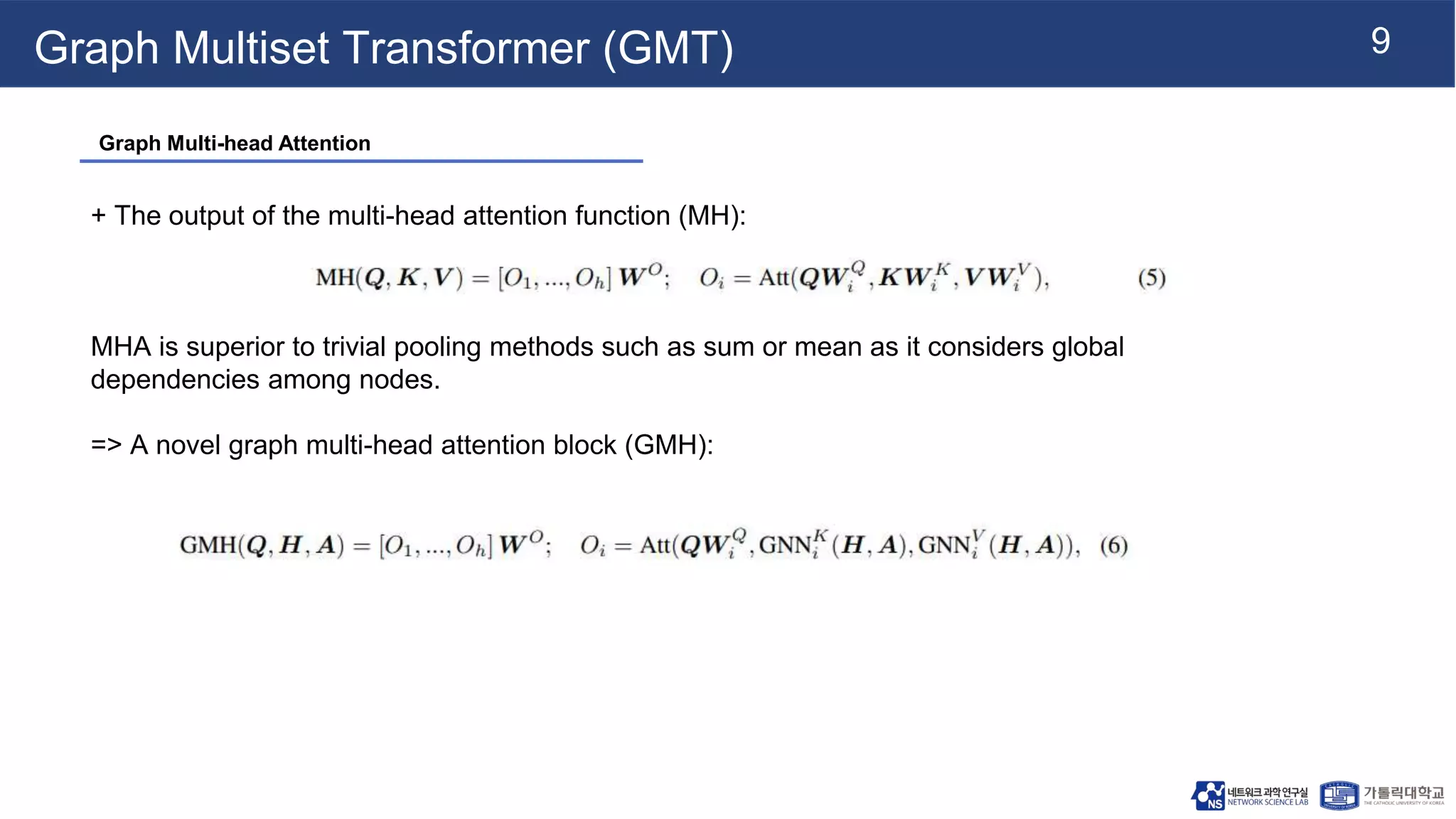
+ The output of the multi-head attention function (MH):
MHA is superior to trivial pooling methods such as sum or mean as it considers global
dependencies among nodes.
=> A novel graph multi-head attention block (GMH):
Graph Multi-head Attention
10
Graph Multiset Transformer (GMT)
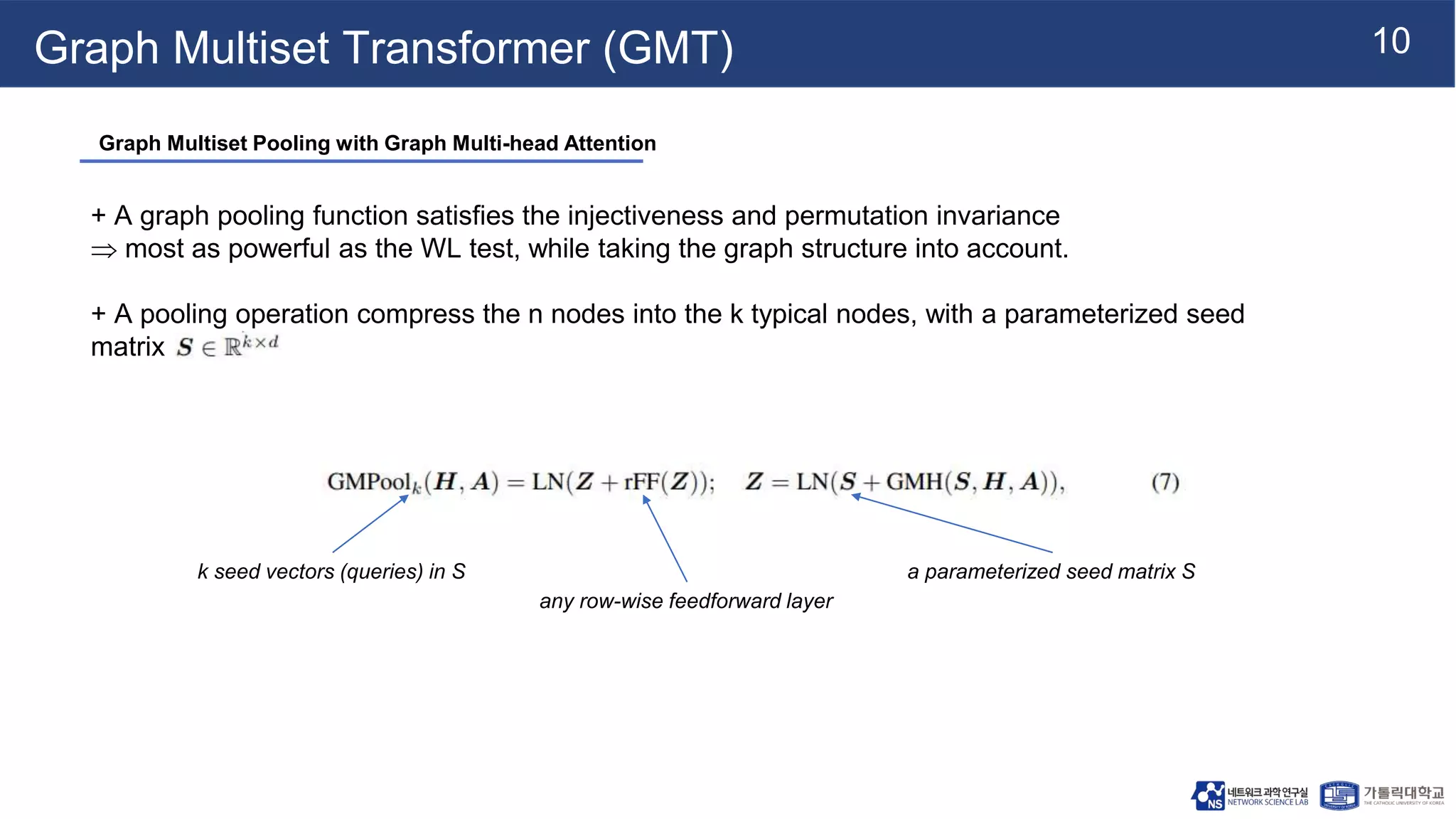
+ A graph pooling function satisfies the injectiveness and permutation invariance
 most as powerful as the WL test, while taking the graph structure into account.
+ A pooling operation compress the n nodes into the k typical nodes, with a parameterized seed
matrix
Graph Multiset Pooling with Graph Multi-head Attention
any row-wise feedforward layer
k seed vectors (queries) in S a parameterized seed matrix S
11
Graph Multiset Transformer (GMT)
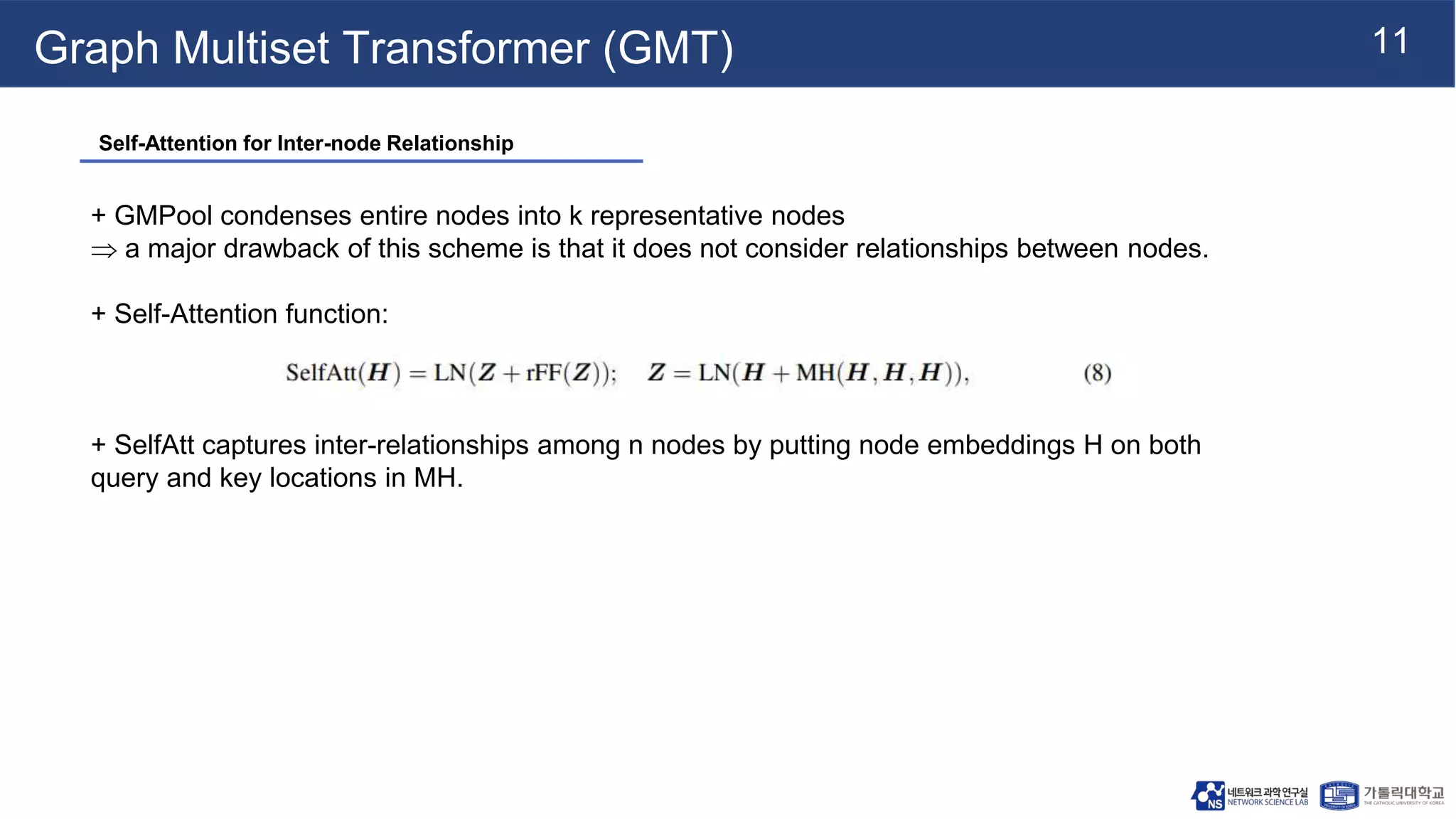
+ GMPool condenses entire nodes into k representative nodes
 a major drawback of this scheme is that it does not consider relationships between nodes.
+ Self-Attention function:
+ SelfAtt captures inter-relationships among n nodes by putting node embeddings H on both
query and key locations in MH.
Self-Attention for Inter-node Relationship
12
Graph Multiset Transformer (GMT)
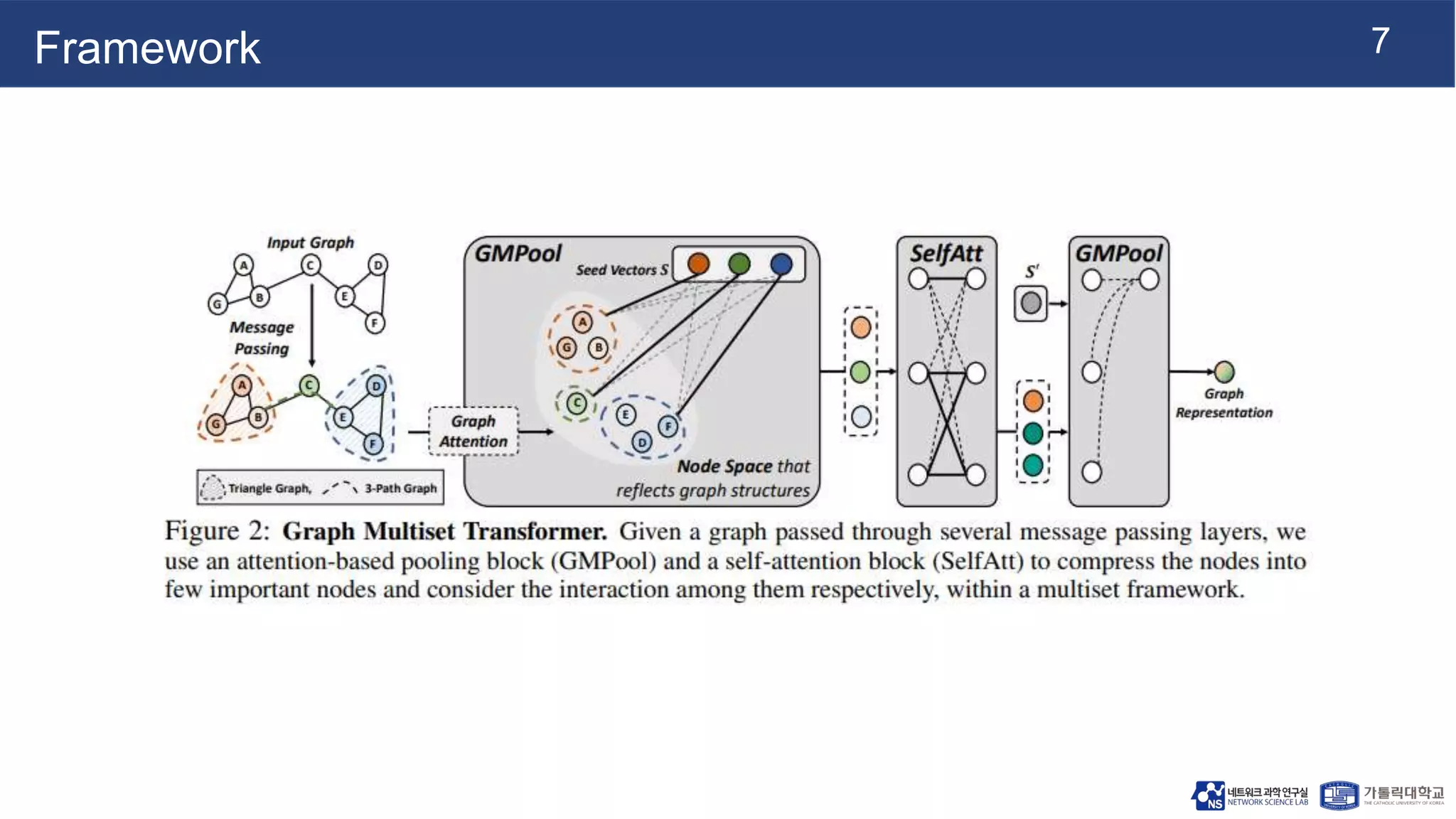
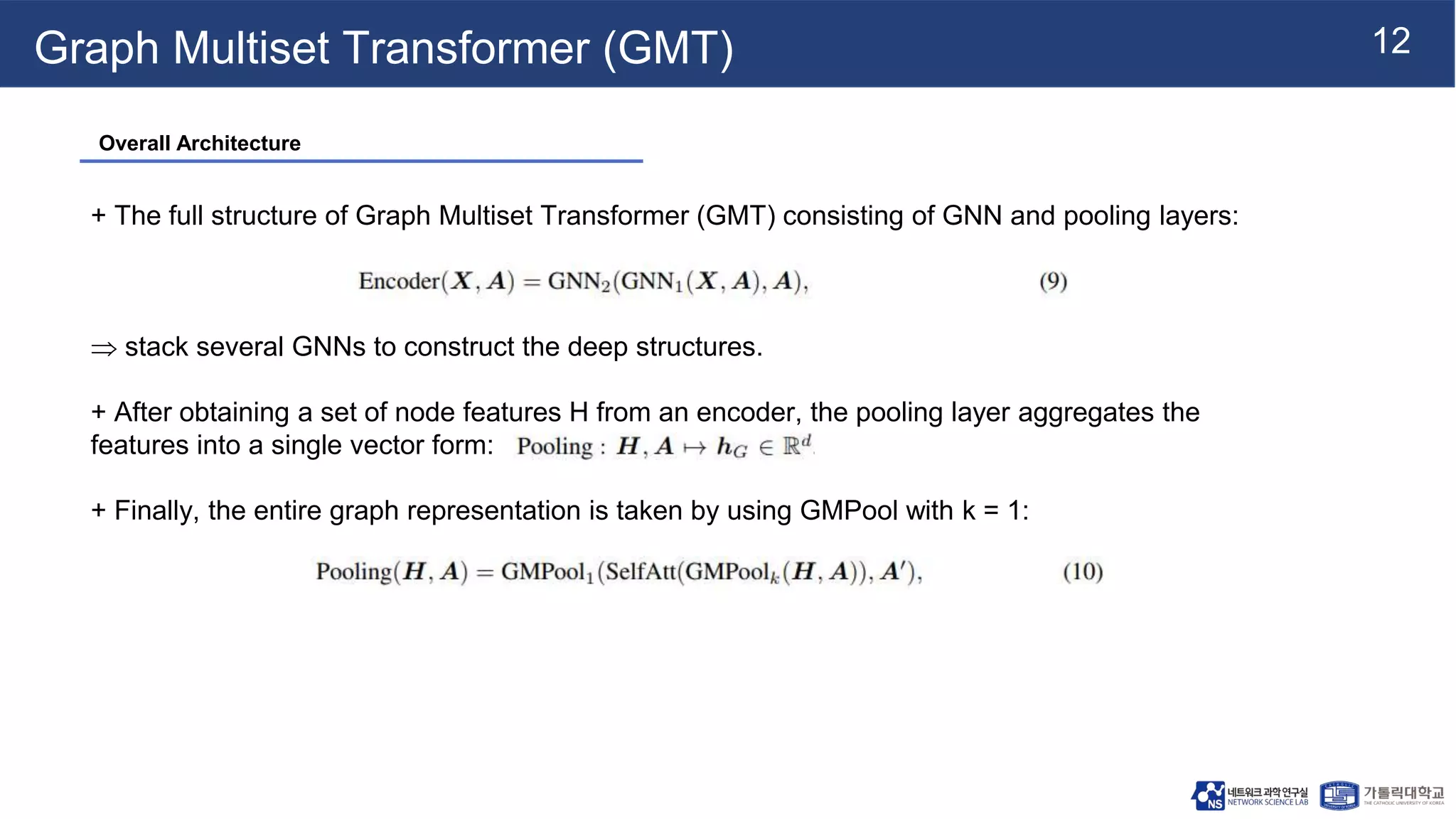
+ The full structure of Graph Multiset Transformer (GMT) consisting of GNN and pooling layers:
 stack several GNNs to construct the deep structures.
+ After obtaining a set of node features H from an encoder, the pooling layer aggregates the
features into a single vector form:
+ Finally, the entire graph representation is taken by using GMPool with k = 1:
Overall Architecture
13
Comparisons
+ The overall Graph Multiset Transformer with multiple GMPool and SelfAtt can map two different graphs 𝐺1
and 𝐺2 to distinct embedding spaces
 can be as powerful as the WL test.
+ Graph Multiset Pooling GMPoolk can perform hierarchical node clustering with learnable k cluster
centroids by Seed Vector S in equation 7.
14
Experiments
Graph classification
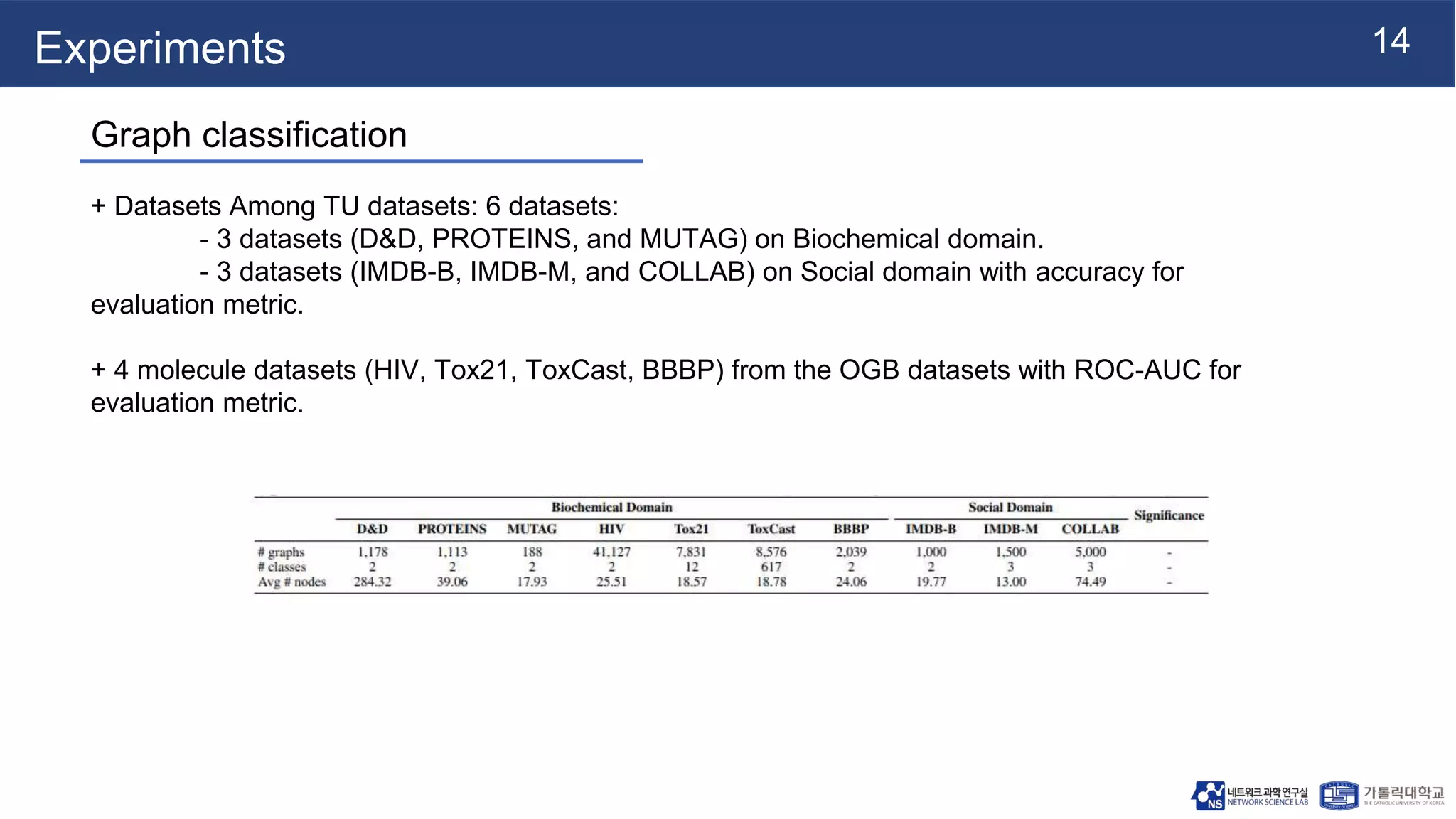
+ Datasets Among TU datasets: 6 datasets:
- 3 datasets (D&D, PROTEINS, and MUTAG) on Biochemical domain.
- 3 datasets (IMDB-B, IMDB-M, and COLLAB) on Social domain with accuracy for
evaluation metric.
+ 4 molecule datasets (HIV, Tox21, ToxCast, BBBP) from the OGB datasets with ROC-AUC for
evaluation metric.
15
Experiment results
Graph classification
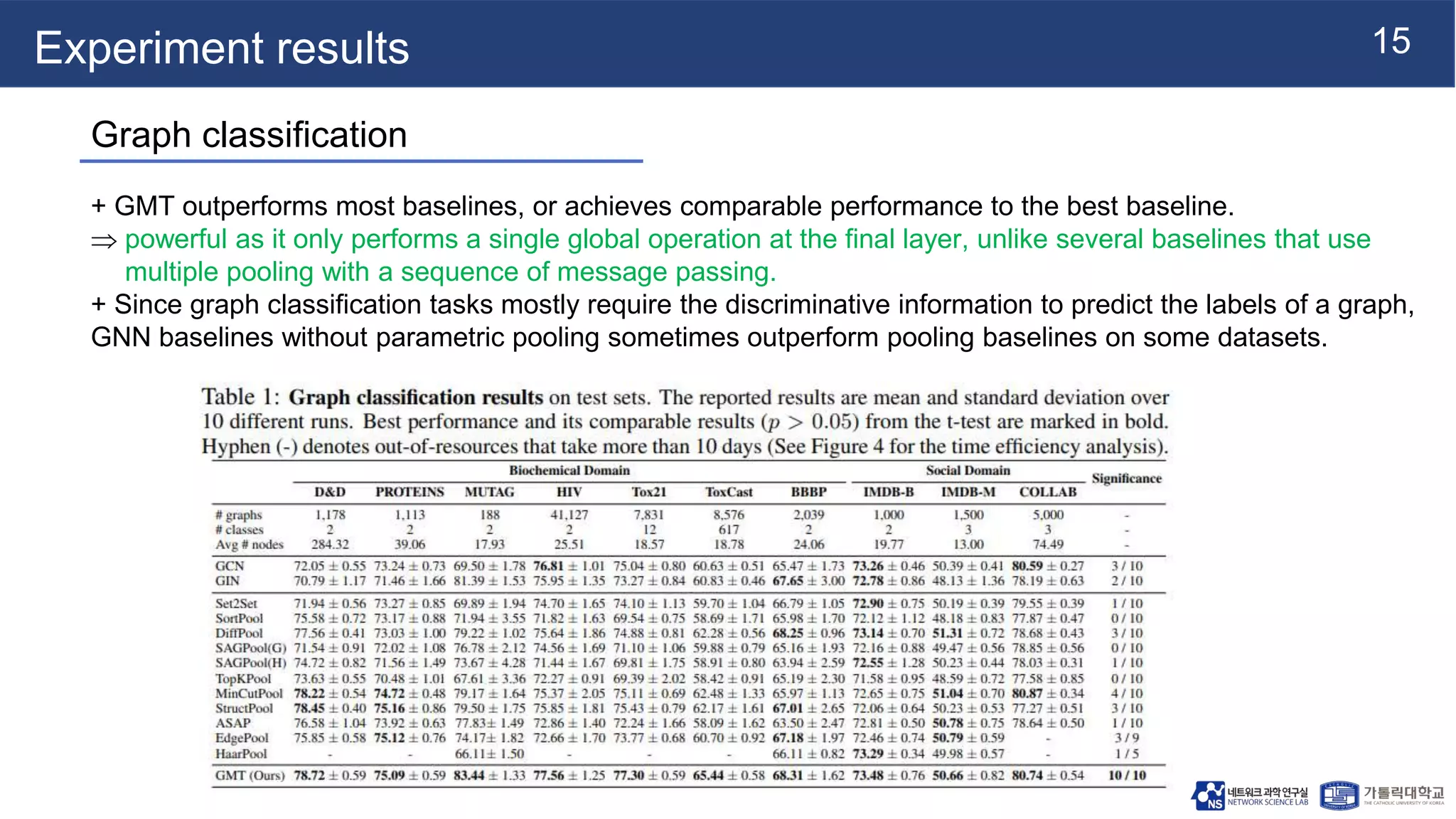
+ GMT outperforms most baselines, or achieves comparable performance to the best baseline.
 powerful as it only performs a single global operation at the final layer, unlike several baselines that use
multiple pooling with a sequence of message passing.
+ Since graph classification tasks mostly require the discriminative information to predict the labels of a graph,
GNN baselines without parametric pooling sometimes outperform pooling baselines on some datasets.
16
Experiment results
Ablation Study
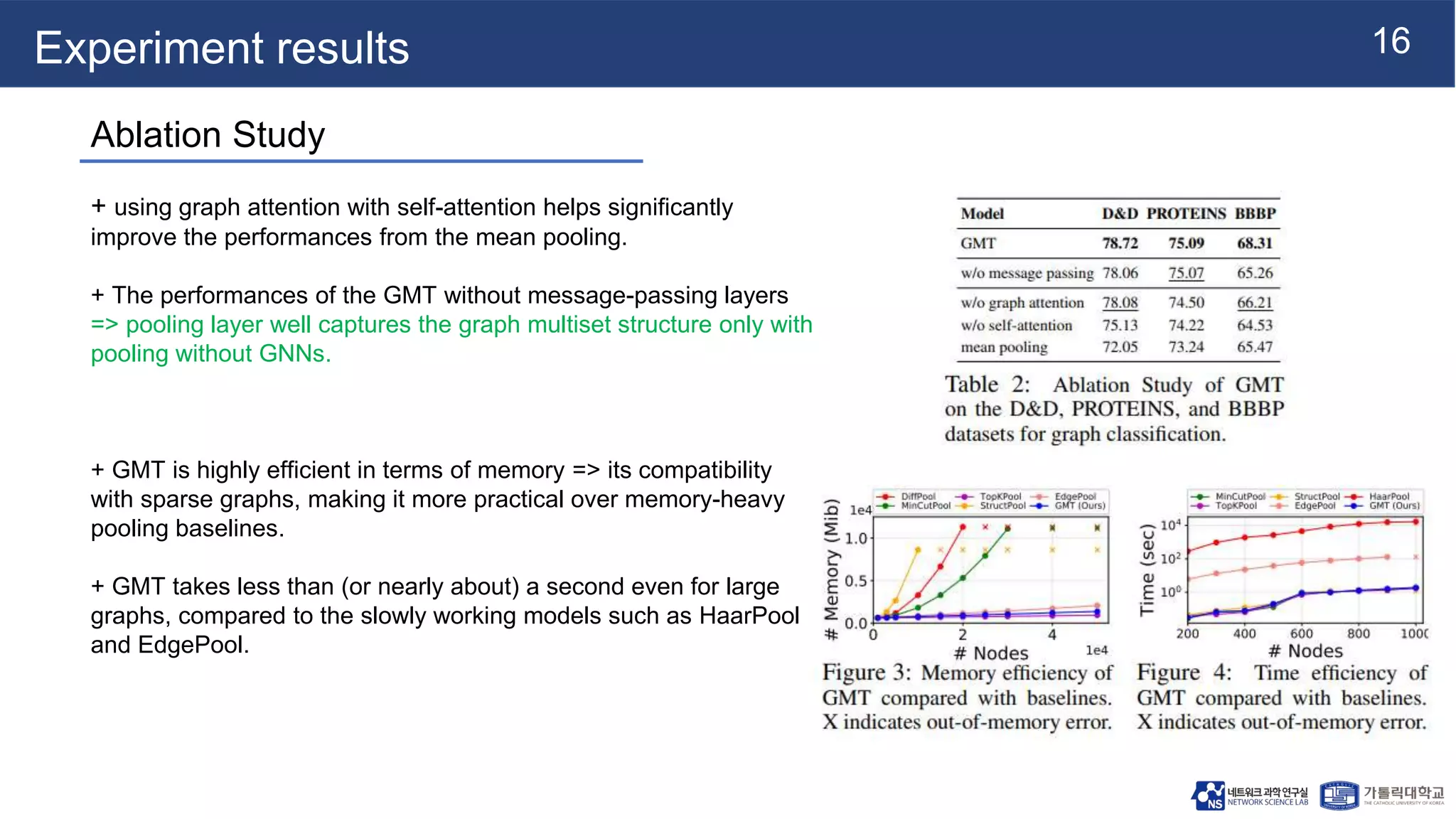
+ using graph attention with self-attention helps significantly
improve the performances from the mean pooling.
+ The performances of the GMT without message-passing layers
=> pooling layer well captures the graph multiset structure only with
pooling without GNNs.
+ GMT is highly efficient in terms of memory => its compatibility
with sparse graphs, making it more practical over memory-heavy
pooling baselines.
+ GMT takes less than (or nearly about) a second even for large
graphs, compared to the slowly working models such as HaarPool
and EdgePool.
17
Experiment results
Graph Reconstruction
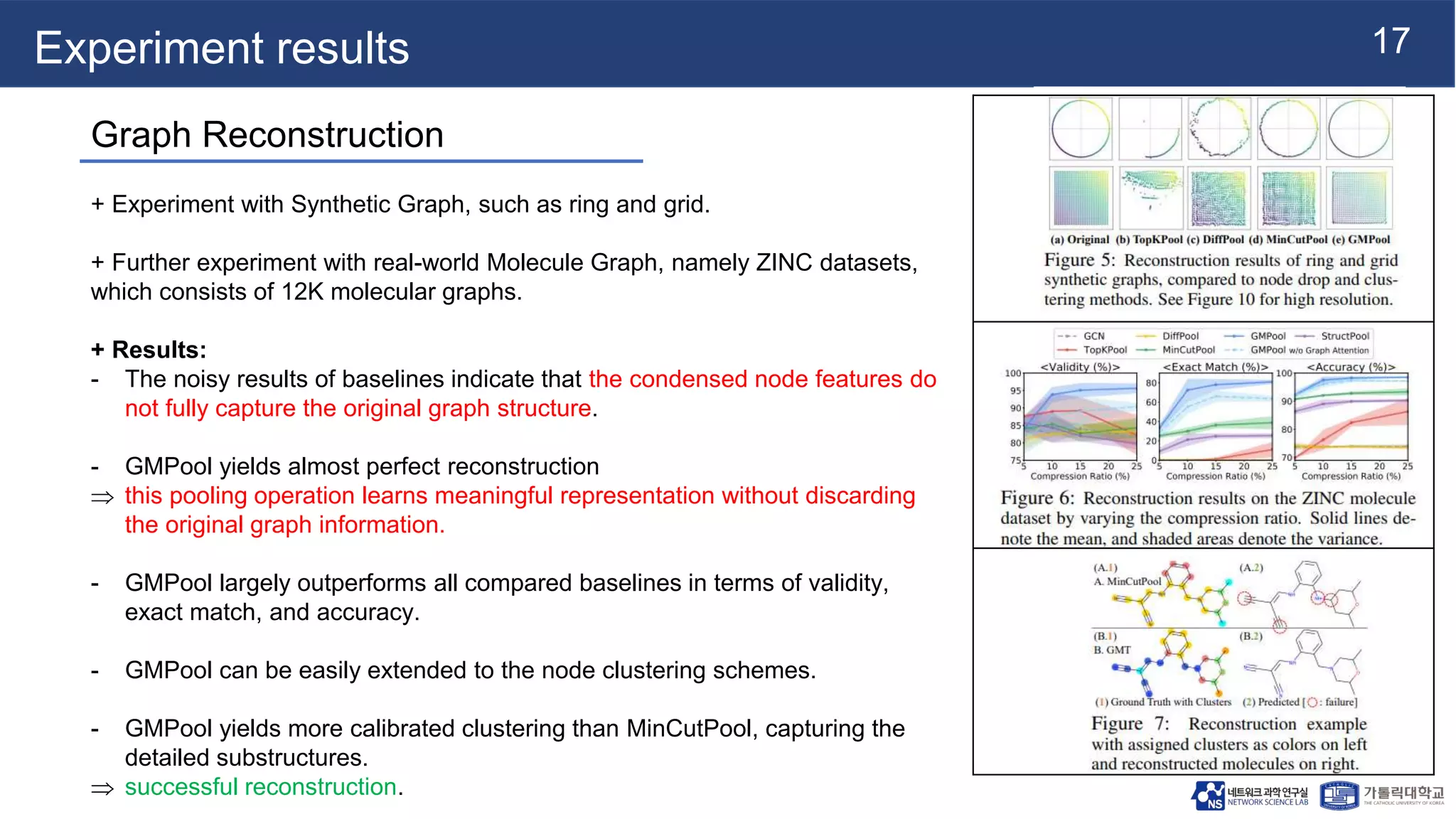
+ Experiment with Synthetic Graph, such as ring and grid.
+ Further experiment with real-world Molecule Graph, namely ZINC datasets,
which consists of 12K molecular graphs.
+ Results:
- The noisy results of baselines indicate that the condensed node features do
not fully capture the original graph structure.
- GMPool yields almost perfect reconstruction
 this pooling operation learns meaningful representation without discarding
the original graph information.
- GMPool largely outperforms all compared baselines in terms of validity,
exact match, and accuracy.
- GMPool can be easily extended to the node clustering schemes.
- GMPool yields more calibrated clustering than MinCutPool, capturing the
detailed substructures.
 successful reconstruction.
18
Experiment results
Graph Generation
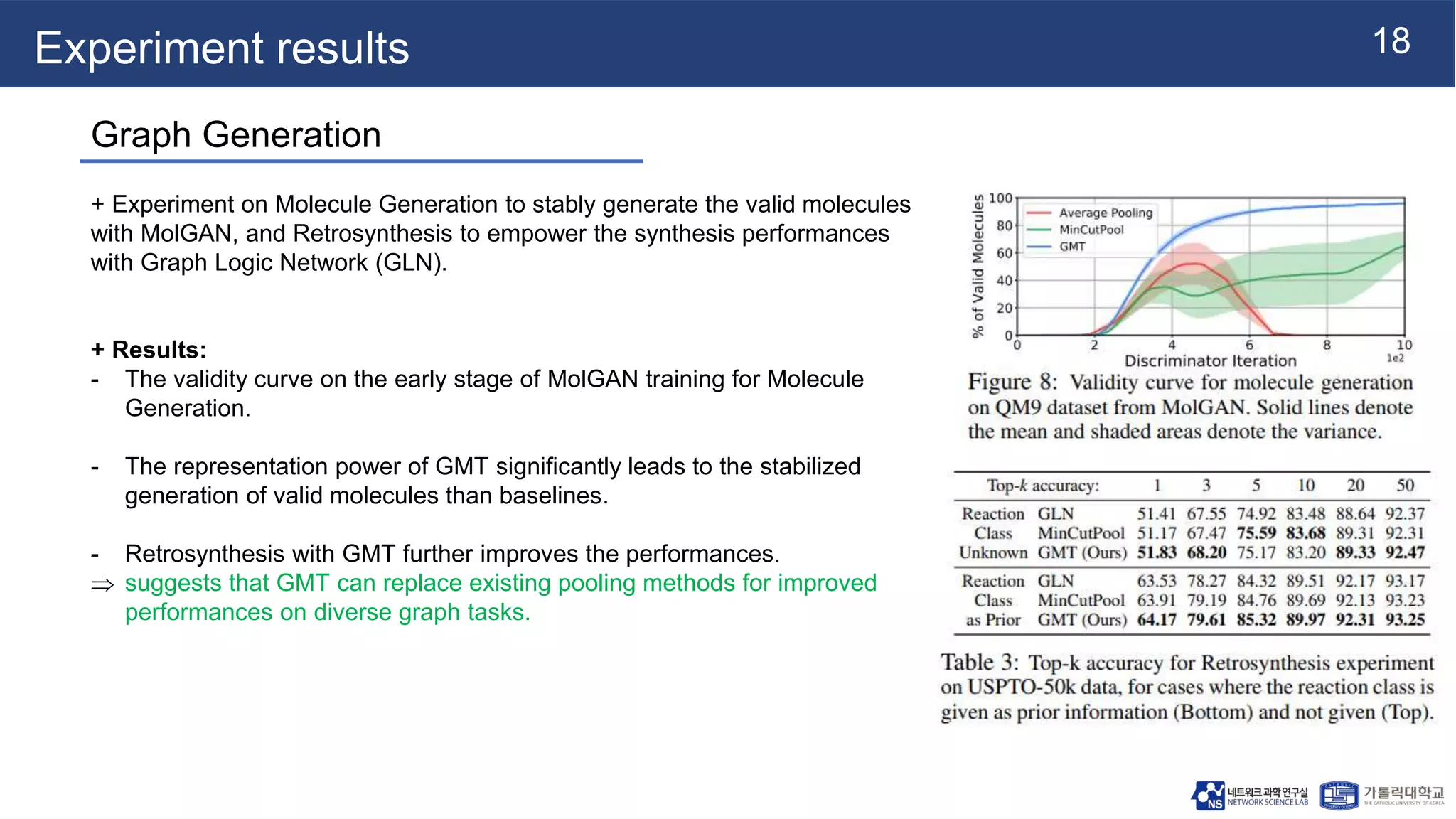
+ Experiment on Molecule Generation to stably generate the valid molecules
with MolGAN, and Retrosynthesis to empower the synthesis performances
with Graph Logic Network (GLN).
+ Results:
- The validity curve on the early stage of MolGAN training for Molecule
Generation.
- The representation power of GMT significantly leads to the stabilized
generation of valid molecules than baselines.
- Retrosynthesis with GMT further improves the performances.
 suggests that GMT can replace existing pooling methods for improved
performances on diverse graph tasks.
19
Conclusions
• Show that existing graph pooling approaches either do not consider the task relevance of each
node (sum or mean) or may not satisfy the injectiveness (node drop and clustering methods).
• A novel graph pooling method, Graph Multiset Transformer (GMT):
- not only encodes the given set of node embeddings as a multiset to uniquely embed two
different graphs into two distinct embeddings,
- but also considers both the global structure of the graph and their task relevance in compressing
the node features.
• The proposed pooling function is as powerful as the WL test, and can be extended to the node
clustering schemes.
• This method outperformed state-of-the-art graph pooling models on most of 10 graph
classification datasets.
20
Thank you!

NS-CUK Seminar: S.T.Nguyen Review on "Accurate learning of graph representations with graph multiset pooling?", International Conference on Learning Representations 2021

  • 1.
    LAB SEMINAR Nguyen ThanhSang Network Science Lab Dept. of Artificial Intelligence The Catholic University of Korea E-mail: sang.ngt99@gmail.com Accurate Learning of Graph Representations with Graph Multiset Pooling --- Jinheon Baek, Minki Kang, Sung Ju Hwang --- 2023-07-10
  • 2.
    Content s 1 ⮚ Paper ▪ Introduction ▪Problem ▪ Contributions ▪ Framework ▪ Experiment ▪ Conclusion
  • 3.
    2 Introduction  GNNs workwith graph structured data.  Learn expressive representations for various tasks: node classification, link prediction, and graph classification.  Existing works on GNNs focus on the message passing strategies for neighborhood aggregation  encode the nodes in a graph accurately, graph pooling that maps the set of nodes into a compact representation  capture a meaningful structure of an entire graph. Graph neural networks (GNNs)
  • 4.
    3 Introduction  Graph poolingmethods play an essential role of representing entire graph.  Averaging all node features is directly used as simplest pooling methods  loss of information since they consider all node information equally without considering key features for graphs.  Node drop methods use learnable scoring functions to drop nodes with lower scores.  Node clustering methods cast the graph pooling problem into the node clustering problem to map the nodes into a set of clusters. Graph Pooling
  • 5.
    4 Introduction  A setof nodes in a graph forms a multiset that allows possibly repeating elements.  Regard the graph representation learning as a multi-set encoding problem.  Set Transformer uses attention mechanism on the set encoding.  building on top of these theoretical grounds on set. (Multi-)Set Representation Learning
  • 6.
    5 Problems + A simplestgraph pooling: average or sum all node features.  treat all nodes equally without considering their relative importance on the given tasks.  can not generate a meaningful graph representation in a task- specific manner.  restrict their capability toward the hierarchical pooling or graph compression into few nodes. + Node drop methods unnecessarily drop some nodes at every pooling step.  information loss on those discarded nodes. + Node clustering methods compute the dense cluster assignment matrix with an adjacency matrix.  prevents from exploiting sparsity in the graph topology.  excessively high computational complexity.  GNNs should be as powerful as WL graph isomorphism test.
  • 7.
    6 Contributions + Treat agraph pooling problem as a multiset encoding problem.  consider relationships among nodes in a set with several attention units, to make a compact representation of an entire graph only with one global function, without additional message-passing operations. • Show that existing GNN with this parametric pooling operation can be as powerful as the WL test, and also be easily extended to the node clustering approaches with learnable clusters. • Evaluate GMT on graph classification, reconstruction, and generation tasks which use synthetic and real-world graphs  outperforms most graph pooling baselines.
  • 8.
  • 9.
    8 Graph Multiset Transformer(GMT) + Form a multiset: containing different nodes can have identical feature vectors. The input of the graph pooling function READOUT consists of nodes in a graph. + To design a graph pooling function that is as powerful as the WL test, it needs to satisfy the permutation invariance and injectiveness over the multiset, since two non-isomorphic graphs should be embedded differently through the injective function. + The simple sum pooling satisfies the injectiveness over a multiset  it may treat all node embeddings equally without consideration of their relevance to the task. + To resolve this issue, an attention mechanism on the multiset pooling function is considered to capture structural dependencies among nodes within a graph.  expressive power of the WL test. Multiset Encoding
  • 10.
    9 Graph Multiset Transformer(GMT) + The output of the multi-head attention function (MH): MHA is superior to trivial pooling methods such as sum or mean as it considers global dependencies among nodes. => A novel graph multi-head attention block (GMH): Graph Multi-head Attention
  • 11.
    10 Graph Multiset Transformer(GMT) + A graph pooling function satisfies the injectiveness and permutation invariance  most as powerful as the WL test, while taking the graph structure into account. + A pooling operation compress the n nodes into the k typical nodes, with a parameterized seed matrix Graph Multiset Pooling with Graph Multi-head Attention any row-wise feedforward layer k seed vectors (queries) in S a parameterized seed matrix S
  • 12.
    11 Graph Multiset Transformer(GMT) + GMPool condenses entire nodes into k representative nodes  a major drawback of this scheme is that it does not consider relationships between nodes. + Self-Attention function: + SelfAtt captures inter-relationships among n nodes by putting node embeddings H on both query and key locations in MH. Self-Attention for Inter-node Relationship
  • 13.
    12 Graph Multiset Transformer(GMT) + The full structure of Graph Multiset Transformer (GMT) consisting of GNN and pooling layers:  stack several GNNs to construct the deep structures. + After obtaining a set of node features H from an encoder, the pooling layer aggregates the features into a single vector form: + Finally, the entire graph representation is taken by using GMPool with k = 1: Overall Architecture
  • 14.
    13 Comparisons + The overallGraph Multiset Transformer with multiple GMPool and SelfAtt can map two different graphs 𝐺1 and 𝐺2 to distinct embedding spaces  can be as powerful as the WL test. + Graph Multiset Pooling GMPoolk can perform hierarchical node clustering with learnable k cluster centroids by Seed Vector S in equation 7.
  • 15.
    14 Experiments Graph classification + DatasetsAmong TU datasets: 6 datasets: - 3 datasets (D&D, PROTEINS, and MUTAG) on Biochemical domain. - 3 datasets (IMDB-B, IMDB-M, and COLLAB) on Social domain with accuracy for evaluation metric. + 4 molecule datasets (HIV, Tox21, ToxCast, BBBP) from the OGB datasets with ROC-AUC for evaluation metric.
  • 16.
    15 Experiment results Graph classification +GMT outperforms most baselines, or achieves comparable performance to the best baseline.  powerful as it only performs a single global operation at the final layer, unlike several baselines that use multiple pooling with a sequence of message passing. + Since graph classification tasks mostly require the discriminative information to predict the labels of a graph, GNN baselines without parametric pooling sometimes outperform pooling baselines on some datasets.
  • 17.
    16 Experiment results Ablation Study +using graph attention with self-attention helps significantly improve the performances from the mean pooling. + The performances of the GMT without message-passing layers => pooling layer well captures the graph multiset structure only with pooling without GNNs. + GMT is highly efficient in terms of memory => its compatibility with sparse graphs, making it more practical over memory-heavy pooling baselines. + GMT takes less than (or nearly about) a second even for large graphs, compared to the slowly working models such as HaarPool and EdgePool.
  • 18.
    17 Experiment results Graph Reconstruction +Experiment with Synthetic Graph, such as ring and grid. + Further experiment with real-world Molecule Graph, namely ZINC datasets, which consists of 12K molecular graphs. + Results: - The noisy results of baselines indicate that the condensed node features do not fully capture the original graph structure. - GMPool yields almost perfect reconstruction  this pooling operation learns meaningful representation without discarding the original graph information. - GMPool largely outperforms all compared baselines in terms of validity, exact match, and accuracy. - GMPool can be easily extended to the node clustering schemes. - GMPool yields more calibrated clustering than MinCutPool, capturing the detailed substructures.  successful reconstruction.
  • 19.
    18 Experiment results Graph Generation +Experiment on Molecule Generation to stably generate the valid molecules with MolGAN, and Retrosynthesis to empower the synthesis performances with Graph Logic Network (GLN). + Results: - The validity curve on the early stage of MolGAN training for Molecule Generation. - The representation power of GMT significantly leads to the stabilized generation of valid molecules than baselines. - Retrosynthesis with GMT further improves the performances.  suggests that GMT can replace existing pooling methods for improved performances on diverse graph tasks.
  • 20.
    19 Conclusions • Show thatexisting graph pooling approaches either do not consider the task relevance of each node (sum or mean) or may not satisfy the injectiveness (node drop and clustering methods). • A novel graph pooling method, Graph Multiset Transformer (GMT): - not only encodes the given set of node embeddings as a multiset to uniquely embed two different graphs into two distinct embeddings, - but also considers both the global structure of the graph and their task relevance in compressing the node features. • The proposed pooling function is as powerful as the WL test, and can be extended to the node clustering schemes. • This method outperformed state-of-the-art graph pooling models on most of 10 graph classification datasets.
  • 21.