1
Clinical Risk Prediction with Temporal Probabilistic
Asymmetric Multi-Task Learning
1School of Computing, 2Graduate School of AI,
Korea Advanced Institute of Science and Technology,
3Aitrics, 4Department of Computer Science, University of Oxford
Tuan Nguyen* 1,4, Hyewon Jeong* 1, Eunho Yang 1,2,3, and Sung Ju Hwang 1,2,3
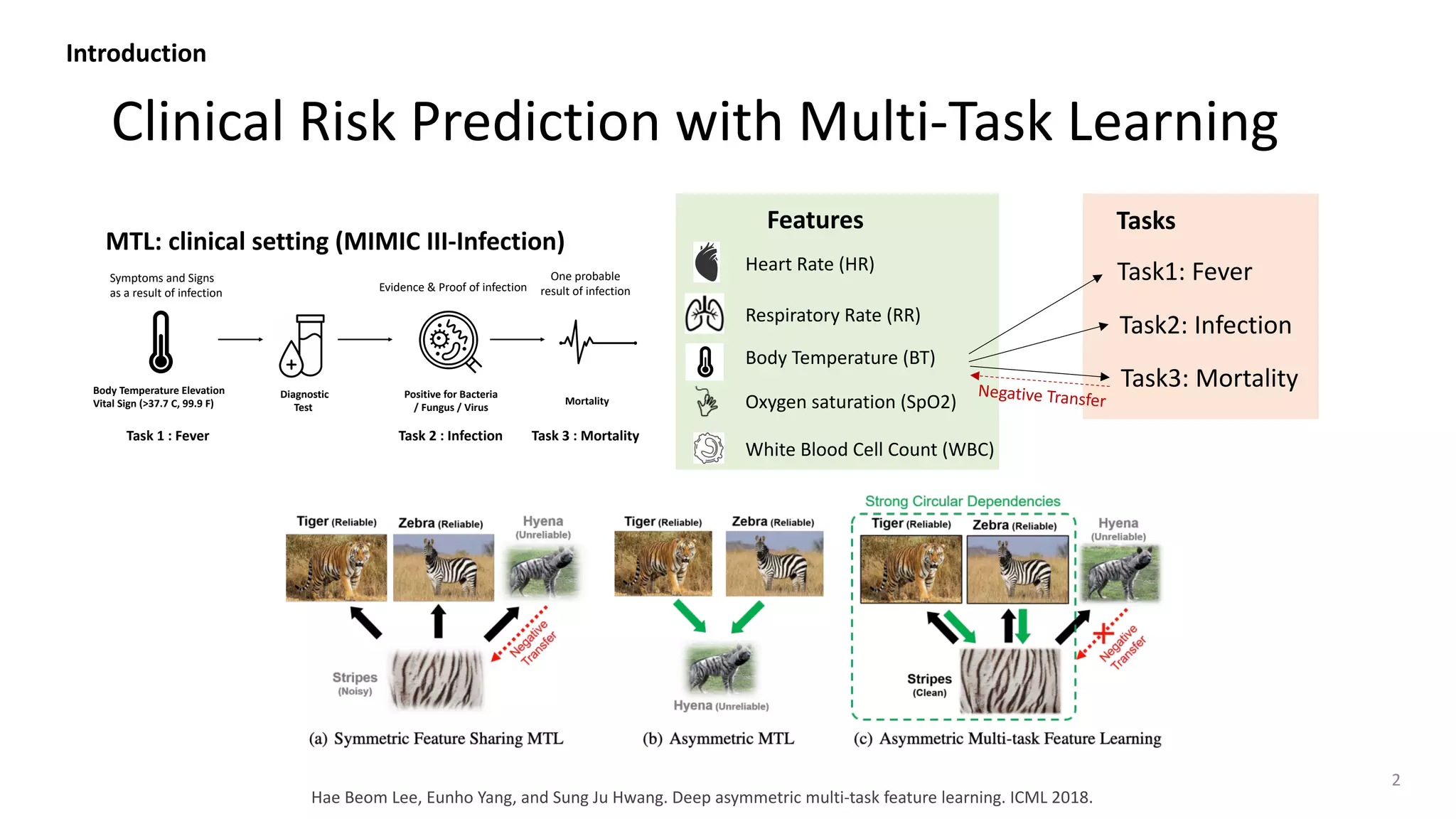
Clinical Risk Prediction with Multi-Task Learning
Hae Beom Lee, Eunho Yang, and Sung Ju Hwang. Deep asymmetric multi-task feature learning. ICML 2018.
2
Introduction
Heart Rate (HR)
Respiratory Rate (RR)
Oxygen saturation (SpO2)
Body Temperature (BT)
White Blood Cell Count (WBC)
Body Temperature Elevation
Vital Sign (>37.7 C, 99.9 F)
Diagnostic
Test
Symptoms and Signs
as a result of infection
Positive for Bacteria
/ Fungus / Virus
Task 1 : Fever Task 2 : Infection
Evidence & Proof of infection
One probable
result of infection
Task 3 : Mortality
Mortality
Features Tasks
Task1: Fever
Task2: Infection
Task3: Mortality
Negative Transfer
MTL: clinical setting (MIMIC III-Infection)
Clinical Risk Prediction with Multi-Task Learning
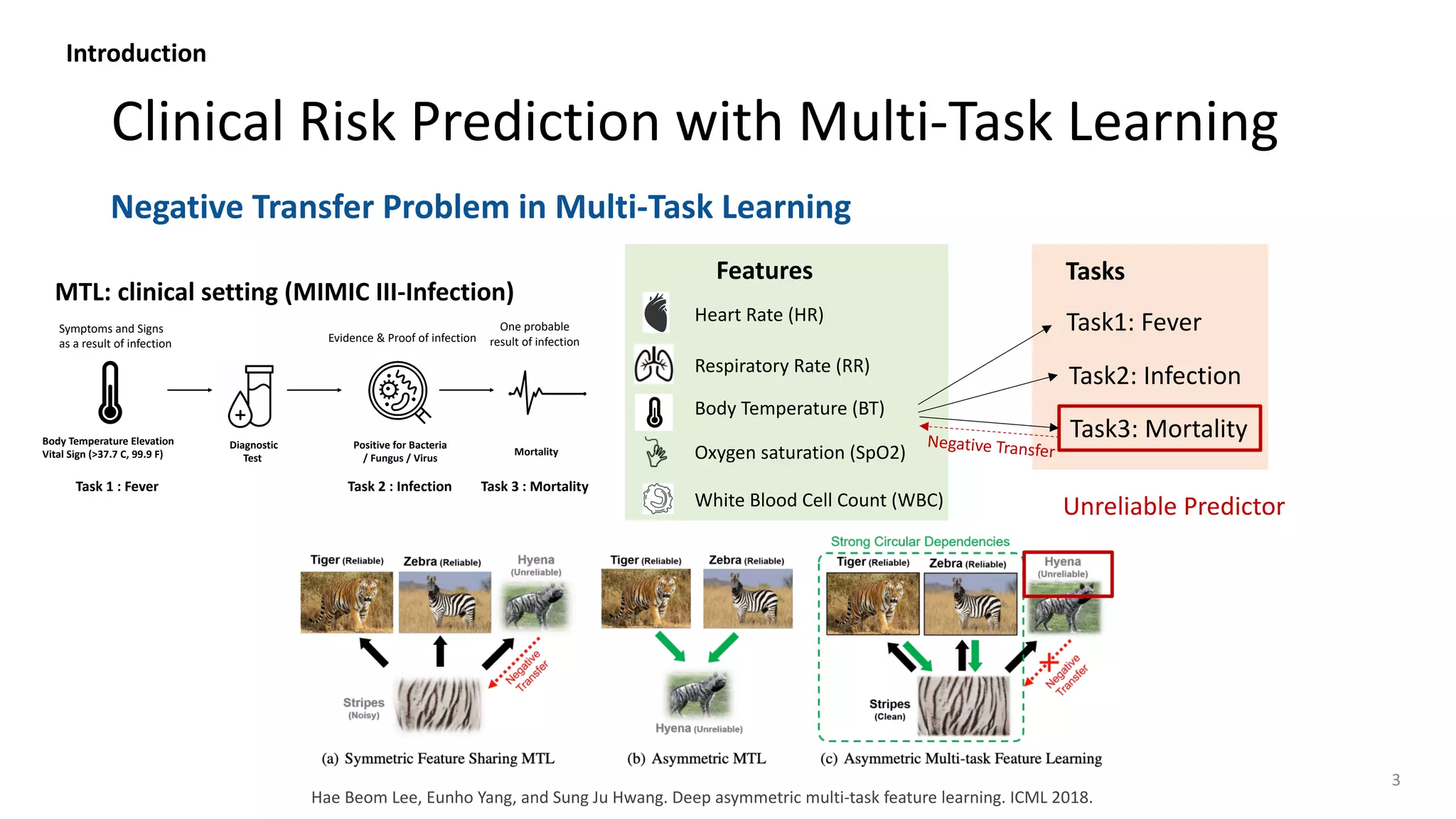
Negative Transfer Problem in Multi-Task Learning
Hae Beom Lee, Eunho Yang, and Sung Ju Hwang. Deep asymmetric multi-task feature learning. ICML 2018.
3
Introduction
Heart Rate (HR)
Respiratory Rate (RR)
Oxygen saturation (SpO2)
Body Temperature (BT)
White Blood Cell Count (WBC)
Body Temperature Elevation
Vital Sign (>37.7 C, 99.9 F)
Diagnostic
Test
Symptoms and Signs
as a result of infection
Positive for Bacteria
/ Fungus / Virus
Task 1 : Fever Task 2 : Infection
Evidence & Proof of infection
One probable
result of infection
Task 3 : Mortality
Mortality
Features Tasks
Task1: Fever
Task2: Infection
Task3: Mortality
Negative Transfer
MTL: clinical setting (MIMIC III-Infection)
Unreliable Predictor
Clinical Risk Prediction with Multi-Task Learning
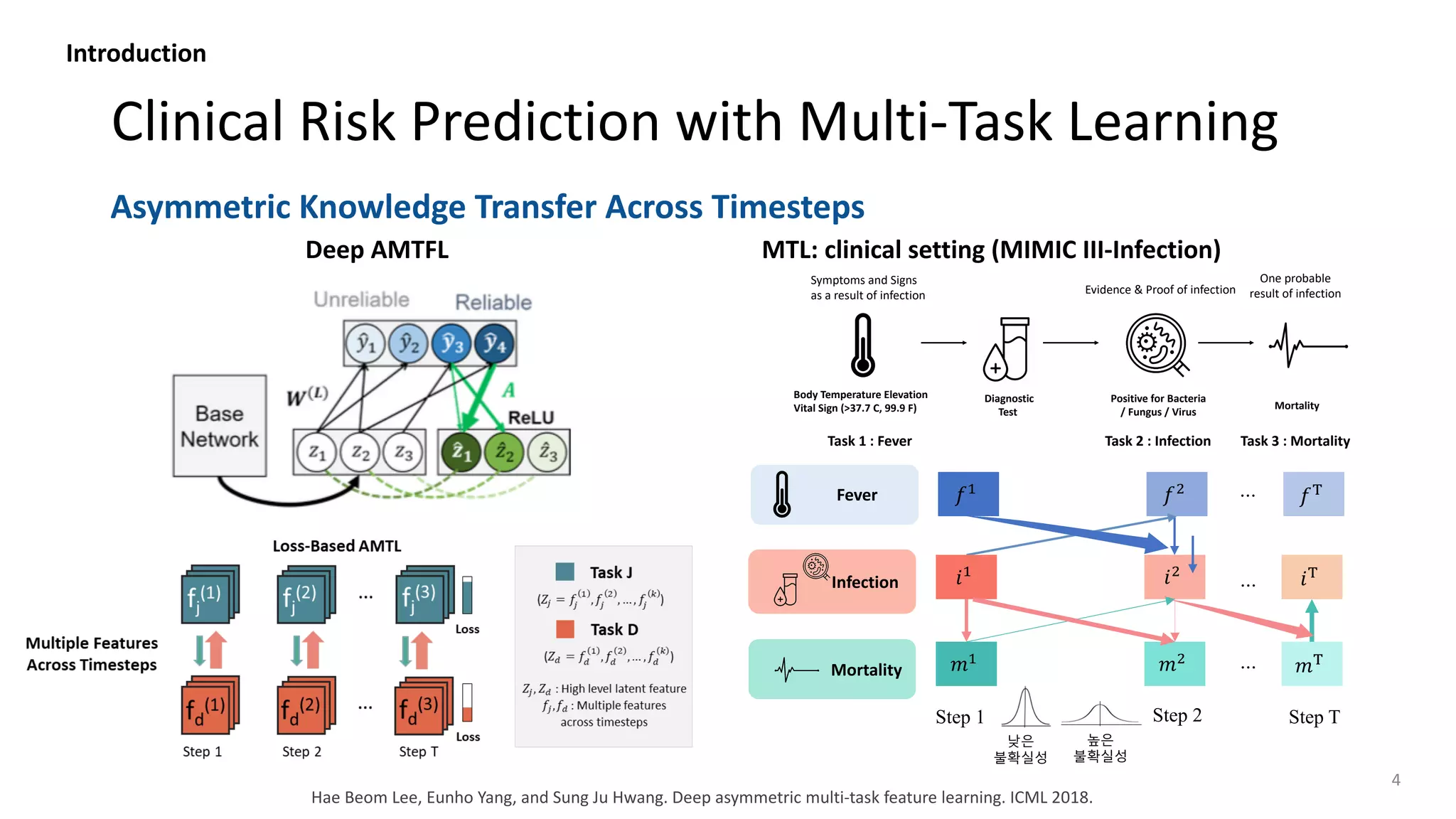
Asymmetric Knowledge Transfer Across Timesteps
4
Introduction
𝑓!
𝑓"
𝑓#
…
Fever
𝑖!
𝑖"
𝑖#
Step 1
𝑚!
𝑚"
𝑚#
…
…
Step 2 Step T
Infection
Mortality
낮은
불확실성
높은
불확실성
Body Temperature Elevation
Vital Sign (>37.7 C, 99.9 F)
Diagnostic
Test
Symptoms and Signs
as a result of infection
Positive for Bacteria
/ Fungus / Virus
Task 1 : Fever Task 2 : Infection
Evidence & Proof of infection
One probable
result of infection
Task 3 : Mortality
Mortality
Deep AMTFL
Hae Beom Lee, Eunho Yang, and Sung Ju Hwang. Deep asymmetric multi-task feature learning. ICML 2018.
MTL: clinical setting (MIMIC III-Infection)
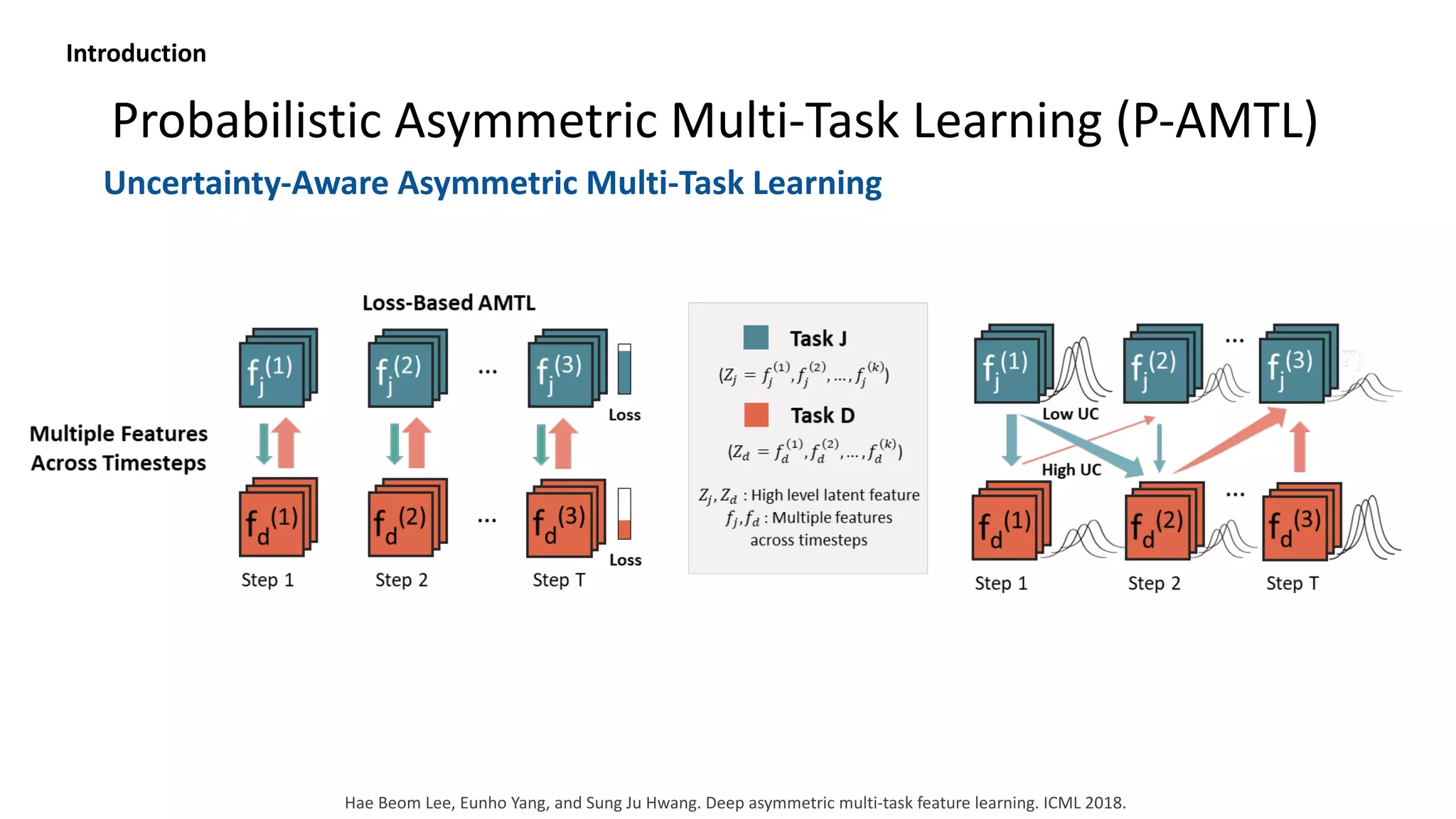
Probabilistic Asymmetric Multi-Task Learning (P-AMTL)
Introduction
Uncertainty-Aware Asymmetric Multi-Task Learning
Hae Beom Lee, Eunho Yang, and Sung Ju Hwang. Deep asymmetric multi-task feature learning. ICML 2018.
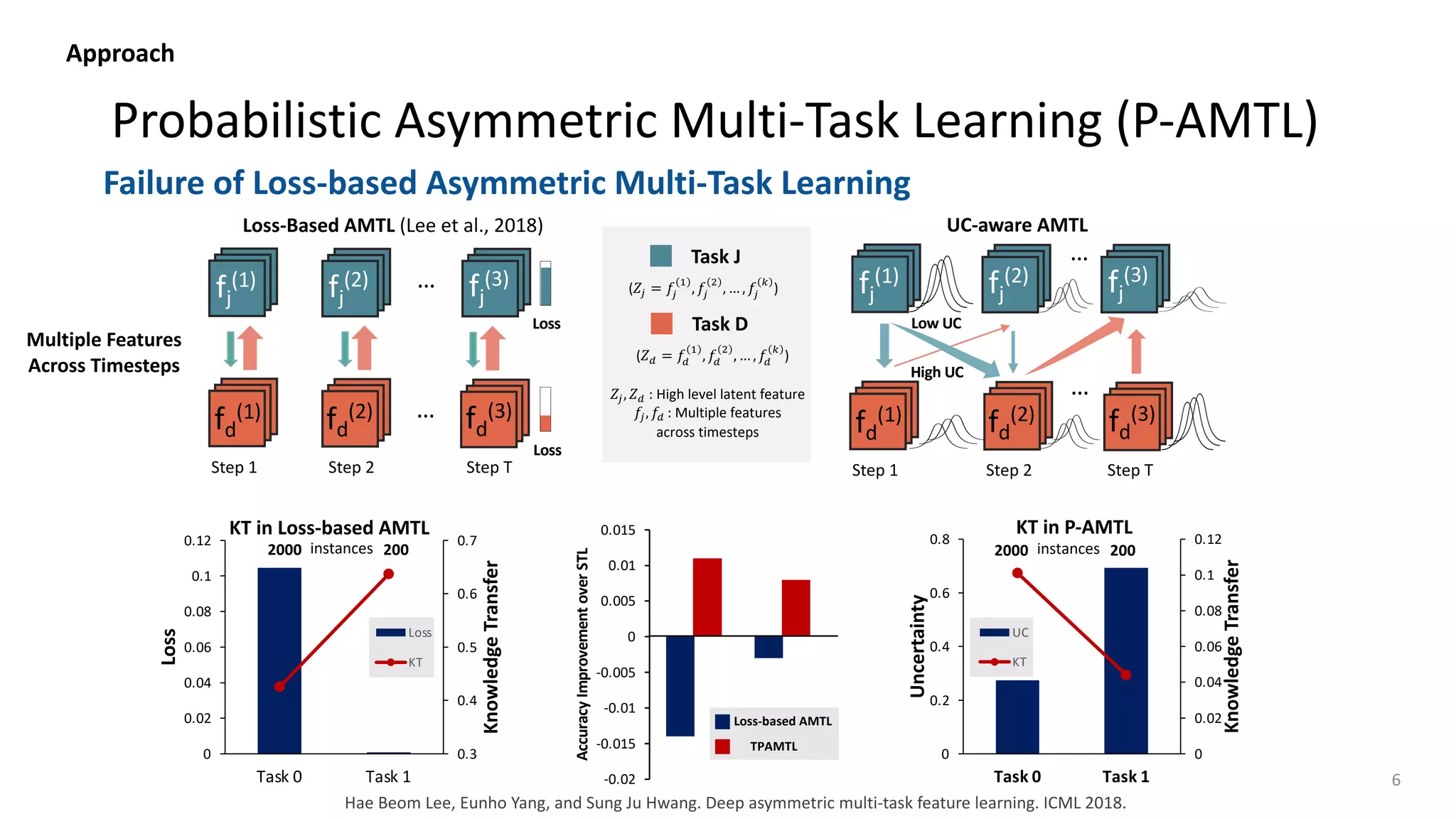
Probabilistic Asymmetric Multi-Task Learning (P-AMTL)
6
0.3
0.4
0.5
0.6
0.7
0
0.02
0.04
0.06
0.08
0.1
0.12
Task 0 Task 1
Knowledge
Transfer
Loss
KT in Loss-based AMTL
Loss
KT
0
0.02
0.04
0.06
0.08
0.1
0.12
0
0.2
0.4
0.6
0.8
Task 0 Task 1
Knowledge
Transfer
Uncertainty
KT in P-AMTL
UC
KT
2000 200
instances 2000 200
instances
-0.02
-0.015
-0.01
-0.005
0
0.005
0.01
0.015
Accuracy
Improvement
over
STL
Loss-based AMTL
TPAMTL
…
…
Step 1 Step 2 Step T
Loss
Loss
Loss-Based AMTL (Lee et al., 2018)
fd
(1) fd
(2) fd
(3)
fj
(1) fj
(2) fj
(3)
…
Low UC
High UC
𝑓!
(#)
UC-aware AMTL
…
Step 1 Step 2 Step T
fd
(1) fd
(2) fd
(3)
fj
(1) fj
(2) fj
(3)
𝑍!, 𝑍" :	High level latent feature
𝑓!, 𝑓" : Multiple features
across timesteps
(𝑍! = 𝑓!
#
, 𝑓!
$
, … , 𝑓!
%
)
(𝑍" = 𝑓"
#
, 𝑓"
$
, … , 𝑓"
%
)
Task J
Task D
Approach
Failure of Loss-based Asymmetric Multi-Task Learning
Hae Beom Lee, Eunho Yang, and Sung Ju Hwang. Deep asymmetric multi-task feature learning. ICML 2018.
Multiple Features
Across Timesteps
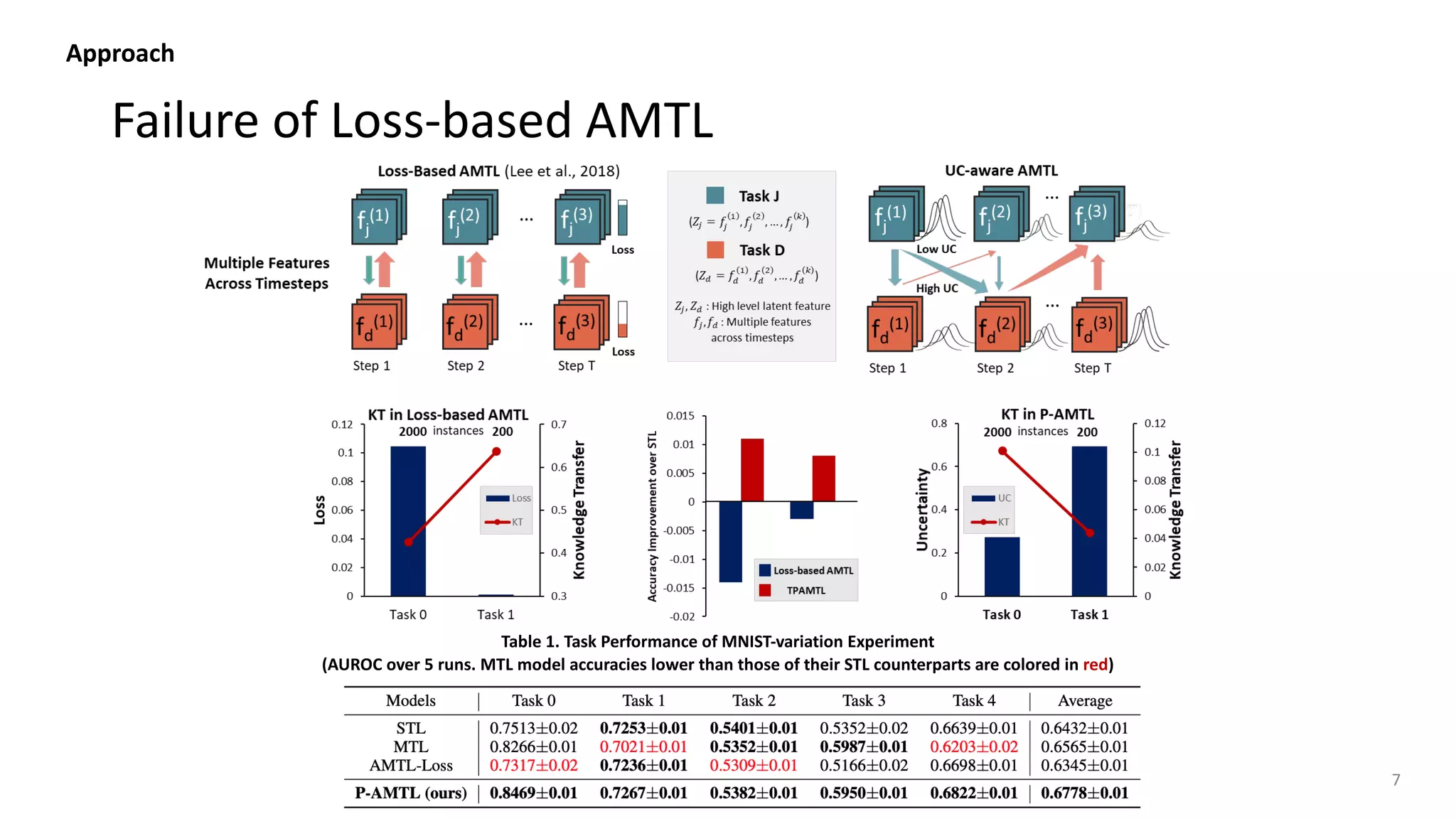
Failure of Loss-based AMTL
7
Approach
Table 1. Task Performance of MNIST-variation Experiment
(AUROC over 5 runs. MTL model accuracies lower than those of their STL counterparts are colored in red)
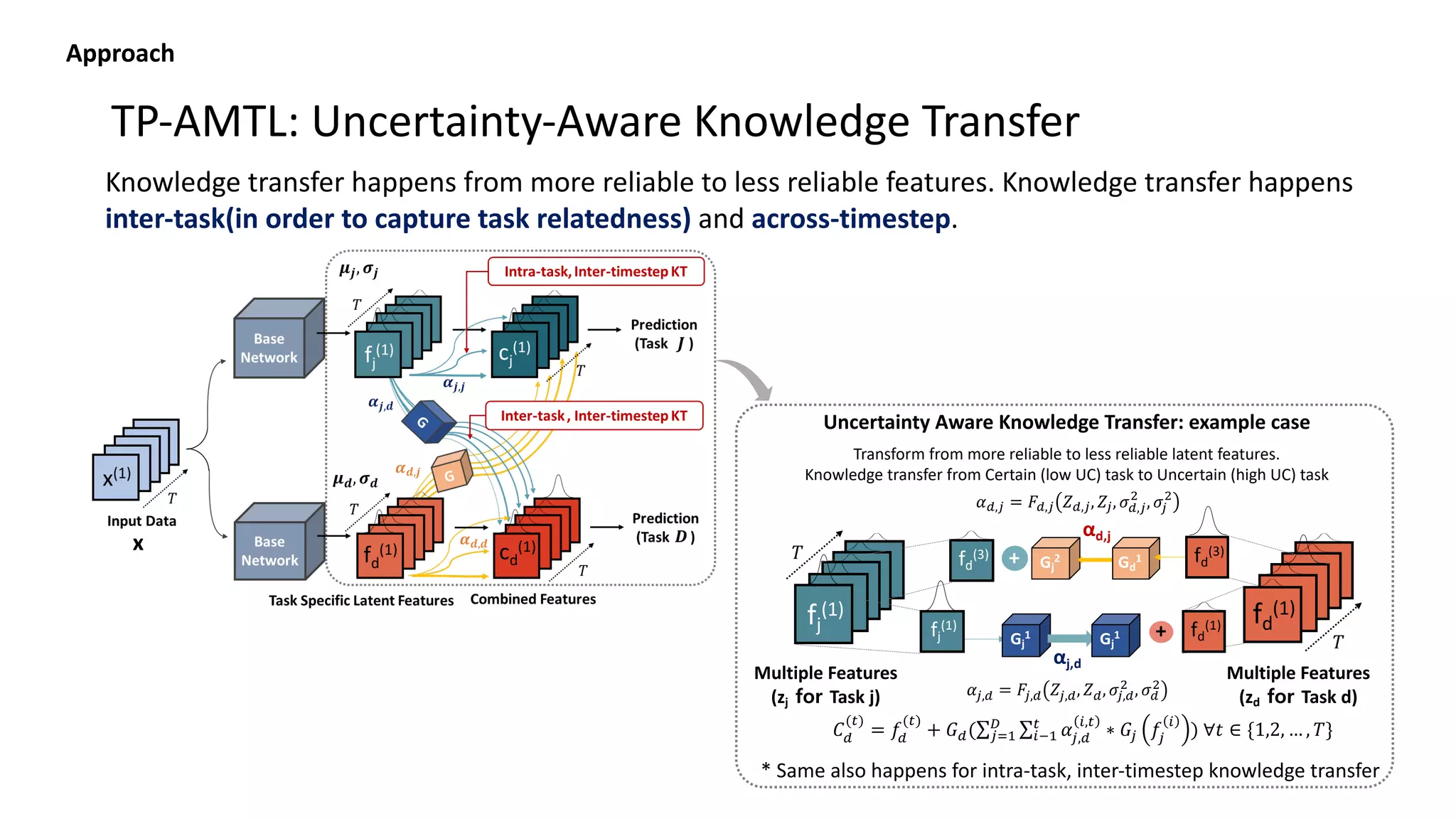
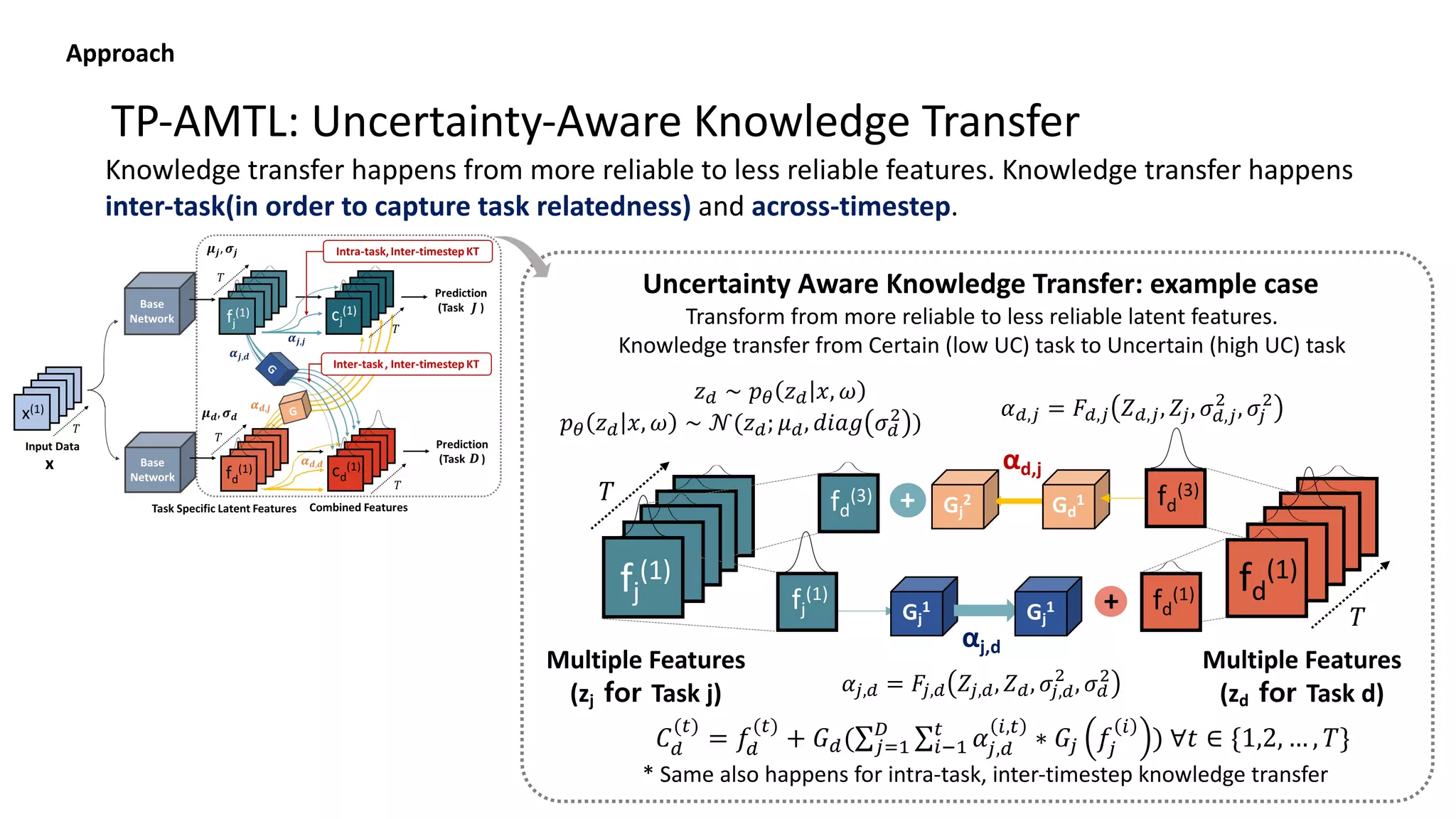
Knowledge transfer happens from more reliable to less reliable features. Knowledge transfer happens
inter-task(in order to capture task relatedness) and across-timestep.
Uncertainty Aware Knowledge Transfer: example case
!
Multiple Features
(zj for Task j)
+ Gj
2
αd,j
Gd
1
!
fd
(1)
Multiple Features
(zd for Task d)
αj,d
Gj
1
+
Gj
1 Gj
1
fd
(3)
fd
(1)
fj
(1)
fd
(3)
fd
(1)
fj
(1)
Transform from more reliable to less reliable latent features.
Knowledge transfer from Certain (low UC) task to Uncertain (high UC) task
!!,# = #!,# $!,#, $#, &!,#
$ , &#
$
!#,! = ##,! $#,!, $!, &#,!
$
, &!
$
"!
(#)
= $!
(#)
+ &!(∑ ∑ )%,!
',#
∗ &%
#
'()
*
%+) $%
'
)	∀. ∈ {1,2, … , !}	
* Same also happens for intra-task, inter-timestep knowledge transfer
TP-AMTL: Uncertainty-Aware Knowledge Transfer
Approach
TP-AMTL: Uncertainty-Aware Knowledge Transfer
Knowledge transfer happens from more reliable to less reliable features. Knowledge transfer happens
inter-task(in order to capture task relatedness) and across-timestep.
Uncertainty Aware Knowledge Transfer: example case
𝑇
Multiple Features
(zj for Task j)
+ Gj
2
αd,j
Gd
1
𝑇
fd
(1)
Multiple Features
(zd for Task d)
αj,d
Gj
1
+
Gj
1 Gj
1
fd
(3)
fd
(1)
fj
(1)
fd
(3)
fd
(1)
fj
(1)
Transform from more reliable to less reliable latent features.
Knowledge transfer from Certain (low UC) task to Uncertain (high UC) task
Approach
𝛼!,# = 𝐹!,# 𝑍!,#, 𝑍#, 𝜎!,#
$
, 𝜎#
$
𝛼#,! = 𝐹#,! 𝑍#,!, 𝑍!, 𝜎#,!
$
, 𝜎!
$
𝐶%
(&)
= 𝑓%
(&)
+ 𝐺%(∑!'(
)
∑*+(
&
𝛼!,%
*,&
∗ 𝐺! 𝑓!
*
) ∀𝑡 ∈ {1,2, … , 𝑇}
* Same also happens for intra-task, inter-timestep knowledge transfer
𝑧# ∼ 𝑝% 𝑧# 𝑥, 𝜔
𝑝% 𝑧# 𝑥, 𝜔 ∼ 𝒩(𝑧#; 𝜇#, 𝑑𝑖𝑎𝑔 𝜎#
$
)
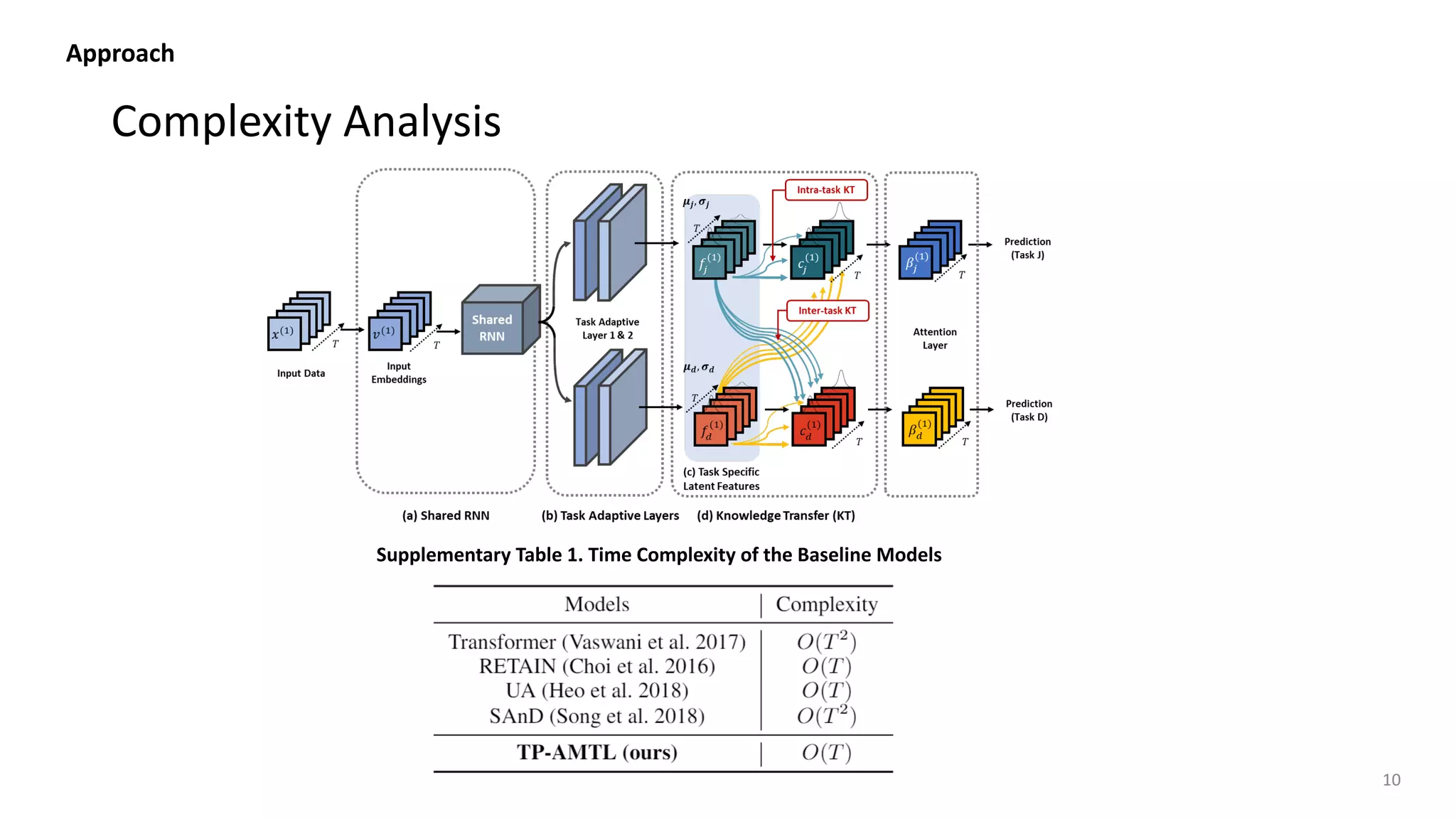
Complexity Analysis
10
Approach
Supplementary Table 1. Time Complexity of the Baseline Models
Tasks and Datasets
11
Task 1 : Stay < 3
Length of ICU Stay
Task 2 : Cardiac
Recovering from
Cardiac Surgery
Task 4 : Mortality
Task 3 : Recovery
Recovering from
general surgery
PhysioNet2012
Body Temperature Elevation
Vital Sign (>37.7 C, 99.9 F)
Diagnostic
Test
Symptoms and Signs
as a result of infection
Positive for Bacteria
/ Fungus / Virus
Task 1 : Fever Task 2 : Infection
Evidence & Proof of infection
One probable
result of infection
Task 3 : Mortality
Mortality
MIMIC - III Infection
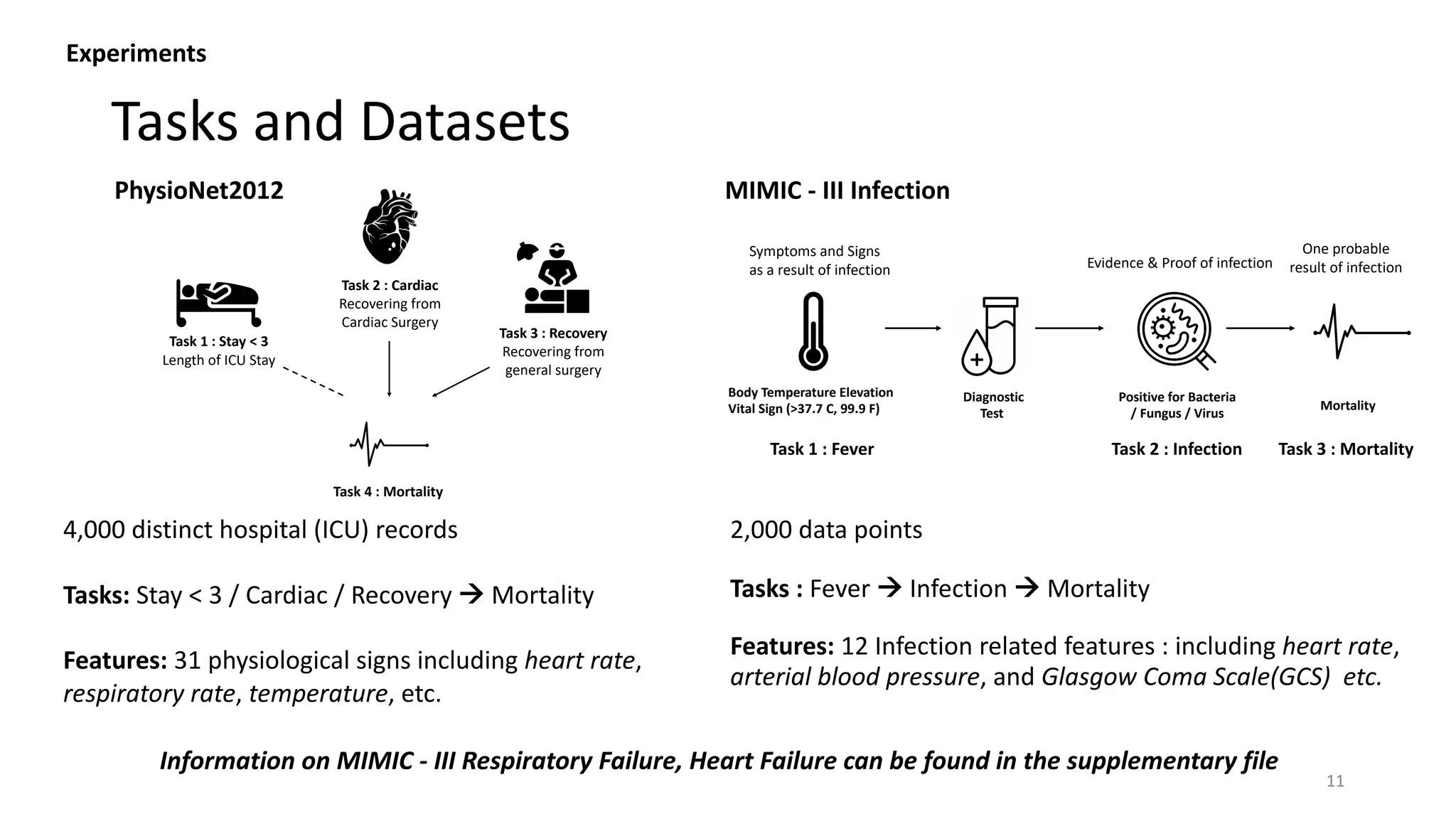
2,000 data points
Tasks : Fever à Infection à Mortality
Features: 12 Infection related features : including heart rate,
arterial blood pressure, and Glasgow Coma Scale(GCS) etc.
4,000 distinct hospital (ICU) records
Tasks: Stay < 3 / Cardiac / Recovery à Mortality
Features: 31 physiological signs including heart rate,
respiratory rate, temperature, etc.
Experiments
Information on MIMIC - III Respiratory Failure, Heart Failure can be found in the supplementary file
Quantitative Results
12
STL : Singletask Learning
MTL : Multitask Learning
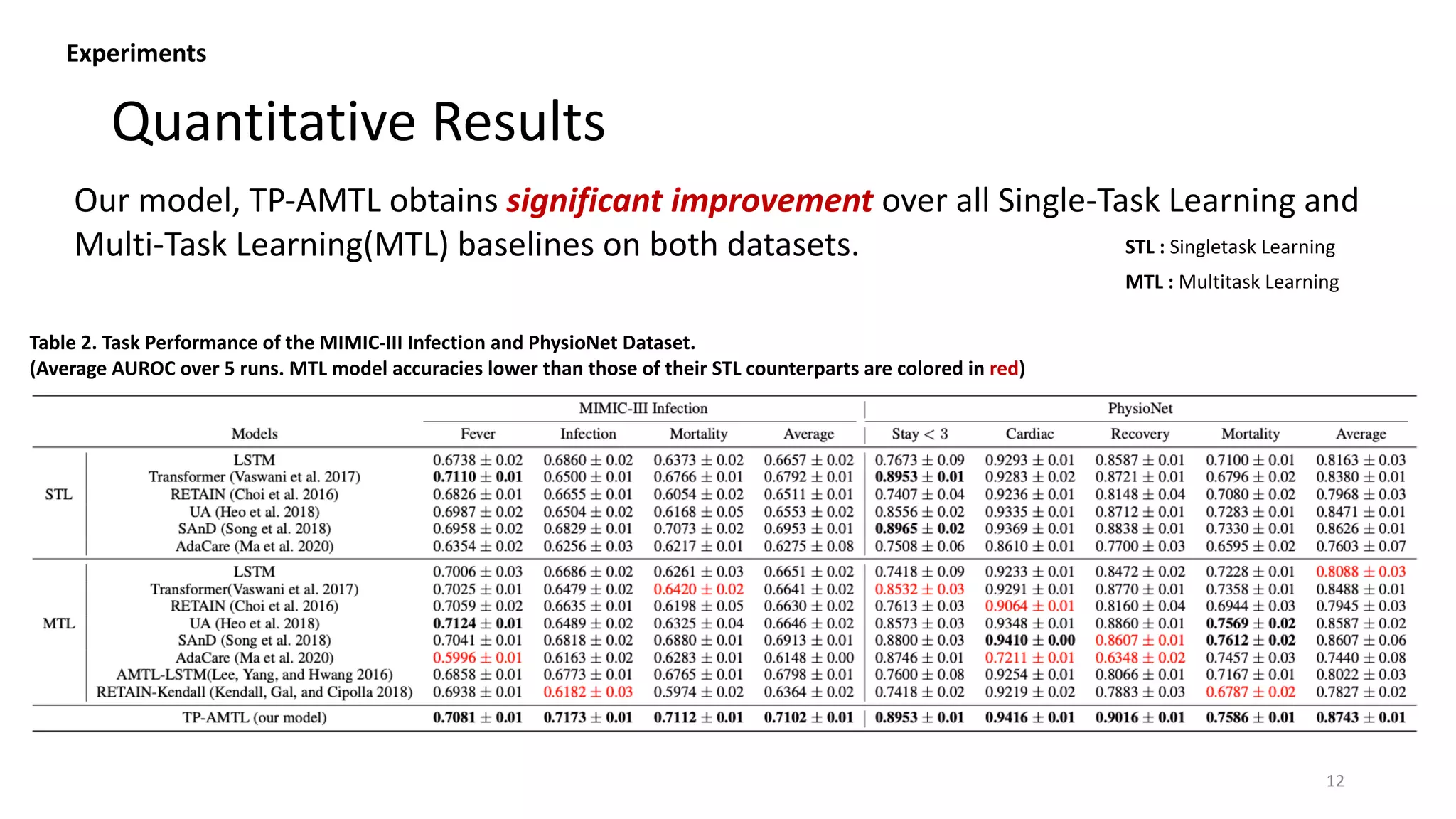
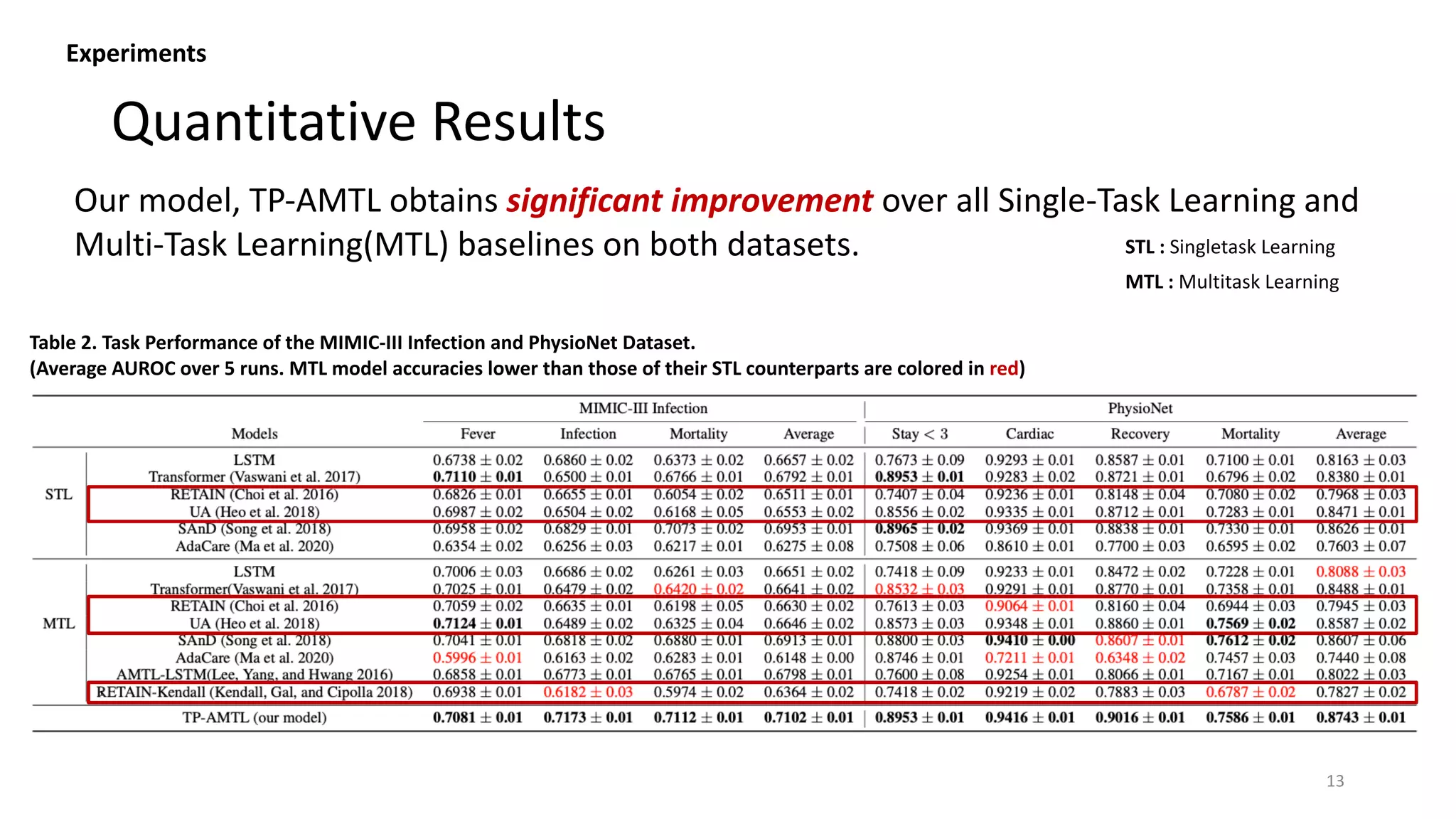
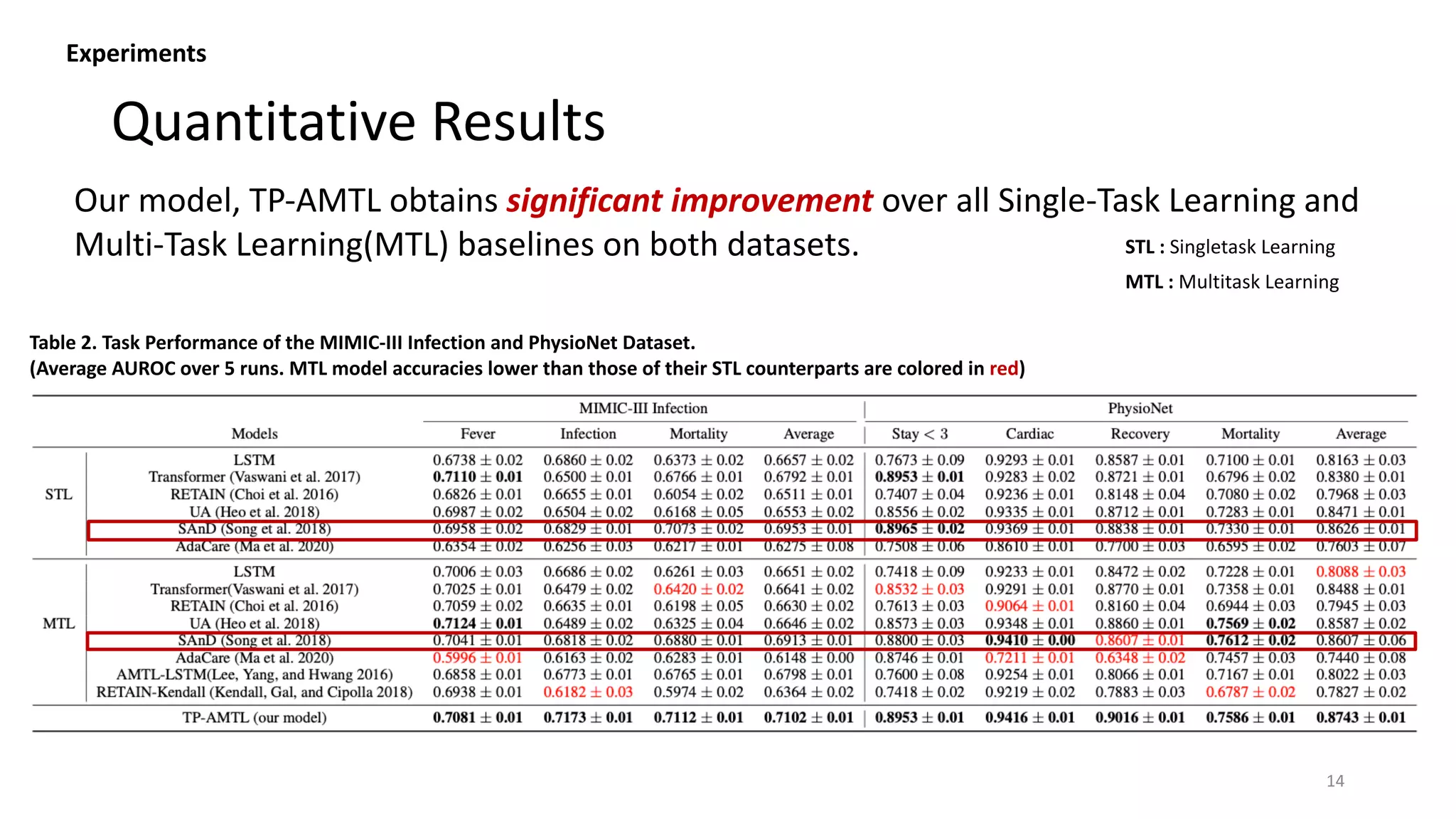
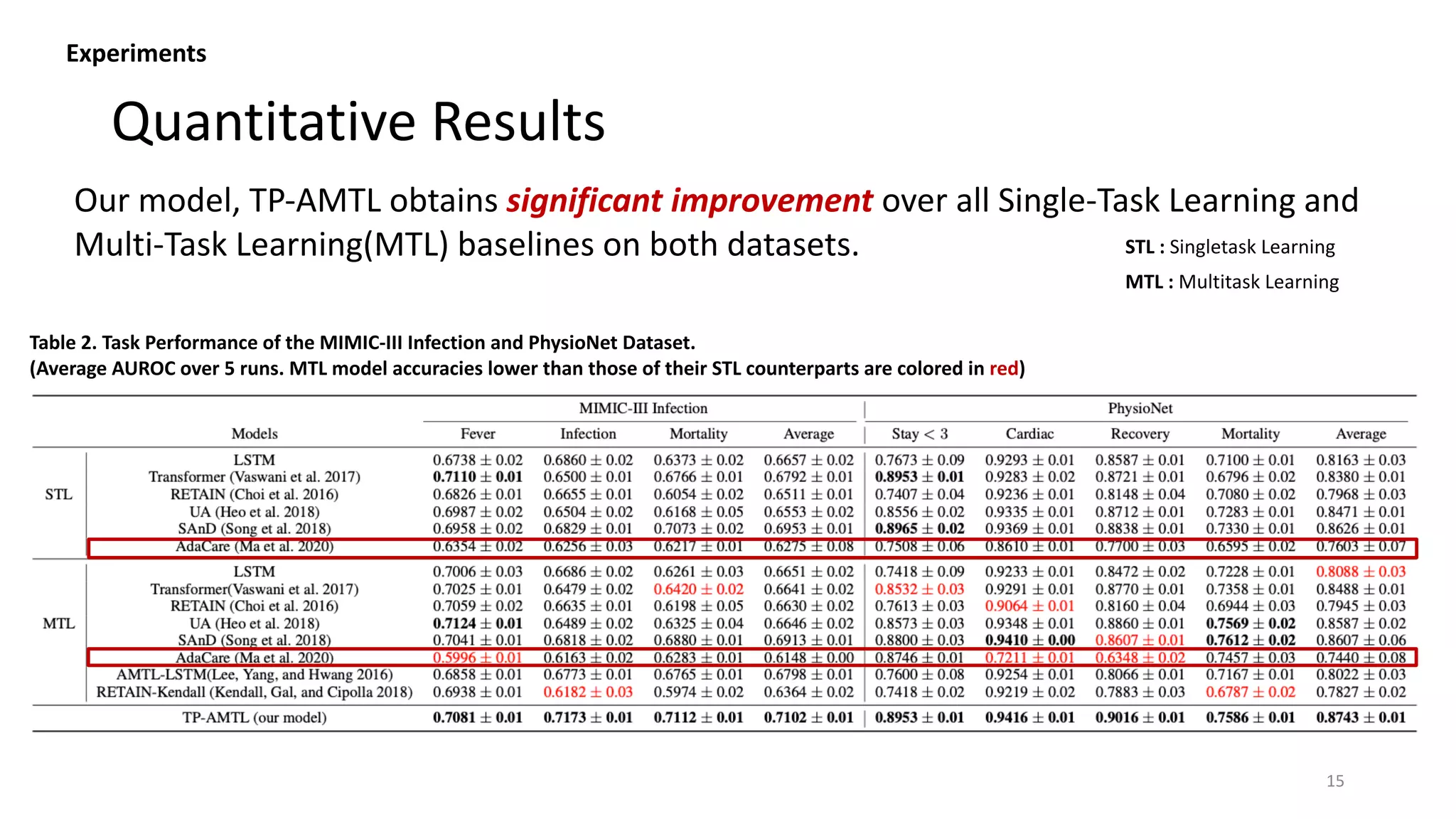
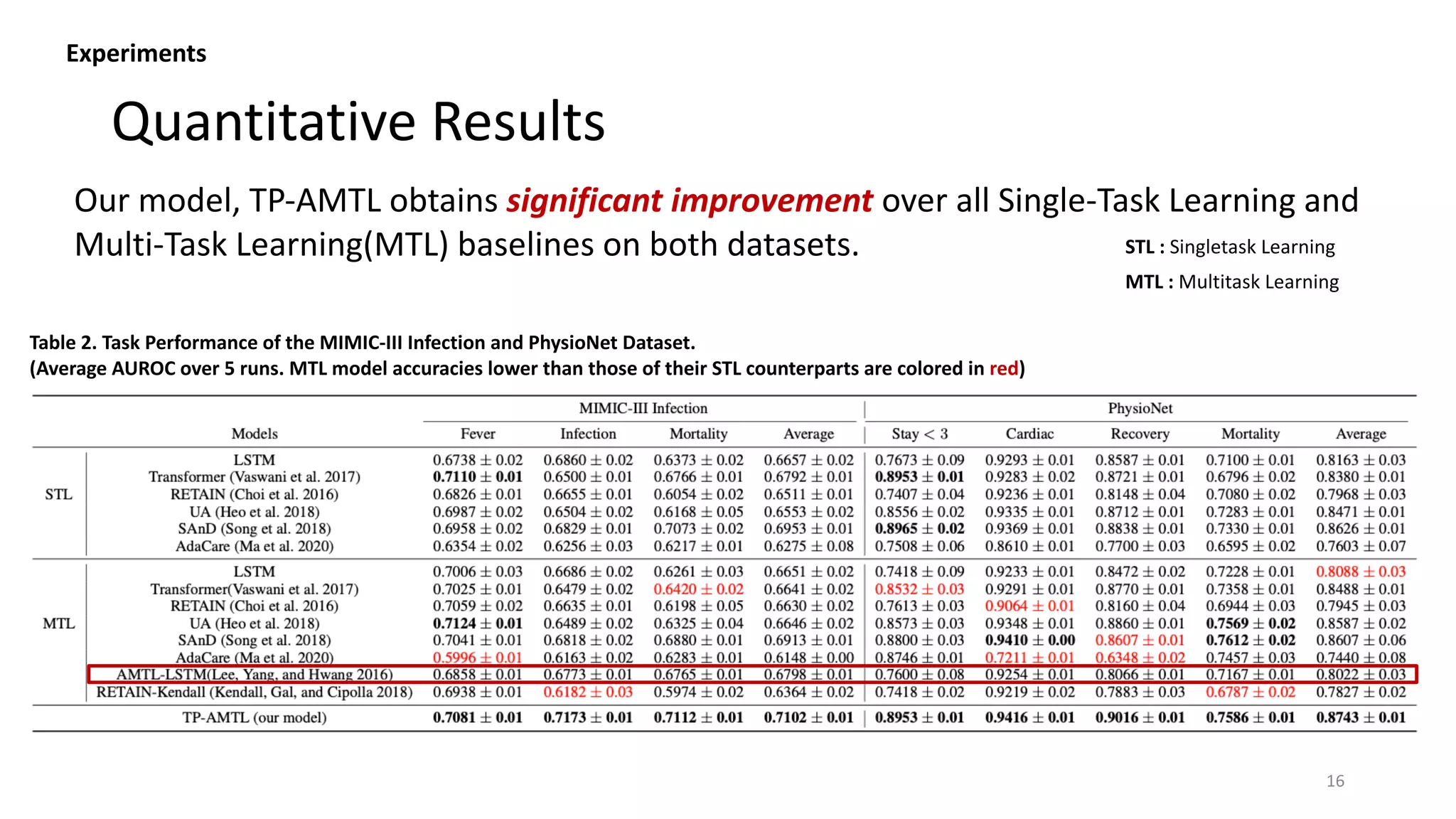
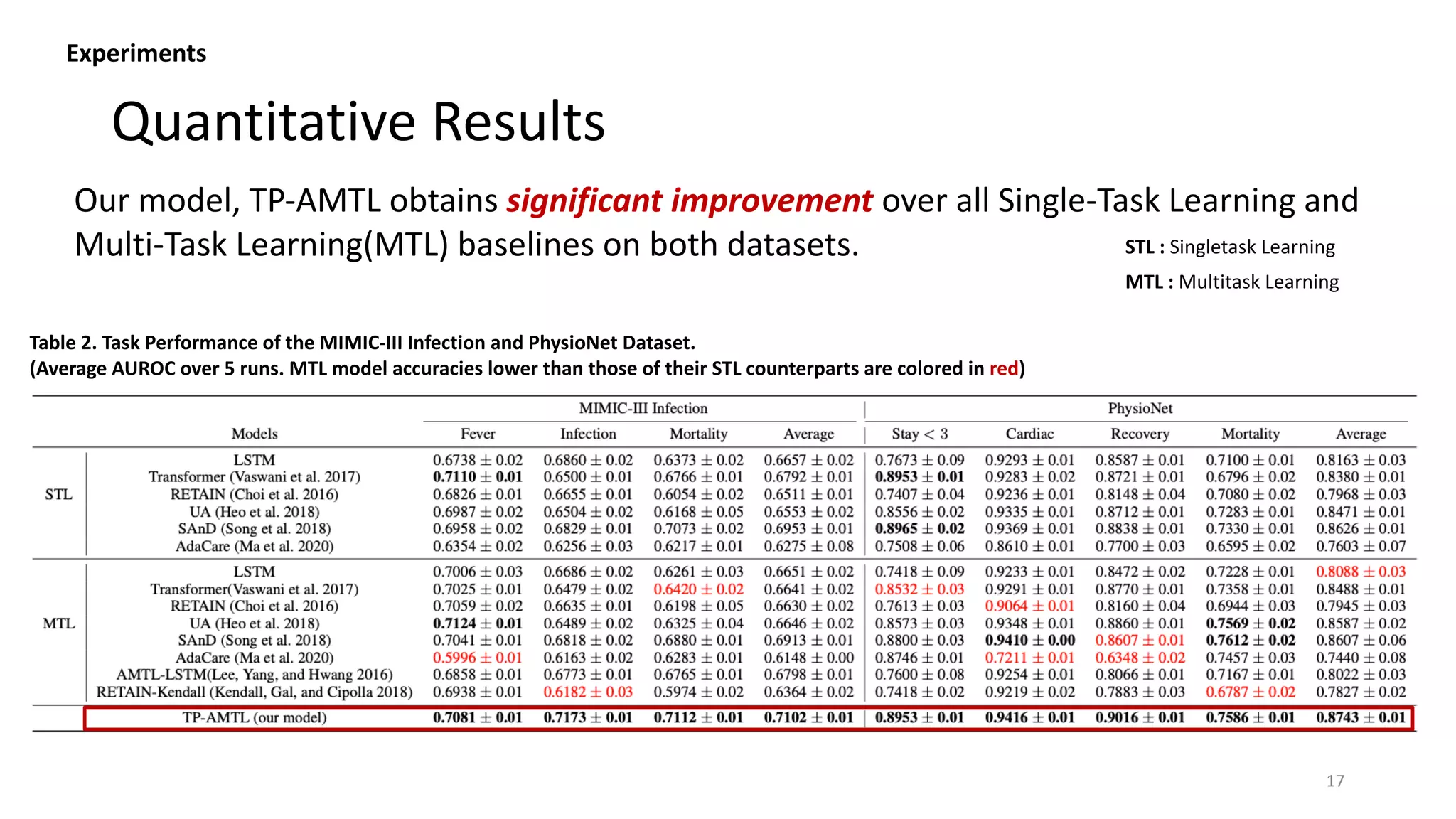
Our model, TP-AMTL obtains significant improvement over all Single-Task Learning and
Multi-Task Learning(MTL) baselines on both datasets.
Experiments
Table 2. Task Performance of the MIMIC-III Infection and PhysioNet Dataset.
(Average AUROC over 5 runs. MTL model accuracies lower than those of their STL counterparts are colored in red)
Quantitative Results
13
STL : Singletask Learning
MTL : Multitask Learning
Our model, TP-AMTL obtains significant improvement over all Single-Task Learning and
Multi-Task Learning(MTL) baselines on both datasets.
Experiments
Table 2. Task Performance of the MIMIC-III Infection and PhysioNet Dataset.
(Average AUROC over 5 runs. MTL model accuracies lower than those of their STL counterparts are colored in red)
1
Quantitative Results
14
STL : Singletask Learning
MTL : Multitask Learning
Our model, TP-AMTL obtains significant improvement over all Single-Task Learning and
Multi-Task Learning(MTL) baselines on both datasets.
Experiments
Table 2. Task Performance of the MIMIC-III Infection and PhysioNet Dataset.
(Average AUROC over 5 runs. MTL model accuracies lower than those of their STL counterparts are colored in red)
Quantitative Results
15
STL : Singletask Learning
MTL : Multitask Learning
Our model, TP-AMTL obtains significant improvement over all Single-Task Learning and
Multi-Task Learning(MTL) baselines on both datasets.
Experiments
Table 2. Task Performance of the MIMIC-III Infection and PhysioNet Dataset.
(Average AUROC over 5 runs. MTL model accuracies lower than those of their STL counterparts are colored in red)
Quantitative Results
16
STL : Singletask Learning
MTL : Multitask Learning
Our model, TP-AMTL obtains significant improvement over all Single-Task Learning and
Multi-Task Learning(MTL) baselines on both datasets.
Experiments
Table 2. Task Performance of the MIMIC-III Infection and PhysioNet Dataset.
(Average AUROC over 5 runs. MTL model accuracies lower than those of their STL counterparts are colored in red)
Quantitative Results
17
STL : Singletask Learning
MTL : Multitask Learning
Our model, TP-AMTL obtains significant improvement over all Single-Task Learning and
Multi-Task Learning(MTL) baselines on both datasets.
Experiments
Table 2. Task Performance of the MIMIC-III Infection and PhysioNet Dataset.
(Average AUROC over 5 runs. MTL model accuracies lower than those of their STL counterparts are colored in red)
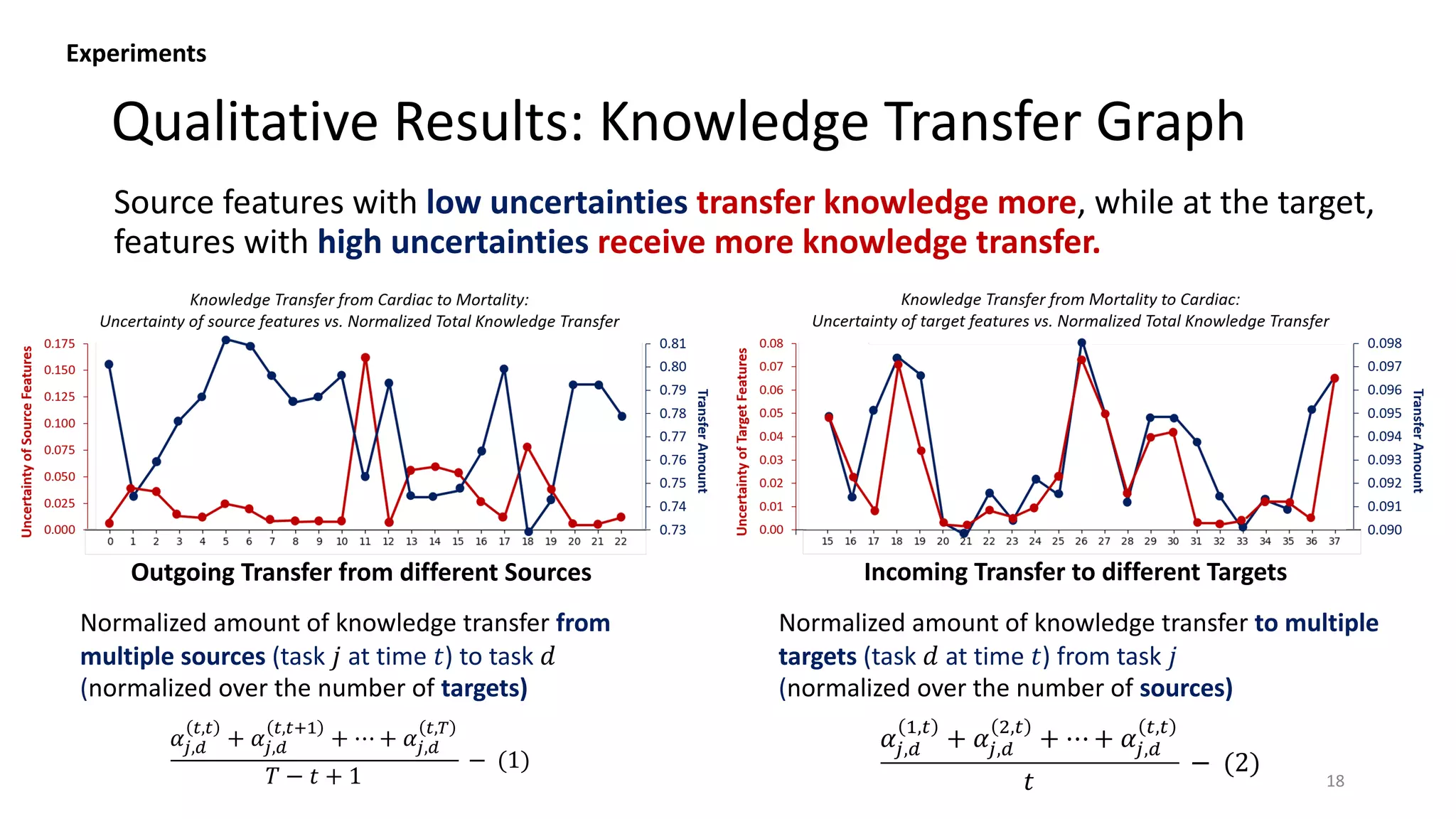
Source features with low uncertainties transfer knowledge more, while at the target,
features with high uncertainties receive more knowledge transfer.
Qualitative Results: Knowledge Transfer Graph
Normalized amount of knowledge transfer from
multiple sources (task 𝑗 at time 𝑡) to task 𝑑
(normalized over the number of targets)
18
Normalized amount of knowledge transfer to multiple
targets (task 𝑑 at time 𝑡) from task 𝑗
(normalized over the number of sources)
Incoming Transfer to different Targets
Outgoing Transfer from different Sources
𝛼!,#
&,&
+ 𝛼!,#
&,&'(
+ ⋯ + 𝛼!,#
&,)
𝑇 − 𝑡 + 1
− (1)
𝛼!,%
(,&
+ 𝛼!,%
-,&
+ ⋯ + 𝛼!,%
&,&
𝑡
− (2)
Experiments
Qualitative Results: Medical Interpretation
19
Interpretation of the Learned Knowledge Graph
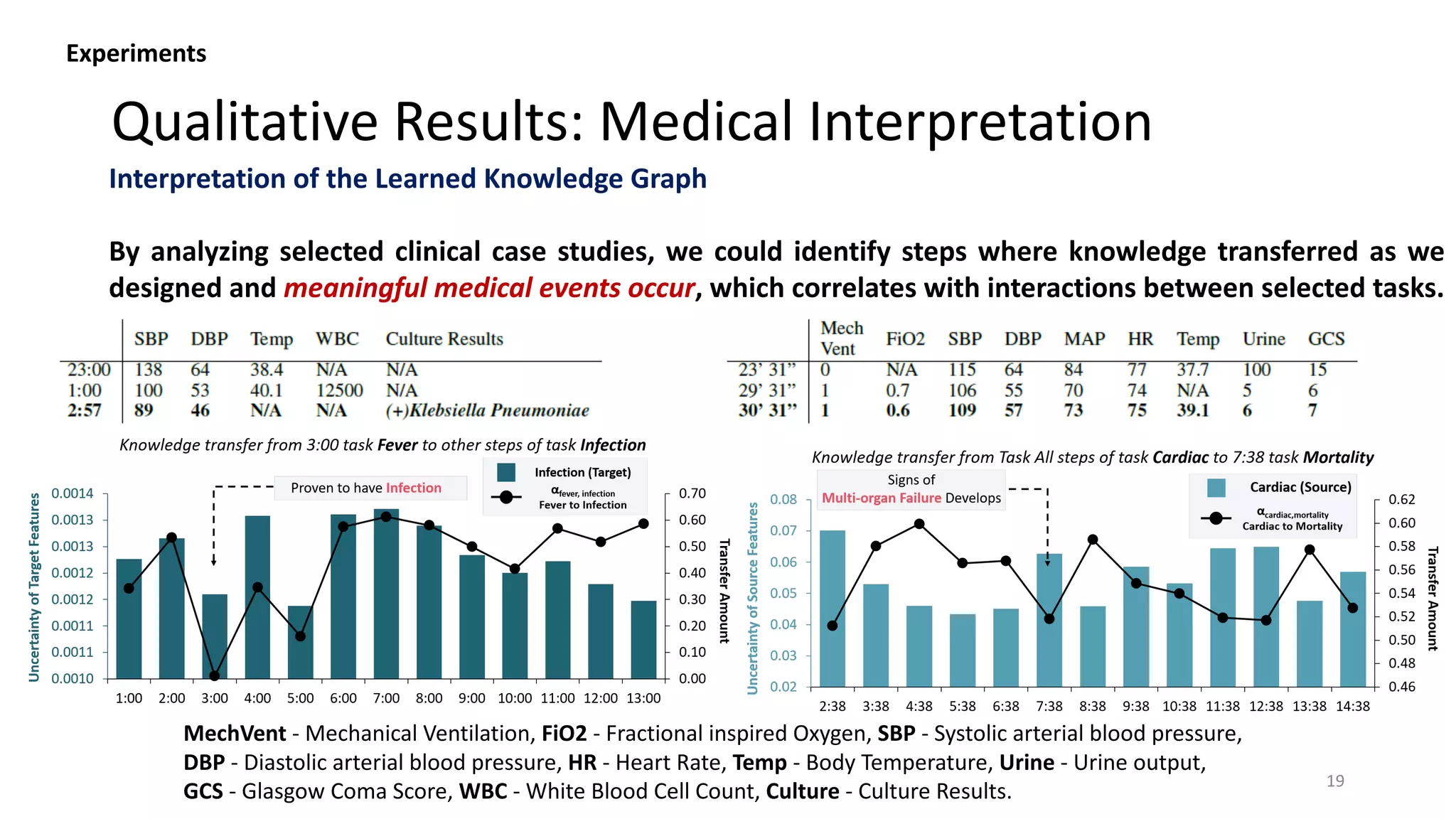
By analyzing selected clinical case studies, we could identify steps where knowledge transferred as we
designed and meaningful medical events occur, which correlates with interactions between selected tasks.
MechVent - Mechanical Ventilation, FiO2 - Fractional inspired Oxygen, SBP - Systolic arterial blood pressure,
DBP - Diastolic arterial blood pressure, HR - Heart Rate, Temp - Body Temperature, Urine - Urine output,
GCS - Glasgow Coma Score, WBC - White Blood Cell Count, Culture - Culture Results.
Experiments
Ablation Study
20
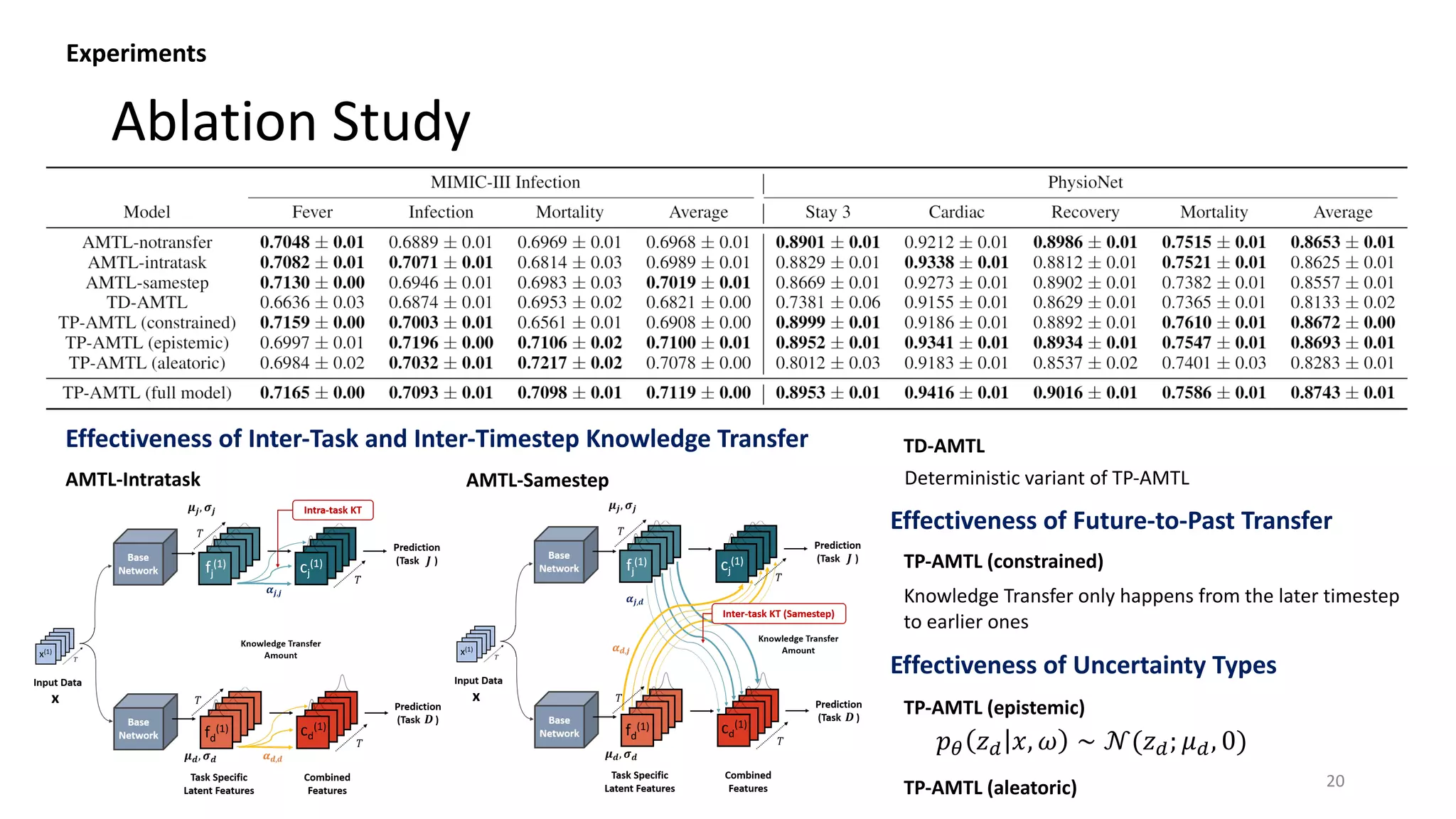
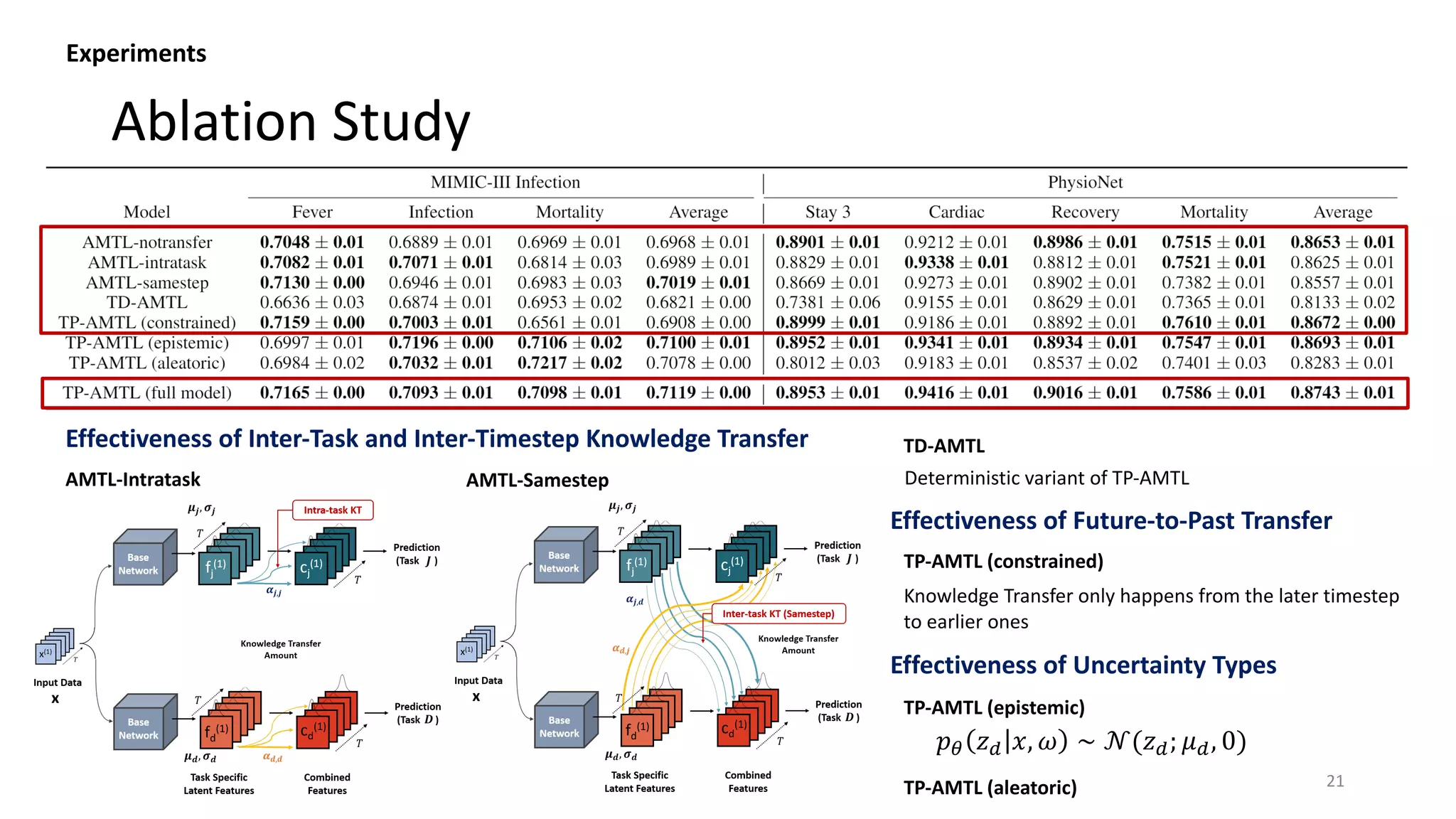
AMTL-Intratask
Effectiveness of Inter-Task and Inter-Timestep Knowledge Transfer
AMTL-Samestep
TD-AMTL
Deterministic variant of TP-AMTL
Experiments
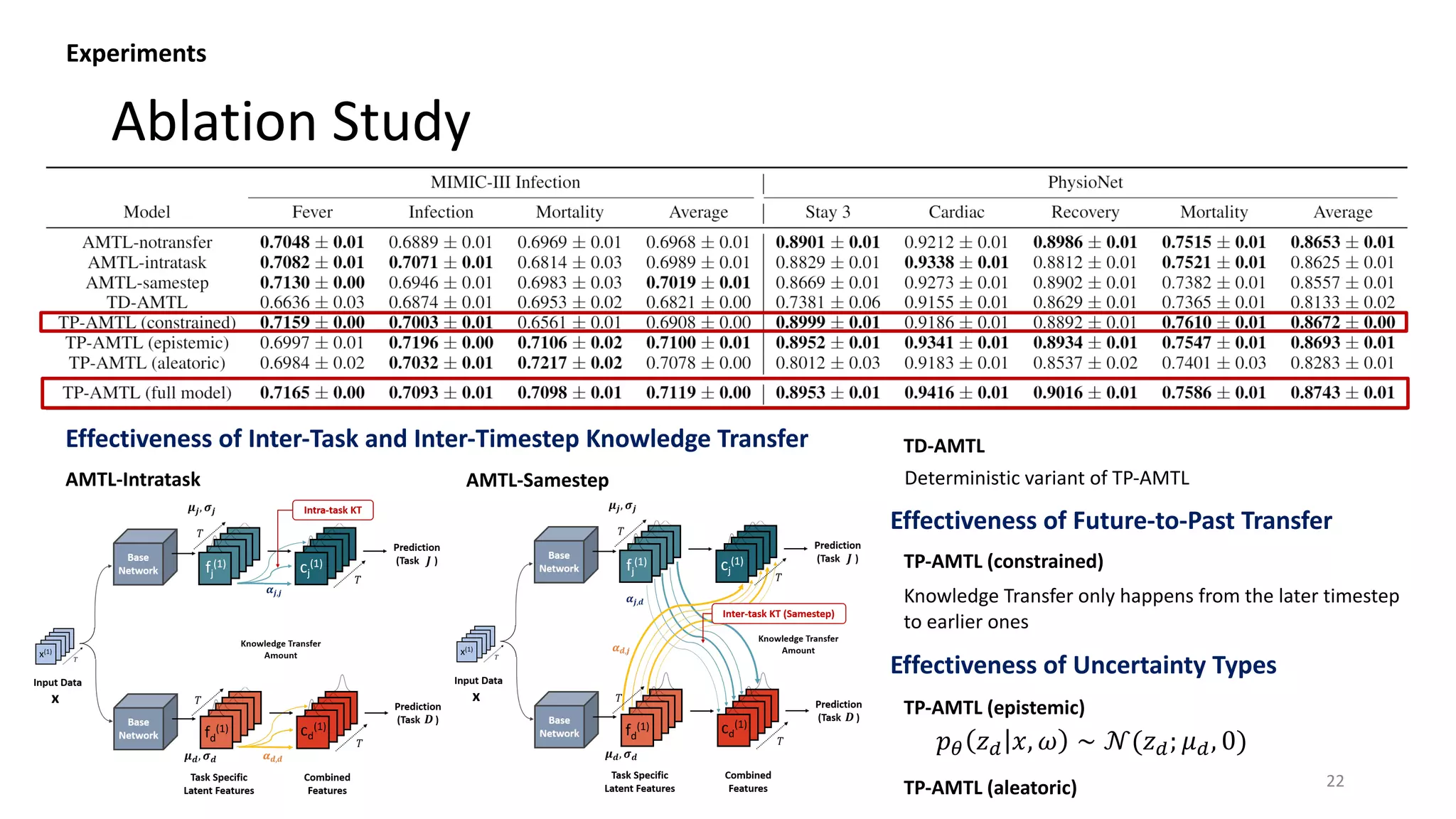
TP-AMTL (constrained)
Effectiveness of Future-to-Past Transfer
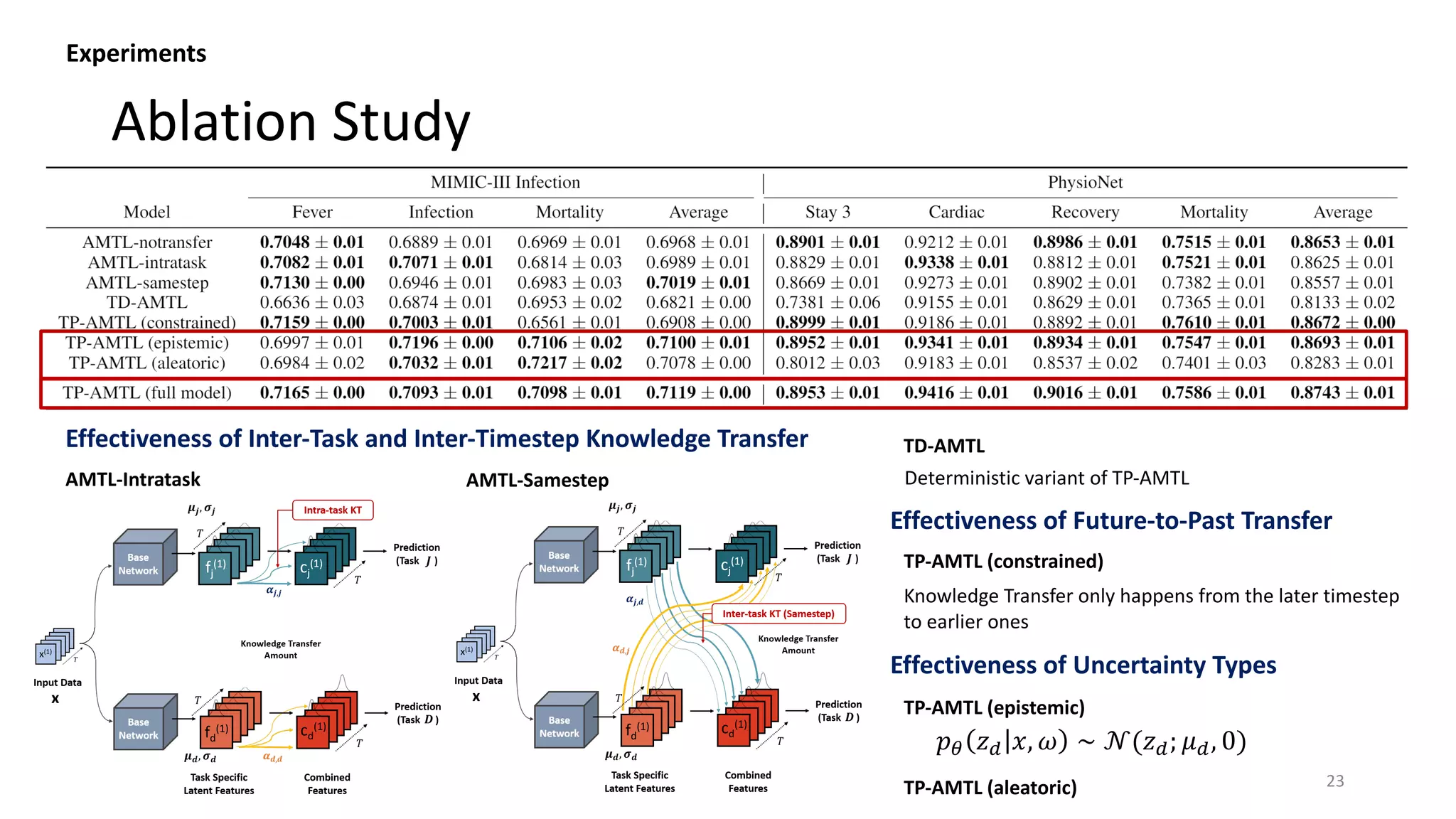
TP-AMTL (epistemic)
Effectiveness of Uncertainty Types
TP-AMTL (aleatoric)
𝑝. 𝑧% 𝑥, 𝜔 ∼ 𝒩(𝑧%; 𝜇%, 0)
Knowledge Transfer only happens from the later timestep
to earlier ones
Ablation Study
21
AMTL-Intratask
Effectiveness of Inter-Task and Inter-Timestep Knowledge Transfer
AMTL-Samestep
TD-AMTL
Deterministic variant of TP-AMTL
Experiments
TP-AMTL (constrained)
Effectiveness of Future-to-Past Transfer
TP-AMTL (epistemic)
Effectiveness of Uncertainty Types
TP-AMTL (aleatoric)
𝑝. 𝑧% 𝑥, 𝜔 ∼ 𝒩(𝑧%; 𝜇%, 0)
Knowledge Transfer only happens from the later timestep
to earlier ones
Ablation Study
22
AMTL-Intratask
Effectiveness of Inter-Task and Inter-Timestep Knowledge Transfer
AMTL-Samestep
TD-AMTL
Deterministic variant of TP-AMTL
Experiments
TP-AMTL (constrained)
Effectiveness of Future-to-Past Transfer
TP-AMTL (epistemic)
Effectiveness of Uncertainty Types
TP-AMTL (aleatoric)
𝑝. 𝑧% 𝑥, 𝜔 ∼ 𝒩(𝑧%; 𝜇%, 0)
Knowledge Transfer only happens from the later timestep
to earlier ones
Ablation Study
23
AMTL-Intratask
Effectiveness of Inter-Task and Inter-Timestep Knowledge Transfer
AMTL-Samestep
TD-AMTL
Deterministic variant of TP-AMTL
Experiments
TP-AMTL (constrained)
Effectiveness of Future-to-Past Transfer
TP-AMTL (epistemic)
Effectiveness of Uncertainty Types
TP-AMTL (aleatoric)
𝑝. 𝑧% 𝑥, 𝜔 ∼ 𝒩(𝑧%; 𝜇%, 0)
Knowledge Transfer only happens from the later timestep
to earlier ones
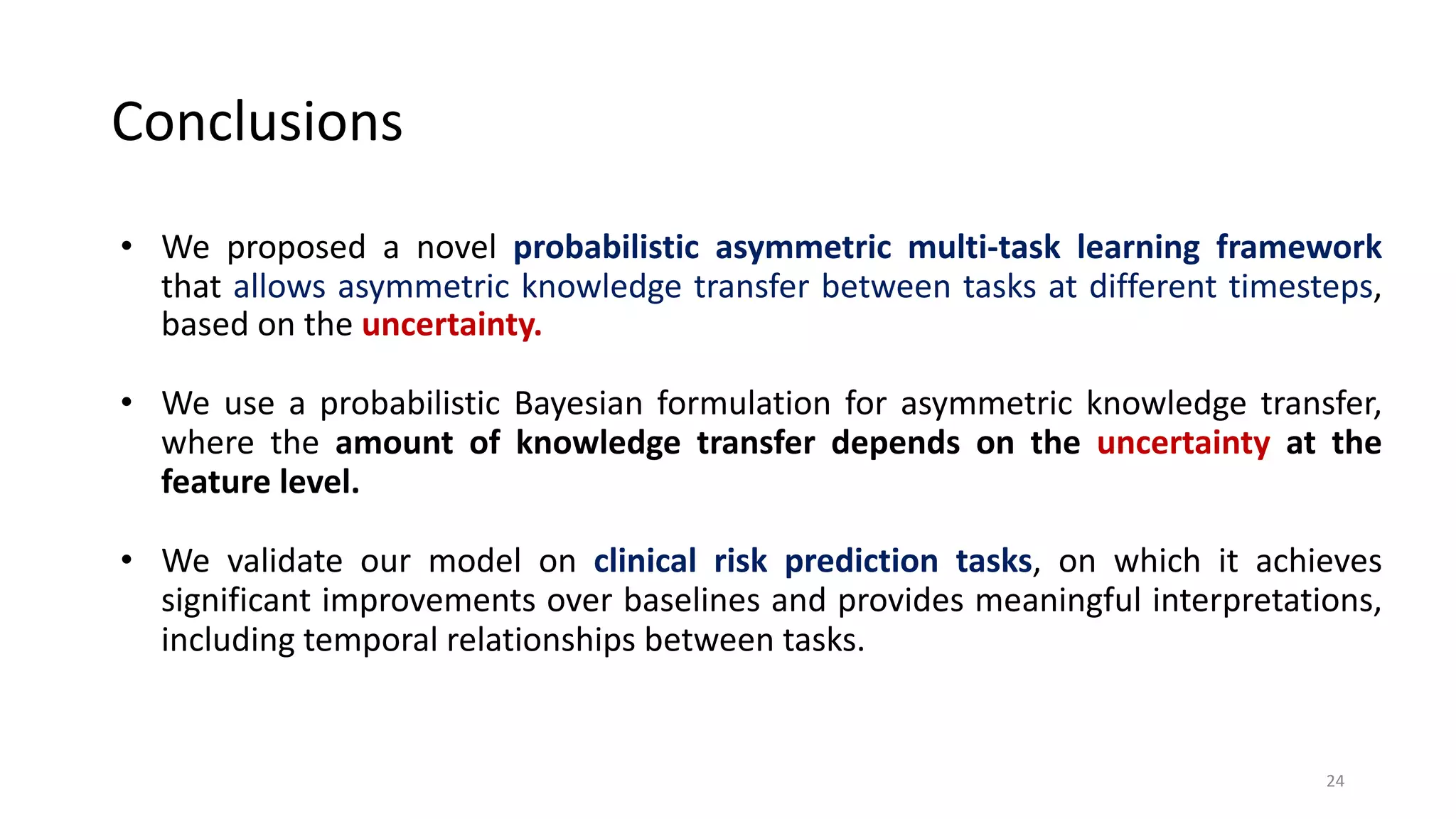
• We proposed a novel probabilistic asymmetric multi-task learning framework
that allows asymmetric knowledge transfer between tasks at different timesteps,
based on the uncertainty.
• We use a probabilistic Bayesian formulation for asymmetric knowledge transfer,
where the amount of knowledge transfer depends on the uncertainty at the
feature level.
• We validate our model on clinical risk prediction tasks, on which it achieves
significant improvements over baselines and provides meaningful interpretations,
including temporal relationships between tasks.
Conclusions
24
Thank you
25

Clinical Risk Prediction with Temporal Probabilistic Asymmetric Multi-Task Learning

  • 1.
    1 Clinical Risk Predictionwith Temporal Probabilistic Asymmetric Multi-Task Learning 1School of Computing, 2Graduate School of AI, Korea Advanced Institute of Science and Technology, 3Aitrics, 4Department of Computer Science, University of Oxford Tuan Nguyen* 1,4, Hyewon Jeong* 1, Eunho Yang 1,2,3, and Sung Ju Hwang 1,2,3
  • 2.
    Clinical Risk Predictionwith Multi-Task Learning Hae Beom Lee, Eunho Yang, and Sung Ju Hwang. Deep asymmetric multi-task feature learning. ICML 2018. 2 Introduction Heart Rate (HR) Respiratory Rate (RR) Oxygen saturation (SpO2) Body Temperature (BT) White Blood Cell Count (WBC) Body Temperature Elevation Vital Sign (>37.7 C, 99.9 F) Diagnostic Test Symptoms and Signs as a result of infection Positive for Bacteria / Fungus / Virus Task 1 : Fever Task 2 : Infection Evidence & Proof of infection One probable result of infection Task 3 : Mortality Mortality Features Tasks Task1: Fever Task2: Infection Task3: Mortality Negative Transfer MTL: clinical setting (MIMIC III-Infection)
  • 3.
    Clinical Risk Predictionwith Multi-Task Learning Negative Transfer Problem in Multi-Task Learning Hae Beom Lee, Eunho Yang, and Sung Ju Hwang. Deep asymmetric multi-task feature learning. ICML 2018. 3 Introduction Heart Rate (HR) Respiratory Rate (RR) Oxygen saturation (SpO2) Body Temperature (BT) White Blood Cell Count (WBC) Body Temperature Elevation Vital Sign (>37.7 C, 99.9 F) Diagnostic Test Symptoms and Signs as a result of infection Positive for Bacteria / Fungus / Virus Task 1 : Fever Task 2 : Infection Evidence & Proof of infection One probable result of infection Task 3 : Mortality Mortality Features Tasks Task1: Fever Task2: Infection Task3: Mortality Negative Transfer MTL: clinical setting (MIMIC III-Infection) Unreliable Predictor
  • 4.
    Clinical Risk Predictionwith Multi-Task Learning Asymmetric Knowledge Transfer Across Timesteps 4 Introduction 𝑓! 𝑓" 𝑓# … Fever 𝑖! 𝑖" 𝑖# Step 1 𝑚! 𝑚" 𝑚# … … Step 2 Step T Infection Mortality 낮은 불확실성 높은 불확실성 Body Temperature Elevation Vital Sign (>37.7 C, 99.9 F) Diagnostic Test Symptoms and Signs as a result of infection Positive for Bacteria / Fungus / Virus Task 1 : Fever Task 2 : Infection Evidence & Proof of infection One probable result of infection Task 3 : Mortality Mortality Deep AMTFL Hae Beom Lee, Eunho Yang, and Sung Ju Hwang. Deep asymmetric multi-task feature learning. ICML 2018. MTL: clinical setting (MIMIC III-Infection)
  • 5.
    Probabilistic Asymmetric Multi-TaskLearning (P-AMTL) Introduction Uncertainty-Aware Asymmetric Multi-Task Learning Hae Beom Lee, Eunho Yang, and Sung Ju Hwang. Deep asymmetric multi-task feature learning. ICML 2018.
  • 6.
    Probabilistic Asymmetric Multi-TaskLearning (P-AMTL) 6 0.3 0.4 0.5 0.6 0.7 0 0.02 0.04 0.06 0.08 0.1 0.12 Task 0 Task 1 Knowledge Transfer Loss KT in Loss-based AMTL Loss KT 0 0.02 0.04 0.06 0.08 0.1 0.12 0 0.2 0.4 0.6 0.8 Task 0 Task 1 Knowledge Transfer Uncertainty KT in P-AMTL UC KT 2000 200 instances 2000 200 instances -0.02 -0.015 -0.01 -0.005 0 0.005 0.01 0.015 Accuracy Improvement over STL Loss-based AMTL TPAMTL … … Step 1 Step 2 Step T Loss Loss Loss-Based AMTL (Lee et al., 2018) fd (1) fd (2) fd (3) fj (1) fj (2) fj (3) … Low UC High UC 𝑓! (#) UC-aware AMTL … Step 1 Step 2 Step T fd (1) fd (2) fd (3) fj (1) fj (2) fj (3) 𝑍!, 𝑍" : High level latent feature 𝑓!, 𝑓" : Multiple features across timesteps (𝑍! = 𝑓! # , 𝑓! $ , … , 𝑓! % ) (𝑍" = 𝑓" # , 𝑓" $ , … , 𝑓" % ) Task J Task D Approach Failure of Loss-based Asymmetric Multi-Task Learning Hae Beom Lee, Eunho Yang, and Sung Ju Hwang. Deep asymmetric multi-task feature learning. ICML 2018. Multiple Features Across Timesteps
  • 7.
    Failure of Loss-basedAMTL 7 Approach Table 1. Task Performance of MNIST-variation Experiment (AUROC over 5 runs. MTL model accuracies lower than those of their STL counterparts are colored in red)
  • 8.
    Knowledge transfer happensfrom more reliable to less reliable features. Knowledge transfer happens inter-task(in order to capture task relatedness) and across-timestep. Uncertainty Aware Knowledge Transfer: example case ! Multiple Features (zj for Task j) + Gj 2 αd,j Gd 1 ! fd (1) Multiple Features (zd for Task d) αj,d Gj 1 + Gj 1 Gj 1 fd (3) fd (1) fj (1) fd (3) fd (1) fj (1) Transform from more reliable to less reliable latent features. Knowledge transfer from Certain (low UC) task to Uncertain (high UC) task !!,# = #!,# $!,#, $#, &!,# $ , &# $ !#,! = ##,! $#,!, $!, &#,! $ , &! $ "! (#) = $! (#) + &!(∑ ∑ )%,! ',# ∗ &% # '() * %+) $% ' ) ∀. ∈ {1,2, … , !} * Same also happens for intra-task, inter-timestep knowledge transfer TP-AMTL: Uncertainty-Aware Knowledge Transfer Approach
  • 9.
    TP-AMTL: Uncertainty-Aware KnowledgeTransfer Knowledge transfer happens from more reliable to less reliable features. Knowledge transfer happens inter-task(in order to capture task relatedness) and across-timestep. Uncertainty Aware Knowledge Transfer: example case 𝑇 Multiple Features (zj for Task j) + Gj 2 αd,j Gd 1 𝑇 fd (1) Multiple Features (zd for Task d) αj,d Gj 1 + Gj 1 Gj 1 fd (3) fd (1) fj (1) fd (3) fd (1) fj (1) Transform from more reliable to less reliable latent features. Knowledge transfer from Certain (low UC) task to Uncertain (high UC) task Approach 𝛼!,# = 𝐹!,# 𝑍!,#, 𝑍#, 𝜎!,# $ , 𝜎# $ 𝛼#,! = 𝐹#,! 𝑍#,!, 𝑍!, 𝜎#,! $ , 𝜎! $ 𝐶% (&) = 𝑓% (&) + 𝐺%(∑!'( ) ∑*+( & 𝛼!,% *,& ∗ 𝐺! 𝑓! * ) ∀𝑡 ∈ {1,2, … , 𝑇} * Same also happens for intra-task, inter-timestep knowledge transfer 𝑧# ∼ 𝑝% 𝑧# 𝑥, 𝜔 𝑝% 𝑧# 𝑥, 𝜔 ∼ 𝒩(𝑧#; 𝜇#, 𝑑𝑖𝑎𝑔 𝜎# $ )
  • 10.
    Complexity Analysis 10 Approach Supplementary Table1. Time Complexity of the Baseline Models
  • 11.
    Tasks and Datasets 11 Task1 : Stay < 3 Length of ICU Stay Task 2 : Cardiac Recovering from Cardiac Surgery Task 4 : Mortality Task 3 : Recovery Recovering from general surgery PhysioNet2012 Body Temperature Elevation Vital Sign (>37.7 C, 99.9 F) Diagnostic Test Symptoms and Signs as a result of infection Positive for Bacteria / Fungus / Virus Task 1 : Fever Task 2 : Infection Evidence & Proof of infection One probable result of infection Task 3 : Mortality Mortality MIMIC - III Infection 2,000 data points Tasks : Fever à Infection à Mortality Features: 12 Infection related features : including heart rate, arterial blood pressure, and Glasgow Coma Scale(GCS) etc. 4,000 distinct hospital (ICU) records Tasks: Stay < 3 / Cardiac / Recovery à Mortality Features: 31 physiological signs including heart rate, respiratory rate, temperature, etc. Experiments Information on MIMIC - III Respiratory Failure, Heart Failure can be found in the supplementary file
  • 12.
    Quantitative Results 12 STL :Singletask Learning MTL : Multitask Learning Our model, TP-AMTL obtains significant improvement over all Single-Task Learning and Multi-Task Learning(MTL) baselines on both datasets. Experiments Table 2. Task Performance of the MIMIC-III Infection and PhysioNet Dataset. (Average AUROC over 5 runs. MTL model accuracies lower than those of their STL counterparts are colored in red)
  • 13.
    Quantitative Results 13 STL :Singletask Learning MTL : Multitask Learning Our model, TP-AMTL obtains significant improvement over all Single-Task Learning and Multi-Task Learning(MTL) baselines on both datasets. Experiments Table 2. Task Performance of the MIMIC-III Infection and PhysioNet Dataset. (Average AUROC over 5 runs. MTL model accuracies lower than those of their STL counterparts are colored in red) 1
  • 14.
    Quantitative Results 14 STL :Singletask Learning MTL : Multitask Learning Our model, TP-AMTL obtains significant improvement over all Single-Task Learning and Multi-Task Learning(MTL) baselines on both datasets. Experiments Table 2. Task Performance of the MIMIC-III Infection and PhysioNet Dataset. (Average AUROC over 5 runs. MTL model accuracies lower than those of their STL counterparts are colored in red)
  • 15.
    Quantitative Results 15 STL :Singletask Learning MTL : Multitask Learning Our model, TP-AMTL obtains significant improvement over all Single-Task Learning and Multi-Task Learning(MTL) baselines on both datasets. Experiments Table 2. Task Performance of the MIMIC-III Infection and PhysioNet Dataset. (Average AUROC over 5 runs. MTL model accuracies lower than those of their STL counterparts are colored in red)
  • 16.
    Quantitative Results 16 STL :Singletask Learning MTL : Multitask Learning Our model, TP-AMTL obtains significant improvement over all Single-Task Learning and Multi-Task Learning(MTL) baselines on both datasets. Experiments Table 2. Task Performance of the MIMIC-III Infection and PhysioNet Dataset. (Average AUROC over 5 runs. MTL model accuracies lower than those of their STL counterparts are colored in red)
  • 17.
    Quantitative Results 17 STL :Singletask Learning MTL : Multitask Learning Our model, TP-AMTL obtains significant improvement over all Single-Task Learning and Multi-Task Learning(MTL) baselines on both datasets. Experiments Table 2. Task Performance of the MIMIC-III Infection and PhysioNet Dataset. (Average AUROC over 5 runs. MTL model accuracies lower than those of their STL counterparts are colored in red)
  • 18.
    Source features withlow uncertainties transfer knowledge more, while at the target, features with high uncertainties receive more knowledge transfer. Qualitative Results: Knowledge Transfer Graph Normalized amount of knowledge transfer from multiple sources (task 𝑗 at time 𝑡) to task 𝑑 (normalized over the number of targets) 18 Normalized amount of knowledge transfer to multiple targets (task 𝑑 at time 𝑡) from task 𝑗 (normalized over the number of sources) Incoming Transfer to different Targets Outgoing Transfer from different Sources 𝛼!,# &,& + 𝛼!,# &,&'( + ⋯ + 𝛼!,# &,) 𝑇 − 𝑡 + 1 − (1) 𝛼!,% (,& + 𝛼!,% -,& + ⋯ + 𝛼!,% &,& 𝑡 − (2) Experiments
  • 19.
    Qualitative Results: MedicalInterpretation 19 Interpretation of the Learned Knowledge Graph By analyzing selected clinical case studies, we could identify steps where knowledge transferred as we designed and meaningful medical events occur, which correlates with interactions between selected tasks. MechVent - Mechanical Ventilation, FiO2 - Fractional inspired Oxygen, SBP - Systolic arterial blood pressure, DBP - Diastolic arterial blood pressure, HR - Heart Rate, Temp - Body Temperature, Urine - Urine output, GCS - Glasgow Coma Score, WBC - White Blood Cell Count, Culture - Culture Results. Experiments
  • 20.
    Ablation Study 20 AMTL-Intratask Effectiveness ofInter-Task and Inter-Timestep Knowledge Transfer AMTL-Samestep TD-AMTL Deterministic variant of TP-AMTL Experiments TP-AMTL (constrained) Effectiveness of Future-to-Past Transfer TP-AMTL (epistemic) Effectiveness of Uncertainty Types TP-AMTL (aleatoric) 𝑝. 𝑧% 𝑥, 𝜔 ∼ 𝒩(𝑧%; 𝜇%, 0) Knowledge Transfer only happens from the later timestep to earlier ones
  • 21.
    Ablation Study 21 AMTL-Intratask Effectiveness ofInter-Task and Inter-Timestep Knowledge Transfer AMTL-Samestep TD-AMTL Deterministic variant of TP-AMTL Experiments TP-AMTL (constrained) Effectiveness of Future-to-Past Transfer TP-AMTL (epistemic) Effectiveness of Uncertainty Types TP-AMTL (aleatoric) 𝑝. 𝑧% 𝑥, 𝜔 ∼ 𝒩(𝑧%; 𝜇%, 0) Knowledge Transfer only happens from the later timestep to earlier ones
  • 22.
    Ablation Study 22 AMTL-Intratask Effectiveness ofInter-Task and Inter-Timestep Knowledge Transfer AMTL-Samestep TD-AMTL Deterministic variant of TP-AMTL Experiments TP-AMTL (constrained) Effectiveness of Future-to-Past Transfer TP-AMTL (epistemic) Effectiveness of Uncertainty Types TP-AMTL (aleatoric) 𝑝. 𝑧% 𝑥, 𝜔 ∼ 𝒩(𝑧%; 𝜇%, 0) Knowledge Transfer only happens from the later timestep to earlier ones
  • 23.
    Ablation Study 23 AMTL-Intratask Effectiveness ofInter-Task and Inter-Timestep Knowledge Transfer AMTL-Samestep TD-AMTL Deterministic variant of TP-AMTL Experiments TP-AMTL (constrained) Effectiveness of Future-to-Past Transfer TP-AMTL (epistemic) Effectiveness of Uncertainty Types TP-AMTL (aleatoric) 𝑝. 𝑧% 𝑥, 𝜔 ∼ 𝒩(𝑧%; 𝜇%, 0) Knowledge Transfer only happens from the later timestep to earlier ones
  • 24.
    • We proposeda novel probabilistic asymmetric multi-task learning framework that allows asymmetric knowledge transfer between tasks at different timesteps, based on the uncertainty. • We use a probabilistic Bayesian formulation for asymmetric knowledge transfer, where the amount of knowledge transfer depends on the uncertainty at the feature level. • We validate our model on clinical risk prediction tasks, on which it achieves significant improvements over baselines and provides meaningful interpretations, including temporal relationships between tasks. Conclusions 24
  • 25.