Acculturation
Theory
Arlene May T. Jordan
EDL 205
Meet the
Proponent
7/13/20XX Conference presentation 2
John H. Schumann
• He is a Professor Emeritus of
Applied Linguistics and former
chair of the Department of
Applied Linguistics and TESL at
UCLA.
• His research includes language
acquisition, the neurobiology of
language, the neurobiology of
learning, and language evolution.
• He designed the Acculturation
Model in 1978
7/13/20XX Conference presentation 3
Acculturation
Theory
• It is an exchange of
cultural features.
• It is sharing of the
differences in cultures.
7/13/20XX Conference presentation 4
Some learners make rapid progress in second language
learning while others with the same initial ability and language
instruction make little progress in the same amount of time.
5
Factors that
influence the
success:
6
 Psychological
Factors
 Social Factors
7/13/20XX Conference presentation 7
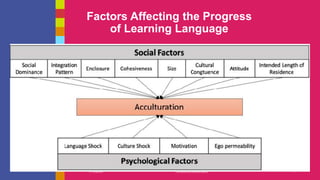
Factors Affecting the Progress
of Learning Language
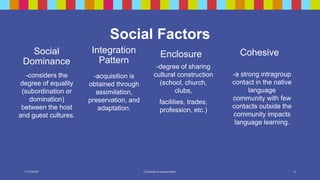
Social
Dominance
Enclosure Cohesive
-considers the
degree of equality
(subordination or
domination)
between the host
and guest cultures.
-degree of sharing
cultural construction
(school, church,
clubs,
facilities, trades,
profession, etc.)
-a strong intragroup
contact in the native
language
community with few
contacts outside the
community impacts
language learning.
-acquisition is
obtained through
assimilation,
preservation, and
adaptation.
Social Factors
7/13/20XX Conference presentation 8
Integration
Pattern
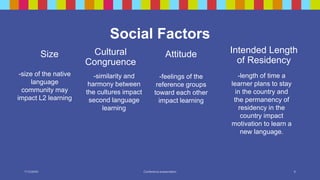
Size Attitude Intended Length
of Residency
-size of the native
language
community may
impact L2 learning
-feelings of the
reference groups
toward each other
impact learning
-length of time a
learner plans to stay
in the country and
the permanency of
residency in the
country impact
motivation to learn a
new language.
-similarity and
harmony between
the cultures impact
second language
learning
Social Factors
7/13/20XX Conference presentation 9
Cultural
Congruence
Psychological
Factors
-the extent to which the
learner feels disoriented
and uncomfortable with
extended residence in a
new culture
Language
Shock
-the degree and type
of desire experienced
by the learner to
acquire the language
-the ability of the learner
to accept a new identity
associated with the
belonging to a new
speech community
Conference presentation 10
-the degree to which
speaking the new
language makes the
learner feel foolish
or comical
Culture Shock
Motivation Ego
Permeability
Related Research:
Criticisms on Acculturation
Model
7/13/20XX Conference presentation 11
Strengths of Acculturation
Model
Criticisms on
Acculturation Model
Kelley (1982) and Stauble (1981)
did not find any relationship between
acculturation and proficiency.
7/13/20XX Conference presentation 12
Mondy(2007) argues that cultural
aspects are quite often, not so readily
identifiable, and that individuals may
succeed in SLA despite the social
conditions.
Criticisms on
Acculturation Model
Ellis(2008) perceived was that social
factors are assumed to have a direct
impact on SLA while they are more
likely to have an indirect one.
7/13/20XX Conference presentation 13
According to Freeman & Long
(1991), Schumann did not specify the
combinations and levels of
social and psychological factors to
predict learner’s language outcome.
Strengths of Acculturation Model
Stern (1983) believes this model has given
a “better insight into language learning, designing
research studies, and diagnoses
individual patterns of language learning.”
7/13/20XX Conference presentation 14
Strengths of Acculturation Model
Spolsky (1988) believes that successful language
teaching requires not only the ability to
impart grammatical knowledge but also sensitivity
to the social realities faced by
students.
7/13/20XX Conference presentation 15
Thank you!!!
7/13/20XX Conference presentation 16

Acculturation Theory Model and Proponent

  • 1.
  • 2.
  • 3.
    John H. Schumann •He is a Professor Emeritus of Applied Linguistics and former chair of the Department of Applied Linguistics and TESL at UCLA. • His research includes language acquisition, the neurobiology of language, the neurobiology of learning, and language evolution. • He designed the Acculturation Model in 1978 7/13/20XX Conference presentation 3
  • 4.
    Acculturation Theory • It isan exchange of cultural features. • It is sharing of the differences in cultures. 7/13/20XX Conference presentation 4
  • 5.
    Some learners makerapid progress in second language learning while others with the same initial ability and language instruction make little progress in the same amount of time. 5
  • 6.
    Factors that influence the success: 6 Psychological Factors  Social Factors
  • 7.
    7/13/20XX Conference presentation7 Factors Affecting the Progress of Learning Language
  • 8.
    Social Dominance Enclosure Cohesive -considers the degreeof equality (subordination or domination) between the host and guest cultures. -degree of sharing cultural construction (school, church, clubs, facilities, trades, profession, etc.) -a strong intragroup contact in the native language community with few contacts outside the community impacts language learning. -acquisition is obtained through assimilation, preservation, and adaptation. Social Factors 7/13/20XX Conference presentation 8 Integration Pattern
  • 9.
    Size Attitude IntendedLength of Residency -size of the native language community may impact L2 learning -feelings of the reference groups toward each other impact learning -length of time a learner plans to stay in the country and the permanency of residency in the country impact motivation to learn a new language. -similarity and harmony between the cultures impact second language learning Social Factors 7/13/20XX Conference presentation 9 Cultural Congruence
  • 10.
    Psychological Factors -the extent towhich the learner feels disoriented and uncomfortable with extended residence in a new culture Language Shock -the degree and type of desire experienced by the learner to acquire the language -the ability of the learner to accept a new identity associated with the belonging to a new speech community Conference presentation 10 -the degree to which speaking the new language makes the learner feel foolish or comical Culture Shock Motivation Ego Permeability
  • 11.
    Related Research: Criticisms onAcculturation Model 7/13/20XX Conference presentation 11 Strengths of Acculturation Model
  • 12.
    Criticisms on Acculturation Model Kelley(1982) and Stauble (1981) did not find any relationship between acculturation and proficiency. 7/13/20XX Conference presentation 12 Mondy(2007) argues that cultural aspects are quite often, not so readily identifiable, and that individuals may succeed in SLA despite the social conditions.
  • 13.
    Criticisms on Acculturation Model Ellis(2008)perceived was that social factors are assumed to have a direct impact on SLA while they are more likely to have an indirect one. 7/13/20XX Conference presentation 13 According to Freeman & Long (1991), Schumann did not specify the combinations and levels of social and psychological factors to predict learner’s language outcome.
  • 14.
    Strengths of AcculturationModel Stern (1983) believes this model has given a “better insight into language learning, designing research studies, and diagnoses individual patterns of language learning.” 7/13/20XX Conference presentation 14
  • 15.
    Strengths of AcculturationModel Spolsky (1988) believes that successful language teaching requires not only the ability to impart grammatical knowledge but also sensitivity to the social realities faced by students. 7/13/20XX Conference presentation 15
  • 16.