Page 1
Adjusting Entries
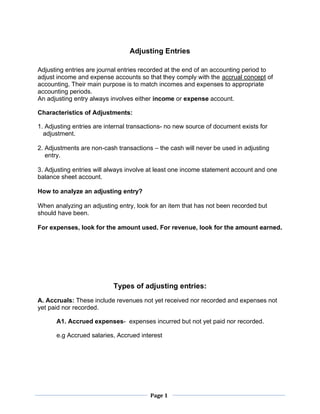
Adjusting entries are journal entries recorded at the end of an accounting period to
adjust income and expense accounts so that they comply with the accrual concept of
accounting. Their main purpose is to match incomes and expenses to appropriate
accounting periods.
An adjusting entry always involves either income or expense account.
Characteristics of Adjustments:
1. Adjusting entries are internal transactions- no new source of document exists for
adjustment.
2. Adjustments are non-cash transactions – the cash will never be used in adjusting
entry.
3. Adjusting entries will always involve at least one income statement account and one
balance sheet account.
How to analyze an adjusting entry?
When analyzing an adjusting entry, look for an item that has not been recorded but
should have been.
For expenses, look for the amount used. For revenue, look for the amount earned.
Types of adjusting entries:
A. Accruals: These include revenues not yet received nor recorded and expenses not
yet paid nor recorded.
A1. Accrued expenses- expenses incurred but not yet paid nor recorded.
e.g Accrued salaries, Accrued interest
Page 2
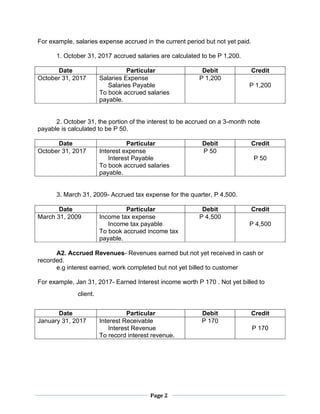
For example, salaries expense accrued in the current period but not yet paid.
1. October 31, 2017 accrued salaries are calculated to be P 1,200.
Date Particular Debit Credit
October 31, 2017 Salaries Expense
Salaries Payable
To book accrued salaries
payable.
P 1,200
P 1,200
2. October 31, the portion of the interest to be accrued on a 3-month note
payable is calculated to be P 50.
Date Particular Debit Credit
October 31, 2017 Interest expense
Interest Payable
To book accrued salaries
payable.
P 50
P 50
3. March 31, 2009- Accrued tax expense for the quarter, P 4,500.
Date Particular Debit Credit
March 31, 2009 Income tax expense
Income tax payable
To book accrued income tax
payable.
P 4,500
P 4,500
A2. Accrued Revenues- Revenues earned but not yet received in cash or
recorded.
e.g interest earned, work completed but not yet billed to customer
For example, Jan 31, 2017- Earned Interest income worth P 170 . Not yet billed to
client.
Date Particular Debit Credit
January 31, 2017 Interest Receivable
Interest Revenue
To record interest revenue.
P 170
P 170
Page 3
B. Prepayments: These are revenues received in advance and recorded as liabilities,
to be recorded as revenue and expenses paid in advance and recorded as assets, to be
recorded as expense.
B1. Prepaid Expenses- advance payment of expenses and recorded as assets.
e.g prepaid insurance, office supplies, prepaid rent, etc.
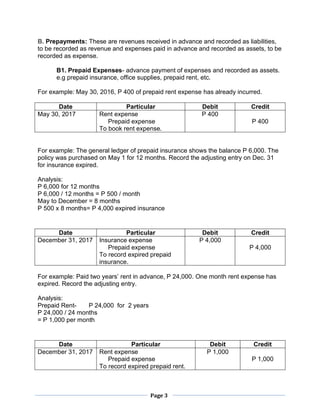
For example: May 30, 2016, P 400 of prepaid rent expense has already incurred.
Date Particular Debit Credit
May 30, 2017 Rent expense
Prepaid expense
To book rent expense.
P 400
P 400
For example: The general ledger of prepaid insurance shows the balance P 6,000. The
policy was purchased on May 1 for 12 months. Record the adjusting entry on Dec. 31
for insurance expired.
Analysis:
P 6,000 for 12 months
P 6,000 / 12 months = P 500 / month
May to December = 8 months
P 500 x 8 months= P 4,000 expired insurance
For example: Paid two years’ rent in advance, P 24,000. One month rent expense has
expired. Record the adjusting entry.
Analysis:
Prepaid Rent- P 24,000 for 2 years
P 24,000 / 24 months
= P 1,000 per month
Date Particular Debit Credit
December 31, 2017 Insurance expense
Prepaid expense
To record expired prepaid
insurance.
P 4,000
P 4,000
Date Particular Debit Credit
December 31, 2017 Rent expense
Prepaid expense
To record expired prepaid rent.
P 1,000
P 1,000
Page 4
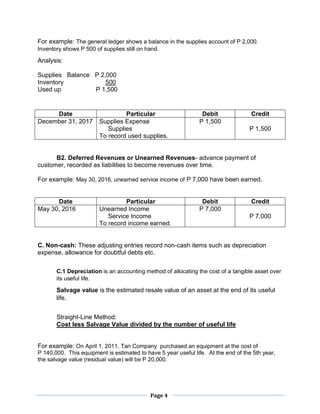
For example: The general ledger shows a balance in the supplies account of P 2,000.
Inventory shows P 500 of supplies still on hand.
Analysis:
Supplies Balance P 2,000
Inventory 500
Used up P 1,500
B2. Deferred Revenues or Unearned Revenues- advance payment of
customer, recorded as liabilities to become revenues over time.
For example: May 30, 2016, unearned service income of P 7,000 have been earned.
C. Non-cash: These adjusting entries record non-cash items such as depreciation
expense, allowance for doubtful debts etc.
C.1 Depreciation is an accounting method of allocating the cost of a tangible asset over
its useful life.
Salvage value is the estimated resale value of an asset at the end of its useful
life.
Straight-Line Method:
Cost less Salvage Value divided by the number of useful life
For example: On April 1, 2011, Tan Company purchased an equipment at the cost of
P 140,000. This equipment is estimated to have 5 year useful life. At the end of the 5th year,
the salvage value (residual value) will be P 20,000.
Date Particular Debit Credit
December 31, 2017 Supplies Expense
Supplies
To record used supplies.
P 1,500
P 1,500
Date Particular Debit Credit
May 30, 2016 Unearned Income
Service Income
To record income earned.
P 7,000
P 7,000
Page 5
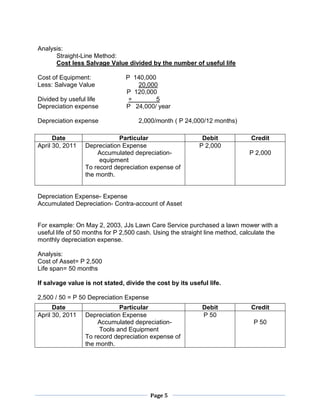
Analysis:
Straight-Line Method:
Cost less Salvage Value divided by the number of useful life
Cost of Equipment: P 140,000
Less: Salvage Value 20,000
P 120,000
Divided by useful life ÷ 5
Depreciation expense P 24,000/ year
Depreciation expense 2,000/month ( P 24,000/12 months)
Depreciation Expense- Expense
Accumulated Depreciation- Contra-account of Asset
For example: On May 2, 2003, JJs Lawn Care Service purchased a lawn mower with a
useful life of 50 months for P 2,500 cash. Using the straight line method, calculate the
monthly depreciation expense.
Analysis:
Cost of Asset= P 2,500
Life span= 50 months
If salvage value is not stated, divide the cost by its useful life.
2,500 / 50 = P 50 Depreciation Expense
Date Particular Debit Credit
April 30, 2011 Depreciation Expense
Accumulated depreciation-
equipment
To record depreciation expense of
the month.
P 2,000
P 2,000
Date Particular Debit Credit
April 30, 2011 Depreciation Expense
Accumulated depreciation-
Tools and Equipment
To record depreciation expense of
the month.
P 50
P 50
Page 6
C.2 Bad Debts refers to accounts receivable (or trade accounts receivable) that
will not be collected.
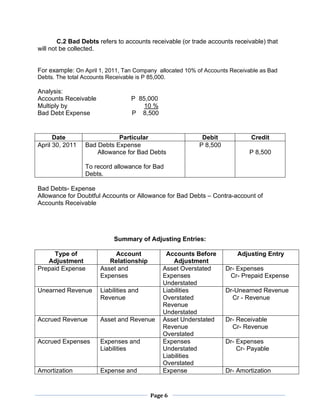
For example: On April 1, 2011, Tan Company allocated 10% of Accounts Receivable as Bad
Debts. The total Accounts Receivable is P 85,000.
Analysis:
Accounts Receivable P 85,000
Multiply by 10 %
Bad Debt Expense P 8,500
Bad Debts- Expense
Allowance for Doubtful Accounts or Allowance for Bad Debts – Contra-account of
Accounts Receivable
Summary of Adjusting Entries:
Type of
Adjustment
Account
Relationship
Accounts Before
Adjustment
Adjusting Entry
Prepaid Expense Asset and
Expenses
Asset Overstated
Expenses
Understated
Dr- Expenses
Cr- Prepaid Expense
Unearned Revenue Liabilities and
Revenue
Liabilities
Overstated
Revenue
Understated
Dr-Unearned Revenue
Cr - Revenue
Accrued Revenue Asset and Revenue Asset Understated
Revenue
Overstated
Dr- Receivable
Cr- Revenue
Accrued Expenses Expenses and
Liabilities
Expenses
Understated
Liabilities
Overstated
Dr- Expenses
Cr- Payable
Amortization Expense and Expense Dr- Amortization
Date Particular Debit Credit
April 30, 2011 Bad Debts Expense
Allowance for Bad Debts
To record allowance for Bad
Debts.
P 8,500
P 8,500
Page 7
Contra-asset Understated
Asset Overstated
Expense
Cr- Accumulated
amortization
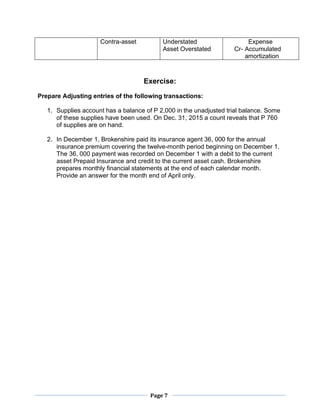
Exercise:
Prepare Adjusting entries of the following transactions:
1. Supplies account has a balance of P 2,000 in the unadjusted trial balance. Some
of these supplies have been used. On Dec. 31, 2015 a count reveals that P 760
of supplies are on hand.
2. In December 1, Brokenshire paid its insurance agent 36, 000 for the annual
insurance premium covering the twelve-month period beginning on December 1.
The 36, 000 payment was recorded on December 1 with a debit to the current
asset Prepaid Insurance and credit to the current asset cash. Brokenshire
prepares monthly financial statements at the end of each calendar month.
Provide an answer for the month end of April only.

Adjusting entries bookkeeping

  • 1.
    Page 1 Adjusting Entries Adjustingentries are journal entries recorded at the end of an accounting period to adjust income and expense accounts so that they comply with the accrual concept of accounting. Their main purpose is to match incomes and expenses to appropriate accounting periods. An adjusting entry always involves either income or expense account. Characteristics of Adjustments: 1. Adjusting entries are internal transactions- no new source of document exists for adjustment. 2. Adjustments are non-cash transactions – the cash will never be used in adjusting entry. 3. Adjusting entries will always involve at least one income statement account and one balance sheet account. How to analyze an adjusting entry? When analyzing an adjusting entry, look for an item that has not been recorded but should have been. For expenses, look for the amount used. For revenue, look for the amount earned. Types of adjusting entries: A. Accruals: These include revenues not yet received nor recorded and expenses not yet paid nor recorded. A1. Accrued expenses- expenses incurred but not yet paid nor recorded. e.g Accrued salaries, Accrued interest
  • 2.
    Page 2 For example,salaries expense accrued in the current period but not yet paid. 1. October 31, 2017 accrued salaries are calculated to be P 1,200. Date Particular Debit Credit October 31, 2017 Salaries Expense Salaries Payable To book accrued salaries payable. P 1,200 P 1,200 2. October 31, the portion of the interest to be accrued on a 3-month note payable is calculated to be P 50. Date Particular Debit Credit October 31, 2017 Interest expense Interest Payable To book accrued salaries payable. P 50 P 50 3. March 31, 2009- Accrued tax expense for the quarter, P 4,500. Date Particular Debit Credit March 31, 2009 Income tax expense Income tax payable To book accrued income tax payable. P 4,500 P 4,500 A2. Accrued Revenues- Revenues earned but not yet received in cash or recorded. e.g interest earned, work completed but not yet billed to customer For example, Jan 31, 2017- Earned Interest income worth P 170 . Not yet billed to client. Date Particular Debit Credit January 31, 2017 Interest Receivable Interest Revenue To record interest revenue. P 170 P 170
  • 3.
    Page 3 B. Prepayments:These are revenues received in advance and recorded as liabilities, to be recorded as revenue and expenses paid in advance and recorded as assets, to be recorded as expense. B1. Prepaid Expenses- advance payment of expenses and recorded as assets. e.g prepaid insurance, office supplies, prepaid rent, etc. For example: May 30, 2016, P 400 of prepaid rent expense has already incurred. Date Particular Debit Credit May 30, 2017 Rent expense Prepaid expense To book rent expense. P 400 P 400 For example: The general ledger of prepaid insurance shows the balance P 6,000. The policy was purchased on May 1 for 12 months. Record the adjusting entry on Dec. 31 for insurance expired. Analysis: P 6,000 for 12 months P 6,000 / 12 months = P 500 / month May to December = 8 months P 500 x 8 months= P 4,000 expired insurance For example: Paid two years’ rent in advance, P 24,000. One month rent expense has expired. Record the adjusting entry. Analysis: Prepaid Rent- P 24,000 for 2 years P 24,000 / 24 months = P 1,000 per month Date Particular Debit Credit December 31, 2017 Insurance expense Prepaid expense To record expired prepaid insurance. P 4,000 P 4,000 Date Particular Debit Credit December 31, 2017 Rent expense Prepaid expense To record expired prepaid rent. P 1,000 P 1,000
  • 4.
    Page 4 For example:The general ledger shows a balance in the supplies account of P 2,000. Inventory shows P 500 of supplies still on hand. Analysis: Supplies Balance P 2,000 Inventory 500 Used up P 1,500 B2. Deferred Revenues or Unearned Revenues- advance payment of customer, recorded as liabilities to become revenues over time. For example: May 30, 2016, unearned service income of P 7,000 have been earned. C. Non-cash: These adjusting entries record non-cash items such as depreciation expense, allowance for doubtful debts etc. C.1 Depreciation is an accounting method of allocating the cost of a tangible asset over its useful life. Salvage value is the estimated resale value of an asset at the end of its useful life. Straight-Line Method: Cost less Salvage Value divided by the number of useful life For example: On April 1, 2011, Tan Company purchased an equipment at the cost of P 140,000. This equipment is estimated to have 5 year useful life. At the end of the 5th year, the salvage value (residual value) will be P 20,000. Date Particular Debit Credit December 31, 2017 Supplies Expense Supplies To record used supplies. P 1,500 P 1,500 Date Particular Debit Credit May 30, 2016 Unearned Income Service Income To record income earned. P 7,000 P 7,000
  • 5.
    Page 5 Analysis: Straight-Line Method: Costless Salvage Value divided by the number of useful life Cost of Equipment: P 140,000 Less: Salvage Value 20,000 P 120,000 Divided by useful life ÷ 5 Depreciation expense P 24,000/ year Depreciation expense 2,000/month ( P 24,000/12 months) Depreciation Expense- Expense Accumulated Depreciation- Contra-account of Asset For example: On May 2, 2003, JJs Lawn Care Service purchased a lawn mower with a useful life of 50 months for P 2,500 cash. Using the straight line method, calculate the monthly depreciation expense. Analysis: Cost of Asset= P 2,500 Life span= 50 months If salvage value is not stated, divide the cost by its useful life. 2,500 / 50 = P 50 Depreciation Expense Date Particular Debit Credit April 30, 2011 Depreciation Expense Accumulated depreciation- equipment To record depreciation expense of the month. P 2,000 P 2,000 Date Particular Debit Credit April 30, 2011 Depreciation Expense Accumulated depreciation- Tools and Equipment To record depreciation expense of the month. P 50 P 50
  • 6.
    Page 6 C.2 BadDebts refers to accounts receivable (or trade accounts receivable) that will not be collected. For example: On April 1, 2011, Tan Company allocated 10% of Accounts Receivable as Bad Debts. The total Accounts Receivable is P 85,000. Analysis: Accounts Receivable P 85,000 Multiply by 10 % Bad Debt Expense P 8,500 Bad Debts- Expense Allowance for Doubtful Accounts or Allowance for Bad Debts – Contra-account of Accounts Receivable Summary of Adjusting Entries: Type of Adjustment Account Relationship Accounts Before Adjustment Adjusting Entry Prepaid Expense Asset and Expenses Asset Overstated Expenses Understated Dr- Expenses Cr- Prepaid Expense Unearned Revenue Liabilities and Revenue Liabilities Overstated Revenue Understated Dr-Unearned Revenue Cr - Revenue Accrued Revenue Asset and Revenue Asset Understated Revenue Overstated Dr- Receivable Cr- Revenue Accrued Expenses Expenses and Liabilities Expenses Understated Liabilities Overstated Dr- Expenses Cr- Payable Amortization Expense and Expense Dr- Amortization Date Particular Debit Credit April 30, 2011 Bad Debts Expense Allowance for Bad Debts To record allowance for Bad Debts. P 8,500 P 8,500
  • 7.
    Page 7 Contra-asset Understated AssetOverstated Expense Cr- Accumulated amortization Exercise: Prepare Adjusting entries of the following transactions: 1. Supplies account has a balance of P 2,000 in the unadjusted trial balance. Some of these supplies have been used. On Dec. 31, 2015 a count reveals that P 760 of supplies are on hand. 2. In December 1, Brokenshire paid its insurance agent 36, 000 for the annual insurance premium covering the twelve-month period beginning on December 1. The 36, 000 payment was recorded on December 1 with a debit to the current asset Prepaid Insurance and credit to the current asset cash. Brokenshire prepares monthly financial statements at the end of each calendar month. Provide an answer for the month end of April only.