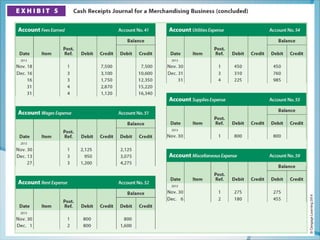
c. 2014 Cengage Learning. All Rights Reserved. May not be copied, scanned, or duplicated, or posted to a publicly accessible website, in whole or in part.
Analyzing
Analyzing
Transactions
Transactions
Chapter 2
Chapter 2
Learning Objectives
Learning Objectives
1.
1. Describe the characteristics of an account and a
Describe the characteristics of an account and a
chart of accounts.
chart of accounts.
2.
2. Describe and illustrate journalizing transactions
Describe and illustrate journalizing transactions
using the double-entry accounting system.
3.
3. Describe and illustrate the journalizing and
Describe and illustrate the journalizing and
posting of transactions to accounts.
4.
4. Prepare an unadjusted trial balance and explain
Prepare an unadjusted trial balance and explain
how it can be used to discover errors.
5.
5. Describe and illustrate the use of horizontal
Describe and illustrate the use of horizontal
analysis in evaluating a company’s performance
and financial condition.
c. 2014 Cengage Learning. All Rights Reserved. May not be copied, scanned, or duplicated, or posted to a publicly accessible website, in whole or in part.
Learning Objective
Learning Objective
Describe the characteristics of an
account and a chart of
accounts
accounts
1
1
Using Accounts to Record Transactions
o Accounting systems are designed to show the
Accounting systems are designed to show the
increases and decreases in each accounting
equation element as a separate record.This
record is called an
record is called an account
account.
.
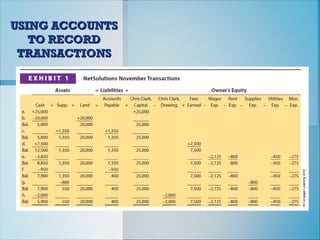
USING ACCOUNTS
USING ACCOUNTS
TO RECORD
TO RECORD
TRANSACTIONS
TRANSACTIONS
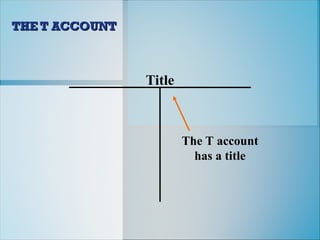
THE T ACCOUNT
THE T ACCOUNT
The T account
has a title
Title
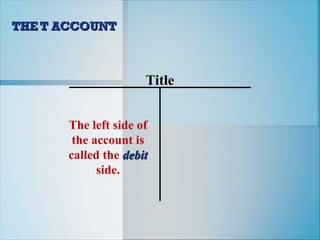
THE T ACCOUNT
THE T ACCOUNT
The left side of
the account is
called the debit
debit
side.
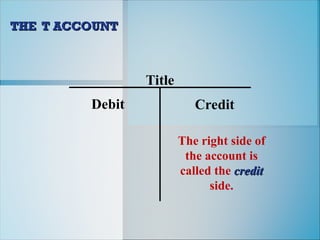
Title
Title
Debit
The right side of
the account is
called the credit
credit
side.
Credit
THE T ACCOUNT
THE T ACCOUNT
THE T ACCOUNT
THE T ACCOUNT
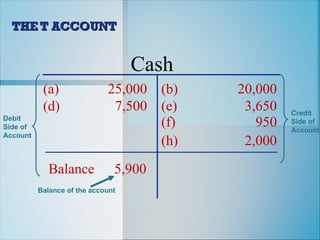
Cash
(a) 25,000 (b) 20,000
(d) 7,500 (e) 3,650
(f) 950
(h) 2,000
Balance 5,900
Debit
Side of
Account
Credit
Side of
Account
Balance of the account
Chart of Accounts
Chart of Accounts
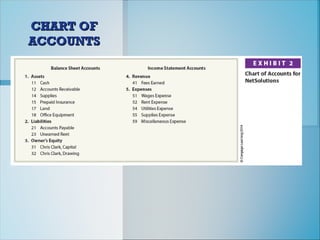
o A group of accounts for a business entity is
A group of accounts for a business entity is
called a
called a ledger
ledger.
.
o A list of the accounts in the ledger is called a
A list of the accounts in the ledger is called a
chart of accounts
chart of accounts.
.
Chart of Accounts
Chart of Accounts
o Assets
Assets are resources owned by the business.
are resources owned by the business.
Some examples of assets follow:
 Cash
Cash
 Supplies
Supplies
 Accounts receivable
Accounts receivable
 Buildings
Buildings
Chart of Accounts
Chart of Accounts
o Liabilities
Liabilities are debts owed to outsiders
are debts owed to outsiders
(creditors). Some examples of liabilities follow:
 Accounts payable
Accounts payable
 Notes payable
Notes payable
 Wages payable
Wages payable
 Interest payable
Interest payable
Chart of Accounts
Chart of Accounts
o Owner’s equity
Owner’s equity is the owner’s right to the
is the owner’s right to the
assets of the business after all liabilities have
been paid. For a proprietorship, the owner’s
equity is represented by the balance of the
owner’s
owner’s capital account
capital account.
.
o A
A drawing
drawing account represents the amount of
account represents the amount of
withdrawals made by the owner.
Chart of Accounts
Chart of Accounts
o Revenues
Revenues are increases in owner’s equity as a
are increases in owner’s equity as a
result of selling services or products to
customers. Some examples of revenue
accounts follow:
accounts follow:
 Fees earned
Fees earned
 Commission revenue
Commission revenue
 Rent revenue
Rent revenue
Chart of Accounts
Chart of Accounts
o The using up of assets or consuming services
The using up of assets or consuming services
in the process of generating revenues results in
expenses
expenses. Some examples of expenses follow:
. Some examples of expenses follow:
 Wages expense
Wages expense
 Rent expense
Rent expense
 Miscellaneous expense
Miscellaneous expense
CHART OF
CHART OF
ACCOUNTS
ACCOUNTS
c. 2014 Cengage Learning. All Rights Reserved. May not be copied, scanned, or duplicated, or posted to a publicly accessible website, in whole or in part.
Learning Objective
Learning Objective
Describe and illustrate journalizing
transactions using the double-entry
accounting system
accounting system
2
2
Double-Entry Accounting System
o All businesses use what is called the
All businesses use what is called the double-
double-
entry accounting system
entry accounting system.This system is based
.This system is based
on the accounting equation and requires:
 Every business transaction to be recorded in at least
Every business transaction to be recorded in at least
two accounts.
two accounts.
 The total debits recorded for each transaction to be
The total debits recorded for each transaction to be
equal to the total credits recorded.
Balance Sheet Accounts
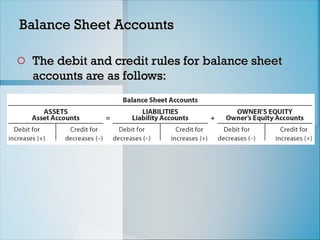
o The debit and credit rules for balance sheet
The debit and credit rules for balance sheet
accounts are as follows:
Income Statement Accounts
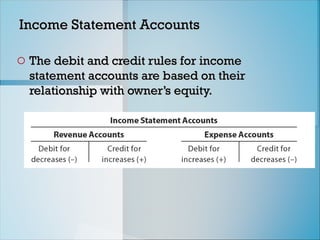
o The debit and credit rules for income
The debit and credit rules for income
statement accounts are based on their
relationship with owner’s equity.
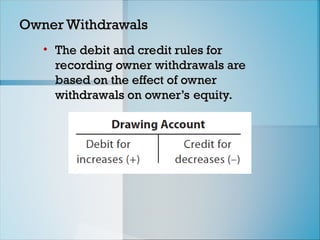
Owner Withdrawals
Owner Withdrawals
• The debit and credit rules for
The debit and credit rules for
recording owner withdrawals are
based on the effect of owner
withdrawals on owner’s equity.
Normal Balances
Normal Balances
o The sum of the increases in an account is
The sum of the increases in an account is
usually equal to or greater than the sum of
the decreases in the account. Thus, the
normal balance of
normal balance of an account
an account is either a
is either a
debit or a credit depending on whether
increases in the account are recorded as
debits or credits.
debits or credits.
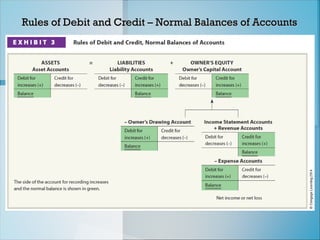
Rules of Debit and Credit – Normal Balances of Accounts
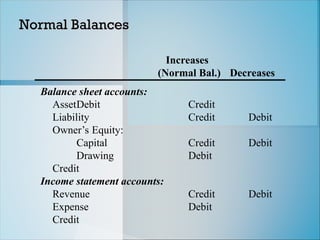
Normal Balances
Normal Balances
Increases
(Normal Bal.) Decreases
Balance sheet accounts:
AssetDebit Credit
Liability Credit Debit
Owner’s Equity:
Capital Credit Debit
Drawing Debit
Credit
Income statement accounts:
Revenue Credit Debit
Expense Debit
Credit
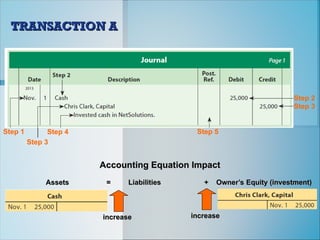
Transaction A
Transaction A
o On November 1, Chris Clark opens a new
On November 1, Chris Clark opens a new
business and deposits $25,000 in a bank account in
the name of NetSolutions.
TRANSACTION A
TRANSACTION A
Step 1 Step 4 Step 5
Step 3
Assets = Liabilities + Owner’s Equity (investment)
Accounting Equation Impact
increase
increase increase
increase
Step 2
Step 3
(continued)
Journalizing
Journalizing
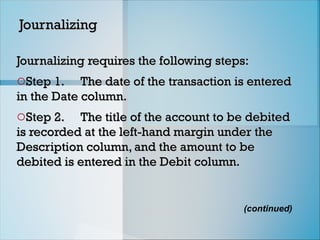
Journalizing requires the following steps:
oStep 1.
Step 1. The date of the transaction is entered
The date of the transaction is entered
in the Date column.
in the Date column.
oStep 2.
Step 2. The title of the account to be debited
The title of the account to be debited
is recorded at the left-hand margin under the
Description column, and the amount to be
debited is entered in the Debit column.
(continued)
Journalizing
Journalizing
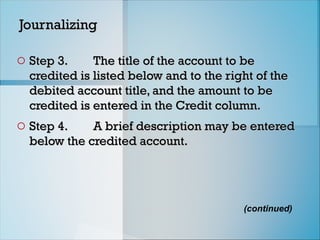
o Step 3.
Step 3. The title of the account to be
The title of the account to be
credited is listed below and to the right of the
debited account title, and the amount to be
credited is entered in the Credit column.
o Step 4.
Step 4. A brief description may be entered
A brief description may be entered
below the credited account.
Journalizing
Journalizing
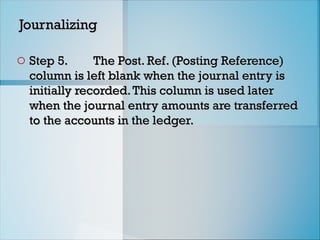
o Step 5.
Step 5. The Post. Ref. (Posting Reference)
The Post. Ref. (Posting Reference)
column is left blank when the journal entry is
initially recorded.This column is used later
when the journal entry amounts are transferred
to the accounts in the ledger.
Journalizing
Journalizing
o A transaction is initially entered in a record
A transaction is initially entered in a record
called a
called a journal
journal.
.
Journalizing
Journalizing
o A transaction is initially entered in a record
A transaction is initially entered in a record
called a journal.
called a journal.
o The process of recording a transaction in the
The process of recording a transaction in the
journal is called
journal is called journalizing
journalizing.
.
Journalizing
Journalizing
o A transaction is initially entered in a record
A transaction is initially entered in a record
called a journal.
called a journal.
o The process of recording a transaction in the
The process of recording a transaction in the
journal is called journalizing.
o The entry in the journal is called a
The entry in the journal is called a journal
journal
entry
entry.
.
Transaction B
Transaction B
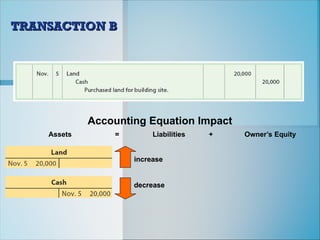
o On November 5, NetSolutions paid $20,000 for
On November 5, NetSolutions paid $20,000 for
the purchase of land as a future building site.
TRANSACTION B
TRANSACTION B
Accounting Equation Impact
Assets = Liabilities + Owner’s Equity
increase
increase
decrease
decrease
Transaction C
Transaction C
o On November 10, NetSolutions purchased
On November 10, NetSolutions purchased
supplies on account for $1,350.
TRANSACTION C
TRANSACTION C
Accounting Equation Impact
Assets = Liabilities + Owner’s Equity
increase
increase increase
increase
Transaction D
Transaction D
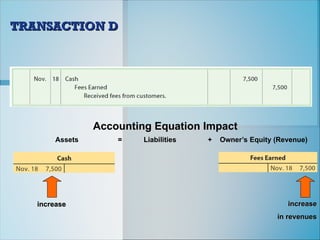
o On November 18, NetSolutions received cash
On November 18, NetSolutions received cash
of $7,500 from customers for services
provided.
provided.
Accounting Equation Impact
Assets = Liabilities + Owner’s Equity (Revenue)
increase
increase increase
increase
in revenues
in revenues
TRANSACTION D
TRANSACTION D
Transaction E
Transaction E
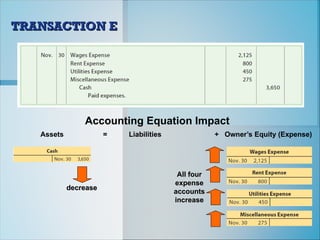
o On November 30, NetSolutions incurred the
On November 30, NetSolutions incurred the
following expenses: wages, $2,125; rent, $800;
utilities, $450; and miscellaneous, $275.
Accounting Equation Impact
Assets = Liabilities + Owner’s Equity (Expense)
decrease
decrease
All four
All four
expense
expense
accounts
accounts
increase
increase
TRANSACTION E
TRANSACTION E
Transaction F
Transaction F
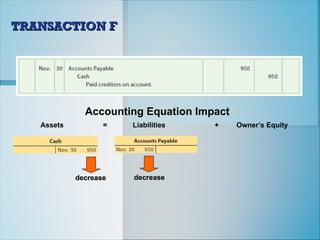
o On November 30, NetSolutions paid creditors
On November 30, NetSolutions paid creditors
on account, $950.
on account, $950.
Accounting Equation Impact
Assets = Liabilities + Owner’s Equity
decrease
decrease
decrease
decrease
TRANSACTION F
TRANSACTION F
Transaction G
Transaction G
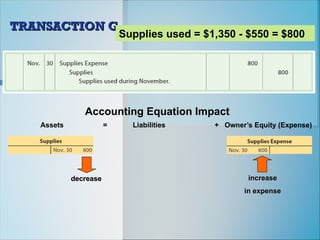
o NetSolutions purchased $1,350 of supplies on
NetSolutions purchased $1,350 of supplies on
November 10. Chris Clark determined that the
cost of supplies on hand on November 30 was
$550.
$550.
Accounting Equation Impact
Assets = Liabilities + Owner’s Equity (Expense)
decrease
decrease increase
increase
in expense
in expense
TRANSACTION G
TRANSACTION G
Supplies used = $1,350 - $550 = $800
Transaction H
Transaction H
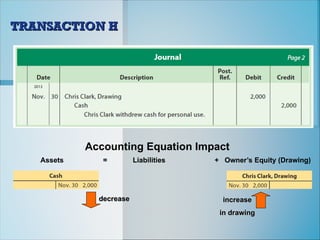
o On November 30, Chris Clark withdrew $2,000
On November 30, Chris Clark withdrew $2,000
from NetSolutions for personal use.
Accounting Equation Impact
Assets = Liabilities + Owner’s Equity (Drawing)
decrease
decrease increase
increase
in drawing
in drawing
TRANSACTION H
TRANSACTION H
c. 2014 Cengage Learning. All Rights Reserved. May not be copied, scanned, or duplicated, or posted to a publicly accessible website, in whole or in part.
Learning Objective
Learning Objective
Describe and illustrate the
journalizing and posting of
transactions to accounts.
3
3
Posting Journal Entries to Accounts
o The process of transferring the debits and
The process of transferring the debits and
credits from the journal entries to the accounts
is called
is called posting
posting.
.
Posting Journal Entries to Accounts
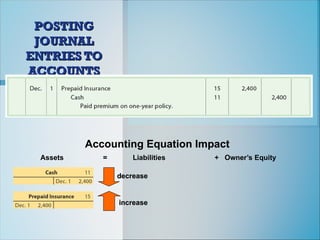
o On December 1, NetSolutions paid a premium
On December 1, NetSolutions paid a premium
of $2,400 for an insurance policy for liability,
theft, and fire.The policy covers a one-year
period.
period.
POSTING
POSTING
JOURNAL
JOURNAL
ENTRIES TO
ENTRIES TO
ACCOUNTS
ACCOUNTS
Accounting Equation Impact
Assets = Liabilities + Owner’s Equity
increase
increase
decrease
decrease
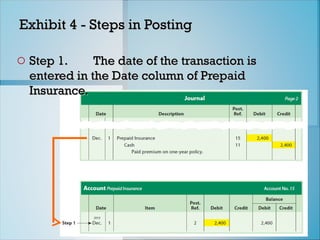
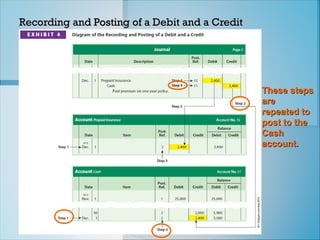
Exhibit 4 - Steps in Posting
o Step 1.
Step 1. The date of the transaction is
The date of the transaction is
entered in the Date column of Prepaid
Insurance.
Insurance.

2,400 2,400
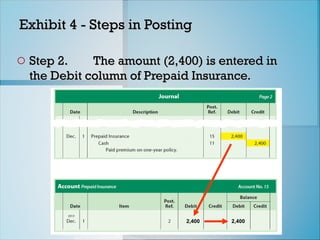
Exhibit 4 - Steps in Posting
o Step 2.
Step 2. The amount (2,400) is entered in
The amount (2,400) is entered in
the Debit column of Prepaid Insurance.
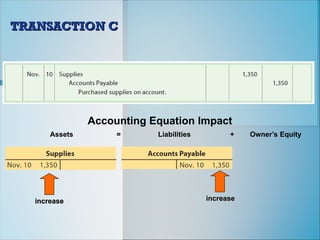

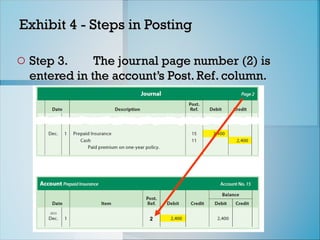
Exhibit 4 - Steps in Posting
o Step 3.
Step 3. The journal page number (2) is
The journal page number (2) is
entered in the account’s Post. Ref. column.
2
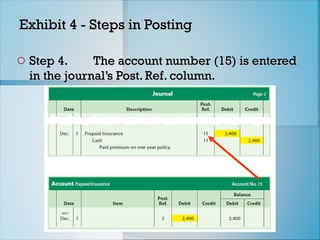
Exhibit 4 - Steps in Posting
o Step 4.
Step 4. The account number (15) is entered
The account number (15) is entered
in the journal’s Post. Ref. column.
Recording and Posting of a Debit and a Credit
These steps
These steps
are
are
repeated to
repeated to
post to the
post to the
Cash
Cash
account.
account.
December Transactions
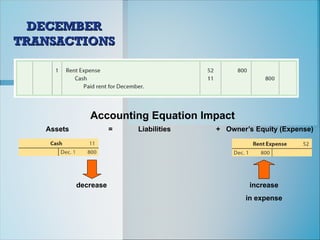
o On December 1, NetSolutions paid rent for
On December 1, NetSolutions paid rent for
December, $800. The company from which
NetSolutions is renting its store space now
requires the payment of rent on the first of
each month, rather than at the end of the
month.
month.
DECEMBER
DECEMBER
TRANSACTIONS
TRANSACTIONS
Accounting Equation Impact
Assets = Liabilities + Owner’s Equity (Expense)
decrease increase
in expense
December Transactions
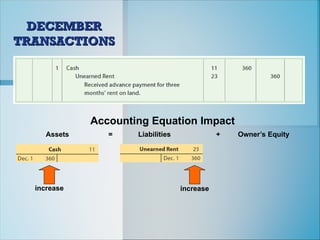
o On December 1, NetSolutions received an offer
On December 1, NetSolutions received an offer
from a local retailer to rent the land purchased on
November 5.The retailer plans to use the land as a
parking lot for its employees and customers.
NetSolutions agreed to rent the land to the retailer
for three months, with the rent payable in advance.
NetSolutions received $360 for three months’ rent
beginning December 1.
o The liability created by receiving the cash in
The liability created by receiving the cash in
advance of providing the service is called
unearned revenue
unearned revenue.
.
DECEMBER
DECEMBER
TRANSACTIONS
TRANSACTIONS
Accounting Equation Impact
Assets = Liabilities + Owner’s Equity
increase
increase
December Transactions
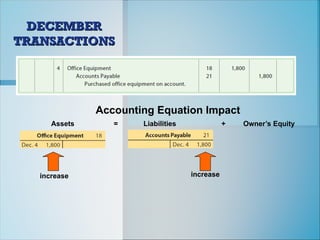
o On December 4, NetSolutions purchased office
On December 4, NetSolutions purchased office
equipment on account from Executive Supply
Co. for $1,800.
Co. for $1,800.
Accounting Equation Impact
Assets = Liabilities + Owner’s Equity
increase increase
DECEMBER
DECEMBER
TRANSACTIONS
TRANSACTIONS
December Transactions
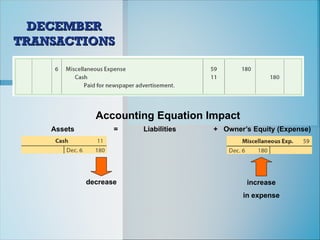
o On December 6, NetSolutions paid $180 for a
On December 6, NetSolutions paid $180 for a
newspaper advertisement.
Accounting Equation Impact
Assets = Liabilities + Owner’s Equity (Expense)
decrease increase
in expense
DECEMBER
DECEMBER
TRANSACTIONS
TRANSACTIONS
December Transactions
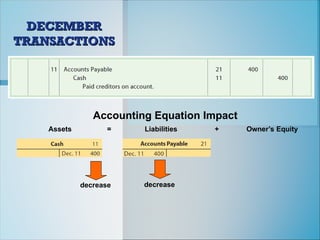
o On December 11, NetSolutions paid creditors
On December 11, NetSolutions paid creditors
$400.
$400.
DECEMBER
DECEMBER
TRANSACTIONS
TRANSACTIONS
Accounting Equation Impact
Assets = Liabilities + Owner’s Equity
decrease decrease
December Transactions
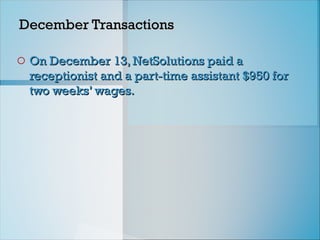
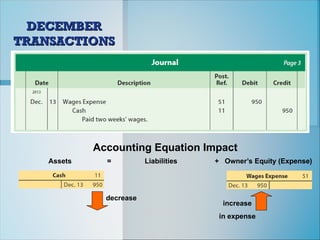
o On December 13, NetSolutions paid a
On December 13, NetSolutions paid a
receptionist and a part-time assistant $950 for
two weeks’ wages.
two weeks’ wages.
DECEMBER
DECEMBER
TRANSACTIONS
TRANSACTIONS
Accounting Equation Impact
Assets = Liabilities + Owner’s Equity (Expense)
decrease
increase
in expense
December Transactions
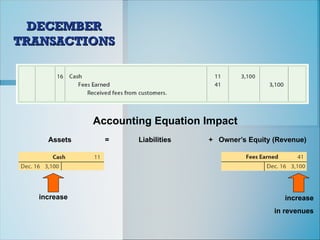
o On December 16, NetSolutions received $3,100
On December 16, NetSolutions received $3,100
from fees earned for the first half of December.
DECEMBER
DECEMBER
TRANSACTIONS
TRANSACTIONS
Accounting Equation Impact
Assets = Liabilities + Owner’s Equity (Revenue)
increase increase
in revenues
December Transactions
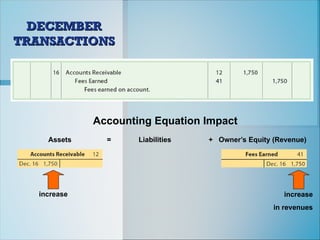
o Fees earned on account totaled $1,750 for the
Fees earned on account totaled $1,750 for the
first half of December.
DECEMBER
DECEMBER
TRANSACTIONS
TRANSACTIONS
Accounting Equation Impact
Assets = Liabilities + Owner’s Equity (Revenue)
increase increase
in revenues
December Transactions
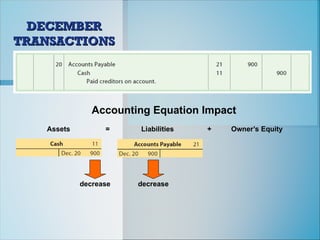
o On December 20, NetSolutions paid $900 to
On December 20, NetSolutions paid $900 to
Executive Supply Co. on the $1,800 debt owed
from the December 4 transaction.
DECEMBER
DECEMBER
TRANSACTIONS
TRANSACTIONS
Accounting Equation Impact
Assets = Liabilities + Owner’s Equity
decrease
decrease
December Transactions
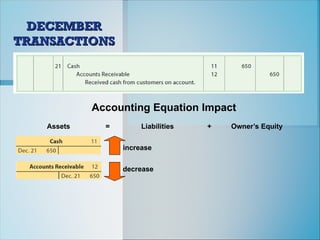
o On December 21, NetSolutions received $650
On December 21, NetSolutions received $650
from customers in payment of their accounts.
DECEMBER
DECEMBER
TRANSACTIONS
TRANSACTIONS
Accounting Equation Impact
Assets = Liabilities + Owner’s Equity
increase
decrease
December Transactions
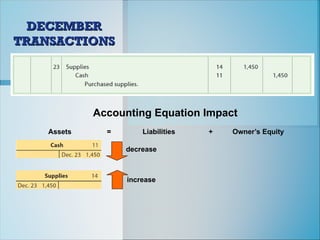
o On December 23, NetSolutions paid $1,450 for
On December 23, NetSolutions paid $1,450 for
supplies.
supplies.
Accounting Equation Impact
Assets = Liabilities + Owner’s Equity
increase
decrease
DECEMBER
DECEMBER
TRANSACTIONS
TRANSACTIONS
December Transactions
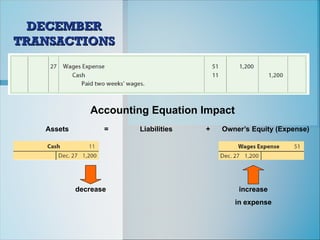
o On December 27, NetSolutions paid the
On December 27, NetSolutions paid the
receptionist and the part-time assistant $1,200
for two weeks’ wages.
Accounting Equation Impact
Assets = Liabilities + Owner’s Equity (Expense)
increase
in expense
decrease
DECEMBER
DECEMBER
TRANSACTIONS
TRANSACTIONS
December Transactions
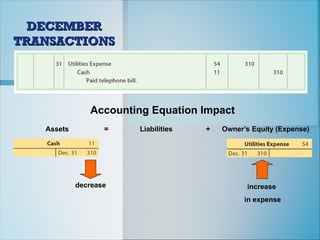
o On December 31, NetSolutions paid its $310
On December 31, NetSolutions paid its $310
telephone bill for the month.
DECEMBER
DECEMBER
TRANSACTIONS
TRANSACTIONS
Accounting Equation Impact
Assets = Liabilities + Owner’s Equity (Expense)
increase
in expense
decrease
December Transactions
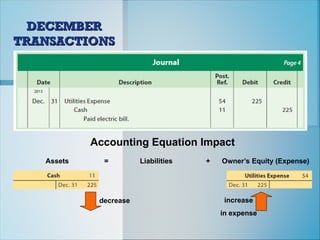
o On December 31, NetSolutions paid its $225
On December 31, NetSolutions paid its $225
electric bill for the month.
Accounting Equation Impact
Assets = Liabilities + Owner’s Equity (Expense)
increase
in expense
decrease
DECEMBER
DECEMBER
TRANSACTIONS
TRANSACTIONS
December Transactions
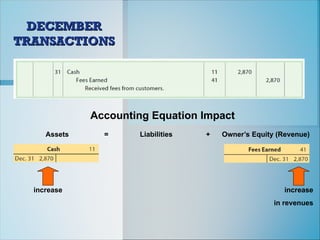
o On December 31, NetSolutions received $2,870
On December 31, NetSolutions received $2,870
from fees earned for the second half of
December.
December.
Accounting Equation Impact
Assets = Liabilities + Owner’s Equity (Revenue)
increase increase
in revenues
DECEMBER
DECEMBER
TRANSACTIONS
TRANSACTIONS
December Transactions
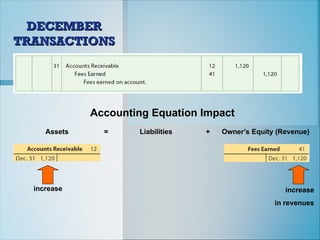
o On December 31, fees earned on account
On December 31, fees earned on account
totaled $1,120 for the second half of
December.
December.
DECEMBER
DECEMBER
TRANSACTIONS
TRANSACTIONS
Accounting Equation Impact
Assets = Liabilities + Owner’s Equity (Revenue)
increase increase
in revenues
December Transactions
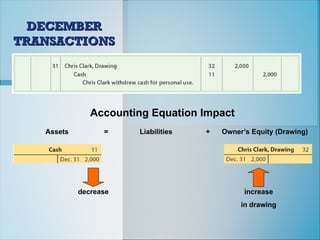
o On December 31, Chris Clark withdrew $2,000
On December 31, Chris Clark withdrew $2,000
for personal use.
for personal use.
Accounting Equation Impact
Assets = Liabilities + Owner’s Equity (Drawing)
increase
in drawing
decrease
DECEMBER
DECEMBER
TRANSACTIONS
TRANSACTIONS
c. 2014 Cengage Learning. All Rights Reserved. May not be copied, scanned, or duplicated, or posted to a publicly accessible website, in whole or in part.
Learning Objective
Learning Objective
Prepare an unadjusted trial balance
and explain how it can be used to
discover errors
discover errors
4
4
Trial Balance
Trial Balance
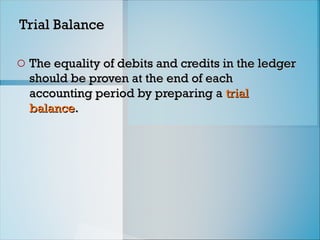
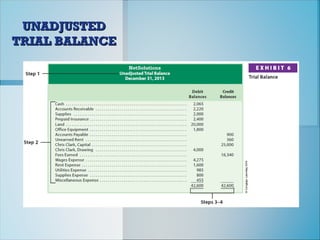
o The equality of debits and credits in the ledger
The equality of debits and credits in the ledger
should be proven at the end of each
accounting period by preparing a
accounting period by preparing a trial
trial
balance
balance.
.
UNADJUSTED
UNADJUSTED
TRIAL BALANCE
TRIAL BALANCE
Trial Balance Errors - Transposition
o A
A transposition
transposition occurs when the order of the
occurs when the order of the
digits is changed by mistake, such as writing
$542 as $452 or $524.
Trial Balance Errors - Slide
o In a
In a slide
slide, the entire number is moved one or
, the entire number is moved one or
more spaces to the right or the left by mistake,
such as writing $542.00 as $54.20 or $97.50 as
$975.00.
$975.00.
Errors Not Affecting the Trial Balance
o If an error has already been journalized and
If an error has already been journalized and
posted to the ledger, a
posted to the ledger, a correcting journal
correcting journal
entry
entry is normally prepared.
is normally prepared.
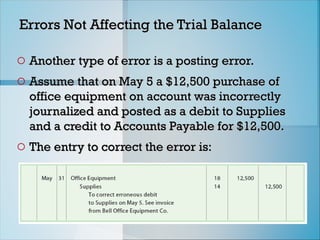
Errors Not Affecting the Trial Balance
o Another type of error is a posting error.
Another type of error is a posting error.
o Assume that on May 5 a $12,500 purchase of
Assume that on May 5 a $12,500 purchase of
office equipment on account was incorrectly
journalized and posted as a debit to Supplies
and a credit to Accounts Payable for $12,500.
o The entry to correct the error is:
The entry to correct the error is:
c. 2014 Cengage Learning. All Rights Reserved. May not be copied, scanned, or duplicated, or posted to a publicly accessible website, in whole or in part.
Learning Objective
Learning Objective
Describe and illustrate the use of
horizontal analysis in evaluating a
company’s performance and
financial condition.
5
5
Horizontal Analysis
Horizontal Analysis
o In
In horizontal analysis
horizontal analysis, the amount of each item
, the amount of each item
on a current financial statement is compared
with the same item on an earlier statement.
Horizontal Analysis
Horizontal Analysis
o In horizontal analysis, the amount of each item
In horizontal analysis, the amount of each item
on a current financial statement is compared
with the same item on an earlier statement.
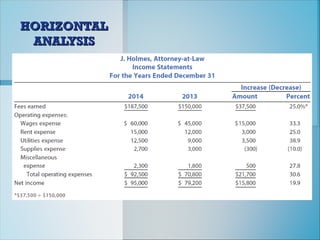
o When two statements are being compared, the
When two statements are being compared, the
earlier statement is used as the base for
computing the amount and the percent of
change.
change.
HORIZONTAL
HORIZONTAL
ANALYSIS
ANALYSIS
c. 2014 Cengage Learning. All Rights Reserved. May not be copied, scanned, or duplicated, or posted to a publicly accessible website, in whole or in part.
Analyzing
Analyzing
Transactions
Transactions
The End
The End

Ch02_WRD25e_Instructor.pptCh02_WRD25e_Instructor.ppt

  • 1.
    c. 2014 CengageLearning. All Rights Reserved. May not be copied, scanned, or duplicated, or posted to a publicly accessible website, in whole or in part. Analyzing Analyzing Transactions Transactions Chapter 2 Chapter 2
  • 2.
    Learning Objectives Learning Objectives 1. 1.Describe the characteristics of an account and a Describe the characteristics of an account and a chart of accounts. chart of accounts. 2. 2. Describe and illustrate journalizing transactions Describe and illustrate journalizing transactions using the double-entry accounting system. using the double-entry accounting system. 3. 3. Describe and illustrate the journalizing and Describe and illustrate the journalizing and posting of transactions to accounts. posting of transactions to accounts. 4. 4. Prepare an unadjusted trial balance and explain Prepare an unadjusted trial balance and explain how it can be used to discover errors. how it can be used to discover errors. 5. 5. Describe and illustrate the use of horizontal Describe and illustrate the use of horizontal analysis in evaluating a company’s performance analysis in evaluating a company’s performance and financial condition. and financial condition.
  • 3.
    c. 2014 CengageLearning. All Rights Reserved. May not be copied, scanned, or duplicated, or posted to a publicly accessible website, in whole or in part. Learning Objective Learning Objective Describe the characteristics of an Describe the characteristics of an account and a chart of account and a chart of accounts accounts 1 1
  • 4.
    Using Accounts toRecord Transactions Using Accounts to Record Transactions o Accounting systems are designed to show the Accounting systems are designed to show the increases and decreases in each accounting increases and decreases in each accounting equation element as a separate record.This equation element as a separate record.This record is called an record is called an account account. .
  • 5.
    USING ACCOUNTS USING ACCOUNTS TORECORD TO RECORD TRANSACTIONS TRANSACTIONS
  • 6.
    THE T ACCOUNT THET ACCOUNT The T account has a title Title
  • 7.
    THE T ACCOUNT THET ACCOUNT The left side of the account is called the debit debit side. Title
  • 8.
    Title Debit The right sideof the account is called the credit credit side. Credit THE T ACCOUNT THE T ACCOUNT
  • 9.
    THE T ACCOUNT THET ACCOUNT Cash (a) 25,000 (b) 20,000 (d) 7,500 (e) 3,650 (f) 950 (h) 2,000 Balance 5,900 Debit Side of Account Credit Side of Account Balance of the account
  • 10.
    Chart of Accounts Chartof Accounts o A group of accounts for a business entity is A group of accounts for a business entity is called a called a ledger ledger. . o A list of the accounts in the ledger is called a A list of the accounts in the ledger is called a chart of accounts chart of accounts. .
  • 11.
    Chart of Accounts Chartof Accounts o Assets Assets are resources owned by the business. are resources owned by the business. Some examples of assets follow: Some examples of assets follow:  Cash Cash  Supplies Supplies  Accounts receivable Accounts receivable  Buildings Buildings
  • 12.
    Chart of Accounts Chartof Accounts o Liabilities Liabilities are debts owed to outsiders are debts owed to outsiders (creditors). Some examples of liabilities follow: (creditors). Some examples of liabilities follow:  Accounts payable Accounts payable  Notes payable Notes payable  Wages payable Wages payable  Interest payable Interest payable
  • 13.
    Chart of Accounts Chartof Accounts o Owner’s equity Owner’s equity is the owner’s right to the is the owner’s right to the assets of the business after all liabilities have assets of the business after all liabilities have been paid. For a proprietorship, the owner’s been paid. For a proprietorship, the owner’s equity is represented by the balance of the equity is represented by the balance of the owner’s owner’s capital account capital account. . o A A drawing drawing account represents the amount of account represents the amount of withdrawals made by the owner. withdrawals made by the owner.
  • 14.
    Chart of Accounts Chartof Accounts o Revenues Revenues are increases in owner’s equity as a are increases in owner’s equity as a result of selling services or products to result of selling services or products to customers. Some examples of revenue customers. Some examples of revenue accounts follow: accounts follow:  Fees earned Fees earned  Commission revenue Commission revenue  Rent revenue Rent revenue
  • 15.
    Chart of Accounts Chartof Accounts o The using up of assets or consuming services The using up of assets or consuming services in the process of generating revenues results in in the process of generating revenues results in expenses expenses. Some examples of expenses follow: . Some examples of expenses follow:  Wages expense Wages expense  Rent expense Rent expense  Miscellaneous expense Miscellaneous expense
  • 16.
  • 17.
    c. 2014 CengageLearning. All Rights Reserved. May not be copied, scanned, or duplicated, or posted to a publicly accessible website, in whole or in part. Learning Objective Learning Objective Describe and illustrate journalizing Describe and illustrate journalizing transactions using the double-entry transactions using the double-entry accounting system accounting system 2 2
  • 18.
    Double-Entry Accounting System Double-EntryAccounting System o All businesses use what is called the All businesses use what is called the double- double- entry accounting system entry accounting system.This system is based .This system is based on the accounting equation and requires: on the accounting equation and requires:  Every business transaction to be recorded in at least Every business transaction to be recorded in at least two accounts. two accounts.  The total debits recorded for each transaction to be The total debits recorded for each transaction to be equal to the total credits recorded. equal to the total credits recorded.
  • 19.
    Balance Sheet Accounts BalanceSheet Accounts o The debit and credit rules for balance sheet The debit and credit rules for balance sheet accounts are as follows: accounts are as follows:
  • 20.
    Income Statement Accounts IncomeStatement Accounts o The debit and credit rules for income The debit and credit rules for income statement accounts are based on their statement accounts are based on their relationship with owner’s equity. relationship with owner’s equity.
  • 21.
    Owner Withdrawals Owner Withdrawals •The debit and credit rules for The debit and credit rules for recording owner withdrawals are recording owner withdrawals are based on the effect of owner based on the effect of owner withdrawals on owner’s equity. withdrawals on owner’s equity.
  • 22.
    Normal Balances Normal Balances oThe sum of the increases in an account is The sum of the increases in an account is usually equal to or greater than the sum of usually equal to or greater than the sum of the decreases in the account. Thus, the the decreases in the account. Thus, the normal balance of normal balance of an account an account is either a is either a debit or a credit depending on whether debit or a credit depending on whether increases in the account are recorded as increases in the account are recorded as debits or credits. debits or credits.
  • 23.
    Rules of Debitand Credit – Normal Balances of Accounts Rules of Debit and Credit – Normal Balances of Accounts
  • 24.
    Normal Balances Normal Balances Increases (NormalBal.) Decreases Balance sheet accounts: AssetDebit Credit Liability Credit Debit Owner’s Equity: Capital Credit Debit Drawing Debit Credit Income statement accounts: Revenue Credit Debit Expense Debit Credit
  • 25.
    Transaction A Transaction A oOn November 1, Chris Clark opens a new On November 1, Chris Clark opens a new business and deposits $25,000 in a bank account in business and deposits $25,000 in a bank account in the name of NetSolutions. the name of NetSolutions.
  • 26.
    TRANSACTION A TRANSACTION A Step1 Step 4 Step 5 Step 3 Assets = Liabilities + Owner’s Equity (investment) Assets = Liabilities + Owner’s Equity (investment) Accounting Equation Impact Accounting Equation Impact increase increase increase increase Step 2 Step 3
  • 27.
    (continued) Journalizing Journalizing Journalizing requires thefollowing steps: Journalizing requires the following steps: oStep 1. Step 1. The date of the transaction is entered The date of the transaction is entered in the Date column. in the Date column. oStep 2. Step 2. The title of the account to be debited The title of the account to be debited is recorded at the left-hand margin under the is recorded at the left-hand margin under the Description column, and the amount to be Description column, and the amount to be debited is entered in the Debit column. debited is entered in the Debit column.
  • 28.
    (continued) Journalizing Journalizing o Step 3. Step3. The title of the account to be The title of the account to be credited is listed below and to the right of the credited is listed below and to the right of the debited account title, and the amount to be debited account title, and the amount to be credited is entered in the Credit column. credited is entered in the Credit column. o Step 4. Step 4. A brief description may be entered A brief description may be entered below the credited account. below the credited account.
  • 29.
    Journalizing Journalizing o Step 5. Step5. The Post. Ref. (Posting Reference) The Post. Ref. (Posting Reference) column is left blank when the journal entry is column is left blank when the journal entry is initially recorded.This column is used later initially recorded.This column is used later when the journal entry amounts are transferred when the journal entry amounts are transferred to the accounts in the ledger. to the accounts in the ledger.
  • 30.
    Journalizing Journalizing o A transactionis initially entered in a record A transaction is initially entered in a record called a called a journal journal. .
  • 31.
    Journalizing Journalizing o A transactionis initially entered in a record A transaction is initially entered in a record called a journal. called a journal. o The process of recording a transaction in the The process of recording a transaction in the journal is called journal is called journalizing journalizing. .
  • 32.
    Journalizing Journalizing o A transactionis initially entered in a record A transaction is initially entered in a record called a journal. called a journal. o The process of recording a transaction in the The process of recording a transaction in the journal is called journalizing. journal is called journalizing. o The entry in the journal is called a The entry in the journal is called a journal journal entry entry. .
  • 33.
    Transaction B Transaction B oOn November 5, NetSolutions paid $20,000 for On November 5, NetSolutions paid $20,000 for the purchase of land as a future building site. the purchase of land as a future building site.
  • 34.
    TRANSACTION B TRANSACTION B AccountingEquation Impact Assets = Liabilities + Owner’s Equity increase increase decrease decrease
  • 35.
    Transaction C Transaction C oOn November 10, NetSolutions purchased On November 10, NetSolutions purchased supplies on account for $1,350. supplies on account for $1,350.
  • 36.
    TRANSACTION C TRANSACTION C AccountingEquation Impact Assets = Liabilities + Owner’s Equity increase increase increase increase
  • 37.
    Transaction D Transaction D oOn November 18, NetSolutions received cash On November 18, NetSolutions received cash of $7,500 from customers for services of $7,500 from customers for services provided. provided.
  • 38.
    Accounting Equation Impact Assets= Liabilities + Owner’s Equity (Revenue) increase increase increase increase in revenues in revenues TRANSACTION D TRANSACTION D
  • 39.
    Transaction E Transaction E oOn November 30, NetSolutions incurred the On November 30, NetSolutions incurred the following expenses: wages, $2,125; rent, $800; following expenses: wages, $2,125; rent, $800; utilities, $450; and miscellaneous, $275. utilities, $450; and miscellaneous, $275.
  • 40.
    Accounting Equation Impact Assets= Liabilities + Owner’s Equity (Expense) decrease decrease All four All four expense expense accounts accounts increase increase TRANSACTION E TRANSACTION E
  • 41.
    Transaction F Transaction F oOn November 30, NetSolutions paid creditors On November 30, NetSolutions paid creditors on account, $950. on account, $950.
  • 42.
    Accounting Equation Impact Assets= Liabilities + Owner’s Equity decrease decrease decrease decrease TRANSACTION F TRANSACTION F
  • 43.
    Transaction G Transaction G oNetSolutions purchased $1,350 of supplies on NetSolutions purchased $1,350 of supplies on November 10. Chris Clark determined that the November 10. Chris Clark determined that the cost of supplies on hand on November 30 was cost of supplies on hand on November 30 was $550. $550.
  • 44.
    Accounting Equation Impact Assets= Liabilities + Owner’s Equity (Expense) decrease decrease increase increase in expense in expense TRANSACTION G TRANSACTION G Supplies used = $1,350 - $550 = $800
  • 45.
    Transaction H Transaction H oOn November 30, Chris Clark withdrew $2,000 On November 30, Chris Clark withdrew $2,000 from NetSolutions for personal use. from NetSolutions for personal use.
  • 46.
    Accounting Equation Impact Assets= Liabilities + Owner’s Equity (Drawing) decrease decrease increase increase in drawing in drawing TRANSACTION H TRANSACTION H
  • 47.
    c. 2014 CengageLearning. All Rights Reserved. May not be copied, scanned, or duplicated, or posted to a publicly accessible website, in whole or in part. Learning Objective Learning Objective Describe and illustrate the Describe and illustrate the journalizing and posting of journalizing and posting of transactions to accounts. transactions to accounts. 3 3
  • 48.
    Posting Journal Entriesto Accounts Posting Journal Entries to Accounts o The process of transferring the debits and The process of transferring the debits and credits from the journal entries to the accounts credits from the journal entries to the accounts is called is called posting posting. .
  • 49.
    Posting Journal Entriesto Accounts Posting Journal Entries to Accounts o On December 1, NetSolutions paid a premium On December 1, NetSolutions paid a premium of $2,400 for an insurance policy for liability, of $2,400 for an insurance policy for liability, theft, and fire.The policy covers a one-year theft, and fire.The policy covers a one-year period. period.
  • 50.
    POSTING POSTING JOURNAL JOURNAL ENTRIES TO ENTRIES TO ACCOUNTS ACCOUNTS AccountingEquation Impact Assets = Liabilities + Owner’s Equity increase increase decrease decrease
  • 51.
    Exhibit 4 -Steps in Posting Exhibit 4 - Steps in Posting o Step 1. Step 1. The date of the transaction is The date of the transaction is entered in the Date column of Prepaid entered in the Date column of Prepaid Insurance. Insurance.
  • 52.
    2,400 2,400 Exhibit 4- Steps in Posting Exhibit 4 - Steps in Posting o Step 2. Step 2. The amount (2,400) is entered in The amount (2,400) is entered in the Debit column of Prepaid Insurance. the Debit column of Prepaid Insurance.
  • 53.
    Exhibit 4 -Steps in Posting Exhibit 4 - Steps in Posting o Step 3. Step 3. The journal page number (2) is The journal page number (2) is entered in the account’s Post. Ref. column. entered in the account’s Post. Ref. column. 2
  • 54.
    Exhibit 4 -Steps in Posting Exhibit 4 - Steps in Posting o Step 4. Step 4. The account number (15) is entered The account number (15) is entered in the journal’s Post. Ref. column. in the journal’s Post. Ref. column.
  • 55.
    Recording and Postingof a Debit and a Credit Recording and Posting of a Debit and a Credit These steps These steps are are repeated to repeated to post to the post to the Cash Cash account. account.
  • 56.
    December Transactions December Transactions oOn December 1, NetSolutions paid rent for On December 1, NetSolutions paid rent for December, $800. The company from which December, $800. The company from which NetSolutions is renting its store space now NetSolutions is renting its store space now requires the payment of rent on the first of requires the payment of rent on the first of each month, rather than at the end of the each month, rather than at the end of the month. month.
  • 57.
    DECEMBER DECEMBER TRANSACTIONS TRANSACTIONS Accounting Equation Impact Assets= Liabilities + Owner’s Equity (Expense) decrease increase in expense
  • 58.
    December Transactions December Transactions oOn December 1, NetSolutions received an offer On December 1, NetSolutions received an offer from a local retailer to rent the land purchased on from a local retailer to rent the land purchased on November 5.The retailer plans to use the land as a November 5.The retailer plans to use the land as a parking lot for its employees and customers. parking lot for its employees and customers. NetSolutions agreed to rent the land to the retailer NetSolutions agreed to rent the land to the retailer for three months, with the rent payable in advance. for three months, with the rent payable in advance. NetSolutions received $360 for three months’ rent NetSolutions received $360 for three months’ rent beginning December 1. beginning December 1. o The liability created by receiving the cash in The liability created by receiving the cash in advance of providing the service is called advance of providing the service is called unearned revenue unearned revenue. .
  • 59.
  • 60.
    December Transactions December Transactions oOn December 4, NetSolutions purchased office On December 4, NetSolutions purchased office equipment on account from Executive Supply equipment on account from Executive Supply Co. for $1,800. Co. for $1,800.
  • 61.
    Accounting Equation Impact Assets= Liabilities + Owner’s Equity increase increase DECEMBER DECEMBER TRANSACTIONS TRANSACTIONS
  • 62.
    December Transactions December Transactions oOn December 6, NetSolutions paid $180 for a On December 6, NetSolutions paid $180 for a newspaper advertisement. newspaper advertisement.
  • 63.
    Accounting Equation Impact Assets= Liabilities + Owner’s Equity (Expense) decrease increase in expense DECEMBER DECEMBER TRANSACTIONS TRANSACTIONS
  • 64.
    December Transactions December Transactions oOn December 11, NetSolutions paid creditors On December 11, NetSolutions paid creditors $400. $400.
  • 65.
  • 66.
    December Transactions December Transactions oOn December 13, NetSolutions paid a On December 13, NetSolutions paid a receptionist and a part-time assistant $950 for receptionist and a part-time assistant $950 for two weeks’ wages. two weeks’ wages.
  • 67.
    DECEMBER DECEMBER TRANSACTIONS TRANSACTIONS Accounting Equation Impact Assets= Liabilities + Owner’s Equity (Expense) decrease increase in expense
  • 68.
    December Transactions December Transactions oOn December 16, NetSolutions received $3,100 On December 16, NetSolutions received $3,100 from fees earned for the first half of December. from fees earned for the first half of December.
  • 69.
    DECEMBER DECEMBER TRANSACTIONS TRANSACTIONS Accounting Equation Impact Assets= Liabilities + Owner’s Equity (Revenue) increase increase in revenues
  • 70.
    December Transactions December Transactions oFees earned on account totaled $1,750 for the Fees earned on account totaled $1,750 for the first half of December. first half of December.
  • 71.
    DECEMBER DECEMBER TRANSACTIONS TRANSACTIONS Accounting Equation Impact Assets= Liabilities + Owner’s Equity (Revenue) increase increase in revenues
  • 72.
    December Transactions December Transactions oOn December 20, NetSolutions paid $900 to On December 20, NetSolutions paid $900 to Executive Supply Co. on the $1,800 debt owed Executive Supply Co. on the $1,800 debt owed from the December 4 transaction. from the December 4 transaction.
  • 73.
  • 74.
    December Transactions December Transactions oOn December 21, NetSolutions received $650 On December 21, NetSolutions received $650 from customers in payment of their accounts. from customers in payment of their accounts.
  • 75.
  • 76.
    December Transactions December Transactions oOn December 23, NetSolutions paid $1,450 for On December 23, NetSolutions paid $1,450 for supplies. supplies.
  • 77.
    Accounting Equation Impact Assets= Liabilities + Owner’s Equity increase decrease DECEMBER DECEMBER TRANSACTIONS TRANSACTIONS
  • 78.
    December Transactions December Transactions oOn December 27, NetSolutions paid the On December 27, NetSolutions paid the receptionist and the part-time assistant $1,200 receptionist and the part-time assistant $1,200 for two weeks’ wages. for two weeks’ wages.
  • 79.
    Accounting Equation Impact Assets= Liabilities + Owner’s Equity (Expense) increase in expense decrease DECEMBER DECEMBER TRANSACTIONS TRANSACTIONS
  • 80.
    December Transactions December Transactions oOn December 31, NetSolutions paid its $310 On December 31, NetSolutions paid its $310 telephone bill for the month. telephone bill for the month.
  • 81.
    DECEMBER DECEMBER TRANSACTIONS TRANSACTIONS Accounting Equation Impact Assets= Liabilities + Owner’s Equity (Expense) increase in expense decrease
  • 82.
    December Transactions December Transactions oOn December 31, NetSolutions paid its $225 On December 31, NetSolutions paid its $225 electric bill for the month. electric bill for the month.
  • 83.
    Accounting Equation Impact Assets= Liabilities + Owner’s Equity (Expense) increase in expense decrease DECEMBER DECEMBER TRANSACTIONS TRANSACTIONS
  • 84.
    December Transactions December Transactions oOn December 31, NetSolutions received $2,870 On December 31, NetSolutions received $2,870 from fees earned for the second half of from fees earned for the second half of December. December.
  • 85.
    Accounting Equation Impact Assets= Liabilities + Owner’s Equity (Revenue) increase increase in revenues DECEMBER DECEMBER TRANSACTIONS TRANSACTIONS
  • 86.
    December Transactions December Transactions oOn December 31, fees earned on account On December 31, fees earned on account totaled $1,120 for the second half of totaled $1,120 for the second half of December. December.
  • 87.
    DECEMBER DECEMBER TRANSACTIONS TRANSACTIONS Accounting Equation Impact Assets= Liabilities + Owner’s Equity (Revenue) increase increase in revenues
  • 88.
    December Transactions December Transactions oOn December 31, Chris Clark withdrew $2,000 On December 31, Chris Clark withdrew $2,000 for personal use. for personal use.
  • 89.
    Accounting Equation Impact Assets= Liabilities + Owner’s Equity (Drawing) increase in drawing decrease DECEMBER DECEMBER TRANSACTIONS TRANSACTIONS
  • 93.
    c. 2014 CengageLearning. All Rights Reserved. May not be copied, scanned, or duplicated, or posted to a publicly accessible website, in whole or in part. Learning Objective Learning Objective Prepare an unadjusted trial balance Prepare an unadjusted trial balance and explain how it can be used to and explain how it can be used to discover errors discover errors 4 4
  • 94.
    Trial Balance Trial Balance oThe equality of debits and credits in the ledger The equality of debits and credits in the ledger should be proven at the end of each should be proven at the end of each accounting period by preparing a accounting period by preparing a trial trial balance balance. .
  • 95.
  • 96.
    Trial Balance Errors- Transposition Trial Balance Errors - Transposition o A A transposition transposition occurs when the order of the occurs when the order of the digits is changed by mistake, such as writing digits is changed by mistake, such as writing $542 as $452 or $524. $542 as $452 or $524.
  • 97.
    Trial Balance Errors- Slide Trial Balance Errors - Slide o In a In a slide slide, the entire number is moved one or , the entire number is moved one or more spaces to the right or the left by mistake, more spaces to the right or the left by mistake, such as writing $542.00 as $54.20 or $97.50 as such as writing $542.00 as $54.20 or $97.50 as $975.00. $975.00.
  • 98.
    Errors Not Affectingthe Trial Balance Errors Not Affecting the Trial Balance o If an error has already been journalized and If an error has already been journalized and posted to the ledger, a posted to the ledger, a correcting journal correcting journal entry entry is normally prepared. is normally prepared.
  • 99.
    Errors Not Affectingthe Trial Balance Errors Not Affecting the Trial Balance o Another type of error is a posting error. Another type of error is a posting error. o Assume that on May 5 a $12,500 purchase of Assume that on May 5 a $12,500 purchase of office equipment on account was incorrectly office equipment on account was incorrectly journalized and posted as a debit to Supplies journalized and posted as a debit to Supplies and a credit to Accounts Payable for $12,500. and a credit to Accounts Payable for $12,500. o The entry to correct the error is: The entry to correct the error is:
  • 100.
    c. 2014 CengageLearning. All Rights Reserved. May not be copied, scanned, or duplicated, or posted to a publicly accessible website, in whole or in part. Learning Objective Learning Objective Describe and illustrate the use of Describe and illustrate the use of horizontal analysis in evaluating a horizontal analysis in evaluating a company’s performance and company’s performance and financial condition. financial condition. 5 5
  • 101.
    Horizontal Analysis Horizontal Analysis oIn In horizontal analysis horizontal analysis, the amount of each item , the amount of each item on a current financial statement is compared on a current financial statement is compared with the same item on an earlier statement. with the same item on an earlier statement.
  • 102.
    Horizontal Analysis Horizontal Analysis oIn horizontal analysis, the amount of each item In horizontal analysis, the amount of each item on a current financial statement is compared on a current financial statement is compared with the same item on an earlier statement. with the same item on an earlier statement. o When two statements are being compared, the When two statements are being compared, the earlier statement is used as the base for earlier statement is used as the base for computing the amount and the percent of computing the amount and the percent of change. change.
  • 103.
  • 104.
    c. 2014 CengageLearning. All Rights Reserved. May not be copied, scanned, or duplicated, or posted to a publicly accessible website, in whole or in part. Analyzing Analyzing Transactions Transactions The End The End