Unit-2:Accounting and Auditing
PART -1
Basic Accounting Principles ; concepts
and postulates
By- Swati Sengar
In simple words, accounting can be
defined as keeping records of all
financial transactions related to an
individual or an entity. And then there
are pre-defined rules and procedures
in the way a transaction should be
accounted for. This is what we call
debit or credit, income or
expenditure, asset or liability. There
are then rules on whether it would be
an asset or an expenditure and so on.
Accounting
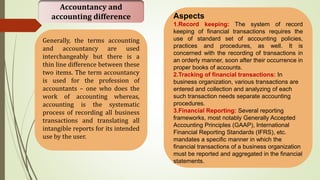
Accountancy and
accounting difference
Generally, the terms accounting
and accountancy are used
interchangeably but there is a
thin line difference between these
two items. The term accountancy
is used for the profession of
accountants – one who does the
work of accounting whereas,
accounting is the systematic
process of recording all business
transactions and translating all
intangible reports for its intended
use by the user.
Aspects
1.Record keeping: The system of record
keeping of financial transactions requires the
use of standard set of accounting policies,
practices and procedures, as well. It is
concerned with the recording of transactions in
an orderly manner, soon after their occurrence in
proper books of accounts.
2.Tracking of financial transactions: In
business organization, various transactions are
entered and collection and analyzing of each
such transaction needs separate accounting
procedures.
3.Financial Reporting: Several reporting
frameworks, most notably Generally Accepted
Accounting Principles (GAAP), International
Financial Reporting Standards (IFRS), etc.
mandates a specific manner in which the
financial transactions of a business organization
must be reported and aggregated in the financial
statements.
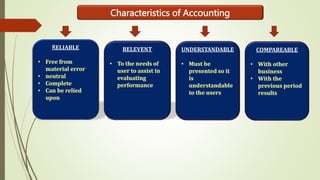
Characteristics of Accounting
RELIABLE RELEVENT UNDERSTANDABLE COMPAREABLE
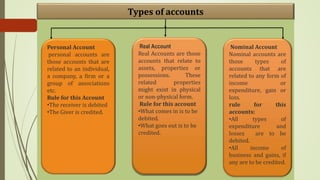
Types of accounts
Personal Account
personal accounts are
those accounts that are
related to an individual,
a company, a firm or a
group of associations
etc.
Rule for this Account
•The receiver is debited
•The Giver is credited.
Real Account
Real Accounts are those
accounts that relate to
assets, properties or
possessions. These
related properties
might exist in physical
or non-physical form.
Rule for this account
•What comes in is to be
debited.
•What goes out is to be
credited.
Nominal Account
Nominal accounts are
those types of
accounts that are
related to any form of
income or
expenditure, gain or
loss.
rule for this
accounts:
•All types of
expenditure and
losses are to be
debited.
•All income of
business and gains, if
any are to be credited.
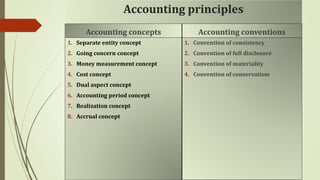
Accounting principles
Accounting concepts
1. Separate entity concept
2. Going concern concept
3. Money measurement concept
4. Cost concept
5. Dual aspect concept
6. Accounting period concept
7. Realization concept
8. Accrual concept
Accounting conventions
1. Convention of consistency
2. Convention of full disclosure
3. Convention of materiality
4. Convention of conservatism
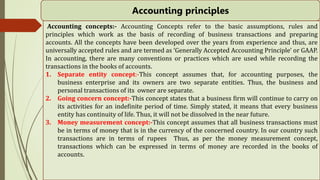
Accounting principles
Accounting concepts:- Accounting Concepts refer to the basic assumptions, rules and
principles which work as the basis of recording of business transactions and preparing
accounts. All the concepts have been developed over the years from experience and thus, are
universally accepted rules and are termed as ‘Generally Accepted Accounting Principle’ or GAAP.
In accounting, there are many conventions or practices which are used while recording the
transactions in the books of accounts.
1. Separate entity concept:-This concept assumes that, for accounting purposes, the
business enterprise and its owners are two separate entities. Thus, the business and
personal transactions of its owner are separate.
2. Going concern concept:-This concept states that a business firm will continue to carry on
its activities for an indefinite period of time. Simply stated, it means that every business
entity has continuity of life. Thus, it will not be dissolved in the near future.
3. Money measurement concept:-This concept assumes that all business transactions must
be in terms of money that is in the currency of the concerned country. In our country such
transactions are in terms of rupees Thus, as per the money measurement concept,
transactions which can be expressed in terms of money are recorded in the books of
accounts.
4. Cost concept:-According to the cost principle, transactions should be listed on financial records
at historical cost – i.e. the original cash value at the time the asset was purchased – rather than the
current market value. The cost principle is also known as the historical cost principle and the historical
cost concept.
5.Dual aspect concept:- Dual aspect is the foundation or basic principle of accounting. It provides the
very basis of recording business transactions in the books of accounts. This concept assumes that
every transaction has a dual effect, i.e. it affects two accounts in their respective opposite sides.
6. Accounting period concept:-According to this concept all assets are recorded in the books of
accounts at their purchase price, which includes cost of acquisition, transportation and installation and
not at its market price. It means that fixed assets like building, plant and machinery, furniture, etc are
recorded in the books of accounts at a price paid for them.
7. Realization concept:-This concept states that revenue from any business transaction should be
included in the accounting records only when it is realised. The term realisation means creation of
legal right to receive money. Selling goods is realisation, receiving order is not.
8. Accrual concept:-The meaning of accrual is something that becomes due especially an amount of
money that is yet to be paid or received at the end of the accounting period. It means that revenues are
recognised when they become receivable.
Accounting conventions
Conventions denote customs or traditions or usages which are in use since long. To be clear, these are
nothing but unwritten laws.
1.Convention of consistency:-The convention of consistency means that same accounting principles
should be used for preparing financial statements year after year. Consistency helps the users of
accounting to make conclusions and draw comparisons between financial statements of different
accounting periods. The financial statements between two or more accounting periods can be only
compared when the accounting convention of consistency is followed.
2.Convention of full disclosure:-Convention of full disclosure requires that all material and relevant
facts concerning financial statements should be fully disclosed. Full disclosure means that there should be
full, fair and adequate disclosure of accounting information.
3.Convention of materiality:-The convention of materiality states that business shall include all the
relevant and material facts separately in the financial statements. Material information refers to facts, if
those are being left out or interpreted in any other way other than what it is in the financial statements, it
could lead to influencing the decisions of users of financial statements.
4. Convention of conservatism:-This convention is based on the principle that “Anticipate no profit, but
provide for all possible losses”. It provides guidance for recording transactions in the books of accounts. It
is based on the policy of playing safe in regard to showing profit . The main objective of this convention
is to show minimum profit.
Thank you

Unit-2 accounting and auditing.pptx

  • 1.
    Unit-2:Accounting and Auditing PART-1 Basic Accounting Principles ; concepts and postulates By- Swati Sengar
  • 2.
    In simple words,accounting can be defined as keeping records of all financial transactions related to an individual or an entity. And then there are pre-defined rules and procedures in the way a transaction should be accounted for. This is what we call debit or credit, income or expenditure, asset or liability. There are then rules on whether it would be an asset or an expenditure and so on. Accounting
  • 3.
    Accountancy and accounting difference Generally,the terms accounting and accountancy are used interchangeably but there is a thin line difference between these two items. The term accountancy is used for the profession of accountants – one who does the work of accounting whereas, accounting is the systematic process of recording all business transactions and translating all intangible reports for its intended use by the user. Aspects 1.Record keeping: The system of record keeping of financial transactions requires the use of standard set of accounting policies, practices and procedures, as well. It is concerned with the recording of transactions in an orderly manner, soon after their occurrence in proper books of accounts. 2.Tracking of financial transactions: In business organization, various transactions are entered and collection and analyzing of each such transaction needs separate accounting procedures. 3.Financial Reporting: Several reporting frameworks, most notably Generally Accepted Accounting Principles (GAAP), International Financial Reporting Standards (IFRS), etc. mandates a specific manner in which the financial transactions of a business organization must be reported and aggregated in the financial statements.
  • 4.
    Characteristics of Accounting RELIABLERELEVENT UNDERSTANDABLE COMPAREABLE
  • 5.
    Types of accounts PersonalAccount personal accounts are those accounts that are related to an individual, a company, a firm or a group of associations etc. Rule for this Account •The receiver is debited •The Giver is credited. Real Account Real Accounts are those accounts that relate to assets, properties or possessions. These related properties might exist in physical or non-physical form. Rule for this account •What comes in is to be debited. •What goes out is to be credited. Nominal Account Nominal accounts are those types of accounts that are related to any form of income or expenditure, gain or loss. rule for this accounts: •All types of expenditure and losses are to be debited. •All income of business and gains, if any are to be credited.
  • 7.
    Accounting principles Accounting concepts 1.Separate entity concept 2. Going concern concept 3. Money measurement concept 4. Cost concept 5. Dual aspect concept 6. Accounting period concept 7. Realization concept 8. Accrual concept Accounting conventions 1. Convention of consistency 2. Convention of full disclosure 3. Convention of materiality 4. Convention of conservatism
  • 8.
    Accounting principles Accounting concepts:-Accounting Concepts refer to the basic assumptions, rules and principles which work as the basis of recording of business transactions and preparing accounts. All the concepts have been developed over the years from experience and thus, are universally accepted rules and are termed as ‘Generally Accepted Accounting Principle’ or GAAP. In accounting, there are many conventions or practices which are used while recording the transactions in the books of accounts. 1. Separate entity concept:-This concept assumes that, for accounting purposes, the business enterprise and its owners are two separate entities. Thus, the business and personal transactions of its owner are separate. 2. Going concern concept:-This concept states that a business firm will continue to carry on its activities for an indefinite period of time. Simply stated, it means that every business entity has continuity of life. Thus, it will not be dissolved in the near future. 3. Money measurement concept:-This concept assumes that all business transactions must be in terms of money that is in the currency of the concerned country. In our country such transactions are in terms of rupees Thus, as per the money measurement concept, transactions which can be expressed in terms of money are recorded in the books of accounts.
  • 9.
    4. Cost concept:-Accordingto the cost principle, transactions should be listed on financial records at historical cost – i.e. the original cash value at the time the asset was purchased – rather than the current market value. The cost principle is also known as the historical cost principle and the historical cost concept. 5.Dual aspect concept:- Dual aspect is the foundation or basic principle of accounting. It provides the very basis of recording business transactions in the books of accounts. This concept assumes that every transaction has a dual effect, i.e. it affects two accounts in their respective opposite sides. 6. Accounting period concept:-According to this concept all assets are recorded in the books of accounts at their purchase price, which includes cost of acquisition, transportation and installation and not at its market price. It means that fixed assets like building, plant and machinery, furniture, etc are recorded in the books of accounts at a price paid for them. 7. Realization concept:-This concept states that revenue from any business transaction should be included in the accounting records only when it is realised. The term realisation means creation of legal right to receive money. Selling goods is realisation, receiving order is not. 8. Accrual concept:-The meaning of accrual is something that becomes due especially an amount of money that is yet to be paid or received at the end of the accounting period. It means that revenues are recognised when they become receivable.
  • 10.
    Accounting conventions Conventions denotecustoms or traditions or usages which are in use since long. To be clear, these are nothing but unwritten laws. 1.Convention of consistency:-The convention of consistency means that same accounting principles should be used for preparing financial statements year after year. Consistency helps the users of accounting to make conclusions and draw comparisons between financial statements of different accounting periods. The financial statements between two or more accounting periods can be only compared when the accounting convention of consistency is followed. 2.Convention of full disclosure:-Convention of full disclosure requires that all material and relevant facts concerning financial statements should be fully disclosed. Full disclosure means that there should be full, fair and adequate disclosure of accounting information. 3.Convention of materiality:-The convention of materiality states that business shall include all the relevant and material facts separately in the financial statements. Material information refers to facts, if those are being left out or interpreted in any other way other than what it is in the financial statements, it could lead to influencing the decisions of users of financial statements. 4. Convention of conservatism:-This convention is based on the principle that “Anticipate no profit, but provide for all possible losses”. It provides guidance for recording transactions in the books of accounts. It is based on the policy of playing safe in regard to showing profit . The main objective of this convention is to show minimum profit.
  • 11.