Accounting for
Promissory Notes
29 July 2013
Introduction
• A promissory note is a written promise
made by a maker, i.e., the person or
business that signs the note, promising to
pay the payee, i.e., the creditor, a certain
amount of money at a fixed determinable
future time which may or may not include
interest.
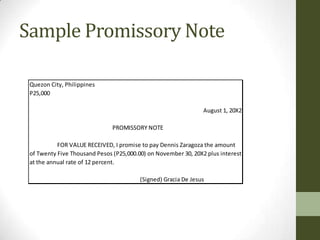
Sample Promissory Note
Quezon City, Philippines
P25,000
August 1, 20X2
PROMISSORY NOTE
FOR VALUE RECEIVED, I promise to pay Dennis Zaragoza the amount
of Twenty Five Thousand Pesos (P25,000.00) on November 30, 20X2 plus interest
at the annual rate of 12 percent.
(Signed) Gracia De Jesus
Components of a Promissory Note:
• Maker. The person or business that signs the note and
promises to pay the amount required by the agreement. The
maker is the debtor.
• Payee. The person or business to whom the maker promises
future payment. The payee is the creditor.
• Principal amount or principal. The amount loaned out by the
payee and borrowed by the maker of the note.
• Interest. The revenue to the payee for loaning out principal
and the expense to the maker for borrowing the principal.
• Interest period or term of the note. The period of time during
which interest is to be computed. It extends from the date of
the note to maturity date.
Components of a Promissory Note:
• Interest rate. The percentage rate that is multiplied to the
principal amount and the term of the note in computing for
the interest.
• Maturity date or due date. The date on which final payment
of the note is due.
• Maturity value. The sum of principal and interest due at the
maturity date of note.
• Place of issue. The locality where the maker executed the
note.
Typical Transactions
• A promissory note may arise from any of the following
transactions:
• A client receives services on goods for which he issues a
promissory note in favor of the company. The client is a debtor
and is the maker of the note. The company to whom the note
was issued is a creditor and is the payee of the note.
• The client has an outstanding account with the company, which
will become due. If the client is not in a position to pay, he could
offer a promissory note to extend time for the payment of his
account
• A loan is extended to a borrower who issues a promissory note.
The borrower is a maker-debtor and the lender is a payee-
creditor.
Interest on Notes
• A promissory note may either be a non-interest or an interest-
bearing note.
• A non-interest bearing note is a promissory note,
which does not provide any payment for interest so
that the amount to be paid at maturity is equal to the
face value of the note.
• An interest-bearing note, on the other hand, is a note
which provides for payment of the interest so that the
amount to be paid at maturity is equal to the maturity
value, i.e., sum of the principal and interest

Accounting for promissory notes 07292013

  • 1.
  • 2.
    Introduction • A promissorynote is a written promise made by a maker, i.e., the person or business that signs the note, promising to pay the payee, i.e., the creditor, a certain amount of money at a fixed determinable future time which may or may not include interest.
  • 3.
    Sample Promissory Note QuezonCity, Philippines P25,000 August 1, 20X2 PROMISSORY NOTE FOR VALUE RECEIVED, I promise to pay Dennis Zaragoza the amount of Twenty Five Thousand Pesos (P25,000.00) on November 30, 20X2 plus interest at the annual rate of 12 percent. (Signed) Gracia De Jesus
  • 4.
    Components of aPromissory Note: • Maker. The person or business that signs the note and promises to pay the amount required by the agreement. The maker is the debtor. • Payee. The person or business to whom the maker promises future payment. The payee is the creditor. • Principal amount or principal. The amount loaned out by the payee and borrowed by the maker of the note. • Interest. The revenue to the payee for loaning out principal and the expense to the maker for borrowing the principal. • Interest period or term of the note. The period of time during which interest is to be computed. It extends from the date of the note to maturity date.
  • 5.
    Components of aPromissory Note: • Interest rate. The percentage rate that is multiplied to the principal amount and the term of the note in computing for the interest. • Maturity date or due date. The date on which final payment of the note is due. • Maturity value. The sum of principal and interest due at the maturity date of note. • Place of issue. The locality where the maker executed the note.
  • 6.
    Typical Transactions • Apromissory note may arise from any of the following transactions: • A client receives services on goods for which he issues a promissory note in favor of the company. The client is a debtor and is the maker of the note. The company to whom the note was issued is a creditor and is the payee of the note. • The client has an outstanding account with the company, which will become due. If the client is not in a position to pay, he could offer a promissory note to extend time for the payment of his account • A loan is extended to a borrower who issues a promissory note. The borrower is a maker-debtor and the lender is a payee- creditor.
  • 7.
    Interest on Notes •A promissory note may either be a non-interest or an interest- bearing note. • A non-interest bearing note is a promissory note, which does not provide any payment for interest so that the amount to be paid at maturity is equal to the face value of the note. • An interest-bearing note, on the other hand, is a note which provides for payment of the interest so that the amount to be paid at maturity is equal to the maturity value, i.e., sum of the principal and interest