František Sudzina
15 - 2
The long term goal
•The goal of every business is to maximize
the benefits for its owners
•We can look at the benefits for owners
from many aspects; the owners’ goals can
be to
•maximize profits,
•to maximize the company’s value, etc.
•These two goals require to produce the
best product with the lowest possible costs
15 - 3
Example
Imagine you have just finished high school and
your uncle has given you 2 million CZK. You
have a couple of options what to do with that
money. You can use it to travel, or you can buy
a luxurious car and find a job for 15,000 CZK
monthly, for example. The third option is that
you use the money to finance your studies
because you expect to earn 50,000 CZK/month
after finishing your studies. This means that
you give up the joy from traveling or from a
luxurious car in order to earn more money in
the future because of additional education.
15 - 4
Capital
•In order to start a business, you need some
investment at the beginning; this investment can
be cash, land, machinery, or our own knowledge
and skills
•The example illustrates the principle of capital
•When the capital is created, there is a decision
to postpone current consumption for the future
•But that is not enough; somebody has to make
an investment – produce a capital good that is
able to increase the work productivity
15 - 5
Capital
•In this case, it was you who was the investor;
you had an investment opportunity – to invest
into your education and the sources for this
investment – a gift from your uncle and your
ability to get a university degree
•It is clear from this example that postponed
consumption or savings precede the investment
•Sometimes the person who is postponing the
consumption is the same person who is making
an investment
15 - 6
Capital
•But in the market economics these are usually
not the same people
•Those, who save, usually do not always have
investment opportunities, and that is why they
lend capital to those, who have opportunities
•For example, they put their savings to banks
and then banks lend this money to companies
with investment opportunities
•Others allocate capital in business companies
so they become their partners or shareholders
15 - 7
Business as a system
•Business is a system whose goal is to change
inputs into outputs
•Inputs can be buildings, machines, material,
human potential
•Output is a product or a service.
•In order to quantify or to compare against each
other or among the industry the individual inputs,
parts, and the results of processes, we need to
convert all of them to a universal value - this
value is money; the way this is done is called
accounting
15 - 8
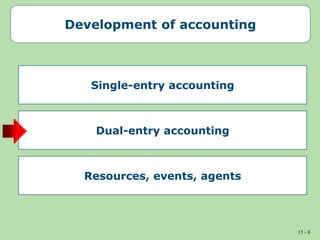
Development of accounting
Single-entry accounting
Dual-entry accounting
Resources, events, agents
15 - 9
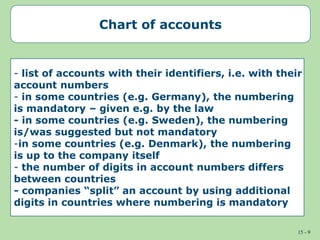
- list of accounts with their identifiers, i.e. with their
account numbers
- in some countries (e.g. Germany), the numbering
is mandatory – given e.g. by the law
- in some countries (e.g. Sweden), the numbering
is/was suggested but not mandatory
-in some countries (e.g. Denmark), the numbering
is up to the company itself
- the number of digits in account numbers differs
between countries
- companies “split” an account by using additional
digits in countries where numbering is mandatory
Chart of accounts
15 - 10
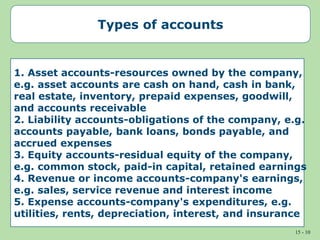
Types of accounts
1. Asset accounts-resources owned by the company,
e.g. asset accounts are cash on hand, cash in bank,
real estate, inventory, prepaid expenses, goodwill,
and accounts receivable
2. Liability accounts-obligations of the company, e.g.
accounts payable, bank loans, bonds payable, and
accrued expenses
3. Equity accounts-residual equity of the company,
e.g. common stock, paid-in capital, retained earnings
4. Revenue or income accounts-company's earnings,
e.g. sales, service revenue and interest income
5. Expense accounts-company's expenditures, e.g.
utilities, rents, depreciation, interest, and insurance
15 - 11
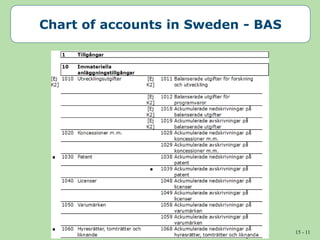
Chart of accounts in Sweden - BAS
15 - 12
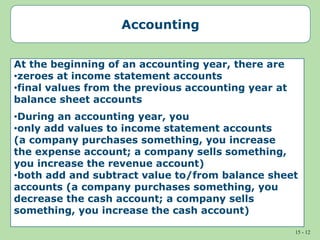
Accounting
At the beginning of an accounting year, there are
•zeroes at income statement accounts
•final values from the previous accounting year at
balance sheet accounts
•During an accounting year, you
•only add values to income statement accounts
(a company purchases something, you increase
the expense account; a company sells something,
you increase the revenue account)
•both add and subtract value to/from balance sheet
accounts (a company purchases something, you
decrease the cash account; a company sells
something, you increase the cash account)
15 - 13
The accrual basis of accounting
recognizes revenues and expenses
when they occur regardless of when
cash is received or disbursed.
The cash basis of accounting recognizes
revenue and expense when cash is
received and disbursed.
Accrual Basis and Cash Basis
15 - 14
Accrual Basis and Cash Basis
The major deficiency of the cash basis
of accounting is that it is incomplete.
It fails to match efforts and accomplishments
in a manner that properly measures economic
performance and financial position.
15 - 15
Adjustments to the Accounts
Under the accrual basis of accounting, record:
1.Explicit transactions-day-to-day routine events
2.Implicit transactions - events that day-to-day
recording procedures temporarily ignore, such as
expiration of prepaid rent or accrual of interest
due to the passage of time.
Explicit transactions are easy to identify because
they are supported by source documents.
Implicit transactions are recorded at the end of
each accounting period by using adjusting entries.
15 - 16
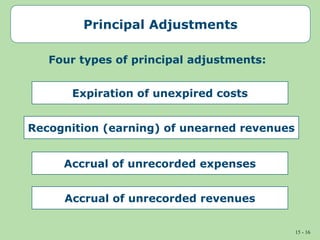
Principal Adjustments
Expiration of unexpired costs
Recognition (earning) of unearned revenues
Accrual of unrecorded expenses
Accrual of unrecorded revenues
Four types of principal adjustments:
15 - 17
Assets other than cash and receivables are viewed as
economic services awaiting future use—prepaid or
stored costs, and they are carried forward to future
periods. The values of assets frequently decline (and
eventually disappear) because of the passage of time.
When a company uses services represented by a
particular cost, the cost expires. An unexpired cost is
any asset that managers expect to become an
expense in future periods.
Adjustment Type I:
Expiration of Unexpired Costs
15 - 18
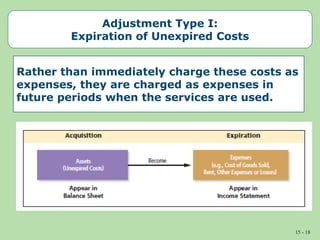
Adjustment Type I:
Expiration of Unexpired Costs
Rather than immediately charge these costs as
expenses, they are charged as expenses in
future periods when the services are used.
15 - 19
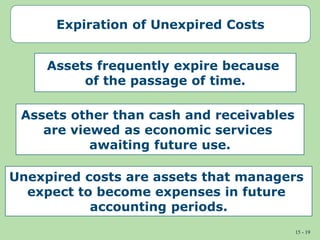
Expiration of Unexpired Costs
Assets other than cash and receivables
are viewed as economic services
awaiting future use.
Assets frequently expire because
of the passage of time.
Unexpired costs are assets that managers
expect to become expenses in future
accounting periods.
15 - 20
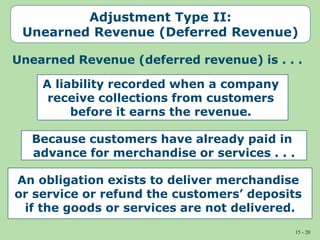
Adjustment Type II:
Unearned Revenue (Deferred Revenue)
Unearned Revenue (deferred revenue) is . . .
Because customers have already paid in
advance for merchandise or services . . .
A liability recorded when a company
receive collections from customers
before it earns the revenue.
An obligation exists to deliver merchandise
or service or refund the customers’ deposits
if the goods or services are not delivered.
15 - 21
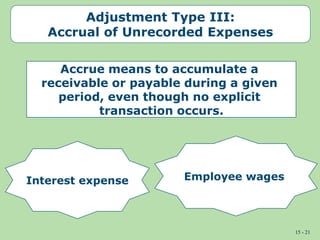
Adjustment Type III:
Accrual of Unrecorded Expenses
Employee wages
Accrue means to accumulate a
receivable or payable during a given
period, even though no explicit
transaction occurs.
Interest expense
15 - 22
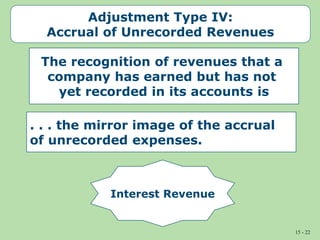
Adjustment Type IV:
Accrual of Unrecorded Revenues
The recognition of revenues that a
company has earned but has not
yet recorded in its accounts is
Interest Revenue
. . . the mirror image of the accrual
of unrecorded expenses.
15 - 23
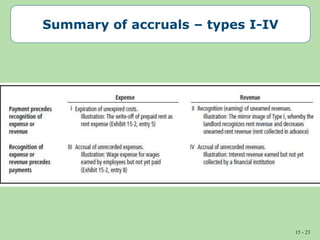
Summary of accruals – types I-IV
15 - 24
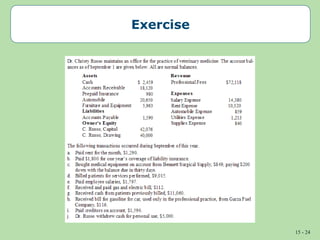
Exercise

Ee04 2016

  • 1.
  • 2.
    15 - 2 Thelong term goal •The goal of every business is to maximize the benefits for its owners •We can look at the benefits for owners from many aspects; the owners’ goals can be to •maximize profits, •to maximize the company’s value, etc. •These two goals require to produce the best product with the lowest possible costs
  • 3.
    15 - 3 Example Imagineyou have just finished high school and your uncle has given you 2 million CZK. You have a couple of options what to do with that money. You can use it to travel, or you can buy a luxurious car and find a job for 15,000 CZK monthly, for example. The third option is that you use the money to finance your studies because you expect to earn 50,000 CZK/month after finishing your studies. This means that you give up the joy from traveling or from a luxurious car in order to earn more money in the future because of additional education.
  • 4.
    15 - 4 Capital •Inorder to start a business, you need some investment at the beginning; this investment can be cash, land, machinery, or our own knowledge and skills •The example illustrates the principle of capital •When the capital is created, there is a decision to postpone current consumption for the future •But that is not enough; somebody has to make an investment – produce a capital good that is able to increase the work productivity
  • 5.
    15 - 5 Capital •Inthis case, it was you who was the investor; you had an investment opportunity – to invest into your education and the sources for this investment – a gift from your uncle and your ability to get a university degree •It is clear from this example that postponed consumption or savings precede the investment •Sometimes the person who is postponing the consumption is the same person who is making an investment
  • 6.
    15 - 6 Capital •Butin the market economics these are usually not the same people •Those, who save, usually do not always have investment opportunities, and that is why they lend capital to those, who have opportunities •For example, they put their savings to banks and then banks lend this money to companies with investment opportunities •Others allocate capital in business companies so they become their partners or shareholders
  • 7.
    15 - 7 Businessas a system •Business is a system whose goal is to change inputs into outputs •Inputs can be buildings, machines, material, human potential •Output is a product or a service. •In order to quantify or to compare against each other or among the industry the individual inputs, parts, and the results of processes, we need to convert all of them to a universal value - this value is money; the way this is done is called accounting
  • 8.
    15 - 8 Developmentof accounting Single-entry accounting Dual-entry accounting Resources, events, agents
  • 9.
    15 - 9 -list of accounts with their identifiers, i.e. with their account numbers - in some countries (e.g. Germany), the numbering is mandatory – given e.g. by the law - in some countries (e.g. Sweden), the numbering is/was suggested but not mandatory -in some countries (e.g. Denmark), the numbering is up to the company itself - the number of digits in account numbers differs between countries - companies “split” an account by using additional digits in countries where numbering is mandatory Chart of accounts
  • 10.
    15 - 10 Typesof accounts 1. Asset accounts-resources owned by the company, e.g. asset accounts are cash on hand, cash in bank, real estate, inventory, prepaid expenses, goodwill, and accounts receivable 2. Liability accounts-obligations of the company, e.g. accounts payable, bank loans, bonds payable, and accrued expenses 3. Equity accounts-residual equity of the company, e.g. common stock, paid-in capital, retained earnings 4. Revenue or income accounts-company's earnings, e.g. sales, service revenue and interest income 5. Expense accounts-company's expenditures, e.g. utilities, rents, depreciation, interest, and insurance
  • 11.
    15 - 11 Chartof accounts in Sweden - BAS
  • 12.
    15 - 12 Accounting Atthe beginning of an accounting year, there are •zeroes at income statement accounts •final values from the previous accounting year at balance sheet accounts •During an accounting year, you •only add values to income statement accounts (a company purchases something, you increase the expense account; a company sells something, you increase the revenue account) •both add and subtract value to/from balance sheet accounts (a company purchases something, you decrease the cash account; a company sells something, you increase the cash account)
  • 13.
    15 - 13 Theaccrual basis of accounting recognizes revenues and expenses when they occur regardless of when cash is received or disbursed. The cash basis of accounting recognizes revenue and expense when cash is received and disbursed. Accrual Basis and Cash Basis
  • 14.
    15 - 14 AccrualBasis and Cash Basis The major deficiency of the cash basis of accounting is that it is incomplete. It fails to match efforts and accomplishments in a manner that properly measures economic performance and financial position.
  • 15.
    15 - 15 Adjustmentsto the Accounts Under the accrual basis of accounting, record: 1.Explicit transactions-day-to-day routine events 2.Implicit transactions - events that day-to-day recording procedures temporarily ignore, such as expiration of prepaid rent or accrual of interest due to the passage of time. Explicit transactions are easy to identify because they are supported by source documents. Implicit transactions are recorded at the end of each accounting period by using adjusting entries.
  • 16.
    15 - 16 PrincipalAdjustments Expiration of unexpired costs Recognition (earning) of unearned revenues Accrual of unrecorded expenses Accrual of unrecorded revenues Four types of principal adjustments:
  • 17.
    15 - 17 Assetsother than cash and receivables are viewed as economic services awaiting future use—prepaid or stored costs, and they are carried forward to future periods. The values of assets frequently decline (and eventually disappear) because of the passage of time. When a company uses services represented by a particular cost, the cost expires. An unexpired cost is any asset that managers expect to become an expense in future periods. Adjustment Type I: Expiration of Unexpired Costs
  • 18.
    15 - 18 AdjustmentType I: Expiration of Unexpired Costs Rather than immediately charge these costs as expenses, they are charged as expenses in future periods when the services are used.
  • 19.
    15 - 19 Expirationof Unexpired Costs Assets other than cash and receivables are viewed as economic services awaiting future use. Assets frequently expire because of the passage of time. Unexpired costs are assets that managers expect to become expenses in future accounting periods.
  • 20.
    15 - 20 AdjustmentType II: Unearned Revenue (Deferred Revenue) Unearned Revenue (deferred revenue) is . . . Because customers have already paid in advance for merchandise or services . . . A liability recorded when a company receive collections from customers before it earns the revenue. An obligation exists to deliver merchandise or service or refund the customers’ deposits if the goods or services are not delivered.
  • 21.
    15 - 21 AdjustmentType III: Accrual of Unrecorded Expenses Employee wages Accrue means to accumulate a receivable or payable during a given period, even though no explicit transaction occurs. Interest expense
  • 22.
    15 - 22 AdjustmentType IV: Accrual of Unrecorded Revenues The recognition of revenues that a company has earned but has not yet recorded in its accounts is Interest Revenue . . . the mirror image of the accrual of unrecorded expenses.
  • 23.
    15 - 23 Summaryof accruals – types I-IV
  • 24.