BUSINESS ACCOUNTING
21BBA2T411
Prof. John Pradeep Kumar
Dept. of Management
KJC, Bengaluru
Unit II
• Double Entry System
• Accounting Cycle
• Preparation of Journal
• Posting to Ledger
• Preparation of Trial Balance
Mr. John Pradeep Kumar, KJC 3
Book- Keeping
• Bookkeeping, often called record keeping, is the part of
accounting that records transactions and business events in the
form of journal entries in the accounting system.
• In other words, bookkeeping is the means by which data is
entered into an accounting system.
• This can either be done manually on a physical ledger pad or
electronically in an accounting program like Quickbooks, and
Tally.
Mr. John Pradeep Kumar, KJC 4
The following are the importance of
bookkeeping:
• Bookkeeping helps to keep track of receipts,
payments. Sales, purchases and record of every
other transaction made from the business.
• It helps to summarize the income, expenditure
and other ledger records periodically.
• It provides information to create financial reports
which tells us specific information about the
business as how much profits the business has
made or how much the business is worth at a
specific point of time.
Types of Bookkeeping Systems
1. Single Entry
• It is incomplete system of recording business
transactions.
• The business organization maintains only cash book and
personal accounts of debtors and creditors.
• So the complete recording of transactions cannot be
made and trail balance cannot be prepared.
Mr. John Pradeep Kumar, KJC 6
Methods/ Types of Accounting
2. Double Entry
• Double Entry is an accounting system that records
the effects of transactions and other events in at
least two accounts with equal debits and credits.
• In this system every business transaction is having a
two fold effect of benefits giving and benefit
receiving aspects.
• The recording is made on the basis of both these
aspects.
Mr. John Pradeep Kumar, KJC 7
Principles of Double Entry System
• For every transaction there are two
aspects.
• One is called Debit and the other is called
Credit.
• The debit and credit aspects of a
transaction are to be identified based on
the principles of double entry system of
accounting.
Mr. John Pradeep Kumar, KJC 8
• Debit refers to entering an amount on the left
side of an account and Credit means to enter
an amount on the right side of an account.
• The abbreviated form of Dr. Stands for Debit
and Cr. Stands for Credit.
• Rules of debit and credit is based on dual
aspect concept i.e. every transaction has Debit
effect and an equivalent credit effect.
Mr. John Pradeep Kumar, KJC 9
• Before deciding which account is to be
debited or credited, it is necessary to decide
the nature of accounts which are influenced
by the business transactions.
• The rules of Debit and Credit are given below
Mr. John Pradeep Kumar, KJC 10
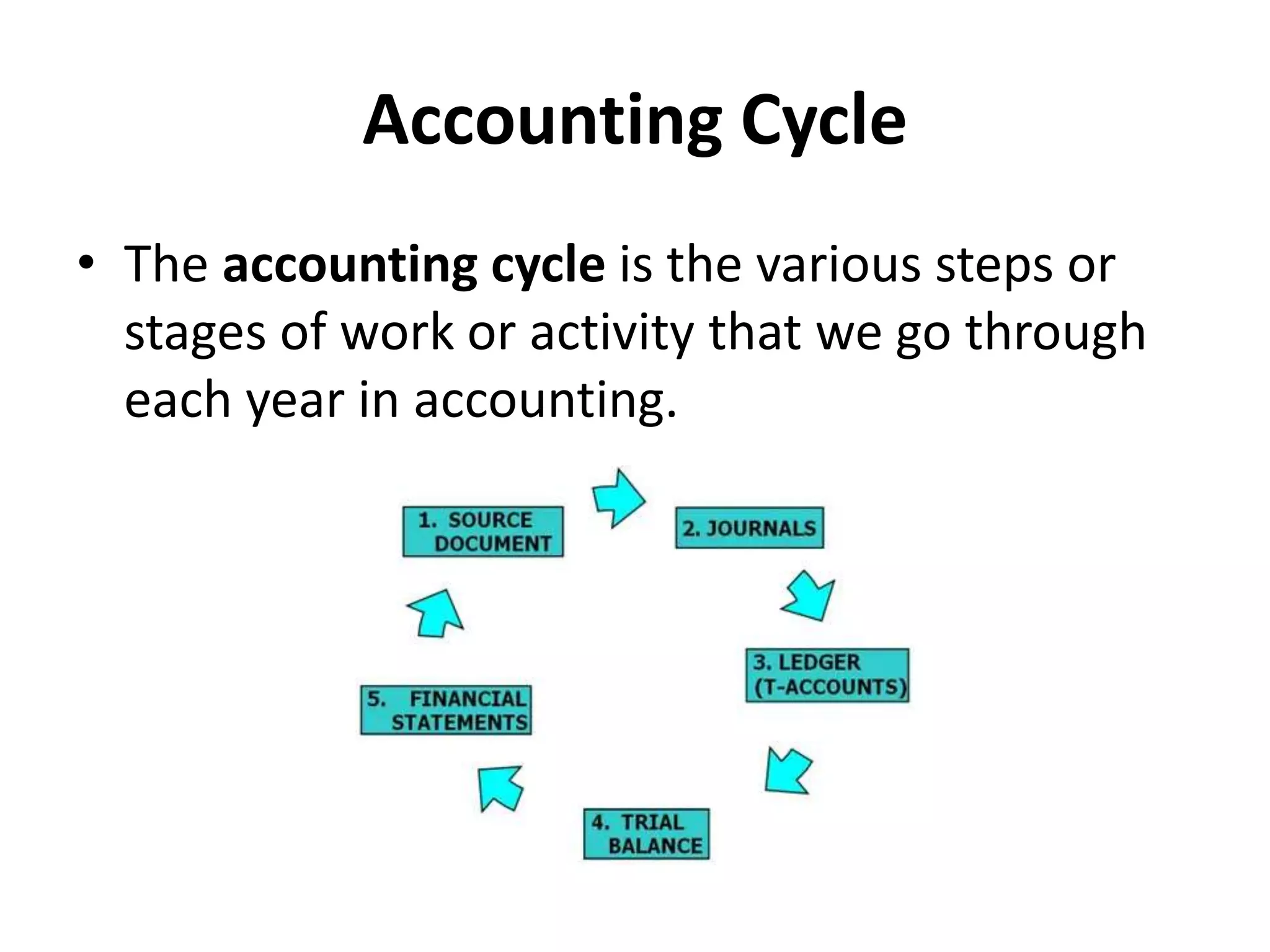
Accounting Cycle
• The accounting cycle is the various steps or
stages of work or activity that we go through
each year in accounting.
Steps in the Accounting Cycle
1. Source Documents: are documents, such
as cash slips, invoices, etc. that form
the source of, and serve as proof for,
a transaction.
2. Journals: Journal entries are that first basic
entry of debit and credit for each transaction,
chronological (date-order) records of
transactions entered into by a business.
Steps in the Accounting Cycle
3. Ledger (T-Accounts): The ledger is a grouping
of the accounts of a business. The accounts are
in the shape of a "T" and thus are often referred
to as T-accounts.
4. The Trial Balance: The trial balance is a sheet
or report displaying all the accounts of a
business, drawn up as a trial (test) of whether
the total of all the debit balances equal the total
of all the credit balances.
5. Financial Statements: The financial
statements are the key reports of a business.
The purpose of the financial statements is to
show the reader the financial position, financial
performance and cash flows of a business.
• Financial statements are usually prepared
once a year, and consist of an income
statement, statement of changes in owners
equity, balance sheet, cash flow
statement and where needed, an auditor’s
report.
• Closing Entries: There is a final step in the
accounting cycle not shown above, which is
the closing off of accounts (or closing
entries), which are done at the end of each
year along with the production of the financial
statements.
• This involves closing out temporary
accounts (incomes and expenses), and
transferring their balances through a profit
account into the owners equity (reserves).
Mr. John Pradeep Kumar, KJC 16
Personal Accounts
• These accounts are related to individuals, firms, companies,
etc. A few examples of personal accounts include debtors,
creditors, banks, outstanding/prepaid accounts, accounts
of credit customers, accounts of goods suppliers, capital,
drawings, etc.
• Natural personal accounts: This type of personal accounts
is the simplest to understand out of all and includes all
god’s creations who have the ability to deal, who, in most
cases, are people. E.g. Kumar’s A/C, Adam’s A/C, etc.
• Artificial personal accounts: Personal accounts which are
created artificially by law, such as corporate bodies
and institutions, are called Artificial personal
accounts. E.g. Pvt. Ltd companies, LLCs(limited liability company),
LLPs(limited liability partnership), clubs, schools, etc.
Mr. John Pradeep Kumar, KJC 17
• Representative personal accounts: Accounts
which represent a certain person or a group
directly or indirectly.
• E.g. Let’s say that wages are paid in advance
to an employee – a wage prepaid account will
be opened in the books of accounts.
• This wages prepaid account is a representative
personal account indirectly linked to
the person.
• E.g. "Wages Outstanding Account", Pre-paid
Insurance Account, advance interest, accrued
salaries
Mr. John Pradeep Kumar, KJC 18
Personal Accounts:
• Rule : Debit the Receiver
Credit the Giver
• According to the above principle, the benefit
receiver’s account is to be debited and the
benefit giver’s account is to be credited.
Mr. John Pradeep Kumar, KJC 19
For Examples:
1. Goods purchased from Ramesh on credit for 2,000
• The two accounts involved in this transaction are goods purchased
A/c and Ramesh A/c. so, Ramesh is the Giver of the goods. Hence
Ramesh account is be credit (i.e. credit the giver rule applies) goods
purchased is expenditure, so nominal account, hence is to be
debited.
2. Cash paid to Mohan Rs. 500
• In this transaction cash ( asset – real account) is going out and
Mohan (personal – personal A/c) is receiving cash. Hence Mohan
account is to be debited and cash account is to be credit.
Mr. John Pradeep Kumar, KJC 20
Real Accounts:(Assets)
• All assets of a firm, which are tangible or intangible, fall
under the category “Real Accounts“.
• Tangible real accounts are related to things that can be
touched and felt physically. A few examples of tangible
real accounts are building, machinery, stock, land, etc.
• Intangible real accounts are related to things that can’t
be touched and felt physically. A few examples of such
real accounts are goodwill, patents, trademarks, etc.
• Rule : Debit What comes in
Credit what goes out
Mr. John Pradeep Kumar, KJC 21
• According to real accounts principle, when an
assets is received by the business, the asset
account is to be debited, when any asset goes
out of the business, the asset account is to be
credited.
• For example:
Purchased office furniture for Rs. 10,000.
• In this transaction office furniture (asset –
Real A/c) is coming in and cash (asset – Real
A/c) is going out. Hence, office furniture
account is to be debited and cash account is to
be credited.
Mr. John Pradeep Kumar, KJC 22
Nominal Accounts
(Expenses, Losses, Incomes, Gains)
• Accounts which are related to expenses, losses,
incomes or gains are called Nominal accounts.
• Nominal accounts do not really exist in physical form,
but behind every nominal account money is
involved.
• E.g. Purchase A/C, Salary A/C, Sales
A/C, Commission received A/C, etc.
• The final result of all nominal accounts is either profit
or loss which is then transferred to the capital
account.
Mr. John Pradeep Kumar, KJC 23
Rule : Debit all Expenses and Losses.
Credit all Incomes and Gains.
• According to normal account principle,
expenses and losses are to be debited and all
incomes and gains of the business are to be
credited.
E.g. Salaries paid Rs. 5000
• In this transaction salaries (expenditure-
nominal A/c) is an item of expenditure and
cash (real A/c) is going out.
Mr. John Pradeep Kumar, KJC 24
Books of Original Entry
• The books in which a transaction is recorded
for the first time from a source document are
called Books of Original Entry or Prime Entry.
• Journal is one of the books of original entry in
which transactions are originally recorded in a
chronological (day-to-day) order according to
the principles of Double Entry System.
Journal
• Journal is a date-wise record of all the
transactions with details of the accounts
debited and credited and the amount of each
transaction.
• Also known as journal proper or general
journal or day book.
• The process of recording transactions in
journal is known as journalising.
Format
Journal of .....................
Ledger Folio (L.F): The page number or folio number of the Ledger, where the posting
has been made from the Journal is recorded in the L.F column of the Journal. Till such
time, this column remains blank.
Mr. John Pradeep Kumar, KJC 28

Business Accounting -Bookkeeping.pdf

  • 1.
    BUSINESS ACCOUNTING 21BBA2T411 Prof. JohnPradeep Kumar Dept. of Management KJC, Bengaluru
  • 2.
    Unit II • DoubleEntry System • Accounting Cycle • Preparation of Journal • Posting to Ledger • Preparation of Trial Balance
  • 3.
    Mr. John PradeepKumar, KJC 3
  • 4.
    Book- Keeping • Bookkeeping,often called record keeping, is the part of accounting that records transactions and business events in the form of journal entries in the accounting system. • In other words, bookkeeping is the means by which data is entered into an accounting system. • This can either be done manually on a physical ledger pad or electronically in an accounting program like Quickbooks, and Tally. Mr. John Pradeep Kumar, KJC 4
  • 5.
    The following arethe importance of bookkeeping: • Bookkeeping helps to keep track of receipts, payments. Sales, purchases and record of every other transaction made from the business. • It helps to summarize the income, expenditure and other ledger records periodically. • It provides information to create financial reports which tells us specific information about the business as how much profits the business has made or how much the business is worth at a specific point of time.
  • 6.
    Types of BookkeepingSystems 1. Single Entry • It is incomplete system of recording business transactions. • The business organization maintains only cash book and personal accounts of debtors and creditors. • So the complete recording of transactions cannot be made and trail balance cannot be prepared. Mr. John Pradeep Kumar, KJC 6
  • 7.
    Methods/ Types ofAccounting 2. Double Entry • Double Entry is an accounting system that records the effects of transactions and other events in at least two accounts with equal debits and credits. • In this system every business transaction is having a two fold effect of benefits giving and benefit receiving aspects. • The recording is made on the basis of both these aspects. Mr. John Pradeep Kumar, KJC 7
  • 8.
    Principles of DoubleEntry System • For every transaction there are two aspects. • One is called Debit and the other is called Credit. • The debit and credit aspects of a transaction are to be identified based on the principles of double entry system of accounting. Mr. John Pradeep Kumar, KJC 8
  • 9.
    • Debit refersto entering an amount on the left side of an account and Credit means to enter an amount on the right side of an account. • The abbreviated form of Dr. Stands for Debit and Cr. Stands for Credit. • Rules of debit and credit is based on dual aspect concept i.e. every transaction has Debit effect and an equivalent credit effect. Mr. John Pradeep Kumar, KJC 9
  • 10.
    • Before decidingwhich account is to be debited or credited, it is necessary to decide the nature of accounts which are influenced by the business transactions. • The rules of Debit and Credit are given below Mr. John Pradeep Kumar, KJC 10
  • 11.
    Accounting Cycle • Theaccounting cycle is the various steps or stages of work or activity that we go through each year in accounting.
  • 12.
    Steps in theAccounting Cycle 1. Source Documents: are documents, such as cash slips, invoices, etc. that form the source of, and serve as proof for, a transaction. 2. Journals: Journal entries are that first basic entry of debit and credit for each transaction, chronological (date-order) records of transactions entered into by a business.
  • 13.
    Steps in theAccounting Cycle 3. Ledger (T-Accounts): The ledger is a grouping of the accounts of a business. The accounts are in the shape of a "T" and thus are often referred to as T-accounts. 4. The Trial Balance: The trial balance is a sheet or report displaying all the accounts of a business, drawn up as a trial (test) of whether the total of all the debit balances equal the total of all the credit balances.
  • 14.
    5. Financial Statements:The financial statements are the key reports of a business. The purpose of the financial statements is to show the reader the financial position, financial performance and cash flows of a business. • Financial statements are usually prepared once a year, and consist of an income statement, statement of changes in owners equity, balance sheet, cash flow statement and where needed, an auditor’s report.
  • 15.
    • Closing Entries:There is a final step in the accounting cycle not shown above, which is the closing off of accounts (or closing entries), which are done at the end of each year along with the production of the financial statements. • This involves closing out temporary accounts (incomes and expenses), and transferring their balances through a profit account into the owners equity (reserves).
  • 16.
    Mr. John PradeepKumar, KJC 16
  • 17.
    Personal Accounts • Theseaccounts are related to individuals, firms, companies, etc. A few examples of personal accounts include debtors, creditors, banks, outstanding/prepaid accounts, accounts of credit customers, accounts of goods suppliers, capital, drawings, etc. • Natural personal accounts: This type of personal accounts is the simplest to understand out of all and includes all god’s creations who have the ability to deal, who, in most cases, are people. E.g. Kumar’s A/C, Adam’s A/C, etc. • Artificial personal accounts: Personal accounts which are created artificially by law, such as corporate bodies and institutions, are called Artificial personal accounts. E.g. Pvt. Ltd companies, LLCs(limited liability company), LLPs(limited liability partnership), clubs, schools, etc. Mr. John Pradeep Kumar, KJC 17
  • 18.
    • Representative personalaccounts: Accounts which represent a certain person or a group directly or indirectly. • E.g. Let’s say that wages are paid in advance to an employee – a wage prepaid account will be opened in the books of accounts. • This wages prepaid account is a representative personal account indirectly linked to the person. • E.g. "Wages Outstanding Account", Pre-paid Insurance Account, advance interest, accrued salaries Mr. John Pradeep Kumar, KJC 18
  • 19.
    Personal Accounts: • Rule: Debit the Receiver Credit the Giver • According to the above principle, the benefit receiver’s account is to be debited and the benefit giver’s account is to be credited. Mr. John Pradeep Kumar, KJC 19
  • 20.
    For Examples: 1. Goodspurchased from Ramesh on credit for 2,000 • The two accounts involved in this transaction are goods purchased A/c and Ramesh A/c. so, Ramesh is the Giver of the goods. Hence Ramesh account is be credit (i.e. credit the giver rule applies) goods purchased is expenditure, so nominal account, hence is to be debited. 2. Cash paid to Mohan Rs. 500 • In this transaction cash ( asset – real account) is going out and Mohan (personal – personal A/c) is receiving cash. Hence Mohan account is to be debited and cash account is to be credit. Mr. John Pradeep Kumar, KJC 20
  • 21.
    Real Accounts:(Assets) • Allassets of a firm, which are tangible or intangible, fall under the category “Real Accounts“. • Tangible real accounts are related to things that can be touched and felt physically. A few examples of tangible real accounts are building, machinery, stock, land, etc. • Intangible real accounts are related to things that can’t be touched and felt physically. A few examples of such real accounts are goodwill, patents, trademarks, etc. • Rule : Debit What comes in Credit what goes out Mr. John Pradeep Kumar, KJC 21
  • 22.
    • According toreal accounts principle, when an assets is received by the business, the asset account is to be debited, when any asset goes out of the business, the asset account is to be credited. • For example: Purchased office furniture for Rs. 10,000. • In this transaction office furniture (asset – Real A/c) is coming in and cash (asset – Real A/c) is going out. Hence, office furniture account is to be debited and cash account is to be credited. Mr. John Pradeep Kumar, KJC 22
  • 23.
    Nominal Accounts (Expenses, Losses,Incomes, Gains) • Accounts which are related to expenses, losses, incomes or gains are called Nominal accounts. • Nominal accounts do not really exist in physical form, but behind every nominal account money is involved. • E.g. Purchase A/C, Salary A/C, Sales A/C, Commission received A/C, etc. • The final result of all nominal accounts is either profit or loss which is then transferred to the capital account. Mr. John Pradeep Kumar, KJC 23
  • 24.
    Rule : Debitall Expenses and Losses. Credit all Incomes and Gains. • According to normal account principle, expenses and losses are to be debited and all incomes and gains of the business are to be credited. E.g. Salaries paid Rs. 5000 • In this transaction salaries (expenditure- nominal A/c) is an item of expenditure and cash (real A/c) is going out. Mr. John Pradeep Kumar, KJC 24
  • 25.
    Books of OriginalEntry • The books in which a transaction is recorded for the first time from a source document are called Books of Original Entry or Prime Entry. • Journal is one of the books of original entry in which transactions are originally recorded in a chronological (day-to-day) order according to the principles of Double Entry System.
  • 26.
    Journal • Journal isa date-wise record of all the transactions with details of the accounts debited and credited and the amount of each transaction. • Also known as journal proper or general journal or day book. • The process of recording transactions in journal is known as journalising.
  • 27.
    Format Journal of ..................... LedgerFolio (L.F): The page number or folio number of the Ledger, where the posting has been made from the Journal is recorded in the L.F column of the Journal. Till such time, this column remains blank.
  • 28.
    Mr. John PradeepKumar, KJC 28