CHAPTER 1
REVIEW OF PRINCIPLES
OF
HIGH
QUALITY
ASSESSMENT
CHAPTER 1
REVIEW OF PRINCIPLES
OF
HIGH
QUALITY
ASSESSMENT
CLARITY
OF
LEARNING
TARGETS
APPROPRIATENESS
OF
ASSESSMENT
METHODS
PROPERTIES
OF
ASSESSMENT
METHODS
COGNITIVE
TARGETS SKILLS,
COMPE-
TENCIES
AND
ABILITIES
TARGETS COGNITIVE TARGETS
PRODUCTS,
OUTPUTS
AND
PROJECTS
TARGETS
WRITTEN -
RESPONSE
INSTRUMENT
PERFOR-
MANCE
TEST
PRODUCT
RATING
SCALES
ORAL
QUESTIO-
NING
OBSER-
VATION
AND
SELF
REPORTS
VALIDITY
RELIABILITY
FAIRNESS
PRACTICA-
LITY
AND
EFFICIENCY
ETHICS
IN
ASSESSMENT
 Assessment can be made
 Precise, accurate and
 dependable only if
 what are to be achieved
 are clearly stated and
 feasible .
We consider learning targets involving
knowledge, reasoning skills, products and
effects.
Learning targets need to be stated in
behavioral terms
or
Terms that denote something w/c can be
observed
thru
the behavior of the student.
1. Cognitive Targets
2. Skills, Competencies and Abilities Targets
As early as the
1950’s, Bloom
(1954),
proposed a
hierarchy of
educational
objectives as
the cognitive
level.
These are:
1. COGNITIVE TARGETS
Knowledge
Refers to the
acquisition of
Facts, Concepts
and
Theories.
Knowledge of
Historical Facts like
the DATE of
EDSA revolution
Knowledge about
the
Discovery
“Philippines”
Magellan
March 15 1521
Knowledge
Forms the foundation of all
other cognitive objectives for w/o
knowledge, it is not possible to
move up to the next higher level of
thinking skills in the hierarchy of
educational objectives.
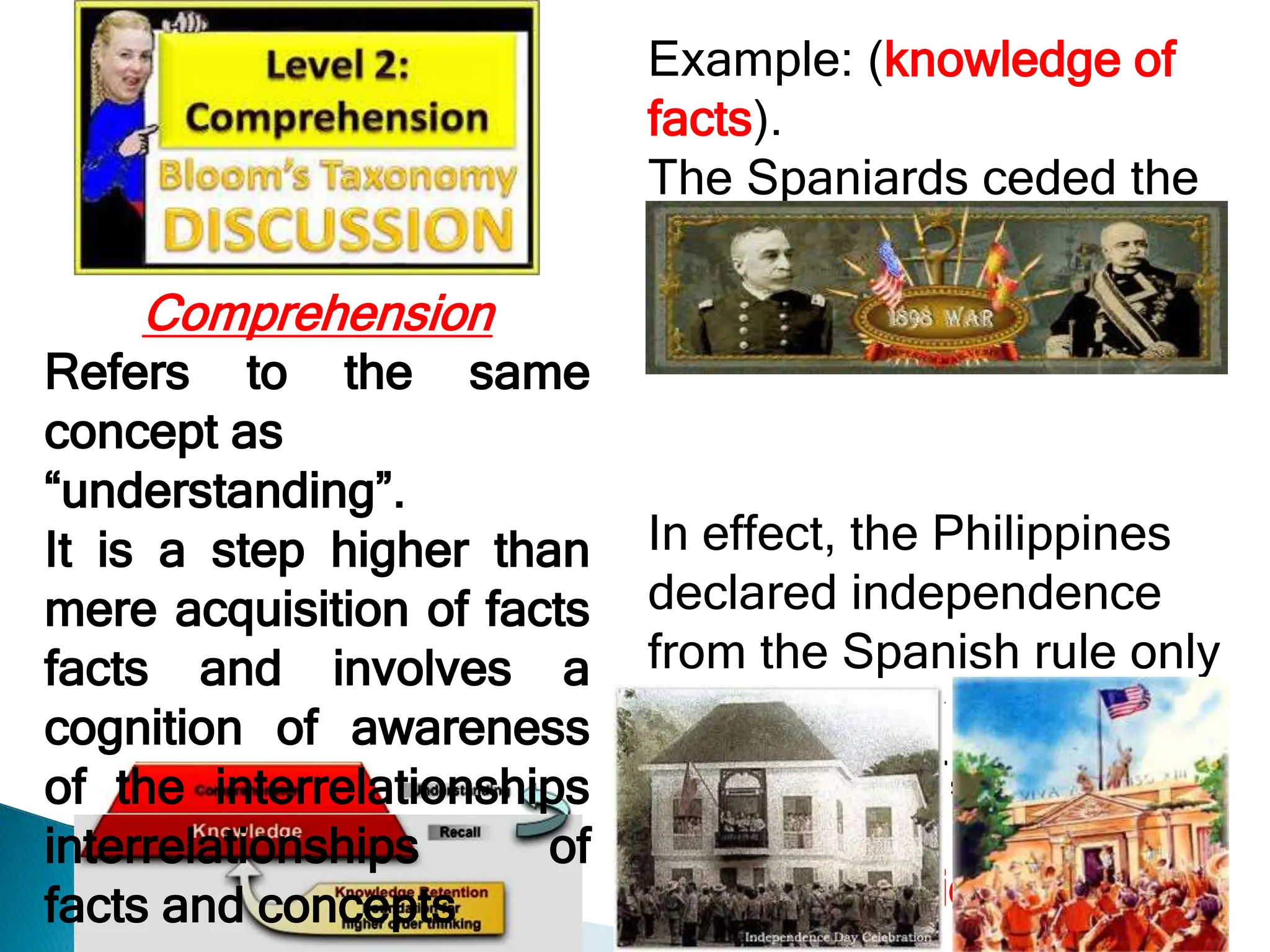
Comprehension
Refers to the same
concept as
“understanding”.
It is a step higher than
mere acquisition of facts
facts and involves a
cognition of awareness
of the interrelationships
interrelationships of
facts and concepts
Example: (knowledge of
facts).
The Spaniards ceded the
Philippines
To the Americans in 1898.
In effect, the Philippines
declared independence
from the Spanish rule only
to be ruled by yet another
foreign power, the
Americans
(comprehension)
APPLICATION
Refers to the
transfer of
knowledge from one
one field
of study to another
or from one concept
concept in the
same discipline.
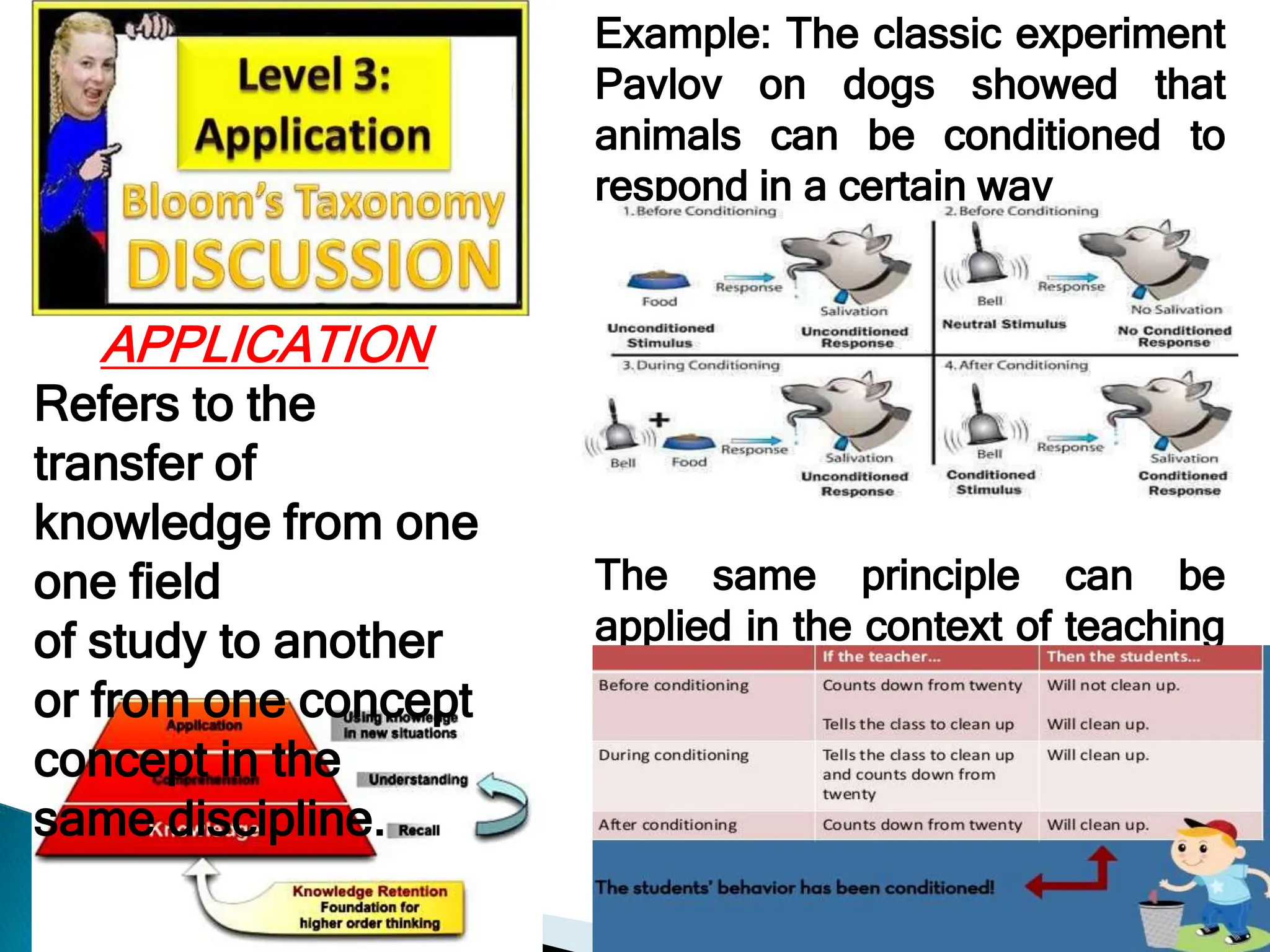
Example: The classic experiment
Pavlov on dogs showed that
animals can be conditioned to
respond in a certain way
to certain stimuli.
The same principle can be
applied in the context of teaching
and learning on behavior
modification for school children.
ANALYSIS
Refers to the breaking
down of a concept or
idea into its
components and
explaining the concept
concept as a
composition of these
concepts.
Example: Poverty in the
Philippines, particularly at the
barangay level, can be traced
back to the low income levels
of families in such barangays
and the propensity for large
households w/ an average of
about 5 children per family.
(Note:Poverty is analyzed in
the context of income and
number of children.
SYNTHESIS
Refers to the opposite
opposite of analysis
and entails putting
together the
components in order
to summarize the
concept.
Example: The field of geometry
is replete w/ examples of synthetic
lessons. from the relationship of the
parts of a triangle for instance, one
can deduce that the sum of the
angles of a triangle is 180˚.
 Evaluate the actors
professionals, amateurs, or
students?
 Criticize the actors capable
of dealing with the script's
requirements?
 (Be fair to the actors in your
assessment of their talents
EVALUATION AND
REASONING
Refers to valuing and
judgment or putting
the “worth” of a
concept or principle.
Students make judgments about
the value of ideas, items,
materials, and more.
Students are expected bring in all
they have learned to make
informed and sound evaluations
of material.
Key Words for the Evaluation
Category:
evaluate, appraise, conclude,
criticize, critique
Example:
Watch an stage play and write a
critique of the actor’s
performance.
2. SKILLS, COMPETENCIES AND ABILITIES
TARGETS
Skills refer to
specific activities
or tasks that a
student can
proficiently do
e.g. skills in
coloring,
language skills
Skills can be
clustered
together to form
specific
competencies
e.g. Birthday
Abilities can be roughly categorized into:
cognitive, psychomotor and affective abilities
Ability to work well
w/ others & to be
trusted by every
classmate (affective
ability)
is an indication
that the
student can
most likely
succeed in
work that
requires
leadership
abilities.
Other students are
better at doing things
alone like
programming & web
designing (cognitive
ability) and,
therefore, they would
be good at highly
technical
individualized work.
3. PRODUCTS, OUTPUTS ANDPROJECTS TARGETS
Tangible and concrete evidence of student’s ability
A clear target for products and projects need to
clearly specify the level of worksmanship of such
projects
e.g. expert level, skilled level or novice level.
Once the
learning targets
are clearly set, it
is now
necessary to
determine an
B. APPROPRIATENESS
OF
ASSESSMENT
METHODS
1. Written-Response Instruments
2. Product Rating Scales
3. Performance Test
4. Oral Questioning
5. Observation and Self Reports
1. WRITTEN-RESPONSE INSTRUMENTS
OBJECTIVE TESTS
a.Multiple Choice
b.True-False
c.Matching or Short
Answer
TESTS,
ESSAYS,
EXAMINATIONS AND
CHECKLIST
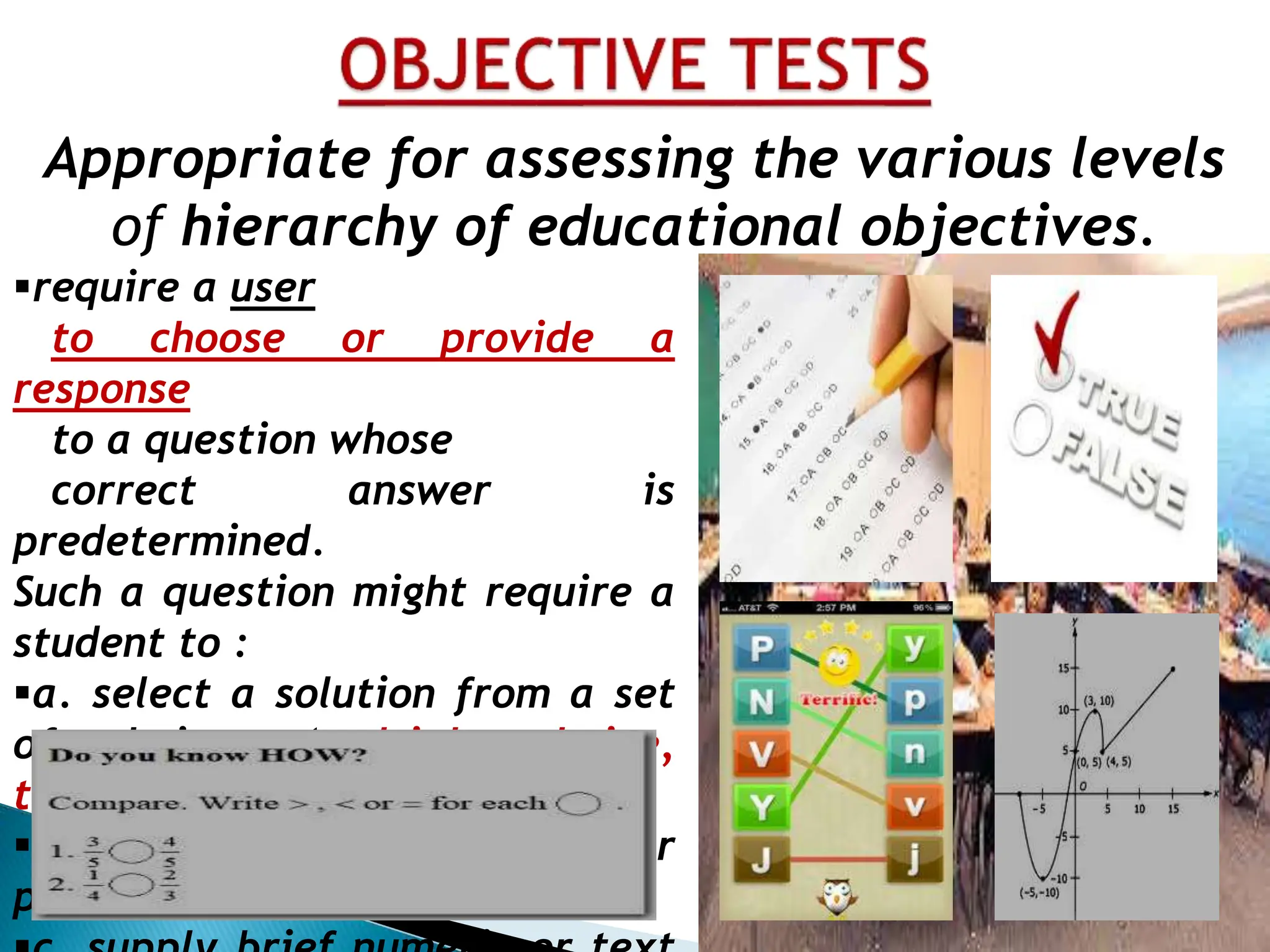
Appropriate for assessing the various levels
of hierarchy of educational objectives.
require a user
to choose or provide a
response
to a question whose
correct answer is
predetermined.
Such a question might require a
student to :
a. select a solution from a set
of choices (multiple choice,
true-false, matching)
b. identify an object or
position (graphical )
What is higher-level thinking?
What do we mean by higher-level thinking? Benjamin
Bloom described six levels of cognitive behavior,
listed here from the most basic – Knowledge – at the
bottom to the most complex – Evaluation – at the top:
Evaluation
Synthesis
Analysis
Application
Comprehension
1. MULTIPLE CHOICE TEST
In particular can be constructed in such a way as to
test higher order thinking skills.
 a. Tim needs extra practice reading
and writing problematic letters and
words at home at least 30 minutes
per day.
 b. Please discuss the importance of
schoolwork to Tim so that he will
dyslexia so I would like to refer him
to a specialist for diagnosis.
 d. Please adjust Tim’s diet because he
is most likely showing symptoms of
ADHD due to food allergies.
 Explanation: C is the best answer
Students must evaluate multiple pieces of evidence, then
apply that evidence to solve a problem, student must select
the best action to take with the evidence.
Tim’s second grade teacher is concerned because of the
following observations about Tim’s behavior in class:
Withdraws from peers on the playground and
during groupwork
Often confuses syllables in words (ex: says mazagine instead
of magazine)
Often confuses b and d, p and q, etc. when writing or
recognizing letters
The teacher has arranged a meeting with Tim’s mother to
discuss these concerns. Which of the following statements is
best for the teacher to say to Tim’s mother?
 When properly planned, can test the
student’s grasp of the higher level cognitive
skills
 particularly in the areas of application
analysis, synthesis, and judgment.
 Questions - “precise”,
 PARAMETERS - “properly defined”
 Write an essay about the first EDSA
 (give add’l. requirements to give focus)
 Focus on the main characters and their
respective roles in the revolution
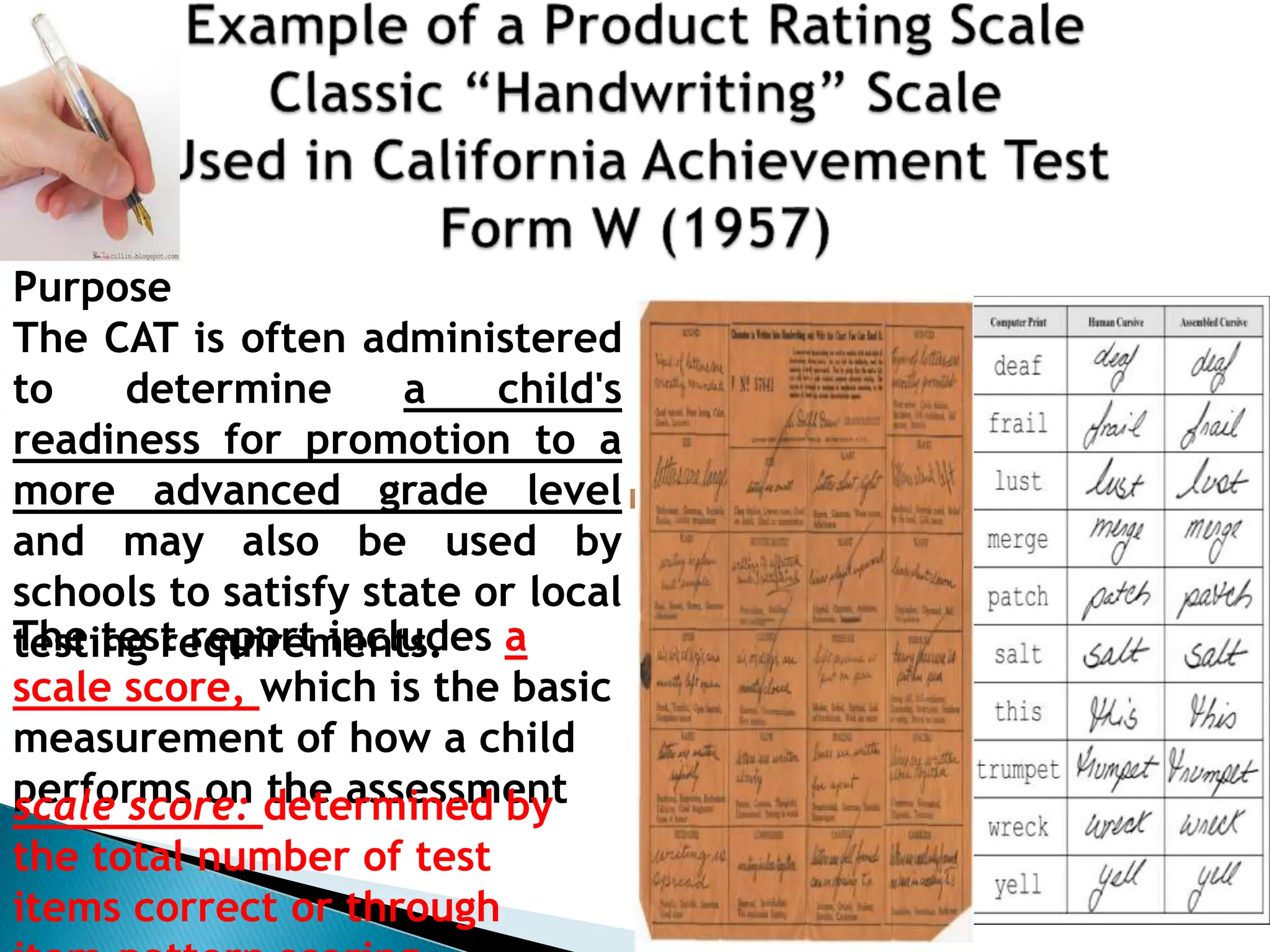
2. PRODUCT RATING SCALES
A Teacher is often tasked to
rate products.
1. Book reports
2. Maps
3. Charts
4. Diagrams
5. Notebooks
6. Essays
7. Creative endeavors
Purpose
The CAT is often administered
to determine a child's
readiness for promotion to a
more advanced grade level
and may also be used by
schools to satisfy state or local
testing requirements.
The test report includes a
scale score, which is the basic
measurement of how a child
performs on the assessment
scale score: determined by
the total number of test
items correct or through
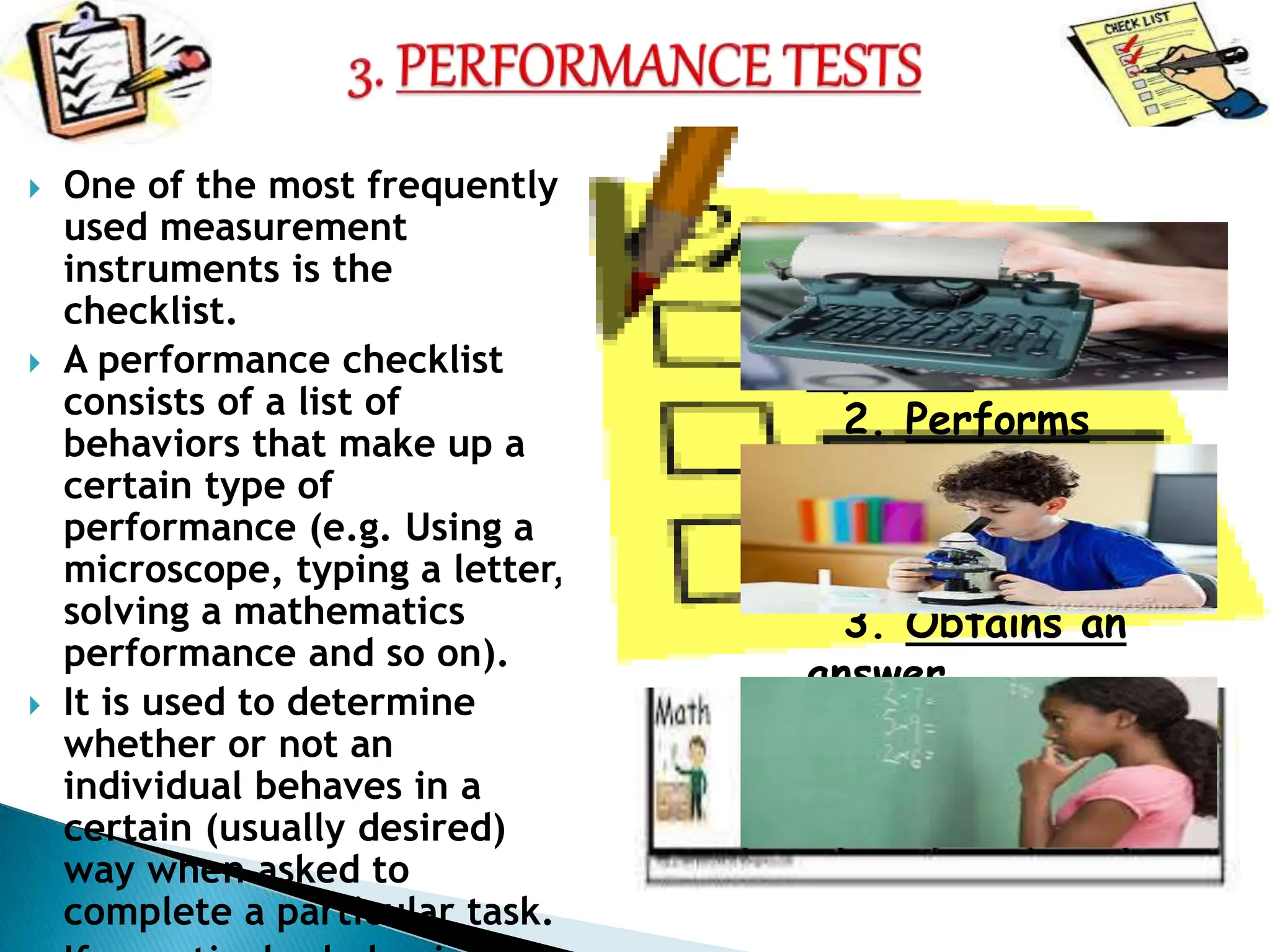
 One of the most frequently
used measurement
instruments is the
checklist.
 A performance checklist
consists of a list of
behaviors that make up a
certain type of
performance (e.g. Using a
microscope, typing a letter,
solving a mathematics
performance and so on).
 It is used to determine
whether or not an
individual behaves in a
certain (usually desired)
way when asked to
complete a particular task.
1. Formulates the
equation
2. Performs
algebraic
operations
3. Obtains an
answer
The traditional Greeks used oral questioning
extensively as an assessment method, Socrates
himself, considered the epitome (perfect example of
a particular quality) of a teacher, was said to have
handled his classes solely based on questioning and
oral interactions,
Oral questioning is an appropriate assessment
method when the objectives are:
 a.) to assess student’s stock knowledge
and/or
 b.) to determine the student’s ability to
communicate ideas in coherent (logical and
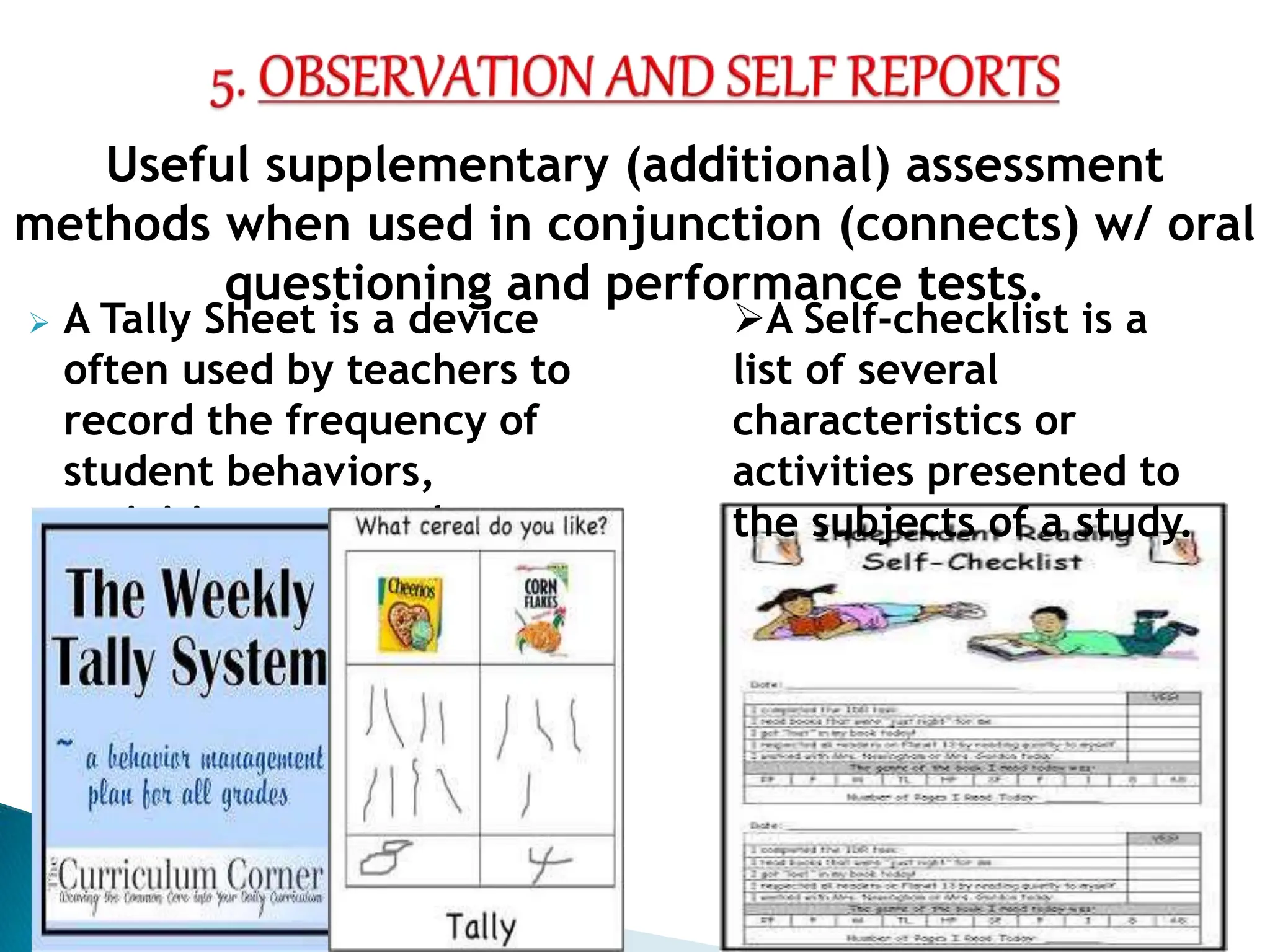
 A Tally Sheet is a device
often used by teachers to
record the frequency of
student behaviors,
activities or remarks.
Useful supplementary (additional) assessment
methods when used in conjunction (connects) w/ oral
questioning and performance tests.
A Self-checklist is a
list of several
characteristics or
activities presented to
the subjects of a study.
C. PROPERTIES
OF
ASSESSMENT
METHODS
1. Validity
2. Reliability
3. Fairness
4. Practicality and efficiency
5. Ethics in assessment
The quality of the
assessment instrument and
method used in education
is very important since the
evaluation and judgment
that the teacher gives on
a student are based on
the information he obtains
1. validity
Defined as the
instrument’s ability
to measure what it
purports (intention)
to measure.
Defined as
referring to the
appropriateness,
correctness,
meaningfulness and
usefulness of the
specific conclusions
that a teacher
reaches regarding
the teaching-learning
Content
Validity refers to the
content and format
of the instrument
How appropriate is
the content? How
comprehensive?
How adequately
does the sample
items or
questions
represent the
content to be
assessed? Is the
format
appropriate?
Does the
instrument
logically get the
intended variable
or factor?
Content and
Format
-Consistent w/
the definition of
variable or factor
to be measured
-1. Do students
have adequate
experience w/
the type of task
posed by the
item?
Content and
Format
2. Did the
teachers cover
sufficient
material for
most students to
be able to
answer the item
correctly?
Content and
Format
3. Does the
item reflect the
degree of
emphasis
received during
instruction?
Two (2) Forms of
Content Validity
Table
CRITERIA
I T E M
1. Material
covered
sufficiently.
2. Most
students are
able to
answer
item
correctly.
3. Students
have prior
experience
w/ the type of
FORMA: ITEMVALIDITY
1 2 3 4 5 6
FORMB: ENTIRETEST
KNOWLEDGE/
SKILLS AREA
ESTIMATED
PERCENT OF
INSTRUCTION
PERCENT.
OF ITEMS
COVERED
IN TEST
1. Knowledge
2.
Comprehensi
on
3. Application
4. Analysis
5. Synthesis
6. Evaluation
Two (2) Forms of
Content Validity
Table
FORMB: ENTIRETEST
KNOWLEDGE/
SKILLS AREA
ESTIMATED
PERCENT OF
INSTRUCTION
PERCENT.
OF ITEMS
COVERED
IN TEST
1. Knowledge
2.
Comprehensi
on
3. Application
4. Analysis
5. Synthesis
6. Evaluation
Based on
Form B,
adjustments
in the
number of
items that
relate to a
topic can be
Two (2) Forms of
Content Validity
Table
CRITERIA
I T E M
1. Material
covered
sufficiently.
2. Most
students are
able to
answer
item
correctly.
3. Students
have prior
experience
w/ the type of
FORMA: ITEMVALIDITY
1 2 3 4 5 6
While Content Validity
is important
Two(2) Types of
Validity
1. Face Validity
Outward
appearance of the
test
lowest form of
test validity.
2. Criterion-Related
Validity
1.Face
Validity
a test can be said
to have face validity
if it "looks like" it is
going to measure
what it is supposed
to measure.
For instance, if you
prepare a test to
measure whether
students can perform
multiplication, and
the people you show
it to all agree that
it looks like a good
Some people
use the term
face validity
only to refer
to the validity
of observers
who are not
expert in
testing
2. Criterion-
related
Validity
(more important
tupe)
The test item
is judge against a
specific criterion
Can also be
measured by
correlating the
test with a known
valid test (as a
A “construct”
is another
term for a
factor, and
we already
know that a
group of
variables that
correlate
Construc
t
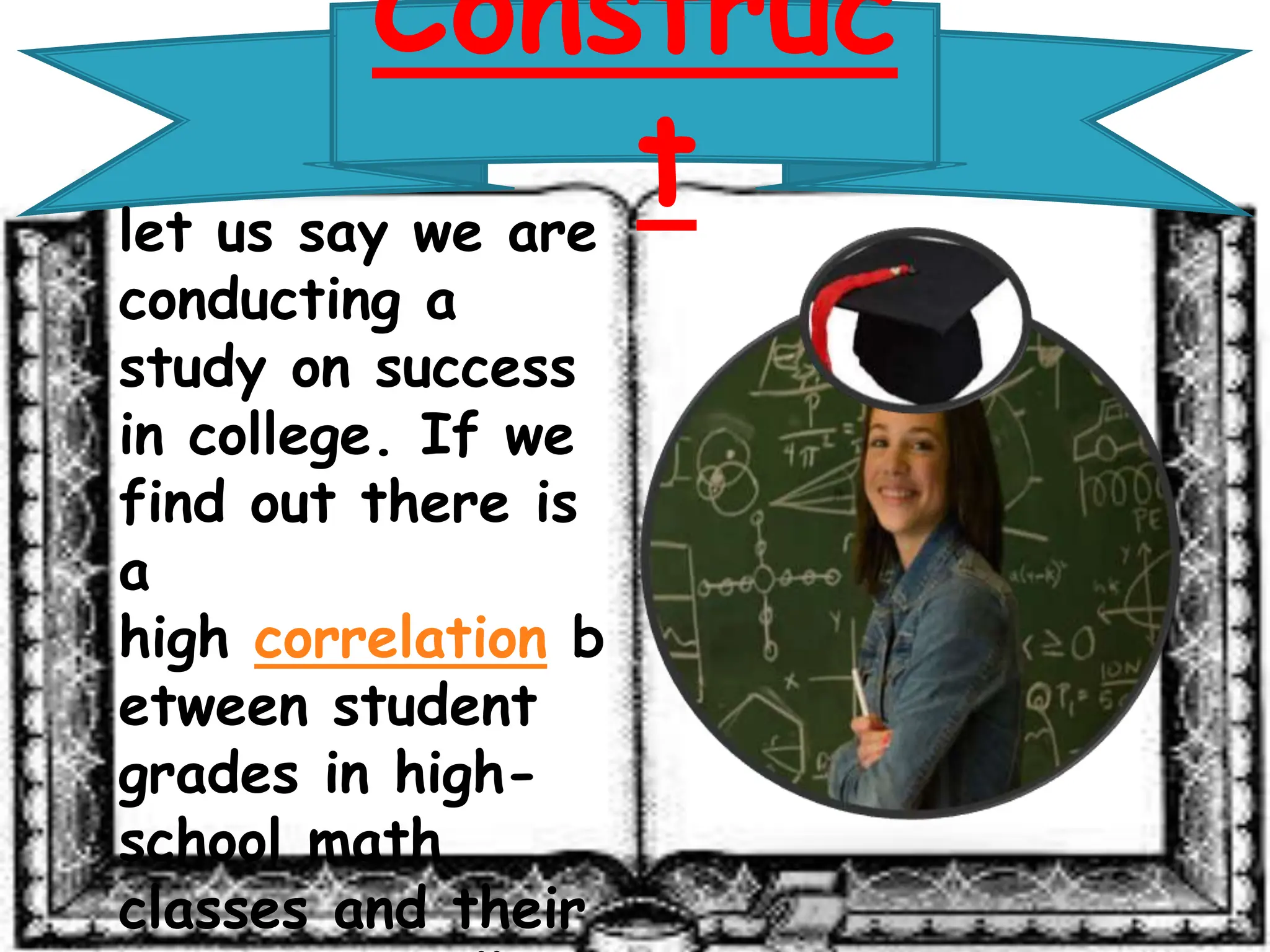
let us say we are
conducting a
study on success
in college. If we
find out there is
a
high correlation b
etween student
grades in high-
school math
classes and their
Construct
We would say there
is high criterion-
related validitybetw
een the
intermediate
variable (grades in
high-school math
classes) and the
ultimate variable
(success in college).
Essentially, the
grades students
received in high-
2. RELIABILITY
The reliability of an
assessment method
refers to its consistency.
It is also a term that is
synonymous w/
dependability or stability.
Stability or internal
consistency as reliability
measures can be estimated in
several ways.
a. The Split-half Method
(using Spearman-Brown
prophecy formula)
b. The Kuder-Richardson
formula
a. The Split-half
Method
Involves scoring two
halves of a test separately
separately for each
person and then
calculating a correlation
coefficient for the two sets
sets of scores.
The coefficient indicates
indicates the degreee to
w/c the two halves of the
the test provide the same
same results
Hence, describes the
Splitting a test to estimate
reliability.
Example:
10 item test split (2)subtests,
A. 1st 1-5
2nd 6-10
Responses:
1st half different- 2nd half
Reason:
increase in item difficulty
and fatigue
B. Odd items vs. even items
Guarantee:
each half will contain an
equal number of items from
the beginning, middle, and
end of the original test.
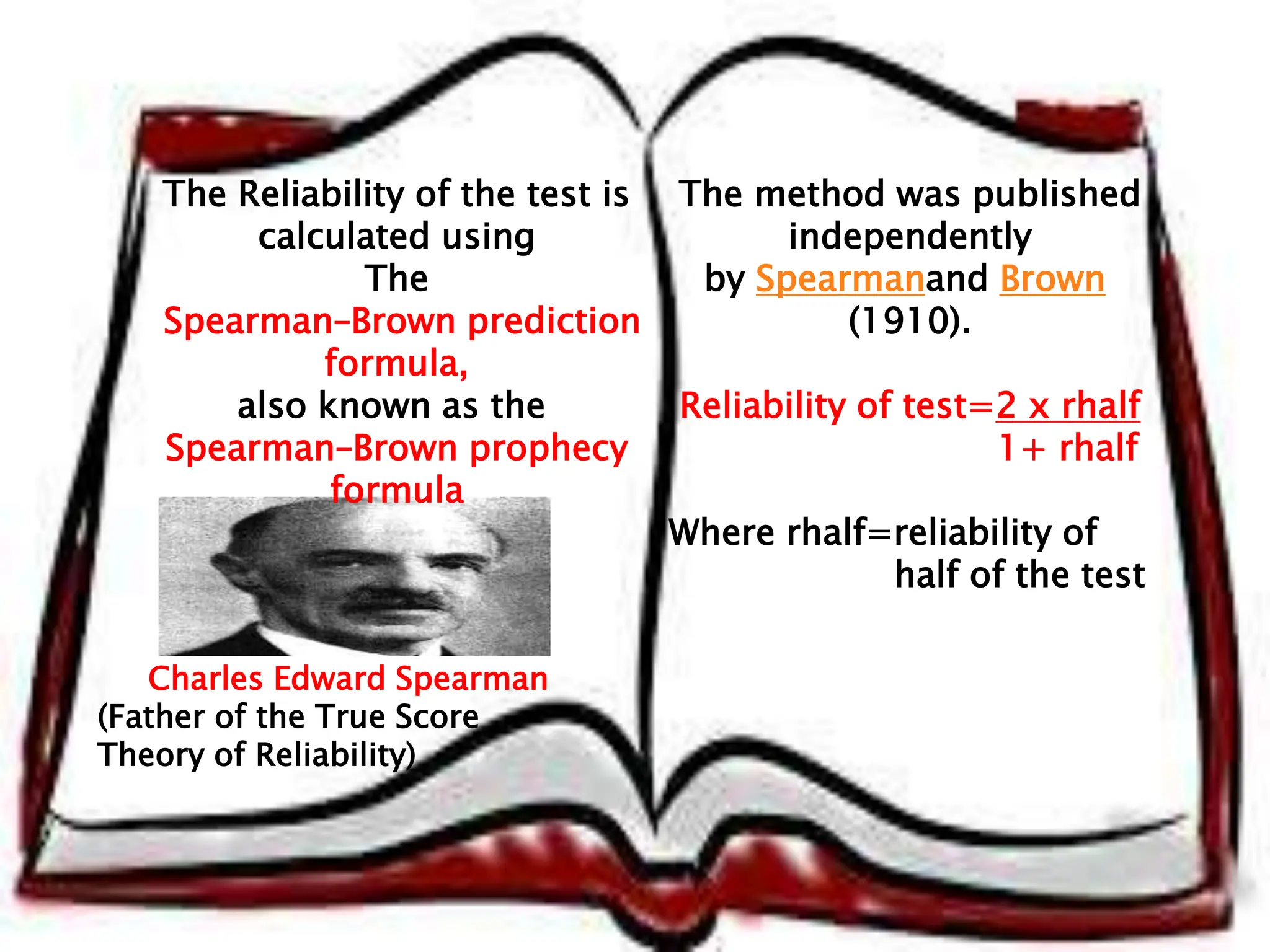
The Reliability of the test is
calculated using
The
Spearman–Brown prediction
formula,
also known as the
Spearman–Brown prophecy
formula
The method was published
independently
by Spearmanand Brown
(1910).
Reliability of test=2 x rhalf
1+ rhalf
Where rhalf=reliability of
half of the test
Charles Edward Spearman
(Father of the True Score
Theory of Reliability)
Correlation Score between the
two halves
Example:Five (5) Students
Test: 10 items Split-Half: odd
vs. even
Result: 0.1336
Spearman–Brown
prophecy formula
Reliability of test=2 x
rhalf
1+
rhalf
R = 2 x 0.1336
1 + 0.1336
R = 0.2672
1.1336
R = 0.2357
Reliability
b. The Kruder-
Richardson
is the more frequently
employed formula for
determining internal
consitency,
particularly KR20
(more difficult to
calculate/requires a
computer program)
 and KR21
Dr. Frederic Kuder
(1903-2000) one of the
premier innovators of
vocational assessments.
His 1938 Kuder
Preference Record
became one of the most-
used career guidance
instruments in schools and
colleges, and was taken by
more than a million people
worldwide over the course
of several decades.
Reliability
The Kruder-
Richardson
Formula:
KR20 = = K 1 – ∑
pq
(K – 1)
(Variance)
Where,
K = number of items in the test
p = proportion of students who
answered the item correctly
q = proportion of students who
answered the item wrongly = 1 – p
– p
pq = variance of a single item
schored dichotomously
(right/wrong)
and
KR21 = K 1 – n
(K – M)
(K – 1)
K(Variance)
Where,
K = number of items on the test,
M = mean of the test,
Variance = variance of the test
scores
The mean of a set of scores is
simply the sum of the scores
divided bu the number of scores;
its variance is by:
Variance = Sum of differences of
individual scores and mean / n – 1
Where n is the number of test
takers
Reliability
c. The Test-retest
Method
of estimating reliability
Reliability of a test may
also mean the consistency
of test results when the
same test is administered
at two different time
periods.
The estimate of test
reliability is then given by
the correlation of the two
test results.
The test results only
affected by the amount of
time.
 The closer the period
the test given to the
same set of examiners
 between the 1st and
the 2nd , the higher the
correlation.
The longer the gap
between the two test,
the lower the correlation.
3. Fairness
An assessment procedure
needs to be fair.
Students needs to know
exactly what the learning
targets are and what method
of assessment will be used.
If students do not know
what they are supposed to be
achieving, then they could
get lost in the maze of
concepts being discussed in
the class.
likewise, students have to
be informed how their
Assessment has to be
viewedas an opportunity to
learn rather than an
oppurtunity to weed out
poor and slow learners
Fairness also implies
freedom from teacher-
stereotyping.(Biases)
Ex. Boys are better than
Girls in Math or Girls are
better than Boys in
Language
5. ETHICS IN ASSESSMENT
The Term “Ethics” refers to questions of
Right and Wrong
When Teachers think
about Ethics, they need
to ask themselves
If it is Right to
Assess a Specific
Knowledge or
Investigate a Certain
Question.
Are there some
Finally, the temptation to assist certain individuals in
class during assessment or testing is ever present.
In this case, it is best if the teacher does not administer
the test himself if he believes that such a concern may, at
a later time, be considered unethical.
PPT-ASSESSMENT-2.pptx assessment of education

PPT-ASSESSMENT-2.pptx assessment of education

  • 2.
    CHAPTER 1 REVIEW OFPRINCIPLES OF HIGH QUALITY ASSESSMENT CHAPTER 1 REVIEW OF PRINCIPLES OF HIGH QUALITY ASSESSMENT
  • 3.
    CLARITY OF LEARNING TARGETS APPROPRIATENESS OF ASSESSMENT METHODS PROPERTIES OF ASSESSMENT METHODS COGNITIVE TARGETS SKILLS, COMPE- TENCIES AND ABILITIES TARGETS COGNITIVETARGETS PRODUCTS, OUTPUTS AND PROJECTS TARGETS WRITTEN - RESPONSE INSTRUMENT PERFOR- MANCE TEST PRODUCT RATING SCALES ORAL QUESTIO- NING OBSER- VATION AND SELF REPORTS VALIDITY RELIABILITY FAIRNESS PRACTICA- LITY AND EFFICIENCY ETHICS IN ASSESSMENT
  • 4.
     Assessment canbe made  Precise, accurate and  dependable only if  what are to be achieved  are clearly stated and  feasible .
  • 5.
    We consider learningtargets involving knowledge, reasoning skills, products and effects. Learning targets need to be stated in behavioral terms or Terms that denote something w/c can be observed thru the behavior of the student. 1. Cognitive Targets 2. Skills, Competencies and Abilities Targets
  • 6.
    As early asthe 1950’s, Bloom (1954), proposed a hierarchy of educational objectives as the cognitive level. These are: 1. COGNITIVE TARGETS
  • 7.
    Knowledge Refers to the acquisitionof Facts, Concepts and Theories. Knowledge of Historical Facts like the DATE of EDSA revolution Knowledge about the Discovery “Philippines” Magellan March 15 1521
  • 8.
    Knowledge Forms the foundationof all other cognitive objectives for w/o knowledge, it is not possible to move up to the next higher level of thinking skills in the hierarchy of educational objectives.
  • 9.
    Comprehension Refers to thesame concept as “understanding”. It is a step higher than mere acquisition of facts facts and involves a cognition of awareness of the interrelationships interrelationships of facts and concepts Example: (knowledge of facts). The Spaniards ceded the Philippines To the Americans in 1898. In effect, the Philippines declared independence from the Spanish rule only to be ruled by yet another foreign power, the Americans (comprehension)
  • 10.
    APPLICATION Refers to the transferof knowledge from one one field of study to another or from one concept concept in the same discipline. Example: The classic experiment Pavlov on dogs showed that animals can be conditioned to respond in a certain way to certain stimuli. The same principle can be applied in the context of teaching and learning on behavior modification for school children.
  • 11.
    ANALYSIS Refers to thebreaking down of a concept or idea into its components and explaining the concept concept as a composition of these concepts. Example: Poverty in the Philippines, particularly at the barangay level, can be traced back to the low income levels of families in such barangays and the propensity for large households w/ an average of about 5 children per family. (Note:Poverty is analyzed in the context of income and number of children.
  • 12.
    SYNTHESIS Refers to theopposite opposite of analysis and entails putting together the components in order to summarize the concept. Example: The field of geometry is replete w/ examples of synthetic lessons. from the relationship of the parts of a triangle for instance, one can deduce that the sum of the angles of a triangle is 180˚.
  • 13.
     Evaluate theactors professionals, amateurs, or students?  Criticize the actors capable of dealing with the script's requirements?  (Be fair to the actors in your assessment of their talents EVALUATION AND REASONING Refers to valuing and judgment or putting the “worth” of a concept or principle. Students make judgments about the value of ideas, items, materials, and more. Students are expected bring in all they have learned to make informed and sound evaluations of material. Key Words for the Evaluation Category: evaluate, appraise, conclude, criticize, critique Example: Watch an stage play and write a critique of the actor’s performance.
  • 14.
    2. SKILLS, COMPETENCIESAND ABILITIES TARGETS Skills refer to specific activities or tasks that a student can proficiently do e.g. skills in coloring, language skills Skills can be clustered together to form specific competencies e.g. Birthday
  • 15.
    Abilities can beroughly categorized into: cognitive, psychomotor and affective abilities Ability to work well w/ others & to be trusted by every classmate (affective ability) is an indication that the student can most likely succeed in work that requires leadership abilities. Other students are better at doing things alone like programming & web designing (cognitive ability) and, therefore, they would be good at highly technical individualized work.
  • 16.
    3. PRODUCTS, OUTPUTSANDPROJECTS TARGETS Tangible and concrete evidence of student’s ability A clear target for products and projects need to clearly specify the level of worksmanship of such projects e.g. expert level, skilled level or novice level.
  • 17.
    Once the learning targets areclearly set, it is now necessary to determine an
  • 18.
    B. APPROPRIATENESS OF ASSESSMENT METHODS 1. Written-ResponseInstruments 2. Product Rating Scales 3. Performance Test 4. Oral Questioning 5. Observation and Self Reports
  • 19.
    1. WRITTEN-RESPONSE INSTRUMENTS OBJECTIVETESTS a.Multiple Choice b.True-False c.Matching or Short Answer TESTS, ESSAYS, EXAMINATIONS AND CHECKLIST
  • 20.
    Appropriate for assessingthe various levels of hierarchy of educational objectives. require a user to choose or provide a response to a question whose correct answer is predetermined. Such a question might require a student to : a. select a solution from a set of choices (multiple choice, true-false, matching) b. identify an object or position (graphical )
  • 21.
    What is higher-levelthinking? What do we mean by higher-level thinking? Benjamin Bloom described six levels of cognitive behavior, listed here from the most basic – Knowledge – at the bottom to the most complex – Evaluation – at the top: Evaluation Synthesis Analysis Application Comprehension 1. MULTIPLE CHOICE TEST In particular can be constructed in such a way as to test higher order thinking skills.
  • 22.
     a. Timneeds extra practice reading and writing problematic letters and words at home at least 30 minutes per day.  b. Please discuss the importance of schoolwork to Tim so that he will dyslexia so I would like to refer him to a specialist for diagnosis.  d. Please adjust Tim’s diet because he is most likely showing symptoms of ADHD due to food allergies.  Explanation: C is the best answer Students must evaluate multiple pieces of evidence, then apply that evidence to solve a problem, student must select the best action to take with the evidence. Tim’s second grade teacher is concerned because of the following observations about Tim’s behavior in class: Withdraws from peers on the playground and during groupwork Often confuses syllables in words (ex: says mazagine instead of magazine) Often confuses b and d, p and q, etc. when writing or recognizing letters The teacher has arranged a meeting with Tim’s mother to discuss these concerns. Which of the following statements is best for the teacher to say to Tim’s mother?
  • 23.
     When properlyplanned, can test the student’s grasp of the higher level cognitive skills  particularly in the areas of application analysis, synthesis, and judgment.  Questions - “precise”,  PARAMETERS - “properly defined”  Write an essay about the first EDSA  (give add’l. requirements to give focus)  Focus on the main characters and their respective roles in the revolution
  • 24.
    2. PRODUCT RATINGSCALES A Teacher is often tasked to rate products. 1. Book reports 2. Maps 3. Charts 4. Diagrams 5. Notebooks 6. Essays 7. Creative endeavors
  • 25.
    Purpose The CAT isoften administered to determine a child's readiness for promotion to a more advanced grade level and may also be used by schools to satisfy state or local testing requirements. The test report includes a scale score, which is the basic measurement of how a child performs on the assessment scale score: determined by the total number of test items correct or through
  • 26.
     One ofthe most frequently used measurement instruments is the checklist.  A performance checklist consists of a list of behaviors that make up a certain type of performance (e.g. Using a microscope, typing a letter, solving a mathematics performance and so on).  It is used to determine whether or not an individual behaves in a certain (usually desired) way when asked to complete a particular task. 1. Formulates the equation 2. Performs algebraic operations 3. Obtains an answer
  • 27.
    The traditional Greeksused oral questioning extensively as an assessment method, Socrates himself, considered the epitome (perfect example of a particular quality) of a teacher, was said to have handled his classes solely based on questioning and oral interactions, Oral questioning is an appropriate assessment method when the objectives are:  a.) to assess student’s stock knowledge and/or  b.) to determine the student’s ability to communicate ideas in coherent (logical and
  • 28.
     A TallySheet is a device often used by teachers to record the frequency of student behaviors, activities or remarks. Useful supplementary (additional) assessment methods when used in conjunction (connects) w/ oral questioning and performance tests. A Self-checklist is a list of several characteristics or activities presented to the subjects of a study.
  • 29.
    C. PROPERTIES OF ASSESSMENT METHODS 1. Validity 2.Reliability 3. Fairness 4. Practicality and efficiency 5. Ethics in assessment
  • 30.
    The quality ofthe assessment instrument and method used in education is very important since the evaluation and judgment that the teacher gives on a student are based on the information he obtains
  • 31.
    1. validity Defined asthe instrument’s ability to measure what it purports (intention) to measure. Defined as referring to the appropriateness, correctness, meaningfulness and usefulness of the specific conclusions that a teacher reaches regarding the teaching-learning
  • 32.
    Content Validity refers tothe content and format of the instrument How appropriate is the content? How comprehensive? How adequately does the sample items or questions represent the content to be assessed? Is the format appropriate? Does the instrument logically get the intended variable or factor?
  • 33.
    Content and Format -Consistent w/ thedefinition of variable or factor to be measured -1. Do students have adequate experience w/ the type of task posed by the item?
  • 34.
    Content and Format 2. Didthe teachers cover sufficient material for most students to be able to answer the item correctly?
  • 35.
    Content and Format 3. Doesthe item reflect the degree of emphasis received during instruction?
  • 36.
    Two (2) Formsof Content Validity Table CRITERIA I T E M 1. Material covered sufficiently. 2. Most students are able to answer item correctly. 3. Students have prior experience w/ the type of FORMA: ITEMVALIDITY 1 2 3 4 5 6 FORMB: ENTIRETEST KNOWLEDGE/ SKILLS AREA ESTIMATED PERCENT OF INSTRUCTION PERCENT. OF ITEMS COVERED IN TEST 1. Knowledge 2. Comprehensi on 3. Application 4. Analysis 5. Synthesis 6. Evaluation
  • 37.
    Two (2) Formsof Content Validity Table FORMB: ENTIRETEST KNOWLEDGE/ SKILLS AREA ESTIMATED PERCENT OF INSTRUCTION PERCENT. OF ITEMS COVERED IN TEST 1. Knowledge 2. Comprehensi on 3. Application 4. Analysis 5. Synthesis 6. Evaluation Based on Form B, adjustments in the number of items that relate to a topic can be
  • 38.
    Two (2) Formsof Content Validity Table CRITERIA I T E M 1. Material covered sufficiently. 2. Most students are able to answer item correctly. 3. Students have prior experience w/ the type of FORMA: ITEMVALIDITY 1 2 3 4 5 6 While Content Validity is important Two(2) Types of Validity 1. Face Validity Outward appearance of the test lowest form of test validity. 2. Criterion-Related Validity
  • 39.
    1.Face Validity a test canbe said to have face validity if it "looks like" it is going to measure what it is supposed to measure. For instance, if you prepare a test to measure whether students can perform multiplication, and the people you show it to all agree that it looks like a good Some people use the term face validity only to refer to the validity of observers who are not expert in testing
  • 40.
    2. Criterion- related Validity (more important tupe) Thetest item is judge against a specific criterion Can also be measured by correlating the test with a known valid test (as a A “construct” is another term for a factor, and we already know that a group of variables that correlate
  • 41.
    Construc t let us saywe are conducting a study on success in college. If we find out there is a high correlation b etween student grades in high- school math classes and their
  • 42.
    Construct We would saythere is high criterion- related validitybetw een the intermediate variable (grades in high-school math classes) and the ultimate variable (success in college). Essentially, the grades students received in high-
  • 43.
    2. RELIABILITY The reliabilityof an assessment method refers to its consistency. It is also a term that is synonymous w/ dependability or stability. Stability or internal consistency as reliability measures can be estimated in several ways. a. The Split-half Method (using Spearman-Brown prophecy formula) b. The Kuder-Richardson formula
  • 44.
    a. The Split-half Method Involvesscoring two halves of a test separately separately for each person and then calculating a correlation coefficient for the two sets sets of scores. The coefficient indicates indicates the degreee to w/c the two halves of the the test provide the same same results Hence, describes the Splitting a test to estimate reliability. Example: 10 item test split (2)subtests, A. 1st 1-5 2nd 6-10 Responses: 1st half different- 2nd half Reason: increase in item difficulty and fatigue B. Odd items vs. even items Guarantee: each half will contain an equal number of items from the beginning, middle, and end of the original test.
  • 45.
    The Reliability ofthe test is calculated using The Spearman–Brown prediction formula, also known as the Spearman–Brown prophecy formula The method was published independently by Spearmanand Brown (1910). Reliability of test=2 x rhalf 1+ rhalf Where rhalf=reliability of half of the test Charles Edward Spearman (Father of the True Score Theory of Reliability)
  • 46.
    Correlation Score betweenthe two halves Example:Five (5) Students Test: 10 items Split-Half: odd vs. even Result: 0.1336 Spearman–Brown prophecy formula Reliability of test=2 x rhalf 1+ rhalf R = 2 x 0.1336 1 + 0.1336 R = 0.2672 1.1336 R = 0.2357
  • 47.
    Reliability b. The Kruder- Richardson isthe more frequently employed formula for determining internal consitency, particularly KR20 (more difficult to calculate/requires a computer program)  and KR21 Dr. Frederic Kuder (1903-2000) one of the premier innovators of vocational assessments. His 1938 Kuder Preference Record became one of the most- used career guidance instruments in schools and colleges, and was taken by more than a million people worldwide over the course of several decades.
  • 48.
    Reliability The Kruder- Richardson Formula: KR20 == K 1 – ∑ pq (K – 1) (Variance) Where, K = number of items in the test p = proportion of students who answered the item correctly q = proportion of students who answered the item wrongly = 1 – p – p pq = variance of a single item schored dichotomously (right/wrong) and KR21 = K 1 – n (K – M) (K – 1) K(Variance) Where, K = number of items on the test, M = mean of the test, Variance = variance of the test scores The mean of a set of scores is simply the sum of the scores divided bu the number of scores; its variance is by: Variance = Sum of differences of individual scores and mean / n – 1 Where n is the number of test takers
  • 49.
    Reliability c. The Test-retest Method ofestimating reliability Reliability of a test may also mean the consistency of test results when the same test is administered at two different time periods. The estimate of test reliability is then given by the correlation of the two test results. The test results only affected by the amount of time.  The closer the period the test given to the same set of examiners  between the 1st and the 2nd , the higher the correlation. The longer the gap between the two test, the lower the correlation.
  • 50.
    3. Fairness An assessmentprocedure needs to be fair. Students needs to know exactly what the learning targets are and what method of assessment will be used. If students do not know what they are supposed to be achieving, then they could get lost in the maze of concepts being discussed in the class. likewise, students have to be informed how their Assessment has to be viewedas an opportunity to learn rather than an oppurtunity to weed out poor and slow learners Fairness also implies freedom from teacher- stereotyping.(Biases) Ex. Boys are better than Girls in Math or Girls are better than Boys in Language
  • 51.
    5. ETHICS INASSESSMENT The Term “Ethics” refers to questions of Right and Wrong When Teachers think about Ethics, they need to ask themselves If it is Right to Assess a Specific Knowledge or Investigate a Certain Question. Are there some
  • 52.
    Finally, the temptationto assist certain individuals in class during assessment or testing is ever present. In this case, it is best if the teacher does not administer the test himself if he believes that such a concern may, at a later time, be considered unethical.