Content: 
1. Introduction 
2. Literature survey 
3. Need and objective 
4. Block diagram of system 
5. Ultrasonic sensor 
6. Lpc2129 
7. Controller area network protocol 
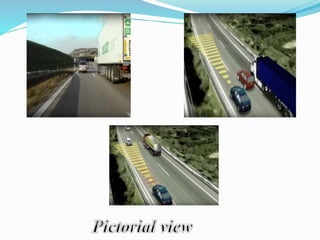
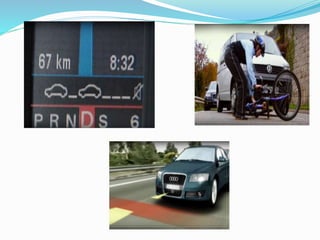
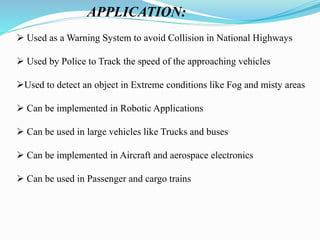
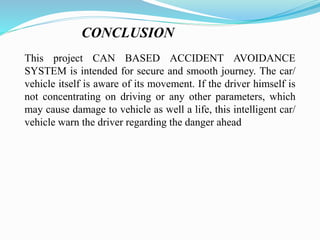
8. System based some pictorial view 
9. Conclusion 
10. Application
INTRODUCTION 
 It is an embedded system based application. The main design aspect 
of CAN Based accident avoidance system project is to avoid the 
accidents by using CAN protocol. This Project describes a design of 
effective accident avoidance system that detects an automotive / vehicle / 
car condition in traveling with the help of ultrasonic sensors and this 
signal can be used to switch off the apply emergency hand brake or disc 
brake with the help of which accident can be avoided.
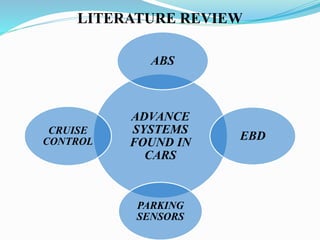
LITERATURE REVIEW 
ABS 
ADVANCE 
SYSTEMS 
FOUND IN 
CARS 
EBD 
PARKING 
SENSORS 
CRUISE 
CONTROL
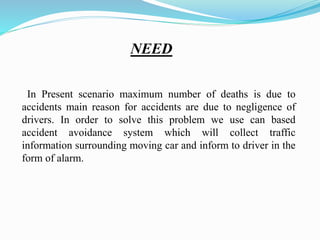
NEED 
In Present scenario maximum number of deaths is due to 
accidents main reason for accidents are due to negligence of 
drivers. In order to solve this problem we use can based 
accident avoidance system which will collect traffic 
information surrounding moving car and inform to driver in the 
form of alarm.
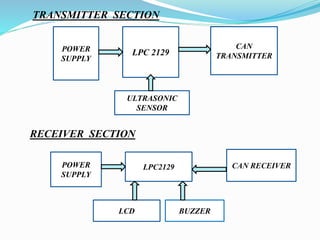
LPC 2129 POWER 
SUPPLY 
CAN 
TRANSMITTER 
ULTRASONIC 
SENSOR 
POWER LPC2129 
SUPPLY 
LCD BUZZER 
CAN RECEIVER 
TRANSMITTER SECTION 
RECEIVER SECTION
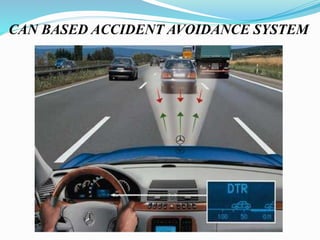
CAN BASED ACCIDENT AVOIDANCE SYSTEM
ULTRASONIC SENSORS 
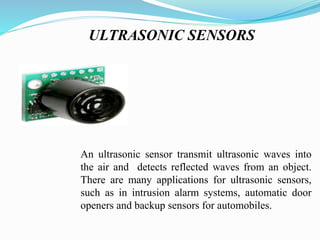
An ultrasonic sensor transmit ultrasonic waves into 
the air and detects reflected waves from an object. 
There are many applications for ultrasonic sensors, 
such as in intrusion alarm systems, automatic door 
openers and backup sensors for automobiles.
FEATURES 
 Object detection includes zero range objects 
 2.5V to 5.5V supply with 2mA typical current draw 
 Readings can occur up to every 50mS, (20-Hz rate) 
 All interfaces are active simultaneously 
 9600Baud rate 
 It detect object from 0 inches to 254 inches with resolution of 
1 inch 
 Sensor operates at 42KHz 
 Cost $ 25 per unit
ARM7TDMI PROCESSOR 
The ARM7TDMI core is a member of the ARM family of 
general-purpose 32-bit Microprocessors. The ARM family offers high 
performance for very low power Consumption and small size. The 
ARM architecture is based on Reduced Instruction Set Computer 
(RISC) principles. 
This simplicity gives: 
 A high instruction throughput 
 An excellent real-time interrupt response 
 A small, cost-effective, processor macro cell.
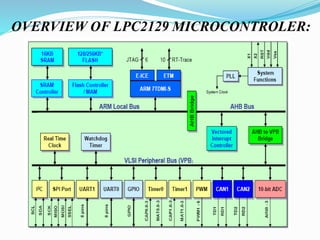
OVERVIEW OF LPC2129 MICROCONTROLER:
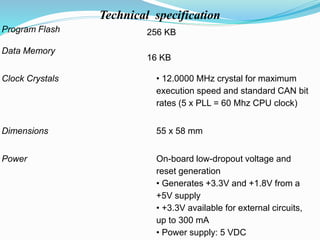
Technical specification 
Program Flash 256 KB 
Clock Crystals • 12.0000 MHz crystal for maximum 
execution speed and standard CAN bit 
rates (5 x PLL = 60 Mhz CPU clock) 
Dimensions 55 x 58 mm 
Power On-board low-dropout voltage and 
reset generation 
• Generates +3.3V and +1.8V from a 
+5V supply 
• +3.3V available for external circuits, 
up to 300 mA 
• Power supply: 5 VDC 
Data Memory 
16 KB
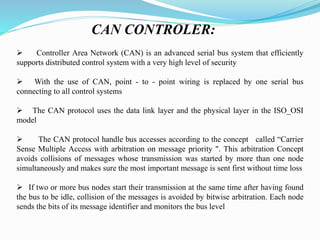
CAN CONTROLER: 
 Controller Area Network (CAN) is an advanced serial bus system that efficiently 
supports distributed control system with a very high level of security 
 With the use of CAN, point - to - point wiring is replaced by one serial bus 
connecting to all control systems 
 The CAN protocol uses the data link layer and the physical layer in the ISO_OSI 
model 
 The CAN protocol handle bus accesses according to the concept called “Carrier 
Sense Multiple Access with arbitration on message priority ". This arbitration Concept 
avoids collisions of messages whose transmission was started by more than one node 
simultaneously and makes sure the most important message is sent first without time loss 
 If two or more bus nodes start their transmission at the same time after having found 
the bus to be idle, collision of the messages is avoided by bitwise arbitration. Each node 
sends the bits of its message identifier and monitors the bus level
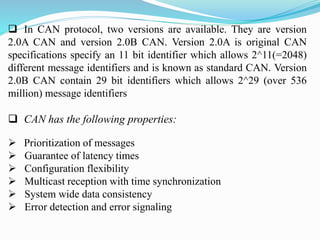
 In CAN protocol, two versions are available. They are version 
2.0A CAN and version 2.0B CAN. Version 2.0A is original CAN 
specifications specify an 11 bit identifier which allows 2^11(=2048) 
different message identifiers and is known as standard CAN. Version 
2.0B CAN contain 29 bit identifiers which allows 2^29 (over 536 
million) message identifiers 
 CAN has the following properties: 
 Prioritization of messages 
 Guarantee of latency times 
 Configuration flexibility 
 Multicast reception with time synchronization 
 System wide data consistency 
 Error detection and error signaling
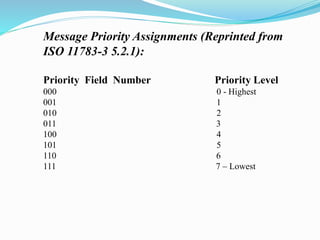
Message Priority Assignments (Reprinted from 
ISO 11783-3 5.2.1): 
Priority Field Number Priority Level 
000 0 - Highest 
001 1 
010 2 
011 3 
100 4 
101 5 
110 6 
111 7 – Lowest
APPLICATION: 
 Used as a Warning System to avoid Collision in National Highways 
 Used by Police to Track the speed of the approaching vehicles 
Used to detect an object in Extreme conditions like Fog and misty areas 
 Can be implemented in Robotic Applications 
 Can be used in large vehicles like Trucks and buses 
 Can be implemented in Aircraft and aerospace electronics 
 Can be used in Passenger and cargo trains
CONCLUSION 
This project CAN BASED ACCIDENT AVOIDANCE 
SYSTEM is intended for secure and smooth journey. The car/ 
vehicle itself is aware of its movement. If the driver himself is 
not concentrating on driving or any other parameters, which 
may cause damage to vehicle as well a life, this intelligent car/ 
vehicle warn the driver regarding the danger ahead
Accident avoidanve using controller area network protocol

Accident avoidanve using controller area network protocol

  • 2.
    Content: 1. Introduction 2. Literature survey 3. Need and objective 4. Block diagram of system 5. Ultrasonic sensor 6. Lpc2129 7. Controller area network protocol 8. System based some pictorial view 9. Conclusion 10. Application
  • 3.
    INTRODUCTION  Itis an embedded system based application. The main design aspect of CAN Based accident avoidance system project is to avoid the accidents by using CAN protocol. This Project describes a design of effective accident avoidance system that detects an automotive / vehicle / car condition in traveling with the help of ultrasonic sensors and this signal can be used to switch off the apply emergency hand brake or disc brake with the help of which accident can be avoided.
  • 4.
    LITERATURE REVIEW ABS ADVANCE SYSTEMS FOUND IN CARS EBD PARKING SENSORS CRUISE CONTROL
  • 5.
    NEED In Presentscenario maximum number of deaths is due to accidents main reason for accidents are due to negligence of drivers. In order to solve this problem we use can based accident avoidance system which will collect traffic information surrounding moving car and inform to driver in the form of alarm.
  • 6.
    LPC 2129 POWER SUPPLY CAN TRANSMITTER ULTRASONIC SENSOR POWER LPC2129 SUPPLY LCD BUZZER CAN RECEIVER TRANSMITTER SECTION RECEIVER SECTION
  • 7.
    CAN BASED ACCIDENTAVOIDANCE SYSTEM
  • 8.
    ULTRASONIC SENSORS Anultrasonic sensor transmit ultrasonic waves into the air and detects reflected waves from an object. There are many applications for ultrasonic sensors, such as in intrusion alarm systems, automatic door openers and backup sensors for automobiles.
  • 9.
    FEATURES  Objectdetection includes zero range objects  2.5V to 5.5V supply with 2mA typical current draw  Readings can occur up to every 50mS, (20-Hz rate)  All interfaces are active simultaneously  9600Baud rate  It detect object from 0 inches to 254 inches with resolution of 1 inch  Sensor operates at 42KHz  Cost $ 25 per unit
  • 10.
    ARM7TDMI PROCESSOR TheARM7TDMI core is a member of the ARM family of general-purpose 32-bit Microprocessors. The ARM family offers high performance for very low power Consumption and small size. The ARM architecture is based on Reduced Instruction Set Computer (RISC) principles. This simplicity gives:  A high instruction throughput  An excellent real-time interrupt response  A small, cost-effective, processor macro cell.
  • 11.
    OVERVIEW OF LPC2129MICROCONTROLER:
  • 12.
    Technical specification ProgramFlash 256 KB Clock Crystals • 12.0000 MHz crystal for maximum execution speed and standard CAN bit rates (5 x PLL = 60 Mhz CPU clock) Dimensions 55 x 58 mm Power On-board low-dropout voltage and reset generation • Generates +3.3V and +1.8V from a +5V supply • +3.3V available for external circuits, up to 300 mA • Power supply: 5 VDC Data Memory 16 KB
  • 13.
    CAN CONTROLER: Controller Area Network (CAN) is an advanced serial bus system that efficiently supports distributed control system with a very high level of security  With the use of CAN, point - to - point wiring is replaced by one serial bus connecting to all control systems  The CAN protocol uses the data link layer and the physical layer in the ISO_OSI model  The CAN protocol handle bus accesses according to the concept called “Carrier Sense Multiple Access with arbitration on message priority ". This arbitration Concept avoids collisions of messages whose transmission was started by more than one node simultaneously and makes sure the most important message is sent first without time loss  If two or more bus nodes start their transmission at the same time after having found the bus to be idle, collision of the messages is avoided by bitwise arbitration. Each node sends the bits of its message identifier and monitors the bus level
  • 14.
     In CANprotocol, two versions are available. They are version 2.0A CAN and version 2.0B CAN. Version 2.0A is original CAN specifications specify an 11 bit identifier which allows 2^11(=2048) different message identifiers and is known as standard CAN. Version 2.0B CAN contain 29 bit identifiers which allows 2^29 (over 536 million) message identifiers  CAN has the following properties:  Prioritization of messages  Guarantee of latency times  Configuration flexibility  Multicast reception with time synchronization  System wide data consistency  Error detection and error signaling
  • 15.
    Message Priority Assignments(Reprinted from ISO 11783-3 5.2.1): Priority Field Number Priority Level 000 0 - Highest 001 1 010 2 011 3 100 4 101 5 110 6 111 7 – Lowest
  • 18.
    APPLICATION:  Usedas a Warning System to avoid Collision in National Highways  Used by Police to Track the speed of the approaching vehicles Used to detect an object in Extreme conditions like Fog and misty areas  Can be implemented in Robotic Applications  Can be used in large vehicles like Trucks and buses  Can be implemented in Aircraft and aerospace electronics  Can be used in Passenger and cargo trains
  • 19.
    CONCLUSION This projectCAN BASED ACCIDENT AVOIDANCE SYSTEM is intended for secure and smooth journey. The car/ vehicle itself is aware of its movement. If the driver himself is not concentrating on driving or any other parameters, which may cause damage to vehicle as well a life, this intelligent car/ vehicle warn the driver regarding the danger ahead