LET US RISE
ABOVE THE REST
01/03/2014
Welcome
ESD CA-II
Presented By:
Aditya Bhavsar
Roll no.: Topic:
EC3106 CAN Protocol
Class:
TY-A(2024-25,
Sem5)
Guided by:
SA.Karmude Sir
Department of Electronics & Telecommunication
CONTENTS
• INTRODUCTION
• BLOCK DIAGRAM
• Layered Architecture
• Standard CAN
• Types of CAN
• Application
• Conclusion
INTRODUCTION
 Controller Area Network(CAN)
 Developed by Robert Bosch in 1989
 No Host required.
 Message Based Protocol
 Differential Two wired communication
 Designed originally for automobiles, but now used in
many other context
Block Diagram
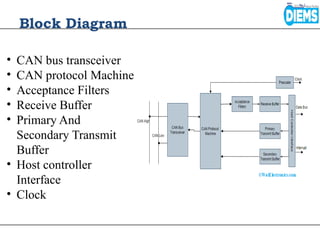
• CAN bus transceiver
• CAN protocol Machine
• Acceptance Filters
• Receive Buffer
• Primary And
Secondary Transmit
Buffer
• Host controller
Interface
• Clock
Layered Architecture
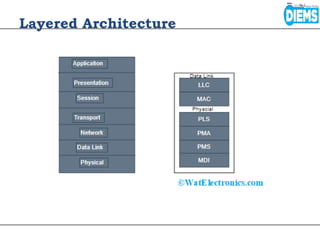
• The CAN communication protocol ISO 11898 defines how data is communicated between
multiple devices in the network
• Data – Link layer
• MAC – Medium Access Control – This layer describes how various devices present in the
network can receive accessibility to the medium. Here, data signaling, error identification,
message encapsulation and decapsulation take place.
• LLC – Logical Link Control – This layer offers logic for the data-link layer because it manages
flow controlling, multiplexing, acceptance filtering, recovery handling, and overload warnings.
• Physical Layer –
• PCS – Physical Coding Sublayer – It observes that when the functional connection has been
established and this layer is defined in Fast Ethernet, 10 Gigabit Ethernet, and gigabit Ethernet
standards. It performs encoding and decoding of information, scrambling and descrambling, and
rate variance compensation.
• PMA – Physical Medium Attachment – It executes the framing of data and is responsible for
transmitting and receiving high-speed information based on the structure of the transceiver
channel. It also performs octet synchronization.
• PMD – Physical Medium Dependent – It describes the particulars of transmission and
reception of every bit that takes place on the physical medium. It also has a transceiver required
for the medium.
• MDI – Medium Dependent Interface – It defines the interface for the medium in the network
which is useful in carrying the transmission.
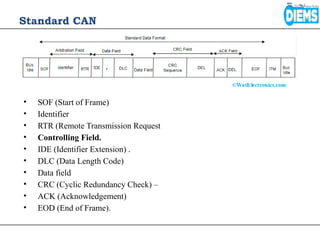
• SOF (Start of Frame)
• Identifier
• RTR (Remote Transmission Request
• Controlling Field.
• IDE (Identifier Extension) .
• DLC (Data Length Code)
• Data field
• CRC (Cyclic Redundancy Check) –
• ACK (Acknowledgement)
• EOD (End of Frame).
Standard CAN
Types of CAN
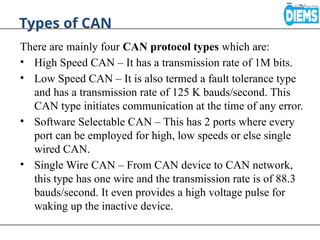
There are mainly four CAN protocol types which are:
• High Speed CAN – It has a transmission rate of 1M bits.
• Low Speed CAN – It is also termed a fault tolerance type
and has a transmission rate of 125 K bauds/second. This
CAN type initiates communication at the time of any error.
• Software Selectable CAN – This has 2 ports where every
port can be employed for high, low speeds or else single
wired CAN.
• Single Wire CAN – From CAN device to CAN network,
this type has one wire and the transmission rate is of 88.3
bauds/second. It even provides a high voltage pulse for
waking up the inactive device.
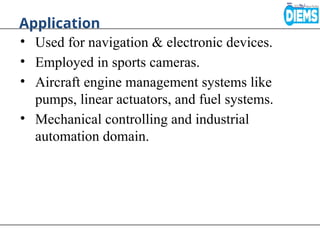
Application
• Used for navigation & electronic devices.
• Employed in sports cameras.
• Aircraft engine management systems like
pumps, linear actuators, and fuel systems.
• Mechanical controlling and industrial
automation domain.
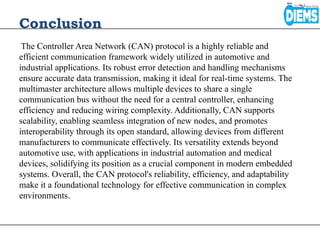
Conclusion
The Controller Area Network (CAN) protocol is a highly reliable and
efficient communication framework widely utilized in automotive and
industrial applications. Its robust error detection and handling mechanisms
ensure accurate data transmission, making it ideal for real-time systems. The
multimaster architecture allows multiple devices to share a single
communication bus without the need for a central controller, enhancing
efficiency and reducing wiring complexity. Additionally, CAN supports
scalability, enabling seamless integration of new nodes, and promotes
interoperability through its open standard, allowing devices from different
manufacturers to communicate effectively. Its versatility extends beyond
automotive use, with applications in industrial automation and medical
devices, solidifying its position as a crucial component in modern embedded
systems. Overall, the CAN protocol's reliability, efficiency, and adaptability
make it a foundational technology for effective communication in complex
environments.
QUESTIONS?
THANK YOU

Control area network protocol in embedded system

  • 1.
    LET US RISE ABOVETHE REST 01/03/2014 Welcome ESD CA-II Presented By: Aditya Bhavsar Roll no.: Topic: EC3106 CAN Protocol Class: TY-A(2024-25, Sem5) Guided by: SA.Karmude Sir Department of Electronics & Telecommunication
  • 2.
    CONTENTS • INTRODUCTION • BLOCKDIAGRAM • Layered Architecture • Standard CAN • Types of CAN • Application • Conclusion
  • 3.
    INTRODUCTION  Controller AreaNetwork(CAN)  Developed by Robert Bosch in 1989  No Host required.  Message Based Protocol  Differential Two wired communication  Designed originally for automobiles, but now used in many other context
  • 4.
    Block Diagram • CANbus transceiver • CAN protocol Machine • Acceptance Filters • Receive Buffer • Primary And Secondary Transmit Buffer • Host controller Interface • Clock
  • 5.
  • 6.
    • The CANcommunication protocol ISO 11898 defines how data is communicated between multiple devices in the network • Data – Link layer • MAC – Medium Access Control – This layer describes how various devices present in the network can receive accessibility to the medium. Here, data signaling, error identification, message encapsulation and decapsulation take place. • LLC – Logical Link Control – This layer offers logic for the data-link layer because it manages flow controlling, multiplexing, acceptance filtering, recovery handling, and overload warnings. • Physical Layer – • PCS – Physical Coding Sublayer – It observes that when the functional connection has been established and this layer is defined in Fast Ethernet, 10 Gigabit Ethernet, and gigabit Ethernet standards. It performs encoding and decoding of information, scrambling and descrambling, and rate variance compensation. • PMA – Physical Medium Attachment – It executes the framing of data and is responsible for transmitting and receiving high-speed information based on the structure of the transceiver channel. It also performs octet synchronization. • PMD – Physical Medium Dependent – It describes the particulars of transmission and reception of every bit that takes place on the physical medium. It also has a transceiver required for the medium. • MDI – Medium Dependent Interface – It defines the interface for the medium in the network which is useful in carrying the transmission.
  • 7.
    • SOF (Startof Frame) • Identifier • RTR (Remote Transmission Request • Controlling Field. • IDE (Identifier Extension) . • DLC (Data Length Code) • Data field • CRC (Cyclic Redundancy Check) – • ACK (Acknowledgement) • EOD (End of Frame). Standard CAN
  • 8.
    Types of CAN Thereare mainly four CAN protocol types which are: • High Speed CAN – It has a transmission rate of 1M bits. • Low Speed CAN – It is also termed a fault tolerance type and has a transmission rate of 125 K bauds/second. This CAN type initiates communication at the time of any error. • Software Selectable CAN – This has 2 ports where every port can be employed for high, low speeds or else single wired CAN. • Single Wire CAN – From CAN device to CAN network, this type has one wire and the transmission rate is of 88.3 bauds/second. It even provides a high voltage pulse for waking up the inactive device.
  • 9.
    Application • Used fornavigation & electronic devices. • Employed in sports cameras. • Aircraft engine management systems like pumps, linear actuators, and fuel systems. • Mechanical controlling and industrial automation domain.
  • 10.
    Conclusion The Controller AreaNetwork (CAN) protocol is a highly reliable and efficient communication framework widely utilized in automotive and industrial applications. Its robust error detection and handling mechanisms ensure accurate data transmission, making it ideal for real-time systems. The multimaster architecture allows multiple devices to share a single communication bus without the need for a central controller, enhancing efficiency and reducing wiring complexity. Additionally, CAN supports scalability, enabling seamless integration of new nodes, and promotes interoperability through its open standard, allowing devices from different manufacturers to communicate effectively. Its versatility extends beyond automotive use, with applications in industrial automation and medical devices, solidifying its position as a crucial component in modern embedded systems. Overall, the CAN protocol's reliability, efficiency, and adaptability make it a foundational technology for effective communication in complex environments.
  • 11.
  • 12.