Accenture
Technology
Vision
2012
Contents
Foreword                            2
Introduction                        3
Technology Trends
 Context-based services             4
 Converging data architectures      10
 Industrialized data services       16
 Social-driven IT                   23
 PaaS-enabled agility               29
 Orchestrated analytical security   36
Implications
 The CEO’s agenda                   43
 IT’s agenda                        45
Research methodology                48
End notes                           49
Contacts                            50
Foreword                                                                                                                            Accenture Technology Vision 2012


We bring the Accenture Technology Vision 2012 to you at a
time of unprecedented change in the global economy and the
technology landscape. Our clients tell us that technology is
more important than ever to their business success. Some of
them sense that the world is on the verge of a new technology
revolution. We agree.
This next revolution will differ from previous        It is time to focus on technology as a driver for
disruptions. This time, technology is present         growth and take the bold decisions to move
in every aspect of our lives. The lines between       beyond IT’s legacy constraints—constraints
consumer and corporate technology continue to         that make it too difficult to change, too
blur. On-premise and off-premise technology are       costly to pursue new opportunities.
melding to drive much quicker processing—and
                                                      The coming transformation journey—changing          Pierre Nanterme              Kevin Campbell
faster and better business results. The flexibility
                                                      IT from roadblock to driver—won’t be easy. It       Chief Executive Officer      Group Chief Executive - Technology
of new technologies and architectures is forcing
                                                      will call for a comprehensive strategy that leads   Accenture                    Accenture
us all to rethink how we harness IT to make
it easier for our organizations to innovate.          to new architectures, new services, and new
                                                      platforms. And it will demand prompt, disciplined
The Accenture Technology Vision 2012 is               execution to bring those new approaches to life.
designed to help you identify these changes—to
make sense of the disruptions. But this year’s        The technology that you use will be radically
report challenges companies to go a step              different three years from now. Stand still and
beyond understanding—to start taking action.          you risk being left behind. Act now and you will
We urge you to plan thoughtful, appropriate           be poised for continued growth in the future.
responses and seize new opportunities.


2
Introduction                                                                                                                                          Accenture Technology Vision 2012


Responding to what’s ahead


Some drivers have an advantage over other        CIOs are feeling the pressure of a bevy             Increasingly, business leaders find that their   Doing so means starting this journey together
motorists: they can see around corners           of technology forces—forces like the                organizations’ success relies on keeping pace    with the business. It demands detailed
at night. With adaptive headlights in their      superabundance of computing power                   with rapidly shifting technology. Companies      discussions with the rest of the C-suite. It will
cars—lamps that swivel a few degrees when        and capacity and the soaring technology             must be prepared to recognize and take           call for CIOs to internalize these trends so
they detect that the car is turning—these        expectations of consumers, employees, and           advantage of new opportunities enabled by        they can start framing these discussions—not
drivers can spot the deer in the road a          even CEOs. Discussions on the impact of cloud       new trends, like context-based services or       talking about the technologies themselves
few milliseconds before the rest of us.          computing and mobility have become routine.         social technologies. But the new moves will      but about the impact they will have on the
                                                 IT organizations are just beginning to wrap their   come at a price. To change with the world        business, and the new initiatives they can drive.
To take prompt action, every CIO requires the    minds around Big Data. They’re pushing to weave     quickly and cost-effectively, there must be a
information equivalent of adaptive headlights—   analytics deeper into the organization. And         new IT base—new architectures, new services,     Some of you are already leading those
the ability to identify relevant trends before   some are asking themselves what to make of the      new platforms. And with a new IT base come       conversations with your business colleagues—
others do. Indeed, they and their business       perennial discussion of the Internet of Things.     new risks and new precautions, so information    and with your IT staff. For those who aren’t,
colleagues need the clearest possible guidance                                                       security has to become a top agenda item.        are you ready?
about changes in information technologies.       Yet even as CIOs begin to react, the list of
With the right guidance, they can effectively    change-making technologies continues to             IT leaders must take action now. They must be
lead their organizations as they adapt to        grow. Recognizing that forces such as the cloud     the ones who lead their enterprises through
the rapidly changing world we live in.           are just the starting point, Accenture’s annual     this turbulent new world. Inside 100 days
                                                 Technology Vision provides our perspective          of reading this report, they should have
                                                 on the future of technology beyond the              begun to map out their strategies to leverage
                                                 conversations already on the table. This year’s     these trends over the long haul. Within 12
                                                 report—Technology Vision 2012—outlines the          months, they should be starting to execute
                                                 new technology trends that forward-thinking         these plans to put their enterprises on the
                                                 CIOs will use to position their organizations       path to new organizations, new processes,
                                                 to drive growth, rather than focusing on            new systems—even a new frame of mind.
                                                 cost-cutting and efficiency improvements.


                                                                                                                                                                                                          3
Context-based services
Context—where you are and what you’re doing—
will drive the next wave of digital services


4
Trend 1 - Context-based services   Accenture Technology Vision 2012
Trend 1 - Context-based services                                                                                                                                     Accenture Technology Vision 2012


Forget about the much-discussed Internet of Things. The really
interesting news is that data from a host of new sources,
combined with technologies that rapidly aggregate and analyze
the data, will deliver fresh insights that can give users much more
immersive and valuable experiences online—and in the real world.
Services that alert you to the nearest Starbucks       mile radius or what route to walk from this          meet the renter at the scene, greatly improving
or gas station just aren’t enough for users these      subway stop to that unfamiliar office building.      the chances of creating a loyal customer for life).
days. Those services don’t “know” you; they
                                                       Today, we have ready access to enough historical     CIOs and other IT leaders who get it—who
don’t know what you’re trying to do right now.
                                                       and real-time data and we know enough about          grasp the importance of context-based
What can still attract users? Services that            what is happening in enough places to be able to     connections—will be able to establish
combine real-time signals from the physical            offer services that are enabling and entertaining.   themselves, and their organizations, as strategic
world with location data, online activities, social    More data, by itself, isn’t enough—technology        players. They will immediately be able to offer
media, and many other types of contextual              now enables rapid aggregation of data from           new levels of insight that will differentiate
inputs. It might be support for a pharmaceutical       multiple sources and delivers new insights           their organizations from competitors.
sales rep tailored to the context of the doctors       that can give users much more immersive and
she will be meeting and the drugs she’s selling. It    valuable experiences. The key—beyond the             What context-based services aren’t
could be data made available to a technician at        proliferation of data and the ability to analyze
                                                                                                            It’s important to deflect any misconceptions
an oil refinery, customized to the equipment he’s      it every which way—is to ensure that context
                                                                                                            about context-based data services. To begin
servicing and what its downtime history looks          enables the services that make sense right
                                                                                                            with, they are not about “really cool” mobile
like. Or it might be a shopping app that gives a       at the point where an action takes place. In
                                                                                                            phone handsets—regardless of how much their
customer fast access to more information about         effect, context allows organizations to shift
                                                                                                            new apps may impress. Although devices such as
a new jacket whose quick response (QR) code            their focus from insight (for example, business
                                                                                                            mobiles are indeed essential vehicles for some of
she’s scanned in the store; tells her how far she      travelers place a premium on the ease and
                                                                                                            those services, that is all they are. Mobility is just
is from stores that carry other sizes of the jacket;   speed of interaction when choosing rental car
                                                                                                            one of many factors that help to convey context.
alerts her to her available credit balance; and        companies) to actionable insight (streamlining
gets instant opinions, via Facebook, from her          the car rental process allows frequent renters       Nor are context-based services all about the
friends about whether they like the jacket or not.     to avoid lines, thus increasing customer loyalty)    cloud. It’s true that connected devices—mobile
                                                       to insight at the point of action (for instance,     and otherwise—will exchange data with cloud-
The new high ground for data services is not in
                                                       the rental company automatically detects when        based service providers, but the cloud is nothing
location-based apps. It is in a kaleidoscope of
                                                       an accident with one of its cars has happened,       more than a logical data-aggregation point.
context that adds up to rich user experiences—
                                                       proactively initiates emergency services if          Similarly, “context-based” is not synonymous
far more alluring than simple indications of
                                                       needed, and issues a replacement rental car to       with “location-based.” The importance of being
how many friends are inside the same one-

6
Trend 1 - Context-based services                                                                                                                            Accenture Technology Vision 2012


able to integrate data from the physical world
beyond location—inputs from QR codes are only
                                                  The next few years are likely to see an expansion
                                                  in the volumes and types of sensors available
                                                                                                      the retailer and the original producer but for
                                                                                                      others in the shopper’s social network as well.       What it means for
one example—must not be underestimated. And
context is not just another example of social
                                                  to add context. The industrial world already
                                                  benefits from radio frequency ID (RFID) systems     Given richer context—access to the shopper’s
                                                                                                      interests, shopping history, or age, perhaps—
                                                                                                                                                            the business
media, although social certainly adds context     in which RFID-tagged items supply contextual
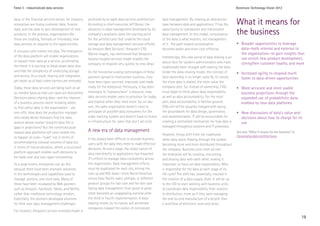
such as shared interests or opinions. It’s in     data about their locations, time, temperature,      providers will offer services that better align       • New products and services based on
the aggregation of all of these things that we    and much more. Now we anticipate a rush             with his needs and wants. Indeed, we expect             context from inside and outside of the
truly see the power of context-based services.    of specialty devices that will excel in niche       that products, services, retailers, and enterprises     enterprise
They create an experience that adds levels of     areas—health monitors that test for blood           will be differentiated based on their ability
utility and richness—and yes, complexity—that     sugar levels, for instance, or wristbands that      to meet users’ requirements in this way.              • New contextual data services that
were not possible even just a few years ago.      transmit signals about a patient’s activity         The power of context will enrich not only online        enable companies to more easily add
                                                  levels to mobile-linked health care systems         interactions but real-world ones as well. Today,        capabilities to their existing products
Context-based services that                       that add context about family health history        online shopping experiences have surpassed
transcend mobile apps                             to enable patients to improve their own health      what is usually available in the physical world;      • New capabilities to experiment with
                                                  care. Apple’s latest iPhone, for instance,          it is possible to view different colors, styles,        new services and iterate quickly based
Context-based services have existed in            contains Bluetooth Smart technology—a                                                                       on pilots
                                                                                                      sizes, and availability of merchandise; to put
rudimentary forms for some time; to an extent,    new standard that supports connections to           shopping carts on hold; to pay in many different
they are evident in the Internet of Things—for    sensors that consume very little power.             ways; to redeem coupons easily; and more. The
instance, in the real-time readings on pace
                                                                                                      next few years will see a push toward merging
and time that marathon runners receive from       The power of context                                the physical and virtual shopping experiences.
a transmitter tag laced to a shoe. They are
                                                  One other source of context is in what is           Blippar, for example, offers augmented reality
also apparent in the recommendation engines
                                                  shared—which is where blogs, chat rooms,            capabilities that allow retailers to experiment
used by sites such as Amazon, Netflix, and
                                                  message boards, social media, product               with doing just that today. And Shopkick
LinkedIn. Recommendation software not
                                                  reviews, and the countless other wells of           enriches the in-store shopping experience with
only keeps track of your personalized history
                                                  online data come in. We can detect or infer         personalized offers, highlights products that
and uses it to infer interests; today, it can
                                                  certain information about others based on our       others have liked, and rewards customers for
produce suggestions based on what others
                                                  interactions with them or, even more simply,        walking into selected stores. The reward for
in your social circle or professional group
                                                  we can give them the opportunity to share           walking in is just the bait; the context piece
are doing. For instance, if other users in your
                                                  it themselves. It turns out that users readily      comes from location (knowing you’re in the
network are reading a popular business book,
                                                  share meaningful personal context; they just        store), understanding interests and intent
a site may propose that you purchase it,
                                                  need to have a compelling reason to do so.          (scanning an item you’re thinking about), and
too—and provide a one-click link to do so.
                                                                                                      social connections (knowing what others liked).
And of course many phones—they do not             So when a retailer provides QR codes in its
                                                  stores, it enables the shopper to access new        The emergence of more context-based
even have to fit the definition of Web-
                                                  and valuable sources of information about a         services will have a compounding— those
ready smartphones that access vast stores
                                                  product or service. Because this is something the   new services themselves provide additional
of apps—have location-sensing capabilities
                                                  consumer wasn’t able to do before—or wasn’t         sources of context. The expanding richness
that provide their users with useful
                                                  able to do with such ease and reliability—he is     of context will be a fast-moving capability
proximity data, route planning, and more.
                                                  willing to trade some personal data in exchange.    that enterprises will need to watch.
                                                  That data in turn becomes valuable not only for
                                                                                                                                                                                                        7
Trend 1 - Context-based services                                                              Accenture Technology Vision 2012


This time next year                        “CIOs and other IT leaders who get it—who
Over the next 12 months, the IT             grasp the importance of context-based
organization should:
                                            connections—will be able to establish
• Create strong links with business
  functions that directly influence the     themselves, and their organizations, as
  consumer experience.
                                            strategic players. They will immediately
• Compile a firm list of context-based
  services that is regularly updated        be able to offer new levels of insight that
  as circumstances change—and that
  forms the basis of discussion with        will differentiate their organizations from
  the business side in order to drive
  the platform for context across the       competitors.”
  enterprise.
                                           What’s possible                                    they use. The banks benefit because they can
• Form a pilot team that blends user                                                          reduce the considerable costs of confirming a
  experience specialists with data         Several interesting examples show how              customer’s location abroad and reimbursing for
  scientists to experiment with new        context-based services may unfold. The             any fraudulent withdrawals from an account.2
  contextual data services.                service from a company called Reach.ly scans
                                           Twitter accounts in search of mentions of          However, it is still early days for context-based
• Establish an environment that enables    planned trips; with the information it gleans,     services. Current services barely scratch the
  experimentation—rapid development,       it enables hotels to contact travelers who         surface of what’s truly possible. Although
  planning, and deployment.                have indicated that they are heading to their      many of the technology challenges are being
                                           vicinity. In another case, several mobile phone    overcome, and although contextual data and
• Begin developing a data platform to      services providers are experimenting with          the means to synthesize it have reached critical
  handle contextual data and analytics,    technology that automatically deactivates          mass, other hurdles remain. For instance, privacy
  including appropriate privacy controls   phones while their owners are driving.1            issues are likely to make headlines soon as
  on potentially sensitive personal                                                           privacy watchdogs jump in to defend against
  information.                             And Misys, a provider of IT solutions for the      unauthorized tracking of citizens or consumers.
                                           financial services sector, is working to combat    In the United States, consumer advocacy groups
• Develop a data roadmap to depict how     bank fraud with GeoGuard, its new consumer         are particularly vocal about such issues.
  to acquire the critical data necessary   location-based offering running on the Force.
  for the next generation of context-      com platform. GeoGuard collates geographic         The skills needed to deliver context
  based services.                          information and enables customers to allow
                                           their banks to request their most recent           So what will it take for IT departments to help
                                           location information, regardless of the services   their organizations deliver rich context-based


8
Trend 1 - Context-based services                                                                           Accenture Technology Vision 2012


experiences to their customers? Context-based
services should be limited only by the creativity
                                                        Context-based services require very different
                                                        thinking from IT leaders. They call for a          Your 100-day plan
of the business, not by IT’s ability to deliver.        much broader and more dynamic view of the
                                                        possibilities for adding value for the business,   Suggested actions to take during the next
It should go without saying that skills in user         and they demand different skills and stronger      three months:
interface design will be high on the list. At           links within the enterprise than has been
the same time, it will be beneficial to have            typical to date. But those who grasp the           • Identify ways to drive the discussion
expertise in the design of high-quality customer        importance of these connections will quickly         toward the value of context; launch
experiences, whether you’re a retailer, a utility, or   establish themselves as strategic players.           discussions of new context-driven
a product manufacturer. One individual should                                                                opportunities with the business side.
be charged with the responsibility of overseeing
customer interactions across all channels.                                                                 • Start thinking in terms of multiple
For example, the Washington Post publishing                                                                  channels and following the mix of
company recently appointed a chief experience                                                                interactions that they enable (Web
officer, as did Cleveland Clinic some years ago.                                                             page to Facebook to retail to mobile...).
Also needed: strong management discipline
                                                                                                           • Start cataloging the contextual data
to get the best results from a mix of IT
                                                                                                             on hand.
traditionalists and creative user-experience
types. Orchestration skills will be essential
                                                                                                           • Start identifying new sources of data
for helping to handle the complex array of
                                                                                                             and determining how to acquire it
internal systems, not to mention the vendors
                                                                                                             (sometimes it must be bought, and
now populating the data services market,
                                                                                                             sometimes new mechanisms will be
where some forms of context will originate.
                                                                                                             needed to collect it in current systems).
Because new sources of context are constantly
popping up—and because there are always new                                                                • Sketch out the user experience skills
use cases, new services, new players, and new                                                                needed to pilot context-based services.
customer needs—context-based services will also
call for skills that encourage experimentation.                                                            • Plan an environment for
And they’ll require real flexibility and fast-                                                               experimentation.
paced ways of working because context that is
constantly in flux will lead to a need for agile                                                           • Draft ideas for how to leverage the
services that change as quickly as users do. IT                                                              technology that customers bring with
practitioners who are geared to traditional IT                                                               them.
cycle times will not be prime candidates for
the new roles needed; they’re unlikely to have
what it takes to get the best from the new
world of context and from an ever-changing
mix of widely distributed contextual data.

                                                                                                                                                     9
Converging data architectures
It’s not about the “big” in Big Data—data
architectures must bridge the old and the new


10
Trend 2 - Converging data architectures   Accenture Technology Vision 2012
Trend 2 - Converging data architectures                                                                                                                     Accenture Technology Vision 2012


Old approaches to data survive because structured forms of
data make IT leaders feel they’re in control. But new approaches
to managing unstructured data provide a whole new notion
of control—the ability to turn data into new streams of value.
Successfully rebalancing the data architecture portfolio and
blending the structured with the unstructured are key to
unlocking that value.
In 2011, even a casual reading of the technology    the status quo facing off against a maverick         Three changes that matter
media indicated that big changes were starting      camp that is enthusiastically—perhaps over-
to sweep through the IT department—whether          enthusiastically—seeing unstructured approaches      There are three fundamental data architecture
IT leaders recognized it or not. Big Data—the       to data as a panacea for all that ails IT today.     technology changes that, individually and
catchall term for the explosion in volumes and                                                           collectively, have significant implications for
types of data and the technologies emerging to      Neither stance is appropriate. Yes, what’s           IT leaders. We foresee a rebalancing of the
support it—was already making big headlines.        emerging is a new world of horizontally scaling,     database landscape as data architects embrace
Conference speeches and trade press articles had    unstructured databases that are better at            the fact that relational databases are no longer
begun the conversation about the importance         solving some old problems. More importantly,         the only tool in the toolkit. We anticipate
of distributed data and the idea of data as a       they’re prompting us to think of new problems        “bridge technologies” that will mix old and new
service. New technologies such as Apache            to solve whose resolution was never attempted        database forms. And we fully expect advances
Hadoop—a software framework that supports           before, because it just couldn’t be done. (Don’t     from the new to re-invigorate the old. In short,
data-intensive distributed applications—            misunderstand the “big” in Big Data—for most         we expect tomorrow’s conversations about
were already gathering momentum. In our             enterprises it’s not about finding ways to handle    data architectures to center on rebalancing,
Technology Vision 2011 report, we pointed out       massive amounts of Facebook or e-mail data.)         coexistence, and cross-pollination.
that companies needed to start conceiving of        But that does not imply “rip and replace”; in no
                                                    way does it render traditional databases obsolete.   IT leaders should be evaluating their data
data platforms in ways that better encompass
                                                    The truth is that now that we have technologies      portfolios for opportunities to rebalance the
the idea of data as the strategic IT asset.
                                                    that can deal with different types of data, there    use of relational and nonrelational databases.
Some enterprises are experimenting with data        is enormous value in maximizing the value of         Today’s data architects now have more choices
platform approaches, but it hasn’t been easy. In    the data in existing systems—in hybridizing          for solving unstructured data problems than
fact, there has been something of a polarization,   it with many forms of unstructured data.             simply jury-rigging relational databases to
with many of those steeped in traditional                                                                do so. Where today the data landscape is
relational database approaches defending                                                                 almost entirely relational, we expect that


12
Trend 2 - Converging data architectures                                                                                                                        Accenture Technology Vision 2012


landscape to change significantly. Over the next
decade, the proportion that is nonrelational
                                                      pollination is already happening at the vendor
                                                      level. Nonrelational databases were the first to
                                                                                                          development for several decades. Approaches
                                                                                                          to structuring information, gathering data           What it means for
will rise. It has been estimated that between
15 percent and 40 percent of all relational
                                                      integrate horizontal scaling technologies into
                                                      the core; now relational databases are starting
                                                                                                          requirements, storing data, and even solving
                                                                                                          data problems are driven by a view of the            the business
database management systems (RDBMS)                   to do the same. There is no shortage of start-up    world adopted from structured design
implementations would be better suited to             activity in the arena, meaning that investment      approaches and the trusty relational database.       • Potential advantage for small and
nonrelational platforms.3 But that shift does         capital is betting on cross-pollination;                                                                   midsize competitors since they lack
not imply that relational is somehow inferior.        newcomers include Xeround, Scalr, Akiban, and       This structured view of the world is entrenched        the “anchor” of heavy investments in
IT leaders will need to make their choices            Schooner. As these technologies reach maturity,     in organizations. Many CIOs still think of             legacy systems
based not on ideology but on the forms of             enterprises should re-evaluate their readiness      themselves not as the stewards of data but as
data they are using and for what purposes.            to tackle more complex data problems.               the data “owners.” And to a worrying extent,         • More accurate and more usable
                                                                                                          many senior IT managers remain convinced               business projections through the
The worlds of structured and unstructured data        Established vendors don’t plan to be left out       that all forms of data can still be dealt with         expanded use of probabilistic data,
are rapidly converging. Leading IT practitioners      of the new world. Just a few glimpses: Oracle       using conventional relational databases, so            enabled by new data platforms
must find ways to constructively manage               has marched into the unstructured world by          they are unwilling to try other options. In
the convergence and enable all forms of data          announcing its Hadoop-framework-based Big           many cases, the resistance is passive: stay the      • IT moves from blocker to enabler,
management to coexist, sometimes using                Data Appliance. IBM has built a new version         present course, ignore Big Data, and it will           improving the leverage of all available
bridge technologies. That’s the case at one large     of InfoSphere BigInsights for its smart cloud       go away. In other cases, the pushback is that          data, both external and internal to the
high-tech company that is using Hadoop to             infrastructure that uses Hadoop to analyze          the new technologies are “toy technologies”—           organization
process and import data into traditional systems      structured and unstructured data. And               not considered “enterprise grade.” In effect,
in ways that wouldn’t be possible with just           Microsoft recently announced plans to deliver       the traditional relational database has been         • Faster responses to queries, and more
the RDBMS approach. In essence, the Hadoop            enterprise-class Hadoop-based distributions         misused for decades because it has been                frequent and increasingly customized
framework becomes a preprocessing engine              on both Windows Server and Windows Azure.           seen as the only tool in the toolbox—and               iterations on those queries
for analyzing raw data to extract important           The shifts in vendors’ thinking are also seen       because IT departments haven’t had the
events before feeding the other systems. It           in consolidation moves as established players       vision and skills to use it in any other way.        See also “What it means for the business” in
is abstracted and integrated with existing            acknowledge that they must move into these                                                               Industrialized data services.
reporting in such a way that it minimizes             new realms. For example, Teradata acquired Aster    Yet we’re seeing the rapid rise of another group—
the impact on the rest of the enterprise.             Data Systems, a leader in Big Data analytics. The   the iconoclasts who are scraping unstructured
                                                      acquisition was designed to expand Teradata’s       data off Web sites, wikis, and Twitter feeds in
Over the long term, the high-performing               portfolio and bring businesses greater depth        order to find insights that can help them discover
organizations will be those whose IT groups           of analytic insight and faster time to value as     new customer segments, identify new product
recognize the need for coexistence and                they unlock the full potential of their Big Data.   directions, and more. These individuals are very
effectively marry the two worlds to get the most                                                          much in touch with the Web-scale companies
from their data. IT leaders must still be realistic   What’s complicating change                          that are already big names in the consumer
about the limits of what can be achieved via                                                              realm—companies such as Google, Amazon,
bridge technologies, sometimes waiting instead        Unfortunately, old IT habits die hard.              Facebook, and Twitter. They are often plugged
for the next generation of data technologies          Legacy thinking prevails. Existing views            into the open-source movement and to the
where cross-pollination between the structured        of data architecture are a product of the           academic and other research communities that
and unstructured worlds will fill gaps. This cross-   application lens that’s been applied to system      surround these Web-scale companies. For them,


                                                                                                                                                                                                              13
Trend 2 - Converging data architectures                                                                  Accenture Technology Vision 2012


This time next year                                the unstructured data milieu is something rich
                                                   and new and fun and cool that they want to play
                                                                                                         certainly have to evaluate and implement
                                                                                                         bridge technologies. For instance, Aster
                                                   with—and that can deliver real business results.      Data’s SQL-MapReduce helps IT departments
Over the next 12 months, the IT                                                                          deal with their lack of skills in nontraditional
organization should:                               At JPMorgan Chase, for example, many lines            database management until they have built up
                                                   of business now use a Hadoop shared service           that capability. Bridge technologies leverage
• Run data platform trials that leverage           for jobs ranging from extract, transform, and         existing investments; they will not immediately
  structured and unstructured data—with            load (ETL) processing and fraud investigation to      disrupt existing IT operations and are unlikely
  data in the platform and in use by one or        social media sentiment analysis.4 The service also    to unsettle the relational database adherents.
  more business processes.                         provides low-cost storage for varied types of         Deeper conversations with the software
                                                   data; for instance, it stores traditional financial   vendor community can help to accelerate
                                                   records and semi-structured Web logs as well as
• Create a list of other business                                                                        the introduction of bridge technologies.
                                                   unstructured text and social comment feeds.
  processes that can begin to leverage
                                                                                                         We expect that the rebalancing will happen
  data in the platform.                            Oil and gas companies are using SAP’s HANA            as a slow evolution as IT departments
                                                   in-memory appliance to review massive amounts         retire applications and start to replatform
• Create a tangible, funded roadmap,               of their raw exploration data. Utilities are using    in the cloud, on mobile devices, and using
  subsequent to successful trials, to              it to analyze large volumes of data from smart        bridge approaches. Rebalancing is likely to
  expand replatforming to a growing                meters and to optimize energy generation              achieve strong momentum where there are
  amount of data and other business                based on predictive patterns of consumption.5         the most gains to be made—in customer-
  activities.
                                                   To a large extent, the maverick groups that are       facing business processes, for example.

• Appoint a top-level executive who is             quite comfortable with all things Web scale           Forward-thinking CIOs will make strong
  responsible for an overarching data-             are working in fields such as marketing, new          business cases for new investments in select
  centric perspective—perhaps even                 product development, and customer relations,          systems to accelerate the retirement of existing
  appoint a chief data officer.                    but as they derive new data and new scraps of         software. They will need to identify “burning
                                                   insight, they are increasingly recognizing the        platforms” that they can use as spurs for
• Create a recruiting pipeline for data            need to work with IT to get actionable outputs        their new initiatives; a prime example would
  specialists in areas such as alternative         from what they’re producing. Forward-looking          be a business process that can benefit from
  database technologies and analytics.             CIOs will want to hire those mavericks.               being able to concurrently and rapidly access
                                                                                                         multiple forms of data from a host of sources,
• Demonstrate a “data stewardship”
                                                   How to think about the                                both external and internal to the organization.
  mentality rather than one of                     three underlying changes                              Over time, of course, concern about the
  ownership.                                       We predict that, increasingly, the effectiveness
                                                                                                         balance between relational and nonrelational
                                                                                                         will eventually become a tactical detail.
                                                   of IT leaders will be gauged by their ability to
See also “This time next year” in Industrialized
data services.
                                                   bridge the gap between the structured and             Furthermore, as CIOs envision how they can
                                                   unstructured worlds. Again, the important thing       foster coexistence between structured and
                                                   is that this must not be an exercise in “rip and      unstructured forms of data, they will need
                                                   replace.” CIOs who are serious about enabling         to resist popular notions that the Big Data
                                                   the coexistence of all forms of data will almost
14
Trend 2 - Converging data architectures                                                                                                                          Accenture Technology Vision 2012


“The rebalancing of data architectures                                                                      Old approaches to data survive because
                                                                                                            structured forms of data make IT leaders feel        Your 100-day plan
 will happen as a slow evolution as IT                                                                      they are in control. But it’s time to reframe the
                                                                                                            whole notion of control. It’s time to stop viewing   Suggested actions to take during the next

 departments retire applications and start to                                                               data as a means to an end—a platform that is
                                                                                                            designed to support an application—and start
                                                                                                                                                                 three months:


 replatform in the cloud, on mobile devices,                                                                seeing it as an underutilized asset. CIOs cannot
                                                                                                            stop or slow change as the fundamental trends
                                                                                                                                                                 • Identify the “burning platforms” among
                                                                                                                                                                   the organization’s business processes that

 and using bridge approaches. It is likely to                                                               toward rebalancing, coexistence, and cross-
                                                                                                            pollination proceed. But there is so much that
                                                                                                                                                                   can become the vehicles for change.


 achieve strong momentum where there are                                                                    they can do to prepare for those changes.            • Map out individuals on the business
                                                                                                                                                                   side who are current “data owners.”

 the most gains to be made—in customer-                                                                                                                          • Map available IT skills in light of

 facing business processes, for example.”                                                                                                                          the need to rebalance database
                                                                                                                                                                   approaches.

“revolution” is all about victory over SQL. Many      to think in terms of reskilling. If IT groups                                                              • Draft new methodologies for data
voices push forward the idea that scale is the        have professionals who know only relational                                                                  design in new projects.
driving reason why relational databases won’t         databases, they will perpetuate the “everything
be used in the future. But that’s not universally     is a nail” problem. The IT leaders themselves                                                              • Assess where current approaches aren’t
true and not always applicable; the arguments         will need to play the roles of orchestrators—                                                                meeting enterprise needs (for example,
about scale serve as a distraction from the main      adept generalists who excel at managing                                                                      where data integration is fragile or
issue. In practice, a lot of the conversation about   disparate sources and forms of data to create                                                                where replication is unmanageable)
Big Data is not necessarily about its “bigness.”      a symphony of new business possibilities.                                                                    and sketch out early retirement of
Very few organizations are going to need the                                                                                                                       applications wherever needs are not
type of scale that often makes the Big Data           At the same time, there will need to be
                                                      individual experts with skills in areas that                                                                 being met.
headlines. So, far from rendering the relational
database obsolete, the new advances will be           realistically do not exist in the traditional IT
                                                      world—for instance, specialists in alternative                                                             • Begin listing opportunities to provide
incorporated over time into the traditional
                                                      database technologies who understand which                                                                   new value-added data services.
databases, extending their performance.
                                                      to use in which circumstances. IT departments
                                                                                                                                                                 See also “Your 100-day plan” in Industrialized
New skills, new structure                             will probably post vacancies for specialists
                                                                                                                                                                 data services.
                                                      with statistical and analytical skills; in general,
for IT departments                                    there will have to be a steady rise in the
With an eye on the long term, CIOs will               analytic literacy of the IT group. And as more
have to think in terms of restructuring their         of these kinds of specialty skills come on
organizations. As a starting point, most              board, and as they reshape the interactions
enterprises need to build better data architecture    with the business side, the orchestrators
skills across the board. They will also have          will become more and more influential.
                                                                                                                                                                                                                  15
Industrialized data services
Freedom to share data will make data more
valuable—but only if it’s managed differently


16
Trend 3 - Industrialized data services   Accenture Technology Vision 2012
Trend 3 - Industrialized data services                                                                                                                       Accenture Technology Vision 2012


Now that data is being decoupled, enterprises are using it in
many different ways to unlock far more of its potential value.
They’re actively hunting for other useful data—outside their
organizations as well as inside—while keeping their eyes open
for opportunities to share their data. But most early data-
sharing activities are ad hoc. Needed next: fresh approaches to
data management.
You’ve got a problem if, several years from now,    The outcome: companies are rapidly creating        As things stand, most companies have some way
your IT organization is still organized chiefly     patchwork quilts of data integration systems       to go before they fully grasp the implications
around applications.                                whose sheer randomness and variety is              of decoupling data and then sharing it across
                                                    leading to inefficiency and complexity             the enterprise. The tendency is still to treat the
These days, data should be free to roam, and
                                                    that is unsustainable. Put simply, increased       emerging opportunities as data integration
that is a very good thing. Once unshackled from
                                                    sharing of data through data services calls        projects—as point solutions, not as ongoing
this or that application, it can be moved, shared
                                                    for a radical rethinking of how IT should          data services. After working lifetimes spent in
with alliance partners or suppliers, divided up,
                                                    handle data management. Data management            complete control of how and when their data
analyzed every which way, blended with other
                                                    shifts from being an IT capability buried          is stored, accessed, archived, and destroyed, it’s
data—whatever it takes to unlock much more
                                                    within application support to a collaborative      not easy for many IT managers to accept that
of its potential value. And that’s exactly what
                                                    effort of IT and business leaders working          they must now collaborate with others with
some far-sighted organizations are doing now.
                                                    in tandem that enables data to be used far         whom they share “ownership” of their data.
But freedom isn’t free. There are hidden costs      beyond the applications that created it.
in properly valuing and managing data now                                                              Industrializing the approach
                                                    In the next few years, we believe, leading
that it can be decoupled. Most organizations’                                                          to sharing data
                                                    organizations will master the types of data
efforts to share data broadly are ad hoc. Let’s
                                                    management necessary to strike the right           Accenture’s Technology Vision 2011 report
say the marketing group is grabbing data from
                                                    balance between constraint and freedom for         identified decoupling as a wide-scale trend
the customer relationship management (CRM)
                                                    their data, based on a clear-eyed view of the      worth watching—and doing something about,
system so it can study recent loyalty trends.
                                                    real value of the data. They will start to think   especially as it relates to data. Many enterprises
The system it sets up to capture, stage, and
                                                    in terms of industrializing the sharing of data.   are starting to recognize that their data has value
store the data is probably entirely different
                                                                                                       beyond its original purpose. More companies
from the system that the finance department
                                                                                                       are beginning to engage in richer data sharing
creates when using the same data sets to
                                                                                                       as analytics increases their appetite for more
calculate, say, customer retention costs.
                                                                                                       data and drives them to better utilize existing
18
Trend 3 - Industrialized data services                                                                                                                            Accenture Technology Vision 2012


data. In the financial services sector, for instance,
enterprises are fusing customer data, finance
                                                        anchored by an agile data services architecture.
                                                        According to chief executive Jeff Bezos, the
                                                                                                            data management. By creating an abstraction
                                                                                                            layer between data and applications, IT has the       What it means for
data, and risk data to spur development of new
products. In the process, organizations like
                                                        advances in data management developed by his
                                                        company’s engineers were the starting point
                                                                                                            opportunity to standardize and industrialize
                                                                                                            data management. In this model, consumption           the business
these are creating, formally or informally, new         for the architectures that underlie the cloud       of the data is what matters, not management
data services to respond to the opportunities.          storage and data management services offered        of it. The path toward centralization                 • Broader opportunities to leverage
                                                        by Amazon Web Services.6 Amazon’s CTO,              becomes easier and more cost-effective.                 data—both internal and external to
A virtuous cycle comes into play. The emergence
                                                        Werner Vogels, has mentioned that Amazon’s                                                                  the organization—to gain insights that
of the data platform will enable organizations                                                              Interestingly, this new world of data sharing is an
                                                        loosely coupled services model enables the                                                                  can enrich new product development,
to expose more data as a service, accelerating                                                              about-face for systems administrators who have
                                                        company to respond very quickly to new ideas.7                                                              strengthen customer loyalty, and more
the trend. It is starting to break down data silos                                                          traditionally been charged with owning the data.
and hide the complexity of underlying storage           As the horizontal-scaling technologies of these     Under the data-sharing model, the concept of          • Increased agility to respond much
and access. As a result, sharing and integration        pioneers spread to mainstream business, they        data ownership is no longer valid. By its nature,       faster to data-driven opportunities
get easier as at least some barriers are removed.       have been open-sourced, improved, and made          the more data is shared, the more value the
Today, these data services are being built on an        ready for the enterprise. Previously, it has been   company sees. So, instead of ownership, CIOs          • More accurate and more usable
as-needed basis as new use cases are discovered.        necessary to “overprovision” a resource; now,       must begin to think about data responsibility           business projections through the
Decisions about sharing data—and the chances            data services enable users to provision for today   as well as data accountability. For the most            expanded use of probabilistic data,
of a business process owner knowing where               and expand when they need more. So, on day          part, data accountability is familiar ground:           enabled by new data platforms
to find useful data in the organization – are           one, the sales organization doesn’t need to         CIOs will still be squarely charged with laying
one-offs. How does the production manager               anticipate all possible data consumers for the      the groundwork for data design, governance,           • New discussions of data’s value and
who needs better forecasts find the sales               order tracking system and doesn’t have to invest    and implementation. IT will be accountable for          decisions about how to charge for its
analyst whose market research data fills in             in infrastructure for users that don’t yet exist.   creating a centralized mechanism for how data is        use
gaps in projections? But the continued push                                                                 managed throughout systems and IT processes.
toward data platforms will soon enable this             A new era of data management                                                                              See also “What it means for the business” in
                                                                                                            However, things shift from the traditional            Converging data architectures.
to happen at scale—“scale” not in terms of              It has always been difficult to provide business    when data starts flowing through the system,
accommodating colossal volumes of data but              users with the data they need to make effective     becoming more and more distributed throughout
in terms of industrialization, where a structured       decisions. At every stage, the siloed nature of     the company. Business units from all over
platform approach enables such decisions to             data tied directly to applications has thwarted     the enterprise will be creating, consuming,
be made over and over again consistently.               IT’s efforts to manage data consistently across     and sharing data with each other, making it
To a large extent, enterprises can do this              the organization. Data management efforts           important to focus on data responsibility. Who
because there have been dramatic advances               must be duplicated for each silo, driving the       is responsible for the data at each stage of its
in the technologies and capabilities used to            cost up and ROI down—think North American           life cycle? The shift has, essentially, resulted in
manage, process, and store data. Many of                versus Asia-Pacific sales, perhaps, or different    the creation of a data supply chain. It will be up
these have been incubated by Web pioneers               product groups for hair care and for skin care.     to the CIO to start working with business units
such as Amazon, Facebook, Yahoo, and Netflix,           Taking data management from good to great           to coordinate data responsibility from creation
rather than traditional technology vendors.             often becomes an unappealing exercise after         to distribution, more as if they were managing
Essentially, the pioneers developed solutions           the third or fourth implementation. A data-         the end-to-end manufacture of a bicycle than
for their own data-management challenges.               sharing model, by its nature, will accelerate       a workflow of electronic ones and zeros.
                                                        companies toward the notion of centralized
For instance, Amazon’s service-oriented model is
                                                                                                                                                                                                                 19
Trend 3 - Industrialized data services                                                              Accenture Technology Vision 2012


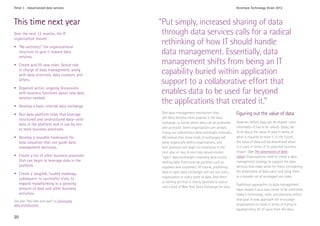
This time next year                            “Put simply, increased sharing of data
Over the next 12 months, the IT                 through data services calls for a radical
organization should:
• “Re-architect” the organizational
                                                rethinking of how IT should handle
  structure to gear it toward data
  services.
                                                data management. Essentially, data
• Create and fill new roles: Senior role
                                                management shifts from being an IT
  in charge of data management, along
  with data scientists, data curators, and
                                                capability buried within application
  others.
                                                support to a collaborative effort that
• Organize active, ongoing discussions
  with business functions about new data        enables data to be used far beyond
  services needed.
• Develop a basic internal data exchange.
                                                the applications that created it.”
• Run data platform trials that leverage        One data-management mechanism that                  Figuring out the value of data
  structured and unstructured data—with         will likely become more popular is the data
                                                exchange—a forum where data can be published        However, before data can be shared—even
  data in the platform and in use by one
                                                and accessed. Some organizations are already        informally—it has to be valued. Today, we
  or more business processes.
                                                trying out rudimentary data exchanges internally.   think about the value of data in terms of
• Develop a reusable framework for              We believe that these kinds of exchanges will       what is required to store it. In the future,
  data valuation that can guide data            grow organically within organizations, and          the value of data will be determined when
  management decisions.                         best practices will begin to materialize in the     it is used, in terms of its potential business
                                                next year or two. A next step would involve         impact. (See The dimensions of data
• Create a list of other business processes     “open” data exchanges—exposing data to and          value.) Organizations need to create a data
  that can begin to leverage data in the        seeking data from external partners such as         management strategy to support the data
  platform.                                     suppliers and customers. Of course, publishing      services that make sense for them, considering
                                                data to open data exchanges will not suit every     the dimensions of data value and tying them
• Create a tangible, funded roadmap,
                                                organization or every piece of data. And there      to a broader set of envisaged use cases.
  subsequent to successful trials, to
  expand replatforming to a growing             is nothing yet that is clearly destined to evolve
                                                                                                    Traditional approaches to data management
  amount of data and other business             into a kind of New York Stock Exchange for data.
                                                                                                    have viewed it as a cost center to be controlled;
  activities.                                                                                       today’s technology, tools, and practices reflect
See also “This time next year” in Converging                                                        that goal. A new approach will encourage
data architectures.                                                                                 organizations to think in terms of trying to
                                                                                                    squeeze every bit of value from the data.

20
Trend 3 - Industrialized data services                                                                                                                    Accenture Technology Vision 2012


As yet, there is little concrete guidance for how
to value data across the entire organization—
                                                    Rethinking the organization
                                                    structure and skills needed
                                                                                                       the business. Industrializing these data sharing
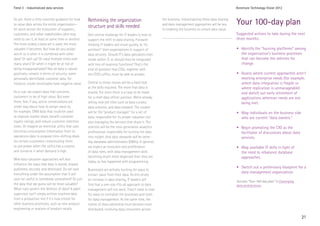
                                                                                                       and data management approaches will be key         Your 100-day plan
let alone across the ecosystem of suppliers,                                                           to enabling the business to unlock data value.
customers, and other stakeholders who may           One central challenge for IT leaders is how to                                                        Suggested actions to take during the next
need to use it, at least at some time or another.   support the shift to data sharing. Forward-                                                           three months:
The more widely a data set is used, the more        thinking IT leaders will move quickly to “re-
valuable it becomes. But how do you assign          architect” their organizations in support of                                                          • Identify the “burning platforms” among
worth to it when it is combined with other          data services. Should IT’s data specialists even                                                        the organization’s business processes
data? Or split up? Or used multiple times over      reside within IT, or should they be integrated                                                          that can become the vehicles for
many years? Or when it might be at risk of          with line-of-business functions? That’s the                                                             change.
being misappropriated? Not all data is valued       kind of question that CIOs, together with
positively; viewed in terms of security, some       the CEO’s office, must be able to answer.                                                             • Assess where current approaches aren’t
personally identifiable customer data, for                                                                                                                  meeting enterprise needs (for example,
instance, could conceivably have negative value.    Central to those moves will be a hard look                                                              where data integration is fragile or
                                                    at the skills required. The more that data is                                                           where replication is unmanageable)
As a rule, we expect data that concerns             shared, the more there is a case to be made                                                             and sketch out early retirement of
customers to be of high value. But even             for a chief data officer position. We’re already                                                        applications wherever needs are not
there, few, if any, active conversations are        seeing new job titles such as data curator,                                                             being met.
under way about how to assign value to,             data scientist, and data steward. The curator
for example, CRM data that could be used            will be the “product manager” for a set of                                                            • Map individuals on the business side
to improve market share, benefit customer           data, responsible for its proper valuation but                                                          who are current “data owners.”
loyalty ratings, and reduce customer retention      also managing the services that share it. The
costs. Or imagine an electrical utility that uses   scientist will be the next-generation analytics                                                       • Begin promoting the CIO as the
electrical consumption information from its         professional, responsible for turning the data                                                          facilitator of discussions about data
operations data to propose time-shifting deals      into insight. And data stewards will be latter-                                                         services.
for certain customers—incentivizing them            day database administrators (DBAs). In general,
to use power when the utility has a surplus         we expect an evolution and proliferation                                                              • Map available IT skills in light of
and conserve it when demand is high.                of data roles, with data management skills                                                              the need to rebalance database
                                                    becoming much more dispersed than they are                                                              approaches.
New data valuation approaches will also
                                                    today, as has happened with programming.
influence the ways that data is stored, shared,
published, secured, and destroyed. Do we save                                                                                                             • Sketch out a preliminary blueprint for a
                                                    Businesses are actively hunting for ways to
everything under the assumption that it will                                                                                                                data management organization.
                                                    extract value from their data. As this drives
soon be useful to somebody somewhere? Or just       an increase in data sharing, IT leaders will                                                          See also “Your 100-day plan” in Converging
the data that we guess will be most valuable?       find that a one-size-fits-all approach to data                                                        data architectures.
What rules govern the deletion of data? A plant     management will not work. They’ll need to look
supervisor can’t simply archive machine data        for ways to centralize the processes and tools
from a production line if it’s now critical for     for data management. At the same time, the
other business processes, such as new product       notion of data ownership must become more
engineering or analysis of product recalls.         distributed, involving data consumers across

                                                                                                                                                                                                       21
Trend 3 - Industrialized data services                                                                                                           Accenture Technology Vision 2012


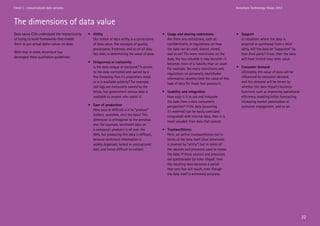
The dimensions of data value
Data-savvy CIOs understand the impracticality   •  tility
                                                  U                                             • Usageandsharingrestrictions                 •  upport
                                                                                                                                                   S
of trying to build frameworks that enable         Our notion of data utility is a cornerstone     Are there any restrictions, such as              In situations where the data is
them to put actual dollar values on data.         of data value. The concepts of quality,         confidentiality or regulations, on how           acquired or purchased from a third
                                                  provenance, freshness, and so on all play       the data can be used, shared, stored,            party, will the data be “supported” by
With that in mind, Accenture has                  key roles in determining the value of data.     and so on? The more restrictions on the          that third party? If not, then the data
developed these qualitative guidelines:                                                           data, the less valuable it may become—it         will have limited long-term value.
                                                • Uniquenessorexclusivity                       becomes more of a liability than an asset.
                                                  Is the data unique or exclusive? Is access      For example, the many restrictions and         • Consumerdemand
                                                  to the data controlled and owned by a           regulations on personally identifiable           Ultimately, the value of data will be
                                                  few (meaning that it’s proprietary data)        information severely limit the value of this     influenced by consumer demand,
                                                  or is it available publicly? For example,       type of data for those that possess it.          and this demand will be driven by
                                                  call logs are exclusively owned by the                                                           whether the data impacts business
                                                  telcos, but government census data is         • Usabilityandintegration                        functions such as improving operational
                                                  available to anyone who wants it.               How easy is it to use and integrate              efficiency, enabling better forecasting,
                                                                                                  the data from a data consumer’s                  increasing market penetration or
                                                • Easeofproduction                              perspective? If the data (assuming               customer engagement, and so on.
                                                  How easy or difficult is it to “produce”        it’s external) can be easily used (and
                                                  (collect, assemble, etc.) the data? This        integrated) with internal data, then it is
                                                  dimension is orthogonal to the previous         more valuable than data that cannot.
                                                  one. For example, sentiment data on
                                                  a company’s products is all over the          •  rustworthiness
                                                                                                  T
                                                  Web, but producing this data is difficult,      Here, we define trustworthiness not in
                                                  because sentiment information is                terms of the data itself (that dimension
                                                  widely dispersed, locked in unstructured        is covered by “utility”) but in terms of
                                                  text, and hence difficult to extract.           the sources and processes used to create
                                                                                                  the data. If these sources and processes
                                                                                                  are questionable (or even illegal), then
                                                                                                  the resulting data becomes a pariah
                                                                                                  that very few will touch, even though
                                                                                                  the data itself is extremely accurate.


                                                                                                                                                                                              22
Social-driven IT
Social isn’t just a bolt-on marketing channel—it
will transform interactions in the business world


23
Trend 4 - Social-driven IT   Accenture Technology Vision 2012
Trend 4 - Social-driven IT                                                                                                                                      Accenture Technology Vision 2012


Facebook, LinkedIn, Twitter, and other forms of social media are
not just new communication channels to customers. They are
powerful catalysts that are changing the ways your customers,
employees, and partners use technology to interact with the
world around them. Most organizations have yet to catch up to
that reality, and almost none take full advantage of it. They must.
Who doesn’t have a Facebook page?                    more efficiently, and with better outcomes.           directly to him to address it before he calls to
                                                     They will also see value in using enterprise social   complain. At the same time, enterprises need
The social media trend has swept across the          platforms for connections with and among              to be on the lookout for opportunities to invent
world with breathtaking speed—and with               employees—and even among enterprises.                 new channels through social, such as social
astonishing impact. In the United States,                                                                  polling via WayIn or Yahoo’s IntoNow.
Facebook is largely supplanting e-mail and text      The opportunity is to capture, measure, analyze,
as the primary tool for communicating with           and exploit these social interactions in new ways.    The challenge for IT managers, then, will be
friends. Social media has become de rigueur          It means that social media must be seen as much       to revisit business processes and the systems
for businesses too—although mostly as an             more than a new “bolt on” channel; it has to be       that implement them. They will need to look
add-on marketing tool. And in more and more          viewed as a catalyst for revisiting everything        across channels to define interactions. They
instances, online forums and Twitter feeds are       that touches a company’s customers and,               must look at new forms of data generated by
becoming valued sources of insight for marketers     increasingly, other communities of stakeholders.      those interactions and evaluate the potential
and product developers eager to learn what           It provides pathways to convey to the rest of the     insights they can get from them. They will
consumers really think.                              organization what has been learned by listening       be obliged to revisit the organizational
                                                     to consumers. The most immediate implication is       structures that perpetuate the separation
But that’s not the only way that social platforms    that a company’s call center applications, its Web    of channels. They will have to think in terms
will be used by businesses in the future.            presence, its customer relationship management        of industrializing social platforms. And they
The social media phenomenon has not just             (CRM) applications, its mobile experience,            are likely to have to update the metrics that
created a new channel to communicate; it has         and other consumer channels all need to all           define success for customer interactions.
fundamentally changed the ways in which              be integrated with each other and be “social-
people communicate. Looking at the broader           enabled.” So, for example, when a customer            No business is going to be able to exclude
impact, we predict that leading organizations will   tweets about a bad experience with buying a           social. Those that dismiss its rising influence as
soon start applying social platforms and social      mattress, it can be linked to his purchase history    a fad—or worse, as a preoccupation only for the
design mechanics to manage interactions across       and to the reviews that he has posted on the          young—will be doing their organizations a gross
all communication channels to consumers,             retailer’s website to determine the problem           disservice. They will be effectively removing
fostering greater intimacy with their customers,     and—since he’s a repeat customer—to reach out         themselves from the conversations that their


25
Trend 4 - Social-driven IT                                                                                                                                            Accenture Technology Vision 2012


consumers are already having about them and
ignoring the new conversations that consumers
                                                         Social platforms are gathering tremendous
                                                         momentum: Bebo, popular in Europe, now has
                                                                                                                 if a homeowner’s security company learns
                                                                                                                 from social media that a customer is planning a      What it means for
are looking for. Complaints are being submitted
to Yelp, instead of to you. Support forums point
                                                         close to 120 million members, China’s Renren
                                                         has 160 million members, and Facebook’s
                                                                                                                 vacation, that would present a good opportunity
                                                                                                                 to offer the homeowner increased monitoring          the business
to how-to videos on YouTube that your call               membership now tops 800 million. And in                 and sensitivity of her home security system. This
center employees don’t even know exist. When             the last year, social platforms have shown big          is an example of an insight that would never have    • Better insight into conversations about
a customer tweets to you that they want to               improvements in user security—specifically in           been available simply because the homeowner            the company
increase their insurance coverage, will you be able      social authentication (determining you’re really        “liked” Hawaii.
to respond?                                              you by using your social graph and photos)                                                                   • More influence on the conversations
                                                         and in trusted friends (reclaiming your account         Nouns in social are moving beyond people, too.         currently happening about the
If they fail to engage with social, enterprises will     by having a reset code sent to a friend you’ve          Toyota Friend is a network that connects owners        company on social media
essentially be encouraging their organizations’          designated in advance). Behind-the-scenes               with their cars, their local dealership, and with
potential customers to be lured away by                  security has been stepped up too. Some social           Toyota itself. For instance, the car can send an     • Improved customer loyalty and
competitors that are increasingly interacting with       platforms now use behavioral analytics tools            alert for required service, just like a tweet.9        more frequent and more consistent
those customers in the ways that the customers           that look for anomalous behavior of users,                                                                     interactions with consumers
want to communicate. More ominously, they                                                                        For users, the new features make their
                                                         sessions, and applications as well as link scanning     interactions with others richer and easier.
will be putting existing customer relationships          (scanning links themselves and building a                                                                    • More opportunities for more direct,
at risk—and they won’t be able to measure the                                                                    For businesses, they further solidify
                                                         reputation system for the Web to flag potentially       the value of social platforms as ways in               personalized two-way interaction with
decline in business until after it has happened.         dangerous domains).8                                                                                           end customers—streamlining faster and
                                                                                                                 which businesses must interact with their
                                                                                                                                                                        more meaningful feedback cycles
What began as play and making                            But social isn’t finished with changing the ways        communities of interest, whether those
                                                                                                                 communities are customers or employees.
friends is now driving business                          we communicate. One of the most prominent                                                                    • Faster resolution of customer concerns,
growth                                                   examples: Facebook recently launched the newest                                                                further improving customer loyalty
                                                         version of Open Graph—the framework that
                                                                                                                 Increasingly mobile...and becoming
Already, social technologies have permanently            enables content developers to build apps that           easier to monetize                                   • More products and services that are
altered the ways in which consumers share                allow users to share whatever they are doing                                                                   better tuned to customer needs
                                                                                                                 The social experience is increasingly a mobile
information, collaborate, interact, entertain            without overwhelming their friends. As founder
                                                                                                                 experience. More and more location-based
themselves, inform themselves, and maintain              and CEO Mark Zuckerberg explained at the                                                                     • New services based on new cross-
                                                                                                                 mobile platforms, like Foursquare and Oink, allow
awareness of events around them. They choose             company’s F8 developers’ conference, Facebook                                                                  channel interactions
                                                                                                                 smartphone users to rate what’s in or what
to use Spotify to discover, discuss, and share           felt constrained by the Like button because it is
                                                                                                                 happens at a place. At Foursquare, for example,
music. They gather at eats.com and Menuism               perceived as an implicit endorsement of content.                                                             • Useful metrics on social’s impact,
                                                                                                                 users share their locations with friends while
to see which of their friends is eating what                                                                                                                            enabling easier and faster assessments
                                                         The F8 event showed just how active the                 collecting points and virtual badges. Foursquare
where, to discuss what they think of it, and to be                                                                                                                      of successes and failures, investments,
                                                         social media development sector is. Essentially,        guides real-world experiences by allowing users
prompted to try dishes their friends like. They use                                                                                                                     and more
                                                         Facebook wants users to share everything they’re        to bookmark information about venues that they
TripAdvisor to trade tips on great places to stay
                                                         doing, whether it’s watching a show or hiking a         want to visit and making relevant suggestions
while traveling. They use a variety of social sites to
                                                         trail, and it decided to create a way to “express       about nearby venues. Merchants and brands use a
get discounts through group buying. Increasingly,
                                                         lightweight activity”. So the company is moving         range of tools on the site to acquire, engage, and
they sign up to new sites via their Facebook
                                                         on to other verbs in addition to “Like”—such as         retain customers and audiences. See Context-
or LinkedIn accounts. And they use Twitter to
                                                         “Read,” “Watch,” “Listen,” or “Travel.” For instance,   based services earlier in this report.
disseminate and discuss the hottest news.
                                                                                                                                                                                                              26
Trend 4 - Social-driven IT                                                                           Accenture Technology Vision 2012


This time next year                          “If they fail to engage with social,
Over the next 12 months, the IT               enterprises will essentially be encouraging
organization should:
                                              their organizations’ customers to be lured
• Engage in social listening to ingest and
  understand the social conversations         away by competitors that are increasingly
  that affect the enterprise.
                                              interacting with those customers in
• Establish a core IT team to design and
  pilot cross-functional social media         the ways that the customers want to
  platforms.
                                              communicate.”
• Work with individual business units
  to help them layer their social             It’s also becoming possible to apply useful            For instance, Walmart is experimenting today
  strategies on top of IT’s enterprise-       metrics to social media’s impact—a key factor in       with the Shopycat app from @WalmartLabs.10
  wide strategy for social, with the goal     making social much more relevant to businesses.
  of moving beyond the listening phase        Metrics are building blocks that will enable           Social’s soaring popularity is by no means
  to managing social interactions with        businesses to monetize their use of social.            limited to consumers. More and more
  consumers.                                                                                         companies are leveraging social platforms,
                                              As social media interactions replace existing          many of them focusing on enabling interactions
• Put in place the technology to support      interactions, it becomes easier to see them in         with their customers. As enterprises are
  the business’s need to monetize its         monetary terms. For instance, as social media          getting started, a rich ecosystem of social
  social interactions rather than simply      interactions replace, say, call center interactions,   vendors has grown up that support and
  communicating via social media.             their value increases because the interactions are     surround the platforms, providing tools for
                                              happening in a very public way, where pleased          capabilities such as campaign management
• Identify the metrics that matter for        (or angry) customers express themselves for            or analytics and, now, for monetization. In
  tracking the success of social and          all to see. The monetization of social platforms       different ways, companies like Klout, Gigya,
  ensure that the technologies used           is embryonic, notable for its isolated examples        and Wildfire provide pathways to monetize
  actually deliver those metrics.             such as Starbucks’ sales of gift cards and             social interactions. For instance, eBay acquired
                                              account management facility within Facebook.           The Gifts Project, a social commerce platform
• Evaluate the impact of social on the        But there is every indication that it will escalate    that lets friends pitch in on items as gifts.
  organization’s roadmap for investment       as more and more companies strive to move
  in collaboration.                           beyond achieving the “Like” to closing the sale.       Taking the next step toward a social
                                              While there is still much speculation about            strategy
• Determine how interactions among the        the true size of the commerce possibilities, we
                                              expect an increasing percentage of consumer            The maturity and sophistication of today’s social
  organization’s employees might change
                                              spending to go through sites such as Facebook.         platforms have created real opportunities for
  by using social.
                                                                                                     enterprises, but many are approaching social
27
Trend 4 - Social-driven IT                                                                                                                                    Accenture Technology Vision 2012


in ways that shortchange its true potential. In
essence, their social strategies are disparate and
                                                     customers to pay their bills on Facebook—
                                                     without pointing them to Geico’s own site.13
                                                                                                          Similarly, IT leaders will need to help disrupt
                                                                                                          the mindset that says “social” equates with         Your 100-day plan
disconnected; enterprises strive to say “they’re     Studios such as Miramax and Warner Bros.             “marketing,” forging links with other groups that
on Facebook” or “on Twitter.” At the very least,     are streaming movies through Facebook,               touch customers and reaching out to business        Suggested actions to take during the next
there is more that most businesses can do within     providing full video rentals from a movie’s          units, such as HR, that manage interactions with    three months:
the customer-facing realm. Today, customers          Facebook page. Titles are still limited, but         other communities. For now, social platforms
have come to expect an integrated approach           clearly both studios are experimenting with          are finding most traction within the business-      • Become an active user of several
to their interactions with enterprises. So, for      ways to use the new platform effectively.            to-consumer realm. But as we noted earlier,           different social media sites to properly
example, a bank’s ability to give a customer                                                              the nature of interactions is changing, and it’s      understand the customer experience.
the same answer to a question whether the            From experimentation                                 our belief that developments and successes
customer e-mails, searches the bank’s site,          to transformation                                    with customer interactions will soon inspire        • Start preparing for the social listening
phones its call center, or walks into a branch                                                            enterprises to rethink enterprise collaboration       process. Begin to figure out what
should now be extended to its social channels.       However, looking beyond the marketing                and knowledge management—and later, to                conversations consumers are already
                                                     department reveals just how far most enterprises     apply the same ideas across the extended              having about the company and where
There are, however, standouts that are actively      still have to go. Today’s standouts have revisited   enterprise, among the ecosystem of suppliers,         those conversations are taking place.
exploring and experimenting with social              and transformed only a single function,              customers, partners, and other stakeholders.
strategies and the transformations they require.     process, or interaction. Tomorrow’s standouts                                                            • Look for best practices in social
Canadian telecommunications company TELUS            will need to take those early experiments            The social media question for businesses is no        in other industries that are “early
is using Twitter as a better and more immediate      and replicate them across many processes,            longer “What should I be posting to Facebook?”        adopters” in order to understand what
path to resolve consumer problems.11 Instead of      many systems, and many interactions. IT will         It’s “How do my customers want to interact            is possible.
phoning a call center and waiting for a human        need to work with the business to capture            with my services?” Social is overturning our
with whom to interact, consumers leave a tweet.      how their customers and other stakeholders           way of interacting with the world; it has its       • Place IT at the center of conversations
In effect, the company is using social as a new      might want to interact with their services—          own language, taboos, interaction styles,             on social in the organization.
entry point into existing business processes.        and determine how to manage accordingly              communication channels, customs, habits,
Early results show that customers who are using      across everything that social media touches.         preferences, and pace. It provides businesses       • Appoint a tech-savvy social champion
the Twitter channel are getting much faster                                                               with new interactions, new services, new              who can easily demonstrate mastery of
resolution of their concerns and are much more       So what does the rapid proliferation of social       customers, new forms of loyalty, and new              the new interaction models.
satisfied with the telco’s responsiveness. Its       mean for IT departments? For one thing,              revenue. Those not actively engaged with or
customer satisfaction ratings via Twitter are        they can be instrumental in breaking down            experimenting with social, or planning ways         • Draft a survey of how business
approximately 85 percent, compared with about        the organizational structures that segment           to move it beyond marketing, risk putting             functions within the organization
70 percent for its conventional contact center.      customers into interaction channels. If, for         themselves at a significant disadvantage.             already use social and how their use
                                                     example, there is an IT subgroup that is
Similarly, insurer MetLife is using Facebook                                                                                                                    compares with best practice across
                                                     responsible for the “digital” channel, its purpose
as a customer support channel, staffing a                                                                                                                       industries.
                                                     and its place in the organization will need
special team to resolve “crisis issues” in two       a rethink. Such siloed approaches erode the
hours or less.12 (The incentive for this type of                                                                                                              • Begin discussions with the business
                                                     value of integrated customer interactions.
initiative: the chance to preempt the explosion                                                                                                                 about which other business units are
of bad news that social media can enable if a                                                                                                                   interacting via social; work across
disgruntled customer becomes vocal online.)                                                                                                                     business units rather than just with
Elsewhere, insurer Geico makes it possible for                                                                                                                  marketing.

                                                                                                                                                                                                       28
PaaS-enabled agility
A maturing platform-as-a-service (PaaS) market
will shift the emphasis from cost-cutting to
business innovation


29
Trend 5 - PaaS-enabled agility   Accenture Technology Vision 2012
Trend 5 - PaaS-enabled agility                                                                                                                                        Accenture Technology Vision 2012


IT leaders must look beyond cloud debates to pinpoint
the business processes and applications that will matter
most to their organizations—and that are best suited
to a platform-as-a-service model. PaaS is not just
a tool for squeezing cost out of IT; it will provide an
environment that can support rapid evolution for key
business processes that need continuous change.
More than ever, businesses have to be able to          For years, many IT organizations have been           not have had clarity on how PaaS would impact
act and react quickly to changes in the market.        striving for these levels of agility. (At a recent   their organizations’ technology direction.
IT’s ability to support such agility has long          conference for CIOs, the chief executive of a
been a laudable aspiration of many CIOs.               leading software vendor depicted business            But the PaaS landscape is changing fast.
                                                       logic as a string of pearls that can easily be       More IT departments are now engaging and
Platform-as-a-service (PaaS) technologies are          restrung.) They’ve tried to structure applications   experimenting with PaaS, although primarily
emerging as key enablers to turn aspiration into       as collections of services. They’ve also invested    for ancillary services. For example, security
reality. By providing the organization with a          substantially in integration efforts—think           company G4S is about to deploy a cash-in-
technical base to design systems that permit the       middleware—and funded custom development             transit application on Azure.14 And Lionsgate,
rapid reassembly of business processes to suit         to extend the services. These efforts have also      a global entertainment company, is deploying
new business needs, IT essentially enables the         tended to remain in-house—a burden for all           its SAP enterprise resource planning (ERP)
organization to launch and learn from quick, low-      concerned. CIOs are now looking outside their        system to Amazon Web Services.15
cost experiments. It becomes possible to innovate      four walls to find easier paths to IT agility.
rapidly and react to market shifts in ways that                                                             That said, it is tempting for CIOs and their top
were simply impractical before. For instance, a call   PaaS offerings—defined as platforms sourced          managers to evaluate PaaS as a cost-saving
center can quickly test a possible new protocol        from and hosted by a service provider that           measure, using technical specifications as their
for flagging and prioritizing calls regarding the      handles the platform’s maintenance, evolution,       lens. If they continue to do this, they will miss a
latest product release, working with a subset of       and operation—have been touted as an option,         large part of PaaS’s potential. Instead, the key is
customer service representatives. If customer          but until recently have not been sufficiently        to stay focused on the business services that will
satisfaction scores go up, the protocol can be         developed to be practical. Platform providers        require a significant level of innovation, flexibility,
integrated into the standard procedure; if not, the    were not prepared to commit to the service-          iteration, and, therefore, experimentation
experiment can be rapidly iterated or scrapped.        level agreements (SLAs) that CIOs would              over the lifetime of an application. It is PaaS’s
                                                       typically require before moving critical business    ability to enable the business to act and
                                                       applications to the platform. Similarly, CIOs may    react quickly that will ultimately differentiate
                                                                                                            the organization from its competitors.
31
Trend 5 - PaaS-enabled agility                                                                                                                                Accenture Technology Vision 2012


Reasons to pay attention
to PaaS now
                                                    At the same time, providers with strong
                                                    infrastructure capabilities—such as the traditional
                                                                                                          in Internet reviews, companies can experiment
                                                                                                          to see what their users think. They can offer the   What it means for
Platform providers have made significant strides,
                                                    infrastructure-as-a-service (IaaS) players—are
                                                    busily adding platform services in order to climb
                                                                                                          automatic grammar-check functionality to a small
                                                                                                          set of reviewers and consumers and find out if      the business
adding capabilities that were not typical this      the stack. In the short term, the emphasis here       they care. Companies often become paralyzed
time last year. Data options on various platforms   will be on custom development. For instance,          by these open questions; this experimentation       • Greater agility—meaning a faster pace
have increased: Google now offers Google            VMware has moved from virtualization products         gives them the ability to answer them.                of change and speed to market
Cloud SQL for use with Google App Engine,           into virtualization infrastructure, and now is
                                                    establishing itself as a cloud platform provider      PaaS involves shorter development cycles,           • Quicker entry into new markets and
and Microsoft is piloting a Hadoop distribution
                                                    with the introduction of Cloud Foundry. Others—       enabling organizations to quickly iterate             new business opportunities
on Azure. Enterprises that want to leverage
                                                    such as Red Hat, through its OpenShift PaaS           functionality and respond more nimbly to
their current developers’ skills now have Java-
                                                    offering—are adopting similar strategies.             short-term opportunities. For example, during       • Fast, low-cost experiments to help
based PaaS, such as Red Hat’s OpenShift. And
                                                                                                          holiday-shopping sales surges, the platform           minimize “big bet” investments and
operational support—one of the biggest concerns
                                                                                                          allows the business to quickly add new
for any IT shop—is now available. For instance,     Moving toward an                                                                                            improve feedback
                                                                                                          functionality without an 18-month development
Rackspace now provides support for OpenStack.       innovation mindset                                    life cycle. Support for, say, a special one-day     • Greater risk of overreliance on some
There is also an accelerating convergence           Savvy IT chiefs are already thinking beyond           retail promotion can be quickly added, rapidly        platform providers
toward the PaaS space as the other as-a-            metered cost when they’re considering PaaS.           scaled up when demand is rising, scaled down
service players move up and down the stack,         However, it’s our observation that there’s still      as the demand ebbs, and then removed after          • Fresh opportunities to try out new
each pushing toward a more complete set             a strong tendency to look at PaaS offerings           the holiday passes. Many current approaches           business models
of capabilities on every layer. In last year’s      primarily as scale or outsourcing capabilities.       stumble over parts of this scenario: almost all
Technology Vision report, we predicted that this    Those are important aspects of what PaaS              scale up readily, some can scale back, but few
would start to happen throughout the cloud          offers, but they represent only part of its value.    allow easy manipulation of the capabilities.
ecosystem. Today, providers with rich catalogs                                                            Importantly, shorter development times aren’t
of business services—the software-as-a-service      Simply put, in the longer view, the IT agility that
                                                    PaaS creates will enable and even encourage           just about getting products to market more
(SaaS) players, for example—are pushing down                                                              quickly. Because applications can be built for
the stack, offering platform capabilities to        business innovation—not simply IT innovation.
                                                    It overcomes longtime IT challenges such as           less investment and fewer resources, both
augment their offerings. Salesforce, NetSuite,                                                            funds and staff are freed up to drive more
and Workday are actively moving into the PaaS       rigid application development, provisioning,
                                                    and deployment, providing an agility that             experimentation and to start making early
space. SAP and Oracle are also expanding the                                                              decisions about which experiments have the
relevance of their SaaS offerings with PaaS.        fundamentally lowers the barriers to business
                                                    innovation. It will enable businesses to test new     greatest potential to produce valuable outcomes.
Here we’ll see an upsurge in PaaS “app stores”                                                            Amazon, for instance, focuses on keeping
that unify the services offered on the platform;    business models, new markets, new products, and
                                                    new strategies. And it can make them far more         costs as low as possible for experiments—that
lightweight software engineering practices for                                                            way, it can run a lot more of them.16 This rapid
assembling solutions will be the norm. PaaS app     responsive than they are today. For example, a
                                                    company can open up new features and functions        prototyping capability makes it easier to shut
stores such as Salesforce’s AppExchange, Intuit                                                           down experiments that aren’t working and to
Marketplace, and Apperian are just the beginning.   in production to a small user group. Instead of
                                                    simply reading about the debate on whether it         figure out how to bring successful experiments
                                                    is ethical to fix grammatical and spelling errors     back in-house for further in-depth work.


                                                                                                                                                                                                       32
Trend 5 - PaaS-enabled agility                                                                    Accenture Technology Vision 2012


This time next year                         It starts with the business process                   preserve the benefits of PaaS by minimizing
                                                                                                  the use of extensions. They should be judicious
                                            Even with PaaS vendors growing in maturity,           about the decisions they make to create
Over the next 12 months, the IT             to some degree CIOs still struggle to decide          extensions—being honest with themselves about
organization should:                        what to look for in a platform-as-a-service.          which services are differentiating and which
                                            At the most basic level, PaaS must offer a            are commodity—and source them accordingly.
• Forge closer partnerships with the        breadth of applications and services that
  business to allow blended teams with      attract business users—such as inventory              In general, the more services that can be
  fast-turn experiments in mind.            management or payroll. But, at the root, if           shared on a common platform—from financial
                                            platforms are to be truly viable, providers will      management services, say, to inventory
• Demonstrate the organizational            need to offer—and IT leaders will need to look        management—the easier it will be to handle the
  structures and skill sets that will       for—reusable business services, integration           inevitable integration challenges, to hold down
  enable IT to evaluate and work with       capabilities, and extension capabilities.             costs, and to demonstrate the true flexibility of
  platform providers much as it works                                                             PaaS. These services can be hosted as part of the
                                            Enterprise IT leaders and their business              platform and should be run and maintained with
  with conventional outsourcing services.
                                            colleagues will want to extract the maximum           a set of SLAs. In many cases, they are optimized
                                            value from their reusable business services,          for the infrastructure they are running on.
• Sign a formal agreement with at least
                                            utilizing them wherever possible, to preserve
  one PaaS provider.                                                                              A platform that offers a large body of services
                                            many of the benefits that PaaS offers, such as
                                            faster response and lower cost. At the same           means fewer platforms to deal with over
• Pilot one application with the PaaS                                                             time. At the same time, as more active app
                                            time, recognizing that the range of available
  provider to prove the PaaS business                                                             stores of services develop around certain
                                            applications and services will never meet all
  case and accelerate adoption through                                                            platforms—leveraging the ecosystem of
                                            the needs of an enterprise, IT managers will
  the enterprise.                                                                                 developers that surround their platforms—
                                            look for integration capabilities that allow them
                                            to wire together multiple existing services,          they will present powerful ways for their
                                            those from third parties and legacy enterprise        platforms and core services to be augmented.
                                            services. Essentially, they need those capabilities
                                                                                                  Even though platform technologies and
                                            to confirm that what gets moved onto the
                                                                                                  strategies are evolving rapidly, there is still
                                            PaaS (“into the cloud”) is connected to the
                                                                                                  no single platform that provides all of the
                                            enterprise in all the right ways, consistent with
                                                                                                  features we have described. In some areas,
                                            their approaches to security, data management,
                                                                                                  PaaS is quite immature: PaaS tools for
                                            usability, and business process governance.
                                                                                                  management, development, and measurement
                                            Where gaps persist, custom development                certainly aren’t what IT staff are used to
                                            may still be necessary to create or extend            working with on-premise, for instance.
                                            existing services. However, our experience is
                                                                                                  It’s also important for enterprises to consider
                                            that overuse of customization dilutes platform
                                                                                                  the readiness of their own organization—both
                                            benefits because it typically increases the costs
                                                                                                  the IT group and the overall business—to use
                                            of long-term maintenance and support costs.
                                                                                                  platform services. That calls for clear-eyed
                                            So, high-performance enterprises will try to
                                                                                                  views of the enterprise’s most valuable business
33
Trend 5 - PaaS-enabled agility                                                                           Accenture Technology Vision 2012


processes—potential as well as current—and for
rapid understanding of which platforms will be
                                                    Another desirable characteristic of hybrid
                                                    platforms is that they offer some insurance          Your 100-day plan
of most use for which sets of business needs.       if the PaaS provider isn’t meeting a
                                                    company’s SLAs or if the security risks of           Suggested actions to take during the next
Being alert to lock-in                              using as-a-service technologies are deemed           three months:
                                                    unacceptable. In effect, they provide an exit
When evaluating PaaS options, IT leaders
                                                    strategy, allowing companies to pull the             • Create a plan to reassess the
also have to be alert to the likelihood and
                                                    applications back in-house when necessary.             organization’s business needs to
consequences of platform lock-in. As they’re
                                                                                                           identify what else could be done
assessing platform choices, they need to be         However, these types of platforms have not             with services that would add lasting
careful that one part of their cloud strategy       dealt significantly with reusable business service     value, assuming IT could deliver every
doesn’t undermine another. For instance,            catalogs to date, and the services that do exist       application as a service.
the selection of a PaaS may affect their            are typically hosted third-party services. In such
ability to use hybrid cloud for processes           scenarios, bringing services back in-house is        • Assess the business architecture
where seamless operation across on-premise          still uncharted territory—both technically and         capability and start discussions on its
and off-premise systems is needed.                  in terms of business issues such as licensing.         evolution, focusing on the elements
Some platforms make it difficult to seamlessly      One important guideline to bear in mind:               of business processes that are
move services and applications back in-house        today, use of PaaS offerings looks a lot more          differentiating.
from the cloud. For example, users of               like outsourcing, so when you’re picking
Force.com are tied to that platform; it is not      a platform, you’re effectively picking a             • Start short-listing appropriate PaaS
designed to accommodate an in-house version         partner rather than a software vendor.                 providers.
of its software stack. If users wish to move
services back inside, they have to commit to        The path to utilizing platform-as-a-service will     • Envision PaaS’s place within the overall
some level of redevelopment. By contrast, other     not be short; nor will moving every business           IT strategy and how it augments the
platforms, such as Azure and Cloud Foundry, do      process to PaaS make sense while the offerings         overall IT platform.
provide this flexibility because they allow users   are still maturing. But the payout can be big
to replicate the stack in their own data centers,   for those that start the journey now with            • Check and confirm that cloud platform
making it fairly straightforward to move services   the right processes. Do you know which                 choices don’t create conflicts with
or data back into their own environments if         processes are the right ones? Do you have a            existing plans to leverage hybrid cloud
they choose to do so. These types of platforms      plan for how IT will be able to support them?          for certain processes.
are useful for “cloudbursting” scenarios—
handling overflow loads such as those incurred
by seasonal sales spikes or end-of-fiscal-
year processing. Even more crucial for many
organizations, they simplify already difficult
issues of data distribution like, for instance,
when some parts of customer data must be
kept in-house for policy or regulatory reasons.


                                                                                                                                                  34
Trend 5 - PaaS-enabled agility                                                                                                         Accenture Technology Vision 2012


Waiting for the hybrid cloud to grow up
Of all the cloud-related topics making   Thefirstwave, which we are experiencing       Thesecondwave will see workflow             Thethirdwave could be described as
headlines these days, hybrid cloud is    now, centers on point-to-point, mostly          that spans on-premise and off-premise         “white label” integration of enterprise
arguably the one that is attracting      batch-style, data integration between           services where the business process           applications in a hybrid cloud model,
the most interest from IT leaders.       enterprise applications and software-as-        involves both. This will demand integration   seamlessly mixing on-premise and off-
But they are stymied because of the      a-service (SaaS) applications. The early        at data, service, and business process        premise services in the package. There’s
relative immaturity of the tools and     adopters of this wave include enterprises       levels, potentially across multiple           still a long way to go before cloud-
frameworks that support hybrid cloud.    that need to expand into a new geography        clouds. The challenges look much the          based software development lifecycle
                                         and opt for a SaaS-hosted model for some        same as in the first wave, but with far       tools and application frameworks
We envision the necessary tools          applications, requiring data integration        greater complexity, and a higher degree       have built-in support for hybrid cloud.
and frameworks maturing in three         with existing applications. Other early         of consistency is required at multiple        End-to-end management across
waves over the next few years.           adopters include those that need new            levels. Cross-cloud security management,      all aspects of the applications and
                                         functionality added to an existing              for example, becomes critical here.           systems is virtually nonexistent.
                                         system, which requires integration with
                                         external data sources in the cloud—social
                                         networks, for example. Another set of
                                         early adopters: those that need analytics
                                         applications where external sources are
                                         ingested or internal sources are published
                                         to cloud-based analytics systems.
                                         Today, there is no shortage of tools
                                         for point-to-point integration, but
                                         frameworks for data integration that
                                         support hybrid cloud are few and far
                                         between, especially those that help with
                                         large-scale cross-cloud master data
                                         management. Furthermore, consistent
                                         data virtualization is still difficult to put
                                         together in a hybrid cloud context.


35
Orchestrated analytical
security
Security breaches are inevitable—and data
platforms (not just device management) will be
how you deal with them


36
Trend 6 - Orchestrated analytical security   Accenture Technology Vision 2012
Trend 6 - Orchestrated analytical security                                                                                                                      Accenture Technology Vision 2012


Nontraditional systems are now getting connected, exposing
the organizations that use them in entirely new ways.
Organizations will have to make peace with the security reality
of today and begin preparing their second line of defense—data
platforms—to mitigate the damage of attacks that get through.
Security-minded IT leaders are seeking              hackers to target as those systems and devices      taken for future analysis. Credit card companies
ways to help their organizations harness            get connected to corporate IT. It’s not an          can be notified of the card numbers that were
new capabilities while managing the                 exaggeration to say that IT is frustrated by the    stolen, and customer support can begin to reach
risks that come along with them.                    confluence of security threats they now face.       out to cardholders affected by the losses.

The bad news: the organization will get attacked,   We see a fundamental flaw in today’s typical        Today, optimal IT security is not about 100
and some attacks will get through. The good         approaches to enterprise security. In too           percent prevention; it’s recognizing that to
news: technologies are emerging to enable           many organizations, the prevailing security         minimize the damage, first you have to know
organizations to start responding appropriately     mindset is about prioritizing compliance            that attackers did get through and get a sense
to the threats that do slip past the gates.         and then working down the list of other             of how they did so. That calls for security
                                                    strategic security initiatives with whatever        professionals to think like the enemy at all times.
The risk of attack on organizations’ systems        resources remain. Compliance is the comfort
is soaring, and threat levels are skyrocketing      zone; it drives the security investment.            We see three core security issues that have
as sophisticated, targeted forms of cyber-                                                              received too little attention. First, IT leaders must
crime emerge. We’re no longer talking only          However, the new high ground is about               be aware of the host of nontraditional “attack
about solitary hackers and occasional virus         fundamentally managing business risks               surfaces” that threaten their organizations
outbreaks—we’re describing increasingly             by expecting and monitoring for security            today. Second, they must develop “data-
professional attacks. Although most companies       compromises in the first place and reacting to      centric” mindsets, leveraging new data
have invested substantially in IT security          them when they occur—commensurate with the          platform concepts to design, implement, and
systems—even during the economic downturn—          risks they pose to the business. So when a hacker   run systems that substantially improve levels
they are still largely unprepared for the scope,    gets through the firewall to steal customers’       of protection. Third, security leads have to
severity, and sophistication of today’s attacks     credit cards, a second line of defense can be in    think and act in terms of orchestrating security
or for the growing list of exposed entry points     place. Companies can monitor the usage of the       resources and responses across systems,
that highly skilled attackers can now exploit.17    credit card data for anomalies; for instance, the   providers, and communications channels,
Governments and organized crime groups              copying or downloading of all card data can         bringing in relevant capabilities as needed.
are being added to the lists of hackers. Cars,      trigger a security mitigation plan. The “action”
assembly lines, pumps, and mobile phones are        can be stopped midstream when it’s caught
quickly becoming new vulnerability points for       early. A snapshot of the system and data can be


38
Trend 6 - Orchestrated analytical security                                                                                                                    Accenture Technology Vision 2012


Increasingly connected means
increasingly exposed
                                                  monitoring system as the cyber-gateway.19
                                                  The manufacturing sector is perhaps the most
                                                                                                        move from monitoring to understanding; from
                                                                                                        collection of data to visualization of behaviors      What it means for
In many IT security departments, the tendency
                                                  vulnerable to such attacks; in one case, an Italian
                                                  security researcher recently disclosed a security
                                                                                                        and anomalies. That means, for instance,
                                                                                                        moving from simply maintaining a list of system       the business
is to prepare for yesterday’s threats rather      vulnerability in a control system used for yogurt     administrators to flagging the creation of new
than today’s and tomorrow’s—and to tackle         production. At the time of the disclosure,            sysadmin positions. It also calls for a shift from    • Increased vulnerability as a result
known security weaknesses without exploring       another researcher, a university student,             an asset view to a process- and data-centric            of many more connections such as
those as yet unknown. The weaknesses that         was able to identify 250 vulnerable systems           view of what’s happening in the networks. An            industrial control systems that were
are much in the news these days are concerns      using only simple online search engines.20            example: moving from monitoring what badges             not designed to repel cyber-attacks
about the risks of extending the enterprise                                                             have access to which areas toward monitoring
                                                  Given the convergence of security threats today,      how often badges are used to attempt to get into      • Increased need to prioritize the risks
through cloud computing and mobility
                                                  it is a good thing that there is momentum behind      areas the badge holders don’t have access to.           of IT security breaches; specifically,
systems. Both are among the top five reasons
                                                  remediation efforts. The IT security community—                                                               learn to identify and highlight the data,
why organizations’ security functions have
                                                  from the U.S. government’s Los Alamos National        In reality, of course, it is impractical to do this     systems, and initiatives that are critical
become more complex in the last few years.18
                                                  Laboratory to software vendors such as EMC—is         using only traditional IT security approaches.          to the business, and do so regularly to
Yet the cloud and smartphones are the least       working hard to push analytics out to the edges       Conventional perimeter defense is the first line        keep their security strategies current
of it. Organizations are becoming increasingly    of their networks to better monitor and detect        of defense, but once threats have breached the
exposed because they are increasingly             threats. McAfee snapped up NitroSecurity, a           perimeter, current approaches are not sufficient      • Increased involvement of the business
connected. Legacy systems that were never         spinoff from Idaho National Laboratory that           by themselves. Nor will these complex and               functions in security given that only
designed for a connected world have been          offers a security platform for industrial controls,   constantly changing challenges be met by                they can properly articulate the risks
brought online, opening up further weak           a nontraditional security weakness. And venture       discrete systems that secure specific data assets       to their critical business processes and
points. Nontraditional systems such as building   capital groups are investing in start-ups that        or specific technologies such as e-mail scanning.       identify the irregularities that may
controls, manufacturing controls, and power       aim to manage the risks of nontraditional IT                                                                  indicate a breach
                                                  environments—from anti-tamper technologies            We predict that to better understand their risks
distribution networks are also connected,
                                                  for industrial control systems to embedded            and to detect attacks security organizations
and IP-enabled devices in the home, car, and                                                                                                                  • Increased need for collaboration with
                                                  devices that shield the smart cards in your wallet    will increasingly turn to data platform
pocket open up further opportunities for                                                                                                                        IT security; by aligning their strategies,
                                                  from remote access. Leading organizations             technologies—technologies that provide access
attackers to exploit personal technologies.                                                                                                                     they can help to ensure that security
                                                  will recognize the expanded role of security in       to and aggregation of data via services. The
                                                                                                        data platform will allow security to easily handle      does not become a barrier to business
Since IT security was never a part of these       supporting the extended enterprise and seek
                                                                                                        large volumes of fast-changing data—orders of           objectives
systems’ original requirements, many are          ways to integrate these new techniques and
wide open to attack in the context of the new     tools into their holistic security architecture.      magnitude greater in scale than traditional log
                                                                                                        analysis. It will also make it easier to harness      • New prioritization of information
connected world. The warning shots are being
                                                                                                                                                                security as a board-level concern;
fired: recently, the Internet was awash with      Leveraging new data platforms                         new forms of data from the unstructured world,
                                                                                                                                                                business leaders must be ready for
reports of attacks on water-utility pumping                                                             opening up additional opportunities for security
                                                  to better detect incidents                            analysis. These platforms will help organizations       the shift to higher levels of security
infrastructure in the United States, including
                                                                                                        acquire a new understanding of their risk               awareness and actions across the
one attack that may have done physical            Security incidents will happen. The only way to
                                                                                                        landscapes, explore their data in new ways, and         enterprise
damage. And a few years ago, other hackers        minimize the damage is to detect when they
penetrated a car’s main communication bus         happen. To deal with the complex and ever-            create more timely detection and responses
using the vehicle’s wireless tire-pressure-       changing array of threats, organizations must         to improve the confidence of the business.


                                                                                                                                                                                                         39
Trend 6 - Orchestrated analytical security                                                          Accenture Technology Vision 2012


This time next year                          In one scenario, the data security platform might
                                             help to suppress insider threats by analyzing
                                                                                                    sophisticated attacks and recover from other
                                                                                                    attacks far more rapidly when they do happen.
                                             data about comparative network usage patterns
Over the next 12 months, the IT              to see whether a suspect employee’s time spent         However, the grander vision of comprehensive
organization should:                         downloading reports is out of the ordinary. In         data-centric security platforms is still largely
                                             another instance, the platform might compare           just that—a vision. Such platforms will give
• Establish processes that make robust,      information packets; the same packets going to         enterprises constant and immediate monitoring
  flexible security a priority when          different hosts could indicate that information        of an organization’s security status; they will
  IT systems are being designed and          is being echoed to a snooping threat. Or it            deal easily with new data sources and detect
  developed.                                 could amend a user’s privileges because it can         and connect disparate events. They will also be
                                             track and correlate across several systems,            capable of experimenting with correlations to
• Demonstrate compliance at any time as      system levels, and ID information, deducing            detect attacks or determine root causes, and
  a result of security investments—rather    that the user is “testing” your security by trying     will have the means to take broader actions
  than letting compliance drive security     to use systems he doesn’t have access to. The          in milliseconds that fend off some attacks.
  investments.                               advantage is that the same data platform can           For now, there are plenty of “basics” that
                                             help handle all of these kinds of tasks, whereas       companies must revisit: the vast majority of all
• Create clear orchestration roles that      today each might be the job of a different tool.       attacks could be denied or at least mitigated if
  specify how IT works with service                                                                 companies were as disciplined and consistent as
  providers.                                 It’s important not to wait for vendors to deliver
                                             the perfect tools. Because your enterprise is          they ought to be about applying updates and
                                             unique, its vulnerabilities are and will be unique     patches to their existing security systems.
• Rework all SLAs that prevent the                                                                  The recently released Microsoft Security
  organization from responding               too, and therefore unlikely to be “healed” by
                                             standard product offerings. The emphasis must          Intelligence Report, volume 11, found
  immediately (and appropriately) to                                                                that less than 1 percent of exploits in the
  threats.                                   be on fully understanding your risk profile and
                                             the type of integrated picture that can help you       first half of 2011 were against zero-day
                                             better manage to it. A case in point: credit-card-     vulnerabilities—that is, software vulnerabilities
• Identify the skills necessary to manage                                                           that are successfully exploited before the
  a data platform for IT security.           ready parking meters will drive both government
                                             revenue and user satisfaction, but they also open      vendor has published a security update or
                                             up an entirely new risk point. Are IT staff in local   “patch.” By contrast, 99 percent of all attacks
• Define a well-practiced, collaborative,                                                           during the same period distributed malware
  strategic response to sophisticated and    municipalities monitoring that point for attacks?
                                                                                                    through familiar techniques, such as social
  determined attacks.                        Mastering risk and figuring out the big picture        engineering and unpatched vulnerabilities.21
                                             for your enterprise makes data and analytics
• Implement effective mechanisms             the two new core competencies of the security          While they deal with basics like these, chief
  for regular, actionable dialogue with      organization. For example, security professionals      information security officers have to get busy
  business functions about IT security       at several large financial services firms are          figuring out what enterprise data is needed to
  issues.                                    borrowing analytics techniques that those              feed into the data platform. And they have to find
                                             firms now use to compete on the trading floor.         ways to build security into their new systems,
                                             The security staff’s goals: to be able to better       evaluating new data sets to do so. Security
                                             detect and mitigate the damage from some               can no longer be viewed as an afterthought.

40
Trend 6 - Orchestrated analytical security                                                                    Accenture Technology Vision 2012


Orchestrating security
resources and responses
                                                       Those teams will include skills that are in short
                                                       supply today in many IT security organizations.        Your 100-day plan
                                                       For instance, they will feature analytics
IT security chiefs who see the value of a data         specialists whose skills sets are a world away         Suggested actions to take during the next
platform for responding flexibly to a host of          from what’s required for typical security jobs,        three months:
threats will need to demonstrate that they             such as managing the appliance that monitors
can rapidly marshal security resources. At the         e-mail. Also needed: individuals with strong           • Identify the organization’s most critical
management level, orchestration will involve           investigative and “sleuthing” skills. Instead of         business systems and data sets and
identifying and accessing the right resources          staring at a dashboard that reads “all clear,”           assess their vulnerability to cyber-
when needed and getting them to work in                these experts will constantly be scanning the            attack.
concert, at speed. As CISOs detect signs of            data for new patterns and anomalies. And
attacks in progress, they pull in threat data from     because fewer of tomorrow’s data solutions will        • Identify nontraditional IT systems that
industry security researchers to understand            be off-the-shelf and more will be tailored to            are being connected to the IT backbone
what’s at stake, tap into pools of niche skills        each business, IT security leaders will want to          to assess their vulnerability to cyber-
to solve the problem, and then work together           hire more professionals who understand how               attack.
with various infrastructure, application, and          to extract value from data. The challenge for
service providers to close the vulnerability.          many of those IT leaders is that such specialists      • Audit basic security operations—from
Such orchestration may lead to flatter security        are in short supply. Part of the reason: many are        patch management processes to how
organizations that don’t manage policy,                being hired by the security software vendors.            user access is managed and tracked, for
architecture, monitoring, incident response,                                                                    instance.
                                                       There is one bittersweet factor that sets the
and remediation from end to end but focus on
                                                       stage for development and implementation of
selecting, guiding, and managing collaborative                                                                • Sketch out the elements of a strategy
                                                       much more stringent security systems in the
networks of specialty security providers.                                                                       to partner with select security
                                                       near future. Quite simply, it is that more and
                                                       more organizations are openly admitting that
                                                                                                                providers.
The skills of orchestration will be not unlike those
required for strategic outsourcing. Managers           they’ve been attacked. While such revelations
                                                       might seem to serve only to ring alarm bells—          • Meet with business peers to gauge
selected for orchestration roles ought to excel
                                                       “everybody’s at great risk, our systems are failing,     alignment of security strategy with
at harmonizing service-level policies among
                                                       our children are being stalked”—in our view, it’s a      business strategy and to articulate a
their infrastructure providers so that they can
                                                       very healthy step in the right direction. After all,     shared sense of risk tolerance.
quickly work with them when a problem occurs
rather than waiting for a response, which              if nobody puts their hands up to say they’ve been
currently can take several days. Orchestrators         attacked, there is far less impetus to change.
will be masters at blending teams of business-
oriented data specialists with no-nonsense
professionals, who often have military and
intelligence backgrounds and whose “constant
vigilance” perspectives help counterbalance
any traces of corporate complacency.


                                                                                                                                                        41
Trend 6 - Orchestrated analytical security                                                                                           Accenture Technology Vision 2012


Anonymization won’t be enough to
protect privacy
Nearly every day, we’re bombarded by         The truth is that, despite assurances of     Although the capabilities to circumvent
statements from employers, financial         anonymity, today’s privacy-preserving        privacy are getting stronger, the demand
services institutions, health care           technologies will fail because the scale     for—indeed, the outcry for—better
companies, and other service providers       of, mobility of, and access to data          privacy protection isn’t going away. We
notifying us that our information is being   make it ever easier to invalidate the        anticipate that the real advances in
shared with various third parties. Some      mathematical assumptions on which the        privacy will come from new approaches
of these notices ask for our consent;        technologies are built. The algorithms       to privacy policy and strategy that
others present a take-it-or-leave-it         typically used to provide anonymization      improve protection while balancing
situation tied to using their services. In   employ sets of assumptions about the         the utility of the data. From those, a
either case, we’re usually assured that we   data, generally based on characteristics     new wave of supporting technologies
shouldn’t be worried because no personally   of scarcity—the deliberate omission of key   will emerge to enable enforcement of
identifiable information is being shared.    data. Problems arise when data sets grow     those policies and implementation of
                                             exponentially, use cases change, or the      those strategies in the real world.
We should be worried. In the world           data is mashed up in unanticipated ways.
of Big Data, that information may be
shared all too easily. Because of the way    The frailty of today’s anonymization
the data landscape is changing, what’s       technologies was already apparent
private today won’t necessarily be private   in a study run a decade ago.23 Using
tomorrow. In one case, a graduate student    traditional data-access methods and
was able to match available health           conventional databases, researchers
care data with other publicly available      were able to uniquely identify 87
records to assemble the medical history      percent of the U.S. population simply
of a prominent politician.22 We contend      by cross-tabbing zip code, gender, and
that it will soon be within the skills of    date of birth information. Even at the
many college students to be able to          level of a county—containing many zip
discover information about people who        codes—it was still possible to pinpoint
think their data is completely secure.       18 percent of the population. Traditional
                                             anonymization techniques become even
                                             less effective now that there are so
                                             many new data sources, new analytics
                                             technologies, and the power of the cloud.


                                                                                                                                                                        42
Implications - The CEO’s agenda                                                                 Accenture Technology Vision 2012


How will technology
alter the CEO’s agenda?
Business leaders are motivated to act on   In a world where competitive advantage is
                                           clocked in hours, not quarters, and in which
                                                                                                Speaking the CEO’s language to
                                                                                                elevate the discussion
the changes that imminent technology       business models themselves are powerful
                                           competitive weapons, business leaders cannot         The six trends referenced in this report become

trends will bring. Their challenge is to   afford to ignore or dismiss the most pressing        the specifics of the discussions about the
                                           technology trends.                                   business impact that the CIO and team must

make sense of what matters most—and
                                                                                                initiate with their executive colleagues. Although
                                           Today, most C-suite executives sense that            driven by technology, these conversations must
                                           powerful technology shifts are sweeping across
when to take action. That’s where their
                                                                                                be carried out in the language of business—in
                                           their organizations. Indeed, many have become        terms of what impact the new trends will have
                                           quite familiar with the essentials of the changes
CIOs must step up. They have to begin to
                                                                                                on customer experience, revenue growth, profit
                                           that have evolved over the last decade—cloud         margins, cost structure, cycle times, and more.
                                           computing, mobility, the push toward analytics,
lead the conversation.
                                                                                                The conversation must also focus on how the
                                           and other shifts that are already helping to hold    trends will affect the organization in aggregate.
                                           down costs, improve productivity, or deliver         Two areas in particular require attention: moving
                                           fresh insights.                                      beyond the constraints of legacy systems, and
                                                                                                rethinking the IT–business partnership.
                                           But they’re less likely to grasp the technology
                                           trends that are just gaining traction—trends that    The decision to address legacy constraints needs
                                           are only now appearing on the horizon. This is       to be made now. There are abundant signs
                                           where CEOs’ and COOs’ relationships with their       that IT is reaching the limits of its capabilities,
                                           IT chiefs can make a huge difference to how          as currently constituted—it is becoming a
                                           skillfully their organizations can turn the new      brake on the business rather than enabling it
                                           trends to advantage. The trends themselves are       to accelerate. Constant updating, patching,
                                           inevitable; if an organization’s top team does not   and jury-rigging of legacy systems is simply
                                           quickly grasp their impact, a competitor’s leaders   becoming too difficult in a world that is growing
                                           surely will. The IT leadership has a vital role to   increasingly complex and faster-paced. For
                                           play in conveying that impact.                       most companies, addressing this change will


43
Implications - The CEO’s agenda                                                                           Accenture Technology Vision 2012


                                                                                                          Coming soon –
                                                                                                          Technology Vision
                                                                                                          2012 Business
                                                                                                          Implications report
not take place as one giant effort, but rather as      business stay up to speed with technology? What    How can we accelerate and augment
incremental investments, updating systems one          forms might deeper collaboration take? As data     innovation if we have a more agile
piece at time. The roadmap required to manage          is applied for competitive advantage, how do       organization? Is “social commerce” real?
the change is not sketched out overnight; it           companies start blending IT and business teams?    What new risks will we be exposed to in
involves meticulous planning and systematic            And is there now a case for challenging current    a “data, data everywhere” world? Do we
design so that every discrete IT project takes the     orthodoxies about the discrete IT department?      need to rethink technology as we look
organization a step forward.                                                                              at expanding into emerging markets?
                                                       These lines of thinking raise some of the
At the same time, the business and IT must             thorny questions about IT skills sets and IT       Those are just a few of the questions that
become better partners—much more closely               organization structures that need attention now.   Accenture will answer in its upcoming
aligned. Certainly, the lines between them are         The conversations between CIOs and business        Business Implications 2012 report—the
blurring already. But much more interaction            colleagues should revolve around what the          essential companion to this Technology
must happen. For instance, securing systems will       organization needs IT to do—not what IT can        Vision 2012 document. That report will
require the coupling of traditionally disparate        and cannot do. The discussions should create a     dive into the business priorities that we
skills; it will call for a fundamental understanding   sense of urgency. They should galvanize action.    believe are natural outcomes of the trends
of how security technology affects business            Today would be a good day to start.                explored in these pages, spotlighting
processes, and it will mean that experimenting                                                            the important subthemes that will drive
with new services will be as much about the                                                               executive discussions and identifying
contextual data that IT can gather as the                                                                 the management roles that will be
business expertise that exploits the data.                                                                needed to lead the coming changes.
In short, there needs to be a partnership that                                                            Among the array of topics we’ll
sees IT as much more than simply meeting the                                                              examine in detail: reframing the use of
day-to-day needs of the business functions.                                                               technologies in emerging economies;
That requirement forces re-examination of the                                                             social media’s imminent impact on
IT–business relationship and the responsibilities                                                         every type of business relationship,
of each party to the other. What obligations                                                              at scale; and new concepts of
does the business now have if technology is to                                                            information privacy and security in a
be leveraged for maximum value? How does the                                                              world where data is free to roam.


                                                                                                                                                    44
Implications - IT’s agenda                                                                     Accenture Technology Vision 2012


IT’s agenda to create
business impact in the
year ahead
                                                                                               Converging data architectures
IT will need to become the catalyst        Context-based services                              and Industrialized data services

for specific actions over the next year    It will be the CIO’s job to frame for the C-suite
                                           the opportunity of contextual services—
                                                                                               At a minimum, it will be necessary for CIOs to
                                                                                               help CEOs and business lieutenants see broader

to position the organization to take       pushing the executives to “dream bigger” and
                                           identifying what new products and services
                                                                                               opportunities to leverage data—internal and
                                                                                               external to the organization. Within 12 months,

advantage of the six overarching changes   are becoming possible as context becomes
                                           key. Over the next four quarters, the IT
                                                                                               as IT and the business continue to build out new
                                                                                               data services, each data service project should

in technology that we have determined      organization should be driving the business
                                           toward a concrete list of context-based
                                                                                               be used as a stepping stone, helping to move
                                                                                               toward development of a data platform for both

will have the greatest impact.             services and drafting a data roadmap that lays
                                           out how IT and the business, together, will
                                                                                               structured and unstructured sources of data.

                                           acquire the critical data needed to deliver.


45
Implications - IT’s agenda                                                                                                                             Accenture Technology Vision 2012


Social-driven IT                                 PaaS-enabled agility                              Orchestrated analytical security
CIOs will need to lead the C-suite to a          The IT chief must parse the discussions about     It’s up to the CIO and chief information security
new understanding of the opportunity in          cloud computing, helping the business team        officer to make security a board-level concern.
social media. To start with, they will have      to look beyond cost savings to put the focus      Breaches will happen, and organizations need
to demonstrate that social is not just about     back on the business process. Within 12           to start thinking beyond prevention alone. The
Facebook, LinkedIn, and Twitter and that         months, the processes that will benefit the       CIO and CISO will need to align with business
it involves more than just the marketing         most from agility and experimentation should      leaders to assume a vigilant monitoring
department. The business has to learn to see     be prioritized and evaluated for transition to    mindset. Data will provide the clues, but both
social technologies as the catalyst that is      PaaS. IT should be working with at least one      IT and the business are needed to effectively
changing the ways that customers, employees,     PaaS provider and evaluating early results from   detect and respond to attacks that slip past
and partners use technology to interact with     a pilot program running with that provider.       the gates. Within the next four quarters, the
the world around them. In a year’s time,                                                           CIO and CISO had better have good answers
the CIO should have a core team in place                                                           to the CEO’s questions about the myriad
to design and pilot cross-functional, social-                                                      new risks to data security. They should also
enabled systems. IT should be working closely                                                      be able to display a detailed roadmap for
with the business to reinvent the company’s                                                        how they plan to aggregate the data needed
interactions with its customers, and to create                                                     to monitor the breaches that do occur.
and update the technology channels that
support these new interaction models.


                                                                                                                                                                                          46
The evolving trends                     Accenture Technology Vision 2012


Accenture Technology Vision 2007-2012


47
Research methodology                                                                                                                                 Accenture Technology Vision 2012


Research
methodology
Each year, the Technology Vision team at          These hypotheses were then screened against     The Vision team then worked with our
Accenture Technology Labs sets out to             inputs from an array of other sources. The      RD groups to consolidate, filter, and
determine the emerging IT developments            sources included the recent activities of       prioritize, and to test each hypothesis
that will have the greatest impact on             commercial RD labs, the academic literature,   against the following criteria:
enterprises, government agencies, and other       the flow of venture capital funding, trends
organizations in the next few years.              highlighted by IT analysts, and key themes      • Certainty of transformational impact
                                                  at industry conferences. For perspective,         on corporate IT departments
The Technology Vision 2012 research effort        we tapped Accenture’s High Performance IT       • Velocity and scale of technology change
began by collecting several hundred hypotheses    research and the findings from our annual       • Impact beyond any one IT or industry “silo”
from the Labs’ scientists, architects, and        CIO Forum. And we validated our hypotheses      • More than a “one for one” replacement
engineers. Additionally, we reached out across    with Accenture practitioners who are              of an existing solution
Accenture to crowdsource fresh perspectives       continually helping our clients implement       • Enables practical action in the next 12 months
on technology change from the wide range          new technologies around the globe.              • Transcends any one vendor or
of professionals who see its impact every day                                                       discrete “product” technology
in their work with clients. The Vision team
looked beyond the technology themes that are                                                      These tests produced a handful of robust
already driving change—themes as current as                                                       hypotheses that were synthesized into
mobility, Big Data, and cloud computing—and                                                       the six overarching themes presented
concentrated on the topics that will soon start                                                   in this year’s Technology Vision.
to appear on the agendas of most CIOs.


48
End notes                                                                                                                                                                                    Accenture Technology Vision 2012


End notes
1.	 	 ew	York	Times	
    N                                                      9.	 	 oyota	press	release	
                                                               T                                                            17.	 	 ccenture	
                                                                                                                                 A
    “A	Short-Circuit	to	Distracted	Driving”                    “Salesforce.com	and	Toyota	Form	Strategic	Alliance	               “Traditional	Approaches	to	Information	Security	Are	No	
    January	20,	2011	                                          to	Build	‘Toyota	Friend’	Social	Network	for	Toyota	               Longer	Sufficient”
                                                               Customers	and	Their	Cars”	                                        November	23,	2011
2.	 	 isys	press	release	
    M                                                          May	23,	2011
    “Misys	Launches	Consumer	Location-Based	Offering                                                                        18.	 	bid	
                                                                                                                                 I
    to	Reduce	Bank	Fraud	via	the	Force.com	Platform”       10.	 	 almart	press	release	
                                                                W
    September	14,	2011                                          “Walmart	Unleashes	Shopycat	Holiday	Gift	Finder”            19.			 ouf,	Ishtiaq,	et	al.	
                                                                                                                                 R
                                                                December	1,	2011                                                 “Security	and	Privacy	Vulnerabilities	of	In-Car	Wireless	
3.		 	 igaOM	Pro	
     G                                                                                                                           Networks:	A	Tire	Pressure	Monitoring	System	Case	
     “Report:	NoSQL	Databases	–	Providing	Extreme	Scale	   11.	 	 Marketer	
                                                                e                                                                Study”	in	Proceedings	of	the	19th	USENIX	Security	

     and	Flexibility”		                                         “TELUS’	Social	Media	Team	Solves	Problems,	Builds	               Symposium,	pages	323–338,	August	2010
     July	6,	2010                                               Relationships”	
                                                                September	12,	2011                                          20.	 	 ANS	Analyst	Program	
                                                                                                                                 S
4.	 	nformationWeek	
    I                                                                                                                            “Critical	Control	System	Vulnerabilities	Demonstrated	-	
    “IT’s	Next	Hot	Job:	Hadoop	Guru”	                      12.	 	nsurance.com		
                                                                I                                                                And	What	to	Do	About	Them”
    November	9,	2011                                            “Why	You	Should	‘Like’	Your	Insurance	Company	on	                November	2011
                                                                Facebook”
5.	 	 he	Times	of	India	
    T                                                           November	9,	2011                                            21.	 	 icrosoft	
                                                                                                                                 M
    “In-Memory	Computing	Is	a	Huge	Breakthrough”                                                                                 “Microsoft	Security	Intelligence	Report,	Volume	11”
    September	21,	2011                                     13.	 	 eico	press	release	
                                                                G                                                                October	2011
                                                                “New	GEICO	App	Gives	Facebook	Users	Access	to	their	
6.	 	 mazon.com		
    A                                                           GEICO	Policies”                                             22.	 	 hm,	Paul	
                                                                                                                                 O
    Annual	Report	(2010)	                                       October	25,	2011                                                 “Broken	Promises	of	Privacy:	Responding	to	the	
    April	27,	2011	                                                                                                              Surprising	Failure	of	Anonymization”	UCLA	Law	Review	
                                                           14.	 	 he	451	Group	
                                                                T                                                                Vol.	57,	p.	1701	
7.	 	 CM	Queue	
    A                                                           “Microsoft	Tunes	Its	Cloud	Position	to	Play	for	a	Hybrid	        August	2010
    “A	Conversation	with	Werner	Vogels”                         Audience”                                                   		
    May	1,	2006                                                 December	1,	2011                                            23.		 weeney,	Latanya	
                                                                                                                                S
                                                                                                                                “Simple	Demographics	Often	Identify	People	Uniquely”	
8.		 	 ll	Facebook		
     A                                                     15.	 	 aseline	
                                                                B                                                               Carnegie	Mellon	University,	Data	Privacy	Working	
     “Facebook	Security	Improvements	Coming	Soon:	              “Two	Keys	to	Successful	Cloud	Computing”                        Paper	3,	2000
     Trusted	Friends	and	Application	Passwords”	                June	14,	2011
     October	27,	2011
                                                           16.	 	 arvard	Business	Review	
                                                                H
                                                                “Institutional	Yes:	The	HBR	Interview	with	Jeff	Bezos”	
                                                                October	1,	2007


                                                                                                                                                                                                                                49
Contacts

Dr. Gavin Michael
Chief Technology Innovation Officer
g.c.michael@accenture.com

Scott W. Kurth
Director, Accenture Technology Vision
scott.kurth@accenture.com

Michael Biltz
Director, Accenture Technology Vision
michael.j.biltz@accenture.com
Copyright © 2012 Accenture     About Accenture
All rights reserved.           Accenture is a global management consulting, technology services and outsourcing company, with more than 244,000
                               people serving clients in more than 120 countries. Combining unparalleled experience, comprehensive capabilities
Accenture, its logo, and       across all industries and business functions, and extensive research on the world’s most successful companies, Accenture
High Performance Delivered     collaborates with clients to help them become high-performance businesses and governments. The company generated
are trademarks of Accenture.   net revenues of US$25.5 billion for the fiscal year ended Aug. 31, 2011. Its home page is www.accenture.com.

Accenture Technology Vision 2012

  • 1.
  • 2.
    Contents Foreword 2 Introduction 3 Technology Trends Context-based services 4 Converging data architectures 10 Industrialized data services 16 Social-driven IT 23 PaaS-enabled agility 29 Orchestrated analytical security 36 Implications The CEO’s agenda 43 IT’s agenda 45 Research methodology 48 End notes 49 Contacts 50
  • 3.
    Foreword Accenture Technology Vision 2012 We bring the Accenture Technology Vision 2012 to you at a time of unprecedented change in the global economy and the technology landscape. Our clients tell us that technology is more important than ever to their business success. Some of them sense that the world is on the verge of a new technology revolution. We agree. This next revolution will differ from previous It is time to focus on technology as a driver for disruptions. This time, technology is present growth and take the bold decisions to move in every aspect of our lives. The lines between beyond IT’s legacy constraints—constraints consumer and corporate technology continue to that make it too difficult to change, too blur. On-premise and off-premise technology are costly to pursue new opportunities. melding to drive much quicker processing—and The coming transformation journey—changing Pierre Nanterme Kevin Campbell faster and better business results. The flexibility IT from roadblock to driver—won’t be easy. It Chief Executive Officer Group Chief Executive - Technology of new technologies and architectures is forcing will call for a comprehensive strategy that leads Accenture Accenture us all to rethink how we harness IT to make it easier for our organizations to innovate. to new architectures, new services, and new platforms. And it will demand prompt, disciplined The Accenture Technology Vision 2012 is execution to bring those new approaches to life. designed to help you identify these changes—to make sense of the disruptions. But this year’s The technology that you use will be radically report challenges companies to go a step different three years from now. Stand still and beyond understanding—to start taking action. you risk being left behind. Act now and you will We urge you to plan thoughtful, appropriate be poised for continued growth in the future. responses and seize new opportunities. 2
  • 4.
    Introduction Accenture Technology Vision 2012 Responding to what’s ahead Some drivers have an advantage over other CIOs are feeling the pressure of a bevy Increasingly, business leaders find that their Doing so means starting this journey together motorists: they can see around corners of technology forces—forces like the organizations’ success relies on keeping pace with the business. It demands detailed at night. With adaptive headlights in their superabundance of computing power with rapidly shifting technology. Companies discussions with the rest of the C-suite. It will cars—lamps that swivel a few degrees when and capacity and the soaring technology must be prepared to recognize and take call for CIOs to internalize these trends so they detect that the car is turning—these expectations of consumers, employees, and advantage of new opportunities enabled by they can start framing these discussions—not drivers can spot the deer in the road a even CEOs. Discussions on the impact of cloud new trends, like context-based services or talking about the technologies themselves few milliseconds before the rest of us. computing and mobility have become routine. social technologies. But the new moves will but about the impact they will have on the IT organizations are just beginning to wrap their come at a price. To change with the world business, and the new initiatives they can drive. To take prompt action, every CIO requires the minds around Big Data. They’re pushing to weave quickly and cost-effectively, there must be a information equivalent of adaptive headlights— analytics deeper into the organization. And new IT base—new architectures, new services, Some of you are already leading those the ability to identify relevant trends before some are asking themselves what to make of the new platforms. And with a new IT base come conversations with your business colleagues— others do. Indeed, they and their business perennial discussion of the Internet of Things. new risks and new precautions, so information and with your IT staff. For those who aren’t, colleagues need the clearest possible guidance security has to become a top agenda item. are you ready? about changes in information technologies. Yet even as CIOs begin to react, the list of With the right guidance, they can effectively change-making technologies continues to IT leaders must take action now. They must be lead their organizations as they adapt to grow. Recognizing that forces such as the cloud the ones who lead their enterprises through the rapidly changing world we live in. are just the starting point, Accenture’s annual this turbulent new world. Inside 100 days Technology Vision provides our perspective of reading this report, they should have on the future of technology beyond the begun to map out their strategies to leverage conversations already on the table. This year’s these trends over the long haul. Within 12 report—Technology Vision 2012—outlines the months, they should be starting to execute new technology trends that forward-thinking these plans to put their enterprises on the CIOs will use to position their organizations path to new organizations, new processes, to drive growth, rather than focusing on new systems—even a new frame of mind. cost-cutting and efficiency improvements. 3
  • 5.
    Context-based services Context—where youare and what you’re doing— will drive the next wave of digital services 4
  • 6.
    Trend 1 -Context-based services Accenture Technology Vision 2012
  • 7.
    Trend 1 -Context-based services Accenture Technology Vision 2012 Forget about the much-discussed Internet of Things. The really interesting news is that data from a host of new sources, combined with technologies that rapidly aggregate and analyze the data, will deliver fresh insights that can give users much more immersive and valuable experiences online—and in the real world. Services that alert you to the nearest Starbucks mile radius or what route to walk from this meet the renter at the scene, greatly improving or gas station just aren’t enough for users these subway stop to that unfamiliar office building. the chances of creating a loyal customer for life). days. Those services don’t “know” you; they Today, we have ready access to enough historical CIOs and other IT leaders who get it—who don’t know what you’re trying to do right now. and real-time data and we know enough about grasp the importance of context-based What can still attract users? Services that what is happening in enough places to be able to connections—will be able to establish combine real-time signals from the physical offer services that are enabling and entertaining. themselves, and their organizations, as strategic world with location data, online activities, social More data, by itself, isn’t enough—technology players. They will immediately be able to offer media, and many other types of contextual now enables rapid aggregation of data from new levels of insight that will differentiate inputs. It might be support for a pharmaceutical multiple sources and delivers new insights their organizations from competitors. sales rep tailored to the context of the doctors that can give users much more immersive and she will be meeting and the drugs she’s selling. It valuable experiences. The key—beyond the What context-based services aren’t could be data made available to a technician at proliferation of data and the ability to analyze It’s important to deflect any misconceptions an oil refinery, customized to the equipment he’s it every which way—is to ensure that context about context-based data services. To begin servicing and what its downtime history looks enables the services that make sense right with, they are not about “really cool” mobile like. Or it might be a shopping app that gives a at the point where an action takes place. In phone handsets—regardless of how much their customer fast access to more information about effect, context allows organizations to shift new apps may impress. Although devices such as a new jacket whose quick response (QR) code their focus from insight (for example, business mobiles are indeed essential vehicles for some of she’s scanned in the store; tells her how far she travelers place a premium on the ease and those services, that is all they are. Mobility is just is from stores that carry other sizes of the jacket; speed of interaction when choosing rental car one of many factors that help to convey context. alerts her to her available credit balance; and companies) to actionable insight (streamlining gets instant opinions, via Facebook, from her the car rental process allows frequent renters Nor are context-based services all about the friends about whether they like the jacket or not. to avoid lines, thus increasing customer loyalty) cloud. It’s true that connected devices—mobile to insight at the point of action (for instance, and otherwise—will exchange data with cloud- The new high ground for data services is not in the rental company automatically detects when based service providers, but the cloud is nothing location-based apps. It is in a kaleidoscope of an accident with one of its cars has happened, more than a logical data-aggregation point. context that adds up to rich user experiences— proactively initiates emergency services if Similarly, “context-based” is not synonymous far more alluring than simple indications of needed, and issues a replacement rental car to with “location-based.” The importance of being how many friends are inside the same one- 6
  • 8.
    Trend 1 -Context-based services Accenture Technology Vision 2012 able to integrate data from the physical world beyond location—inputs from QR codes are only The next few years are likely to see an expansion in the volumes and types of sensors available the retailer and the original producer but for others in the shopper’s social network as well. What it means for one example—must not be underestimated. And context is not just another example of social to add context. The industrial world already benefits from radio frequency ID (RFID) systems Given richer context—access to the shopper’s interests, shopping history, or age, perhaps— the business media, although social certainly adds context in which RFID-tagged items supply contextual such as shared interests or opinions. It’s in data about their locations, time, temperature, providers will offer services that better align • New products and services based on the aggregation of all of these things that we and much more. Now we anticipate a rush with his needs and wants. Indeed, we expect context from inside and outside of the truly see the power of context-based services. of specialty devices that will excel in niche that products, services, retailers, and enterprises enterprise They create an experience that adds levels of areas—health monitors that test for blood will be differentiated based on their ability utility and richness—and yes, complexity—that sugar levels, for instance, or wristbands that to meet users’ requirements in this way. • New contextual data services that were not possible even just a few years ago. transmit signals about a patient’s activity The power of context will enrich not only online enable companies to more easily add levels to mobile-linked health care systems interactions but real-world ones as well. Today, capabilities to their existing products Context-based services that that add context about family health history online shopping experiences have surpassed transcend mobile apps to enable patients to improve their own health what is usually available in the physical world; • New capabilities to experiment with care. Apple’s latest iPhone, for instance, it is possible to view different colors, styles, new services and iterate quickly based Context-based services have existed in contains Bluetooth Smart technology—a on pilots sizes, and availability of merchandise; to put rudimentary forms for some time; to an extent, new standard that supports connections to shopping carts on hold; to pay in many different they are evident in the Internet of Things—for sensors that consume very little power. ways; to redeem coupons easily; and more. The instance, in the real-time readings on pace next few years will see a push toward merging and time that marathon runners receive from The power of context the physical and virtual shopping experiences. a transmitter tag laced to a shoe. They are One other source of context is in what is Blippar, for example, offers augmented reality also apparent in the recommendation engines shared—which is where blogs, chat rooms, capabilities that allow retailers to experiment used by sites such as Amazon, Netflix, and message boards, social media, product with doing just that today. And Shopkick LinkedIn. Recommendation software not reviews, and the countless other wells of enriches the in-store shopping experience with only keeps track of your personalized history online data come in. We can detect or infer personalized offers, highlights products that and uses it to infer interests; today, it can certain information about others based on our others have liked, and rewards customers for produce suggestions based on what others interactions with them or, even more simply, walking into selected stores. The reward for in your social circle or professional group we can give them the opportunity to share walking in is just the bait; the context piece are doing. For instance, if other users in your it themselves. It turns out that users readily comes from location (knowing you’re in the network are reading a popular business book, share meaningful personal context; they just store), understanding interests and intent a site may propose that you purchase it, need to have a compelling reason to do so. (scanning an item you’re thinking about), and too—and provide a one-click link to do so. social connections (knowing what others liked). And of course many phones—they do not So when a retailer provides QR codes in its stores, it enables the shopper to access new The emergence of more context-based even have to fit the definition of Web- and valuable sources of information about a services will have a compounding— those ready smartphones that access vast stores product or service. Because this is something the new services themselves provide additional of apps—have location-sensing capabilities consumer wasn’t able to do before—or wasn’t sources of context. The expanding richness that provide their users with useful able to do with such ease and reliability—he is of context will be a fast-moving capability proximity data, route planning, and more. willing to trade some personal data in exchange. that enterprises will need to watch. That data in turn becomes valuable not only for 7
  • 9.
    Trend 1 -Context-based services Accenture Technology Vision 2012 This time next year “CIOs and other IT leaders who get it—who Over the next 12 months, the IT grasp the importance of context-based organization should: connections—will be able to establish • Create strong links with business functions that directly influence the themselves, and their organizations, as consumer experience. strategic players. They will immediately • Compile a firm list of context-based services that is regularly updated be able to offer new levels of insight that as circumstances change—and that forms the basis of discussion with will differentiate their organizations from the business side in order to drive the platform for context across the competitors.” enterprise. What’s possible they use. The banks benefit because they can • Form a pilot team that blends user reduce the considerable costs of confirming a experience specialists with data Several interesting examples show how customer’s location abroad and reimbursing for scientists to experiment with new context-based services may unfold. The any fraudulent withdrawals from an account.2 contextual data services. service from a company called Reach.ly scans Twitter accounts in search of mentions of However, it is still early days for context-based • Establish an environment that enables planned trips; with the information it gleans, services. Current services barely scratch the experimentation—rapid development, it enables hotels to contact travelers who surface of what’s truly possible. Although planning, and deployment. have indicated that they are heading to their many of the technology challenges are being vicinity. In another case, several mobile phone overcome, and although contextual data and • Begin developing a data platform to services providers are experimenting with the means to synthesize it have reached critical handle contextual data and analytics, technology that automatically deactivates mass, other hurdles remain. For instance, privacy including appropriate privacy controls phones while their owners are driving.1 issues are likely to make headlines soon as on potentially sensitive personal privacy watchdogs jump in to defend against information. And Misys, a provider of IT solutions for the unauthorized tracking of citizens or consumers. financial services sector, is working to combat In the United States, consumer advocacy groups • Develop a data roadmap to depict how bank fraud with GeoGuard, its new consumer are particularly vocal about such issues. to acquire the critical data necessary location-based offering running on the Force. for the next generation of context- com platform. GeoGuard collates geographic The skills needed to deliver context based services. information and enables customers to allow their banks to request their most recent So what will it take for IT departments to help location information, regardless of the services their organizations deliver rich context-based 8
  • 10.
    Trend 1 -Context-based services Accenture Technology Vision 2012 experiences to their customers? Context-based services should be limited only by the creativity Context-based services require very different thinking from IT leaders. They call for a Your 100-day plan of the business, not by IT’s ability to deliver. much broader and more dynamic view of the possibilities for adding value for the business, Suggested actions to take during the next It should go without saying that skills in user and they demand different skills and stronger three months: interface design will be high on the list. At links within the enterprise than has been the same time, it will be beneficial to have typical to date. But those who grasp the • Identify ways to drive the discussion expertise in the design of high-quality customer importance of these connections will quickly toward the value of context; launch experiences, whether you’re a retailer, a utility, or establish themselves as strategic players. discussions of new context-driven a product manufacturer. One individual should opportunities with the business side. be charged with the responsibility of overseeing customer interactions across all channels. • Start thinking in terms of multiple For example, the Washington Post publishing channels and following the mix of company recently appointed a chief experience interactions that they enable (Web officer, as did Cleveland Clinic some years ago. page to Facebook to retail to mobile...). Also needed: strong management discipline • Start cataloging the contextual data to get the best results from a mix of IT on hand. traditionalists and creative user-experience types. Orchestration skills will be essential • Start identifying new sources of data for helping to handle the complex array of and determining how to acquire it internal systems, not to mention the vendors (sometimes it must be bought, and now populating the data services market, sometimes new mechanisms will be where some forms of context will originate. needed to collect it in current systems). Because new sources of context are constantly popping up—and because there are always new • Sketch out the user experience skills use cases, new services, new players, and new needed to pilot context-based services. customer needs—context-based services will also call for skills that encourage experimentation. • Plan an environment for And they’ll require real flexibility and fast- experimentation. paced ways of working because context that is constantly in flux will lead to a need for agile • Draft ideas for how to leverage the services that change as quickly as users do. IT technology that customers bring with practitioners who are geared to traditional IT them. cycle times will not be prime candidates for the new roles needed; they’re unlikely to have what it takes to get the best from the new world of context and from an ever-changing mix of widely distributed contextual data. 9
  • 11.
    Converging data architectures It’snot about the “big” in Big Data—data architectures must bridge the old and the new 10
  • 12.
    Trend 2 -Converging data architectures Accenture Technology Vision 2012
  • 13.
    Trend 2 -Converging data architectures Accenture Technology Vision 2012 Old approaches to data survive because structured forms of data make IT leaders feel they’re in control. But new approaches to managing unstructured data provide a whole new notion of control—the ability to turn data into new streams of value. Successfully rebalancing the data architecture portfolio and blending the structured with the unstructured are key to unlocking that value. In 2011, even a casual reading of the technology the status quo facing off against a maverick Three changes that matter media indicated that big changes were starting camp that is enthusiastically—perhaps over- to sweep through the IT department—whether enthusiastically—seeing unstructured approaches There are three fundamental data architecture IT leaders recognized it or not. Big Data—the to data as a panacea for all that ails IT today. technology changes that, individually and catchall term for the explosion in volumes and collectively, have significant implications for types of data and the technologies emerging to Neither stance is appropriate. Yes, what’s IT leaders. We foresee a rebalancing of the support it—was already making big headlines. emerging is a new world of horizontally scaling, database landscape as data architects embrace Conference speeches and trade press articles had unstructured databases that are better at the fact that relational databases are no longer begun the conversation about the importance solving some old problems. More importantly, the only tool in the toolkit. We anticipate of distributed data and the idea of data as a they’re prompting us to think of new problems “bridge technologies” that will mix old and new service. New technologies such as Apache to solve whose resolution was never attempted database forms. And we fully expect advances Hadoop—a software framework that supports before, because it just couldn’t be done. (Don’t from the new to re-invigorate the old. In short, data-intensive distributed applications— misunderstand the “big” in Big Data—for most we expect tomorrow’s conversations about were already gathering momentum. In our enterprises it’s not about finding ways to handle data architectures to center on rebalancing, Technology Vision 2011 report, we pointed out massive amounts of Facebook or e-mail data.) coexistence, and cross-pollination. that companies needed to start conceiving of But that does not imply “rip and replace”; in no way does it render traditional databases obsolete. IT leaders should be evaluating their data data platforms in ways that better encompass The truth is that now that we have technologies portfolios for opportunities to rebalance the the idea of data as the strategic IT asset. that can deal with different types of data, there use of relational and nonrelational databases. Some enterprises are experimenting with data is enormous value in maximizing the value of Today’s data architects now have more choices platform approaches, but it hasn’t been easy. In the data in existing systems—in hybridizing for solving unstructured data problems than fact, there has been something of a polarization, it with many forms of unstructured data. simply jury-rigging relational databases to with many of those steeped in traditional do so. Where today the data landscape is relational database approaches defending almost entirely relational, we expect that 12
  • 14.
    Trend 2 -Converging data architectures Accenture Technology Vision 2012 landscape to change significantly. Over the next decade, the proportion that is nonrelational pollination is already happening at the vendor level. Nonrelational databases were the first to development for several decades. Approaches to structuring information, gathering data What it means for will rise. It has been estimated that between 15 percent and 40 percent of all relational integrate horizontal scaling technologies into the core; now relational databases are starting requirements, storing data, and even solving data problems are driven by a view of the the business database management systems (RDBMS) to do the same. There is no shortage of start-up world adopted from structured design implementations would be better suited to activity in the arena, meaning that investment approaches and the trusty relational database. • Potential advantage for small and nonrelational platforms.3 But that shift does capital is betting on cross-pollination; midsize competitors since they lack not imply that relational is somehow inferior. newcomers include Xeround, Scalr, Akiban, and This structured view of the world is entrenched the “anchor” of heavy investments in IT leaders will need to make their choices Schooner. As these technologies reach maturity, in organizations. Many CIOs still think of legacy systems based not on ideology but on the forms of enterprises should re-evaluate their readiness themselves not as the stewards of data but as data they are using and for what purposes. to tackle more complex data problems. the data “owners.” And to a worrying extent, • More accurate and more usable many senior IT managers remain convinced business projections through the The worlds of structured and unstructured data Established vendors don’t plan to be left out that all forms of data can still be dealt with expanded use of probabilistic data, are rapidly converging. Leading IT practitioners of the new world. Just a few glimpses: Oracle using conventional relational databases, so enabled by new data platforms must find ways to constructively manage has marched into the unstructured world by they are unwilling to try other options. In the convergence and enable all forms of data announcing its Hadoop-framework-based Big many cases, the resistance is passive: stay the • IT moves from blocker to enabler, management to coexist, sometimes using Data Appliance. IBM has built a new version present course, ignore Big Data, and it will improving the leverage of all available bridge technologies. That’s the case at one large of InfoSphere BigInsights for its smart cloud go away. In other cases, the pushback is that data, both external and internal to the high-tech company that is using Hadoop to infrastructure that uses Hadoop to analyze the new technologies are “toy technologies”— organization process and import data into traditional systems structured and unstructured data. And not considered “enterprise grade.” In effect, in ways that wouldn’t be possible with just Microsoft recently announced plans to deliver the traditional relational database has been • Faster responses to queries, and more the RDBMS approach. In essence, the Hadoop enterprise-class Hadoop-based distributions misused for decades because it has been frequent and increasingly customized framework becomes a preprocessing engine on both Windows Server and Windows Azure. seen as the only tool in the toolbox—and iterations on those queries for analyzing raw data to extract important The shifts in vendors’ thinking are also seen because IT departments haven’t had the events before feeding the other systems. It in consolidation moves as established players vision and skills to use it in any other way. See also “What it means for the business” in is abstracted and integrated with existing acknowledge that they must move into these Industrialized data services. reporting in such a way that it minimizes new realms. For example, Teradata acquired Aster Yet we’re seeing the rapid rise of another group— the impact on the rest of the enterprise. Data Systems, a leader in Big Data analytics. The the iconoclasts who are scraping unstructured acquisition was designed to expand Teradata’s data off Web sites, wikis, and Twitter feeds in Over the long term, the high-performing portfolio and bring businesses greater depth order to find insights that can help them discover organizations will be those whose IT groups of analytic insight and faster time to value as new customer segments, identify new product recognize the need for coexistence and they unlock the full potential of their Big Data. directions, and more. These individuals are very effectively marry the two worlds to get the most much in touch with the Web-scale companies from their data. IT leaders must still be realistic What’s complicating change that are already big names in the consumer about the limits of what can be achieved via realm—companies such as Google, Amazon, bridge technologies, sometimes waiting instead Unfortunately, old IT habits die hard. Facebook, and Twitter. They are often plugged for the next generation of data technologies Legacy thinking prevails. Existing views into the open-source movement and to the where cross-pollination between the structured of data architecture are a product of the academic and other research communities that and unstructured worlds will fill gaps. This cross- application lens that’s been applied to system surround these Web-scale companies. For them, 13
  • 15.
    Trend 2 -Converging data architectures Accenture Technology Vision 2012 This time next year the unstructured data milieu is something rich and new and fun and cool that they want to play certainly have to evaluate and implement bridge technologies. For instance, Aster with—and that can deliver real business results. Data’s SQL-MapReduce helps IT departments Over the next 12 months, the IT deal with their lack of skills in nontraditional organization should: At JPMorgan Chase, for example, many lines database management until they have built up of business now use a Hadoop shared service that capability. Bridge technologies leverage • Run data platform trials that leverage for jobs ranging from extract, transform, and existing investments; they will not immediately structured and unstructured data—with load (ETL) processing and fraud investigation to disrupt existing IT operations and are unlikely data in the platform and in use by one or social media sentiment analysis.4 The service also to unsettle the relational database adherents. more business processes. provides low-cost storage for varied types of Deeper conversations with the software data; for instance, it stores traditional financial vendor community can help to accelerate records and semi-structured Web logs as well as • Create a list of other business the introduction of bridge technologies. unstructured text and social comment feeds. processes that can begin to leverage We expect that the rebalancing will happen data in the platform. Oil and gas companies are using SAP’s HANA as a slow evolution as IT departments in-memory appliance to review massive amounts retire applications and start to replatform • Create a tangible, funded roadmap, of their raw exploration data. Utilities are using in the cloud, on mobile devices, and using subsequent to successful trials, to it to analyze large volumes of data from smart bridge approaches. Rebalancing is likely to expand replatforming to a growing meters and to optimize energy generation achieve strong momentum where there are amount of data and other business based on predictive patterns of consumption.5 the most gains to be made—in customer- activities. To a large extent, the maverick groups that are facing business processes, for example. • Appoint a top-level executive who is quite comfortable with all things Web scale Forward-thinking CIOs will make strong responsible for an overarching data- are working in fields such as marketing, new business cases for new investments in select centric perspective—perhaps even product development, and customer relations, systems to accelerate the retirement of existing appoint a chief data officer. but as they derive new data and new scraps of software. They will need to identify “burning insight, they are increasingly recognizing the platforms” that they can use as spurs for • Create a recruiting pipeline for data need to work with IT to get actionable outputs their new initiatives; a prime example would specialists in areas such as alternative from what they’re producing. Forward-looking be a business process that can benefit from database technologies and analytics. CIOs will want to hire those mavericks. being able to concurrently and rapidly access multiple forms of data from a host of sources, • Demonstrate a “data stewardship” How to think about the both external and internal to the organization. mentality rather than one of three underlying changes Over time, of course, concern about the ownership. We predict that, increasingly, the effectiveness balance between relational and nonrelational will eventually become a tactical detail. of IT leaders will be gauged by their ability to See also “This time next year” in Industrialized data services. bridge the gap between the structured and Furthermore, as CIOs envision how they can unstructured worlds. Again, the important thing foster coexistence between structured and is that this must not be an exercise in “rip and unstructured forms of data, they will need replace.” CIOs who are serious about enabling to resist popular notions that the Big Data the coexistence of all forms of data will almost 14
  • 16.
    Trend 2 -Converging data architectures Accenture Technology Vision 2012 “The rebalancing of data architectures Old approaches to data survive because structured forms of data make IT leaders feel Your 100-day plan will happen as a slow evolution as IT they are in control. But it’s time to reframe the whole notion of control. It’s time to stop viewing Suggested actions to take during the next departments retire applications and start to data as a means to an end—a platform that is designed to support an application—and start three months: replatform in the cloud, on mobile devices, seeing it as an underutilized asset. CIOs cannot stop or slow change as the fundamental trends • Identify the “burning platforms” among the organization’s business processes that and using bridge approaches. It is likely to toward rebalancing, coexistence, and cross- pollination proceed. But there is so much that can become the vehicles for change. achieve strong momentum where there are they can do to prepare for those changes. • Map out individuals on the business side who are current “data owners.” the most gains to be made—in customer- • Map available IT skills in light of facing business processes, for example.” the need to rebalance database approaches. “revolution” is all about victory over SQL. Many to think in terms of reskilling. If IT groups • Draft new methodologies for data voices push forward the idea that scale is the have professionals who know only relational design in new projects. driving reason why relational databases won’t databases, they will perpetuate the “everything be used in the future. But that’s not universally is a nail” problem. The IT leaders themselves • Assess where current approaches aren’t true and not always applicable; the arguments will need to play the roles of orchestrators— meeting enterprise needs (for example, about scale serve as a distraction from the main adept generalists who excel at managing where data integration is fragile or issue. In practice, a lot of the conversation about disparate sources and forms of data to create where replication is unmanageable) Big Data is not necessarily about its “bigness.” a symphony of new business possibilities. and sketch out early retirement of Very few organizations are going to need the applications wherever needs are not type of scale that often makes the Big Data At the same time, there will need to be individual experts with skills in areas that being met. headlines. So, far from rendering the relational database obsolete, the new advances will be realistically do not exist in the traditional IT world—for instance, specialists in alternative • Begin listing opportunities to provide incorporated over time into the traditional database technologies who understand which new value-added data services. databases, extending their performance. to use in which circumstances. IT departments See also “Your 100-day plan” in Industrialized New skills, new structure will probably post vacancies for specialists data services. with statistical and analytical skills; in general, for IT departments there will have to be a steady rise in the With an eye on the long term, CIOs will analytic literacy of the IT group. And as more have to think in terms of restructuring their of these kinds of specialty skills come on organizations. As a starting point, most board, and as they reshape the interactions enterprises need to build better data architecture with the business side, the orchestrators skills across the board. They will also have will become more and more influential. 15
  • 17.
    Industrialized data services Freedomto share data will make data more valuable—but only if it’s managed differently 16
  • 18.
    Trend 3 -Industrialized data services Accenture Technology Vision 2012
  • 19.
    Trend 3 -Industrialized data services Accenture Technology Vision 2012 Now that data is being decoupled, enterprises are using it in many different ways to unlock far more of its potential value. They’re actively hunting for other useful data—outside their organizations as well as inside—while keeping their eyes open for opportunities to share their data. But most early data- sharing activities are ad hoc. Needed next: fresh approaches to data management. You’ve got a problem if, several years from now, The outcome: companies are rapidly creating As things stand, most companies have some way your IT organization is still organized chiefly patchwork quilts of data integration systems to go before they fully grasp the implications around applications. whose sheer randomness and variety is of decoupling data and then sharing it across leading to inefficiency and complexity the enterprise. The tendency is still to treat the These days, data should be free to roam, and that is unsustainable. Put simply, increased emerging opportunities as data integration that is a very good thing. Once unshackled from sharing of data through data services calls projects—as point solutions, not as ongoing this or that application, it can be moved, shared for a radical rethinking of how IT should data services. After working lifetimes spent in with alliance partners or suppliers, divided up, handle data management. Data management complete control of how and when their data analyzed every which way, blended with other shifts from being an IT capability buried is stored, accessed, archived, and destroyed, it’s data—whatever it takes to unlock much more within application support to a collaborative not easy for many IT managers to accept that of its potential value. And that’s exactly what effort of IT and business leaders working they must now collaborate with others with some far-sighted organizations are doing now. in tandem that enables data to be used far whom they share “ownership” of their data. But freedom isn’t free. There are hidden costs beyond the applications that created it. in properly valuing and managing data now Industrializing the approach In the next few years, we believe, leading that it can be decoupled. Most organizations’ to sharing data organizations will master the types of data efforts to share data broadly are ad hoc. Let’s management necessary to strike the right Accenture’s Technology Vision 2011 report say the marketing group is grabbing data from balance between constraint and freedom for identified decoupling as a wide-scale trend the customer relationship management (CRM) their data, based on a clear-eyed view of the worth watching—and doing something about, system so it can study recent loyalty trends. real value of the data. They will start to think especially as it relates to data. Many enterprises The system it sets up to capture, stage, and in terms of industrializing the sharing of data. are starting to recognize that their data has value store the data is probably entirely different beyond its original purpose. More companies from the system that the finance department are beginning to engage in richer data sharing creates when using the same data sets to as analytics increases their appetite for more calculate, say, customer retention costs. data and drives them to better utilize existing 18
  • 20.
    Trend 3 -Industrialized data services Accenture Technology Vision 2012 data. In the financial services sector, for instance, enterprises are fusing customer data, finance anchored by an agile data services architecture. According to chief executive Jeff Bezos, the data management. By creating an abstraction layer between data and applications, IT has the What it means for data, and risk data to spur development of new products. In the process, organizations like advances in data management developed by his company’s engineers were the starting point opportunity to standardize and industrialize data management. In this model, consumption the business these are creating, formally or informally, new for the architectures that underlie the cloud of the data is what matters, not management data services to respond to the opportunities. storage and data management services offered of it. The path toward centralization • Broader opportunities to leverage by Amazon Web Services.6 Amazon’s CTO, becomes easier and more cost-effective. data—both internal and external to A virtuous cycle comes into play. The emergence Werner Vogels, has mentioned that Amazon’s the organization—to gain insights that of the data platform will enable organizations Interestingly, this new world of data sharing is an loosely coupled services model enables the can enrich new product development, to expose more data as a service, accelerating about-face for systems administrators who have company to respond very quickly to new ideas.7 strengthen customer loyalty, and more the trend. It is starting to break down data silos traditionally been charged with owning the data. and hide the complexity of underlying storage As the horizontal-scaling technologies of these Under the data-sharing model, the concept of • Increased agility to respond much and access. As a result, sharing and integration pioneers spread to mainstream business, they data ownership is no longer valid. By its nature, faster to data-driven opportunities get easier as at least some barriers are removed. have been open-sourced, improved, and made the more data is shared, the more value the Today, these data services are being built on an ready for the enterprise. Previously, it has been company sees. So, instead of ownership, CIOs • More accurate and more usable as-needed basis as new use cases are discovered. necessary to “overprovision” a resource; now, must begin to think about data responsibility business projections through the Decisions about sharing data—and the chances data services enable users to provision for today as well as data accountability. For the most expanded use of probabilistic data, of a business process owner knowing where and expand when they need more. So, on day part, data accountability is familiar ground: enabled by new data platforms to find useful data in the organization – are one, the sales organization doesn’t need to CIOs will still be squarely charged with laying one-offs. How does the production manager anticipate all possible data consumers for the the groundwork for data design, governance, • New discussions of data’s value and who needs better forecasts find the sales order tracking system and doesn’t have to invest and implementation. IT will be accountable for decisions about how to charge for its analyst whose market research data fills in in infrastructure for users that don’t yet exist. creating a centralized mechanism for how data is use gaps in projections? But the continued push managed throughout systems and IT processes. toward data platforms will soon enable this A new era of data management See also “What it means for the business” in However, things shift from the traditional Converging data architectures. to happen at scale—“scale” not in terms of It has always been difficult to provide business when data starts flowing through the system, accommodating colossal volumes of data but users with the data they need to make effective becoming more and more distributed throughout in terms of industrialization, where a structured decisions. At every stage, the siloed nature of the company. Business units from all over platform approach enables such decisions to data tied directly to applications has thwarted the enterprise will be creating, consuming, be made over and over again consistently. IT’s efforts to manage data consistently across and sharing data with each other, making it To a large extent, enterprises can do this the organization. Data management efforts important to focus on data responsibility. Who because there have been dramatic advances must be duplicated for each silo, driving the is responsible for the data at each stage of its in the technologies and capabilities used to cost up and ROI down—think North American life cycle? The shift has, essentially, resulted in manage, process, and store data. Many of versus Asia-Pacific sales, perhaps, or different the creation of a data supply chain. It will be up these have been incubated by Web pioneers product groups for hair care and for skin care. to the CIO to start working with business units such as Amazon, Facebook, Yahoo, and Netflix, Taking data management from good to great to coordinate data responsibility from creation rather than traditional technology vendors. often becomes an unappealing exercise after to distribution, more as if they were managing Essentially, the pioneers developed solutions the third or fourth implementation. A data- the end-to-end manufacture of a bicycle than for their own data-management challenges. sharing model, by its nature, will accelerate a workflow of electronic ones and zeros. companies toward the notion of centralized For instance, Amazon’s service-oriented model is 19
  • 21.
    Trend 3 -Industrialized data services Accenture Technology Vision 2012 This time next year “Put simply, increased sharing of data Over the next 12 months, the IT through data services calls for a radical organization should: • “Re-architect” the organizational rethinking of how IT should handle structure to gear it toward data services. data management. Essentially, data • Create and fill new roles: Senior role management shifts from being an IT in charge of data management, along with data scientists, data curators, and capability buried within application others. support to a collaborative effort that • Organize active, ongoing discussions with business functions about new data enables data to be used far beyond services needed. • Develop a basic internal data exchange. the applications that created it.” • Run data platform trials that leverage One data-management mechanism that Figuring out the value of data structured and unstructured data—with will likely become more popular is the data exchange—a forum where data can be published However, before data can be shared—even data in the platform and in use by one and accessed. Some organizations are already informally—it has to be valued. Today, we or more business processes. trying out rudimentary data exchanges internally. think about the value of data in terms of • Develop a reusable framework for We believe that these kinds of exchanges will what is required to store it. In the future, data valuation that can guide data grow organically within organizations, and the value of data will be determined when management decisions. best practices will begin to materialize in the it is used, in terms of its potential business next year or two. A next step would involve impact. (See The dimensions of data • Create a list of other business processes “open” data exchanges—exposing data to and value.) Organizations need to create a data that can begin to leverage data in the seeking data from external partners such as management strategy to support the data platform. suppliers and customers. Of course, publishing services that make sense for them, considering data to open data exchanges will not suit every the dimensions of data value and tying them • Create a tangible, funded roadmap, organization or every piece of data. And there to a broader set of envisaged use cases. subsequent to successful trials, to expand replatforming to a growing is nothing yet that is clearly destined to evolve Traditional approaches to data management amount of data and other business into a kind of New York Stock Exchange for data. have viewed it as a cost center to be controlled; activities. today’s technology, tools, and practices reflect See also “This time next year” in Converging that goal. A new approach will encourage data architectures. organizations to think in terms of trying to squeeze every bit of value from the data. 20
  • 22.
    Trend 3 -Industrialized data services Accenture Technology Vision 2012 As yet, there is little concrete guidance for how to value data across the entire organization— Rethinking the organization structure and skills needed the business. Industrializing these data sharing and data management approaches will be key Your 100-day plan let alone across the ecosystem of suppliers, to enabling the business to unlock data value. customers, and other stakeholders who may One central challenge for IT leaders is how to Suggested actions to take during the next need to use it, at least at some time or another. support the shift to data sharing. Forward- three months: The more widely a data set is used, the more thinking IT leaders will move quickly to “re- valuable it becomes. But how do you assign architect” their organizations in support of • Identify the “burning platforms” among worth to it when it is combined with other data services. Should IT’s data specialists even the organization’s business processes data? Or split up? Or used multiple times over reside within IT, or should they be integrated that can become the vehicles for many years? Or when it might be at risk of with line-of-business functions? That’s the change. being misappropriated? Not all data is valued kind of question that CIOs, together with positively; viewed in terms of security, some the CEO’s office, must be able to answer. • Assess where current approaches aren’t personally identifiable customer data, for meeting enterprise needs (for example, instance, could conceivably have negative value. Central to those moves will be a hard look where data integration is fragile or at the skills required. The more that data is where replication is unmanageable) As a rule, we expect data that concerns shared, the more there is a case to be made and sketch out early retirement of customers to be of high value. But even for a chief data officer position. We’re already applications wherever needs are not there, few, if any, active conversations are seeing new job titles such as data curator, being met. under way about how to assign value to, data scientist, and data steward. The curator for example, CRM data that could be used will be the “product manager” for a set of • Map individuals on the business side to improve market share, benefit customer data, responsible for its proper valuation but who are current “data owners.” loyalty ratings, and reduce customer retention also managing the services that share it. The costs. Or imagine an electrical utility that uses scientist will be the next-generation analytics • Begin promoting the CIO as the electrical consumption information from its professional, responsible for turning the data facilitator of discussions about data operations data to propose time-shifting deals into insight. And data stewards will be latter- services. for certain customers—incentivizing them day database administrators (DBAs). In general, to use power when the utility has a surplus we expect an evolution and proliferation • Map available IT skills in light of and conserve it when demand is high. of data roles, with data management skills the need to rebalance database becoming much more dispersed than they are approaches. New data valuation approaches will also today, as has happened with programming. influence the ways that data is stored, shared, published, secured, and destroyed. Do we save • Sketch out a preliminary blueprint for a Businesses are actively hunting for ways to everything under the assumption that it will data management organization. extract value from their data. As this drives soon be useful to somebody somewhere? Or just an increase in data sharing, IT leaders will See also “Your 100-day plan” in Converging the data that we guess will be most valuable? find that a one-size-fits-all approach to data data architectures. What rules govern the deletion of data? A plant management will not work. They’ll need to look supervisor can’t simply archive machine data for ways to centralize the processes and tools from a production line if it’s now critical for for data management. At the same time, the other business processes, such as new product notion of data ownership must become more engineering or analysis of product recalls. distributed, involving data consumers across 21
  • 23.
    Trend 3 -Industrialized data services Accenture Technology Vision 2012 The dimensions of data value Data-savvy CIOs understand the impracticality • tility U • Usageandsharingrestrictions • upport S of trying to build frameworks that enable Our notion of data utility is a cornerstone Are there any restrictions, such as In situations where the data is them to put actual dollar values on data. of data value. The concepts of quality, confidentiality or regulations, on how acquired or purchased from a third provenance, freshness, and so on all play the data can be used, shared, stored, party, will the data be “supported” by With that in mind, Accenture has key roles in determining the value of data. and so on? The more restrictions on the that third party? If not, then the data developed these qualitative guidelines: data, the less valuable it may become—it will have limited long-term value. • Uniquenessorexclusivity becomes more of a liability than an asset. Is the data unique or exclusive? Is access For example, the many restrictions and • Consumerdemand to the data controlled and owned by a regulations on personally identifiable Ultimately, the value of data will be few (meaning that it’s proprietary data) information severely limit the value of this influenced by consumer demand, or is it available publicly? For example, type of data for those that possess it. and this demand will be driven by call logs are exclusively owned by the whether the data impacts business telcos, but government census data is • Usabilityandintegration functions such as improving operational available to anyone who wants it. How easy is it to use and integrate efficiency, enabling better forecasting, the data from a data consumer’s increasing market penetration or • Easeofproduction perspective? If the data (assuming customer engagement, and so on. How easy or difficult is it to “produce” it’s external) can be easily used (and (collect, assemble, etc.) the data? This integrated) with internal data, then it is dimension is orthogonal to the previous more valuable than data that cannot. one. For example, sentiment data on a company’s products is all over the • rustworthiness T Web, but producing this data is difficult, Here, we define trustworthiness not in because sentiment information is terms of the data itself (that dimension widely dispersed, locked in unstructured is covered by “utility”) but in terms of text, and hence difficult to extract. the sources and processes used to create the data. If these sources and processes are questionable (or even illegal), then the resulting data becomes a pariah that very few will touch, even though the data itself is extremely accurate. 22
  • 24.
    Social-driven IT Social isn’tjust a bolt-on marketing channel—it will transform interactions in the business world 23
  • 25.
    Trend 4 -Social-driven IT Accenture Technology Vision 2012
  • 26.
    Trend 4 -Social-driven IT Accenture Technology Vision 2012 Facebook, LinkedIn, Twitter, and other forms of social media are not just new communication channels to customers. They are powerful catalysts that are changing the ways your customers, employees, and partners use technology to interact with the world around them. Most organizations have yet to catch up to that reality, and almost none take full advantage of it. They must. Who doesn’t have a Facebook page? more efficiently, and with better outcomes. directly to him to address it before he calls to They will also see value in using enterprise social complain. At the same time, enterprises need The social media trend has swept across the platforms for connections with and among to be on the lookout for opportunities to invent world with breathtaking speed—and with employees—and even among enterprises. new channels through social, such as social astonishing impact. In the United States, polling via WayIn or Yahoo’s IntoNow. Facebook is largely supplanting e-mail and text The opportunity is to capture, measure, analyze, as the primary tool for communicating with and exploit these social interactions in new ways. The challenge for IT managers, then, will be friends. Social media has become de rigueur It means that social media must be seen as much to revisit business processes and the systems for businesses too—although mostly as an more than a new “bolt on” channel; it has to be that implement them. They will need to look add-on marketing tool. And in more and more viewed as a catalyst for revisiting everything across channels to define interactions. They instances, online forums and Twitter feeds are that touches a company’s customers and, must look at new forms of data generated by becoming valued sources of insight for marketers increasingly, other communities of stakeholders. those interactions and evaluate the potential and product developers eager to learn what It provides pathways to convey to the rest of the insights they can get from them. They will consumers really think. organization what has been learned by listening be obliged to revisit the organizational to consumers. The most immediate implication is structures that perpetuate the separation But that’s not the only way that social platforms that a company’s call center applications, its Web of channels. They will have to think in terms will be used by businesses in the future. presence, its customer relationship management of industrializing social platforms. And they The social media phenomenon has not just (CRM) applications, its mobile experience, are likely to have to update the metrics that created a new channel to communicate; it has and other consumer channels all need to all define success for customer interactions. fundamentally changed the ways in which be integrated with each other and be “social- people communicate. Looking at the broader enabled.” So, for example, when a customer No business is going to be able to exclude impact, we predict that leading organizations will tweets about a bad experience with buying a social. Those that dismiss its rising influence as soon start applying social platforms and social mattress, it can be linked to his purchase history a fad—or worse, as a preoccupation only for the design mechanics to manage interactions across and to the reviews that he has posted on the young—will be doing their organizations a gross all communication channels to consumers, retailer’s website to determine the problem disservice. They will be effectively removing fostering greater intimacy with their customers, and—since he’s a repeat customer—to reach out themselves from the conversations that their 25
  • 27.
    Trend 4 -Social-driven IT Accenture Technology Vision 2012 consumers are already having about them and ignoring the new conversations that consumers Social platforms are gathering tremendous momentum: Bebo, popular in Europe, now has if a homeowner’s security company learns from social media that a customer is planning a What it means for are looking for. Complaints are being submitted to Yelp, instead of to you. Support forums point close to 120 million members, China’s Renren has 160 million members, and Facebook’s vacation, that would present a good opportunity to offer the homeowner increased monitoring the business to how-to videos on YouTube that your call membership now tops 800 million. And in and sensitivity of her home security system. This center employees don’t even know exist. When the last year, social platforms have shown big is an example of an insight that would never have • Better insight into conversations about a customer tweets to you that they want to improvements in user security—specifically in been available simply because the homeowner the company increase their insurance coverage, will you be able social authentication (determining you’re really “liked” Hawaii. to respond? you by using your social graph and photos) • More influence on the conversations and in trusted friends (reclaiming your account Nouns in social are moving beyond people, too. currently happening about the If they fail to engage with social, enterprises will by having a reset code sent to a friend you’ve Toyota Friend is a network that connects owners company on social media essentially be encouraging their organizations’ designated in advance). Behind-the-scenes with their cars, their local dealership, and with potential customers to be lured away by security has been stepped up too. Some social Toyota itself. For instance, the car can send an • Improved customer loyalty and competitors that are increasingly interacting with platforms now use behavioral analytics tools alert for required service, just like a tweet.9 more frequent and more consistent those customers in the ways that the customers that look for anomalous behavior of users, interactions with consumers want to communicate. More ominously, they For users, the new features make their sessions, and applications as well as link scanning interactions with others richer and easier. will be putting existing customer relationships (scanning links themselves and building a • More opportunities for more direct, at risk—and they won’t be able to measure the For businesses, they further solidify reputation system for the Web to flag potentially the value of social platforms as ways in personalized two-way interaction with decline in business until after it has happened. dangerous domains).8 end customers—streamlining faster and which businesses must interact with their more meaningful feedback cycles What began as play and making But social isn’t finished with changing the ways communities of interest, whether those communities are customers or employees. friends is now driving business we communicate. One of the most prominent • Faster resolution of customer concerns, growth examples: Facebook recently launched the newest further improving customer loyalty version of Open Graph—the framework that Increasingly mobile...and becoming Already, social technologies have permanently enables content developers to build apps that easier to monetize • More products and services that are altered the ways in which consumers share allow users to share whatever they are doing better tuned to customer needs The social experience is increasingly a mobile information, collaborate, interact, entertain without overwhelming their friends. As founder experience. More and more location-based themselves, inform themselves, and maintain and CEO Mark Zuckerberg explained at the • New services based on new cross- mobile platforms, like Foursquare and Oink, allow awareness of events around them. They choose company’s F8 developers’ conference, Facebook channel interactions smartphone users to rate what’s in or what to use Spotify to discover, discuss, and share felt constrained by the Like button because it is happens at a place. At Foursquare, for example, music. They gather at eats.com and Menuism perceived as an implicit endorsement of content. • Useful metrics on social’s impact, users share their locations with friends while to see which of their friends is eating what enabling easier and faster assessments The F8 event showed just how active the collecting points and virtual badges. Foursquare where, to discuss what they think of it, and to be of successes and failures, investments, social media development sector is. Essentially, guides real-world experiences by allowing users prompted to try dishes their friends like. They use and more Facebook wants users to share everything they’re to bookmark information about venues that they TripAdvisor to trade tips on great places to stay doing, whether it’s watching a show or hiking a want to visit and making relevant suggestions while traveling. They use a variety of social sites to trail, and it decided to create a way to “express about nearby venues. Merchants and brands use a get discounts through group buying. Increasingly, lightweight activity”. So the company is moving range of tools on the site to acquire, engage, and they sign up to new sites via their Facebook on to other verbs in addition to “Like”—such as retain customers and audiences. See Context- or LinkedIn accounts. And they use Twitter to “Read,” “Watch,” “Listen,” or “Travel.” For instance, based services earlier in this report. disseminate and discuss the hottest news. 26
  • 28.
    Trend 4 -Social-driven IT Accenture Technology Vision 2012 This time next year “If they fail to engage with social, Over the next 12 months, the IT enterprises will essentially be encouraging organization should: their organizations’ customers to be lured • Engage in social listening to ingest and understand the social conversations away by competitors that are increasingly that affect the enterprise. interacting with those customers in • Establish a core IT team to design and pilot cross-functional social media the ways that the customers want to platforms. communicate.” • Work with individual business units to help them layer their social It’s also becoming possible to apply useful For instance, Walmart is experimenting today strategies on top of IT’s enterprise- metrics to social media’s impact—a key factor in with the Shopycat app from @WalmartLabs.10 wide strategy for social, with the goal making social much more relevant to businesses. of moving beyond the listening phase Metrics are building blocks that will enable Social’s soaring popularity is by no means to managing social interactions with businesses to monetize their use of social. limited to consumers. More and more consumers. companies are leveraging social platforms, As social media interactions replace existing many of them focusing on enabling interactions • Put in place the technology to support interactions, it becomes easier to see them in with their customers. As enterprises are the business’s need to monetize its monetary terms. For instance, as social media getting started, a rich ecosystem of social social interactions rather than simply interactions replace, say, call center interactions, vendors has grown up that support and communicating via social media. their value increases because the interactions are surround the platforms, providing tools for happening in a very public way, where pleased capabilities such as campaign management • Identify the metrics that matter for (or angry) customers express themselves for or analytics and, now, for monetization. In tracking the success of social and all to see. The monetization of social platforms different ways, companies like Klout, Gigya, ensure that the technologies used is embryonic, notable for its isolated examples and Wildfire provide pathways to monetize actually deliver those metrics. such as Starbucks’ sales of gift cards and social interactions. For instance, eBay acquired account management facility within Facebook. The Gifts Project, a social commerce platform • Evaluate the impact of social on the But there is every indication that it will escalate that lets friends pitch in on items as gifts. organization’s roadmap for investment as more and more companies strive to move in collaboration. beyond achieving the “Like” to closing the sale. Taking the next step toward a social While there is still much speculation about strategy • Determine how interactions among the the true size of the commerce possibilities, we expect an increasing percentage of consumer The maturity and sophistication of today’s social organization’s employees might change spending to go through sites such as Facebook. platforms have created real opportunities for by using social. enterprises, but many are approaching social 27
  • 29.
    Trend 4 -Social-driven IT Accenture Technology Vision 2012 in ways that shortchange its true potential. In essence, their social strategies are disparate and customers to pay their bills on Facebook— without pointing them to Geico’s own site.13 Similarly, IT leaders will need to help disrupt the mindset that says “social” equates with Your 100-day plan disconnected; enterprises strive to say “they’re Studios such as Miramax and Warner Bros. “marketing,” forging links with other groups that on Facebook” or “on Twitter.” At the very least, are streaming movies through Facebook, touch customers and reaching out to business Suggested actions to take during the next there is more that most businesses can do within providing full video rentals from a movie’s units, such as HR, that manage interactions with three months: the customer-facing realm. Today, customers Facebook page. Titles are still limited, but other communities. For now, social platforms have come to expect an integrated approach clearly both studios are experimenting with are finding most traction within the business- • Become an active user of several to their interactions with enterprises. So, for ways to use the new platform effectively. to-consumer realm. But as we noted earlier, different social media sites to properly example, a bank’s ability to give a customer the nature of interactions is changing, and it’s understand the customer experience. the same answer to a question whether the From experimentation our belief that developments and successes customer e-mails, searches the bank’s site, to transformation with customer interactions will soon inspire • Start preparing for the social listening phones its call center, or walks into a branch enterprises to rethink enterprise collaboration process. Begin to figure out what should now be extended to its social channels. However, looking beyond the marketing and knowledge management—and later, to conversations consumers are already department reveals just how far most enterprises apply the same ideas across the extended having about the company and where There are, however, standouts that are actively still have to go. Today’s standouts have revisited enterprise, among the ecosystem of suppliers, those conversations are taking place. exploring and experimenting with social and transformed only a single function, customers, partners, and other stakeholders. strategies and the transformations they require. process, or interaction. Tomorrow’s standouts • Look for best practices in social Canadian telecommunications company TELUS will need to take those early experiments The social media question for businesses is no in other industries that are “early is using Twitter as a better and more immediate and replicate them across many processes, longer “What should I be posting to Facebook?” adopters” in order to understand what path to resolve consumer problems.11 Instead of many systems, and many interactions. IT will It’s “How do my customers want to interact is possible. phoning a call center and waiting for a human need to work with the business to capture with my services?” Social is overturning our with whom to interact, consumers leave a tweet. how their customers and other stakeholders way of interacting with the world; it has its • Place IT at the center of conversations In effect, the company is using social as a new might want to interact with their services— own language, taboos, interaction styles, on social in the organization. entry point into existing business processes. and determine how to manage accordingly communication channels, customs, habits, Early results show that customers who are using across everything that social media touches. preferences, and pace. It provides businesses • Appoint a tech-savvy social champion the Twitter channel are getting much faster with new interactions, new services, new who can easily demonstrate mastery of resolution of their concerns and are much more So what does the rapid proliferation of social customers, new forms of loyalty, and new the new interaction models. satisfied with the telco’s responsiveness. Its mean for IT departments? For one thing, revenue. Those not actively engaged with or customer satisfaction ratings via Twitter are they can be instrumental in breaking down experimenting with social, or planning ways • Draft a survey of how business approximately 85 percent, compared with about the organizational structures that segment to move it beyond marketing, risk putting functions within the organization 70 percent for its conventional contact center. customers into interaction channels. If, for themselves at a significant disadvantage. already use social and how their use example, there is an IT subgroup that is Similarly, insurer MetLife is using Facebook compares with best practice across responsible for the “digital” channel, its purpose as a customer support channel, staffing a industries. and its place in the organization will need special team to resolve “crisis issues” in two a rethink. Such siloed approaches erode the hours or less.12 (The incentive for this type of • Begin discussions with the business value of integrated customer interactions. initiative: the chance to preempt the explosion about which other business units are of bad news that social media can enable if a interacting via social; work across disgruntled customer becomes vocal online.) business units rather than just with Elsewhere, insurer Geico makes it possible for marketing. 28
  • 30.
    PaaS-enabled agility A maturingplatform-as-a-service (PaaS) market will shift the emphasis from cost-cutting to business innovation 29
  • 31.
    Trend 5 -PaaS-enabled agility Accenture Technology Vision 2012
  • 32.
    Trend 5 -PaaS-enabled agility Accenture Technology Vision 2012 IT leaders must look beyond cloud debates to pinpoint the business processes and applications that will matter most to their organizations—and that are best suited to a platform-as-a-service model. PaaS is not just a tool for squeezing cost out of IT; it will provide an environment that can support rapid evolution for key business processes that need continuous change. More than ever, businesses have to be able to For years, many IT organizations have been not have had clarity on how PaaS would impact act and react quickly to changes in the market. striving for these levels of agility. (At a recent their organizations’ technology direction. IT’s ability to support such agility has long conference for CIOs, the chief executive of a been a laudable aspiration of many CIOs. leading software vendor depicted business But the PaaS landscape is changing fast. logic as a string of pearls that can easily be More IT departments are now engaging and Platform-as-a-service (PaaS) technologies are restrung.) They’ve tried to structure applications experimenting with PaaS, although primarily emerging as key enablers to turn aspiration into as collections of services. They’ve also invested for ancillary services. For example, security reality. By providing the organization with a substantially in integration efforts—think company G4S is about to deploy a cash-in- technical base to design systems that permit the middleware—and funded custom development transit application on Azure.14 And Lionsgate, rapid reassembly of business processes to suit to extend the services. These efforts have also a global entertainment company, is deploying new business needs, IT essentially enables the tended to remain in-house—a burden for all its SAP enterprise resource planning (ERP) organization to launch and learn from quick, low- concerned. CIOs are now looking outside their system to Amazon Web Services.15 cost experiments. It becomes possible to innovate four walls to find easier paths to IT agility. rapidly and react to market shifts in ways that That said, it is tempting for CIOs and their top were simply impractical before. For instance, a call PaaS offerings—defined as platforms sourced managers to evaluate PaaS as a cost-saving center can quickly test a possible new protocol from and hosted by a service provider that measure, using technical specifications as their for flagging and prioritizing calls regarding the handles the platform’s maintenance, evolution, lens. If they continue to do this, they will miss a latest product release, working with a subset of and operation—have been touted as an option, large part of PaaS’s potential. Instead, the key is customer service representatives. If customer but until recently have not been sufficiently to stay focused on the business services that will satisfaction scores go up, the protocol can be developed to be practical. Platform providers require a significant level of innovation, flexibility, integrated into the standard procedure; if not, the were not prepared to commit to the service- iteration, and, therefore, experimentation experiment can be rapidly iterated or scrapped. level agreements (SLAs) that CIOs would over the lifetime of an application. It is PaaS’s typically require before moving critical business ability to enable the business to act and applications to the platform. Similarly, CIOs may react quickly that will ultimately differentiate the organization from its competitors. 31
  • 33.
    Trend 5 -PaaS-enabled agility Accenture Technology Vision 2012 Reasons to pay attention to PaaS now At the same time, providers with strong infrastructure capabilities—such as the traditional in Internet reviews, companies can experiment to see what their users think. They can offer the What it means for Platform providers have made significant strides, infrastructure-as-a-service (IaaS) players—are busily adding platform services in order to climb automatic grammar-check functionality to a small set of reviewers and consumers and find out if the business adding capabilities that were not typical this the stack. In the short term, the emphasis here they care. Companies often become paralyzed time last year. Data options on various platforms will be on custom development. For instance, by these open questions; this experimentation • Greater agility—meaning a faster pace have increased: Google now offers Google VMware has moved from virtualization products gives them the ability to answer them. of change and speed to market Cloud SQL for use with Google App Engine, into virtualization infrastructure, and now is establishing itself as a cloud platform provider PaaS involves shorter development cycles, • Quicker entry into new markets and and Microsoft is piloting a Hadoop distribution with the introduction of Cloud Foundry. Others— enabling organizations to quickly iterate new business opportunities on Azure. Enterprises that want to leverage such as Red Hat, through its OpenShift PaaS functionality and respond more nimbly to their current developers’ skills now have Java- offering—are adopting similar strategies. short-term opportunities. For example, during • Fast, low-cost experiments to help based PaaS, such as Red Hat’s OpenShift. And holiday-shopping sales surges, the platform minimize “big bet” investments and operational support—one of the biggest concerns allows the business to quickly add new for any IT shop—is now available. For instance, Moving toward an improve feedback functionality without an 18-month development Rackspace now provides support for OpenStack. innovation mindset life cycle. Support for, say, a special one-day • Greater risk of overreliance on some There is also an accelerating convergence Savvy IT chiefs are already thinking beyond retail promotion can be quickly added, rapidly platform providers toward the PaaS space as the other as-a- metered cost when they’re considering PaaS. scaled up when demand is rising, scaled down service players move up and down the stack, However, it’s our observation that there’s still as the demand ebbs, and then removed after • Fresh opportunities to try out new each pushing toward a more complete set a strong tendency to look at PaaS offerings the holiday passes. Many current approaches business models of capabilities on every layer. In last year’s primarily as scale or outsourcing capabilities. stumble over parts of this scenario: almost all Technology Vision report, we predicted that this Those are important aspects of what PaaS scale up readily, some can scale back, but few would start to happen throughout the cloud offers, but they represent only part of its value. allow easy manipulation of the capabilities. ecosystem. Today, providers with rich catalogs Importantly, shorter development times aren’t of business services—the software-as-a-service Simply put, in the longer view, the IT agility that PaaS creates will enable and even encourage just about getting products to market more (SaaS) players, for example—are pushing down quickly. Because applications can be built for the stack, offering platform capabilities to business innovation—not simply IT innovation. It overcomes longtime IT challenges such as less investment and fewer resources, both augment their offerings. Salesforce, NetSuite, funds and staff are freed up to drive more and Workday are actively moving into the PaaS rigid application development, provisioning, and deployment, providing an agility that experimentation and to start making early space. SAP and Oracle are also expanding the decisions about which experiments have the relevance of their SaaS offerings with PaaS. fundamentally lowers the barriers to business innovation. It will enable businesses to test new greatest potential to produce valuable outcomes. Here we’ll see an upsurge in PaaS “app stores” Amazon, for instance, focuses on keeping that unify the services offered on the platform; business models, new markets, new products, and new strategies. And it can make them far more costs as low as possible for experiments—that lightweight software engineering practices for way, it can run a lot more of them.16 This rapid assembling solutions will be the norm. PaaS app responsive than they are today. For example, a company can open up new features and functions prototyping capability makes it easier to shut stores such as Salesforce’s AppExchange, Intuit down experiments that aren’t working and to Marketplace, and Apperian are just the beginning. in production to a small user group. Instead of simply reading about the debate on whether it figure out how to bring successful experiments is ethical to fix grammatical and spelling errors back in-house for further in-depth work. 32
  • 34.
    Trend 5 -PaaS-enabled agility Accenture Technology Vision 2012 This time next year It starts with the business process preserve the benefits of PaaS by minimizing the use of extensions. They should be judicious Even with PaaS vendors growing in maturity, about the decisions they make to create Over the next 12 months, the IT to some degree CIOs still struggle to decide extensions—being honest with themselves about organization should: what to look for in a platform-as-a-service. which services are differentiating and which At the most basic level, PaaS must offer a are commodity—and source them accordingly. • Forge closer partnerships with the breadth of applications and services that business to allow blended teams with attract business users—such as inventory In general, the more services that can be fast-turn experiments in mind. management or payroll. But, at the root, if shared on a common platform—from financial platforms are to be truly viable, providers will management services, say, to inventory • Demonstrate the organizational need to offer—and IT leaders will need to look management—the easier it will be to handle the structures and skill sets that will for—reusable business services, integration inevitable integration challenges, to hold down enable IT to evaluate and work with capabilities, and extension capabilities. costs, and to demonstrate the true flexibility of platform providers much as it works PaaS. These services can be hosted as part of the Enterprise IT leaders and their business platform and should be run and maintained with with conventional outsourcing services. colleagues will want to extract the maximum a set of SLAs. In many cases, they are optimized value from their reusable business services, for the infrastructure they are running on. • Sign a formal agreement with at least utilizing them wherever possible, to preserve one PaaS provider. A platform that offers a large body of services many of the benefits that PaaS offers, such as faster response and lower cost. At the same means fewer platforms to deal with over • Pilot one application with the PaaS time. At the same time, as more active app time, recognizing that the range of available provider to prove the PaaS business stores of services develop around certain applications and services will never meet all case and accelerate adoption through platforms—leveraging the ecosystem of the needs of an enterprise, IT managers will the enterprise. developers that surround their platforms— look for integration capabilities that allow them to wire together multiple existing services, they will present powerful ways for their those from third parties and legacy enterprise platforms and core services to be augmented. services. Essentially, they need those capabilities Even though platform technologies and to confirm that what gets moved onto the strategies are evolving rapidly, there is still PaaS (“into the cloud”) is connected to the no single platform that provides all of the enterprise in all the right ways, consistent with features we have described. In some areas, their approaches to security, data management, PaaS is quite immature: PaaS tools for usability, and business process governance. management, development, and measurement Where gaps persist, custom development certainly aren’t what IT staff are used to may still be necessary to create or extend working with on-premise, for instance. existing services. However, our experience is It’s also important for enterprises to consider that overuse of customization dilutes platform the readiness of their own organization—both benefits because it typically increases the costs the IT group and the overall business—to use of long-term maintenance and support costs. platform services. That calls for clear-eyed So, high-performance enterprises will try to views of the enterprise’s most valuable business 33
  • 35.
    Trend 5 -PaaS-enabled agility Accenture Technology Vision 2012 processes—potential as well as current—and for rapid understanding of which platforms will be Another desirable characteristic of hybrid platforms is that they offer some insurance Your 100-day plan of most use for which sets of business needs. if the PaaS provider isn’t meeting a company’s SLAs or if the security risks of Suggested actions to take during the next Being alert to lock-in using as-a-service technologies are deemed three months: unacceptable. In effect, they provide an exit When evaluating PaaS options, IT leaders strategy, allowing companies to pull the • Create a plan to reassess the also have to be alert to the likelihood and applications back in-house when necessary. organization’s business needs to consequences of platform lock-in. As they’re identify what else could be done assessing platform choices, they need to be However, these types of platforms have not with services that would add lasting careful that one part of their cloud strategy dealt significantly with reusable business service value, assuming IT could deliver every doesn’t undermine another. For instance, catalogs to date, and the services that do exist application as a service. the selection of a PaaS may affect their are typically hosted third-party services. In such ability to use hybrid cloud for processes scenarios, bringing services back in-house is • Assess the business architecture where seamless operation across on-premise still uncharted territory—both technically and capability and start discussions on its and off-premise systems is needed. in terms of business issues such as licensing. evolution, focusing on the elements Some platforms make it difficult to seamlessly One important guideline to bear in mind: of business processes that are move services and applications back in-house today, use of PaaS offerings looks a lot more differentiating. from the cloud. For example, users of like outsourcing, so when you’re picking Force.com are tied to that platform; it is not a platform, you’re effectively picking a • Start short-listing appropriate PaaS designed to accommodate an in-house version partner rather than a software vendor. providers. of its software stack. If users wish to move services back inside, they have to commit to The path to utilizing platform-as-a-service will • Envision PaaS’s place within the overall some level of redevelopment. By contrast, other not be short; nor will moving every business IT strategy and how it augments the platforms, such as Azure and Cloud Foundry, do process to PaaS make sense while the offerings overall IT platform. provide this flexibility because they allow users are still maturing. But the payout can be big to replicate the stack in their own data centers, for those that start the journey now with • Check and confirm that cloud platform making it fairly straightforward to move services the right processes. Do you know which choices don’t create conflicts with or data back into their own environments if processes are the right ones? Do you have a existing plans to leverage hybrid cloud they choose to do so. These types of platforms plan for how IT will be able to support them? for certain processes. are useful for “cloudbursting” scenarios— handling overflow loads such as those incurred by seasonal sales spikes or end-of-fiscal- year processing. Even more crucial for many organizations, they simplify already difficult issues of data distribution like, for instance, when some parts of customer data must be kept in-house for policy or regulatory reasons. 34
  • 36.
    Trend 5 -PaaS-enabled agility Accenture Technology Vision 2012 Waiting for the hybrid cloud to grow up Of all the cloud-related topics making Thefirstwave, which we are experiencing Thesecondwave will see workflow Thethirdwave could be described as headlines these days, hybrid cloud is now, centers on point-to-point, mostly that spans on-premise and off-premise “white label” integration of enterprise arguably the one that is attracting batch-style, data integration between services where the business process applications in a hybrid cloud model, the most interest from IT leaders. enterprise applications and software-as- involves both. This will demand integration seamlessly mixing on-premise and off- But they are stymied because of the a-service (SaaS) applications. The early at data, service, and business process premise services in the package. There’s relative immaturity of the tools and adopters of this wave include enterprises levels, potentially across multiple still a long way to go before cloud- frameworks that support hybrid cloud. that need to expand into a new geography clouds. The challenges look much the based software development lifecycle and opt for a SaaS-hosted model for some same as in the first wave, but with far tools and application frameworks We envision the necessary tools applications, requiring data integration greater complexity, and a higher degree have built-in support for hybrid cloud. and frameworks maturing in three with existing applications. Other early of consistency is required at multiple End-to-end management across waves over the next few years. adopters include those that need new levels. Cross-cloud security management, all aspects of the applications and functionality added to an existing for example, becomes critical here. systems is virtually nonexistent. system, which requires integration with external data sources in the cloud—social networks, for example. Another set of early adopters: those that need analytics applications where external sources are ingested or internal sources are published to cloud-based analytics systems. Today, there is no shortage of tools for point-to-point integration, but frameworks for data integration that support hybrid cloud are few and far between, especially those that help with large-scale cross-cloud master data management. Furthermore, consistent data virtualization is still difficult to put together in a hybrid cloud context. 35
  • 37.
    Orchestrated analytical security Security breachesare inevitable—and data platforms (not just device management) will be how you deal with them 36
  • 38.
    Trend 6 -Orchestrated analytical security Accenture Technology Vision 2012
  • 39.
    Trend 6 -Orchestrated analytical security Accenture Technology Vision 2012 Nontraditional systems are now getting connected, exposing the organizations that use them in entirely new ways. Organizations will have to make peace with the security reality of today and begin preparing their second line of defense—data platforms—to mitigate the damage of attacks that get through. Security-minded IT leaders are seeking hackers to target as those systems and devices taken for future analysis. Credit card companies ways to help their organizations harness get connected to corporate IT. It’s not an can be notified of the card numbers that were new capabilities while managing the exaggeration to say that IT is frustrated by the stolen, and customer support can begin to reach risks that come along with them. confluence of security threats they now face. out to cardholders affected by the losses. The bad news: the organization will get attacked, We see a fundamental flaw in today’s typical Today, optimal IT security is not about 100 and some attacks will get through. The good approaches to enterprise security. In too percent prevention; it’s recognizing that to news: technologies are emerging to enable many organizations, the prevailing security minimize the damage, first you have to know organizations to start responding appropriately mindset is about prioritizing compliance that attackers did get through and get a sense to the threats that do slip past the gates. and then working down the list of other of how they did so. That calls for security strategic security initiatives with whatever professionals to think like the enemy at all times. The risk of attack on organizations’ systems resources remain. Compliance is the comfort is soaring, and threat levels are skyrocketing zone; it drives the security investment. We see three core security issues that have as sophisticated, targeted forms of cyber- received too little attention. First, IT leaders must crime emerge. We’re no longer talking only However, the new high ground is about be aware of the host of nontraditional “attack about solitary hackers and occasional virus fundamentally managing business risks surfaces” that threaten their organizations outbreaks—we’re describing increasingly by expecting and monitoring for security today. Second, they must develop “data- professional attacks. Although most companies compromises in the first place and reacting to centric” mindsets, leveraging new data have invested substantially in IT security them when they occur—commensurate with the platform concepts to design, implement, and systems—even during the economic downturn— risks they pose to the business. So when a hacker run systems that substantially improve levels they are still largely unprepared for the scope, gets through the firewall to steal customers’ of protection. Third, security leads have to severity, and sophistication of today’s attacks credit cards, a second line of defense can be in think and act in terms of orchestrating security or for the growing list of exposed entry points place. Companies can monitor the usage of the resources and responses across systems, that highly skilled attackers can now exploit.17 credit card data for anomalies; for instance, the providers, and communications channels, Governments and organized crime groups copying or downloading of all card data can bringing in relevant capabilities as needed. are being added to the lists of hackers. Cars, trigger a security mitigation plan. The “action” assembly lines, pumps, and mobile phones are can be stopped midstream when it’s caught quickly becoming new vulnerability points for early. A snapshot of the system and data can be 38
  • 40.
    Trend 6 -Orchestrated analytical security Accenture Technology Vision 2012 Increasingly connected means increasingly exposed monitoring system as the cyber-gateway.19 The manufacturing sector is perhaps the most move from monitoring to understanding; from collection of data to visualization of behaviors What it means for In many IT security departments, the tendency vulnerable to such attacks; in one case, an Italian security researcher recently disclosed a security and anomalies. That means, for instance, moving from simply maintaining a list of system the business is to prepare for yesterday’s threats rather vulnerability in a control system used for yogurt administrators to flagging the creation of new than today’s and tomorrow’s—and to tackle production. At the time of the disclosure, sysadmin positions. It also calls for a shift from • Increased vulnerability as a result known security weaknesses without exploring another researcher, a university student, an asset view to a process- and data-centric of many more connections such as those as yet unknown. The weaknesses that was able to identify 250 vulnerable systems view of what’s happening in the networks. An industrial control systems that were are much in the news these days are concerns using only simple online search engines.20 example: moving from monitoring what badges not designed to repel cyber-attacks about the risks of extending the enterprise have access to which areas toward monitoring Given the convergence of security threats today, how often badges are used to attempt to get into • Increased need to prioritize the risks through cloud computing and mobility it is a good thing that there is momentum behind areas the badge holders don’t have access to. of IT security breaches; specifically, systems. Both are among the top five reasons remediation efforts. The IT security community— learn to identify and highlight the data, why organizations’ security functions have from the U.S. government’s Los Alamos National In reality, of course, it is impractical to do this systems, and initiatives that are critical become more complex in the last few years.18 Laboratory to software vendors such as EMC—is using only traditional IT security approaches. to the business, and do so regularly to Yet the cloud and smartphones are the least working hard to push analytics out to the edges Conventional perimeter defense is the first line keep their security strategies current of it. Organizations are becoming increasingly of their networks to better monitor and detect of defense, but once threats have breached the exposed because they are increasingly threats. McAfee snapped up NitroSecurity, a perimeter, current approaches are not sufficient • Increased involvement of the business connected. Legacy systems that were never spinoff from Idaho National Laboratory that by themselves. Nor will these complex and functions in security given that only designed for a connected world have been offers a security platform for industrial controls, constantly changing challenges be met by they can properly articulate the risks brought online, opening up further weak a nontraditional security weakness. And venture discrete systems that secure specific data assets to their critical business processes and points. Nontraditional systems such as building capital groups are investing in start-ups that or specific technologies such as e-mail scanning. identify the irregularities that may controls, manufacturing controls, and power aim to manage the risks of nontraditional IT indicate a breach environments—from anti-tamper technologies We predict that to better understand their risks distribution networks are also connected, for industrial control systems to embedded and to detect attacks security organizations and IP-enabled devices in the home, car, and • Increased need for collaboration with devices that shield the smart cards in your wallet will increasingly turn to data platform pocket open up further opportunities for IT security; by aligning their strategies, from remote access. Leading organizations technologies—technologies that provide access attackers to exploit personal technologies. they can help to ensure that security will recognize the expanded role of security in to and aggregation of data via services. The data platform will allow security to easily handle does not become a barrier to business Since IT security was never a part of these supporting the extended enterprise and seek large volumes of fast-changing data—orders of objectives systems’ original requirements, many are ways to integrate these new techniques and wide open to attack in the context of the new tools into their holistic security architecture. magnitude greater in scale than traditional log analysis. It will also make it easier to harness • New prioritization of information connected world. The warning shots are being security as a board-level concern; fired: recently, the Internet was awash with Leveraging new data platforms new forms of data from the unstructured world, business leaders must be ready for reports of attacks on water-utility pumping opening up additional opportunities for security to better detect incidents analysis. These platforms will help organizations the shift to higher levels of security infrastructure in the United States, including acquire a new understanding of their risk awareness and actions across the one attack that may have done physical Security incidents will happen. The only way to landscapes, explore their data in new ways, and enterprise damage. And a few years ago, other hackers minimize the damage is to detect when they penetrated a car’s main communication bus happen. To deal with the complex and ever- create more timely detection and responses using the vehicle’s wireless tire-pressure- changing array of threats, organizations must to improve the confidence of the business. 39
  • 41.
    Trend 6 -Orchestrated analytical security Accenture Technology Vision 2012 This time next year In one scenario, the data security platform might help to suppress insider threats by analyzing sophisticated attacks and recover from other attacks far more rapidly when they do happen. data about comparative network usage patterns Over the next 12 months, the IT to see whether a suspect employee’s time spent However, the grander vision of comprehensive organization should: downloading reports is out of the ordinary. In data-centric security platforms is still largely another instance, the platform might compare just that—a vision. Such platforms will give • Establish processes that make robust, information packets; the same packets going to enterprises constant and immediate monitoring flexible security a priority when different hosts could indicate that information of an organization’s security status; they will IT systems are being designed and is being echoed to a snooping threat. Or it deal easily with new data sources and detect developed. could amend a user’s privileges because it can and connect disparate events. They will also be track and correlate across several systems, capable of experimenting with correlations to • Demonstrate compliance at any time as system levels, and ID information, deducing detect attacks or determine root causes, and a result of security investments—rather that the user is “testing” your security by trying will have the means to take broader actions than letting compliance drive security to use systems he doesn’t have access to. The in milliseconds that fend off some attacks. investments. advantage is that the same data platform can For now, there are plenty of “basics” that help handle all of these kinds of tasks, whereas companies must revisit: the vast majority of all • Create clear orchestration roles that today each might be the job of a different tool. attacks could be denied or at least mitigated if specify how IT works with service companies were as disciplined and consistent as providers. It’s important not to wait for vendors to deliver the perfect tools. Because your enterprise is they ought to be about applying updates and unique, its vulnerabilities are and will be unique patches to their existing security systems. • Rework all SLAs that prevent the The recently released Microsoft Security organization from responding too, and therefore unlikely to be “healed” by standard product offerings. The emphasis must Intelligence Report, volume 11, found immediately (and appropriately) to that less than 1 percent of exploits in the threats. be on fully understanding your risk profile and the type of integrated picture that can help you first half of 2011 were against zero-day better manage to it. A case in point: credit-card- vulnerabilities—that is, software vulnerabilities • Identify the skills necessary to manage that are successfully exploited before the a data platform for IT security. ready parking meters will drive both government revenue and user satisfaction, but they also open vendor has published a security update or up an entirely new risk point. Are IT staff in local “patch.” By contrast, 99 percent of all attacks • Define a well-practiced, collaborative, during the same period distributed malware strategic response to sophisticated and municipalities monitoring that point for attacks? through familiar techniques, such as social determined attacks. Mastering risk and figuring out the big picture engineering and unpatched vulnerabilities.21 for your enterprise makes data and analytics • Implement effective mechanisms the two new core competencies of the security While they deal with basics like these, chief for regular, actionable dialogue with organization. For example, security professionals information security officers have to get busy business functions about IT security at several large financial services firms are figuring out what enterprise data is needed to issues. borrowing analytics techniques that those feed into the data platform. And they have to find firms now use to compete on the trading floor. ways to build security into their new systems, The security staff’s goals: to be able to better evaluating new data sets to do so. Security detect and mitigate the damage from some can no longer be viewed as an afterthought. 40
  • 42.
    Trend 6 -Orchestrated analytical security Accenture Technology Vision 2012 Orchestrating security resources and responses Those teams will include skills that are in short supply today in many IT security organizations. Your 100-day plan For instance, they will feature analytics IT security chiefs who see the value of a data specialists whose skills sets are a world away Suggested actions to take during the next platform for responding flexibly to a host of from what’s required for typical security jobs, three months: threats will need to demonstrate that they such as managing the appliance that monitors can rapidly marshal security resources. At the e-mail. Also needed: individuals with strong • Identify the organization’s most critical management level, orchestration will involve investigative and “sleuthing” skills. Instead of business systems and data sets and identifying and accessing the right resources staring at a dashboard that reads “all clear,” assess their vulnerability to cyber- when needed and getting them to work in these experts will constantly be scanning the attack. concert, at speed. As CISOs detect signs of data for new patterns and anomalies. And attacks in progress, they pull in threat data from because fewer of tomorrow’s data solutions will • Identify nontraditional IT systems that industry security researchers to understand be off-the-shelf and more will be tailored to are being connected to the IT backbone what’s at stake, tap into pools of niche skills each business, IT security leaders will want to to assess their vulnerability to cyber- to solve the problem, and then work together hire more professionals who understand how attack. with various infrastructure, application, and to extract value from data. The challenge for service providers to close the vulnerability. many of those IT leaders is that such specialists • Audit basic security operations—from Such orchestration may lead to flatter security are in short supply. Part of the reason: many are patch management processes to how organizations that don’t manage policy, being hired by the security software vendors. user access is managed and tracked, for architecture, monitoring, incident response, instance. There is one bittersweet factor that sets the and remediation from end to end but focus on stage for development and implementation of selecting, guiding, and managing collaborative • Sketch out the elements of a strategy much more stringent security systems in the networks of specialty security providers. to partner with select security near future. Quite simply, it is that more and more organizations are openly admitting that providers. The skills of orchestration will be not unlike those required for strategic outsourcing. Managers they’ve been attacked. While such revelations might seem to serve only to ring alarm bells— • Meet with business peers to gauge selected for orchestration roles ought to excel “everybody’s at great risk, our systems are failing, alignment of security strategy with at harmonizing service-level policies among our children are being stalked”—in our view, it’s a business strategy and to articulate a their infrastructure providers so that they can very healthy step in the right direction. After all, shared sense of risk tolerance. quickly work with them when a problem occurs rather than waiting for a response, which if nobody puts their hands up to say they’ve been currently can take several days. Orchestrators attacked, there is far less impetus to change. will be masters at blending teams of business- oriented data specialists with no-nonsense professionals, who often have military and intelligence backgrounds and whose “constant vigilance” perspectives help counterbalance any traces of corporate complacency. 41
  • 43.
    Trend 6 -Orchestrated analytical security Accenture Technology Vision 2012 Anonymization won’t be enough to protect privacy Nearly every day, we’re bombarded by The truth is that, despite assurances of Although the capabilities to circumvent statements from employers, financial anonymity, today’s privacy-preserving privacy are getting stronger, the demand services institutions, health care technologies will fail because the scale for—indeed, the outcry for—better companies, and other service providers of, mobility of, and access to data privacy protection isn’t going away. We notifying us that our information is being make it ever easier to invalidate the anticipate that the real advances in shared with various third parties. Some mathematical assumptions on which the privacy will come from new approaches of these notices ask for our consent; technologies are built. The algorithms to privacy policy and strategy that others present a take-it-or-leave-it typically used to provide anonymization improve protection while balancing situation tied to using their services. In employ sets of assumptions about the the utility of the data. From those, a either case, we’re usually assured that we data, generally based on characteristics new wave of supporting technologies shouldn’t be worried because no personally of scarcity—the deliberate omission of key will emerge to enable enforcement of identifiable information is being shared. data. Problems arise when data sets grow those policies and implementation of exponentially, use cases change, or the those strategies in the real world. We should be worried. In the world data is mashed up in unanticipated ways. of Big Data, that information may be shared all too easily. Because of the way The frailty of today’s anonymization the data landscape is changing, what’s technologies was already apparent private today won’t necessarily be private in a study run a decade ago.23 Using tomorrow. In one case, a graduate student traditional data-access methods and was able to match available health conventional databases, researchers care data with other publicly available were able to uniquely identify 87 records to assemble the medical history percent of the U.S. population simply of a prominent politician.22 We contend by cross-tabbing zip code, gender, and that it will soon be within the skills of date of birth information. Even at the many college students to be able to level of a county—containing many zip discover information about people who codes—it was still possible to pinpoint think their data is completely secure. 18 percent of the population. Traditional anonymization techniques become even less effective now that there are so many new data sources, new analytics technologies, and the power of the cloud. 42
  • 44.
    Implications - TheCEO’s agenda Accenture Technology Vision 2012 How will technology alter the CEO’s agenda? Business leaders are motivated to act on In a world where competitive advantage is clocked in hours, not quarters, and in which Speaking the CEO’s language to elevate the discussion the changes that imminent technology business models themselves are powerful competitive weapons, business leaders cannot The six trends referenced in this report become trends will bring. Their challenge is to afford to ignore or dismiss the most pressing the specifics of the discussions about the technology trends. business impact that the CIO and team must make sense of what matters most—and initiate with their executive colleagues. Although Today, most C-suite executives sense that driven by technology, these conversations must powerful technology shifts are sweeping across when to take action. That’s where their be carried out in the language of business—in their organizations. Indeed, many have become terms of what impact the new trends will have quite familiar with the essentials of the changes CIOs must step up. They have to begin to on customer experience, revenue growth, profit that have evolved over the last decade—cloud margins, cost structure, cycle times, and more. computing, mobility, the push toward analytics, lead the conversation. The conversation must also focus on how the and other shifts that are already helping to hold trends will affect the organization in aggregate. down costs, improve productivity, or deliver Two areas in particular require attention: moving fresh insights. beyond the constraints of legacy systems, and rethinking the IT–business partnership. But they’re less likely to grasp the technology trends that are just gaining traction—trends that The decision to address legacy constraints needs are only now appearing on the horizon. This is to be made now. There are abundant signs where CEOs’ and COOs’ relationships with their that IT is reaching the limits of its capabilities, IT chiefs can make a huge difference to how as currently constituted—it is becoming a skillfully their organizations can turn the new brake on the business rather than enabling it trends to advantage. The trends themselves are to accelerate. Constant updating, patching, inevitable; if an organization’s top team does not and jury-rigging of legacy systems is simply quickly grasp their impact, a competitor’s leaders becoming too difficult in a world that is growing surely will. The IT leadership has a vital role to increasingly complex and faster-paced. For play in conveying that impact. most companies, addressing this change will 43
  • 45.
    Implications - TheCEO’s agenda Accenture Technology Vision 2012 Coming soon – Technology Vision 2012 Business Implications report not take place as one giant effort, but rather as business stay up to speed with technology? What How can we accelerate and augment incremental investments, updating systems one forms might deeper collaboration take? As data innovation if we have a more agile piece at time. The roadmap required to manage is applied for competitive advantage, how do organization? Is “social commerce” real? the change is not sketched out overnight; it companies start blending IT and business teams? What new risks will we be exposed to in involves meticulous planning and systematic And is there now a case for challenging current a “data, data everywhere” world? Do we design so that every discrete IT project takes the orthodoxies about the discrete IT department? need to rethink technology as we look organization a step forward. at expanding into emerging markets? These lines of thinking raise some of the At the same time, the business and IT must thorny questions about IT skills sets and IT Those are just a few of the questions that become better partners—much more closely organization structures that need attention now. Accenture will answer in its upcoming aligned. Certainly, the lines between them are The conversations between CIOs and business Business Implications 2012 report—the blurring already. But much more interaction colleagues should revolve around what the essential companion to this Technology must happen. For instance, securing systems will organization needs IT to do—not what IT can Vision 2012 document. That report will require the coupling of traditionally disparate and cannot do. The discussions should create a dive into the business priorities that we skills; it will call for a fundamental understanding sense of urgency. They should galvanize action. believe are natural outcomes of the trends of how security technology affects business Today would be a good day to start. explored in these pages, spotlighting processes, and it will mean that experimenting the important subthemes that will drive with new services will be as much about the executive discussions and identifying contextual data that IT can gather as the the management roles that will be business expertise that exploits the data. needed to lead the coming changes. In short, there needs to be a partnership that Among the array of topics we’ll sees IT as much more than simply meeting the examine in detail: reframing the use of day-to-day needs of the business functions. technologies in emerging economies; That requirement forces re-examination of the social media’s imminent impact on IT–business relationship and the responsibilities every type of business relationship, of each party to the other. What obligations at scale; and new concepts of does the business now have if technology is to information privacy and security in a be leveraged for maximum value? How does the world where data is free to roam. 44
  • 46.
    Implications - IT’sagenda Accenture Technology Vision 2012 IT’s agenda to create business impact in the year ahead Converging data architectures IT will need to become the catalyst Context-based services and Industrialized data services for specific actions over the next year It will be the CIO’s job to frame for the C-suite the opportunity of contextual services— At a minimum, it will be necessary for CIOs to help CEOs and business lieutenants see broader to position the organization to take pushing the executives to “dream bigger” and identifying what new products and services opportunities to leverage data—internal and external to the organization. Within 12 months, advantage of the six overarching changes are becoming possible as context becomes key. Over the next four quarters, the IT as IT and the business continue to build out new data services, each data service project should in technology that we have determined organization should be driving the business toward a concrete list of context-based be used as a stepping stone, helping to move toward development of a data platform for both will have the greatest impact. services and drafting a data roadmap that lays out how IT and the business, together, will structured and unstructured sources of data. acquire the critical data needed to deliver. 45
  • 47.
    Implications - IT’sagenda Accenture Technology Vision 2012 Social-driven IT PaaS-enabled agility Orchestrated analytical security CIOs will need to lead the C-suite to a The IT chief must parse the discussions about It’s up to the CIO and chief information security new understanding of the opportunity in cloud computing, helping the business team officer to make security a board-level concern. social media. To start with, they will have to look beyond cost savings to put the focus Breaches will happen, and organizations need to demonstrate that social is not just about back on the business process. Within 12 to start thinking beyond prevention alone. The Facebook, LinkedIn, and Twitter and that months, the processes that will benefit the CIO and CISO will need to align with business it involves more than just the marketing most from agility and experimentation should leaders to assume a vigilant monitoring department. The business has to learn to see be prioritized and evaluated for transition to mindset. Data will provide the clues, but both social technologies as the catalyst that is PaaS. IT should be working with at least one IT and the business are needed to effectively changing the ways that customers, employees, PaaS provider and evaluating early results from detect and respond to attacks that slip past and partners use technology to interact with a pilot program running with that provider. the gates. Within the next four quarters, the the world around them. In a year’s time, CIO and CISO had better have good answers the CIO should have a core team in place to the CEO’s questions about the myriad to design and pilot cross-functional, social- new risks to data security. They should also enabled systems. IT should be working closely be able to display a detailed roadmap for with the business to reinvent the company’s how they plan to aggregate the data needed interactions with its customers, and to create to monitor the breaches that do occur. and update the technology channels that support these new interaction models. 46
  • 48.
    The evolving trends Accenture Technology Vision 2012 Accenture Technology Vision 2007-2012 47
  • 49.
    Research methodology Accenture Technology Vision 2012 Research methodology Each year, the Technology Vision team at These hypotheses were then screened against The Vision team then worked with our Accenture Technology Labs sets out to inputs from an array of other sources. The RD groups to consolidate, filter, and determine the emerging IT developments sources included the recent activities of prioritize, and to test each hypothesis that will have the greatest impact on commercial RD labs, the academic literature, against the following criteria: enterprises, government agencies, and other the flow of venture capital funding, trends organizations in the next few years. highlighted by IT analysts, and key themes • Certainty of transformational impact at industry conferences. For perspective, on corporate IT departments The Technology Vision 2012 research effort we tapped Accenture’s High Performance IT • Velocity and scale of technology change began by collecting several hundred hypotheses research and the findings from our annual • Impact beyond any one IT or industry “silo” from the Labs’ scientists, architects, and CIO Forum. And we validated our hypotheses • More than a “one for one” replacement engineers. Additionally, we reached out across with Accenture practitioners who are of an existing solution Accenture to crowdsource fresh perspectives continually helping our clients implement • Enables practical action in the next 12 months on technology change from the wide range new technologies around the globe. • Transcends any one vendor or of professionals who see its impact every day discrete “product” technology in their work with clients. The Vision team looked beyond the technology themes that are These tests produced a handful of robust already driving change—themes as current as hypotheses that were synthesized into mobility, Big Data, and cloud computing—and the six overarching themes presented concentrated on the topics that will soon start in this year’s Technology Vision. to appear on the agendas of most CIOs. 48
  • 50.
    End notes Accenture Technology Vision 2012 End notes 1. ew York Times N 9. oyota press release T 17. ccenture A “A Short-Circuit to Distracted Driving” “Salesforce.com and Toyota Form Strategic Alliance “Traditional Approaches to Information Security Are No January 20, 2011 to Build ‘Toyota Friend’ Social Network for Toyota Longer Sufficient” Customers and Their Cars” November 23, 2011 2. isys press release M May 23, 2011 “Misys Launches Consumer Location-Based Offering 18. bid I to Reduce Bank Fraud via the Force.com Platform” 10. almart press release W September 14, 2011 “Walmart Unleashes Shopycat Holiday Gift Finder” 19. ouf, Ishtiaq, et al. R December 1, 2011 “Security and Privacy Vulnerabilities of In-Car Wireless 3. igaOM Pro G Networks: A Tire Pressure Monitoring System Case “Report: NoSQL Databases – Providing Extreme Scale 11. Marketer e Study” in Proceedings of the 19th USENIX Security and Flexibility” “TELUS’ Social Media Team Solves Problems, Builds Symposium, pages 323–338, August 2010 July 6, 2010 Relationships” September 12, 2011 20. ANS Analyst Program S 4. nformationWeek I “Critical Control System Vulnerabilities Demonstrated - “IT’s Next Hot Job: Hadoop Guru” 12. nsurance.com I And What to Do About Them” November 9, 2011 “Why You Should ‘Like’ Your Insurance Company on November 2011 Facebook” 5. he Times of India T November 9, 2011 21. icrosoft M “In-Memory Computing Is a Huge Breakthrough” “Microsoft Security Intelligence Report, Volume 11” September 21, 2011 13. eico press release G October 2011 “New GEICO App Gives Facebook Users Access to their 6. mazon.com A GEICO Policies” 22. hm, Paul O Annual Report (2010) October 25, 2011 “Broken Promises of Privacy: Responding to the April 27, 2011 Surprising Failure of Anonymization” UCLA Law Review 14. he 451 Group T Vol. 57, p. 1701 7. CM Queue A “Microsoft Tunes Its Cloud Position to Play for a Hybrid August 2010 “A Conversation with Werner Vogels” Audience” May 1, 2006 December 1, 2011 23. weeney, Latanya S “Simple Demographics Often Identify People Uniquely” 8. ll Facebook A 15. aseline B Carnegie Mellon University, Data Privacy Working “Facebook Security Improvements Coming Soon: “Two Keys to Successful Cloud Computing” Paper 3, 2000 Trusted Friends and Application Passwords” June 14, 2011 October 27, 2011 16. arvard Business Review H “Institutional Yes: The HBR Interview with Jeff Bezos” October 1, 2007 49
  • 51.
    Contacts Dr. Gavin Michael ChiefTechnology Innovation Officer g.c.michael@accenture.com Scott W. Kurth Director, Accenture Technology Vision scott.kurth@accenture.com Michael Biltz Director, Accenture Technology Vision michael.j.biltz@accenture.com
  • 52.
    Copyright © 2012Accenture About Accenture All rights reserved. Accenture is a global management consulting, technology services and outsourcing company, with more than 244,000 people serving clients in more than 120 countries. Combining unparalleled experience, comprehensive capabilities Accenture, its logo, and across all industries and business functions, and extensive research on the world’s most successful companies, Accenture High Performance Delivered collaborates with clients to help them become high-performance businesses and governments. The company generated are trademarks of Accenture. net revenues of US$25.5 billion for the fiscal year ended Aug. 31, 2011. Its home page is www.accenture.com.