Accenture Technology Vision 2015
Digital Business Era:
Stretch Your Boundaries
Foreword	3
Introduction	4
Trends
01: The Internet of Me	 18
02: Outcome Economy	 34
03: Platform (R)evolution	 50
04: The Intelligent Enterprise	 70
05: Workforce Reimagined	 88
Conclusion	104
Research Methodology	 106
End Notes	 110
Contacts	118
CONTENTS
#techvision2015
2 CONTENTS
We are pleased to present the Accenture Technology
Vision 2015, our annual view of the technology
trends that will have a profound impact on
enterprises for the next three to five years.
This year, we see an unprecedented leap forward by
organizations on the journey to becoming digital
businesses. The change is not simply progress. It’s
culminating in a different way of doing business
entirely. “Digital Business Era: Stretch Your Boundaries,”
looks at how digital businesses are moving beyond
their traditional models. It focuses on how these
businesses, in aggregate, are creating a hyper-
connected world where companies, consumers and
even everyday objects have instant capabilities to act
and interact with each other digitally across the globe.
We call this world the “We Economy,” and it offers
savvy companies new strategies to compete and win
in a digital world. It also provides rich opportunities
for businesses to collaborate with other players in
the digital ecosystem to place “big bets”—on new
products, services and experiences—that would not
have been possible just one or two years ago, but
today can shape new markets at scale.
The critical message from our Accenture Technology
Vision 2015 is that businesses must think and act
differently to succeed in this new environment.
A single idea, a single technology or a single
organization will no longer be the key to success.
High performers of the future will be those who
position themselves at the center of the emerging
digital ecosystems.
The Accenture Technology Vision 2015 is a must-read
for leaders of organizations across industries and
around the world. We hope it provides relevant ideas
to help you stretch boundaries in your journey to
become a digital business.
FOREWORD
Pierre Nanterme	
Chairman & CEO
	
Paul Daugherty
Chief Technology Officer
ACCENTURE TECHNOLOGY VISION 2015
FOREWORD 3
If your company is like most, over the
last few years you have seen your top
teams focused on leveraging social, mobile,
analytics, and cloud (SMAC) to transform
your enterprise into a digital business.
Today, the challenge has become:
what will business leaders do with their
digital advantage?
INTRODUCTION
#techvision2015
4 INTRODUCTION
It’s not a trivial question. Becoming a digital
business is a massive transformation. Two years
ago, the Accenture Technology Vision forecasted
the pervasive need for every business to become a
digital business. We saw technology begin to take its
place as a primary driver of profitability and market
differentiation in every industry.
Last year at Accenture, we began to see the industry
leaders embrace this transformation and begin to
reimagine their businesses for the digital era. The
2014 Accenture Technology Vision declared that “Big
Is the Next Big Thing.” We saw that the next logical
step for large and often long-established companies
was to start using technology not just as a way to
improve their own internal processes, but also as a
driving force for how they grow. We predicted that
these new “digerati,” with their deep resources, huge
scale, and process discipline, were about to rewrite
much of the digital playbook.
Today, we see pioneering enterprises beginning to
do just that—but they are doing far more than just
flexing their digital muscles. They are fundamentally
changing the way they look at themselves; leading
enterprises are quickly mastering the shift from “me”
to “we.” They are stretching their boundaries by
tapping into a broad array of other digital businesses,
digital customers, and even digital devices at the
edge of their networks. Leaders eager to drive change
are using this broader digital ecosystem to place bets
on a grand scale. These forward-thinking companies
are looking to shape entire markets and change the
way we work and live.
INTRODUCTION 5
ACCENTURE TECHNOLOGY VISION 2015
Succeeding in the
“We Economy”
The digital era not only makes big bets possible but
increasingly necessary. The Internet of Things (IoT) is
becoming a force that is driving innovation and new
opportunities by bringing every object, consumer,
and activity into the digital realm. At the same time,
leading businesses are making similar changes within
their enterprises by digitizing every employee,
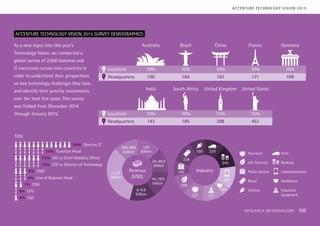
process, product, and service. This year, we conducted
our first Technology Vision survey, polling more than
2,000 business and technology executives across nine
countries and 10 industries, in order to understand
key technology challenges as well as priority
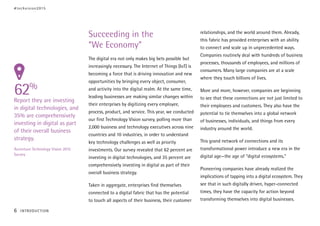
investments. Our survey revealed that 62 percent are
investing in digital technologies, and 35 percent are
comprehensively investing in digital as part of their
overall business strategy.
Taken in aggregate, enterprises find themselves
connected to a digital fabric that has the potential
to touch all aspects of their business, their customer
relationships, and the world around them. Already,
this fabric has provided enterprises with an ability
to connect and scale up in unprecedented ways.
Companies routinely deal with hundreds of business
processes, thousands of employees, and millions of
consumers. Many large companies are at a scale
where they touch billions of lives.
More and more, however, companies are beginning
to see that these connections are not just limited to
their employees and customers. They also have the
potential to tie themselves into a global network
of businesses, individuals, and things from every
industry around the world.
This grand network of connections and its
transformational power introduce a new era in the
digital age—the age of “digital ecosystems.”
Pioneering companies have already realized the
implications of tapping into a digital ecosystem. They
see that in such digitally driven, hyper-connected
times, they have the capacity for action beyond
transforming themselves into digital businesses.
62%
Report they are investing
in digital technologies, and
35% are comprehensively
investing in digital as part
of their overall business
strategy.
Accenture Technology Vision 2015
Survey
#techvision2015
6 INTRODUCTION
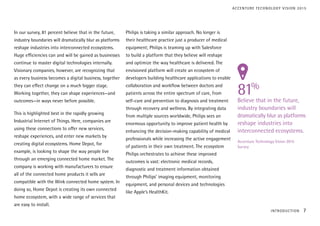
In our survey, 81 percent believe that in the future,
industry boundaries will dramatically blur as platforms
reshape industries into interconnected ecosystems.
Huge efficiencies can and will be gained as businesses
continue to master digital technologies internally.
Visionary companies, however, are recognizing that
as every business becomes a digital business, together
they can effect change on a much bigger stage.
Working together, they can shape experiences—and
outcomes—in ways never before possible.
This is highlighted best in the rapidly growing
Industrial Internet of Things. Here, companies are
using these connections to offer new services,
reshape experiences, and enter new markets by
creating digital ecosystems. Home Depot, for
example, is looking to shape the way people live
through an emerging connected home market. The
company is working with manufacturers to ensure
all of the connected home products it sells are
compatible with the Wink connected home system. In
doing so, Home Depot is creating its own connected
home ecosystem, with a wide range of services that
are easy to install.
Philips is taking a similar approach. No longer is
their healthcare practice just a producer of medical
equipment; Philips is teaming up with Salesforce
to build a platform that they believe will reshape
and optimize the way healthcare is delivered. The
envisioned platform will create an ecosystem of
developers building healthcare applications to enable
collaboration and workflow between doctors and
patients across the entire spectrum of care, from
self-care and prevention to diagnosis and treatment
through recovery and wellness. By integrating data
from multiple sources worldwide, Philips sees an
enormous opportunity to improve patient health by
enhancing the decision-making capability of medical
professionals while increasing the active engagement
of patients in their own treatment. The ecosystem
Philips orchestrates to achieve these improved
outcomes is vast: electronic medical records,
diagnostic and treatment information obtained
through Philips’ imaging equipment, monitoring
equipment, and personal devices and technologies
like Apple’s HealthKit.
81%
Believe that in the future,
industry boundaries will
dramatically blur as platforms
reshape industries into
interconnected ecosystems.
Accenture Technology Vision 2015
Survey
INTRODUCTION 7
ACCENTURE TECHNOLOGY VISION 2015
Fiat is looking toward connected cars as the
next growth opportunity within the automotive
industry. Partnering with leading edge companies
in navigation systems, media, social media and
entertainment sectors, Fiat is creating its own
Uconnect platform. It will be integrated with the
Fiat-Chrysler Group’s vehicles to provide drivers
with communication, entertainment, and navigation
features that can help drivers stay focused on driving.
Home Depot, Philips, Fiat, and many other companies
are making big bets on huge opportunities that have
the potential to bring about change on a global
scale. By tapping into digital ecosystems, these
companies have the ability to realize ambitions that
transcend any single business or any one industry.
These pioneering businesses see great potential
to make a difference—and to make a profit—by
operating as ecosystems, not just as individual
corporate entities. By mastering the shift from “me”
to “we,” these leading enterprises are shaping a new
economy—the “we economy.”
By tapping into the digital ecosystem, ordinary
businesses can tackle challenges that were previously
well beyond their scope. They can realize an opportunity
to help design and create smart mega-cities of the
future, radically rebuild centuries-old modes of
transportation, or raise the quality of healthcare by
addressing it holistically across many industries, from
hospitals to insurance to apparel. These are the types
of “epic” transformations that excite customers,
inspire employees, galvanize long-term suppliers—
and enable investors to reap big rewards.
The new power brokers will place themselves at the
center of these digital ecosystems and quickly master
new digital relationships with their customers, end
users, suppliers, alliance partners, developers, data
sources, makers of smart devices, and specialty talent
sources. All will share the same goal: to grow new
markets and in turn their individual businesses.
#techvision2015
8 INTRODUCTION
None of this will be easy, but the effort has the
potential for tremendous rewards. The new age of
the digital ecosystem isn’t only about changing
an individual company; it’s about shaping entire
markets. Each enterprise will determine its own
fortunes—and that’s an opportunity that no company
will want to miss.
2015 Vision Trends:
Hallmarks of tomorrow’s
digital business leaders
Technology is moving at a breakneck pace. Social,
mobile, analytics, cloud, and increasingly the Internet
of Things have become driving forces behind the
rapid evolution of digital businesses. This year’s
Accenture Technology Vision highlights five emerging
themes that reflect the shifts being seen among the
digital power brokers of tomorrow.
1. The Internet of Me is changing the way people
around the world interact through technology, placing
the end user at the center of every digital experience.
2. At the same time, digital devices on the edge are
powering an Outcome Economy and enabling a new
business model that shifts the focus from selling
things to selling results.
3. The Platform (R)evolution reflects how digital
platforms are becoming the tools of choice for
building next-generation products and services—and
entire ecosystems in the digital and physical worlds.
4. The Intelligent Enterprise is making its machines
smarter—embedding software intelligence into
every aspect of its business to drive new levels of
operational efficiency, evolution, and innovation.
5. Advances in more natural human interfaces,
wearable devices, and smart machines are
extending intelligent technology to interact as a
“team member,” working alongside employees in a
Workforce Reimagined.
INTRODUCTION 9
ACCENTURE TECHNOLOGY VISION 2015
Collectively, these trends represent the newest
expression of Accenture’s stance that “Every Business
Is a Digital Business.” They also add to Accenture’s
multiyear perspective on technology’s global
tectonic shifts that should impact the strategies and
operational priorities for organizations worldwide.
Historically, the trends in each year’s Accenture
Technology Vision highlight the evolution of a
key technology—some of these technologies are
already central to the digital explorations of many
leading enterprises. Viewed in aggregate, the trends
represent a fundamental shift in the assumptions
that companies must make as they plan for success
in the years to come. Business leaders in every
industry can draw insight and inspiration from these
rich perspectives as they consider where digital
technologies can take their organizations in the future.
But becoming a digital business is no longer simply
about incorporating these technologies into an
organization—it’s about using digital technology to
weave businesses into the broader digital fabric that
extends to customers, partners, employees, and
other industries.
These digital ecosystems are still emerging, but the
proactive enterprises that take the next few years
to define the ecosystems in their own industries
will create their own destiny. The question for every
enterprise is: what role will your company play in this
next important stage of the digital revolution?
Completing the picture
The Accenture Technology Vision comprises a three-
year set of technology trends. While we highlight
the latest trends for each year, it is important to
recognize that each trend represents only part of
the picture. As enterprises continue their journey
toward becoming digital businesses, they will need to
keep up with the latest evolutions in technology and
continue to master those that have been maturing.
These technologies are quickly becoming the base
for how enterprises will build their next generation
of business, as well as the catalysts for many of the
trends that we discuss this year. To reference the full
papers behind the set of trends below, please go to
www.accenture.com/technologyvision.
#techvision2015
10 INTRODUCTION
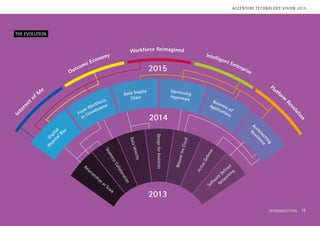
THE EVOLUTION
ACCENTURE TECHNOLOGY VISION 2015
INTRODUCTION 11
Beyond the cloud: stop talking about
cloud—the value is in using it
No vision would be complete without commenting
on the cloud, but cloud computing is no longer
an emerging trend. The on-demand technology
is pervasive in all decisions made today; the key
question is not “Should we use cloud?” but rather
“How can we use cloud?” What’s more, cloud isn’t
a single concept. Its individual elements—from
software-as-a-service (SaaS) to platform-as-a-service
(PaaS), from public to private—are as distinct and
different from one another as the opportunities are
for enterprises to use them. The next phase is putting
the cloud to work and crafting an overarching
approach that weaves cloud capabilities into the
fabric of IT solutions and responses—with business
value the uppermost priority.
Design for analytics: formulate the
questions, and design for the answers
Business intelligence. Data analytics. Big data.
Companies are no longer suffering from a lack of
data—they’re suffering from a lack of the right data.
Business leaders need the right big data to effectively
define the strategic direction of the enterprise. The
current generation of software was designed for
functionality, but the next generation must also be
designed for analytics.
Relationships at scale: moving beyond
transactions to digital relationships
Businesses need to re-think their digital strategies
to move beyond e-commerce and marketing. While
mobile technology, social networks, and context-
based services have increased the number of digital
connections with consumers, most companies are
still creating more detailed views of their consumers,
their attributes, and their transactions. Individually,
these connections may represent new types of user
experiences, even new sets of sales channels—but
that’s not the real opportunity. Taken in aggregate,
digital represents a key new approach to consumer
engagement and loyalty: companies can manage
relationships with consumers, at scale.
#techvision2015
12 INTRODUCTION
Seamless collaboration: right channel,
right worker, right job
It’s time for the enterprise to reimagine the way its
employees work. The rise in social networking has
breathed new life into collaboration. Users’ new
social behavior and their growing expectation that
every app will be “social” are pushing companies to
create new user experiences. However, to increase
productivity, enterprises must move beyond
standalone social and collaborative channels and
begin to embed them directly into their core business
processes. The new approach is to build social and
collaborative applications throughout the enterprise.
Active defense: adapting cyber security
defenses to the threat
Despite an increasing focus on securing the digital
business, IT departments struggle to keep pace with
recent advances in security technology. Enterprises
know that endpoint security is not enough, but
the move to active defense—risk-based approaches
to security management, analytics-driven event
detection, and reflex-like incident response—isn’t
yet happening on a broad scale. Although these
technologies are maturing rapidly and communities
are forming to expose the risks, the biggest barrier
is the slow adoption of solutions that already exist.
IT’s core challenge: get current with best practices in
security, get smarter about the new active defense
possibilities, and get real about the journey ahead.
Data velocity: matching the speed of
decision to the speed of action
Business leaders have been bombarded with statistics
about the soaring volume of data that they can mine
for valuable insights. They have been deluged with
articles describing the incredible variety of “external”
data hidden in everything from tweets and blogs to
sensor outputs and GPS data from mobile phones.
But the next perspective on data that deserves
attention is data velocity—the pace with which data
can be gathered, sorted, and analyzed in order to
produce insights that managers can act on quickly.
As expectations of near-instant responses become
the norm, business leaders will rely heavily on higher
data velocities to gain a competitive edge.
INTRODUCTION 13
ACCENTURE TECHNOLOGY VISION 2015
Software-defined networking:
virtualization’s last mile
With virtualization investments already paying off in
servers, and starting to pay off in storage, businesses
must turn their attention to virtualizing the network
in order to extend the life of their infrastructure and
reap the full value of their virtualization investments.
Like other virtualization technologies, software-
defined networking (SDN) has the ability to radically
change the flexibility with which businesses and
IT operate. You may think of networking as a low-
level technology, but this aspect has the ability to
transform enterprises. With SDN, businesses can
finally realize the vision of a dynamic enterprise.
Digital-physical blur: extending
intelligence to the edge
The real world is coming online, as smart objects,
devices, and machines increase our insight into and
control over the physical world. More than just an
“Internet of Things,” this new layer of connected
intelligence augments employees, automates
processes, and incorporates machines into our lives.
For consumers, this provides new levels of
empowerment. In addition to being highly informed,
consumers can interact and influence the way they
experience everything around them. For their part,
organizations now get real-time connections to the
real world that allows machines as well as employees
to act and react faster—and more intelligently.
From workforce to crowdsource:
rise of the borderless enterprise
Picture a workforce that extends beyond your
employees, one that consists of any user connected
to the Internet. Cloud, social, and collaboration
technologies now allow organizations to tap into
vast pools of human resources across the world, and
many people are motivated to help. Channeling these
efforts to drive business goals is a challenge, but the
opportunity is enormous. Such an approach can give
every business access to an immense, agile workforce
that not only is better suited to solving some of the
problems that organizations struggle with today, but
will often do so for free.
#techvision2015
14 INTRODUCTION
Data supply chain: putting information
into circulation
Data technologies are evolving rapidly, but most
have been adopted in piecemeal fashion. As a
result, enterprise data is vastly underutilized. Data
ecosystems are complex and littered with data silos,
limiting the value that organizations can get out
of their own data by making it difficult to access.
To truly unlock that value, companies must start
treating data more as a supply chain, enabling
the data to flow easily and usefully through the
entire organization—and eventually throughout the
organization’s ecosystem of partners as well.
Harnessing hyperscale: hardware is back
(and never really went away)
Eclipsed by more than a decade of innovation in
software, the hardware world is now a hotbed of
new development as demand soars for bigger, faster,
and more efficient data centers. Every company will
see the benefits of “hyperscale” innovation trickle
into their data centers in the form of cost reduction,
but as companies digitize their businesses, more and
more will see these systems as essential to enabling
their next wave of growth.
Business of applications: software as a
core competency in the digital world
The way we build software is changing. Mimicking
the shift in the consumer world, enterprises are
rapidly moving from applications to apps. Yes,
there will always be big, complex enterprise
software systems to support large organizations,
and IT developers will need to keep customizing
those systems, providing updates and patches,
and more. But now, as organizations push for
greater operational agility, there is a sharp shift
toward simpler, more modular apps. What are the
implications for IT leaders and business leaders?
Soon, they will have to decide who plays what
application development role in their new digital
organizations—and how they can transform the
nature of application development itself.
INTRODUCTION 15
ACCENTURE TECHNOLOGY VISION 2015
Architecting resilience: built to survive
failure, the mantra of the nonstop business
In the digital era, businesses are now expected to
support the nonstop demands that their employees
and stakeholders place on business processes,
services, and systems. This shift to support ever-
changing priorities has ripple effects throughout
the organization, especially in the office of the chief
information officer. There, the need for “always
on” IT infrastructure, security, and business process
economics can mean the difference between business
as usual and the erosion of brand value. As a result,
today’s IT leaders must ensure that their systems are
designed for failure rather than designed to spec.
#techvision2015
16 INTRODUCTION
ACCENTURE TECHNOLOGY VISION 2015
INTRODUCTION 17
The Internet of Me:
Our world, personalized
As everyday objects are going online, so too are experiences—
creating an abundance of digital channels that reach
deep into every aspect of individuals’ lives. Forward-
thinking businesses are changing the ways they build new
applications, products, and services. To gain control over
these points of access, they are creating highly personalized
experiences that engage and exhilarate consumers—without
breaching the customer’s trust. The companies that succeed
in this new “Internet of Me” will become the next generation
of household names.
TREND 1
#techvision2015
18 TREND 1: THE INTERNET OF ME
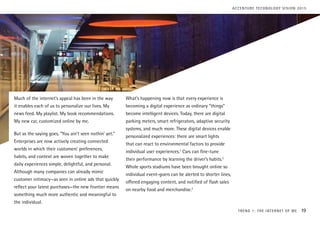
Much of the internet’s appeal has been in the way
it enables each of us to personalize our lives. My
news feed. My playlist. My book recommendations.
My new car, customized online by me.
But as the saying goes, “You ain’t seen nothin’ yet.”
Enterprises are now actively creating connected
worlds in which their customers’ preferences,
habits, and context are woven together to make
daily experiences simple, delightful, and personal.
Although many companies can already mimic
customer intimacy—as seen in online ads that quickly
reflect your latest purchases—the new frontier means
something much more authentic and meaningful to
the individual.
What’s happening now is that every experience is
becoming a digital experience as ordinary “things”
become intelligent devices. Today, there are digital
parking meters, smart refrigerators, adaptive security
systems, and much more. These digital devices enable
personalized experiences: there are smart lights
that can react to environmental factors to provide
individual user experiences.1
Cars can fine-tune
their performance by learning the driver’s habits.2
Whole sports stadiums have been brought online so
individual event-goers can be alerted to shorter lines,
offered engaging content, and notified of flash sales
on nearby food and merchandise.3
TREND 1: THE INTERNET OF ME 19
ACCENTURE TECHNOLOGY VISION 2015
Experience matters most: 89 percent of business
leaders surveyed by Gartner believe that customer
experience will be their primary basis for competition
by 2016.4
Beyond mobility: The connected world—including
cars, homes, and wearables—are creating a rapidly
expanding world of access to the customer. Two out
of three of IT and business executives (66 percent) we
surveyed report that smart objects will have a high or
very high impact on their organizations by helping to
advance a company’s industry position or gain
competitive advantage.
Rising consumer demand: Two-thirds of consumers
are expected to purchase a connected home device
within the next five years, and the ownership of
consumer wearables is expected to double year over
year by 2016.5
Contextual experiences: Big data analytics
solutions, combined with the proliferation of edge
devices collecting highly contextual data, are
allowing businesses to craft experiences that are
unique for each user.
Personalization everywhere: Businesses everywhere,
not just “tech companies,” are using personalization
to build a better experience. Companies integrating
personalization with their core product or service are
finding a significant competitive advantage. Sixty
percent of organizations we surveyed indicate they
are seeing a positive ROI on their investments in
personalization technologies.
WHY NOW?
#techvision2015
20 TREND 1: THE INTERNET OF ME
In fact, in our survey, companies shared that they are
exploring a variety of emerging channels to engage
customers including: wearables (62 percent), connected
TVs (68 percent), connected cars (59 percent), and
smart objects (64 percent). These, and countless
similar examples, are coalescing into the “Internet
of Me.” This describes the emerging interconnected
environment in which businesses are building
products and services to be designed for, created for,
and specifically centered on the individual.
This signals a wholesale change in the way businesses
must design applications. It means much more than
just “personalization for the connected world.”
Now, the focus has to be on experience—and
success means making people the center of business
decisions. Features and functionality must reflect
what individuals are trying to accomplish, enabling
them to control, measure, and even automate parts
of their lives in both the digital and physical worlds.
Leading companies are already moving fast in
this direction—and reframing the competitive
conversation in their industries. In our Vision survey,
81 percent place the personalized customer
experience in their top three priorities for their
organization, with 39 percent reporting it as their
top priority. The new connected car from Mercedes-
Benz, for instance, includes application programming
interface (API) connections to Nest thermostats at
the driver’s home.6
The car can notify the thermostat
when the driver will arrive, and the thermostat in
turn adjusts the in-home temperature to the driver’s
desired settings. Appliance-maker Whirlpool is
making similar Internet of Me moves: its smart dryers
include a function that allows environmentally
conscious consumers to schedule energy-intensive
tasks for when electricity is more abundant and rates
are lower.7
Fashion and apparel leader Ralph Lauren,
in line with the quantified-self movement, has
developed a sensor-embedded athletic shirt that
tracks activity and heart rate.8
TREND 1: THE INTERNET OF ME 21
ACCENTURE TECHNOLOGY VISION 2015
For more and more companies, this new focus on
exhilarating, user-centric experiences is paying off.
Sixty percent of our survey respondents report
positive results from their investments in personalization
technologies. These numbers will only improve as
companies gain sophistication in this space, and
quickly become the foundation for the next
generation of business. Gartner research shows that
89 percent of companies believe that customer
experience will be their primary basis for competition
by 2016, versus 36 percent four years ago.9
The momentum is here and now: devices are
becoming more interconnected and consumers
continue to demonstrate their demand for these
“smart” devices. It is therefore incumbent on business
leaders to start reworking their products, services
and business processes accordingly. Businesses
that embrace the Internet of Me concept will find
themselves sustaining higher levels of engagement,
and in turn, opening up whole new vistas for growth.
For the businesses that don’t soon take advantage
of the growing prevalence and constancy of
connectivity, their competitors surely will.
The new battleground
for mindshare
Customer mindshare across the Internet of Me is up
for grabs since there are few preconceived notions
of what to expect and few strong players—thus far.
Capturing mindshare will be critically important for
every company looking to migrate from crowded
existing channels toward new opportunities. In its
new context, mindshare is not just about building
awareness of the company’s offerings across
emerging channels—that’s just the beginning. The
goal is to command the user’s attention through
engaging and delightful experiences. Companies
will then have the ability to pitch new products and
services or to act as gatekeepers for other businesses
that want to access users through these new channels.
To understand the expanded concept of mindshare
and the value it can generate, consider Facebook:
approximately 70 percent of smartphone owners
are active users of the social network, opening the
app an average of 14 times a day.10
The service has
#techvision2015
22 TREND 1: THE INTERNET OF ME
become nearly synonymous with social interaction in
the same way that Google has with search. Because
Google and Facebook hold such large swaths of
consumer mindshare, they have become the de facto
platforms upon which other businesses advertise
and deliver new services. To put words into numbers:
Facebook’s ad revenue for Q3 2014 grew by 64 percent
year over year, with mobile ads accounting for
66 percent of the growth.11
With each evolution of technology, businesses have
competed across new channels to gain customer
mindshare. As the Web became ubiquitous in homes,
companies invested in building new architectures
to capture the mindshare of the emerging “online
consumer.” Similarly, now that smartphones account
for nearly two-thirds of the mobile phone market,
enterprises are investing heavily in mobility. Mobility
investments have rewarded companies that have
pursued them, and new business models have
developed exclusively around apps. Uber and Lyft, the
ride-share services, are just two examples of “mobile-
only” companies that are disrupting segments of the
transportation industry.
The Internet of Me raises the “mindshare” stakes.
Now, the shift is from mobility to the Internet of
Things (IoT)—and this time the opportunity is bigger.
Rather than just one channel, like the PC or phone,
the convergence of the digital and physical worlds is
creating hundreds of potential channels that reach
deep into every aspect of people’s lives. An Acquity
Group study confirms that consumer adoption of
IoT devices is growing exponentially: the report
found that nearly two-thirds of consumers intend to
purchase a connected home device by 2019, while
the ownership of wearable technology is expected to
have doubled year over year by 2016.12
This latest technology shift provides the best of
two worlds: the intelligence, personalization, and
adaptability of digital technology blended with the
interactive and immersive experience of the real world.
As consumer adoption grows, businesses have the
opportunity to define how people will use these new
devices; how they will connect with one another;
and what form the interactions will take. Controlling
those experiences is a lucrative role that is entirely
up for grabs.
TREND 1: THE INTERNET OF ME 23
ACCENTURE TECHNOLOGY VISION 2015
Take AT&T Drive—AT&T’s connected car platform—
as an example of how businesses can find multiple
opportunities within a single channel. Nearly every
major auto manufacturer is investing in building
connected cars, yet few have the necessary networking
and software experience to build an end-to-end solution.
AT&T Drive provides them with a suite of features
that they can pick from rather than having to build
everything themselves. But AT&T is also using the
connected car as a platform to grow consumer
mindshare: the company now allows customers to
include connected cars—such as the Audi Q3—in its
shared data plans for no more than it costs to add a
tablet to a plan.13
Leading companies such as AT&T see that, for now,
the competition for the Internet of Me is meager.
But they sense that the opportunity is vast—and they
know that they can gain an enduring advantage if
they successfully and consistently deliver outstanding
consumer experiences.
Turning mindshare
into value
As businesses grow their mindshare across new
channels, they can leverage their position to
deliver new products and services that enhance
each individual’s Internet of Me. Certainly, greater
mindshare can lead to greater wallet share. For
instance, Coca-Cola Amatil increased sales by 12
percent after retrofitting vending machines with
touchscreens, video cameras, and Microsoft Kinect
technology to create a fresh, personalized vending
experience. But driving sales is only one way to
benefit from this new access to the consumer: the
data created by these connected vending machines
is enabling the Southeast Asian beverage company
to make better decisions about cooler placement,
restocking, and more.14
Businesses will find value in the ways they
personalize their products or services. Geography,
culture, and varied individual needs will all impact
how businesses scale their Internet of Me solutions.
#techvision2015
24 TREND 1: THE INTERNET OF ME
For example, in some regions there is a higher value
on societal benefits than on individual benefits; any
Internet of Me strategy should carefully consider
local preferences. No one solution fits all—every
company will first need to determine which channels
best suit their needs and then build unique solutions
for those channels.
Georgia Power, a utilities provider, is driving new
customer value by leveraging its network of 2.4 million
smart meters. The company now offers consumers
access to their real-time data generated by the
meters so they can gain a deeper understanding of
their energy use. Georgia Power is even attracting
new business by offering personalized services such
as pre-paid and pay-as-you-go billing—allowing the
company to serve customers who do not have good
credit and cannot afford a security deposit.15
A key point here is that “ordinary” traditional
companies—not hot tech startups—are making these
moves. Companies such as Coca-Cola Amatil, and
Georgia Power are gaining more access to consumer
mindshare by offering pervasive experiences in
traditional settings. By focusing on the very things
that made them leaders in their markets in the first
place, traditional companies have natural advantages
in the Internet of Me.
Experience matters most
in the Internet of Me
Ultimately, success in the Internet of Me will be driven
by how businesses deliver the individual experiences
that consumers demand. Many businesses are already
aware of this: 62 percent of organizations attribute
their investments in omni-channel initiatives to the
simple fact that their customers expect it—but only
a few agree that they are doing it well.16
While
companies have been experimenting with
personalization to one degree or another for years,
today, the abundance of data and sensors can
provide a much more complete picture from which
companies can personalize their products and
services at scale.
TREND 1: THE INTERNET OF ME 25
ACCENTURE TECHNOLOGY VISION 2015
Case in point: PhysIQ is a device-agnostic analytics
platform that healthcare professionals are using to
leverage the new types of data being generated by IoT
devices such as fitness trackers. The health-monitoring
platform can pull data from any combination of devices,
aggregate it, and deliver a single, comprehensive
health score. The score is intimately personalized:
data is constantly generated by whichever devices
the user chooses, and the platform learns individual
habits and tendencies over time. This makes PhysIQ
much more effective in predicting and alerting
healthcare providers to any anomalies.17
It’s essential to emphasize that there is no singular
personalization strategy. Each solution is dependent
on what tools, data streams, and feedback loops
a business has access to and how it chooses to
integrate these data sources to build personalization
into its products and services. Macy’s, the department
store, is personalizing its traditional brick-and-
mortar experience by using iBeacons to send push
notifications to in-store shoppers. The alerts use data
from Shopkick, an app that lets shoppers browse,
“favorite,” and discover new items from the Macy’s
catalog. The messages instantly notify shoppers
which of their favorites are available in-store, and
then deliver customized discounts on those items.18
Eighty-one percent of executives we surveyed
place the personalized customer experience in
their top three priorities for their organization,
with 39 percent reporting it as their top priority. To
truly become a leader in the Internet of Me space,
businesses will have to figure out how the customer
experience they “own” relates to other experiences
in the customer’s life or how they can help to deliver
the outcomes that a customer is trying to achieve.
One good example is Automatic. Primarily a car
diagnostic device, drivers can use the device for
other tasks as well—like sending a canned text to
pre-selected contacts whenever they park their
vehicles near a supermarket.19
This automated task
is powered by Automatic’s integration with If This
Then That (IFTTT)—a free service that helps connected
devices communicate with each other. Belkin, Nest,
and Philips all have a number of IFTTT “recipes” that
#techvision2015
26 TREND 1: THE INTERNET OF ME
let individuals mix experiences, such as lighting
conditions and temperature, all based on where they
are or what they are doing—and all without touching
a switch or taking out a phone.20
Because the user
defines the relationships and picks the recipes, the
resulting experiences are both infinitely personalized
and scalable.
The power of ecosystems
Greater opportunities for personalization will
emerge as individual businesses realize they are not
the only participants in any given Internet of Me.
Finding new partnerships that combine channels and
services to benefit the individual will prove lucrative
for companies that execute against this idea. Take
Samsung, for example. The consumer electronics
giant is building a wide range of connected big-
box products such as refrigerators. These physical
products now represent an interface to the digital
world that other businesses can use to their
advantage—as Pandora is already doing.
Pandora had been facing the challenge of growing
its share of the in-home music listening market. The
music streaming service accepted Samsung’s offer to
be one of the first integrated apps because it saw the
refrigerator as a platform with immense potential
for helping the company break into the market
for “home listening.”21
Now users can tune in to
personalized radio stations in the place where a great
deal of in-home listening happens: the kitchen.
Optimizing a strategy for the interconnected world
starts with determining a company’s role in the Internet
of Me. As companies begin to specialize, some will
build devices, others will develop applications and
offerings on top of those devices, and others still will
build the platforms that other providers plug into.
Nike’s shift in its FuelBand strategy indicates that leading
businesses are already thinking this way. Initially, Nike
built the FuelBand device and maintained the app that
tracked and shared users’ runs. However, the sportswear
company discontinued hardware production in favor
of operating as a data analytics provider in this space.22
TREND 1: THE INTERNET OF ME 27
ACCENTURE TECHNOLOGY VISION 2015
By opting to focus on specific elements of the
experience (data, analytics, and insights), Nike is
better positioned to become a partner in, rather than
competing for a share of, the wearable device market.
Delivering a billion or more personalized experiences
every day is no small feat, yet this is what tomorrow’s
platforms will be required to do in the Internet of
Me. As businesses start to identify their niches in this
new environment, they will do well to shortlist the
partners with which they can best collaborate and
aggregate mindshare. By offering APIs and data that
are open and accessible to others in their ecosystems,
constituent players will acquire the power of
businesses that are many times their size. Seventy-
two percent of executives we surveyed expect
that within the next two years, they will see broad
adoption of industry platforms that will integrate
data with digital business partners.
Technology enables,
but trust endures
As businesses create personalized experiences, they
necessarily receive troves of personal data about
consumers, their habits, and their preferences. To
be comfortable sharing their data, consumers must
have trust in the other party. This trust acts as a bond
between the business and the consumer, and allows
product and service adoption to flourish.
However, consumers are likely to seek alternatives and
exit a relationship when trust is broken, particularly
if that broken trust leads to adverse impacts in the
real world. A recent Accenture survey reveals that
67 percent of individuals are willing to share data with
companies, but that percentage drops to 27 percent
if the business is sharing data with a third party.23
Since data collection and sharing have direct
implications on a company’s ability to compete for
mindshare in the Internet of Me, digital businesses must
improve their competency within three components
of trust: security, privacy, and transparency.
72%
Expect that within the
next two years, they will
see broad adoption of
industry platforms that will
integrate data with digital
business partners.
Accenture Technology Vision 2015
Survey
#techvision2015
28 TREND 1: THE INTERNET OF ME
Irresponsible handling of data is quickly becoming
a corporate risk—in terms of reputation, customer
attrition, and regulatory compliance. Throughout
the data supply chain, protecting customer data is
fundamental to attracting and retaining consumer trust.
In the age of big data, companies can take a number
of security-related precautions to hedge against risks
and still maintain integration with legacy systems.
Hive for Hadoop offers SQL-like query tools to present
unstructured data in a relational format. Also, limiting
queries by restricting access to classified data offers
another level of protection for shared data.
New data protection measures can be seen in the
strategies of both Apple and Google: encrypted file
systems are the default in iOS 8 and Android L.24
Importantly, the decryption key now resides on the
user’s phone, outside of the corporation, shifting the
burden of data protection from the provider to the user.
Each company may require unique security solutions
to address its own set of risks. The most immediate
imperative is to ensure that software and security
controls are able to address the latest risks and that
a plan is in place for responding to new risks in a
timely fashion. Monitoring what data is accessed, by
whom, and why is becoming a critical function of
maintaining trust. This is particularly important as
consumers adopt smart devices for everything from
pacemakers to home security systems.
The traditional notion of privacy, the second
component of trust, is evolving and becoming
far more complex. Regulators are becoming more
active in defining public policy with “do not track”
legislation emerging in the European Union and the
State of California.
At the very least, businesses need to ensure compliance
with their terms of use and privacy policies. This may
seem obvious, but all too frequently, commitments
are unintentionally violated by employees with good
intentions for innocuous reasons.
TREND 1: THE INTERNET OF ME 29
ACCENTURE TECHNOLOGY VISION 2015
85%
Say that the average
consumer has very
limited insight into how
organizations are using data
related to them.
Accenture Technology Vision 2015
Survey
Third-party compliance audits of adherence to
privacy requirements are a positive step toward
building trust. While conducting regular and
pervasive audits is a step forward, disclosing results
to stakeholders is a giant leap. This proposition
becomes more complex as companies increasingly
share data. Sharing data through APIs or appending
metadata through DRM-capable systems are ways to
automate and manage exposure of privacy audits.
As the final component of trust, companies must be
transparent about their practices with customers.
An astounding 85 percent of organizations say
that while the amount of data they have related
to the average consumer is growing, consumers
themselves have very little insight into how it is
used. For example, many companies have recently
faced scrutiny for experimenting with user data.
In one experiment, an online dating site purposely
manipulated the “match percentage” between
prospective partners. As a result, users were shown
an artificially high score prior to connecting
with a potential match.25
Some saw this lack of
transparency as particularly egregious because it
negated the very service users expected while using
the site.
However, experiments with SaaS users are
commonplace—often simply referred to as “user
testing,” with the goal of improving and delivering a
better service. But gone are the days when sufficient
transparency meant mere legal compliance—where
users accepted the privacy policy and terms of use
simply through signing up or clicking an “accept”
button. In order to be more transparent, businesses
need to inform users in a way that is both easy to
understand and relevant to the services provided.
The Personal Genome Project has redefined “informed
consent” by requiring a perfect score on a test
before participants can even enter their name. Sage
Bionetworks, a non-profit organization, and Lookout,
a mobile security firm, have taken a similar approach
and present users with interactive policy forms to
provide consent.27
#techvision2015
30 TREND 1: THE INTERNET OF ME
It is not possible to overstate the increasing importance
of trust in gaining market share and user adoption of
data-rich products and services. Look no further than
the high-profile resignations of the CEO and CIO of
Target to see a new level of importance placed on trust
that is based on security, privacy, and transparency.
Maintaining trust, as well as the policies and practices
that drive it, is now a foundational component for
success as a digital business.
Looking ahead
The rise in the importance of trust is one clear
indication that the old adage, “Always put the
customer first,” has taken on new meaning in
the digital age. Empowered consumers can put
themselves first with the help of new technologies
that have given rise to the anytime, anywhere
Internet of Me. Customers increasingly want
better, faster, and cheaper all at once. In response,
companies must create new ways to capture
attention, deliver new services, and build trust.
Over time, new market ecosystems will emerge to
deliver digitally enabled, highly personalized, and
acceptably secure offers to inform, sell, and service
customers. In a world where the virtual is migrating
to the physical, each person’s experience will differ
slightly. Companies will need to tailor their products
or services to the unique affinities of each individual.
What will your role be in the evolving Internet of Me?
TREND 1: THE INTERNET OF ME 31
ACCENTURE TECHNOLOGY VISION 2015
Over the next 100 days, commit your business to
gaining a deeper understanding of who your core
users are and identify opportunities to better serve
their individual needs.
• Start using your customer data to discover what
connected devices they currently use/intend to
purchase and what their goals are with the new
technology. Identify more granular segments
within your user base to accommodate future
personalization strategies.
• Review and begin to update your consumer
engagement processes and governance strategy.
Prepare to shift toward a world where every
customer has a unique view of your product,
and your product is increasingly influenced by
ecosystem partners.
• Evaluate competitors for their use of mass
personalization strategies. Take note of pinnacle
personalization experiences and how big data
analytics are used to deliver them. Use this
opportunity to learn what companies in related
industries are doing as well.
• Identify emerging edge technologies that can
supplement your existing product or service by
providing either new channels to your customer
or new data for contextual insights. Look to early
adopters for inspiration and best practices in
leveraging these devices.
• Appoint a cross-functional team to champion
and develop the end-user experience. Building
a strategy for the Internet of Me begins with
bringing the individual’s voice to the table.
• Assess your current back-end architecture and
data storage. In order to support a personalization
strategy at scale, the company will require
hardware that can support the increased load and
speed necessary for real-time action. Determine
what investments the company will have to make.
YOUR 100-DAY PLAN
#techvision2015
32 TREND 1: THE INTERNET OF ME
By this time next year, your business should be
prepared to start extending offerings across the
Internet of Me, providing new levels of service and
personalization to your customers.
• Commission a pilot that leverages new channels
of access to the consumer. Incorporate your user
research to make experience and personalization
priorities in this new product or service.
•	Determine where your company holds a
competitive advantage, or existing role, within your
users’ Internet of Me. Some possibilities include:
building devices/products, software, and apps;
providing data analytics and insights; or facilitating
seamlessly integrated experiences.
•	Develop an ecosystem strategy that will allow you
to work with a portfolio of potential partners. The
resulting strategy should play to the strengths of
each company, allowing them to specialize in their
roles and deliver a complete end-user experience.
•	Proactively address security issues that could leave
sensitive customer data exposed or physical devices
vulnerable to attack or failure. As new pilots and
projects are developed, connect with internal and
external subject matter experts to identify threat
profiles and areas for improvement.
•	Privacy policies must be completely overhauled
and created to reflect a transparent, trust-centric
mindset. Carefully account for the new relationship
your business will have with consumers and their
data and how they will interact in the real world.
•	Create a trust task force that is integrated across all
business units. Help leaders go beyond compliance
to make trust and privacy a seamless part of
business development in an effort to mitigate
corporate risk and liability.
YOUR 1-YEAR PLAN
TREND 1: THE INTERNET OF ME 33
ACCENTURE TECHNOLOGY VISION 2015
The Outcome Economy:
Hardware producing
hard results
Intelligent hardware is bridging the last mile between
the digital enterprise and the physical world. As leading
enterprises come face-to-face with the Internet of Things,
they are uncovering opportunities to embed hardware and
sensors in their digital toolboxes. They are using these highly
connected hardware components to give customers what
they really want: not more products or services, but more
meaningful outcomes. These “digital disrupters” know that
getting ahead is no longer about selling things—it’s about
selling results. Welcome to the “outcome economy.”
TREND 2
#techvision2015
34 TREND 2: OUTCOME ECONOMY
How much would you pay to laugh out loud? If you
were a patron of a pay-per-laugh Teatreneu theater
company production in Barcelona, the answer would
be €0.30 for each instance.1
Teatreneu uses facial
recognition technology to register each laugh and
charges customers accordingly—up to €24 per show,
a 25 percent increase over previous ticket prices.
And, if you live in the smart city of Los Angeles,
there’s a good chance you have benefited from
one of 7,000 smart parking spaces. The hockey
puck-sized sensors, which Streetline installs in
the roadbeds of the cities and campuses where it
operates, communicate real-time parking conditions
to smartphone apps, telling drivers where parking
is available. These connected parking spaces have
delivered tangible outcomes to drivers and to the
city, increasing parking revenue by 2 percent, while
simultaneously decreasing the average cost of
parking by 11 percent and increasing space utilization
by 11 percent.2
TREND 2: OUTCOME ECONOMY 35
ACCENTURE TECHNOLOGY VISION 2015
Hardware is approachable: More businesses and
individuals are able to leverage a vast ecosystem of
tools to design, produce, and distribute hardware
than ever before. It’s no longer necessary to be a tech
firm to build hardware.
M2M economics: Cost reductions are driving
machine-to-machine (M2M) investments: 45 percent
of global consumer electronics executives cited
declining costs as driving their M2M investments in
2014, up from 27 percent in 2013.3
Sensor efficiency: Sensors are cheaper, smaller, and
more energy efficient than ever before, allowing
more sensors to be installed in more places and
maintained for longer periods of time at the edge of
networks without the need to service or replace them
for two to five years.
M2M standards: Machine-to-machine
communication standards are closer to reaching
maturity, allowing for more localized and real-time
decisions at the edge of networks. In 2014, 22 percent
of organizations had M2M solutions in place, and
42 percent of the rest expect to implement M2M
solutions by 2016; by 2017, 75 percent of
organizations will have M2M as part of their
strategic roadmaps.4
Ubiquitous bandwidth: High-bandwidth, wired, and
wireless communications are now ubiquitous in most
markets. Traffic from wireless and mobile devices
will be 54 percent of all traffic, exceeding traffic
from wired devices by 2016. By 2018, global fixed
broadband speeds will reach an average of 42 Mbps,
up from 16 Mbps in 2013.5
WHY NOW?
#techvision2015
36 TREND 2: OUTCOME ECONOMY
These are just two glimpses of the emerging
outcome economy in which digital businesses
increasingly sell solutions and results rather than
just products and services. The outcome economy is
defined by the ability of companies to create value
by delivering solutions to customers that in turn
lead to quantifiable results. This is made possible
by hardware becoming increasingly intelligent,
otherwise known as the Internet of Things (IoT).
From smart industrial equipment to the bevy of
sensors in the modern smartphone, companies now
have the tools to gain end-to-end insights into the
outcomes that their customers are trying to achieve.
What’s more, this same technology allows companies
to discover the metrics, or measures of value, by
which their customers define success. In effect, these
metrics enable businesses to identify, measure, and
aim for their customers’ desired outcomes.6
By placing intelligent hardware at the edge—where
the digital and physical worlds intersect—84 percent
of our Vision survey respondents agree they can
gain a deeper level of understanding of both how
products are being used and the detailed outcomes
customers are trying to achieve.
Harbingers of the
outcome economy
The underlying principle of an outcome economy is
not new: marketers have long talked about selling
solutions rather than products. Decades ago, Harvard
University marketing professor Theodore “Ted”
Levitt was famously said to have told his students
that people didn’t want quarter-inch drill bits; they
wanted quarter-inch holes. However, the outcome
economy has been notoriously difficult to grow,
because there have been few effective ways of deeply
and continually discerning what customers want.
TREND 2: OUTCOME ECONOMY 37
ACCENTURE TECHNOLOGY VISION 2015
Digital technology is now resolving that difficulty—so
much so that the outcome economy is no longer just
an aspiration; it is very much here and now. In fact,
it’s a strategic transformation for big companies in
every industry as well as a disruptive opportunity
for startups. The early adopters are tying feedback
from embedded hardware and sensors to their
digital systems, giving them the end-to-end insights
necessary to understand and influence outcomes. A
few examples prove the point.
Not long ago, Monsanto acquired Climate Corporation,
a maker of farm intelligence software that integrates
with precision agriculture sensors and systems to
deliver intelligence about current and future weather,
soil, and crop conditions. With the acquisition,
Monsanto is able to offer growers actionable insights
on how to reduce risks, improve yields, and increase
profits. The agrochemical giant can now not only
recommend the most profitable crops to plant, but
also what types of seed to buy, when to plant, how
to tend the crops, when to harvest, what yields to
expect, and even what revenue farmers can expect
at the end of the growing season.7
The end-to-end knowledge that Monsanto can now
gather powers its ability to improve outcomes for
growers. Today, farmers are able to buy field-specific
weather-related crop insurance that guarantees
financial outcomes and hedges against the risk
presented by increasingly variable and extreme
weather events. It’s not a stretch to envision a future
in which precision irrigation systems, integrated
with these decision support systems, then take
autonomous action based on sensor data of soil
moisture and precise weather forecasts.
In the auto industry, Tesla Motors found a way to use
hardware on the edge to deliver safety outcomes to
consumers beyond what was previously possible. In
late 2013, the luxury electric car maker saw several
instances of the battery packs in its Model S cars
equipped with the Smart Air Suspension option
catching fire after being punctured by road debris at
highway speeds. Instead of following the traditional
auto industry protocol of issuing a costly recall and
waiting for customers to bring their vehicles in for
#techvision2015
38 TREND 2: OUTCOME ECONOMY
service, Tesla made use of the intelligent hardware
in every car to distribute a firmware update to the
affected cars, which increased their minimum ground
clearance and prevented them from automatically
lowering at freeway speeds.8
When Tesla devised
a longer-term solution, it returned the original
functionality to the affected vehicles and gave
owners the option of bringing their cars in for a
free retrofit of its sturdier undercarriage armor.
The diagnosis of the problem and improved safety
outcomes for Tesla customers were possible only
because the manufacturer had end-to-end feedback
from and the ability to update the computer systems
in those drivers’ cars.
This emphasis on outcomes is also seen in the
pharmaceuticals sector, where Proteus Digital Health
is focused on improving patient outcomes as a new
way to create value in that industry. The digital
health company integrates a tiny, inert sensor in
the pills it produces; the sensor acts in concert with
a wearable device and mobile app to provide full
“adherence transparency” for patients, healthcare
providers, and payers. Not only can the Proteus
hardware-based system determine when patients
take their medications, but it also can send alerts
and reminders to the individual if they forget to
take a pill. With this approach, Proteus can help
patients increase the effectiveness of their treatment,
demonstrate cost savings over traditional methods of
care, and drive better overall outcomes for patients,
payers, and providers—the proverbial “win-win-win”
situation.9
There is no shortage of trailblazing examples
across a variety of other industries. The one big
point that bears underlining: edge intelligence—
and the hardware that powers it—is not a digital
phenomenon that benefits only high-tech companies.
TREND 2: OUTCOME ECONOMY 39
ACCENTURE TECHNOLOGY VISION 2015
Hardware at the edge
The levels of insight and control that are the
hallmarks of the outcome economy are only made
possible through the integration of hardware with
existing capabilities. Cloud-based software analytics
and visualization technologies, along with hardware
sensors and increased computing capabilities at the
edge, are all necessary components in the outcome
economy. As intelligence moves steadily and rapidly
toward the network’s edge, it effectively builds a
bridge of data-rich feedback loops that span the “last
mile” between customers and businesses. Companies
that incorporate this next generation of edge
intelligence are seeing their performance per unit
cost soar.
Just one quick example: Nest, the intelligent home
products company, pushed new software to its
Nest Protect devices and consequently halved the
incidence of false fire alarms—delivering greater
safety and trust outcomes to its customers. The
company’s smoke and carbon monoxide alarms
featured embedded, low-cost, but dormant humidity
sensors. Armed with aggregated anonymous data
from hundreds of thousands of its deployed devices,
Nest was able to refine and improve its detection
algorithms. But, to do so, it needed humidity data. So
the next software update sent to products in the field
activated the dormant humidity sensor and improved
the performance of the installed devices.10
Having this bevy of sensors in a device such
as a smoke alarm would have seemed fiscally
irresponsible just a few years ago, but as unit
shipments have soared, the cost of sensors has
plummeted. Between 2006 and 2013, shipments of
micro-electromechanical sensors (MEMS)—analog
microchips for measuring things in the real world—
for consumer devices have grown at 32 percent year-
over-year to eight billion units.11
In four years, the
Samsung Galaxy smartphone went from having three
sensors in the first-generation model in 2010 to 10 in
the fifth-generation model in 2014.12
#techvision2015
40 TREND 2: OUTCOME ECONOMY
Sensors are also getting more sensitive and
significantly less expensive. In mid-2014, Broadcom
released the WICED Sense Development Kit. The kit
includes a full software development stack, a mobile
app to view real-time sensor data, and a device
the size of a key fob with five MEMS: gyroscope,
accelerometer, pressure, humidity, and temperature—
all of which retails for $20.13
Other embedded and
expandable solutions such as Raspberry Pi, Intel
Galileo, and Marvell Kinoma also help makers embed
sensors in just about anything so they can rapidly
prototype and create new hardware-centric
products in far less time and at much lower cost
than ever before.
Cresting the hurdle
of hardware
Leading businesses, large and small, are using
hardware and its ability to bring them closer to their
customers as a differentiator and as a way to enter
new markets.
But what exactly is meant by “hardware”? In this
context, the definition is not confined to traditional
IT categories—servers, networking gear, PCs, and so
on. The concept is far broader than that. It includes
the IoT and devices that range from smart washing
machines, wearables, and security cameras to
autonomous cars and intelligent buildings.
Today’s hardware offers capabilities that parallel the
advancements that were made in software more than
a decade ago and amplified in the as-a-service world.
It is not a stretch to say that as intelligent hardware
becomes cheaper to create and easier to integrate,
it is effectively becoming the new software. In our
survey, nearly two thirds (64 percent) of respondents
indicated their company was either using or
experimenting with emerging channels such as smart
objects (parking meters, smart appliances, robots, etc.),
connected TVs (68 percent), and connected cars
(59 percent) to engage customers.
TREND 2: OUTCOME ECONOMY 41
ACCENTURE TECHNOLOGY VISION 2015
Hardware is indeed becoming much easier to make:
it can be designed, produced, and distributed by
small teams with significantly fewer resources than
what was required just 10 years ago. Sociometric
Solutions, a social-sensing analytics firm that helps
service-based organizations improve productivity and
drive sales growth, has experienced this firsthand.
In 2005, when the company was a Massachusetts
Institute of Technology Media Lab startup, its founders
had to write their own operating system for the
name-badge device whose embedded sensors can
track a person’s location, interaction, body movement,
and speech dynamics.14
Eight years later, when the
company redesigned its badge as an independent
startup, it was able to use an embedded Linux kernel
and add modular capabilities to the software stack,
enabling development to happen four times faster at
less than half the cost.15
LIFX, an Australian connected
lighting startup, went from concept to hardware,
firmware, and software to shipping in 12 months.16
Today, there are more and more resources to help
enterprises master the hardware dimension of the
outcome economy.
Many manufacturers and manufacturing services
companies are setting up specialized units with this
in mind. Hardware accelerators, just one segment
of this movement, are launching at an astonishing
pace: at the start of 2013, there were three top-tier
hardware accelerators globally; just a year and a half
later, there were 15.17
For example, PCH is a provider of end-to-end product
development and supply chain solutions. In 2013, the
company launched Highway1, a hardware accelerator
designed to help hardware startups navigate the
complexities of launching a new product. Hardware
accelerators such as Highway1 and competitor
Flextronics’ Lab IX are making it possible for startups,
many of which are crowdfunded, to deliver products
to their customers on time and within budget.
The “crowdfunding factor” is important to the
development of intelligent hardware. Between 2011
and 2013, there were 443 hardware campaigns on
Kickstarter and Indiegogo that raised more than
$100,000 apiece. Nearly 10 percent of those have
gone on to raise venture capital, averaging an initial
#techvision2015
42 TREND 2: OUTCOME ECONOMY
investment of $8.7 million each.18
In fact, many new
companies are using their seed rounds of funding to
launch highly professional crowdfunding campaigns
in order to gain valuable insights about product/
market fit and test pricing strategies. A handful of
notable examples are: Scanadu, Misfit Wearables,
Oculus VR (Oculus was later acquired by Facebook for
$2 billion), Canary (home security), and LIFX (smart
light bulbs).
Large, long-established enterprises are already
active participants in the push to make hardware
more accessible, usable, and results focused. GE is
an investor in Quirky, an acclaimed marketplace
and crowdsource design community, building
both smart (connected) and traditional products.
For its connected products, Quirky has launched
its own connected device platform, Wink—a type
of standards and certification body with its own
hardware hub that enables smartphones and
other devices to connect with and program Wink-
compatible products as well as smart products from
more than a dozen other brands.19
This not only
provides a way for devices from dozens of previously
isolated or siloed brands to interoperate, but also
makes it easier to build capacity for intelligence at
the edge.
With every new intelligent device and every new
industry group supporting hardware development,
the promise of the outcome economy comes that
much closer.
Signposts of transformation
at the edge
One of the most significant markers of the shift
toward hardware on the edge is the coalescing
of standards for inter-device communication.
Companies that are keen to engage in the outcome
economy now should tune into the standards
discussion and decide where they want to participate
in defining the future of their industry and others.
Sitting on the sidelines at this stage will mean
allowing others to define the way businesses will
compete in the future.
TREND 2: OUTCOME ECONOMY 43
ACCENTURE TECHNOLOGY VISION 2015
It’s no exaggeration to say that a standards war has
erupted. Prior to 2014, the only large-scale standards
body in the IoT space was the AllSeen Alliance,
promoting and expanding the use of AllJoyn, a
software framework and core set of system services
that allow edge devices to communicate. In 2014,
a half-dozen more industry groups, certification
bodies, and standards organizations joined the fray.
Several focus on the connected home, while others
concentrate on industrial applications at various
levels of the stack.
It’s still too early to tell which consortia will have
the most influence over the long term. But, the
fact that so many groups are coalescing in the
first place underscores the importance of the role
that intelligent hardware will play in our collective
future. Enterprises must not wait for a clear winner
to emerge, as the standards landscape will likely be
fragmented for many years. The key will be for each
company to join the consortium that best fits its
digital strategies and to learn by collaborating with
fellow participants.
What businesses must
do next
Of course, with every step forward by a Tesla, Monsanto,
or hardware startup, customers are conditioned to
expect more. Yesterday’s automobile firmware upgrade
will become tomorrow’s baseline expectation.
The shift toward the IoT powers the outcome
economy and prioritizes data-rich feedback loops
that help companies get to know the outcomes that
their customers want and improve performance on
the metrics that matter. Today, most companies still
make tools that their customers have to configure
to create the outcomes they desire. These tools are
usually functional, but they often require much
more work to satisfy the real needs of customers—
such as customizable off-the-shelf software that
still requires a team of developers to configure and
maintain. Now, for the first time, companies can gain
quantifiable, end-to-end insights into the outcomes
their customers are trying to achieve and use those
insights to develop significantly more effective products.
#techvision2015
44 TREND 2: OUTCOME ECONOMY
To take advantage of these new capabilities,
businesses need to start by re-evaluating their
customers’ intended outcomes. They must establish
feedback loops wherever their customers create
value. Then, they need to incorporate the resulting
insights into their business processes and product
management systems.
To begin, businesses would do well to map feedback
loops throughout product and service lifecycles,
paying special attention to how many steps away
from customer outcomes the farthest collection
points are located. The goal is to move feedback
loops as close to customer outcomes as possible in
order to figure out what the desired outcomes are
and how to influence them. Acting on these insights
will help to refine the critical data that needs to be
collected and the types of hardware that need to be
in place to take action—either through mobility or
app solutions (informing a person at the right time)
or machine solutions that automate corrective actions.
When adding new hardware, companies can develop
the competency to build it themselves, as Nike did
with FuelBand, or they can partner with or acquire
companies as Google did with Motorola, Nest, and
Dropcam.
In many cases, new hardware solutions, or the
integration of sensors in existing hardware, will
help to push the edge of the network closer to
the customer. In more challenging cases, new
partnerships or acquisitions might be required to
enable new capabilities at the edge—and to unlock
the greatest of opportunities, wholly new business
models may well be necessary.
The possibilities are far-reaching and can play out across
industries. Consider the utilities sector, for instance.
Companies such as SolarCity are going beyond the
meter to own, install, and operate infrastructure on their
customers’ premises. They have end-to-end insights
and control over the outcomes their customers want.
TREND 2: OUTCOME ECONOMY 45
ACCENTURE TECHNOLOGY VISION 2015
In doing so, SolarCity gains long-term, stable cash
flows and removes the customer payback risks of
renewable energy by guaranteeing economic
outcomes up front.20
In fact, SolarCity has been so
successful that utilities are starting to see its business
model as a threat to their survival.
The IoT transition presents an opportunity for
utilities and their regulators to pursue a future
where the edges of utility networks stretch beyond
the meter and into the homes and businesses of
their customers. This transition could simultaneously
offer utilities more control over the grid, while also
delivering improved outcomes for customers and the
environment. Consider Facebook’s Open Compute
Project, an open initiative to crowdsource the design
of energy-efficient servers for data centers, which
was able to realize $1.2 billion in energy savings for
Facebook.21
If utilities could manage infrastructure
on their customers’ premises, it might make sense
for them to form, say, Open Furnace and Open Air
Conditioning projects, delivering the outcomes
that customers want, as well as the end-to-end
control that utilities need to conserve energy,
manage the grid, and build robust demand response
infrastructure.
This hypothetical opportunity offers a glimpse of
how disruptive companies can be when they nudge
the edges of their networks just a step or two closer
to their customers. When companies gain end-to-
end feedback loops that extend all the way to the
intersection of the digital and physical worlds, true
disruption can occur. This is the value unlocked by
the outcome economy.
The hardware imperative
The outcome economy upends long-held notions
of how superior products and services are defined.
Delivering customer outcomes is a strategy for
sustaining competitive advantage today; it will be
a turnaround strategy in the next few years, and a
survival strategy beyond that.
#techvision2015
46 TREND 2: OUTCOME ECONOMY
Hardware at the edge is absolutely critical to this
capability and a competency that business leaders
must strive to attain, no matter the industry. From
now on, hardware will no longer be an afterthought—
it will be part of the DNA of every business.
This new capability in hardware will not only add
another layer of insights, but will also help businesses
better understand the context in which their
customers are operating. This combined benefit will
empower managers to make decisions that directly
impact customer outcomes. Of course, one company
cannot do it all—the new leaders will be those that
can consistently collaborate with others to deliver
excellence across a spectrum of capabilities that
include hardware. Seventy-seven percent of our
Vision survey respondents are already strengthening
their digital businesses by taking part in open
innovation initiatives, using APIs to exchange data,
and leveraging technology platforms to deliver better
outcomes to partners and customers. The companies
that make those kinds of connections—literally and
figuratively—will outrun their rivals today and thrive
for a long time to come.
77%
Are taking part in open
innovation initiatives, using
APIs to exchange data and
use technology platforms to
deliver better outcomes.
Accenture Technology Vision 2015
Survey
TREND 2: OUTCOME ECONOMY 47
ACCENTURE TECHNOLOGY VISION 2015
In the next three months, focus on taking an
inventory of where your business stands, so you can
be more strategic over the longer term.
• Catalog the outcomes your customers are trying
to achieve and map those outcomes to current
product and service offerings.
•	Take an inventory of hardware at the edge of your
network; chart the proximity of this hardware to
the customer outcomes cataloged earlier. Use the
intersection of these two mappings to highlight
opportunities to use hardware at the edge for new
feedback loops. Determine if any of these solutions
are repeatable across products and services.
•	Evaluate existing product and service feedback
loops by drawing process diagrams for your top 10
offerings, taking careful note of how many steps
away from customer outcomes your furthest data
points are located.
•	Identify which Internet of Things (IoT) consortia
might be ideal to accelerate the hardware
ambitions of your business and your ecosystem of
partners; reach out to some existing members to
discuss the benefits of participating.
•	Build a competitive threat matrix that is focused
on nimble startups. Look at the way they use
intelligent technology at the edge to compete
for your customers. Use what you learn to either
inform your acquisition strategy or propose new
initiatives that will provide best-in-class insight on
how to help your customers achieve their goals.
•	Identify opportunities to add sensors or other
hardware to existing products that will enhance
business insight on what customers are trying to
achieve. Evaluate options to transform product
companies into product-service hybrid companies,
with important data-based information services.
•	Launch a company-wide innovation challenge to
solicit ideas from your workforce that will highlight
opportunities to migrate from products to services
and services to outcomes. Identify at least three
new business models to pilot.
YOUR 100-DAY PLAN
#techvision2015
48 TREND 2: OUTCOME ECONOMY
By this time next year, be prepared to embark on a
hardware project, add sensors to existing solutions,
and have pilot projects that can demonstrate insights
gained from a closer relationship to customer outcomes.
• Model the impact of transitioning to outcome-
based revenue streams. Evaluate a roadmap and
pilot the transition of at least one offering or suite
of offerings to outcome based.
•	Evaluate your ability to deliver hardware
solutions at the edge and acquire or partner with
organizations to fill capability gaps.
•	Appoint an outcome-driven innovation champion to
work with product managers to uncover ways products
can be refined to meet unmet customer needs.
•	Pilot an outcome-based offering with a close
customer and create feedback loops within its
business processes that provide near-real-time
insights on the outcomes your product is delivering
to their business.
•	Look outside of your company for data sources
that will enhance your understanding of what your
customers are trying to achieve.
•	Create a multiyear roadmap for integrating more
hardware and feedback loops with existing products
and services.
•	Develop an ecosystem strategy that will allow you
to work with a portfolio of potential partners.
Evaluate if there are opportunities for disruptions
in your industry by moving up the value chain with
hardware-based outcomes.
YOUR 1-YEAR PLAN
TREND 2: OUTCOME ECONOMY 49
ACCENTURE TECHNOLOGY VISION 2015
The Platform (R)evolution:
Defining ecosystems,
redefining industries
Among the Global 2000, digital industry platforms and
ecosystems are fueling the next wave of breakthrough
innovation and disruptive growth. Increasingly, platform-
based companies are capturing more of the digital economy’s
opportunities for strong growth and profitability. Rapid
advances in cloud and mobility not only are eliminating the
technology and cost barriers associated with such platforms,
but also are opening up this new playing field to enterprises
across industries and geographies. In short: platform-based
ecosystems are the new plane of competition.
TREND 3
#techvision2015
50 TREND 3: THE PLATFORM (R)EVOLUTION
Ask a class full of children to draw “John Deere,”
and they will crayon big green tractors and diggers
with yellow wheels. Ask the proverbial man on the
street to describe the John Deere company, and he
will probably talk about the company’s farming
equipment and mention their signature green-
and-yellow tractors. But ask the company’s leaders
how they view Deere, and you will hear another
answer, and language, entirely. They will speak not
of products or brands, but of platforms for meeting
the current and future needs of all those who are
linked to the land…from farmers and ranchers
to landowners and bankers to retail grocers and
government workers…to that class full of children
and the average citizen-consumer.
We’re not referring to conventional equipment
platforms—this harvester, that tractor—but
to an industry technology platform that will
increasingly create new kinds of products, value,
and differentiation for buyers and sellers across
the entire supply chain. In 2012, the MyJohnDeere
platform was launched to start a wholesale push
toward precision agriculture that would improve
productivity, efficiency, and yield. Through this digital
industry platform, John Deere helps agricultural
producers consolidate the management of equipment
information, production data, and farm operations—
and ultimately improve the bottom line.1
TREND 3: THE PLATFORM (R)EVOLUTION 51
ACCENTURE TECHNOLOGY VISION 2015
Digital outpacing GNP: The growth of the digital
economy is outpacing GNP, and the disparity of those
capturing the growth and profitability continues
to widen.
Rise of platform-based companies: According to
Massachusetts Institute of Technology, in 2013,
14 of the top 30 global brands by market
capitalization were platform-oriented companies.2
Digital disruption: Since 2000, 52 percent of the
companies in the Fortune 500 have gone bankrupt,
have been acquired, or have ceased to exist, due in
large part to the disruption of traditional industry
models by digital models.3
Cloud economics: Advances in cloud, mobile
platforms, and application development are
eliminating the technological and cost barriers
associated with digital industry platforms.
Everyone’s playing field: There will be more than
100 new digital industry platforms from non-tech
companies as early as 2016, according to IDC.4
Power of APIs: The technologies of application
programming interfaces (APIs)—the secret sauce of
the digital economy—are allowing companies to open
up their data and platforms for others to develop
applications on and to create value.
WHY NOW?
#techvision2015
52 TREND 3: THE PLATFORM (R)EVOLUTION
John Deere is just one of the many companies that
are beginning to deploy a new weapon to grow their
business: the digital industry platform. Thirty-nine
percent of the executives we surveyed are using
industry platforms to integrate data and applications
with digital business partners and collaborate, while
35 percent are experimenting with industry platforms.
Underpinned by the latest wave of digital technologies—
social, mobile, analytics, cloud, and the Internet of
Things (IoT)—this platform is essentially a well-
defined technical architecture, firm governance, and
set of technology services all focused on enabling the
creation of new industry-specific applications. Like
MyJohnDeere, it’s designed to be the blueprint for
how companies will build, connect, and deliver
applications specific to industry problems. The
platforms serve as a pool of reusable functionality
and capabilities to make building and evolving these
applications fast and easy—and to help companies
ultimately achieve better business outcomes.
In the digital economy, these platforms also serve
as business model strategies that create competitive
differentiation. The key characteristic of a platform-
based business is that others outside the company
are creating value for the enterprise—in many
cases enabling entirely new digital models for
the company. It’s true that over the last decade,
technology and Internet-born companies like Apple,
Facebook, and Salesforce.com have dominated the
headlines with their platform-based businesses. But
now, established non-tech industry enterprises are
moving quickly with major strategic initiatives to
become platform-based businesses.
In fact, the platform leaders of tomorrow will go
beyond the technology titans of today. By combining
the power of technology platforms with their
industry expertise, companies are developing new
business models and capabilities crucial to create
disruptive innovation, lead in key markets, and drive
growth. Inherent in these platform models is the
ecosystem they create and harness to deliver value.
39%
Are using industry
platforms to integrate
data and applications with
digital business partners
and collaborate, while 35%
are experimenting with
industry platforms.
Accenture Technology Vision 2015
Survey
TREND 3: THE PLATFORM (R)EVOLUTION 53
ACCENTURE TECHNOLOGY VISION 2015
John Deere’s platform, for example, supports an
ecosystem strategy that has enabled the company to
establish new digital partnerships with bio-chemistry
and agricultural hybridization leaders and to
expand its role in the digitally driven precision
agriculture market.
Building digital industry platforms and developing an
ecosystem strategy is a multiyear process. It’s not a
matter of “if,” but of “when” and “how.” Companies
large and small now see the digital industry platform
and the ecosystems that flow from them as the new
competitive mandate, whether they face established
players or digital newcomers.
Early movers like Philips, Home Depot, Kaiser
Permanente, Fiat, and John Deere are placing big bets
today. They understand that surviving and excelling
in the future depends not only on creating a digital
industry platform, but also on revolutionizing their
markets through platform-based ecosystems.
Welcome to the platform age
Digital business platforms mark the beginning of the
platform age. According to Massachusetts Institute
of Technology, “In 2013, 14 of the top 30 global
brands by market capitalization were platform-
oriented companies—companies that created and
now dominate arenas in which buyers, sellers, and
a variety of third parties are connected in real
time.”5
While many businesses are using digital
initiatives to harness social, mobile, analytics, and
cloud technologies for competitive advantage and
disruption, far-sighted leaders are bringing together
their digital initiatives under platform umbrellas.
Today, it’s not enough to simply develop and deploy
digital tools. Companies must apply their industry
knowledge to build platforms that allow them to
rapidly innovate, develop, and deploy the products
and solutions needed to drive their digital business
strategies. This foundation will enable better
ways of operating, as well as create new kinds of
revenue streams.
#techvision2015
54 TREND 3: THE PLATFORM (R)EVOLUTION
Looking back, this is not the first time we’ve seen
platforms preempt waves of change. Platforms
involving new technologies, new processes, and
new relationships have historically driven major
disruption. Factories were the platforms that drove
the industrial revolution. Trains were the platforms
that revolutionized the transportation of goods and
people, enabling new ecosystems of communities
and commerce. And computer and communication
platforms have driven the information and
connectivity disruptions of the past 30 years.
Today, digital industry platforms are driving the next
major wave of technology and business change. But
why now? The elimination of barriers—in terms of the
technology, cost, and time associated with traditional
IT infrastructure and application development—
is the primary force driving and enabling this
change. According to Gartner, “the cost for service
providers to deliver infrastructure will plunge
almost 40 percent by 2017.”6
Rapid advances in
digital technologies and the economic leveling that
they create are the major reasons why traditional
companies can now develop their own digital
industry platforms. These enabling technologies
include continuing developments in cloud services,
mobile platforms as front ends, rapid application
development, application programming interfaces
(APIs), and other advances.
While these digital technologies have disrupted
numerous established companies during the past 10
years, digital industry platforms will fuel the acceleration
of disruption during the next three to five years,
leaving less and less time for established companies
to react to change. In case there’s any doubt about
the impermanence of the modern enterprise, since
2000, 52 percent of the companies in the Fortune 500
have gone bankrupt, been acquired, or ceased to
exist.7
This is due in large part to the disruption of
traditional industry models by digital models.
TREND 3: THE PLATFORM (R)EVOLUTION 55
ACCENTURE TECHNOLOGY VISION 2015
Digital technologies are coalescing into even more
powerful platforms, accelerating the pace of change,
and becoming the core foundation for the next
major wave of digital disruption across all industries.
According to research firm IDC, one-third of leaders
in virtually every industry will be disrupted by
competitors by 2018—newcomers and established—
that leverage platforms to innovate new offerings,
reach new customers, radically expand supply and
go-to-market networks, and disrupt their industries’
cost and profit models.8
In addition, four out of five
respondents (81 percent) in our survey believe that in
the future, industry boundaries will dramatically blur
as platforms reshape industries into interconnected
ecosystems.
Industry leaders with staying power are already
moving in this direction. GE, for example, has
formed a number of strategic relationships with
Amazon Web Services, Pivotal, Softbank, and
Cisco to accelerate the adoption of its GE Predix
software platform, which serves as the foundation
for connecting machines, people and analytics to
the Industrial Internet. Meanwhile, working with
Salesforce.com, Philips has launched HealthSuite
Digital Platform, an aggressive hospital-to-home
connected-care platform. On another front, home
improvement retailers are battling it out for the
do-it-yourself home automation market with a
variety of products and partnerships. Like many large
retailers, Home Depot and others are also looking to
engage with in-store customers through platforms
that are supporting apps, do-it-yourself project help,
and digitized product catalogs. These examples show
how platform leaders are redefining the ways that
products and services are created, sold, delivered,
and serviced.
4 out of 5Believe that in the future,
industry boundaries will
dramatically blur as platforms
reshape industries into
interconnected ecosystems.
Accenture Technology Vision 2015
Survey
#techvision2015
56 TREND 3: THE PLATFORM (R)EVOLUTION
The technology ingredients
needed for digital industry
platforms
If the digital industry platform is the pressing strategic
technology investment requirement for how companies
determine their future, then how does an enterprise
start building its own digital industry platform?
Most digital industry platforms will emerge on leading
public and hybrid cloud foundations: Microsoft’s
Azure, Amazon Web Services, Force.com, and many
others. Coupled with the maturity and economics of
these cloud services, APIs will become the secret
sauce for the rapid development of creative and
innovative apps and services that help form these
platforms. Put simply, APIs allow applications within
a company—and between a number of companies—
to share data and communicate. One-third of
organizations in our survey (35 percent) report they
are already using partner APIs, and an additional
38 percent are experimenting with them.
Seventy-one percent expect partner APIs to be
broadly adopted across their industries within the
next two years. Often described as “the API
Economy,” the rapid uptake of APIs has become the
glue behind the digital economy—and proficiency
with APIs is a core capability for a successful digital
business. Enterprises will also need competencies in
mobile platforms, open-source development, and
real-time computing environments. [See sidebar
Building Blocks of the Digital Industry Platform to
read more about the technology ingredients.]
Shifting the mindset
from “me” to “we”
As enterprises move to platform-based models, their
technology capabilities are rapidly changing—and so
are their ambitions. Innovative companies now view
platforms as a way to increase their capabilities to
attack bigger opportunities and to solve bigger problems.
71%
Expect partner APIs to be
broadly adopted across
their industries within the
next two years.
Accenture Technology Vision 2015
Survey
TREND 3: THE PLATFORM (R)EVOLUTION 57
ACCENTURE TECHNOLOGY VISION 2015
SIDEBAR
While a comprehensive technology blueprint
for platform building is beyond the scope of
Tech Vision, it’s useful to examine some of the
key technology building blocks.
Cloud services—the foundation
The majority of digital industry platforms will
run on leading software-as-a-service (SaaS)
and platform-as-a-service (PaaS) technology
foundations, such as Amazon AWS, Microsoft
Azure, and Salesforce.com Saleforce1. In
the last few years, SaaS/PaaS providers have
matured very rapidly and can now support
market-level digital business initiatives,
including digital industry platforms. That’s
good news for non-tech companies that may
not be poised to develop their own technology
platforms from scratch.
API strategy and architecture—
the digital glue
Familiarity with and proficiency in APIs are
now core capabilities for any successful digital
business. While some non-tech executives may
be familiar with APIs, many are only just now
starting to grasp their significance. Once just
a part of the developer’s toolkit, APIs are now
vital for digital industry platforms. Specialists
leading many of the API success stories include
Apigee and Intel’s Mashery.
There are, in fact, different types of APIs and
API business cases. For example, private APIs
expose data and functionality from legacy
systems and hybrid platforms for internal use
only to create ecosystems of internal developers
and business users. Although private APIs are
a good first step for focusing expertise and
operational efficiencies, they have limited
strategic impact. Thus, some enterprises will move
to partner API programs to deploy the multi-
stakeholder digital business initiatives in digital
industry platforms. Partner APIs are partially
open but still partner-controlled environments,
involving named and dedicated players.
Still other organizations will launch more
open and unrestricted public API programs to
attract the broadest range of digital business
partners, developers, and co-innovators for
the greatest potential returns. However, public
API programs require that enterprises have a
platform, architecture, and governance model
that not only can scale with unlimited API
use, but also can support a broad range of
developers and use cases.
Building Blocks of the Digital Industry Platform
#techvision2015
58 TREND 3: THE PLATFORM (R)EVOLUTION
Open-source and reusable software—
the accelerator
Open-source development and reusable
software has typically driven innovation
and agility for application and product
development among large tech players and
startups. Now, large global enterprises are
getting in on the game as well. Open-source
code and software components are also key to
digital industry platforms, enabling platform
owners and ecosystem partners (developers,
customers, and alliance partners) to create and
share apps to deliver the greatest innovation,
quickly and cost-effectively.
Mobile development platforms—
the digital treasure chest
Mobile development platforms will be
significant to digital industry platforms for
many types of enterprises. Today, iOS and
Android are the dominant mobile development
platforms for low-cost, rapid application
development and rich user experiences.
Companies will use public cloud services, open-
source software, and mobile development
platforms to unlock the treasure chest of
ready-to-assemble components and modules
that help create innovative apps and business
models. Critical to that effort, companies must
architect their technology stack and software
as modules and easy-to-use components to
attract developers. Thus, driving innovation
means truly eliminating complexity in the
platform to enable faster prototyping, testing,
and deployment of new apps.
Internet of Things—the catalyst for
real-time business models
In many cases, digital industry platforms will
be the hub for machine-to-machine (M2M)
and Internet of Things (IoT) initiatives, which
are already transforming how business works,
and will ultimately impact all industries. Industry
platforms of all kinds, but particularly M2M/
IoT-based initiatives, will increasingly require
real-time technical architectures to enable their
digital relationships. True strategic advantage
will come from having real-time capabilities
in place, so enterprises can attract and create
digital business opportunities and react quickly
to competitive threats. The rapid proliferation
of M2M/IoT will only increase this need for
scalable real-time environments and event-
based processing. Eighty percent of organizations
surveyed agree that companies will move toward
real-time platforms and systems as enterprises
adopt mobility and IoT solutions.
TREND 3: THE PLATFORM (R)EVOLUTION 59
ACCENTURE TECHNOLOGY VISION 2015
Kaiser Permanente, for example, is taking on
complex healthcare challenges with a variety of
industry partnerships. Recognizing the critical need
to embrace collaboration to drive the next wave
of healthcare innovation, in 2013 Kaiser launched
Interchange, an API program embracing internal and
external software developers to build applications.
The company has also invested $4 billion (roughly
$444 per member) in building its HealthConnect
platform.9
A foundational component of Kaiser’s
digital initiatives, the platform provides its clinicians
and nine million members with real-time access
to medical records. It also enables the company
to extend its traditional boundaries by engaging
with members through mobile applications, self-
management services, in-home monitoring, and
virtual consultations. Kaiser’s collaborative digital
initiatives improve the timeliness and quality of
patient care, while reducing operational costs and
optimizing clinicians’ time and expertise.
But platform strategies are not just for enterprises. In
China, the government is using a platform approach
to drive its smart city initiatives. With the population
of China swelling by eight million per year, the
government is turning to technology for help in
solving urgent issues, from traffic flow and public
transit to power grid management.10
But to achieve these ambitious goals, enterprises and
governments both understand that they can’t go it
alone. In the digital era, enterprises are seeing that
their fortunes depend not only on their own
successful efforts, but also on the success of their
platform-driven ecosystems. China’s smart city
platform approach is enabling major providers like
Schneider Electric to address complex urban
transportation, building, and energy management
challenges in an integrated, scalable, and repeatable
platform approach.11
Running on Microsoft Azure,
Schneider’s StruxureWare open-platform approach
includes an ecosystem of technology and integration
partners. With the “me” to “we” mindset, Schneider is
taking on one of the world’s biggest problems.
#techvision2015
60 TREND 3: THE PLATFORM (R)EVOLUTION
According to a senior executive, “The energy dilemma
facing our world is massive, and our best hope for
solving it for future generations is through partnerships
with other like-minded, innovative companies.”12
The big shift, however, is not about figuring out
how to fit into established ecosystems—it’s about
recognizing that companies in almost every industry
are already beginning the process of creating these
new digital ecosystems. Future success will depend on
the digital relationships that enterprises are creating
today. Sixty percent of the executives we surveyed
plan to engage new digital business partners within
their respective industries over the next two years,
40 percent plan to leverage digital business partners
outside their industry, and 48 percent plan to partner
with digital technology and cloud platform leaders.
In short, business and technology leaders must
master the shift from “me” to “we” in order to bring
these emerging digital ecosystems to life.
The ecosystem as an
innovation sandbox
These new digital ecosystems revolve around
innovation—creating entirely new ways to do business
and connect with partners and customers. It has
never been easy for large, established companies to
continuously innovate. Increasingly, leading companies
have begun to drive innovation in an unusual way:
letting others innovate for them. A majority of
organizations we surveyed (53 percent) indicate they
are now using an open innovation program to
innovate with customers, suppliers or partners. By
opening their platforms to external companies,
organizations can expand their open innovation
efforts even further by creating innovation sandboxes
in which their partners, alliances, startups, and even
consumers can experiment creatively and safely.
60%
Plan to engage new digital
partners within their
respective industries over
the next two years.
Accenture Technology Vision 2015
Survey
TREND 3: THE PLATFORM (R)EVOLUTION 61
ACCENTURE TECHNOLOGY VISION 2015
The results can be impressive. Facebook has unleashed
unprecedented growth and creative output—not to
mention competitive advantage—by allowing both
consumers and companies to innovate on the Facebook
platform. Initially, Facebook’s core business did not
include game development. So, in 2009 the company
engaged with Zynga to build an integrated gaming
experience on the Facebook platform. Zynga’s
FarmVille and CityVille games rapidly went viral. By
2011, 12 percent of Facebook’s revenue came from
Zynga.13
Looking to follow a similar path to drive
innovation and positive outcomes for its customers,
Philips HealthSuite and GE are intending to open
their platform to companies in 2015.
But using an ecosystem sandbox approach does
more than boost innovation. It also helps to reduce
the risks of moving into uncharted territory by
externally shifting the risk to other enterprises and
third-party developers. Those companies that succeed
will drive further end-user adoption of the platform,
capturing their share of the business and economic
benefits. Take Apple’s app store, for example—its top-
grossing mobile game Clash of Clans is generating
well over $1 million a day.14
Apple gets 30 percent
of the overall net sales.15
Of course, not every Apple
app will be a huge win. But rarely, if ever, is the
company criticized for the hundreds of thousands
of iPhone apps that didn’t succeed. Apple is not
going to complain, because it never bore the risk of
developing those apps in the first place.
Leveraging the network
multiplier effect
Beyond innovation and new ideas, the ecosystem
is also becoming a key way for companies to grow
faster. By understanding the network multiplier
effect of platform-driven ecosystems, companies can
digitally tap into the many networks of people who
are working toward the same goals. Then they can
leverage these networks to drive sustainable growth
in faster and economically smarter ways.
#techvision2015
62 TREND 3: THE PLATFORM (R)EVOLUTION
In business, the network multiplier effect is about
a product or service becoming more valuable as
its adoption increases. Think telephones. With
only a handful of users to call, the product was
interesting, but not particularly valuable. But being
able to call billions of households all over the world
has revolutionized how people communicate and
do business. With platforms, the network effect
really starts with a company’s internal teams of IT
stakeholders—business units, operations, marketing/
sales, and R&D. Simply put, to get value out of a
platform, it has to be used. But unlike applications of
the past, it’s not just about getting one group to use
it. It’s about enabling and encouraging every group
in the company to adopt it as the best way forward.
Adoption by more users and different groups of users
will make the platform more valuable to all.
With ecosystems, enterprises are looking to use their
platforms as a base to create a multi-sided network
effect that generates value for many stakeholders
in a given market—with increased adoption, the
rewards are shared among various platform owners
and stakeholders. Digitally driven companies such as
Salesforce.com have been successfully leveraging the
multi-sided network effect for years. During the past
10 years, more than 100,000 companies have adopted
the Salesforce1 platform, sparking development of
220,000-plus apps. In short, Salesforce has leveraged
its platform-driven ecosystem to drive exponential
value creation and shared rewards for the company,
its customers, and its end users.16
Apple, Google, and Amazon have long understood
and mastered the network multiplier effect of
ecosystems. The rapid adoption of their platforms
by very broad communities of developers and users
has spurred astonishing value creation and very
high profit margins. The economics of the network
multiplier effect have supported double-digit growth
and staggering market caps; rapid adoption and huge
scale have driven profitability without diminishing
returns. Leveraging its know-how and capabilities as
the largest online retailer, Amazon pioneered public
cloud services, one of the most transformational
technologies of the past decade. It now serves
hundreds of thousands of business customers.17
TREND 3: THE PLATFORM (R)EVOLUTION 63
ACCENTURE TECHNOLOGY VISION 2015
While Amazon is a dominant force in online
consumer retail, others are leading in enterprise
e-commerce—namely SAP’s Ariba Business Network
and China-based Alibaba. SAP’s Ariba is considered
the world’s largest business network with 1.6
million connected companies and $600 billion
in transactions flowing through the exchange
annually—outpacing the likes of Amazon and eBay
combined on a transactional basis.18
In fast pursuit,
fueled by a $25 billion initial public offering—
the largest IPO ever—Alibaba’s marketplaces are
generating $248 billion on an annual transactional
basis.19
In a business-to-business (B2B) procurement
world, cloud-based Ariba and Alibaba are leading
examples of the network multiplier effect that
allows trading partners to connect and collaborate
on a common open platform for products and an
expanding range of services—all to the benefit of SAP
and Alibaba as their networks expand.
Today, the multi-sided network effect takes on
greater economic significance for all kinds of
companies as digital industry platforms proliferate
and interconnect as ecosystems. As more companies
interconnect, more revenue will flow through
these ecosystems, providing new growth and
more opportunities for productive and profitable
partnerships. The starting point for leveraging
the network multiplier effect, then, is to explore
ecosystem options in the digital economy.
Exploring the enterprise’s
role in the digital economy—
ecosystem choices
Once an enterprise sees itself as part of the digital
ecosystem, the next step is to determine its unique
value and role within it. Is it the primary ecosystem
leader and digital industry platform owner? Does
it play more of a secondary or shared role? Does
it connect to another organization’s ecosystem?
#techvision2015
64 TREND 3: THE PLATFORM (R)EVOLUTION
Where and how does it connect its own ecosystem
with other platforms? What are the cross-industry
opportunities? What are the competing ecosystems?
First and foremost, every company will need
to decide whether to create its own platform
ecosystems, partner in the development of platform
ecosystems, or join one or more established
ecosystems. Accordingly, each company will need to
map out its environment, identify relationships and
interconnections to digital partners and developers,
and assess how the digital ecosystem competition is
emerging and evolving.
Platform ecosystems often start with a foundation
of traditional industry partners. Participating
enterprises begin to identify new digital relationships
within their markets—opening up their platforms
to third parties, for instance. That’s the path that
drugstore chain Walgreens chose for launching its
QuickPrints photo-processing API program in 2012,
while seeking to leverage its 8,200 locations and
photo-processing capabilities. Although the program
began with a traditional supplier—Hallmark Cards—
the QuickPrints initiative soon expanded to include
new digital partners and eventually became open
to any developer looking to integrate online photo
services into an app. Learning from its QuickPrints
pilot, Walgreens subsequently expanded its platform
business into a larger ecosystem with its Pharmacy
API program in 2013. The results are impressive:
customers who engage with Walgreens in the store,
online, and using their mobile phones spend six times
more than do store-only customers.20
This approach
allowed Walgreens to learn through the lower-
risk QuickPrints program with established partner
Hallmark, and then expand to their more complex
Pharmacy API program.
Alternatively, an enterprise can leverage its platform
to engage with new digital partners and developer
communities within its own industry and across other
industries, creating entirely new business models
and forms of value for all ecosystem participants.
TREND 3: THE PLATFORM (R)EVOLUTION 65
ACCENTURE TECHNOLOGY VISION 2015
For example, General Motors (GM) is making a broad
cross-industry ecosystem play with its “connected
car” platform. The company has evolved its OnStar
system from a standalone safety and concierge
service to a connected-car platform that includes
multiple partners and a wide range of innovators.
Its emerging connected car platform features real-
time diagnostics, safety/emergency, infotainment,
navigation, insurance modules, multiple third-party
apps, mobile connectivity, and so on. Recently, GM
teamed with AT&T to offer drivers and passengers
access to 4G LTE network capabilities as part of
AT&T’s next-generation connected-car platform.21
All
the established automakers are following GM’s lead
with connected car platforms that cross traditional
industry boundaries. Only newcomer Tesla Motors
originated as a platform business, with its software-
defined premium electric cars.
As if transcending industry boundaries weren’t
interesting enough, platform-based ecosystems
can have a truly universal impact. They give global
conglomerates the power to establish dominant
digital business positions—sometimes called over-
the-top (OTT) ecosystems. For example, GE has
outlined its vision for the “Industrial Internet”
where intelligent networks of machines operate
through multiple forms of software, sensors, data,
and analytics. To fulfill this vision, GE launched its
Predix software platform, with very ambitious goals
to provide a common platform across GE businesses.
Employing more than 1,000 developers, designers
and engineers at its software headquarters in the
greater Silicon Valley, GE aims to “software-define”
everything it makes, from trains and planes to
wind turbines and power plants. Its clear objective
is to extend the reach of the company’s vision
and ecosystem well beyond GE itself.22
Although
GE launched 40 Predictivity solutions internally
and developed offerings powered by Predix, the
company is opening up the platform externally to
all companies.23
A dominant force in many of its
markets, GE truly understands the value of opening
up its Predix platform and creating innovation with
an ecosystem.
#techvision2015
66 TREND 3: THE PLATFORM (R)EVOLUTION
Conclusion
Digital business platforms are the new blueprint
for how companies will build, connect, and deliver
applications specific to industry problems and
opportunities. But platforms themselves are simply
the building blocks of a new concept for creating
value. Their development is evolutionary. Over time,
leading organizations will experiment with many
kinds of platform-centered initiatives, gradually
converging on the platforms that best fit their needs.
It’s the broader shift toward platform-driven
ecosystems that will be revolutionary. More and more
leading companies already grasp the potential role
that ecosystems will play. They envision entirely new
realms of opportunity by leveraging their evolving
digital platforms in the context of powerful ecosystems
of partners. They know that in the digital era, their
fortunes depend not only on their own efforts and
successes, but also upon the successes of the
ecosystems their platforms can enrich and enable.
Platform-driven ecosystems are not a far-future
idea. The tools and techniques are coming together
today, and the data and sources of data are readily
accessible. What’s needed most is a widespread shift
in mindset toward platform-based ecosystems. The
leaders are making that shift now. An increasingly
urgent challenge for other global players: they must
quickly determine which platforms and ecosystems
will give their organizations a competitive advantage
and define their roles in the digital economy.
TREND 3: THE PLATFORM (R)EVOLUTION 67
ACCENTURE TECHNOLOGY VISION 2015
In 100 days, begin to develop a comprehensive
strategy that will lay out the foundation for your
digital industry platform and ecosystem.
• Appoint a champion to build a platform strategy
across your enterprise.
•	Task business development and alliance
organizations to catalogue the digital platforms
being offered by existing partners.
•	Organize a governance body to be the gatekeepers
of digital inputs and outputs with external partners.
•	Establish or reconfirm a top-down (Board and
C-level), enterprise-wide commitment to your
digital business strategy and industry blueprint.
•	Based on your digital business strategy, begin
the design of your industry platform with three
core components: the business model, technical
architecture, and governance model.
•	As a major foundational component of your
platform, create a cross-functional business and
technical team to develop your API strategy and
management approach.
•	Identify potential digital partners and ecosystem
scenarios in three categories: existing business
partners becoming digital partners, new digital
partners within your industry, and new digital
partners outside your industry.
•	Based on your digital business strategy and
potential partner scenarios, consider if you will
initially join, partner, or create your own platform
ecosystem.
•	If you likely will build a platform, start identifying
technology partner options for public and hybrid
cloud services.
YOUR 100-DAY PLAN
#techvision2015
68 TREND 3: THE PLATFORM (R)EVOLUTION
By this time next year, start the transition from pilot to
production phases for internal and external programs.
• Execute a multiphase pilot program to launch your
platform and API programs internally and externally.
•	Formalize technology partner and cloud services
relationships to support your platform environment.
•	Extend internal platform and API developer
programs into a formal external developer program.
•	Create and promote a digital sandbox for developers
to design and test apps built on the platform.
•	Transition internal API programs into production,
while launching external API pilot programs for one
of your least complex offerings.
•	Measure and report progress of the platform and
API programs using a range of business, financial,
and technical metrics.
•	Evangelize the initial round of apps and digital
partner solutions built on the pilot platform.
•	Embrace opportunities for industry disruptions
by expanding partner strategies to move up the
value chain.
•	Think big and broadly about the problems you
can attack and the opportunities you never
thought possible.
YOUR 1-YEAR PLAN
TREND 3: THE PLATFORM (R)EVOLUTION 69
ACCENTURE TECHNOLOGY VISION 2015
Intelligent Enterprise:
Huge data, smarter
systems—better business
The next level of operational excellence and the next generation
of software services will both emerge from the latest gains in
software intelligence. Until now, increasingly capable software
has been geared to help employees make better and faster
decisions. But with an influx of big data—and advances in
processing power, data science, and cognitive technology—
software intelligence is helping machines to make even more,
better informed decisions. Business and technology leaders
must now view software intelligence not as a pilot or a one-
off project, but as an across-the-board functionality—one that
will drive new levels of evolution and discovery, propelling
innovation throughout the enterprise.
TREND 4
#techvision2015
70 TREND 4: INTELLIGENT ENTERPRISE
For years now, business and technology leaders have
caught tantalizing glimpses of a new corporate
ideal—a powerful, productive, and exceptionally
intelligent organization whose competitive edge
comes from its pervasive use of data to drive
decisions. In this deeply data-driven model, a
marketing analyst uses big data to decide on an ad
placement, and a veteran executive leverages new
analytics tools to augment a growth strategy. The key
is that users can readily exploit actionable insights
from data to drive better business outcomes across
the enterprise.
At many companies, the quest for this Holy Grail
is under way. Their executive teams can cite the
studies showing that companies with a data-driven
culture are three times more likely to rate themselves
as substantially ahead of their peers in financial
performance.1
They understand that the usage of
analytics and adoption of a data-driven culture tend
to lead to business success.2
Indeed, 60 percent of
global businesses believe that big data will improve
their decision-making and competitiveness.3
TREND 4: INTELLIGENT ENTERPRISE 71
ACCENTURE TECHNOLOGY VISION 2015
Rising digital complexity: 50 percent of CIOs state
that their chief concerns are solution complexity and
integration difficulties.4
According to 91 percent of
our survey respondents, software intelligence will be
critical to simplifying IT.
Unprecedented data volumes: IDC predicts that by
2020, there will be more than 40 zettabytes of data,
37 percent of which will be considered useful for
analysis (up from 22 percent in 2013).5
Decreasing cost of storage: Counteracting the rapid
growth of data is the plummeting cost of storing it,
enabling companies to maintain vast data lakes that
can later be used to uncover analytical value. Over
the past 30 years, the cost per gigabyte of hard disk
data storage has halved every 14 months, from more
than $400,000 in 1980 to $0.05 in 2013.6
Virtually unlimited compute power: Companies
can analyze big data at scale because they now have
access to incredible compute power, largely due to
the availability of cloud services. IDC reports state
that revenue from public cloud services grew at
double-digit rates to reach $45.7 billion in 2013 and
will grow at a compound annual growth rate (CAGR)
of 23 percent through 2018.7
Advances in data science: Improvements in deep-
learning and cognitive-computing technologies
are driving enterprise adoption. Advancements
in more human-like qualities, such as speech and
image recognition and reasoning capabilities, are
enabling companies to answer unclear and undefined
questions better and faster than ever before.
WHY NOW?
#techvision2015
72 TREND 4: INTELLIGENT ENTERPRISE
However, the plain fact is that most enterprises are
struggling to fully utilize their data—they wrestle not
only with the volume of data now available to them,
but also with the many complexities of identifying,
capturing, categorizing, analyzing, and sharing it
throughout the data supply chain. Half of all chief
information officers concede that their biggest
concerns are solution complexity and integration
difficulties.8
Only 28 percent of businesses believe
that they are generating strategic value from the
data they collect, and nearly 40 percent admit that
they need a plan to take advantage of big data.9
So, what will it take for businesses to achieve this
ideal—or at least get much closer to it?
The answer lies in realizing that more decisions are
being made by software—and that many more decisions
can and should be entrusted to machines. But as
software takes on more decision-making duties, it must
be made smarter, too. Only then can the enterprise
consider itself truly data driven and intelligent.
However, the opportunities do not end there. With
increased intelligence, software can also self-evolve
and make novel discoveries that drive entirely new
levels of innovation. Now, more than ever, businesses
must make a renewed investment in machines and
their digital intelligence—to propel data-driven
outcomes as well as opportunities for innovation.
This is the era of software intelligence, in which
applications and tools take on more human-like
intelligence. Sure, researchers have been working on
intelligent systems for years, but these technologies
have only recently become viable—the consequence
of today’s mix of vast amounts of data, cheap
storage, tremendously scalable computing, and
advanced data science.
TREND 4: INTELLIGENT ENTERPRISE 73
ACCENTURE TECHNOLOGY VISION 2015
Just how is “software intelligence” defined? Isn’t all
software “intelligent” to some extent? At its most
basic, the term describes a class of technologies that
enables machines to make decisions—to turn on the
heat when the temperature drops below 70 degrees,
for example. The homeowner’s thermostat setting
becomes the software’s rule. Today’s more intelligent
thermostats “learn” the homeowner’s behavior,
essentially defining and evolving the rules themselves—
monitoring the homeowner’s schedule, say, and
automatically lowering the temperature from just
before she leaves in the morning until just before
she returns.
But software intelligence is now taking such
capabilities much further. Staying with our
thermostat example, the next generation of devices
will be able to “discover” useful connections that the
homeowner might not even be aware of herself; they
might learn, for instance, that 15 minutes after she
turns on the treadmill, she always turns off the heat,
and then take over that action for her.
These kinds of capabilities—to make decisions, to self-
evolve, and to discover—represent the foundational
aspects of software intelligence today. Tomorrow,
cognitive computing will take this to an even
greater level, extending a machine’s ability to sense,
comprehend, and act. With access to even more data
and cognitive reasoning capabilities, a machine could
perceive that its user is running a fever, understand
that she’s getting sick, and then turn up the heat—all
while diagnosing her illness and putting her in touch
with a healthcare provider.
Software intelligence must now be seen as a core
capability—one that not only can elevate operational
excellence throughout the organization, but also can
power innovation. Increasingly, decisions made solely
by software—whether they are to determine how
best to provide customer support or how to optimize
the supply chain—will determine the success or
failure of companies. Now, it’s up to business leaders
to ensure that the software is intelligent enough to
consistently make the right decisions.
#techvision2015
74 TREND 4: INTELLIGENT ENTERPRISE
An unexpected catalyst for
more intelligent software
The catalysts for the software intelligence push
are not hard to find. To be sure, there have been
decreases in data storage costs, increases in
processing power, and advances in data science. But
one notable driver comes from a place most may
not expect: the data itself. In recent years, there has
been an explosion of data—much of it due to the
proliferation of connected devices. Researchers report
that more data has been created in the last two years
than in all of human history, and market research
firm IDC notes in 2014, the digital universe equaled
1.7 megabytes a minute for every person on Earth.
IDC predicts the total size of the digital universe
will reach 44 zettabytes of data in 2020. Roughly
10 percent of that data will come from 32 billion
connected devices—more than twice as many as there
are now.10
Over the past year, respondents in our
survey indicate the volume of data managed by
their organizations grew steadily by an average of
55 percent.
The consequence: every company in every industry
now has access to astounding amounts of data
that allow software to increase its intelligence
significantly. Machines are uniquely able to capitalize
on the scale of big data so that statistical algorithms
can improve their accuracy and discover entirely
new associations among the data—associations that
might not have been possible to hypothesize. Having
more data usually beats using a better algorithm, and
this enables big data to catapult the performance of
even relatively simple algorithms to new heights of
intelligence.11
Consider language translation. For years, humans
have struggled to create accurate translation systems
in order to program the vast rules and logic of
language into machines. It’s not the words themselves
that are hard to translate—it’s the grammar and the
subtle, nuanced idiosyncrasies typical of most
languages that make it so challenging. Yet, engineers
are now making good headway.
TREND 4: INTELLIGENT ENTERPRISE 75
ACCENTURE TECHNOLOGY VISION 2015
Google Translate has made leaps and bounds in what
is possible in language translation today, and it has
done so by exploiting big data—scouring hundreds of
millions of documents and billions of word sequences
to determine the best translations. By detecting
patterns in documents that have already been
translated by human translators, Google Translate can
make intelligent guesses as to what an appropriate
translation should be. Google Translate can translate
text between 80 different languages and serves
200 million people daily, making it one of the best
tools available today.12
Now imagine how the superabundance of data
can and will drive increasingly useful insights for
companies to make more informed business decisions
about their customers, products, competitors, and
markets. Consider Shazam, the music identification
service, for example. Shazam impresses its many users
with its ability to “listen” to a song and scan countless
data sets to pinpoint the name of the song and the
artist in seconds. But the software intelligence behind
Shazam’s business model is driving much more than
foot-tapping rhythms. It is typically able to discover
hit songs 33 days before they reach the top of the
Billboard Hot 100. The “leading indicator” of this is
“app click” data—data that details how often users
try to identify a particular song playing around them.
The demand for these insights is so great that Shazam
is developing a “dashboard” feature for purchase.13
By accessing that dashboard, other entities, such as
record labels and concert promoters, can increase
sales and better plan concert tours—effectively using
big data to drive big revenue.
A software intelligence
maturity curve
Software intelligence encompasses a wide range of
artificial intelligence technologies that ingest data to
trigger automatic action. These technologies range
from rule-based programming to machine learning,
deep learning, and cognitive computing. It also
includes specialty technology areas such as natural
language processing (NLP) for speech capabilities, as
well as computer vision for image recognition.
#techvision2015
76 TREND 4: INTELLIGENT ENTERPRISE
This is just a small sample of terms from the wide
spectrum of software intelligence—terms that can be
highly technical, nuanced, and, frankly, misunderstood
by many. Hyperbolic coverage by the media of areas
such as deep learning has hindered as much as it has
helped; to the proverbial man in the street, the field
of software intelligence is probably as murky as ever.
However, what is becoming clear to more and more
business and technology leaders is that companies
can use software intelligence to achieve real, tangible
business benefits.
From increasing worker productivity to improving
software functionality and discovering new
customers, intelligent software can be put to work
to tackle perennial business problems. It is an across-
the-board enabler of operational excellence and
innovative software services that is applicable across
many business functions.
Accenture envisions a way to make sense of these
new capabilities: a software intelligence maturity
curve that starts with automation, moves into
machine learning, and then extends to cognitive
computing. Each stage of this maturity curve merits
a closer look.
A foundation in automation
Enterprises understand that it is to their strategic
advantage to simplify and streamline many aspects
of their operations. Consider the complexity being
created by rising data volumes alone. In our Vision
survey, a majority of organizations (55 percent)
indicate the degree to which it is a challenge to
manage data at their organization is either very or
extremely challenging. Out of necessity, enterprises
are automating many of their tasks to keep up.
TREND 4: INTELLIGENT ENTERPRISE 77
ACCENTURE TECHNOLOGY VISION 2015
For decades, rule-based algorithms have been the
norm to enable businesses to make more decisions,
faster. They help enterprises deal with their growing
data and IT systems by translating business logic
into programmable rules. These types of algorithms
automate basic processes—such as filtering unwanted
email into a spam folder or monitoring corporate
networks for problems—adding much-needed
horsepower to longstanding data challenges.
Rule-based programming continues to be used by
new applications that address modern technical
challenges. Just look at what is happening in today’s
data centers, which are becoming far larger and
more complex than ever in order to handle big
data. The setup, configuration, and management
of these massive systems are so cumbersome that
open-source tools such as Chef, Puppet, Ansible,
and Salt are proving invaluable for automating and
simplifying the necessary IT infrastructure tasks.14
To illustrate, Puppet Labs has helped cloud solutions
provider Morphlabs to perform any kind of system
configuration in hours rather than days or weeks
by implementing its configuration management
automation tool.15
These types of solutions provide
the speed and scale necessary to realize and
capitalize on data insights throughout the enterprise.
A company’s first foray into software intelligence
should be to identify tedious, time-consuming
tasks that follow consistent business processes
and to prioritize those as top candidates for rule-
based automation. London Heathrow Airport, for
instance, chose to automate its airport operations
and was able to implement the first stage with the
Pegasystems’ Applications Platform in just nine weeks
with substantial benefits—including an increase in
on-time departures from 68 to 85 percent.16
Rule-based automation is a powerful driver of
intelligence that many companies have yet to fully
embrace. Once they do, however, they will seek an
even better response to the increasingly dynamic
nature of today’s businesses—beyond hard-coded rules.
A new class of self-evolving applications promises to
fundamentally change software development.
#techvision2015
78 TREND 4: INTELLIGENT ENTERPRISE
Software that learns
Much of the power of software intelligence comes
from its ability to self-evolve and make novel
discoveries. It enables software to stay up to date
without relying on manual updates, and it uncovers
opportunities to attract customers with new and
improved products and services, respectively.
Businesses that leverage massive amounts of data
to identify and define associations—the foundations
of machine learning—will gain an edge over their
competitors.
Machine learning is not a single technology or
technique but rather a field of computational
science that encompasses modern mathematics,
various statistical techniques including clustering
trees, probability theory, dynamic systems, and
deep learning, to name a few of its key areas. Data
scientists pull from all of these areas to determine
the set of algorithms—from Bayesian networks to
probabilistic trees, or an ensemble—that comprise
the best fit for the use case. But what all of these
algorithms have in common is that they learn from
data and apply this knowledge to future situations.
In short, they acquire experience, which enables their
software to self-evolve and make discoveries for
innovation. Forty-one percent of those we surveyed
indicated they are using machine learning. Another
36 percent are experimenting with it and 16 percent
are considering using it.
IT groups are now under immense pressure to rapidly
produce software products and services and to keep
them up to date. DevOps has become the norm,
with teams deploying code up to 30 times more
frequently than before.17
But quicker iterations of
smaller updates and never-ending project lifecycles
can’t go on forever. Machine learning provides the
answer, easing the load. By definition, it learns from
data to discover connections, so it has the distinct
advantage of evolving automatically with changes
in data—effectively enabling software to better keep
pace with the rising expectations of its users.
TREND 4: INTELLIGENT ENTERPRISE 79
ACCENTURE TECHNOLOGY VISION 2015
Take Netflix, the media streaming company
that revolutionized its industry by deploying a
sophisticated recommendation engine with machine
learning at its core.18
With more than 30 million
subscribers, Netflix relies on its algorithms to discover
connections between consumers’ prior activities
and the likelihood of their next viewing.19
If a user
watches the gruesome action movies From Dusk Till
Dawn and 300, for example, Netflix can learn from
these unique data points to recommend a specific
category of movies: Visually Striking Violent Action
& Adventure. By using this approach, machines
make intelligent decisions to provide personalized
recommendations for every user—ultimately driving
about 75 percent of viewer activity.20
Businesses in other industries are making similar
moves. In the energy sector, an oil and gas
production company has deployed machine learning
to add real-time situational awareness to its facility-
management system. By continuously reviewing tens
of thousands of data streams on operating conditions
along the company’s pipelines, the software learns
what normal behavior looks like. It then evolves
by itself to flag unexpected patterns within the
data, raising alerts in real-time about unexpected
situations before they become critical events. This
makes the pipeline operations safer and more
profitable, too.21
Properly utilized, machine learning can add even
more value. Not only can it self-evolve, but it can
discover entirely new associations—ones that almost
certainly could not have been made by humans
alone. Typically, these unprecedented connections are
highly predictive in nature, empowering enterprises
to acquire the insights that enable them to adapt—
and thus develop new products and enter new
markets before their competitors do.
The predictive intelligence engine 6Sense uses
machine learning to improve sales effectiveness in
business-to-business scenarios. Fueled by volumes of
data and powered by advanced analytics, 6Sense’s
software helps sales and marketing teams discover
#techvision2015
80 TREND 4: INTELLIGENT ENTERPRISE
new prospects, identify the best ways to reach
them, and predict their propensity to buy with up to
80 percent accuracy—effectively enabling companies
to market to customers they don’t yet have.22
Not only does this constitute a new take on lead
discovery, but it also gives users the foresight to
adapt to future customers’ interests and needs.
For many companies, machine learning may be a
daunting challenge, but now is the time to start
investing—to educate talented employees, hire
technical experts, and implement the necessary
technologies. Forward-looking companies will
identify their data assets, leverage new ones, and
start to explore the data they already have in search
of hidden insights. They will start small and add
on until machine learning is pervasive throughout
the enterprise.
Scaling intelligence through
cognitive computing
The last stage of the maturity curve of software
intelligence is cognitive computing. It is the
culmination of rule-based, machine-learning, and
other advanced technologies used to achieve the
highest levels of contextual software intelligence
at scale. Cognitive computing software can sense,
comprehend, and act. In other words, it enables
computers to perceive the world, analyze and
understand the information collected, and make
informed decisions to take action.
With the ability to utilize much more data and
acquire many more insights for greater contextual
understanding, cognitive computing systems
can start to solve problems that are particularly
ambiguous, unclear, and undefined—problems which,
thus far, have been left solely to the formidable
cognitive capabilities of humans.
TREND 4: INTELLIGENT ENTERPRISE 81
ACCENTURE TECHNOLOGY VISION 2015
Often, there may not be a “right” answer to these
types of questions; but by exploiting its unique
reasoning capabilities, cognitive computing software
can help determine the “best” answer. This unique
approach opens the doors to solving entirely new
problems and challenges facing businesses every day—
to further drive intelligence throughout the enterprise.
Some recent advances in cognitive computing come
from improvements in deep learning—a multilayer
approach to machine learning inspired by biological
neural networks. Notably, many of these deep-learning
successes have also come through unsupervised-
learning methods—again, another sub-category of
machine learning—where unlabeled data, without
tags or other metadata, is used. Both deep-learning
and unsupervised-learning methods have significantly
pushed the boundaries of NLP for speech recognition
and propelled the capabilities of computer vision for
image recognition—both of which are critical to
achieving a more human-like interface.
IBM has made one of the largest investments in
cognitive computing today, putting $1 billion
toward its Watson Group early in 2014. Defeating
two champions of the TV game show Jeopardy! in
2011 was just the beginning; Watson is now taking
on pertinent vertical industry challenges, with an
emphasis on the healthcare industry. According to
IBM chief executive Virginia Rometty, Watson has the
potential to “change the face of healthcare”—helping
doctors deliver better, more personalized care in
situations that may not be well defined or clear.23
The
ultimate goal is for Watson to continue to deepen its
knowledge and expand its breadth of expertise—to
achieve the Holy Grail of software intelligence.
Amelia, IPsoft’s virtual agent, is another example
of the cognitive computing software in use today.
“She” can be deployed quickly, using an instruction
manual for a call center representative, say. But
the software’s strengths lie in its ability to learn
from experience, understand context, and provide
a “human touch.” The impact that Amelia has on
#techvision2015
82 TREND 4: INTELLIGENT ENTERPRISE
businesses is immediate and substantial—so much
so that IPsoft guarantees a 30 percent increase in IT
efficiency in 90 days.24
It’s easy to extrapolate: Amelia
could provide financial trading support or become an
expert advisor for field engineers in remote locations,
for instance.
While cognitive computing technologies may be
out of reach for many companies today, far-sighted
business and technology leaders will begin to elevate
the software intelligence of their organizations by
raising expectations for their current solutions and
then building in communication capabilities, such as
NLP or image recognition. They will start by focusing
on small, better-defined use cases and then gradually
broaden their scope—while simultaneously providing
more data to increase their systems’ contextual
understanding—to tackle more ambiguous questions
and daunting challenges.
Caution and collaboration
Of course, the power and potential of software
intelligence do not come without some risks. An
over-reliance on data—regardless of how smart the
underlying algorithms used to process it are—can
result in narrow interpretations that inhibit rather
than enable innovation. Consider Street Bump, a
smartphone app used in Boston, Massachusetts,
to collect data on potholes using a phone’s
accelerometer and GPS and submitting the data
to the city to initiate repairs. While the concept
was great, the problem was its scope: because
smartphone owners tended to have higher incomes, a
majority of the potholes being reported were in more
affluent sections of town—which was an inaccurate
representation of the needs across the city.25
TREND 4: INTELLIGENT ENTERPRISE 83
ACCENTURE TECHNOLOGY VISION 2015
The good news is that companies can work around—
and perhaps even overcome—these limitations
by building new levels of collaboration between
humans and computers. Machines can compute
with exceptional precision and scale, and will get
better and better at doing so. But humans excel at
thinking creatively and in context, such that they can
question and improve the conclusions of intelligent
software. According to 78 percent of our survey
respondents, successful businesses will manage
employees alongside intelligent machines—ensuring
collaboration between the two. Leading companies
will ensure increased collaboration between their
employees and machines in a new blended workforce.
[See Workforce Reimagined to read more about how
businesses should reimagine the new people-plus-
machine workforce.]
The power of pervasive
intelligence
Used wisely and carefully, the power of software
intelligence can give companies the operational
excellence and innovative edge they need—because
machines have the speed and scale, and now the
intelligence, to make decisions that will have a real
impact on the business. Companies will start by
automating many of the tedious manual processes
that inhibit agility as they pursue the data-driven
enterprise. And once achieved, they will realize
it is just the beginning—the truly intelligent
enterprise will unlock many more opportunities.
Machine-learning technologies will pave the way
for intelligent software to evolve itself to keep
pace with technology. They will also make novel
discoveries that enable companies to adapt to the
ever-changing digital world. Cognitive computing
will go one step further to capitalize on its unique
reasoning capabilities to address questions that were
once unanswerable due to their ambiguity and lack
of clarity.
78%
Believe successful
businesses will manage
employees alongside
intelligent machines—
ensuring collaboration
between the two.
Accenture Technology Vision 2015
Survey
#techvision2015
84 TREND 4: INTELLIGENT ENTERPRISE
Put simply, businesses that harness the power
and potential of software intelligence will run
more efficiently, innovate more rapidly, and serve
customers more effectively. Visionary companies
will find new ways to get smart software out of the
lab and into as many practical scenarios as possible,
thereby spurring innovation and raising the bar of
operating performance across their organizations.
Software intelligence is a game-changer for every
business in every industry. Ignoring that fact is,
simply, not very smart.
TREND 4: INTELLIGENT ENTERPRISE 85
ACCENTURE TECHNOLOGY VISION 2015
Over the next three months, develop a comprehensive
understanding of software intelligence, including
how it is currently used and could best be used in
your company.
• Identify the software intelligence currently in use
by your company to provide a capabilities and gap
analysis. Understand the advantages that software
intelligence provides, from making decisions
to self-evolution and discovering opportunities
for innovation.
•	Take an inventory of labor-intensive business
processes and identify appropriate opportunities
to invest in automation and machine-learning
capabilities that can help to improve operational
capabilities and scale analytics.
•	Identify specific applications that require frequent
and manual updates, data extracts, and/or a
high degree of personalization. If the application
relies on data, classify it as a top candidate for
software intelligence, such as machine learning
for self-evolution.
•	Map these examples/use cases against your current
business processes and corporate strategy to
prioritize specific opportunities—to catch up or
gain new advantages.
•	Cultivate your data science talent—develop a
plan to build, buy, and/or partner to support
your machine-learning and advanced-analytics
know-how.
YOUR 100-DAY PLAN
#techvision2015
86 TREND 4: INTELLIGENT ENTERPRISE
A year from now, begin to permeate software
intelligence throughout your enterprise—by proving
rule-based automation capabilities, implementing new
machine-learning technologies, and understanding
the latest cognitive computing trends.
• Review your top candidates for software
intelligence as determined in the 100-day plan.
Implement an automation technology that
addresses one of these use cases. Quantify its
business impact and use those cost savings to
justify the next project(s).
•	Develop machine learning skills by implementing
a machine-learning software solution that utilizes
a defined data set for a very specific use case
and benefits from advanced analytics, such as a
personalization application.
•	Pilot a machine-learning solution that discovers
new data associations. Review the outcomes with
an eye toward identifying new opportunities for
growth and innovation, such as a new customer
segment or creating a new product.
•	Review your machine-learning use cases with a
questioning eye. Set up a quality assurance process
to support or refute the conclusions being drawn
and subsequent actions taken. Have your data
scientists confirm that the datasets are complete
and accurate and that the algorithms are appropriate.
•	Create a training program to ensure that your
data scientists are educated on the latest deep-
learning and cognitive-computing technologies,
specifically in natural language processing and
image recognition. Give them time to research
and develop potential solutions with these new
technologies.
•	Establish a top-down strategic commitment to
software intelligence and data science, including
R&D investment, innovation programs, and
production development.
YOUR 1-YEAR PLAN
TREND 4: INTELLIGENT ENTERPRISE 87
ACCENTURE TECHNOLOGY VISION 2015
Workforce Reimagined:
Collaboration at the
intersection of humans
and machines
The push to go digital is amplifying the need for humans
and machines to do more, together. Advances in natural
interfaces, wearable devices, and smart machines will present
new opportunities for companies to empower their workers
through technology. This will also surface new challenges
in managing a collaborative workforce composed of both
people and machines. Successful businesses will recognize
the benefits of human talent and intelligent technology
working side by side in collaboration—and they will embrace
them both as critical members of the reimagined workforce.
TREND 5
#techvision2015
88 TREND 5: WORKFORCE REIMAGINED
Say hello to technology, the newest employee in your
workforce. It’s smarter than ever and quick, too, but
technology still needs training and teammates; it can’t
work alone—nor should it. According to 77 percent
of the executives we surveyed, within three years,
companies will need to focus on training their machines
as much as they do on training their people (e.g., using
intelligent software, algorithms, and machine learning).
When people and machines work together, they have
the potential to produce better outputs than either
could separately. Businesses must recognize that
technology is no longer just a set of tools—it is now
a partner in a new collaborative workforce.
In fact, collaborative technology is already making
everyday lives easier. Consider the semi-autonomous
cars from manufacturers like Audi, Infiniti, Mercedes-
Benz, General Motors, and Toyota. Each has
announced self-driving navigation features that
will enhance their cars and assist drivers, making
their experiences better, easier, and safer all around.
TREND 5: WORKFORCE REIMAGINED 89
ACCENTURE TECHNOLOGY VISION 2015
Maturing technology: Advances in natural language
processing (NLP) are making it much easier for
humans to interact naturally with technology and
machines. NLP is expected to grow rapidly to a
$10 billion market by 2018.1
Advances in wearable
computing are allowing workers to integrate more
technology seamlessly into their workflows.
Human-like interactions: Baidu chief scientist
Andrew Ng predicts that voice and image searches on
Baidu will surpass text queries within five years—an
indication of growing expectations for more human-
like interactions with intelligent software.2
Fast ROI: Gartner predicts that “by 2018, the total
cost of ownership for business operations will be
30 percent lower than today because of the wider
use of smart machines and industrialized services.”3
Improved efficiency: Gartner forecasts that in 2017,
savings in the field service industry will increase
$1 billion due to smartglasses.4
Important use cases such as worker safety:
Most of the resources that are easily accessible from
the earth (oil & gas, minerals, energy) have been
extracted. Resource companies are sending humans
to more and more dangerous missions in more
and more remote regions of the Earth. The need
for robots to work together with humans in such
situations is becoming more pronounced.
WHY NOW?
#techvision2015
90 TREND 5: WORKFORCE REIMAGINED
If navigating in heavy urban traffic, for instance,
Mercedes-Benz S-Class drivers in Europe can press
a button on the car’s steering wheel to activate
Intelligent Drive, enabling the system to temporarily
take over braking, steering, and acceleration up to
37 miles per hour.5
Of course, this feature doesn’t
offer anything new that a human driver can’t
already do, but it takes advantage of the machine’s
unique capabilities to avoid becoming fatigued
or distracted—thus increasing vehicle safety while
easing the burden of driving in traffic.
But in the enterprise, human and machine
collaboration goes beyond just eliminating fatigue
or making experiences more pleasant—it provides
organizations with the opportunity to tackle even
greater challenges. For example, the US space agency
NASA is teaming astronauts and robots together to
face the difficult and dangerous task of cleaning up
derelict satellites. Outfitted with advanced analytics
algorithms and stereoscopic cameras, robot spheres
are analyzing space junk to quickly map each piece’s
spin, velocity, trajectory, and center of mass—
allowing astronauts to capture it safely.6
These examples demonstrate just how effective
people and machines can be when they work
together—and more and more companies are
realizing this every day. It is now possible to use
advances in speech recognition, natural language
processing, wearable technology, and machines to
access the power of intelligent software throughout
the decision-making process [see The Intelligent
Enterprise], enabling humans to leverage technology
to produce better business outputs. The companies
that are successfully embracing the reimagined
workforce—in which people and machines effectively
work as a collaborative team—are obtaining a
competitive edge in this new digital world.
Look again at the scenarios from NASA and
Mercedes-Benz. Most focus on the advanced
software and robotics that drive these machines to
act intelligently on their own. However, of equal
note are the advancements in how people interact
with technology.
77%
Believe that within the next
three years, companies will
need to focus equally on
training their people and
their machines.
Accenture Technology Vision 2015
Survey
TREND 5: WORKFORCE REIMAGINED 91
ACCENTURE TECHNOLOGY VISION 2015
In the journalism field, for instance, reporters at the
Los Angeles Times are now working with intelligent
software to write articles. QuakeBot is one such
program that writes first drafts of reports when an
earthquake hits.7
It extracts earthquake data from a
United States Geological Survey report and plugs it
into a pre-written template. From there, the article
is turned over to a human editor who verifies that
the information is correct, makes any edits, and
immediately publishes it. In addition to making
the reporting process much easier for the writer,
this teamwork greatly improves the speed between
earthquake occurrence and article publication. In one
instance, QuakeBot enabled an article to be posted
within three minutes—making the Los Angeles Times
the first media outlet to report on the earthquake.8
The next generation of businesses will be composed
of people and technology working side by side to
achieve better results and tackle bigger challenges.
To best embrace this shift, companies will have to
train their employees to collaborate effectively with
technology—and, in some cases, teach and guide
the technology as if it were an apprentice. Smart
machines now have the ability to interact with, train,
and learn from humans, and this enables them to
perform better over time. By creating a positive cycle
of collaboration between humans and machines,
enterprises can drastically improve the outputs
of both and embrace the digital age with a
reimagined workforce.
The augmented workforce
The development of more natural interfaces for
interacting with technology is making it more
acceptable to turn to machines for assistance today.
But it doesn’t have to be a robot that augments your
workforce efficiency. By bringing the digital into
the physical world, even wearables are transforming
people into “better versions” of themselves.
#techvision2015
92 TREND 5: WORKFORCE REIMAGINED
And it doesn’t stop there. Humans are using
machines to take on more challenging physical tasks
while achieving greater operational efficiency. These
new capabilities are allowing companies to create
new experiences where humans and machines are
accomplishing more together than either could
have on their own. The result? Companies are
providing capabilities that enable their employees
to collaborate productively with technology, and
technology is starting to act as a real member of
the workforce.
Newer and more natural interfaces
It seems straightforward, but you can’t work with
machines if you can’t communicate with them. The
developments in how people interface with machines
are a driving force behind the new wave of human-
computer collaboration seen in the enterprise.
Advances in natural language processing (NLP) and
speech recognition are making it much easier for
humans to interact naturally with technology and
machines—and companies are starting to recognize
this value. The market for NLP is expected to grow
from $3.8 billion in 2013 to $9.9 billion in 2018, a
compounded annual growth rate of 21.1 percent over
that period.9
Voice searches on mobile phones that use Apple’s
Siri or Google Now are increasing in popularity.
That’s because speech recognition is more reliable
than ever. By making unstructured conversations,
written or spoken, searchable in real-time, NLP is
acting as the enabler behind speech recognition.
Additionally, as users grant these mobile intelligent
assistants access to contextual data, they receive
more relevant suggestions. Take Google Now, which
makes inferences based upon voice and written
searches and confirmation messages sent to Gmail.
By analyzing contextual clues and incorporating
user feedback—for relevancy and accuracy—tools like
Google Now learn what is useful and, for example,
notify users of flight times for itineraries found in
email. Immediate user feedback not only enables
Google Now to evolve as an improved assistant, but
also grants Google the ability to act as a trusted
mobile advisor to every user.
TREND 5: WORKFORCE REIMAGINED 93
ACCENTURE TECHNOLOGY VISION 2015
Expect Labs’ MindMeld is another application
using NLP with the potential to change how huge
segments of the workforce operate. The “anticipatory
computing” app listens to voice conversations and
surfaces relevant information for its users in real-
time. Expect Labs has already released the MindMeld
API to the public, enabling other apps to build in
this functionality.10
Consider the advantage this
could create for customer service agents: MindMeld
technology could provide support by suggesting
effective responses for the agent, even as a customer
is still explaining the issue. Not only does this
human-machine collaboration enhance the customer
experience, a pain point for many, but it can also
reduce call time, make the agent more effective,
and improve overall efficiency for the call center
by allowing the customer service agent to focus on
activities only humans can do.
The power of wearables
But the interfaces between people and machines
are evolving in many more ways than just how both
sides communicate. Physical enhancements provided
by smart devices are helping to bridge the digital
and physical worlds. Wearable technology is now
collecting more data via sensors, communicating
more information via displays, and truly augmenting
a person’s physical capabilities. Leveraging wearable
devices that augment action allows companies to
equip their employees with the technology they
need to do better work, while improving operational
efficiency and safety.
Physical sensors are being built into wearable systems
to collect information on their surroundings—which
can potentially save lives in hazardous situations.
Forty percent of organizations in our survey are
considering using sensors to augment their workforce
for this intelligence gathering purpose. For instance,
Accenture’s Life Safety Solution outfits workers in
oil and gas refineries or chemical plants with a lapel-
based wireless four-gas detector, in addition to a
40%
Are considering using sensors
to gather intelligence and
equip their workforce with
more insights.
Accenture Technology Vision 2015
Survey
#techvision2015
94 TREND 5: WORKFORCE REIMAGINED
panic button and a motion sensor.11
By continuously
monitoring the environment, companies can mitigate
risks and improve worker safety. In a similar vein,
Caterpillar’s telematics solutions use video analytics
to detect when heavy machinery operators are
drowsy.12
In both cases, these sensors are monitoring
employees and their environments in order to alert
them to unsafe conditions.
Wearable technology can provide further value
by displaying critical information in unobtrusive
ways. To illustrate, last year Accenture and Philips
demonstrated how a doctor wearing Google Glass in
an operating room could use the display to monitor
a patient’s vital signs while performing surgical
procedures, all without turning away from the
patient.13
And surgeons at Indiana University Health
Methodist Hospital have used Google Glass assistance
during the removal of abdominal tumors.14
Surgeons
were able to look directly at their patients and keep
their hands on critical tasks, all while maintaining a
constant view of vital patient data as well. In these
cases, augmented devices have provided doctors
with additional degrees of freedom, portability, and
unprecedented contextual information. Taking this
one step further, some hospitals are making plans
to improve training by using cameras to stream and
record live surgeries, as seen through the eyes—and
smart glasses—of a surgeon.
Companies may also opt to use wearable technology
in order to magnify a person’s physical capabilities
and increase worker productivity. In fact, the US
military is already in advanced tests with so-called
exoskeletons—robotic frameworks that people wear
to augment their own physical strength. To assist
with the construction and maintenance of its ships,
the US Navy purchased two Lockheed exoskeletons—
intelligent machines that can support heavy assembly
machinery and handle loads of up to 36 pounds.
Early tests show that the exoskeleton has increased
productivity from two to 27 times, depending on the
task.15
Now, these adaptable machines are reaching
manufacturing floors, as well, optimizing company
savings on production costs.
TREND 5: WORKFORCE REIMAGINED 95
ACCENTURE TECHNOLOGY VISION 2015
Human and machine, side by side
As the field of robotics continues to advance,
more machines are becoming capable of not just
communicating and augmenting human employees,
but also physically working side by side with them.
Many enterprises have learned that, while machines
excel at precision, scale, and consistency, humans are
better suited for creativity, contextual understanding,
and complex communications. Now, companies can
have a division of labor that caters to the strengths
of each—and appropriately distributes tasks to
maximize the impact of both.
Already, there are many compelling examples
of humans and machines working together to
boost process productivity. Close to one-third of
organizations in our survey are considering robotics
to automate business and industrial processes. In an
auto manufacturing trial, a human-robot team was
able to assemble the frame of a car 10 times faster
than a team of three professionals. How? For simple
welds, a robot with a video projector would show a
human where to place a specific part; then the robot
would make perfect welds in five seconds per weld.
For more difficult welds, however, the robot would
defer to its human partner to perform better.16
By specializing tasks, process improvements are just
the beginning of how enterprises will improve their
workforce. Machine learning means managers can
now entrust robots with whole workflows, not just
simple tasks. Amazon’s Kiva robots, working alongside
warehouse employees, not only improve operational
efficiency as they retrieve items, but also enable
dynamic warehouse operations. These robots can
reduce the average time it takes to grab an item from
a shelf to 15 minutes, down from an hour and a half,
and their dynamic and adaptive algorithms suggest
inventory sorting.17
For example, they know that
certain seldom-ordered products are better stored in
a more remote area.
1 out of 3Are considering using
robotics to automate
business and industrial
processes.
Accenture Technology Vision 2015
Survey
#techvision2015
96 TREND 5: WORKFORCE REIMAGINED
These advances in technology mean that humans
now have the opportunity to multiply their efficiency.
A blended human and machine workforce is giving
companies the ability to automate tasks, improve
processes, and contribute to a positive feedback
loop—driving increased intelligence, performance,
and productivity across the enterprise.
Building your new workforce
From newer and more natural user interfaces to
smarter physical devices and machines, improvements
in intelligent technology are enabling teams of
humans and machines to collaborate more easily and
effectively than ever before—and empowering them
to do more together than they ever could alone.
Just what will it take to realize the full potential of
humans and machines working together? Companies
must prioritize the training of the blended workforce,
helping their human talent grow the skills needed to
complement machine capabilities.
Furthermore, companies must start making
technology more approachable and usable to a
broader set of employees. Gartner predicts that
“by 2018, the total cost of ownership for business
operations will be 30 percent lower than today
because of the wider use of smart machines and
industrialized services across the enterprise.”18
Training
Advances in technology are empowering people
to learn in new ways—and technology is getting
smarter, too, thanks to human feedback. Together,
these improvements result in greater employee
engagement.
Massive open online courses (MOOCs) are gaining
traction as a legitimate way to receive quality
training. Ninety percent of our survey respondents
report they expect to use MOOCs within the next
three years as a way to better train their workforce.
90%
Expect to use MOOCs
within the next three years
as a way to better train
their workforce.
Accenture Technology Vision 2015
Survey
TREND 5: WORKFORCE REIMAGINED 97
ACCENTURE TECHNOLOGY VISION 2015
Coursera’s Signature Track program, for instance,
is enabling companies such as Yahoo to develop
their own signature training programs, which can
be completed remotely and at a person’s own pace.
Researchers at Stanford University are using MOOCs
to realize big gains in efficiency. By incorporating
machine learning techniques into their Machine
Learning MOOCs, they are able to provide near-
real-time feedback to approximately 25 percent of
students in a 100,000-student course. To do this, the
university only needs about half of the effort that
would normally go into providing feedback for code
submissions provided by a traditional group of
400 students.19
But in a workforce of humans and machines, it’s
not just people that need training to keep their
skills up to date. Enterprises also have to invest in
their machines to ensure that employee–technology
collaboration is optimized.
In experiments at Massachusetts Institute of
Technology (MIT), researchers have shown that
an industrial robot can be trained by essentially
observing and adapting to the habits of an individual
worker. In this specific manufacturing experiment,
humans inserted objects into prepared drill holes in
whatever sequence they preferred. Robots then made
the workers more efficient by observing and then
predicting their sequence of object placement, and
then filling holes with glue just before the workers
inserted objects into the holes.20
Errors, such as glue
drying before an object was inserted, were reduced
without having to change or adapt the humans’
work styles.
Advances in robotics technology mean that training
some machines, such as Rethink Robotics’ Baxter, is
as simple as moving their robotic limbs so that they
can learn what to do.21
Over time, that may lead to
real-time collaborative learning by both the human
and the machine as they learn to optimize the
completion of predictable tasks.
#techvision2015
98 TREND 5: WORKFORCE REIMAGINED
Democratization of skills
Another way to improve interactions between people
and machines is to “democratize” technology—
find ways to categorize and shift skill sets so
that employees can approach tasks that were
previously reserved for specialists. For example,
new developments in higher-level programming
languages, such as Apple’s Swift and Google’s Go,
are making it easier for business users to create their
own applications. While software development used
to require specific coding skills, syntax knowledge,
and architecture topologies, today’s more accessible
programming languages require far fewer specialized
development skills—putting them within reach of
non-IT professionals.
Similarly, drag-and-drop visual interfaces make it
easier for tasks such as data prep to be simplified by
software. Trifacta is one such company that supports
agile data exploration, essentially bringing visual
analysis to everyone. Now, non-IT employees can
make insightful decisions with less intense data prep
and fewer analytical skills. By developing people
with greater learning agility, companies can shift the
emphasis away from specific expertise in favor of
industry knowledge.
Immersive wearable displays are also helping to
level up skills and improve employee engagement.
In Japan, Mitsubishi Electric is experimenting with
software from the augmented reality software
company Metaio on Epson’s Moverio smart glasses
to assist air conditioner technicians on their service
calls. The glasses let the technicians view three-
dimensional overlays on the physical objects they’re
repairing so that they can see how to remove or
replace parts.22
TREND 5: WORKFORCE REIMAGINED 99
ACCENTURE TECHNOLOGY VISION 2015
Volkswagen has also created a display system for
its XL1 hybrid, which makes it easier for mechanics
to quickly repair the vehicle’s complex power train
design. Using a tablet that shows an on-screen
digital overlay, mechanics can review the context-
dependent steps that they must take.23
This reduces
repair times, supports rapid and complex product
design changes, and enables dynamic learning—
technicians no longer have to pause to refer to
a service manual or call the home office for
additional instruction.
Better workforce,
better business
This reimagined workforce—one that will enable more
work to be done better—will raise many new issues
as well. Which jobs should be assigned to humans
and which to humans working with machines?
What governance systems are in place to help us
decide? How do we deliberately and strategically
decentralize decision-making so that machines can
carry more of the load—sometimes literally? How
can the human workforce be trained for this new
blended work environment? How do we rethink the
skills for hiring human talent—should we emphasize
more or less specialized knowledge? Researchers are
continuing to probe into these kinds of questions.
For business and IT leaders, however, the biggest
question may be how to recognize and then respond
to the fact that business processes—indeed, the entire
value chain of business operations—are starting to shift
from a labor-driven and technology-enabled paradigm
to a digital-driven and human-enabled model.24
#techvision2015
100 TREND 5: WORKFORCE REIMAGINED
Leading companies are already beginning to voice
these kinds of questions. They are starting to think
about the combinations of intelligent technology
and training that can enable and optimize human-
machine efforts, accomplishing more than either
could on their own. They are looking anew at core
business activities to identify those tasks that can
be better suited to involving machines. And they are
beginning to give thought to what type of people
they should be hiring in the future.
Human and machine, each on its own, won’t be
enough to drive business in the decades to come.
Tomorrow’s leading enterprises will be those that
reimagine their workforce and effectively blend
humans and technology as partners. Get ready for
your new digital workforce.
TREND 5: WORKFORCE REIMAGINED 101
ACCENTURE TECHNOLOGY VISION 2015
Take 100 days to learn about the variety of options
that contribute to the reimagined workforce. Decide
how you can harness them moving forward.
• Appoint a cross-functional team to uncover
opportunities for integrating technology to
augment your workforce’s operational efficiency
and workplace safety—include members from the
human resources, business, and technology areas.
•	Identify what competitors and companies in other
industries are doing in blended workforces. Based
on the benchmark results, prioritize the range of
opportunities, timelines, and risk-return criteria.
•	Establish criteria to identify use cases for
investment in further human-machine
collaboration. Based on your company’s criteria,
find the segment with the most practitioners in
your company and identify which tasks rely more
on precision, scale, and consistency versus creativity
and contextual decision-making.
•	Take a close look at positions that remain open.
Pilot filling these positions with new methods of
people and machine interaction.
•	Ensure an understanding of where your workforce
needs augmentation technologies, and perform a
gap analysis on the skills that will be required of
future employees.
•	Evaluate if technology can be used to address
some of the worker safety issues in remote and
challenging environments.
•	Test scenarios where wearable computing
technologies improve the seamless integration of
workers and business processes.
•	Pilot the use of new training technology to deliver
more options for a distributed workforce—consider
massive open online course (MOOC) certification
programs, virtualized training, and job swapping.
YOUR 100-DAY PLAN
#techvision2015
102 TREND 5: WORKFORCE REIMAGINED
By this time next year, your business should have an
understanding of the types of workplace tasks that
employees can let machines complete. Begin building
a blended workforce in stages.
• Pilot prioritized solutions by dividing and
distributing tasks that play to your workforce’s
strengths: machines for precision, scale, and
consistency and humans for creativity, contextual
decisions, and complex communication.
•	Determine industry-relevant opportunities for
leveraging technology to help your human
workforce focus on tasks that are more complex.
•	Create employee-training programs that are
sensitive to the new skills required for your
blended workforce.
•	Integrate technology where specially trained
workers were previously required. Use the
augmentation technologies to make those jobs
available to less skilled workers.
•	Evaluate and apply technologies to address some of
the worker safety issues in remote and challenging
environments.
YOUR 1-YEAR PLAN
TREND 5: WORKFORCE REIMAGINED 103
ACCENTURE TECHNOLOGY VISION 2015
Stretching the Boundaries
of the Digital Business
CONCLUSION
Two years ago, the Accenture Technology Vision
signaled that “Every business was becoming a digital
business.” We forecasted worldwide transformation
in the role of technology and in the business models
required for success, detailing what it would take
for every business to re-imagine itself in this new
digital era.
Last year, we pushed that thinking further. Our report
declared that “Big is the Next Big Thing”—meaning
that large and often long-established companies
were starting to use technology as a driving force
for how they grow. We predicted that these new
“digerati,” with their deep resources, huge scale, and
process discipline, were about to rewrite much of the
digital playbook.
One year on, Global 2000 companies have been
transforming along this very path. There is John Deere,
founded in 1837, and today a true digital trailblazer.
There is consumer electronics titan Samsung, now
moving into very different digital realms. The list of
digital giants gets longer by the day.
But what’s significant is that non-IT companies are
placing themselves in the driver’s seat. They are not
waiting for the next wave of technology to wash
over them. There is no technology standard that must
crystallize before they can act. They are not watching
to see what Google or Facebook or Box or Pinterest is
doing—they are making their big moves proactively.
#techvision2015
104 CONCLUSION
And what’s new about those moves is that they
are not directed internally—toward improvements
in their current operations and business processes.
Instead, these enterprises are stretching their
boundaries to leverage a broader ecosystem of digital
businesses as they shape the next generation of their
products, services, and business models.
As such, the digital movers are thinking big thoughts,
asking big questions: how do we sell insurance in an
age of driverless cars? Are we selling services, such
as an electrical supply, or outcomes, such as warmth
and comfort? Are we making and selling televisions
or creating hubs for smart homes? How can we help
bring about tomorrow’s smart mega-cities? What can
we do to solve the world’s looming food shortages?
Leading companies are no longer thinking only
about using technology to transform themselves
into a digital business. They are thinking about how
to combine their industry expertise with the power
of digital technology to reshape their markets and
define their new role in a “We Economy.”
Make no mistake, this “We Economy” will require a
much different approach to building applications—
one that is liquid, intelligent, and connected. Future
applications need to be more nimble. Companies
that begin their reinvention now will benefit from
applications that can adapt to the pace of business,
manage rising complexity and open doors to more
interconnected business environments. This new
approach is described in the Accenture Future of
Applications Point of View.
The questions for leaders of traditional businesses
are now these: how will your organization exercise
its digital advantage? What will your company do
to grow and expand to take on greater challenges?
And ultimately—what will our future be, together as
enterprises in the “We Economy?”
ACCENTURE TECHNOLOGY VISION 2015
CONCLUSION 105
About the Technology Vision
RESEARCH METHODOLOGY
#techvision2015
106 RESEARCH METHODOLOGY
Every year, the Technology Vision team collaborates
with Accenture Research to pinpoint the emerging
IT developments that will have the greatest impact
on companies, government agencies, and other
organizations in the next three to five years.
The research process this year began with gathering
inputs from the Technology Vision External Advisory
Board, a group comprising of more than two dozen
executives and entrepreneurs from the public and
private sectors, academia, venture capital, and
startup companies. In addition, the Technology
Vision team conducted nearly 100 interviews
with technology luminaries, industry experts, and
Accenture business leaders.
The team also tapped into the vast pool of
knowledge and innovative ideas from professionals
across Accenture, using Accenture’s collaboration
technologies and a crowdsourcing approach to
launch and run an online contest to uncover the
most interesting emerging technology themes. Over
1,700 participants actively engaged in the contest,
contributing valuable ideas and voting on others’
inputs.
RESEARCH METHODOLOGY 107
ACCENTURE TECHNOLOGY VISION 2015
In parallel, Accenture Research conducted a global
survey of 2,000 business and IT executives across nine
countries and 10 industries to capture insights into
the adoption of emerging technologies. The survey
identified key issues and priorities for technology
adoption and investment. Respondents include
mostly C-level executives and directors. Functional
and line of business leads were also included.
Respondent company revenues were $500 million and
over with the majority of companies over $6 billion.
As a shortlist of themes emerged from the research
process, the Technology Vision team hosted a series
of deep-dive sessions with Accenture leadership
and external subject-matter experts, validating and
further refining the themes. Once a set of trends
emerged that appeared to be complete, the External
Advisory Board was reconvened to validate the
selection of trends and add insight from their own
spheres of influence.
The screens used during these processes weighed the
themes for their relevance to “real world” business
challenges. Specifically, the Technology Vision team
sought ideas that transcend the well-known drivers
of technological change, concentrating instead on
the themes that will soon start to appear on the
C-level agendas of most enterprises. Each theme met
the following criteria:
• Actionable today
• Highly relevant to an organization’s transformation
within three years
• Having significant impact beyond any one
industry “silo”
• Disruptive beyond a straightforward “one for one”
replacement for an existing solution
• Transcending any one vendor or discrete “product”
technology
This process resulted in the five overarching themes
presented in this year’s report.
#techvision2015
108 RESEARCH METHODOLOGY
Revenue
(USD)
6-9.9
billion
1-5.9
billion
+50
billion
500-999
million
20-49.9
billion
10-19.9
billion
Auto
Banking
Communications
Healthcare
Industrial
Equipment
Insurance
Life Sciences
Public Service
Retail
Utilities
Title
Director, IT24%
15%
13%
13%
9%
9%
7%
6%
4%
Function Head
CIO or Chief Mobility Officer
CTO or Director of Technology
CMO
Line of Business Head
COO
CFO
CSO
Headquarters
Locations 10%
190 184 167 171 199
10% 10% 10% 10%
Headquarters
Locations 10%
143 185 298 451
10% 15% 15%
Australia Brazil China France
India South Africa United Kingdom United States
Germany
Industry
220
243
230
101
221221
208
162
234
160
ACCENTURE TECHNOLOGY VISION 2015 SURVEY DEMOGRAPHICS
As a new input into this year’s
Technology Vision, we conducted a
global survey of 2,000 business and
IT executives across nine countries in
order to understand their perspectives
on key technology challenges they face,
and identify their priority investments
over the next few years. This survey
was fielded from December 2014
through January 2015.
ACCENTURE TECHNOLOGY VISION 2015
RESEARCH METHODOLOGY 109
END NOTES
Trend 1: The Internet of Me
1
“Smart Light Bulb Saves Energy as It Learns,”
Engineering.com, September 14, 2014.
http://www.engineering.com/ElectronicsDesign/
ElectronicsDesignArticles/ArticleID/8489/Smart-
Light-Bulb-Saves-Energy-as-It-Learns.aspx.
“10 Things You Did Not Know You Can Do With
Philips Hue and IFTTT,” Smart Bulb Reviews,
February 2, 2014. http://smartbulbreviews.com/10-
things-you-did-not-know-you-can-do-with-
philips-hue-and-ifttt/.
2
“What is an Adaptive Transmission?” Cars.com,
September 19, 2013. http://ask.cars.com/2013/09/
what-is-an-adaptive-transmission.html.
3
“Meet Levi’s Stadium, the Most High-Tech Sports
Venue Yet,” Time, August 18, 2014.
http://time.com/3136272/levis-stadium-
tech/#3136272/levis-stadium-tech/.
4
“Top 10 Strategic Predictions for 2015 and
Beyond: Digital Business is Driving ‘Big Change,”
Gartner, October 4, 2014.
http://www.gartner.com/document/2864817?ref=s
hareSummary.
5
“The Internet of Things: The Future of Consumer
Adoption,” Acquity Group, 2014.
http://www.acquitygroup.com/docs/default-source/
Whitepapers/acquitygroup-2014iotstudyfca32e344
0236f7b9704ff000083d49c.pdf?sfvrsn=2.
6
“The Nest Developer Program is Here,” Nest,
June 23, 2014. https://nest.com/blog/2014/06/23/
the-nest-developer-program-is-here/.
7
“Whirlpool Corporation Announces Product
Integration with Nest,” Whirlpool press release,
June 24, 2014. http://investors.whirlpoolcorp.
com/releasedetail.cfm?ReleaseID=856250. (Note:
Energy-saving feature is offered via Nest’s Rush
Hour Rewards program)
8
“Ralph Lauren Introduces iPhone-connected ‘Polo
Tech’ Fitness Tracking Shirt,” 9 to 5 Mac Apple
Intelligence, August 26, 2014. http://9to5mac.
com/2014/08/26/ralph-lauren-introduces-iphone-
connected-polo-tech-fitness-tracking-shirt/.
9
“Top 10 Strategic Predictions for 2015 and
Beyond: Digital Business is Driving ‘Big Change,”
Gartner, October 4, 2014.
http://www.gartner.com/document/2864817?ref=s
hareSummary.
10
“Smartphone Users Check Facebook 14 Times a
Day,” Mashable, March 27, 2013.
http://mashable.com/2013/03/27/facebook-usage-
survey/.
11
“Facebook Reports Third Quarter 2014 Results,”
Facebook, October 28, 2014. http://investor.fb.com/
releasedetail.cfm?ReleaseID=878726.
12
“The Internet of Things: The Future of Consumer
Adoption,” Acquity Group, 2014.
http://www.acquitygroup.com/docs/default-source/
Whitepapers/acquitygroup-2014iotstudyfca32e344
0236f7b9704ff000083d49c.pdf?sfvrsn=2.
#techvision2015
110 NOTES
13
“The Future of the Connected Car,” AT&T,
January 6, 2014. http://about.att.com/newsroom/
connected_car.html.
14
“Coca-Cola Amatil Boosts Sales With Interactive
Vending Machines,” FoodBev.com, May 6, 2014.
http://www.foodbev.com/news/coca-cola-amatil-
boosts-sales-with-inter#.VCm4_hYfBSk.
15
“PayGo to Support Georgia Power Prepay
Initiative,” PayGo press release, January 21, 2014.
http://home.paygoelectric.com/paygo-to-support-
georgia-power-prepay-initiative/.
16
“Customer Desires vs. Retailer Capabilities:
Minding the Omni-Channel Commerce Gap,”
Forrester Consulting report commissioned by
Accenture and hybris software, January 20, 2014.
http://www.accenture.com/
SiteCollectionDocuments/Accenture-Customer-
Desires-VS-Retailer-Capabilities.pdf.
17
PhysIQ website: http://www.physiq.com.
18
“Macy’s, Inc. Outlines New Developments in
Omnichannel Strategy and Technology,” Macy’s
press release, September 15, 2014.
http://www.businesswire.com/news/
home/20140915005587/en/Macy’s-Outlines-
Developments-Omnichannel-Strategy-
Technology#.VBc5R0sR4jJ.
19
“Connected Car App Automatic Gets Even
Smarter With IFTTT Integration,” TechCrunch,
February 26, 2014.
http://techcrunch.com/2014/02/26/connected-
car-app-automatic-gets-even-smarter-with-ifttt-
integration/.
20
IFTTT website: https://ifttt.com/recipes.
21
“Pandora Wants to DJ the ‘Internet of Things’
(Q&A),” CNET, July 5, 2014.
http://www.cnet.com/news/pandora-wants-to-dj-
the-internet-of-things-q-a/.
22
“Following Rumors That the FuelBand is Dead,
Nike CEO Admits the Company Will Focus on
Software,” Business Insider, April 25, 2014.
http://www.businessinsider.com/nike-ceo-admits-
that-the-company-will-focus-on-software-2014-4.
23
“The Four Keys to Digital Trust,” Accenture,
September 9, 2014. http://www.accenture.com/
SiteCollectionDocuments/communications/
accenture-four-keys-digital-trust.pdf.
24
“Anything Apple Can Do...Google’s Android L
Software Will Be Encrypted by Default—Just Like
iOS 8,” Daily MailOnline UK, September 19, 2014.
http://www.dailymail.co.uk/sciencetech/
article-2762150/Anything-Apple-Google-s-Android-
L-software-encrypted-default-just-like-iOS-8.html.
25
“Why OKCupid’s ‘Experiments’ Were Worse Than
Facebook’s,” Huffington Post, August 6, 2014.
http://www.huffingtonpost.com/joseph-farrell/
why-okcupids-experiments-_b_5655217.html.
26
“Lookout Open Sourced Its “Private Parts,” You
Should, Too,” Lookout, March 12, 2014.
https://blog.lookout.com/blog/2014/03/12/open-
source-privacy-policy/.
NOTES 111
ACCENTURE TECHNOLOGY VISION 2015
Trend 2: The Outcome Economy
1
“Comedy Club Charges per Laugh with Facial
Recognition,” BBC News, October 9, 2014.
http://www.bbc.com/news/technology-29551380.
2
ExpressPark Demand Based Pricing results are based
on “LA Express Park: Demand-Based Pricing—How is it
Working?” from the ITSA Smart Parking Symposium,
March 18, 2013. http://vimeo.com/64186728.
3
“The M2M Adoption Barometer 2014,” Vodafone,
July 2, 2014. https://m2m.vodafone.com/cs/m2m/
insight_news/2014-07-02-the-m2m-adoption-
barometer-2014.
4
Ibid.
5
“The Zettabyte Era—Trends and Analysis,” Cisco,
June 10, 2014. http://www.cisco.com/c/en/us/
solutions/collateral/service-provider/visual-
networking-index-vni/VNI_Hyperconnectivity_
WP.html.
6
Anthony W. Ulwick, “Turn Customer Input into
Innovation,” Harvard Business Review, January 2002.
7
Climate Corporation website:
http://www.climate.com/.
8
“The Mission of Tesla,” Tesla blog by Elon Musk,
November 18, 2013. http://www.teslamotors.com/
blog/mission-tesla.
9
Interview with Yashar Behzad, Director of Product
Development and Data Science at Proteus Digital
Health, July 30, 2014.
10
“Your Nest Protect Just Got a Whole Lot
Smarter,” Gizmoto, September 4, 2014.
http://gizmodo.com/your-nest-protect-just-got-a-
whole-lot-smarter-1630455315.
11
“MEMS Market Tracker—Consumer and Mobile—
H2 2013,” IHS, March 4, 2014.
https://technology.ihs.com/426078/.
12
“Internet Trends 2014,” KPCB, May 28, 2014.
http://kpcb.com/internet-trends.
13
Broadcom website: http://www.broadcom.com/
products/wiced/sense/.
14
“Specs That See Right Through You,” New Scientist,
July 5, 2011. http://www.newscientist.com/article/
mg21128191.600-specs-that-see-right-through-
you.html.
15
Interview with Ben Waber, Co-Founder, President
and CEO of Sociometric Solutions, August 18, 2014.
16
Gigaom conference in SF, Tuesday, October 21st,
presentation by Phil Bosua, CEO of LIFX.
17
Accenture analysis.
18
“How Much Venture Capital are Kickstarter and
Indiegogo Hardware Projects Raising?” CB Insights,
August 11, 2014. http://www.cbinsights.com/blog/
crowdfunded-venture-capital-hardware/.
19
Wink website: http://www.winkapp.com/faq.
“Wink, Home Depot Aim to ‘Take Confusion Out’
of Home Automation,” CEPro, July 1, 2014.
http://www.cepro.com/article/wink_home_
depot_aim_to_take_confusion_out_of_home_
automation_starting_today/.
20
“Musk Solar Strategy Used as Model for Record
Investments,” Bloomberg, September 15, 2014.
http://www.bloomberg.com/news/2014-09-15/
musk-solar-strategy-used-as-model-for-record-
investments.html.
21
“Facebook: Open Compute Has Saved Us $1.2
Billion,” Data Center Knowledge, January 28, 2014.
http://www.datacenterknowledge.com/
archives/2014/01/28/facebook-open-compute-
saved-us-1-2-billion/.
#techvision2015
112 NOTES
Trend 3: The Platform (R)evolution
1
“John Deere Launches MyJohnDeere Web Portal
as Customer Resource,” John Deere press release,
June 29, 2012. http://www.deere.com/wps/dcom/
en_US/corporate/our_company/news_and_media/
press_releases/2012/agriculture/2012jun29_
myjohndeere.page.
2
“The Ups and Downs of Dynamic Pricing,”
Innovation@Work blog, October 31, 2014.
http://executive.mit.edu/blog/the-ups-and-downs-
of-dynamic-pricing#.VG4yA_nF-bU.
3
“Constellation’s 2014 Outlook on Dominating
Digital Business Disruption,” Constellation
Research, February 10, 2014.
https://www.constellationr.com/content/research-
summary-sneak-peeks-constellations-futurist-
framework-and-2014-outlook-digital.
4
“Directions 2014 Tokyo: Key Battles and
Strategies for Dominance on the 3rd Platform,”
IDC, June 2014. http://www.idc.com/getdoc.
jsp?containerId=J14990272.
5
“The Ups and Downs of Dynamic Pricing,”
Innovation@Work blog, October 31, 2014.
http://executive.mit.edu/blog/the-ups-and-downs-
of-dynamic-pricing#.VG4yA_nF-bU.
6
“Gartner Forecasts IT Spending Growth and
Trends,” Gartner, November 10, 2014.
http://gartnernews.com/gartner-forecasts-it-
spending-growth-and-trends/.
7
“Constellation’s 2014 Outlook on Dominating
Digital Business Disruption,” Constellation
Research, February 10, 2014.
https://www.constellationr.com/content/research-
summary-sneak-peeks-constellations-futurist-
framework-and-2014-outlook-digital.
8
“IDC Predictions 2015: Accelerating Innovation—
and Growth—on the 3rd Platform,” IDC,
December 2014. http://www.idc.com/getdoc.
jsp?containerId=252700.
9
“How Kaiser Bet $4 Billion on Electronic Health
Records—and Won,” InfoWorld, May 2, 2013.
http://www.infoworld.com/article/2614353/ehr/
how-kaiser-bet--4-billion-on-electronic-health-
records----and-won.html.
10
Worldometers website: http://www.worldometers.
info/world-population/china-population/.
11
“Bright Ideas for Cities of Light,” China Daily,
October 29, 2012. http://usa.chinadaily.com.cn/
business/2012-10/29/content_15854498.htm.
12
“Schneider Electric Boosts Partner Programs for
EcoStruxure,” Data Center Knowledge, June 7, 2013.
13
“Zynga Makes Up 12% of Facebook’s 2011
Revenue,” Forbes, February 1, 2012.
14
“Top Grossing iOS Mobile Gaming Apps as of
October 2014, Ranked by Daily Revenue (in U.S.
Dollars),” Statista, October 2014.
http://www.statista.com/statistics/263988/top-
grossing-mobile-ios-gaming-apps-ranked-by-
daily-revenue/.
15
Apple website: https://developer.apple.com/
programs/ios/distribute.html.
16
Salesforce.com website: http://www.salesforce.
com/au/platform/what/.
17
Amazon.com website: http://aws.amazon.com/
about-aws/global-infrastructure/.
18
Ariba website: http://www.ariba.com/solutions/
the-ariba-network.
19
“What is Alibaba?” WSJ.com, 2014.
http://projects.wsj.com/alibaba/.
20
http://apigee.com/about/press-releases.
NOTES 113
ACCENTURE TECHNOLOGY VISION 2015
21
“General Motors Selects AT&T’s 4G LTE Network
to Deliver Enhanced Services to Millions of
Vehicles,” AT&T press release, February 25, 2013.
http://www.brslabs.com/industries/energy/.
22
GE website: https://www.gesoftware.com/about.
23
“Minds + Machines Roundup: One Platform,
40 Predictivity Solutions, and Predix for All,” GE
Software, October 9, 2014.
https:www.gesoftware.comblogminds-machines-
roundup-one-platform-40-predictivity-solutions-
and-predix-all.
Trend 4: Intelligent Enterprise
1
“Fostering a Data-Driven Culture,” Economist
Intelligent Unit and Tableau, 2013.
http://www.tableausoftware.com/economist-
fostering-data-driven-culture.
2
“Analytics, Data-Driven Culture Bring Business
Success: Survey,” eWeek.com, September 27, 2012.
http://www.eweek.com/it-management/analytics-
data-driven-culture-bring-business-success-
survey/?mchk=1.
3
“Data Driven Leaders Can Create a Big Data
Payoff.” Business News Daily, September 30, 2014.
http://www.businessnewsdaily.com/7218-data-
driven-leadership.html.
4
“The CMO–CIO Disconnect Bridging the Gap to
Seize the Digital Opportunity,” Accenture, 2013.
http://www.accenture.com/SiteCollectionDocuments/
PDF/Accenture-2040-CMO-CIO.pdf.
5
“EMC Digital Universe Study,” with data and
analysis by IDC, April 2014. http://www.emc.com/
leadership/digital-universe/index.htm.
6
“Average Cost of Hard Drive Storage,” Statistic
Brain, November 11, 2014.
http://www.statisticbrain.com/average-cost-of-
hard-drive-storage/.
7
“Public Cloud Services Spending Is Being Driven
by Enterprise Applications Solutions, According to
IDC,” IDC press release, July 7, 2014.
http://www.idc.com/getdoc.
jsp?containerId=prUS24977214.
8
“The CMO–CIO Disconnect. Bridging the Gap to
Seize the Digital Opportunity”, Accenture, 2013.
http://www.accenture.com/SiteCollectionDocuments/
PDF/Accenture-2040-CMO-CIO.pdf.
9
“Data Driven Leaders Can Create a Big Data
Payoff,” Business News Daily, September 30, 2014.
http://www.businessnewsdaily.com/7218-data-
driven-leadership.html.
10
“EMC Digital Universe Study,” with data and
analysis by IDC, April 2014. http://www.emc.com/
leadership/digital-universe/index.htm.
11
“Why More Data and Simple Algorithms Beat
Complex Analytics,” DataInformed, August 7, 2013.
http://data-informed.com/why-more-data-and-
simple-algorithms-beat-complex-analytics-models/.
#techvision2015
114 NOTES
12
“Google Translate—Find Out How Our
Translations Are Created,” Google, 2014.
http://translate.google.com/about/intl/en_ALL/.
“Big Data is the New Artificial Intelligence,”
Betanews.com, April 16, 2014.
http://betanews.com/2014/04/16/big-data-is-the-
new-artificial-intelligence/.
“Google Translate Now Serves 200 Million People
Daily,” CNET, May 18, 2013. http://www.cnet.com/
news/google-translate-now-serves-200-million-
people-daily/.
13
“Shazam Predicts 2013 Chart Toppers,” Billboard,
November 30, 2012. http://www.billboard.com/
biz/articles/news/1082833/shazam-predicts-2013-
chart-toppers.
“Can Shazam Predict the Next Big Hit? Industry
Insiders Look to Song Identification App as New
Measure of Success” Rollingstone.com, February 20,
2014. http://www.rollingstone.com/music/news/
can-shazam-predict-the-next-big-hit-20140220.
14
“Review: Puppet vs. Chef vs. Ansible vs. Salt,”
InfoWorld, November 21, 2013.
http://www.infoworld.com/article/2609482/data-
center/review--puppet-vs--chef-vs--ansible-vs--
salt.html.
15
“MorphLabs uses Puppet for Configuration
Management Automation and to Quickly Deliver
Custom Cloud Services,” Puppet Labs, July 2010.
http://puppetlabs.com/sites/default/files/wp-content/
uploads/2010/07/CaseStudy_MorphLabs_0.pdf.
16
“Pega Customers: Heathrow,” Pega website.
http://www.pega.com/customers/heathrow.
17
“Why Do DevOps?”, New Relic website.
http://newrelic.com/devops/benefits-of-devops.
18
“Machine Learning and Recommender Systems
@ Netflix Scale—Qcon International Software
Development Conference 2013”, Xavier Amatriain,
Research/Engineering Manager at Netflix,
November 2013. http://www.slideshare.net/xamat/
qcon-sf-2013-machine-learning-recommender-
systems-netflix-scale.
19
“Big Data at Netflix Drives Business Decisions,”
InfoQ, December 12, 2013. http://www.infoq.com/
news/2013/12/netflix-bigdata-decisions.
20
“The Science Behind the Netflix Algorithms That
Decide What You’ll Watch Next,” Wired, August 7,
2013. http://www.wired.com/2013/08/qq_netflix-
algorithm/.
21
“Case Study: Midstream Gas Pipeline,” BRS Labs,
2014. http://www.brslabs.com/files/pdf/Case_
Study_SCADA.pdf.
22
6Sense website: http://6sense.com/.
23
“IBM Unveils Plans for Watson Supercomputer,”
CNN Money, January 9, 2014.
http://money.cnn.com/2014/01/09/technology/
enterprise/ibm-watson/.
24
“Transforming Tomorrow. Delivering Today. A
Selection of Stories from Organizations Adopting
IPsoft’s Innovative Autonomic Solutions to Deliver
Guaranteed Business Outcomes”, IPsoft, June 2014.
http://www.ipsoft.com/wp-content/
uploads/2014/06/Case_Study_Selection1.pdf.
25
City of Boston Street Bump Mobile App:
http://www.cityofboston.gov/doit/apps/streetbump.asp.
“Confronting the Data Dilemma,” Elizabeth Good
Christopherson, Rita Allen Foundation, July 25, 2013.
http://www.ritaallenfoundation.org/blogs/
confronting-data-dilemma.php.
NOTES 115
ACCENTURE TECHNOLOGY VISION 2015
Trend 5: Workforce Reimagined
1
“Natural Language Processing (NLP) Market worth
$9,858.4 Million by 2018,” Markets and Markets,
October 2013.
http://www.marketsandmarkets.com/PressReleases/
natural-language-processing-nlp.asp.
2
“Baidu Builds Largest Computer Brain for Online
Queries,” Bloomberg, September 4, 2014.
http://www.bloomberg.com/news/2014-09-04/
baidu-builds-largest-computer-brain-for-online-
queries.html.
3
“Gartner Reveals Top Predictions for IT
Organizations and Users for 2015 and Beyond,”
Gartner, October 7, 2014. http://www.gartner.com/
newsroom/id/2866617.
4
Ibid.
5
“Mercedes-Benz’s Autonomous Driving
Features Dominate the Industry—and Will for
Years,” Automotive News, August 4, 2014.
http://www.autonews.com/article/20140804/
OEM06/308049979/mercedes-benzs-autonomous-
driving-features-dominate-the-industry.
6
“Using Cameras and Fancy Algorithms to Track
Spinning Space Junk,’ Wired, September 11, 2014.
http://www.wired.com/2014/09/algorithm-
spinning-space-junk/.
7
“How an LA Times Reporter Got an Algorithm to
Write Articles for Him,” Business Insider, March 17,
2014. http://www.businessinsider.com/quakebot-
robot-la-times-2014-3.
8
“Rise of Robot Reporters: When Software Writes
the News,” New Scientist, March 21, 2014.
http://www.newscientist.com/article/dn25273-rise-
of-robot-reporters-when-software-writes-the-
news.html#.VHuaEzHF_1Y.
9
“Natural Language Processing (NLP) Market
worth $9,858.4 Million by 2018,” Natural Language
Processing (NLP) Market [IVR, OCR, Pattern
Recognition, Auto Coding, Text Analytics, Speech
Analytics, Machine Translation, Information
Extraction, Question Answer, Report Generation]—
Worldwide Market Forecast & Analysis (2013–2018),”
MarketsandMarkets, October 2013.
http://www.marketsandmarkets.com/PressReleases/
natural-language-processing-nlp.asp.
10
“More AI for developers as Expect Labs releases
the MindMeld API,” Gigaom, February 19, 2014.
https://gigaom.com/2014/02/19/more-ai-for-
developers-as-expect-labs-releases-the-mindmeld-api/.
11
“Accenture Life Safety Solution Named New
Product of the Year,” Accenture press release,
October 23, 2012. http://newsroom.accenture.com/
news/accenture-life-safety-solution-named-new-
product-of-the-year.htm.
12
“New Technology from Seeing Machines Offered
in Caterpillar Mining Trucks to Combat Driver
Fatigue,” M2M Evolution, May 29, 2013.
http://www.m2mevolution.com/topics/m2mevolution/
articles/339753-new-technology-from-seeing-
machines-offered-caterpillar-mining.htm.
13
“Accenture and Philips Collaborate on Google
Glass Proof-of-Concept in the Medical Equipment
Technology Industry,” Accenture, October 3, 2013.
http://www.accenture.com/us-en/Pages/service-
google-glass-medical-equipment-technology-
industry.aspx.
14
“Google Glass Helped to Enhance the Way that a
Surgeon Can Perform Various Procedures,” Mobile
Commerce Press, February 21, 2014.
http://www.mobilecommercepress.com/
augmented-reality-wearable-technology-assists-
cancer-surgery/8510991/.
15
“Navy’s Exoskeleton Could Make Workers 20
Times More Productive,” Wired, September 10, 2014.
http://www.wired.com/2014/09/navys-exoskeleton-
could-make-workers-20-times-more-productive/.
#techvision2015
116 NOTES
16
“The Future of Computer Intelligence Is
Everything but Artificial,” Wired, June 11, 2014.
http://www.wired.com/2014/06/the-future-of-
computer-intelligence-is-everything-but-artificial/.
17
“Meet Amazon’s Busiest Employee—the Kiva
Robot,” CNET, November 30, 2014.
http://www.cnet.com/news/meet-amazons-busiest-
employee-the-kiva-robot/.
18
“Gartner Reveals Top Predictions for IT
Organizations and Users for 2015 and Beyond,”
Gartner press release, October 7, 2014.
http://www.gartner.com/newsroom/id/2866617.
19
Jonathan Huang, “Data Driven Student Feedback
for Programming Intensive MOOCs,” Stanford
Computer Forum, April 16, 2014.
https://forum.stanford.edu/events/2014/2014jonat
hanhuanginfo.php.
20
“Robotic Assistants May Adapt to Humans
in the Factory,” MIT News, June 12, 2012.
http://newsoffice.mit.edu/2012/robot-
manufacturing-0612.
21
“Increasingly, Robots of All Sizes Are Human
Workmates,” MIT Technology Review, April 23, 2014.
http://www.technologyreview.com/news/526691/
increasingly-robots-of-all-sizes-are-human-
workmates/.
22
“Augmented Reality gets to Work,” MIT
Technology Review, February 24, 2014.
http://www.technologyreview.com/news/524626/
augmented-reality-gets-to-work/.
23
“Volkswagen XL1 Gets an Augmented Reality
Service App,” Mashable, October 5, 2013.
http://mashable.com/2013/10/05/volkswagen-
augmented-reality/.
24
“Gartner Reveals Top Predictions for IT
Organizations and Users for 2015 and Beyond,”
Gartner press release, October 7, 2014.
http://www.gartner.com/newsroom/id/2866617.
NOTES 117
ACCENTURE TECHNOLOGY VISION 2015
Contact us
Paul Daugherty
Chief Technology Officer
paul.r.daugherty@accenture.com
Prith Banerjee
Managing Director, Accenture Technology R&D
prithviraj.banerjee@accenture.com
Michael J. Biltz
Managing Director, Accenture Technology Vision
michael.j.biltz@accenture.com
accenture.com/technologyvision
FOR MORE INFORMATION
#techvision2015
118 CONTACTS
ACCENTURE TECHNOLOGY VISION 2015
CONTACTS 119
ABOUT US
About the Accenture Technology Labs
The Technology Vision is published each year by
the Accenture Technology Labs, the research and
development (R&D) organization within Accenture.
For more than 20 years, the Technology Labs have
helped Accenture and its clients convert technology
innovation into business results. Our R&D team
explores new and emerging technologies to create
a vision of how technology will shape the future
and shape the next wave of cutting edge
business solutions.
The Accenture Technology Labs offers seminars on
the Technology Vision, which provide a forum to
discuss the trends in greater depth and explore the
implications for your organization’s business.
To learn more about the Accenture Technology Labs,
or our seminars, contact a member of the Technology
Vision team or visit www.accenture.com/technologylabs.
About Accenture
Accenture is a global management consulting,
technology services and outsourcing company, with
approximately 319,000 people serving clients in
more than 120 countries. Combining unparalleled
experience, comprehensive capabilities across all
industries and business functions, and extensive
research on the world’s most successful companies,
Accenture collaborates with clients to help them
become high-performance businesses and governments.
The company generated net revenues of US$30.0 billion
for the fiscal year ended Aug. 31, 2014. Its home page
is www.accenture.com.
Copyright © 2015 Accenture
All rights reserved.
Accenture, its logo, and
High Performance Delivered
are trademarks of Accenture.
14-6367U/9-8959

Accenture technology vision 2015

  • 1.
    Accenture Technology Vision2015 Digital Business Era: Stretch Your Boundaries
  • 2.
    Foreword 3 Introduction 4 Trends 01: The Internetof Me 18 02: Outcome Economy 34 03: Platform (R)evolution 50 04: The Intelligent Enterprise 70 05: Workforce Reimagined 88 Conclusion 104 Research Methodology 106 End Notes 110 Contacts 118 CONTENTS #techvision2015 2 CONTENTS
  • 3.
    We are pleasedto present the Accenture Technology Vision 2015, our annual view of the technology trends that will have a profound impact on enterprises for the next three to five years. This year, we see an unprecedented leap forward by organizations on the journey to becoming digital businesses. The change is not simply progress. It’s culminating in a different way of doing business entirely. “Digital Business Era: Stretch Your Boundaries,” looks at how digital businesses are moving beyond their traditional models. It focuses on how these businesses, in aggregate, are creating a hyper- connected world where companies, consumers and even everyday objects have instant capabilities to act and interact with each other digitally across the globe. We call this world the “We Economy,” and it offers savvy companies new strategies to compete and win in a digital world. It also provides rich opportunities for businesses to collaborate with other players in the digital ecosystem to place “big bets”—on new products, services and experiences—that would not have been possible just one or two years ago, but today can shape new markets at scale. The critical message from our Accenture Technology Vision 2015 is that businesses must think and act differently to succeed in this new environment. A single idea, a single technology or a single organization will no longer be the key to success. High performers of the future will be those who position themselves at the center of the emerging digital ecosystems. The Accenture Technology Vision 2015 is a must-read for leaders of organizations across industries and around the world. We hope it provides relevant ideas to help you stretch boundaries in your journey to become a digital business. FOREWORD Pierre Nanterme Chairman & CEO Paul Daugherty Chief Technology Officer ACCENTURE TECHNOLOGY VISION 2015 FOREWORD 3
  • 4.
    If your companyis like most, over the last few years you have seen your top teams focused on leveraging social, mobile, analytics, and cloud (SMAC) to transform your enterprise into a digital business. Today, the challenge has become: what will business leaders do with their digital advantage? INTRODUCTION #techvision2015 4 INTRODUCTION
  • 5.
    It’s not atrivial question. Becoming a digital business is a massive transformation. Two years ago, the Accenture Technology Vision forecasted the pervasive need for every business to become a digital business. We saw technology begin to take its place as a primary driver of profitability and market differentiation in every industry. Last year at Accenture, we began to see the industry leaders embrace this transformation and begin to reimagine their businesses for the digital era. The 2014 Accenture Technology Vision declared that “Big Is the Next Big Thing.” We saw that the next logical step for large and often long-established companies was to start using technology not just as a way to improve their own internal processes, but also as a driving force for how they grow. We predicted that these new “digerati,” with their deep resources, huge scale, and process discipline, were about to rewrite much of the digital playbook. Today, we see pioneering enterprises beginning to do just that—but they are doing far more than just flexing their digital muscles. They are fundamentally changing the way they look at themselves; leading enterprises are quickly mastering the shift from “me” to “we.” They are stretching their boundaries by tapping into a broad array of other digital businesses, digital customers, and even digital devices at the edge of their networks. Leaders eager to drive change are using this broader digital ecosystem to place bets on a grand scale. These forward-thinking companies are looking to shape entire markets and change the way we work and live. INTRODUCTION 5 ACCENTURE TECHNOLOGY VISION 2015
  • 6.
    Succeeding in the “WeEconomy” The digital era not only makes big bets possible but increasingly necessary. The Internet of Things (IoT) is becoming a force that is driving innovation and new opportunities by bringing every object, consumer, and activity into the digital realm. At the same time, leading businesses are making similar changes within their enterprises by digitizing every employee, process, product, and service. This year, we conducted our first Technology Vision survey, polling more than 2,000 business and technology executives across nine countries and 10 industries, in order to understand key technology challenges as well as priority investments. Our survey revealed that 62 percent are investing in digital technologies, and 35 percent are comprehensively investing in digital as part of their overall business strategy. Taken in aggregate, enterprises find themselves connected to a digital fabric that has the potential to touch all aspects of their business, their customer relationships, and the world around them. Already, this fabric has provided enterprises with an ability to connect and scale up in unprecedented ways. Companies routinely deal with hundreds of business processes, thousands of employees, and millions of consumers. Many large companies are at a scale where they touch billions of lives. More and more, however, companies are beginning to see that these connections are not just limited to their employees and customers. They also have the potential to tie themselves into a global network of businesses, individuals, and things from every industry around the world. This grand network of connections and its transformational power introduce a new era in the digital age—the age of “digital ecosystems.” Pioneering companies have already realized the implications of tapping into a digital ecosystem. They see that in such digitally driven, hyper-connected times, they have the capacity for action beyond transforming themselves into digital businesses. 62% Report they are investing in digital technologies, and 35% are comprehensively investing in digital as part of their overall business strategy. Accenture Technology Vision 2015 Survey #techvision2015 6 INTRODUCTION
  • 7.
    In our survey,81 percent believe that in the future, industry boundaries will dramatically blur as platforms reshape industries into interconnected ecosystems. Huge efficiencies can and will be gained as businesses continue to master digital technologies internally. Visionary companies, however, are recognizing that as every business becomes a digital business, together they can effect change on a much bigger stage. Working together, they can shape experiences—and outcomes—in ways never before possible. This is highlighted best in the rapidly growing Industrial Internet of Things. Here, companies are using these connections to offer new services, reshape experiences, and enter new markets by creating digital ecosystems. Home Depot, for example, is looking to shape the way people live through an emerging connected home market. The company is working with manufacturers to ensure all of the connected home products it sells are compatible with the Wink connected home system. In doing so, Home Depot is creating its own connected home ecosystem, with a wide range of services that are easy to install. Philips is taking a similar approach. No longer is their healthcare practice just a producer of medical equipment; Philips is teaming up with Salesforce to build a platform that they believe will reshape and optimize the way healthcare is delivered. The envisioned platform will create an ecosystem of developers building healthcare applications to enable collaboration and workflow between doctors and patients across the entire spectrum of care, from self-care and prevention to diagnosis and treatment through recovery and wellness. By integrating data from multiple sources worldwide, Philips sees an enormous opportunity to improve patient health by enhancing the decision-making capability of medical professionals while increasing the active engagement of patients in their own treatment. The ecosystem Philips orchestrates to achieve these improved outcomes is vast: electronic medical records, diagnostic and treatment information obtained through Philips’ imaging equipment, monitoring equipment, and personal devices and technologies like Apple’s HealthKit. 81% Believe that in the future, industry boundaries will dramatically blur as platforms reshape industries into interconnected ecosystems. Accenture Technology Vision 2015 Survey INTRODUCTION 7 ACCENTURE TECHNOLOGY VISION 2015
  • 8.
    Fiat is lookingtoward connected cars as the next growth opportunity within the automotive industry. Partnering with leading edge companies in navigation systems, media, social media and entertainment sectors, Fiat is creating its own Uconnect platform. It will be integrated with the Fiat-Chrysler Group’s vehicles to provide drivers with communication, entertainment, and navigation features that can help drivers stay focused on driving. Home Depot, Philips, Fiat, and many other companies are making big bets on huge opportunities that have the potential to bring about change on a global scale. By tapping into digital ecosystems, these companies have the ability to realize ambitions that transcend any single business or any one industry. These pioneering businesses see great potential to make a difference—and to make a profit—by operating as ecosystems, not just as individual corporate entities. By mastering the shift from “me” to “we,” these leading enterprises are shaping a new economy—the “we economy.” By tapping into the digital ecosystem, ordinary businesses can tackle challenges that were previously well beyond their scope. They can realize an opportunity to help design and create smart mega-cities of the future, radically rebuild centuries-old modes of transportation, or raise the quality of healthcare by addressing it holistically across many industries, from hospitals to insurance to apparel. These are the types of “epic” transformations that excite customers, inspire employees, galvanize long-term suppliers— and enable investors to reap big rewards. The new power brokers will place themselves at the center of these digital ecosystems and quickly master new digital relationships with their customers, end users, suppliers, alliance partners, developers, data sources, makers of smart devices, and specialty talent sources. All will share the same goal: to grow new markets and in turn their individual businesses. #techvision2015 8 INTRODUCTION
  • 9.
    None of thiswill be easy, but the effort has the potential for tremendous rewards. The new age of the digital ecosystem isn’t only about changing an individual company; it’s about shaping entire markets. Each enterprise will determine its own fortunes—and that’s an opportunity that no company will want to miss. 2015 Vision Trends: Hallmarks of tomorrow’s digital business leaders Technology is moving at a breakneck pace. Social, mobile, analytics, cloud, and increasingly the Internet of Things have become driving forces behind the rapid evolution of digital businesses. This year’s Accenture Technology Vision highlights five emerging themes that reflect the shifts being seen among the digital power brokers of tomorrow. 1. The Internet of Me is changing the way people around the world interact through technology, placing the end user at the center of every digital experience. 2. At the same time, digital devices on the edge are powering an Outcome Economy and enabling a new business model that shifts the focus from selling things to selling results. 3. The Platform (R)evolution reflects how digital platforms are becoming the tools of choice for building next-generation products and services—and entire ecosystems in the digital and physical worlds. 4. The Intelligent Enterprise is making its machines smarter—embedding software intelligence into every aspect of its business to drive new levels of operational efficiency, evolution, and innovation. 5. Advances in more natural human interfaces, wearable devices, and smart machines are extending intelligent technology to interact as a “team member,” working alongside employees in a Workforce Reimagined. INTRODUCTION 9 ACCENTURE TECHNOLOGY VISION 2015
  • 10.
    Collectively, these trendsrepresent the newest expression of Accenture’s stance that “Every Business Is a Digital Business.” They also add to Accenture’s multiyear perspective on technology’s global tectonic shifts that should impact the strategies and operational priorities for organizations worldwide. Historically, the trends in each year’s Accenture Technology Vision highlight the evolution of a key technology—some of these technologies are already central to the digital explorations of many leading enterprises. Viewed in aggregate, the trends represent a fundamental shift in the assumptions that companies must make as they plan for success in the years to come. Business leaders in every industry can draw insight and inspiration from these rich perspectives as they consider where digital technologies can take their organizations in the future. But becoming a digital business is no longer simply about incorporating these technologies into an organization—it’s about using digital technology to weave businesses into the broader digital fabric that extends to customers, partners, employees, and other industries. These digital ecosystems are still emerging, but the proactive enterprises that take the next few years to define the ecosystems in their own industries will create their own destiny. The question for every enterprise is: what role will your company play in this next important stage of the digital revolution? Completing the picture The Accenture Technology Vision comprises a three- year set of technology trends. While we highlight the latest trends for each year, it is important to recognize that each trend represents only part of the picture. As enterprises continue their journey toward becoming digital businesses, they will need to keep up with the latest evolutions in technology and continue to master those that have been maturing. These technologies are quickly becoming the base for how enterprises will build their next generation of business, as well as the catalysts for many of the trends that we discuss this year. To reference the full papers behind the set of trends below, please go to www.accenture.com/technologyvision. #techvision2015 10 INTRODUCTION
  • 11.
    THE EVOLUTION ACCENTURE TECHNOLOGYVISION 2015 INTRODUCTION 11
  • 12.
    Beyond the cloud:stop talking about cloud—the value is in using it No vision would be complete without commenting on the cloud, but cloud computing is no longer an emerging trend. The on-demand technology is pervasive in all decisions made today; the key question is not “Should we use cloud?” but rather “How can we use cloud?” What’s more, cloud isn’t a single concept. Its individual elements—from software-as-a-service (SaaS) to platform-as-a-service (PaaS), from public to private—are as distinct and different from one another as the opportunities are for enterprises to use them. The next phase is putting the cloud to work and crafting an overarching approach that weaves cloud capabilities into the fabric of IT solutions and responses—with business value the uppermost priority. Design for analytics: formulate the questions, and design for the answers Business intelligence. Data analytics. Big data. Companies are no longer suffering from a lack of data—they’re suffering from a lack of the right data. Business leaders need the right big data to effectively define the strategic direction of the enterprise. The current generation of software was designed for functionality, but the next generation must also be designed for analytics. Relationships at scale: moving beyond transactions to digital relationships Businesses need to re-think their digital strategies to move beyond e-commerce and marketing. While mobile technology, social networks, and context- based services have increased the number of digital connections with consumers, most companies are still creating more detailed views of their consumers, their attributes, and their transactions. Individually, these connections may represent new types of user experiences, even new sets of sales channels—but that’s not the real opportunity. Taken in aggregate, digital represents a key new approach to consumer engagement and loyalty: companies can manage relationships with consumers, at scale. #techvision2015 12 INTRODUCTION
  • 13.
    Seamless collaboration: rightchannel, right worker, right job It’s time for the enterprise to reimagine the way its employees work. The rise in social networking has breathed new life into collaboration. Users’ new social behavior and their growing expectation that every app will be “social” are pushing companies to create new user experiences. However, to increase productivity, enterprises must move beyond standalone social and collaborative channels and begin to embed them directly into their core business processes. The new approach is to build social and collaborative applications throughout the enterprise. Active defense: adapting cyber security defenses to the threat Despite an increasing focus on securing the digital business, IT departments struggle to keep pace with recent advances in security technology. Enterprises know that endpoint security is not enough, but the move to active defense—risk-based approaches to security management, analytics-driven event detection, and reflex-like incident response—isn’t yet happening on a broad scale. Although these technologies are maturing rapidly and communities are forming to expose the risks, the biggest barrier is the slow adoption of solutions that already exist. IT’s core challenge: get current with best practices in security, get smarter about the new active defense possibilities, and get real about the journey ahead. Data velocity: matching the speed of decision to the speed of action Business leaders have been bombarded with statistics about the soaring volume of data that they can mine for valuable insights. They have been deluged with articles describing the incredible variety of “external” data hidden in everything from tweets and blogs to sensor outputs and GPS data from mobile phones. But the next perspective on data that deserves attention is data velocity—the pace with which data can be gathered, sorted, and analyzed in order to produce insights that managers can act on quickly. As expectations of near-instant responses become the norm, business leaders will rely heavily on higher data velocities to gain a competitive edge. INTRODUCTION 13 ACCENTURE TECHNOLOGY VISION 2015
  • 14.
    Software-defined networking: virtualization’s lastmile With virtualization investments already paying off in servers, and starting to pay off in storage, businesses must turn their attention to virtualizing the network in order to extend the life of their infrastructure and reap the full value of their virtualization investments. Like other virtualization technologies, software- defined networking (SDN) has the ability to radically change the flexibility with which businesses and IT operate. You may think of networking as a low- level technology, but this aspect has the ability to transform enterprises. With SDN, businesses can finally realize the vision of a dynamic enterprise. Digital-physical blur: extending intelligence to the edge The real world is coming online, as smart objects, devices, and machines increase our insight into and control over the physical world. More than just an “Internet of Things,” this new layer of connected intelligence augments employees, automates processes, and incorporates machines into our lives. For consumers, this provides new levels of empowerment. In addition to being highly informed, consumers can interact and influence the way they experience everything around them. For their part, organizations now get real-time connections to the real world that allows machines as well as employees to act and react faster—and more intelligently. From workforce to crowdsource: rise of the borderless enterprise Picture a workforce that extends beyond your employees, one that consists of any user connected to the Internet. Cloud, social, and collaboration technologies now allow organizations to tap into vast pools of human resources across the world, and many people are motivated to help. Channeling these efforts to drive business goals is a challenge, but the opportunity is enormous. Such an approach can give every business access to an immense, agile workforce that not only is better suited to solving some of the problems that organizations struggle with today, but will often do so for free. #techvision2015 14 INTRODUCTION
  • 15.
    Data supply chain:putting information into circulation Data technologies are evolving rapidly, but most have been adopted in piecemeal fashion. As a result, enterprise data is vastly underutilized. Data ecosystems are complex and littered with data silos, limiting the value that organizations can get out of their own data by making it difficult to access. To truly unlock that value, companies must start treating data more as a supply chain, enabling the data to flow easily and usefully through the entire organization—and eventually throughout the organization’s ecosystem of partners as well. Harnessing hyperscale: hardware is back (and never really went away) Eclipsed by more than a decade of innovation in software, the hardware world is now a hotbed of new development as demand soars for bigger, faster, and more efficient data centers. Every company will see the benefits of “hyperscale” innovation trickle into their data centers in the form of cost reduction, but as companies digitize their businesses, more and more will see these systems as essential to enabling their next wave of growth. Business of applications: software as a core competency in the digital world The way we build software is changing. Mimicking the shift in the consumer world, enterprises are rapidly moving from applications to apps. Yes, there will always be big, complex enterprise software systems to support large organizations, and IT developers will need to keep customizing those systems, providing updates and patches, and more. But now, as organizations push for greater operational agility, there is a sharp shift toward simpler, more modular apps. What are the implications for IT leaders and business leaders? Soon, they will have to decide who plays what application development role in their new digital organizations—and how they can transform the nature of application development itself. INTRODUCTION 15 ACCENTURE TECHNOLOGY VISION 2015
  • 16.
    Architecting resilience: builtto survive failure, the mantra of the nonstop business In the digital era, businesses are now expected to support the nonstop demands that their employees and stakeholders place on business processes, services, and systems. This shift to support ever- changing priorities has ripple effects throughout the organization, especially in the office of the chief information officer. There, the need for “always on” IT infrastructure, security, and business process economics can mean the difference between business as usual and the erosion of brand value. As a result, today’s IT leaders must ensure that their systems are designed for failure rather than designed to spec. #techvision2015 16 INTRODUCTION
  • 17.
    ACCENTURE TECHNOLOGY VISION2015 INTRODUCTION 17
  • 18.
    The Internet ofMe: Our world, personalized As everyday objects are going online, so too are experiences— creating an abundance of digital channels that reach deep into every aspect of individuals’ lives. Forward- thinking businesses are changing the ways they build new applications, products, and services. To gain control over these points of access, they are creating highly personalized experiences that engage and exhilarate consumers—without breaching the customer’s trust. The companies that succeed in this new “Internet of Me” will become the next generation of household names. TREND 1 #techvision2015 18 TREND 1: THE INTERNET OF ME
  • 19.
    Much of theinternet’s appeal has been in the way it enables each of us to personalize our lives. My news feed. My playlist. My book recommendations. My new car, customized online by me. But as the saying goes, “You ain’t seen nothin’ yet.” Enterprises are now actively creating connected worlds in which their customers’ preferences, habits, and context are woven together to make daily experiences simple, delightful, and personal. Although many companies can already mimic customer intimacy—as seen in online ads that quickly reflect your latest purchases—the new frontier means something much more authentic and meaningful to the individual. What’s happening now is that every experience is becoming a digital experience as ordinary “things” become intelligent devices. Today, there are digital parking meters, smart refrigerators, adaptive security systems, and much more. These digital devices enable personalized experiences: there are smart lights that can react to environmental factors to provide individual user experiences.1 Cars can fine-tune their performance by learning the driver’s habits.2 Whole sports stadiums have been brought online so individual event-goers can be alerted to shorter lines, offered engaging content, and notified of flash sales on nearby food and merchandise.3 TREND 1: THE INTERNET OF ME 19 ACCENTURE TECHNOLOGY VISION 2015
  • 20.
    Experience matters most:89 percent of business leaders surveyed by Gartner believe that customer experience will be their primary basis for competition by 2016.4 Beyond mobility: The connected world—including cars, homes, and wearables—are creating a rapidly expanding world of access to the customer. Two out of three of IT and business executives (66 percent) we surveyed report that smart objects will have a high or very high impact on their organizations by helping to advance a company’s industry position or gain competitive advantage. Rising consumer demand: Two-thirds of consumers are expected to purchase a connected home device within the next five years, and the ownership of consumer wearables is expected to double year over year by 2016.5 Contextual experiences: Big data analytics solutions, combined with the proliferation of edge devices collecting highly contextual data, are allowing businesses to craft experiences that are unique for each user. Personalization everywhere: Businesses everywhere, not just “tech companies,” are using personalization to build a better experience. Companies integrating personalization with their core product or service are finding a significant competitive advantage. Sixty percent of organizations we surveyed indicate they are seeing a positive ROI on their investments in personalization technologies. WHY NOW? #techvision2015 20 TREND 1: THE INTERNET OF ME
  • 21.
    In fact, inour survey, companies shared that they are exploring a variety of emerging channels to engage customers including: wearables (62 percent), connected TVs (68 percent), connected cars (59 percent), and smart objects (64 percent). These, and countless similar examples, are coalescing into the “Internet of Me.” This describes the emerging interconnected environment in which businesses are building products and services to be designed for, created for, and specifically centered on the individual. This signals a wholesale change in the way businesses must design applications. It means much more than just “personalization for the connected world.” Now, the focus has to be on experience—and success means making people the center of business decisions. Features and functionality must reflect what individuals are trying to accomplish, enabling them to control, measure, and even automate parts of their lives in both the digital and physical worlds. Leading companies are already moving fast in this direction—and reframing the competitive conversation in their industries. In our Vision survey, 81 percent place the personalized customer experience in their top three priorities for their organization, with 39 percent reporting it as their top priority. The new connected car from Mercedes- Benz, for instance, includes application programming interface (API) connections to Nest thermostats at the driver’s home.6 The car can notify the thermostat when the driver will arrive, and the thermostat in turn adjusts the in-home temperature to the driver’s desired settings. Appliance-maker Whirlpool is making similar Internet of Me moves: its smart dryers include a function that allows environmentally conscious consumers to schedule energy-intensive tasks for when electricity is more abundant and rates are lower.7 Fashion and apparel leader Ralph Lauren, in line with the quantified-self movement, has developed a sensor-embedded athletic shirt that tracks activity and heart rate.8 TREND 1: THE INTERNET OF ME 21 ACCENTURE TECHNOLOGY VISION 2015
  • 22.
    For more andmore companies, this new focus on exhilarating, user-centric experiences is paying off. Sixty percent of our survey respondents report positive results from their investments in personalization technologies. These numbers will only improve as companies gain sophistication in this space, and quickly become the foundation for the next generation of business. Gartner research shows that 89 percent of companies believe that customer experience will be their primary basis for competition by 2016, versus 36 percent four years ago.9 The momentum is here and now: devices are becoming more interconnected and consumers continue to demonstrate their demand for these “smart” devices. It is therefore incumbent on business leaders to start reworking their products, services and business processes accordingly. Businesses that embrace the Internet of Me concept will find themselves sustaining higher levels of engagement, and in turn, opening up whole new vistas for growth. For the businesses that don’t soon take advantage of the growing prevalence and constancy of connectivity, their competitors surely will. The new battleground for mindshare Customer mindshare across the Internet of Me is up for grabs since there are few preconceived notions of what to expect and few strong players—thus far. Capturing mindshare will be critically important for every company looking to migrate from crowded existing channels toward new opportunities. In its new context, mindshare is not just about building awareness of the company’s offerings across emerging channels—that’s just the beginning. The goal is to command the user’s attention through engaging and delightful experiences. Companies will then have the ability to pitch new products and services or to act as gatekeepers for other businesses that want to access users through these new channels. To understand the expanded concept of mindshare and the value it can generate, consider Facebook: approximately 70 percent of smartphone owners are active users of the social network, opening the app an average of 14 times a day.10 The service has #techvision2015 22 TREND 1: THE INTERNET OF ME
  • 23.
    become nearly synonymouswith social interaction in the same way that Google has with search. Because Google and Facebook hold such large swaths of consumer mindshare, they have become the de facto platforms upon which other businesses advertise and deliver new services. To put words into numbers: Facebook’s ad revenue for Q3 2014 grew by 64 percent year over year, with mobile ads accounting for 66 percent of the growth.11 With each evolution of technology, businesses have competed across new channels to gain customer mindshare. As the Web became ubiquitous in homes, companies invested in building new architectures to capture the mindshare of the emerging “online consumer.” Similarly, now that smartphones account for nearly two-thirds of the mobile phone market, enterprises are investing heavily in mobility. Mobility investments have rewarded companies that have pursued them, and new business models have developed exclusively around apps. Uber and Lyft, the ride-share services, are just two examples of “mobile- only” companies that are disrupting segments of the transportation industry. The Internet of Me raises the “mindshare” stakes. Now, the shift is from mobility to the Internet of Things (IoT)—and this time the opportunity is bigger. Rather than just one channel, like the PC or phone, the convergence of the digital and physical worlds is creating hundreds of potential channels that reach deep into every aspect of people’s lives. An Acquity Group study confirms that consumer adoption of IoT devices is growing exponentially: the report found that nearly two-thirds of consumers intend to purchase a connected home device by 2019, while the ownership of wearable technology is expected to have doubled year over year by 2016.12 This latest technology shift provides the best of two worlds: the intelligence, personalization, and adaptability of digital technology blended with the interactive and immersive experience of the real world. As consumer adoption grows, businesses have the opportunity to define how people will use these new devices; how they will connect with one another; and what form the interactions will take. Controlling those experiences is a lucrative role that is entirely up for grabs. TREND 1: THE INTERNET OF ME 23 ACCENTURE TECHNOLOGY VISION 2015
  • 24.
    Take AT&T Drive—AT&T’sconnected car platform— as an example of how businesses can find multiple opportunities within a single channel. Nearly every major auto manufacturer is investing in building connected cars, yet few have the necessary networking and software experience to build an end-to-end solution. AT&T Drive provides them with a suite of features that they can pick from rather than having to build everything themselves. But AT&T is also using the connected car as a platform to grow consumer mindshare: the company now allows customers to include connected cars—such as the Audi Q3—in its shared data plans for no more than it costs to add a tablet to a plan.13 Leading companies such as AT&T see that, for now, the competition for the Internet of Me is meager. But they sense that the opportunity is vast—and they know that they can gain an enduring advantage if they successfully and consistently deliver outstanding consumer experiences. Turning mindshare into value As businesses grow their mindshare across new channels, they can leverage their position to deliver new products and services that enhance each individual’s Internet of Me. Certainly, greater mindshare can lead to greater wallet share. For instance, Coca-Cola Amatil increased sales by 12 percent after retrofitting vending machines with touchscreens, video cameras, and Microsoft Kinect technology to create a fresh, personalized vending experience. But driving sales is only one way to benefit from this new access to the consumer: the data created by these connected vending machines is enabling the Southeast Asian beverage company to make better decisions about cooler placement, restocking, and more.14 Businesses will find value in the ways they personalize their products or services. Geography, culture, and varied individual needs will all impact how businesses scale their Internet of Me solutions. #techvision2015 24 TREND 1: THE INTERNET OF ME
  • 25.
    For example, insome regions there is a higher value on societal benefits than on individual benefits; any Internet of Me strategy should carefully consider local preferences. No one solution fits all—every company will first need to determine which channels best suit their needs and then build unique solutions for those channels. Georgia Power, a utilities provider, is driving new customer value by leveraging its network of 2.4 million smart meters. The company now offers consumers access to their real-time data generated by the meters so they can gain a deeper understanding of their energy use. Georgia Power is even attracting new business by offering personalized services such as pre-paid and pay-as-you-go billing—allowing the company to serve customers who do not have good credit and cannot afford a security deposit.15 A key point here is that “ordinary” traditional companies—not hot tech startups—are making these moves. Companies such as Coca-Cola Amatil, and Georgia Power are gaining more access to consumer mindshare by offering pervasive experiences in traditional settings. By focusing on the very things that made them leaders in their markets in the first place, traditional companies have natural advantages in the Internet of Me. Experience matters most in the Internet of Me Ultimately, success in the Internet of Me will be driven by how businesses deliver the individual experiences that consumers demand. Many businesses are already aware of this: 62 percent of organizations attribute their investments in omni-channel initiatives to the simple fact that their customers expect it—but only a few agree that they are doing it well.16 While companies have been experimenting with personalization to one degree or another for years, today, the abundance of data and sensors can provide a much more complete picture from which companies can personalize their products and services at scale. TREND 1: THE INTERNET OF ME 25 ACCENTURE TECHNOLOGY VISION 2015
  • 26.
    Case in point:PhysIQ is a device-agnostic analytics platform that healthcare professionals are using to leverage the new types of data being generated by IoT devices such as fitness trackers. The health-monitoring platform can pull data from any combination of devices, aggregate it, and deliver a single, comprehensive health score. The score is intimately personalized: data is constantly generated by whichever devices the user chooses, and the platform learns individual habits and tendencies over time. This makes PhysIQ much more effective in predicting and alerting healthcare providers to any anomalies.17 It’s essential to emphasize that there is no singular personalization strategy. Each solution is dependent on what tools, data streams, and feedback loops a business has access to and how it chooses to integrate these data sources to build personalization into its products and services. Macy’s, the department store, is personalizing its traditional brick-and- mortar experience by using iBeacons to send push notifications to in-store shoppers. The alerts use data from Shopkick, an app that lets shoppers browse, “favorite,” and discover new items from the Macy’s catalog. The messages instantly notify shoppers which of their favorites are available in-store, and then deliver customized discounts on those items.18 Eighty-one percent of executives we surveyed place the personalized customer experience in their top three priorities for their organization, with 39 percent reporting it as their top priority. To truly become a leader in the Internet of Me space, businesses will have to figure out how the customer experience they “own” relates to other experiences in the customer’s life or how they can help to deliver the outcomes that a customer is trying to achieve. One good example is Automatic. Primarily a car diagnostic device, drivers can use the device for other tasks as well—like sending a canned text to pre-selected contacts whenever they park their vehicles near a supermarket.19 This automated task is powered by Automatic’s integration with If This Then That (IFTTT)—a free service that helps connected devices communicate with each other. Belkin, Nest, and Philips all have a number of IFTTT “recipes” that #techvision2015 26 TREND 1: THE INTERNET OF ME
  • 27.
    let individuals mixexperiences, such as lighting conditions and temperature, all based on where they are or what they are doing—and all without touching a switch or taking out a phone.20 Because the user defines the relationships and picks the recipes, the resulting experiences are both infinitely personalized and scalable. The power of ecosystems Greater opportunities for personalization will emerge as individual businesses realize they are not the only participants in any given Internet of Me. Finding new partnerships that combine channels and services to benefit the individual will prove lucrative for companies that execute against this idea. Take Samsung, for example. The consumer electronics giant is building a wide range of connected big- box products such as refrigerators. These physical products now represent an interface to the digital world that other businesses can use to their advantage—as Pandora is already doing. Pandora had been facing the challenge of growing its share of the in-home music listening market. The music streaming service accepted Samsung’s offer to be one of the first integrated apps because it saw the refrigerator as a platform with immense potential for helping the company break into the market for “home listening.”21 Now users can tune in to personalized radio stations in the place where a great deal of in-home listening happens: the kitchen. Optimizing a strategy for the interconnected world starts with determining a company’s role in the Internet of Me. As companies begin to specialize, some will build devices, others will develop applications and offerings on top of those devices, and others still will build the platforms that other providers plug into. Nike’s shift in its FuelBand strategy indicates that leading businesses are already thinking this way. Initially, Nike built the FuelBand device and maintained the app that tracked and shared users’ runs. However, the sportswear company discontinued hardware production in favor of operating as a data analytics provider in this space.22 TREND 1: THE INTERNET OF ME 27 ACCENTURE TECHNOLOGY VISION 2015
  • 28.
    By opting tofocus on specific elements of the experience (data, analytics, and insights), Nike is better positioned to become a partner in, rather than competing for a share of, the wearable device market. Delivering a billion or more personalized experiences every day is no small feat, yet this is what tomorrow’s platforms will be required to do in the Internet of Me. As businesses start to identify their niches in this new environment, they will do well to shortlist the partners with which they can best collaborate and aggregate mindshare. By offering APIs and data that are open and accessible to others in their ecosystems, constituent players will acquire the power of businesses that are many times their size. Seventy- two percent of executives we surveyed expect that within the next two years, they will see broad adoption of industry platforms that will integrate data with digital business partners. Technology enables, but trust endures As businesses create personalized experiences, they necessarily receive troves of personal data about consumers, their habits, and their preferences. To be comfortable sharing their data, consumers must have trust in the other party. This trust acts as a bond between the business and the consumer, and allows product and service adoption to flourish. However, consumers are likely to seek alternatives and exit a relationship when trust is broken, particularly if that broken trust leads to adverse impacts in the real world. A recent Accenture survey reveals that 67 percent of individuals are willing to share data with companies, but that percentage drops to 27 percent if the business is sharing data with a third party.23 Since data collection and sharing have direct implications on a company’s ability to compete for mindshare in the Internet of Me, digital businesses must improve their competency within three components of trust: security, privacy, and transparency. 72% Expect that within the next two years, they will see broad adoption of industry platforms that will integrate data with digital business partners. Accenture Technology Vision 2015 Survey #techvision2015 28 TREND 1: THE INTERNET OF ME
  • 29.
    Irresponsible handling ofdata is quickly becoming a corporate risk—in terms of reputation, customer attrition, and regulatory compliance. Throughout the data supply chain, protecting customer data is fundamental to attracting and retaining consumer trust. In the age of big data, companies can take a number of security-related precautions to hedge against risks and still maintain integration with legacy systems. Hive for Hadoop offers SQL-like query tools to present unstructured data in a relational format. Also, limiting queries by restricting access to classified data offers another level of protection for shared data. New data protection measures can be seen in the strategies of both Apple and Google: encrypted file systems are the default in iOS 8 and Android L.24 Importantly, the decryption key now resides on the user’s phone, outside of the corporation, shifting the burden of data protection from the provider to the user. Each company may require unique security solutions to address its own set of risks. The most immediate imperative is to ensure that software and security controls are able to address the latest risks and that a plan is in place for responding to new risks in a timely fashion. Monitoring what data is accessed, by whom, and why is becoming a critical function of maintaining trust. This is particularly important as consumers adopt smart devices for everything from pacemakers to home security systems. The traditional notion of privacy, the second component of trust, is evolving and becoming far more complex. Regulators are becoming more active in defining public policy with “do not track” legislation emerging in the European Union and the State of California. At the very least, businesses need to ensure compliance with their terms of use and privacy policies. This may seem obvious, but all too frequently, commitments are unintentionally violated by employees with good intentions for innocuous reasons. TREND 1: THE INTERNET OF ME 29 ACCENTURE TECHNOLOGY VISION 2015
  • 30.
    85% Say that theaverage consumer has very limited insight into how organizations are using data related to them. Accenture Technology Vision 2015 Survey Third-party compliance audits of adherence to privacy requirements are a positive step toward building trust. While conducting regular and pervasive audits is a step forward, disclosing results to stakeholders is a giant leap. This proposition becomes more complex as companies increasingly share data. Sharing data through APIs or appending metadata through DRM-capable systems are ways to automate and manage exposure of privacy audits. As the final component of trust, companies must be transparent about their practices with customers. An astounding 85 percent of organizations say that while the amount of data they have related to the average consumer is growing, consumers themselves have very little insight into how it is used. For example, many companies have recently faced scrutiny for experimenting with user data. In one experiment, an online dating site purposely manipulated the “match percentage” between prospective partners. As a result, users were shown an artificially high score prior to connecting with a potential match.25 Some saw this lack of transparency as particularly egregious because it negated the very service users expected while using the site. However, experiments with SaaS users are commonplace—often simply referred to as “user testing,” with the goal of improving and delivering a better service. But gone are the days when sufficient transparency meant mere legal compliance—where users accepted the privacy policy and terms of use simply through signing up or clicking an “accept” button. In order to be more transparent, businesses need to inform users in a way that is both easy to understand and relevant to the services provided. The Personal Genome Project has redefined “informed consent” by requiring a perfect score on a test before participants can even enter their name. Sage Bionetworks, a non-profit organization, and Lookout, a mobile security firm, have taken a similar approach and present users with interactive policy forms to provide consent.27 #techvision2015 30 TREND 1: THE INTERNET OF ME
  • 31.
    It is notpossible to overstate the increasing importance of trust in gaining market share and user adoption of data-rich products and services. Look no further than the high-profile resignations of the CEO and CIO of Target to see a new level of importance placed on trust that is based on security, privacy, and transparency. Maintaining trust, as well as the policies and practices that drive it, is now a foundational component for success as a digital business. Looking ahead The rise in the importance of trust is one clear indication that the old adage, “Always put the customer first,” has taken on new meaning in the digital age. Empowered consumers can put themselves first with the help of new technologies that have given rise to the anytime, anywhere Internet of Me. Customers increasingly want better, faster, and cheaper all at once. In response, companies must create new ways to capture attention, deliver new services, and build trust. Over time, new market ecosystems will emerge to deliver digitally enabled, highly personalized, and acceptably secure offers to inform, sell, and service customers. In a world where the virtual is migrating to the physical, each person’s experience will differ slightly. Companies will need to tailor their products or services to the unique affinities of each individual. What will your role be in the evolving Internet of Me? TREND 1: THE INTERNET OF ME 31 ACCENTURE TECHNOLOGY VISION 2015
  • 32.
    Over the next100 days, commit your business to gaining a deeper understanding of who your core users are and identify opportunities to better serve their individual needs. • Start using your customer data to discover what connected devices they currently use/intend to purchase and what their goals are with the new technology. Identify more granular segments within your user base to accommodate future personalization strategies. • Review and begin to update your consumer engagement processes and governance strategy. Prepare to shift toward a world where every customer has a unique view of your product, and your product is increasingly influenced by ecosystem partners. • Evaluate competitors for their use of mass personalization strategies. Take note of pinnacle personalization experiences and how big data analytics are used to deliver them. Use this opportunity to learn what companies in related industries are doing as well. • Identify emerging edge technologies that can supplement your existing product or service by providing either new channels to your customer or new data for contextual insights. Look to early adopters for inspiration and best practices in leveraging these devices. • Appoint a cross-functional team to champion and develop the end-user experience. Building a strategy for the Internet of Me begins with bringing the individual’s voice to the table. • Assess your current back-end architecture and data storage. In order to support a personalization strategy at scale, the company will require hardware that can support the increased load and speed necessary for real-time action. Determine what investments the company will have to make. YOUR 100-DAY PLAN #techvision2015 32 TREND 1: THE INTERNET OF ME
  • 33.
    By this timenext year, your business should be prepared to start extending offerings across the Internet of Me, providing new levels of service and personalization to your customers. • Commission a pilot that leverages new channels of access to the consumer. Incorporate your user research to make experience and personalization priorities in this new product or service. • Determine where your company holds a competitive advantage, or existing role, within your users’ Internet of Me. Some possibilities include: building devices/products, software, and apps; providing data analytics and insights; or facilitating seamlessly integrated experiences. • Develop an ecosystem strategy that will allow you to work with a portfolio of potential partners. The resulting strategy should play to the strengths of each company, allowing them to specialize in their roles and deliver a complete end-user experience. • Proactively address security issues that could leave sensitive customer data exposed or physical devices vulnerable to attack or failure. As new pilots and projects are developed, connect with internal and external subject matter experts to identify threat profiles and areas for improvement. • Privacy policies must be completely overhauled and created to reflect a transparent, trust-centric mindset. Carefully account for the new relationship your business will have with consumers and their data and how they will interact in the real world. • Create a trust task force that is integrated across all business units. Help leaders go beyond compliance to make trust and privacy a seamless part of business development in an effort to mitigate corporate risk and liability. YOUR 1-YEAR PLAN TREND 1: THE INTERNET OF ME 33 ACCENTURE TECHNOLOGY VISION 2015
  • 34.
    The Outcome Economy: Hardwareproducing hard results Intelligent hardware is bridging the last mile between the digital enterprise and the physical world. As leading enterprises come face-to-face with the Internet of Things, they are uncovering opportunities to embed hardware and sensors in their digital toolboxes. They are using these highly connected hardware components to give customers what they really want: not more products or services, but more meaningful outcomes. These “digital disrupters” know that getting ahead is no longer about selling things—it’s about selling results. Welcome to the “outcome economy.” TREND 2 #techvision2015 34 TREND 2: OUTCOME ECONOMY
  • 35.
    How much wouldyou pay to laugh out loud? If you were a patron of a pay-per-laugh Teatreneu theater company production in Barcelona, the answer would be €0.30 for each instance.1 Teatreneu uses facial recognition technology to register each laugh and charges customers accordingly—up to €24 per show, a 25 percent increase over previous ticket prices. And, if you live in the smart city of Los Angeles, there’s a good chance you have benefited from one of 7,000 smart parking spaces. The hockey puck-sized sensors, which Streetline installs in the roadbeds of the cities and campuses where it operates, communicate real-time parking conditions to smartphone apps, telling drivers where parking is available. These connected parking spaces have delivered tangible outcomes to drivers and to the city, increasing parking revenue by 2 percent, while simultaneously decreasing the average cost of parking by 11 percent and increasing space utilization by 11 percent.2 TREND 2: OUTCOME ECONOMY 35 ACCENTURE TECHNOLOGY VISION 2015
  • 36.
    Hardware is approachable:More businesses and individuals are able to leverage a vast ecosystem of tools to design, produce, and distribute hardware than ever before. It’s no longer necessary to be a tech firm to build hardware. M2M economics: Cost reductions are driving machine-to-machine (M2M) investments: 45 percent of global consumer electronics executives cited declining costs as driving their M2M investments in 2014, up from 27 percent in 2013.3 Sensor efficiency: Sensors are cheaper, smaller, and more energy efficient than ever before, allowing more sensors to be installed in more places and maintained for longer periods of time at the edge of networks without the need to service or replace them for two to five years. M2M standards: Machine-to-machine communication standards are closer to reaching maturity, allowing for more localized and real-time decisions at the edge of networks. In 2014, 22 percent of organizations had M2M solutions in place, and 42 percent of the rest expect to implement M2M solutions by 2016; by 2017, 75 percent of organizations will have M2M as part of their strategic roadmaps.4 Ubiquitous bandwidth: High-bandwidth, wired, and wireless communications are now ubiquitous in most markets. Traffic from wireless and mobile devices will be 54 percent of all traffic, exceeding traffic from wired devices by 2016. By 2018, global fixed broadband speeds will reach an average of 42 Mbps, up from 16 Mbps in 2013.5 WHY NOW? #techvision2015 36 TREND 2: OUTCOME ECONOMY
  • 37.
    These are justtwo glimpses of the emerging outcome economy in which digital businesses increasingly sell solutions and results rather than just products and services. The outcome economy is defined by the ability of companies to create value by delivering solutions to customers that in turn lead to quantifiable results. This is made possible by hardware becoming increasingly intelligent, otherwise known as the Internet of Things (IoT). From smart industrial equipment to the bevy of sensors in the modern smartphone, companies now have the tools to gain end-to-end insights into the outcomes that their customers are trying to achieve. What’s more, this same technology allows companies to discover the metrics, or measures of value, by which their customers define success. In effect, these metrics enable businesses to identify, measure, and aim for their customers’ desired outcomes.6 By placing intelligent hardware at the edge—where the digital and physical worlds intersect—84 percent of our Vision survey respondents agree they can gain a deeper level of understanding of both how products are being used and the detailed outcomes customers are trying to achieve. Harbingers of the outcome economy The underlying principle of an outcome economy is not new: marketers have long talked about selling solutions rather than products. Decades ago, Harvard University marketing professor Theodore “Ted” Levitt was famously said to have told his students that people didn’t want quarter-inch drill bits; they wanted quarter-inch holes. However, the outcome economy has been notoriously difficult to grow, because there have been few effective ways of deeply and continually discerning what customers want. TREND 2: OUTCOME ECONOMY 37 ACCENTURE TECHNOLOGY VISION 2015
  • 38.
    Digital technology isnow resolving that difficulty—so much so that the outcome economy is no longer just an aspiration; it is very much here and now. In fact, it’s a strategic transformation for big companies in every industry as well as a disruptive opportunity for startups. The early adopters are tying feedback from embedded hardware and sensors to their digital systems, giving them the end-to-end insights necessary to understand and influence outcomes. A few examples prove the point. Not long ago, Monsanto acquired Climate Corporation, a maker of farm intelligence software that integrates with precision agriculture sensors and systems to deliver intelligence about current and future weather, soil, and crop conditions. With the acquisition, Monsanto is able to offer growers actionable insights on how to reduce risks, improve yields, and increase profits. The agrochemical giant can now not only recommend the most profitable crops to plant, but also what types of seed to buy, when to plant, how to tend the crops, when to harvest, what yields to expect, and even what revenue farmers can expect at the end of the growing season.7 The end-to-end knowledge that Monsanto can now gather powers its ability to improve outcomes for growers. Today, farmers are able to buy field-specific weather-related crop insurance that guarantees financial outcomes and hedges against the risk presented by increasingly variable and extreme weather events. It’s not a stretch to envision a future in which precision irrigation systems, integrated with these decision support systems, then take autonomous action based on sensor data of soil moisture and precise weather forecasts. In the auto industry, Tesla Motors found a way to use hardware on the edge to deliver safety outcomes to consumers beyond what was previously possible. In late 2013, the luxury electric car maker saw several instances of the battery packs in its Model S cars equipped with the Smart Air Suspension option catching fire after being punctured by road debris at highway speeds. Instead of following the traditional auto industry protocol of issuing a costly recall and waiting for customers to bring their vehicles in for #techvision2015 38 TREND 2: OUTCOME ECONOMY
  • 39.
    service, Tesla madeuse of the intelligent hardware in every car to distribute a firmware update to the affected cars, which increased their minimum ground clearance and prevented them from automatically lowering at freeway speeds.8 When Tesla devised a longer-term solution, it returned the original functionality to the affected vehicles and gave owners the option of bringing their cars in for a free retrofit of its sturdier undercarriage armor. The diagnosis of the problem and improved safety outcomes for Tesla customers were possible only because the manufacturer had end-to-end feedback from and the ability to update the computer systems in those drivers’ cars. This emphasis on outcomes is also seen in the pharmaceuticals sector, where Proteus Digital Health is focused on improving patient outcomes as a new way to create value in that industry. The digital health company integrates a tiny, inert sensor in the pills it produces; the sensor acts in concert with a wearable device and mobile app to provide full “adherence transparency” for patients, healthcare providers, and payers. Not only can the Proteus hardware-based system determine when patients take their medications, but it also can send alerts and reminders to the individual if they forget to take a pill. With this approach, Proteus can help patients increase the effectiveness of their treatment, demonstrate cost savings over traditional methods of care, and drive better overall outcomes for patients, payers, and providers—the proverbial “win-win-win” situation.9 There is no shortage of trailblazing examples across a variety of other industries. The one big point that bears underlining: edge intelligence— and the hardware that powers it—is not a digital phenomenon that benefits only high-tech companies. TREND 2: OUTCOME ECONOMY 39 ACCENTURE TECHNOLOGY VISION 2015
  • 40.
    Hardware at theedge The levels of insight and control that are the hallmarks of the outcome economy are only made possible through the integration of hardware with existing capabilities. Cloud-based software analytics and visualization technologies, along with hardware sensors and increased computing capabilities at the edge, are all necessary components in the outcome economy. As intelligence moves steadily and rapidly toward the network’s edge, it effectively builds a bridge of data-rich feedback loops that span the “last mile” between customers and businesses. Companies that incorporate this next generation of edge intelligence are seeing their performance per unit cost soar. Just one quick example: Nest, the intelligent home products company, pushed new software to its Nest Protect devices and consequently halved the incidence of false fire alarms—delivering greater safety and trust outcomes to its customers. The company’s smoke and carbon monoxide alarms featured embedded, low-cost, but dormant humidity sensors. Armed with aggregated anonymous data from hundreds of thousands of its deployed devices, Nest was able to refine and improve its detection algorithms. But, to do so, it needed humidity data. So the next software update sent to products in the field activated the dormant humidity sensor and improved the performance of the installed devices.10 Having this bevy of sensors in a device such as a smoke alarm would have seemed fiscally irresponsible just a few years ago, but as unit shipments have soared, the cost of sensors has plummeted. Between 2006 and 2013, shipments of micro-electromechanical sensors (MEMS)—analog microchips for measuring things in the real world— for consumer devices have grown at 32 percent year- over-year to eight billion units.11 In four years, the Samsung Galaxy smartphone went from having three sensors in the first-generation model in 2010 to 10 in the fifth-generation model in 2014.12 #techvision2015 40 TREND 2: OUTCOME ECONOMY
  • 41.
    Sensors are alsogetting more sensitive and significantly less expensive. In mid-2014, Broadcom released the WICED Sense Development Kit. The kit includes a full software development stack, a mobile app to view real-time sensor data, and a device the size of a key fob with five MEMS: gyroscope, accelerometer, pressure, humidity, and temperature— all of which retails for $20.13 Other embedded and expandable solutions such as Raspberry Pi, Intel Galileo, and Marvell Kinoma also help makers embed sensors in just about anything so they can rapidly prototype and create new hardware-centric products in far less time and at much lower cost than ever before. Cresting the hurdle of hardware Leading businesses, large and small, are using hardware and its ability to bring them closer to their customers as a differentiator and as a way to enter new markets. But what exactly is meant by “hardware”? In this context, the definition is not confined to traditional IT categories—servers, networking gear, PCs, and so on. The concept is far broader than that. It includes the IoT and devices that range from smart washing machines, wearables, and security cameras to autonomous cars and intelligent buildings. Today’s hardware offers capabilities that parallel the advancements that were made in software more than a decade ago and amplified in the as-a-service world. It is not a stretch to say that as intelligent hardware becomes cheaper to create and easier to integrate, it is effectively becoming the new software. In our survey, nearly two thirds (64 percent) of respondents indicated their company was either using or experimenting with emerging channels such as smart objects (parking meters, smart appliances, robots, etc.), connected TVs (68 percent), and connected cars (59 percent) to engage customers. TREND 2: OUTCOME ECONOMY 41 ACCENTURE TECHNOLOGY VISION 2015
  • 42.
    Hardware is indeedbecoming much easier to make: it can be designed, produced, and distributed by small teams with significantly fewer resources than what was required just 10 years ago. Sociometric Solutions, a social-sensing analytics firm that helps service-based organizations improve productivity and drive sales growth, has experienced this firsthand. In 2005, when the company was a Massachusetts Institute of Technology Media Lab startup, its founders had to write their own operating system for the name-badge device whose embedded sensors can track a person’s location, interaction, body movement, and speech dynamics.14 Eight years later, when the company redesigned its badge as an independent startup, it was able to use an embedded Linux kernel and add modular capabilities to the software stack, enabling development to happen four times faster at less than half the cost.15 LIFX, an Australian connected lighting startup, went from concept to hardware, firmware, and software to shipping in 12 months.16 Today, there are more and more resources to help enterprises master the hardware dimension of the outcome economy. Many manufacturers and manufacturing services companies are setting up specialized units with this in mind. Hardware accelerators, just one segment of this movement, are launching at an astonishing pace: at the start of 2013, there were three top-tier hardware accelerators globally; just a year and a half later, there were 15.17 For example, PCH is a provider of end-to-end product development and supply chain solutions. In 2013, the company launched Highway1, a hardware accelerator designed to help hardware startups navigate the complexities of launching a new product. Hardware accelerators such as Highway1 and competitor Flextronics’ Lab IX are making it possible for startups, many of which are crowdfunded, to deliver products to their customers on time and within budget. The “crowdfunding factor” is important to the development of intelligent hardware. Between 2011 and 2013, there were 443 hardware campaigns on Kickstarter and Indiegogo that raised more than $100,000 apiece. Nearly 10 percent of those have gone on to raise venture capital, averaging an initial #techvision2015 42 TREND 2: OUTCOME ECONOMY
  • 43.
    investment of $8.7million each.18 In fact, many new companies are using their seed rounds of funding to launch highly professional crowdfunding campaigns in order to gain valuable insights about product/ market fit and test pricing strategies. A handful of notable examples are: Scanadu, Misfit Wearables, Oculus VR (Oculus was later acquired by Facebook for $2 billion), Canary (home security), and LIFX (smart light bulbs). Large, long-established enterprises are already active participants in the push to make hardware more accessible, usable, and results focused. GE is an investor in Quirky, an acclaimed marketplace and crowdsource design community, building both smart (connected) and traditional products. For its connected products, Quirky has launched its own connected device platform, Wink—a type of standards and certification body with its own hardware hub that enables smartphones and other devices to connect with and program Wink- compatible products as well as smart products from more than a dozen other brands.19 This not only provides a way for devices from dozens of previously isolated or siloed brands to interoperate, but also makes it easier to build capacity for intelligence at the edge. With every new intelligent device and every new industry group supporting hardware development, the promise of the outcome economy comes that much closer. Signposts of transformation at the edge One of the most significant markers of the shift toward hardware on the edge is the coalescing of standards for inter-device communication. Companies that are keen to engage in the outcome economy now should tune into the standards discussion and decide where they want to participate in defining the future of their industry and others. Sitting on the sidelines at this stage will mean allowing others to define the way businesses will compete in the future. TREND 2: OUTCOME ECONOMY 43 ACCENTURE TECHNOLOGY VISION 2015
  • 44.
    It’s no exaggerationto say that a standards war has erupted. Prior to 2014, the only large-scale standards body in the IoT space was the AllSeen Alliance, promoting and expanding the use of AllJoyn, a software framework and core set of system services that allow edge devices to communicate. In 2014, a half-dozen more industry groups, certification bodies, and standards organizations joined the fray. Several focus on the connected home, while others concentrate on industrial applications at various levels of the stack. It’s still too early to tell which consortia will have the most influence over the long term. But, the fact that so many groups are coalescing in the first place underscores the importance of the role that intelligent hardware will play in our collective future. Enterprises must not wait for a clear winner to emerge, as the standards landscape will likely be fragmented for many years. The key will be for each company to join the consortium that best fits its digital strategies and to learn by collaborating with fellow participants. What businesses must do next Of course, with every step forward by a Tesla, Monsanto, or hardware startup, customers are conditioned to expect more. Yesterday’s automobile firmware upgrade will become tomorrow’s baseline expectation. The shift toward the IoT powers the outcome economy and prioritizes data-rich feedback loops that help companies get to know the outcomes that their customers want and improve performance on the metrics that matter. Today, most companies still make tools that their customers have to configure to create the outcomes they desire. These tools are usually functional, but they often require much more work to satisfy the real needs of customers— such as customizable off-the-shelf software that still requires a team of developers to configure and maintain. Now, for the first time, companies can gain quantifiable, end-to-end insights into the outcomes their customers are trying to achieve and use those insights to develop significantly more effective products. #techvision2015 44 TREND 2: OUTCOME ECONOMY
  • 45.
    To take advantageof these new capabilities, businesses need to start by re-evaluating their customers’ intended outcomes. They must establish feedback loops wherever their customers create value. Then, they need to incorporate the resulting insights into their business processes and product management systems. To begin, businesses would do well to map feedback loops throughout product and service lifecycles, paying special attention to how many steps away from customer outcomes the farthest collection points are located. The goal is to move feedback loops as close to customer outcomes as possible in order to figure out what the desired outcomes are and how to influence them. Acting on these insights will help to refine the critical data that needs to be collected and the types of hardware that need to be in place to take action—either through mobility or app solutions (informing a person at the right time) or machine solutions that automate corrective actions. When adding new hardware, companies can develop the competency to build it themselves, as Nike did with FuelBand, or they can partner with or acquire companies as Google did with Motorola, Nest, and Dropcam. In many cases, new hardware solutions, or the integration of sensors in existing hardware, will help to push the edge of the network closer to the customer. In more challenging cases, new partnerships or acquisitions might be required to enable new capabilities at the edge—and to unlock the greatest of opportunities, wholly new business models may well be necessary. The possibilities are far-reaching and can play out across industries. Consider the utilities sector, for instance. Companies such as SolarCity are going beyond the meter to own, install, and operate infrastructure on their customers’ premises. They have end-to-end insights and control over the outcomes their customers want. TREND 2: OUTCOME ECONOMY 45 ACCENTURE TECHNOLOGY VISION 2015
  • 46.
    In doing so,SolarCity gains long-term, stable cash flows and removes the customer payback risks of renewable energy by guaranteeing economic outcomes up front.20 In fact, SolarCity has been so successful that utilities are starting to see its business model as a threat to their survival. The IoT transition presents an opportunity for utilities and their regulators to pursue a future where the edges of utility networks stretch beyond the meter and into the homes and businesses of their customers. This transition could simultaneously offer utilities more control over the grid, while also delivering improved outcomes for customers and the environment. Consider Facebook’s Open Compute Project, an open initiative to crowdsource the design of energy-efficient servers for data centers, which was able to realize $1.2 billion in energy savings for Facebook.21 If utilities could manage infrastructure on their customers’ premises, it might make sense for them to form, say, Open Furnace and Open Air Conditioning projects, delivering the outcomes that customers want, as well as the end-to-end control that utilities need to conserve energy, manage the grid, and build robust demand response infrastructure. This hypothetical opportunity offers a glimpse of how disruptive companies can be when they nudge the edges of their networks just a step or two closer to their customers. When companies gain end-to- end feedback loops that extend all the way to the intersection of the digital and physical worlds, true disruption can occur. This is the value unlocked by the outcome economy. The hardware imperative The outcome economy upends long-held notions of how superior products and services are defined. Delivering customer outcomes is a strategy for sustaining competitive advantage today; it will be a turnaround strategy in the next few years, and a survival strategy beyond that. #techvision2015 46 TREND 2: OUTCOME ECONOMY
  • 47.
    Hardware at theedge is absolutely critical to this capability and a competency that business leaders must strive to attain, no matter the industry. From now on, hardware will no longer be an afterthought— it will be part of the DNA of every business. This new capability in hardware will not only add another layer of insights, but will also help businesses better understand the context in which their customers are operating. This combined benefit will empower managers to make decisions that directly impact customer outcomes. Of course, one company cannot do it all—the new leaders will be those that can consistently collaborate with others to deliver excellence across a spectrum of capabilities that include hardware. Seventy-seven percent of our Vision survey respondents are already strengthening their digital businesses by taking part in open innovation initiatives, using APIs to exchange data, and leveraging technology platforms to deliver better outcomes to partners and customers. The companies that make those kinds of connections—literally and figuratively—will outrun their rivals today and thrive for a long time to come. 77% Are taking part in open innovation initiatives, using APIs to exchange data and use technology platforms to deliver better outcomes. Accenture Technology Vision 2015 Survey TREND 2: OUTCOME ECONOMY 47 ACCENTURE TECHNOLOGY VISION 2015
  • 48.
    In the nextthree months, focus on taking an inventory of where your business stands, so you can be more strategic over the longer term. • Catalog the outcomes your customers are trying to achieve and map those outcomes to current product and service offerings. • Take an inventory of hardware at the edge of your network; chart the proximity of this hardware to the customer outcomes cataloged earlier. Use the intersection of these two mappings to highlight opportunities to use hardware at the edge for new feedback loops. Determine if any of these solutions are repeatable across products and services. • Evaluate existing product and service feedback loops by drawing process diagrams for your top 10 offerings, taking careful note of how many steps away from customer outcomes your furthest data points are located. • Identify which Internet of Things (IoT) consortia might be ideal to accelerate the hardware ambitions of your business and your ecosystem of partners; reach out to some existing members to discuss the benefits of participating. • Build a competitive threat matrix that is focused on nimble startups. Look at the way they use intelligent technology at the edge to compete for your customers. Use what you learn to either inform your acquisition strategy or propose new initiatives that will provide best-in-class insight on how to help your customers achieve their goals. • Identify opportunities to add sensors or other hardware to existing products that will enhance business insight on what customers are trying to achieve. Evaluate options to transform product companies into product-service hybrid companies, with important data-based information services. • Launch a company-wide innovation challenge to solicit ideas from your workforce that will highlight opportunities to migrate from products to services and services to outcomes. Identify at least three new business models to pilot. YOUR 100-DAY PLAN #techvision2015 48 TREND 2: OUTCOME ECONOMY
  • 49.
    By this timenext year, be prepared to embark on a hardware project, add sensors to existing solutions, and have pilot projects that can demonstrate insights gained from a closer relationship to customer outcomes. • Model the impact of transitioning to outcome- based revenue streams. Evaluate a roadmap and pilot the transition of at least one offering or suite of offerings to outcome based. • Evaluate your ability to deliver hardware solutions at the edge and acquire or partner with organizations to fill capability gaps. • Appoint an outcome-driven innovation champion to work with product managers to uncover ways products can be refined to meet unmet customer needs. • Pilot an outcome-based offering with a close customer and create feedback loops within its business processes that provide near-real-time insights on the outcomes your product is delivering to their business. • Look outside of your company for data sources that will enhance your understanding of what your customers are trying to achieve. • Create a multiyear roadmap for integrating more hardware and feedback loops with existing products and services. • Develop an ecosystem strategy that will allow you to work with a portfolio of potential partners. Evaluate if there are opportunities for disruptions in your industry by moving up the value chain with hardware-based outcomes. YOUR 1-YEAR PLAN TREND 2: OUTCOME ECONOMY 49 ACCENTURE TECHNOLOGY VISION 2015
  • 50.
    The Platform (R)evolution: Definingecosystems, redefining industries Among the Global 2000, digital industry platforms and ecosystems are fueling the next wave of breakthrough innovation and disruptive growth. Increasingly, platform- based companies are capturing more of the digital economy’s opportunities for strong growth and profitability. Rapid advances in cloud and mobility not only are eliminating the technology and cost barriers associated with such platforms, but also are opening up this new playing field to enterprises across industries and geographies. In short: platform-based ecosystems are the new plane of competition. TREND 3 #techvision2015 50 TREND 3: THE PLATFORM (R)EVOLUTION
  • 51.
    Ask a classfull of children to draw “John Deere,” and they will crayon big green tractors and diggers with yellow wheels. Ask the proverbial man on the street to describe the John Deere company, and he will probably talk about the company’s farming equipment and mention their signature green- and-yellow tractors. But ask the company’s leaders how they view Deere, and you will hear another answer, and language, entirely. They will speak not of products or brands, but of platforms for meeting the current and future needs of all those who are linked to the land…from farmers and ranchers to landowners and bankers to retail grocers and government workers…to that class full of children and the average citizen-consumer. We’re not referring to conventional equipment platforms—this harvester, that tractor—but to an industry technology platform that will increasingly create new kinds of products, value, and differentiation for buyers and sellers across the entire supply chain. In 2012, the MyJohnDeere platform was launched to start a wholesale push toward precision agriculture that would improve productivity, efficiency, and yield. Through this digital industry platform, John Deere helps agricultural producers consolidate the management of equipment information, production data, and farm operations— and ultimately improve the bottom line.1 TREND 3: THE PLATFORM (R)EVOLUTION 51 ACCENTURE TECHNOLOGY VISION 2015
  • 52.
    Digital outpacing GNP:The growth of the digital economy is outpacing GNP, and the disparity of those capturing the growth and profitability continues to widen. Rise of platform-based companies: According to Massachusetts Institute of Technology, in 2013, 14 of the top 30 global brands by market capitalization were platform-oriented companies.2 Digital disruption: Since 2000, 52 percent of the companies in the Fortune 500 have gone bankrupt, have been acquired, or have ceased to exist, due in large part to the disruption of traditional industry models by digital models.3 Cloud economics: Advances in cloud, mobile platforms, and application development are eliminating the technological and cost barriers associated with digital industry platforms. Everyone’s playing field: There will be more than 100 new digital industry platforms from non-tech companies as early as 2016, according to IDC.4 Power of APIs: The technologies of application programming interfaces (APIs)—the secret sauce of the digital economy—are allowing companies to open up their data and platforms for others to develop applications on and to create value. WHY NOW? #techvision2015 52 TREND 3: THE PLATFORM (R)EVOLUTION
  • 53.
    John Deere isjust one of the many companies that are beginning to deploy a new weapon to grow their business: the digital industry platform. Thirty-nine percent of the executives we surveyed are using industry platforms to integrate data and applications with digital business partners and collaborate, while 35 percent are experimenting with industry platforms. Underpinned by the latest wave of digital technologies— social, mobile, analytics, cloud, and the Internet of Things (IoT)—this platform is essentially a well- defined technical architecture, firm governance, and set of technology services all focused on enabling the creation of new industry-specific applications. Like MyJohnDeere, it’s designed to be the blueprint for how companies will build, connect, and deliver applications specific to industry problems. The platforms serve as a pool of reusable functionality and capabilities to make building and evolving these applications fast and easy—and to help companies ultimately achieve better business outcomes. In the digital economy, these platforms also serve as business model strategies that create competitive differentiation. The key characteristic of a platform- based business is that others outside the company are creating value for the enterprise—in many cases enabling entirely new digital models for the company. It’s true that over the last decade, technology and Internet-born companies like Apple, Facebook, and Salesforce.com have dominated the headlines with their platform-based businesses. But now, established non-tech industry enterprises are moving quickly with major strategic initiatives to become platform-based businesses. In fact, the platform leaders of tomorrow will go beyond the technology titans of today. By combining the power of technology platforms with their industry expertise, companies are developing new business models and capabilities crucial to create disruptive innovation, lead in key markets, and drive growth. Inherent in these platform models is the ecosystem they create and harness to deliver value. 39% Are using industry platforms to integrate data and applications with digital business partners and collaborate, while 35% are experimenting with industry platforms. Accenture Technology Vision 2015 Survey TREND 3: THE PLATFORM (R)EVOLUTION 53 ACCENTURE TECHNOLOGY VISION 2015
  • 54.
    John Deere’s platform,for example, supports an ecosystem strategy that has enabled the company to establish new digital partnerships with bio-chemistry and agricultural hybridization leaders and to expand its role in the digitally driven precision agriculture market. Building digital industry platforms and developing an ecosystem strategy is a multiyear process. It’s not a matter of “if,” but of “when” and “how.” Companies large and small now see the digital industry platform and the ecosystems that flow from them as the new competitive mandate, whether they face established players or digital newcomers. Early movers like Philips, Home Depot, Kaiser Permanente, Fiat, and John Deere are placing big bets today. They understand that surviving and excelling in the future depends not only on creating a digital industry platform, but also on revolutionizing their markets through platform-based ecosystems. Welcome to the platform age Digital business platforms mark the beginning of the platform age. According to Massachusetts Institute of Technology, “In 2013, 14 of the top 30 global brands by market capitalization were platform- oriented companies—companies that created and now dominate arenas in which buyers, sellers, and a variety of third parties are connected in real time.”5 While many businesses are using digital initiatives to harness social, mobile, analytics, and cloud technologies for competitive advantage and disruption, far-sighted leaders are bringing together their digital initiatives under platform umbrellas. Today, it’s not enough to simply develop and deploy digital tools. Companies must apply their industry knowledge to build platforms that allow them to rapidly innovate, develop, and deploy the products and solutions needed to drive their digital business strategies. This foundation will enable better ways of operating, as well as create new kinds of revenue streams. #techvision2015 54 TREND 3: THE PLATFORM (R)EVOLUTION
  • 55.
    Looking back, thisis not the first time we’ve seen platforms preempt waves of change. Platforms involving new technologies, new processes, and new relationships have historically driven major disruption. Factories were the platforms that drove the industrial revolution. Trains were the platforms that revolutionized the transportation of goods and people, enabling new ecosystems of communities and commerce. And computer and communication platforms have driven the information and connectivity disruptions of the past 30 years. Today, digital industry platforms are driving the next major wave of technology and business change. But why now? The elimination of barriers—in terms of the technology, cost, and time associated with traditional IT infrastructure and application development— is the primary force driving and enabling this change. According to Gartner, “the cost for service providers to deliver infrastructure will plunge almost 40 percent by 2017.”6 Rapid advances in digital technologies and the economic leveling that they create are the major reasons why traditional companies can now develop their own digital industry platforms. These enabling technologies include continuing developments in cloud services, mobile platforms as front ends, rapid application development, application programming interfaces (APIs), and other advances. While these digital technologies have disrupted numerous established companies during the past 10 years, digital industry platforms will fuel the acceleration of disruption during the next three to five years, leaving less and less time for established companies to react to change. In case there’s any doubt about the impermanence of the modern enterprise, since 2000, 52 percent of the companies in the Fortune 500 have gone bankrupt, been acquired, or ceased to exist.7 This is due in large part to the disruption of traditional industry models by digital models. TREND 3: THE PLATFORM (R)EVOLUTION 55 ACCENTURE TECHNOLOGY VISION 2015
  • 56.
    Digital technologies arecoalescing into even more powerful platforms, accelerating the pace of change, and becoming the core foundation for the next major wave of digital disruption across all industries. According to research firm IDC, one-third of leaders in virtually every industry will be disrupted by competitors by 2018—newcomers and established— that leverage platforms to innovate new offerings, reach new customers, radically expand supply and go-to-market networks, and disrupt their industries’ cost and profit models.8 In addition, four out of five respondents (81 percent) in our survey believe that in the future, industry boundaries will dramatically blur as platforms reshape industries into interconnected ecosystems. Industry leaders with staying power are already moving in this direction. GE, for example, has formed a number of strategic relationships with Amazon Web Services, Pivotal, Softbank, and Cisco to accelerate the adoption of its GE Predix software platform, which serves as the foundation for connecting machines, people and analytics to the Industrial Internet. Meanwhile, working with Salesforce.com, Philips has launched HealthSuite Digital Platform, an aggressive hospital-to-home connected-care platform. On another front, home improvement retailers are battling it out for the do-it-yourself home automation market with a variety of products and partnerships. Like many large retailers, Home Depot and others are also looking to engage with in-store customers through platforms that are supporting apps, do-it-yourself project help, and digitized product catalogs. These examples show how platform leaders are redefining the ways that products and services are created, sold, delivered, and serviced. 4 out of 5Believe that in the future, industry boundaries will dramatically blur as platforms reshape industries into interconnected ecosystems. Accenture Technology Vision 2015 Survey #techvision2015 56 TREND 3: THE PLATFORM (R)EVOLUTION
  • 57.
    The technology ingredients neededfor digital industry platforms If the digital industry platform is the pressing strategic technology investment requirement for how companies determine their future, then how does an enterprise start building its own digital industry platform? Most digital industry platforms will emerge on leading public and hybrid cloud foundations: Microsoft’s Azure, Amazon Web Services, Force.com, and many others. Coupled with the maturity and economics of these cloud services, APIs will become the secret sauce for the rapid development of creative and innovative apps and services that help form these platforms. Put simply, APIs allow applications within a company—and between a number of companies— to share data and communicate. One-third of organizations in our survey (35 percent) report they are already using partner APIs, and an additional 38 percent are experimenting with them. Seventy-one percent expect partner APIs to be broadly adopted across their industries within the next two years. Often described as “the API Economy,” the rapid uptake of APIs has become the glue behind the digital economy—and proficiency with APIs is a core capability for a successful digital business. Enterprises will also need competencies in mobile platforms, open-source development, and real-time computing environments. [See sidebar Building Blocks of the Digital Industry Platform to read more about the technology ingredients.] Shifting the mindset from “me” to “we” As enterprises move to platform-based models, their technology capabilities are rapidly changing—and so are their ambitions. Innovative companies now view platforms as a way to increase their capabilities to attack bigger opportunities and to solve bigger problems. 71% Expect partner APIs to be broadly adopted across their industries within the next two years. Accenture Technology Vision 2015 Survey TREND 3: THE PLATFORM (R)EVOLUTION 57 ACCENTURE TECHNOLOGY VISION 2015
  • 58.
    SIDEBAR While a comprehensivetechnology blueprint for platform building is beyond the scope of Tech Vision, it’s useful to examine some of the key technology building blocks. Cloud services—the foundation The majority of digital industry platforms will run on leading software-as-a-service (SaaS) and platform-as-a-service (PaaS) technology foundations, such as Amazon AWS, Microsoft Azure, and Salesforce.com Saleforce1. In the last few years, SaaS/PaaS providers have matured very rapidly and can now support market-level digital business initiatives, including digital industry platforms. That’s good news for non-tech companies that may not be poised to develop their own technology platforms from scratch. API strategy and architecture— the digital glue Familiarity with and proficiency in APIs are now core capabilities for any successful digital business. While some non-tech executives may be familiar with APIs, many are only just now starting to grasp their significance. Once just a part of the developer’s toolkit, APIs are now vital for digital industry platforms. Specialists leading many of the API success stories include Apigee and Intel’s Mashery. There are, in fact, different types of APIs and API business cases. For example, private APIs expose data and functionality from legacy systems and hybrid platforms for internal use only to create ecosystems of internal developers and business users. Although private APIs are a good first step for focusing expertise and operational efficiencies, they have limited strategic impact. Thus, some enterprises will move to partner API programs to deploy the multi- stakeholder digital business initiatives in digital industry platforms. Partner APIs are partially open but still partner-controlled environments, involving named and dedicated players. Still other organizations will launch more open and unrestricted public API programs to attract the broadest range of digital business partners, developers, and co-innovators for the greatest potential returns. However, public API programs require that enterprises have a platform, architecture, and governance model that not only can scale with unlimited API use, but also can support a broad range of developers and use cases. Building Blocks of the Digital Industry Platform #techvision2015 58 TREND 3: THE PLATFORM (R)EVOLUTION
  • 59.
    Open-source and reusablesoftware— the accelerator Open-source development and reusable software has typically driven innovation and agility for application and product development among large tech players and startups. Now, large global enterprises are getting in on the game as well. Open-source code and software components are also key to digital industry platforms, enabling platform owners and ecosystem partners (developers, customers, and alliance partners) to create and share apps to deliver the greatest innovation, quickly and cost-effectively. Mobile development platforms— the digital treasure chest Mobile development platforms will be significant to digital industry platforms for many types of enterprises. Today, iOS and Android are the dominant mobile development platforms for low-cost, rapid application development and rich user experiences. Companies will use public cloud services, open- source software, and mobile development platforms to unlock the treasure chest of ready-to-assemble components and modules that help create innovative apps and business models. Critical to that effort, companies must architect their technology stack and software as modules and easy-to-use components to attract developers. Thus, driving innovation means truly eliminating complexity in the platform to enable faster prototyping, testing, and deployment of new apps. Internet of Things—the catalyst for real-time business models In many cases, digital industry platforms will be the hub for machine-to-machine (M2M) and Internet of Things (IoT) initiatives, which are already transforming how business works, and will ultimately impact all industries. Industry platforms of all kinds, but particularly M2M/ IoT-based initiatives, will increasingly require real-time technical architectures to enable their digital relationships. True strategic advantage will come from having real-time capabilities in place, so enterprises can attract and create digital business opportunities and react quickly to competitive threats. The rapid proliferation of M2M/IoT will only increase this need for scalable real-time environments and event- based processing. Eighty percent of organizations surveyed agree that companies will move toward real-time platforms and systems as enterprises adopt mobility and IoT solutions. TREND 3: THE PLATFORM (R)EVOLUTION 59 ACCENTURE TECHNOLOGY VISION 2015
  • 60.
    Kaiser Permanente, forexample, is taking on complex healthcare challenges with a variety of industry partnerships. Recognizing the critical need to embrace collaboration to drive the next wave of healthcare innovation, in 2013 Kaiser launched Interchange, an API program embracing internal and external software developers to build applications. The company has also invested $4 billion (roughly $444 per member) in building its HealthConnect platform.9 A foundational component of Kaiser’s digital initiatives, the platform provides its clinicians and nine million members with real-time access to medical records. It also enables the company to extend its traditional boundaries by engaging with members through mobile applications, self- management services, in-home monitoring, and virtual consultations. Kaiser’s collaborative digital initiatives improve the timeliness and quality of patient care, while reducing operational costs and optimizing clinicians’ time and expertise. But platform strategies are not just for enterprises. In China, the government is using a platform approach to drive its smart city initiatives. With the population of China swelling by eight million per year, the government is turning to technology for help in solving urgent issues, from traffic flow and public transit to power grid management.10 But to achieve these ambitious goals, enterprises and governments both understand that they can’t go it alone. In the digital era, enterprises are seeing that their fortunes depend not only on their own successful efforts, but also on the success of their platform-driven ecosystems. China’s smart city platform approach is enabling major providers like Schneider Electric to address complex urban transportation, building, and energy management challenges in an integrated, scalable, and repeatable platform approach.11 Running on Microsoft Azure, Schneider’s StruxureWare open-platform approach includes an ecosystem of technology and integration partners. With the “me” to “we” mindset, Schneider is taking on one of the world’s biggest problems. #techvision2015 60 TREND 3: THE PLATFORM (R)EVOLUTION
  • 61.
    According to asenior executive, “The energy dilemma facing our world is massive, and our best hope for solving it for future generations is through partnerships with other like-minded, innovative companies.”12 The big shift, however, is not about figuring out how to fit into established ecosystems—it’s about recognizing that companies in almost every industry are already beginning the process of creating these new digital ecosystems. Future success will depend on the digital relationships that enterprises are creating today. Sixty percent of the executives we surveyed plan to engage new digital business partners within their respective industries over the next two years, 40 percent plan to leverage digital business partners outside their industry, and 48 percent plan to partner with digital technology and cloud platform leaders. In short, business and technology leaders must master the shift from “me” to “we” in order to bring these emerging digital ecosystems to life. The ecosystem as an innovation sandbox These new digital ecosystems revolve around innovation—creating entirely new ways to do business and connect with partners and customers. It has never been easy for large, established companies to continuously innovate. Increasingly, leading companies have begun to drive innovation in an unusual way: letting others innovate for them. A majority of organizations we surveyed (53 percent) indicate they are now using an open innovation program to innovate with customers, suppliers or partners. By opening their platforms to external companies, organizations can expand their open innovation efforts even further by creating innovation sandboxes in which their partners, alliances, startups, and even consumers can experiment creatively and safely. 60% Plan to engage new digital partners within their respective industries over the next two years. Accenture Technology Vision 2015 Survey TREND 3: THE PLATFORM (R)EVOLUTION 61 ACCENTURE TECHNOLOGY VISION 2015
  • 62.
    The results canbe impressive. Facebook has unleashed unprecedented growth and creative output—not to mention competitive advantage—by allowing both consumers and companies to innovate on the Facebook platform. Initially, Facebook’s core business did not include game development. So, in 2009 the company engaged with Zynga to build an integrated gaming experience on the Facebook platform. Zynga’s FarmVille and CityVille games rapidly went viral. By 2011, 12 percent of Facebook’s revenue came from Zynga.13 Looking to follow a similar path to drive innovation and positive outcomes for its customers, Philips HealthSuite and GE are intending to open their platform to companies in 2015. But using an ecosystem sandbox approach does more than boost innovation. It also helps to reduce the risks of moving into uncharted territory by externally shifting the risk to other enterprises and third-party developers. Those companies that succeed will drive further end-user adoption of the platform, capturing their share of the business and economic benefits. Take Apple’s app store, for example—its top- grossing mobile game Clash of Clans is generating well over $1 million a day.14 Apple gets 30 percent of the overall net sales.15 Of course, not every Apple app will be a huge win. But rarely, if ever, is the company criticized for the hundreds of thousands of iPhone apps that didn’t succeed. Apple is not going to complain, because it never bore the risk of developing those apps in the first place. Leveraging the network multiplier effect Beyond innovation and new ideas, the ecosystem is also becoming a key way for companies to grow faster. By understanding the network multiplier effect of platform-driven ecosystems, companies can digitally tap into the many networks of people who are working toward the same goals. Then they can leverage these networks to drive sustainable growth in faster and economically smarter ways. #techvision2015 62 TREND 3: THE PLATFORM (R)EVOLUTION
  • 63.
    In business, thenetwork multiplier effect is about a product or service becoming more valuable as its adoption increases. Think telephones. With only a handful of users to call, the product was interesting, but not particularly valuable. But being able to call billions of households all over the world has revolutionized how people communicate and do business. With platforms, the network effect really starts with a company’s internal teams of IT stakeholders—business units, operations, marketing/ sales, and R&D. Simply put, to get value out of a platform, it has to be used. But unlike applications of the past, it’s not just about getting one group to use it. It’s about enabling and encouraging every group in the company to adopt it as the best way forward. Adoption by more users and different groups of users will make the platform more valuable to all. With ecosystems, enterprises are looking to use their platforms as a base to create a multi-sided network effect that generates value for many stakeholders in a given market—with increased adoption, the rewards are shared among various platform owners and stakeholders. Digitally driven companies such as Salesforce.com have been successfully leveraging the multi-sided network effect for years. During the past 10 years, more than 100,000 companies have adopted the Salesforce1 platform, sparking development of 220,000-plus apps. In short, Salesforce has leveraged its platform-driven ecosystem to drive exponential value creation and shared rewards for the company, its customers, and its end users.16 Apple, Google, and Amazon have long understood and mastered the network multiplier effect of ecosystems. The rapid adoption of their platforms by very broad communities of developers and users has spurred astonishing value creation and very high profit margins. The economics of the network multiplier effect have supported double-digit growth and staggering market caps; rapid adoption and huge scale have driven profitability without diminishing returns. Leveraging its know-how and capabilities as the largest online retailer, Amazon pioneered public cloud services, one of the most transformational technologies of the past decade. It now serves hundreds of thousands of business customers.17 TREND 3: THE PLATFORM (R)EVOLUTION 63 ACCENTURE TECHNOLOGY VISION 2015
  • 64.
    While Amazon isa dominant force in online consumer retail, others are leading in enterprise e-commerce—namely SAP’s Ariba Business Network and China-based Alibaba. SAP’s Ariba is considered the world’s largest business network with 1.6 million connected companies and $600 billion in transactions flowing through the exchange annually—outpacing the likes of Amazon and eBay combined on a transactional basis.18 In fast pursuit, fueled by a $25 billion initial public offering— the largest IPO ever—Alibaba’s marketplaces are generating $248 billion on an annual transactional basis.19 In a business-to-business (B2B) procurement world, cloud-based Ariba and Alibaba are leading examples of the network multiplier effect that allows trading partners to connect and collaborate on a common open platform for products and an expanding range of services—all to the benefit of SAP and Alibaba as their networks expand. Today, the multi-sided network effect takes on greater economic significance for all kinds of companies as digital industry platforms proliferate and interconnect as ecosystems. As more companies interconnect, more revenue will flow through these ecosystems, providing new growth and more opportunities for productive and profitable partnerships. The starting point for leveraging the network multiplier effect, then, is to explore ecosystem options in the digital economy. Exploring the enterprise’s role in the digital economy— ecosystem choices Once an enterprise sees itself as part of the digital ecosystem, the next step is to determine its unique value and role within it. Is it the primary ecosystem leader and digital industry platform owner? Does it play more of a secondary or shared role? Does it connect to another organization’s ecosystem? #techvision2015 64 TREND 3: THE PLATFORM (R)EVOLUTION
  • 65.
    Where and howdoes it connect its own ecosystem with other platforms? What are the cross-industry opportunities? What are the competing ecosystems? First and foremost, every company will need to decide whether to create its own platform ecosystems, partner in the development of platform ecosystems, or join one or more established ecosystems. Accordingly, each company will need to map out its environment, identify relationships and interconnections to digital partners and developers, and assess how the digital ecosystem competition is emerging and evolving. Platform ecosystems often start with a foundation of traditional industry partners. Participating enterprises begin to identify new digital relationships within their markets—opening up their platforms to third parties, for instance. That’s the path that drugstore chain Walgreens chose for launching its QuickPrints photo-processing API program in 2012, while seeking to leverage its 8,200 locations and photo-processing capabilities. Although the program began with a traditional supplier—Hallmark Cards— the QuickPrints initiative soon expanded to include new digital partners and eventually became open to any developer looking to integrate online photo services into an app. Learning from its QuickPrints pilot, Walgreens subsequently expanded its platform business into a larger ecosystem with its Pharmacy API program in 2013. The results are impressive: customers who engage with Walgreens in the store, online, and using their mobile phones spend six times more than do store-only customers.20 This approach allowed Walgreens to learn through the lower- risk QuickPrints program with established partner Hallmark, and then expand to their more complex Pharmacy API program. Alternatively, an enterprise can leverage its platform to engage with new digital partners and developer communities within its own industry and across other industries, creating entirely new business models and forms of value for all ecosystem participants. TREND 3: THE PLATFORM (R)EVOLUTION 65 ACCENTURE TECHNOLOGY VISION 2015
  • 66.
    For example, GeneralMotors (GM) is making a broad cross-industry ecosystem play with its “connected car” platform. The company has evolved its OnStar system from a standalone safety and concierge service to a connected-car platform that includes multiple partners and a wide range of innovators. Its emerging connected car platform features real- time diagnostics, safety/emergency, infotainment, navigation, insurance modules, multiple third-party apps, mobile connectivity, and so on. Recently, GM teamed with AT&T to offer drivers and passengers access to 4G LTE network capabilities as part of AT&T’s next-generation connected-car platform.21 All the established automakers are following GM’s lead with connected car platforms that cross traditional industry boundaries. Only newcomer Tesla Motors originated as a platform business, with its software- defined premium electric cars. As if transcending industry boundaries weren’t interesting enough, platform-based ecosystems can have a truly universal impact. They give global conglomerates the power to establish dominant digital business positions—sometimes called over- the-top (OTT) ecosystems. For example, GE has outlined its vision for the “Industrial Internet” where intelligent networks of machines operate through multiple forms of software, sensors, data, and analytics. To fulfill this vision, GE launched its Predix software platform, with very ambitious goals to provide a common platform across GE businesses. Employing more than 1,000 developers, designers and engineers at its software headquarters in the greater Silicon Valley, GE aims to “software-define” everything it makes, from trains and planes to wind turbines and power plants. Its clear objective is to extend the reach of the company’s vision and ecosystem well beyond GE itself.22 Although GE launched 40 Predictivity solutions internally and developed offerings powered by Predix, the company is opening up the platform externally to all companies.23 A dominant force in many of its markets, GE truly understands the value of opening up its Predix platform and creating innovation with an ecosystem. #techvision2015 66 TREND 3: THE PLATFORM (R)EVOLUTION
  • 67.
    Conclusion Digital business platformsare the new blueprint for how companies will build, connect, and deliver applications specific to industry problems and opportunities. But platforms themselves are simply the building blocks of a new concept for creating value. Their development is evolutionary. Over time, leading organizations will experiment with many kinds of platform-centered initiatives, gradually converging on the platforms that best fit their needs. It’s the broader shift toward platform-driven ecosystems that will be revolutionary. More and more leading companies already grasp the potential role that ecosystems will play. They envision entirely new realms of opportunity by leveraging their evolving digital platforms in the context of powerful ecosystems of partners. They know that in the digital era, their fortunes depend not only on their own efforts and successes, but also upon the successes of the ecosystems their platforms can enrich and enable. Platform-driven ecosystems are not a far-future idea. The tools and techniques are coming together today, and the data and sources of data are readily accessible. What’s needed most is a widespread shift in mindset toward platform-based ecosystems. The leaders are making that shift now. An increasingly urgent challenge for other global players: they must quickly determine which platforms and ecosystems will give their organizations a competitive advantage and define their roles in the digital economy. TREND 3: THE PLATFORM (R)EVOLUTION 67 ACCENTURE TECHNOLOGY VISION 2015
  • 68.
    In 100 days,begin to develop a comprehensive strategy that will lay out the foundation for your digital industry platform and ecosystem. • Appoint a champion to build a platform strategy across your enterprise. • Task business development and alliance organizations to catalogue the digital platforms being offered by existing partners. • Organize a governance body to be the gatekeepers of digital inputs and outputs with external partners. • Establish or reconfirm a top-down (Board and C-level), enterprise-wide commitment to your digital business strategy and industry blueprint. • Based on your digital business strategy, begin the design of your industry platform with three core components: the business model, technical architecture, and governance model. • As a major foundational component of your platform, create a cross-functional business and technical team to develop your API strategy and management approach. • Identify potential digital partners and ecosystem scenarios in three categories: existing business partners becoming digital partners, new digital partners within your industry, and new digital partners outside your industry. • Based on your digital business strategy and potential partner scenarios, consider if you will initially join, partner, or create your own platform ecosystem. • If you likely will build a platform, start identifying technology partner options for public and hybrid cloud services. YOUR 100-DAY PLAN #techvision2015 68 TREND 3: THE PLATFORM (R)EVOLUTION
  • 69.
    By this timenext year, start the transition from pilot to production phases for internal and external programs. • Execute a multiphase pilot program to launch your platform and API programs internally and externally. • Formalize technology partner and cloud services relationships to support your platform environment. • Extend internal platform and API developer programs into a formal external developer program. • Create and promote a digital sandbox for developers to design and test apps built on the platform. • Transition internal API programs into production, while launching external API pilot programs for one of your least complex offerings. • Measure and report progress of the platform and API programs using a range of business, financial, and technical metrics. • Evangelize the initial round of apps and digital partner solutions built on the pilot platform. • Embrace opportunities for industry disruptions by expanding partner strategies to move up the value chain. • Think big and broadly about the problems you can attack and the opportunities you never thought possible. YOUR 1-YEAR PLAN TREND 3: THE PLATFORM (R)EVOLUTION 69 ACCENTURE TECHNOLOGY VISION 2015
  • 70.
    Intelligent Enterprise: Huge data,smarter systems—better business The next level of operational excellence and the next generation of software services will both emerge from the latest gains in software intelligence. Until now, increasingly capable software has been geared to help employees make better and faster decisions. But with an influx of big data—and advances in processing power, data science, and cognitive technology— software intelligence is helping machines to make even more, better informed decisions. Business and technology leaders must now view software intelligence not as a pilot or a one- off project, but as an across-the-board functionality—one that will drive new levels of evolution and discovery, propelling innovation throughout the enterprise. TREND 4 #techvision2015 70 TREND 4: INTELLIGENT ENTERPRISE
  • 71.
    For years now,business and technology leaders have caught tantalizing glimpses of a new corporate ideal—a powerful, productive, and exceptionally intelligent organization whose competitive edge comes from its pervasive use of data to drive decisions. In this deeply data-driven model, a marketing analyst uses big data to decide on an ad placement, and a veteran executive leverages new analytics tools to augment a growth strategy. The key is that users can readily exploit actionable insights from data to drive better business outcomes across the enterprise. At many companies, the quest for this Holy Grail is under way. Their executive teams can cite the studies showing that companies with a data-driven culture are three times more likely to rate themselves as substantially ahead of their peers in financial performance.1 They understand that the usage of analytics and adoption of a data-driven culture tend to lead to business success.2 Indeed, 60 percent of global businesses believe that big data will improve their decision-making and competitiveness.3 TREND 4: INTELLIGENT ENTERPRISE 71 ACCENTURE TECHNOLOGY VISION 2015
  • 72.
    Rising digital complexity:50 percent of CIOs state that their chief concerns are solution complexity and integration difficulties.4 According to 91 percent of our survey respondents, software intelligence will be critical to simplifying IT. Unprecedented data volumes: IDC predicts that by 2020, there will be more than 40 zettabytes of data, 37 percent of which will be considered useful for analysis (up from 22 percent in 2013).5 Decreasing cost of storage: Counteracting the rapid growth of data is the plummeting cost of storing it, enabling companies to maintain vast data lakes that can later be used to uncover analytical value. Over the past 30 years, the cost per gigabyte of hard disk data storage has halved every 14 months, from more than $400,000 in 1980 to $0.05 in 2013.6 Virtually unlimited compute power: Companies can analyze big data at scale because they now have access to incredible compute power, largely due to the availability of cloud services. IDC reports state that revenue from public cloud services grew at double-digit rates to reach $45.7 billion in 2013 and will grow at a compound annual growth rate (CAGR) of 23 percent through 2018.7 Advances in data science: Improvements in deep- learning and cognitive-computing technologies are driving enterprise adoption. Advancements in more human-like qualities, such as speech and image recognition and reasoning capabilities, are enabling companies to answer unclear and undefined questions better and faster than ever before. WHY NOW? #techvision2015 72 TREND 4: INTELLIGENT ENTERPRISE
  • 73.
    However, the plainfact is that most enterprises are struggling to fully utilize their data—they wrestle not only with the volume of data now available to them, but also with the many complexities of identifying, capturing, categorizing, analyzing, and sharing it throughout the data supply chain. Half of all chief information officers concede that their biggest concerns are solution complexity and integration difficulties.8 Only 28 percent of businesses believe that they are generating strategic value from the data they collect, and nearly 40 percent admit that they need a plan to take advantage of big data.9 So, what will it take for businesses to achieve this ideal—or at least get much closer to it? The answer lies in realizing that more decisions are being made by software—and that many more decisions can and should be entrusted to machines. But as software takes on more decision-making duties, it must be made smarter, too. Only then can the enterprise consider itself truly data driven and intelligent. However, the opportunities do not end there. With increased intelligence, software can also self-evolve and make novel discoveries that drive entirely new levels of innovation. Now, more than ever, businesses must make a renewed investment in machines and their digital intelligence—to propel data-driven outcomes as well as opportunities for innovation. This is the era of software intelligence, in which applications and tools take on more human-like intelligence. Sure, researchers have been working on intelligent systems for years, but these technologies have only recently become viable—the consequence of today’s mix of vast amounts of data, cheap storage, tremendously scalable computing, and advanced data science. TREND 4: INTELLIGENT ENTERPRISE 73 ACCENTURE TECHNOLOGY VISION 2015
  • 74.
    Just how is“software intelligence” defined? Isn’t all software “intelligent” to some extent? At its most basic, the term describes a class of technologies that enables machines to make decisions—to turn on the heat when the temperature drops below 70 degrees, for example. The homeowner’s thermostat setting becomes the software’s rule. Today’s more intelligent thermostats “learn” the homeowner’s behavior, essentially defining and evolving the rules themselves— monitoring the homeowner’s schedule, say, and automatically lowering the temperature from just before she leaves in the morning until just before she returns. But software intelligence is now taking such capabilities much further. Staying with our thermostat example, the next generation of devices will be able to “discover” useful connections that the homeowner might not even be aware of herself; they might learn, for instance, that 15 minutes after she turns on the treadmill, she always turns off the heat, and then take over that action for her. These kinds of capabilities—to make decisions, to self- evolve, and to discover—represent the foundational aspects of software intelligence today. Tomorrow, cognitive computing will take this to an even greater level, extending a machine’s ability to sense, comprehend, and act. With access to even more data and cognitive reasoning capabilities, a machine could perceive that its user is running a fever, understand that she’s getting sick, and then turn up the heat—all while diagnosing her illness and putting her in touch with a healthcare provider. Software intelligence must now be seen as a core capability—one that not only can elevate operational excellence throughout the organization, but also can power innovation. Increasingly, decisions made solely by software—whether they are to determine how best to provide customer support or how to optimize the supply chain—will determine the success or failure of companies. Now, it’s up to business leaders to ensure that the software is intelligent enough to consistently make the right decisions. #techvision2015 74 TREND 4: INTELLIGENT ENTERPRISE
  • 75.
    An unexpected catalystfor more intelligent software The catalysts for the software intelligence push are not hard to find. To be sure, there have been decreases in data storage costs, increases in processing power, and advances in data science. But one notable driver comes from a place most may not expect: the data itself. In recent years, there has been an explosion of data—much of it due to the proliferation of connected devices. Researchers report that more data has been created in the last two years than in all of human history, and market research firm IDC notes in 2014, the digital universe equaled 1.7 megabytes a minute for every person on Earth. IDC predicts the total size of the digital universe will reach 44 zettabytes of data in 2020. Roughly 10 percent of that data will come from 32 billion connected devices—more than twice as many as there are now.10 Over the past year, respondents in our survey indicate the volume of data managed by their organizations grew steadily by an average of 55 percent. The consequence: every company in every industry now has access to astounding amounts of data that allow software to increase its intelligence significantly. Machines are uniquely able to capitalize on the scale of big data so that statistical algorithms can improve their accuracy and discover entirely new associations among the data—associations that might not have been possible to hypothesize. Having more data usually beats using a better algorithm, and this enables big data to catapult the performance of even relatively simple algorithms to new heights of intelligence.11 Consider language translation. For years, humans have struggled to create accurate translation systems in order to program the vast rules and logic of language into machines. It’s not the words themselves that are hard to translate—it’s the grammar and the subtle, nuanced idiosyncrasies typical of most languages that make it so challenging. Yet, engineers are now making good headway. TREND 4: INTELLIGENT ENTERPRISE 75 ACCENTURE TECHNOLOGY VISION 2015
  • 76.
    Google Translate hasmade leaps and bounds in what is possible in language translation today, and it has done so by exploiting big data—scouring hundreds of millions of documents and billions of word sequences to determine the best translations. By detecting patterns in documents that have already been translated by human translators, Google Translate can make intelligent guesses as to what an appropriate translation should be. Google Translate can translate text between 80 different languages and serves 200 million people daily, making it one of the best tools available today.12 Now imagine how the superabundance of data can and will drive increasingly useful insights for companies to make more informed business decisions about their customers, products, competitors, and markets. Consider Shazam, the music identification service, for example. Shazam impresses its many users with its ability to “listen” to a song and scan countless data sets to pinpoint the name of the song and the artist in seconds. But the software intelligence behind Shazam’s business model is driving much more than foot-tapping rhythms. It is typically able to discover hit songs 33 days before they reach the top of the Billboard Hot 100. The “leading indicator” of this is “app click” data—data that details how often users try to identify a particular song playing around them. The demand for these insights is so great that Shazam is developing a “dashboard” feature for purchase.13 By accessing that dashboard, other entities, such as record labels and concert promoters, can increase sales and better plan concert tours—effectively using big data to drive big revenue. A software intelligence maturity curve Software intelligence encompasses a wide range of artificial intelligence technologies that ingest data to trigger automatic action. These technologies range from rule-based programming to machine learning, deep learning, and cognitive computing. It also includes specialty technology areas such as natural language processing (NLP) for speech capabilities, as well as computer vision for image recognition. #techvision2015 76 TREND 4: INTELLIGENT ENTERPRISE
  • 77.
    This is justa small sample of terms from the wide spectrum of software intelligence—terms that can be highly technical, nuanced, and, frankly, misunderstood by many. Hyperbolic coverage by the media of areas such as deep learning has hindered as much as it has helped; to the proverbial man in the street, the field of software intelligence is probably as murky as ever. However, what is becoming clear to more and more business and technology leaders is that companies can use software intelligence to achieve real, tangible business benefits. From increasing worker productivity to improving software functionality and discovering new customers, intelligent software can be put to work to tackle perennial business problems. It is an across- the-board enabler of operational excellence and innovative software services that is applicable across many business functions. Accenture envisions a way to make sense of these new capabilities: a software intelligence maturity curve that starts with automation, moves into machine learning, and then extends to cognitive computing. Each stage of this maturity curve merits a closer look. A foundation in automation Enterprises understand that it is to their strategic advantage to simplify and streamline many aspects of their operations. Consider the complexity being created by rising data volumes alone. In our Vision survey, a majority of organizations (55 percent) indicate the degree to which it is a challenge to manage data at their organization is either very or extremely challenging. Out of necessity, enterprises are automating many of their tasks to keep up. TREND 4: INTELLIGENT ENTERPRISE 77 ACCENTURE TECHNOLOGY VISION 2015
  • 78.
    For decades, rule-basedalgorithms have been the norm to enable businesses to make more decisions, faster. They help enterprises deal with their growing data and IT systems by translating business logic into programmable rules. These types of algorithms automate basic processes—such as filtering unwanted email into a spam folder or monitoring corporate networks for problems—adding much-needed horsepower to longstanding data challenges. Rule-based programming continues to be used by new applications that address modern technical challenges. Just look at what is happening in today’s data centers, which are becoming far larger and more complex than ever in order to handle big data. The setup, configuration, and management of these massive systems are so cumbersome that open-source tools such as Chef, Puppet, Ansible, and Salt are proving invaluable for automating and simplifying the necessary IT infrastructure tasks.14 To illustrate, Puppet Labs has helped cloud solutions provider Morphlabs to perform any kind of system configuration in hours rather than days or weeks by implementing its configuration management automation tool.15 These types of solutions provide the speed and scale necessary to realize and capitalize on data insights throughout the enterprise. A company’s first foray into software intelligence should be to identify tedious, time-consuming tasks that follow consistent business processes and to prioritize those as top candidates for rule- based automation. London Heathrow Airport, for instance, chose to automate its airport operations and was able to implement the first stage with the Pegasystems’ Applications Platform in just nine weeks with substantial benefits—including an increase in on-time departures from 68 to 85 percent.16 Rule-based automation is a powerful driver of intelligence that many companies have yet to fully embrace. Once they do, however, they will seek an even better response to the increasingly dynamic nature of today’s businesses—beyond hard-coded rules. A new class of self-evolving applications promises to fundamentally change software development. #techvision2015 78 TREND 4: INTELLIGENT ENTERPRISE
  • 79.
    Software that learns Muchof the power of software intelligence comes from its ability to self-evolve and make novel discoveries. It enables software to stay up to date without relying on manual updates, and it uncovers opportunities to attract customers with new and improved products and services, respectively. Businesses that leverage massive amounts of data to identify and define associations—the foundations of machine learning—will gain an edge over their competitors. Machine learning is not a single technology or technique but rather a field of computational science that encompasses modern mathematics, various statistical techniques including clustering trees, probability theory, dynamic systems, and deep learning, to name a few of its key areas. Data scientists pull from all of these areas to determine the set of algorithms—from Bayesian networks to probabilistic trees, or an ensemble—that comprise the best fit for the use case. But what all of these algorithms have in common is that they learn from data and apply this knowledge to future situations. In short, they acquire experience, which enables their software to self-evolve and make discoveries for innovation. Forty-one percent of those we surveyed indicated they are using machine learning. Another 36 percent are experimenting with it and 16 percent are considering using it. IT groups are now under immense pressure to rapidly produce software products and services and to keep them up to date. DevOps has become the norm, with teams deploying code up to 30 times more frequently than before.17 But quicker iterations of smaller updates and never-ending project lifecycles can’t go on forever. Machine learning provides the answer, easing the load. By definition, it learns from data to discover connections, so it has the distinct advantage of evolving automatically with changes in data—effectively enabling software to better keep pace with the rising expectations of its users. TREND 4: INTELLIGENT ENTERPRISE 79 ACCENTURE TECHNOLOGY VISION 2015
  • 80.
    Take Netflix, themedia streaming company that revolutionized its industry by deploying a sophisticated recommendation engine with machine learning at its core.18 With more than 30 million subscribers, Netflix relies on its algorithms to discover connections between consumers’ prior activities and the likelihood of their next viewing.19 If a user watches the gruesome action movies From Dusk Till Dawn and 300, for example, Netflix can learn from these unique data points to recommend a specific category of movies: Visually Striking Violent Action & Adventure. By using this approach, machines make intelligent decisions to provide personalized recommendations for every user—ultimately driving about 75 percent of viewer activity.20 Businesses in other industries are making similar moves. In the energy sector, an oil and gas production company has deployed machine learning to add real-time situational awareness to its facility- management system. By continuously reviewing tens of thousands of data streams on operating conditions along the company’s pipelines, the software learns what normal behavior looks like. It then evolves by itself to flag unexpected patterns within the data, raising alerts in real-time about unexpected situations before they become critical events. This makes the pipeline operations safer and more profitable, too.21 Properly utilized, machine learning can add even more value. Not only can it self-evolve, but it can discover entirely new associations—ones that almost certainly could not have been made by humans alone. Typically, these unprecedented connections are highly predictive in nature, empowering enterprises to acquire the insights that enable them to adapt— and thus develop new products and enter new markets before their competitors do. The predictive intelligence engine 6Sense uses machine learning to improve sales effectiveness in business-to-business scenarios. Fueled by volumes of data and powered by advanced analytics, 6Sense’s software helps sales and marketing teams discover #techvision2015 80 TREND 4: INTELLIGENT ENTERPRISE
  • 81.
    new prospects, identifythe best ways to reach them, and predict their propensity to buy with up to 80 percent accuracy—effectively enabling companies to market to customers they don’t yet have.22 Not only does this constitute a new take on lead discovery, but it also gives users the foresight to adapt to future customers’ interests and needs. For many companies, machine learning may be a daunting challenge, but now is the time to start investing—to educate talented employees, hire technical experts, and implement the necessary technologies. Forward-looking companies will identify their data assets, leverage new ones, and start to explore the data they already have in search of hidden insights. They will start small and add on until machine learning is pervasive throughout the enterprise. Scaling intelligence through cognitive computing The last stage of the maturity curve of software intelligence is cognitive computing. It is the culmination of rule-based, machine-learning, and other advanced technologies used to achieve the highest levels of contextual software intelligence at scale. Cognitive computing software can sense, comprehend, and act. In other words, it enables computers to perceive the world, analyze and understand the information collected, and make informed decisions to take action. With the ability to utilize much more data and acquire many more insights for greater contextual understanding, cognitive computing systems can start to solve problems that are particularly ambiguous, unclear, and undefined—problems which, thus far, have been left solely to the formidable cognitive capabilities of humans. TREND 4: INTELLIGENT ENTERPRISE 81 ACCENTURE TECHNOLOGY VISION 2015
  • 82.
    Often, there maynot be a “right” answer to these types of questions; but by exploiting its unique reasoning capabilities, cognitive computing software can help determine the “best” answer. This unique approach opens the doors to solving entirely new problems and challenges facing businesses every day— to further drive intelligence throughout the enterprise. Some recent advances in cognitive computing come from improvements in deep learning—a multilayer approach to machine learning inspired by biological neural networks. Notably, many of these deep-learning successes have also come through unsupervised- learning methods—again, another sub-category of machine learning—where unlabeled data, without tags or other metadata, is used. Both deep-learning and unsupervised-learning methods have significantly pushed the boundaries of NLP for speech recognition and propelled the capabilities of computer vision for image recognition—both of which are critical to achieving a more human-like interface. IBM has made one of the largest investments in cognitive computing today, putting $1 billion toward its Watson Group early in 2014. Defeating two champions of the TV game show Jeopardy! in 2011 was just the beginning; Watson is now taking on pertinent vertical industry challenges, with an emphasis on the healthcare industry. According to IBM chief executive Virginia Rometty, Watson has the potential to “change the face of healthcare”—helping doctors deliver better, more personalized care in situations that may not be well defined or clear.23 The ultimate goal is for Watson to continue to deepen its knowledge and expand its breadth of expertise—to achieve the Holy Grail of software intelligence. Amelia, IPsoft’s virtual agent, is another example of the cognitive computing software in use today. “She” can be deployed quickly, using an instruction manual for a call center representative, say. But the software’s strengths lie in its ability to learn from experience, understand context, and provide a “human touch.” The impact that Amelia has on #techvision2015 82 TREND 4: INTELLIGENT ENTERPRISE
  • 83.
    businesses is immediateand substantial—so much so that IPsoft guarantees a 30 percent increase in IT efficiency in 90 days.24 It’s easy to extrapolate: Amelia could provide financial trading support or become an expert advisor for field engineers in remote locations, for instance. While cognitive computing technologies may be out of reach for many companies today, far-sighted business and technology leaders will begin to elevate the software intelligence of their organizations by raising expectations for their current solutions and then building in communication capabilities, such as NLP or image recognition. They will start by focusing on small, better-defined use cases and then gradually broaden their scope—while simultaneously providing more data to increase their systems’ contextual understanding—to tackle more ambiguous questions and daunting challenges. Caution and collaboration Of course, the power and potential of software intelligence do not come without some risks. An over-reliance on data—regardless of how smart the underlying algorithms used to process it are—can result in narrow interpretations that inhibit rather than enable innovation. Consider Street Bump, a smartphone app used in Boston, Massachusetts, to collect data on potholes using a phone’s accelerometer and GPS and submitting the data to the city to initiate repairs. While the concept was great, the problem was its scope: because smartphone owners tended to have higher incomes, a majority of the potholes being reported were in more affluent sections of town—which was an inaccurate representation of the needs across the city.25 TREND 4: INTELLIGENT ENTERPRISE 83 ACCENTURE TECHNOLOGY VISION 2015
  • 84.
    The good newsis that companies can work around— and perhaps even overcome—these limitations by building new levels of collaboration between humans and computers. Machines can compute with exceptional precision and scale, and will get better and better at doing so. But humans excel at thinking creatively and in context, such that they can question and improve the conclusions of intelligent software. According to 78 percent of our survey respondents, successful businesses will manage employees alongside intelligent machines—ensuring collaboration between the two. Leading companies will ensure increased collaboration between their employees and machines in a new blended workforce. [See Workforce Reimagined to read more about how businesses should reimagine the new people-plus- machine workforce.] The power of pervasive intelligence Used wisely and carefully, the power of software intelligence can give companies the operational excellence and innovative edge they need—because machines have the speed and scale, and now the intelligence, to make decisions that will have a real impact on the business. Companies will start by automating many of the tedious manual processes that inhibit agility as they pursue the data-driven enterprise. And once achieved, they will realize it is just the beginning—the truly intelligent enterprise will unlock many more opportunities. Machine-learning technologies will pave the way for intelligent software to evolve itself to keep pace with technology. They will also make novel discoveries that enable companies to adapt to the ever-changing digital world. Cognitive computing will go one step further to capitalize on its unique reasoning capabilities to address questions that were once unanswerable due to their ambiguity and lack of clarity. 78% Believe successful businesses will manage employees alongside intelligent machines— ensuring collaboration between the two. Accenture Technology Vision 2015 Survey #techvision2015 84 TREND 4: INTELLIGENT ENTERPRISE
  • 85.
    Put simply, businessesthat harness the power and potential of software intelligence will run more efficiently, innovate more rapidly, and serve customers more effectively. Visionary companies will find new ways to get smart software out of the lab and into as many practical scenarios as possible, thereby spurring innovation and raising the bar of operating performance across their organizations. Software intelligence is a game-changer for every business in every industry. Ignoring that fact is, simply, not very smart. TREND 4: INTELLIGENT ENTERPRISE 85 ACCENTURE TECHNOLOGY VISION 2015
  • 86.
    Over the nextthree months, develop a comprehensive understanding of software intelligence, including how it is currently used and could best be used in your company. • Identify the software intelligence currently in use by your company to provide a capabilities and gap analysis. Understand the advantages that software intelligence provides, from making decisions to self-evolution and discovering opportunities for innovation. • Take an inventory of labor-intensive business processes and identify appropriate opportunities to invest in automation and machine-learning capabilities that can help to improve operational capabilities and scale analytics. • Identify specific applications that require frequent and manual updates, data extracts, and/or a high degree of personalization. If the application relies on data, classify it as a top candidate for software intelligence, such as machine learning for self-evolution. • Map these examples/use cases against your current business processes and corporate strategy to prioritize specific opportunities—to catch up or gain new advantages. • Cultivate your data science talent—develop a plan to build, buy, and/or partner to support your machine-learning and advanced-analytics know-how. YOUR 100-DAY PLAN #techvision2015 86 TREND 4: INTELLIGENT ENTERPRISE
  • 87.
    A year fromnow, begin to permeate software intelligence throughout your enterprise—by proving rule-based automation capabilities, implementing new machine-learning technologies, and understanding the latest cognitive computing trends. • Review your top candidates for software intelligence as determined in the 100-day plan. Implement an automation technology that addresses one of these use cases. Quantify its business impact and use those cost savings to justify the next project(s). • Develop machine learning skills by implementing a machine-learning software solution that utilizes a defined data set for a very specific use case and benefits from advanced analytics, such as a personalization application. • Pilot a machine-learning solution that discovers new data associations. Review the outcomes with an eye toward identifying new opportunities for growth and innovation, such as a new customer segment or creating a new product. • Review your machine-learning use cases with a questioning eye. Set up a quality assurance process to support or refute the conclusions being drawn and subsequent actions taken. Have your data scientists confirm that the datasets are complete and accurate and that the algorithms are appropriate. • Create a training program to ensure that your data scientists are educated on the latest deep- learning and cognitive-computing technologies, specifically in natural language processing and image recognition. Give them time to research and develop potential solutions with these new technologies. • Establish a top-down strategic commitment to software intelligence and data science, including R&D investment, innovation programs, and production development. YOUR 1-YEAR PLAN TREND 4: INTELLIGENT ENTERPRISE 87 ACCENTURE TECHNOLOGY VISION 2015
  • 88.
    Workforce Reimagined: Collaboration atthe intersection of humans and machines The push to go digital is amplifying the need for humans and machines to do more, together. Advances in natural interfaces, wearable devices, and smart machines will present new opportunities for companies to empower their workers through technology. This will also surface new challenges in managing a collaborative workforce composed of both people and machines. Successful businesses will recognize the benefits of human talent and intelligent technology working side by side in collaboration—and they will embrace them both as critical members of the reimagined workforce. TREND 5 #techvision2015 88 TREND 5: WORKFORCE REIMAGINED
  • 89.
    Say hello totechnology, the newest employee in your workforce. It’s smarter than ever and quick, too, but technology still needs training and teammates; it can’t work alone—nor should it. According to 77 percent of the executives we surveyed, within three years, companies will need to focus on training their machines as much as they do on training their people (e.g., using intelligent software, algorithms, and machine learning). When people and machines work together, they have the potential to produce better outputs than either could separately. Businesses must recognize that technology is no longer just a set of tools—it is now a partner in a new collaborative workforce. In fact, collaborative technology is already making everyday lives easier. Consider the semi-autonomous cars from manufacturers like Audi, Infiniti, Mercedes- Benz, General Motors, and Toyota. Each has announced self-driving navigation features that will enhance their cars and assist drivers, making their experiences better, easier, and safer all around. TREND 5: WORKFORCE REIMAGINED 89 ACCENTURE TECHNOLOGY VISION 2015
  • 90.
    Maturing technology: Advancesin natural language processing (NLP) are making it much easier for humans to interact naturally with technology and machines. NLP is expected to grow rapidly to a $10 billion market by 2018.1 Advances in wearable computing are allowing workers to integrate more technology seamlessly into their workflows. Human-like interactions: Baidu chief scientist Andrew Ng predicts that voice and image searches on Baidu will surpass text queries within five years—an indication of growing expectations for more human- like interactions with intelligent software.2 Fast ROI: Gartner predicts that “by 2018, the total cost of ownership for business operations will be 30 percent lower than today because of the wider use of smart machines and industrialized services.”3 Improved efficiency: Gartner forecasts that in 2017, savings in the field service industry will increase $1 billion due to smartglasses.4 Important use cases such as worker safety: Most of the resources that are easily accessible from the earth (oil & gas, minerals, energy) have been extracted. Resource companies are sending humans to more and more dangerous missions in more and more remote regions of the Earth. The need for robots to work together with humans in such situations is becoming more pronounced. WHY NOW? #techvision2015 90 TREND 5: WORKFORCE REIMAGINED
  • 91.
    If navigating inheavy urban traffic, for instance, Mercedes-Benz S-Class drivers in Europe can press a button on the car’s steering wheel to activate Intelligent Drive, enabling the system to temporarily take over braking, steering, and acceleration up to 37 miles per hour.5 Of course, this feature doesn’t offer anything new that a human driver can’t already do, but it takes advantage of the machine’s unique capabilities to avoid becoming fatigued or distracted—thus increasing vehicle safety while easing the burden of driving in traffic. But in the enterprise, human and machine collaboration goes beyond just eliminating fatigue or making experiences more pleasant—it provides organizations with the opportunity to tackle even greater challenges. For example, the US space agency NASA is teaming astronauts and robots together to face the difficult and dangerous task of cleaning up derelict satellites. Outfitted with advanced analytics algorithms and stereoscopic cameras, robot spheres are analyzing space junk to quickly map each piece’s spin, velocity, trajectory, and center of mass— allowing astronauts to capture it safely.6 These examples demonstrate just how effective people and machines can be when they work together—and more and more companies are realizing this every day. It is now possible to use advances in speech recognition, natural language processing, wearable technology, and machines to access the power of intelligent software throughout the decision-making process [see The Intelligent Enterprise], enabling humans to leverage technology to produce better business outputs. The companies that are successfully embracing the reimagined workforce—in which people and machines effectively work as a collaborative team—are obtaining a competitive edge in this new digital world. Look again at the scenarios from NASA and Mercedes-Benz. Most focus on the advanced software and robotics that drive these machines to act intelligently on their own. However, of equal note are the advancements in how people interact with technology. 77% Believe that within the next three years, companies will need to focus equally on training their people and their machines. Accenture Technology Vision 2015 Survey TREND 5: WORKFORCE REIMAGINED 91 ACCENTURE TECHNOLOGY VISION 2015
  • 92.
    In the journalismfield, for instance, reporters at the Los Angeles Times are now working with intelligent software to write articles. QuakeBot is one such program that writes first drafts of reports when an earthquake hits.7 It extracts earthquake data from a United States Geological Survey report and plugs it into a pre-written template. From there, the article is turned over to a human editor who verifies that the information is correct, makes any edits, and immediately publishes it. In addition to making the reporting process much easier for the writer, this teamwork greatly improves the speed between earthquake occurrence and article publication. In one instance, QuakeBot enabled an article to be posted within three minutes—making the Los Angeles Times the first media outlet to report on the earthquake.8 The next generation of businesses will be composed of people and technology working side by side to achieve better results and tackle bigger challenges. To best embrace this shift, companies will have to train their employees to collaborate effectively with technology—and, in some cases, teach and guide the technology as if it were an apprentice. Smart machines now have the ability to interact with, train, and learn from humans, and this enables them to perform better over time. By creating a positive cycle of collaboration between humans and machines, enterprises can drastically improve the outputs of both and embrace the digital age with a reimagined workforce. The augmented workforce The development of more natural interfaces for interacting with technology is making it more acceptable to turn to machines for assistance today. But it doesn’t have to be a robot that augments your workforce efficiency. By bringing the digital into the physical world, even wearables are transforming people into “better versions” of themselves. #techvision2015 92 TREND 5: WORKFORCE REIMAGINED

  • 93.
    And it doesn’tstop there. Humans are using machines to take on more challenging physical tasks while achieving greater operational efficiency. These new capabilities are allowing companies to create new experiences where humans and machines are accomplishing more together than either could have on their own. The result? Companies are providing capabilities that enable their employees to collaborate productively with technology, and technology is starting to act as a real member of the workforce. Newer and more natural interfaces It seems straightforward, but you can’t work with machines if you can’t communicate with them. The developments in how people interface with machines are a driving force behind the new wave of human- computer collaboration seen in the enterprise. Advances in natural language processing (NLP) and speech recognition are making it much easier for humans to interact naturally with technology and machines—and companies are starting to recognize this value. The market for NLP is expected to grow from $3.8 billion in 2013 to $9.9 billion in 2018, a compounded annual growth rate of 21.1 percent over that period.9 Voice searches on mobile phones that use Apple’s Siri or Google Now are increasing in popularity. That’s because speech recognition is more reliable than ever. By making unstructured conversations, written or spoken, searchable in real-time, NLP is acting as the enabler behind speech recognition. Additionally, as users grant these mobile intelligent assistants access to contextual data, they receive more relevant suggestions. Take Google Now, which makes inferences based upon voice and written searches and confirmation messages sent to Gmail. By analyzing contextual clues and incorporating user feedback—for relevancy and accuracy—tools like Google Now learn what is useful and, for example, notify users of flight times for itineraries found in email. Immediate user feedback not only enables Google Now to evolve as an improved assistant, but also grants Google the ability to act as a trusted mobile advisor to every user. TREND 5: WORKFORCE REIMAGINED 93 ACCENTURE TECHNOLOGY VISION 2015
  • 94.
    Expect Labs’ MindMeldis another application using NLP with the potential to change how huge segments of the workforce operate. The “anticipatory computing” app listens to voice conversations and surfaces relevant information for its users in real- time. Expect Labs has already released the MindMeld API to the public, enabling other apps to build in this functionality.10 Consider the advantage this could create for customer service agents: MindMeld technology could provide support by suggesting effective responses for the agent, even as a customer is still explaining the issue. Not only does this human-machine collaboration enhance the customer experience, a pain point for many, but it can also reduce call time, make the agent more effective, and improve overall efficiency for the call center by allowing the customer service agent to focus on activities only humans can do. The power of wearables But the interfaces between people and machines are evolving in many more ways than just how both sides communicate. Physical enhancements provided by smart devices are helping to bridge the digital and physical worlds. Wearable technology is now collecting more data via sensors, communicating more information via displays, and truly augmenting a person’s physical capabilities. Leveraging wearable devices that augment action allows companies to equip their employees with the technology they need to do better work, while improving operational efficiency and safety. Physical sensors are being built into wearable systems to collect information on their surroundings—which can potentially save lives in hazardous situations. Forty percent of organizations in our survey are considering using sensors to augment their workforce for this intelligence gathering purpose. For instance, Accenture’s Life Safety Solution outfits workers in oil and gas refineries or chemical plants with a lapel- based wireless four-gas detector, in addition to a 40% Are considering using sensors to gather intelligence and equip their workforce with more insights. Accenture Technology Vision 2015 Survey #techvision2015 94 TREND 5: WORKFORCE REIMAGINED
  • 95.
    panic button anda motion sensor.11 By continuously monitoring the environment, companies can mitigate risks and improve worker safety. In a similar vein, Caterpillar’s telematics solutions use video analytics to detect when heavy machinery operators are drowsy.12 In both cases, these sensors are monitoring employees and their environments in order to alert them to unsafe conditions. Wearable technology can provide further value by displaying critical information in unobtrusive ways. To illustrate, last year Accenture and Philips demonstrated how a doctor wearing Google Glass in an operating room could use the display to monitor a patient’s vital signs while performing surgical procedures, all without turning away from the patient.13 And surgeons at Indiana University Health Methodist Hospital have used Google Glass assistance during the removal of abdominal tumors.14 Surgeons were able to look directly at their patients and keep their hands on critical tasks, all while maintaining a constant view of vital patient data as well. In these cases, augmented devices have provided doctors with additional degrees of freedom, portability, and unprecedented contextual information. Taking this one step further, some hospitals are making plans to improve training by using cameras to stream and record live surgeries, as seen through the eyes—and smart glasses—of a surgeon. Companies may also opt to use wearable technology in order to magnify a person’s physical capabilities and increase worker productivity. In fact, the US military is already in advanced tests with so-called exoskeletons—robotic frameworks that people wear to augment their own physical strength. To assist with the construction and maintenance of its ships, the US Navy purchased two Lockheed exoskeletons— intelligent machines that can support heavy assembly machinery and handle loads of up to 36 pounds. Early tests show that the exoskeleton has increased productivity from two to 27 times, depending on the task.15 Now, these adaptable machines are reaching manufacturing floors, as well, optimizing company savings on production costs. TREND 5: WORKFORCE REIMAGINED 95 ACCENTURE TECHNOLOGY VISION 2015
  • 96.
    Human and machine,side by side As the field of robotics continues to advance, more machines are becoming capable of not just communicating and augmenting human employees, but also physically working side by side with them. Many enterprises have learned that, while machines excel at precision, scale, and consistency, humans are better suited for creativity, contextual understanding, and complex communications. Now, companies can have a division of labor that caters to the strengths of each—and appropriately distributes tasks to maximize the impact of both. Already, there are many compelling examples of humans and machines working together to boost process productivity. Close to one-third of organizations in our survey are considering robotics to automate business and industrial processes. In an auto manufacturing trial, a human-robot team was able to assemble the frame of a car 10 times faster than a team of three professionals. How? For simple welds, a robot with a video projector would show a human where to place a specific part; then the robot would make perfect welds in five seconds per weld. For more difficult welds, however, the robot would defer to its human partner to perform better.16 By specializing tasks, process improvements are just the beginning of how enterprises will improve their workforce. Machine learning means managers can now entrust robots with whole workflows, not just simple tasks. Amazon’s Kiva robots, working alongside warehouse employees, not only improve operational efficiency as they retrieve items, but also enable dynamic warehouse operations. These robots can reduce the average time it takes to grab an item from a shelf to 15 minutes, down from an hour and a half, and their dynamic and adaptive algorithms suggest inventory sorting.17 For example, they know that certain seldom-ordered products are better stored in a more remote area. 1 out of 3Are considering using robotics to automate business and industrial processes. Accenture Technology Vision 2015 Survey #techvision2015 96 TREND 5: WORKFORCE REIMAGINED
  • 97.
    These advances intechnology mean that humans now have the opportunity to multiply their efficiency. A blended human and machine workforce is giving companies the ability to automate tasks, improve processes, and contribute to a positive feedback loop—driving increased intelligence, performance, and productivity across the enterprise. Building your new workforce From newer and more natural user interfaces to smarter physical devices and machines, improvements in intelligent technology are enabling teams of humans and machines to collaborate more easily and effectively than ever before—and empowering them to do more together than they ever could alone. Just what will it take to realize the full potential of humans and machines working together? Companies must prioritize the training of the blended workforce, helping their human talent grow the skills needed to complement machine capabilities. Furthermore, companies must start making technology more approachable and usable to a broader set of employees. Gartner predicts that “by 2018, the total cost of ownership for business operations will be 30 percent lower than today because of the wider use of smart machines and industrialized services across the enterprise.”18 Training Advances in technology are empowering people to learn in new ways—and technology is getting smarter, too, thanks to human feedback. Together, these improvements result in greater employee engagement. Massive open online courses (MOOCs) are gaining traction as a legitimate way to receive quality training. Ninety percent of our survey respondents report they expect to use MOOCs within the next three years as a way to better train their workforce. 90% Expect to use MOOCs within the next three years as a way to better train their workforce. Accenture Technology Vision 2015 Survey TREND 5: WORKFORCE REIMAGINED 97 ACCENTURE TECHNOLOGY VISION 2015
  • 98.
    Coursera’s Signature Trackprogram, for instance, is enabling companies such as Yahoo to develop their own signature training programs, which can be completed remotely and at a person’s own pace. Researchers at Stanford University are using MOOCs to realize big gains in efficiency. By incorporating machine learning techniques into their Machine Learning MOOCs, they are able to provide near- real-time feedback to approximately 25 percent of students in a 100,000-student course. To do this, the university only needs about half of the effort that would normally go into providing feedback for code submissions provided by a traditional group of 400 students.19 But in a workforce of humans and machines, it’s not just people that need training to keep their skills up to date. Enterprises also have to invest in their machines to ensure that employee–technology collaboration is optimized. In experiments at Massachusetts Institute of Technology (MIT), researchers have shown that an industrial robot can be trained by essentially observing and adapting to the habits of an individual worker. In this specific manufacturing experiment, humans inserted objects into prepared drill holes in whatever sequence they preferred. Robots then made the workers more efficient by observing and then predicting their sequence of object placement, and then filling holes with glue just before the workers inserted objects into the holes.20 Errors, such as glue drying before an object was inserted, were reduced without having to change or adapt the humans’ work styles. Advances in robotics technology mean that training some machines, such as Rethink Robotics’ Baxter, is as simple as moving their robotic limbs so that they can learn what to do.21 Over time, that may lead to real-time collaborative learning by both the human and the machine as they learn to optimize the completion of predictable tasks. #techvision2015 98 TREND 5: WORKFORCE REIMAGINED
  • 99.
    Democratization of skills Anotherway to improve interactions between people and machines is to “democratize” technology— find ways to categorize and shift skill sets so that employees can approach tasks that were previously reserved for specialists. For example, new developments in higher-level programming languages, such as Apple’s Swift and Google’s Go, are making it easier for business users to create their own applications. While software development used to require specific coding skills, syntax knowledge, and architecture topologies, today’s more accessible programming languages require far fewer specialized development skills—putting them within reach of non-IT professionals. Similarly, drag-and-drop visual interfaces make it easier for tasks such as data prep to be simplified by software. Trifacta is one such company that supports agile data exploration, essentially bringing visual analysis to everyone. Now, non-IT employees can make insightful decisions with less intense data prep and fewer analytical skills. By developing people with greater learning agility, companies can shift the emphasis away from specific expertise in favor of industry knowledge. Immersive wearable displays are also helping to level up skills and improve employee engagement. In Japan, Mitsubishi Electric is experimenting with software from the augmented reality software company Metaio on Epson’s Moverio smart glasses to assist air conditioner technicians on their service calls. The glasses let the technicians view three- dimensional overlays on the physical objects they’re repairing so that they can see how to remove or replace parts.22 TREND 5: WORKFORCE REIMAGINED 99 ACCENTURE TECHNOLOGY VISION 2015
  • 100.
    Volkswagen has alsocreated a display system for its XL1 hybrid, which makes it easier for mechanics to quickly repair the vehicle’s complex power train design. Using a tablet that shows an on-screen digital overlay, mechanics can review the context- dependent steps that they must take.23 This reduces repair times, supports rapid and complex product design changes, and enables dynamic learning— technicians no longer have to pause to refer to a service manual or call the home office for additional instruction. Better workforce, better business This reimagined workforce—one that will enable more work to be done better—will raise many new issues as well. Which jobs should be assigned to humans and which to humans working with machines? What governance systems are in place to help us decide? How do we deliberately and strategically decentralize decision-making so that machines can carry more of the load—sometimes literally? How can the human workforce be trained for this new blended work environment? How do we rethink the skills for hiring human talent—should we emphasize more or less specialized knowledge? Researchers are continuing to probe into these kinds of questions. For business and IT leaders, however, the biggest question may be how to recognize and then respond to the fact that business processes—indeed, the entire value chain of business operations—are starting to shift from a labor-driven and technology-enabled paradigm to a digital-driven and human-enabled model.24 #techvision2015 100 TREND 5: WORKFORCE REIMAGINED
  • 101.
    Leading companies arealready beginning to voice these kinds of questions. They are starting to think about the combinations of intelligent technology and training that can enable and optimize human- machine efforts, accomplishing more than either could on their own. They are looking anew at core business activities to identify those tasks that can be better suited to involving machines. And they are beginning to give thought to what type of people they should be hiring in the future. Human and machine, each on its own, won’t be enough to drive business in the decades to come. Tomorrow’s leading enterprises will be those that reimagine their workforce and effectively blend humans and technology as partners. Get ready for your new digital workforce. TREND 5: WORKFORCE REIMAGINED 101 ACCENTURE TECHNOLOGY VISION 2015
  • 102.
    Take 100 daysto learn about the variety of options that contribute to the reimagined workforce. Decide how you can harness them moving forward. • Appoint a cross-functional team to uncover opportunities for integrating technology to augment your workforce’s operational efficiency and workplace safety—include members from the human resources, business, and technology areas. • Identify what competitors and companies in other industries are doing in blended workforces. Based on the benchmark results, prioritize the range of opportunities, timelines, and risk-return criteria. • Establish criteria to identify use cases for investment in further human-machine collaboration. Based on your company’s criteria, find the segment with the most practitioners in your company and identify which tasks rely more on precision, scale, and consistency versus creativity and contextual decision-making. • Take a close look at positions that remain open. Pilot filling these positions with new methods of people and machine interaction. • Ensure an understanding of where your workforce needs augmentation technologies, and perform a gap analysis on the skills that will be required of future employees. • Evaluate if technology can be used to address some of the worker safety issues in remote and challenging environments. • Test scenarios where wearable computing technologies improve the seamless integration of workers and business processes. • Pilot the use of new training technology to deliver more options for a distributed workforce—consider massive open online course (MOOC) certification programs, virtualized training, and job swapping. YOUR 100-DAY PLAN #techvision2015 102 TREND 5: WORKFORCE REIMAGINED
  • 103.
    By this timenext year, your business should have an understanding of the types of workplace tasks that employees can let machines complete. Begin building a blended workforce in stages. • Pilot prioritized solutions by dividing and distributing tasks that play to your workforce’s strengths: machines for precision, scale, and consistency and humans for creativity, contextual decisions, and complex communication. • Determine industry-relevant opportunities for leveraging technology to help your human workforce focus on tasks that are more complex. • Create employee-training programs that are sensitive to the new skills required for your blended workforce. • Integrate technology where specially trained workers were previously required. Use the augmentation technologies to make those jobs available to less skilled workers. • Evaluate and apply technologies to address some of the worker safety issues in remote and challenging environments. YOUR 1-YEAR PLAN TREND 5: WORKFORCE REIMAGINED 103 ACCENTURE TECHNOLOGY VISION 2015
  • 104.
    Stretching the Boundaries ofthe Digital Business CONCLUSION Two years ago, the Accenture Technology Vision signaled that “Every business was becoming a digital business.” We forecasted worldwide transformation in the role of technology and in the business models required for success, detailing what it would take for every business to re-imagine itself in this new digital era. Last year, we pushed that thinking further. Our report declared that “Big is the Next Big Thing”—meaning that large and often long-established companies were starting to use technology as a driving force for how they grow. We predicted that these new “digerati,” with their deep resources, huge scale, and process discipline, were about to rewrite much of the digital playbook. One year on, Global 2000 companies have been transforming along this very path. There is John Deere, founded in 1837, and today a true digital trailblazer. There is consumer electronics titan Samsung, now moving into very different digital realms. The list of digital giants gets longer by the day. But what’s significant is that non-IT companies are placing themselves in the driver’s seat. They are not waiting for the next wave of technology to wash over them. There is no technology standard that must crystallize before they can act. They are not watching to see what Google or Facebook or Box or Pinterest is doing—they are making their big moves proactively. #techvision2015 104 CONCLUSION
  • 105.
    And what’s newabout those moves is that they are not directed internally—toward improvements in their current operations and business processes. Instead, these enterprises are stretching their boundaries to leverage a broader ecosystem of digital businesses as they shape the next generation of their products, services, and business models. As such, the digital movers are thinking big thoughts, asking big questions: how do we sell insurance in an age of driverless cars? Are we selling services, such as an electrical supply, or outcomes, such as warmth and comfort? Are we making and selling televisions or creating hubs for smart homes? How can we help bring about tomorrow’s smart mega-cities? What can we do to solve the world’s looming food shortages? Leading companies are no longer thinking only about using technology to transform themselves into a digital business. They are thinking about how to combine their industry expertise with the power of digital technology to reshape their markets and define their new role in a “We Economy.” Make no mistake, this “We Economy” will require a much different approach to building applications— one that is liquid, intelligent, and connected. Future applications need to be more nimble. Companies that begin their reinvention now will benefit from applications that can adapt to the pace of business, manage rising complexity and open doors to more interconnected business environments. This new approach is described in the Accenture Future of Applications Point of View. The questions for leaders of traditional businesses are now these: how will your organization exercise its digital advantage? What will your company do to grow and expand to take on greater challenges? And ultimately—what will our future be, together as enterprises in the “We Economy?” ACCENTURE TECHNOLOGY VISION 2015 CONCLUSION 105
  • 106.
    About the TechnologyVision RESEARCH METHODOLOGY #techvision2015 106 RESEARCH METHODOLOGY
  • 107.
    Every year, theTechnology Vision team collaborates with Accenture Research to pinpoint the emerging IT developments that will have the greatest impact on companies, government agencies, and other organizations in the next three to five years. The research process this year began with gathering inputs from the Technology Vision External Advisory Board, a group comprising of more than two dozen executives and entrepreneurs from the public and private sectors, academia, venture capital, and startup companies. In addition, the Technology Vision team conducted nearly 100 interviews with technology luminaries, industry experts, and Accenture business leaders. The team also tapped into the vast pool of knowledge and innovative ideas from professionals across Accenture, using Accenture’s collaboration technologies and a crowdsourcing approach to launch and run an online contest to uncover the most interesting emerging technology themes. Over 1,700 participants actively engaged in the contest, contributing valuable ideas and voting on others’ inputs. RESEARCH METHODOLOGY 107 ACCENTURE TECHNOLOGY VISION 2015
  • 108.
    In parallel, AccentureResearch conducted a global survey of 2,000 business and IT executives across nine countries and 10 industries to capture insights into the adoption of emerging technologies. The survey identified key issues and priorities for technology adoption and investment. Respondents include mostly C-level executives and directors. Functional and line of business leads were also included. Respondent company revenues were $500 million and over with the majority of companies over $6 billion. As a shortlist of themes emerged from the research process, the Technology Vision team hosted a series of deep-dive sessions with Accenture leadership and external subject-matter experts, validating and further refining the themes. Once a set of trends emerged that appeared to be complete, the External Advisory Board was reconvened to validate the selection of trends and add insight from their own spheres of influence. The screens used during these processes weighed the themes for their relevance to “real world” business challenges. Specifically, the Technology Vision team sought ideas that transcend the well-known drivers of technological change, concentrating instead on the themes that will soon start to appear on the C-level agendas of most enterprises. Each theme met the following criteria: • Actionable today • Highly relevant to an organization’s transformation within three years • Having significant impact beyond any one industry “silo” • Disruptive beyond a straightforward “one for one” replacement for an existing solution • Transcending any one vendor or discrete “product” technology This process resulted in the five overarching themes presented in this year’s report. #techvision2015 108 RESEARCH METHODOLOGY
  • 109.
    Revenue (USD) 6-9.9 billion 1-5.9 billion +50 billion 500-999 million 20-49.9 billion 10-19.9 billion Auto Banking Communications Healthcare Industrial Equipment Insurance Life Sciences Public Service Retail Utilities Title Director,IT24% 15% 13% 13% 9% 9% 7% 6% 4% Function Head CIO or Chief Mobility Officer CTO or Director of Technology CMO Line of Business Head COO CFO CSO Headquarters Locations 10% 190 184 167 171 199 10% 10% 10% 10% Headquarters Locations 10% 143 185 298 451 10% 15% 15% Australia Brazil China France India South Africa United Kingdom United States Germany Industry 220 243 230 101 221221 208 162 234 160 ACCENTURE TECHNOLOGY VISION 2015 SURVEY DEMOGRAPHICS As a new input into this year’s Technology Vision, we conducted a global survey of 2,000 business and IT executives across nine countries in order to understand their perspectives on key technology challenges they face, and identify their priority investments over the next few years. This survey was fielded from December 2014 through January 2015. ACCENTURE TECHNOLOGY VISION 2015 RESEARCH METHODOLOGY 109
  • 110.
    END NOTES Trend 1:The Internet of Me 1 “Smart Light Bulb Saves Energy as It Learns,” Engineering.com, September 14, 2014. http://www.engineering.com/ElectronicsDesign/ ElectronicsDesignArticles/ArticleID/8489/Smart- Light-Bulb-Saves-Energy-as-It-Learns.aspx. “10 Things You Did Not Know You Can Do With Philips Hue and IFTTT,” Smart Bulb Reviews, February 2, 2014. http://smartbulbreviews.com/10- things-you-did-not-know-you-can-do-with- philips-hue-and-ifttt/. 2 “What is an Adaptive Transmission?” Cars.com, September 19, 2013. http://ask.cars.com/2013/09/ what-is-an-adaptive-transmission.html. 3 “Meet Levi’s Stadium, the Most High-Tech Sports Venue Yet,” Time, August 18, 2014. http://time.com/3136272/levis-stadium- tech/#3136272/levis-stadium-tech/. 4 “Top 10 Strategic Predictions for 2015 and Beyond: Digital Business is Driving ‘Big Change,” Gartner, October 4, 2014. http://www.gartner.com/document/2864817?ref=s hareSummary. 5 “The Internet of Things: The Future of Consumer Adoption,” Acquity Group, 2014. http://www.acquitygroup.com/docs/default-source/ Whitepapers/acquitygroup-2014iotstudyfca32e344 0236f7b9704ff000083d49c.pdf?sfvrsn=2. 6 “The Nest Developer Program is Here,” Nest, June 23, 2014. https://nest.com/blog/2014/06/23/ the-nest-developer-program-is-here/. 7 “Whirlpool Corporation Announces Product Integration with Nest,” Whirlpool press release, June 24, 2014. http://investors.whirlpoolcorp. com/releasedetail.cfm?ReleaseID=856250. (Note: Energy-saving feature is offered via Nest’s Rush Hour Rewards program) 8 “Ralph Lauren Introduces iPhone-connected ‘Polo Tech’ Fitness Tracking Shirt,” 9 to 5 Mac Apple Intelligence, August 26, 2014. http://9to5mac. com/2014/08/26/ralph-lauren-introduces-iphone- connected-polo-tech-fitness-tracking-shirt/. 9 “Top 10 Strategic Predictions for 2015 and Beyond: Digital Business is Driving ‘Big Change,” Gartner, October 4, 2014. http://www.gartner.com/document/2864817?ref=s hareSummary. 10 “Smartphone Users Check Facebook 14 Times a Day,” Mashable, March 27, 2013. http://mashable.com/2013/03/27/facebook-usage- survey/. 11 “Facebook Reports Third Quarter 2014 Results,” Facebook, October 28, 2014. http://investor.fb.com/ releasedetail.cfm?ReleaseID=878726. 12 “The Internet of Things: The Future of Consumer Adoption,” Acquity Group, 2014. http://www.acquitygroup.com/docs/default-source/ Whitepapers/acquitygroup-2014iotstudyfca32e344 0236f7b9704ff000083d49c.pdf?sfvrsn=2. #techvision2015 110 NOTES
  • 111.
    13 “The Future ofthe Connected Car,” AT&T, January 6, 2014. http://about.att.com/newsroom/ connected_car.html. 14 “Coca-Cola Amatil Boosts Sales With Interactive Vending Machines,” FoodBev.com, May 6, 2014. http://www.foodbev.com/news/coca-cola-amatil- boosts-sales-with-inter#.VCm4_hYfBSk. 15 “PayGo to Support Georgia Power Prepay Initiative,” PayGo press release, January 21, 2014. http://home.paygoelectric.com/paygo-to-support- georgia-power-prepay-initiative/. 16 “Customer Desires vs. Retailer Capabilities: Minding the Omni-Channel Commerce Gap,” Forrester Consulting report commissioned by Accenture and hybris software, January 20, 2014. http://www.accenture.com/ SiteCollectionDocuments/Accenture-Customer- Desires-VS-Retailer-Capabilities.pdf. 17 PhysIQ website: http://www.physiq.com. 18 “Macy’s, Inc. Outlines New Developments in Omnichannel Strategy and Technology,” Macy’s press release, September 15, 2014. http://www.businesswire.com/news/ home/20140915005587/en/Macy’s-Outlines- Developments-Omnichannel-Strategy- Technology#.VBc5R0sR4jJ. 19 “Connected Car App Automatic Gets Even Smarter With IFTTT Integration,” TechCrunch, February 26, 2014. http://techcrunch.com/2014/02/26/connected- car-app-automatic-gets-even-smarter-with-ifttt- integration/. 20 IFTTT website: https://ifttt.com/recipes. 21 “Pandora Wants to DJ the ‘Internet of Things’ (Q&A),” CNET, July 5, 2014. http://www.cnet.com/news/pandora-wants-to-dj- the-internet-of-things-q-a/. 22 “Following Rumors That the FuelBand is Dead, Nike CEO Admits the Company Will Focus on Software,” Business Insider, April 25, 2014. http://www.businessinsider.com/nike-ceo-admits- that-the-company-will-focus-on-software-2014-4. 23 “The Four Keys to Digital Trust,” Accenture, September 9, 2014. http://www.accenture.com/ SiteCollectionDocuments/communications/ accenture-four-keys-digital-trust.pdf. 24 “Anything Apple Can Do...Google’s Android L Software Will Be Encrypted by Default—Just Like iOS 8,” Daily MailOnline UK, September 19, 2014. http://www.dailymail.co.uk/sciencetech/ article-2762150/Anything-Apple-Google-s-Android- L-software-encrypted-default-just-like-iOS-8.html. 25 “Why OKCupid’s ‘Experiments’ Were Worse Than Facebook’s,” Huffington Post, August 6, 2014. http://www.huffingtonpost.com/joseph-farrell/ why-okcupids-experiments-_b_5655217.html. 26 “Lookout Open Sourced Its “Private Parts,” You Should, Too,” Lookout, March 12, 2014. https://blog.lookout.com/blog/2014/03/12/open- source-privacy-policy/. NOTES 111 ACCENTURE TECHNOLOGY VISION 2015
  • 112.
    Trend 2: TheOutcome Economy 1 “Comedy Club Charges per Laugh with Facial Recognition,” BBC News, October 9, 2014. http://www.bbc.com/news/technology-29551380. 2 ExpressPark Demand Based Pricing results are based on “LA Express Park: Demand-Based Pricing—How is it Working?” from the ITSA Smart Parking Symposium, March 18, 2013. http://vimeo.com/64186728. 3 “The M2M Adoption Barometer 2014,” Vodafone, July 2, 2014. https://m2m.vodafone.com/cs/m2m/ insight_news/2014-07-02-the-m2m-adoption- barometer-2014. 4 Ibid. 5 “The Zettabyte Era—Trends and Analysis,” Cisco, June 10, 2014. http://www.cisco.com/c/en/us/ solutions/collateral/service-provider/visual- networking-index-vni/VNI_Hyperconnectivity_ WP.html. 6 Anthony W. Ulwick, “Turn Customer Input into Innovation,” Harvard Business Review, January 2002. 7 Climate Corporation website: http://www.climate.com/. 8 “The Mission of Tesla,” Tesla blog by Elon Musk, November 18, 2013. http://www.teslamotors.com/ blog/mission-tesla. 9 Interview with Yashar Behzad, Director of Product Development and Data Science at Proteus Digital Health, July 30, 2014. 10 “Your Nest Protect Just Got a Whole Lot Smarter,” Gizmoto, September 4, 2014. http://gizmodo.com/your-nest-protect-just-got-a- whole-lot-smarter-1630455315. 11 “MEMS Market Tracker—Consumer and Mobile— H2 2013,” IHS, March 4, 2014. https://technology.ihs.com/426078/. 12 “Internet Trends 2014,” KPCB, May 28, 2014. http://kpcb.com/internet-trends. 13 Broadcom website: http://www.broadcom.com/ products/wiced/sense/. 14 “Specs That See Right Through You,” New Scientist, July 5, 2011. http://www.newscientist.com/article/ mg21128191.600-specs-that-see-right-through- you.html. 15 Interview with Ben Waber, Co-Founder, President and CEO of Sociometric Solutions, August 18, 2014. 16 Gigaom conference in SF, Tuesday, October 21st, presentation by Phil Bosua, CEO of LIFX. 17 Accenture analysis. 18 “How Much Venture Capital are Kickstarter and Indiegogo Hardware Projects Raising?” CB Insights, August 11, 2014. http://www.cbinsights.com/blog/ crowdfunded-venture-capital-hardware/. 19 Wink website: http://www.winkapp.com/faq. “Wink, Home Depot Aim to ‘Take Confusion Out’ of Home Automation,” CEPro, July 1, 2014. http://www.cepro.com/article/wink_home_ depot_aim_to_take_confusion_out_of_home_ automation_starting_today/. 20 “Musk Solar Strategy Used as Model for Record Investments,” Bloomberg, September 15, 2014. http://www.bloomberg.com/news/2014-09-15/ musk-solar-strategy-used-as-model-for-record- investments.html. 21 “Facebook: Open Compute Has Saved Us $1.2 Billion,” Data Center Knowledge, January 28, 2014. http://www.datacenterknowledge.com/ archives/2014/01/28/facebook-open-compute- saved-us-1-2-billion/. #techvision2015 112 NOTES
  • 113.
    Trend 3: ThePlatform (R)evolution 1 “John Deere Launches MyJohnDeere Web Portal as Customer Resource,” John Deere press release, June 29, 2012. http://www.deere.com/wps/dcom/ en_US/corporate/our_company/news_and_media/ press_releases/2012/agriculture/2012jun29_ myjohndeere.page. 2 “The Ups and Downs of Dynamic Pricing,” Innovation@Work blog, October 31, 2014. http://executive.mit.edu/blog/the-ups-and-downs- of-dynamic-pricing#.VG4yA_nF-bU. 3 “Constellation’s 2014 Outlook on Dominating Digital Business Disruption,” Constellation Research, February 10, 2014. https://www.constellationr.com/content/research- summary-sneak-peeks-constellations-futurist- framework-and-2014-outlook-digital. 4 “Directions 2014 Tokyo: Key Battles and Strategies for Dominance on the 3rd Platform,” IDC, June 2014. http://www.idc.com/getdoc. jsp?containerId=J14990272. 5 “The Ups and Downs of Dynamic Pricing,” Innovation@Work blog, October 31, 2014. http://executive.mit.edu/blog/the-ups-and-downs- of-dynamic-pricing#.VG4yA_nF-bU. 6 “Gartner Forecasts IT Spending Growth and Trends,” Gartner, November 10, 2014. http://gartnernews.com/gartner-forecasts-it- spending-growth-and-trends/. 7 “Constellation’s 2014 Outlook on Dominating Digital Business Disruption,” Constellation Research, February 10, 2014. https://www.constellationr.com/content/research- summary-sneak-peeks-constellations-futurist- framework-and-2014-outlook-digital. 8 “IDC Predictions 2015: Accelerating Innovation— and Growth—on the 3rd Platform,” IDC, December 2014. http://www.idc.com/getdoc. jsp?containerId=252700. 9 “How Kaiser Bet $4 Billion on Electronic Health Records—and Won,” InfoWorld, May 2, 2013. http://www.infoworld.com/article/2614353/ehr/ how-kaiser-bet--4-billion-on-electronic-health- records----and-won.html. 10 Worldometers website: http://www.worldometers. info/world-population/china-population/. 11 “Bright Ideas for Cities of Light,” China Daily, October 29, 2012. http://usa.chinadaily.com.cn/ business/2012-10/29/content_15854498.htm. 12 “Schneider Electric Boosts Partner Programs for EcoStruxure,” Data Center Knowledge, June 7, 2013. 13 “Zynga Makes Up 12% of Facebook’s 2011 Revenue,” Forbes, February 1, 2012. 14 “Top Grossing iOS Mobile Gaming Apps as of October 2014, Ranked by Daily Revenue (in U.S. Dollars),” Statista, October 2014. http://www.statista.com/statistics/263988/top- grossing-mobile-ios-gaming-apps-ranked-by- daily-revenue/. 15 Apple website: https://developer.apple.com/ programs/ios/distribute.html. 16 Salesforce.com website: http://www.salesforce. com/au/platform/what/. 17 Amazon.com website: http://aws.amazon.com/ about-aws/global-infrastructure/. 18 Ariba website: http://www.ariba.com/solutions/ the-ariba-network. 19 “What is Alibaba?” WSJ.com, 2014. http://projects.wsj.com/alibaba/. 20 http://apigee.com/about/press-releases. NOTES 113 ACCENTURE TECHNOLOGY VISION 2015
  • 114.
    21 “General Motors SelectsAT&T’s 4G LTE Network to Deliver Enhanced Services to Millions of Vehicles,” AT&T press release, February 25, 2013. http://www.brslabs.com/industries/energy/. 22 GE website: https://www.gesoftware.com/about. 23 “Minds + Machines Roundup: One Platform, 40 Predictivity Solutions, and Predix for All,” GE Software, October 9, 2014. https:www.gesoftware.comblogminds-machines- roundup-one-platform-40-predictivity-solutions- and-predix-all. Trend 4: Intelligent Enterprise 1 “Fostering a Data-Driven Culture,” Economist Intelligent Unit and Tableau, 2013. http://www.tableausoftware.com/economist- fostering-data-driven-culture. 2 “Analytics, Data-Driven Culture Bring Business Success: Survey,” eWeek.com, September 27, 2012. http://www.eweek.com/it-management/analytics- data-driven-culture-bring-business-success- survey/?mchk=1. 3 “Data Driven Leaders Can Create a Big Data Payoff.” Business News Daily, September 30, 2014. http://www.businessnewsdaily.com/7218-data- driven-leadership.html. 4 “The CMO–CIO Disconnect Bridging the Gap to Seize the Digital Opportunity,” Accenture, 2013. http://www.accenture.com/SiteCollectionDocuments/ PDF/Accenture-2040-CMO-CIO.pdf. 5 “EMC Digital Universe Study,” with data and analysis by IDC, April 2014. http://www.emc.com/ leadership/digital-universe/index.htm. 6 “Average Cost of Hard Drive Storage,” Statistic Brain, November 11, 2014. http://www.statisticbrain.com/average-cost-of- hard-drive-storage/. 7 “Public Cloud Services Spending Is Being Driven by Enterprise Applications Solutions, According to IDC,” IDC press release, July 7, 2014. http://www.idc.com/getdoc. jsp?containerId=prUS24977214. 8 “The CMO–CIO Disconnect. Bridging the Gap to Seize the Digital Opportunity”, Accenture, 2013. http://www.accenture.com/SiteCollectionDocuments/ PDF/Accenture-2040-CMO-CIO.pdf. 9 “Data Driven Leaders Can Create a Big Data Payoff,” Business News Daily, September 30, 2014. http://www.businessnewsdaily.com/7218-data- driven-leadership.html. 10 “EMC Digital Universe Study,” with data and analysis by IDC, April 2014. http://www.emc.com/ leadership/digital-universe/index.htm. 11 “Why More Data and Simple Algorithms Beat Complex Analytics,” DataInformed, August 7, 2013. http://data-informed.com/why-more-data-and- simple-algorithms-beat-complex-analytics-models/. #techvision2015 114 NOTES
  • 115.
    12 “Google Translate—Find OutHow Our Translations Are Created,” Google, 2014. http://translate.google.com/about/intl/en_ALL/. “Big Data is the New Artificial Intelligence,” Betanews.com, April 16, 2014. http://betanews.com/2014/04/16/big-data-is-the- new-artificial-intelligence/. “Google Translate Now Serves 200 Million People Daily,” CNET, May 18, 2013. http://www.cnet.com/ news/google-translate-now-serves-200-million- people-daily/. 13 “Shazam Predicts 2013 Chart Toppers,” Billboard, November 30, 2012. http://www.billboard.com/ biz/articles/news/1082833/shazam-predicts-2013- chart-toppers. “Can Shazam Predict the Next Big Hit? Industry Insiders Look to Song Identification App as New Measure of Success” Rollingstone.com, February 20, 2014. http://www.rollingstone.com/music/news/ can-shazam-predict-the-next-big-hit-20140220. 14 “Review: Puppet vs. Chef vs. Ansible vs. Salt,” InfoWorld, November 21, 2013. http://www.infoworld.com/article/2609482/data- center/review--puppet-vs--chef-vs--ansible-vs-- salt.html. 15 “MorphLabs uses Puppet for Configuration Management Automation and to Quickly Deliver Custom Cloud Services,” Puppet Labs, July 2010. http://puppetlabs.com/sites/default/files/wp-content/ uploads/2010/07/CaseStudy_MorphLabs_0.pdf. 16 “Pega Customers: Heathrow,” Pega website. http://www.pega.com/customers/heathrow. 17 “Why Do DevOps?”, New Relic website. http://newrelic.com/devops/benefits-of-devops. 18 “Machine Learning and Recommender Systems @ Netflix Scale—Qcon International Software Development Conference 2013”, Xavier Amatriain, Research/Engineering Manager at Netflix, November 2013. http://www.slideshare.net/xamat/ qcon-sf-2013-machine-learning-recommender- systems-netflix-scale. 19 “Big Data at Netflix Drives Business Decisions,” InfoQ, December 12, 2013. http://www.infoq.com/ news/2013/12/netflix-bigdata-decisions. 20 “The Science Behind the Netflix Algorithms That Decide What You’ll Watch Next,” Wired, August 7, 2013. http://www.wired.com/2013/08/qq_netflix- algorithm/. 21 “Case Study: Midstream Gas Pipeline,” BRS Labs, 2014. http://www.brslabs.com/files/pdf/Case_ Study_SCADA.pdf. 22 6Sense website: http://6sense.com/. 23 “IBM Unveils Plans for Watson Supercomputer,” CNN Money, January 9, 2014. http://money.cnn.com/2014/01/09/technology/ enterprise/ibm-watson/. 24 “Transforming Tomorrow. Delivering Today. A Selection of Stories from Organizations Adopting IPsoft’s Innovative Autonomic Solutions to Deliver Guaranteed Business Outcomes”, IPsoft, June 2014. http://www.ipsoft.com/wp-content/ uploads/2014/06/Case_Study_Selection1.pdf. 25 City of Boston Street Bump Mobile App: http://www.cityofboston.gov/doit/apps/streetbump.asp. “Confronting the Data Dilemma,” Elizabeth Good Christopherson, Rita Allen Foundation, July 25, 2013. http://www.ritaallenfoundation.org/blogs/ confronting-data-dilemma.php. NOTES 115 ACCENTURE TECHNOLOGY VISION 2015
  • 116.
    Trend 5: WorkforceReimagined 1 “Natural Language Processing (NLP) Market worth $9,858.4 Million by 2018,” Markets and Markets, October 2013. http://www.marketsandmarkets.com/PressReleases/ natural-language-processing-nlp.asp. 2 “Baidu Builds Largest Computer Brain for Online Queries,” Bloomberg, September 4, 2014. http://www.bloomberg.com/news/2014-09-04/ baidu-builds-largest-computer-brain-for-online- queries.html. 3 “Gartner Reveals Top Predictions for IT Organizations and Users for 2015 and Beyond,” Gartner, October 7, 2014. http://www.gartner.com/ newsroom/id/2866617. 4 Ibid. 5 “Mercedes-Benz’s Autonomous Driving Features Dominate the Industry—and Will for Years,” Automotive News, August 4, 2014. http://www.autonews.com/article/20140804/ OEM06/308049979/mercedes-benzs-autonomous- driving-features-dominate-the-industry. 6 “Using Cameras and Fancy Algorithms to Track Spinning Space Junk,’ Wired, September 11, 2014. http://www.wired.com/2014/09/algorithm- spinning-space-junk/. 7 “How an LA Times Reporter Got an Algorithm to Write Articles for Him,” Business Insider, March 17, 2014. http://www.businessinsider.com/quakebot- robot-la-times-2014-3. 8 “Rise of Robot Reporters: When Software Writes the News,” New Scientist, March 21, 2014. http://www.newscientist.com/article/dn25273-rise- of-robot-reporters-when-software-writes-the- news.html#.VHuaEzHF_1Y. 9 “Natural Language Processing (NLP) Market worth $9,858.4 Million by 2018,” Natural Language Processing (NLP) Market [IVR, OCR, Pattern Recognition, Auto Coding, Text Analytics, Speech Analytics, Machine Translation, Information Extraction, Question Answer, Report Generation]— Worldwide Market Forecast & Analysis (2013–2018),” MarketsandMarkets, October 2013. http://www.marketsandmarkets.com/PressReleases/ natural-language-processing-nlp.asp. 10 “More AI for developers as Expect Labs releases the MindMeld API,” Gigaom, February 19, 2014. https://gigaom.com/2014/02/19/more-ai-for- developers-as-expect-labs-releases-the-mindmeld-api/. 11 “Accenture Life Safety Solution Named New Product of the Year,” Accenture press release, October 23, 2012. http://newsroom.accenture.com/ news/accenture-life-safety-solution-named-new- product-of-the-year.htm. 12 “New Technology from Seeing Machines Offered in Caterpillar Mining Trucks to Combat Driver Fatigue,” M2M Evolution, May 29, 2013. http://www.m2mevolution.com/topics/m2mevolution/ articles/339753-new-technology-from-seeing- machines-offered-caterpillar-mining.htm. 13 “Accenture and Philips Collaborate on Google Glass Proof-of-Concept in the Medical Equipment Technology Industry,” Accenture, October 3, 2013. http://www.accenture.com/us-en/Pages/service- google-glass-medical-equipment-technology- industry.aspx. 14 “Google Glass Helped to Enhance the Way that a Surgeon Can Perform Various Procedures,” Mobile Commerce Press, February 21, 2014. http://www.mobilecommercepress.com/ augmented-reality-wearable-technology-assists- cancer-surgery/8510991/. 15 “Navy’s Exoskeleton Could Make Workers 20 Times More Productive,” Wired, September 10, 2014. http://www.wired.com/2014/09/navys-exoskeleton- could-make-workers-20-times-more-productive/. #techvision2015 116 NOTES
  • 117.
    16 “The Future ofComputer Intelligence Is Everything but Artificial,” Wired, June 11, 2014. http://www.wired.com/2014/06/the-future-of- computer-intelligence-is-everything-but-artificial/. 17 “Meet Amazon’s Busiest Employee—the Kiva Robot,” CNET, November 30, 2014. http://www.cnet.com/news/meet-amazons-busiest- employee-the-kiva-robot/. 18 “Gartner Reveals Top Predictions for IT Organizations and Users for 2015 and Beyond,” Gartner press release, October 7, 2014. http://www.gartner.com/newsroom/id/2866617. 19 Jonathan Huang, “Data Driven Student Feedback for Programming Intensive MOOCs,” Stanford Computer Forum, April 16, 2014. https://forum.stanford.edu/events/2014/2014jonat hanhuanginfo.php. 20 “Robotic Assistants May Adapt to Humans in the Factory,” MIT News, June 12, 2012. http://newsoffice.mit.edu/2012/robot- manufacturing-0612. 21 “Increasingly, Robots of All Sizes Are Human Workmates,” MIT Technology Review, April 23, 2014. http://www.technologyreview.com/news/526691/ increasingly-robots-of-all-sizes-are-human- workmates/. 22 “Augmented Reality gets to Work,” MIT Technology Review, February 24, 2014. http://www.technologyreview.com/news/524626/ augmented-reality-gets-to-work/. 23 “Volkswagen XL1 Gets an Augmented Reality Service App,” Mashable, October 5, 2013. http://mashable.com/2013/10/05/volkswagen- augmented-reality/. 24 “Gartner Reveals Top Predictions for IT Organizations and Users for 2015 and Beyond,” Gartner press release, October 7, 2014. http://www.gartner.com/newsroom/id/2866617. NOTES 117 ACCENTURE TECHNOLOGY VISION 2015
  • 118.
    Contact us Paul Daugherty ChiefTechnology Officer paul.r.daugherty@accenture.com Prith Banerjee Managing Director, Accenture Technology R&D prithviraj.banerjee@accenture.com Michael J. Biltz Managing Director, Accenture Technology Vision michael.j.biltz@accenture.com accenture.com/technologyvision FOR MORE INFORMATION #techvision2015 118 CONTACTS
  • 119.
    ACCENTURE TECHNOLOGY VISION2015 CONTACTS 119
  • 120.
    ABOUT US About theAccenture Technology Labs The Technology Vision is published each year by the Accenture Technology Labs, the research and development (R&D) organization within Accenture. For more than 20 years, the Technology Labs have helped Accenture and its clients convert technology innovation into business results. Our R&D team explores new and emerging technologies to create a vision of how technology will shape the future and shape the next wave of cutting edge business solutions. The Accenture Technology Labs offers seminars on the Technology Vision, which provide a forum to discuss the trends in greater depth and explore the implications for your organization’s business. To learn more about the Accenture Technology Labs, or our seminars, contact a member of the Technology Vision team or visit www.accenture.com/technologylabs. About Accenture Accenture is a global management consulting, technology services and outsourcing company, with approximately 319,000 people serving clients in more than 120 countries. Combining unparalleled experience, comprehensive capabilities across all industries and business functions, and extensive research on the world’s most successful companies, Accenture collaborates with clients to help them become high-performance businesses and governments. The company generated net revenues of US$30.0 billion for the fiscal year ended Aug. 31, 2014. Its home page is www.accenture.com. Copyright © 2015 Accenture All rights reserved. Accenture, its logo, and High Performance Delivered are trademarks of Accenture. 14-6367U/9-8959