Writing at the Graduate
Level – Session 1
Charles J Frank
Concordia College NY
Education Department
Course Objectives
•Improve writing skills at the graduate
level
•Why?
Syllabus - Session 1
• Types of written assignments encountered in the Education program
• The Basics – how to build a strong written assignment
• APA format – overview
• Research Overview
• Review
Types of writing assignments encountered in
the Ed program
• Book reviews/ article analyses
• This type of assignment generally requires that you read a book or article(s) on a particular topic
and analyze it (usually using other peer-reviewed research sources). You may also be asked to
provide a reaction to what you have read.
• Literature Reviews
• These may be assigned independently, or it may be required as part of a larger assignment. Its
purpose is to provide a review of the existing research on a particular topic. It should never be
just a listing of published articles!
Writing Assignments, cont.
• Lesson Plan
• This may be also be required on its own, or as part of a larger assignment. The format
currently required by Concordia may be updated as necessary.
• Case Studies
• An in-depth look at a topic using a particular situation, group, or individual as the focus.
The analysis often includes a literature review, and/or a reaction piece.
Writing assignments, cont.
• Research Papers
• This type of assignment will ask you to examine a particular issue or topic in some
depth, with an extensive analysis. In some cases, you may be asked to actually conduct a
research project and present the results with an analysis.
• Theses
• Similar to a research paper, but in much greater depth and scope. For a Master’s thesis,
you are often required to explore an original research question, using primary and
secondary resource.
The Building Blocks of Strong Academic
Writing
• Strong thesis.
• Quality content organized into a logical flow. Content should demonstrate creative*
and critical thinking and support the thesis. Smooth incorporation of research.
• Correct grammar and syntax – clean “G.U.M.S.” (grammar, usage, mechanics, and
spelling)
• Academic language – vocabulary used to express complex ideas
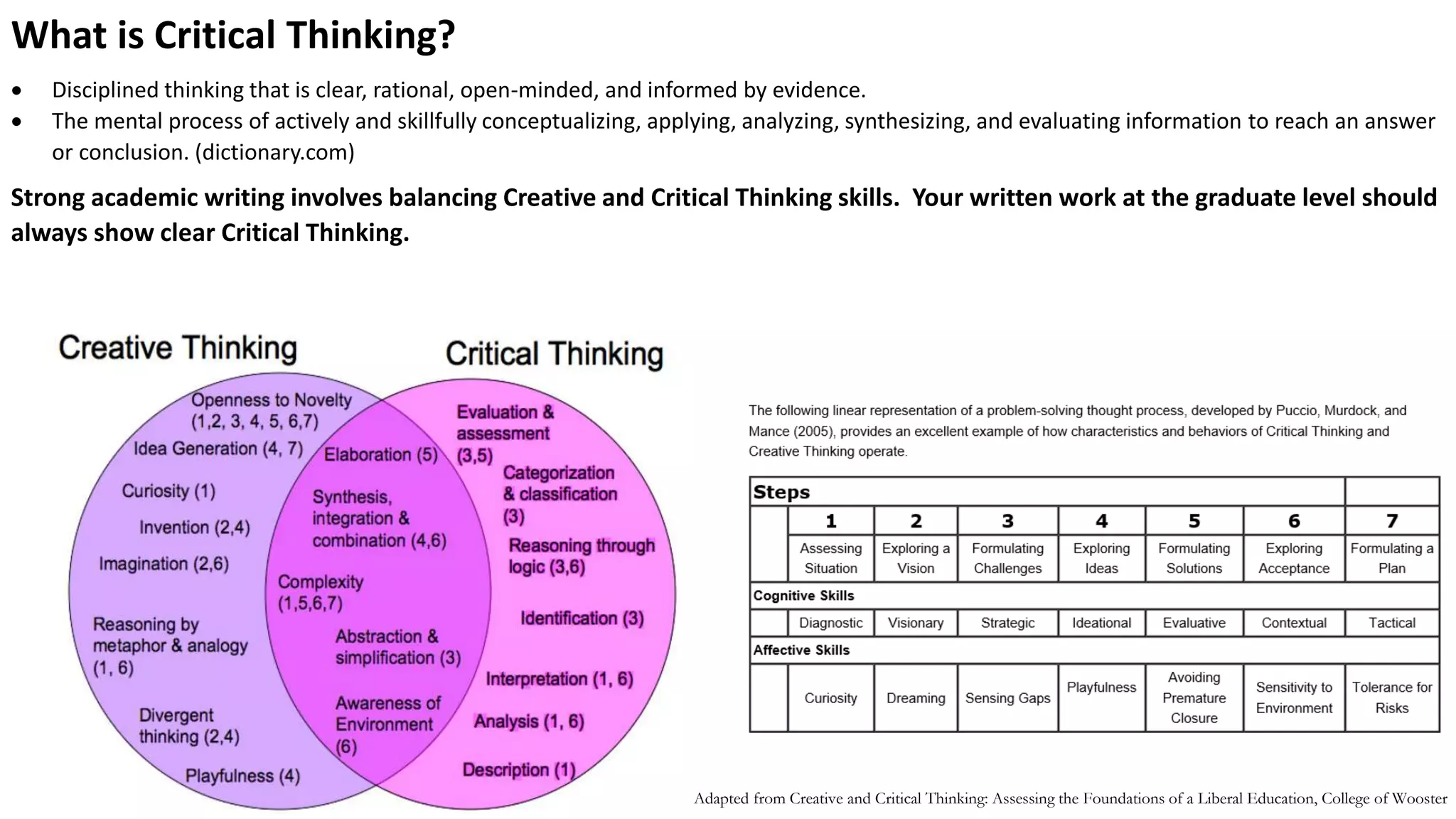
What is Critical Thinking?
 Disciplined thinking that is clear, rational, open-minded, and informed by evidence.
 The mental process of actively and skillfully conceptualizing, applying, analyzing, synthesizing, and evaluating information to reach an answer
or conclusion. (dictionary.com)
Strong academic writing involves balancing Creative and Critical Thinking skills. Your written work at the graduate level should
always show clear Critical Thinking.
Adapted from Creative and Critical Thinking: Assessing the Foundations of a Liberal Education, College of Wooster
Writing a Paper, Step by Step
• Understand your assignment. What type of writing project is required? What does
the assignment require that you do? Is there available research on your topic?
• Begin your research into the topic. As you gather research, narrow down your topic.
• Create a thesis for your paper – or topic sentence, as needed.
• Create an outline.
• Begin your draft, and revise as necessary. Writing is a process – be prepared to
revise and re-write, possibly several times, until you are ready to finalize your paper.
Research tips
• Join your research and writing from the very beginning of the process.
• http://www.concordia-ny.edu/library/index.cfm
• Make technology your research assistant .
• Use the APA template reference features, citation databases, or index cards
• Some useful apps – Evernote, Drop Box, Google Drive, SkyDrive, etc.
• Remember that plagiarism can be unintentional -document all sources using the
correct APA format, and avoid plagiarism!
• http://www.apastyle.org/learn/quick-guide-on-references.aspx#In-Text
Creating a Strong Thesis
• With the assignment understood, and the scope of your paper narrowed
down to something manageable, develop your thesis.
• Your thesis will be the main idea upon which your paper is built.
• Use your research to build and support your thesis.
• Is your thesis clear and concise? Does it directly apply to the assignment?
Your thesis should let the reader know exactly what you will be discussing in
your work.
Organizing Content
• Always start with an outline! Your outline is your roadmap through your thought
process.
• The parts of a paper: introduction, body, and conclusion…and abstract and
references!
• Your outline should contain the main points of your paper, and the sub-topics that
fall under each main point. The main points should fall in logical order to support
the main idea.
• Your outline can be traditional or done as a graphic organizer; use the method that
works best.
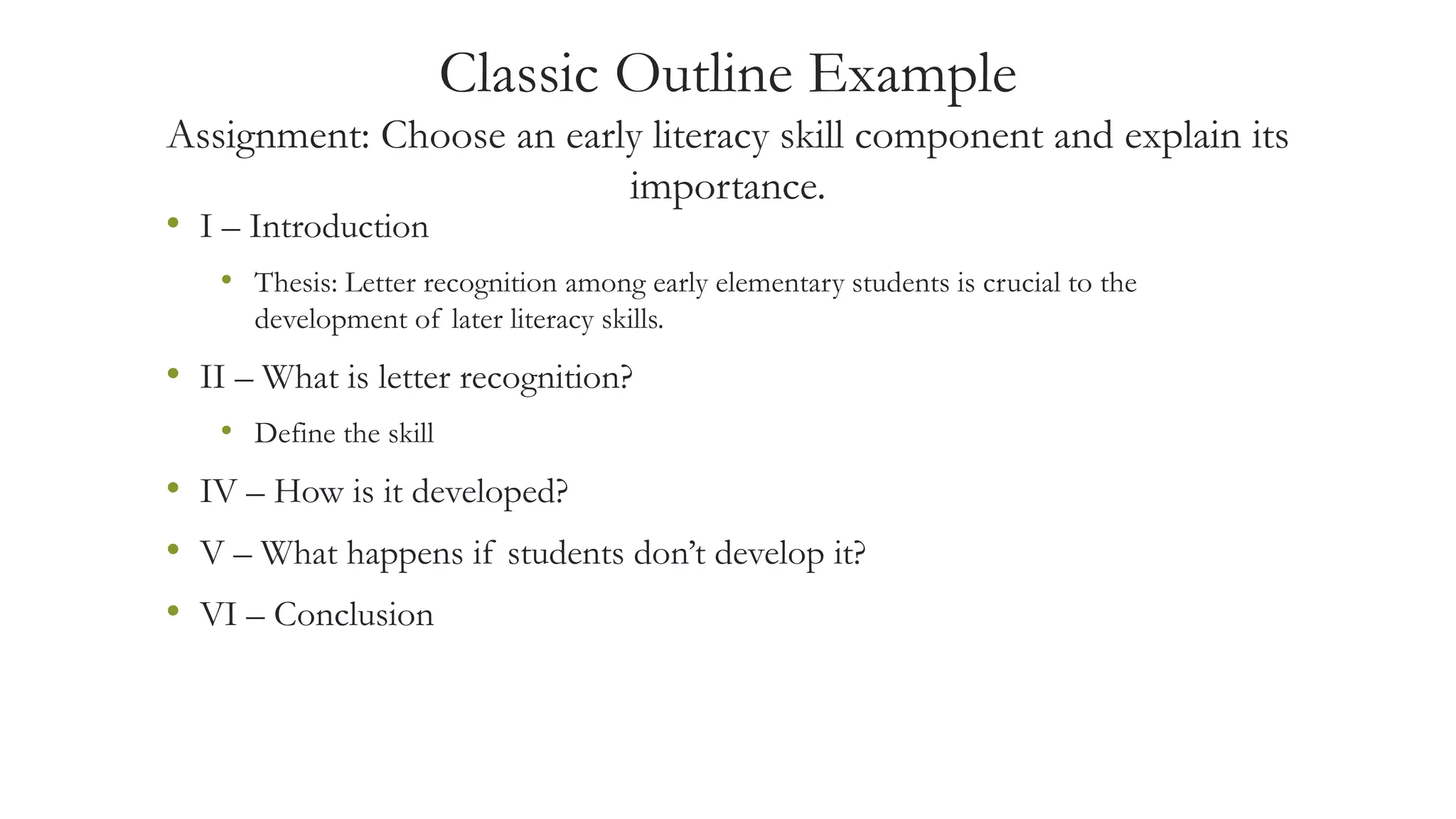
Classic Outline Example
Assignment: Choose an early literacy skill component and explain its
importance.
• I – Introduction
• Thesis: Letter recognition among early elementary students is crucial to the
development of later literacy skills.
• II – What is letter recognition?
• Define the skill
• IV – How is it developed?
• V – What happens if students don’t develop it?
• VI – Conclusion
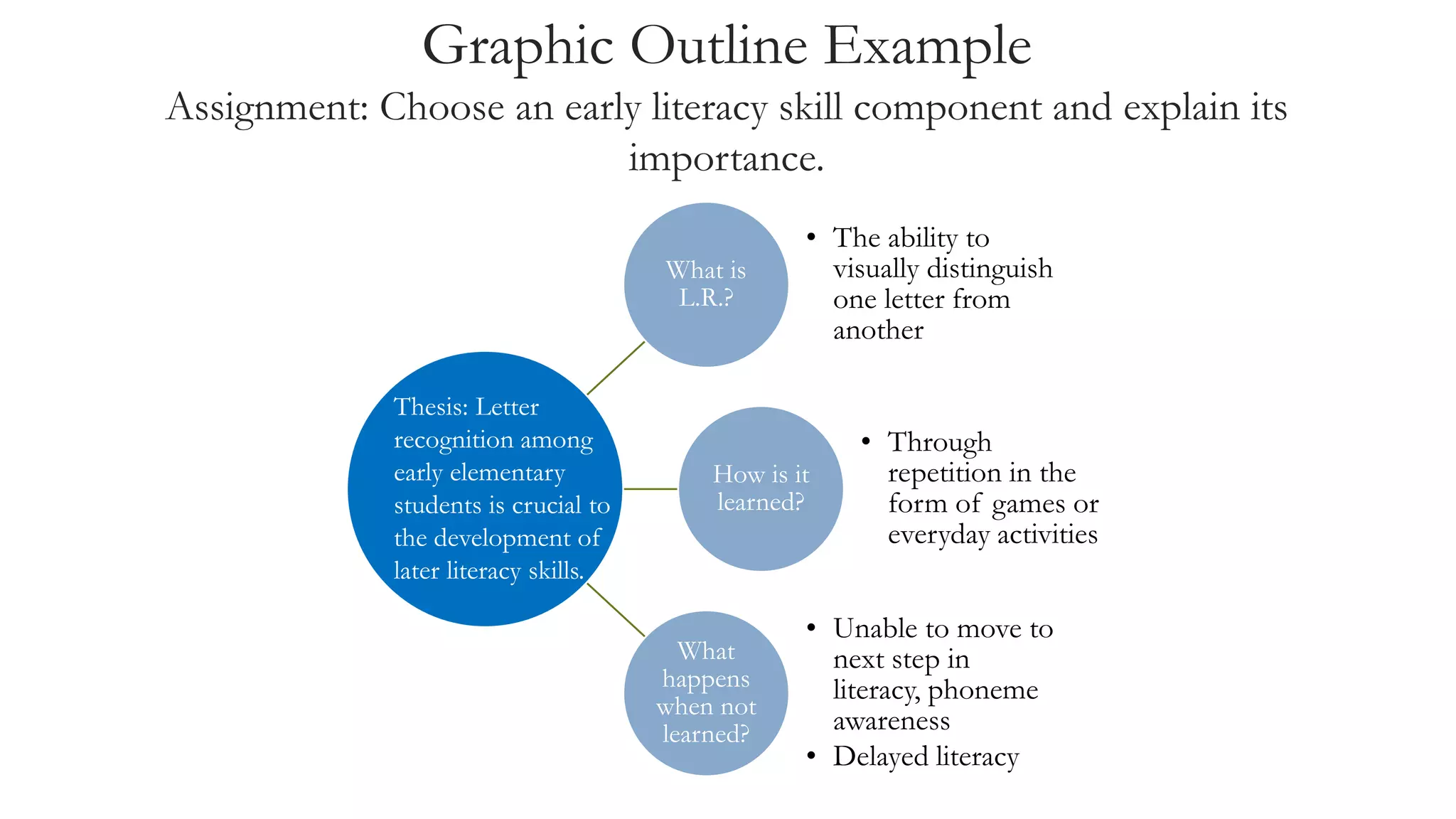
Graphic Outline Example
Assignment: Choose an early literacy skill component and explain its
importance.
What is
L.R.?
• The ability to
visually distinguish
one letter from
another
How is it
learned?
• Through
repetition in the
form of games or
everyday activities
What
happens
when not
learned?
• Unable to move to
next step in
literacy, phoneme
awareness
• Delayed literacy
Thesis: Letter
recognition among
early elementary
students is crucial to
the development of
later literacy skills.
Organizing Content, cont.
Paragraph Structure
• Build strong paragraphs – each paragraph should have a beginning, middle and end just
like the paper as a whole. Each paragraph should generally involve a particular concept
or point.
• Paragraph sequencing – does your paragraph order make sense?
• Citations/References should be included and tracked throughout paragraph writing.
• Use transitions between paragraphs and heading sections when used.
Transitions
• A good transition helps link the ideas discussed from paragraph to paragraph, and
from topic to topic within a writing project.
• A transition will often reference material from earlier paragraphs, and relate it to the
current paragraph with either a few words or phrases. A transition can also
introduce a new idea towards the end of a paragraph.
• Transitions provide continuity and context. Without them, a paper is disjointed.
• If it is too hard to relate the topics discussed in two paragraphs, it is possible that
the sequencing needs to be re-examined.
Some Common Transition Words
(Adapted from The Owl at Purdue)
• When introducing a new idea:
• Again, besides, moreover, in addition to, etc.
• When comparing concepts:
• However, in contrast, although, by comparison
• To demonstrate time/chronology:
• Previously, thereafter, finally, etc.
• To lead into a summary or conclusion:
• To conclude, consequently, as has been noted, accordingly
Using APA Format to Organize Your Paper
• APA format is a wonderful tool for organizing your work
• Use headings in APA format where appropriate to group related sub-topics;
this often means that your main outline points will correspond to a heading
level or sub-level.
• Remember that transitions are important between sections as well!
• C:UsersJOneDriveAPA template for presentation.docx
Literature Review
• Literature reviews can and often do stand on their own as a separate piece of writing; but
can also be an important part of a larger research or thesis paper. It often appears in the
introduction section in a shorter paper, or it may have its own subsection in a larger paper.
• A literature review as a standalone paper is a survey or collection of existing information on
a particular topic; and it provides a foundation for new ideas or research on a topic. It
should both summarize and synthesize the information presented.
• No "bullet-point" paragraphs; instead the sources cited and discussed should be used to
advance the narrative
Literature Reviews Within a Larger Paper
• A Literature Review is often used as part of a larger paper, usually a research
paper. Some of the questions this type of literature review should answer
within your paper (within a separate heading section, as per APA guidelines)
are:
• What is the significance of your research topic? Why is your research topic important
to the overall field of education?
• Where does your research topic fit within the context of the larger body of existing
research? What research has been done before on the topic, if any, and what did that
research reveal?
Literature Review Examples
• Review some examples of literature reviews in peer-reviewed articles
• Note how the review fits in to the larger paper
• http://ezproxy.concordia-ny.edu:2056/ehost/pdfviewer/pdfviewer?sid=fa55bbbd-
764b-4a16-98a2-1d177f63ce53%40sessionmgr4001&vid=11&hid=4212
Creating Your Abstract
• An abstract should be a concise summary of your paper, preferably using
keywords.
• http://ezproxy.concordia-ny.edu:2056/ehost/detail/detail?vid=4&sid=fa55bbbd-764b-
4a16-98a2-
1d177f63ce53%40sessionmgr4001&hid=4212&bdata=JnNpdGU9ZWhvc3QtbGl2ZQ
%3d%3d#db=ehh&AN=96190876
• It should explain your main idea, with conclusions, without re-writing the
whole paper. This means it must be written after the paper is completed.
• Add it into your paper using APA format.
Academic Language – A Brief Overview
• What is Academic Language?
• “…words, grammar, and organizational strategies used to describe complex ideas, higher-
order thinking processes, and abstract concepts.” (Zwiers, 2008)
• Where and how should it be used?
• Should be integrated within your work, and should be included in lesson plans, when
applicable
• Bloom’s taxonomy – a means of breaking down the language we use to gather,
comprehend, and synthesize information in a learning environment
• http://teaching.uncc.edu/learning-resources/articles-books/best-practice/goals-
objectives/writing-objectives
Creating a Thesis - Exercise
• What is the assignment you are currently working on?
• How can you narrow down the topic?
• Come up with a thesis statement or topic sentence for your assignment
• Working in groups, evaluate your thesis and those of your group members
• Be constructive and positive!
Rough Outline Exercise
• Put together a rough outline for the thesis you composed earlier
• We’ll discuss the outlines in our groups.
Using the Library
• Introduction to Concordia Resources – library research walk-thru
• http://www.concordia-ny.edu/library/index.cfm
• Remember when searching for journal articles – don’t just search the education journal
databases! There is a lot of information dealing with education-related topics that can be
found within the psychology, sociology, and sometimes even biology databases. Cross-
discipline research can be very helpful!
• Online Research outside of Library
• Google Scholar to locate peer-reviewed articles
• www.googlescholar.com
Presenting Your Work
• A strong outline should make creating a presentation simple - your main
headings are often a great guide for your slides
• Try for visual appeal without distracting from your content
• Polish your public speaking skills – body language, enunciation, clarity
• Take your time, don’t rush through
• Knowing your stuff makes it easier! Be an expert.
Useful Links for Writing Resources
• Purdue University Writing Resources – “The Owl”
• https://owl.english.purdue.edu/owl/
• apastyle.org
• University of Toronto Writing Center
• http://www.writing.utoronto.ca/advice
• Quick grammar reference website:
• http://www.grammarbook.com/english_rules.asp

Writing seminar slides ALST Test Prep

  • 1.
    Writing at theGraduate Level – Session 1 Charles J Frank Concordia College NY Education Department
  • 2.
    Course Objectives •Improve writingskills at the graduate level •Why?
  • 3.
    Syllabus - Session1 • Types of written assignments encountered in the Education program • The Basics – how to build a strong written assignment • APA format – overview • Research Overview • Review
  • 4.
    Types of writingassignments encountered in the Ed program • Book reviews/ article analyses • This type of assignment generally requires that you read a book or article(s) on a particular topic and analyze it (usually using other peer-reviewed research sources). You may also be asked to provide a reaction to what you have read. • Literature Reviews • These may be assigned independently, or it may be required as part of a larger assignment. Its purpose is to provide a review of the existing research on a particular topic. It should never be just a listing of published articles!
  • 5.
    Writing Assignments, cont. •Lesson Plan • This may be also be required on its own, or as part of a larger assignment. The format currently required by Concordia may be updated as necessary. • Case Studies • An in-depth look at a topic using a particular situation, group, or individual as the focus. The analysis often includes a literature review, and/or a reaction piece.
  • 6.
    Writing assignments, cont. •Research Papers • This type of assignment will ask you to examine a particular issue or topic in some depth, with an extensive analysis. In some cases, you may be asked to actually conduct a research project and present the results with an analysis. • Theses • Similar to a research paper, but in much greater depth and scope. For a Master’s thesis, you are often required to explore an original research question, using primary and secondary resource.
  • 7.
    The Building Blocksof Strong Academic Writing • Strong thesis. • Quality content organized into a logical flow. Content should demonstrate creative* and critical thinking and support the thesis. Smooth incorporation of research. • Correct grammar and syntax – clean “G.U.M.S.” (grammar, usage, mechanics, and spelling) • Academic language – vocabulary used to express complex ideas
  • 8.
    What is CriticalThinking?  Disciplined thinking that is clear, rational, open-minded, and informed by evidence.  The mental process of actively and skillfully conceptualizing, applying, analyzing, synthesizing, and evaluating information to reach an answer or conclusion. (dictionary.com) Strong academic writing involves balancing Creative and Critical Thinking skills. Your written work at the graduate level should always show clear Critical Thinking. Adapted from Creative and Critical Thinking: Assessing the Foundations of a Liberal Education, College of Wooster
  • 9.
    Writing a Paper,Step by Step • Understand your assignment. What type of writing project is required? What does the assignment require that you do? Is there available research on your topic? • Begin your research into the topic. As you gather research, narrow down your topic. • Create a thesis for your paper – or topic sentence, as needed. • Create an outline. • Begin your draft, and revise as necessary. Writing is a process – be prepared to revise and re-write, possibly several times, until you are ready to finalize your paper.
  • 10.
    Research tips • Joinyour research and writing from the very beginning of the process. • http://www.concordia-ny.edu/library/index.cfm • Make technology your research assistant . • Use the APA template reference features, citation databases, or index cards • Some useful apps – Evernote, Drop Box, Google Drive, SkyDrive, etc. • Remember that plagiarism can be unintentional -document all sources using the correct APA format, and avoid plagiarism! • http://www.apastyle.org/learn/quick-guide-on-references.aspx#In-Text
  • 11.
    Creating a StrongThesis • With the assignment understood, and the scope of your paper narrowed down to something manageable, develop your thesis. • Your thesis will be the main idea upon which your paper is built. • Use your research to build and support your thesis. • Is your thesis clear and concise? Does it directly apply to the assignment? Your thesis should let the reader know exactly what you will be discussing in your work.
  • 12.
    Organizing Content • Alwaysstart with an outline! Your outline is your roadmap through your thought process. • The parts of a paper: introduction, body, and conclusion…and abstract and references! • Your outline should contain the main points of your paper, and the sub-topics that fall under each main point. The main points should fall in logical order to support the main idea. • Your outline can be traditional or done as a graphic organizer; use the method that works best.
  • 13.
    Classic Outline Example Assignment:Choose an early literacy skill component and explain its importance. • I – Introduction • Thesis: Letter recognition among early elementary students is crucial to the development of later literacy skills. • II – What is letter recognition? • Define the skill • IV – How is it developed? • V – What happens if students don’t develop it? • VI – Conclusion
  • 14.
    Graphic Outline Example Assignment:Choose an early literacy skill component and explain its importance. What is L.R.? • The ability to visually distinguish one letter from another How is it learned? • Through repetition in the form of games or everyday activities What happens when not learned? • Unable to move to next step in literacy, phoneme awareness • Delayed literacy Thesis: Letter recognition among early elementary students is crucial to the development of later literacy skills.
  • 15.
    Organizing Content, cont. ParagraphStructure • Build strong paragraphs – each paragraph should have a beginning, middle and end just like the paper as a whole. Each paragraph should generally involve a particular concept or point. • Paragraph sequencing – does your paragraph order make sense? • Citations/References should be included and tracked throughout paragraph writing. • Use transitions between paragraphs and heading sections when used.
  • 16.
    Transitions • A goodtransition helps link the ideas discussed from paragraph to paragraph, and from topic to topic within a writing project. • A transition will often reference material from earlier paragraphs, and relate it to the current paragraph with either a few words or phrases. A transition can also introduce a new idea towards the end of a paragraph. • Transitions provide continuity and context. Without them, a paper is disjointed. • If it is too hard to relate the topics discussed in two paragraphs, it is possible that the sequencing needs to be re-examined.
  • 17.
    Some Common TransitionWords (Adapted from The Owl at Purdue) • When introducing a new idea: • Again, besides, moreover, in addition to, etc. • When comparing concepts: • However, in contrast, although, by comparison • To demonstrate time/chronology: • Previously, thereafter, finally, etc. • To lead into a summary or conclusion: • To conclude, consequently, as has been noted, accordingly
  • 18.
    Using APA Formatto Organize Your Paper • APA format is a wonderful tool for organizing your work • Use headings in APA format where appropriate to group related sub-topics; this often means that your main outline points will correspond to a heading level or sub-level. • Remember that transitions are important between sections as well! • C:UsersJOneDriveAPA template for presentation.docx
  • 19.
    Literature Review • Literaturereviews can and often do stand on their own as a separate piece of writing; but can also be an important part of a larger research or thesis paper. It often appears in the introduction section in a shorter paper, or it may have its own subsection in a larger paper. • A literature review as a standalone paper is a survey or collection of existing information on a particular topic; and it provides a foundation for new ideas or research on a topic. It should both summarize and synthesize the information presented. • No "bullet-point" paragraphs; instead the sources cited and discussed should be used to advance the narrative
  • 20.
    Literature Reviews Withina Larger Paper • A Literature Review is often used as part of a larger paper, usually a research paper. Some of the questions this type of literature review should answer within your paper (within a separate heading section, as per APA guidelines) are: • What is the significance of your research topic? Why is your research topic important to the overall field of education? • Where does your research topic fit within the context of the larger body of existing research? What research has been done before on the topic, if any, and what did that research reveal?
  • 21.
    Literature Review Examples •Review some examples of literature reviews in peer-reviewed articles • Note how the review fits in to the larger paper • http://ezproxy.concordia-ny.edu:2056/ehost/pdfviewer/pdfviewer?sid=fa55bbbd- 764b-4a16-98a2-1d177f63ce53%40sessionmgr4001&vid=11&hid=4212
  • 22.
    Creating Your Abstract •An abstract should be a concise summary of your paper, preferably using keywords. • http://ezproxy.concordia-ny.edu:2056/ehost/detail/detail?vid=4&sid=fa55bbbd-764b- 4a16-98a2- 1d177f63ce53%40sessionmgr4001&hid=4212&bdata=JnNpdGU9ZWhvc3QtbGl2ZQ %3d%3d#db=ehh&AN=96190876 • It should explain your main idea, with conclusions, without re-writing the whole paper. This means it must be written after the paper is completed. • Add it into your paper using APA format.
  • 23.
    Academic Language –A Brief Overview • What is Academic Language? • “…words, grammar, and organizational strategies used to describe complex ideas, higher- order thinking processes, and abstract concepts.” (Zwiers, 2008) • Where and how should it be used? • Should be integrated within your work, and should be included in lesson plans, when applicable • Bloom’s taxonomy – a means of breaking down the language we use to gather, comprehend, and synthesize information in a learning environment • http://teaching.uncc.edu/learning-resources/articles-books/best-practice/goals- objectives/writing-objectives
  • 24.
    Creating a Thesis- Exercise • What is the assignment you are currently working on? • How can you narrow down the topic? • Come up with a thesis statement or topic sentence for your assignment • Working in groups, evaluate your thesis and those of your group members • Be constructive and positive!
  • 25.
    Rough Outline Exercise •Put together a rough outline for the thesis you composed earlier • We’ll discuss the outlines in our groups.
  • 26.
    Using the Library •Introduction to Concordia Resources – library research walk-thru • http://www.concordia-ny.edu/library/index.cfm • Remember when searching for journal articles – don’t just search the education journal databases! There is a lot of information dealing with education-related topics that can be found within the psychology, sociology, and sometimes even biology databases. Cross- discipline research can be very helpful! • Online Research outside of Library • Google Scholar to locate peer-reviewed articles • www.googlescholar.com
  • 27.
    Presenting Your Work •A strong outline should make creating a presentation simple - your main headings are often a great guide for your slides • Try for visual appeal without distracting from your content • Polish your public speaking skills – body language, enunciation, clarity • Take your time, don’t rush through • Knowing your stuff makes it easier! Be an expert.
  • 28.
    Useful Links forWriting Resources • Purdue University Writing Resources – “The Owl” • https://owl.english.purdue.edu/owl/ • apastyle.org • University of Toronto Writing Center • http://www.writing.utoronto.ca/advice • Quick grammar reference website: • http://www.grammarbook.com/english_rules.asp

Editor's Notes

  • #3 Ask students why.. To improve critical thinking skills, be a better communicator, to be a better teacher. Can't teach kids to write if you're not good at it! On a practical level, writing skills are important for the NYS certification exams!
  • #7 These are the main types of papers encountered in an Ed program. If you come across something different – ask! If you have questions about an assisgnment – ask!
  • #8 * Please add creative to your slide copy! Writing is a one-sided conversation; you must make sure the reader will have no trouble understanding what you are communicating.
  • #10 Let’s talk about some of these steps in detail, because they are so important.
  • #13 Your paragraphs should be sequenced so that the concept or point being discussed flows logically and naturally We’re discussing abstract at the end of the parts of a paper because you need to have explored your conclusions before you can discuss them briefly
  • #14 It’s a great idea to note your sources as you go regarding a particular topic or sub-topic, so that you remain on-track. If you are required to hand in an outline prior to the paper, you should use the standard APA outline format. See references.
  • #15 may help in organizing larger points, but can get messy when determining sub-topics. Also sometimes harder to keep track of references/sources w/out getting messy. Remember that its important to organize your thoughts; the exact format doesn’t matter as long as it helps YOU!
  • #18 Adapted from The Owl
  • #19 So we’ve discussed organizing your content using an outline, and discussed building effective paragraphs w/transitions. As you continue through the writing process, there are some other things to touch on.
  • #20 Review several literature review papers and point out the different ways the authors include the sources within the document. Examples of both stand-alone lit reviews and parts of larger papers
  • #25 Hands-on practice creating a thesis using typical general topics common to education  Have students share some thesis ideas.
  • #26 Analyze a real peer-reviewed journal paper, and go over the various elements, pointing out the paragraph organization, transitions, etc. Using the earlier thesis, ask students to come up with rudimentary outlines; paragraph topic headings only, just to practice creating a narrative
  • #27 - Walk-through of Concordia library online resources, demonstrating optimal search terms, how to search across multiple databases - Walk-through Google Scholar search to get resource, then use Concordia resources to dowload
  • #28 run video from youtube - "how not to present a power-point" -review basic public speaking skills as a reminder -teaching is really presenting
  • #29 get complete links for UToronto and Columbia