Reading and
Writing
Quarter 4 – Week
1
HYPERTEXT AND
INTERTEXT
PAGE
01
Context
Context is defined as the social, cultural,
political, historical, and other related
circumstances that surround the text and form
the terms from which it can be better
understood and evaluated. Knowledge of the
text’s context helps in appreciating the text’s
message more deeply.
PAGE
03
PAGE
02 Questions to ask to understand the context of the
text:
1. When was the work written?
2. What were the circumstances that produced
it?
3. What issues does it deal with?
Two Contexts of Text Development
Intertext
Hypertext
PAGE
05
PAGE
04
1. When was the text written? What was the
society like back then?
2. What were the political, social, cultural,
economic, or even religious influences in the
author’s life that are reflected in his writing?
PAGE
05
PAGE
04
Intertextuality (Intertext)
PAGE
05
PAGE
04
Intertextuality (Intertext)
Writers often reference another literary, media, or
social text in their own writing. They create a link
or connection between their work and other texts.
The relationship formed between the two texts is
called intertextuality.
An example of intertextuality is a writer’s
borrowing and transforming a prior text, and
incorporating an aspect of it in a new text.
Julia Kristeva, a French author, coined the term
intertextuality. In her essay “Word, Dialogue, and
Novel,” published in 1967, she says, “Any text is
constructed as a mosaic of quotations: any text
is the absorption and transformation of
another.”
-For a reader to understand the meaning of a
text, he or she should be able to make sense of
its connection or relationship with the other text.
PAGE
07
PAGE
06
When reading a work that uses intertextuality,
you may ask the following questions:
1. Why did the author reference another text in
his or her writing?
2. How is the text incorporated into the author’s
writing? How did the author reimagine it?
3. What effect does the text have on the author’s
writing?
Forms of Intertextuality
The following are two forms of intertextuality:
 The writer references either a brief or
prolonged portion of a literary text in his or
her writing. He or she mentions the title of the
book, uses one of its characters, or recreates
one of its scenes.
 The writer references a media or social text in
his or her writing. He or she mentions film, a
TV show, a song, or any event in society,
history, politics, etc. and becomes part of the
writing.
PAGE
09
PAGE
08
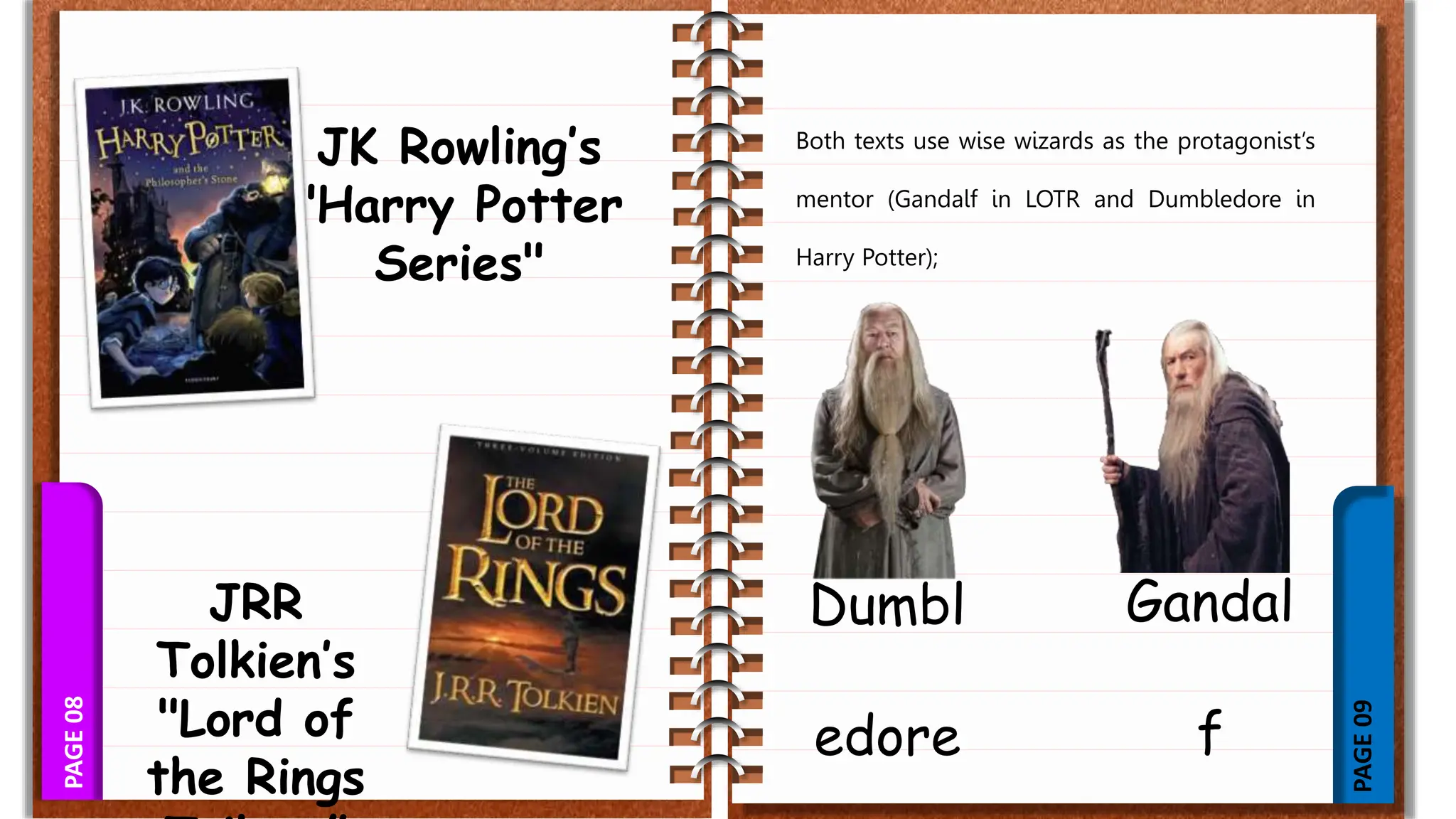
JK Rowling’s
"Harry Potter
Series"
Both texts use wise wizards as the protagonist’s
mentor (Gandalf in LOTR and Dumbledore in
Harry Potter);
JRR
Tolkien’s
"Lord of
the Rings
Dumbl
edore
Gandal
f
PAGE
11
PAGE
10
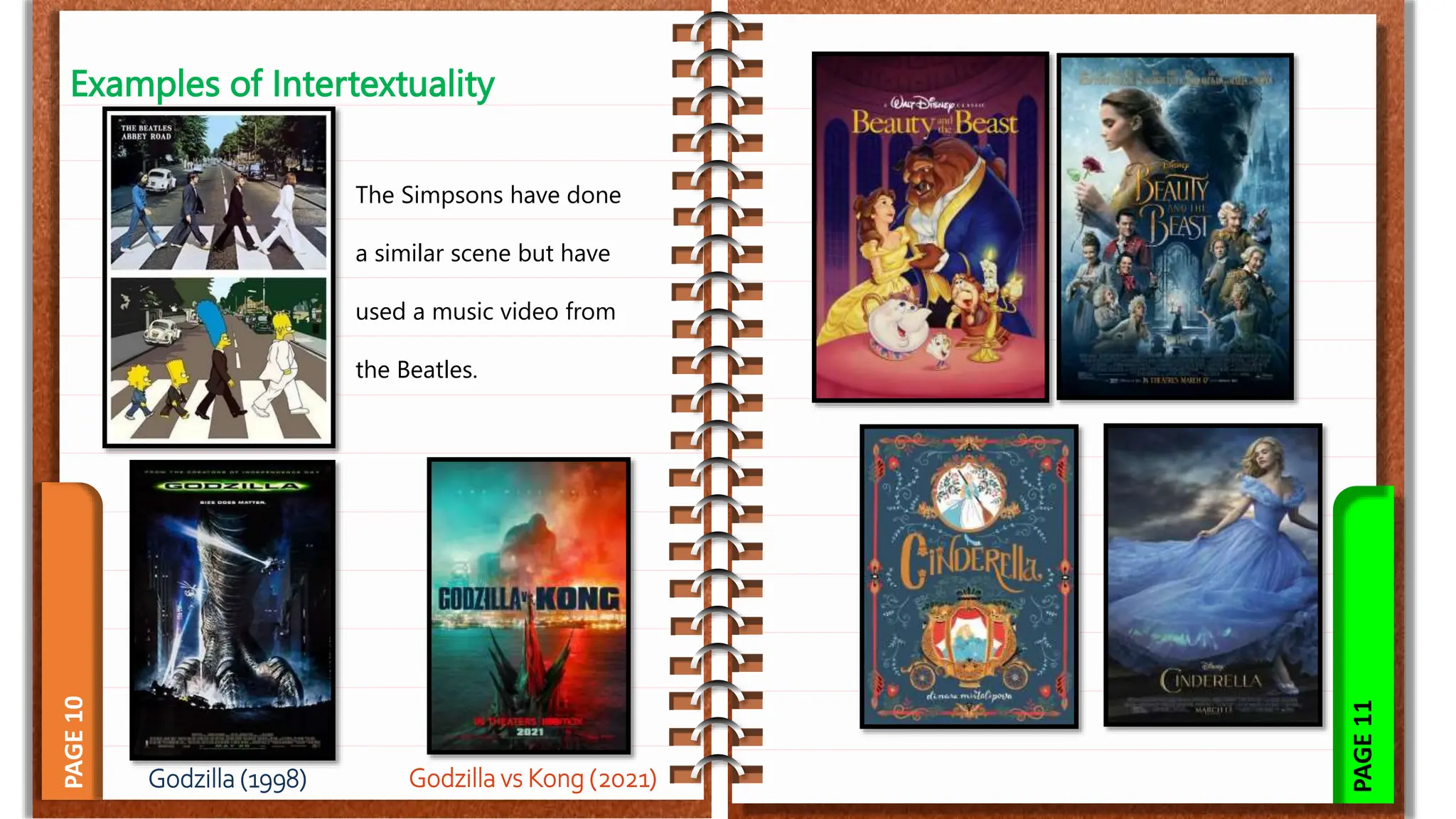
Examples of Intertextuality
The Simpsons have done
a similar scene but have
used a music video from
the Beatles.
Godzilla (1998) Godzilla vs Kong (2021)
PAGE
12
The song “Tatsulok” emphasizes the roots of the armed conflict in the country where it is caused by poverty. This
refers to the hierarchy known as the social pyramid, where individuals with higher social status are at the top of it and
the lower portion represents individuals with a lower social status.
PAGE
13
Taylor Swift- ‘Love story’• The lyrics of this song talk about Romeo and Juliette. This video is made to look
like a modernized version of the story, relating more to the lyrics of the song.
PAGE
15
PAGE
14
Hypertextuality (Hypertext)
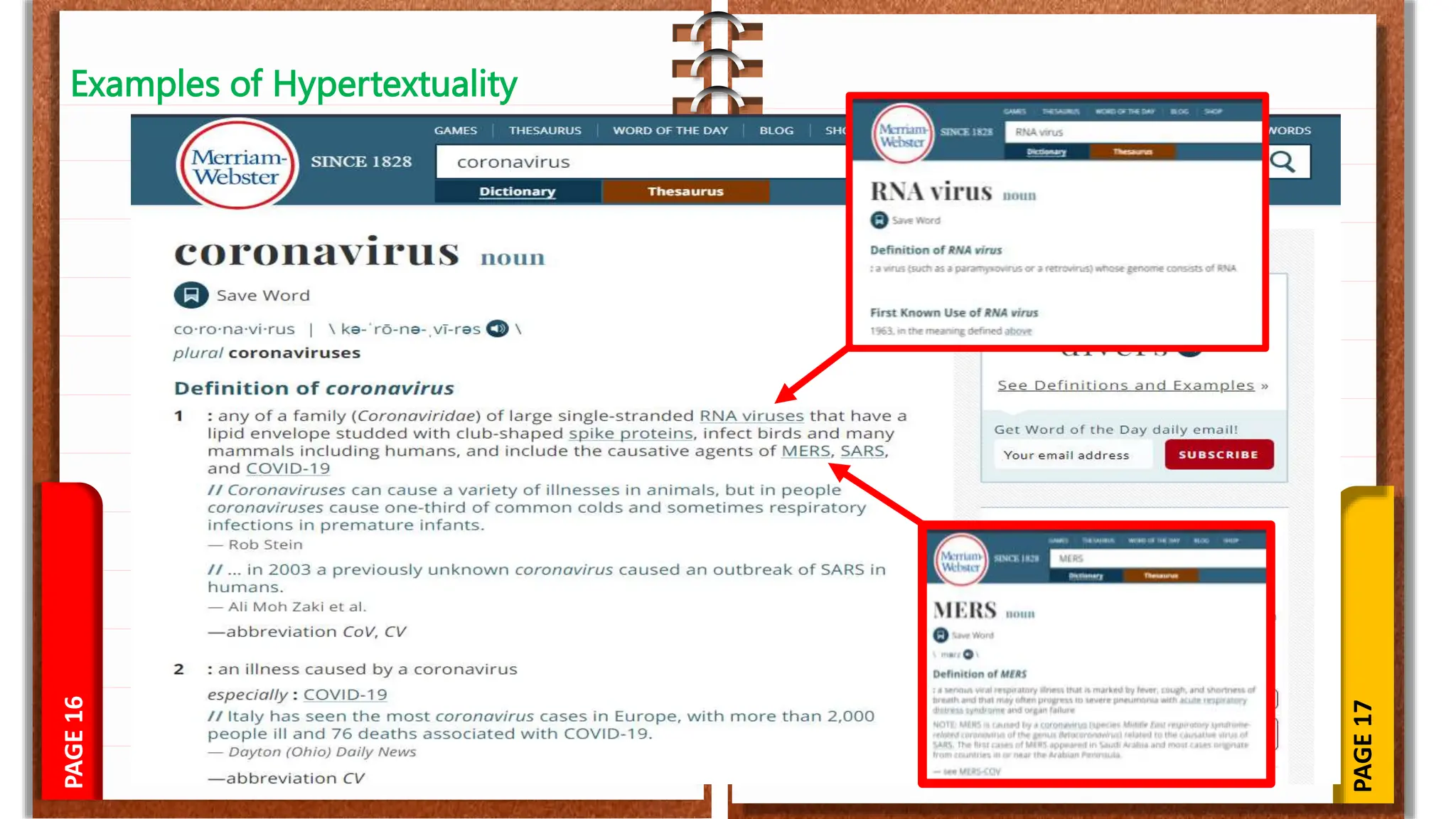
It is an arrangement of information in a computer
database, in which objects like text, pictures, and
programs are linked to one another.
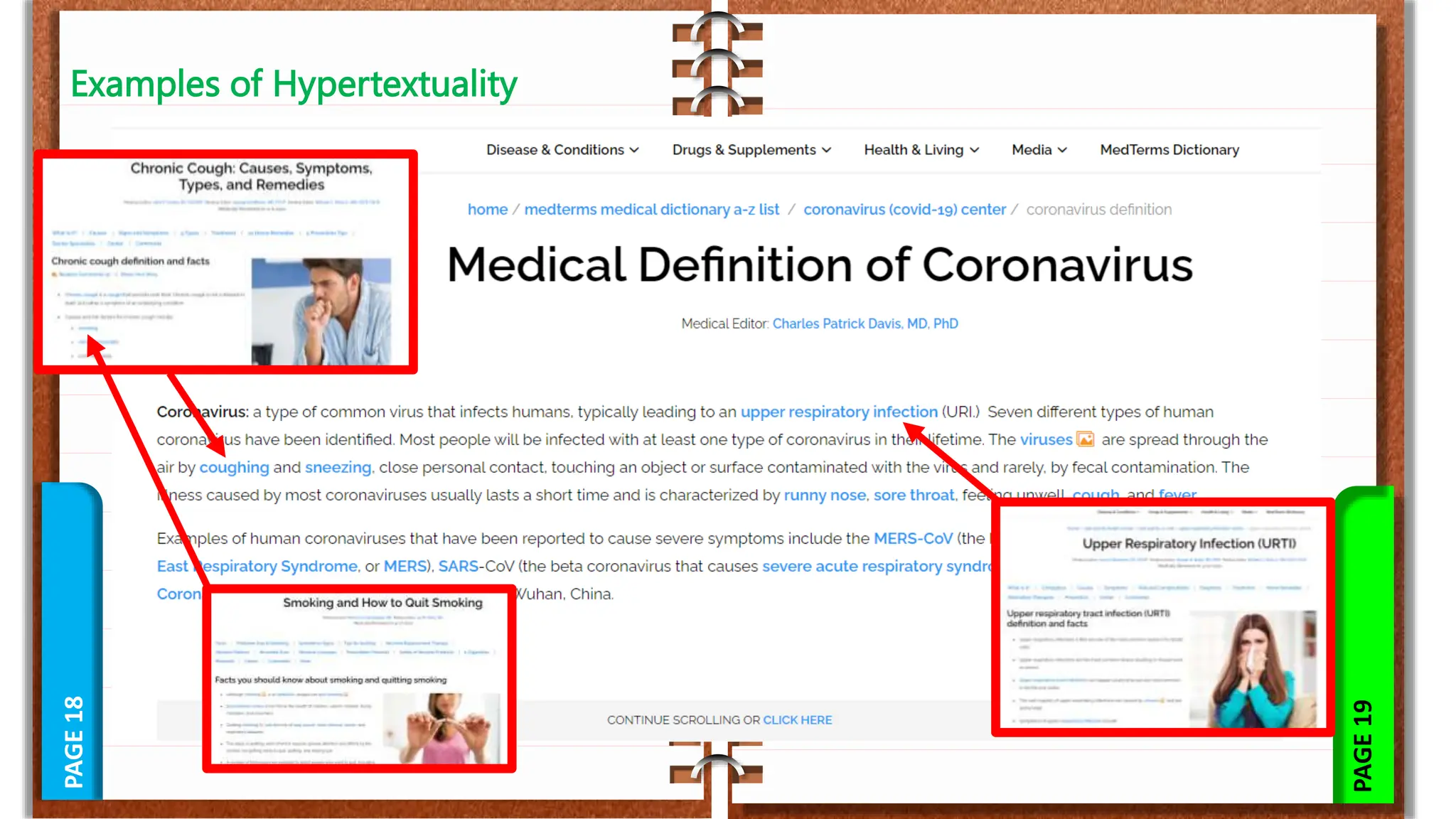
When a user selects an object, he or she can see
the other objects linked to it. In reading an online
article, for instance, the user can click on
highlighted words or phrases (called hypertext
links) to go to new Web pages with related
content.
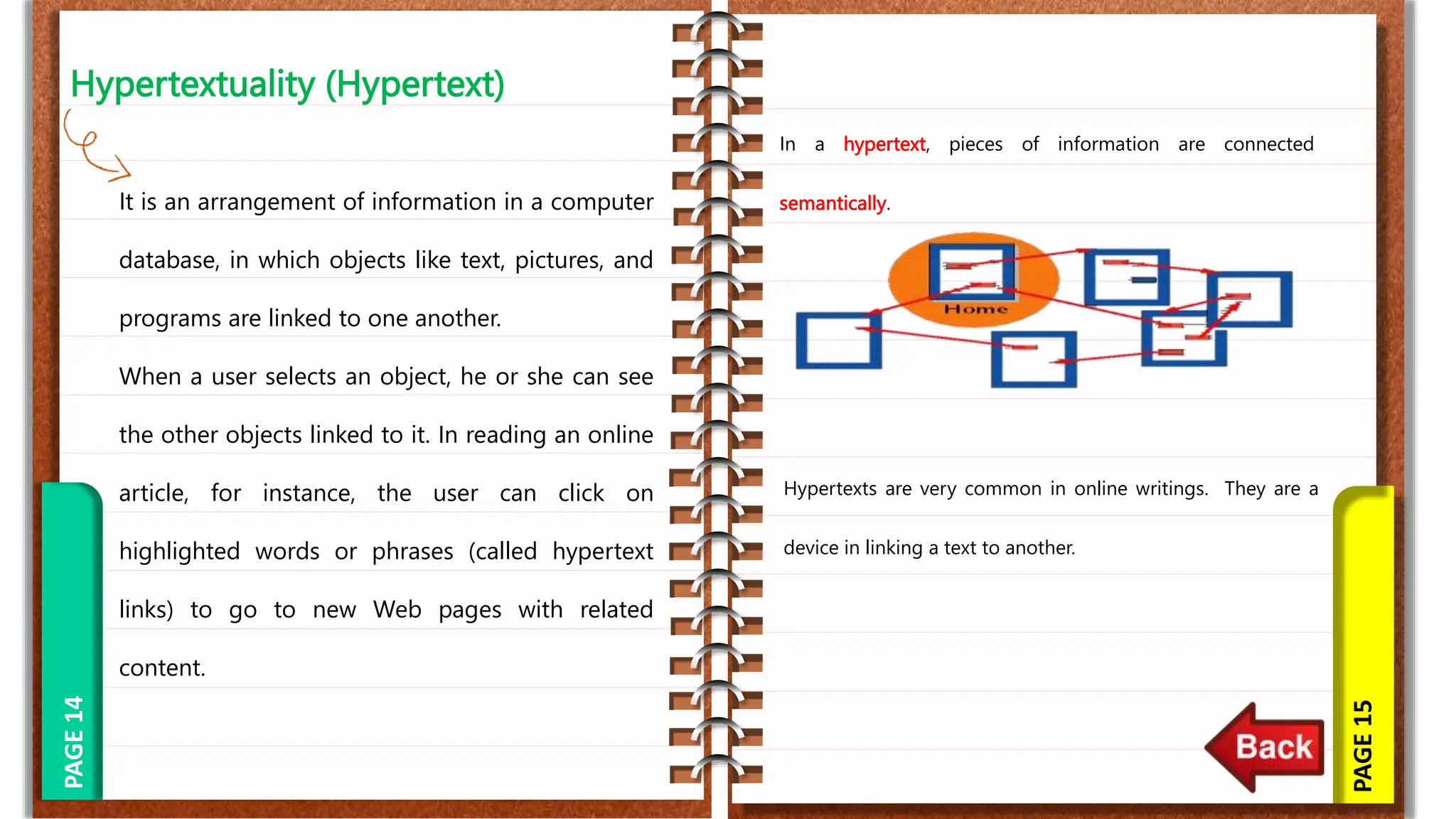
In a hypertext, pieces of information are connected
semantically.
Hypertexts are very common in online writings. They are a
device in linking a text to another.
PAGE
17
PAGE
16
Examples of Hypertextuality
PAGE
19
PAGE
18
Examples of Hypertextuality
PAGE
19
PAGE
18
Examples of Hypertextuality
using PowerPoint:
Learning Competency with code:
Identify the context in which a text was
developed
a. Hypertext
b. Intertext
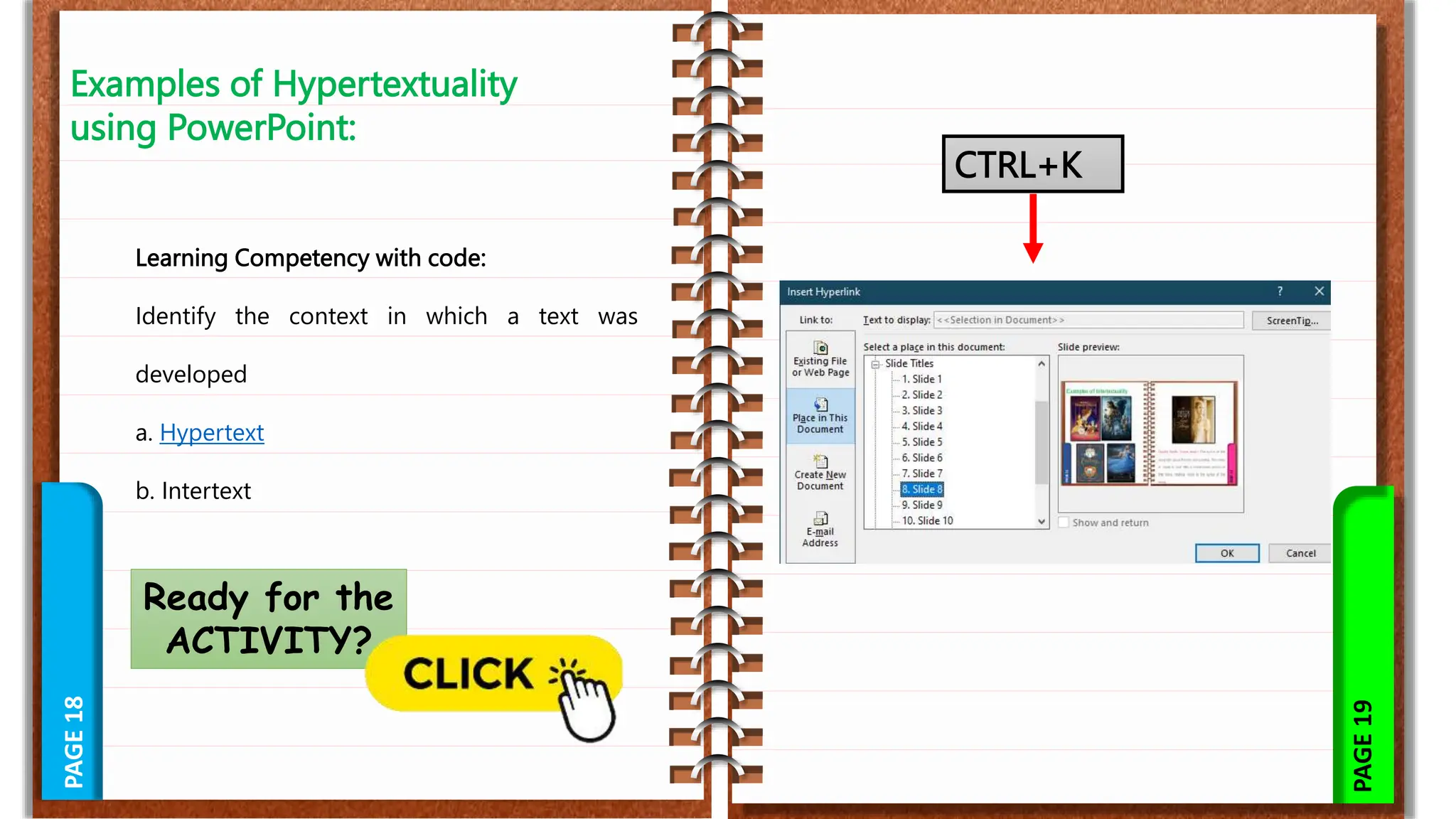
CTRL+K
Ready for the
ACTIVITY?
PAGE
19
PAGE
18
THANK YOU

Reading and Writing - Quarter 4 - Week 1-2.pptx

  • 1.
    Reading and Writing Quarter 4– Week 1 HYPERTEXT AND INTERTEXT
  • 2.
    PAGE 01 Context Context is definedas the social, cultural, political, historical, and other related circumstances that surround the text and form the terms from which it can be better understood and evaluated. Knowledge of the text’s context helps in appreciating the text’s message more deeply.
  • 3.
    PAGE 03 PAGE 02 Questions toask to understand the context of the text: 1. When was the work written? 2. What were the circumstances that produced it? 3. What issues does it deal with? Two Contexts of Text Development Intertext Hypertext
  • 4.
    PAGE 05 PAGE 04 1. When wasthe text written? What was the society like back then? 2. What were the political, social, cultural, economic, or even religious influences in the author’s life that are reflected in his writing?
  • 5.
  • 6.
    PAGE 05 PAGE 04 Intertextuality (Intertext) Writers oftenreference another literary, media, or social text in their own writing. They create a link or connection between their work and other texts. The relationship formed between the two texts is called intertextuality. An example of intertextuality is a writer’s borrowing and transforming a prior text, and incorporating an aspect of it in a new text. Julia Kristeva, a French author, coined the term intertextuality. In her essay “Word, Dialogue, and Novel,” published in 1967, she says, “Any text is constructed as a mosaic of quotations: any text is the absorption and transformation of another.” -For a reader to understand the meaning of a text, he or she should be able to make sense of its connection or relationship with the other text.
  • 7.
    PAGE 07 PAGE 06 When reading awork that uses intertextuality, you may ask the following questions: 1. Why did the author reference another text in his or her writing? 2. How is the text incorporated into the author’s writing? How did the author reimagine it? 3. What effect does the text have on the author’s writing? Forms of Intertextuality The following are two forms of intertextuality:  The writer references either a brief or prolonged portion of a literary text in his or her writing. He or she mentions the title of the book, uses one of its characters, or recreates one of its scenes.  The writer references a media or social text in his or her writing. He or she mentions film, a TV show, a song, or any event in society, history, politics, etc. and becomes part of the writing.
  • 8.
    PAGE 09 PAGE 08 JK Rowling’s "Harry Potter Series" Bothtexts use wise wizards as the protagonist’s mentor (Gandalf in LOTR and Dumbledore in Harry Potter); JRR Tolkien’s "Lord of the Rings Dumbl edore Gandal f
  • 9.
    PAGE 11 PAGE 10 Examples of Intertextuality TheSimpsons have done a similar scene but have used a music video from the Beatles. Godzilla (1998) Godzilla vs Kong (2021)
  • 10.
    PAGE 12 The song “Tatsulok”emphasizes the roots of the armed conflict in the country where it is caused by poverty. This refers to the hierarchy known as the social pyramid, where individuals with higher social status are at the top of it and the lower portion represents individuals with a lower social status.
  • 11.
    PAGE 13 Taylor Swift- ‘Lovestory’• The lyrics of this song talk about Romeo and Juliette. This video is made to look like a modernized version of the story, relating more to the lyrics of the song.
  • 12.
    PAGE 15 PAGE 14 Hypertextuality (Hypertext) It isan arrangement of information in a computer database, in which objects like text, pictures, and programs are linked to one another. When a user selects an object, he or she can see the other objects linked to it. In reading an online article, for instance, the user can click on highlighted words or phrases (called hypertext links) to go to new Web pages with related content. In a hypertext, pieces of information are connected semantically. Hypertexts are very common in online writings. They are a device in linking a text to another.
  • 13.
  • 14.
  • 15.
    PAGE 19 PAGE 18 Examples of Hypertextuality usingPowerPoint: Learning Competency with code: Identify the context in which a text was developed a. Hypertext b. Intertext CTRL+K Ready for the ACTIVITY?
  • 16.
  • 17.