Academic Assessment 
SPED 435
Achievement Tests
Ability Assessment vs Achievement 
Assessment 
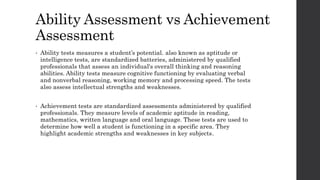
• Ability tests measures a student’s potential. also known as aptitude or 
intelligence tests, are standardized batteries, administered by qualified 
professionals that assess an individual's overall thinking and reasoning 
abilities. Ability tests measure cognitive functioning by evaluating verbal 
and nonverbal reasoning, working memory and processing speed. The tests 
also assess intellectual strengths and weaknesses. 
• Achievement tests are standardized assessments administered by qualified 
professionals. They measure levels of academic aptitude in reading, 
mathematics, written language and oral language. These tests are used to 
determine how well a student is functioning in a specific area. They 
highlight academic strengths and weaknesses in key subjects.
Norm-Referenced & Curriculum- 
Based Assessments 
Norm-Referenced 
• An assessment designed to measure and 
compare individual students’ 
performances or test results to those of 
an appropriate peer group (that is, norm 
group) at the classroom, local, or 
national level. Students with the best 
performance on a given assessment 
receive the highest grades. 
• generally used to sort students rather 
than to measure individual performance 
against a standard or criterion. 
• 
Curriculum-Based 
• Is an approach to linking instruction 
with assessment. CBA has three 
purposes: (1) to determine eligibility, 
(2) to develop the goals for 
instruction, and (3) to evaluate the 
student's progress in the curriculum. 
Based on the performance on a CBA 
instrument, teachers and other 
professionals can specify instructional 
goals.
Assessment
WIAT-III 
• The test assesses the academic achievement of children, adolescents, college 
students and adults, aged 4 through 85. The test enables the assessment of a 
broad range of academics skills or only a particular area of need. There are 
four basic scales: Reading, Math, Writing, and Oral Language. Within these 
scales there is a total of 9 sub-test scores. 
• It can be used to identify the academic strengths and weaknesses 
individuals possess as well as inform and aid intervention planning. An 
individually administered achievement test such as the WIAT-II can be used 
in a variety of settings where there is concern over educational progress. It 
can provide meaningful information to assist with diagnostic, eligibility, 
placement, and intervention decisions.
Woodcock-Johnson III Test of 
Achievement 
• The tests help teachers and others to determine learning disabilities and 
create learning programs appropriate for an individual. 
• This test includes both a standard battery and the extended battery. 
Standard battery includes tests 1-10 and the extended battery tests 11-22 
• The standard battery includes subtests of: reading fluency, understanding 
directions, letter-word identification, story recall, math fluency, calculation, 
spelling, writing samples, writing fluency, passage comprehension, applied 
problems, and story recall-delayed. 
• The extended battery subtests include: picture vocabulary, word attack, 
editing, oral comprehension, reading vocabulary, academic knowledge, 
quantitative concepts, sound awareness, spelling of sounds, capitalization, 
and punctuation.
Selecting the Appropriate Test 
• There are many different things to consider when selecting the appropriate 
diagnostic instrument or technique. First of all, what are you testing the 
student for? or what is the purpose of the test? Next, it is important to 
consider if the technique or instrument used has reliability and validity. 
Third, does it give you the information you need for planning (IEP) or 
intervention? Fourth, are there specific skills or areas a student may be 
struggling in (for example: math) that the test would be useful for. 
• It is important for a special education teacher to understand and be able to 
administer different types of tests. This is something that is done fairly 
often and it has to be done accurately.
References 
• http://www.education.com/reference/article/curriculum-based-assessment/ 
• http://www.learnnc.org/ 
• http://www.ehow.com/

Academic Assessment 8

  • 1.
  • 2.
  • 3.
    Ability Assessment vsAchievement Assessment • Ability tests measures a student’s potential. also known as aptitude or intelligence tests, are standardized batteries, administered by qualified professionals that assess an individual's overall thinking and reasoning abilities. Ability tests measure cognitive functioning by evaluating verbal and nonverbal reasoning, working memory and processing speed. The tests also assess intellectual strengths and weaknesses. • Achievement tests are standardized assessments administered by qualified professionals. They measure levels of academic aptitude in reading, mathematics, written language and oral language. These tests are used to determine how well a student is functioning in a specific area. They highlight academic strengths and weaknesses in key subjects.
  • 4.
    Norm-Referenced & Curriculum- Based Assessments Norm-Referenced • An assessment designed to measure and compare individual students’ performances or test results to those of an appropriate peer group (that is, norm group) at the classroom, local, or national level. Students with the best performance on a given assessment receive the highest grades. • generally used to sort students rather than to measure individual performance against a standard or criterion. • Curriculum-Based • Is an approach to linking instruction with assessment. CBA has three purposes: (1) to determine eligibility, (2) to develop the goals for instruction, and (3) to evaluate the student's progress in the curriculum. Based on the performance on a CBA instrument, teachers and other professionals can specify instructional goals.
  • 5.
  • 6.
    WIAT-III • Thetest assesses the academic achievement of children, adolescents, college students and adults, aged 4 through 85. The test enables the assessment of a broad range of academics skills or only a particular area of need. There are four basic scales: Reading, Math, Writing, and Oral Language. Within these scales there is a total of 9 sub-test scores. • It can be used to identify the academic strengths and weaknesses individuals possess as well as inform and aid intervention planning. An individually administered achievement test such as the WIAT-II can be used in a variety of settings where there is concern over educational progress. It can provide meaningful information to assist with diagnostic, eligibility, placement, and intervention decisions.
  • 7.
    Woodcock-Johnson III Testof Achievement • The tests help teachers and others to determine learning disabilities and create learning programs appropriate for an individual. • This test includes both a standard battery and the extended battery. Standard battery includes tests 1-10 and the extended battery tests 11-22 • The standard battery includes subtests of: reading fluency, understanding directions, letter-word identification, story recall, math fluency, calculation, spelling, writing samples, writing fluency, passage comprehension, applied problems, and story recall-delayed. • The extended battery subtests include: picture vocabulary, word attack, editing, oral comprehension, reading vocabulary, academic knowledge, quantitative concepts, sound awareness, spelling of sounds, capitalization, and punctuation.
  • 8.
    Selecting the AppropriateTest • There are many different things to consider when selecting the appropriate diagnostic instrument or technique. First of all, what are you testing the student for? or what is the purpose of the test? Next, it is important to consider if the technique or instrument used has reliability and validity. Third, does it give you the information you need for planning (IEP) or intervention? Fourth, are there specific skills or areas a student may be struggling in (for example: math) that the test would be useful for. • It is important for a special education teacher to understand and be able to administer different types of tests. This is something that is done fairly often and it has to be done accurately.
  • 9.