Chapter 6:
Assessment of Educational Ability
   Survey Battery
   Diagnostic
   Readiness
   Cognitive Ability Tests


                               1
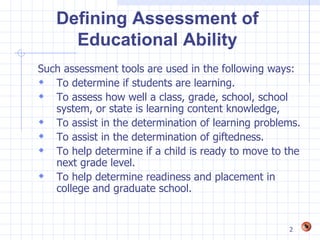
Defining Assessment of
     Educational Ability
Such assessment tools are used in the following ways:
 To determine if students are learning.
 To assess how well a class, grade, school, school
   system, or state is learning content knowledge,
 To assist in the determination of learning problems.
 To assist in the determination of giftedness.
 To help determine if a child is ready to move to the
   next grade level.
 To help determine readiness and placement in
   college and graduate school.


                                                   2
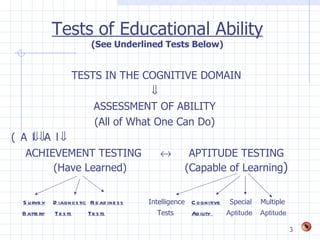
Tests of Educational Ability
                            (See Underlined Tests Below)


                        TESTS IN THE COGNITIVE DOMAIN
                                        ⇓
                            ASSESSMENT OF ABILITY
                            (All of What One Can Do)
( A l⇓⇓A l ⇓
   ACHIEVEMENT TESTING                         ↔        APTITUDE TESTING
         (Have Learned)                                (Capable of Learning)


  S u rve y   D iagnos tic R e ad ine s s   Intelligence C ognitive    Special   Multiple
 Batte ry     Te s ts      Te s ts            Tests      Ab ility     Aptitude   Aptitude

                                                                                            3
Defining Tests of Educational Ability

Survey Battery Tests: Measure broad content areas.
Often used to assess progress in school.

Diagnostic Tests: Assess problem areas of learning
(e.g., learning disabilities).

Readiness Tests: Measure readiness for moving
ahead in school. Often readiness to enter First grade.

Cognitive Abilities Tests: Often based on what has
learned in school. Measure broad range of cognitive
ability. Useful in making predictions (e.g., success in
school or in college).
                                                      4
Survey Battery Achievement Testing

  Increasingly important as the result of:
     Standards of Learning Tests Given by
      States
     No Child Left Behind
     See Box 6.1, p. 109


                                             5
Survey Battery Achievement Testing

  Helpful in following ways:
     Can help a student, his or her parents, and
      his or her teachers, identify strengths and
      weaknesses
     Classroom, school, or school system profile
      reports, help teachers, principals,
      administrators, and the public see how
      students are doing at all these levels.


                                               6
Types of Survey Battery Achievement Tests:
   Stanford Achievement Test (SAT10)

  Most sub-tests in the mid .80s to low .90s
  using KR-20 internal consistency estimates.
  Reliability estimates fell for the open-ended
  sections to mid .50 through the .80s.
  Sound content, criterion, and construct
  validity.
  Offers Individual Profile Sheets, Class
  Grouping Sheets, Grade Grouping Sheets, and
  School System Grouping Sheets.
      See Figures 6.2 and 6.3, pp. 110 and 11.
                                                  7
Types of Survey Battery Achievement Tests:
      Iowa Test of Basic Skills (ITBS)

  One of the oldest and best-known achievement tests
  “M” version for grades K through 8
  Sub-tests depending on the grade level: language,
  reading, vocabulary, listening, word analysis, math,
  social studies, science and writing assessment.
  Criticized the test for not measuring “higher-order
  thinking”
  Reliability of most subtests in the .80s to .90s and
  strong content validity.


                                                     8
Types of Survey Battery Achievement
    Tests: Metropolitan (8th ed.)

  K-12 for a broad range of subjects such as
  reading, language arts, mathematics, science,
  and social studies.
  Multiple choice questions and open-ended
  items, which are scored a 0 to 3
  Some criticism: data too heavily weighted for
  rural classrooms and under represents urban
  classrooms
  Good reliability and validity

                                             9
Diagnostic Testing
Used to assess problems in learning
PL 94-142 and IDEIA have made these types of
tests crucial
   Laws assert that individuals (age 2 – 21) who are
    suspected of having a disability that interferes with
    learning has right to be tested at school system’s
    expense
   Used in development of IEP
   Students with a disability have the right to an
    education within the least restrictive environment.


                                                      10
Types of Diagnostic Tests:
Wide Range Achievement Test (WRAT)

 Good screening test for learning problems.
 Developed to assess basic reading, spelling, and
 arithmetic skills.
 Attempts to eliminate effects of comprehension in
 determining a learning disability.
 Individual is asked, one-on-one by the examiner, to
 “read” (pronounce) words, to spell words, and to
 figure out a number of math problems.
 For ages 5 – 75.
 Internal consistency reliability in .90s.
 Rationale for content validity and evidence of
 construct and criterion-related validity.          11
Types of Diagnostic Tests: Key-math,
Peabody Individual Achievement test
Key Math Diagnostic Test
  Assesses students’ understanding of basic mathematics

   and provides diagnostic information to teachers.
  Comprehensive test for learning problems in math.

  Takes 35-50 minutes to take.

  Reliabilities: 80s and .90s

  Evidence of content and construct validity.

Peabody Individual Achievement Test
  Provides broad academic screening for children K – 12

  Median reliability estimates: .94

  Shows content, construct, and criterion-related validity

Other Diagnostic Tests: Wechsler Individual Achievement
Test – Second Edition (WIAT-II), Woodcock-Johnson. 12
Readiness Testing

Sometimes helpful in deciding whether a child
is “ready” to move onto next level (usually
kindergarten or first grade).
Some problems:
   Children’s cognitive functioning changes rapidly at
    young ages.
   Cross-cultural biases exist in some of these tests.
   When English is not first language children will
    tend not to do as well on these tests.

                                                     13
Types of Readiness Tests: Metropolitan
 Readiness Test, sixth edition (MRT6)

   Assesses beginning educational skills
    for preschoolers, kindergarteners,
    and first graders.
   Composite reliability estimates: .90s

   Subtest reliability: .53 through .80s

   Some question its validity


                                         14
Types of Diagnostic Tests:
   Gesell School Readiness Test

Assesses personal and social skills, neurological and
motor growth, language development, and adaptive
behavior.
Arnold Gesell spent years examining the normal
development
As far as Gesell was concerned, “achievement” was
more than how one scores on a reading or math test.
Questionable Reliability and Validity
Read box 6.4, p. 118


                                                  15
Types of Diagnostic Tests:
 Kindergarten Readiness Test

Used to determine if a child is ready to
begin kindergarten.
Covers Reasoning, Language, Auditory
and Visual Attention, Numbers, Fine
Motor Skills, and several other cognitive
and sensory-perception areas.
Questionable reliability and validity.

                                       16
Cognitive Ability Tests
Assesses what an individual is capable of doing
Should not be confused with intelligence tests.
Often look more like achievement tests—but
measure broad content areas.
Good for identifying students not succeeding in
school due to:
   learning disabilities
   Motivation
   problems at home or school
   self-esteem issues.
                                           17
Cognitive Ability Tests:
      The Cognitive Ability Test
Constructed with two models of intelligence:
   Vernon’s hierarchy of abilities
   Cattell’s fluid and crystallized abilities.
Provides verbal, quantitative, and nonverbal reasoning
abilities scores. Composite score also calculated
Uses standard score with mean of 100 and standard
deviation of 16, percentile ranks, and stanines
Good reliability estimates: .80s & .90s
Offers rationale for content validity but difficult to defend
this type of test as it is used to measure future. Good
concurrent validity.


                                                      18
Types of Cognitive Ability Tests:
 Otis-Lennon School Ability Test

K – 12
Verbal, quantitative, and non-verbal sections
Raw scores converted to stanines, percentile
rank, a standard score called the school
ability index, and normal curve equivalents
(NCEs) by age or grade.
Questionable content validity. Although fair
concurrent validity and fairly good reliability.

                                               19
Types of Cognitive Ability Tests:
       College Admissions Exams

ACT:
  Most Popular

  Designed to assess educational development and

   ability to complete college level work
  Covers four skill areas, including: English, math,

   reading, and science.
  Scores range from 1 – 36, (M = 18, SD = 5).

  Mean for college bound students about 21

  Composite score has reliability estimate of .96

  Predictive validity: is .43 with first year GPA.


                                                    20
Types of Cognitive Ability Tests:
  College Admissions Exams
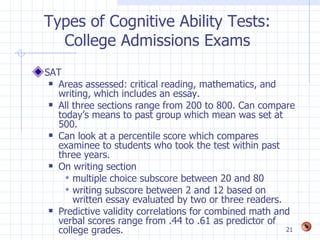
SAT
  Areas assessed: critical reading, mathematics, and
   writing, which includes an essay.
  All three sections range from 200 to 800. Can compare
   today’s means to past group which mean was set at
   500.
  Can look at a percentile score which compares
   examinee to students who took the test within past
   three years.
  On writing section

      multiple choice subscore between 20 and 80
      writing subscore between 2 and 12 based on
       written essay evaluated by two or three readers.
  Predictive validity correlations for combined math and
   verbal scores range from .44 to .61 as predictor of
   college grades.                                      21
Types of Cognitive Ability Tests:
College Admissions Exams
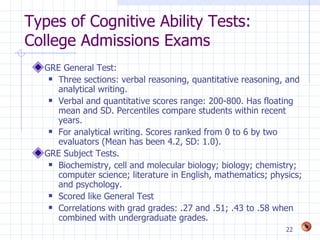
  GRE General Test:
    Three sections: verbal reasoning, quantitative reasoning, and

     analytical writing.
    Verbal and quantitative scores range: 200-800. Has floating

     mean and SD. Percentiles compare students within recent
     years.
    For analytical writing. Scores ranked from 0 to 6 by two

     evaluators (Mean has been 4.2, SD: 1.0).
  GRE Subject Tests.
    Biochemistry, cell and molecular biology; biology; chemistry;

     computer science; literature in English, mathematics; physics;
     and psychology.
    Scored like General Test

    Correlations with grad grades: .27 and .51; .43 to .58 when

     combined with undergraduate grades.
                                                              22
Types of Cognitive Ability Tests:
College Admissions Exams
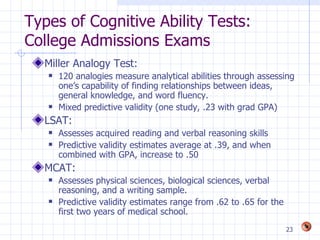
  Miller Analogy Test:
      120 analogies measure analytical abilities through assessing
       one’s capability of finding relationships between ideas,
       general knowledge, and word fluency.
      Mixed predictive validity (one study, .23 with grad GPA)
  LSAT:
      Assesses acquired reading and verbal reasoning skills
      Predictive validity estimates average at .39, and when
       combined with GPA, increase to .50
  MCAT:
      Assesses physical sciences, biological sciences, verbal
       reasoning, and a writing sample.
      Predictive validity estimates range from .62 to .65 for the
       first two years of medical school.
                                                                     23
The Role of Helpers in the
     Assessment of Educational Ability

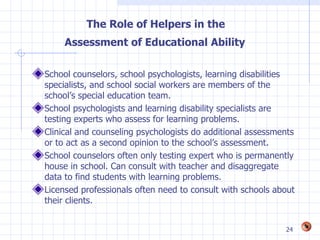
School counselors, school psychologists, learning disabilities
specialists, and school social workers are members of the
school’s special education team.
School psychologists and learning disability specialists are
testing experts who assess for learning problems.
Clinical and counseling psychologists do additional assessments
or to act as a second opinion to the school’s assessment.
School counselors often only testing expert who is permanently
house in school. Can consult with teacher and disaggregate
data to find students with learning problems.
Licensed professionals often need to consult with schools about
their clients.


                                                            24
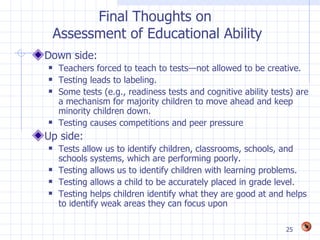
Final Thoughts on
    Assessment of Educational Ability
Down side:
   Teachers forced to teach to tests—not allowed to be creative.
   Testing leads to labeling.
   Some tests (e.g., readiness tests and cognitive ability tests) are
    a mechanism for majority children to move ahead and keep
    minority children down.
   Testing causes competitions and peer pressure
Up side:
   Tests allow us to identify children, classrooms, schools, and
    schools systems, which are performing poorly.
   Testing allows us to identify children with learning problems.
   Testing allows a child to be accurately placed in grade level.
   Testing helps children identify what they are good at and helps
    to identify weak areas they can focus upon

                                                                25

Educational assessment

  • 1.
    Chapter 6: Assessment ofEducational Ability Survey Battery Diagnostic Readiness Cognitive Ability Tests 1
  • 2.
    Defining Assessment of Educational Ability Such assessment tools are used in the following ways:  To determine if students are learning.  To assess how well a class, grade, school, school system, or state is learning content knowledge,  To assist in the determination of learning problems.  To assist in the determination of giftedness.  To help determine if a child is ready to move to the next grade level.  To help determine readiness and placement in college and graduate school. 2
  • 3.
    Tests of EducationalAbility (See Underlined Tests Below) TESTS IN THE COGNITIVE DOMAIN ⇓ ASSESSMENT OF ABILITY (All of What One Can Do) ( A l⇓⇓A l ⇓ ACHIEVEMENT TESTING ↔ APTITUDE TESTING (Have Learned) (Capable of Learning) S u rve y D iagnos tic R e ad ine s s Intelligence C ognitive Special Multiple Batte ry Te s ts Te s ts Tests Ab ility Aptitude Aptitude 3
  • 4.
    Defining Tests ofEducational Ability Survey Battery Tests: Measure broad content areas. Often used to assess progress in school. Diagnostic Tests: Assess problem areas of learning (e.g., learning disabilities). Readiness Tests: Measure readiness for moving ahead in school. Often readiness to enter First grade. Cognitive Abilities Tests: Often based on what has learned in school. Measure broad range of cognitive ability. Useful in making predictions (e.g., success in school or in college). 4
  • 5.
    Survey Battery AchievementTesting Increasingly important as the result of:  Standards of Learning Tests Given by States  No Child Left Behind  See Box 6.1, p. 109 5
  • 6.
    Survey Battery AchievementTesting Helpful in following ways:  Can help a student, his or her parents, and his or her teachers, identify strengths and weaknesses  Classroom, school, or school system profile reports, help teachers, principals, administrators, and the public see how students are doing at all these levels. 6
  • 7.
    Types of SurveyBattery Achievement Tests: Stanford Achievement Test (SAT10) Most sub-tests in the mid .80s to low .90s using KR-20 internal consistency estimates. Reliability estimates fell for the open-ended sections to mid .50 through the .80s. Sound content, criterion, and construct validity. Offers Individual Profile Sheets, Class Grouping Sheets, Grade Grouping Sheets, and School System Grouping Sheets.  See Figures 6.2 and 6.3, pp. 110 and 11. 7
  • 8.
    Types of SurveyBattery Achievement Tests: Iowa Test of Basic Skills (ITBS) One of the oldest and best-known achievement tests “M” version for grades K through 8 Sub-tests depending on the grade level: language, reading, vocabulary, listening, word analysis, math, social studies, science and writing assessment. Criticized the test for not measuring “higher-order thinking” Reliability of most subtests in the .80s to .90s and strong content validity. 8
  • 9.
    Types of SurveyBattery Achievement Tests: Metropolitan (8th ed.) K-12 for a broad range of subjects such as reading, language arts, mathematics, science, and social studies. Multiple choice questions and open-ended items, which are scored a 0 to 3 Some criticism: data too heavily weighted for rural classrooms and under represents urban classrooms Good reliability and validity 9
  • 10.
    Diagnostic Testing Used toassess problems in learning PL 94-142 and IDEIA have made these types of tests crucial  Laws assert that individuals (age 2 – 21) who are suspected of having a disability that interferes with learning has right to be tested at school system’s expense  Used in development of IEP  Students with a disability have the right to an education within the least restrictive environment. 10
  • 11.
    Types of DiagnosticTests: Wide Range Achievement Test (WRAT) Good screening test for learning problems. Developed to assess basic reading, spelling, and arithmetic skills. Attempts to eliminate effects of comprehension in determining a learning disability. Individual is asked, one-on-one by the examiner, to “read” (pronounce) words, to spell words, and to figure out a number of math problems. For ages 5 – 75. Internal consistency reliability in .90s. Rationale for content validity and evidence of construct and criterion-related validity. 11
  • 12.
    Types of DiagnosticTests: Key-math, Peabody Individual Achievement test Key Math Diagnostic Test  Assesses students’ understanding of basic mathematics and provides diagnostic information to teachers.  Comprehensive test for learning problems in math.  Takes 35-50 minutes to take.  Reliabilities: 80s and .90s  Evidence of content and construct validity. Peabody Individual Achievement Test  Provides broad academic screening for children K – 12  Median reliability estimates: .94  Shows content, construct, and criterion-related validity Other Diagnostic Tests: Wechsler Individual Achievement Test – Second Edition (WIAT-II), Woodcock-Johnson. 12
  • 13.
    Readiness Testing Sometimes helpfulin deciding whether a child is “ready” to move onto next level (usually kindergarten or first grade). Some problems:  Children’s cognitive functioning changes rapidly at young ages.  Cross-cultural biases exist in some of these tests.  When English is not first language children will tend not to do as well on these tests. 13
  • 14.
    Types of ReadinessTests: Metropolitan Readiness Test, sixth edition (MRT6)  Assesses beginning educational skills for preschoolers, kindergarteners, and first graders.  Composite reliability estimates: .90s  Subtest reliability: .53 through .80s  Some question its validity 14
  • 15.
    Types of DiagnosticTests: Gesell School Readiness Test Assesses personal and social skills, neurological and motor growth, language development, and adaptive behavior. Arnold Gesell spent years examining the normal development As far as Gesell was concerned, “achievement” was more than how one scores on a reading or math test. Questionable Reliability and Validity Read box 6.4, p. 118 15
  • 16.
    Types of DiagnosticTests: Kindergarten Readiness Test Used to determine if a child is ready to begin kindergarten. Covers Reasoning, Language, Auditory and Visual Attention, Numbers, Fine Motor Skills, and several other cognitive and sensory-perception areas. Questionable reliability and validity. 16
  • 17.
    Cognitive Ability Tests Assesseswhat an individual is capable of doing Should not be confused with intelligence tests. Often look more like achievement tests—but measure broad content areas. Good for identifying students not succeeding in school due to:  learning disabilities  Motivation  problems at home or school  self-esteem issues. 17
  • 18.
    Cognitive Ability Tests: The Cognitive Ability Test Constructed with two models of intelligence:  Vernon’s hierarchy of abilities  Cattell’s fluid and crystallized abilities. Provides verbal, quantitative, and nonverbal reasoning abilities scores. Composite score also calculated Uses standard score with mean of 100 and standard deviation of 16, percentile ranks, and stanines Good reliability estimates: .80s & .90s Offers rationale for content validity but difficult to defend this type of test as it is used to measure future. Good concurrent validity. 18
  • 19.
    Types of CognitiveAbility Tests: Otis-Lennon School Ability Test K – 12 Verbal, quantitative, and non-verbal sections Raw scores converted to stanines, percentile rank, a standard score called the school ability index, and normal curve equivalents (NCEs) by age or grade. Questionable content validity. Although fair concurrent validity and fairly good reliability. 19
  • 20.
    Types of CognitiveAbility Tests: College Admissions Exams ACT:  Most Popular  Designed to assess educational development and ability to complete college level work  Covers four skill areas, including: English, math, reading, and science.  Scores range from 1 – 36, (M = 18, SD = 5).  Mean for college bound students about 21  Composite score has reliability estimate of .96  Predictive validity: is .43 with first year GPA. 20
  • 21.
    Types of CognitiveAbility Tests: College Admissions Exams SAT  Areas assessed: critical reading, mathematics, and writing, which includes an essay.  All three sections range from 200 to 800. Can compare today’s means to past group which mean was set at 500.  Can look at a percentile score which compares examinee to students who took the test within past three years.  On writing section  multiple choice subscore between 20 and 80  writing subscore between 2 and 12 based on written essay evaluated by two or three readers.  Predictive validity correlations for combined math and verbal scores range from .44 to .61 as predictor of college grades. 21
  • 22.
    Types of CognitiveAbility Tests: College Admissions Exams GRE General Test:  Three sections: verbal reasoning, quantitative reasoning, and analytical writing.  Verbal and quantitative scores range: 200-800. Has floating mean and SD. Percentiles compare students within recent years.  For analytical writing. Scores ranked from 0 to 6 by two evaluators (Mean has been 4.2, SD: 1.0). GRE Subject Tests.  Biochemistry, cell and molecular biology; biology; chemistry; computer science; literature in English, mathematics; physics; and psychology.  Scored like General Test  Correlations with grad grades: .27 and .51; .43 to .58 when combined with undergraduate grades. 22
  • 23.
    Types of CognitiveAbility Tests: College Admissions Exams Miller Analogy Test:  120 analogies measure analytical abilities through assessing one’s capability of finding relationships between ideas, general knowledge, and word fluency.  Mixed predictive validity (one study, .23 with grad GPA) LSAT:  Assesses acquired reading and verbal reasoning skills  Predictive validity estimates average at .39, and when combined with GPA, increase to .50 MCAT:  Assesses physical sciences, biological sciences, verbal reasoning, and a writing sample.  Predictive validity estimates range from .62 to .65 for the first two years of medical school. 23
  • 24.
    The Role ofHelpers in the Assessment of Educational Ability School counselors, school psychologists, learning disabilities specialists, and school social workers are members of the school’s special education team. School psychologists and learning disability specialists are testing experts who assess for learning problems. Clinical and counseling psychologists do additional assessments or to act as a second opinion to the school’s assessment. School counselors often only testing expert who is permanently house in school. Can consult with teacher and disaggregate data to find students with learning problems. Licensed professionals often need to consult with schools about their clients. 24
  • 25.
    Final Thoughts on Assessment of Educational Ability Down side:  Teachers forced to teach to tests—not allowed to be creative.  Testing leads to labeling.  Some tests (e.g., readiness tests and cognitive ability tests) are a mechanism for majority children to move ahead and keep minority children down.  Testing causes competitions and peer pressure Up side:  Tests allow us to identify children, classrooms, schools, and schools systems, which are performing poorly.  Testing allows us to identify children with learning problems.  Testing allows a child to be accurately placed in grade level.  Testing helps children identify what they are good at and helps to identify weak areas they can focus upon 25