ABSORPTION
     OF
   LIPIDS

  Absorption of lipids   1
Products of digestion
          2-MAG
          FA
      Cholesterol
     Phospholipids
    Lysophosholipids
      Absorption of lipids   2
ABSORPTION OF LONG CHAIN
        FATTY ACIDS

LCFA (>14C) - not directly to blood


   - absorbed to the lymph

             Absorption of lipids   3
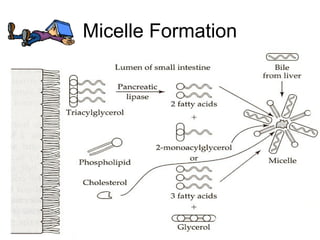
MIXED MICELLE FORMATION
• After digestion, monoglycerides
  and FA associate with bile salts
  and PL to form  molecular
  aggregates called micelle.

• Micelles are much smaller than
  emulsion droplets (4-7nm v/s
  1µm for emulsionlipids
             Absorption of
                           droplets).
                                  4
• Most fat absorption takes place in
  the jejununal mucosa

• Micelles are transport the poorly
  soluble monoglycerides and fatty
  acids to the to the brush border
  surface of the enterocyte where they
  can be absorbed by passive
  diffusion.
            Absorption of lipids   5
• Complex of lipid materials
  soluble in water.
• They are spherical particles
  with a hydrophillic exterior and
  hydrophobic interior core.


           Absorption of lipids   6
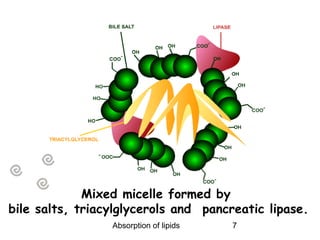
Mixed micelle formed by
bile salts, triacylglycerols and  pancreatic lipase.
                  Absorption of lipids   7
• Bile salts help in the formation of
  these aggregates due to their
  detergent action

• Bile salts are absorbed in the
  ileum (enterohepatic circulation)


             Absorption of lipids   8
Enterohepatic circulation of
         bile salts

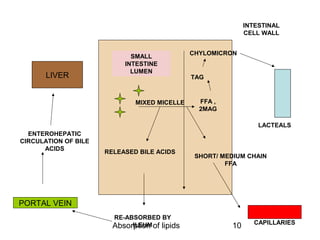
The bile salts left behind
 are re-absorbed further
 down the gastrointestinal
 tract (in the ileum),
 transported to the liver,
 and finally recycled and
 secreted back into the
 digestive tract
           Absorption of lipids   9
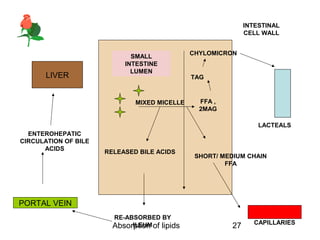
INTESTINAL
                                                              CELL WALL


                                               CHYLOMICRON
                             SMALL
                           INTESTINE
                             LUMEN
       LIVER                                   TAG


                              MIXED MICELLE      FFA ,
                                                 2MAG

                                                                  LACTEALS
  ENTEROHEPATIC
CIRCULATION OF BILE
      ACIDS
                      RELEASED BILE ACIDS
                                                SHORT/ MEDIUM CHAIN
                                                        FFA


PORTAL VEIN
                        RE-ABSORBED BY
                                                                 CAPILLARIES
                        Absorption of lipids
                             ILEUM                       10
Re-esterification inside
                     the mucosal cells
 Inside the enterocytes, monoglycerides
  and free fatty acids are reformed into
  TG.
• The fatty acids are activated to fatty
  acyl coA by Acyl coA synthetases by
  using 2 high energy phosphates.
• 2 such activated fatty acids react with
  MAG to form TAG.

              Absorption of lipids   11
Micelle Formation


   Absorption of lipids   12
• Free glycerol absorbed from
  the intestinal lumen directly
  enters into the blood stream.

• So free glycerol is not available
  for re-esterification


           Absorption of lipids   13
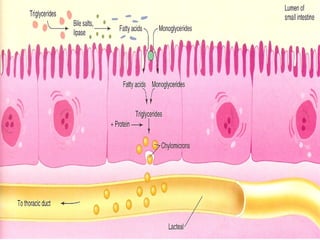
• inside the cell, they become
  CHYLOMICRONS.
• The triglycerides, cholesterol,
  phospholipids along with
  apoprotein B4 and apoprotein A
  forms the chylomicrons and
  enter the lymph system.


           Absorption of lipids   14
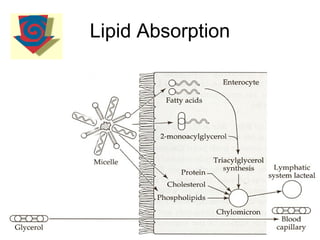
Lipid Absorption


  Absorption of lipids   15
• The chyle (milky fluid) from the
  intestinal mucosa loaded with
  chylomicrons are transported
  through the lacteals into the
  thoracic duct and emptied into
  lymph cirulation.
• Serum appears milky within a few
  hours after high fat meal ( post
  prandial lipemia) due to the
  presence of Chylomicron uptake by
  tissues.    Absorption of lipids 16
Absorption of lipids   17
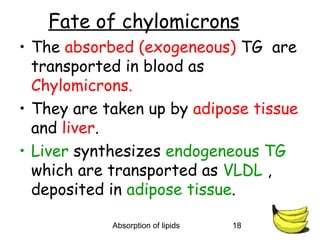
Fate of chylomicrons
• The absorbed (exogeneous) TG are
  transported in blood as
  Chylomicrons.
• They are taken up by adipose tissue
  and liver.
• Liver synthesizes endogeneous TG
  which are transported as VLDL ,
  deposited in adipose tissue.

            Absorption of lipids   18
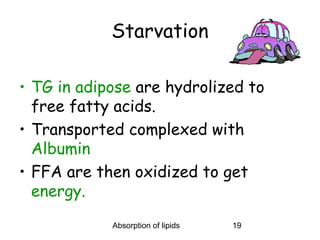
Starvation

• TG in adipose are hydrolized to
  free fatty acids.
• Transported complexed with
  Albumin
• FFA are then oxidized to get
  energy.
            Absorption of lipids   19
ABSORPTION OF SCFA
• Short chain fatty acids (SCFA)-
  milk, butter, ghee
• Medium chain fatty acids (MCFA)-
  coconut oil, mother’s milk


       DO NOT REQUIRE
         RE-ESTERIFICATION!
           Absorption of lipids   20
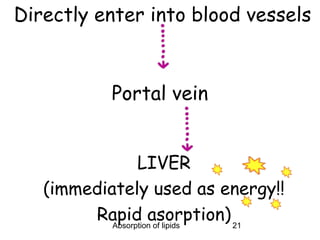
Directly enter into blood vessels


           Portal vein


                 LIVER
   (immediately used as energy!!
        Rapid asorption) 21
           Absorption of lipids
Overview of Fatty Acid Uptake
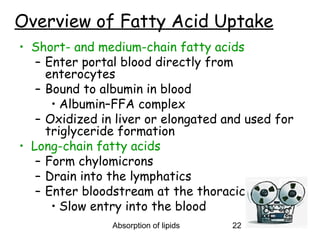
• Short- and medium-chain fatty acids
   – Enter portal blood directly from
     enterocytes
   – Bound to albumin in blood
      • Albumin–FFA complex
   – Oxidized in liver or elongated and used for
     triglyceride formation
• Long-chain fatty acids
   – Form chylomicrons
   – Drain into the lymphatics
   – Enter bloodstream at the thoracic duct
      • Slow entry into the blood
                Absorption of lipids   22
Abnormalities in lipid absorption
1.Defective digestion:
“STEATORRHEA”
Fat excretion ; >6g/day in faeces
Unsplit fat seen.
Chronic diseases of pancreas.


              Absorption of lipids   23
2. Defective absorption:


Split fat seen in stools as fatty acids and
  monoglycerides.
Maybe due to:
• Coeliac diseases, sprue, crohn’s diseas
• Surgical removal of intestine
• Bile duct obstruction due to gall stones,
  tumour of head of pancreas, enlarged lymph
  nodes etc causing deficiency of bile salts.

               Absorption of lipids   24
• TG with SCFA and MCFA face no
  problem in digestion as they do not
  require micellerisation for absorption.

• Hence in MALABSORPTION
  SYNDROMES, milk fat and coconut oil are
  used therapeutically (MCT)


               Absorption of lipids   25
3.CHYLURIA
• Appearance of chyle in urine
• Milky appearance due to lipid droplets.
• Due to abnormal connection between
  urinary tract and lymphatic drainage.


               Absorption of lipids   26
INTESTINAL
                                                              CELL WALL


                                               CHYLOMICRON
                             SMALL
                           INTESTINE
                             LUMEN
       LIVER                                   TAG


                              MIXED MICELLE      FFA ,
                                                 2MAG

                                                                  LACTEALS
  ENTEROHEPATIC
CIRCULATION OF BILE
      ACIDS
                      RELEASED BILE ACIDS
                                                SHORT/ MEDIUM CHAIN
                                                        FFA


PORTAL VEIN
                        RE-ABSORBED BY
                                                                 CAPILLARIES
                        Absorption of lipids
                             ILEUM                       27
tHanK
          yoU


Absorption of lipids   28
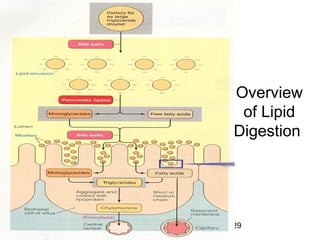
Overview
                        of Lipid
                       Digestion


Absorption of lipids   29

Absorption of lipids

  • 1.
    ABSORPTION OF LIPIDS Absorption of lipids 1
  • 2.
    Products of digestion 2-MAG FA Cholesterol Phospholipids Lysophosholipids Absorption of lipids 2
  • 3.
    ABSORPTION OF LONGCHAIN FATTY ACIDS LCFA (>14C) - not directly to blood - absorbed to the lymph Absorption of lipids 3
  • 4.
    MIXED MICELLE FORMATION •After digestion, monoglycerides and FA associate with bile salts and PL to form  molecular aggregates called micelle. • Micelles are much smaller than emulsion droplets (4-7nm v/s 1µm for emulsionlipids Absorption of droplets). 4
  • 5.
    • Most fatabsorption takes place in the jejununal mucosa • Micelles are transport the poorly soluble monoglycerides and fatty acids to the to the brush border surface of the enterocyte where they can be absorbed by passive diffusion. Absorption of lipids 5
  • 6.
    • Complex oflipid materials soluble in water. • They are spherical particles with a hydrophillic exterior and hydrophobic interior core. Absorption of lipids 6
  • 7.
    Mixed micelle formedby bile salts, triacylglycerols and  pancreatic lipase. Absorption of lipids 7
  • 8.
    • Bile saltshelp in the formation of these aggregates due to their detergent action • Bile salts are absorbed in the ileum (enterohepatic circulation) Absorption of lipids 8
  • 9.
    Enterohepatic circulation of bile salts The bile salts left behind are re-absorbed further down the gastrointestinal tract (in the ileum), transported to the liver, and finally recycled and secreted back into the digestive tract Absorption of lipids 9
  • 10.
    INTESTINAL CELL WALL CHYLOMICRON SMALL INTESTINE LUMEN LIVER TAG MIXED MICELLE FFA , 2MAG LACTEALS ENTEROHEPATIC CIRCULATION OF BILE ACIDS RELEASED BILE ACIDS SHORT/ MEDIUM CHAIN FFA PORTAL VEIN RE-ABSORBED BY CAPILLARIES Absorption of lipids ILEUM 10
  • 11.
    Re-esterification inside the mucosal cells Inside the enterocytes, monoglycerides and free fatty acids are reformed into TG. • The fatty acids are activated to fatty acyl coA by Acyl coA synthetases by using 2 high energy phosphates. • 2 such activated fatty acids react with MAG to form TAG. Absorption of lipids 11
  • 12.
    Micelle Formation Absorption of lipids 12
  • 13.
    • Free glycerolabsorbed from the intestinal lumen directly enters into the blood stream. • So free glycerol is not available for re-esterification Absorption of lipids 13
  • 14.
    • inside thecell, they become CHYLOMICRONS. • The triglycerides, cholesterol, phospholipids along with apoprotein B4 and apoprotein A forms the chylomicrons and enter the lymph system. Absorption of lipids 14
  • 15.
    Lipid Absorption Absorption of lipids 15
  • 16.
    • The chyle(milky fluid) from the intestinal mucosa loaded with chylomicrons are transported through the lacteals into the thoracic duct and emptied into lymph cirulation. • Serum appears milky within a few hours after high fat meal ( post prandial lipemia) due to the presence of Chylomicron uptake by tissues. Absorption of lipids 16
  • 17.
  • 18.
    Fate of chylomicrons •The absorbed (exogeneous) TG are transported in blood as Chylomicrons. • They are taken up by adipose tissue and liver. • Liver synthesizes endogeneous TG which are transported as VLDL , deposited in adipose tissue. Absorption of lipids 18
  • 19.
    Starvation • TG inadipose are hydrolized to free fatty acids. • Transported complexed with Albumin • FFA are then oxidized to get energy. Absorption of lipids 19
  • 20.
    ABSORPTION OF SCFA •Short chain fatty acids (SCFA)- milk, butter, ghee • Medium chain fatty acids (MCFA)- coconut oil, mother’s milk DO NOT REQUIRE RE-ESTERIFICATION! Absorption of lipids 20
  • 21.
    Directly enter intoblood vessels Portal vein LIVER (immediately used as energy!! Rapid asorption) 21 Absorption of lipids
  • 22.
    Overview of FattyAcid Uptake • Short- and medium-chain fatty acids – Enter portal blood directly from enterocytes – Bound to albumin in blood • Albumin–FFA complex – Oxidized in liver or elongated and used for triglyceride formation • Long-chain fatty acids – Form chylomicrons – Drain into the lymphatics – Enter bloodstream at the thoracic duct • Slow entry into the blood Absorption of lipids 22
  • 23.
    Abnormalities in lipidabsorption 1.Defective digestion: “STEATORRHEA” Fat excretion ; >6g/day in faeces Unsplit fat seen. Chronic diseases of pancreas. Absorption of lipids 23
  • 24.
    2. Defective absorption: Splitfat seen in stools as fatty acids and monoglycerides. Maybe due to: • Coeliac diseases, sprue, crohn’s diseas • Surgical removal of intestine • Bile duct obstruction due to gall stones, tumour of head of pancreas, enlarged lymph nodes etc causing deficiency of bile salts. Absorption of lipids 24
  • 25.
    • TG withSCFA and MCFA face no problem in digestion as they do not require micellerisation for absorption. • Hence in MALABSORPTION SYNDROMES, milk fat and coconut oil are used therapeutically (MCT) Absorption of lipids 25
  • 26.
    3.CHYLURIA • Appearance ofchyle in urine • Milky appearance due to lipid droplets. • Due to abnormal connection between urinary tract and lymphatic drainage. Absorption of lipids 26
  • 27.
    INTESTINAL CELL WALL CHYLOMICRON SMALL INTESTINE LUMEN LIVER TAG MIXED MICELLE FFA , 2MAG LACTEALS ENTEROHEPATIC CIRCULATION OF BILE ACIDS RELEASED BILE ACIDS SHORT/ MEDIUM CHAIN FFA PORTAL VEIN RE-ABSORBED BY CAPILLARIES Absorption of lipids ILEUM 27
  • 28.
    tHanK yoU Absorption of lipids 28
  • 29.
    Overview of Lipid Digestion Absorption of lipids 29