Case
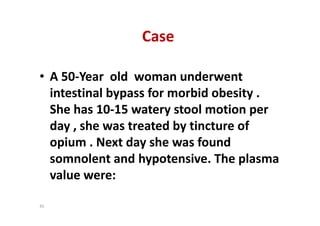
• A 50-Year old woman underwent
intestinal bypass for morbid obesity .
She has 10-15 watery stool motion per
day , she was treated by tincture of
opium . Next day she was found
somnolent and hypotensive. The plasma
value were:
• A 50-Year old woman underwent
intestinal bypass for morbid obesity .
She has 10-15 watery stool motion per
day , she was treated by tincture of
opium . Next day she was found
somnolent and hypotensive. The plasma
value were:
2
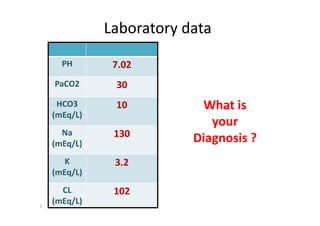
Laboratory data
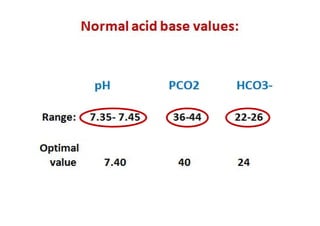
PH 7.02
PaCO2 30
HCO3
(mEq/L)
10 What is
your
Diagnosis ?
HCO3
(mEq/L)
Na
(mEq/L)
130
K
(mEq/L)
3.2
CL
(mEq/L)
102
3
What is
your
Diagnosis ?
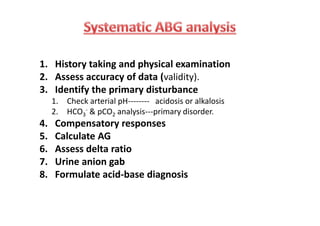
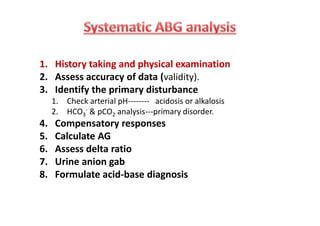
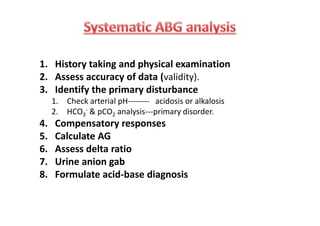
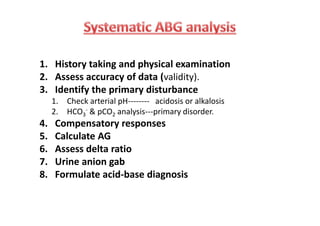
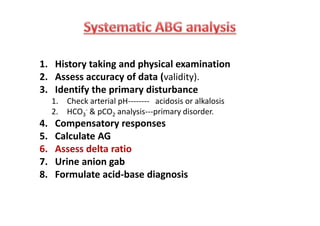
1. History taking and physical examination
2. Assess accuracy of data (validity).
3. Identify the primary disturbance
1. Check arterial pH-------- acidosis or alkalosis
2. HCO3
- & pCO2 analysis---primary disorder.
4. Compensatory responses
5. Calculate AG
6. Assess delta ratio
7. Urine anion gab
8. Formulate acid-base diagnosis
1. History taking and physical examination
2. Assess accuracy of data (validity).
3. Identify the primary disturbance
1. Check arterial pH-------- acidosis or alkalosis
2. HCO3
- & pCO2 analysis---primary disorder.
4. Compensatory responses
5. Calculate AG
6. Assess delta ratio
7. Urine anion gab
8. Formulate acid-base diagnosis
1. History taking and physical examination
2. Assess accuracy of data (validity).
3. Identify the primary disturbance
1. Check arterial pH-------- acidosis or alkalosis
2. HCO3
- & pCO2 analysis---primary disorder.
4. Compensatory responses
5. Calculate AG
6. Assess delta ratio
7. Urine anion gab
8. Formulate acid-base diagnosis
1. History taking and physical examination
2. Assess accuracy of data (validity).
3. Identify the primary disturbance
1. Check arterial pH-------- acidosis or alkalosis
2. HCO3
- & pCO2 analysis---primary disorder.
4. Compensatory responses
5. Calculate AG
6. Assess delta ratio
7. Urine anion gab
8. Formulate acid-base diagnosis
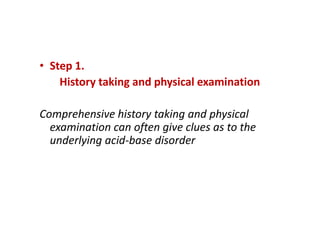
• Step 1.
History taking and physical examination
Comprehensive history taking and physical
examination can often give clues as to the
underlying acid-base disorder
• Step 1.
History taking and physical examination
Comprehensive history taking and physical
examination can often give clues as to the
underlying acid-base disorder
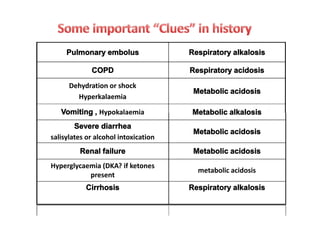
Respiratory alkalosisPulmonary embolus
Respiratory acidosisCOPD
Metabolic acidosis
Dehydration or shock
Hyperkalaemia
Metabolic alkalosisVomiting , Hypokalaemia Metabolic alkalosisVomiting , Hypokalaemia
Metabolic acidosis
Severe diarrhea
salisylates or alcohol intoxication
Metabolic acidosisRenal failure
metabolic acidosis
Hyperglycaemia (DKA? if ketones
present
Respiratory alkalosisCirrhosis
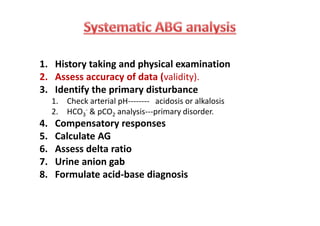
1. History taking and physical examination
2. Assess accuracy of data (validity).
3. Identify the primary disturbance
1. Check arterial pH-------- acidosis or alkalosis
2. HCO3
- & pCO2 analysis---primary disorder.
4. Compensatory responses
5. Calculate AG
6. Assess delta ratio
7. Urine anion gab
8. Formulate acid-base diagnosis
1. History taking and physical examination
2. Assess accuracy of data (validity).
3. Identify the primary disturbance
1. Check arterial pH-------- acidosis or alkalosis
2. HCO3
- & pCO2 analysis---primary disorder.
4. Compensatory responses
5. Calculate AG
6. Assess delta ratio
7. Urine anion gab
8. Formulate acid-base diagnosis
1. History taking and physical examination
2. Assess accuracy of data (validity).
3. Identify the primary disturbance
1. Check arterial pH-------- acidosis or alkalosis
2. HCO3
- & pCO2 analysis---primary disorder.
4. Compensatory responses
5. Calculate AG
6. Assess delta ratio
7. Urine anion gab
8. Formulate acid-base diagnosis
1. History taking and physical examination
2. Assess accuracy of data (validity).
3. Identify the primary disturbance
1. Check arterial pH-------- acidosis or alkalosis
2. HCO3
- & pCO2 analysis---primary disorder.
4. Compensatory responses
5. Calculate AG
6. Assess delta ratio
7. Urine anion gab
8. Formulate acid-base diagnosis
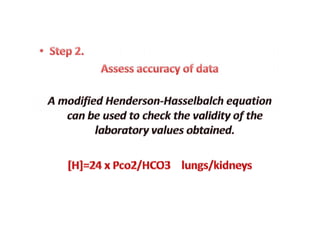
ValidityValidity
1. History taking and physical examination
2. Assess accuracy of data (validity).
3. Identify the primary disturbance
1. Check arterial pH-------- acidosis or alkalosis
2. HCO3
- & pCO2 analysis---primary disorder.
4. Compensatory responses
5. Calculate AG
6. Assess delta ratio
7. Urine anion gab
8. Formulate acid-base diagnosis
1. History taking and physical examination
2. Assess accuracy of data (validity).
3. Identify the primary disturbance
1. Check arterial pH-------- acidosis or alkalosis
2. HCO3
- & pCO2 analysis---primary disorder.
4. Compensatory responses
5. Calculate AG
6. Assess delta ratio
7. Urine anion gab
8. Formulate acid-base diagnosis
1. History taking and physical examination
2. Assess accuracy of data (validity).
3. Identify the primary disturbance
1. Check arterial pH-------- acidosis or alkalosis
2. HCO3
- & pCO2 analysis---primary disorder.
4. Compensatory responses
5. Calculate AG
6. Assess delta ratio
7. Urine anion gab
8. Formulate acid-base diagnosis
1. History taking and physical examination
2. Assess accuracy of data (validity).
3. Identify the primary disturbance
1. Check arterial pH-------- acidosis or alkalosis
2. HCO3
- & pCO2 analysis---primary disorder.
4. Compensatory responses
5. Calculate AG
6. Assess delta ratio
7. Urine anion gab
8. Formulate acid-base diagnosis
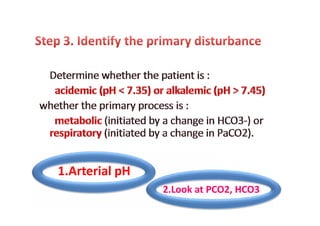
1.Arterial pH
2.Look at PCO2, HCO3
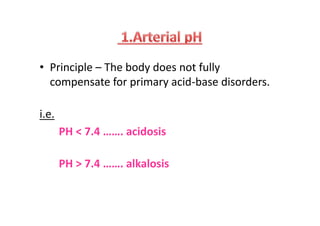
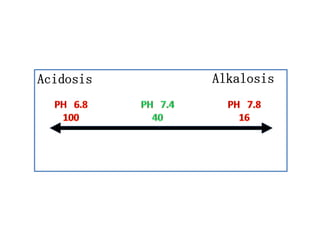
• Principle – The body does not fully
compensate for primary acid-base disorders.
i.e.
PH < 7.4 ……. acidosis
PH > 7.4 ……. alkalosis
• Principle – The body does not fully
compensate for primary acid-base disorders.
i.e.
PH < 7.4 ……. acidosis
PH > 7.4 ……. alkalosis
Acidosis AlkalosisAcidosis
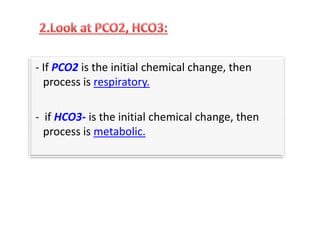
- If PCO2 is the initial chemical change, then
process is respiratory.
- if HCO3- is the initial chemical change, then
process is metabolic.
- If PCO2 is the initial chemical change, then
process is respiratory.
- if HCO3- is the initial chemical change, then
process is metabolic.
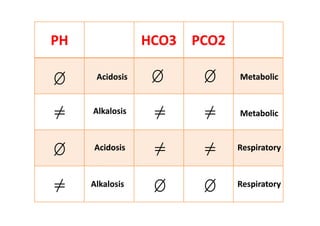
PCO2HCO3PH
  

AcidosisAcidosis
AlkalosisAlkalosis
MetabolicMetabolic
MetabolicMetabolic

 




AcidosisAcidosis
AlkalosisAlkalosis
AlkalosisAlkalosis MetabolicMetabolic
RespiratoryRespiratory
1. History taking and physical examination
2. Assess accuracy of data (validity).
3. Identify the primary disturbance
1. Check arterial pH-------- acidosis or alkalosis
2. HCO3
- & pCO2 analysis---primary disorder.
4. Compensatory responses
5. Calculate AG
6. Assess delta ratio
7. Urine anion gab
8. Formulate acid-base diagnosis
1. History taking and physical examination
2. Assess accuracy of data (validity).
3. Identify the primary disturbance
1. Check arterial pH-------- acidosis or alkalosis
2. HCO3
- & pCO2 analysis---primary disorder.
4. Compensatory responses
5. Calculate AG
6. Assess delta ratio
7. Urine anion gab
8. Formulate acid-base diagnosis
1. History taking and physical examination
2. Assess accuracy of data (validity).
3. Identify the primary disturbance
1. Check arterial pH-------- acidosis or alkalosis
2. HCO3
- & pCO2 analysis---primary disorder.
4. Compensatory responses
5. Calculate AG
6. Assess delta ratio
7. Urine anion gab
8. Formulate acid-base diagnosis
1. History taking and physical examination
2. Assess accuracy of data (validity).
3. Identify the primary disturbance
1. Check arterial pH-------- acidosis or alkalosis
2. HCO3
- & pCO2 analysis---primary disorder.
4. Compensatory responses
5. Calculate AG
6. Assess delta ratio
7. Urine anion gab
8. Formulate acid-base diagnosis
Metabolic acidosis
Expected pCO2 = 1.5 x [HCO3] + 8 (range: +/- 2)
Metabolic alkalosis
Expected pCO2 = 0.7 [HCO3] + 20 (range: +/- 5)
“If the actual pCO2 or [HCO3
-]
is different from the predicted values,
You must suspect a 2nd acid-base disorder”
Metabolic acidosis
Expected pCO2 = 1.5 x [HCO3] + 8 (range: +/- 2)
Metabolic alkalosis
Expected pCO2 = 0.7 [HCO3] + 20 (range: +/- 5)
“If the actual pCO2 or [HCO3
-]
is different from the predicted values,
You must suspect a 2nd acid-base disorder”
• Acute Respiratory :
The [HCO3] will increase by 1 mmol/l for every 10
mmHg elevation in pCO2 above 40 mmHg.
Expected [HCO3] = 24 + { (Actual pCO2 - 40) / 10 }
• Chronic Respiratory :
The [HCO3] will increase by 4 mmol/l for every 10
mmHg elevation in pCO2 above 40mmHg.
Expected [HCO3] = 24 + 4 { (Actual pCO2 - 40) / 10}
• Acute Respiratory :
The [HCO3] will increase by 1 mmol/l for every 10
mmHg elevation in pCO2 above 40 mmHg.
Expected [HCO3] = 24 + { (Actual pCO2 - 40) / 10 }
• Chronic Respiratory :
The [HCO3] will increase by 4 mmol/l for every 10
mmHg elevation in pCO2 above 40mmHg.
Expected [HCO3] = 24 + 4 { (Actual pCO2 - 40) / 10}
• Acute Respiratory
The [HCO3] will decrease by 2 mmol/l for every 10
mmHg decrease in pCO2 below 40 mmHg.
Expected [HCO3] = 24 - 2 { ( 40 - Actual pCO2) / 10 }
• Chronic Respiratory
The [HCO3] will decrease by 5 mmol/l for every 10
mmHg decrease in pCO2 below 40 mmHg.
Expected [HCO3] = 24 - 5 { ( 40 - Actual pCO2 ) / 10 }
(range: +/- 2)
• It takes 2 to 3 days to reach maximal renal compensation
• Acute Respiratory
The [HCO3] will decrease by 2 mmol/l for every 10
mmHg decrease in pCO2 below 40 mmHg.
Expected [HCO3] = 24 - 2 { ( 40 - Actual pCO2) / 10 }
• Chronic Respiratory
The [HCO3] will decrease by 5 mmol/l for every 10
mmHg decrease in pCO2 below 40 mmHg.
Expected [HCO3] = 24 - 5 { ( 40 - Actual pCO2 ) / 10 }
(range: +/- 2)
• It takes 2 to 3 days to reach maximal renal compensation
1. History taking and physical examination
2. Assess accuracy of data (validity).
3. Identify the primary disturbance
1. Check arterial pH-------- acidosis or alkalosis
2. HCO3
- & pCO2 analysis---primary disorder.
4. Compensatory responses
5. Calculate AG
6. Assess delta ratio
7. Urine anion gab
8. Formulate acid-base diagnosis
1. History taking and physical examination
2. Assess accuracy of data (validity).
3. Identify the primary disturbance
1. Check arterial pH-------- acidosis or alkalosis
2. HCO3
- & pCO2 analysis---primary disorder.
4. Compensatory responses
5. Calculate AG
6. Assess delta ratio
7. Urine anion gab
8. Formulate acid-base diagnosis
1. History taking and physical examination
2. Assess accuracy of data (validity).
3. Identify the primary disturbance
1. Check arterial pH-------- acidosis or alkalosis
2. HCO3
- & pCO2 analysis---primary disorder.
4. Compensatory responses
5. Calculate AG
6. Assess delta ratio
7. Urine anion gab
8. Formulate acid-base diagnosis
1. History taking and physical examination
2. Assess accuracy of data (validity).
3. Identify the primary disturbance
1. Check arterial pH-------- acidosis or alkalosis
2. HCO3
- & pCO2 analysis---primary disorder.
4. Compensatory responses
5. Calculate AG
6. Assess delta ratio
7. Urine anion gab
8. Formulate acid-base diagnosis
• The anion gap is defined as the quantity of
anions not balanced by cations.
• (Na + K) + Unmeasured cations =
(Cl + HCO3) + Unmeasured anions
• Anion Gap=
measured cation- measured anion.
• Anion gap = [Na + K] – (Cl + HCO3)
• Value: 12 ± 4 meq/L
• The anion gap is defined as the quantity of
anions not balanced by cations.
• (Na + K) + Unmeasured cations =
(Cl + HCO3) + Unmeasured anions
• Anion Gap=
measured cation- measured anion.
• Anion gap = [Na + K] – (Cl + HCO3)
• Value: 12 ± 4 meq/L
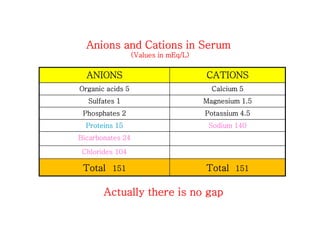
Anions and Cations in Serum
(Values in mEq/L)
CATIONSANIONS
Calcium 5Organic acids 5
Magnesium 1.5Sulfates 1
Potassium 4.5Phosphates 2
Actually there is no gap
Potassium 4.5Phosphates 2
Sodium 140Proteins 15
Bicarbonates 24
Chlorides 104
Total 151Total 151
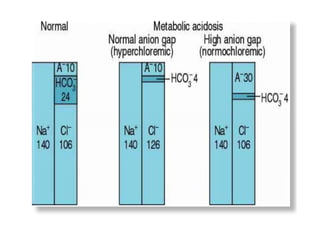
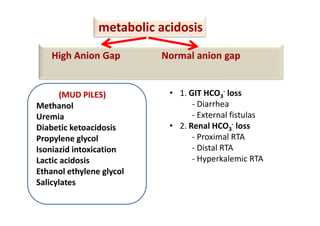
High Anion Gap Normal anion gap
• 1. Ketoacidosis
- Diabetic
- Alcoholic
- Starvation
• 2. Lactic acidosis
• 3. Toxicosis
- Ethylene glycol
- Methanol
- Salicylates
• 4. Advanced renal failure
• 1. GIT HCO3
- loss
- Diarrhea
- External fistulas
• 2. Renal HCO3
- loss
- Proximal RTA
- Distal RTA
- Hyperkalemic RTA
metabolic acidosis
(MUD PILES)(MUD PILES)
Methanol
Uremia
Diabetic ketoacidosis
Propylene glycol
Isoniazid intoxication
Lactic acidosis
Ethanol ethylene glycol
Salicylates
• 1. Ketoacidosis
- Diabetic
- Alcoholic
- Starvation
• 2. Lactic acidosis
• 3. Toxicosis
- Ethylene glycol
- Methanol
- Salicylates
• 4. Advanced renal failure
• 1. GIT HCO3
- loss
- Diarrhea
- External fistulas
• 2. Renal HCO3
- loss
- Proximal RTA
- Distal RTA
- Hyperkalemic RTA
(MUD PILES)(MUD PILES)
Methanol
Uremia
Diabetic ketoacidosis
Propylene glycol
Isoniazid intoxication
Lactic acidosis
Ethanol ethylene glycol
Salicylates
Osmolal gap
Step 1:
Calculate Osm = 2[Na+] + glucose/18 + BUN/2.8
Step 2: Measure Osm
Step 3: Osmolal gap (measured - calc) should be ≤ 10
‫ﻻ‬‫ﻳ‬‫ﻤ‬‫ﻜ‬‫ﻦ‬‫ﻋ‬‫ﺮ‬‫ض‬‫ا‬‫ﻟ‬‫ﺼ‬‫ﻮ‬‫ر‬‫ة‬.‫ﻗ‬‫ﺪ‬‫ﻻ‬‫ﺗ‬‫ﻜ‬‫ﻮ‬‫ن‬‫ھ‬‫ﻨ‬‫ﺎ‬‫ك‬‫ﻣ‬‫ﺴ‬‫ﺎ‬‫ﺣ‬‫ﺔ‬‫ﻛ‬‫ﺎ‬‫ﻓ‬‫ﯿ‬‫ﺔ‬‫ﻟ‬‫ﻠ‬‫ﺬ‬‫ا‬‫ﻛ‬‫ﺮ‬‫ة‬‫ﻋ‬‫ﻠ‬‫ﻰ‬‫ا‬‫ﻟ‬‫ﻜ‬‫ﻤ‬‫ﺒ‬‫ﯿ‬‫ﻮ‬‫ﺗ‬‫ﺮ‬‫ﻟ‬‫ﻔ‬‫ﺘ‬‫ﺢ‬‫ا‬‫ﻟ‬‫ﺼ‬‫ﻮ‬‫ر‬‫ة‬‫أ‬‫و‬‫ﻗ‬‫ﺪ‬‫ﺗ‬‫ﻜ‬‫ﻮ‬‫ن‬‫ا‬‫ﻟ‬‫ﺼ‬‫ﻮ‬‫ر‬‫ة‬‫ﺗ‬‫ﺎ‬‫ﻟ‬‫ﻔ‬‫ﺔ‬.‫ﻗ‬‫ﻢ‬‫ﺑ‬‫ﺈ‬‫ﻋ‬‫ﺎ‬‫د‬‫ة‬‫ﺗ‬‫ﺸ‬‫ﻐ‬‫ﯿ‬‫ﻞ‬‫ا‬‫ﻟ‬‫ﻜ‬‫ﻤ‬‫ﺒ‬‫ﯿ‬‫ﻮ‬‫ﺗ‬‫ﺮ‬،‫ﺛ‬‫ﻢ‬‫ا‬‫ﻓ‬‫ﺘ‬‫ﺢ‬‫ا‬‫ﻟ‬‫ﻤ‬‫ﻠ‬‫ﻒ‬‫ﻣ‬‫ﺮ‬‫ة‬‫أ‬‫ﺧ‬‫ﺮ‬‫ى‬.‫إ‬‫ذ‬‫ا‬‫ﻇ‬‫ﻠ‬‫ﺖ‬‫ﻋ‬‫ﻼ‬‫ﻣ‬‫ﺔ‬x‫ا‬‫ﻟ‬‫ﺤ‬‫ﻤ‬‫ﺮ‬‫ا‬‫ء‬‫ﺗ‬‫ﻈ‬‫ﮫ‬‫ﺮ‬،‫ﻗ‬‫ﺪ‬‫ﺗ‬‫ﻀ‬‫ﻄ‬‫ﺮ‬‫إ‬‫ﻟ‬‫ﻰ‬‫ﺣ‬‫ﺬ‬‫ف‬‫ا‬‫ﻟ‬‫ﺼ‬‫ﻮ‬‫ر‬‫ة‬‫ﺛ‬‫ﻢ‬‫إ‬‫د‬‫ر‬‫ا‬‫ﺟ‬‫ﮫ‬‫ﺎ‬‫ﻣ‬‫ﺮ‬‫ة‬‫أ‬‫ﺧ‬‫ﺮ‬‫ى‬.
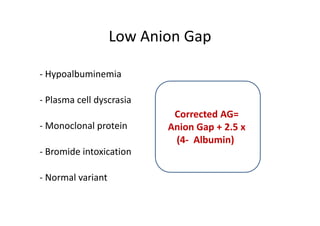
Low Anion Gap
- Hypoalbuminemia
- Plasma cell dyscrasia
- Monoclonal protein
- Bromide intoxication
- Normal variant
Corrected AG=
Anion Gap + 2.5 x
(4- Albumin)
- Hypoalbuminemia
- Plasma cell dyscrasia
- Monoclonal protein
- Bromide intoxication
- Normal variant
Corrected AG=
Anion Gap + 2.5 x
(4- Albumin)
1. History taking and physical examination
2. Assess accuracy of data (validity).
3. Identify the primary disturbance
1. Check arterial pH-------- acidosis or alkalosis
2. HCO3
- & pCO2 analysis---primary disorder.
4. Compensatory responses
5. Calculate AG
6. Assess delta ratio
7. Urine anion gab
8. Formulate acid-base diagnosis
1. History taking and physical examination
2. Assess accuracy of data (validity).
3. Identify the primary disturbance
1. Check arterial pH-------- acidosis or alkalosis
2. HCO3
- & pCO2 analysis---primary disorder.
4. Compensatory responses
5. Calculate AG
6. Assess delta ratio
7. Urine anion gab
8. Formulate acid-base diagnosis
1. History taking and physical examination
2. Assess accuracy of data (validity).
3. Identify the primary disturbance
1. Check arterial pH-------- acidosis or alkalosis
2. HCO3
- & pCO2 analysis---primary disorder.
4. Compensatory responses
5. Calculate AG
6. Assess delta ratio
7. Urine anion gab
8. Formulate acid-base diagnosis
1. History taking and physical examination
2. Assess accuracy of data (validity).
3. Identify the primary disturbance
1. Check arterial pH-------- acidosis or alkalosis
2. HCO3
- & pCO2 analysis---primary disorder.
4. Compensatory responses
5. Calculate AG
6. Assess delta ratio
7. Urine anion gab
8. Formulate acid-base diagnosis
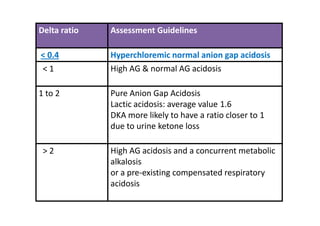
• If a metabolic acidosis is diagnosed, then the
Delta Ratio should be checked
Delta ratio= ∆ Anion gap/∆ [HCO3-]
∆ Anion gap = (12-AG)
∆ [HCO3-] = (24 - [HCO3-])
Delta ratio Assessment Guidelines
< 0.4 Hyperchloremic normal anion gap acidosis
< 1 High AG & normal AG acidosis
1 to 2 Pure Anion Gap Acidosis
Lactic acidosis: average value 1.6
DKA more likely to have a ratio closer to 1
due to urine ketone loss
Pure Anion Gap Acidosis
Lactic acidosis: average value 1.6
DKA more likely to have a ratio closer to 1
due to urine ketone loss
> 2 High AG acidosis and a concurrent metabolic
alkalosis
or a pre-existing compensated respiratory
acidosis
1. History taking and physical examination
2. Assess accuracy of data (validity).
3. Identify the primary disturbance
1. Check arterial pH-------- acidosis or alkalosis
2. HCO3
- & pCO2 analysis---primary disorder.
4. Compensatory responses
5. Calculate AG
6. Assess delta ratio
7. Urine anion gab
8. Formulate acid-base diagnosis
1. History taking and physical examination
2. Assess accuracy of data (validity).
3. Identify the primary disturbance
1. Check arterial pH-------- acidosis or alkalosis
2. HCO3
- & pCO2 analysis---primary disorder.
4. Compensatory responses
5. Calculate AG
6. Assess delta ratio
7. Urine anion gab
8. Formulate acid-base diagnosis
1. History taking and physical examination
2. Assess accuracy of data (validity).
3. Identify the primary disturbance
1. Check arterial pH-------- acidosis or alkalosis
2. HCO3
- & pCO2 analysis---primary disorder.
4. Compensatory responses
5. Calculate AG
6. Assess delta ratio
7. Urine anion gab
8. Formulate acid-base diagnosis
1. History taking and physical examination
2. Assess accuracy of data (validity).
3. Identify the primary disturbance
1. Check arterial pH-------- acidosis or alkalosis
2. HCO3
- & pCO2 analysis---primary disorder.
4. Compensatory responses
5. Calculate AG
6. Assess delta ratio
7. Urine anion gab
8. Formulate acid-base diagnosis
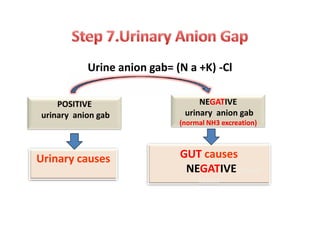
Urine anion gab= (N a +K) -Cl
POSITIVE
urinary anion gab
NEGATIVE
urinary anion gab
(normal NH(normal NH33 excreationexcreation))
POSITIVE
urinary anion gab
NEGATIVE
urinary anion gab
(normal NH(normal NH33 excreationexcreation))
GUT causes
NEGATIVEn bowel
causes
Urinary causes
1. History taking and physical examination
2. Assess accuracy of data (validity).
3. Identify the primary disturbance
1. Check arterial pH-------- acidosis or alkalosis
2. HCO3
- & pCO2 analysis---primary disorder.
4. Compensatory responses
5. Calculate AG
6. Assess delta ratio
7. Urine anion gab
8. Formulate acid-base diagnosis
1. History taking and physical examination
2. Assess accuracy of data (validity).
3. Identify the primary disturbance
1. Check arterial pH-------- acidosis or alkalosis
2. HCO3
- & pCO2 analysis---primary disorder.
4. Compensatory responses
5. Calculate AG
6. Assess delta ratio
7. Urine anion gab
8. Formulate acid-base diagnosis
1. History taking and physical examination
2. Assess accuracy of data (validity).
3. Identify the primary disturbance
1. Check arterial pH-------- acidosis or alkalosis
2. HCO3
- & pCO2 analysis---primary disorder.
4. Compensatory responses
5. Calculate AG
6. Assess delta ratio
7. Urine anion gab
8. Formulate acid-base diagnosis
1. History taking and physical examination
2. Assess accuracy of data (validity).
3. Identify the primary disturbance
1. Check arterial pH-------- acidosis or alkalosis
2. HCO3
- & pCO2 analysis---primary disorder.
4. Compensatory responses
5. Calculate AG
6. Assess delta ratio
7. Urine anion gab
8. Formulate acid-base diagnosis
Final DiagnosisFinal DiagnosisFinal DiagnosisFinal Diagnosis
Case
• A 50-Year old woman underwent
intestinal bypass for morbid obesity .
She has 10-15 watery stool motion per
day , she was treated by tincture of
opium . Next day she was found
somnolent and hypotensive. The plasma
value were:
• A 50-Year old woman underwent
intestinal bypass for morbid obesity .
She has 10-15 watery stool motion per
day , she was treated by tincture of
opium . Next day she was found
somnolent and hypotensive. The plasma
value were:
45
Laboratory data
PH 7.02
PaCO2 30
HCO3
(mEq/L)
10
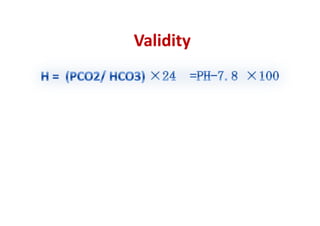
H = (PCO2/ HCO3) ×24 =PH-7.8 ×100
H= (30/10)X24=7.02-7.8X100
Validity
PH= acidosis------Hco3= Met acidosis
Primary
defect
Expected pCO2 = 1.5 x [HCO3] + 8
(range: +/- 2)
=1.5X10+8= 22
pco2 30 added respiratory acidosis.
CompensationHCO3
(mEq/L)
10
Na
(mEq/L)
130
K
(mEq/L)
3.2
CL
(mEq/L)
102
46
Expected pCO2 = 1.5 x [HCO3] + 8
(range: +/- 2)
=1.5X10+8= 22
pco2 30 added respiratory acidosis.
Compensation
= [Na+] – [HCO3
-] – [Cl-]
=130-(10+ 102)= 18
High AG
AG
Anion gap/∆ [HCO3-]
=18-12/24-10= <1 (0.42).
High AG & normal AG acidosis
Delta ratio
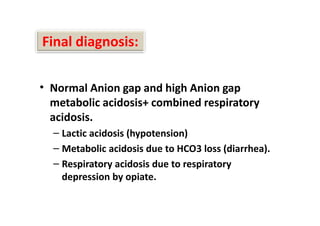
Final diagnosis:
• Normal Anion gap and high Anion gap
metabolic acidosis+ combined respiratory
acidosis.
– Lactic acidosis (hypotension)
– Metabolic acidosis due to HCO3 loss (diarrhea).
– Respiratory acidosis due to respiratory
depression by opiate.
• Normal Anion gap and high Anion gap
metabolic acidosis+ combined respiratory
acidosis.
– Lactic acidosis (hypotension)
– Metabolic acidosis due to HCO3 loss (diarrhea).
– Respiratory acidosis due to respiratory
depression by opiate.
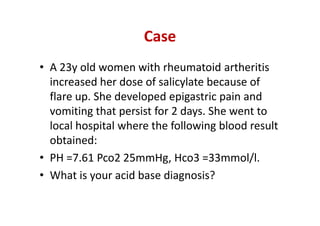
Case
• A 23y old women with rheumatoid artheritis
increased her dose of salicylate because of
flare up. She developed epigastric pain and
vomiting that persist for 2 days. She went to
local hospital where the following blood result
obtained:
• PH =7.61 Pco2 25mmHg, Hco3 =33mmol/l.
• What is your acid base diagnosis?
• A 23y old women with rheumatoid artheritis
increased her dose of salicylate because of
flare up. She developed epigastric pain and
vomiting that persist for 2 days. She went to
local hospital where the following blood result
obtained:
• PH =7.61 Pco2 25mmHg, Hco3 =33mmol/l.
• What is your acid base diagnosis?
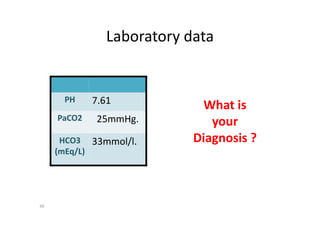
Laboratory data
PH 7.61
PaCO2 25mmHg.
What is
your
Diagnosis ?
PaCO2 25mmHg.
HCO3
(mEq/L)
33mmol/l.
49
What is
your
Diagnosis ?
Laboratory data
PH 7.61
PaCO2 25mmHg.
HCO3
(mEq/L)
33mmol/l.
H = (PCO2/ HCO3) ×24 =PH-7.8
×100
H= (25/33)X24=7.61-7.8X100Validity
PH= alkalosis------increased Hco3=
Metabolic alkalosis
Primary
defect
Metabolic alkalosis
Expected pCO2 = 0.7x [HCO3] + 20
(range: +/- 2)
=0.7X33+ 20=43
So compansation is not adaqaute
respiratory alkalosis.
CompensationHCO3
(mEq/L)
33mmol/l.
50
Metabolic alkalosis
Expected pCO2 = 0.7x [HCO3] + 20
(range: +/- 2)
=0.7X33+ 20=43
So compansation is not adaqaute
respiratory alkalosis.
Compensation
Final diagnosis
Combined Metabolic alkalosis (GIT loss Vomiting )
and respiratory alkalosis with salicylate.
Let’s play tic-tac-toe
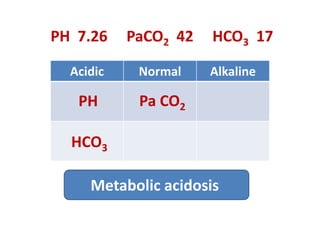
PH 7.26 PaCO2 42 HCO3 17
AlkalineNormalAcidic
PH Pa CO2
HCO3
Metabolic acidosis
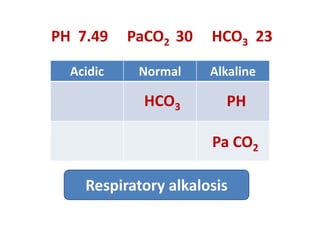
PH 7.49 PaCO2 30 HCO3 23
AlkalineNormalAcidic
PHHCO3
Pa CO2
Respiratory alkalosis
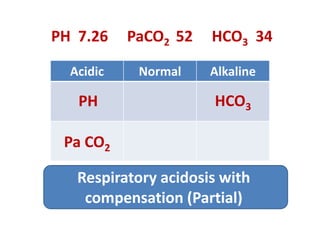
PH 7.26 PaCO2 52 HCO3 34
AlkalineNormalAcidic
PH HCO3
Pa CO2
Respiratory acidosis with
compensation (Partial)
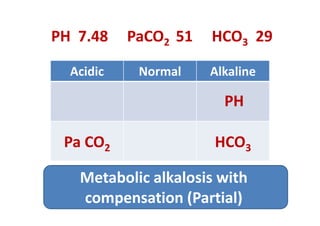
PH 7.48 PaCO2 51 HCO3 29
AlkalineNormalAcidic
PH
Pa CO2 HCO3
Metabolic alkalosis with
compensation (Partial)
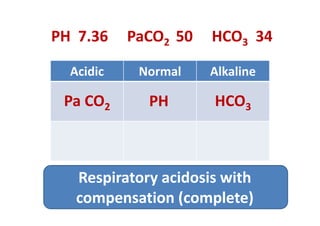
PH 7.36 PaCO2 50 HCO3 34
AlkalineNormalAcidic
PHPa CO2 HCO3
Respiratory acidosis with
compensation (complete)
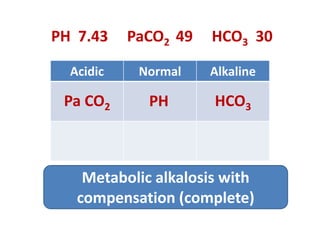
PH 7.43 PaCO2 49 HCO3 30
AlkalineNormalAcidic
PHPa CO2 HCO3
Metabolic alkalosis with
compensation (complete)
ABG interpretation Dr Ayman Sabri

ABG interpretation Dr Ayman Sabri

  • 2.
    Case • A 50-Yearold woman underwent intestinal bypass for morbid obesity . She has 10-15 watery stool motion per day , she was treated by tincture of opium . Next day she was found somnolent and hypotensive. The plasma value were: • A 50-Year old woman underwent intestinal bypass for morbid obesity . She has 10-15 watery stool motion per day , she was treated by tincture of opium . Next day she was found somnolent and hypotensive. The plasma value were: 2
  • 3.
    Laboratory data PH 7.02 PaCO230 HCO3 (mEq/L) 10 What is your Diagnosis ? HCO3 (mEq/L) Na (mEq/L) 130 K (mEq/L) 3.2 CL (mEq/L) 102 3 What is your Diagnosis ?
  • 6.
    1. History takingand physical examination 2. Assess accuracy of data (validity). 3. Identify the primary disturbance 1. Check arterial pH-------- acidosis or alkalosis 2. HCO3 - & pCO2 analysis---primary disorder. 4. Compensatory responses 5. Calculate AG 6. Assess delta ratio 7. Urine anion gab 8. Formulate acid-base diagnosis 1. History taking and physical examination 2. Assess accuracy of data (validity). 3. Identify the primary disturbance 1. Check arterial pH-------- acidosis or alkalosis 2. HCO3 - & pCO2 analysis---primary disorder. 4. Compensatory responses 5. Calculate AG 6. Assess delta ratio 7. Urine anion gab 8. Formulate acid-base diagnosis
  • 7.
    1. History takingand physical examination 2. Assess accuracy of data (validity). 3. Identify the primary disturbance 1. Check arterial pH-------- acidosis or alkalosis 2. HCO3 - & pCO2 analysis---primary disorder. 4. Compensatory responses 5. Calculate AG 6. Assess delta ratio 7. Urine anion gab 8. Formulate acid-base diagnosis 1. History taking and physical examination 2. Assess accuracy of data (validity). 3. Identify the primary disturbance 1. Check arterial pH-------- acidosis or alkalosis 2. HCO3 - & pCO2 analysis---primary disorder. 4. Compensatory responses 5. Calculate AG 6. Assess delta ratio 7. Urine anion gab 8. Formulate acid-base diagnosis
  • 8.
    • Step 1. Historytaking and physical examination Comprehensive history taking and physical examination can often give clues as to the underlying acid-base disorder • Step 1. History taking and physical examination Comprehensive history taking and physical examination can often give clues as to the underlying acid-base disorder
  • 9.
    Respiratory alkalosisPulmonary embolus RespiratoryacidosisCOPD Metabolic acidosis Dehydration or shock Hyperkalaemia Metabolic alkalosisVomiting , Hypokalaemia Metabolic alkalosisVomiting , Hypokalaemia Metabolic acidosis Severe diarrhea salisylates or alcohol intoxication Metabolic acidosisRenal failure metabolic acidosis Hyperglycaemia (DKA? if ketones present Respiratory alkalosisCirrhosis
  • 10.
    1. History takingand physical examination 2. Assess accuracy of data (validity). 3. Identify the primary disturbance 1. Check arterial pH-------- acidosis or alkalosis 2. HCO3 - & pCO2 analysis---primary disorder. 4. Compensatory responses 5. Calculate AG 6. Assess delta ratio 7. Urine anion gab 8. Formulate acid-base diagnosis 1. History taking and physical examination 2. Assess accuracy of data (validity). 3. Identify the primary disturbance 1. Check arterial pH-------- acidosis or alkalosis 2. HCO3 - & pCO2 analysis---primary disorder. 4. Compensatory responses 5. Calculate AG 6. Assess delta ratio 7. Urine anion gab 8. Formulate acid-base diagnosis
  • 11.
    1. History takingand physical examination 2. Assess accuracy of data (validity). 3. Identify the primary disturbance 1. Check arterial pH-------- acidosis or alkalosis 2. HCO3 - & pCO2 analysis---primary disorder. 4. Compensatory responses 5. Calculate AG 6. Assess delta ratio 7. Urine anion gab 8. Formulate acid-base diagnosis 1. History taking and physical examination 2. Assess accuracy of data (validity). 3. Identify the primary disturbance 1. Check arterial pH-------- acidosis or alkalosis 2. HCO3 - & pCO2 analysis---primary disorder. 4. Compensatory responses 5. Calculate AG 6. Assess delta ratio 7. Urine anion gab 8. Formulate acid-base diagnosis
  • 13.
  • 14.
    1. History takingand physical examination 2. Assess accuracy of data (validity). 3. Identify the primary disturbance 1. Check arterial pH-------- acidosis or alkalosis 2. HCO3 - & pCO2 analysis---primary disorder. 4. Compensatory responses 5. Calculate AG 6. Assess delta ratio 7. Urine anion gab 8. Formulate acid-base diagnosis 1. History taking and physical examination 2. Assess accuracy of data (validity). 3. Identify the primary disturbance 1. Check arterial pH-------- acidosis or alkalosis 2. HCO3 - & pCO2 analysis---primary disorder. 4. Compensatory responses 5. Calculate AG 6. Assess delta ratio 7. Urine anion gab 8. Formulate acid-base diagnosis
  • 15.
    1. History takingand physical examination 2. Assess accuracy of data (validity). 3. Identify the primary disturbance 1. Check arterial pH-------- acidosis or alkalosis 2. HCO3 - & pCO2 analysis---primary disorder. 4. Compensatory responses 5. Calculate AG 6. Assess delta ratio 7. Urine anion gab 8. Formulate acid-base diagnosis 1. History taking and physical examination 2. Assess accuracy of data (validity). 3. Identify the primary disturbance 1. Check arterial pH-------- acidosis or alkalosis 2. HCO3 - & pCO2 analysis---primary disorder. 4. Compensatory responses 5. Calculate AG 6. Assess delta ratio 7. Urine anion gab 8. Formulate acid-base diagnosis
  • 16.
  • 17.
    • Principle –The body does not fully compensate for primary acid-base disorders. i.e. PH < 7.4 ……. acidosis PH > 7.4 ……. alkalosis • Principle – The body does not fully compensate for primary acid-base disorders. i.e. PH < 7.4 ……. acidosis PH > 7.4 ……. alkalosis
  • 18.
  • 19.
    - If PCO2is the initial chemical change, then process is respiratory. - if HCO3- is the initial chemical change, then process is metabolic. - If PCO2 is the initial chemical change, then process is respiratory. - if HCO3- is the initial chemical change, then process is metabolic.
  • 20.
    PCO2HCO3PH     AcidosisAcidosis AlkalosisAlkalosis MetabolicMetabolic MetabolicMetabolic       AcidosisAcidosis AlkalosisAlkalosis AlkalosisAlkalosis MetabolicMetabolic RespiratoryRespiratory RespiratoryRespiratory
  • 21.
    1. History takingand physical examination 2. Assess accuracy of data (validity). 3. Identify the primary disturbance 1. Check arterial pH-------- acidosis or alkalosis 2. HCO3 - & pCO2 analysis---primary disorder. 4. Compensatory responses 5. Calculate AG 6. Assess delta ratio 7. Urine anion gab 8. Formulate acid-base diagnosis 1. History taking and physical examination 2. Assess accuracy of data (validity). 3. Identify the primary disturbance 1. Check arterial pH-------- acidosis or alkalosis 2. HCO3 - & pCO2 analysis---primary disorder. 4. Compensatory responses 5. Calculate AG 6. Assess delta ratio 7. Urine anion gab 8. Formulate acid-base diagnosis
  • 22.
    1. History takingand physical examination 2. Assess accuracy of data (validity). 3. Identify the primary disturbance 1. Check arterial pH-------- acidosis or alkalosis 2. HCO3 - & pCO2 analysis---primary disorder. 4. Compensatory responses 5. Calculate AG 6. Assess delta ratio 7. Urine anion gab 8. Formulate acid-base diagnosis 1. History taking and physical examination 2. Assess accuracy of data (validity). 3. Identify the primary disturbance 1. Check arterial pH-------- acidosis or alkalosis 2. HCO3 - & pCO2 analysis---primary disorder. 4. Compensatory responses 5. Calculate AG 6. Assess delta ratio 7. Urine anion gab 8. Formulate acid-base diagnosis
  • 23.
    Metabolic acidosis Expected pCO2= 1.5 x [HCO3] + 8 (range: +/- 2) Metabolic alkalosis Expected pCO2 = 0.7 [HCO3] + 20 (range: +/- 5) “If the actual pCO2 or [HCO3 -] is different from the predicted values, You must suspect a 2nd acid-base disorder” Metabolic acidosis Expected pCO2 = 1.5 x [HCO3] + 8 (range: +/- 2) Metabolic alkalosis Expected pCO2 = 0.7 [HCO3] + 20 (range: +/- 5) “If the actual pCO2 or [HCO3 -] is different from the predicted values, You must suspect a 2nd acid-base disorder”
  • 24.
    • Acute Respiratory: The [HCO3] will increase by 1 mmol/l for every 10 mmHg elevation in pCO2 above 40 mmHg. Expected [HCO3] = 24 + { (Actual pCO2 - 40) / 10 } • Chronic Respiratory : The [HCO3] will increase by 4 mmol/l for every 10 mmHg elevation in pCO2 above 40mmHg. Expected [HCO3] = 24 + 4 { (Actual pCO2 - 40) / 10} • Acute Respiratory : The [HCO3] will increase by 1 mmol/l for every 10 mmHg elevation in pCO2 above 40 mmHg. Expected [HCO3] = 24 + { (Actual pCO2 - 40) / 10 } • Chronic Respiratory : The [HCO3] will increase by 4 mmol/l for every 10 mmHg elevation in pCO2 above 40mmHg. Expected [HCO3] = 24 + 4 { (Actual pCO2 - 40) / 10}
  • 25.
    • Acute Respiratory The[HCO3] will decrease by 2 mmol/l for every 10 mmHg decrease in pCO2 below 40 mmHg. Expected [HCO3] = 24 - 2 { ( 40 - Actual pCO2) / 10 } • Chronic Respiratory The [HCO3] will decrease by 5 mmol/l for every 10 mmHg decrease in pCO2 below 40 mmHg. Expected [HCO3] = 24 - 5 { ( 40 - Actual pCO2 ) / 10 } (range: +/- 2) • It takes 2 to 3 days to reach maximal renal compensation • Acute Respiratory The [HCO3] will decrease by 2 mmol/l for every 10 mmHg decrease in pCO2 below 40 mmHg. Expected [HCO3] = 24 - 2 { ( 40 - Actual pCO2) / 10 } • Chronic Respiratory The [HCO3] will decrease by 5 mmol/l for every 10 mmHg decrease in pCO2 below 40 mmHg. Expected [HCO3] = 24 - 5 { ( 40 - Actual pCO2 ) / 10 } (range: +/- 2) • It takes 2 to 3 days to reach maximal renal compensation
  • 26.
    1. History takingand physical examination 2. Assess accuracy of data (validity). 3. Identify the primary disturbance 1. Check arterial pH-------- acidosis or alkalosis 2. HCO3 - & pCO2 analysis---primary disorder. 4. Compensatory responses 5. Calculate AG 6. Assess delta ratio 7. Urine anion gab 8. Formulate acid-base diagnosis 1. History taking and physical examination 2. Assess accuracy of data (validity). 3. Identify the primary disturbance 1. Check arterial pH-------- acidosis or alkalosis 2. HCO3 - & pCO2 analysis---primary disorder. 4. Compensatory responses 5. Calculate AG 6. Assess delta ratio 7. Urine anion gab 8. Formulate acid-base diagnosis
  • 27.
    1. History takingand physical examination 2. Assess accuracy of data (validity). 3. Identify the primary disturbance 1. Check arterial pH-------- acidosis or alkalosis 2. HCO3 - & pCO2 analysis---primary disorder. 4. Compensatory responses 5. Calculate AG 6. Assess delta ratio 7. Urine anion gab 8. Formulate acid-base diagnosis 1. History taking and physical examination 2. Assess accuracy of data (validity). 3. Identify the primary disturbance 1. Check arterial pH-------- acidosis or alkalosis 2. HCO3 - & pCO2 analysis---primary disorder. 4. Compensatory responses 5. Calculate AG 6. Assess delta ratio 7. Urine anion gab 8. Formulate acid-base diagnosis
  • 28.
    • The aniongap is defined as the quantity of anions not balanced by cations. • (Na + K) + Unmeasured cations = (Cl + HCO3) + Unmeasured anions • Anion Gap= measured cation- measured anion. • Anion gap = [Na + K] – (Cl + HCO3) • Value: 12 ± 4 meq/L • The anion gap is defined as the quantity of anions not balanced by cations. • (Na + K) + Unmeasured cations = (Cl + HCO3) + Unmeasured anions • Anion Gap= measured cation- measured anion. • Anion gap = [Na + K] – (Cl + HCO3) • Value: 12 ± 4 meq/L
  • 29.
    Anions and Cationsin Serum (Values in mEq/L) CATIONSANIONS Calcium 5Organic acids 5 Magnesium 1.5Sulfates 1 Potassium 4.5Phosphates 2 Actually there is no gap Potassium 4.5Phosphates 2 Sodium 140Proteins 15 Bicarbonates 24 Chlorides 104 Total 151Total 151
  • 31.
    High Anion GapNormal anion gap • 1. Ketoacidosis - Diabetic - Alcoholic - Starvation • 2. Lactic acidosis • 3. Toxicosis - Ethylene glycol - Methanol - Salicylates • 4. Advanced renal failure • 1. GIT HCO3 - loss - Diarrhea - External fistulas • 2. Renal HCO3 - loss - Proximal RTA - Distal RTA - Hyperkalemic RTA metabolic acidosis (MUD PILES)(MUD PILES) Methanol Uremia Diabetic ketoacidosis Propylene glycol Isoniazid intoxication Lactic acidosis Ethanol ethylene glycol Salicylates • 1. Ketoacidosis - Diabetic - Alcoholic - Starvation • 2. Lactic acidosis • 3. Toxicosis - Ethylene glycol - Methanol - Salicylates • 4. Advanced renal failure • 1. GIT HCO3 - loss - Diarrhea - External fistulas • 2. Renal HCO3 - loss - Proximal RTA - Distal RTA - Hyperkalemic RTA (MUD PILES)(MUD PILES) Methanol Uremia Diabetic ketoacidosis Propylene glycol Isoniazid intoxication Lactic acidosis Ethanol ethylene glycol Salicylates
  • 32.
    Osmolal gap Step 1: CalculateOsm = 2[Na+] + glucose/18 + BUN/2.8 Step 2: Measure Osm Step 3: Osmolal gap (measured - calc) should be ≤ 10
  • 33.
    ‫ﻻ‬‫ﻳ‬‫ﻤ‬‫ﻜ‬‫ﻦ‬‫ﻋ‬‫ﺮ‬‫ض‬‫ا‬‫ﻟ‬‫ﺼ‬‫ﻮ‬‫ر‬‫ة‬.‫ﻗ‬‫ﺪ‬‫ﻻ‬‫ﺗ‬‫ﻜ‬‫ﻮ‬‫ن‬‫ھ‬‫ﻨ‬‫ﺎ‬‫ك‬‫ﻣ‬‫ﺴ‬‫ﺎ‬‫ﺣ‬‫ﺔ‬‫ﻛ‬‫ﺎ‬‫ﻓ‬‫ﯿ‬‫ﺔ‬‫ﻟ‬‫ﻠ‬‫ﺬ‬‫ا‬‫ﻛ‬‫ﺮ‬‫ة‬‫ﻋ‬‫ﻠ‬‫ﻰ‬‫ا‬‫ﻟ‬‫ﻜ‬‫ﻤ‬‫ﺒ‬‫ﯿ‬‫ﻮ‬‫ﺗ‬‫ﺮ‬‫ﻟ‬‫ﻔ‬‫ﺘ‬‫ﺢ‬‫ا‬‫ﻟ‬‫ﺼ‬‫ﻮ‬‫ر‬‫ة‬‫أ‬‫و‬‫ﻗ‬‫ﺪ‬‫ﺗ‬‫ﻜ‬‫ﻮ‬‫ن‬‫ا‬‫ﻟ‬‫ﺼ‬‫ﻮ‬‫ر‬‫ة‬‫ﺗ‬‫ﺎ‬‫ﻟ‬‫ﻔ‬‫ﺔ‬.‫ﻗ‬‫ﻢ‬‫ﺑ‬‫ﺈ‬‫ﻋ‬‫ﺎ‬‫د‬‫ة‬‫ﺗ‬‫ﺸ‬‫ﻐ‬‫ﯿ‬‫ﻞ‬‫ا‬‫ﻟ‬‫ﻜ‬‫ﻤ‬‫ﺒ‬‫ﯿ‬‫ﻮ‬‫ﺗ‬‫ﺮ‬،‫ﺛ‬‫ﻢ‬‫ا‬‫ﻓ‬‫ﺘ‬‫ﺢ‬‫ا‬‫ﻟ‬‫ﻤ‬‫ﻠ‬‫ﻒ‬‫ﻣ‬‫ﺮ‬‫ة‬‫أ‬‫ﺧ‬‫ﺮ‬‫ى‬.‫إ‬‫ذ‬‫ا‬‫ﻇ‬‫ﻠ‬‫ﺖ‬‫ﻋ‬‫ﻼ‬‫ﻣ‬‫ﺔ‬x‫ا‬‫ﻟ‬‫ﺤ‬‫ﻤ‬‫ﺮ‬‫ا‬‫ء‬‫ﺗ‬‫ﻈ‬‫ﮫ‬‫ﺮ‬،‫ﻗ‬‫ﺪ‬‫ﺗ‬‫ﻀ‬‫ﻄ‬‫ﺮ‬‫إ‬‫ﻟ‬‫ﻰ‬‫ﺣ‬‫ﺬ‬‫ف‬‫ا‬‫ﻟ‬‫ﺼ‬‫ﻮ‬‫ر‬‫ة‬‫ﺛ‬‫ﻢ‬‫إ‬‫د‬‫ر‬‫ا‬‫ﺟ‬‫ﮫ‬‫ﺎ‬‫ﻣ‬‫ﺮ‬‫ة‬‫أ‬‫ﺧ‬‫ﺮ‬‫ى‬.
  • 34.
    Low Anion Gap -Hypoalbuminemia - Plasma cell dyscrasia - Monoclonal protein - Bromide intoxication - Normal variant Corrected AG= Anion Gap + 2.5 x (4- Albumin) - Hypoalbuminemia - Plasma cell dyscrasia - Monoclonal protein - Bromide intoxication - Normal variant Corrected AG= Anion Gap + 2.5 x (4- Albumin)
  • 35.
    1. History takingand physical examination 2. Assess accuracy of data (validity). 3. Identify the primary disturbance 1. Check arterial pH-------- acidosis or alkalosis 2. HCO3 - & pCO2 analysis---primary disorder. 4. Compensatory responses 5. Calculate AG 6. Assess delta ratio 7. Urine anion gab 8. Formulate acid-base diagnosis 1. History taking and physical examination 2. Assess accuracy of data (validity). 3. Identify the primary disturbance 1. Check arterial pH-------- acidosis or alkalosis 2. HCO3 - & pCO2 analysis---primary disorder. 4. Compensatory responses 5. Calculate AG 6. Assess delta ratio 7. Urine anion gab 8. Formulate acid-base diagnosis
  • 36.
    1. History takingand physical examination 2. Assess accuracy of data (validity). 3. Identify the primary disturbance 1. Check arterial pH-------- acidosis or alkalosis 2. HCO3 - & pCO2 analysis---primary disorder. 4. Compensatory responses 5. Calculate AG 6. Assess delta ratio 7. Urine anion gab 8. Formulate acid-base diagnosis 1. History taking and physical examination 2. Assess accuracy of data (validity). 3. Identify the primary disturbance 1. Check arterial pH-------- acidosis or alkalosis 2. HCO3 - & pCO2 analysis---primary disorder. 4. Compensatory responses 5. Calculate AG 6. Assess delta ratio 7. Urine anion gab 8. Formulate acid-base diagnosis
  • 37.
    • If ametabolic acidosis is diagnosed, then the Delta Ratio should be checked Delta ratio= ∆ Anion gap/∆ [HCO3-] ∆ Anion gap = (12-AG) ∆ [HCO3-] = (24 - [HCO3-])
  • 38.
    Delta ratio AssessmentGuidelines < 0.4 Hyperchloremic normal anion gap acidosis < 1 High AG & normal AG acidosis 1 to 2 Pure Anion Gap Acidosis Lactic acidosis: average value 1.6 DKA more likely to have a ratio closer to 1 due to urine ketone loss Pure Anion Gap Acidosis Lactic acidosis: average value 1.6 DKA more likely to have a ratio closer to 1 due to urine ketone loss > 2 High AG acidosis and a concurrent metabolic alkalosis or a pre-existing compensated respiratory acidosis
  • 39.
    1. History takingand physical examination 2. Assess accuracy of data (validity). 3. Identify the primary disturbance 1. Check arterial pH-------- acidosis or alkalosis 2. HCO3 - & pCO2 analysis---primary disorder. 4. Compensatory responses 5. Calculate AG 6. Assess delta ratio 7. Urine anion gab 8. Formulate acid-base diagnosis 1. History taking and physical examination 2. Assess accuracy of data (validity). 3. Identify the primary disturbance 1. Check arterial pH-------- acidosis or alkalosis 2. HCO3 - & pCO2 analysis---primary disorder. 4. Compensatory responses 5. Calculate AG 6. Assess delta ratio 7. Urine anion gab 8. Formulate acid-base diagnosis
  • 40.
    1. History takingand physical examination 2. Assess accuracy of data (validity). 3. Identify the primary disturbance 1. Check arterial pH-------- acidosis or alkalosis 2. HCO3 - & pCO2 analysis---primary disorder. 4. Compensatory responses 5. Calculate AG 6. Assess delta ratio 7. Urine anion gab 8. Formulate acid-base diagnosis 1. History taking and physical examination 2. Assess accuracy of data (validity). 3. Identify the primary disturbance 1. Check arterial pH-------- acidosis or alkalosis 2. HCO3 - & pCO2 analysis---primary disorder. 4. Compensatory responses 5. Calculate AG 6. Assess delta ratio 7. Urine anion gab 8. Formulate acid-base diagnosis
  • 41.
    Urine anion gab=(N a +K) -Cl POSITIVE urinary anion gab NEGATIVE urinary anion gab (normal NH(normal NH33 excreationexcreation)) POSITIVE urinary anion gab NEGATIVE urinary anion gab (normal NH(normal NH33 excreationexcreation)) GUT causes NEGATIVEn bowel causes Urinary causes
  • 42.
    1. History takingand physical examination 2. Assess accuracy of data (validity). 3. Identify the primary disturbance 1. Check arterial pH-------- acidosis or alkalosis 2. HCO3 - & pCO2 analysis---primary disorder. 4. Compensatory responses 5. Calculate AG 6. Assess delta ratio 7. Urine anion gab 8. Formulate acid-base diagnosis 1. History taking and physical examination 2. Assess accuracy of data (validity). 3. Identify the primary disturbance 1. Check arterial pH-------- acidosis or alkalosis 2. HCO3 - & pCO2 analysis---primary disorder. 4. Compensatory responses 5. Calculate AG 6. Assess delta ratio 7. Urine anion gab 8. Formulate acid-base diagnosis
  • 43.
    1. History takingand physical examination 2. Assess accuracy of data (validity). 3. Identify the primary disturbance 1. Check arterial pH-------- acidosis or alkalosis 2. HCO3 - & pCO2 analysis---primary disorder. 4. Compensatory responses 5. Calculate AG 6. Assess delta ratio 7. Urine anion gab 8. Formulate acid-base diagnosis 1. History taking and physical examination 2. Assess accuracy of data (validity). 3. Identify the primary disturbance 1. Check arterial pH-------- acidosis or alkalosis 2. HCO3 - & pCO2 analysis---primary disorder. 4. Compensatory responses 5. Calculate AG 6. Assess delta ratio 7. Urine anion gab 8. Formulate acid-base diagnosis
  • 44.
    Final DiagnosisFinal DiagnosisFinalDiagnosisFinal Diagnosis
  • 45.
    Case • A 50-Yearold woman underwent intestinal bypass for morbid obesity . She has 10-15 watery stool motion per day , she was treated by tincture of opium . Next day she was found somnolent and hypotensive. The plasma value were: • A 50-Year old woman underwent intestinal bypass for morbid obesity . She has 10-15 watery stool motion per day , she was treated by tincture of opium . Next day she was found somnolent and hypotensive. The plasma value were: 45
  • 46.
    Laboratory data PH 7.02 PaCO230 HCO3 (mEq/L) 10 H = (PCO2/ HCO3) ×24 =PH-7.8 ×100 H= (30/10)X24=7.02-7.8X100 Validity PH= acidosis------Hco3= Met acidosis Primary defect Expected pCO2 = 1.5 x [HCO3] + 8 (range: +/- 2) =1.5X10+8= 22 pco2 30 added respiratory acidosis. CompensationHCO3 (mEq/L) 10 Na (mEq/L) 130 K (mEq/L) 3.2 CL (mEq/L) 102 46 Expected pCO2 = 1.5 x [HCO3] + 8 (range: +/- 2) =1.5X10+8= 22 pco2 30 added respiratory acidosis. Compensation = [Na+] – [HCO3 -] – [Cl-] =130-(10+ 102)= 18 High AG AG Anion gap/∆ [HCO3-] =18-12/24-10= <1 (0.42). High AG & normal AG acidosis Delta ratio
  • 47.
    Final diagnosis: • NormalAnion gap and high Anion gap metabolic acidosis+ combined respiratory acidosis. – Lactic acidosis (hypotension) – Metabolic acidosis due to HCO3 loss (diarrhea). – Respiratory acidosis due to respiratory depression by opiate. • Normal Anion gap and high Anion gap metabolic acidosis+ combined respiratory acidosis. – Lactic acidosis (hypotension) – Metabolic acidosis due to HCO3 loss (diarrhea). – Respiratory acidosis due to respiratory depression by opiate.
  • 48.
    Case • A 23yold women with rheumatoid artheritis increased her dose of salicylate because of flare up. She developed epigastric pain and vomiting that persist for 2 days. She went to local hospital where the following blood result obtained: • PH =7.61 Pco2 25mmHg, Hco3 =33mmol/l. • What is your acid base diagnosis? • A 23y old women with rheumatoid artheritis increased her dose of salicylate because of flare up. She developed epigastric pain and vomiting that persist for 2 days. She went to local hospital where the following blood result obtained: • PH =7.61 Pco2 25mmHg, Hco3 =33mmol/l. • What is your acid base diagnosis?
  • 49.
    Laboratory data PH 7.61 PaCO225mmHg. What is your Diagnosis ? PaCO2 25mmHg. HCO3 (mEq/L) 33mmol/l. 49 What is your Diagnosis ?
  • 50.
    Laboratory data PH 7.61 PaCO225mmHg. HCO3 (mEq/L) 33mmol/l. H = (PCO2/ HCO3) ×24 =PH-7.8 ×100 H= (25/33)X24=7.61-7.8X100Validity PH= alkalosis------increased Hco3= Metabolic alkalosis Primary defect Metabolic alkalosis Expected pCO2 = 0.7x [HCO3] + 20 (range: +/- 2) =0.7X33+ 20=43 So compansation is not adaqaute respiratory alkalosis. CompensationHCO3 (mEq/L) 33mmol/l. 50 Metabolic alkalosis Expected pCO2 = 0.7x [HCO3] + 20 (range: +/- 2) =0.7X33+ 20=43 So compansation is not adaqaute respiratory alkalosis. Compensation Final diagnosis Combined Metabolic alkalosis (GIT loss Vomiting ) and respiratory alkalosis with salicylate.
  • 51.
  • 52.
    PH 7.26 PaCO242 HCO3 17 AlkalineNormalAcidic PH Pa CO2 HCO3 Metabolic acidosis
  • 53.
    PH 7.49 PaCO230 HCO3 23 AlkalineNormalAcidic PHHCO3 Pa CO2 Respiratory alkalosis
  • 54.
    PH 7.26 PaCO252 HCO3 34 AlkalineNormalAcidic PH HCO3 Pa CO2 Respiratory acidosis with compensation (Partial)
  • 55.
    PH 7.48 PaCO251 HCO3 29 AlkalineNormalAcidic PH Pa CO2 HCO3 Metabolic alkalosis with compensation (Partial)
  • 56.
    PH 7.36 PaCO250 HCO3 34 AlkalineNormalAcidic PHPa CO2 HCO3 Respiratory acidosis with compensation (complete)
  • 57.
    PH 7.43 PaCO249 HCO3 30 AlkalineNormalAcidic PHPa CO2 HCO3 Metabolic alkalosis with compensation (complete)