Arterial Blood Gas
Interpretation
By
Dr. Ahmed Galal Mohamed
PICU Specialist
Objectives
• ABG Sampling
• Interpretation of ABG
• Oxygenation status
• Acid Base status
• Case Scenarios
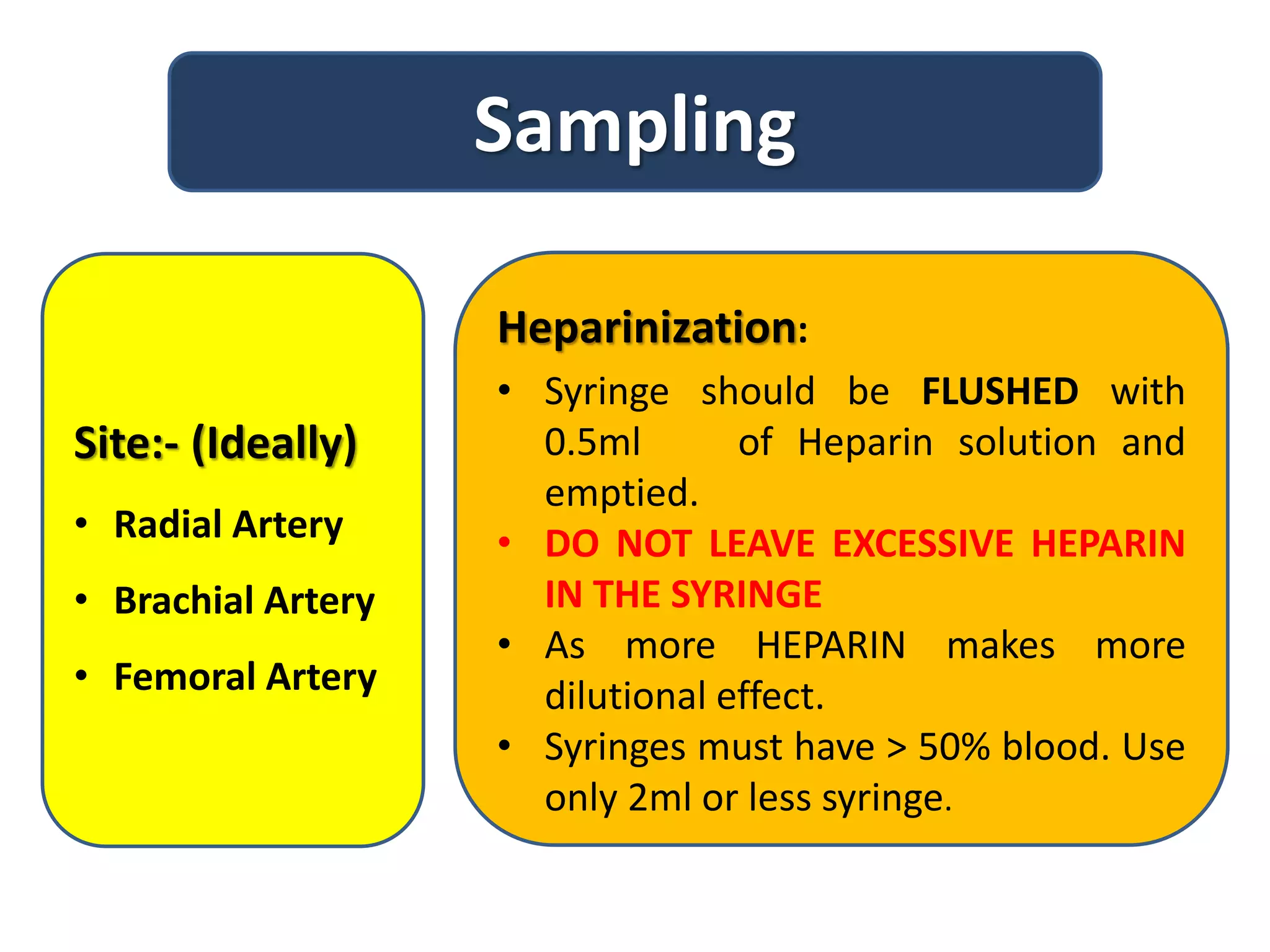
Sampling
Site:- (Ideally)
• Radial Artery
• Brachial Artery
• Femoral Artery
Heparinization:
• Syringe should be FLUSHED with
0.5ml of Heparin solution and
emptied.
• DO NOT LEAVE EXCESSIVE HEPARIN
IN THE SYRINGE
• As more HEPARIN makes more
dilutional effect.
• Syringes must have > 50% blood. Use
only 2ml or less syringe.
Sampling
ABG Syringe must
be transported at
the earliest to the
laboratory for EARLY
analysis via COLD
CHAIN
• Ensure No Air
Bubbles. Syringe
must be sealed
immediately after
withdrawing
sample.
• Contact with AIR
BUBBLES will
increase the PaO2
& decrease PaCO2
Sampling
o Patients Body Temperature affects the values
of PaCO2 and HCO3.
• ABG Analyser is controlled for Normal Body temperatures
• Any change in body temp at the time of sampling leads to
alteration in values detected by the electrodes
o The increase in cell count cause decrease in
PaO2.
o ABG Sample should always be sent with
relevant information regarding O2 status, FiO2
and Temp
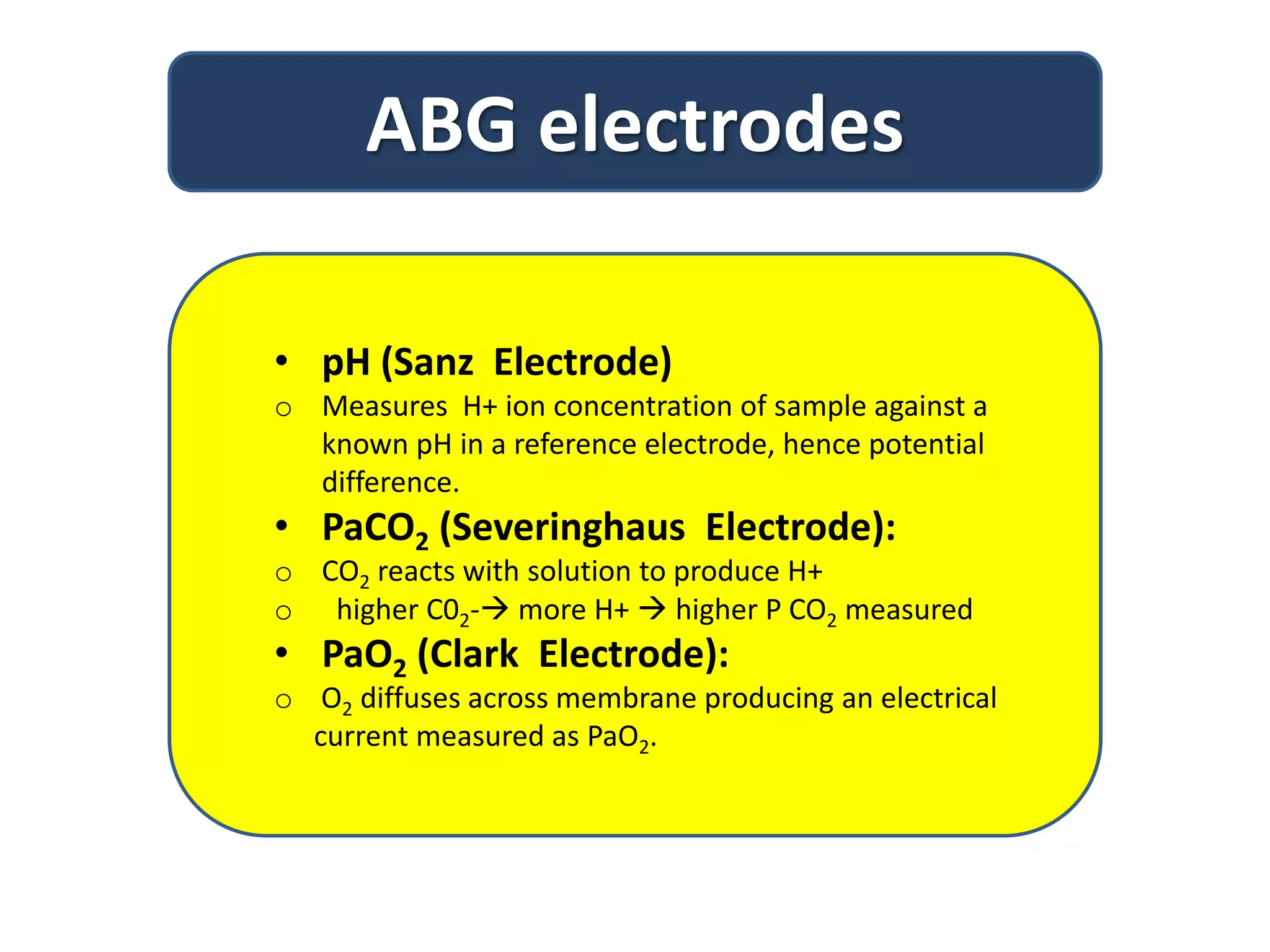
ABG electrodes
• pH (Sanz Electrode)
o Measures H+ ion concentration of sample against a
known pH in a reference electrode, hence potential
difference.
• PaCO2 (Severinghaus Electrode):
o CO2 reacts with solution to produce H+
o higher C02- more H+  higher P CO2 measured
• PaO2 (Clark Electrode):
o O2 diffuses across membrane producing an electrical
current measured as PaO2.
Interpretation of ABG
Oxygenation
Acid-base
disorders
Oxygenation
PaO2
SaO2
Normally 60 – 95 on room air
Normally 85 – 100 on room air
PaO2/
FiO2
Normally > 450
Acid base disorders
Acid
Base
Any molecule that is able to release
hydrogen atoms “proton-donor substance.”
Any molecule that is able to receive
hydrogen atoms “proton-receptor
substance”
Regulation of acid base
CO2 + H2O carbonic anhydrase H2CO3 H+ + HCO3
-
CO2 HCO3
Normal acid base balance
pH AlkalosisAcidosis 7
Normal blood pH = 7.4
Acidemia & alkalemia
PaCO2
HCO3
35 – 45 mmHg
16 - 24
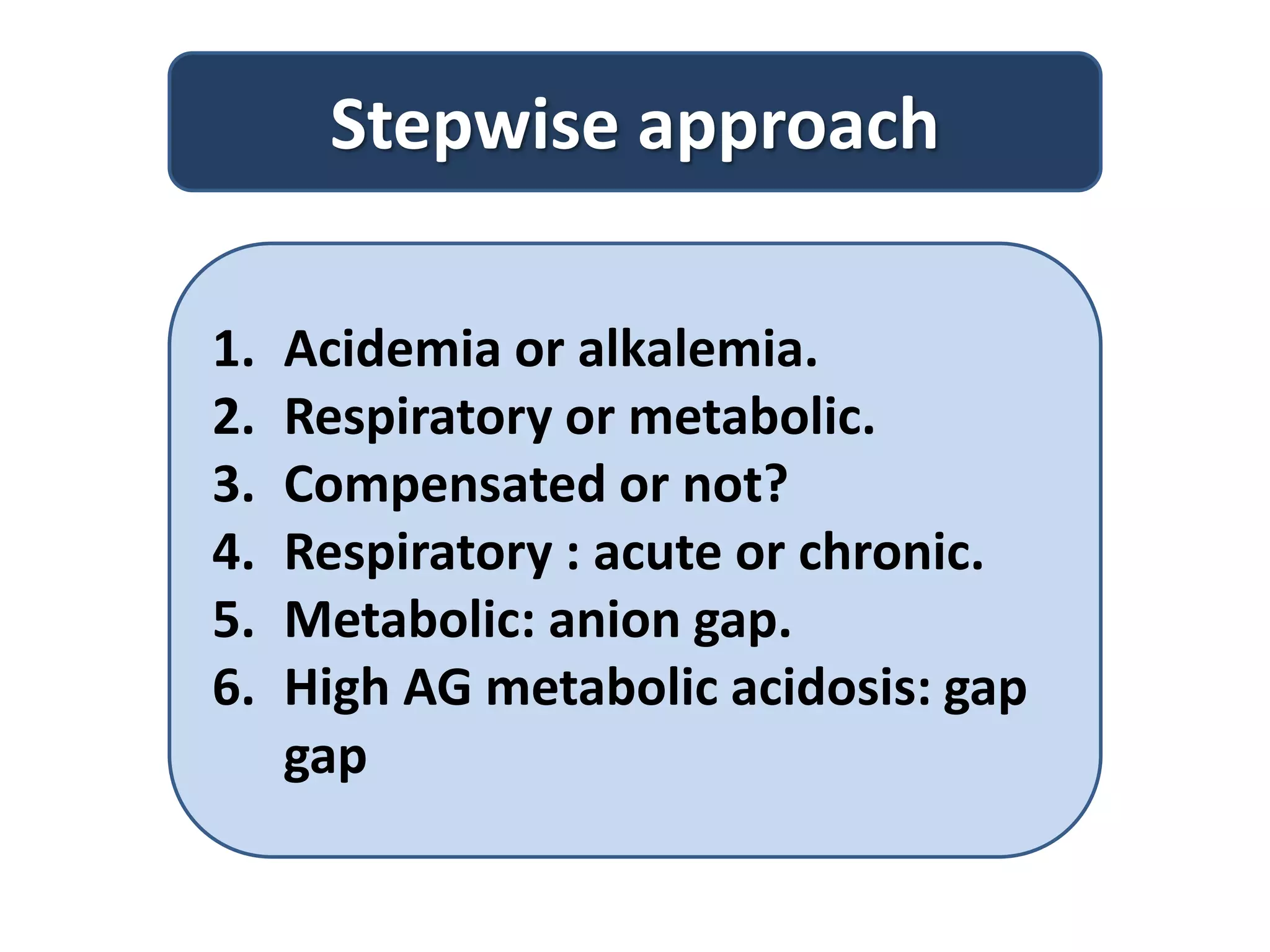
Stepwise approach
1. Acidemia or alkalemia.
2. Respiratory or metabolic.
3. Compensated or not?
4. Respiratory : acute or chronic.
5. Metabolic: anion gap.
6. High AG metabolic acidosis: gap
gap
Step1: acidemia VS alkalemia
• Look at pH:
<7.35 - acidemia
>7.45 – alkalemia
Step2: respiratory vs metabolic
• If CO2 is high so it is respiratory
• If HCO3 is low so it is metabolic
Step3: Compensated or not?
In metabolic disorders Expected PaCo2.
Metabolic acidosis:
• PCO2 = (1.5 X [HCO3
-])+8 + 2
• For every decrease by 1 in HCO3 the PCO2 falls
by 1.25 mm Hg
Metabolic alkalosis:
• PCO2 = (0.7 X [HCO3
-])+ 21 + 2
• For every increase by 1 in HCO3 the PCO2
increases by 0.75 mm Hg
Step3: Compensated or not?
In respiratory disorders Expected pH.
Respiratory acidosis:
• ACUTE :- pH=7.40–0.008( PCO2-40)
• CHRONIC :- pH=7.40–0.003(PCO2-40)
Respiratory alkalosis:
• ACUTE pH=7.40+0.008(40-PCO2)
• CHRONIC pH=7.40+0.003(40-PCO2)
Step4: respiratory: acute or chronic
In respiratory disorders Expected pH.
Compare pH measured VS pH expected
• pH m = pH e acute = acute respiratory disorder.
• pH m = between pH e of acute & chronic =
partially compensated disorder.
• pH m = pH e chronic = fully compensated disorder.

ABG interpretation

  • 1.
    Arterial Blood Gas Interpretation By Dr.Ahmed Galal Mohamed PICU Specialist
  • 2.
    Objectives • ABG Sampling •Interpretation of ABG • Oxygenation status • Acid Base status • Case Scenarios
  • 3.
    Sampling Site:- (Ideally) • RadialArtery • Brachial Artery • Femoral Artery Heparinization: • Syringe should be FLUSHED with 0.5ml of Heparin solution and emptied. • DO NOT LEAVE EXCESSIVE HEPARIN IN THE SYRINGE • As more HEPARIN makes more dilutional effect. • Syringes must have > 50% blood. Use only 2ml or less syringe.
  • 4.
    Sampling ABG Syringe must betransported at the earliest to the laboratory for EARLY analysis via COLD CHAIN • Ensure No Air Bubbles. Syringe must be sealed immediately after withdrawing sample. • Contact with AIR BUBBLES will increase the PaO2 & decrease PaCO2
  • 5.
    Sampling o Patients BodyTemperature affects the values of PaCO2 and HCO3. • ABG Analyser is controlled for Normal Body temperatures • Any change in body temp at the time of sampling leads to alteration in values detected by the electrodes o The increase in cell count cause decrease in PaO2. o ABG Sample should always be sent with relevant information regarding O2 status, FiO2 and Temp
  • 6.
    ABG electrodes • pH(Sanz Electrode) o Measures H+ ion concentration of sample against a known pH in a reference electrode, hence potential difference. • PaCO2 (Severinghaus Electrode): o CO2 reacts with solution to produce H+ o higher C02- more H+  higher P CO2 measured • PaO2 (Clark Electrode): o O2 diffuses across membrane producing an electrical current measured as PaO2.
  • 7.
  • 8.
    Oxygenation PaO2 SaO2 Normally 60 –95 on room air Normally 85 – 100 on room air PaO2/ FiO2 Normally > 450
  • 9.
    Acid base disorders Acid Base Anymolecule that is able to release hydrogen atoms “proton-donor substance.” Any molecule that is able to receive hydrogen atoms “proton-receptor substance”
  • 10.
    Regulation of acidbase CO2 + H2O carbonic anhydrase H2CO3 H+ + HCO3 - CO2 HCO3
  • 11.
    Normal acid basebalance pH AlkalosisAcidosis 7 Normal blood pH = 7.4 Acidemia & alkalemia PaCO2 HCO3 35 – 45 mmHg 16 - 24
  • 12.
    Stepwise approach 1. Acidemiaor alkalemia. 2. Respiratory or metabolic. 3. Compensated or not? 4. Respiratory : acute or chronic. 5. Metabolic: anion gap. 6. High AG metabolic acidosis: gap gap
  • 13.
    Step1: acidemia VSalkalemia • Look at pH: <7.35 - acidemia >7.45 – alkalemia Step2: respiratory vs metabolic • If CO2 is high so it is respiratory • If HCO3 is low so it is metabolic
  • 14.
    Step3: Compensated ornot? In metabolic disorders Expected PaCo2. Metabolic acidosis: • PCO2 = (1.5 X [HCO3 -])+8 + 2 • For every decrease by 1 in HCO3 the PCO2 falls by 1.25 mm Hg Metabolic alkalosis: • PCO2 = (0.7 X [HCO3 -])+ 21 + 2 • For every increase by 1 in HCO3 the PCO2 increases by 0.75 mm Hg
  • 15.
    Step3: Compensated ornot? In respiratory disorders Expected pH. Respiratory acidosis: • ACUTE :- pH=7.40–0.008( PCO2-40) • CHRONIC :- pH=7.40–0.003(PCO2-40) Respiratory alkalosis: • ACUTE pH=7.40+0.008(40-PCO2) • CHRONIC pH=7.40+0.003(40-PCO2)
  • 16.
    Step4: respiratory: acuteor chronic In respiratory disorders Expected pH. Compare pH measured VS pH expected • pH m = pH e acute = acute respiratory disorder. • pH m = between pH e of acute & chronic = partially compensated disorder. • pH m = pH e chronic = fully compensated disorder.