Created: 3/7/2017 19:37
Author: Ali Sadeq
ABG Interpretation
Overview:
ABG Sampling
Indications.
Procedure and Precautions.
Complications.
ABG interpretation
Oxygenation status.
Acid Base status.
Step wise approach for ABG interpretation.
Clinical case scenarios.
ABG Sampling
An arterial blood gas (ABG) test is a blood gas test of blood from an artery; it is
thus a blood test that measures the amounts of certain gases (such as oxygen and
carbon dioxide) dissolved in arterial blood.
Indications:
Identification of respiratory, metabolic, and mixed acid-base disorders,
with or without physiologic compensation.
Assess the ventilatory status, oxygenation and acid base status.
Assessment of the response to therapeutic interventions.
Regulate electrolyte therapy.
Contraindications include infection at the site of the puncture, coagulopathy or
atriovenous fistula.
Procedure and Precautions:
Wash your hands, introduce yourself to the patient and clarify their
identity. Explain what you would like to do and obtain consent. This is
a slightly uncomfortable procedure so you should let the patient know
this.
Prepare the equipment.
Needle
2ml syringe with heparin and a cap for the syringe
A plastic bung
Local anesthetic (plus needle and syringe for giving)
Alcohol gel
Gauze
Gloves
A sharps bin
Choose puncture site, ideally radial, other sites include brachial and
femoral artery.
Position the patient’s arm with the wrist extended then locate the
radial artery
Perform Allen's test to ensure that there will still be a blood
supply to the hand
Put on your gloves and attach the needle to the heparinised
syringe. Also prepare your local anaesthetic and give a small amount
over the palpable radial artery.
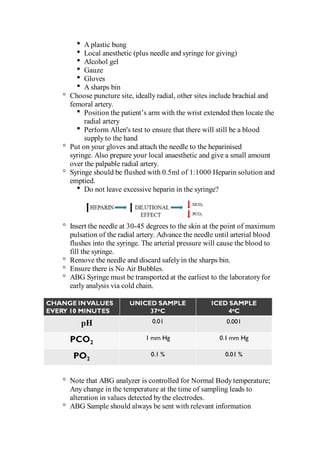
Syringe should be flushed with 0.5ml of 1:1000 Heparin solution and
emptied.
Do not leave excessive heparin in the syringe?
Insert the needle at 30-45 degrees to the skin at the point of maximum
pulsation of the radial artery. Advance the needle until arterial blood
flushes into the syringe. The arterial pressure will cause the blood to
fill the syringe.
Remove the needle and discard safely in the sharps bin.
Ensure there is No Air Bubbles.
ABG Syringe must be transported at the earliest to the laboratory for
early analysis via cold chain.
Note that ABG analyzer is controlled for Normal Body temperature;
Any change in the temperature at the time of sampling leads to
alteration in values detected by the electrodes.
ABG Sample should always be sent with relevant information
regarding O2, FiO2 status and Temp.
Possible complications include:
Hematoma at the site of puncture.
Thrombus in the artery.
Infection.
ABG interpretation
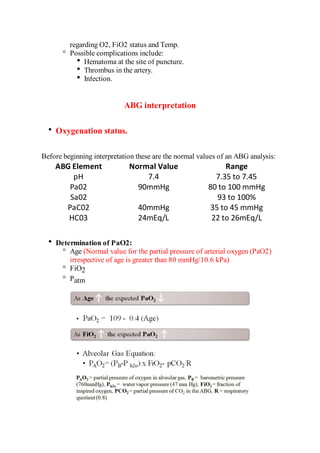
Oxygenation status.
Before beginning interpretation these are the normal values of an ABG analysis:
ABG Element Normal Value Range
pH 7.4 7.35 to 7.45
Pa02 90mmHg 80 to 100 mmHg
Sa02 93 to 100%
PaC02 40mmHg 35 to 45 mmHg
HC03 24mEq/L 22 to 26mEq/L
Determination of PaO2:
Age (Normal value for the partial pressure of arterial oxygen (PaO2)
irrespective of age is greater than 80 mmHg/10.6 kPa)
FiO2
Patm
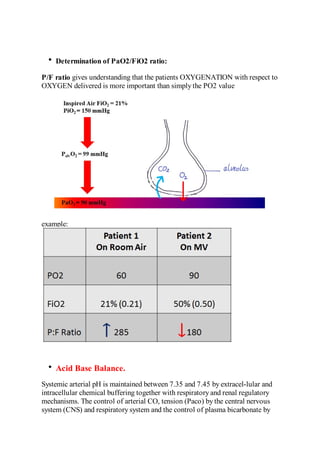
Determination of PaO2/FiO2 ratio:
P/F ratio gives understanding that the patients OXYGENATION with respect to
OXYGEN delivered is more important than simply the PO2 value
example:
Acid Base Balance.
Systemic arterial pH is maintained between 7.35 and 7.45 by extracel-lular and
intracellular chemical buffering together with respiratory and renal regulatory
mechanisms. The control of arterial CO, tension (Paco) by the central nervous
system (CNS) and respiratory system and the control of plasma bicarbonate by
the kidneys stabilize the arterial pH by excretion or retention of acid or alkali
The metabolic and respiratory components that regulate systemic pH are
described by the Henderson-Hasselbalch equation:
H+ion concentration in the body is precisely regulated by 3 lines of deference:
Bicarbonate buffer:
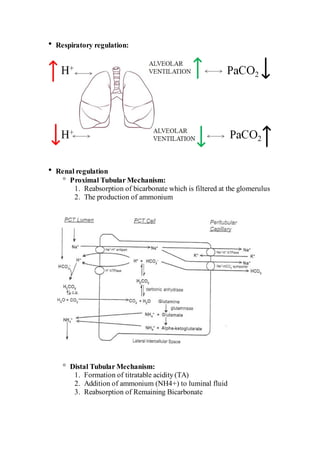
Respiratory regulation:
Renal regulation
Proximal Tubular Mechanism:
1. Reabsorption of bicarbonate which is filtered at the glomerulus
2. The production of ammonium
Distal Tubular Mechanism:
1. Formation of titratable acidity (TA)
2. Addition of ammonium (NH4+) to luminal fluid
3. Reabsorption of Remaining Bicarbonate
Types of acid base disorders:
Prediction of compensatory responses on simple acid base disorder:
Metabolic disorders
Metabolic acidosis:
For every 1mmol/l decrease in HCO3 the PCO2 falls by
1.25mmHg
PCO2 = [HCO3-] + 15
Metabolic alkalosis:
For every 1mol/l increment in HCO3 the PCO2 increases
by 0.75mmHg
PCO2 = [HCO3-] + 15
Respiratory disorders:
Respiratory Acidosis:
Acute: 1 mmHg increment in PCO2 > increase in HCO3
by 0.1 meq/l
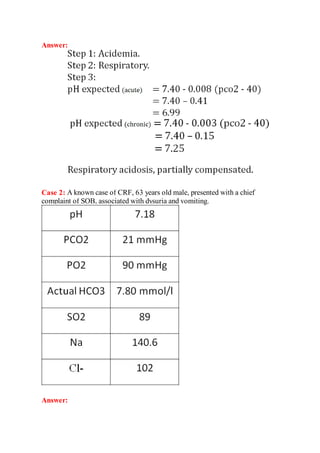
pH=7.40–0.008(PCO2-40)
Chronic: 1 mmHg increment in PCO2 > increase in HCO3
by 0.4 meq/l
pH=7.40–0.003(PCO2-40)
Respiratory alkalosis:
Acute: 1 mmHg decrease in PCO2 > decrease in HCO3 by
0.2 meq/l
pH=7.40+0.008(40-PCO2)
Chronic: 1 mmHg decrease in PCO2 > decrease in HCO3
by 0.4 meq/l
pH=7.40+0.003(40-PCO2)
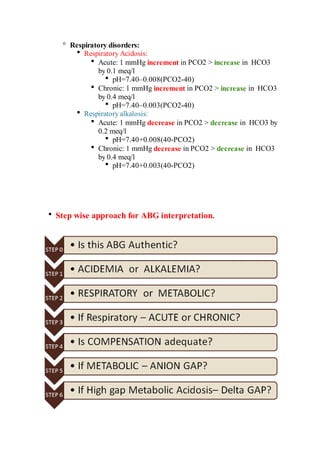
Step wise approach for ABG interpretation.
STEP 0: Is this ABG authentic?
STEP 1: Acidemia or alkalemia?
STEP 2: Respiratory or Metabolic?
STEP 3: If respiratory; Acute or chronic?
STEP 4: Is compensation adequate?
STEP 5: If metabolic; Anion gap?
Let's talk a little about anion gap concept...
Anion gap is based on the principle of electro-neutrality, is the measurement
of the balance between cations (+ve) and anions (-ve). It's an important
diagnostic tool when you looking at a metabolic acidosis.
The normal value for the serum anion gap is 12 ± 4 mEq/L.
STEP 6: If high gap; delta ratio?
If one molecule of metabolic acid (HA) is added to the ECF and dissociates, the
one H+ released will react with one molecule of HCO3- to produce CO2 and
H2O. This is the process of buffering. The net effect will be an increase in
unmeasured anions by the one acid anion A- (ie anion gap increases by one) and
a decrease in the bicarbonate by one.
Now, if all the acid dissociated in the ECF and all the buffering was by
bicarbonate, then the increase in the AG should be equal to the decrease in
bicarbonate so the ratio between these two changes (which we call the delta
ratio) should be equal to one. The delta ratio quantifies the relationship between
the changes in these two quantities.
Example:
If the AG was say 26 mmols/l (an increase of 14 from the average value of 12),
it might be expected that the HCO3-would fall by the same amount from its
usual value (ie 24 minus 14 = 10mmols/l). If the actual HCO3- value was
different from this it would be indirect evidence of the presence of certain other
acid-base disorders
Delta Ratio Assessment Guideline
< 0.4 Hyperchloraemic normal anion gap acidosis
0.4 - 0.8 Consider combined high AG & normal AG
acidosis BUT note that the ratio is often <1 in
acidosis associated with renal failure
1 to 2 Usual for uncomplicated high-AG acidosis
> 2 Suggests a pre-existing elevated HCO3 level so
consider: a concurrent metabolic alkalosis, or a
pre-existing compensated respiratory acidosis.
Clinical Case Scenarios
Case 1: A known case of COPD, 62 years old male, presented with SOB on
exertion.
Answer:
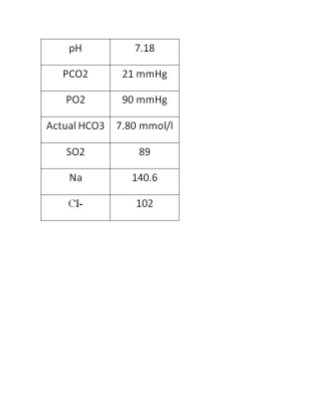
Case 2: A known case of CRF, 63 years old male, presented with a chief
complaint of SOB, associated with dysuria and vomiting.
Answer:
Questions & Discussion.

Abg interpretation

  • 1.
    Created: 3/7/2017 19:37 Author:Ali Sadeq ABG Interpretation Overview: ABG Sampling Indications. Procedure and Precautions. Complications. ABG interpretation Oxygenation status. Acid Base status. Step wise approach for ABG interpretation. Clinical case scenarios. ABG Sampling An arterial blood gas (ABG) test is a blood gas test of blood from an artery; it is thus a blood test that measures the amounts of certain gases (such as oxygen and carbon dioxide) dissolved in arterial blood. Indications: Identification of respiratory, metabolic, and mixed acid-base disorders, with or without physiologic compensation. Assess the ventilatory status, oxygenation and acid base status. Assessment of the response to therapeutic interventions. Regulate electrolyte therapy. Contraindications include infection at the site of the puncture, coagulopathy or atriovenous fistula. Procedure and Precautions: Wash your hands, introduce yourself to the patient and clarify their identity. Explain what you would like to do and obtain consent. This is
  • 2.
    a slightly uncomfortableprocedure so you should let the patient know this. Prepare the equipment. Needle 2ml syringe with heparin and a cap for the syringe A plastic bung Local anesthetic (plus needle and syringe for giving) Alcohol gel Gauze Gloves A sharps bin Choose puncture site, ideally radial, other sites include brachial and femoral artery. Position the patient’s arm with the wrist extended then locate the radial artery Perform Allen's test to ensure that there will still be a blood supply to the hand Put on your gloves and attach the needle to the heparinised syringe. Also prepare your local anaesthetic and give a small amount over the palpable radial artery. Syringe should be flushed with 0.5ml of 1:1000 Heparin solution and emptied. Do not leave excessive heparin in the syringe? Insert the needle at 30-45 degrees to the skin at the point of maximum pulsation of the radial artery. Advance the needle until arterial blood flushes into the syringe. The arterial pressure will cause the blood to fill the syringe. Remove the needle and discard safely in the sharps bin. Ensure there is No Air Bubbles. ABG Syringe must be transported at the earliest to the laboratory for early analysis via cold chain.
  • 3.
    Note that ABGanalyzer is controlled for Normal Body temperature; Any change in the temperature at the time of sampling leads to alteration in values detected by the electrodes. ABG Sample should always be sent with relevant information regarding O2, FiO2 status and Temp. Possible complications include: Hematoma at the site of puncture. Thrombus in the artery. Infection. ABG interpretation Oxygenation status. Before beginning interpretation these are the normal values of an ABG analysis: ABG Element Normal Value Range pH 7.4 7.35 to 7.45 Pa02 90mmHg 80 to 100 mmHg Sa02 93 to 100% PaC02 40mmHg 35 to 45 mmHg HC03 24mEq/L 22 to 26mEq/L
  • 4.
    Determination of PaO2: Age(Normal value for the partial pressure of arterial oxygen (PaO2) irrespective of age is greater than 80 mmHg/10.6 kPa) FiO2 Patm Determination of PaO2/FiO2 ratio: P/F ratio gives understanding that the patients OXYGENATION with respect to OXYGEN delivered is more important than simply the PO2 value
  • 5.
    example: Acid Base Balance. Systemicarterial pH is maintained between 7.35 and 7.45 by extracel-lular and intracellular chemical buffering together with respiratory and renal regulatory mechanisms. The control of arterial CO, tension (Paco) by the central nervous system (CNS) and respiratory system and the control of plasma bicarbonate by the kidneys stabilize the arterial pH by excretion or retention of acid or alkali The metabolic and respiratory components that regulate systemic pH are described by the Henderson-Hasselbalch equation: H+ion concentration in the body is precisely regulated by 3 lines of deference:
  • 6.
  • 7.
    Renal regulation Proximal TubularMechanism: 1. Reabsorption of bicarbonate which is filtered at the glomerulus 2. The production of ammonium Distal Tubular Mechanism: 1. Formation of titratable acidity (TA) 2. Addition of ammonium (NH4+) to luminal fluid
  • 8.
    3. Reabsorption ofRemaining Bicarbonate Types of acid base disorders: Prediction of compensatory responses on simple acid base disorder:
  • 9.
    Metabolic disorders Metabolic acidosis: Forevery 1mmol/l decrease in HCO3 the PCO2 falls by 1.25mmHg PCO2 = [HCO3-] + 15 Metabolic alkalosis: For every 1mol/l increment in HCO3 the PCO2 increases by 0.75mmHg PCO2 = [HCO3-] + 15 Respiratory disorders: Respiratory Acidosis: Acute: 1 mmHg increment in PCO2 > increase in HCO3 by 0.1 meq/l pH=7.40–0.008(PCO2-40) Chronic: 1 mmHg increment in PCO2 > increase in HCO3 by 0.4 meq/l pH=7.40–0.003(PCO2-40) Respiratory alkalosis: Acute: 1 mmHg decrease in PCO2 > decrease in HCO3 by 0.2 meq/l pH=7.40+0.008(40-PCO2) Chronic: 1 mmHg decrease in PCO2 > decrease in HCO3 by 0.4 meq/l pH=7.40+0.003(40-PCO2) Step wise approach for ABG interpretation.
  • 10.
    STEP 0: Isthis ABG authentic?
  • 11.
    STEP 1: Acidemiaor alkalemia? STEP 2: Respiratory or Metabolic? STEP 3: If respiratory; Acute or chronic?
  • 12.
    STEP 4: Iscompensation adequate? STEP 5: If metabolic; Anion gap? Let's talk a little about anion gap concept...
  • 13.
    Anion gap isbased on the principle of electro-neutrality, is the measurement of the balance between cations (+ve) and anions (-ve). It's an important diagnostic tool when you looking at a metabolic acidosis. The normal value for the serum anion gap is 12 ± 4 mEq/L. STEP 6: If high gap; delta ratio?
  • 14.
    If one moleculeof metabolic acid (HA) is added to the ECF and dissociates, the one H+ released will react with one molecule of HCO3- to produce CO2 and H2O. This is the process of buffering. The net effect will be an increase in unmeasured anions by the one acid anion A- (ie anion gap increases by one) and a decrease in the bicarbonate by one. Now, if all the acid dissociated in the ECF and all the buffering was by bicarbonate, then the increase in the AG should be equal to the decrease in bicarbonate so the ratio between these two changes (which we call the delta ratio) should be equal to one. The delta ratio quantifies the relationship between the changes in these two quantities. Example: If the AG was say 26 mmols/l (an increase of 14 from the average value of 12), it might be expected that the HCO3-would fall by the same amount from its usual value (ie 24 minus 14 = 10mmols/l). If the actual HCO3- value was different from this it would be indirect evidence of the presence of certain other acid-base disorders Delta Ratio Assessment Guideline < 0.4 Hyperchloraemic normal anion gap acidosis 0.4 - 0.8 Consider combined high AG & normal AG acidosis BUT note that the ratio is often <1 in acidosis associated with renal failure 1 to 2 Usual for uncomplicated high-AG acidosis > 2 Suggests a pre-existing elevated HCO3 level so consider: a concurrent metabolic alkalosis, or a pre-existing compensated respiratory acidosis.
  • 15.
    Clinical Case Scenarios Case1: A known case of COPD, 62 years old male, presented with SOB on exertion.
  • 16.
    Answer: Case 2: Aknown case of CRF, 63 years old male, presented with a chief complaint of SOB, associated with dysuria and vomiting.
  • 18.