Arterial Blood Gas
Interpretation
PRESENTER- Dr. Garima Aggarwal
Resident IInd Yr
Department of Medicine
MODERATOR- Dr. Vikas Kesarwani
5th August
2011
OBJECTIVES
ABG Sampling
Interpretation of ABG
Oxygenation status
Acid Base status
Case Scenarios
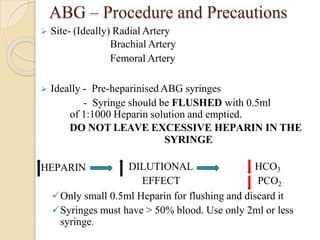
ABG – Procedure and Precautions
 Site- (Ideally) Radial Artery
Brachial Artery
Femoral Artery
 Ideally - Pre-heparinised ABG syringes
- Syringe should be FLUSHED with 0.5ml
of 1:1000 Heparin solution and emptied.
DO NOT LEAVE EXCESSIVE HEPARIN IN THE
SYRINGE
HEPARIN DILUTIONAL
EFFECT
HCO3
PCO2
Only small 0.5ml Heparin for flushing and discard it
Syringes must have > 50% blood. Use only 2ml or less
syringe.
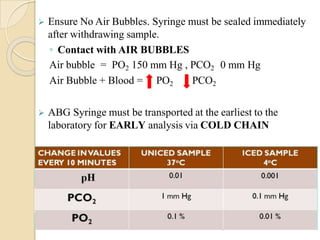
 Ensure No Air Bubbles. Syringe must be sealed immediately
after withdrawing sample.
◦ Contact with AIR BUBBLES
Air bubble = PO2 150 mm Hg , PCO2 0 mm Hg
Air Bubble + Blood = PO2 PCO2
 ABG Syringe must be transported at the earliest to the
laboratory for EARLY analysis via COLD CHAIN
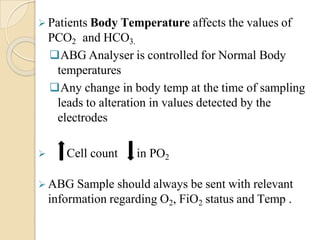
 Patients Body Temperature affects the values of
PCO2 and HCO3.
ABG Analyser is controlled for Normal Body
temperatures
Any change in body temp at the time of sampling
leads to alteration in values detected by the
electrodes
 Cell count in PO2
 ABG Sample should always be sent with relevant
information regarding O2, FiO2 status and Temp .
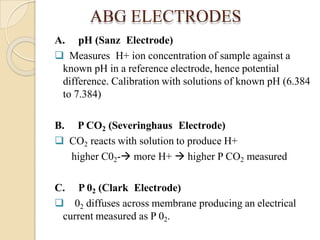
ABG ELECTRODES
A. pH (Sanz Electrode)
 Measures H+ ion concentration of sample against a
known pH in a reference electrode, hence potential
difference. Calibration with solutions of known pH (6.384
to 7.384)
B. P CO2 (Severinghaus Electrode)
 CO2 reacts with solution to produce H+
higher C02- more H+  higher P CO2 measured
C. P 02 (Clark Electrode)
 02 diffuses across membrane producing an electrical
current measured as P 02.
Interpretation of ABG
 OXYGENATION
 ACID BASE
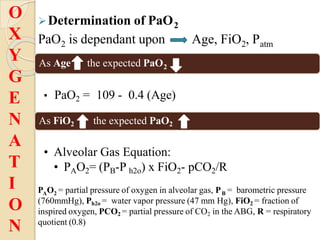
Determination of PaO2
2
PaO is dependant upon Age, FiO , P
2 atm
As Age the expected PaO2
• PaO2 = 109 - 0.4 (Age)
As FiO2 the expected PaO2
• Alveolar Gas Equation:
• PAO2= (PB-P h2o) x FiO2- pCO2/R
O
X
Y
G
E
N
A
T
I
O
N
A 2 B
P O = partial pressure of oxygen in alveolar gas, P = barometric pressure
(760mmHg), Ph2o = water vapor pressure (47 mm Hg), FiO2 = fraction of
inspired oxygen, PCO2 = partial pressure of CO2 in the ABG, R = respiratory
quotient (0.8)
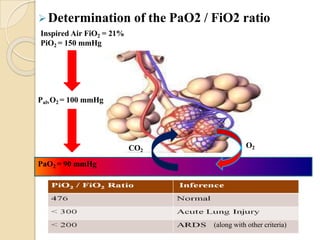
Determination of the PaO2 / FiO2 ratio
Inspired Air FiO2 = 21%
PiO2 = 150 mmHg
PalvO2 = 100 mmHg
PaO2 = 90 mmHg
O2
CO2
(along with other criteria)
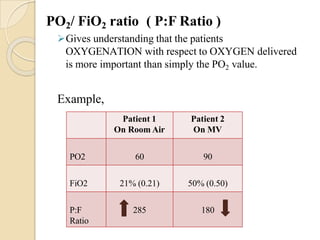
PO2/ FiO2 ratio ( P:F Ratio )
Gives understanding that the patients
OXYGENATION with respect to OXYGEN delivered
is more important than simply the PO2 value.
Example,
Patient 1
On Room Air
Patient 2
On MV
PO2 60 90
FiO2 21% (0.21) 50% (0.50)
P:F
Ratio
285 180
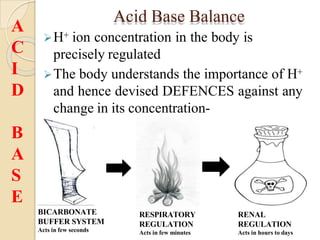
Acid Base Balance
H+ ion concentration in the body is
precisely regulated
The body understands the importance of H+
and hence devised DEFENCES against any
change in its concentration-
BICARBONATE
BUFFER SYSTEM
Acts in few seconds
RESPIRATORY
REGULATION
Acts in few minutes
RENAL
REGULATION
Acts in hours to days
A
C
I
D
B
A
S
E
Regulation of Acid Base
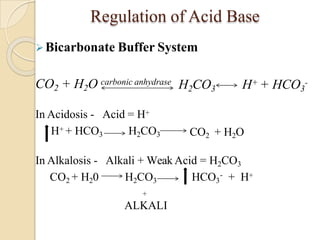
Bicarbonate Buffer System
H2CO3 H+ + HCO3
-
CO2 + H2O carbonic anhydrase
In Acidosis - Acid = H+
H+ + HCO3 H2CO3 CO2 + H2O
In Alkalosis - Alkali + Weak Acid = H2CO3
CO2 + H20 -
HCO3 + H+
H2CO3
+
ALKALI
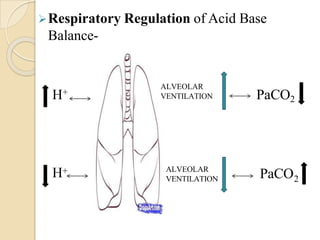
Respiratory Regulation of Acid Base
Balance-
H+ PaCO2
H+ PaCO2
ALVEOLAR
VENTILATION
ALVEOLAR
VENTILATION
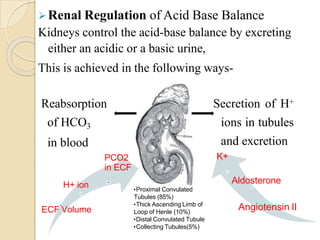
Renal Regulation of Acid Base Balance
Kidneys control the acid-base balance by excreting
either an acidic or a basic urine,
This is achieved in the following ways-
•Proximal Convulated
Tubules (85%)
•Thick Ascending Limb of
Loop of Henle (10%)
•Distal Convulated Tubule
•Collecting Tubules(5%)
ECF Volume
Reabsorption
of HCO3
in blood
PCO2
in ECF
H+ ion
Angiotensin II
Aldosterone
Secretion of H+
ions in tubules
and excretion
K+
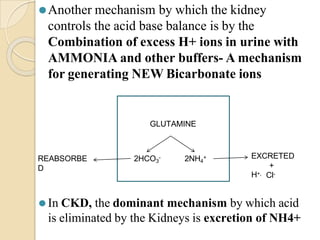
⚫Another mechanism by which the kidney
controls the acid base balance is by the
Combination of excess H+ ions in urine with
AMMONIA and other buffers- A mechanism
for generating NEW Bicarbonate ions
⚫In CKD, the dominant mechanism by which acid
is eliminated by the Kidneys is excretion of NH4+
GLUTAMINE
2HCO3
- 2NH4
+
REABSORBE
D
EXCRETED
+
H+, Cl-
Assessment of ACID BASE Balance
⚫Definitions and Terminology
ACIDOSIS – presence of a process which tends to
pH by virtue of gain of H + or loss of HCO3
-
ALKALOSIS – presence of a process which tends
3
to pH by virtue of loss of H+ or gain of HCO -
If these changes, change pH, suffix ‘emia’ is added
 ACIDEMIA – reduction in arterial pH (pH<7.35)
 ALKALEMIA – increase in arterial pH (pH>7.45)
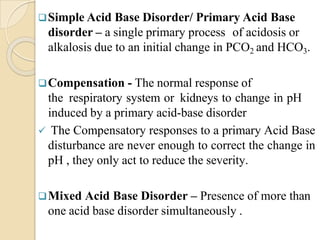
Simple Acid Base Disorder/ Primary Acid Base
disorder – a single primary process of acidosis or
alkalosis due to an initial change in PCO2 and HCO3.
Compensation - The normal response of
the respiratory system or kidneys to change in pH
induced by a primary acid-base disorder
 The Compensatory responses to a primary Acid Base
disturbance are never enough to correct the change in
pH , they only act to reduce the severity.
Mixed Acid Base Disorder – Presence of more than
one acid base disorder simultaneously .
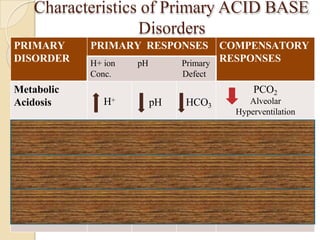
Characteristics of Primary ACID BASE
Disorders
PRIMARY
DISORDER
PRIMARY RESPONSES COMPENSATORY
RESPONSES
H+ ion pH
Conc.
Primary
Defect
Metabolic
Acidosis H+ pH HCO3
PCO2
Alveolar
Hyperventilation
Metabolic
Alkalosis H+ pH HCO3
PCO2
Alveolar
Hypoventilation
Respiratory
Acidosis H+ pH PCO2 HCO3
Respiratory
Alkalosis H+ pH PCO2 HCO3
Compensation
• PCO2 = (1.5 X [HCO3
-])+8 + 2
• PCO2 = [HCO3-] + 15
• For every 1mmol/l in HCO3 the PCO2
falls by 1.25 mm Hg
METABOLIC
ACIDOSIS
• PCO2 = (0.7 X [HCO3
-])+ 21 + 2
3
• PCO2 = [HCO -] + 15
• For every 1mol/l in HCO3 the PCO2
by 0.75 mm Hg
METABOLIC
ALKALOSIS
Metabolic Disorders – Compensation in these disorders leads to
a change in PCO2
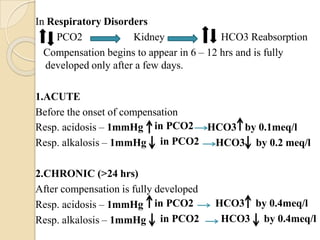
In Respiratory Disorders
PCO2 Kidney HCO3 Reabsorption
Compensation begins to appear in 6 – 12 hrs and is fully
developed only after a few days.
1.ACUTE
Before the onset of compensation
HCO3 by 0.1meq/l
Resp. acidosis – 1mmHg
Resp. alkalosis – 1mmHg
in PCO2
in PCO2 HCO3 by 0.2 meq/l
2.CHRONIC (>24 hrs)
After compensation is fully developed
Resp. acidosis – 1mmHg
Resp. alkalosis – 1mmHg
in PCO2
in PCO2
HCO3
HCO3
by 0.4meq/l
by 0.4meq/l
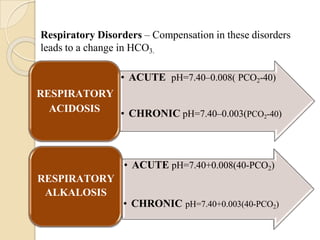
• CHRONIC pH=7.40–0.003(PCO2-40)
Respiratory Disorders – Compensation in these disorders
leads to a change in HCO3.
• ACUTE pH=7.40–0.008( PCO2-40)
RESPIRATORY
ACIDOSIS
• ACUTE pH=7.40+0.008(40-PCO2)
RESPIRATORY
ALKALOSIS
• CHRONIC pH=7.40+0.003(40-PCO2)
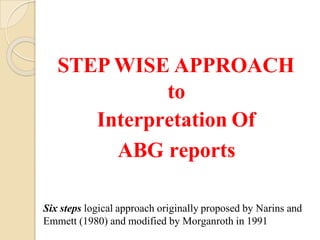
STEP WISE APPROACH
to
Interpretation Of
ABG reports
Six steps logical approach originally proposed by Narins and
Emmett (1980) and modified by Morganroth in 1991
Normal Values
ANALYTE Normal Value Units
pH 7.35 - 7.45
PCO2 35 - 45 mm Hg
PO2 72 – 104 mm Hg`
[HCO3] 22 – 30 meq/L
SaO2 95-100 %
Anion Gap 12 + 4 meq/L
∆HCO3 +2 to -2 meq/L
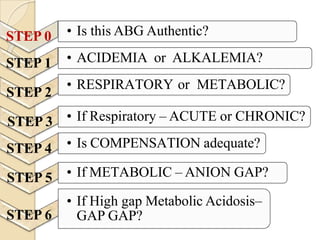
STEP 0
STEP 1
STEP 2
• Is this ABG Authentic?
• ACIDEMIA or ALKALEMIA?
• RESPIRATORY or METABOLIC?
STEP 3
STEP 4
• If Respiratory – ACUTE or CHRONIC?
• Is COMPENSATION adequate?
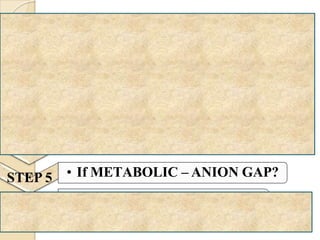
STEP 5 • If METABOLIC – ANION GAP?
STEP 6
• If High gap Metabolic Acidosis–
GAP GAP?
Is this ABG authentic ?
⚫ pH = - log [H+]
Henderson-Hasselbalch equation
pH = 6.1 + log HCO3
-
0.03 x PCO2
The [HCO3-] mentioned on the ABG is actually calculated
using this equation from measured values of PCO2 nd pH
• [H+] neq/l = 24 X (PCO2 / HCO3)
• pH = -log [ H+]
pHexpected = pHmeasured = ABG is authentic
⚫Reference table for pH v/s [H+]
[H+] neq/l = 24 X (PCO2 / HCO3)
H+ ion pH
100 7.00
79 7.10
63 7.20
50 7.30
45 7.35
40 7.40
35 7.45
32 7.50
25 7.60
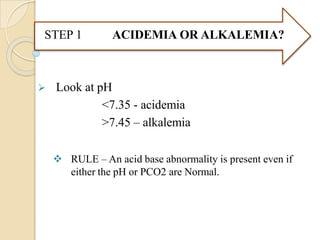
 Look at pH
<7.35 - acidemia
>7.45 – alkalemia
 RULE – An acid base abnormality is present even if
either the pH or PCO2 are Normal.
ACIDEMIA OR ALKALEMIA?
STEP 1
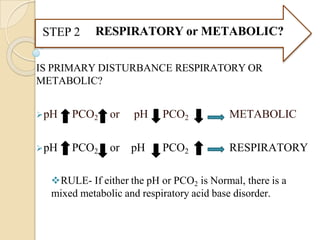
IS PRIMARY DISTURBANCE RESPIRATORY OR
METABOLIC?
pH PCO2 or pH PCO2 METABOLIC
pH PCO2 or pH PCO2 RESPIRATORY
RULE- If either the pH or PCO2 is Normal, there is a
mixed metabolic and respiratory acid base disorder.
RESPIRATORY or METABOLIC?
STEP 2
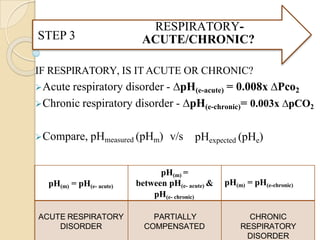
IF RESPIRATORY, IS IT ACUTE OR CHRONIC?
Acute respiratory disorder - ∆pH(e-acute) = 0.008x ∆Pco2
Chronic respiratory disorder - ∆pH(e-chronic)= 0.003x ∆pCO2
Compare, pHmeasured (pHm) v/s pHexpected (pHe)
RESPIRATORY-
ACUTE/CHRONIC?
STEP 3
pH(m) = pH(e- acute)
pH(m) =
between pH(e- acute) &
pH(e- chronic)
pH(m) = pH(e-chronic)
ACUTE RESPIRATORY
DISORDER
PARTIALLY
COMPENSATED
CHRONIC
RESPIRATORY
DISORDER
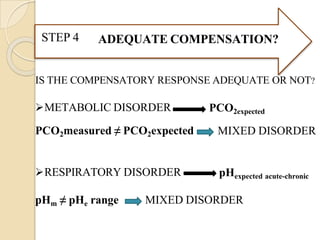
ADEQUATE COMPENSATION?
STEP 4
IS THE COMPENSATORY RESPONSE ADEQUATE OR NOT?
METABOLIC DISORDER
PCO2measured ≠ PCO2expected
PCO2expected
MIXED DISORDER
RESPIRATORY DISORDER pHexpected acute-chronic
pHm ≠ pHe range MIXED DISORDER
STEP 0
STEP 1
STEP 2
• Is this ABG Authentic?
• ACIDEMIA or ALKALEMIA?
• RESPIRATORY or METABOLIC?
STEP 3
STEP 4
• If Respiratory – ACUTE or CHRONIC?
• Is COMPENSATION adequate?
STEP 5 • If METABOLIC – ANION GAP?
STEP 6
• If High gap Metabolic Acidosis–
GAP GAP?
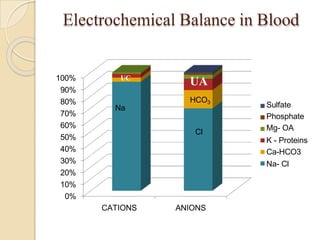
Electrochemical Balance in Blood
80%
70%
60%
50%
40%
30%
20%
10%
0%
100%
90%
CATIONS ANIONS
Sulfate
Phosphate
Mg- OA
K - Proteins
Ca-HCO3
Na- Cl
UA
UC
Na
Cl
HCO3
Anion Gap
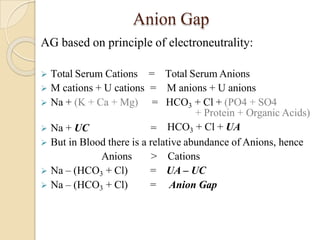
AG based on principle of electroneutrality:
 Total Serum Cations
 M cations + U cations
=
=
Total Serum Anions
M anions + U anions
 Na + (K + Ca + Mg) = HCO3 + Cl + (PO4 + SO4
 Na + UC =
+ Protein + Organic Acids)
HCO3 + Cl + UA
 But in Blood there is a relative abundance of Anions, hence
Anions > Cations
 Na – (HCO3 + Cl) = UA – UC
 Na – (HCO3 + Cl) = Anion Gap
METABOLIC ACIDOSIS-
ANION GAP?
STEP 5
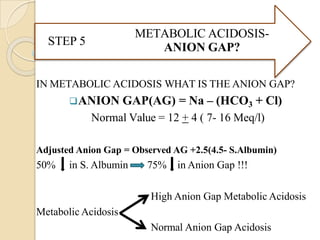
IN METABOLIC ACIDOSIS WHAT IS THE ANION GAP?
ANION GAP(AG) = Na – (HCO3 + Cl)
Normal Value = 12 + 4 ( 7- 16 Meq/l)
Adjusted Anion Gap = Observed AG +2.5(4.5- S.Albumin)
50% in S. Albumin 75% in Anion Gap !!!
High Anion Gap Metabolic Acidosis
Metabolic Acidosis
Normal Anion Gap Acidosis
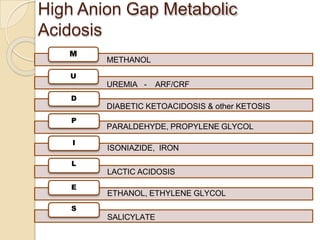
High Anion Gap Metabolic
Acidosis
M
U
D
P
I
E
METHANOL
UREMIA - ARF/CRF
DIABETIC KETOACIDOSIS & other KETOSIS
PARALDEHYDE, PROPYLENE GLYCOL
ISONIAZIDE, IRON
L
LACTIC ACIDOSIS
ETHANOL, ETHYLENE GLYCOL
S
SALICYLATE
CO EXISTANT METABOLIC
DISORDER – “Gap Gap”?
STEP 6
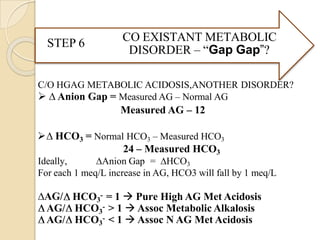
C/O HGAG METABOLIC ACIDOSIS,ANOTHER DISORDER?
 ∆ Anion Gap = Measured AG – Normal AG
Measured AG – 12
∆ HCO3 = Normal HCO3 – Measured HCO3
24 – Measured HCO3
Ideally, ∆Anion Gap = ∆HCO3
For each 1 meq/L increase in AG, HCO3 will fall by 1 meq/L
∆AG/ HCO3
- = 1  Pure High AG Met Acidosis
AG/ HCO3
- > 1  Assoc Metabolic Alkalosis
AG/ HCO3
- < 1  Assoc N AG Met Acidosis
Clinical
CASE
SCENARIOS
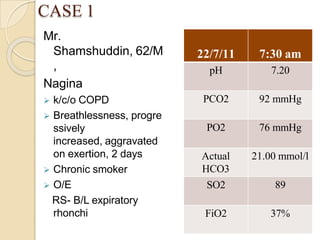
CASE 1
Mr.
Shamshuddin, 62/M
,
Nagina
 k/c/o COPD
 Breathlessness, progre
ssively
increased, aggravated
on exertion, 2 days
 Chronic smoker
 O/E
RS- B/L expiratory
rhonchi
22/7/11 7:30 am
pH 7.20
PCO2 92 mmHg
PO2 76 mmHg
Actual
HCO3
21.00 mmol/l
SO2 89
FiO2 37%
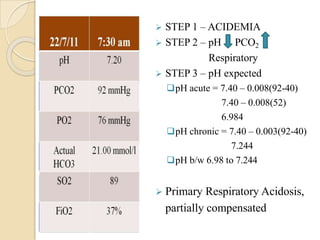
 STEP 1 – ACIDEMIA
 STEP 2 – pH PCO2
Respiratory
 STEP 3 – pH expected
pH acute = 7.40 – 0.008(92-40)
7.40 – 0.008(52)
6.984
pH chronic = 7.40 – 0.003(92-40)
7.244
pH b/w 6.98 to 7.244
 Primary Respiratory Acidosis,
partially compensated
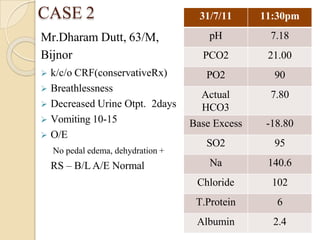
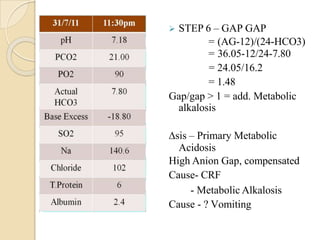
CASE 2 31/7/11 11:30pm
pH 7.18
PCO2 21.00
PO2 90
Actual
HCO3
7.80
Base Excess -18.80
SO2 95
Na 140.6
Chloride 102
T.Protein 6
Albumin 2.4
Mr.Dharam Dutt, 63/M,
Bijnor
 k/c/o CRF(conservativeRx)
 Breathlessness
 Decreased Urine Otpt. 2days
 Vomiting 10-15
 O/E
No pedal edema, dehydration +
RS – B/LA/E Normal
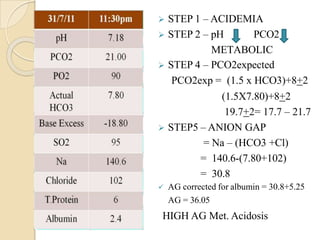
 STEP 1 – ACIDEMIA
 STEP 2 – pH PCO2
METABOLIC
 STEP 4 – PCO2expected
PCO2exp = (1.5 x HCO3)+8+2
(1.5X7.80)+8+2
19.7+2= 17.7 – 21.7
 STEP5 – ANION GAP
= Na – (HCO3 +Cl)
= 140.6-(7.80+102)
= 30.8
 AG corrected for albumin = 30.8+5.25
AG = 36.05
HIGH AG Met. Acidosis
 STEP 6 – GAP GAP
= (AG-12)/(24-HCO3)
= 36.05-12/24-7.80
= 24.05/16.2
= 1.48
Gap/gap > 1 = add. Metabolic
alkalosis
∆sis – Primary Metabolic
Acidosis
High Anion Gap, compensated
Cause- CRF
- Metabolic Alkalosis
Cause - ? Vomiting
References
1) Harrison’s Principles of Internal Medicine, 17th edition,
Chap 48 – Acidosis and Alkalosis
2) Paul L.Marino – The ICU Book, 3rd Edition
3) Guyton and Hall – Textbook of Medical Physiology, 11th
edition
4) Davenport – The ABC of Acid Base Chemistry, 6th edition
5) Cohen and Kassirer – Acid Base
6) Hansen JE, Clinics in Chest medicine10(2), 1989, 227-37
7) Lippincott’s-Fluid Balance, NM Metheny
8) World Wide Web

abg objetives.pptx

  • 1.
    Arterial Blood Gas Interpretation PRESENTER-Dr. Garima Aggarwal Resident IInd Yr Department of Medicine MODERATOR- Dr. Vikas Kesarwani 5th August 2011
  • 2.
    OBJECTIVES ABG Sampling Interpretation ofABG Oxygenation status Acid Base status Case Scenarios
  • 3.
    ABG – Procedureand Precautions  Site- (Ideally) Radial Artery Brachial Artery Femoral Artery  Ideally - Pre-heparinised ABG syringes - Syringe should be FLUSHED with 0.5ml of 1:1000 Heparin solution and emptied. DO NOT LEAVE EXCESSIVE HEPARIN IN THE SYRINGE HEPARIN DILUTIONAL EFFECT HCO3 PCO2 Only small 0.5ml Heparin for flushing and discard it Syringes must have > 50% blood. Use only 2ml or less syringe.
  • 4.
     Ensure NoAir Bubbles. Syringe must be sealed immediately after withdrawing sample. ◦ Contact with AIR BUBBLES Air bubble = PO2 150 mm Hg , PCO2 0 mm Hg Air Bubble + Blood = PO2 PCO2  ABG Syringe must be transported at the earliest to the laboratory for EARLY analysis via COLD CHAIN
  • 5.
     Patients BodyTemperature affects the values of PCO2 and HCO3. ABG Analyser is controlled for Normal Body temperatures Any change in body temp at the time of sampling leads to alteration in values detected by the electrodes  Cell count in PO2  ABG Sample should always be sent with relevant information regarding O2, FiO2 status and Temp .
  • 6.
    ABG ELECTRODES A. pH(Sanz Electrode)  Measures H+ ion concentration of sample against a known pH in a reference electrode, hence potential difference. Calibration with solutions of known pH (6.384 to 7.384) B. P CO2 (Severinghaus Electrode)  CO2 reacts with solution to produce H+ higher C02- more H+  higher P CO2 measured C. P 02 (Clark Electrode)  02 diffuses across membrane producing an electrical current measured as P 02.
  • 7.
    Interpretation of ABG OXYGENATION  ACID BASE
  • 8.
    Determination of PaO2 2 PaOis dependant upon Age, FiO , P 2 atm As Age the expected PaO2 • PaO2 = 109 - 0.4 (Age) As FiO2 the expected PaO2 • Alveolar Gas Equation: • PAO2= (PB-P h2o) x FiO2- pCO2/R O X Y G E N A T I O N A 2 B P O = partial pressure of oxygen in alveolar gas, P = barometric pressure (760mmHg), Ph2o = water vapor pressure (47 mm Hg), FiO2 = fraction of inspired oxygen, PCO2 = partial pressure of CO2 in the ABG, R = respiratory quotient (0.8)
  • 9.
    Determination of thePaO2 / FiO2 ratio Inspired Air FiO2 = 21% PiO2 = 150 mmHg PalvO2 = 100 mmHg PaO2 = 90 mmHg O2 CO2 (along with other criteria)
  • 10.
    PO2/ FiO2 ratio( P:F Ratio ) Gives understanding that the patients OXYGENATION with respect to OXYGEN delivered is more important than simply the PO2 value. Example, Patient 1 On Room Air Patient 2 On MV PO2 60 90 FiO2 21% (0.21) 50% (0.50) P:F Ratio 285 180
  • 11.
    Acid Base Balance H+ion concentration in the body is precisely regulated The body understands the importance of H+ and hence devised DEFENCES against any change in its concentration- BICARBONATE BUFFER SYSTEM Acts in few seconds RESPIRATORY REGULATION Acts in few minutes RENAL REGULATION Acts in hours to days A C I D B A S E
  • 12.
    Regulation of AcidBase Bicarbonate Buffer System H2CO3 H+ + HCO3 - CO2 + H2O carbonic anhydrase In Acidosis - Acid = H+ H+ + HCO3 H2CO3 CO2 + H2O In Alkalosis - Alkali + Weak Acid = H2CO3 CO2 + H20 - HCO3 + H+ H2CO3 + ALKALI
  • 13.
    Respiratory Regulation ofAcid Base Balance- H+ PaCO2 H+ PaCO2 ALVEOLAR VENTILATION ALVEOLAR VENTILATION
  • 14.
    Renal Regulation ofAcid Base Balance Kidneys control the acid-base balance by excreting either an acidic or a basic urine, This is achieved in the following ways- •Proximal Convulated Tubules (85%) •Thick Ascending Limb of Loop of Henle (10%) •Distal Convulated Tubule •Collecting Tubules(5%) ECF Volume Reabsorption of HCO3 in blood PCO2 in ECF H+ ion Angiotensin II Aldosterone Secretion of H+ ions in tubules and excretion K+
  • 15.
    ⚫Another mechanism bywhich the kidney controls the acid base balance is by the Combination of excess H+ ions in urine with AMMONIA and other buffers- A mechanism for generating NEW Bicarbonate ions ⚫In CKD, the dominant mechanism by which acid is eliminated by the Kidneys is excretion of NH4+ GLUTAMINE 2HCO3 - 2NH4 + REABSORBE D EXCRETED + H+, Cl-
  • 16.
    Assessment of ACIDBASE Balance ⚫Definitions and Terminology ACIDOSIS – presence of a process which tends to pH by virtue of gain of H + or loss of HCO3 - ALKALOSIS – presence of a process which tends 3 to pH by virtue of loss of H+ or gain of HCO - If these changes, change pH, suffix ‘emia’ is added  ACIDEMIA – reduction in arterial pH (pH<7.35)  ALKALEMIA – increase in arterial pH (pH>7.45)
  • 17.
    Simple Acid BaseDisorder/ Primary Acid Base disorder – a single primary process of acidosis or alkalosis due to an initial change in PCO2 and HCO3. Compensation - The normal response of the respiratory system or kidneys to change in pH induced by a primary acid-base disorder  The Compensatory responses to a primary Acid Base disturbance are never enough to correct the change in pH , they only act to reduce the severity. Mixed Acid Base Disorder – Presence of more than one acid base disorder simultaneously .
  • 18.
    Characteristics of PrimaryACID BASE Disorders PRIMARY DISORDER PRIMARY RESPONSES COMPENSATORY RESPONSES H+ ion pH Conc. Primary Defect Metabolic Acidosis H+ pH HCO3 PCO2 Alveolar Hyperventilation Metabolic Alkalosis H+ pH HCO3 PCO2 Alveolar Hypoventilation Respiratory Acidosis H+ pH PCO2 HCO3 Respiratory Alkalosis H+ pH PCO2 HCO3
  • 19.
    Compensation • PCO2 =(1.5 X [HCO3 -])+8 + 2 • PCO2 = [HCO3-] + 15 • For every 1mmol/l in HCO3 the PCO2 falls by 1.25 mm Hg METABOLIC ACIDOSIS • PCO2 = (0.7 X [HCO3 -])+ 21 + 2 3 • PCO2 = [HCO -] + 15 • For every 1mol/l in HCO3 the PCO2 by 0.75 mm Hg METABOLIC ALKALOSIS Metabolic Disorders – Compensation in these disorders leads to a change in PCO2
  • 20.
    In Respiratory Disorders PCO2Kidney HCO3 Reabsorption Compensation begins to appear in 6 – 12 hrs and is fully developed only after a few days. 1.ACUTE Before the onset of compensation HCO3 by 0.1meq/l Resp. acidosis – 1mmHg Resp. alkalosis – 1mmHg in PCO2 in PCO2 HCO3 by 0.2 meq/l 2.CHRONIC (>24 hrs) After compensation is fully developed Resp. acidosis – 1mmHg Resp. alkalosis – 1mmHg in PCO2 in PCO2 HCO3 HCO3 by 0.4meq/l by 0.4meq/l
  • 21.
    • CHRONIC pH=7.40–0.003(PCO2-40) RespiratoryDisorders – Compensation in these disorders leads to a change in HCO3. • ACUTE pH=7.40–0.008( PCO2-40) RESPIRATORY ACIDOSIS • ACUTE pH=7.40+0.008(40-PCO2) RESPIRATORY ALKALOSIS • CHRONIC pH=7.40+0.003(40-PCO2)
  • 22.
    STEP WISE APPROACH to InterpretationOf ABG reports Six steps logical approach originally proposed by Narins and Emmett (1980) and modified by Morganroth in 1991
  • 23.
    Normal Values ANALYTE NormalValue Units pH 7.35 - 7.45 PCO2 35 - 45 mm Hg PO2 72 – 104 mm Hg` [HCO3] 22 – 30 meq/L SaO2 95-100 % Anion Gap 12 + 4 meq/L ∆HCO3 +2 to -2 meq/L
  • 24.
    STEP 0 STEP 1 STEP2 • Is this ABG Authentic? • ACIDEMIA or ALKALEMIA? • RESPIRATORY or METABOLIC? STEP 3 STEP 4 • If Respiratory – ACUTE or CHRONIC? • Is COMPENSATION adequate? STEP 5 • If METABOLIC – ANION GAP? STEP 6 • If High gap Metabolic Acidosis– GAP GAP?
  • 25.
    Is this ABGauthentic ? ⚫ pH = - log [H+] Henderson-Hasselbalch equation pH = 6.1 + log HCO3 - 0.03 x PCO2 The [HCO3-] mentioned on the ABG is actually calculated using this equation from measured values of PCO2 nd pH • [H+] neq/l = 24 X (PCO2 / HCO3) • pH = -log [ H+] pHexpected = pHmeasured = ABG is authentic
  • 26.
    ⚫Reference table forpH v/s [H+] [H+] neq/l = 24 X (PCO2 / HCO3) H+ ion pH 100 7.00 79 7.10 63 7.20 50 7.30 45 7.35 40 7.40 35 7.45 32 7.50 25 7.60
  • 27.
     Look atpH <7.35 - acidemia >7.45 – alkalemia  RULE – An acid base abnormality is present even if either the pH or PCO2 are Normal. ACIDEMIA OR ALKALEMIA? STEP 1
  • 28.
    IS PRIMARY DISTURBANCERESPIRATORY OR METABOLIC? pH PCO2 or pH PCO2 METABOLIC pH PCO2 or pH PCO2 RESPIRATORY RULE- If either the pH or PCO2 is Normal, there is a mixed metabolic and respiratory acid base disorder. RESPIRATORY or METABOLIC? STEP 2
  • 29.
    IF RESPIRATORY, ISIT ACUTE OR CHRONIC? Acute respiratory disorder - ∆pH(e-acute) = 0.008x ∆Pco2 Chronic respiratory disorder - ∆pH(e-chronic)= 0.003x ∆pCO2 Compare, pHmeasured (pHm) v/s pHexpected (pHe) RESPIRATORY- ACUTE/CHRONIC? STEP 3 pH(m) = pH(e- acute) pH(m) = between pH(e- acute) & pH(e- chronic) pH(m) = pH(e-chronic) ACUTE RESPIRATORY DISORDER PARTIALLY COMPENSATED CHRONIC RESPIRATORY DISORDER
  • 30.
    ADEQUATE COMPENSATION? STEP 4 ISTHE COMPENSATORY RESPONSE ADEQUATE OR NOT? METABOLIC DISORDER PCO2measured ≠ PCO2expected PCO2expected MIXED DISORDER RESPIRATORY DISORDER pHexpected acute-chronic pHm ≠ pHe range MIXED DISORDER
  • 31.
    STEP 0 STEP 1 STEP2 • Is this ABG Authentic? • ACIDEMIA or ALKALEMIA? • RESPIRATORY or METABOLIC? STEP 3 STEP 4 • If Respiratory – ACUTE or CHRONIC? • Is COMPENSATION adequate? STEP 5 • If METABOLIC – ANION GAP? STEP 6 • If High gap Metabolic Acidosis– GAP GAP?
  • 32.
    Electrochemical Balance inBlood 80% 70% 60% 50% 40% 30% 20% 10% 0% 100% 90% CATIONS ANIONS Sulfate Phosphate Mg- OA K - Proteins Ca-HCO3 Na- Cl UA UC Na Cl HCO3
  • 33.
    Anion Gap AG basedon principle of electroneutrality:  Total Serum Cations  M cations + U cations = = Total Serum Anions M anions + U anions  Na + (K + Ca + Mg) = HCO3 + Cl + (PO4 + SO4  Na + UC = + Protein + Organic Acids) HCO3 + Cl + UA  But in Blood there is a relative abundance of Anions, hence Anions > Cations  Na – (HCO3 + Cl) = UA – UC  Na – (HCO3 + Cl) = Anion Gap
  • 34.
    METABOLIC ACIDOSIS- ANION GAP? STEP5 IN METABOLIC ACIDOSIS WHAT IS THE ANION GAP? ANION GAP(AG) = Na – (HCO3 + Cl) Normal Value = 12 + 4 ( 7- 16 Meq/l) Adjusted Anion Gap = Observed AG +2.5(4.5- S.Albumin) 50% in S. Albumin 75% in Anion Gap !!! High Anion Gap Metabolic Acidosis Metabolic Acidosis Normal Anion Gap Acidosis
  • 35.
    High Anion GapMetabolic Acidosis M U D P I E METHANOL UREMIA - ARF/CRF DIABETIC KETOACIDOSIS & other KETOSIS PARALDEHYDE, PROPYLENE GLYCOL ISONIAZIDE, IRON L LACTIC ACIDOSIS ETHANOL, ETHYLENE GLYCOL S SALICYLATE
  • 36.
    CO EXISTANT METABOLIC DISORDER– “Gap Gap”? STEP 6 C/O HGAG METABOLIC ACIDOSIS,ANOTHER DISORDER?  ∆ Anion Gap = Measured AG – Normal AG Measured AG – 12 ∆ HCO3 = Normal HCO3 – Measured HCO3 24 – Measured HCO3 Ideally, ∆Anion Gap = ∆HCO3 For each 1 meq/L increase in AG, HCO3 will fall by 1 meq/L ∆AG/ HCO3 - = 1  Pure High AG Met Acidosis AG/ HCO3 - > 1  Assoc Metabolic Alkalosis AG/ HCO3 - < 1  Assoc N AG Met Acidosis
  • 37.
  • 38.
    CASE 1 Mr. Shamshuddin, 62/M , Nagina k/c/o COPD  Breathlessness, progre ssively increased, aggravated on exertion, 2 days  Chronic smoker  O/E RS- B/L expiratory rhonchi 22/7/11 7:30 am pH 7.20 PCO2 92 mmHg PO2 76 mmHg Actual HCO3 21.00 mmol/l SO2 89 FiO2 37%
  • 39.
     STEP 1– ACIDEMIA  STEP 2 – pH PCO2 Respiratory  STEP 3 – pH expected pH acute = 7.40 – 0.008(92-40) 7.40 – 0.008(52) 6.984 pH chronic = 7.40 – 0.003(92-40) 7.244 pH b/w 6.98 to 7.244  Primary Respiratory Acidosis, partially compensated
  • 40.
    CASE 2 31/7/1111:30pm pH 7.18 PCO2 21.00 PO2 90 Actual HCO3 7.80 Base Excess -18.80 SO2 95 Na 140.6 Chloride 102 T.Protein 6 Albumin 2.4 Mr.Dharam Dutt, 63/M, Bijnor  k/c/o CRF(conservativeRx)  Breathlessness  Decreased Urine Otpt. 2days  Vomiting 10-15  O/E No pedal edema, dehydration + RS – B/LA/E Normal
  • 41.
     STEP 1– ACIDEMIA  STEP 2 – pH PCO2 METABOLIC  STEP 4 – PCO2expected PCO2exp = (1.5 x HCO3)+8+2 (1.5X7.80)+8+2 19.7+2= 17.7 – 21.7  STEP5 – ANION GAP = Na – (HCO3 +Cl) = 140.6-(7.80+102) = 30.8  AG corrected for albumin = 30.8+5.25 AG = 36.05 HIGH AG Met. Acidosis
  • 42.
     STEP 6– GAP GAP = (AG-12)/(24-HCO3) = 36.05-12/24-7.80 = 24.05/16.2 = 1.48 Gap/gap > 1 = add. Metabolic alkalosis ∆sis – Primary Metabolic Acidosis High Anion Gap, compensated Cause- CRF - Metabolic Alkalosis Cause - ? Vomiting
  • 43.
    References 1) Harrison’s Principlesof Internal Medicine, 17th edition, Chap 48 – Acidosis and Alkalosis 2) Paul L.Marino – The ICU Book, 3rd Edition 3) Guyton and Hall – Textbook of Medical Physiology, 11th edition 4) Davenport – The ABC of Acid Base Chemistry, 6th edition 5) Cohen and Kassirer – Acid Base 6) Hansen JE, Clinics in Chest medicine10(2), 1989, 227-37 7) Lippincott’s-Fluid Balance, NM Metheny 8) World Wide Web