APPROACH TO ARTERIALAPPROACH TO ARTERIAL
BLOOD GAS ANALYSISBLOOD GAS ANALYSIS
Gp Capt S Shankar
Clinical Immunologist
Command Hospital (Air Force)
A tale of two investigationsA tale of two investigations
ECG ABG
Step by step approach YES NO
Pattern recognition YES NO
Theory YES YES
Your eyes cannot see what your mind does not
know
AIMAIM
SYSTEMATIC APPROACH
– Understand the principles of reading an ABG
report
– Remember the systematic approach
– Analyse simple and complex disorders
PARTSPARTS
I-Baseline assessment
II-Understanding the principles
III-Systematic approach
IV-Interactive session
Baseline assessmentBaseline assessment
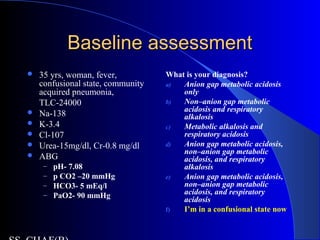
 35 yrs, woman, fever,
confusional state, community
acquired pneumonia,
TLC-24000
 Na-138
 K-3.4
 Cl-107
 Urea-15mg/dl, Cr-0.8 mg/dl
 ABG
– pH- 7.08
– p CO2 –20 mmHg
– HCO3- 5 mEq/l
– PaO2- 90 mmHg
What is your diagnosis?
a) Anion gap metabolic acidosis
only
b) Non–anion gap metabolic
acidosis and respiratory
alkalosis
c) Metabolic alkalosis and
respiratory acidosis
d) Anion gap metabolic acidosis,
non–anion gap metabolic
acidosis, and respiratory
alkalosis
e) Anion gap metabolic acidosis,
non–anion gap metabolic
acidosis, and respiratory
acidosis
f) I’m in a confusional state now
ABGABG
Important diagnostic tool
Useful for determining
– the oxygenation status
– the acid-base balance
Four basic valuesFour basic values
pH = arterial blood pH
PaCO2 (or PCO2)= arterial pressure of
CO2, in mm Hg
PaO2 (or PO2)= arterial pressure of O2, in
mm Hg
HCO3-
= serum bicarbonate concentration,
in mEq/liter
Hypoxia and HypoxemiaHypoxia and Hypoxemia
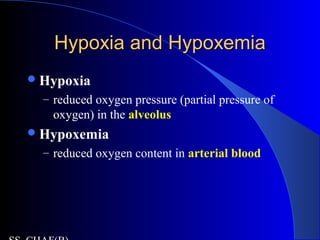
Hypoxia
– reduced oxygen pressure (partial pressure of
oxygen) in the alveolus
Hypoxemia
– reduced oxygen content in arterial blood
HypoxemiaHypoxemia
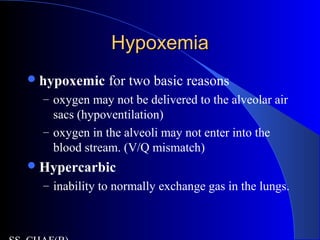
hypoxemic for two basic reasons
– oxygen may not be delivered to the alveolar air
sacs (hypoventilation)
– oxygen in the alveoli may not enter into the
blood stream. (V/Q mismatch)
Hypercarbic
– inability to normally exchange gas in the lungs.
acidosisacidosis andand alkalosisalkalosis
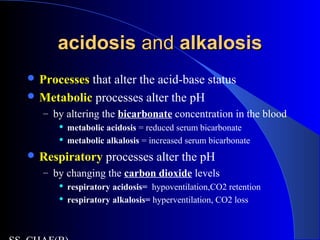
 Processes that alter the acid-base status
 Metabolic processes alter the pH
– by altering the bicarbonate concentration in the blood
 metabolic acidosis = reduced serum bicarbonate
 metabolic alkalosis = increased serum bicarbonate
 Respiratory processes alter the pH
– by changing the carbon dioxide levels
 respiratory acidosis= hypoventilation,CO2 retention
 respiratory alkalosis= hyperventilation, CO2 loss
STEPS TO ABG ANALYSISSTEPS TO ABG ANALYSIS
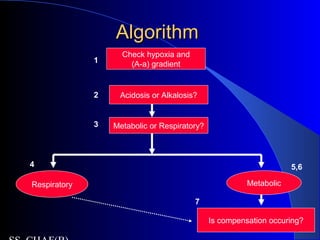
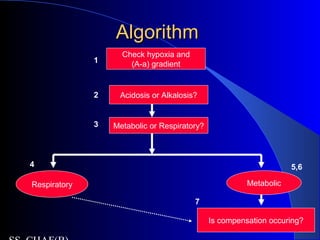
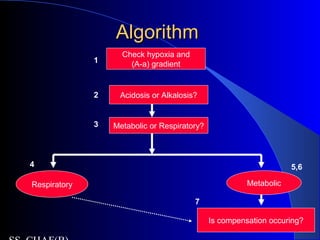
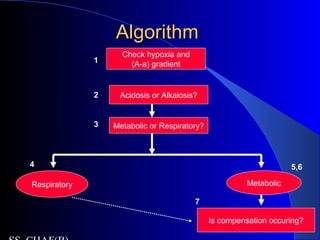
AlgorithmAlgorithm
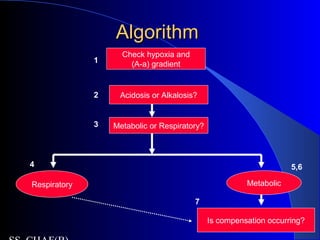
Check hypoxia and
(A-a) gradient
Acidosis or Alkalosis?
Metabolic or Respiratory?
Respiratory Metabolic
1
2
3
4 5,6
Is compensation occurring?
7
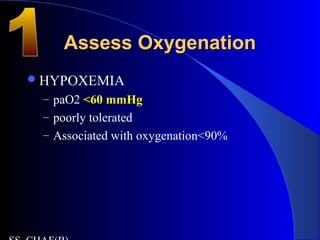
Assess OxygenationAssess Oxygenation
HYPOXEMIA
– paO2 <60 mmHg
– poorly tolerated
– Associated with oxygenation<90%
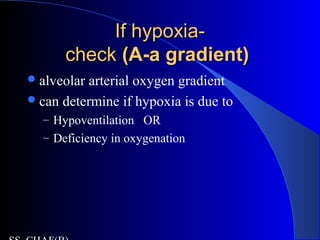
If hypoxia-If hypoxia-
checkcheck (A-a gradient)(A-a gradient)
alveolar arterial oxygen gradient
can determine if hypoxia is due to
– Hypoventilation OR
– Deficiency in oxygenation
(A-a gradient)(A-a gradient)
 partial pressure of oxygen in the alveolus
(Alveolar gas equation)
– PAO2= FiO2 x (PB- PH2O) – PaCO2/R
– PAO2= 0.21 x (760-47) – PaCO2/0.8
– PAO2= 150-1.25( PACO2)
– PACO2 = PaCO2 (CO2 freely diffuses)
 A-a gradient = PAO2 - PaO2
– = [ 150-1.25 (PaCO2) ] - PaO2
– Normal A-a gradient is 10-20 mm Hg
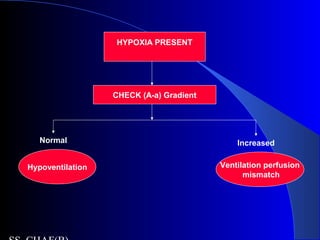
HYPOXIA PRESENT
CHECK (A-a) Gradient
Hypoventilation Ventilation perfusion
mismatch
Normal Increased
AlgorithmAlgorithm
Check hypoxia and
(A-a) gradient
Acidosis or Alkalosis?
Metabolic or Respiratory?
Respiratory Metabolic
1
2
3
4 5,6
Is compensation occuring?
7
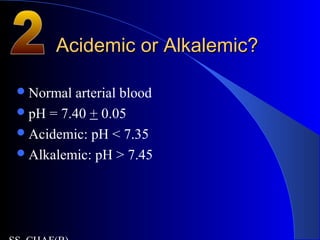
Acidemic or Alkalemic?Acidemic or Alkalemic?
Normal arterial blood
pH = 7.40 + 0.05
Acidemic: pH < 7.35
Alkalemic: pH > 7.45
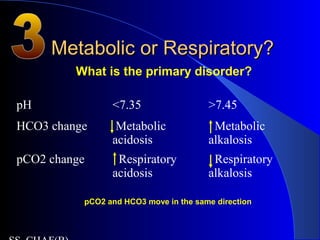
Metabolic or Respiratory?Metabolic or Respiratory?
pH <7.35 >7.45
HCO3 change Metabolic
acidosis
Metabolic
alkalosis
pCO2 change Respiratory
acidosis
Respiratory
alkalosis
pCO2 and HCO3 move in the same direction
What is the primary disorder?
AlgorithmAlgorithm
Check hypoxia and
(A-a) gradient
Acidosis or Alkalosis?
Metabolic or Respiratory?
Respiratory Metabolic
1
2
3
4 5,6
Is compensation occuring?
7
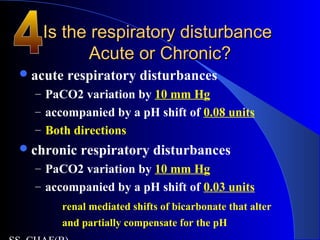
Is the respiratory disturbanceIs the respiratory disturbance
Acute or Chronic?Acute or Chronic?
acute respiratory disturbances
– PaCO2 variation by 10 mm Hg
– accompanied by a pH shift of 0.08 units
– Both directions
chronic respiratory disturbances
– PaCO2 variation by 10 mm Hg
– accompanied by a pH shift of 0.03 units
renal mediated shifts of bicarbonate that alter
and partially compensate for the pH
AlgorithmAlgorithm
Check hypoxia and
(A-a) gradient
Acidosis or Alkalosis?
Metabolic or Respiratory?
Respiratory Metabolic
1
2
3
4 5,6
Is compensation occuring?
7
For metabolic acidosis-For metabolic acidosis-
what is the anion gap?what is the anion gap?
 AG = [Na+] - ([Cl-
] + [HCO3-
])
 normal anion gap is 12
Unmeasured Anions Unmeasured Cations
Proteins, mostly albumin 15 mEq/L Calcium 5 mEq/L
Organic acids 5 mEq/L Potassium 4.5 mEq/L
Phosphates 2 mEq/L Magnesium 1.5 mEq/L
Sulfates 1 mEq/L
Totals: 23 mEq/L 11 mEq/L
Anion Gap = GAP between unmeasured anions and cations.
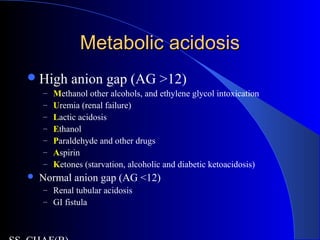
Metabolic acidosisMetabolic acidosis
High anion gap (AG >12)
– Methanol other alcohols, and ethylene glycol intoxication
– Uremia (renal failure)
– Lactic acidosis
– Ethanol
– Paraldehyde and other drugs
– Aspirin
– Ketones (starvation, alcoholic and diabetic ketoacidosis)
 Normal anion gap (AG <12)
– Renal tubular acidosis
– GI fistula
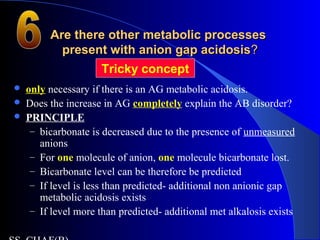
Are there other metabolic processesAre there other metabolic processes
present with anion gap acidosispresent with anion gap acidosis??
 only necessary if there is an AG metabolic acidosis.
 Does the increase in AG completely explain the AB disorder?
 PRINCIPLE
– bicarbonate is decreased due to the presence of unmeasured
anions
– For one molecule of anion, one molecule bicarbonate lost.
– Bicarbonate level can be therefore be predicted
– If level is less than predicted- additional non anionic gap
metabolic acidosis exists
– If level more than predicted- additional met alkalosis exists
Tricky concept
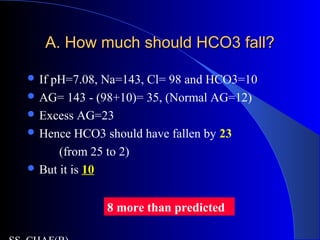
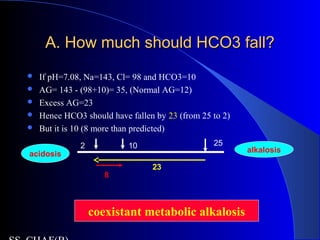
A. How much should HCO3 fall?A. How much should HCO3 fall?
 If pH=7.08, Na=143, Cl= 98 and HCO3=10
 AG= 143 - (98+10)= 35, (Normal AG=12)
 Excess AG=23
 Hence HCO3 should have fallen by 23
(from 25 to 2)
 But it is 10
8 more than predicted
A. How much should HCO3 fall?A. How much should HCO3 fall?
 If pH=7.08, Na=143, Cl= 98 and HCO3=10
 AG= 143 - (98+10)= 35, (Normal AG=12)
 Excess AG=23
 Hence HCO3 should have fallen by 23 (from 25 to 2)
 But it is 10 (8 more than predicted)
2 10 25
8
acidosis
alkalosis
23
coexistant metabolic alkalosis
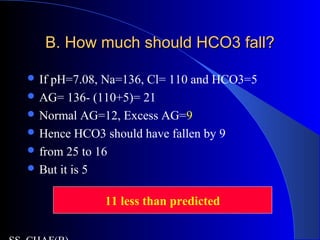
B. How much should HCO3 fall?B. How much should HCO3 fall?
 If pH=7.08, Na=136, Cl= 110 and HCO3=5
 AG= 136- (110+5)= 21
 Normal AG=12, Excess AG=9
 Hence HCO3 should have fallen by 9
 from 25 to 16
 But it is 5
11 less than predicted
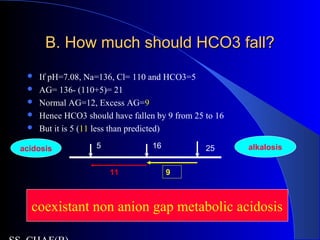
B. How much should HCO3 fall?B. How much should HCO3 fall?
 If pH=7.08, Na=136, Cl= 110 and HCO3=5
 AG= 136- (110+5)= 21
 Normal AG=12, Excess AG=9
 Hence HCO3 should have fallen by 9 from 25 to 16
 But it is 5 (11 less than predicted)
acidosis alkalosis25165
11 9
coexistant non anion gap metabolic acidosis
AlgorithmAlgorithm
Check hypoxia and
(A-a) gradient
Acidosis or Alkalosis?
Metabolic or Respiratory?
Respiratory Metabolic
1
2
3
4 5,6
Is compensation occuring?
7
Is the respiratory system compensatingIs the respiratory system compensating
adequately for a metabolic disturbance?adequately for a metabolic disturbance?
Mainly necessary if disturbance is primarily
metabolic.
Metabolic acidosis
– Expected PaCO2 = [1.5 x serum HCO3-] + 8 + 2.
(Winter’s formula)
– E.g If HCO3 = 10
– Paco2= 21-25
– If <21- then coexisatnt resp alkalosis
– If >25, coexistant resp acidosis
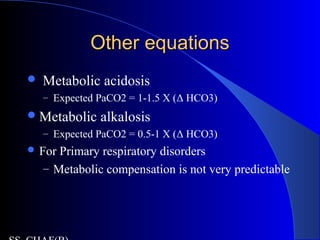
Other equationsOther equations
 Metabolic acidosis
– Expected PaCO2 = 1-1.5 X (Δ HCO3)
Metabolic alkalosis
– Expected PaCO2 = 0.5-1 X (Δ HCO3)
 For Primary respiratory disorders
– Metabolic compensation is not very predictable
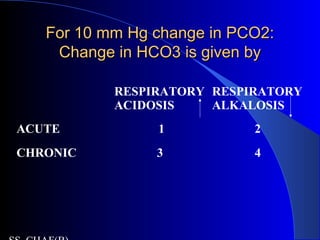
For 10 mm Hg change in PCO2:For 10 mm Hg change in PCO2:
Change in HCO3 is given byChange in HCO3 is given by
RESPIRATORY
ACIDOSIS
RESPIRATORY
ALKALOSIS
ACUTE 1 2
CHRONIC 3 4
INTERACTIVE SESSIONINTERACTIVE SESSION
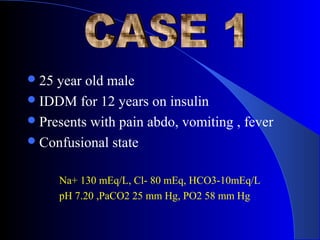
25 year old male
IDDM for 12 years on insulin
Presents with pain abdo, vomiting , fever
Confusional state
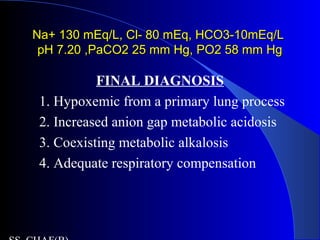
Na+ 130 mEq/L, Cl- 80 mEq, HCO3-10mEq/L
pH 7.20 ,PaCO2 25 mm Hg, PO2 58 mm Hg
Na+ 130 mEq/L, Cl- 80 mEq, HCO3-10mEq/LNa+ 130 mEq/L, Cl- 80 mEq, HCO3-10mEq/L
pH 7.20 ,PaCO2 25 mm Hg, PO2 68 mm HgpH 7.20 ,PaCO2 25 mm Hg, PO2 68 mm Hg
1. Assess oxygenation
PaO2 = 58 mm Hg
He has hypoxia
(A-a) gradient= [ 150 - 1.25 (PaCO2) ] - PaO2
= [150 - 1.25 (25)] - 58 = 61
there is a primary lung problem
Possibly aspiration pneumonia
Na+ 130 mEq/L, Cl- 80 mEq, HCO3-10mEq/LNa+ 130 mEq/L, Cl- 80 mEq, HCO3-10mEq/L
pH 7.20 ,PaCO2 25 mm Hg, PO2 58 mm HgpH 7.20 ,PaCO2 25 mm Hg, PO2 58 mm Hg
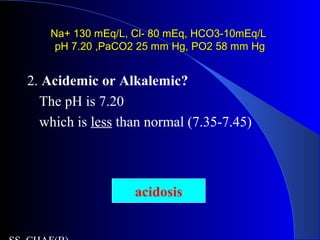
2. Acidemic or Alkalemic?
The pH is 7.20
which is less than normal (7.35-7.45)
acidosis
Na+ 130 mEq/L, Cl- 80 mEq, HCO3-10mEq/LNa+ 130 mEq/L, Cl- 80 mEq, HCO3-10mEq/L
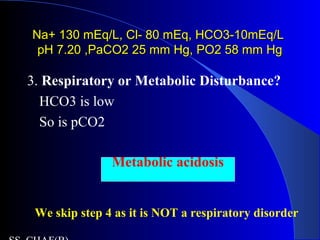
pH 7.20 ,PaCO2 25 mm Hg, PO2 58 mm HgpH 7.20 ,PaCO2 25 mm Hg, PO2 58 mm Hg
3. Respiratory or Metabolic Disturbance?
HCO3 is low
So is pCO2
Metabolic acidosis
We skip step 4 as it is NOT a respiratory disorder
Na+ 130 mEq/L, Cl- 80 mEq, HCO3-10mEq/LNa+ 130 mEq/L, Cl- 80 mEq, HCO3-10mEq/L
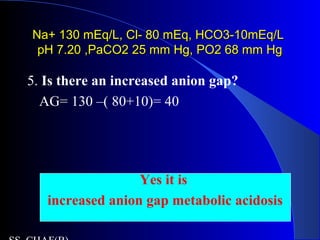
pH 7.20 ,PaCO2 25 mm Hg, PO2 68 mm HgpH 7.20 ,PaCO2 25 mm Hg, PO2 68 mm Hg
5. Is there an increased anion gap?
AG= 130 –( 80+10)= 40
Yes it is
increased anion gap metabolic acidosis
Na+ 130 mEq/L, Cl- 80 mEq, HCO3-10mEq/LNa+ 130 mEq/L, Cl- 80 mEq, HCO3-10mEq/L
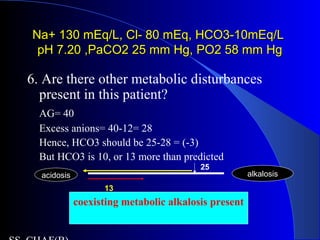
pH 7.20 ,PaCO2 25 mm Hg, PO2 58 mm HgpH 7.20 ,PaCO2 25 mm Hg, PO2 58 mm Hg
6. Are there other metabolic disturbances
present in this patient?
AG= 40
Excess anions= 40-12= 28
Hence, HCO3 should be 25-28 = (-3)
But HCO3 is 10, or 13 more than predicted
acidosis alkalosis
13
25
coexisting metabolic alkalosis present
Na+ 130 mEq/L, Cl- 80 mEq, HCO3-10mEq/LNa+ 130 mEq/L, Cl- 80 mEq, HCO3-10mEq/L
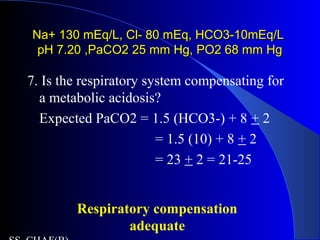
pH 7.20 ,PaCO2 25 mm Hg, PO2 68 mm HgpH 7.20 ,PaCO2 25 mm Hg, PO2 68 mm Hg
7. Is the respiratory system compensating for
a metabolic acidosis?
Expected PaCO2 = 1.5 (HCO3-) + 8 + 2
= 1.5 (10) + 8 + 2
= 23 + 2 = 21-25
Respiratory compensation
adequate
Na+ 130 mEq/L, Cl- 80 mEq, HCO3-10mEq/LNa+ 130 mEq/L, Cl- 80 mEq, HCO3-10mEq/L
pH 7.20 ,PaCO2 25 mm Hg, PO2 58 mm HgpH 7.20 ,PaCO2 25 mm Hg, PO2 58 mm Hg
FINAL DIAGNOSIS
1. Hypoxemic from a primary lung process
2. Increased anion gap metabolic acidosis
3. Coexisting metabolic alkalosis
4. Adequate respiratory compensation
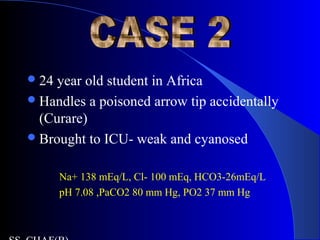
24 year old student in Africa
Handles a poisoned arrow tip accidentally
(Curare)
Brought to ICU- weak and cyanosed
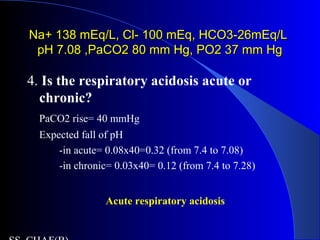
Na+ 138 mEq/L, Cl- 100 mEq, HCO3-26mEq/L
pH 7.08 ,PaCO2 80 mm Hg, PO2 37 mm Hg
Na+ 138 mEq/L, Cl- 100 mEq, HCO3-26mEq/LNa+ 138 mEq/L, Cl- 100 mEq, HCO3-26mEq/L
pH 7.08 ,PaCO2 80 mm Hg, PO2 37 mm HgpH 7.08 ,PaCO2 80 mm Hg, PO2 37 mm Hg
1. Assess oxygenation
Is the patient hypoxic?
YES
What is his (A-a) gradient?
A-a gradient = [ 150 - 1.25 (PaCO2) ] - PaO2
[150 - 1.25 (80)] - 37 = 10.
Hypoxia solely due to hypoventilation
Na+ 138 mEq/L, Cl- 100 mEq, HCO3-26mEq/LNa+ 138 mEq/L, Cl- 100 mEq, HCO3-26mEq/L
pH 7.08 ,PaCO2 80 mm Hg, PO2 37 mm HgpH 7.08 ,PaCO2 80 mm Hg, PO2 37 mm Hg
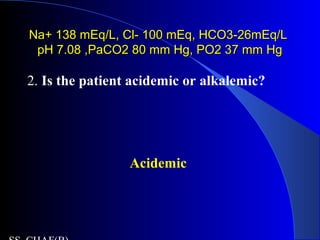
2. Is the patient acidemic or alkalemic?
Acidemic
Na+ 138 mEq/L, Cl- 100 mEq, HCO3-26mEq/LNa+ 138 mEq/L, Cl- 100 mEq, HCO3-26mEq/L
pH 7.08 ,PaCO2 80 mm Hg, PO2 37 mm HgpH 7.08 ,PaCO2 80 mm Hg, PO2 37 mm Hg
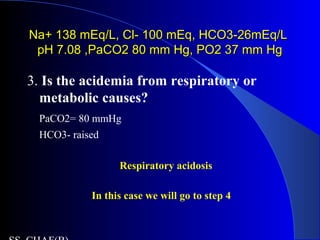
3. Is the acidemia from respiratory or
metabolic causes?
PaCO2= 80 mmHg
HCO3- raised
Respiratory acidosis
In this case we will go to step 4
Na+ 138 mEq/L, Cl- 100 mEq, HCO3-26mEq/LNa+ 138 mEq/L, Cl- 100 mEq, HCO3-26mEq/L
pH 7.08 ,PaCO2 80 mm Hg, PO2 37 mm HgpH 7.08 ,PaCO2 80 mm Hg, PO2 37 mm Hg
4. Is the respiratory acidosis acute or
chronic?
PaCO2 rise= 40 mmHg
Expected fall of pH
-in acute= 0.08x40=0.32 (from 7.4 to 7.08)
-in chronic= 0.03x40= 0.12 (from 7.4 to 7.28)
Acute respiratory acidosis
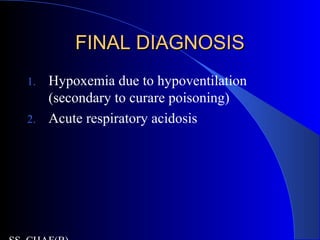
FINAL DIAGNOSISFINAL DIAGNOSIS
1. Hypoxemia due to hypoventilation
(secondary to curare poisoning)
2. Acute respiratory acidosis
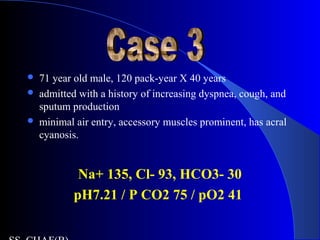
 71 year old male, 120 pack-year X 40 years
 admitted with a history of increasing dyspnea, cough, and
sputum production
 minimal air entry, accessory muscles prominent, has acral
cyanosis.
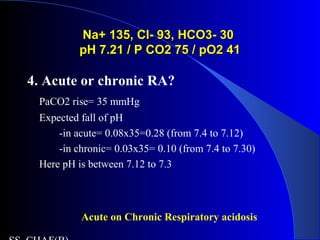
Na+ 135, Cl- 93, HCO3- 30
pH7.21 / P CO2 75 / pO2 41
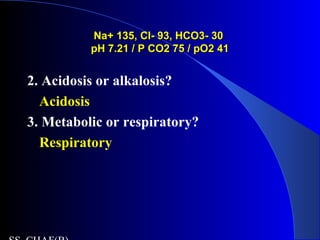
Na+ 135, Cl- 93, HCO3- 30Na+ 135, Cl- 93, HCO3- 30
pH 7.21 / P CO2 75 / pO2 41pH 7.21 / P CO2 75 / pO2 41
1. Assess oxygenation
Hypoxemia present
A-a gradient = [ 150 - 1.25 (PaCO2) ] - PaO2
[150 - 1.25 (75)] - 41 = 15
Hypoxemia is due to
hypoventilation
Na+ 135, Cl- 93, HCO3- 30Na+ 135, Cl- 93, HCO3- 30
pH 7.21 / P CO2 75 / pO2 41pH 7.21 / P CO2 75 / pO2 41
2. Acidosis or alkalosis?
Acidosis
3. Metabolic or respiratory?
Respiratory
Na+ 135, Cl- 93, HCO3- 30Na+ 135, Cl- 93, HCO3- 30
pH 7.21 / P CO2 75 / pO2 41pH 7.21 / P CO2 75 / pO2 41
4. Acute or chronic RA?
PaCO2 rise= 35 mmHg
Expected fall of pH
-in acute= 0.08x35=0.28 (from 7.4 to 7.12)
-in chronic= 0.03x35= 0.10 (from 7.4 to 7.30)
Here pH is between 7.12 to 7.3
Acute on Chronic Respiratory acidosis
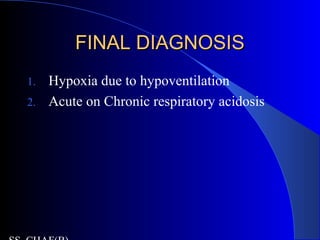
FINAL DIAGNOSISFINAL DIAGNOSIS
1. Hypoxia due to hypoventilation
2. Acute on Chronic respiratory acidosis
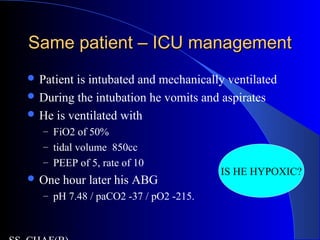
Same patient – ICU managementSame patient – ICU management
 Patient is intubated and mechanically ventilated
 During the intubation he vomits and aspirates
 He is ventilated with
– FiO2 of 50%
– tidal volume 850cc
– PEEP of 5, rate of 10
 One hour later his ABG
– pH 7.48 / paCO2 -37 / pO2 -215.
IS HE HYPOXIC?
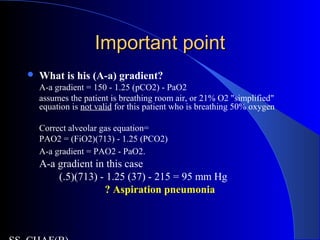
Important pointImportant point
 What is his (A-a) gradient?
A-a gradient = 150 - 1.25 (pCO2) - PaO2
assumes the patient is breathing room air, or 21% O2 "simplified"
equation is not valid for this patient who is breathing 50% oxygen
Correct alveolar gas equation=
PAO2 = (FiO2)(713) - 1.25 (PCO2)
A-a gradient = PAO2 - PaO2.
A-a gradient in this case
(.5)(713) - 1.25 (37) - 215 = 95 mm Hg
? Aspiration pneumonia
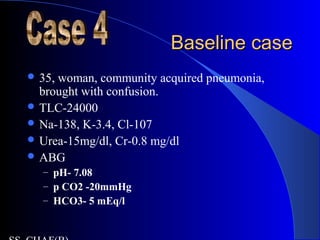
Baseline caseBaseline case
 35, woman, community acquired pneumonia,
brought with confusion.
 TLC-24000
 Na-138, K-3.4, Cl-107
 Urea-15mg/dl, Cr-0.8 mg/dl
 ABG
– pH- 7.08
– p CO2 -20mmHg
– HCO3- 5 mEq/l
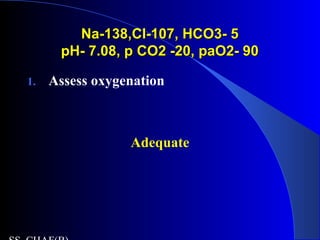
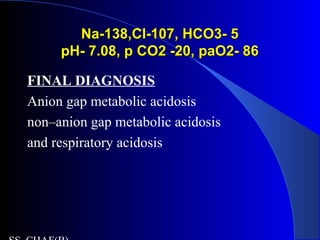
Na-138,Cl-107, HCO3- 5Na-138,Cl-107, HCO3- 5
pH- 7.08, p CO2 -20, paO2- 90pH- 7.08, p CO2 -20, paO2- 90
1. Assess oxygenation
Adequate
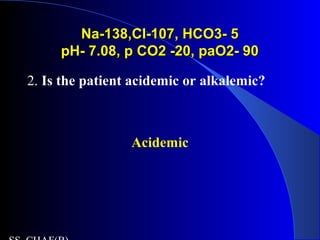
Na-138,Cl-107, HCO3- 5Na-138,Cl-107, HCO3- 5
pH- 7.08, p CO2 -20, paO2- 90pH- 7.08, p CO2 -20, paO2- 90
2. Is the patient acidemic or alkalemic?
Acidemic
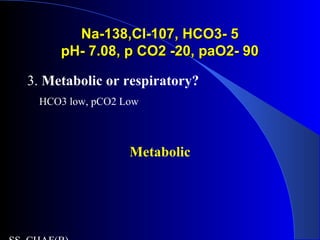
Na-138,Cl-107, HCO3- 5Na-138,Cl-107, HCO3- 5
pH- 7.08, p CO2 -20, paO2- 90pH- 7.08, p CO2 -20, paO2- 90
3. Metabolic or respiratory?
HCO3 low, pCO2 Low
Metabolic
Na-138,Cl-107, HCO3- 5Na-138,Cl-107, HCO3- 5
pH- 7.08, p CO2 -20, paO2- 90pH- 7.08, p CO2 -20, paO2- 90
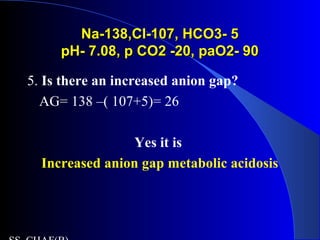
5. Is there an increased anion gap?
AG= 138 –( 107+5)= 26
Yes it is
Increased anion gap metabolic acidosis
Na-138,Cl-107, HCO3- 5Na-138,Cl-107, HCO3- 5
pH- 7.08, p CO2 -20, paO2- 90pH- 7.08, p CO2 -20, paO2- 90
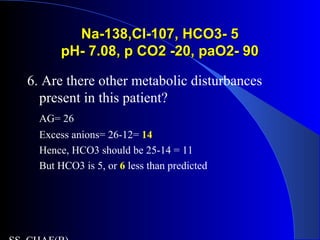
6. Are there other metabolic disturbances
present in this patient?
AG= 26
Excess anions= 26-12= 14
Hence, HCO3 should be 25-14 = 11
But HCO3 is 5, or 6 less than predicted
Na-138,Cl-107, HCO3- 5Na-138,Cl-107, HCO3- 5
pH- 7.08, p CO2 -20, paO2- 86pH- 7.08, p CO2 -20, paO2- 86
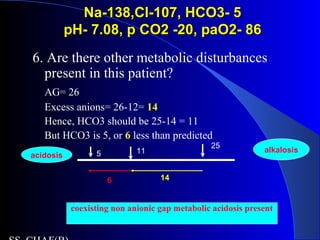
6. Are there other metabolic disturbances
present in this patient?
AG= 26
Excess anions= 26-12= 14
Hence, HCO3 should be 25-14 = 11
But HCO3 is 5, or 6 less than predicted
25
115
6 14
acidosis
alkalosis
coexisting non anionic gap metabolic acidosis present
Na-138,Cl-107, HCO3- 5Na-138,Cl-107, HCO3- 5
pH- 7.08, p CO2 -20, paO2- 86pH- 7.08, p CO2 -20, paO2- 86
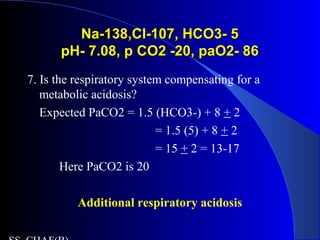
7. Is the respiratory system compensating for a
metabolic acidosis?
Expected PaCO2 = 1.5 (HCO3-) + 8 + 2
= 1.5 (5) + 8 + 2
= 15 + 2 = 13-17
Here PaCO2 is 20
Additional respiratory acidosis
Na-138,Cl-107, HCO3- 5Na-138,Cl-107, HCO3- 5
pH- 7.08, p CO2 -20, paO2- 86pH- 7.08, p CO2 -20, paO2- 86
FINAL DIAGNOSIS
Anion gap metabolic acidosis
non–anion gap metabolic acidosis
and respiratory acidosis
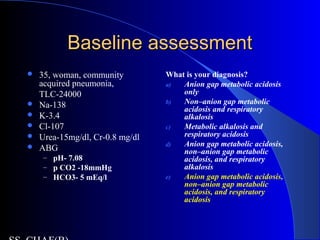
Baseline assessmentBaseline assessment
 35, woman, community
acquired pneumonia,
TLC-24000
 Na-138
 K-3.4
 Cl-107
 Urea-15mg/dl, Cr-0.8 mg/dl
 ABG
– pH- 7.08
– p CO2 -18mmHg
– HCO3- 5 mEq/l
What is your diagnosis?
a) Anion gap metabolic acidosis
only
b) Non–anion gap metabolic
acidosis and respiratory
alkalosis
c) Metabolic alkalosis and
respiratory acidosis
d) Anion gap metabolic acidosis,
non–anion gap metabolic
acidosis, and respiratory
alkalosis
e) Anion gap metabolic acidosis,
non–anion gap metabolic
acidosis, and respiratory
acidosis
Practice, Practice, Practice…..

Abg 2014

  • 1.
    APPROACH TO ARTERIALAPPROACHTO ARTERIAL BLOOD GAS ANALYSISBLOOD GAS ANALYSIS Gp Capt S Shankar Clinical Immunologist Command Hospital (Air Force)
  • 2.
    A tale oftwo investigationsA tale of two investigations ECG ABG Step by step approach YES NO Pattern recognition YES NO Theory YES YES Your eyes cannot see what your mind does not know
  • 3.
    AIMAIM SYSTEMATIC APPROACH – Understandthe principles of reading an ABG report – Remember the systematic approach – Analyse simple and complex disorders
  • 4.
    PARTSPARTS I-Baseline assessment II-Understanding theprinciples III-Systematic approach IV-Interactive session
  • 5.
    Baseline assessmentBaseline assessment 35 yrs, woman, fever, confusional state, community acquired pneumonia, TLC-24000  Na-138  K-3.4  Cl-107  Urea-15mg/dl, Cr-0.8 mg/dl  ABG – pH- 7.08 – p CO2 –20 mmHg – HCO3- 5 mEq/l – PaO2- 90 mmHg What is your diagnosis? a) Anion gap metabolic acidosis only b) Non–anion gap metabolic acidosis and respiratory alkalosis c) Metabolic alkalosis and respiratory acidosis d) Anion gap metabolic acidosis, non–anion gap metabolic acidosis, and respiratory alkalosis e) Anion gap metabolic acidosis, non–anion gap metabolic acidosis, and respiratory acidosis f) I’m in a confusional state now
  • 6.
    ABGABG Important diagnostic tool Usefulfor determining – the oxygenation status – the acid-base balance
  • 7.
    Four basic valuesFourbasic values pH = arterial blood pH PaCO2 (or PCO2)= arterial pressure of CO2, in mm Hg PaO2 (or PO2)= arterial pressure of O2, in mm Hg HCO3- = serum bicarbonate concentration, in mEq/liter
  • 8.
    Hypoxia and HypoxemiaHypoxiaand Hypoxemia Hypoxia – reduced oxygen pressure (partial pressure of oxygen) in the alveolus Hypoxemia – reduced oxygen content in arterial blood
  • 9.
    HypoxemiaHypoxemia hypoxemic for twobasic reasons – oxygen may not be delivered to the alveolar air sacs (hypoventilation) – oxygen in the alveoli may not enter into the blood stream. (V/Q mismatch) Hypercarbic – inability to normally exchange gas in the lungs.
  • 10.
    acidosisacidosis andand alkalosisalkalosis Processes that alter the acid-base status  Metabolic processes alter the pH – by altering the bicarbonate concentration in the blood  metabolic acidosis = reduced serum bicarbonate  metabolic alkalosis = increased serum bicarbonate  Respiratory processes alter the pH – by changing the carbon dioxide levels  respiratory acidosis= hypoventilation,CO2 retention  respiratory alkalosis= hyperventilation, CO2 loss
  • 11.
    STEPS TO ABGANALYSISSTEPS TO ABG ANALYSIS
  • 12.
    AlgorithmAlgorithm Check hypoxia and (A-a)gradient Acidosis or Alkalosis? Metabolic or Respiratory? Respiratory Metabolic 1 2 3 4 5,6 Is compensation occurring? 7
  • 13.
    Assess OxygenationAssess Oxygenation HYPOXEMIA –paO2 <60 mmHg – poorly tolerated – Associated with oxygenation<90%
  • 14.
    If hypoxia-If hypoxia- checkcheck(A-a gradient)(A-a gradient) alveolar arterial oxygen gradient can determine if hypoxia is due to – Hypoventilation OR – Deficiency in oxygenation
  • 15.
    (A-a gradient)(A-a gradient) partial pressure of oxygen in the alveolus (Alveolar gas equation) – PAO2= FiO2 x (PB- PH2O) – PaCO2/R – PAO2= 0.21 x (760-47) – PaCO2/0.8 – PAO2= 150-1.25( PACO2) – PACO2 = PaCO2 (CO2 freely diffuses)  A-a gradient = PAO2 - PaO2 – = [ 150-1.25 (PaCO2) ] - PaO2 – Normal A-a gradient is 10-20 mm Hg
  • 16.
    HYPOXIA PRESENT CHECK (A-a)Gradient Hypoventilation Ventilation perfusion mismatch Normal Increased
  • 17.
    AlgorithmAlgorithm Check hypoxia and (A-a)gradient Acidosis or Alkalosis? Metabolic or Respiratory? Respiratory Metabolic 1 2 3 4 5,6 Is compensation occuring? 7
  • 18.
    Acidemic or Alkalemic?Acidemicor Alkalemic? Normal arterial blood pH = 7.40 + 0.05 Acidemic: pH < 7.35 Alkalemic: pH > 7.45
  • 19.
    Metabolic or Respiratory?Metabolicor Respiratory? pH <7.35 >7.45 HCO3 change Metabolic acidosis Metabolic alkalosis pCO2 change Respiratory acidosis Respiratory alkalosis pCO2 and HCO3 move in the same direction What is the primary disorder?
  • 20.
    AlgorithmAlgorithm Check hypoxia and (A-a)gradient Acidosis or Alkalosis? Metabolic or Respiratory? Respiratory Metabolic 1 2 3 4 5,6 Is compensation occuring? 7
  • 21.
    Is the respiratorydisturbanceIs the respiratory disturbance Acute or Chronic?Acute or Chronic? acute respiratory disturbances – PaCO2 variation by 10 mm Hg – accompanied by a pH shift of 0.08 units – Both directions chronic respiratory disturbances – PaCO2 variation by 10 mm Hg – accompanied by a pH shift of 0.03 units renal mediated shifts of bicarbonate that alter and partially compensate for the pH
  • 22.
    AlgorithmAlgorithm Check hypoxia and (A-a)gradient Acidosis or Alkalosis? Metabolic or Respiratory? Respiratory Metabolic 1 2 3 4 5,6 Is compensation occuring? 7
  • 23.
    For metabolic acidosis-Formetabolic acidosis- what is the anion gap?what is the anion gap?  AG = [Na+] - ([Cl- ] + [HCO3- ])  normal anion gap is 12 Unmeasured Anions Unmeasured Cations Proteins, mostly albumin 15 mEq/L Calcium 5 mEq/L Organic acids 5 mEq/L Potassium 4.5 mEq/L Phosphates 2 mEq/L Magnesium 1.5 mEq/L Sulfates 1 mEq/L Totals: 23 mEq/L 11 mEq/L Anion Gap = GAP between unmeasured anions and cations.
  • 24.
    Metabolic acidosisMetabolic acidosis Highanion gap (AG >12) – Methanol other alcohols, and ethylene glycol intoxication – Uremia (renal failure) – Lactic acidosis – Ethanol – Paraldehyde and other drugs – Aspirin – Ketones (starvation, alcoholic and diabetic ketoacidosis)  Normal anion gap (AG <12) – Renal tubular acidosis – GI fistula
  • 25.
    Are there othermetabolic processesAre there other metabolic processes present with anion gap acidosispresent with anion gap acidosis??  only necessary if there is an AG metabolic acidosis.  Does the increase in AG completely explain the AB disorder?  PRINCIPLE – bicarbonate is decreased due to the presence of unmeasured anions – For one molecule of anion, one molecule bicarbonate lost. – Bicarbonate level can be therefore be predicted – If level is less than predicted- additional non anionic gap metabolic acidosis exists – If level more than predicted- additional met alkalosis exists Tricky concept
  • 26.
    A. How muchshould HCO3 fall?A. How much should HCO3 fall?  If pH=7.08, Na=143, Cl= 98 and HCO3=10  AG= 143 - (98+10)= 35, (Normal AG=12)  Excess AG=23  Hence HCO3 should have fallen by 23 (from 25 to 2)  But it is 10 8 more than predicted
  • 27.
    A. How muchshould HCO3 fall?A. How much should HCO3 fall?  If pH=7.08, Na=143, Cl= 98 and HCO3=10  AG= 143 - (98+10)= 35, (Normal AG=12)  Excess AG=23  Hence HCO3 should have fallen by 23 (from 25 to 2)  But it is 10 (8 more than predicted) 2 10 25 8 acidosis alkalosis 23 coexistant metabolic alkalosis
  • 28.
    B. How muchshould HCO3 fall?B. How much should HCO3 fall?  If pH=7.08, Na=136, Cl= 110 and HCO3=5  AG= 136- (110+5)= 21  Normal AG=12, Excess AG=9  Hence HCO3 should have fallen by 9  from 25 to 16  But it is 5 11 less than predicted
  • 29.
    B. How muchshould HCO3 fall?B. How much should HCO3 fall?  If pH=7.08, Na=136, Cl= 110 and HCO3=5  AG= 136- (110+5)= 21  Normal AG=12, Excess AG=9  Hence HCO3 should have fallen by 9 from 25 to 16  But it is 5 (11 less than predicted) acidosis alkalosis25165 11 9 coexistant non anion gap metabolic acidosis
  • 30.
    AlgorithmAlgorithm Check hypoxia and (A-a)gradient Acidosis or Alkalosis? Metabolic or Respiratory? Respiratory Metabolic 1 2 3 4 5,6 Is compensation occuring? 7
  • 31.
    Is the respiratorysystem compensatingIs the respiratory system compensating adequately for a metabolic disturbance?adequately for a metabolic disturbance? Mainly necessary if disturbance is primarily metabolic. Metabolic acidosis – Expected PaCO2 = [1.5 x serum HCO3-] + 8 + 2. (Winter’s formula) – E.g If HCO3 = 10 – Paco2= 21-25 – If <21- then coexisatnt resp alkalosis – If >25, coexistant resp acidosis
  • 32.
    Other equationsOther equations Metabolic acidosis – Expected PaCO2 = 1-1.5 X (Δ HCO3) Metabolic alkalosis – Expected PaCO2 = 0.5-1 X (Δ HCO3)  For Primary respiratory disorders – Metabolic compensation is not very predictable
  • 33.
    For 10 mmHg change in PCO2:For 10 mm Hg change in PCO2: Change in HCO3 is given byChange in HCO3 is given by RESPIRATORY ACIDOSIS RESPIRATORY ALKALOSIS ACUTE 1 2 CHRONIC 3 4
  • 34.
  • 35.
    25 year oldmale IDDM for 12 years on insulin Presents with pain abdo, vomiting , fever Confusional state Na+ 130 mEq/L, Cl- 80 mEq, HCO3-10mEq/L pH 7.20 ,PaCO2 25 mm Hg, PO2 58 mm Hg
  • 36.
    Na+ 130 mEq/L,Cl- 80 mEq, HCO3-10mEq/LNa+ 130 mEq/L, Cl- 80 mEq, HCO3-10mEq/L pH 7.20 ,PaCO2 25 mm Hg, PO2 68 mm HgpH 7.20 ,PaCO2 25 mm Hg, PO2 68 mm Hg 1. Assess oxygenation PaO2 = 58 mm Hg He has hypoxia (A-a) gradient= [ 150 - 1.25 (PaCO2) ] - PaO2 = [150 - 1.25 (25)] - 58 = 61 there is a primary lung problem Possibly aspiration pneumonia
  • 37.
    Na+ 130 mEq/L,Cl- 80 mEq, HCO3-10mEq/LNa+ 130 mEq/L, Cl- 80 mEq, HCO3-10mEq/L pH 7.20 ,PaCO2 25 mm Hg, PO2 58 mm HgpH 7.20 ,PaCO2 25 mm Hg, PO2 58 mm Hg 2. Acidemic or Alkalemic? The pH is 7.20 which is less than normal (7.35-7.45) acidosis
  • 38.
    Na+ 130 mEq/L,Cl- 80 mEq, HCO3-10mEq/LNa+ 130 mEq/L, Cl- 80 mEq, HCO3-10mEq/L pH 7.20 ,PaCO2 25 mm Hg, PO2 58 mm HgpH 7.20 ,PaCO2 25 mm Hg, PO2 58 mm Hg 3. Respiratory or Metabolic Disturbance? HCO3 is low So is pCO2 Metabolic acidosis We skip step 4 as it is NOT a respiratory disorder
  • 39.
    Na+ 130 mEq/L,Cl- 80 mEq, HCO3-10mEq/LNa+ 130 mEq/L, Cl- 80 mEq, HCO3-10mEq/L pH 7.20 ,PaCO2 25 mm Hg, PO2 68 mm HgpH 7.20 ,PaCO2 25 mm Hg, PO2 68 mm Hg 5. Is there an increased anion gap? AG= 130 –( 80+10)= 40 Yes it is increased anion gap metabolic acidosis
  • 40.
    Na+ 130 mEq/L,Cl- 80 mEq, HCO3-10mEq/LNa+ 130 mEq/L, Cl- 80 mEq, HCO3-10mEq/L pH 7.20 ,PaCO2 25 mm Hg, PO2 58 mm HgpH 7.20 ,PaCO2 25 mm Hg, PO2 58 mm Hg 6. Are there other metabolic disturbances present in this patient? AG= 40 Excess anions= 40-12= 28 Hence, HCO3 should be 25-28 = (-3) But HCO3 is 10, or 13 more than predicted acidosis alkalosis 13 25 coexisting metabolic alkalosis present
  • 41.
    Na+ 130 mEq/L,Cl- 80 mEq, HCO3-10mEq/LNa+ 130 mEq/L, Cl- 80 mEq, HCO3-10mEq/L pH 7.20 ,PaCO2 25 mm Hg, PO2 68 mm HgpH 7.20 ,PaCO2 25 mm Hg, PO2 68 mm Hg 7. Is the respiratory system compensating for a metabolic acidosis? Expected PaCO2 = 1.5 (HCO3-) + 8 + 2 = 1.5 (10) + 8 + 2 = 23 + 2 = 21-25 Respiratory compensation adequate
  • 42.
    Na+ 130 mEq/L,Cl- 80 mEq, HCO3-10mEq/LNa+ 130 mEq/L, Cl- 80 mEq, HCO3-10mEq/L pH 7.20 ,PaCO2 25 mm Hg, PO2 58 mm HgpH 7.20 ,PaCO2 25 mm Hg, PO2 58 mm Hg FINAL DIAGNOSIS 1. Hypoxemic from a primary lung process 2. Increased anion gap metabolic acidosis 3. Coexisting metabolic alkalosis 4. Adequate respiratory compensation
  • 43.
    24 year oldstudent in Africa Handles a poisoned arrow tip accidentally (Curare) Brought to ICU- weak and cyanosed Na+ 138 mEq/L, Cl- 100 mEq, HCO3-26mEq/L pH 7.08 ,PaCO2 80 mm Hg, PO2 37 mm Hg
  • 44.
    Na+ 138 mEq/L,Cl- 100 mEq, HCO3-26mEq/LNa+ 138 mEq/L, Cl- 100 mEq, HCO3-26mEq/L pH 7.08 ,PaCO2 80 mm Hg, PO2 37 mm HgpH 7.08 ,PaCO2 80 mm Hg, PO2 37 mm Hg 1. Assess oxygenation Is the patient hypoxic? YES What is his (A-a) gradient? A-a gradient = [ 150 - 1.25 (PaCO2) ] - PaO2 [150 - 1.25 (80)] - 37 = 10. Hypoxia solely due to hypoventilation
  • 45.
    Na+ 138 mEq/L,Cl- 100 mEq, HCO3-26mEq/LNa+ 138 mEq/L, Cl- 100 mEq, HCO3-26mEq/L pH 7.08 ,PaCO2 80 mm Hg, PO2 37 mm HgpH 7.08 ,PaCO2 80 mm Hg, PO2 37 mm Hg 2. Is the patient acidemic or alkalemic? Acidemic
  • 46.
    Na+ 138 mEq/L,Cl- 100 mEq, HCO3-26mEq/LNa+ 138 mEq/L, Cl- 100 mEq, HCO3-26mEq/L pH 7.08 ,PaCO2 80 mm Hg, PO2 37 mm HgpH 7.08 ,PaCO2 80 mm Hg, PO2 37 mm Hg 3. Is the acidemia from respiratory or metabolic causes? PaCO2= 80 mmHg HCO3- raised Respiratory acidosis In this case we will go to step 4
  • 47.
    Na+ 138 mEq/L,Cl- 100 mEq, HCO3-26mEq/LNa+ 138 mEq/L, Cl- 100 mEq, HCO3-26mEq/L pH 7.08 ,PaCO2 80 mm Hg, PO2 37 mm HgpH 7.08 ,PaCO2 80 mm Hg, PO2 37 mm Hg 4. Is the respiratory acidosis acute or chronic? PaCO2 rise= 40 mmHg Expected fall of pH -in acute= 0.08x40=0.32 (from 7.4 to 7.08) -in chronic= 0.03x40= 0.12 (from 7.4 to 7.28) Acute respiratory acidosis
  • 48.
    FINAL DIAGNOSISFINAL DIAGNOSIS 1.Hypoxemia due to hypoventilation (secondary to curare poisoning) 2. Acute respiratory acidosis
  • 49.
     71 yearold male, 120 pack-year X 40 years  admitted with a history of increasing dyspnea, cough, and sputum production  minimal air entry, accessory muscles prominent, has acral cyanosis. Na+ 135, Cl- 93, HCO3- 30 pH7.21 / P CO2 75 / pO2 41
  • 50.
    Na+ 135, Cl-93, HCO3- 30Na+ 135, Cl- 93, HCO3- 30 pH 7.21 / P CO2 75 / pO2 41pH 7.21 / P CO2 75 / pO2 41 1. Assess oxygenation Hypoxemia present A-a gradient = [ 150 - 1.25 (PaCO2) ] - PaO2 [150 - 1.25 (75)] - 41 = 15 Hypoxemia is due to hypoventilation
  • 51.
    Na+ 135, Cl-93, HCO3- 30Na+ 135, Cl- 93, HCO3- 30 pH 7.21 / P CO2 75 / pO2 41pH 7.21 / P CO2 75 / pO2 41 2. Acidosis or alkalosis? Acidosis 3. Metabolic or respiratory? Respiratory
  • 52.
    Na+ 135, Cl-93, HCO3- 30Na+ 135, Cl- 93, HCO3- 30 pH 7.21 / P CO2 75 / pO2 41pH 7.21 / P CO2 75 / pO2 41 4. Acute or chronic RA? PaCO2 rise= 35 mmHg Expected fall of pH -in acute= 0.08x35=0.28 (from 7.4 to 7.12) -in chronic= 0.03x35= 0.10 (from 7.4 to 7.30) Here pH is between 7.12 to 7.3 Acute on Chronic Respiratory acidosis
  • 53.
    FINAL DIAGNOSISFINAL DIAGNOSIS 1.Hypoxia due to hypoventilation 2. Acute on Chronic respiratory acidosis
  • 54.
    Same patient –ICU managementSame patient – ICU management  Patient is intubated and mechanically ventilated  During the intubation he vomits and aspirates  He is ventilated with – FiO2 of 50% – tidal volume 850cc – PEEP of 5, rate of 10  One hour later his ABG – pH 7.48 / paCO2 -37 / pO2 -215. IS HE HYPOXIC?
  • 55.
    Important pointImportant point What is his (A-a) gradient? A-a gradient = 150 - 1.25 (pCO2) - PaO2 assumes the patient is breathing room air, or 21% O2 "simplified" equation is not valid for this patient who is breathing 50% oxygen Correct alveolar gas equation= PAO2 = (FiO2)(713) - 1.25 (PCO2) A-a gradient = PAO2 - PaO2. A-a gradient in this case (.5)(713) - 1.25 (37) - 215 = 95 mm Hg ? Aspiration pneumonia
  • 56.
    Baseline caseBaseline case 35, woman, community acquired pneumonia, brought with confusion.  TLC-24000  Na-138, K-3.4, Cl-107  Urea-15mg/dl, Cr-0.8 mg/dl  ABG – pH- 7.08 – p CO2 -20mmHg – HCO3- 5 mEq/l
  • 57.
    Na-138,Cl-107, HCO3- 5Na-138,Cl-107,HCO3- 5 pH- 7.08, p CO2 -20, paO2- 90pH- 7.08, p CO2 -20, paO2- 90 1. Assess oxygenation Adequate
  • 58.
    Na-138,Cl-107, HCO3- 5Na-138,Cl-107,HCO3- 5 pH- 7.08, p CO2 -20, paO2- 90pH- 7.08, p CO2 -20, paO2- 90 2. Is the patient acidemic or alkalemic? Acidemic
  • 59.
    Na-138,Cl-107, HCO3- 5Na-138,Cl-107,HCO3- 5 pH- 7.08, p CO2 -20, paO2- 90pH- 7.08, p CO2 -20, paO2- 90 3. Metabolic or respiratory? HCO3 low, pCO2 Low Metabolic
  • 60.
    Na-138,Cl-107, HCO3- 5Na-138,Cl-107,HCO3- 5 pH- 7.08, p CO2 -20, paO2- 90pH- 7.08, p CO2 -20, paO2- 90 5. Is there an increased anion gap? AG= 138 –( 107+5)= 26 Yes it is Increased anion gap metabolic acidosis
  • 61.
    Na-138,Cl-107, HCO3- 5Na-138,Cl-107,HCO3- 5 pH- 7.08, p CO2 -20, paO2- 90pH- 7.08, p CO2 -20, paO2- 90 6. Are there other metabolic disturbances present in this patient? AG= 26 Excess anions= 26-12= 14 Hence, HCO3 should be 25-14 = 11 But HCO3 is 5, or 6 less than predicted
  • 62.
    Na-138,Cl-107, HCO3- 5Na-138,Cl-107,HCO3- 5 pH- 7.08, p CO2 -20, paO2- 86pH- 7.08, p CO2 -20, paO2- 86 6. Are there other metabolic disturbances present in this patient? AG= 26 Excess anions= 26-12= 14 Hence, HCO3 should be 25-14 = 11 But HCO3 is 5, or 6 less than predicted 25 115 6 14 acidosis alkalosis coexisting non anionic gap metabolic acidosis present
  • 63.
    Na-138,Cl-107, HCO3- 5Na-138,Cl-107,HCO3- 5 pH- 7.08, p CO2 -20, paO2- 86pH- 7.08, p CO2 -20, paO2- 86 7. Is the respiratory system compensating for a metabolic acidosis? Expected PaCO2 = 1.5 (HCO3-) + 8 + 2 = 1.5 (5) + 8 + 2 = 15 + 2 = 13-17 Here PaCO2 is 20 Additional respiratory acidosis
  • 64.
    Na-138,Cl-107, HCO3- 5Na-138,Cl-107,HCO3- 5 pH- 7.08, p CO2 -20, paO2- 86pH- 7.08, p CO2 -20, paO2- 86 FINAL DIAGNOSIS Anion gap metabolic acidosis non–anion gap metabolic acidosis and respiratory acidosis
  • 65.
    Baseline assessmentBaseline assessment 35, woman, community acquired pneumonia, TLC-24000  Na-138  K-3.4  Cl-107  Urea-15mg/dl, Cr-0.8 mg/dl  ABG – pH- 7.08 – p CO2 -18mmHg – HCO3- 5 mEq/l What is your diagnosis? a) Anion gap metabolic acidosis only b) Non–anion gap metabolic acidosis and respiratory alkalosis c) Metabolic alkalosis and respiratory acidosis d) Anion gap metabolic acidosis, non–anion gap metabolic acidosis, and respiratory alkalosis e) Anion gap metabolic acidosis, non–anion gap metabolic acidosis, and respiratory acidosis
  • 66.