Arterial Blood Gas
Interpretation
Presentor - Dr. Aman Jain
Moderator - Dr. Shambhavi
No of slides - 42
1
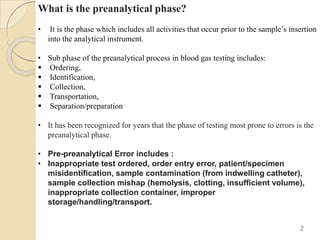
What is the preanalytical phase?
• It is the phase which includes all activities that occur prior to the sample’s insertion
into the analytical instrument.
• Sub phase of the preanalytical process in blood gas testing includes:
 Ordering,
 Identification,
 Collection,
 Transportation,
 Separation/preparation
• It has been recognized for years that the phase of testing most prone to errors is the
preanalytical phase.
• Pre-preanalytical Error includes :
• Inappropriate test ordered, order entry error, patient/specimen
misidentification, sample contamination (from indwelling catheter),
sample collection mishap (hemolysis, clotting, insufficient volume),
inappropriate collection container, improper
storage/handling/transport.
2
3
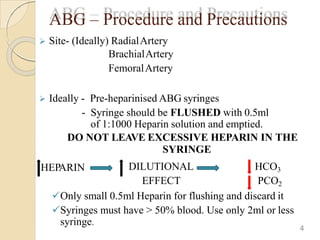
ABG – Procedure and Precautions
 Site- (Ideally) RadialArtery
BrachialArtery
FemoralArtery
 Ideally - Pre-heparinised ABG syringes
- Syringe should be FLUSHED with 0.5ml
of 1:1000 Heparin solution and emptied.
DO NOT LEAVE EXCESSIVE HEPARIN IN THE
SYRINGE
HEPARIN DILUTIONAL
EFFECT
HCO3
PCO2
Only small 0.5ml Heparin for flushing and discard it
Syringes must have > 50% blood. Use only 2ml or less
syringe.
4
Interpretation ofABG
 OXYGENATION
 ACID BASE
5
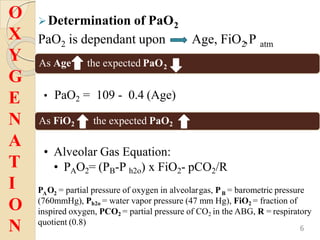
Determination of PaO2
2
PaO is dependant upon Age, FiO ,P
2 atm
As Age the expected PaO2
• PaO2 = 109 - 0.4 (Age)
As FiO2 the expected PaO2
• Alveolar Gas Equation:
• PAO2= (PB-P h2o) x FiO2- pCO2/R
O
X
Y
G
E
N
A
T
I
O
N
A 2 B
P O = partial pressure of oxygen in alveolargas, P = barometric pressure
(760mmHg), Ph2o = water vapor pressure (47 mm Hg), FiO2 = fraction of
inspired oxygen, PCO2 = partial pressure of CO2 in the ABG, R = respiratory
quotient (0.8)
6
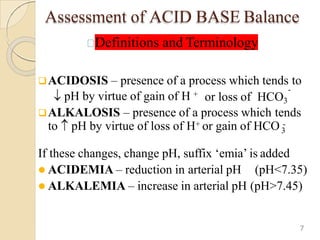
Assessment of ACID BASE Balance
Definitions and Terminology
ACIDOSIS – presence of a process which tends to
pH by virtue of gain of H +
-
or loss of HCO3
ALKALOSIS – presence of a process which tends
3
to pH by virtue of loss of H+ or gain of HCO -
If these changes, change pH, suffix ‘emia’ is added
 ACIDEMIA – reduction in arterial pH (pH<7.35)
 ALKALEMIA – increase in arterial pH (pH>7.45)
7
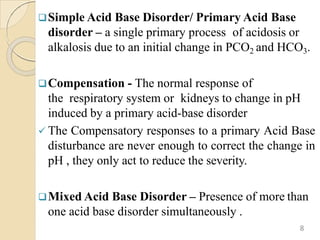
Simple Acid Base Disorder/ Primary Acid Base
disorder – a single primary process of acidosis or
alkalosis due to an initial change in PCO2 and HCO3.
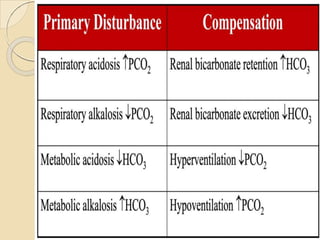
Compensation - The normal response of
the respiratory system or kidneys to change in pH
induced by a primary acid-base disorder
 The Compensatory responses to a primary Acid Base
disturbance are never enough to correct the change in
pH , they only act to reduce the severity.
Mixed Acid Base Disorder – Presence of more than
one acid base disorder simultaneously .
8
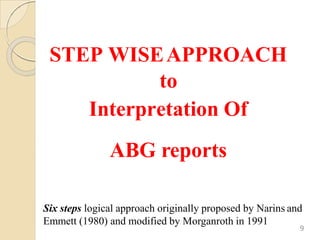
STEP WISEAPPROACH
to
Interpretation Of
ABG reports
Six steps logical approach originally proposed by Narins and
Emmett (1980) and modified by Morganroth in 1991
9
Normal Values
ANALYTE Normal Value Units
pH 7.35 - 7.45
PCO2 35 - 45 mm Hg
PO2 72 – 104 mm Hg`
[HCO3] 22 – 30 meq/L
SaO2 95-100 %
Anion Gap 12 + 4 meq/L
∆HCO3 +2 to -2 meq/L
10
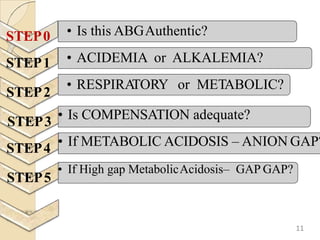
STEP0
STEP1
STEP2
• Is this ABGAuthentic?
• ACIDEMIA or ALKALEMIA?
• RESPIRA
TORY or METABOLIC?
STEP3 • Is COMPENSATION adequate?
STEP4 • If METABOLIC ACIDOSIS – ANION GAP?
STEP5
• If High gap MetabolicAcidosis– GAP GAP?
11
Is this ABG authentic ?
pH = - log [H+]
Henderson-Hasselbalch equation
pH = 6.1 + log HCO3
-
0.03 x PCO2
The [HCO3-] mentioned on the ABG is actually calculated
using this equation from measured values of PCO2 ndpH
• [H+] neq/l = 24 X (PCO2 / HCO3)
• pH = -log [ H+]
pHexpected = pHmeasured = ABG is authentic
12
Reference table for pH v/s [H+]
[H+] neq/l = 24 X (PCO2 /HCO3)
H+ ion pH
100 7.00
79 7.10
63 7.20
50 7.30
45 7.35
40 7.40
35 7.45
32 7.50
25 7.60
13
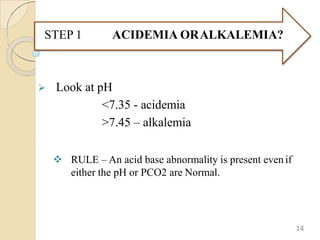
 Look at pH
<7.35 - acidemia
>7.45 – alkalemia
 RULE – An acid base abnormality is present even if
either the pH or PCO2 are Normal.
ACIDEMIA ORALKALEMIA?
STEP 1
14
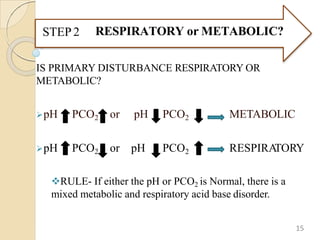
IS PRIMARY DISTURBANCE RESPIRATORY OR
METABOLIC?
pH PCO2 or pH PCO2 METABOLIC
pH PCO2 or pH PCO2 RESPIRA
TORY
RULE- If either the pH or PCO2 is Normal, there is a
mixed metabolic and respiratory acid base disorder.
RESPIRATORY or METABOLIC?
STEP2
15
16
17
STEP 3 - COMPENSATION
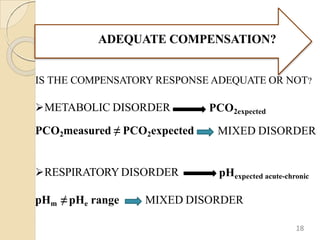
ADEQUATE COMPENSATION?
IS THE COMPENSATORY RESPONSE ADEQUATE OR NOT?
METABOLIC DISORDER
PCO2measured ≠ PCO2expected
PCO2expected
MIXED DISORDER
RESPIRATORYDISORDER pHexpected acute-chronic
pHm ≠ pHe range MIXED DISORDER
18
STEP0
STEP1
STEP2
• Is this ABGAuthentic?
• ACIDEMIA or ALKALEMIA?
• RESPIRA
TORY or METABOLIC?
STEP3
STEP4
• If Respiratory – ACUTE or CHRONIC?
• Is COMPENSATION adequate?
STEP4
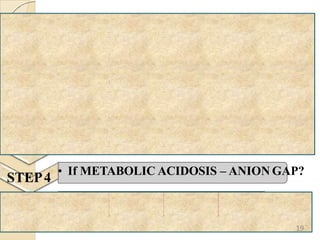
• If METABOLIC ACIDOSIS – ANION GAP?
STEP6
• If High gap MetabolicAcidosis–
GAP GAP?
19
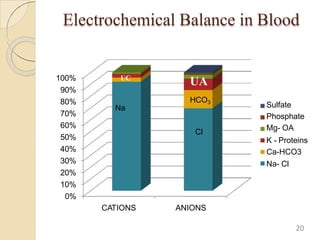
Electrochemical Balance in Blood
80%
70%
60%
50%
40%
30%
20%
10%
0%
100%
90%
CATIONS ANIONS
Sulfate
Phosphate
Mg- OA
K - Proteins
Ca-HCO3
Na- Cl
UA
UC
Na
Cl
HCO3
20
Anion Gap
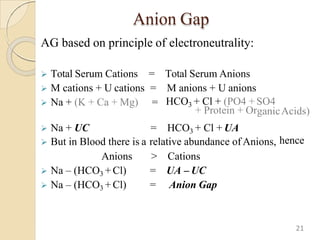
AG based on principle of electroneutrality:
 Total Serum Cations = Total Serum Anions
 M cations + U cations = M anions + U anions
 Na + (K + Ca + Mg) = HCO3 + Cl + (PO4 + SO4
+ Protein + Or
 Na + UC
 But in Blood there is a
= HCO3 + Cl + UA
relative abundance of Anions,
ganicAcids)
hence
Anions > Cations
 Na – (HCO3 + Cl) = UA – UC
 Na – (HCO3 + Cl) = Anion Gap
21
METABOLIC ACIDOSIS-
ANION GAP?
STEP4
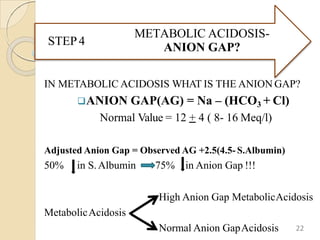
IN METABOLIC ACIDOSIS WHAT IS THE ANION GAP?
ANION GAP(AG) = Na – (HCO3 + Cl)
Normal Value = 12 + 4 ( 8- 16 Meq/l)
Adjusted Anion Gap = Observed AG +2.5(4.5- S.Albumin)
50% in S.Albumin 75% in Anion Gap !!!
High Anion Gap MetabolicAcidosis
MetabolicAcidosis
Normal Anion GapAcidosis 22
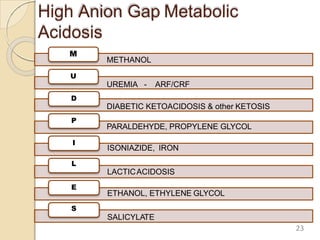
High Anion Gap Metabolic
Acidosis
M
U
D
P
I
E
METHANOL
UREMIA - ARF/CRF
DIABETIC KETOACIDOSIS & other KETOSIS
PARALDEHYDE, PROPYLENE GLYCOL
ISONIAZIDE, IRON
L
LACTICACIDOSIS
ETHANOL, ETHYLENE GLYCOL
S
SALICYLATE
23
CO EXISTANT METABOLIC
DISORDER – “Gap Gap”?
STEP5
C/O HGAG METABOLIC ACIDOSIS,ANOTHER DISORDER?
 ∆ Anion Gap = Measured AG – NormalAG
Measured AG – 12
∆ HCO3 = Normal HCO3 – MeasuredHCO3
24 – Measured HCO3
Ideally, ∆Anion Gap = ∆HCO3
For each 1 meq/L increase in AG, HCO3 will fall by 1 meq/L
∆AG/ HCO3
- = 1  Pure High AG MetAcidosis
AG/ HCO3
- > 1  Assoc Metabolic Alkalosis
AG/ HCO3
- < 1  Assoc N AG MetAcidosis
24
Clinical
CASE
SCENARIOS
25
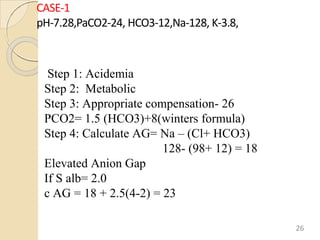
CASE-1
pH-7.28,PaCO2-24, HCO3-12,Na-128, K-3.8,
Step 1: Acidemia
Step 2: Metabolic
Step 3: Appropriate compensation- 26
PCO2= 1.5 (HCO3)+8(winters formula)
Step 4: Calculate AG= Na – (Cl+ HCO3)
128- (98+ 12) = 18
Elevated Anion Gap
If S alb= 2.0
c AG = 18 + 2.5(4-2) = 23
26
CASE-2
pH-7.17,PaCO2-65,HCO3-22
Na-136,Cl-98,
Sr.Alb-1.6
Step 1: Acidemia
Step 2: Respirtory
Step 3: Evaluate compensation – no, its decreased- metabolic
acidosis
Step 4: Calculate AG= Na – (Cl+ HCO3)
136- (98+ 22) = 16
If S alb= 1.6
Step 5: c AG = 16 + 2.5(4-1.6) = 22 (elevated gap Met Acidosis
Step 6: Calculate Delta ratio : 22- 12/ 24- 22= 10/ 2= 5
DELTA RATIO > 2, IRRESPECTIVE OF ETIOLOGY- OF
INCREASED AG, IT POINTS TO METABOLIC
ALKALOSIS
48 yr, alcoholic , found unconscious
,soiled with vomitus, last seen at party
6 hrs back
27
17 year old w/severe kyphoscoliosis, admitted
for pneumonia
pH 7. 42
paCO2 29
paO2 72
HCO3 17
Na 140
K 4.0
Cl 109
Step 1: Check pH: Normal (towards alkalosis)
Step 2: Check paCO2 : Alkalotic (respiratory alkalosis)
Step 3: Compensation: (11mmHg CO2 ~ 5 meq HCO3)
Step 4: Calculate Anion Gap AG=140 –(109+17)=14
Step 5: Delta gap= 14-12/24-17= 2/ 5= 0.4
Signifies underlying normal anion gap metabolic acidosis
28
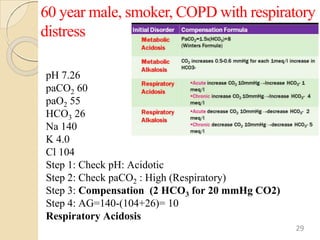
60 year male, smoker, COPD with respiratory
distress
pH 7.26
paCO2 60
paO2 55
HCO3 26
Na 140
K 4.0
Cl 104
Step 1: Check pH: Acidotic
Step 2: Check paCO2 : High (Respiratory)
Step 3: Compensation (2 HCO3 for 20 mmHg CO2)
Step 4: AG=140-(104+26)= 10
Respiratory Acidosis
29
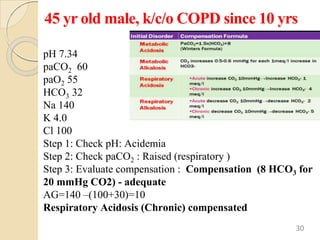
45 yr old male, k/c/o COPD since 10 yrs
pH 7.34
paCO2 60
paO2 55
HCO3 32
Na 140
K 4.0
Cl 100
Step 1: Check pH: Acidemia
Step 2: Check paCO2 : Raised (respiratory )
Step 3: Evaluate compensation : Compensation (8 HCO3 for
20 mmHg CO2) - adequate
AG=140 –(100+30)=10
Respiratory Acidosis (Chronic) compensated
30
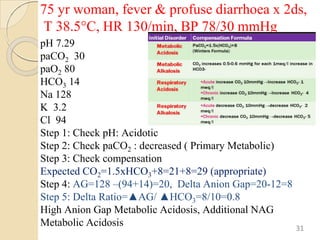
75 yr woman, fever & profuse diarrhoea x 2ds,
T 38.5°C, HR 130/min, BP 78/30 mmHg
pH 7.29
paCO2 30
paO2 80
HCO3 14
Na 128
K 3.2
Cl 94
Step 1: Check pH: Acidotic
Step 2: Check paCO2 : decreased ( Primary Metabolic)
Step 3: Check compensation
Expected CO2=1.5xHCO3+8=21+8=29 (appropriate)
Step 4: AG=128 –(94+14)=20, Delta Anion Gap=20-12=8
Step 5: Delta Ratio=▲AG/ ▲HCO3=8/10=0.8
High Anion Gap Metabolic Acidosis, Additional NAG
Metabolic Acidosis 31
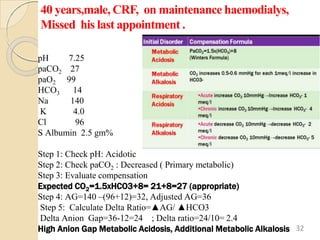
40 years,male, CRF, on maintenance haemodialys,
Missed his last appointment .
pH 7.25
paCO2 27
paO2 99
HCO3 14
Na 140
K 4.0
Cl 96
S Albumin 2.5 gm%
Step 1: Check pH: Acidotic
Step 2: Check paCO2 : Decreased ( Primary metabolic)
Step 3: Evaluate compensation
Expected CO2=1.5xHCO3+8= 21+8=27 (appropriate)
Step 4: AG=140 –(96+12)=32, Adjusted AG=36
Step 5: Calculate Delta Ratio=▲AG/ ▲HCO3
Delta Anion Gap=36-12=24 ; Delta ratio=24/10= 2.4
High Anion Gap Metabolic Acidosis, Additional Metabolic Alkalosis 32
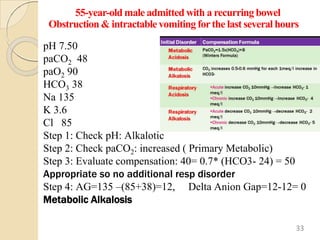
55-year-old male admitted with a recurring bowel
Obstruction& intractable vomiting forthe last several hours
pH 7.50
paCO2 48
paO2 90
HCO3 38
Na 135
K 3.6
Cl 85
Step 1: Check pH: Alkalotic
Step 2: Check paCO2: increased ( Primary Metabolic)
Step 3: Evaluate compensation: 40= 0.7* (HCO3- 24) = 50
Appropriate so no additional resp disorder
Step 4: AG=135 –(85+38)=12, Delta Anion Gap=12-12= 0
Metabolic Alkalosis
33
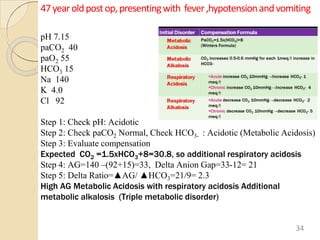
47yearoldpostop,presentingwith fever,hypotensionandvomiting
pH 7.15
paCO2 40
paO2 55
HCO3 15
Na 140
K 4.0
Cl 92
Step 1: Check pH: Acidotic
Step 2: Check paCO2 Normal, Check HCO3- : Acidotic (Metabolic Acidosis)
Step 3: Evaluate compensation
Expected CO2 =1.5xHCO3+8=30.8, so additional respiratory acidosis
Step 4: AG=140 –(92+15)=33, Delta Anion Gap=33-12= 21
Step 5: Delta Ratio=▲AG/ ▲HCO3=21/9= 2.3
High AG Metabolic Acidosis with respiratory acidosis Additional
metabolic alkalosis (Triple metabolic disorder)
34
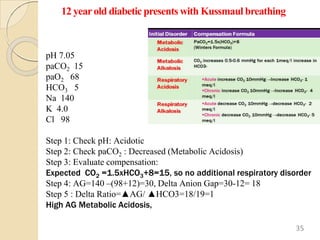
12 yearold diabetic presents with Kussmaul breathing
pH 7.05
paCO2 15
paO2 68
HCO3 5
Na 140
K 4.0
Cl 98
Step 1: Check pH: Acidotic
Step 2: Check paCO2 : Decreased (Metabolic Acidosis)
Step 3: Evaluate compensation:
Expected CO2 =1.5xHCO3+8=15, so no additional respiratory disorder
Step 4: AG=140 –(98+12)=30, Delta Anion Gap=30-12= 18
Step 5 : Delta Ratio=▲AG/ ▲HCO3=18/19=1
High AG Metabolic Acidosis,
35
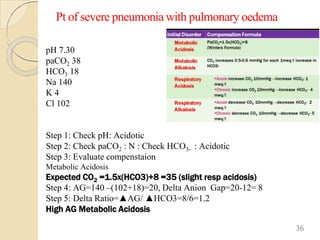
Pt of severe pneumonia with pulmonary oedema
pH 7.30
paCO2 38
HCO3 18
Na 140
K 4
Cl 102
Step 1: Check pH: Acidotic
Step 2: Check paCO2 : N : Check HCO3- : Acidotic
Step 3: Evaluate compenstaion
Metabolic Acidosis
Expected CO2 =1.5x(HCO3)+8 =35 (slight resp acidosis)
Step 4: AG=140 –(102+18)=20, Delta Anion Gap=20-12= 8
Step 5: Delta Ratio=▲AG/ ▲HCO3=8/6=1.2
High AG Metabolic Acidosis
36
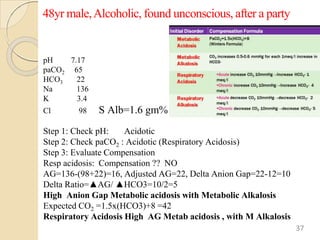
48yr male,Alcoholic, found unconscious, after a party
pH 7.17
paCO2 65
HCO3 22
Na 136
K 3.4
Cl 98 S Alb=1.6 gm%
Step 1: Check pH: Acidotic
Step 2: Check paCO2 : Acidotic (Respiratory Acidosis)
Step 3: Evaluate Compensation
Resp acidosis: Compensation ?? NO
AG=136-(98+22)=16, Adjusted AG=22, Delta Anion Gap=22-12=10
Delta Ratio=▲AG/ ▲HCO3=10/2=5
High Anion Gap Metabolic acidosis with Metabolic Alkalosis
Expected CO2 =1.5x(HCO3)+8 =42
Respiratory Acidosis High AG Metab acidosis , with M Alkalosis
37
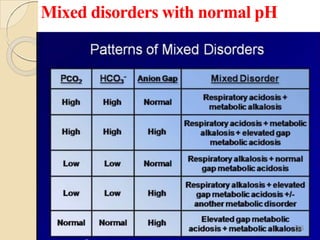
Mixed disorders with normal pH
38
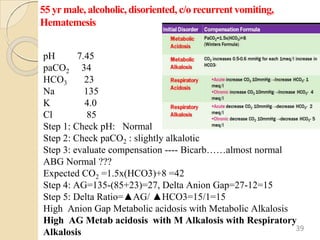
55 yrmale,alcoholic,disoriented, c/o recurrent vomiting,
Hematemesis
pH 7.45
paCO2 34
HCO3 23
Na 135
K 4.0
Cl 85
Step 1: Check pH: Normal
Step 2: Check paCO2 : slightly alkalotic
Step 3: evaluate compensation ---- Bicarb……almost normal
ABG Normal ???
Expected CO2 =1.5x(HCO3)+8 =42
Step 4: AG=135-(85+23)=27, Delta Anion Gap=27-12=15
Step 5: Delta Ratio=▲AG/ ▲HCO3=15/1=15
High Anion Gap Metabolic acidosis with Metabolic Alkalosis
High AG Metab acidosis with M Alkalosis with Respiratory
Alkalosis 39
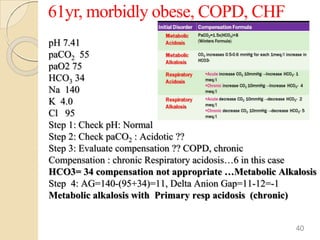
61yr, morbidly obese, COPD, CHF
pH 7.41
paCO2 55
paO2 75
HCO3 34
Na 140
K 4.0
Cl 95
Step 1: Check pH: Normal
Step 2: Check paCO2 : Acidotic ??
Step 3: Evaluate compensation ?? COPD, chronic
Compensation : chronic Respiratory acidosis…6 in this case
HCO3= 34 compensation not appropriate …Metabolic Alkalosis
Step 4: AG=140-(95+34)=11, Delta Anion Gap=11-12=-1
Metabolic alkalosis with Primary resp acidosis (chronic)
40
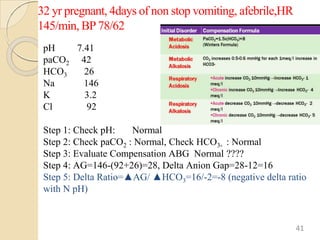
32 yr pregnant, 4days of non stop vomiting, afebrile,HR
145/min, BP78/62
pH 7.41
paCO2 42
HCO3 26
Na 146
K 3.2
Cl 92
Step 1: Check pH: Normal
Step 2: Check paCO2 : Normal, Check HCO3- : Normal
Step 3: Evaluate Compensation ABG Normal ????
Step 4: AG=146-(92+26)=28, Delta Anion Gap=28-12=16
Step 5: Delta Ratio=▲AG/ ▲HCO3=16/-2=-8 (negative delta ratio
with N pH)
41
References
1) Harrison’s Principles of Internal Medicine, 17th edition,
Chap 48 – Acidosis andAlkalosis
2) Paul L.Marino – The ICU Book, 3rd Edition
3) Guyton and Hall – Textbook of Medical Physiology, 11th
edition
4) Davenport – The ABC of Acid Base Chemistry, 6thedition
5) Cohen and Kassirer – Acid Base
6) Hansen JE, Clinics in Chest medicine10(2), 1989, 227-37
7) Lippincott’s-Fluid Balance, NM Metheny
8) World Wide Web
42

ABG analysis presentation by Dr. Aman jain

  • 1.
    Arterial Blood Gas Interpretation Presentor- Dr. Aman Jain Moderator - Dr. Shambhavi No of slides - 42 1
  • 2.
    What is thepreanalytical phase? • It is the phase which includes all activities that occur prior to the sample’s insertion into the analytical instrument. • Sub phase of the preanalytical process in blood gas testing includes:  Ordering,  Identification,  Collection,  Transportation,  Separation/preparation • It has been recognized for years that the phase of testing most prone to errors is the preanalytical phase. • Pre-preanalytical Error includes : • Inappropriate test ordered, order entry error, patient/specimen misidentification, sample contamination (from indwelling catheter), sample collection mishap (hemolysis, clotting, insufficient volume), inappropriate collection container, improper storage/handling/transport. 2
  • 3.
  • 4.
    ABG – Procedureand Precautions  Site- (Ideally) RadialArtery BrachialArtery FemoralArtery  Ideally - Pre-heparinised ABG syringes - Syringe should be FLUSHED with 0.5ml of 1:1000 Heparin solution and emptied. DO NOT LEAVE EXCESSIVE HEPARIN IN THE SYRINGE HEPARIN DILUTIONAL EFFECT HCO3 PCO2 Only small 0.5ml Heparin for flushing and discard it Syringes must have > 50% blood. Use only 2ml or less syringe. 4
  • 5.
  • 6.
    Determination of PaO2 2 PaOis dependant upon Age, FiO ,P 2 atm As Age the expected PaO2 • PaO2 = 109 - 0.4 (Age) As FiO2 the expected PaO2 • Alveolar Gas Equation: • PAO2= (PB-P h2o) x FiO2- pCO2/R O X Y G E N A T I O N A 2 B P O = partial pressure of oxygen in alveolargas, P = barometric pressure (760mmHg), Ph2o = water vapor pressure (47 mm Hg), FiO2 = fraction of inspired oxygen, PCO2 = partial pressure of CO2 in the ABG, R = respiratory quotient (0.8) 6
  • 7.
    Assessment of ACIDBASE Balance Definitions and Terminology ACIDOSIS – presence of a process which tends to pH by virtue of gain of H + - or loss of HCO3 ALKALOSIS – presence of a process which tends 3 to pH by virtue of loss of H+ or gain of HCO - If these changes, change pH, suffix ‘emia’ is added  ACIDEMIA – reduction in arterial pH (pH<7.35)  ALKALEMIA – increase in arterial pH (pH>7.45) 7
  • 8.
    Simple Acid BaseDisorder/ Primary Acid Base disorder – a single primary process of acidosis or alkalosis due to an initial change in PCO2 and HCO3. Compensation - The normal response of the respiratory system or kidneys to change in pH induced by a primary acid-base disorder  The Compensatory responses to a primary Acid Base disturbance are never enough to correct the change in pH , they only act to reduce the severity. Mixed Acid Base Disorder – Presence of more than one acid base disorder simultaneously . 8
  • 9.
    STEP WISEAPPROACH to Interpretation Of ABGreports Six steps logical approach originally proposed by Narins and Emmett (1980) and modified by Morganroth in 1991 9
  • 10.
    Normal Values ANALYTE NormalValue Units pH 7.35 - 7.45 PCO2 35 - 45 mm Hg PO2 72 – 104 mm Hg` [HCO3] 22 – 30 meq/L SaO2 95-100 % Anion Gap 12 + 4 meq/L ∆HCO3 +2 to -2 meq/L 10
  • 11.
    STEP0 STEP1 STEP2 • Is thisABGAuthentic? • ACIDEMIA or ALKALEMIA? • RESPIRA TORY or METABOLIC? STEP3 • Is COMPENSATION adequate? STEP4 • If METABOLIC ACIDOSIS – ANION GAP? STEP5 • If High gap MetabolicAcidosis– GAP GAP? 11
  • 12.
    Is this ABGauthentic ? pH = - log [H+] Henderson-Hasselbalch equation pH = 6.1 + log HCO3 - 0.03 x PCO2 The [HCO3-] mentioned on the ABG is actually calculated using this equation from measured values of PCO2 ndpH • [H+] neq/l = 24 X (PCO2 / HCO3) • pH = -log [ H+] pHexpected = pHmeasured = ABG is authentic 12
  • 13.
    Reference table forpH v/s [H+] [H+] neq/l = 24 X (PCO2 /HCO3) H+ ion pH 100 7.00 79 7.10 63 7.20 50 7.30 45 7.35 40 7.40 35 7.45 32 7.50 25 7.60 13
  • 14.
     Look atpH <7.35 - acidemia >7.45 – alkalemia  RULE – An acid base abnormality is present even if either the pH or PCO2 are Normal. ACIDEMIA ORALKALEMIA? STEP 1 14
  • 15.
    IS PRIMARY DISTURBANCERESPIRATORY OR METABOLIC? pH PCO2 or pH PCO2 METABOLIC pH PCO2 or pH PCO2 RESPIRA TORY RULE- If either the pH or PCO2 is Normal, there is a mixed metabolic and respiratory acid base disorder. RESPIRATORY or METABOLIC? STEP2 15
  • 16.
  • 17.
    17 STEP 3 -COMPENSATION
  • 18.
    ADEQUATE COMPENSATION? IS THECOMPENSATORY RESPONSE ADEQUATE OR NOT? METABOLIC DISORDER PCO2measured ≠ PCO2expected PCO2expected MIXED DISORDER RESPIRATORYDISORDER pHexpected acute-chronic pHm ≠ pHe range MIXED DISORDER 18
  • 19.
    STEP0 STEP1 STEP2 • Is thisABGAuthentic? • ACIDEMIA or ALKALEMIA? • RESPIRA TORY or METABOLIC? STEP3 STEP4 • If Respiratory – ACUTE or CHRONIC? • Is COMPENSATION adequate? STEP4 • If METABOLIC ACIDOSIS – ANION GAP? STEP6 • If High gap MetabolicAcidosis– GAP GAP? 19
  • 20.
    Electrochemical Balance inBlood 80% 70% 60% 50% 40% 30% 20% 10% 0% 100% 90% CATIONS ANIONS Sulfate Phosphate Mg- OA K - Proteins Ca-HCO3 Na- Cl UA UC Na Cl HCO3 20
  • 21.
    Anion Gap AG basedon principle of electroneutrality:  Total Serum Cations = Total Serum Anions  M cations + U cations = M anions + U anions  Na + (K + Ca + Mg) = HCO3 + Cl + (PO4 + SO4 + Protein + Or  Na + UC  But in Blood there is a = HCO3 + Cl + UA relative abundance of Anions, ganicAcids) hence Anions > Cations  Na – (HCO3 + Cl) = UA – UC  Na – (HCO3 + Cl) = Anion Gap 21
  • 22.
    METABOLIC ACIDOSIS- ANION GAP? STEP4 INMETABOLIC ACIDOSIS WHAT IS THE ANION GAP? ANION GAP(AG) = Na – (HCO3 + Cl) Normal Value = 12 + 4 ( 8- 16 Meq/l) Adjusted Anion Gap = Observed AG +2.5(4.5- S.Albumin) 50% in S.Albumin 75% in Anion Gap !!! High Anion Gap MetabolicAcidosis MetabolicAcidosis Normal Anion GapAcidosis 22
  • 23.
    High Anion GapMetabolic Acidosis M U D P I E METHANOL UREMIA - ARF/CRF DIABETIC KETOACIDOSIS & other KETOSIS PARALDEHYDE, PROPYLENE GLYCOL ISONIAZIDE, IRON L LACTICACIDOSIS ETHANOL, ETHYLENE GLYCOL S SALICYLATE 23
  • 24.
    CO EXISTANT METABOLIC DISORDER– “Gap Gap”? STEP5 C/O HGAG METABOLIC ACIDOSIS,ANOTHER DISORDER?  ∆ Anion Gap = Measured AG – NormalAG Measured AG – 12 ∆ HCO3 = Normal HCO3 – MeasuredHCO3 24 – Measured HCO3 Ideally, ∆Anion Gap = ∆HCO3 For each 1 meq/L increase in AG, HCO3 will fall by 1 meq/L ∆AG/ HCO3 - = 1  Pure High AG MetAcidosis AG/ HCO3 - > 1  Assoc Metabolic Alkalosis AG/ HCO3 - < 1  Assoc N AG MetAcidosis 24
  • 25.
  • 26.
    CASE-1 pH-7.28,PaCO2-24, HCO3-12,Na-128, K-3.8, Step1: Acidemia Step 2: Metabolic Step 3: Appropriate compensation- 26 PCO2= 1.5 (HCO3)+8(winters formula) Step 4: Calculate AG= Na – (Cl+ HCO3) 128- (98+ 12) = 18 Elevated Anion Gap If S alb= 2.0 c AG = 18 + 2.5(4-2) = 23 26
  • 27.
    CASE-2 pH-7.17,PaCO2-65,HCO3-22 Na-136,Cl-98, Sr.Alb-1.6 Step 1: Acidemia Step2: Respirtory Step 3: Evaluate compensation – no, its decreased- metabolic acidosis Step 4: Calculate AG= Na – (Cl+ HCO3) 136- (98+ 22) = 16 If S alb= 1.6 Step 5: c AG = 16 + 2.5(4-1.6) = 22 (elevated gap Met Acidosis Step 6: Calculate Delta ratio : 22- 12/ 24- 22= 10/ 2= 5 DELTA RATIO > 2, IRRESPECTIVE OF ETIOLOGY- OF INCREASED AG, IT POINTS TO METABOLIC ALKALOSIS 48 yr, alcoholic , found unconscious ,soiled with vomitus, last seen at party 6 hrs back 27
  • 28.
    17 year oldw/severe kyphoscoliosis, admitted for pneumonia pH 7. 42 paCO2 29 paO2 72 HCO3 17 Na 140 K 4.0 Cl 109 Step 1: Check pH: Normal (towards alkalosis) Step 2: Check paCO2 : Alkalotic (respiratory alkalosis) Step 3: Compensation: (11mmHg CO2 ~ 5 meq HCO3) Step 4: Calculate Anion Gap AG=140 –(109+17)=14 Step 5: Delta gap= 14-12/24-17= 2/ 5= 0.4 Signifies underlying normal anion gap metabolic acidosis 28
  • 29.
    60 year male,smoker, COPD with respiratory distress pH 7.26 paCO2 60 paO2 55 HCO3 26 Na 140 K 4.0 Cl 104 Step 1: Check pH: Acidotic Step 2: Check paCO2 : High (Respiratory) Step 3: Compensation (2 HCO3 for 20 mmHg CO2) Step 4: AG=140-(104+26)= 10 Respiratory Acidosis 29
  • 30.
    45 yr oldmale, k/c/o COPD since 10 yrs pH 7.34 paCO2 60 paO2 55 HCO3 32 Na 140 K 4.0 Cl 100 Step 1: Check pH: Acidemia Step 2: Check paCO2 : Raised (respiratory ) Step 3: Evaluate compensation : Compensation (8 HCO3 for 20 mmHg CO2) - adequate AG=140 –(100+30)=10 Respiratory Acidosis (Chronic) compensated 30
  • 31.
    75 yr woman,fever & profuse diarrhoea x 2ds, T 38.5°C, HR 130/min, BP 78/30 mmHg pH 7.29 paCO2 30 paO2 80 HCO3 14 Na 128 K 3.2 Cl 94 Step 1: Check pH: Acidotic Step 2: Check paCO2 : decreased ( Primary Metabolic) Step 3: Check compensation Expected CO2=1.5xHCO3+8=21+8=29 (appropriate) Step 4: AG=128 –(94+14)=20, Delta Anion Gap=20-12=8 Step 5: Delta Ratio=▲AG/ ▲HCO3=8/10=0.8 High Anion Gap Metabolic Acidosis, Additional NAG Metabolic Acidosis 31
  • 32.
    40 years,male, CRF,on maintenance haemodialys, Missed his last appointment . pH 7.25 paCO2 27 paO2 99 HCO3 14 Na 140 K 4.0 Cl 96 S Albumin 2.5 gm% Step 1: Check pH: Acidotic Step 2: Check paCO2 : Decreased ( Primary metabolic) Step 3: Evaluate compensation Expected CO2=1.5xHCO3+8= 21+8=27 (appropriate) Step 4: AG=140 –(96+12)=32, Adjusted AG=36 Step 5: Calculate Delta Ratio=▲AG/ ▲HCO3 Delta Anion Gap=36-12=24 ; Delta ratio=24/10= 2.4 High Anion Gap Metabolic Acidosis, Additional Metabolic Alkalosis 32
  • 33.
    55-year-old male admittedwith a recurring bowel Obstruction& intractable vomiting forthe last several hours pH 7.50 paCO2 48 paO2 90 HCO3 38 Na 135 K 3.6 Cl 85 Step 1: Check pH: Alkalotic Step 2: Check paCO2: increased ( Primary Metabolic) Step 3: Evaluate compensation: 40= 0.7* (HCO3- 24) = 50 Appropriate so no additional resp disorder Step 4: AG=135 –(85+38)=12, Delta Anion Gap=12-12= 0 Metabolic Alkalosis 33
  • 34.
    47yearoldpostop,presentingwith fever,hypotensionandvomiting pH 7.15 paCO240 paO2 55 HCO3 15 Na 140 K 4.0 Cl 92 Step 1: Check pH: Acidotic Step 2: Check paCO2 Normal, Check HCO3- : Acidotic (Metabolic Acidosis) Step 3: Evaluate compensation Expected CO2 =1.5xHCO3+8=30.8, so additional respiratory acidosis Step 4: AG=140 –(92+15)=33, Delta Anion Gap=33-12= 21 Step 5: Delta Ratio=▲AG/ ▲HCO3=21/9= 2.3 High AG Metabolic Acidosis with respiratory acidosis Additional metabolic alkalosis (Triple metabolic disorder) 34
  • 35.
    12 yearold diabeticpresents with Kussmaul breathing pH 7.05 paCO2 15 paO2 68 HCO3 5 Na 140 K 4.0 Cl 98 Step 1: Check pH: Acidotic Step 2: Check paCO2 : Decreased (Metabolic Acidosis) Step 3: Evaluate compensation: Expected CO2 =1.5xHCO3+8=15, so no additional respiratory disorder Step 4: AG=140 –(98+12)=30, Delta Anion Gap=30-12= 18 Step 5 : Delta Ratio=▲AG/ ▲HCO3=18/19=1 High AG Metabolic Acidosis, 35
  • 36.
    Pt of severepneumonia with pulmonary oedema pH 7.30 paCO2 38 HCO3 18 Na 140 K 4 Cl 102 Step 1: Check pH: Acidotic Step 2: Check paCO2 : N : Check HCO3- : Acidotic Step 3: Evaluate compenstaion Metabolic Acidosis Expected CO2 =1.5x(HCO3)+8 =35 (slight resp acidosis) Step 4: AG=140 –(102+18)=20, Delta Anion Gap=20-12= 8 Step 5: Delta Ratio=▲AG/ ▲HCO3=8/6=1.2 High AG Metabolic Acidosis 36
  • 37.
    48yr male,Alcoholic, foundunconscious, after a party pH 7.17 paCO2 65 HCO3 22 Na 136 K 3.4 Cl 98 S Alb=1.6 gm% Step 1: Check pH: Acidotic Step 2: Check paCO2 : Acidotic (Respiratory Acidosis) Step 3: Evaluate Compensation Resp acidosis: Compensation ?? NO AG=136-(98+22)=16, Adjusted AG=22, Delta Anion Gap=22-12=10 Delta Ratio=▲AG/ ▲HCO3=10/2=5 High Anion Gap Metabolic acidosis with Metabolic Alkalosis Expected CO2 =1.5x(HCO3)+8 =42 Respiratory Acidosis High AG Metab acidosis , with M Alkalosis 37
  • 38.
  • 39.
    55 yrmale,alcoholic,disoriented, c/orecurrent vomiting, Hematemesis pH 7.45 paCO2 34 HCO3 23 Na 135 K 4.0 Cl 85 Step 1: Check pH: Normal Step 2: Check paCO2 : slightly alkalotic Step 3: evaluate compensation ---- Bicarb……almost normal ABG Normal ??? Expected CO2 =1.5x(HCO3)+8 =42 Step 4: AG=135-(85+23)=27, Delta Anion Gap=27-12=15 Step 5: Delta Ratio=▲AG/ ▲HCO3=15/1=15 High Anion Gap Metabolic acidosis with Metabolic Alkalosis High AG Metab acidosis with M Alkalosis with Respiratory Alkalosis 39
  • 40.
    61yr, morbidly obese,COPD, CHF pH 7.41 paCO2 55 paO2 75 HCO3 34 Na 140 K 4.0 Cl 95 Step 1: Check pH: Normal Step 2: Check paCO2 : Acidotic ?? Step 3: Evaluate compensation ?? COPD, chronic Compensation : chronic Respiratory acidosis…6 in this case HCO3= 34 compensation not appropriate …Metabolic Alkalosis Step 4: AG=140-(95+34)=11, Delta Anion Gap=11-12=-1 Metabolic alkalosis with Primary resp acidosis (chronic) 40
  • 41.
    32 yr pregnant,4days of non stop vomiting, afebrile,HR 145/min, BP78/62 pH 7.41 paCO2 42 HCO3 26 Na 146 K 3.2 Cl 92 Step 1: Check pH: Normal Step 2: Check paCO2 : Normal, Check HCO3- : Normal Step 3: Evaluate Compensation ABG Normal ???? Step 4: AG=146-(92+26)=28, Delta Anion Gap=28-12=16 Step 5: Delta Ratio=▲AG/ ▲HCO3=16/-2=-8 (negative delta ratio with N pH) 41
  • 42.
    References 1) Harrison’s Principlesof Internal Medicine, 17th edition, Chap 48 – Acidosis andAlkalosis 2) Paul L.Marino – The ICU Book, 3rd Edition 3) Guyton and Hall – Textbook of Medical Physiology, 11th edition 4) Davenport – The ABC of Acid Base Chemistry, 6thedition 5) Cohen and Kassirer – Acid Base 6) Hansen JE, Clinics in Chest medicine10(2), 1989, 227-37 7) Lippincott’s-Fluid Balance, NM Metheny 8) World Wide Web 42

Editor's Notes

  • #28 Is HCO3 increased by 1 for every 10 mm rise of PCO2
  • #29 Respiratory alkalosis (due to chronic hyperventilation secondary to hypoxia) with Compensatory MA
  • #31 improve the ventilation status by , mechanical ventilation, pulmonary toilet or by bronchodilators.
  • #33 40 years,male,CRF,on maintenance haemodialys,Missed his last appointment Tachypnoeic, febrile pH 7.32 PaCO2 32 mmHg HCO3- 18 meq/l Base deficit -6 Follow the three steps: 1. pH is low (normal 7.35-7.45); therefore acidosis. 2. PaCO2 is low. lungs, acting as the primary acid-base buffer, are attempting to compensate by “blowing off excessive C02”, therefore increasing the pH. 3. Assess the HCO3. It is low (normal 22-26). We would expect the pH and the HCO3 to move in the same direction, confirming that the primary problem is metabolic.
  • #34 55-year-old male admitted with a recurring bowel Obstruction & intractable vomiting for the last several hours pH 7.50 PaCO2 42 HCO3- 33 Treatment of this patient might include the administration of I.V.fluids and measures to reduce the excess base.
  • #36  Severe partly compensated metabolic acidosis (due to ketoacidosis) without hypoxemia
  • #38 Alcoholic KA (inadequate fluid and carb intake) Met Alk (vomiting)
  • #40 Alcoholic KA (inadequate fluid and carb intake) Met Alk (vomiting)
  • #42 Hypovol shock Contr alkalosis + vomiting