Diagnostic Procedures in GIT Diseases:
Introduction: Major cause of morbidity & mortality. 10% of GP consultations are for indigestion. ¼ of GP consultations for diarrhea. Infective diarrhea is a major cause of ill heath & death in developing countries. GIT is one of the most common sites for cancer. Major advances had occurred in the field of GE; PUD proved to be an infective condition due to HP & Nobel prize had been given recently to its discoverer, Marshal. Molecular events in the CRC development had been discovered & from this effort became successful in its prevention by NSAIDs. GIT endoscopy made diagnosis of GIT diseases very easy. Therapeutic endoscopy made it possible to replace surgery for many GIT conditions as GI bleeding, bilairy stone removal & stenting, palliative cancer stenting, polyp removal, PEG & endoscopic mucosal resection.
History: Dysphagia: difficult swallowing Odynophagia: painful swallowing. Aphagia: can not swallow. Heart burn. Non cardiac chest pain. Regurgitation. Aerophagia: eructation. Hematemesis. Melena. Hematochesia: fresh bleeding per rectum. Dyspepsia: abnormal digestion. Anorexia. Flatulence. Alteration in bowel habits. Bleeding per rectum. Abd pain.
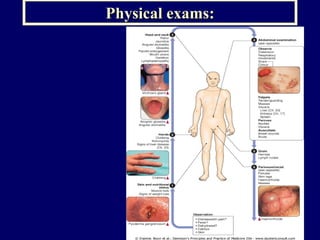
Physical exams:
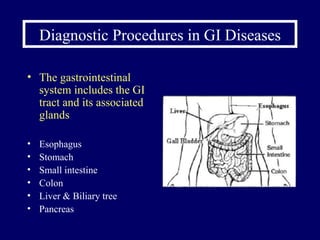
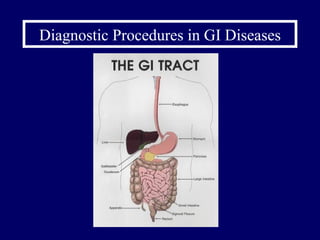
Diagnostic Procedures in GI Diseases The gastrointestinal system includes the GI tract and its associated glands Esophagus Stomach Small intestine Colon Liver & Biliary tree Pancreas
Diagnostic Procedures in GI Diseases The diagnostic tests can be divided into several categories: Structural tests Functional tests Tests for  Helicobacter pylori Special blood tests Special stool tests
Diagnostic Procedures in GI Diseases Structural Tests
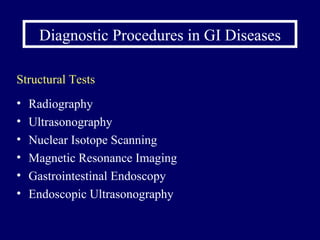
Diagnostic Procedures in GI Diseases Structural Tests Radiography Ultrasonography Nuclear Isotope Scanning  Magnetic Resonance Imaging Gastrointestinal Endoscopy Endoscopic Ultrasonography
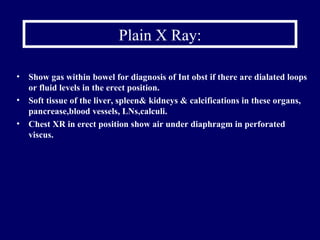
Plain X Ray: Show gas within bowel for diagnosis of Int obst if there are dialated loops or fluid levels in the erect position. Soft tissue of the liver, spleen& kidneys & calcifications in these organs, pancrease,blood vessels, LNs,calculi. Chest XR in erect position show air under diaphragm in perforated viscus.
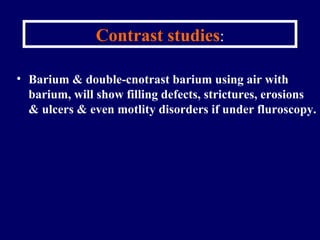
Contrast studies : Barium & double-cnotrast barium using air with barium, will show filling defects, strictures, erosions & ulcers & even motlity disorders if under fluroscopy.
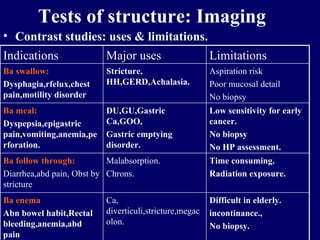
Tests of structure: Imaging Contrast studies: uses & limitations. Indications Major uses Limitations Ba swallow: Dysphagia,rfelux,chest pain,motility disorder Stricture, HH,GERD,Achalasia. Aspiration risk Poor mucosal detail No biopsy Ba meal: Dyspepsia,epigastric pain,vomiting,anemia,perforation. DU,GU,Gastric Ca,GOO,  Gastric emptying disorder. Low sensitivity for early cancer. No biopsy No HP assessment. Ba follow through: Diarrhea,abd pain, Obst by stricture Malabsorption. Chrons. Time consuming. Radiation exposure. Ba enema Abn bowel habit,Rectal bleeding,anemia,abd pain Ca, diverticuli,stricture,megacolon. Difficult in elderly. incontinance., No biopsy.
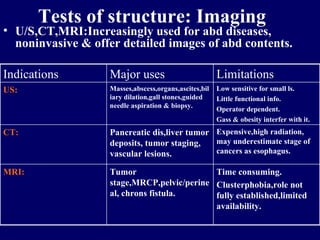
Tests of structure: Imaging U/S,CT,MRI:Increasingly used for abd diseases, noninvasive & offer detailed images of abd contents. Indications Major uses Limitations US: Masses,abscess,organs,ascites,biliary dilation,gall stones,guided needle aspiration & biopsy. Low sensitive for small ls. Little functional info. Operator dependent. Gass & obesity interfer with it. CT: Pancreatic dis,liver tumor deposits, tumor staging, vascular lesions. Expensive,high radiation, may underestimate stage of cancers as esophagus. MRI: Tumor stage,MRCP,pelvic/perineal, chrons fistula. Time consuming. Clusterphobia,role not fully established,limited availability.
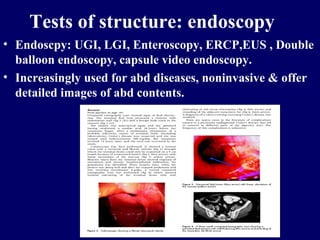
Tests of structure: endoscopy Endoscpy: UGI, LGI, Enteroscopy, ERCP,EUS , Double balloon endoscopy, capsule video endoscopy. Increasingly used for abd diseases, noninvasive & offer detailed images of abd contents.
Diagnostic Procedures in GI Diseases Functional Tests
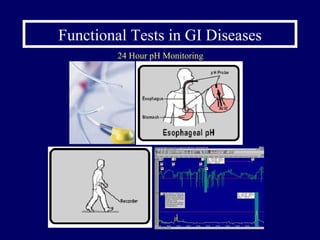
Diagnostic Procedures in GI Diseases Functional Tests Tests for motility 24 hour pH monitoring  Tests for acid output Tests for malabsorption Tests for pancreatic function
Gastrointestinal Endoscopy
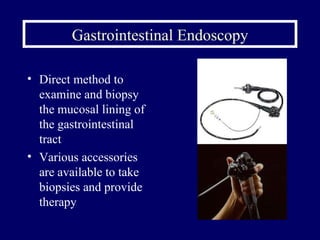
Gastrointestinal Endoscopy Direct method to examine and biopsy the mucosal lining of the gastrointestinal tract Various accessories are available to take biopsies and provide therapy
Gastrointestinal Endoscopy Types of Gastrointestinal Endoscopy
Gastrointestinal Endoscopy Types of Gastrointestinal Endoscopy Esophagogastroduodenoscopy (Upper GI Endoscopy) Small Bowel Enteroscopy (Jejunoscopy) Colonoscopy (Lower GI Endoscopy) Sigmoidoscopy Endoscopic Retrograde Cholangiopancreatogram (ERCP)
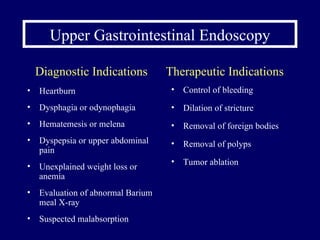
Upper Gastrointestinal Endoscopy Heartburn Dysphagia or odynophagia Hematemesis or melena Dyspepsia or upper abdominal pain Unexplained weight loss or anemia Evaluation of abnormal Barium meal X-ray Suspected malabsorption Control of bleeding Dilation of stricture Removal of foreign bodies Removal of polyps Tumor ablation Diagnostic Indications Therapeutic Indications
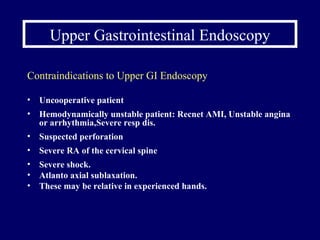
Upper Gastrointestinal Endoscopy Contraindications to Upper GI Endoscopy Uncooperative patient Hemodynamically unstable patient:  Recnet AMI, Unstable angina or arrhythmia,Severe resp dis. Suspected perforation Severe RA of the cervical spine Severe shock. Atlanto axial sublaxation. These may be relative in experienced hands.
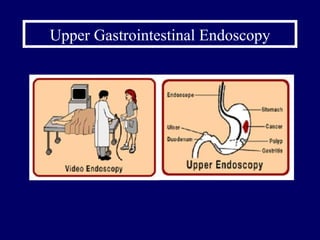
Upper Gastrointestinal Endoscopy
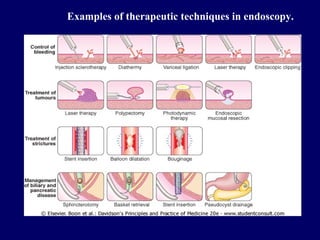
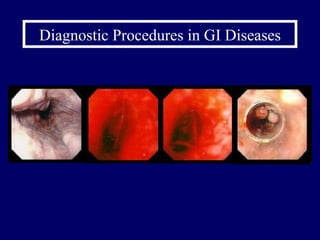
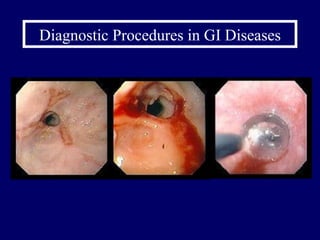
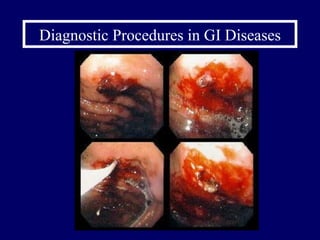
Examples of therapeutic techniques in endoscopy.
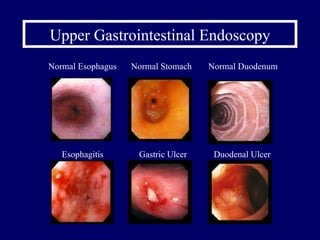
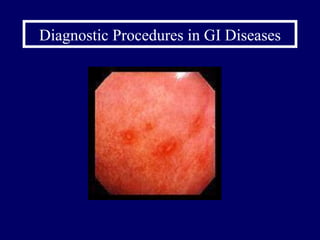
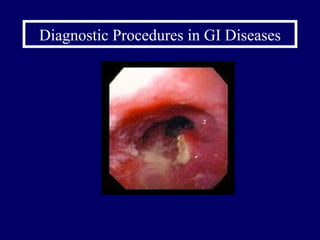
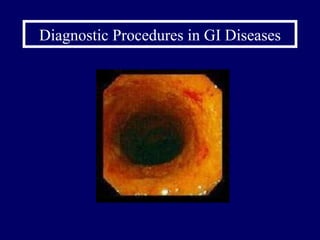
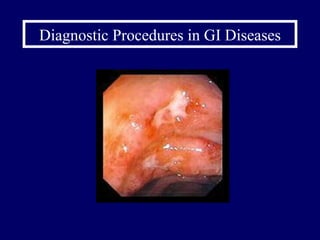
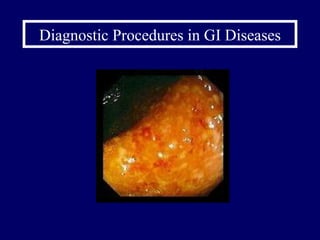
Upper Gastrointestinal Endoscopy Normal Esophagus Normal Stomach Normal Duodenum Duodenal Ulcer Gastric Ulcer Esophagitis
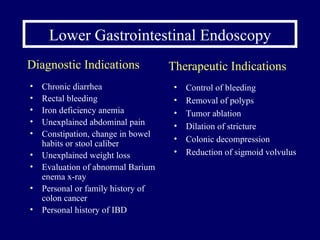
Lower Gastrointestinal Endoscopy Chronic diarrhea Rectal bleeding Iron deficiency anemia Unexplained abdominal pain Constipation, change in bowel habits or stool caliber Unexplained weight loss Evaluation of abnormal Barium enema x-ray Personal or family history of colon cancer Personal history of IBD Control of bleeding Removal of polyps Tumor ablation Dilation of stricture Colonic decompression Reduction of sigmoid volvulus  Diagnostic Indications Therapeutic Indications
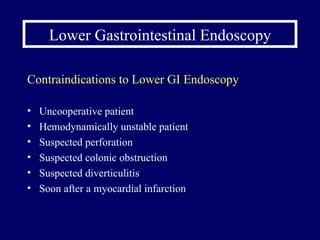
Lower Gastrointestinal Endoscopy Contraindications to Lower GI Endoscopy Uncooperative patient Hemodynamically unstable patient Suspected perforation Suspected colonic obstruction Suspected diverticulitis Soon after a myocardial infarction
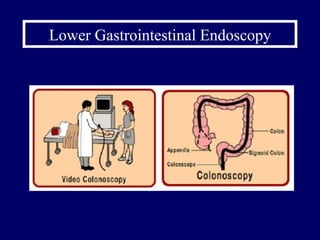
Lower Gastrointestinal Endoscopy
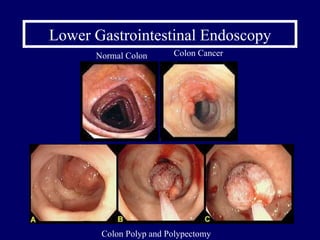
Lower Gastrointestinal Endoscopy Normal Colon Colon Cancer Colon Polyp and Polypectomy
Endoscopic Retrograde Cholangiopancreatogram Indications
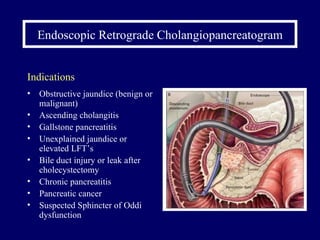
Endoscopic Retrograde Cholangiopancreatogram Indications Obstructive jaundice (benign or malignant) Ascending cholangitis  Gallstone pancreatitis Unexplained jaundice or elevated LFT’s Bile duct injury or leak after cholecystectomy Chronic pancreatitis Pancreatic cancer Suspected Sphincter of Oddi dysfunction
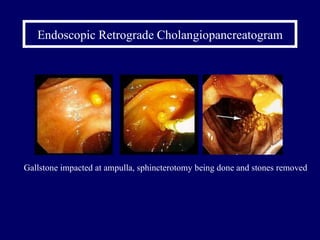
Endoscopic Retrograde Cholangiopancreatogram Gallstone impacted at ampulla, sphincterotomy being done and stones removed
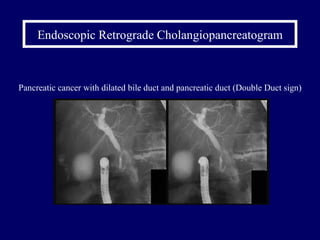
Endoscopic Retrograde Cholangiopancreatogram Pancreatic cancer with dilated bile duct and pancreatic duct (Double Duct sign)
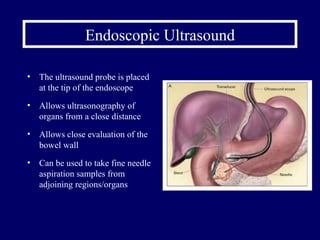
Endoscopic Ultrasound The ultrasound probe is placed at the tip of the endoscope Allows ultrasonography of organs from a close distance Allows close evaluation of the bowel wall Can be used to take fine needle aspiration samples from adjoining regions/organs
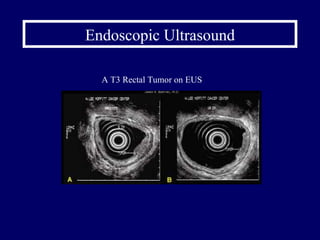
Endoscopic Ultrasound A T3 Rectal Tumor on EUS
Diagnostic Procedures in GI Diseases
Capsule Endoscopy
Capsule Endoscopy
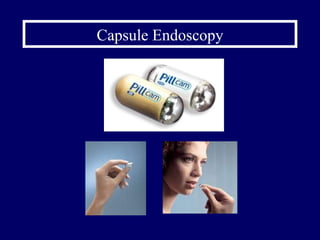
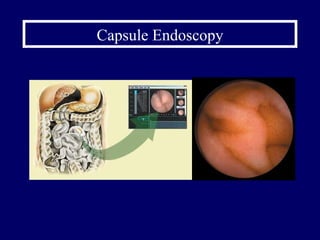
Capsule Endoscopy Capsule endoscopy is intended for visualization of the small bowel mucosa It may be used as a tool in the detection of abnormalities of the small bowel in adults and children from 10 years of age and up Diagnostic Indications
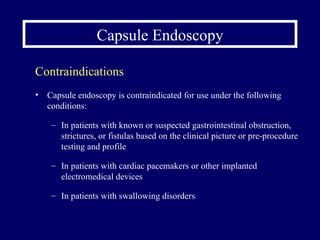
Capsule Endoscopy Capsule endoscopy is contraindicated for use under the following conditions: In patients with known or suspected gastrointestinal obstruction, strictures, or fistulas based on the clinical picture or pre-procedure testing and profile In patients with cardiac pacemakers or other implanted electromedical devices In patients with swallowing disorders Contraindications
Diagnostic Procedures in GI Diseases Functional Tests
Diagnostic Procedures in GI Diseases Functional Tests Tests for motility Tests for pH  Tests for acid output Tests for malabsorption Tests for pancreatic function
Functional Tests in GI Diseases Tests for motility
Functional Tests in GI Diseases Tests for motility Esophageal Manometry 24 Hour pH Monitoring Anorectal Manometry
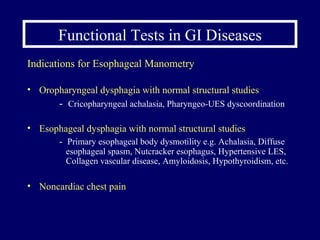
Functional Tests in GI Diseases Indications for Esophageal Manometry Oropharyngeal dysphagia with normal structural studies -  Cricopharyngeal achalasia, Pharyngeo-UES dyscoordination Esophageal dysphagia with normal structural studies  -  Primary esophageal body dysmotility e.g. Achalasia, Diffuse    esophageal spasm, Nutcracker esophagus, Hypertensive LES,    Collagen vascular disease, Amyloidosis, Hypothyroidism, etc.  Noncardiac chest pain
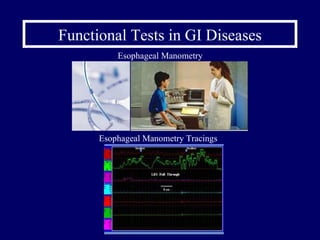
Functional Tests in GI Diseases Esophageal Manometry Tracings Esophageal Manometry
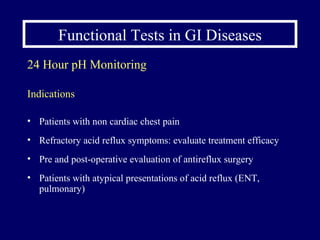
Functional Tests in GI Diseases 24 Hour pH Monitoring Indications Patients with non cardiac chest pain Refractory acid reflux symptoms: evaluate treatment efficacy Pre and post-operative evaluation of antireflux surgery Patients with atypical presentations of acid reflux (ENT, pulmonary)
Functional Tests in GI Diseases 24 Hour pH Monitoring
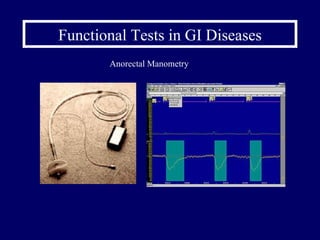
Functional Tests in GI Diseases Anorectal Manometry Used in the clinical assessment of patients in whom a problem with defecation is suspected This technique is helpful in evaluating the anorectal sphincter mechanism Contraindicated in the presence of an anal fissure, since the resting anal pressure is abnormally high
Functional Tests in GI Diseases Anorectal Manometry
Tests of structure: Biopsy Obtained through endoscpy or percutanously & sent for histopath exam. Reasons for biopsy or cytological exams: Brash cytology of suspected malignant lesions. Histological assessment of mucosal abns. Diagnosis of infections( candida, HP,Giardia). Measure enzymes as disacharidases. Analysis of genetic mutations as oncogenes , tumor suppressor genes.
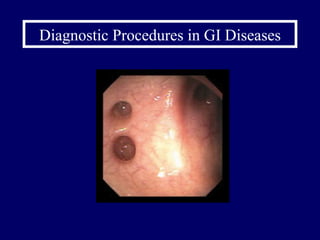
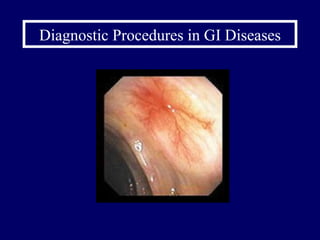
2.Tests of infection: Bacterial cultures For identifying causes of diarrhea sp if acute or bloody. Causes of infective diarrhea: Viruses: Rota, adeno, entero, requires EM or viral cultures. Bacteria: Campylo jej, EC,Salmonella,clostridium difficile( ned toxine isolation). Protozoa: Giardia,ameba, cryptosporidium & moicrospora.
Functional Tests in GI Diseases Tests for Malabsorption
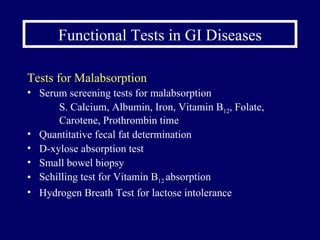
Functional Tests in GI Diseases Tests for Malabsorption Serum screening tests for malabsorption S. Calcium, Albumin, Iron, Vitamin B 12 , Folate,  Carotene, Prothrombin time Quantitative fecal fat determination D-xylose absorption test Small bowel biopsy Schilling test for Vitamin B 12   absorption Hydrogen Breath Test for lactose intolerance
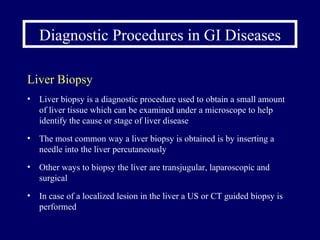
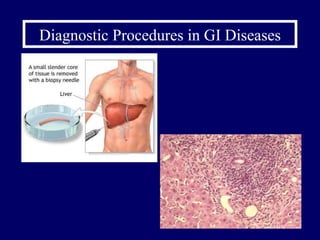
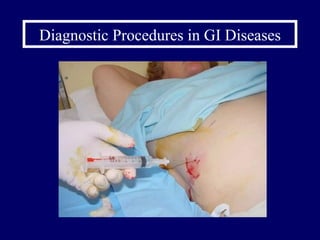
Diagnostic Procedures in GI Diseases Liver Biopsy Liver biopsy is a diagnostic procedure used to obtain a small amount of liver tissue which can be examined under a microscope to help identify the cause or stage of liver disease The most common way a liver biopsy is obtained is by inserting a needle into the liver percutaneously Other ways to biopsy the liver are transjugular, laparoscopic and surgical In case of a localized lesion in the liver a US or CT guided biopsy is performed
Diagnostic Procedures in GI Diseases
Diagnostic Procedures in GI Diseases Tests for  Helicobacter pylori
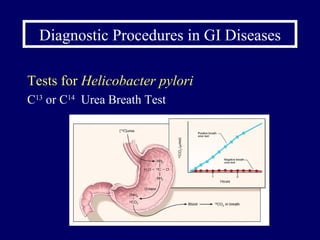
Diagnostic Procedures in GI Diseases Tests for  Helicobacter pylori Non-invasive C 13  or C 14   Urea Breath Test H. pylori IgG titer (serology) Stool antigene for H Pylori. Invasive Gastric mucosal biopsy Rapid Urease test
Diagnostic Procedures in GI Diseases Tests for  Helicobacter pylori C 13  or C 14   Urea Breath Test
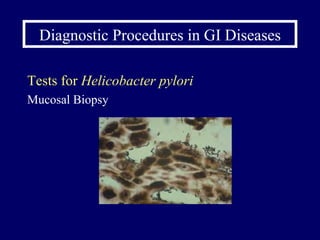
Diagnostic Procedures in GI Diseases Tests for  Helicobacter pylori Mucosal Biopsy
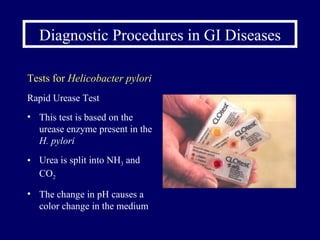
Diagnostic Procedures in GI Diseases Tests for  Helicobacter pylori Rapid Urease Test This test is based on the urease enzyme present in the  H. pylori  Urea is split into NH 3  and CO 2  The change in pH causes a color change in the medium
Diagnostic Procedures in GI Diseases Blood tests Liver function tests (LFT’S) Hepatitis serology  S. Amylase & Lipase Alfa-Feto Protein (AFP) Carcino-Embryonic Antigen (CEA)  Stool tests Stool microscopy Stool ova & parasites Stool culture Stool C. difficile toxin Stool occult blood
Diagnostic Procedures in GI Diseases

Git Diagnostic Tests.

  • 1.
  • 2.
    Introduction: Major causeof morbidity & mortality. 10% of GP consultations are for indigestion. ¼ of GP consultations for diarrhea. Infective diarrhea is a major cause of ill heath & death in developing countries. GIT is one of the most common sites for cancer. Major advances had occurred in the field of GE; PUD proved to be an infective condition due to HP & Nobel prize had been given recently to its discoverer, Marshal. Molecular events in the CRC development had been discovered & from this effort became successful in its prevention by NSAIDs. GIT endoscopy made diagnosis of GIT diseases very easy. Therapeutic endoscopy made it possible to replace surgery for many GIT conditions as GI bleeding, bilairy stone removal & stenting, palliative cancer stenting, polyp removal, PEG & endoscopic mucosal resection.
  • 3.
    History: Dysphagia: difficultswallowing Odynophagia: painful swallowing. Aphagia: can not swallow. Heart burn. Non cardiac chest pain. Regurgitation. Aerophagia: eructation. Hematemesis. Melena. Hematochesia: fresh bleeding per rectum. Dyspepsia: abnormal digestion. Anorexia. Flatulence. Alteration in bowel habits. Bleeding per rectum. Abd pain.
  • 4.
  • 5.
    Diagnostic Procedures inGI Diseases The gastrointestinal system includes the GI tract and its associated glands Esophagus Stomach Small intestine Colon Liver & Biliary tree Pancreas
  • 6.
    Diagnostic Procedures inGI Diseases The diagnostic tests can be divided into several categories: Structural tests Functional tests Tests for Helicobacter pylori Special blood tests Special stool tests
  • 7.
    Diagnostic Procedures inGI Diseases Structural Tests
  • 8.
    Diagnostic Procedures inGI Diseases Structural Tests Radiography Ultrasonography Nuclear Isotope Scanning Magnetic Resonance Imaging Gastrointestinal Endoscopy Endoscopic Ultrasonography
  • 9.
    Plain X Ray:Show gas within bowel for diagnosis of Int obst if there are dialated loops or fluid levels in the erect position. Soft tissue of the liver, spleen& kidneys & calcifications in these organs, pancrease,blood vessels, LNs,calculi. Chest XR in erect position show air under diaphragm in perforated viscus.
  • 10.
    Contrast studies :Barium & double-cnotrast barium using air with barium, will show filling defects, strictures, erosions & ulcers & even motlity disorders if under fluroscopy.
  • 11.
    Tests of structure:Imaging Contrast studies: uses & limitations. Indications Major uses Limitations Ba swallow: Dysphagia,rfelux,chest pain,motility disorder Stricture, HH,GERD,Achalasia. Aspiration risk Poor mucosal detail No biopsy Ba meal: Dyspepsia,epigastric pain,vomiting,anemia,perforation. DU,GU,Gastric Ca,GOO, Gastric emptying disorder. Low sensitivity for early cancer. No biopsy No HP assessment. Ba follow through: Diarrhea,abd pain, Obst by stricture Malabsorption. Chrons. Time consuming. Radiation exposure. Ba enema Abn bowel habit,Rectal bleeding,anemia,abd pain Ca, diverticuli,stricture,megacolon. Difficult in elderly. incontinance., No biopsy.
  • 12.
    Tests of structure:Imaging U/S,CT,MRI:Increasingly used for abd diseases, noninvasive & offer detailed images of abd contents. Indications Major uses Limitations US: Masses,abscess,organs,ascites,biliary dilation,gall stones,guided needle aspiration & biopsy. Low sensitive for small ls. Little functional info. Operator dependent. Gass & obesity interfer with it. CT: Pancreatic dis,liver tumor deposits, tumor staging, vascular lesions. Expensive,high radiation, may underestimate stage of cancers as esophagus. MRI: Tumor stage,MRCP,pelvic/perineal, chrons fistula. Time consuming. Clusterphobia,role not fully established,limited availability.
  • 13.
    Tests of structure:endoscopy Endoscpy: UGI, LGI, Enteroscopy, ERCP,EUS , Double balloon endoscopy, capsule video endoscopy. Increasingly used for abd diseases, noninvasive & offer detailed images of abd contents.
  • 14.
    Diagnostic Procedures inGI Diseases Functional Tests
  • 15.
    Diagnostic Procedures inGI Diseases Functional Tests Tests for motility 24 hour pH monitoring Tests for acid output Tests for malabsorption Tests for pancreatic function
  • 16.
  • 17.
    Gastrointestinal Endoscopy Directmethod to examine and biopsy the mucosal lining of the gastrointestinal tract Various accessories are available to take biopsies and provide therapy
  • 18.
    Gastrointestinal Endoscopy Typesof Gastrointestinal Endoscopy
  • 19.
    Gastrointestinal Endoscopy Typesof Gastrointestinal Endoscopy Esophagogastroduodenoscopy (Upper GI Endoscopy) Small Bowel Enteroscopy (Jejunoscopy) Colonoscopy (Lower GI Endoscopy) Sigmoidoscopy Endoscopic Retrograde Cholangiopancreatogram (ERCP)
  • 20.
    Upper Gastrointestinal EndoscopyHeartburn Dysphagia or odynophagia Hematemesis or melena Dyspepsia or upper abdominal pain Unexplained weight loss or anemia Evaluation of abnormal Barium meal X-ray Suspected malabsorption Control of bleeding Dilation of stricture Removal of foreign bodies Removal of polyps Tumor ablation Diagnostic Indications Therapeutic Indications
  • 21.
    Upper Gastrointestinal EndoscopyContraindications to Upper GI Endoscopy Uncooperative patient Hemodynamically unstable patient: Recnet AMI, Unstable angina or arrhythmia,Severe resp dis. Suspected perforation Severe RA of the cervical spine Severe shock. Atlanto axial sublaxation. These may be relative in experienced hands.
  • 22.
  • 23.
    Examples of therapeutictechniques in endoscopy.
  • 24.
    Upper Gastrointestinal EndoscopyNormal Esophagus Normal Stomach Normal Duodenum Duodenal Ulcer Gastric Ulcer Esophagitis
  • 25.
    Lower Gastrointestinal EndoscopyChronic diarrhea Rectal bleeding Iron deficiency anemia Unexplained abdominal pain Constipation, change in bowel habits or stool caliber Unexplained weight loss Evaluation of abnormal Barium enema x-ray Personal or family history of colon cancer Personal history of IBD Control of bleeding Removal of polyps Tumor ablation Dilation of stricture Colonic decompression Reduction of sigmoid volvulus Diagnostic Indications Therapeutic Indications
  • 26.
    Lower Gastrointestinal EndoscopyContraindications to Lower GI Endoscopy Uncooperative patient Hemodynamically unstable patient Suspected perforation Suspected colonic obstruction Suspected diverticulitis Soon after a myocardial infarction
  • 27.
  • 28.
    Lower Gastrointestinal EndoscopyNormal Colon Colon Cancer Colon Polyp and Polypectomy
  • 29.
  • 30.
    Endoscopic Retrograde CholangiopancreatogramIndications Obstructive jaundice (benign or malignant) Ascending cholangitis Gallstone pancreatitis Unexplained jaundice or elevated LFT’s Bile duct injury or leak after cholecystectomy Chronic pancreatitis Pancreatic cancer Suspected Sphincter of Oddi dysfunction
  • 31.
    Endoscopic Retrograde CholangiopancreatogramGallstone impacted at ampulla, sphincterotomy being done and stones removed
  • 32.
    Endoscopic Retrograde CholangiopancreatogramPancreatic cancer with dilated bile duct and pancreatic duct (Double Duct sign)
  • 33.
    Endoscopic Ultrasound Theultrasound probe is placed at the tip of the endoscope Allows ultrasonography of organs from a close distance Allows close evaluation of the bowel wall Can be used to take fine needle aspiration samples from adjoining regions/organs
  • 34.
    Endoscopic Ultrasound AT3 Rectal Tumor on EUS
  • 35.
  • 36.
  • 37.
  • 38.
    Capsule Endoscopy Capsuleendoscopy is intended for visualization of the small bowel mucosa It may be used as a tool in the detection of abnormalities of the small bowel in adults and children from 10 years of age and up Diagnostic Indications
  • 39.
    Capsule Endoscopy Capsuleendoscopy is contraindicated for use under the following conditions: In patients with known or suspected gastrointestinal obstruction, strictures, or fistulas based on the clinical picture or pre-procedure testing and profile In patients with cardiac pacemakers or other implanted electromedical devices In patients with swallowing disorders Contraindications
  • 40.
    Diagnostic Procedures inGI Diseases Functional Tests
  • 41.
    Diagnostic Procedures inGI Diseases Functional Tests Tests for motility Tests for pH Tests for acid output Tests for malabsorption Tests for pancreatic function
  • 42.
    Functional Tests inGI Diseases Tests for motility
  • 43.
    Functional Tests inGI Diseases Tests for motility Esophageal Manometry 24 Hour pH Monitoring Anorectal Manometry
  • 44.
    Functional Tests inGI Diseases Indications for Esophageal Manometry Oropharyngeal dysphagia with normal structural studies - Cricopharyngeal achalasia, Pharyngeo-UES dyscoordination Esophageal dysphagia with normal structural studies - Primary esophageal body dysmotility e.g. Achalasia, Diffuse esophageal spasm, Nutcracker esophagus, Hypertensive LES, Collagen vascular disease, Amyloidosis, Hypothyroidism, etc. Noncardiac chest pain
  • 45.
    Functional Tests inGI Diseases Esophageal Manometry Tracings Esophageal Manometry
  • 46.
    Functional Tests inGI Diseases 24 Hour pH Monitoring Indications Patients with non cardiac chest pain Refractory acid reflux symptoms: evaluate treatment efficacy Pre and post-operative evaluation of antireflux surgery Patients with atypical presentations of acid reflux (ENT, pulmonary)
  • 47.
    Functional Tests inGI Diseases 24 Hour pH Monitoring
  • 48.
    Functional Tests inGI Diseases Anorectal Manometry Used in the clinical assessment of patients in whom a problem with defecation is suspected This technique is helpful in evaluating the anorectal sphincter mechanism Contraindicated in the presence of an anal fissure, since the resting anal pressure is abnormally high
  • 49.
    Functional Tests inGI Diseases Anorectal Manometry
  • 50.
    Tests of structure:Biopsy Obtained through endoscpy or percutanously & sent for histopath exam. Reasons for biopsy or cytological exams: Brash cytology of suspected malignant lesions. Histological assessment of mucosal abns. Diagnosis of infections( candida, HP,Giardia). Measure enzymes as disacharidases. Analysis of genetic mutations as oncogenes , tumor suppressor genes.
  • 51.
    2.Tests of infection:Bacterial cultures For identifying causes of diarrhea sp if acute or bloody. Causes of infective diarrhea: Viruses: Rota, adeno, entero, requires EM or viral cultures. Bacteria: Campylo jej, EC,Salmonella,clostridium difficile( ned toxine isolation). Protozoa: Giardia,ameba, cryptosporidium & moicrospora.
  • 52.
    Functional Tests inGI Diseases Tests for Malabsorption
  • 53.
    Functional Tests inGI Diseases Tests for Malabsorption Serum screening tests for malabsorption S. Calcium, Albumin, Iron, Vitamin B 12 , Folate, Carotene, Prothrombin time Quantitative fecal fat determination D-xylose absorption test Small bowel biopsy Schilling test for Vitamin B 12 absorption Hydrogen Breath Test for lactose intolerance
  • 54.
    Diagnostic Procedures inGI Diseases Liver Biopsy Liver biopsy is a diagnostic procedure used to obtain a small amount of liver tissue which can be examined under a microscope to help identify the cause or stage of liver disease The most common way a liver biopsy is obtained is by inserting a needle into the liver percutaneously Other ways to biopsy the liver are transjugular, laparoscopic and surgical In case of a localized lesion in the liver a US or CT guided biopsy is performed
  • 55.
  • 56.
  • 57.
    Diagnostic Procedures inGI Diseases Tests for Helicobacter pylori
  • 58.
    Diagnostic Procedures inGI Diseases Tests for Helicobacter pylori Non-invasive C 13 or C 14 Urea Breath Test H. pylori IgG titer (serology) Stool antigene for H Pylori. Invasive Gastric mucosal biopsy Rapid Urease test
  • 59.
    Diagnostic Procedures inGI Diseases Tests for Helicobacter pylori C 13 or C 14 Urea Breath Test
  • 60.
    Diagnostic Procedures inGI Diseases Tests for Helicobacter pylori Mucosal Biopsy
  • 61.
    Diagnostic Procedures inGI Diseases Tests for Helicobacter pylori Rapid Urease Test This test is based on the urease enzyme present in the H. pylori Urea is split into NH 3 and CO 2 The change in pH causes a color change in the medium
  • 62.
    Diagnostic Procedures inGI Diseases Blood tests Liver function tests (LFT’S) Hepatitis serology S. Amylase & Lipase Alfa-Feto Protein (AFP) Carcino-Embryonic Antigen (CEA) Stool tests Stool microscopy Stool ova & parasites Stool culture Stool C. difficile toxin Stool occult blood
  • 63.
  • 64.
  • 65.
  • 66.
  • 67.
  • 68.
  • 69.
  • 70.
  • 71.
  • 72.