Presented  By  Deepak
ABC analysis It is the Methods of Inventory/Material control ABC ANALYSIS STOCK LEVELS EOQ(Economic Order Quantity) Perpetual Inventory System
What is Inventory? The term  INVENTORY  is defined as “the systematic control and regulation of purchase, storage and usage of materials in such a way so as to maintain an even flow of production and at the same time avoiding excessive investment in inventories.”
What is ABC Analysis? ABC analysis divides the total inventory into 3 classes A,B & C using the rupee volume, as follows: class “A”  items constitute the most important class of inventories so far as the proportion in the total value of inventory .The “A” items consists of approximately 15% of the total items , accounts for 80% of the total material usage. This items merit a tightly controlled inventory system with constant attention to the purchase & stores management. A larger effort per item on only a few items will cost only moderately, but the effort can result in larger savings. class “B”  items   constitute an intermediate position, which constitute approximately 35% of the total items, accounts for approximately 15% of the  total material consumption. These items merit a formalized inventory  system & periodic attention but the purchase & the stores management. class “C”  items  are quite negligible. It consists remaining 50% items, accounting only 5% of the monetary value of total material usage . Quite relaxed inventory procedures are used.
ABC ANALYSIS OF INVENTORY Class “A” Class “B” Class “C”
Ex - In shoes leather forms A grade materials , sole forms B grade materials and shoe lace forms C grade materials this is ABC analysis in inventory management
ABC  Analysis in Medical Stores Inventory Control Background: The basic principle of inventory control is ABC based on cost criteria . Methods: Based on ABC matrix, economic analysis of drug expenditure of  priced vocabulary of medical stores  (PVMS) section 01 for the year 2003 of a 190 bedded service hospital was under taken. Result: Out of  493  drugs in  PVMS  section 01, only  325  drugs were being used in the reference hospital. The total cost of drugs used was Rupees  55,23,503 . Of these  325  drugs,  47(14.4%)  drugs were Category A , consuming  70%  of total expenditure,  73 (22.46 %) drugs Category B consuming  20%  and rest  205  drugs  (63.7%)  Category C drugs cost only  10%  of expenditure.
ITEM ITEMS(%) MONEY VALUE(%) A 10 70  B 20 20 C 70 10
“ A “ Class items  (High Consumption Value) “ B” Class items (Moderate Consumption Value) “ C” Class items (Low Consumption Value) 1.Very strict control. 1.Moderate control Loose control 2. No safety stocks or very low safety stocks. 2.Low safety stocks 2.High safety stocks. 3.Maximium follow-up & expediting. 3.Periodic follow-up. 3.Follow –up & expediting in exceptional cases. 4.Rigorous value analysis. 4.Moderate value analysis. 4.Minimum Value Analysis. 5.Must be handled by senior officers. 5. Can be handled by middle management. 5. Can be fully delegated.
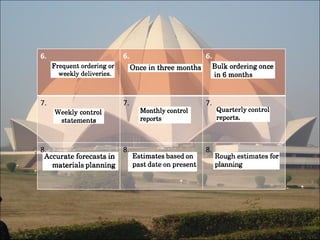
6. 6. 6. 7. 7. 7. 8. 8. 8.
CONCLUSION At last I conclude that ABC analysis is a vital  method for control the Inventory.
TH AN K   Y O U

ABC Analysis

  • 1.
    Presented By Deepak
  • 2.
    ABC analysis Itis the Methods of Inventory/Material control ABC ANALYSIS STOCK LEVELS EOQ(Economic Order Quantity) Perpetual Inventory System
  • 3.
    What is Inventory?The term INVENTORY is defined as “the systematic control and regulation of purchase, storage and usage of materials in such a way so as to maintain an even flow of production and at the same time avoiding excessive investment in inventories.”
  • 4.
    What is ABCAnalysis? ABC analysis divides the total inventory into 3 classes A,B & C using the rupee volume, as follows: class “A” items constitute the most important class of inventories so far as the proportion in the total value of inventory .The “A” items consists of approximately 15% of the total items , accounts for 80% of the total material usage. This items merit a tightly controlled inventory system with constant attention to the purchase & stores management. A larger effort per item on only a few items will cost only moderately, but the effort can result in larger savings. class “B” items constitute an intermediate position, which constitute approximately 35% of the total items, accounts for approximately 15% of the total material consumption. These items merit a formalized inventory system & periodic attention but the purchase & the stores management. class “C” items are quite negligible. It consists remaining 50% items, accounting only 5% of the monetary value of total material usage . Quite relaxed inventory procedures are used.
  • 5.
    ABC ANALYSIS OFINVENTORY Class “A” Class “B” Class “C”
  • 6.
    Ex - Inshoes leather forms A grade materials , sole forms B grade materials and shoe lace forms C grade materials this is ABC analysis in inventory management
  • 7.
    ABC Analysisin Medical Stores Inventory Control Background: The basic principle of inventory control is ABC based on cost criteria . Methods: Based on ABC matrix, economic analysis of drug expenditure of priced vocabulary of medical stores (PVMS) section 01 for the year 2003 of a 190 bedded service hospital was under taken. Result: Out of 493 drugs in PVMS section 01, only 325 drugs were being used in the reference hospital. The total cost of drugs used was Rupees 55,23,503 . Of these 325 drugs, 47(14.4%) drugs were Category A , consuming 70% of total expenditure, 73 (22.46 %) drugs Category B consuming 20% and rest 205 drugs (63.7%) Category C drugs cost only 10% of expenditure.
  • 8.
    ITEM ITEMS(%) MONEYVALUE(%) A 10 70 B 20 20 C 70 10
  • 9.
    “ A “Class items (High Consumption Value) “ B” Class items (Moderate Consumption Value) “ C” Class items (Low Consumption Value) 1.Very strict control. 1.Moderate control Loose control 2. No safety stocks or very low safety stocks. 2.Low safety stocks 2.High safety stocks. 3.Maximium follow-up & expediting. 3.Periodic follow-up. 3.Follow –up & expediting in exceptional cases. 4.Rigorous value analysis. 4.Moderate value analysis. 4.Minimum Value Analysis. 5.Must be handled by senior officers. 5. Can be handled by middle management. 5. Can be fully delegated.
  • 10.
    6. 6. 6.7. 7. 7. 8. 8. 8.
  • 11.
    CONCLUSION At lastI conclude that ABC analysis is a vital method for control the Inventory.
  • 12.
    TH AN K Y O U