SYSTEM DEVELOPMENT
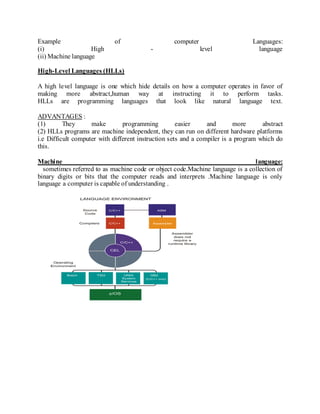
fig:show source code processing mechanism
Introduction
A Programming language is a notational system for describing tasks/computations in a
machine and .human readable form.
Most computer languages are designedto facilitate certainoperations andnot others
: Numerical computation, or text manipulation, or I/O.
More broadly, a computer language typicallyembodies a particular programming paradigm
Characteristics ofaprogramminglanguage:
Every language has syntax and semantics:
 Syntax: The syntax of a program is the form of its declarations, expressions,
statements and program units.
 Semantic: The semantic of a program is concernedwiththe meaning of its program.
Programming Languages
Languages are used to communicate between different entities. Computer language makes it
possible to talk to the computers and ask the computer to perform specific work. Computer
language produces programs which are executed by CPU, and then CPU instructs all the
other parts of computers to perform work accordingly. Computers only understand programs
in their own machine language. Machine language is the language of 0’s and 1’s. It is
difficult to write program in machine language.
Example of computer Languages:
(i) High - level language
(ii) Machine language
High-Level Languages (HLLs)
A high level language is one which hide details on how a computer operates in favor of
making more abstract,human way at instructing it to perform tasks.
HLLs are programming languages that look like natural language text.
ADVANTAGES :
(1) They make programming easier and more abstract
(2) HLLs programs are machine independent, they can run on different hardware platforms
i.e Difficult computer with different instruction sets and a compiler is a program which do
this.
Machine language:
sometimes referred to as machine code or object code.Machine language is a collection of
binary digits or bits that the computer reads and interprets .Machine language is only
language a computer is capable of understanding .
Mapping BetweenHLL and Machine Language
Translating HLL programs to machine language programs is not a one-to-one mapping. A
HLL instruction (usually called a statement) will be translated to one or more machine
language instructions. The number of mapped machine instructions depends on the efficiency
of the compiler in producing optimized machine language programs from the HLL programs.
A machine language program produced by a compiler or an assembler. Usually, machine
language programs produced by compilers are not efficient (i.e. they contain many
unnecessaryinstructions that increase processingand slow down execution).
Assemblylanguage
Assembly language is the most basic programming language available for any processor.
With assembly language, a programmer works only with operations implemented directly on
the physical CPU. Assembly language lacks high-level conveniences such as variables and
functions, and it is not portable between various families of processors. Nevertheless,
assembly language is the most powerful computer programming language available, and it
gives programmers the insight requiredto write effective code inhigh-level languages.
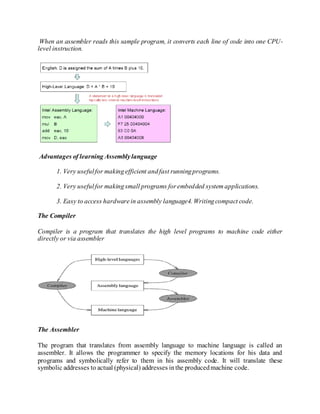
Machine code for displaying$ sign on lower right corner of screen.
10111000, 00000000, 10111000, 10001110, 11011000, 11000110, 00000110, 10011110,
00001111, 00100100, 11001101, 00011111
The program above, writtenin assembly language, looks like this:
MOV AX, 47104MOVDS, AXMOV [3998], 36INT32
When an assembler reads this sample program, it converts each line of code into one CPU-
level instruction.
Advantages of learning Assemblylanguage
1. Very usefulfor makingefficient andfast runningprograms.
2. Very usefulfor makingsmall programs forembedded system applications.
3. Easy to access hardwarein assembly language4. Writingcompact code.
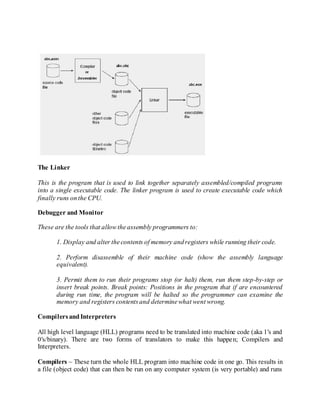
The Compiler
Compiler is a program that translates the high level programs to machine code either
directly or via assembler
The Assembler
The program that translates from assembly language to machine language is called an
assembler. It allows the programmer to specify the memory locations for his data and
programs and symbolically refer to them in his assembly code. It will translate these
symbolic addresses to actual (physical) addresses inthe producedmachine code.
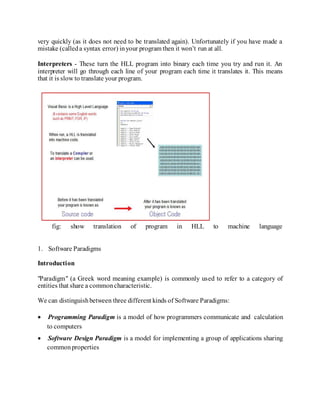
The Linker
This is the program that is used to link together separately assembled/compiled programs
into a single executable code. The linker program is used to create executable code which
finally runs onthe CPU.
Debugger and Monitor
These are the tools that allow theassembly programmers to:
1. Display and alter thecontents of memory andregisters while running their code.
2. Perform disassemble of their machine code (show the assembly language
equivalent).
3. Permit them to run their programs stop (or halt) them, run them step-by-step or
insert break points. Break points: Positions in the program that if are encountered
during run time, the program will be halted so the programmer can examine the
memory and registers contentsand determinewhat went wrong.
CompilersandInterpreters
All high level language (HLL) programs need to be translated into machine code (aka 1′s and
0′s/binary). There are two forms of translators to make this happen; Compilers and
Interpreters.
Compilers – These turn the whole HLL program into machine code in one go. This results in
a file (object code) that can then be run on any computer system (is very portable) and runs
very quickly (as it does not need to be translated again). Unfortunately if you have made a
mistake (calleda syntax error) inyour program then it won’t run at all.
Interpreters - These turn the HLL program into binary each time you try and run it. An
interpreter will go through each line of your program each time it translates it. This means
that it is slow to translate your program.
fig: show translation of program in HLL to machine language
1. Software Paradigms
Introduction
"Paradigm" (a Greek word meaning example) is commonly used to refer to a category of
entities that share a commoncharacteristic.
We can distinguishbetween three different kinds of Software Paradigms:
 Programming Paradigm is a model of how programmers communicate and calculation
to computers
 Software Design Paradigm is a model for implementing a group of applications sharing
commonproperties
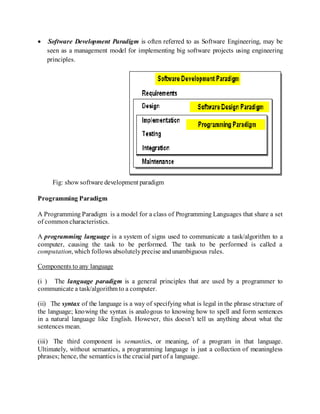
 Software Development Paradigm is often referred to as Software Engineering, may be
seen as a management model for implementing big software projects using engineering
principles.
Fig: show software development paradigm
Programming Paradigm
A Programming Paradigm is a model for a class of Programming Languages that share a set
of commoncharacteristics.
A programming language is a system of signs used to communicate a task/algorithm to a
computer, causing the task to be performed. The task to be performed is called a
computation, which follows absolutelyprecise andunambiguous rules.
Components to any language
(i ) The language paradigm is a general principles that are used by a programmer to
communicate a task/algorithm to a computer.
(ii) The syntax of the language is a way of specifying what is legal in the phrase structure of
the language; knowing the syntax is analogous to knowing how to spell and form sentences
in a natural language like English. However, this doesn’t tell us anything about what the
sentences mean.
(iii) The third component is semantics, or meaning, of a program in that language.
Ultimately, without semantics, a programming language is just a collection of meaningless
phrases; hence, the semantics is the crucial part of a language.
There have been a large number of programming languages. Back in the 60’s there were over
700 of them – most were academic, special purpose, or developed by an organization for
their own needs.
Fortunately, there are just four major programminglanguage paradigms:
 Imperative (Procedural)Paradigm (FORTRAN, C, Ada, etc.)
 Object-Oriented Paradigm (Smalltalk, Java, C++)
 LogicParadigm (Prolog)
 Functional Paradigm (Lisp, ML, Haskell)
Generally, a selected Programming Paradigm defines main property of a software developed
by means of a programming language supportingthe paradigm.
• Scalability/modifiability
• Inerrability/reusability
• Portability
• Performance
• Reliability
• Ease of creation
Software DesignParadigm
Software Design Paradigm embody the results of people’s ideas on how to construct
programs, combine them into large software systems and formal mechanisms for how those
ideas should be expressed.
Thus, we can say that a Software Design Paradigm is a model for a class of problems that
share a set of commoncharacteristics.
Software design paradigms can be sub-divided as:
 Design Patterns
 Components
 Software Architecture
 Frameworks
It should be especially noted that a particular Programming Paradigm essentially defines
software design paradigms. For example, we can speak about Object-Oriented design
patterns, procedural components (modules), functional software architecture, etc.
DesignPatterns:
A design pattern is a proven solution for a general design problem. It consists of
communicating‘objects’that are customizedto solve the problem in a particular context.
Patterns have their origin in object-oriented programming where they began as collections of
objects organized to solve a problem. There isn't any fundamental relationship between
patterns and objects; it just happens they began there. Patterns may have arisen because
objects seem so elemental, but the problems we were trying to solve with them were so
complex.
 Architectural Patterns: An architectural pattern expresses a fundamental structural
organization or schema for software systems. It provides a set of predefined subsystems,
specifies their responsibilities, and includes rules and guidelines for organizing the
relationships betweenthem.
 Idioms: An idiom is a low-level pattern specific to a programming language. An idiom
describes how to implement particular aspects of components or the relationships
between them using the features of the given language.
Components:
A component is a physical and replaceable part of a system that conforms to and provides the
realization of a set of interfaces,typically represents the physical packaging of otherwise logical
elements, such as classes, interfaces, and collaborations
Software components are binary units of independent production, acquisition, and deployment
that interact to forma a functioning program
A component must be compatible and inter operate with a whole range of other components.
Examples of components: “Window”, “Push Button”, “Text Editor”, etc.
Software Architecture:
Software architecture is the structure of the components of the solution. A particular software
architecture decomposes a problem into smaller pieces and attempts to find a solution
(Component) for each piece. We can also say that an architecture defines a software system
components, their integrationandinteroperability:
 Integration means the pieces fit together well.
 Interoperationmeans that they work together effectivelyto produce ananswer.
There are many software architectures. Choosing the right one can be a difficult problem in
itself.
Frameworks:
A software framework is a reusable mini-architecture that provides the generic structure and
behavior for a family of software abstractions, along with a context of metaphors which
specifies theircollaborationand use within a given domain.
Frameworks can be seen as an intermediate level between components and a software
architecture.
Example: Suppose architecture of a WBT system reuse such components as “Text Editing
Input object” and “Push buttons”. A software framework may define an “HTML Editor”
which can be firther reusedfor buildingthe architecture.
Software EngineeringandSoftware Paradigms
The term "software engineering" was coined in about 1969 to mean "the establishment and
use of sound engineering principles in order to economically obtain software that is reliable
and works efficientlyonreal machines".
This view opposed uniqueness and "magic" of programming in an effort to move the
development of software from "magic" (which only a select few can do) to "art" (which the
talented can do) to "science"(which supposedly anyone can do!). There have been numerous
definitions given for software engineering(includingthat above and below).
Software Engineering is not a discipline; it is an aspiration, as yet unarchived. Many
approaches have been proposed including reusable components, formal methods, structured
methods and architectural studies. These approaches chiefly emphasize the engineering
product; the solutionrather than the problem it solves.
Software Development current situation:
 People developing systems were consistently wrong in their estimates of time, effort, and
costs
 Reliabilityand maintainability were difficult to achieve
 Deliveredsystems frequentlydidnot work
i.e 1979 study of a small number of government projects showed that:
* 2% worked
* 3% could work after some corrections
* 45% delivered but never successfully used
* 20% used but extensively reworked or abandoned
* 30% paid and undelivered
 Fixing bugs in deliveredsoftware producedmore bugs
 Increase in size of software systems
 NASA
 Star Wars Defense Initiative
 Social SecurityAdministration
 financial transactionsystems
 Changes in the ratio of hardware to software costs
 early60's - 80% hardware costs
 middle 60's - 40-50% software costs
 today - less than 20% hardware costs
 Increasingly important role of maintenance
 Fixing errors, modification, adding options
 Cost is oftentwice that of developing the software
 Advances in hardware (lower costs)
 Advances in software techniques (e.g., users interaction)
 Increaseddemands for software
 Medicine, Manufacturing, Entertainment, Publishing
 Demand for larger and more complexsoftware systems
 Airplanes (crashes), NASA (abortedspace shuttle launches),
 "ghost" trains, runaway missiles,
 ATM machines (have you had your card "swallowed"?), life-support systems, car
systems, etc.
 US National security and day-to-day operations are highly dependent on
computerizedsystems.
Manufacturing software can be characterized by a series of steps ranging from concept
exploration to final retirement; this series of steps is generally referred to as a software
lifecycle.
Steps or phases in a software lifecycle fall generallyinto these categories:
 Requirements (Relative Cost 2%)
 Specification(analysis) (Relative Cost 5%)
 Design (Relative Cost 6%)
 Implementation(Relative Cost 5%)
 Testing (Relative Cost 7%)
 Integration (Relative Cost 8%)
 Maintenance (Relative Cost 67%)
 Retirement
Software engineering employs avarietyofmethods, tools, andparadigms.
Paradigms refer to particular approaches or philosophies for designing, building and
maintaining software. Different paradigms each have their own advantages and
disadvantages which make one more appropriate in a given situation than perhaps another
(!).
A method (also referred to as a technique) is heavily depended on a selected paradigm and
may be seen as a procedure for producing some result. Methods generally involve some
formal notationand process(es).
Tools are automatedsystems implementing aparticular method.
Thus, the followingphases are heavily affectedbyselectedsoftware paradigms
 Design
 Implementation
 Integration
 Maintenance
The software development cycle involves the activities in the production of a software
system. Generallythe software development cycle can be divided into the followingphases:
 Requirements analysis and specification
 Design
 Preliminarydesign
 Detaileddesign
 Implementation
 Component Implementation
 Component Integration
 System Documenting
 Testing
 Unit testing
 Integration testing
 System testing
 Installation and Acceptance Testing
 Maintenance
 Bug Reportingand Fixing
 Change requirements and software upgrading
Software life cycles that will be brieflyreviewed include:
 Build and Fix model
 Waterfall and ModifiedWaterfall models
 Rapid Prototyping
 Boehm's spiral model
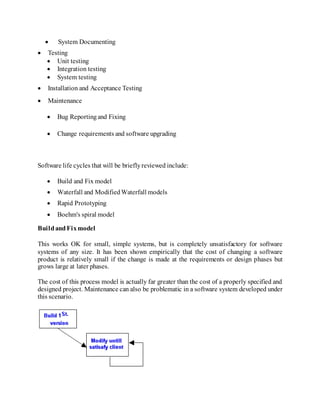
BuildandFixmodel
This works OK for small, simple systems, but is completely unsatisfactory for software
systems of any size. It has been shown empirically that the cost of changing a software
product is relatively small if the change is made at the requirements or design phases but
grows large at later phases.
The cost of this process model is actually far greater than the cost of a properly specified and
designed project. Maintenance can also be problematic in a software system developed under
this scenario.
Figure: Build and Fix model
Waterfall and ModifiedWaterfall models
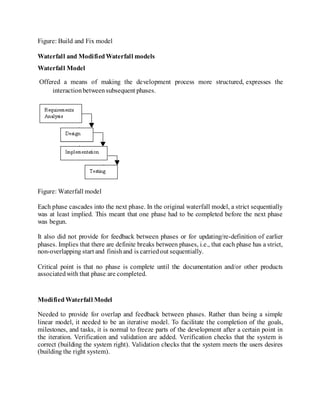
Waterfall Model
Offered a means of making the development process more structured, expresses the
interactionbetweensubsequent phases.
Figure: Waterfall model
Each phase cascades into the next phase. In the original waterfall model, a strict sequentially
was at least implied. This meant that one phase had to be completed before the next phase
was begun.
It also did not provide for feedback between phases or for updating/re-definition of earlier
phases. Implies that there are definite breaks between phases, i.e., that each phase has a strict,
non-overlapping start and finishand is carriedout sequentially.
Critical point is that no phase is complete until the documentation and/or other products
associatedwith that phase are completed.
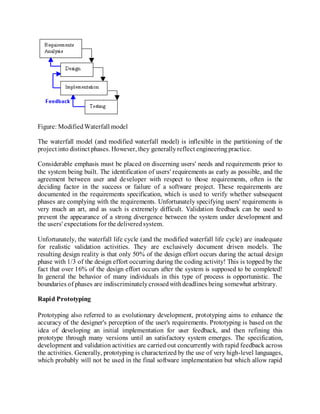
ModifiedWaterfall Model
Needed to provide for overlap and feedback between phases. Rather than being a simple
linear model, it needed to be an iterative model. To facilitate the completion of the goals,
milestones, and tasks, it is normal to freeze parts of the development after a certain point in
the iteration. Verification and validation are added. Verification checks that the system is
correct (building the system right). Validation checks that the system meets the users desires
(building the right system).
Figure: ModifiedWaterfall model
The waterfall model (and modified waterfall model) is inflexible in the partitioning of the
project into distinct phases. However, they generallyreflect engineeringpractice.
Considerable emphasis must be placed on discerning users' needs and requirements prior to
the system being built. The identification of users' requirements as early as possible, and the
agreement between user and developer with respect to those requirements, often is the
deciding factor in the success or failure of a software project. These requirements are
documented in the requirements specification, which is used to verify whether subsequent
phases are complying with the requirements. Unfortunately specifying users' requirements is
very much an art, and as such is extremely difficult. Validation feedback can be used to
prevent the appearance of a strong divergence between the system under development and
the users' expectations for the deliveredsystem.
Unfortunately, the waterfall life cycle (and the modified waterfall life cycle) are inadequate
for realistic validation activities. They are exclusively document driven models. The
resulting design reality is that only 50% of the design effort occurs during the actual design
phase with 1/3 of the design effort occurring during the coding activity! This is topped by the
fact that over 16% of the design effort occurs after the system is supposed to be completed!
In general the behavior of many individuals in this type of process is opportunistic. The
boundaries of phases are indiscriminatelycrossedwithdeadlines being somewhat arbitrary.
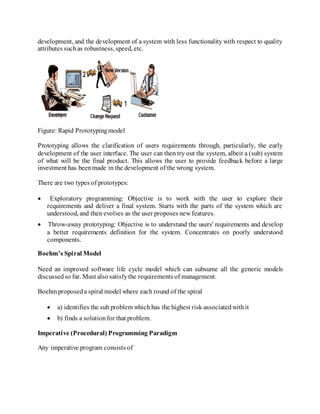
Rapid Prototyping
Prototyping also referred to as evolutionary development, prototyping aims to enhance the
accuracy of the designer's perception of the user's requirements. Prototyping is based on the
idea of developing an initial implementation for user feedback, and then refining this
prototype through many versions until an satisfactory system emerges. The specification,
development and validation activities are carried out concurrently with rapid feedback across
the activities. Generally, prototyping is characterized by the use of very high-level languages,
which probably will not be used in the final software implementation but which allow rapid
development, and the development of a system with less functionality with respect to quality
attributes suchas robustness, speed, etc.
Figure: Rapid Prototypingmodel
Prototyping allows the clarification of users requirements through, particularly, the early
development of the user interface. The user can then try out the system, albeit a (sub) system
of what will be the final product. This allows the user to provide feedback before a large
investment has beenmade in the development of the wrong system.
There are two types of prototypes:
 Exploratory programming: Objective is to work with the user to explore their
requirements and deliver a final system. Starts with the parts of the system which are
understood, and then evolves as the user proposes new features.
 Throw-away prototyping: Objective is to understand the users' requirements and develop
a better requirements definition for the system. Concentrates on poorly understood
components.
Boehm’s Spiral Model
Need an improved software life cycle model which can subsume all the generic models
discussedso far. Must also satisfythe requirements of management.
Boehm proposeda spiral model where each round of the spiral
 a) identifies the sub problem which has the highest risk associatedwithit
 b) finds a solutionfor that problem.
Imperative (Procedural) Programming Paradigm
Any imperative program consists of
 Declarative statements which gives a name to a value. A named value is called a
variable. Thus, declarative statements create variables. In procedural languages it is
commonfor the same variable to keep changing value as the program runs.
 Imperative statements whichassign new values to variables
 Program flow control statements which define order in which imperative statements are
evaluated.
Example:
var factorial = 1; /*Declarative statement*/
var argument = 5;
var counter = 1;
while (counter <= argument) /*Program flowstatement*/
{
factorial = factorial*counter;/*Imperative statement*/
counter++;
}
Variables and Types
Different variables in a program may have different types. For example, a language may
treat a two bytes as a string of characters and as a number. Dividing a string ‘20’ by number
‘2’ may not be possible. A language like this has at least two types - one for strings and one
for numbers.
Example:
var PersonName = new String(); /*variable type “string”*/
var PersonSalary= new Integer(); /*variable type “integer”*/
Types can be weak or strong. Strong type means that at any point in the program, when it is
running, the type of a particular chunk of data (i.e. variable) is known. Weak type means that
imperative operators may change a variable type.
Example:
var PersonName;/*variable of a weak type”*/
PersonName = 0;/*PersonName is an “integer”*/
PersonName = ‘Nick’; /*PersonName is a“string”*/
Obviously, languages supporting weak variable types need sophisticated rules for type
conversions.
Example:
var PersonName;/*variable of a weak type”*/
PersonName = 0;/*PersonName is an “integer”*/
PersonName = PersonName + ‘Nick’ + 0; /*PersonName is astring “0Nick0”*/
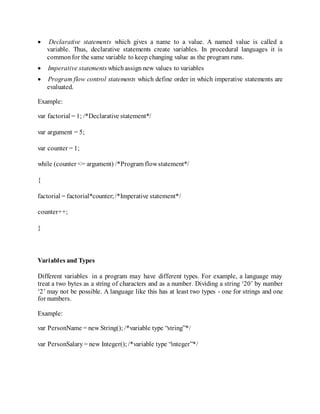
To support weak typing, values are boxed together with information about their type - value
and type are then passedaround the program together.
Fig . show how to support weak typing
Functions (Procedures)
Programmers have dreamed/attempted of building systems from a library of reusable
software components boundtogether with a little new code.
Imperative (Procedural) Programming Paradigm is essentially based on concept of so-called
“Functions” also known as “Modules”, “Procedures”or “Subroutines”.
A function is a section of code that is parceled off from the main program and hidden behind
an interface:
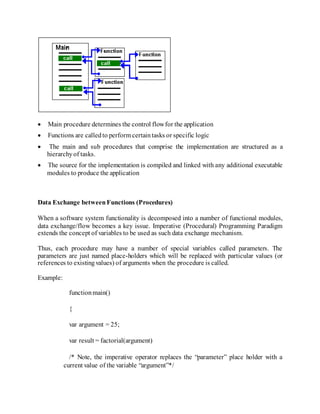
functionfactorial(parameter)
{
var i = 1;
var result = 1;
while(i <= parameter)
{
result = result * i;
i++;
}
return(result);
}
 The code within the function performs a particular activity, here generating a factorial
value
 The idea of parceling the code off into a subroutine is to provide a single point of entry.
Anyone wanting a new factorial value has only to call the “factorial” function with the
appropriate parameters.
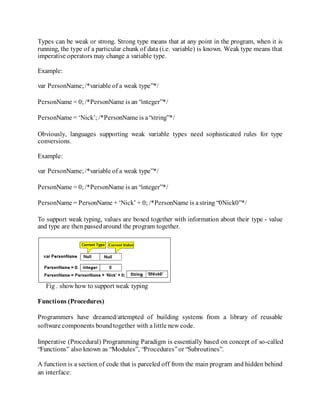
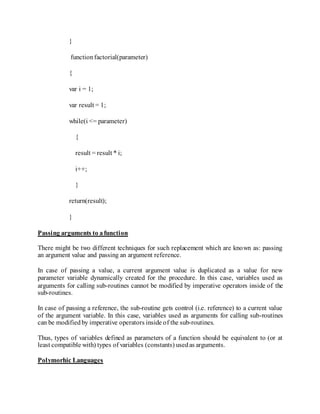
Here's what the conventional application based on the Imperative (Procedural) Programming
Paradigm looks like:
 Main procedure determines the control flowfor the application
 Functions are calledto perform certaintasks or specific logic
 The main and sub procedures that comprise the implementation are structured as a
hierarchyof tasks.
 The source for the implementation is compiled and linked with any additional executable
modules to produce the application
Data Exchange betweenFunctions (Procedures)
When a software system functionality is decomposed into a number of functional modules,
data exchange/flow becomes a key issue. Imperative (Procedural) Programming Paradigm
extends the concept of variables to be used as such data exchange mechanism.
Thus, each procedure may have a number of special variables called parameters. The
parameters are just named place-holders which will be replaced with particular values (or
references to existingvalues) of arguments when the procedure is called.
Example:
functionmain()
{
var argument = 25;
var result = factorial(argument)
/* Note, the imperative operator replaces the “parameter” place holder with a
current value of the variable “argument”*/
}
functionfactorial(parameter)
{
var i = 1;
var result = 1;
while(i <= parameter)
{
result = result * i;
i++;
}
return(result);
}
Passing arguments to afunction
There might be two different techniques for such replacement which are known as: passing
an argument value and passing an argument reference.
In case of passing a value, a current argument value is duplicated as a value for new
parameter variable dynamically created for the procedure. In this case, variables used as
arguments for calling sub-routines cannot be modified by imperative operators inside of the
sub-routines.
In case of passing a reference, the sub-routine gets control (i.e. reference) to a current value
of the argument variable. In this case, variables used as arguments for calling sub-routines
can be modifiedby imperative operators inside of the sub-routines.
Thus, types of variables defined as parameters of a function should be equivalent to (or at
least compatible with) types of variables (constants) usedas arguments.
Polymorhic Languages
When strong static typing is enforced it can be difficult to write generic algorithms -
functions that can act on a range of different types. Polymorphism allows "any" to be
included in the type system. For example, the types of a list of items are unimportant if we
only want to know the length of the list, so a function can have a type that indicates that it
takes lists of "any" type and returns an integer. Moreover, polymorphism allows combining
functions implemented by means of different programming languages supporting potentially
different types of variables.
Pragmatically speaking, polymorphic languages allow to define new types as hidden
functions which should be automatically applied to values of such “user-defined type” to
convert it to values of a “standard” language type.
Variable Scope
Normally, variables that are defined within a function are created each time the function is
used and destroyed again when the function ends. The value that the function returns is not
destroyed, but it is not possible to assign a value to the variable inside the function definition
from outside.
Example:
functionone()
{
var dynamicLocalVariable = 25;
two();
/* at this point just one variable “dynamicLocalVariable” exists */
alert(dynamicLocalVariable);
/* this operator displays the current value “25” */
}
functiontwo()
{
var dynamicLocalVariable = 55;
/* at this point two variables “dynamicLocalVariable” exists */
alert(dynamicLocalVariable);
/* this operator displays the current value “55” */
}
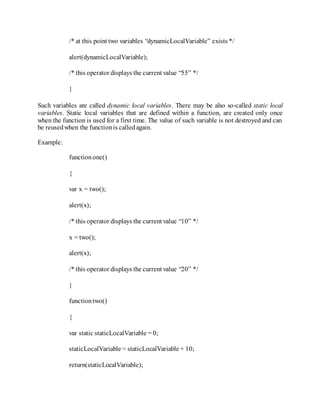
Such variables are called dynamic local variables. There may be also so-called static local
variables. Static local variables that are defined within a function, are created only once
when the function is used for a first time. The value of such variable is not destroyed and can
be reusedwhen the functionis calledagain.
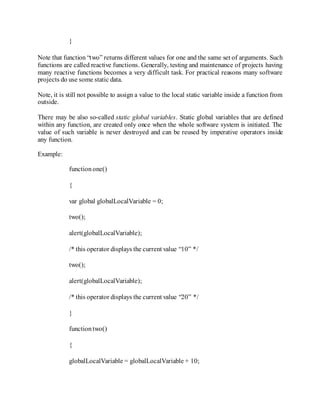
Example:
functionone()
{
var x = two();
alert(x);
/* this operator displays the current value “10” */
x = two();
alert(x);
/* this operator displays the current value “20” */
}
functiontwo()
{
var static staticLocalVariable = 0;
staticLocalVariable = staticLocalVariable + 10;
return(staticLocalVariable);
}
Note that function “two” returns different values for one and the same set of arguments. Such
functions are called reactive functions. Generally, testing and maintenance of projects having
many reactive functions becomes a very difficult task. For practical reasons many software
projects do use some static data.
Note, it is still not possible to assign a value to the local static variable inside a function from
outside.
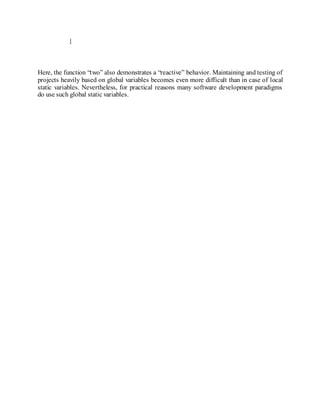
There may be also so-called static global variables. Static global variables that are defined
within any function, are created only once when the whole software system is initiated. The
value of such variable is never destroyed and can be reused by imperative operators inside
any function.
Example:
functionone()
{
var global globalLocalVariable = 0;
two();
alert(globalLocalVariable);
/* this operator displays the current value “10” */
two();
alert(globalLocalVariable);
/* this operator displays the current value “20” */
}
functiontwo()
{
globalLocalVariable = globalLocalVariable + 10;
}
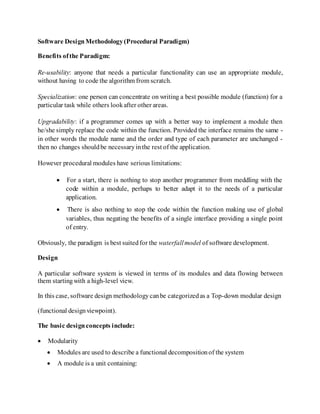
Here, the function “two” also demonstrates a “reactive” behavior. Maintaining and testing of
projects heavily based on global variables becomes even more difficult than in case of local
static variables. Nevertheless, for practical reasons many software development paradigms
do use such global static variables.
Software DesignMethodology(Procedural Paradigm)
Benefits ofthe Paradigm:
Re-usability: anyone that needs a particular functionality can use an appropriate module,
without having to code the algorithm from scratch.
Specialization: one person can concentrate on writing a best possible module (function) for a
particular task while others lookafter other areas.
Upgradability: if a programmer comes up with a better way to implement a module then
he/she simply replace the code within the function. Provided the interface remains the same -
in other words the module name and the order and type of each parameter are unchanged -
then no changes shouldbe necessaryinthe rest of the application.
However procedural modules have serious limitations:
 For a start, there is nothing to stop another programmer from meddling with the
code within a module, perhaps to better adapt it to the needs of a particular
application.
 There is also nothing to stop the code within the function making use of global
variables, thus negating the benefits of a single interface providing a single point
of entry.
Obviously, the paradigm is best suitedfor the waterfallmodel of software development.
Design
A particular software system is viewed in terms of its modules and data flowing between
them startingwith a high-level view.
In this case, software design methodologycanbe categorizedas a Top-down modular design
(functional designviewpoint).
The basic designconcepts include:
 Modularity
 Modules are used to describe a functional decompositionof the system
 A module is a unit containing:
 executable statements
 data structures
 other modules
A module:
 has a name
 can be separatelycompiled
 can be usedin a program or by other modules
 System design generallydetermines what goes into a module
Cohesive
 Single clearlydefinedfunction
 Descriptionof when and how used
 Loosely Coupled Modules (Modules implement functionality, but not parts of other
modules)
 Black Boxes (informationhiding)
 each module is a black box
 each module has a set of known inputs and a set of predictable outputs
 inner workings of module are unknown to user
 can be reusable
Preliminary and Detailed Design specify the modules to carry out the functions in the
DataFlow Diagrams (DFD).
Preliminarydesigndeals mainlywithStructure Charts:
Hierarchical tree structure
 Modules - rectangle boxes
 calling relationships are shown with arrows
 arrows are labeled with the data flowing between modules
Module Design
 Title
 Module ID - from structure charts
 Purpose
 Method - algorithm
 Usage - who calls it
 External references - other modulescalled
 Calling sequence - parameter descriptions
 Input assertion
 Output assertion
 Local variables
 Author(s)
 Remarks
PreliminaryDesignDocument
 Cover Page
 Table of Contents
 Design Description
 Software Structure Charts
 Data Dictionary
 Module Designs
 Module Headers
 Major Data Structures Design
 Design Reviews (Examination of all or part of the software design to find design
anomalies )
Overview of DetailedDesign
 select analgorithm for each module
 refine the data structures
 produce detaileddesign document
Implementation
Coding (for eachModule)
 Source Code
 Documentation
Integration
 Decide what order the modules will be assembled
 Assemble and test integrationof modules
 After final assembly perform system test
 Note, coding and testingare oftendone in parallel
Testing
Types of testing
 Unit testing
 Integration testing
 Acceptance testing
As it was mentioned above, the paradigm is best suited for the waterfall model of software
development. Implementing change requirements and especially rapid prototyping are weak
points of the programmingparadigm.

SYSTEM DEVELOPMENT

  • 1.
    SYSTEM DEVELOPMENT fig:show sourcecode processing mechanism Introduction A Programming language is a notational system for describing tasks/computations in a machine and .human readable form. Most computer languages are designedto facilitate certainoperations andnot others : Numerical computation, or text manipulation, or I/O. More broadly, a computer language typicallyembodies a particular programming paradigm Characteristics ofaprogramminglanguage: Every language has syntax and semantics:  Syntax: The syntax of a program is the form of its declarations, expressions, statements and program units.  Semantic: The semantic of a program is concernedwiththe meaning of its program. Programming Languages Languages are used to communicate between different entities. Computer language makes it possible to talk to the computers and ask the computer to perform specific work. Computer language produces programs which are executed by CPU, and then CPU instructs all the other parts of computers to perform work accordingly. Computers only understand programs in their own machine language. Machine language is the language of 0’s and 1’s. It is difficult to write program in machine language.
  • 2.
    Example of computerLanguages: (i) High - level language (ii) Machine language High-Level Languages (HLLs) A high level language is one which hide details on how a computer operates in favor of making more abstract,human way at instructing it to perform tasks. HLLs are programming languages that look like natural language text. ADVANTAGES : (1) They make programming easier and more abstract (2) HLLs programs are machine independent, they can run on different hardware platforms i.e Difficult computer with different instruction sets and a compiler is a program which do this. Machine language: sometimes referred to as machine code or object code.Machine language is a collection of binary digits or bits that the computer reads and interprets .Machine language is only language a computer is capable of understanding .
  • 3.
    Mapping BetweenHLL andMachine Language Translating HLL programs to machine language programs is not a one-to-one mapping. A HLL instruction (usually called a statement) will be translated to one or more machine language instructions. The number of mapped machine instructions depends on the efficiency of the compiler in producing optimized machine language programs from the HLL programs. A machine language program produced by a compiler or an assembler. Usually, machine language programs produced by compilers are not efficient (i.e. they contain many unnecessaryinstructions that increase processingand slow down execution). Assemblylanguage Assembly language is the most basic programming language available for any processor. With assembly language, a programmer works only with operations implemented directly on the physical CPU. Assembly language lacks high-level conveniences such as variables and functions, and it is not portable between various families of processors. Nevertheless, assembly language is the most powerful computer programming language available, and it gives programmers the insight requiredto write effective code inhigh-level languages. Machine code for displaying$ sign on lower right corner of screen. 10111000, 00000000, 10111000, 10001110, 11011000, 11000110, 00000110, 10011110, 00001111, 00100100, 11001101, 00011111 The program above, writtenin assembly language, looks like this: MOV AX, 47104MOVDS, AXMOV [3998], 36INT32
  • 4.
    When an assemblerreads this sample program, it converts each line of code into one CPU- level instruction. Advantages of learning Assemblylanguage 1. Very usefulfor makingefficient andfast runningprograms. 2. Very usefulfor makingsmall programs forembedded system applications. 3. Easy to access hardwarein assembly language4. Writingcompact code. The Compiler Compiler is a program that translates the high level programs to machine code either directly or via assembler The Assembler The program that translates from assembly language to machine language is called an assembler. It allows the programmer to specify the memory locations for his data and programs and symbolically refer to them in his assembly code. It will translate these symbolic addresses to actual (physical) addresses inthe producedmachine code.
  • 5.
    The Linker This isthe program that is used to link together separately assembled/compiled programs into a single executable code. The linker program is used to create executable code which finally runs onthe CPU. Debugger and Monitor These are the tools that allow theassembly programmers to: 1. Display and alter thecontents of memory andregisters while running their code. 2. Perform disassemble of their machine code (show the assembly language equivalent). 3. Permit them to run their programs stop (or halt) them, run them step-by-step or insert break points. Break points: Positions in the program that if are encountered during run time, the program will be halted so the programmer can examine the memory and registers contentsand determinewhat went wrong. CompilersandInterpreters All high level language (HLL) programs need to be translated into machine code (aka 1′s and 0′s/binary). There are two forms of translators to make this happen; Compilers and Interpreters. Compilers – These turn the whole HLL program into machine code in one go. This results in a file (object code) that can then be run on any computer system (is very portable) and runs
  • 6.
    very quickly (asit does not need to be translated again). Unfortunately if you have made a mistake (calleda syntax error) inyour program then it won’t run at all. Interpreters - These turn the HLL program into binary each time you try and run it. An interpreter will go through each line of your program each time it translates it. This means that it is slow to translate your program. fig: show translation of program in HLL to machine language 1. Software Paradigms Introduction "Paradigm" (a Greek word meaning example) is commonly used to refer to a category of entities that share a commoncharacteristic. We can distinguishbetween three different kinds of Software Paradigms:  Programming Paradigm is a model of how programmers communicate and calculation to computers  Software Design Paradigm is a model for implementing a group of applications sharing commonproperties
  • 7.
     Software DevelopmentParadigm is often referred to as Software Engineering, may be seen as a management model for implementing big software projects using engineering principles. Fig: show software development paradigm Programming Paradigm A Programming Paradigm is a model for a class of Programming Languages that share a set of commoncharacteristics. A programming language is a system of signs used to communicate a task/algorithm to a computer, causing the task to be performed. The task to be performed is called a computation, which follows absolutelyprecise andunambiguous rules. Components to any language (i ) The language paradigm is a general principles that are used by a programmer to communicate a task/algorithm to a computer. (ii) The syntax of the language is a way of specifying what is legal in the phrase structure of the language; knowing the syntax is analogous to knowing how to spell and form sentences in a natural language like English. However, this doesn’t tell us anything about what the sentences mean. (iii) The third component is semantics, or meaning, of a program in that language. Ultimately, without semantics, a programming language is just a collection of meaningless phrases; hence, the semantics is the crucial part of a language.
  • 8.
    There have beena large number of programming languages. Back in the 60’s there were over 700 of them – most were academic, special purpose, or developed by an organization for their own needs. Fortunately, there are just four major programminglanguage paradigms:  Imperative (Procedural)Paradigm (FORTRAN, C, Ada, etc.)  Object-Oriented Paradigm (Smalltalk, Java, C++)  LogicParadigm (Prolog)  Functional Paradigm (Lisp, ML, Haskell) Generally, a selected Programming Paradigm defines main property of a software developed by means of a programming language supportingthe paradigm. • Scalability/modifiability • Inerrability/reusability • Portability • Performance • Reliability • Ease of creation Software DesignParadigm Software Design Paradigm embody the results of people’s ideas on how to construct programs, combine them into large software systems and formal mechanisms for how those ideas should be expressed. Thus, we can say that a Software Design Paradigm is a model for a class of problems that share a set of commoncharacteristics. Software design paradigms can be sub-divided as:  Design Patterns  Components  Software Architecture  Frameworks
  • 9.
    It should beespecially noted that a particular Programming Paradigm essentially defines software design paradigms. For example, we can speak about Object-Oriented design patterns, procedural components (modules), functional software architecture, etc. DesignPatterns: A design pattern is a proven solution for a general design problem. It consists of communicating‘objects’that are customizedto solve the problem in a particular context. Patterns have their origin in object-oriented programming where they began as collections of objects organized to solve a problem. There isn't any fundamental relationship between patterns and objects; it just happens they began there. Patterns may have arisen because objects seem so elemental, but the problems we were trying to solve with them were so complex.  Architectural Patterns: An architectural pattern expresses a fundamental structural organization or schema for software systems. It provides a set of predefined subsystems, specifies their responsibilities, and includes rules and guidelines for organizing the relationships betweenthem.  Idioms: An idiom is a low-level pattern specific to a programming language. An idiom describes how to implement particular aspects of components or the relationships between them using the features of the given language. Components: A component is a physical and replaceable part of a system that conforms to and provides the realization of a set of interfaces,typically represents the physical packaging of otherwise logical elements, such as classes, interfaces, and collaborations Software components are binary units of independent production, acquisition, and deployment that interact to forma a functioning program A component must be compatible and inter operate with a whole range of other components. Examples of components: “Window”, “Push Button”, “Text Editor”, etc. Software Architecture: Software architecture is the structure of the components of the solution. A particular software architecture decomposes a problem into smaller pieces and attempts to find a solution (Component) for each piece. We can also say that an architecture defines a software system components, their integrationandinteroperability:  Integration means the pieces fit together well.  Interoperationmeans that they work together effectivelyto produce ananswer.
  • 10.
    There are manysoftware architectures. Choosing the right one can be a difficult problem in itself. Frameworks: A software framework is a reusable mini-architecture that provides the generic structure and behavior for a family of software abstractions, along with a context of metaphors which specifies theircollaborationand use within a given domain. Frameworks can be seen as an intermediate level between components and a software architecture. Example: Suppose architecture of a WBT system reuse such components as “Text Editing Input object” and “Push buttons”. A software framework may define an “HTML Editor” which can be firther reusedfor buildingthe architecture. Software EngineeringandSoftware Paradigms The term "software engineering" was coined in about 1969 to mean "the establishment and use of sound engineering principles in order to economically obtain software that is reliable and works efficientlyonreal machines". This view opposed uniqueness and "magic" of programming in an effort to move the development of software from "magic" (which only a select few can do) to "art" (which the talented can do) to "science"(which supposedly anyone can do!). There have been numerous definitions given for software engineering(includingthat above and below). Software Engineering is not a discipline; it is an aspiration, as yet unarchived. Many approaches have been proposed including reusable components, formal methods, structured methods and architectural studies. These approaches chiefly emphasize the engineering product; the solutionrather than the problem it solves. Software Development current situation:  People developing systems were consistently wrong in their estimates of time, effort, and costs  Reliabilityand maintainability were difficult to achieve  Deliveredsystems frequentlydidnot work i.e 1979 study of a small number of government projects showed that: * 2% worked * 3% could work after some corrections
  • 11.
    * 45% deliveredbut never successfully used * 20% used but extensively reworked or abandoned * 30% paid and undelivered  Fixing bugs in deliveredsoftware producedmore bugs  Increase in size of software systems  NASA  Star Wars Defense Initiative  Social SecurityAdministration  financial transactionsystems  Changes in the ratio of hardware to software costs  early60's - 80% hardware costs  middle 60's - 40-50% software costs  today - less than 20% hardware costs  Increasingly important role of maintenance  Fixing errors, modification, adding options  Cost is oftentwice that of developing the software  Advances in hardware (lower costs)  Advances in software techniques (e.g., users interaction)  Increaseddemands for software  Medicine, Manufacturing, Entertainment, Publishing  Demand for larger and more complexsoftware systems  Airplanes (crashes), NASA (abortedspace shuttle launches),  "ghost" trains, runaway missiles,  ATM machines (have you had your card "swallowed"?), life-support systems, car systems, etc.  US National security and day-to-day operations are highly dependent on computerizedsystems. Manufacturing software can be characterized by a series of steps ranging from concept exploration to final retirement; this series of steps is generally referred to as a software lifecycle. Steps or phases in a software lifecycle fall generallyinto these categories:  Requirements (Relative Cost 2%)
  • 12.
     Specification(analysis) (RelativeCost 5%)  Design (Relative Cost 6%)  Implementation(Relative Cost 5%)  Testing (Relative Cost 7%)  Integration (Relative Cost 8%)  Maintenance (Relative Cost 67%)  Retirement Software engineering employs avarietyofmethods, tools, andparadigms. Paradigms refer to particular approaches or philosophies for designing, building and maintaining software. Different paradigms each have their own advantages and disadvantages which make one more appropriate in a given situation than perhaps another (!). A method (also referred to as a technique) is heavily depended on a selected paradigm and may be seen as a procedure for producing some result. Methods generally involve some formal notationand process(es). Tools are automatedsystems implementing aparticular method. Thus, the followingphases are heavily affectedbyselectedsoftware paradigms  Design  Implementation  Integration  Maintenance The software development cycle involves the activities in the production of a software system. Generallythe software development cycle can be divided into the followingphases:  Requirements analysis and specification  Design  Preliminarydesign  Detaileddesign  Implementation  Component Implementation  Component Integration
  • 13.
     System Documenting Testing  Unit testing  Integration testing  System testing  Installation and Acceptance Testing  Maintenance  Bug Reportingand Fixing  Change requirements and software upgrading Software life cycles that will be brieflyreviewed include:  Build and Fix model  Waterfall and ModifiedWaterfall models  Rapid Prototyping  Boehm's spiral model BuildandFixmodel This works OK for small, simple systems, but is completely unsatisfactory for software systems of any size. It has been shown empirically that the cost of changing a software product is relatively small if the change is made at the requirements or design phases but grows large at later phases. The cost of this process model is actually far greater than the cost of a properly specified and designed project. Maintenance can also be problematic in a software system developed under this scenario.
  • 14.
    Figure: Build andFix model Waterfall and ModifiedWaterfall models Waterfall Model Offered a means of making the development process more structured, expresses the interactionbetweensubsequent phases. Figure: Waterfall model Each phase cascades into the next phase. In the original waterfall model, a strict sequentially was at least implied. This meant that one phase had to be completed before the next phase was begun. It also did not provide for feedback between phases or for updating/re-definition of earlier phases. Implies that there are definite breaks between phases, i.e., that each phase has a strict, non-overlapping start and finishand is carriedout sequentially. Critical point is that no phase is complete until the documentation and/or other products associatedwith that phase are completed. ModifiedWaterfall Model Needed to provide for overlap and feedback between phases. Rather than being a simple linear model, it needed to be an iterative model. To facilitate the completion of the goals, milestones, and tasks, it is normal to freeze parts of the development after a certain point in the iteration. Verification and validation are added. Verification checks that the system is correct (building the system right). Validation checks that the system meets the users desires (building the right system).
  • 15.
    Figure: ModifiedWaterfall model Thewaterfall model (and modified waterfall model) is inflexible in the partitioning of the project into distinct phases. However, they generallyreflect engineeringpractice. Considerable emphasis must be placed on discerning users' needs and requirements prior to the system being built. The identification of users' requirements as early as possible, and the agreement between user and developer with respect to those requirements, often is the deciding factor in the success or failure of a software project. These requirements are documented in the requirements specification, which is used to verify whether subsequent phases are complying with the requirements. Unfortunately specifying users' requirements is very much an art, and as such is extremely difficult. Validation feedback can be used to prevent the appearance of a strong divergence between the system under development and the users' expectations for the deliveredsystem. Unfortunately, the waterfall life cycle (and the modified waterfall life cycle) are inadequate for realistic validation activities. They are exclusively document driven models. The resulting design reality is that only 50% of the design effort occurs during the actual design phase with 1/3 of the design effort occurring during the coding activity! This is topped by the fact that over 16% of the design effort occurs after the system is supposed to be completed! In general the behavior of many individuals in this type of process is opportunistic. The boundaries of phases are indiscriminatelycrossedwithdeadlines being somewhat arbitrary. Rapid Prototyping Prototyping also referred to as evolutionary development, prototyping aims to enhance the accuracy of the designer's perception of the user's requirements. Prototyping is based on the idea of developing an initial implementation for user feedback, and then refining this prototype through many versions until an satisfactory system emerges. The specification, development and validation activities are carried out concurrently with rapid feedback across the activities. Generally, prototyping is characterized by the use of very high-level languages, which probably will not be used in the final software implementation but which allow rapid
  • 16.
    development, and thedevelopment of a system with less functionality with respect to quality attributes suchas robustness, speed, etc. Figure: Rapid Prototypingmodel Prototyping allows the clarification of users requirements through, particularly, the early development of the user interface. The user can then try out the system, albeit a (sub) system of what will be the final product. This allows the user to provide feedback before a large investment has beenmade in the development of the wrong system. There are two types of prototypes:  Exploratory programming: Objective is to work with the user to explore their requirements and deliver a final system. Starts with the parts of the system which are understood, and then evolves as the user proposes new features.  Throw-away prototyping: Objective is to understand the users' requirements and develop a better requirements definition for the system. Concentrates on poorly understood components. Boehm’s Spiral Model Need an improved software life cycle model which can subsume all the generic models discussedso far. Must also satisfythe requirements of management. Boehm proposeda spiral model where each round of the spiral  a) identifies the sub problem which has the highest risk associatedwithit  b) finds a solutionfor that problem. Imperative (Procedural) Programming Paradigm Any imperative program consists of
  • 17.
     Declarative statementswhich gives a name to a value. A named value is called a variable. Thus, declarative statements create variables. In procedural languages it is commonfor the same variable to keep changing value as the program runs.  Imperative statements whichassign new values to variables  Program flow control statements which define order in which imperative statements are evaluated. Example: var factorial = 1; /*Declarative statement*/ var argument = 5; var counter = 1; while (counter <= argument) /*Program flowstatement*/ { factorial = factorial*counter;/*Imperative statement*/ counter++; } Variables and Types Different variables in a program may have different types. For example, a language may treat a two bytes as a string of characters and as a number. Dividing a string ‘20’ by number ‘2’ may not be possible. A language like this has at least two types - one for strings and one for numbers. Example: var PersonName = new String(); /*variable type “string”*/ var PersonSalary= new Integer(); /*variable type “integer”*/
  • 18.
    Types can beweak or strong. Strong type means that at any point in the program, when it is running, the type of a particular chunk of data (i.e. variable) is known. Weak type means that imperative operators may change a variable type. Example: var PersonName;/*variable of a weak type”*/ PersonName = 0;/*PersonName is an “integer”*/ PersonName = ‘Nick’; /*PersonName is a“string”*/ Obviously, languages supporting weak variable types need sophisticated rules for type conversions. Example: var PersonName;/*variable of a weak type”*/ PersonName = 0;/*PersonName is an “integer”*/ PersonName = PersonName + ‘Nick’ + 0; /*PersonName is astring “0Nick0”*/ To support weak typing, values are boxed together with information about their type - value and type are then passedaround the program together. Fig . show how to support weak typing Functions (Procedures) Programmers have dreamed/attempted of building systems from a library of reusable software components boundtogether with a little new code. Imperative (Procedural) Programming Paradigm is essentially based on concept of so-called “Functions” also known as “Modules”, “Procedures”or “Subroutines”. A function is a section of code that is parceled off from the main program and hidden behind an interface:
  • 19.
    functionfactorial(parameter) { var i =1; var result = 1; while(i <= parameter) { result = result * i; i++; } return(result); }  The code within the function performs a particular activity, here generating a factorial value  The idea of parceling the code off into a subroutine is to provide a single point of entry. Anyone wanting a new factorial value has only to call the “factorial” function with the appropriate parameters. Here's what the conventional application based on the Imperative (Procedural) Programming Paradigm looks like:
  • 20.
     Main proceduredetermines the control flowfor the application  Functions are calledto perform certaintasks or specific logic  The main and sub procedures that comprise the implementation are structured as a hierarchyof tasks.  The source for the implementation is compiled and linked with any additional executable modules to produce the application Data Exchange betweenFunctions (Procedures) When a software system functionality is decomposed into a number of functional modules, data exchange/flow becomes a key issue. Imperative (Procedural) Programming Paradigm extends the concept of variables to be used as such data exchange mechanism. Thus, each procedure may have a number of special variables called parameters. The parameters are just named place-holders which will be replaced with particular values (or references to existingvalues) of arguments when the procedure is called. Example: functionmain() { var argument = 25; var result = factorial(argument) /* Note, the imperative operator replaces the “parameter” place holder with a current value of the variable “argument”*/
  • 21.
    } functionfactorial(parameter) { var i =1; var result = 1; while(i <= parameter) { result = result * i; i++; } return(result); } Passing arguments to afunction There might be two different techniques for such replacement which are known as: passing an argument value and passing an argument reference. In case of passing a value, a current argument value is duplicated as a value for new parameter variable dynamically created for the procedure. In this case, variables used as arguments for calling sub-routines cannot be modified by imperative operators inside of the sub-routines. In case of passing a reference, the sub-routine gets control (i.e. reference) to a current value of the argument variable. In this case, variables used as arguments for calling sub-routines can be modifiedby imperative operators inside of the sub-routines. Thus, types of variables defined as parameters of a function should be equivalent to (or at least compatible with) types of variables (constants) usedas arguments. Polymorhic Languages
  • 22.
    When strong statictyping is enforced it can be difficult to write generic algorithms - functions that can act on a range of different types. Polymorphism allows "any" to be included in the type system. For example, the types of a list of items are unimportant if we only want to know the length of the list, so a function can have a type that indicates that it takes lists of "any" type and returns an integer. Moreover, polymorphism allows combining functions implemented by means of different programming languages supporting potentially different types of variables. Pragmatically speaking, polymorphic languages allow to define new types as hidden functions which should be automatically applied to values of such “user-defined type” to convert it to values of a “standard” language type. Variable Scope Normally, variables that are defined within a function are created each time the function is used and destroyed again when the function ends. The value that the function returns is not destroyed, but it is not possible to assign a value to the variable inside the function definition from outside. Example: functionone() { var dynamicLocalVariable = 25; two(); /* at this point just one variable “dynamicLocalVariable” exists */ alert(dynamicLocalVariable); /* this operator displays the current value “25” */ } functiontwo() { var dynamicLocalVariable = 55;
  • 23.
    /* at thispoint two variables “dynamicLocalVariable” exists */ alert(dynamicLocalVariable); /* this operator displays the current value “55” */ } Such variables are called dynamic local variables. There may be also so-called static local variables. Static local variables that are defined within a function, are created only once when the function is used for a first time. The value of such variable is not destroyed and can be reusedwhen the functionis calledagain. Example: functionone() { var x = two(); alert(x); /* this operator displays the current value “10” */ x = two(); alert(x); /* this operator displays the current value “20” */ } functiontwo() { var static staticLocalVariable = 0; staticLocalVariable = staticLocalVariable + 10; return(staticLocalVariable);
  • 24.
    } Note that function“two” returns different values for one and the same set of arguments. Such functions are called reactive functions. Generally, testing and maintenance of projects having many reactive functions becomes a very difficult task. For practical reasons many software projects do use some static data. Note, it is still not possible to assign a value to the local static variable inside a function from outside. There may be also so-called static global variables. Static global variables that are defined within any function, are created only once when the whole software system is initiated. The value of such variable is never destroyed and can be reused by imperative operators inside any function. Example: functionone() { var global globalLocalVariable = 0; two(); alert(globalLocalVariable); /* this operator displays the current value “10” */ two(); alert(globalLocalVariable); /* this operator displays the current value “20” */ } functiontwo() { globalLocalVariable = globalLocalVariable + 10;
  • 25.
    } Here, the function“two” also demonstrates a “reactive” behavior. Maintaining and testing of projects heavily based on global variables becomes even more difficult than in case of local static variables. Nevertheless, for practical reasons many software development paradigms do use such global static variables.
  • 26.
    Software DesignMethodology(Procedural Paradigm) Benefitsofthe Paradigm: Re-usability: anyone that needs a particular functionality can use an appropriate module, without having to code the algorithm from scratch. Specialization: one person can concentrate on writing a best possible module (function) for a particular task while others lookafter other areas. Upgradability: if a programmer comes up with a better way to implement a module then he/she simply replace the code within the function. Provided the interface remains the same - in other words the module name and the order and type of each parameter are unchanged - then no changes shouldbe necessaryinthe rest of the application. However procedural modules have serious limitations:  For a start, there is nothing to stop another programmer from meddling with the code within a module, perhaps to better adapt it to the needs of a particular application.  There is also nothing to stop the code within the function making use of global variables, thus negating the benefits of a single interface providing a single point of entry. Obviously, the paradigm is best suitedfor the waterfallmodel of software development. Design A particular software system is viewed in terms of its modules and data flowing between them startingwith a high-level view. In this case, software design methodologycanbe categorizedas a Top-down modular design (functional designviewpoint). The basic designconcepts include:  Modularity  Modules are used to describe a functional decompositionof the system  A module is a unit containing:
  • 27.
     executable statements data structures  other modules A module:  has a name  can be separatelycompiled  can be usedin a program or by other modules  System design generallydetermines what goes into a module Cohesive  Single clearlydefinedfunction  Descriptionof when and how used  Loosely Coupled Modules (Modules implement functionality, but not parts of other modules)  Black Boxes (informationhiding)  each module is a black box  each module has a set of known inputs and a set of predictable outputs  inner workings of module are unknown to user  can be reusable Preliminary and Detailed Design specify the modules to carry out the functions in the DataFlow Diagrams (DFD). Preliminarydesigndeals mainlywithStructure Charts: Hierarchical tree structure  Modules - rectangle boxes  calling relationships are shown with arrows  arrows are labeled with the data flowing between modules Module Design  Title  Module ID - from structure charts  Purpose
  • 28.
     Method -algorithm  Usage - who calls it  External references - other modulescalled  Calling sequence - parameter descriptions  Input assertion  Output assertion  Local variables  Author(s)  Remarks PreliminaryDesignDocument  Cover Page  Table of Contents  Design Description  Software Structure Charts  Data Dictionary  Module Designs  Module Headers  Major Data Structures Design  Design Reviews (Examination of all or part of the software design to find design anomalies ) Overview of DetailedDesign  select analgorithm for each module  refine the data structures  produce detaileddesign document Implementation Coding (for eachModule)  Source Code  Documentation
  • 29.
    Integration  Decide whatorder the modules will be assembled  Assemble and test integrationof modules  After final assembly perform system test  Note, coding and testingare oftendone in parallel Testing Types of testing  Unit testing  Integration testing  Acceptance testing As it was mentioned above, the paradigm is best suited for the waterfall model of software development. Implementing change requirements and especially rapid prototyping are weak points of the programmingparadigm.