Diyala University
College of Engineering
Department of Communications
By AULA MAAD
RIYAM ABD_AL GABAAR
NABAA BADEEA
AHMAD ABBAS
THIRD STAGE
With MS_ Hussein

MICROPROSSER SYSTEEM
2013_11_29
Contents
•
•
•
•
•
•
•
•

The definition of the microprocessor (3)
The importance of the microprocessor (5)
microprocessor (8)
Number of microprocessor used in Computer (9)
Microprocessor Components(10)
Registers(12)
Types of microprocessor (14_15)
Applications of Microprocessor (17)
What is a Microprocessor?
• Microprocessors are integrated electrical
circuits that are capable of carrying out the
instructions of a computer software
application or program. These electrical
circuits receive instructions from the
application or program, interpret these
instructions and execute an action or set of
actions, based upon what the instructions
call for.
Why Is a Microprocessor Important?
A device that uses a microprocessor is normally •
capable of many functions, such as word
processing, calculation, and communication via
Internet or telephone. However, for the device to
work properly, the microprocessor itself has to
communicate with other parts of the device. For
example, a microprocessor would need to
communicate with the video display to control the
output data that a program may produce.
Therefore, a microprocessor would act as device's
"brain" in that it transmits, receives and interprets
the data needed to operate a device.
Microprocessor
• CPU etched on a chip
• Chip size is ¼ x ¼ inch
• Composed of silicon
• Contains millions of transistors
– Electronic switches that can allow
current to pass through
How many microprocessor in the
computer?
PCs have dual-core central processors •
(CPU). That's one chip with two complete
microprocessors on it, both sharing one
path to memory and peripherals.
Does we can use many M P in computer •
We can not use more than a •
microprocessor in the computer because
everything that I said the number control
units quality and speed of work
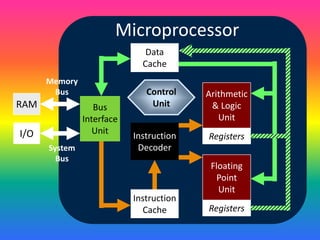
Microprocessor Components
Bus interface unit]
Data & instruction cache memory
Instruction decoder
Arithmetic-Logic unit
Floating-point unit
Control unit

•
•
•
•
•
•
Microprocessor
Data
Cache
Memory
Bus

RAM

Bus
Interface
Unit

I/O
System
Bus

Control
Unit

Instruction
Decoder

Instruction
Cache

Arithmetic
& Logic
Unit

Registers
Floating
Point
Unit
Registers
Registers
Special-purpose
High-speed
Temporary storage
Located inside CPU
Instruction register
Holds instruction currently
being executed

Data register
Holds data waiting to be
processed
Holds results from processing
Types of Microprocessors
PowerPC –
Cooperative efforts of Apple, IBM, and •
Motorola
Used in Apple Macintosh family of PCs •
Found in servers and embedded systems •
Alpha •
Manufactured by Compaq –
High-end servers and workstations –
Applications of Microprocessor
1. General purpose application
Single board micro computers (i
ii) Personal Computers (ii
iii) Super Minis and CAD(iii
2. Special purpose application.(iv
i) Instrumentation (v
ii) Control(vi
iii) Communication(vii
iv) Office Automation and Publication(viii
THANK YOU
FOR LESTION

Aula

  • 1.
    Diyala University College ofEngineering Department of Communications By AULA MAAD RIYAM ABD_AL GABAAR NABAA BADEEA AHMAD ABBAS THIRD STAGE With MS_ Hussein MICROPROSSER SYSTEEM 2013_11_29
  • 2.
    Contents • • • • • • • • The definition ofthe microprocessor (3) The importance of the microprocessor (5) microprocessor (8) Number of microprocessor used in Computer (9) Microprocessor Components(10) Registers(12) Types of microprocessor (14_15) Applications of Microprocessor (17)
  • 3.
    What is aMicroprocessor? • Microprocessors are integrated electrical circuits that are capable of carrying out the instructions of a computer software application or program. These electrical circuits receive instructions from the application or program, interpret these instructions and execute an action or set of actions, based upon what the instructions call for.
  • 5.
    Why Is aMicroprocessor Important? A device that uses a microprocessor is normally • capable of many functions, such as word processing, calculation, and communication via Internet or telephone. However, for the device to work properly, the microprocessor itself has to communicate with other parts of the device. For example, a microprocessor would need to communicate with the video display to control the output data that a program may produce. Therefore, a microprocessor would act as device's "brain" in that it transmits, receives and interprets the data needed to operate a device.
  • 8.
    Microprocessor • CPU etchedon a chip • Chip size is ¼ x ¼ inch • Composed of silicon • Contains millions of transistors – Electronic switches that can allow current to pass through
  • 9.
    How many microprocessorin the computer? PCs have dual-core central processors • (CPU). That's one chip with two complete microprocessors on it, both sharing one path to memory and peripherals. Does we can use many M P in computer • We can not use more than a • microprocessor in the computer because everything that I said the number control units quality and speed of work
  • 10.
    Microprocessor Components Bus interfaceunit] Data & instruction cache memory Instruction decoder Arithmetic-Logic unit Floating-point unit Control unit • • • • • •
  • 11.
  • 12.
    Registers Special-purpose High-speed Temporary storage Located insideCPU Instruction register Holds instruction currently being executed Data register Holds data waiting to be processed Holds results from processing
  • 14.
    Types of Microprocessors PowerPC– Cooperative efforts of Apple, IBM, and • Motorola Used in Apple Macintosh family of PCs • Found in servers and embedded systems • Alpha • Manufactured by Compaq – High-end servers and workstations –
  • 16.
    Applications of Microprocessor 1.General purpose application Single board micro computers (i ii) Personal Computers (ii iii) Super Minis and CAD(iii 2. Special purpose application.(iv i) Instrumentation (v ii) Control(vi iii) Communication(vii iv) Office Automation and Publication(viii
  • 18.