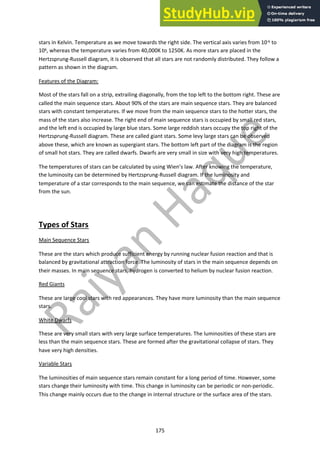
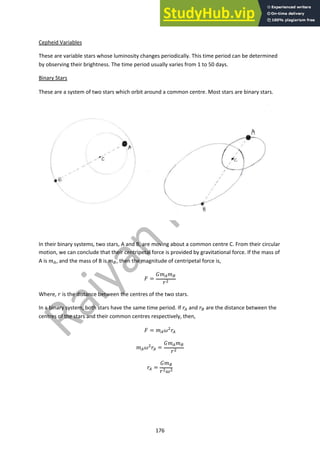
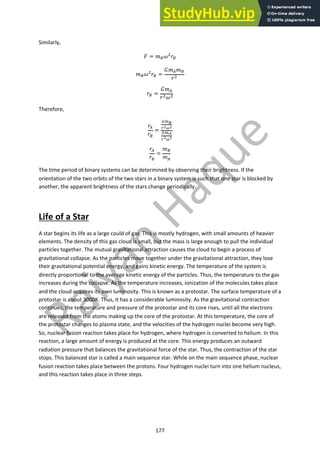
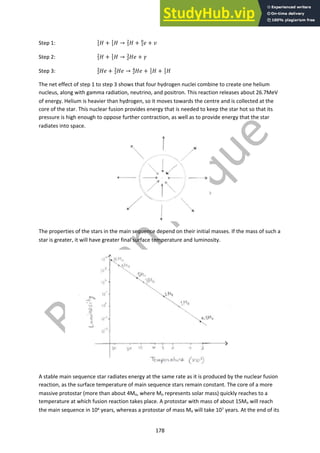
Notes
A2 PHYSICS
Raiyan Haque
1
Table of Contents
FURTHER MECHANICS................................................................................................... 2
ELECTRIC FIELDS ......................................................................................................... 20
MAGNETIC FIELDS........................................................................................................ 60
PARTICLE PHYSICS....................................................................................................... 85
NUCLEAR PHYSICS..................................................................................................... 105
THERMODYNAMICS ................................................................................................... 118
OSCILLATIONS ............................................................................................................ 138
ASTROPHYSICS........................................................................................................... 158
2
FURTHER MECHANICS
3
Momentum
Momentum is a vector quantity. The magnitude of momentum is equal to the product of
mass and velocity of an object. The direction of momentum is parallel to the direction of
velocity of the object.
𝑝 = 𝑚𝑣
The rate of change of motion is proportional to the unbalanced force, and this change takes
place along the direction of force.
𝐹 ∝
𝑚𝑣 − 𝑚𝑢
𝑡
𝐹 = 𝑘 ∙
𝑚𝑣 − 𝑚𝑢
𝑡
𝐹 = 𝑘 ∙
𝑚(𝑣 − 𝑢)
𝑡
As we know,
𝑣 − 𝑢
𝑡
= 𝑎
Therefore,
𝐹 = 𝑘𝑚𝑎
Here, k=1. Therefore,
𝐹 = 𝑚𝑎
1 unit of force is defined as the magnitude of force which causes an acceleration of 1m/s2
when it acts upon an object of mass 1kg.
Impulse
Impulse is a vector quantity. The magnitude of impulse is equal to the product of force and
its time of action (time of collision).
𝐹𝑡 = 𝑚𝑣 − 𝑚𝑢 = 𝑖𝑚𝑝𝑢𝑙𝑠𝑒
4
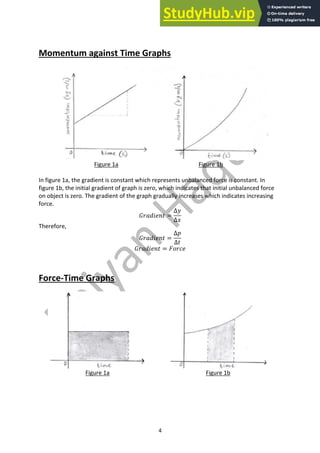
Momentum against Time Graphs
Figure 1a Figure 1b
In figure 1a, the gradient is constant which represents unbalanced force is constant. In
figure 1b, the initial gradient of graph is zero, which indicates that initial unbalanced force
on object is zero. The gradient of the graph gradually increases which indicates increasing
force.
𝐺𝑟𝑎𝑑𝑖𝑒𝑛𝑡 =
∆𝑦
∆𝑥
Therefore,
𝐺𝑟𝑎𝑑𝑖𝑒𝑛𝑡 =
∆𝑝
∆𝑡
𝐺𝑟𝑎𝑑𝑖𝑒𝑛𝑡 = 𝐹𝑜𝑟𝑐𝑒
Force-Time Graphs
Figure 1a Figure 1b
5
Figure 2a Figure 2b
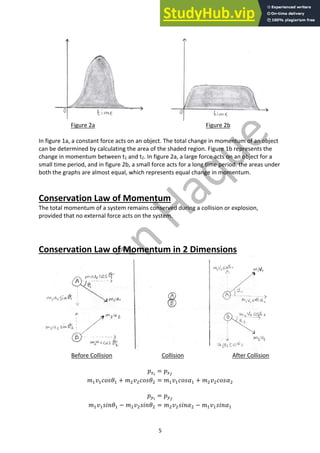
In figure 1a, a constant force acts on an object. The total change in momentum of an object
can be determined by calculating the area of the shaded region. Figure 1b represents the
change in momentum between t1 and t2. In figure 2a, a large force acts on an object for a
small time period, and in figure 2b, a small force acts for a long time period. the areas under
both the graphs are almost equal, which represents equal change in momentum.
Conservation Law of Momentum
The total momentum of a system remains conserved during a collision or explosion,
provided that no external force acts on the system.
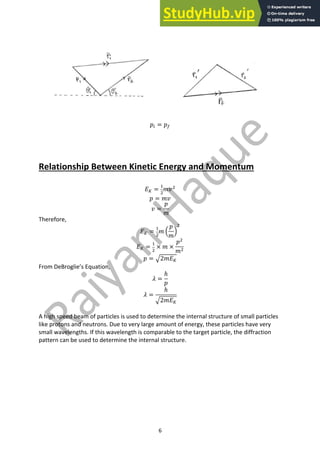
Conservation Law of Momentum in 2 Dimensions
Before Collision Collision After Collision
𝑝!!
= 𝑝!"
𝑚"𝑣"𝑐𝑜𝑠𝜃" + 𝑚#𝑣#𝑐𝑜𝑠𝜃# = 𝑚"𝑣"𝑐𝑜𝑠𝛼" + 𝑚#𝑣#𝑐𝑜𝑠𝛼#
𝑝$!
= 𝑝$"
𝑚"𝑣"𝑠𝑖𝑛𝜃" − 𝑚#𝑣#𝑠𝑖𝑛𝜃# = 𝑚#𝑣#𝑠𝑖𝑛𝛼# − 𝑚"𝑣"𝑠𝑖𝑛𝛼"
6
𝑝% = 𝑝&
Relationship Between Kinetic Energy and Momentum
𝐸' =
"
#
𝑚𝑣#
𝑝 = 𝑚𝑣
𝑣 =
𝑝
𝑚
Therefore,
𝐸' =
"
#
𝑚 A
𝑝
𝑚
B
#
𝐸' =
"
#
× 𝑚 ×
𝑝#
𝑚#
𝑝 = D2𝑚𝐸'
From DeBroglie’s Equation,
𝜆 =
ℎ
𝑝
𝜆 =
ℎ
D2𝑚𝐸'
A high speed beam of particles is used to determine the internal structure of small particles
like protons and neutrons. Due to very large amount of energy, these particles have very
small wavelengths. If this wavelength is comparable to the target particle, the diffraction
pattern can be used to determine the internal structure.
7
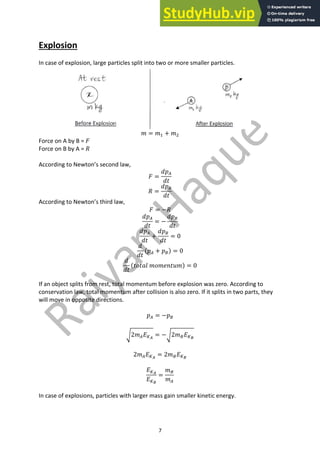
Explosion
In case of explosion, large particles split into two or more smaller particles.
𝑚 = 𝑚" + 𝑚#
Force on A by B = 𝐹
Force on B by A = 𝑅
According to Newton’s second law,
𝐹 =
𝑑𝑝(
𝑑𝑡
𝑅 =
𝑑𝑝)
𝑑𝑡
According to Newton’s third law,
𝐹 = −𝑅
𝑑𝑝(
𝑑𝑡
= −
𝑑𝑝)
𝑑𝑡
𝑑𝑝(
𝑑𝑡
+
𝑑𝑝)
𝑑𝑡
= 0
𝑑
𝑑𝑡
(𝑝( + 𝑝)) = 0
𝑑
𝑑𝑡
(𝑡𝑜𝑡𝑎𝑙 𝑚𝑜𝑚𝑒𝑛𝑡𝑢𝑚) = 0
If an object splits from rest, total momentum before explosion was zero. According to
conservation law, total momentum after collision is also zero. If it splits in two parts, they
will move in opposite directions.
𝑝( = −𝑝)
J2𝑚(𝐸'#
= −J2𝑚)𝐸'$
2𝑚(𝐸'#
= 2𝑚)𝐸'$
𝐸'#
𝐸'$
=
𝑚)
𝑚(
In case of explosions, particles with larger mass gain smaller kinetic energy.
8
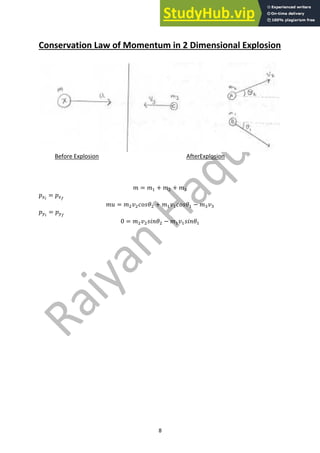
Conservation Law of Momentum in 2 Dimensional Explosion
Before Explosion AfterExplosion
𝑚 = 𝑚" + 𝑚# + 𝑚*
𝑝!!
= 𝑝!"
𝑚𝑢 = 𝑚#𝑣#𝑐𝑜𝑠𝜃# + 𝑚"𝑣"𝑐𝑜𝑠𝜃" − 𝑚*𝑣*
𝑝$!
= 𝑝$"
0 = 𝑚#𝑣#𝑠𝑖𝑛𝜃# − 𝑚"𝑣"𝑠𝑖𝑛𝜃"
9
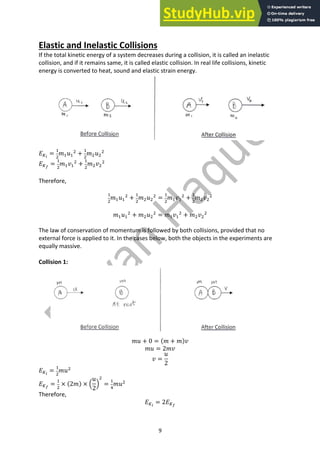
Elastic and Inelastic Collisions
If the total kinetic energy of a system decreases during a collision, it is called an inelastic
collision, and if it remains same, it is called elastic collision. In real life collisions, kinetic
energy is converted to heat, sound and elastic strain energy.
𝐸'!
=
"
#
𝑚"𝑢"
#
+
"
#
𝑚#𝑢#
#
𝐸'"
=
"
#
𝑚"𝑣"
#
+
"
#
𝑚#𝑣#
#
Therefore,
"
#
𝑚"𝑢"
#
+
"
#
𝑚#𝑢#
#
=
"
#
𝑚"𝑣"
#
+
"
#
𝑚#𝑣#
#
𝑚"𝑢"
#
+ 𝑚#𝑢#
#
= 𝑚"𝑣"
#
+ 𝑚#𝑣#
#
The law of conservation of momentum is followed by both collisions, provided that no
external force is applied to it. In the cases below, both the objects in the experiments are
equally massive.
Collision 1:
𝑚𝑢 + 0 = (𝑚 + 𝑚)𝑣
𝑚𝑢 = 2𝑚𝑣
𝑣 =
𝑢
2
𝐸'!
=
"
#
𝑚𝑢#
𝐸'"
=
"
#
× (2𝑚) × A
𝑢
2
B
#
=
"
+
𝑚𝑢#
Therefore,
𝐸'!
= 2𝐸'"
10
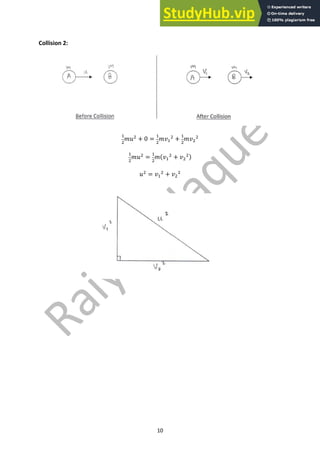
Collision 2:
"
#
𝑚𝑢#
+ 0 =
"
#
𝑚𝑣"
#
+
"
#
𝑚𝑣#
#
"
#
𝑚𝑢#
=
"
#
𝑚(𝑣"
#
+ 𝑣#
#)
𝑢#
= 𝑣"
#
+ 𝑣#
#
11
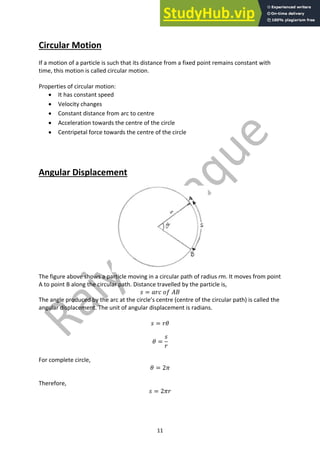
Circular Motion
If a motion of a particle is such that its distance from a fixed point remains constant with
time, this motion is called circular motion.
Properties of circular motion:
• It has constant speed
• Velocity changes
• Constant distance from arc to centre
• Acceleration towards the centre of the circle
• Centripetal force towards the centre of the circle
Angular Displacement
The figure above shows a particle moving in a circular path of radius rm. It moves from point
A to point B along the circular path. Distance travelled by the particle is,
𝑠 = 𝑎𝑟𝑐 𝑜𝑓 𝐴𝐵
The angle produced by the arc at the circle’s centre (centre of the circular path) is called the
angular displacement. The unit of angular displacement is radians.
𝑠 = 𝑟𝜃
𝜃 =
𝑠
𝑟
For complete circle,
𝜃 = 2𝜋
Therefore,
𝑠 = 2𝜋𝑟
12
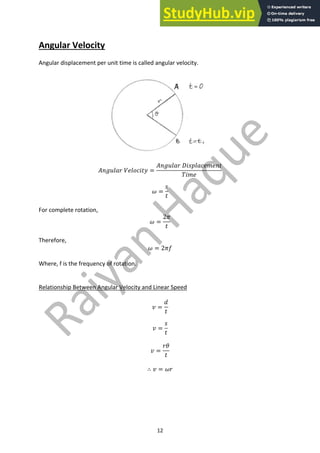
Angular Velocity
Angular displacement per unit time is called angular velocity.
𝐴𝑛𝑔𝑢𝑙𝑎𝑟 𝑉𝑒𝑙𝑜𝑐𝑖𝑡𝑦 =
𝐴𝑛𝑔𝑢𝑙𝑎𝑟 𝐷𝑖𝑠𝑝𝑙𝑎𝑐𝑒𝑚𝑒𝑛𝑡
𝑇𝑖𝑚𝑒
𝜔 =
𝑠
𝑡
For complete rotation,
𝜔 =
2𝜋
𝑡
Therefore,
𝜔 = 2𝜋𝑓
Where, f is the frequency of rotation.
Relationship Between Angular Velocity and Linear Speed
𝑣 =
𝑑
𝑡
𝑣 =
𝑠
𝑡
𝑣 =
𝑟𝜃
𝑡
∴ 𝑣 = 𝜔𝑟
13
Rotation per Minute (RPM)
This is used as a unit of angular velocity. It represents the number of complete rotation
within one minute.
Centripetal Acceleration
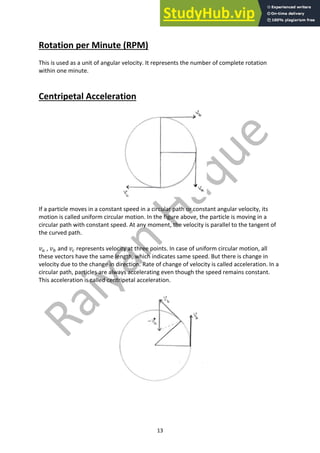
If a particle moves in a constant speed in a circular path or constant angular velocity, its
motion is called uniform circular motion. In the figure above, the particle is moving in a
circular path with constant speed. At any moment, the velocity is parallel to the tangent of
the curved path.
𝑣, , 𝑣- and 𝑣. represents velocity at three points. In case of uniform circular motion, all
these vectors have the same length, which indicates same speed. But there is change in
velocity due to the change in direction. Rate of change of velocity is called acceleration. In a
circular path, particles are always accelerating even though the speed remains constant.
This acceleration is called centripetal acceleration.
14
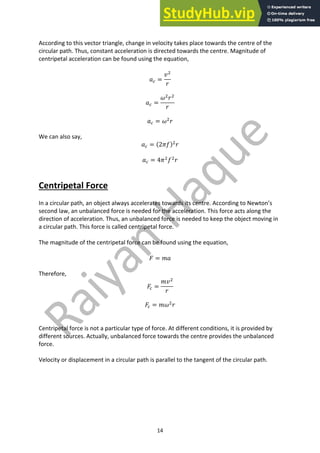
According to this vector triangle, change in velocity takes place towards the centre of the
circular path. Thus, constant acceleration is directed towards the centre. Magnitude of
centripetal acceleration can be found using the equation,
𝑎. =
𝑣#
𝑟
𝑎. =
𝜔#
𝑟#
𝑟
𝑎. = 𝜔#
𝑟
We can also say,
𝑎. = (2𝜋𝑓)#
𝑟
𝑎. = 4𝜋#
𝑓#
𝑟
Centripetal Force
In a circular path, an object always accelerates towards its centre. According to Newton’s
second law, an unbalanced force is needed for the acceleration. This force acts along the
direction of acceleration. Thus, an unbalanced force is needed to keep the object moving in
a circular path. This force is called centripetal force.
The magnitude of the centripetal force can be found using the equation,
𝐹 = 𝑚𝑎
Therefore,
𝐹. =
𝑚𝑣#
𝑟
𝐹. = 𝑚𝜔#
𝑟
Centripetal force is not a particular type of force. At different conditions, it is provided by
different sources. Actually, unbalanced force towards the centre provides the unbalanced
force.
Velocity or displacement in a circular path is parallel to the tangent of the circular path.
15
Change in apparent weight due to Rotational Motion
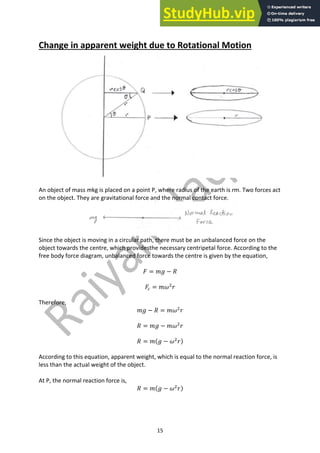
An object of mass mkg is placed on a point P, where radius of the earth is rm. Two forces act
on the object. They are gravitational force and the normal contact force.
Since the object is moving in a circular path, there must be an unbalanced force on the
object towards the centre, which providesthe necessary centripetal force. According to the
free body force diagram, unbalanced force towards the centre is given by the equation,
𝐹 = 𝑚𝑔 − 𝑅
𝐹. = 𝑚𝜔#
𝑟
Therefore,
𝑚𝑔 − 𝑅 = 𝑚𝜔#
𝑟
𝑅 = 𝑚𝑔 − 𝑚𝜔#
𝑟
𝑅 = 𝑚(𝑔 − 𝜔#
𝑟)
According to this equation, apparent weight, which is equal to the normal reaction force, is
less than the actual weight of the object.
At P, the normal reaction force is,
𝑅 = 𝑚(𝑔 − 𝜔#
𝑟)
16
If the object moves towards the pole, apparent weight of the object increases, due to the
decreasing radius.
𝑅 = 𝑚(𝑔 − 𝜔#
𝑟𝑐𝑜𝑠𝜃)
If θ = 90o
,
𝑅 = 𝑚(𝑔 − 𝜔#
𝑟𝑐𝑜𝑠90)
𝑅 = 𝑚𝑔
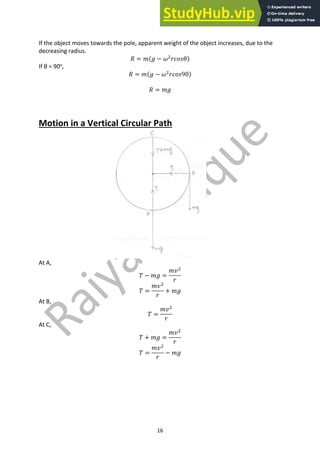
Motion in a Vertical Circular Path
At A,
𝑇 − 𝑚𝑔 =
𝑚𝑣#
𝑟
𝑇 =
𝑚𝑣#
𝑟
+ 𝑚𝑔
At B,
𝑇 =
𝑚𝑣#
𝑟
At C,
𝑇 + 𝑚𝑔 =
𝑚𝑣#
𝑟
𝑇 =
𝑚𝑣#
𝑟
− 𝑚𝑔
17
Speed Breaker
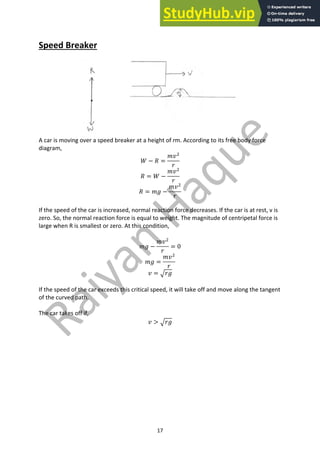
A car is moving over a speed breaker at a height of rm. According to its free body force
diagram,
𝑊 − 𝑅 =
𝑚𝑣#
𝑟
𝑅 = 𝑊 −
𝑚𝑣#
𝑟
𝑅 = 𝑚𝑔 −
𝑚𝑣#
𝑟
If the speed of the car is increased, normal reaction force decreases. If the car is at rest, v is
zero. So, the normal reaction force is equal to weight. The magnitude of centripetal force is
large when R is smallest or zero. At this condition,
𝑚𝑔 −
𝑚𝑣#
𝑟
= 0
𝑚𝑔 =
𝑚𝑣#
𝑟
𝑣 = D𝑟𝑔
If the speed of the car exceeds this critical speed, it will take off and move along the tangent
of the curved path.
The car takes off if,
𝑣 > D𝑟𝑔
18
Satellites
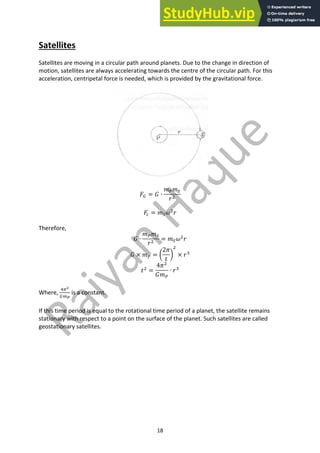
Satellites are moving in a circular path around planets. Due to the change in direction of
motion, satellites are always accelerating towards the centre of the circular path. For this
acceleration, centripetal force is needed, which is provided by the gravitational force.
𝐹/ = 𝐺 ∙
𝑚0𝑚1
𝑟#
𝐹. = 𝑚1𝜔#
𝑟
Therefore,
𝐺 ∙
𝑚0𝑚1
𝑟#
= 𝑚1𝜔#
𝑟
𝐺 × 𝑚0 = Y
2𝜋
𝑡
Z
#
× 𝑟*
𝑡#
=
4𝜋#
𝐺𝑚0
∙ 𝑟*
Where,
+2%
/3&
is a constant.
If this time period is equal to the rotational time period of a planet, the satellite remains
stationary with respect to a point on the surface of the planet. Such satellites are called
geostationary satellites.
19
Experiment to Determine the Relationship between
Centripetal Force and Speed of an Object
Apparatus:
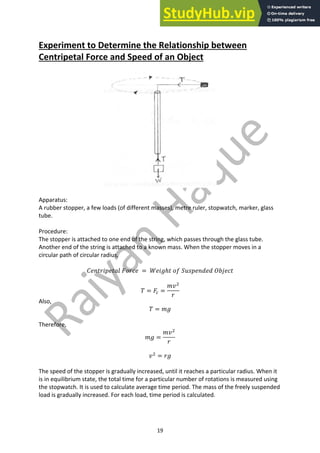
A rubber stopper, a few loads (of different masses), metre ruler, stopwatch, marker, glass
tube.
Procedure:
The stopper is attached to one end of the string, which passes through the glass tube.
Another end of the string is attached to a known mass. When the stopper moves in a
circular path of circular radius,
𝐶𝑒𝑛𝑡𝑟𝑖𝑝𝑒𝑡𝑎𝑙 𝐹𝑜𝑟𝑐𝑒 = 𝑊𝑒𝑖𝑔ℎ𝑡 𝑜𝑓 𝑆𝑢𝑠𝑝𝑒𝑛𝑑𝑒𝑑 𝑂𝑏𝑗𝑒𝑐𝑡
𝑇 = 𝐹. =
𝑚𝑣#
𝑟
Also,
𝑇 = 𝑚𝑔
Therefore,
𝑚𝑔 =
𝑚𝑣#
𝑟
𝑣#
= 𝑟𝑔
The speed of the stopper is gradually increased, until it reaches a particular radius. When it
is in equilibrium state, the total time for a particular number of rotations is measured using
the stopwatch. It is used to calculate average time period. The mass of the freely suspended
load is gradually increased. For each load, time period is calculated.
20
ELECTRIC FIELDS
21
Electric Fields
Electric charge is one of the fundamental properties of all particles. A particle can be
positively charged or negatively charged. Some particles can also be neutral.
Electric field is defined as the space where the charged particles experience a force. Electric
field strength of a point inside the field is defined as force per unit charge.
𝐸𝑙𝑒𝑐𝑡𝑟𝑖𝑐 𝐹𝑖𝑒𝑙𝑑 𝑆𝑡𝑟𝑒𝑛𝑔𝑡ℎ =
𝐹𝑜𝑟𝑐𝑒
𝐶ℎ𝑎𝑟𝑔𝑒
𝐸 =
𝐹
𝑄
Unit of electric field strength = Nc-1
Electric field is a vector quantity. The direction of field strength is the direction of a force on
a positively charged particle on an electric field. A negatively charged particle experiences
force on the opposite direction of the electric field.
According to Newton’s Second Law, an unbalanced force causes acceleration.
𝐹 = 𝑚𝑎
𝐹 = 𝑄𝐸
Therefore,
𝑚𝑎 = 𝑄𝐸
𝑎 =
𝑄𝐸
𝑚
𝑎 represents acceleration of a charged particle in an electric field if the field strength is 𝐸.
22
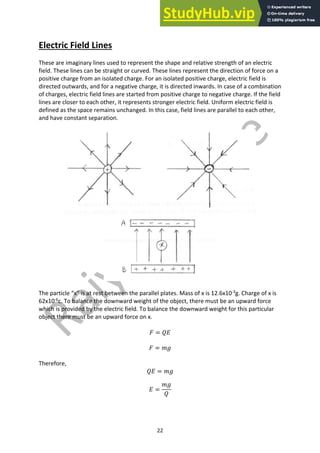
Electric Field Lines
These are imaginary lines used to represent the shape and relative strength of an electric
field. These lines can be straight or curved. These lines represent the direction of force on a
positive charge from an isolated charge. For an isolated positive charge, electric field is
directed outwards, and for a negative charge, it is directed inwards. In case of a combination
of charges, electric field lines are started from positive charge to negative charge. If the field
lines are closer to each other, it represents stronger electric field. Uniform electric field is
defined as the space remains unchanged. In this case, field lines are parallel to each other,
and have constant separation.
The particle “x” is at rest between the parallel plates. Mass of x is 12.6x10⁻³
g. Charge of x is
62x10-6
c. To balance the downward weight of the object, there must be an upward force
which is provided by the electric field. To balance the downward weight for this particular
object there must be an upward force on x.
𝐹 = 𝑄𝐸
𝐹 = 𝑚𝑔
Therefore,
𝑄𝐸 = 𝑚𝑔
𝐸 =
𝑚𝑔
𝑄
23
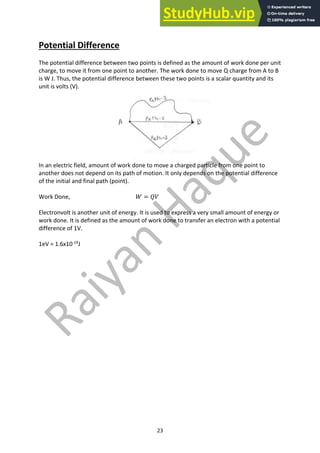
Potential Difference
The potential difference between two points is defined as the amount of work done per unit
charge, to move it from one point to another. The work done to move Q charge from A to B
is W J. Thus, the potential difference between these two points is a scalar quantity and its
unit is volts (V).
In an electric field, amount of work done to move a charged particle from one point to
another does not depend on its path of motion. It only depends on the potential difference
of the initial and final path (point).
Work Done, 𝑊 = 𝑄𝑉
Electronvolt is another unit of energy. It is used to express a very small amount of energy or
work done. It is defined as the amount of work done to transfer an electron with a potential
difference of 1V.
1eV = 1.6x10⁻¹⁹
J
24
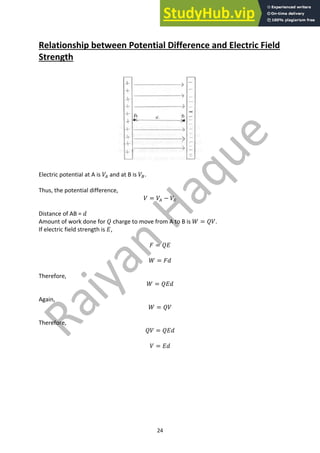
Relationship between Potential Difference and Electric Field
Strength
Electric potential at A is 𝑉( and at B is 𝑉).
Thus, the potential difference,
𝑉 = 𝑉( − 𝑉)
Distance of AB = 𝑑
Amount of work done for 𝑄 charge to move from A to B is 𝑊 = 𝑄𝑉.
If electric field strength is 𝐸,
𝐹 = 𝑄𝐸
𝑊 = 𝐹𝑑
Therefore,
𝑊 = 𝑄𝐸𝑑
Again,
𝑊 = 𝑄𝑉
Therefore,
𝑄𝑉 = 𝑄𝐸𝑑
𝑉 = 𝐸𝑑
25
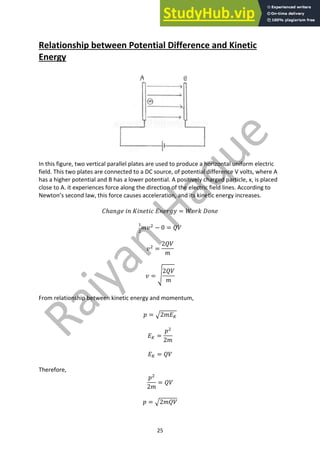
Relationship between Potential Difference and Kinetic
Energy
In this figure, two vertical parallel plates are used to produce a horizontal uniform electric
field. This two plates are connected to a DC source, of potential difference V volts, where A
has a higher potential and B has a lower potential. A positively charged particle, x, is placed
close to A. it experiences force along the direction of the electric field lines. According to
Newton’s second law, this force causes acceleration, and its kinetic energy increases.
𝐶ℎ𝑎𝑛𝑔𝑒 𝑖𝑛 𝐾𝑖𝑛𝑒𝑡𝑖𝑐 𝐸𝑛𝑒𝑟𝑔𝑦 = 𝑊𝑜𝑟𝑘 𝐷𝑜𝑛𝑒
"
#
𝑚𝑣#
− 0 = 𝑄𝑉
𝑣#
=
2𝑄𝑉
𝑚
𝑣 = b
2𝑄𝑉
𝑚
From relationship between kinetic energy and momentum,
𝑝 = D2𝑚𝐸'
𝐸' =
𝑝#
2𝑚
𝐸' = 𝑄𝑉
Therefore,
𝑝#
2𝑚
= 𝑄𝑉
𝑝 = D2𝑚𝑄𝑉
26
From de Broglie Equation,
𝜆 =
ℎ
𝑝
𝜆 =
ℎ
D2𝑚𝑄𝑉
Electron Gun
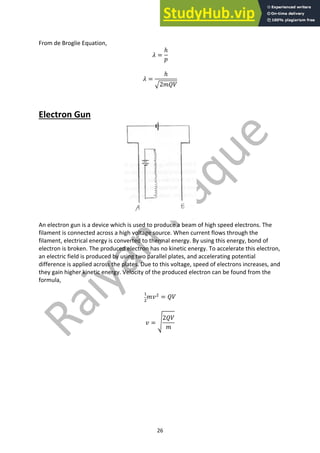
An electron gun is a device which is used to produce a beam of high speed electrons. The
filament is connected across a high voltage source. When current flows through the
filament, electrical energy is converted to thermal energy. By using this energy, bond of
electron is broken. The produced electron has no kinetic energy. To accelerate this electron,
an electric field is produced by using two parallel plates, and accelerating potential
difference is applied across the plates. Due to this voltage, speed of electrons increases, and
they gain higher kinetic energy. Velocity of the produced electron can be found from the
formula,
"
#
𝑚𝑣#
= 𝑄𝑉
𝑣 = b
2𝑄𝑉
𝑚
27
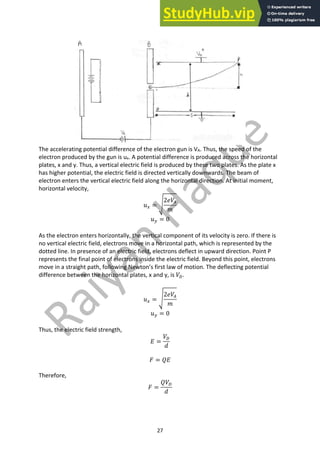
The accelerating potential difference of the electron gun is VA. Thus, the speed of the
electron produced by the gun is ux. A potential difference is produced across the horizontal
plates, x and y. Thus, a vertical electric field is produced by these two plates. As the plate x
has higher potential, the electric field is directed vertically downwards. The beam of
electron enters the vertical electric field along the horizontal direction. At initial moment,
horizontal velocity,
𝑢! = b
2𝑒𝑉(
𝑚
𝑢$ = 0
As the electron enters horizontally, the vertical component of its velocity is zero. If there is
no vertical electric field, electrons move in a horizontal path, which is represented by the
dotted line. In presence of an electric field, electrons deflect in upward direction. Point P
represents the final point of electrons inside the electric field. Beyond this point, electrons
move in a straight path, following Newton’s first law of motion. The deflecting potential
difference between the horizontal plates, x and y, is 𝑉4.
𝑢! = b
2𝑒𝑉(
𝑚
𝑢$ = 0
Thus, the electric field strength,
𝐸 =
𝑉4
𝑑
𝐹 = 𝑄𝐸
Therefore,
𝐹 =
𝑄𝑉4
𝑑
28
According to Newton’s second law of motion,
𝐹 = 𝑚𝑎
Therefore,
𝑚𝑎 =
𝑄𝑉4
𝑑
Hence, in this case,
𝑎$ =
𝑄𝑉4
𝑚𝑑
Since a parabolic motion is taking place,
𝑢! = 𝑣! = b
2𝑒𝑉(
𝑚
𝑢! =
𝑠
𝑡
𝑡 =
𝑠
𝑢!
Also,
𝑠 = 𝑢𝑡 +
"
#
𝑎𝑡#
If the displacement is ℎ, therefore,
ℎ = 𝑢$𝑡 +
"
#
𝑎$𝑡#
ℎ = 0 +
"
#
×
𝑒𝑉4
𝑚𝑑
× 𝑡#
ℎ =
"
#
×
𝑒𝑉4
𝑚𝑑
× Y
𝑠
𝑢!
Z
#
ℎ =
"
#
×
𝑒𝑉4
𝑚𝑑
×
𝑠#
2𝑒𝑉(
𝑚
ℎ =
𝑉4𝑠#
4𝑑𝑉(
At point P, the final vertical velocity,
𝑣 = 𝑢 + 𝑎𝑡
𝑣$ = 𝑢$ + 𝑎$𝑡
29
𝑣$ = 0 +
𝑒𝑉4
𝑚𝑑
×
𝑠
𝑢!
𝑣$ =
𝑒𝑉4𝑠
𝑚𝑑𝑢!
Resistant tangential velocity,
𝑣 = J𝑣!
# + 𝑣$
#
tan 𝜃 =
𝑣$
𝑣!
tan 𝜃 =
𝑒𝑉4𝑠
𝑚𝑑𝑢!
÷ 𝑢!
tan 𝜃 =
𝑒𝑉4𝑠
𝑚𝑑𝑢!
#
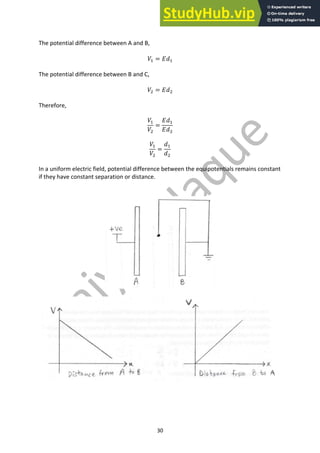
Equipotential
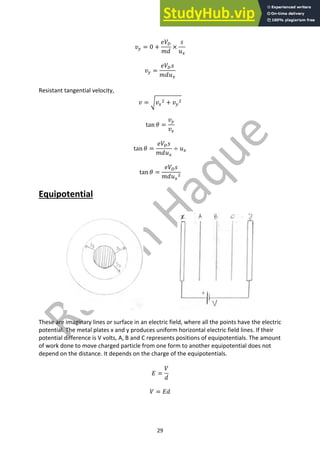
These are imaginary lines or surface in an electric field, where all the points have the electric
potential. The metal plates x and y produces uniform horizontal electric field lines. If their
potential difference is V volts, A, B and C represents positions of equipotentials. The amount
of work done to move charged particle from one form to another equipotential does not
depend on the distance. It depends on the charge of the equipotentials.
𝐸 =
𝑉
𝑑
𝑉 = 𝐸𝑑
30
The potential difference between A and B,
𝑉" = 𝐸𝑑"
The potential difference between B and C,
𝑉# = 𝐸𝑑#
Therefore,
𝑉"
𝑉#
=
𝐸𝑑"
𝐸𝑑#
𝑉"
𝑉#
=
𝑑"
𝑑#
In a uniform electric field, potential difference between the equipotentials remains constant
if they have constant separation or distance.
31
Coulomb’s Law
When two charged particles are close to each other, they interact with each other by
electrostatic force. The magnitude of this force is calculated by using Coulomb’s law.
Coulomb’s Law states that the magnitude of electrostatic force between particles is directly
proportional to the product of their charges and inversely proportional to their distance
squared.
Charge of A = 𝑄"
Charge of B = 𝑄#
Therefore,
𝐹5 =
𝑘𝑄"𝑄#
𝑑#
Here,
𝑘 =
1
4𝜋𝜀
Where, ε is the permittivity of the medium.
k is considered as 8.99x10⁹
Nm2
c-2
for our purposes.
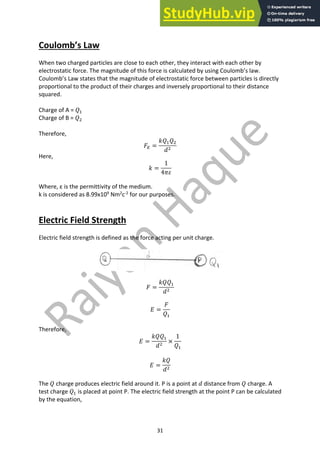
Electric Field Strength
Electric field strength is defined as the force acting per unit charge.
𝐹 =
𝑘𝑄𝑄"
𝑑#
𝐸 =
𝐹
𝑄"
Therefore,
𝐸 =
𝑘𝑄𝑄"
𝑑#
×
1
𝑄"
𝐸 =
𝑘𝑄
𝑑#
The 𝑄 charge produces electric field around it. P is a point at 𝑑 distance from 𝑄 charge. A
test charge 𝑄" is placed at point P. The electric field strength at the point P can be calculated
by the equation,
32
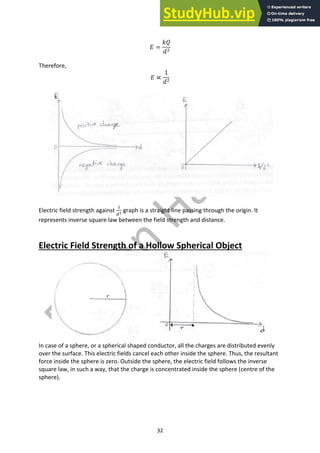
𝐸 =
𝑘𝑄
𝑑#
Therefore,
𝐸 ∝
1
𝑑#
Electric field strength against
"
6%
graph is a straight line passing through the origin. It
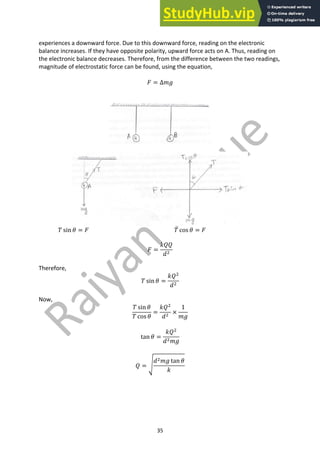
represents inverse square law between the field strength and distance.
Electric Field Strength of a Hollow Spherical Object
In case of a sphere, or a spherical shaped conductor, all the charges are distributed evenly
over the surface. This electric fields cancel each other inside the sphere. Thus, the resultant
force inside the sphere is zero. Outside the sphere, the electric field follows the inverse
square law, in such a way, that the charge is concentrated inside the sphere (centre of the
sphere).
33
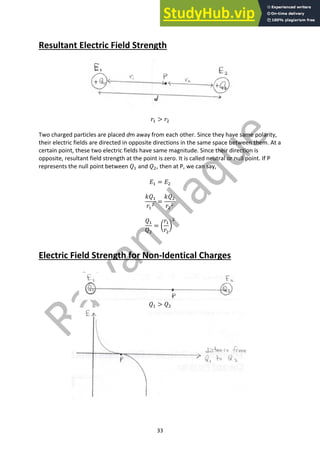
Resultant Electric Field Strength
𝑟" > 𝑟#
Two charged particles are placed dm away from each other. Since they have same polarity,
their electric fields are directed in opposite directions in the same space between them. At a
certain point, these two electric fields have same magnitude. Since their direction is
opposite, resultant field strength at the point is zero. It is called neutral or null point. If P
represents the null point between 𝑄" and 𝑄#, then at P, we can say,
𝐸" = 𝐸#
𝑘𝑄"
𝑟"
#
=
𝑘𝑄#
𝑟#
#
𝑄"
𝑄#
= Y
𝑟"
𝑟#
Z
#
Electric Field Strength for Non-Identical Charges
𝑄" > 𝑄#
34
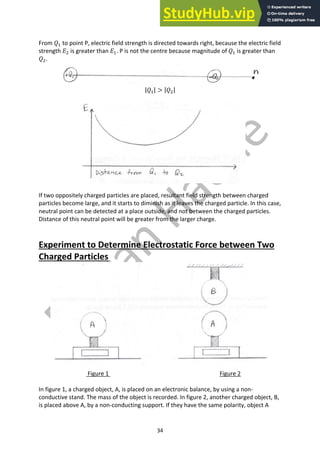
From 𝑄" to point P, electric field strength is directed towards right, because the electric field
strength 𝐸# is greater than 𝐸". P is not the centre because magnitude of 𝑄" is greater than
𝑄#.
|𝑄"| > |𝑄#|
If two oppositely charged particles are placed, resultant field strength between charged
particles become large, and it starts to diminish as it leaves the charged particle. In this case,
neutral point can be detected at a place outside, and not between the charged particles.
Distance of this neutral point will be greater from the larger charge.
Experiment to Determine Electrostatic Force between Two
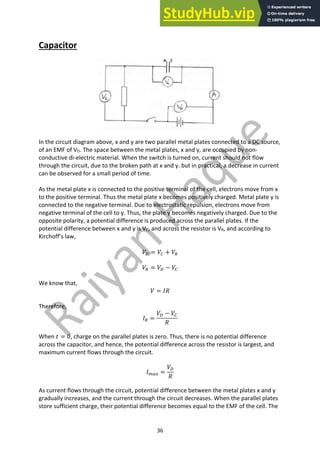
Charged Particles
Figure 1 Figure 2
In figure 1, a charged object, A, is placed on an electronic balance, by using a non-
conductive stand. The mass of the object is recorded. In figure 2, another charged object, B,
is placed above A, by a non-conducting support. If they have the same polarity, object A
35
experiences a downward force. Due to this downward force, reading on the electronic
balance increases. If they have opposite polarity, upward force acts on A. Thus, reading on
the electronic balance decreases. Therefore, from the difference between the two readings,
magnitude of electrostatic force can be found, using the equation,
𝐹 = ∆𝑚𝑔
𝑇 sin 𝜃 = 𝐹 𝑇 cos 𝜃 = 𝐹
𝐹 =
𝑘𝑄𝑄
𝑑#
Therefore,
𝑇 sin 𝜃 =
𝑘𝑄#
𝑑#
Now,
𝑇 sin 𝜃
𝑇 cos 𝜃
=
𝑘𝑄#
𝑑#
×
1
𝑚𝑔
tan 𝜃 =
𝑘𝑄#
𝑑#𝑚𝑔
𝑄 = b
𝑑#𝑚𝑔 tan 𝜃
𝑘
36
Capacitor
In the circuit diagram above, x and y are two parallel metal plates connected to a DC source,
of an EMF of VD. The space between the metal plates, x and y, are occupied by non-
conductive di-electric material. When the switch is turned on, current should not flow
through the circuit, due to the broken path at x and y. but in practical, a decrease in current
can be observed for a small period of time.
As the metal plate x is connected to the positive terminal of the cell, electrons move from x
to the positive terminal. Thus the metal plate x becomes positively charged. Metal plate y is
connected to the negative terminal. Due to electrostatic repulsion, electrons move from
negative terminal of the cell to y. Thus, the plate y becomes negatively charged. Due to the
opposite polarity, a potential difference is produced across the parallel plates. If the
potential difference between x and y is VC, and across the resistor is VR, and according to
Kirchoff’s law,
𝑉4 = 𝑉7 + 𝑉8
𝑉8 = 𝑉4 − 𝑉7
We know that,
𝑉 = 𝐼𝑅
Therefore,
𝐼8 =
𝑉4 − 𝑉7
𝑅
When 𝑡 = 0, charge on the parallel plates is zero. Thus, there is no potential difference
across the capacitor, and hence, the potential difference across the resistor is largest, and
maximum current flows through the circuit.
𝐼3,! =
𝑉4
𝑅
As current flows through the circuit, potential difference between the metal plates x and y
gradually increases, and the current through the circuit decreases. When the parallel plates
store sufficient charge, their potential difference becomes equal to the EMF of the cell. The
37
potential difference across the resistor drops to zero. According to Ohm’s law, current
through the circuit becomes zero. At this condition, parallel plates have largest possible
charge.
If the plates are connected across an electric appliance, it can provide energy. Thus the
arrangement can store electric potential energy, by creating an electric field between the
plates. This arrangement is called the capacitor.
To transfer more charge into the capacitor, its potential difference must be increased.
Charge of the capacitor is proportional to the potential difference between x and y.
𝑄 ∝ 𝑉
𝑄 = 𝐶𝑉
The proportionality constant, 𝐶, is called the capacitance. Capacitance is defined as the
amount of charge stored by a capacitor when the potential across its two plates is 1 volt.
Unit = c/V or Farad (F)
In practice, a Farad is a very large unit. For real life appliances, milliFarad and microFarad is
used.
38
Charge against Voltage Graphs
The equation, 𝑄 = 𝐶𝑉, represents linear relationship between potential difference and
charge. Thus, the graph is a straight line through the origin. In this case, the applied
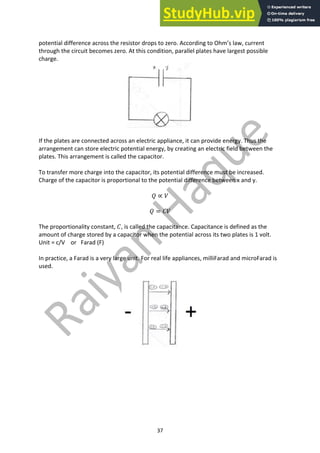
potential difference is considered which is varied using a variable resistor. Thus, the
potential difference is an independent variable, and is plotted across the x-axis. The
dependent variable is charge, and is plotted across the y-axis. The gradient of this graph
gives capacitance. The potential difference across the capacitor depends on the amount of
charge of the parallel plates.
Capacitors can come in many types, for example, the parallel plates can be turned to a
cylinder, to make large surface area, while keeping the capacitor compact. Such capacitors
are known as cylindrical capacitors.
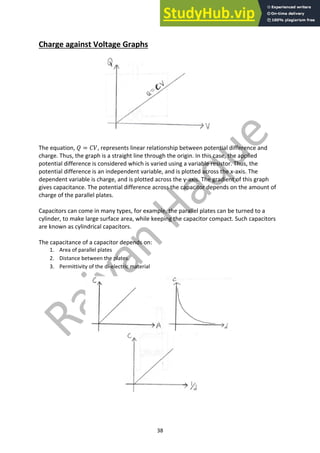
The capacitance of a capacitor depends on:
1. Area of parallel plates
2. Distance between the plates.
3. Permittivity of the di-electric material
39
𝐶 =
𝜀𝐴
𝑑
ε = Permittivity
A = Surface Area
d = Distance
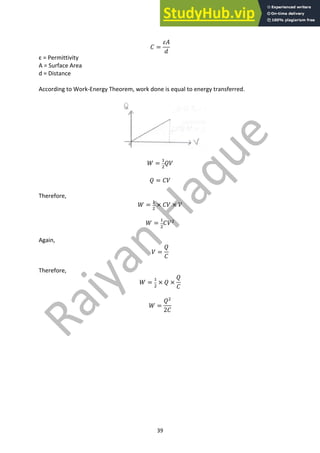
According to Work-Energy Theorem, work done is equal to energy transferred.
𝑊 =
"
#
𝑄𝑉
𝑄 = 𝐶𝑉
Therefore,
𝑊 =
"
#
× 𝐶𝑉 × 𝑉
𝑊 =
"
#
𝐶𝑉#
Again,
𝑉 =
𝑄
𝐶
Therefore,
𝑊 =
"
#
× 𝑄 ×
𝑄
𝐶
𝑊 =
𝑄#
2𝐶
40
Efficiency of a Capacitor
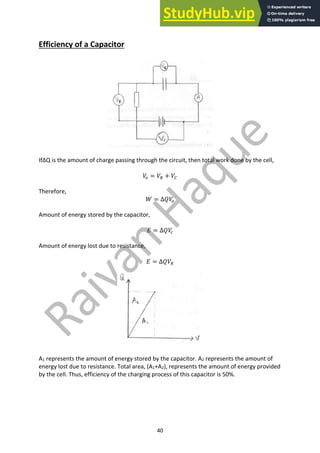
IfΔQ is the amount of charge passing through the circuit, then total work done by the cell,
𝑉
9 = 𝑉8 + 𝑉7
Therefore,
𝑊 = ∆𝑄𝑉
9
Amount of energy stored by the capacitor,
𝐸 = ∆𝑄𝑉
.
Amount of energy lost due to resistance,
𝐸 = ∆𝑄𝑉8
A1 represents the amount of energy stored by the capacitor. A2 represents the amount of
energy lost due to resistance. Total area, (A1+A2), represents the amount of energy provided
by the cell. Thus, efficiency of the charging process of this capacitor is 50%.
41
Series Combination of Capacitors
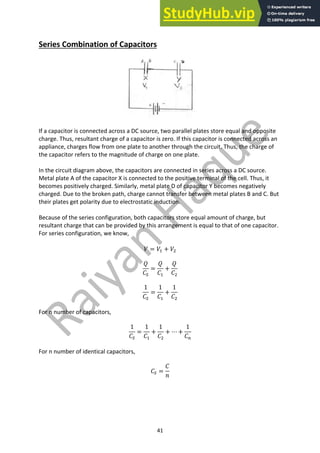
If a capacitor is connected across a DC source, two parallel plates store equal and opposite
charge. Thus, resultant charge of a capacitor is zero. If this capacitor is connected across an
appliance, charges flow from one plate to another through the circuit. Thus, the charge of
the capacitor refers to the magnitude of charge on one plate.
In the circuit diagram above, the capacitors are connected in series across a DC source.
Metal plate A of the capacitor X is connected to the positive terminal of the cell. Thus, it
becomes positively charged. Similarly, metal plate D of capacitor Y becomes negatively
charged. Due to the broken path, charge cannot transfer between metal plates B and C. But
their plates get polarity due to electrostatic induction.
Because of the series configuration, both capacitors store equal amount of charge, but
resultant charge that can be provided by this arrangement is equal to that of one capacitor.
For series configuration, we know,
𝑉 = 𝑉" + 𝑉#
𝑄
𝐶1
=
𝑄
𝐶"
+
𝑄
𝐶#
1
𝐶1
=
1
𝐶"
+
1
𝐶#
For n number of capacitors,
1
𝐶1
=
1
𝐶"
+
1
𝐶#
+ ⋯ +
1
𝐶:
For n number of identical capacitors,
𝐶1 =
𝐶
𝑛
42
Parallel Combination of Capacitors
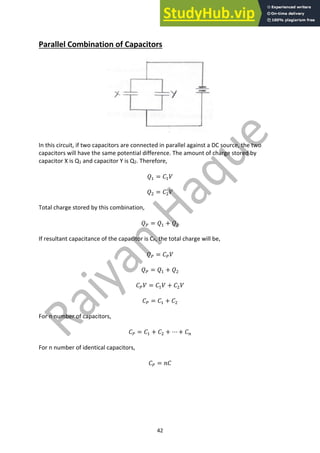
In this circuit, if two capacitors are connected in parallel against a DC source, the two
capacitors will have the same potential difference. The amount of charge stored by
capacitor X is Q1 and capacitor Y is Q2. Therefore,
𝑄" = 𝐶"𝑉
𝑄# = 𝐶#𝑉
Total charge stored by this combination,
𝑄0 = 𝑄" + 𝑄#
If resultant capacitance of the capacitor is CP, the total charge will be,
𝑄0 = 𝐶0𝑉
𝑄0 = 𝑄" + 𝑄#
𝐶0𝑉 = 𝐶"𝑉 + 𝐶#𝑉
𝐶0 = 𝐶" + 𝐶#
For n number of capacitors,
𝐶0 = 𝐶" + 𝐶# + ⋯ + 𝐶:
For n number of identical capacitors,
𝐶0 = 𝑛𝐶
43
Energy Stored in Series and Parallel Combination of Capacitors
Figure 1 Figure 2
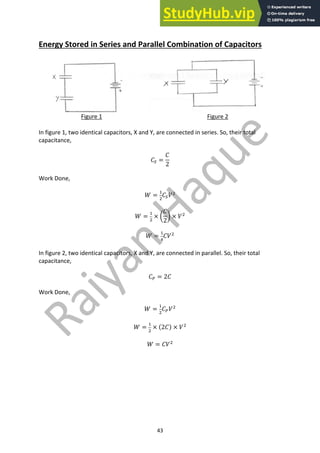
In figure 1, two identical capacitors, X and Y, are connected in series. So, their total
capacitance,
𝐶1 =
𝐶
2
Work Done,
𝑊 =
"
#
𝐶1𝑉#
𝑊 =
"
#
× Y
𝐶
2
Z × 𝑉#
𝑊 =
"
+
𝐶𝑉#
In figure 2, two identical capacitors, X and Y, are connected in parallel. So, their total
capacitance,
𝐶0 = 2𝐶
Work Done,
𝑊 =
"
#
𝐶0𝑉#
𝑊 =
"
#
× (2𝐶) × 𝑉#
𝑊 = 𝐶𝑉#
44
Charging of Capacitors
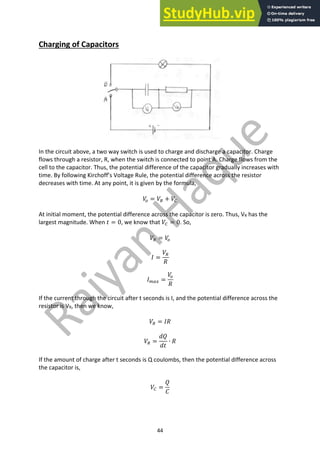
In the circuit above, a two way switch is used to charge and discharge a capacitor. Charge
flows through a resistor, R, when the switch is connected to point A. Charge flows from the
cell to the capacitor. Thus, the potential difference of the capacitor gradually increases with
time. By following Kirchoff’s Voltage Rule, the potential difference across the resistor
decreases with time. At any point, it is given by the formula,
𝑉
9 = 𝑉8 + 𝑉7
At initial moment, the potential difference across the capacitor is zero. Thus, VR has the
largest magnitude. When 𝑡 = 0, we know that 𝑉7 = 0. So,
𝑉8 = 𝑉
9
𝐼 =
𝑉8
𝑅
𝐼3,! =
𝑉
9
𝑅
If the current through the circuit after t seconds is I, and the potential difference across the
resistor is VR, then we know,
𝑉8 = 𝐼𝑅
𝑉8 =
𝑑𝑄
𝑑𝑡
∙ 𝑅
If the amount of charge after t seconds is Q coulombs, then the potential difference across
the capacitor is,
𝑉7 =
𝑄
𝐶
45
From Kirchoff’s Voltage Rule, we know,
𝑉
9 = 𝑉8 + 𝑉7
𝑉
9 =
𝑑𝑄
𝑑𝑡
∙ 𝑅 +
𝑄
𝐶
𝑑𝑄
𝑑𝑡
∙ 𝑅 = 𝑉
9 −
𝑄
𝐶
𝑑𝑄
𝑑𝑡
∙ 𝑅 =
𝐶𝑉
9 − 𝑄
𝐶
p
𝐶
𝐶𝑉
9 − 𝑄
𝑑𝑄 = p
1
𝑅
𝑑𝑡
𝐶 p
1
𝐶𝑉
9 − 𝑄
𝑑𝑄 = p
1
𝑅
𝑑𝑡
𝐶 ln|𝐶𝑉
9 − 𝑄| = −
𝑡
𝑅
+ 𝑘
ln|𝐶𝑉
9 − 𝑄| = −
𝑡
𝑅𝐶
+
𝑘
𝐶
𝐶𝑉
9 − 𝑄 = 𝑒;
<
87
=
>
7
𝐶𝑉
9 − 𝑄 = 𝑒;
<
87 × 𝑒
>
7
𝐶𝑉
9 − 𝑄 = 𝐾𝑒;
<
87
𝐶𝑉
9 − 𝑄 = 𝐶𝑉
9𝑒;
<
87
𝑄 = 𝐶𝑉
9 − 𝐶𝑉
9𝑒;
<
87
𝑄 = 𝐶𝑉
9 Y1 − 𝑒;
<
87Z
𝑄 = 𝑄9 Y1 − 𝑒;
<
87Z
Now, from the equation,
𝑄 = 𝑄9 − 𝑄9𝑒;
<
87
46
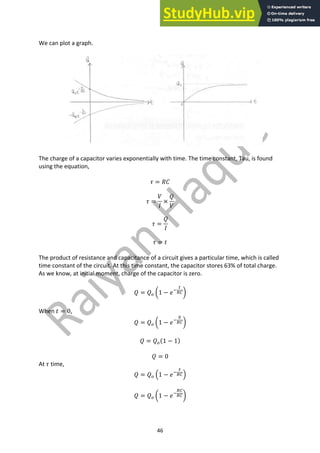
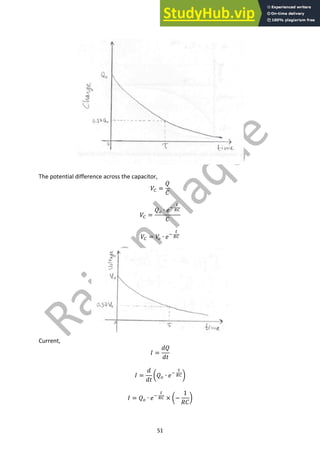
We can plot a graph.
The charge of a capacitor varies exponentially with time. The time constant, Tau, is found
using the equation,
𝜏 = 𝑅𝐶
𝜏 =
𝑉
𝐼
×
𝑄
𝑉
𝜏 =
𝑄
𝐼
𝜏 = 𝑡
The product of resistance and capacitance of a circuit gives a particular time, which is called
time constant of the circuit. At this time constant, the capacitor stores 63% of total charge.
As we know, at initial moment, charge of the capacitor is zero.
𝑄 = 𝑄9 Y1 − 𝑒;
<
87Z
When 𝑡 = 0,
𝑄 = 𝑄9 Y1 − 𝑒;
?
87Z
𝑄 = 𝑄9(1 − 1)
𝑄 = 0
At 𝜏 time,
𝑄 = 𝑄9 A1 − 𝑒;
@
87B
𝑄 = 𝑄9 Y1 − 𝑒;
87
87Z
47
𝑄 = 𝑄9(1 − 𝑒;")
𝑄 ≅ 0.63𝑄9
Identify the Equation of Current at Time, t seconds
When time, t=0,
𝐼9 =
𝑉
9
𝑅
This current gradually decreases.
At time 𝑡 seconds,
𝐼 =
𝑑𝑄
𝑑𝑡
𝐼 =
𝑑
𝑑𝑡
Y𝑄9 − 𝑄9𝑒;
<
87Z
𝐼 = 0 − 𝑄9𝑒;
<
87 × Y−
1
𝑅𝐶
Z
𝐼 =
𝑄9𝑒;
<
87
𝑅𝐶
𝐼 =
𝑄9
𝑅𝐶
∙ 𝑒;
<
87
𝐼 = 𝐼9𝑒;
<
87
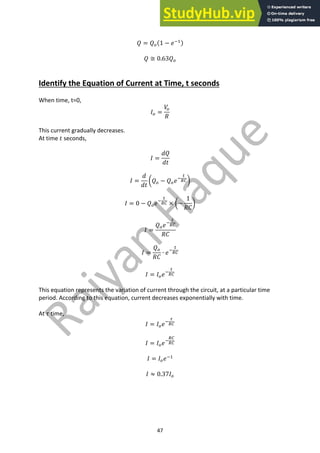
This equation represents the variation of current through the circuit, at a particular time
period. According to this equation, current decreases exponentially with time.
At 𝜏 time,
𝐼 = 𝐼9𝑒;
@
87
𝐼 = 𝐼9𝑒;
87
87
𝐼 = 𝐼9𝑒;"
𝐼 ≈ 0.37𝐼9
48
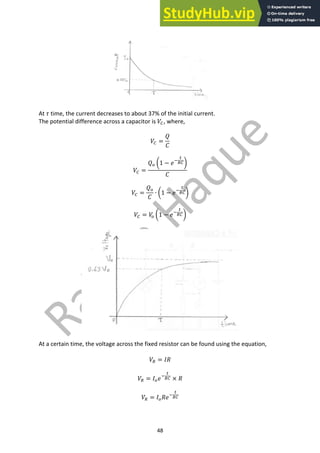
At 𝜏 time, the current decreases to about 37% of the initial current.
The potential difference across a capacitor is 𝑉7, where,
𝑉7 =
𝑄
𝐶
𝑉7 =
𝑄9 Y1 − 𝑒;
<
87Z
𝐶
𝑉7 =
𝑄9
𝐶
∙ Y1 − 𝑒;
<
87Z
𝑉7 = 𝑉
9 Y1 − 𝑒;
<
87Z
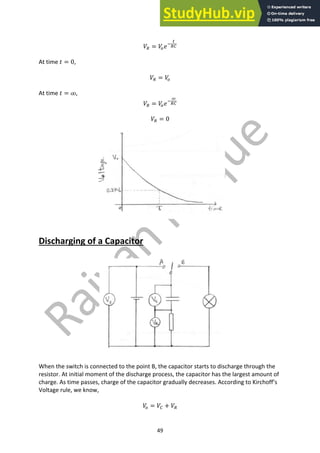
At a certain time, the voltage across the fixed resistor can be found using the equation,
𝑉8 = 𝐼𝑅
𝑉8 = 𝐼9𝑒;
<
87 × 𝑅
𝑉8 = 𝐼9𝑅𝑒;
<
87
49
𝑉8 = 𝑉
9𝑒;
<
87
At time 𝑡 = 0,
𝑉8 = 𝑉
9
At time 𝑡 = ꝏ,
𝑉8 = 𝑉
9𝑒;
ꝏ
87
𝑉8 = 0
Discharging of a Capacitor
When the switch is connected to the point B, the capacitor starts to discharge through the
resistor. At initial moment of the discharge process, the capacitor has the largest amount of
charge. As time passes, charge of the capacitor gradually decreases. According to Kirchoff’s
Voltage rule, we know,
𝑉
9 = 𝑉7 + 𝑉8
50
When the cell is removed, 𝑉? = 0
𝑉7 + 𝑉8 = 0
𝑉7 =
𝑄
𝐶
𝑉8 =
𝑑𝑄
𝑑𝑡
∙ 𝑅
Therefore,
𝑄
𝐶
+
𝑑𝑄
𝑑𝑡
∙ 𝑅 = 0
𝑑𝑄
𝑑𝑡
∙ 𝑅 = −
𝑄
𝐶
p
1
𝑄
𝑑𝑄
A
A'
= − p
1
𝑅𝐶
𝑑𝑡
<
?
[ln 𝑄]A'
A
= − {
𝑡
𝑅𝐶
|
?
<
ln }
𝑄
𝑄9
} = −
𝑡
𝑅𝐶
𝑄
𝑄9
= 𝑒;
<
87
𝑄 = 𝑄9 ∙ 𝑒;
<
87
When 𝑡 = 𝜏,
𝜏 = 𝑅𝐶
𝑄 = 𝑄9 ∙ 𝑒;
87
87
𝑄 = 𝑄9 ∙ 𝑒;"
𝑄 = 0.37𝑄9
51
The potential difference across the capacitor,
𝑉7 =
𝑄
𝐶
𝑉7 =
𝑄9 ∙ 𝑒;
<
87
𝐶
𝑉7 = 𝑉
9 ∙ 𝑒;
<
87
Current,
𝐼 =
𝑑𝑄
𝑑𝑡
𝐼 =
𝑑
𝑑𝑡
Y𝑄9 ∙ 𝑒;
<
87Z
𝐼 = 𝑄9 ∙ 𝑒;
<
87 × Y−
1
𝑅𝐶
Z
52
𝐼 = −
𝑄9
𝑅𝐶
∙ 𝑒;
<
87
𝐼 = −𝐼9 ∙ 𝑒;
<
87
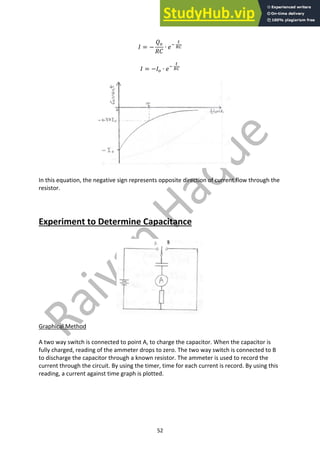
In this equation, the negative sign represents opposite direction of current flow through the
resistor.
Experiment to Determine Capacitance
Graphical Method
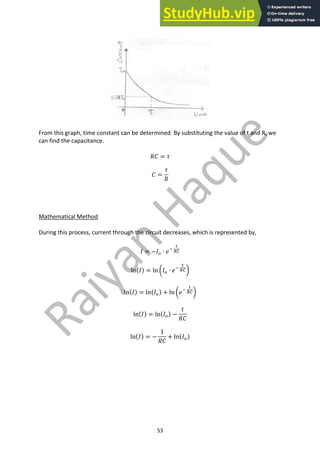
A two way switch is connected to point A, to charge the capacitor. When the capacitor is
fully charged, reading of the ammeter drops to zero. The two way switch is connected to B
to discharge the capacitor through a known resistor. The ammeter is used to record the
current through the circuit. By using the timer, time for each current is record. By using this
reading, a current against time graph is plotted.
53
From this graph, time constant can be determined. By substituting the value of t and R, we
can find the capacitance.
𝑅𝐶 = 𝜏
𝐶 =
𝜏
𝑅
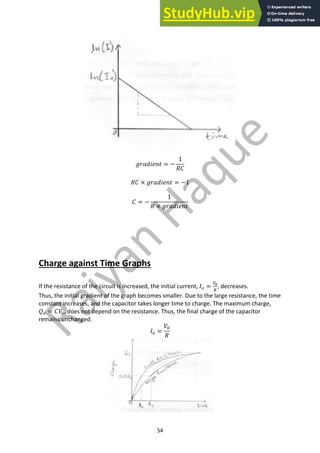
Mathematical Method
During this process, current through the circuit decreases, which is represented by,
𝐼 = −𝐼9 ∙ 𝑒;
<
87
ln(𝐼) = ln Y𝐼9 ∙ 𝑒;
<
87Z
ln(𝐼) = ln(𝐼9) + ln Y𝑒;
<
87Z
ln(𝐼) = ln(𝐼9) −
𝑡
𝑅𝐶
ln(𝐼) = −
1
𝑅𝐶
+ ln(𝐼9)
54
𝑔𝑟𝑎𝑑𝑖𝑒𝑛𝑡 = −
1
𝑅𝐶
𝑅𝐶 × 𝑔𝑟𝑎𝑑𝑖𝑒𝑛𝑡 = −1
𝐶 = −
1
𝑅 × 𝑔𝑟𝑎𝑑𝑖𝑒𝑛𝑡
Charge against Time Graphs
If the resistance of the circuit is increased, the initial current, 𝐼9 =
C(
8
, decreases.
Thus, the initial gradient of the graph becomes smaller. Due to the large resistance, the time
constant increases, and the capacitor takes longer time to charge. The maximum charge,
𝑄9 = 𝐶𝑉
9, does not depend on the resistance. Thus, the final charge of the capacitor
remains unchanged.
𝐼9 =
𝑉?
𝑅
55
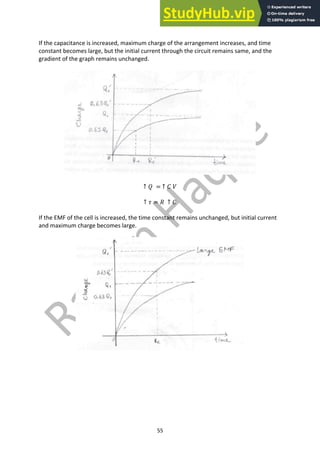
If the capacitance is increased, maximum charge of the arrangement increases, and time
constant becomes large, but the initial current through the circuit remains same, and the
gradient of the graph remains unchanged.
↑ 𝑄 = ↑ 𝐶 𝑉
↑ 𝜏 = 𝑅 ↑ 𝐶
If the EMF of the cell is increased, the time constant remains unchanged, but initial current
and maximum charge becomes large.
56
Properties of Current against Time Graphs
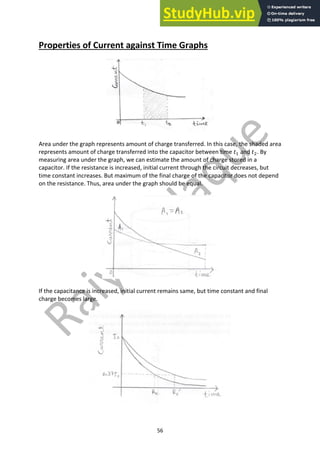
Area under the graph represents amount of charge transferred. In this case, the shaded area
represents amount of charge transferred into the capacitor between time 𝑡" and 𝑡#. By
measuring area under the graph, we can estimate the amount of charge stored in a
capacitor. If the resistance is increased, initial current through the circuit decreases, but
time constant increases. But maximum of the final charge of the capacitor does not depend
on the resistance. Thus, area under the graph should be equal.
If the capacitance is increased, initial current remains same, but time constant and final
charge becomes large.
57
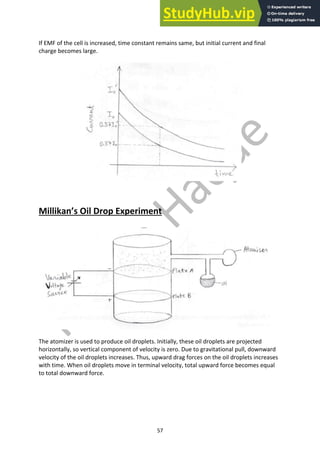
If EMF of the cell is increased, time constant remains same, but initial current and final
charge becomes large.
Millikan’s Oil Drop Experiment
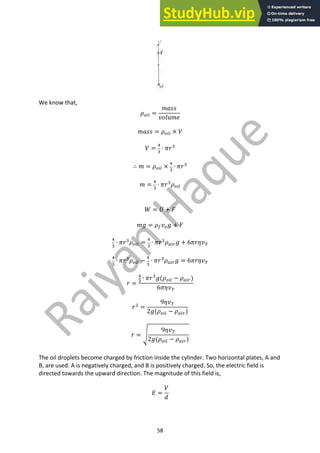
The atomizer is used to produce oil droplets. Initially, these oil droplets are projected
horizontally, so vertical component of velocity is zero. Due to gravitational pull, downward
velocity of the oil droplets increases. Thus, upward drag forces on the oil droplets increases
with time. When oil droplets move in terminal velocity, total upward force becomes equal
to total downward force.
58
We know that,
𝜌9%D =
𝑚𝑎𝑠𝑠
𝑣𝑜𝑙𝑢𝑚𝑒
𝑚𝑎𝑠𝑠 = 𝜌9%D × 𝑉
𝑉 =
+
*
∙ 𝜋𝑟*
∴ 𝑚 = 𝜌9%D ×
+
*
∙ 𝜋𝑟*
𝑚 =
+
*
∙ 𝜋𝑟*
𝜌9%D
𝑊 = 𝑈 + 𝐹
𝑚𝑔 = 𝜌&𝑣9𝑔 + 𝐹
+
*
∙ 𝜋𝑟*
𝜌9%D =
+
*
∙ 𝜋𝑟*
𝜌,%E𝑔 + 6𝜋𝑟𝜂𝑣F
+
*
∙ 𝜋𝑟*
𝜌9%D −
+
*
∙ 𝜋𝑟*
𝜌,%E𝑔 = 6𝜋𝑟𝜂𝑣F
𝑟 =
+
* ∙ 𝜋𝑟*
𝑔(𝜌9%D − 𝜌,%E)
6𝜋𝜂𝑣F
𝑟#
=
9𝜂𝑣F
2𝑔(𝜌9%D − 𝜌,%E)
𝑟 = b
9𝜂𝑣F
2𝑔(𝜌9%D − 𝜌,%E)
The oil droplets become charged by friction inside the cylinder. Two horizontal plates, A and
B, are used. A is negatively charged, and B is positively charged. So, the electric field is
directed towards the upward direction. The magnitude of this field is,
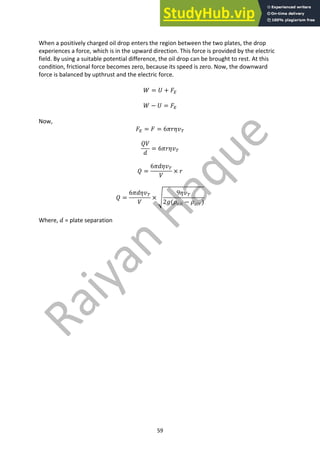
𝐸 =
𝑉
𝑑
59
When a positively charged oil drop enters the region between the two plates, the drop
experiences a force, which is in the upward direction. This force is provided by the electric
field. By using a suitable potential difference, the oil drop can be brought to rest. At this
condition, frictional force becomes zero, because its speed is zero. Now, the downward
force is balanced by upthrust and the electric force.
𝑊 = 𝑈 + 𝐹5
𝑊 − 𝑈 = 𝐹5
Now,
𝐹5 = 𝐹 = 6𝜋𝑟𝜂𝑣F
𝑄𝑉
𝑑
= 6𝜋𝑟𝜂𝑣F
𝑄 =
6𝜋𝑑𝜂𝑣F
𝑉
× 𝑟
𝑄 =
6𝜋𝑑𝜂𝑣F
𝑉
× b
9𝜂𝑣F
2𝑔(𝜌9%D − 𝜌,%E)
Where, 𝑑 = plate separation
60
MAGNETIC FIELDS
61
Magnetic Fields
A magnetic field is a space where a magnet or a moving charged particle experience a force. Like an
electric field, a magnetic field is a vector quantity. Thus, it has a magnitude and direction.
Properties of Charged Particles
• A static charged particle produces electric field.
• A moving charged particle produces both electric field and magnetic field.
Poles of a Magnet (Magnetic Poles)
Poles represent the point where the strength of the magnet (or magnetic field) is largest. A freely
suspended magnet is directed along north-south direction. Direction of magnetic field is defined as
the direction of force experienced on the individual north pole inside the magnetic field.
Same poles repel each other, and opposite poles attract. This phenomenon is known as magnetic
interaction.
Magnetic Field Strength
Magnetic field is represented by imaginary lines, which are called magnetic field lines. Separation
between these field lines represent relative field strengths. If the field lines are closer to each other,
it represents stronger magnetic field. In the figures above, magnetic field lines are passing through
Area, A. The total number of field lines through a particular area is called magnetic flux or magnetic
field density.
! = #$
% is the magnetic flux. Its unit is Weber (Wb). B is the magnetic field strength, and its unit is Tesla
(T). The area is represented by A, in m2.
62
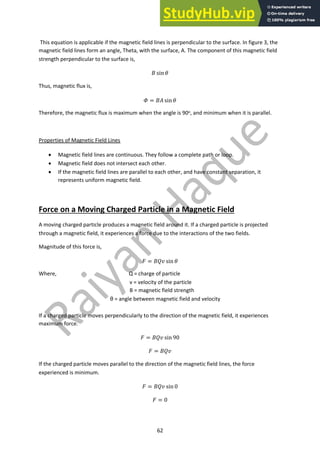
This equation is applicable if the magnetic field lines is perpendicular to the surface. In figure 3, the
magnetic field lines form an angle, Theta, with the surface, A. The component of this magnetic field
strength perpendicular to the surface is,
! sin %
Thus, magnetic flux is,
& = !( sin %
Therefore, the magnetic flux is maximum when the angle is 90o, and minimum when it is parallel.
Properties of Magnetic Field Lines
• Magnetic field lines are continuous. They follow a complete path or loop.
• Magnetic field does not intersect each other.
• If the magnetic field lines are parallel to each other, and have constant separation, it
represents uniform magnetic field.
Force on a Moving Charged Particle in a Magnetic Field
A moving charged particle produces a magnetic field around it. If a charged particle is projected
through a magnetic field, it experiences a force due to the interactions of the two fields.
Magnitude of this force is,
) = !*+ sin %
Where, Q = charge of particle
v = velocity of the particle
B = magnetic field strength
θ = angle between magnetic field and velocity
If a charged particle moves perpendicularly to the direction of the magnetic field, it experiences
maximum force.
) = !*+ sin 90
) = !*+
If the charged particle moves parallel to the direction of the magnetic field lines, the force
experienced is minimum.
) = !*+ sin 0
) = 0
63
The magnitude of the magnetic field strength is equal to the amount of force that acts on 1c of
charge when it moves at 1m/s, perpendicular to the direction of magnetic field.
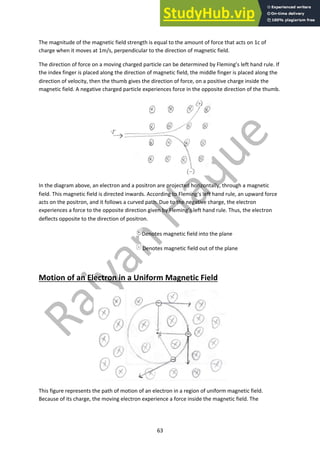
The direction of force on a moving charged particle can be determined by Fleming’s left hand rule. If
the index finger is placed along the direction of magnetic field, the middle finger is placed along the
direction of velocity, then the thumb gives the direction of force, on a positive charge inside the
magnetic field. A negative charged particle experiences force in the opposite direction of the thumb.
In the diagram above, an electron and a positron are projected horizontally, through a magnetic
field. This magnetic field is directed inwards. According to Fleming’s left hand rule, an upward force
acts on the positron, and it follows a curved path. Due to the negative charge, the electron
experiences a force to the opposite direction given by Fleming’s left hand rule. Thus, the electron
deflects opposite to the direction of positron.
Denotes magnetic field into the plane
Denotes magnetic field out of the plane
Motion of an Electron in a Uniform Magnetic Field
This figure represents the path of motion of an electron in a region of uniform magnetic field.
Because of its charge, the moving electron experience a force inside the magnetic field. The
64
direction of this force can be determined by Fleming’s left hand rule. In this case, the angle between
velocity and the magnetic field is 90o, so the force will be,
! = #$%
! = #&%
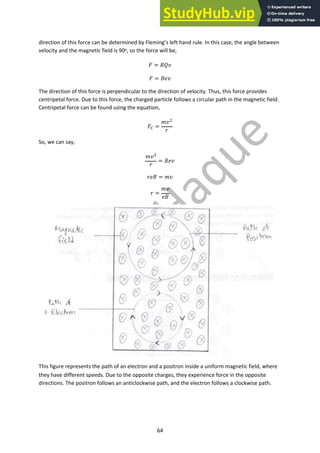
The direction of this force is perpendicular to the direction of velocity. Thus, this force provides
centripetal force. Due to this force, the charged particle follows a circular path in the magnetic field.
Centripetal force can be found using the equation,
!! =
'%"
(
So, we can say,
'%"
(
= #&%
(&# = '%
( =
'%
&#
This figure represents the path of an electron and a positron inside a uniform magnetic field, where
they have different speeds. Due to the opposite charges, they experience force in the opposite
directions. The positron follows an anticlockwise path, and the electron follows a clockwise path.
65
! =
#$
%&
Momentum,
' = #$ = (2#*!
Therefore,
! =
(2#*!
%&
If m, Q and B are constants,
! ∝ (*!
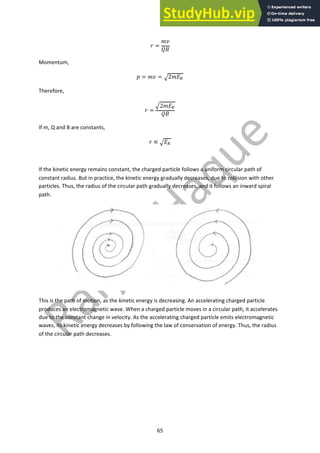
If the kinetic energy remains constant, the charged particle follows a uniform circular path of
constant radius. But in practice, the kinetic energy gradually decreases, due to collision with other
particles. Thus, the radius of the circular path gradually decreases, and it follows an inward spiral
path.
This is the path of motion, as the kinetic energy is decreasing. An accelerating charged particle
produces an electromagnetic wave. When a charged particle moves in a circular path, it accelerates
due to the constant change in velocity. As the accelerating charged particle emits electromagnetic
waves, its kinetic energy decreases by following the law of conservation of energy. Thus, the radius
of the circular path decreases.
66
Magnetic Field Arounda Current Carrying Wire
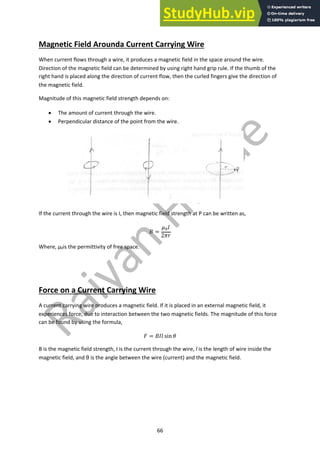
When current flows through a wire, it produces a magnetic field in the space around the wire.
Direction of the magnetic field can be determined by using right hand grip rule. If the thumb of the
right hand is placed along the direction of current flow, then the curled fingers give the direction of
the magnetic field.
Magnitude of this magnetic field strength depends on:
• The amount of current through the wire.
• Perpendicular distance of the point from the wire.
If the current through the wire is I, then magnetic field strength at P can be written as,
! =
#!$
2&'
Where, µ0is the permittivity of free space.
Force on a Current Carrying Wire
A current carrying wire produces a magnetic field. If it is placed in an external magnetic field, it
experiences force, due to interaction between the two magnetic fields. The magnitude of this force
can be found by using the formula,
( = !$) sin -
B is the magnetic field strength, I is the current through the wire, l is the length of wire inside the
magnetic field, and θ is the angle between the wire (current) and the magnetic field.
67
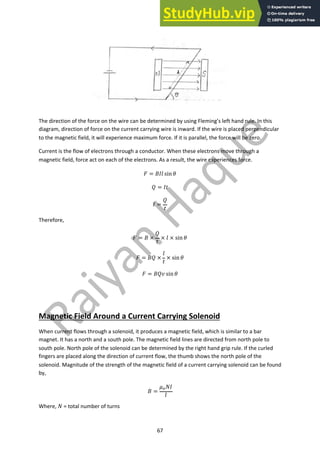
The direction of the force on the wire can be determined by using Fleming’s left hand rule. In this
diagram, direction of force on the current carrying wire is inward. If the wire is placed perpendicular
to the magnetic field, it will experience maximum force. If it is parallel, the force will be zero.
Current is the flow of electrons through a conductor. When these electrons move through a
magnetic field, force act on each of the electrons. As a result, the wire experiences force.
! = #$% sin )
* = $+
$ =
*
+
Therefore,
! = # ×
*
+
× % × sin )
! = #* ×
%
+
× sin )
! = #*- sin )
Magnetic Field Around a Current Carrying Solenoid
When current flows through a solenoid, it produces a magnetic field, which is similar to a bar
magnet. It has a north and a south pole. The magnetic field lines are directed from north pole to
south pole. North pole of the solenoid can be determined by the right hand grip rule. If the curled
fingers are placed along the direction of current flow, the thumb shows the north pole of the
solenoid. Magnitude of the strength of the magnetic field of a current carrying solenoid can be found
by,
# =
.!/$
%
Where, / = total number of turns
68
Number of turns per unit length, !,
! =
#
$
Therefore,
% = &!!'
Electric Motor
Figure 1a Figure 1b
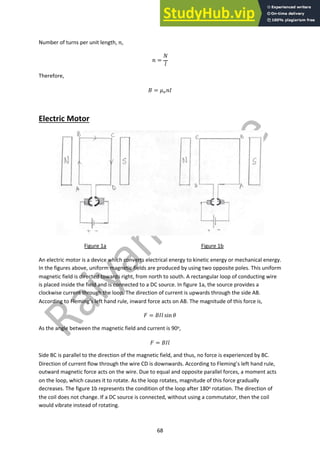
An electric motor is a device which converts electrical energy to kinetic energy or mechanical energy.
In the figures above, uniform magnetic fields are produced by using two opposite poles. This uniform
magnetic field is directed towards right, from north to south. A rectangular loop of conducting wire
is placed inside the field and is connected to a DC source. In figure 1a, the source provides a
clockwise current through the loop. The direction of current is upwards through the side AB.
According to Fleming’s left hand rule, inward force acts on AB. The magnitude of this force is,
( = %'$ sin ,
As the angle between the magnetic field and current is 90o,
( = %'$
Side BC is parallel to the direction of the magnetic field, and thus, no force is experienced by BC.
Direction of current flow through the wire CD is downwards. According to Fleming’s left hand rule,
outward magnetic force acts on the wire. Due to equal and opposite parallel forces, a moment acts
on the loop, which causes it to rotate. As the loop rotates, magnitude of this force gradually
decreases. The figure 1b represents the condition of the loop after 180o rotation. The direction of
the coil does not change. If a DC source is connected, without using a commutator, then the coil
would vibrate instead of rotating.
69
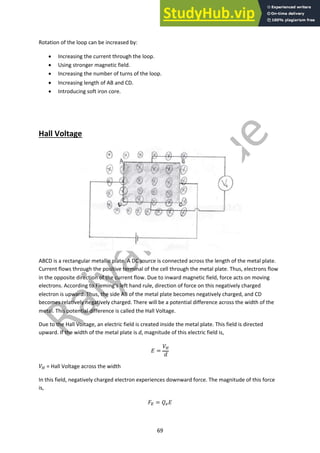
Rotation of the loop can be increased by:
• Increasing the current through the loop.
• Using stronger magnetic field.
• Increasing the number of turns of the loop.
• Increasing length of AB and CD.
• Introducing soft iron core.
Hall Voltage
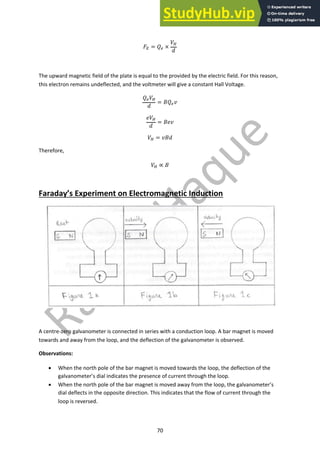
ABCD is a rectangular metallic plate. A DC source is connected across the length of the metal plate.
Current flows through the positive terminal of the cell through the metal plate. Thus, electrons flow
in the opposite direction of the current flow. Due to inward magnetic field, force acts on moving
electrons. According to Fleming’s left hand rule, direction of force on this negatively charged
electron is upward. Thus, the side AB of the metal plate becomes negatively charged, and CD
becomes relatively negatively charged. There will be a potential difference across the width of the
metal. This potential difference is called the Hall Voltage.
Due to the Hall Voltage, an electric field is created inside the metal plate. This field is directed
upward. If the width of the metal plate is d, magnitude of this electric field is,
! =
#!
$
#! = Hall Voltage across the width
In this field, negatively charged electron experiences downward force. The magnitude of this force
is,
%" = &#!
70
!! = #" ×
%#
&
The upward magnetic field of the plate is equal to the provided by the electric field. For this reason,
this electron remains undeflected, and the voltmeter will give a constant Hall Voltage.
#"%#
&
= '#"(
)%#
&
= ')(
%# = ('&
Therefore,
%# ∝ '
Faraday’s Experiment on Electromagnetic Induction
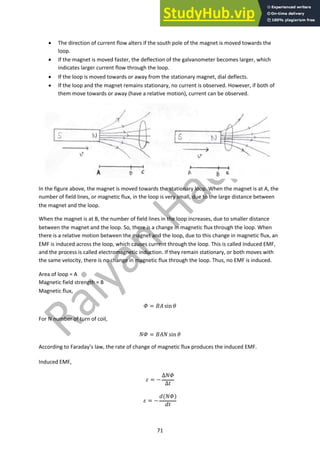
A centre-zero galvanometer is connected in series with a conduction loop. A bar magnet is moved
towards and away from the loop, and the deflection of the galvanometer is observed.
Observations:
• When the north pole of the bar magnet is moved towards the loop, the deflection of the
galvanometer’s dial indicates the presence of current through the loop.
• When the north pole of the bar magnet is moved away from the loop, the galvanometer’s
dial deflects in the opposite direction. This indicates that the flow of current through the
loop is reversed.
71
• The direction of current flow alters if the south pole of the magnet is moved towards the
loop.
• If the magnet is moved faster, the deflection of the galvanometer becomes larger, which
indicates larger current flow through the loop.
• If the loop is moved towards or away from the stationary magnet, dial deflects.
• If the loop and the magnet remains stationary, no current is observed. However, if both of
them move towards or away (have a relative motion), current can be observed.
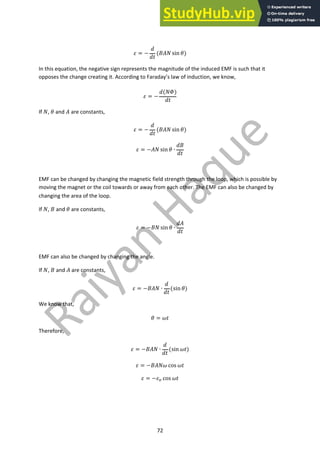
In the figure above, the magnet is moved towards the stationary loop. When the magnet is at A, the
number of field lines, or magnetic flux, in the loop is very small, due to the large distance between
the magnet and the loop.
When the magnet is at B, the number of field lines in the loop increases, due to smaller distance
between the magnet and the loop. So, there is a change in magnetic flux through the loop. When
there is a relative motion between the magnet and the loop, due to this change in magnetic flux, an
EMF is induced across the loop, which causes current through the loop. This is called Induced EMF,
and the process is called electromagnetic induction. If they remain stationary, or both moves with
the same velocity, there is no change in magnetic flux through the loop. Thus, no EMF is induced.
Area of loop = A
Magnetic field strength = B
Magnetic flux,
! = #$ sin (
For N number of turn of coil,
)! = #$) sin (
According to Faraday’s law, the rate of change of magnetic flux produces the induced EMF.
Induced EMF,
* = −
∆)!
∆-
* = −
.()!)
.-
72
! = −
$
$%
('() sin -)
In this equation, the negative sign represents the magnitude of the induced EMF is such that it
opposes the change creating it. According to Faraday’s law of induction, we know,
! = −
$()/)
$%
If ), - and ( are constants,
! = −
$
$%
('() sin -)
! = −() sin - ∙
$'
$%
EMF can be changed by changing the magnetic field strength through the loop, which is possible by
moving the magnet or the coil towards or away from each other. The EMF can also be changed by
changing the area of the loop.
If ), ' and - are constants,
! = −') sin - ∙
$(
$%
EMF can also be changed by changing the angle.
If ), ' and ( are constants,
! = −'() ∙
$
$%
(sin -)
We know that,
- = 1%
Therefore,
! = −'() ∙
$
$%
(sin 1%)
! = −'()1 cos 1%
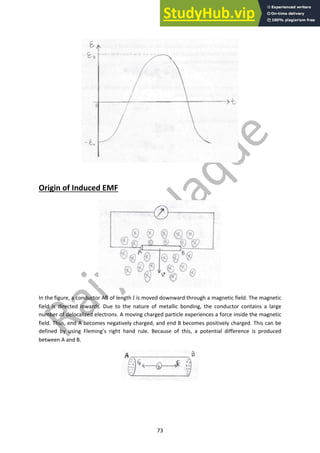
! = −!! cos 1%
73
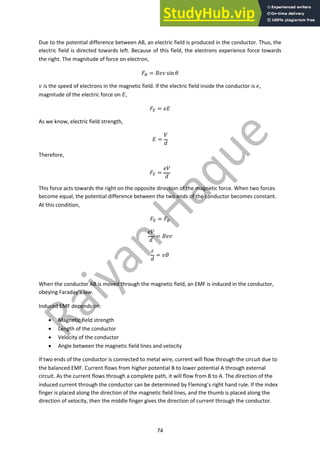
Origin of Induced EMF
In the figure, a conductor AB of length ! is moved downward through a magnetic field. The magnetic
field is directed inwards. Due to the nature of metallic bonding, the conductor contains a large
number of delocalized electrons. A moving charged particle experiences a force inside the magnetic
field. Thus, end A becomes negatively charged, and end B becomes positively charged. This can be
defined by using Fleming’s right hand rule. Because of this, a potential difference is produced
between A and B.
74
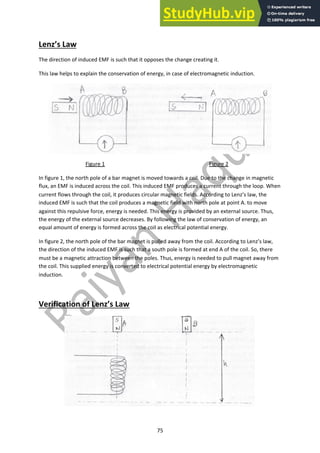
Due to the potential difference between AB, an electric field is produced in the conductor. Thus, the
electric field is directed towards left. Because of this field, the electrons experience force towards
the right. The magnitude of force on electron,
!! = #$% sin )
% is the speed of electrons in the magnetic field. If the electric field inside the conductor is $,
magnitude of the electric force on *,
!" = $*
As we know, electric field strength,
* =
+
,
Therefore,
!" =
$+
,
This force acts towards the right on the opposite direction of the magnetic force. When two forces
become equal, the potential difference between the two ends of the conductor becomes constant.
At this condition,
!" = !!
$+
,
= #$%
-
,
= %#
When the conductor AB is moved through the magnetic field, an EMF is induced in the conductor,
obeying Faraday’s law.
Induced EMF depends on:
• Magnetic field strength
• Length of the conductor
• Velocity of the conductor
• Angle between the magnetic field lines and velocity
If two ends of the conductor is connected to metal wire, current will flow through the circuit due to
the balanced EMF. Current flows from higher potential B to lower potential A through external
circuit. As the current flows through a complete path, it will flow from B to A. The direction of the
induced current through the conductor can be determined by Fleming’s right hand rule. If the index
finger is placed along the direction of the magnetic field lines, and the thumb is placed along the
direction of velocity, then the middle finger gives the direction of current through the conductor.
75
Lenz’s Law
The direction of induced EMF is such that it opposes the change creating it.
This law helps to explain the conservation of energy, in case of electromagnetic induction.
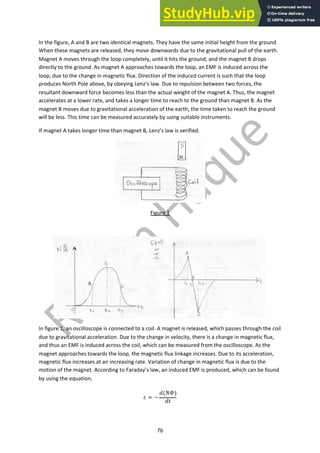
Figure 1 Figure 2
In figure 1, the north pole of a bar magnet is moved towards a coil. Due to the change in magnetic
flux, an EMF is induced across the coil. This induced EMF produces a current through the loop. When
current flows through the coil, it produces circular magnetic fields. According to Lenz’s law, the
induced EMF is such that the coil produces a magnetic field with north pole at point A. to move
against this repulsive force, energy is needed. This energy is provided by an external source. Thus,
the energy of the external source decreases. By following the law of conservation of energy, an
equal amount of energy is formed across the coil as electrical potential energy.
In figure 2, the north pole of the bar magnet is pulled away from the coil. According to Lenz’s law,
the direction of the induced EMF is such that a south pole is formed at end A of the coil. So, there
must be a magnetic attraction between the poles. Thus, energy is needed to pull magnet away from
the coil. This supplied energy is converted to electrical potential energy by electromagnetic
induction.
Verification of Lenz’s Law
76
In the figure, A and B are two identical magnets. They have the same initial height from the ground.
When these magnets are released, they move downwards due to the gravitational pull of the earth.
Magnet A moves through the loop completely, until it hits the ground, and the magnet B drops
directly to the ground. As magnet A approaches towards the loop, an EMF is induced across the
loop, due to the change in magnetic flux. Direction of the induced current is such that the loop
produces North Pole above, by obeying Lenz’s law. Due to repulsion between two forces, the
resultant downward force becomes less than the actual weight of the magnet A. Thus, the magnet
accelerates at a lower rate, and takes a longer time to reach to the ground than magnet B. As the
magnet B moves due to gravitational acceleration of the earth, the time taken to reach the ground
will be less. This time can be measured accurately by using suitable instruments.
If magnet A takes longer time than magnet B, Lenz’s law is verified.
Figure 1
In figure 1, an oscilloscope is connected to a coil. A magnet is released, which passes through the coil
due to gravitational acceleration. Due to the change in velocity, there is a change in magnetic flux,
and thus an EMF is induced across the coil, which can be measured from the oscilloscope. As the
magnet approaches towards the loop, the magnetic flux linkage increases. Due to its acceleration,
magnetic flux increases at an increasing rate. Variation of change in magnetic flux is due to the
motion of the magnet. According to Faraday’s law, an induced EMF is produced, which can be found
by using the equation,
! = −
$(&')
$)
77
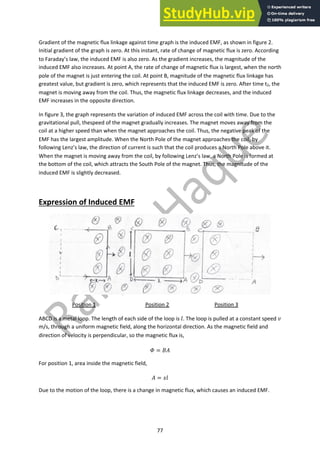
Gradient of the magnetic flux linkage against time graph is the induced EMF, as shown in figure 2.
Initial gradient of the graph is zero. At this instant, rate of change of magnetic flux is zero. According
to Faraday’s law, the induced EMF is also zero. As the gradient increases, the magnitude of the
induced EMF also increases. At point A, the rate of change of magnetic flux is largest, when the north
pole of the magnet is just entering the coil. At point B, magnitude of the magnetic flux linkage has
greatest value, but gradient is zero, which represents that the induced EMF is zero. After time t2, the
magnet is moving away from the coil. Thus, the magnetic flux linkage decreases, and the induced
EMF increases in the opposite direction.
In figure 3, the graph represents the variation of induced EMF across the coil with time. Due to the
gravitational pull, thespeed of the magnet gradually increases. The magnet moves away from the
coil at a higher speed than when the magnet approaches the coil. Thus, the negative peak of the
EMF has the largest amplitude. When the North Pole of the magnet approaches the coil, by
following Lenz’s law, the direction of current is such that the coil produces a North Pole above it.
When the magnet is moving away from the coil, by following Lenz’s law, a North Pole is formed at
the bottom of the coil, which attracts the South Pole of the magnet. Thus, the magnitude of the
induced EMF is slightly decreased.
Expression of Induced EMF
Position 1 Position 2 Position 3
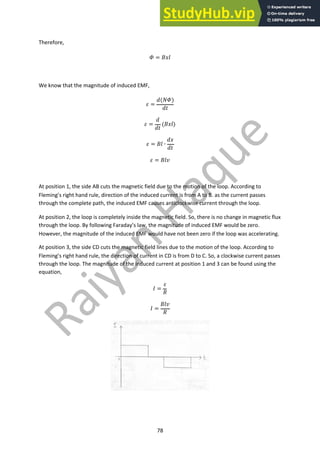
ABCD is a metal loop. The length of each side of the loop is !. The loop is pulled at a constant speed "
m/s, through a uniform magnetic field, along the horizontal direction. As the magnetic field and
direction of velocity is perpendicular, so the magnetic flux is,
# = %&
For position 1, area inside the magnetic field,
& = '!
Due to the motion of the loop, there is a change in magnetic flux, which causes an induced EMF.
78
Therefore,
! = #$%
We know that the magnitude of induced EMF,
& =
'()!)
'+
& =
'
'+
(#$%)
& = #% ∙
'$
'+
& = #%-
At position 1, the side AB cuts the magnetic field due to the motion of the loop. According to
Fleming’s right hand rule, direction of the induced current is from A to B. as the current passes
through the complete path, the induced EMF causes anticlockwise current through the loop.
At position 2, the loop is completely inside the magnetic field. So, there is no change in magnetic flux
through the loop. By following Faraday’s law, the magnitude of induced EMF would be zero.
However, the magnitude of the induced EMF would have not been zero if the loop was accelerating.
At position 3, the side CD cuts the magnetic field lines due to the motion of the loop. According to
Fleming’s right hand rule, the direction of current in CD is from D to C. So, a clockwise current passes
through the loop. The magnitude of the induced current at position 1 and 3 can be found using the
equation,
. =
&
/
. =
#%-
/
79
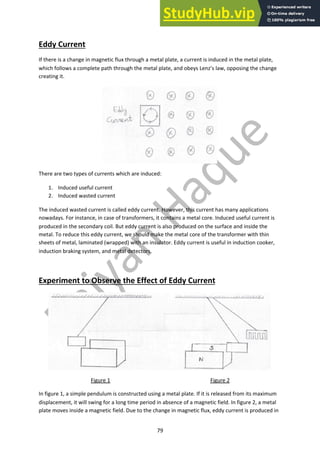
Eddy Current
If there is a change in magnetic flux through a metal plate, a current is induced in the metal plate,
which follows a complete path through the metal plate, and obeys Lenz’s law, opposing the change
creating it.
There are two types of currents which are induced:
1. Induced useful current
2. Induced wasted current
The induced wasted current is called eddy current. However, this current has many applications
nowadays. For instance, in case of transformers, it contains a metal core. Induced useful current is
produced in the secondary coil. But eddy current is also produced on the surface and inside the
metal. To reduce this eddy current, we should make the metal core of the transformer with thin
sheets of metal, laminated (wrapped) with an insulator. Eddy current is useful in induction cooker,
induction braking system, and metal detectors.
Experiment to Observe the Effect of Eddy Current
Figure 1 Figure 2
In figure 1, a simple pendulum is constructed using a metal plate. If it is released from its maximum
displacement, it will swing for a long time period in absence of a magnetic field. In figure 2, a metal
plate moves inside a magnetic field. Due to the change in magnetic flux, eddy current is produced in
80
the metal plate. By following Lenz’s law, the motion of the metal plate is opposed due to induced
current. As a result, this metal plate comes to rest in a very short time. In figure 3, a splitted metal
plate moves through the magnetic field. Due to this, broken current is produced. That’s why, amount
of eddy current decreases. As a result, the plate experiences small force, and swings for a longer
time period.
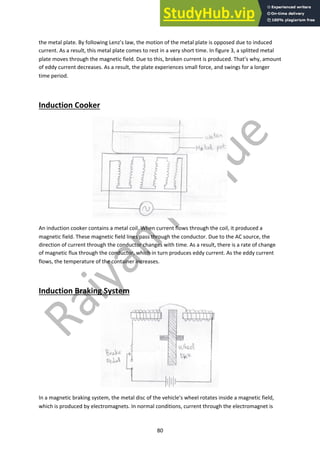
Induction Cooker
An induction cooker contains a metal coil. When current flows through the coil, it produced a
magnetic field. These magnetic field lines pass through the conductor. Due to the AC source, the
direction of current through the conductor changes with time. As a result, there is a rate of change
of magnetic flux through the conductor, which in turn produces eddy current. As the eddy current
flows, the temperature of the container increases.
Induction Braking System
In a magnetic braking system, the metal disc of the vehicle’s wheel rotates inside a magnetic field,
which is produced by electromagnets. In normal conditions, current through the electromagnet is
81
zero. Thus, the metal disc moves freely through the electromagnet. When brake is applied, which
means that the switch of the electromagnet is closed, and current flows through the
electromagnets’ coils, the electromagnets produce a magnetic field which passes through the metal
disc. Due to the rotation of the disc, there is a change in magnetic flux, which produces eddy current
in the metal disc. By following Lenz’s law, the direction of the eddy current is such that the motion of
the disc is opposed. Thus, its speed decreases, and the car slows down. In this case, the kinetic
energy of the car is converted to thermal energy.
Metal Detectors
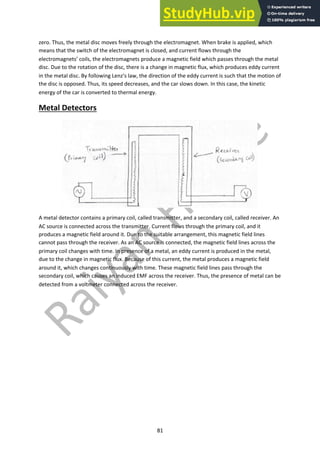
A metal detector contains a primary coil, called transmitter, and a secondary coil, called receiver. An
AC source is connected across the transmitter. Current flows through the primary coil, and it
produces a magnetic field around it. Due to the suitable arrangement, this magnetic field lines
cannot pass through the receiver. As an AC source is connected, the magnetic field lines across the
primary coil changes with time. In presence of a metal, an eddy current is produced in the metal,
due to the change in magnetic flux. Because of this current, the metal produces a magnetic field
around it, which changes continuously with time. These magnetic field lines pass through the
secondary coil, which causes an induced EMF across the receiver. Thus, the presence of metal can be
detected from a voltmeter connected across the receiver.
82
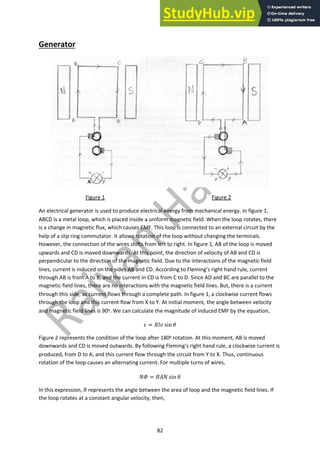
Generator
Figure 1 Figure 2
An electrical generator is used to produce electrical energy from mechanical energy. In figure 1,
ABCD is a metal loop, which is placed inside a uniform magnetic field. When the loop rotates, there
is a change in magnetic flux, which causes EMF. This loop is connected to an external circuit by the
help of a slip ring commutator. It allows rotation of the loop without changing the terminals.
However, the connection of the wires shifts from left to right. In figure 1, AB of the loop is moved
upwards and CD is moved downwards. At this point, the direction of velocity of AB and CD is
perpendicular to the direction of the magnetic field. Due to the interactions of the magnetic field
lines, current is induced on the sides AB and CD. According to Fleming’s right hand rule, current
through AB is from A to B, and the current in CD is from C to D. Since AD and BC are parallel to the
magnetic field lines, there are no interactions with the magnetic field lines. But, there is a current
through this side, as current flows through a complete path. In figure 1, a clockwise current flows
through the loop and this current flow from X to Y. At initial moment, the angle between velocity
and magnetic field lines is 90o. We can calculate the magnitude of induced EMF by the equation,
! = #$% sin )
Figure 2 represents the condition of the loop after 180o rotation. At this moment, AB is moved
downwards and CD is moved outwards. By following Fleming’s right hand rule, a clockwise current is
produced, from D to A, and this current flow through the circuit from Y to X. Thus, continuous
rotation of the loop causes an alternating current. For multiple turns of wires,
*+ = #,* sin )
In this expression, ) represents the angle between the area of loop and the magnetic field lines. If
the loop rotates at a constant angular velocity, then,
83
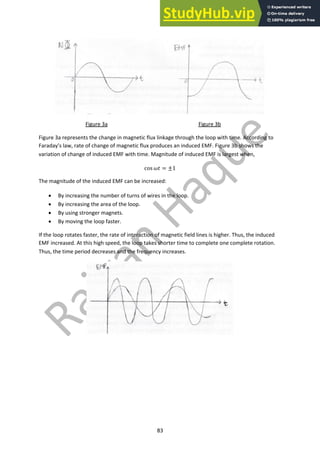
Figure 3a Figure 3b
Figure 3a represents the change in magnetic flux linkage through the loop with time. According to
Faraday’s law, rate of change of magnetic flux produces an induced EMF. Figure 3b shows the
variation of change of induced EMF with time. Magnitude of induced EMF is largest when,
cos $% = ±1
The magnitude of the induced EMF can be increased:
• By increasing the number of turns of wires in the loop.
• By increasing the area of the loop.
• By using stronger magnets.
• By moving the loop faster.
If the loop rotates faster, the rate of interaction of magnetic field lines is higher. Thus, the induced
EMF increased. At this high speed, the loop takes shorter time to complete one complete rotation.
Thus, the time period decreases and the frequency increases.
84
Transformer
Transformers are used to increase or decrease a supply voltage according to the aim. There are two
types of transformers:
1. Step-up Transformers
2. Step-down Transformers
In a step-up transformer, the voltage is increased, and in a step-down transformer, the voltage is
decreased.
This is done by taking the advantage of magnetic field lines and the number of turns of wires in the
coils. In a step-up transformer, the number of turns in the primary coil is less than the number of
turns in the secondary coil. In a step-down transformer, the number of turns in the primary coil is
greater than the number of turns in the secondary coil.
In case of transformers, the number of turns, voltage, and current follow a ratio:
!!
!"
=
#!
#"
=
$!
$"
!! = Number of loops in secondary coil
!" = Number of loops in primary coil
#! = Voltage across secondary coil
#" = Voltage across primary coil
$! = Current in secondary coil
$" = Current in primary coil
85
PARTICLE PHYSICS
86
Alpha Particle Scattering Experiment
In this experiment, a beam of alpha particles is projected through a gold foil, and the deflection is
observed. A natural source of alpha particles is Radon. It is placed in a metal or lead container with a
small opening. Thus, a narrow beam of alpha particles are produced and the deflection of alpha
particles through the gold foil can be observed. This arrangement took place inside a vacuum
chamber, so that the velocity of the alpha particles is not affected.
Observations:
• Most of the alpha particles move in a straight line or is slightly deflected.
• Some of the alpha particles are deflected at a large angle.
• Very few alpha particles are deflected at or greater than 90o which is called backscattering.
Conclusion:
• Most of the space inside an atom is empty.
• There is a positively charged centre, called nucleus.
• Mass of the positively charged centre is very large compared to that of the negative charged
electron. The nucleus contains most of the mass of the atom.
87
In this experiment, a narrow beam of alpha particles is used, to measure deviation accurately. Gold
foil was used as it is a malleable material and can be penetrated easily. Moreover, in case of other
thick metal plate, the alpha particles will be deflected multiple times, and a random pattern of alpha
particles would have been produced. Vacuum chamber was used to prevent random collision of
alpha particles with air particles. If random collision took place, the alpha particles would lose their
kinetic energy.
NOTE: It is wise to use gold foil of 1 atom thickness, which will make the experiment much more
reliable. If there are multiple layers of atoms, the alpha particles will be deflected several times and
proper deflection cannot be observed.
Wave-Particle Duality
When a beam of electrons passes through a crystal, it diffracts, which indicates wave nature of
electrons. Similarly, photoelectric effect represents the particle nature of photons.
! = ℎ$
! = %&!
Therefore,
ℎ$ = %&!
ℎ&
'
= %&!
%& =
ℎ
'
( =
ℎ
'
We know that momentum,
( = %& = )2%!"
Therefore, from de Broglie’s Equation,
' =
ℎ
(
' =
ℎ
)2%!"
88
Particle Accelerators
According to Einstein, relation between mass and energy can be explained by the equation,
! = #$!
According to Einstein, if any object increases its speed with respect to any object stationary observer,
its mass increases due to inertia. It happens more significantly if the object travels close to the speed
of light. If it reaches the speed of light, its mass increases to infinity, which results in infinite energy,
according to Einstein’s theory, which is proven mathematically, but not experimentally, due to
obvious engineering problems.
In a nuclear reactor, energy is produced from mass. It is also possible to make mass from energy.
When a high-speed particle collides against a target, the kinetic energy of the particle decreases. By
following the law of conservation of mass-energy, the kinetic energy is converted to mass. Thus,
fundamental particles are produced. Accelerators are used to produce high speed beam of particles.
Linear Accelerators (LINAC)
%" > %# > %$ > %! > %%
In a LINAC, charged particles are accelerated in a straight path, through a series of drift tubes. These
tubes are connected across an alternating voltage source. Thus, there is a potential difference
between each consecutive tubes.
89
Figure 2a represents the variation of potential of terminals with time. At time ! = 0, a positively
charged particle, like proton, is at a point between tube 1 and tube2, which is represented by figure
2b. At this instant, tube 1 is positive and tube 2 is negative. Because of this, a horizontal electric field
is produced between the tubes. The positively charged [particle experiences a force along the
direction of the electric field, and it begins to accelerate. There is not electric field inside the tube.
That’s why, the charged particle moves with a constant speed inside the tubes.
At time ! = !!, the positively charged particle is at a position between tubes 2 and 3. At this instant,
the tube 2 is positive and the tube 3 is negative. Due to the electric field, the charged particle
experiences a force along the direction of the electric field lines, which is also the direction of
motion. Thus the particle accelerates and its kinetic energy increases. Due to the synchronized
alternating source, the charged particle experiences force along the direction of its velocity. Thus it
travels through the gap between the two tubes and finally, a high speed beam is produced.
For this arrangement, a source of constant frequency or time period of alternating current source
should be used. For continuous acceleration, the charged particle should remain inside the tube for
half time period. At constant speed, the distance travelled by the charged particle within its half time
period is,
$ =
%!
2
As speed increases, within the same time, the proton travels larger distance. To keep it synchronized,
the length of the tube should be increased. When the speed of the particle becomes comparable to
the speed of light, after a certain point, it cannot increase its speed anymore. As the particle is at a
high speed, its mass increases. This extra mass is known as relativistic mass. The relativistic mass can
be found by the equation,
' =
'"
(1 −
#!
$!
Where, '" = rest mass, m = relativistic mass, % = speed of the particle, and + = speed of light.
NOTE: When the speed of a particle reaches closer and closer to the speed of light, its speed
becomes constant, but its kinetic energy still increases due to increasing mass. When this high speed
particle beam collide against a target, its kinetic energy decreases, which is converted to new mass
(in the form of particles).
90
Targets can be arranged in two ways:
Fixed Target Experiment
In case of fixed target experiment, there is a resultant momentum before collision. Thus, the particle
must have a resultant momentum after collision. By following the conservation law, the particle has
kinetic before collision. The total energy given by the accelerator is not converted into mass.
Collision Beam Experiment
In case of collision beam experiment, the total momentum before collision is zero. If two particles
move with same speed in opposite directions, according to the conservation law, the total
momentum after collision must be zero. Thus it is possible that the particle comes to rest after
collision. The total kinetic energy after the collision can be used to produce mass. This method is
highly efficient in terms of energy to mass conversion, but the probability of collision of particles is
lower.
Cyclotron
Inside a magnetic field, charged particles follow a circular path, because centripetal force is provided
by the magnetic field.
!! = !"
#$% =
&%#
'
' =
&%
#$
' =
(
#$
' =
)2&+$
#$
'# =
2&+$
##$#
Therefore,
+$ ∝ '#
91
In a cyclotron, charged particles are accelerated in a circular path. It is accelerated using the
semicircular Dees, electric field and magnetic field. The metal Dees, X and Y, are connected across an
alternating voltage source.
Figure 2a represents variation of potential of terminal A with time. This arrangement is placed inside
a uniform magnetic field, and it is perpendicular to the surface of the Dees. A positively charged
particle, like proton, is placed in the middle of the gap between the two Dees.
92
Figure 2b represents the position of a proton between two Dees, at time, t=0. It experiences a force
along the direction of the electric field lines, and it accelerates because a resultant force acts on it.
Thus, the kinetic energy of the proton increases in the space between the Dees. Inside the Dees,
there is no accelerating electric field. Thus, the particle moves with constant speed, but it
accelerates by changing the direction of motion due to the magnetic field. That’s why, it follows a
circular path inside the semicircular Dees.
Figure 2c represents the motion of the proton inside the Dees. It experiences force along the
direction of motion, and thus its kinetic energy increases.
According to the equation,
! =
#$
%&
Radius of the circular path increases as the particle moves with greater speed, and it will follow
outward spiral path. Velocity if the particle increases each time it passes throughthe gap between
the Dees. For its continuous acceleration, the particle should spend half time period inside each
Dees.
93
! =
#$
%&
$ =
%&!
#
We know that,
$ = '!
Therefore,
'! =
%&!
#
2)* =
%&
#
* =
%&
2)#
* is called the cyclotron frequency. If an AC source of this frequency is applied, the particles remain
synchronized with the time period of the source.
+ =
1
*
Therefore,
+ =
2)#
%&
+
2
=
)#
%&
!
"
is the time spent by the particle in each Dee.
As speed of the particle in the cyclotron increases, it continues to increase its speed, until it reaches
the speed of light.
94
Synchrotron
BM = Binding Magnet
RFAC = Radio Frequency Accelerating Cavity
FM = Focusing Magnet
In a synchrotron, charged particle accelerates in a circular path of constant radius. Inside the RFAC,
an alternating synchronized electric field is used to accelerate the charged particle. Binding magnets
are used to provide centripetal force, which keeps the charged particle moving in a circular path.
This magnetic field is produced by electromagnets. The strength of the magnets can be modified.
The radius of the circular path increases according to the equation,
! =
#$
%&
To keep the radius constant, magnetic field is modified when the speed of the particle increases.
After passing through the RFAC, the particle accelerates in a circular path, maintaining constant
radius. When a charged particle accelerates, it radiates electromagnetic waves. In a synchrotron,
charged particles move in a circular path, and reach a speed comparable to the speed of light. Due to
its circular motion, its acceleration takes place, even at constant speed. As a result, it radiates
electromagnetic radiation, which is called synchrotron radiation. Because of this radiation, a large
amount of energy is lost to the surroundings. Focusing magnets help to focus all the particles to a
concentric beam. Particle detectors are used to detect the path of motion of these particles.
95
Bubble Chamber
Bubble chambers contain liquid hydrogen. The temperature of hydrogen is higher than its boiling
point, but it remains in liquid phase due to high pressure. If pressure is released, hydrogen changes
its phase from liquid to gas. Thus, bubble is formed inside the liquid hydrogen. This bubble formation
initiates around the impurities, when a particle is produced and pass through the bubble chamber. It
causes ionization around its path of motion. Thus, ions acts as impuritiesand bubbles are produced
around the path of motion of the particles. A magnetic field is used to deflect the charged particles.
From the direction of their deflection charge of the particles can be identified, and their mass-charge
ratio can be calculated from the radius of the path.
Examples:
Electron and positron curl is formed due to the magnetic field.
An electron loses its energy quickly because it radiates electromagnetic radiation. That’s why it is
spiraling inwards.
A particle comes to rest, and leaves a dense track near the end as its ionizing power increases.
96
A neutral particle decays into some other particles. Two of them are charged, and one is neutral.
Particles and Antiparticles
Each particle has an antiparticle. Particles and antiparticles have same properties, except the charge.
Electron and positron are two antiparticles of each other. Electron is the particle, and positron is an
antiparticle. They both have the same mass, but have equal and opposite charge. The charge of an
electron is -1.6x10⁻¹⁹c, and the charge of a positron 1.6x10⁻¹⁹c.
Antiparticles have:
• Same mass as the original particle.
• Opposite charge of the original particle.
• Opposite spin of the original particle.
• Opposite value of baryon number, lepton number, and strangeness.
The first antiparticle discovered was anti-electron, which is named as positron. It is usually notes as
e+. Other antiparticles are denoted as the normal symbol of the particle, but with a bar over it.
Pair Production
A particle and an antiparticle can be produced from a high energy photon, or by collision between
two other particles. The photon must have sufficient energy to produce the rest mass of two
particles. So, its energy must be at least twice the rest energies of the two particles. If it is greater
than this, the surplus energy is converted into the kinetic energy of the particles.
According to the conservation law of mass-energy, the energy of the photon is equivalent to the
energy of the produced particles.
97
Annihilation
When a particle and its antiparticle interacts, they are converted to energy, in the form of photons.
This process of mass to energy conversion is called annihilation. If a particle and its antiparticle
produce two photons, so we can say, according to the conservation law,
2ℎ# = 2%&!
ℎ# = %&!
Electronvolt (eV)
It is another unit of energy. This is the energy required to move 1 electron which is accelerated
through a potential difference of 1V. So, we know, 1eV = 1.6x10⁻¹⁹J.
Rest Mass
The mass of subatomic particles are always described as their rest mass. In other words, mass of
subatomic particle which is not moving. This is because Einstein’s special theory of relativity says
that the mass of anything increases when it is moving, and since the particle can move very fast, this
increment can be considerable.
Rest Energy
This is linked to the rest mass. According to the equation, E=mc2, the rest energy can be converted to
rest mass by dividing with c2. The rest energy is usually measured in electronvolts.
Spin
This is an important property of subatomic particles. This can sometimes be considered as angular
momentum. Spin takes values such as 0, ±
"
!
, ±1, ±
#
!
, ±2, and so on.
98
Particle Classification
All particles can be classified into hadrons and leptons. Hadrons experience strong nuclear force,
however, leptons do not.
Leptons
Properties:
• They have spin ½ or -½.
• They are acted on weak nuclear force.
• They are fundamental particles and cannot be sub-divided further.
• All leptons have lepton number +1, and all anti-leptons have lepton number -1.
• All particles which are not leptons have lepton number 0.
The most familiar example of leptons is electrons. Electrons are stable and they do not decay.
Muons and Taus are also leptons. They decay quite readily into other particles. Electrons, Muons,
and Taus, each have their corresponding neutrinos. They have no charge and mass, and only interact
very weakly with matter. Hence, they are very hard to detect.
All six leptons have antiparticles with opposite spin, charge and lepton number.
Particle Symbol Charge Antiparticle
Electron e- -1 e+
Electron Neutrino ve 0 v̅e
Muon μ- -1 μ+
Muon Neutrino vμ 0 v̅μ
Tau τ- -1 τ+
Tau Neutrino vτ 0 v̅τ
Hadrons
Hadrons are sub-divided into two groups. They are Baryons and Mesons.
Baryons
• They have spin 0.5, -0.5, 1.5, or -1.5.
• They are not fundamental particles.
• They are composed of quarks.
• All baryons have baryon number +1, and all anti-baryons have baryon number -1.
• All other particles other than baryons have baryon number 0.
• Baryons are the heaviest group of particles.
99
Protons and neutrons are baryons. The only stable baryon is proton. It has a half-life of about 1032
years. So, proton decay will be so rare that it is virtually unobservable. All other baryons decay
readily, most with a half-life of about 13 minutes when they are outside the nucleus. A neutron
decays to produce a proton, an electron, and an anti-electron neutrino.
Baryon Chart
Particle Symbol Charge Antiparticle
Proton p +1 p̅
Neutron n 0 n̅
Lambda λ 0 λ5
Sigma+ Σ+ +1 Σ5+
Sigmao Σo 0 Σ5o
Sigma- Σ- -1 Σ5-
Xi+ +1
Xio 0
Xi- -1
Particles
Leptons Hadrons
Baryons Mesons
Quarks
100
Mesons
• Mesons have mass between leptons and baryons.
• Their spins are whole numbers (0, +1, -1, +2, -2).
• They are not fundamental particles. They consist of quarks.
• All mesons have a very short half-life.
Meson Chart
Particle Symbol Charge Antiparticle
Pion+ π+ +1 π̅+
Piono πo 0 π̅ o
Pion- π- -1 π̅ -
Kaon+ κ+ +1 κ̅ +
Kaono κo 0 κ̅ o
Kaon- κ- +1 κ̅ -
Eta η 0 η̅
Quarks
• There are 6 quarks altogether. Each has its corresponding anti-quark.
• Quarks experience strong nuclear force.
• Quarks are the constituent particles of hadrons.
• They are considered as fundamental particles.
• Quarks have not been observed in isolation.
• Quarks have baryon number 1/3, and anti-quarks have baryon number -1/3.
• Quarks have spin 0.5 or -0.5.
• Quarks and anti-quarks have lepton number 0.
• Baryons are formed from three quarks.
• Mesons are formed from 1 quark and a non-corresponding anti-quark.
Quark Table
Particle Symbol Charge Antiparticle
Up u +2/3 u̅
Down d -1/3 d;
Charm s +2/3 s̅
Strange c -1/3 c̅
Top t +2/3 t̅
Bottom b -1/3 b;
101
Strangeness
Strangeness explains why some reactions cannot take place.
Properties:
• Strange quarks have strangeness -1.
• The anti-quark of strange quark has strangeness +1.
• All other quarks and leptons have strangeness 0.
The strangeness of a hadron can be found by adding the strangenesses of its constituent quarks.
Quark Compositions and Strangenesses of some Hadrons:
Particle Quarks Strangeness
Proton uud 0
Neutron udd 0
Pion+ ud- 0
Kaono ds̅ +1
Kaon+ us̅ +1
Sigma+ uus -1
Lambda uds -1
Fundamental Forces
There are four fundamental forces:
• Gravitational force – It acts between masses and it is always attractive in nature. Its range is
infinite.
• Electromagnetic force – This is the force between all charged objects. It can be attractive or
repulsive. Its range is infinite.
• Weak nuclear force – It acts on all particles, that is, on both leptons and quarks. It has a
range less than 10-17m. It is responsible for beta decay and interactions involving quark
change. The electromagnetic and weak nuclear forces are now thought to be different
aspects of the same force, so they are sometimes called electroweak force together.
• Strong nuclear force – It acts on hadrons and quarks. Its range is very short and it acts only
within the nucleus. It is responsible for holding the nucleus together.
The order of strength is:
Strong nuclear > Electromagnetic > Weak Nuclear > Gravitational
102
Particle Exchange Model for Four Interactions
The idea behind this model is that forces are acting because of virtual particles being exchanged
between interacting particles. The virtual particles are considered to form clouds surrounding the
interacting particles.
Large Hadron Collider (LHC)
The Large Hadron Collider is a giant synchrotron, over 8km in diameter and built 100m under the
ground, bordered between Switzerland and France. This machine is designed to collide protons with
each other. Scientists believe that it will produce new particles which were not seen after the Big
Bang.
There are four critical experiments in the LHC. They are:
Compact Muon Solenoid (CMS) – This discovers the Higgs Boson, a new fundamental particle. From
CMS experiments, it is hoped that the LHC will make mini black holes, dark matter, super symmetric
particles, gravitons, etc.
Large Hadron Collider Beauty (LHCB) – This detector looks for the decay of bottom and charm
quarks from mesons. Scientists want to observe why our universe contains mostly matter and very
little antimatter. Theoretically, they should be in equal amounts.
A Toroidal LHC Apparatus (ATLAS) – This is done to verify the new fundamental particle, Higgs
Boson. This also wants to figure out extra dimensions in space.
A Large Ion Collision Experiment (ALICE) – The idea of this experiment is to find quark-gluon plasma
which has been predicted by quantum mechanics theory.
Detectors must be capable of:
• Measuring momentum and signs of charge.
• Measuring energy.
• Identifying the charged particle (if any) like electrons, muons, etc.
• Inferring the presence of the undetectable neutral particle, neutrino.
NOTE: Anti-hydrogen was made by LHC, but it did not last long.
103
Antimatter
This is the matter composing of antiparticles. Antimatter is a matter which has electrical charges
reversed. Anti-electrons (positrons) are like electrons with a positive charge. Antimatter and matter
behave same way towards gravity.
Law of Conservation of Particle Interaction
When particles interact, some of their properties remain conserved. These properties are:
• Momentum
• Mass-Energy
• Charge
• Baryon number
• Lepton number
• Strangeness
Momentum
During particle interaction, the total momentum remains conserved, provided that no external force
is acting on them.
Mass-Energy
During particle interaction, energy can be used to produce mass and mass can be used make energy.
In a reaction, if energy is produced, total mass decreases. On the other hand, if mass of the products
become large, it means that energy is provided during this reaction. If initial mass of two interacting
particles is mi and mf, the change in mass is,
∆" = $"! − ""$
& = "'#
If the final mass of the system is larger than the initial mass, it ensures energy is provided to the
system.
Charge
During particle interaction, the total charge remains conserved.
104
Baryon number
Charge Characteristics of quarks:
Quarks Relative Charge Exact Charge
u, c, t +
!
"
+
!#
"
u̅, c̅, t̅ −
!
"
−
!#
"
d, s, b −
$
"
−
#
"
d*, s̅, b* +
$
"
+
#
"
The total number of baryon before interaction is equal to the total number of baryon after
interaction. As we know, baryons are composed of three quarks. Individual quarks of a baryon have
a baryon number of 1/3, and the individual antiquarks of an antibaryon have a baryon number of
-1/3.
Lepton Number
All leptons have lepton number 1, and all anti-leptons have lepton number -1. All other particles
other than leptons have lepton number 0.
Strangeness
Strangeness is -1 for all strange quarks, and +1 for all anti-strange quarks. All other quarks have
strangeness 0.
Boson Table
Force Exchange Boson Symbol Charge
Electromagnetic Photon γ 0
Weak Nuclear W boson
Z boson
W-
W+
Zo
-1
+1
0
Strong Nuclear Gluon g 0
Gravitational Graviton undetermined undetermined
105
NUCLEAR PHYSICS
106
Stability of Nucleus
All atoms contain a nucleus at their centres. Protons, which are positively charged, remains inside
the nucleus, while the electrons, which are negatively charged, revolves (orbits) around the nucleus.
The total charge of an atom is zero, even though the nucleus is positively charged, because there are
equal numbers of protons and electrons in an atom, and due to the fact that the charge of a proton
is equal and opposite to the charge of an electron.
The total number of protons in an atom is called the atomic number, and the total number of
nucleons (sum of protons and neutrons) is called the mass number, or the atomic mass. Each
element has atoms of distinct atomic and mass numbers, characteristic to the particular element.
Inside the nucleus, electrostatic repulsive force acts between protons. Therefore, the protons tend
to move away from each other. However, they are held together in the nucleus due to strong
nuclear force.
The stability of a nucleus depends on the ratio of protons and neutrons in the nucleus. The pattern
of stability can be analyzed from a neutron number against proton number graph.
For small nuclei, whose proton numbers are not high, stability is achieved if they have equal
numbers of protons and neutrons in their nuclei. If the number of protons is more, the electrostatic
repulsive force increases, but the strong nuclear force does not increase at the same proportion, due
to its short range. When a proton is added to the nucleus, it will exert roughly the same force of
repulsion on the other protons inside the nucleus. This is because all protons have nearly the same
separation. However, strong nuclear force is only effective between adjacent neighbors. To make
the nucleus stable, more neutrons should be added. The extra neutrons will provide the strong
nuclear force, which will reduce the effect of the electrostatic repulsion force to the extent that the
nucleons stay together. Thus, larger nuclei achieve stability if the number of neutrons is greater than
the number of protons.
Most stable nuclei have equal numbers of protons and neutrons. This implies that two neutrons and
two protons (an alpha particle) is the most stable composition for a nucleus. Thus, 16O, 28Si, and 56Fe
are also elements with stable nuclei. When more protons and neutrons are added, nuclei move to
higher energy levels, and become unstable again. To achieve stability once again, the nuclei tries to
return to its lower energy levels. Such nuclei undergoes break-down, emitting radiation. The types of
radioactive decay are alpha decay, beta decay, and decay by emitting gamma radiation.
107
Alpha Radiation
Alpha radiation is the flow of alpha particles (helium nuclei). It contains two protons and two
neutrons. Due to the presence of protons as the only charged particles, alpha particles are positively
charged. The relative charge of an alpha particle is +2 and the actual charge of an alpha particle is
+2e. Alpha radiation is deflected by both electric and magnetic fields. In an electric field, it deflects
along the direction of the electric field. In a magnetic field, alpha particles deflect by following
Fleming’s left hand rule. The relative mass of an alpha particle is 4, and its actual mass is
6.67x10⁻²⁷kg. The average kinetic energy of an alpha particle is 5MeV. To knock an electron from an
atom, 10eV of energy is needed. So, alpha particles can ionize a large number of atoms before losing
their total energy. Hence, alpha particles have the most ionizing power. For this property, alpha
radiation can be detected by cloud chambers, GM tubes, and photographic films. This property also
makes alpha particles harmful for humans, due to their high reactivity and ionization.
Alpha radiation can be stopped using paper. They have a very small range in air, of about 5-10cm.
when a nucleus radiates alpha radiation, its mass number decreases by 4 and its atomic number
decreases by 2. For example, Radium nuclei decay to form Radon, when it emits an alpha particle.
During this process, a large amount of energy is radiated.
!"
!!
""# → !$
!#
""" + &
"
$
During alpha decay, the total number of protons and neutrons remain same before and after the
decay. But, the mass of the parent nucleus is greater than the sum of masses of the daughter and
helium (alpha) nuclei. This change in mass is converted to energy, according to Einstein’s equation of
mass-energy equivalence.
' = ∆*+"
∆* = *% + *&
Beta Decay
Beta radiation is the flow of beta particles (electrons). Thus, it is negatively charged. Its mass is very
small, of approximately 9.11x10⁻³¹kg. So, it can travel faster than alpha particles. Beta radiation has
lower ionizing power than alpha radiation, but it has more penetrating power. It can travel 5-100cm
in air, but cannot travel through a few millimetres of aluminium foil. The path of beta radiation is
deflected by both electric and magnetic fields. In an electric field, beta particles deflect in the
opposite direction of the electric field. In a magnetic field, the deflection of beta particles follow
Fleming’s left hand rule. During beta decay process, one neutron breaks down and forms electron
and one proton. This proton remains inside the nucleus, but the electron is emitted as a beta
particle. Carbon-14 is converted to nitrogen-14 by beta decay. A large amount of energy is produced
in this process.
,
#
'$
→ -
(
'$
+ .
)'
*
108
Gamma Radiation
Gamma radiation is high frequency electromagnetic wave. It does not contain any conventional
particles; it consists of photons. It is neutrally charged, and thus it has minimum ionizing power.
However it has maximum penetrating power. Its intensity can be reduced by thick lead blocks.
During gamma radiation emission, the parent nucleus remains unchanged. This radiation is emitted
when a high energy nucleus returns to its low energy level, without changing its internal structure.
The speed of gamma radiation is the same as the speed of light, because they both are
electromagnetic waves. Gamma radiation is not deflected by electric or magnetic fields, because it
does not consist of any charged particles.
The Geiger-Mϋller Tube (GM Tube)
In a GM tube, a central rod is placed inside a metallic tube. A large potential difference is applied
between them using a DC source. The space between the rod and the tube is filled with argon gas at
a low pressure. In absence of any ionizing radiation, current cannot flow through the circuit due to
the open path. To conduct electricity, free charged carriers are needed. In normal conditions, atoms
of argon gas are neutral, and thus are non-conductive. If a radioactive source is placed before the
GM tube, the radiation enters through the mica window to the tube. Mica is a ceramic-like material,
and a thin sheet is used to close the GM tube. This keeps unwanted particles out of the interior of
the GM tube, while allowing radiation to enter. As the radiation enters the tube, it causes ionization
of the argon atoms, producing charged ions inside the tube. These ions conduct electricity between
the metal tube and the central rod. Thus, current flows through the external circuit and that can be
detected by a suitable counter. The current produced by the radioactive source is not continuous;
only a pulse is produced when ionization takes place. The counter records the number of pulse
produced in one second. This is called count rate. It represents the strength of the ionizing radiation.
109
Background Radiation
In absence of any radiation source or ionizing radiation, there are no free charge carriers inside the
GM tube. Thus, it gives zero reading. In practice, GM counters give small readings even though the
source is not placed in front of the tube. This is called background count rate. It is caused by
background radiation, and it changes from place to place. Main sources of background radiation are:
• Cosmic ray
• Radon gas
• Radioactive rocks
• Nuclear power plants
For any radioactive decay experiment, we have to note the background count rate at the beginning
of the experiment. If the source is placed in front of the GM tube, the count rate changes, but
background radiation cannot be eliminated. The reading that is given by the counter is contributed
by the source and the background radiation. To get the actual reading of the source, we have to
subtract the background count rate from the total reading.
Radioactive Decay
Radioactive decay is a process by which an unstable nucleus achieves stability. This process has two
properties:
1. It is spontaneous.
2. It is random.
Radioactive decay takes place spontaneously. Unstable nuclei break down without the influence of
external factors, like temperature and pressure. The count rate of the source remains constant if
pressure or temperature is altered.
Radioactive decay is also a random process. It is not possible to predict when a particular nucleus
will break down. In a radioactive sample containing a large number of nuclei, each nucleus has the
same probability of decay. However, we cannot determine whether a particular nucleus would break
down in the next moment or not.
To compare the activity of different radioactive element, it is needed to study the sample of
different elements, rather than individual nuclei. The behaviour of a particular nucleus is
unpredictable. For any radioactive decay experiment, a sample is used that contains a large number
of identical nuclei. For any sample, the number of parent nuclei changes with time. The parent nuclei
produce daughter nuclei, which are new type of nuclei. The produced nuclei remain inside the
sample, but they are not a part of the original sample. If the daughter nuclei are unstable or
radioactive, they will break down further, until stable nuclei are formed. If a particular sample
contains a large number of nuclei, its breakdown per unit time will be high. This rate of breakdown is
called the activity of the source.
The activity of a sample, A, is proportional to the number of nucleons present in the nucleus.
110
! ∝ −$
! =
&$
&'
Therefore,
&$
&'
∝ −$
&$
&'
= −($
In this equation, the negative sign indicates that the number of parent nuclei decreases with time.
Lambda is called the decay constant. It is the constant of proportionality of decay of any nucleus in a
radioactive sample.
If we ignore the negative sign,
! = ($
( =
!
$
Exponential Decay
In a radioactive decay process, the number of parent nuclei decreases with time. At any moment,
the rate of breakdown can be represented by the equation,
&$
&'
= −($
At initial moment, when t=0, the sample contains maximum number of parent nuclei. Let us consider
this number to be N, which decreases with time, t seconds. The number of parent nuclei in the
sample can be found using the equation,
&$
&'
= −($
−)
1
$
&$
!
!!
= ) (
"
#
[ln|$|]!!
! = [−(']#
"
ln|$| − ln|$$| = −((' − 0)
ln 3
$
$$
3 = −('
111
!
!!
= #"#$
! = !!#"#$
This equation represents exponential relationship between parent nuclei with time.
The gradient of the graph gives the activity of the source at a particular instant. Since the activity of
the source is proportional to the number of parent nuclei, it will always decrease with time.
As we know, activity,
$ = %!
$ = %!!#"#$
$ = $!#"#$
Half-Life
Half-life is defined as the average time taken for half of the sample to decay. We can determine half-
life of a radioactive sample from its exponential decay curve.
112
This graph represents exponential decay of a radioactive sample that contains N0 nuclei at initial
moment. This parent nucleus decays exponentially with time. Within first half-life, the number of
parent nuclei will decrease to half of N0. Thus, half-life represents half lifetime of the sample. Within
the next half-life, the number of parent nuclei will decrease to one fourth of No. And so on, it
continues. During each half-life, the number of nuclei decreases to half its initial value. In practice, all
of these half-lives might not be equal, because radioactive decay is a random process.
During each half-life, the same number of parent nuclei will not decay. In practice, radioactive
sample contains a large number of nuclei. It is not possible to determine the number of nucleons
present in the sample. The half-life of a radioactive sample can be determined by its activity against
time graph. To determine the actual value of half-life, it is measured several times and the average is
taken. If half life of a radioactive sample is t1/2, we can say,
! = !!#
"#$!
"
#
! =
%
&
!!
Therefore,
!!#
"#$!
"
# =
%
&
!!
#
"#$!
"
# =
%
&
ln #
"#$!
"
# = ln !
"
−'(!
"
# = − ln 2
(%
&
'
=
ln 2
'
113
Experiment to Determine Half-Life of a Radioactive Sample
The activity of a radioactive sample decreases with time. To determine the half-life of a radioactive
sample, we need to measure the activity of the sample using a GM tube, at suitable intervals. To
measure the actual count rate of the source, we have to subtract the background count rate from
every reading.
!! =
# ln 2
'
# = half-life number (#"# half-life)
The equation above can be used to predict the half-life, or an activity against time graph can be
plotted to determine the half-life.
( = ($)%&"
ln ( = ln ($ − '!
ln ( = −'! + ln ($
Mass Defect/Deficit
Let us consider an element,
,
'
(
Where,
Number of protons = -
Number of neutrons = ( − -
Mass of proton = 1.0072763
Mass of neutron = 1.008663
Where, 3 is the atomic mass unit, 1.66x10⁻²⁷.
114
Therefore, in a particular atom’s nucleus,
Total mass of protons = !(1.007276))
Total mass of neutrons = (+ − !)(1.00866))
Total theoretical mass of nucleus = !(1.007276)) + (+ − !)(1.00866))
When the actual mass of a nucleus is measured, it is always slightly less than the theoretical mass.
The difference between these two masses is the mass defect.
Binding Energy
The theoretical mass of a nucleus is slightly larger than the actual mass. The small amount of mass is
converted into energy. This energy is called binding energy. If the mass defect of a particular nucleus
is /0, its binding energy can be calculated by,
1 = ∆04!
Nuclear binding energy can be defined as the energy that is required to separate nucleons from a
nucleus.
Binding Energy per Nucleon
Binding energy per nucleon is defined as the average amount of energy that is required to remove a
nucleon from a nucleus. If a substance contains n number of nucleons, then its average binding
energy per nucleon will be,
1 =
∆04!
5
The stability of a particular nucleus depends on its binding energy per nucleon. The most stable
elements are those which have the greatest binding energy per nucleon. Iron is the most stable
element because its binding energy per nucleon is greatest compared to all elements. It implies that
maximum energy is required to remove one nucleon from an iron nucleus.
To achieve stability, all elements try to increase their binding energy per nucleon. Nuclei of small
elements join together to form a large nucleus. Thus, they move towards iron’s stability. This process
is called nuclear fusion. On the other hand, the nuclei of large elements break down to form small
nuclei. Thus, binding energy per nucleon increases and they become more stable. This process is
called nuclear fission.
115
Nuclear Fusion
Small nuclei join together to form large nuclei. The mass of the produced nucleus is slightly less than
the total mass of the reacting nuclei. Some amount of mass is converted to energy. This energy is
mostly reduced in the form of kinetic energy.
Nuclear Fusion Reactor
A large amount of energy is needed to initiate the fusion reaction. It is very difficult to arrange this
reaction in a controlled way. Electrostatic force of repulsion between two nuclei is present, so a
huge amount of energy is needed to join the two nuclei by collision. The temperature should be in
plasma state, which is at least 107K. At this condition, electrons are unable to remain inside an atom.
If this material touches any other material, for instance, the side of the reactor, it transfers energy.
So, plasma state is no longer maintained. If this happens at a smaller proportion, it is possible to
carry out the reaction. But if this happens at a large proportion, it is difficult to carry out this
reaction. To overcome this situation, the reactor must be inside an electromagnetic chamber, so that
the particles do not come in contact with the container wall (shielding).
Advantages of Fusion Reaction
• Fusion reaction does not produce any greenhouse gas.
• It does not involve in chain reaction, so it can be stopped any time.
• No nuclear waste is produced.
• Large amount of fuel is produced.
• Fuel for fusion reaction is hydrogen, which is abundant in nature.
Disadvantages of Fusion Reaction
• It occurs at very high temperatures.
• It is difficult to gain very high temperature.
• It is not cost effective.
116
Nuclear Fission
Large nuclei split into small nuclei, when a slow moving neutron is absorbed by Uranium. It
momentarily turns into 236U.
!
!"
"#$
+ #
%
&
→ !
!"
"#'
!
!"
"#'
→ %&
$'
&((
+ '(
#'
)!
+ 3 #
%
&
Chain Reaction
It is a process which once starts, continues to go on without further external energy supplied to it. A
tremendous amount of energy is released during a chain reaction. Chain reaction occurs during
fission reaction.
Nuclear Fission Reactor
It is a device which is used to control nuclear chain reaction. The fission of atoms produces energy
which can be used to generate electricity. In a nuclear fission reactor, a moderator is used to control
the chain reaction in such a way that in each fission reaction, one of the generated neutrons
participates in the next reaction. It is called critical condition.
If more than one neutron is generated in each reaction, then chain reaction takes place
uncontrollably. So, a huge amount of energy is produced which is sufficiently large enough to
destroy the reactor (as would a nuclear bomb). So, to control the reaction, a control rod is used,
which is used to absorb slow moving neutrons. Fuel rods are also needed to initiate and carry out
the reaction. The fuel rods contain Uranium.
The reactor core contains the fuel rods of enriched Uranium, which means they contain high
amounts of the Uranium isotope of 235U. This is found naturally. Graphite is used as moderator,
117
which absorbs some of the kinetic energies of the neutrons so that they become slow. This is done
to ensure that neutrons get easily absorbed by 235U. This is the initial stage of the fission reaction.
In the reactor, there are control rods made of Boron or Cadmium. These absorb neutrons and take
them out of the fission process. If the control rods are inserted completely in the reactor, almost all
the neutrons are absorbed, and the chain reaction stops. As the control rod is removed, chain
reaction starts with a greater rate, and eventually becomes fatal.
The reactor produces a variety of different types of materials. Some have short half-lives and decay
rapidly. This is safe to handle. Others have extremely large half-lives. They will continue to produce
ionizing radiation for thousands of years. The waste products which remain after nuclear reaction
causes serious hazard if they contain long half-lives. The nuclear waste is usually sealed in a thick
lead container and buried underground. The place of underground storage has to be selected
carefully to ensure no living being gets near to it. Some wastes are taken to space.
Uses of Nuclear Fission Reaction
Some reactors are designed to produce Plutonium. Plutonium is very highly radioactive artificial
element. It is another fissile material. If a large mass of Plutonium are brought close to each other,
chain reaction starts. For this reason, it can be used to make atomic bombs.
Nuclear fission reaction can also be used to produce electricity. When cold water is passed through
the reactor, hot water and steam is produced. This steam is used to rotate turbines. When the
turbines rotate, magnetic field interacts with a coil of wire. As a result, electricity is produced. If the
reaction can be controlled, and wastes can be managed, it will be a huge source of energy.
118
THERMODYNAMICS
119
Heat and Temperature
Heat is a form of energy. It flows from one point to another due to temperature difference.
It is a scalar quantity, and its unit is Joule (J).
Temperature is a physical quantity which determines the direction of flow of heat between
two objects. Heat flows from a higher temperature object to a lower temperature object.
!! > !"
The rate of heat flow is proportional to the temperature difference. Some physical
properties of objects depend on the temperature of the objects. These properties change if
the temperature is varied. Some examples of such properties are:
1. Length of a liquid at constant cross-sectional area.
2. Volume of a gas at constant pressure.
3. Pressure of a gas at constant volume.
4. Resistance of conductors and semiconductors.
5. Luminosity of an object.
Some of the properties mentioned above are exploited to construct thermometers.
The temperature of an object depends on the average kinetic energy of the molecules it is
composed of.
Internal Energy
Due to the intermolecular forces of attraction, all the molecules in an object have potential
energy. Moreover, these molecules also have kinetic energy, due to their random motion in
different directions. The summation of the potential energy and the average kinetic energy
is known as internal energy.
There is no intermolecular force between the molecules of an ideal gas. Thus, the internal
energy of an ideal gas is equal to the average kinetic energy of the molecules. If heat or
thermal energy is supplied from an external source, the internal energy of the ideal gas
changes.
A B
120
The graph above represents the action of heat energy on an object’s state of matter.
Between initial time and t1, the supplied energy is used to change the kinetic energy of the
molecules. Thus, the temperature of the solid object increases from θ1 to θ2. Between t1 and
t2, the object changes its state from solid to liquid. Thus, intermolecular separation
increases. This given energy is used to increase the potential energy of the molecules. Since
the kinetic energy is constant, temperature remains unchanged. Between t2 and t3, the
temperature of the liquid increases. The given energy is used to increase the kinetic energy
of the molecules. Between t3 and t4, the provided thermal energy is used to increase the
potential energy of the molecules, as it changes state from a liquid to a gas. As the kinetic
energy is constant, temperature remains unchanged. At t4, the substance completely
changes to gaseous state. As the kinetic energy of the gas molecule increases, temperature
increases with time.
The average kinetic energy of the molecules decreases if the temperature is reduced.
121
At -2730
C, the average kinetic energy of all substances become zero. The molecules in a
substance stop their vibration at this temperature. This temperature is known as absolute
zero temperature. By considering the lowest temperature to be zero, a new thermodynamic
scale was introduced, which is called the Kelvin scale or the absolute temperature scale.
If there is a temperature difference, heat flows from one object to another. When heat
flows, the average kinetic energy of the molecules decreases. Thus, the temperature of the
object gradually decreases with time. At the same time, the average kinetic energy increases
if the object receives heat. At any moment, when both objects in a system have the same
average molecular kinetic energy, heat flow stops.
!"#$ &' ℎ$"# ')&* ∝ ,ℎ"-.$ /- #$01$2"#32$.
The graph above represents the change in temperature of an object with time. The initial
temperature of the object is higher than room temperature. Due to the temperature
difference, heat flows out of the object and its temperature decreases. The gradient of this
graph represents the rate of temperature drop. Initially, there is a large temperature
difference between the object and its surroundings, and thus, heat flows out of the object
to the surroundings. As the temperature of the object gets smaller, the temperature
difference with the surroundings decreases, and thus, the rate of temperature change
decreases. This is represented by the decreasing gradient.
122
Specific Heat Capacity
To change the temperature of an object, thermal energy is provided by an external source.
The amount of thermal energy required to change the temperature of an object depends
on:
1. Mass of the object
2. Difference between initial and final temperature
For constant mass, the amount of thermal energy required to change the temperature is
directly proportional to the difference between initial and final temperatures.
! ∝ ($! − $")
! ∝ ∆$
If the temperature difference remains constant, the amount of thermal energy required to
change the temperature is proportional to the mass of the object.
! ∝ (
Therefore,
! ∝ (∆$
! = (*∆$
The constant c is the specific heat capacity of the object. It is the property of the material.
Its unit is Jkg-1
K-1
.
Specific heat capacity is defined as the amount of thermal energy needed to change the
temperature of 1kg of an object by 10
C (or 1K). If heat or thermal energy is provided at a
constant rate, it will take longer time to change the temperature of a material with higher
specific heat capacity than of a material with lower specific heat capacity.
The specific heat capacity of water is 4200 Jkg-1
K-1
. Due to this high specific heat capacity,
water takes a large amount of heat to change its temperature.
123
0th Law of Thermodynamics
If two objects of different temperature are placed close to each other, heat flows from one
object to the other, as long as there is a temperature difference between them.
When the two objects, A and B, reach the same temperature, heat flow stops. They are said
to be in thermal equilibrium. If the final common temperature of the objects A and B is θ,
then the heat energy provided by object A is,
!! = #!$!(&" − &)
The amount of energy received by the object B is,
!# = ##$#(& − &$)
The 0th
law of thermodynamics represents the conservation of energy. According to this law,
the amount of energy provided by A is the same as the amount of energy received by B.
!! = !#
#!$!(&" − &) = ##$#(& − &$)
#!$!&" − #!$!& = ##$#& − ##$#&$
−#!$!& − ##$#& = −##$#&$ − #!$!&"
−&(#!$! + ##$#) = −(##$#&$ + #!$!&")
& =
##$#&$ + #!$!&"
#!$! + ##$#
124
Experiment to Determine Specific Heat Capacity of Solids and
Liquids
Figure 1aFigure 1b
Figure 1a shows the apparatus which is used to identify the specific heat capacity of liquids.
Initially, the mass of the liquid is measured using an electric balance, and the temperature of
the liquid is measured using a thermometer before the circuit turned on. When the switch is
closed, a stopwatch is started, and after some time before turning off the circuit, ammeter
and voltmeter readings are taken, and the final temperature is recorded when the
temperature reaches a steady value.
! = #$%
! = &'()! − )")
Therefore, &',)! − )"- = #$%
' =
#$%
&()! − )")
Where, c is the specific heat capacity.
The same technique is used to measure the specific heat capacity of solids. The only
difference is that oil is present between the thermometer and the solid object, which
prevents damage to the thermometer in case of uneven heating.
125
Kinetic Theory of Gas
An ideal gas is modeled according to the following assumptions:
1. The gas is made up of identical particles called molecules.
2. These molecules are vibrating in random directions. During their vibration, they
collide with each other and also with the walls of the container of the gas.
3. Their collisions are perfectly elastic. The time of collision is very small.
4. There is no intermolecular force of attraction between the ideal gas molecules.
5. The total volume of a gas molecule is negligible compared to the entire volume of
the gas.
6. They follow root-mean-square speed
Root-Mean-Square Speed (RMS Speed)
The container contains n number of molecules, which are moving randomly in different
directions, with a wide range of speeds. Since the container has a large number of gas
molecules, their average velocity is zero.
Average speed,
!!"# =
!$ + !% + !& + ⋯ + !'
%
Mean-square speed,
〈!%〉 =
!$
% + !%
% + !&
% + ⋯ + !'
%
%
126
Root-mean-square,
!〈#!〉 = '
#"
! + #!
! + ##
! + ⋯ + #$
!
*
RMS speed has a non-zero magnitude. It is considered to be the average speed of the gas
molecules in a sample. So, the total kinetic energy of gas the gas molecules in a sample is,
+% =
1
2
.#"
! +
1
2
.#!
! +
1
2
.##
! + ⋯ +
1
2
.#$
!
+% =
1
2
.(#"
! + #!
! + ##
! + ⋯ + #$
!)
We know that,
〈#!〉 =
#"
! + #!
! + ##
! + ⋯ + #$
!
*
*〈#!〉 = #"
! + #!
! + ##
! + ⋯ + #$
!
Therefore,
+% =
1
2
.(#"
! + #!
! + ##
! + ⋯ + #$
!)
+% =
1
2
∙ .*〈#!〉
The average kinetic energy depends on the mean square speed, which is proportional to the
absolute temperature of the gas.
+%!"#
∝ 3
+%!"#
= 43
127
Boyle’s Law
Boyle’s law is described as the relationship between pressure and volume of a gas at a
constant temperature.
Boyle’s law states that the volume of a fixed mass of gas is inversely proportional to the
pressure.
! ∝
1
$
! =
&
$
!!$! = !"$"
Experiment to Determine Boyle’s Law
Air is trapped in a vertical cylindrical tube filled with oil. The vertical tube is connected to a
pressure tube and a pressure gauge. By using a pump, the pressure is gradually increased. At
large values of pressure, the volume of air particles decreases. Pressure is measured using
the pressure gauge, and the volume is calculated by measuring length of air in the vertical
tube using the metre rule, and multiplying it by the circular cross sectional area of the
cylindrical tube. For each value of pressure at constant intervals, the corresponding value of
volume is noted. A volume against pressure graph is plotted according to the data.
128
PRECAUTION: in this experiment, the pressure must be changed slowly. This is done to
prevent change in temperature, as temperature is the controlled variable. The mass of gas,
or the number of particles of gas under observation should be kept constant.
Several volume against pressure graphs are plotted at different temperatures each. All the
graphs will follow the same pattern, but the graph of higher temperatures will be
completely above those of the lower temperature.
Charles’s Law
This law represents the relationship between temperature and volume at constant pressure.
This law states that the volume of an ideal gas is directly proportional to the absolute
temperature, provided that the pressure and the mass of gas remain constant.
! ∝ #
! = %#
!
#
= %
!!
#!
=
!"
#"
129
Experiment to Determine Charles’s Law
A thin cylindrical capillary tube sealed at one end is plugged at the centre with a drop of
concentrated sulphuric acid. A ruler is attached to the capillary tube, so that the height h
from the sealed end to the drop of acid can be measured. The setup is immersed in a beaker
containing oil, and a heater is used to heat the beaker. A thermometer is used to measure
the temperature. The volume of gas in the capillary tube blocked by the plug of acid is
measure using the formula,
! = #$!ℎ
Where, r is the cross-sectional radius of the cylindrical capillary tube, and h is the height for
the sealed end to the plug, measured using the ruler.
For temperature at suitable interval, the corresponding value of volume is measured.
Temperature Volume
T1 V1
T2 V2
.
.
.
.
.
.
Tn Vn
130
If a graph is plotted taking the temperature in degrees Celsius, all the straight lines for
different gases have constant gradient (different for each gas), but none of them pass
through the origin. For all gases, their lines intersect the temperature axis (horizontal axis)
at -273o
C. This temperature is called absolute zero. If the temperature is taken in Kelvin (the
absolute temperature scale), this line will have same gradient, but will pass through the
origin.
Pressure Law
This law states that the pressure of a gas at constant volume is directly proportional to its
absolute temperature, provided that mass of gas remains constant.
! ∝ #
! = %#
!!
#!
=
!"
!"
131
Experiment to Verify Pressure Law
In this experiment, the volume of gas is kept constant. Its pressure can be measured using a
pressure gauge. A heat source is used to increase to temperature of the gas. This
temperature is recorded using a suitable thermometer. By using the heat source, the
temperature is gradually increased.
Temperature Pressure
T1 P1
T2 P2
.
.
.
.
.
.
Tn Tn
If the temperature is taken in degrees Celsius, all the straight lines of different gases have
constant gradients (different for each gas), but none of them pass through the origin. All the
lines intersect the temperature axis (horizontal axis) at -273oC. At this temperature, the
pressure of gases becomes zero (theoretically). As the pressure of the gas becomes zero, the
gas molecules stop vibrating at this temperature.
132
By combining this equation for constant mass, we can write,
!!"!
#!
=
!"""
#"
!"
#
= %
In this equation, % is a constant, called the molar gas constant.
% = 8.31 Jmol-1
K-1
.
!" = %#
This equation is valid for one mole of gas.
For n moles of gas, the equation becomes,
!" = &%#
Where, & is the number of moles of gas.
Ideal Gas Equation
!!"!
#!
=
!"""
#"
!"
#
= '
!" = '# (For one mole of gas)
In the equation above, ' is a constant called the molar gas constant.
For & moles of gas,
!" = &'#
The constant ' is replaced with the alphabet %, where % = 8.31 Jmol-1K-1
!" = &%#
133
For ! number of molecules,
" =
!
!!
Where, " is the number of moles, ! is the number of molecules, and !! is Avogadro’s
constant. (!! = 6.023x10²³
)
$% =
!
!!
× '(
$% =
'
!!
× !(
Here,
'
!!
= )
Therefore,
$% = )!(
Where, ) is the Boltzmann constant, and ) = 1.38x10⁻²³
.
The figure above represents a gas container containing n number of molecules. The length
of each side of the container is *. Hence, the cross-sectional area of the container is *" and
the volume of the container is *#. + represents the velocity of the molecules inside the
container. The velocity of each particle can be resolved in three dimensions.
+$
" = +$!
" + +$"
" + +$#
"
134
!!!
, !!"
and !!#
are the components of velocity in the direction x, y and z. The time taken to
travel between two vertical wall is ", where,
" =
$
%
The number of collisions within this time is one. Thus, the change in momentum within this
time is,
& =
∆("
"
& =
− +!!!
− +!!!
"
& =
−2+!!!
"
& =
−2+!!!
#$
%$!
& =
−+(!!!
)#
/
The method used above is shown below. The collision is considered to be completely elastic,
and so no kinetic energy is lost.
& =
+(% − 0)
"
& =
+(−1 − 1)
"
& = −
2+1
"
135
Pressure on the Wall
! =
#
$
! =
−&((!!
)"
*
÷ *"
! =
−&((!!
)"
*#
! =
−&((!!
)"
,
! = −
&
,
((!!
)"
Calculation of Total Pressure for - number of Molecules
! =
&.(!!
/
"
,
+
&.("!
/
"
,
+
&.(#!
/
"
,
+ ⋯ +
&.($!
/
"
,
! =
&
,
∙ .(!!
" + ("!
" + (#!
" + ⋯ + ($!
"/
! =
&
,
∙ - ∙ 〈(%
"〉
From root-mean-square speed equation,
〈("〉 = 〈(%
"〉 + 〈(&
"〉 + 〈('
"〉
〈(%
"〉 = 〈("〉 − 〈(&
"〉 − 〈('
"〉
Assuming that (%, (&, and (' are equal,
〈("〉 = 3〈(%
"〉
〈(%
"〉 = !
#
× 〈("〉
Therefore, putting this value in the equation,
! =
&
,
× - ×
!
#
× 〈("〉
! =
&-〈("〉
3,
136
If density is given,
! = !
"
∙ $%〈'#〉
We know that,
!) = *%+
! =
*%+
)
Therefore, substituting this value for P in the previous equation,
*%+
)
=
,%〈'#〉
3)
,〈'#〉 = 3*+
!
#
∙ ,〈'#〉 =
"
#
∙ *+
.$ = "
#
∙ *+
Therefore,
.$ ∝ +
137
Maxwell – Boltzmann Distribution
If a sample of n number of gaseous molecules vibrates or moves within a wide range of
speed, the Maxwell – Boltzmann distribution graph represents the number of gas molecules
with different speeds. The speed corresponding to the peak of the graph represents the
most probable speed of the molecules. The area under the graph represents the total
number of gas molecules.
In the graph above, the shaded area represents the number of molecules with speeds
ranging from !! to !". If the temperature is increased, the average kinetic energy of the gas
molecules increases. Thus, the peak of the graph shifts toward a higher speed or higher
energy region. But, the peak becomes lower, which indicates a smaller number of molecules
at the most probable speed or energy.
The areas under the two graphs are the same, which indicates equal number of molecules.
In liquids, the molecules also have a wide range of kinetic energies. If their kinetic energy
exceeds the minimum value, it is capable to leave the liquid surface. This process of leaving
the liquid surface is called vaporization. According to this graph, at higher temperatures, the
number of molecules with sufficient energy to evaporate is large. Thus, the rate of
evaporation increases with temperature.
138
OSCILLATIONS
139
Simple Harmonic Motion
Periodic Motion
If the motion of a particle is such that it passes through a point with same direction and velocity
after a constant time period, its motion is called periodic motion. In this case, the particle repeats its
motion in constant frequency. Examples of this kind of motion would be circular motion, motion of
the earth around the sun, etc.
Vibration
If the motion of a particle is such that it travels at a particular direction during half of its time period,
and moves in the opposite direction during the next half time period, its motion is called vibration.
An example would be the motion of a simple pendulum.
Simple Harmonic Motion
If the motion of a particle is such that its acceleration at any moment is proportional to and opposite
of its displacement from its equilibrium position, its motion is called simple harmonic motion.
Acceleration is directly proportional to the negative of displacement.
! ∝ −$
! = −&!
$
Examples of simple harmonic motion would be motion of simple pendulums, motion of vibrating
strings, etc.
Simple harmonic motion is a periodic vibration. The number of complete oscillation produced per
unit time is called frequency of vibration.
Angular displacement,
& =
2(
)
& = 2(*
140
Mass-Spring System
The figure A represents the equilibrium position of the spring. In figure B, it is pulled downwards and
maximum displacement occurs from equilibrium position, which is called amplitude. At this
condition, it stores elastic strain energy and when it is released, this elastic strain energy is
converted into kinetic energy, and the load starts to oscillate with respect to its equilibrium position.
In figure B, the extension of the spring takes place. According to Hooke’s law,
! = −$%
This causes an unbalanced force which causes acceleration. The direction of this acceleration is
upwards, which is in the opposite direction of displacement. As the load moves towards the
equilibrium position, velocity increases, but displacement from equilibrium position decreases. As
unbalanced force decreases, acceleration also decreases with time. At the equilibrium position, it
has maximum speed, but acceleration is zero. The maximum speed takes place because total strain
energy is converted into kinetic energy. After equilibrium position is reached, extension becomes
negative (as the spring compresses). Thus, the unbalanced force acts on the downward direction.
That’s why acceleration at any moment is proportional to and opposite of its displacement from
equilibrium position. If the displacement (extension) is %, then from Hooke’s law, we know that,
! = −$%
According to Newton’s second law of motion,
! = &'
Therefore,
&' = −$%
' = −
$%
&
141
Since it is executing simple harmonic motion, we can say,
−"!# = −
%#
&
" = '
%
&
2)* = '
%
&
* =
1
2)
∙ '
%
&
The equation can be used to calculate frequency of mass. The time period can be calculated by using
the equation,
- =
1
*
Therefore,
- = 1 ÷ /
1
2)
∙ '
%
&
0
- = 2) ∙ 1
&
%
For constant %,
*"
*!
= '
&!
&"
For constant &,
*"
*!
= '
%"
%!
142
Experiment to Determine the Stiffness of a Spring
If the load is displaced from equilibrium position, it stores elastic strain energy, and when it is
released, it starts to vibrate with respect to its equilibrium position. The total time for 10-15
oscillations to take place is measured using a stopwatch. The average time period ! will be.
! =
!#!$% !'() !$*)+
+,(-). #/ #01'%%$!'#+0
The mass of the load is measured using an electronic balance. The stiffness is calculated using the
equation of Hooke’s law. As we know that time period,
! = 23 ∙ 5
(
*
5
(
*
=
!
23
(
*
= 6
!
23
7
!
*!! = 43!(
* =
43!
(
!!
143
Experiment to Determine Relationship Between Time and Mass
Graphical Method
For a particular spring, time period is determined from different masses.
Mass Time Period ln(m) ln(T)
!! "! ln !! ln "!
!" "" ln !" ln "!
.
.
.
.
.
.
.
.
.
.
.
.
!# "# ln !# ln "#
" ∝ !$
" = '!$
Where, ( is the extension.
ln " = ln '!$
ln " = ln ' + ln !$
ln " = ( ln ! + ln '
144
Mathematical Method
! = 2$ ∙ &
'
(
! =
2$ × √'
√(
ln ! = ln √' + ln
2$
√(
ln ! =
!
"
ln ' + ln
2$
√(
Let the .-intercept of the graph be /, where,
/ = ln
2$
√(
Therefore,
2$
√(
= 0#
√( =
2$
0#
( =
4$"
0"#
( = 4$"0$"#
ASSUMPTION: No damping occurs.
145
Simple Pendulum
A simple pendulum is constructed by a freely suspended load from a rigid point. The distance
between the point of suspension and the centre of gravity of the load is called the length of the
pendulum. So, we can say,
! = # + %
If the load is displaced from its equilibrium position, it stores gravitational potential energy. When it
is released, this energy is converted into kinetic energy and it oscillates with respect to its
equilibrium position. It executes simple harmonic motion as its acceleration is proportional to and
opposite of the direction of displacement. The weight of the load acts downwards. It can be resolved
in two components. The component &' cos + balances the tension, while the component &' sin +
acts towards the equilibrium position. This unbalanced component causes acceleration of the load. If
+ is very small, we can say,
sin + ≈ +
[Angle unit in radians]
/ = &0
146
Therefore,
!" = !$ sin (
When ( is small,
!" = !$(
Again,
) = *(
( =
)
*
Where, * is the length of pendulum. In our case, this * is +.
Therefore,
" = −$ ×
)
+
" = −
$)
+
Since it is executing simple harmonic motion,
−.!
) = −
$)
+
.!
=
$
+
. = /
$
+
212 = /
$
+
2 =
1
21
∙ /
$
+
5 = 1 ÷ 7
1
21
∙ /
$
+
8
5 = 21 ∙ 9
+
$
147
Experiment to Determine Gravitational Field Strength using Simple
Pendulum
APPARATUS: Meter rule, stopwatch.
The pendulum is displaced from equilibrium position. When it is released, pendulum begins to
accelerate about its equilibrium. The time period for 10-15 oscillations is measured using a
stopwatch. The average time period is calculated using the equation,
!"#$!%# '()# '!*#+ =
'-'!. '()#
+/)0#$ -1 -23(..!'(-+2
Using the formula,
4 = 26 ∙ 8
.
%
Where, . is the length of the pendulum.
By substituting the value of time in the equation, we can calculate the acceleration due to gravity.
4 = 26 ∙ 8
.
%
8
.
%
=
4
26
.
%
=
4!
46!
% =
46!.
4!
148
Relationship between Time Period and Length
! ∝ #!
! = %#!
ln ! = ln %#!
ln ! = ln % + ln #!
ln ! = ) ln # + ln %
This graph represents a linear relationship between ln ! and ln #. ln ! against ln # graph is a straight
line.
149
Equation of Simple Harmonic Motion
Figure 1
! = !! cos &
Figure 2
Figure 1 represents the displacement against time graph of a particle, which is executing simple
harmonic motion. In this case, the initial displacement is large and this displacement changes with
time. The displacement is considered from the equilibrium.
Figure 2 represents a circular phase diagram of the particle undergoing simple harmonic motion. At
the point ', the displacement from equilibrium position is !. According to the phase diagram,
& = ()
! = !" cos ()
!! represents the amplitude of oscillation. At any moment, velocity can be found by differentiating
the equation.
+!
+)
= !" ∙
+
+)
cos ()
+!
+)
= −(!" sin ()
150
Therefore,
! = −$%! sin $)
The maximum velocity is %"$ and the minimum velocity is −%"$.
Similarly, the acceleration can also found,
*!
*)
= −$%! ∙
*
*)
sin $)
*!
*)
= −$#%! cos $)
Therefore,
. = −$#%! cos $)
Therefore, the maximum magnitude of acceleration is %"$#.
Energy of Simple Harmonic Motion
At the maximum displacement, a particle executing simple harmonic motion has the largest
potential energy, with zero kinetic energy. At the equilibrium position, it has maximum kinetic
energy, but zero potential energy.
At position 1,
Kinetic Energy = zero
Gravitational Potential Energy = maximum
Velocity = zero
Displacement = maximum
Acceleration = maximum
151
At position 2,
Kinetic Energy = maximum
Gravitational Potential Energy = zero
Velocity = maximum
Displacement = zero
Acceleration = zero
At any point, the particle has both potential energy and kinetic energy. The total energy remains
constant.
!"#$% '()*+, = ./()#/0 '()*+, + 2"#)(#/$% '()*+,
At the equilibrium position, the potential energy is zero. So the total energy remains constant.
3 = '!" + '#
For position 2,
3 = 0 + '#
3 =
$
%
56%
3 =
$
%
56&'(
%
3 =
$
%
5(8)9)%
3 =
$
%
58)
%9%
We know that,
9% =
;
5
Therefore,
3 =
$
%
58)
% ×
;
5
3 =
$
%
;8)
%
Where, 3 is the total energy, =2' is the gravitational potential energy, and '# is the kinetic energy.
152
Free Oscillation
If a system is displaced from its equilibrium position, it stores potential energy. When it is released, it
starts to oscillate with respect to the equilibrium position. In absence of any external force, the total
energy remains constant. This form of oscillation is known as free oscillation. In this case, the
amplitude of oscillation remains constant.
Natural Frequency
In absence of external forces, a system vibrates at its own frequency. This is called the natural
frequency of the system. This frequency does not depend on the amplitude of oscillation.
Damping or Damped Oscillation
If a resistive force acts on a vibrating or oscillating system, the total energy of the system decreases.
This effect is known as damping.
! =
!
"
#$#
"
%"
We know that,
% = 2'(
153
Therefore,
! =
!
"
#$#
"
(2'()"
! =
!
"
#$#
" × 4'"("
! = 2#$#
"
'"
("
Therefore,
! ∝ $#
"
$# ∝ √!
In presence of resistive force, the total energy of the system decreases. Thus, the amplitude of
oscillation decreases. This form of oscillation is called damped oscillation. The degree of damping
depends on the magnitude of the resistive force.
In terms of resistive force, damping can be classified into three types:
1. Light Damping
2. Critical Damping
3. Over Damping
Light Damping
This form of damping occurs due to a small resistive force. Because of this force, the energy of the
system slowly decreases, and the amplitude of the oscillation decreases exponentially.
154
Exponential Decay of Amplitude:
! = !!#"#$
When $ = 0,
! = !!
Therefore, at $ = $% and ! = !%,
!% = !!#"#$!
!%
!!
= #"#$!
ln (
!%
!!
( = −*$%
*$% = ln(
!!
!%
(
* =
1
$%
ln(
!!
!%
(
Where, * is the damping constant.
In case of light damping, the oscillation frequency remains constant. The object passes through the
equilibrium oscillating many times before coming rest. Thus, it is undergoing simple harmonic
motion.
155
Critical Damping
In this case, the magnitude of the resistive force is sufficient to bring the system to rest at its
equilibrium position in the shortest possible time. Since the system does not pass through the
equilibrium position, acceleration is not proportional to displacement. It is not executing simple
harmonic motion.
Critical damping causes the most damping because it helps to achieve stability within the shortest
possible time.
Over Damping
In this case, a large resistive force acts on the system, and it takes a longer time to reach the
equilibrium position.
156
Forced Oscillation
If a force is applied on an oscillating system, the energy of the system becomes large, and thus, the
amplitude of oscillation increases. This form of oscillation is called forced oscillation. In case of
periodic force, the system switches to oscillate at a frequency which is equal to the frequency of the
applied force.
The amplitude of forced oscillation system depends on:
1. The natural frequency of the system.
2. The frequency of the applied force.
3. The phase difference between the applied force and the nature of vibration.
4. The magnitude of the applied force.
5. The magnitude of the resistive force.
Barton’s Pendulum
All the pendulums are suspended from a string. The mass of the bob of the pendulum X is larger
than the other pendulums which are of the same mass. When pendulum X vibrates or oscillates, it
produces force on the other pendulums with the aid of the string. The magnitude of this force is
equal to the frequency of the vibration of the pendulum X. Thus, the other pendulums also oscillate.
The magnitudes of vibrations of these pendulums are different. The pendulum C vibrates with the
largest amplitude. The length of pendulum C is equal to the length of the pendulum X. Thus, they
157
have the same natural frequency. As the frequency of the applied force on pendulum C is equal to
the natural frequency of vibration, resonance occurs. Thus, it vibrates with the maximum amplitude.
Microwave Oven
In a microwave oven, an electromagnetic wave is used to apply periodic force. Thus, vibration
increases and kinetic energy becomes large. Temperature is directly proportional to the average
kinetic energy of the molecules in a substance. As a result, the temperature of the substance
increases. The natural frequency of water molecules is within the range of microwaves. If microwave
is used, water molecules vibrate with the largest amplitude due to resonance.
As we know,
! =
!
"
#$#
"%"
As the amplitude $$ increases, the water molecules gain more kinetic energy, and thus, temperature
increases.
158
ASTROPHYSICS
159
Newton’s Law of Gravitation
Newton’s second law of motion implies that whenever a mass moves with acceleration, an
unbalanced force must be acting on it. An object falling freely under gravity must experience a
resultant force along the direction of acceleration. This force is known as weight.
Planets which orbit a star accelerates due to its circular motion. A resultant force must act on the
planet which causes this acceleration. All these types of forces are known as gravitational attraction
force.
This force acts between two or more masses. It is one of the fundamental forces. The range of this
force is infinite. For the action of this force, objects need not have to be charged or magnetized.
Gravitational force acts between any two masses. The field particle of this force is graviton.
According to Newton’s law of gravitation, the magnitude of this force is proportional to the product
of their masses, and inversely proportional to the square of the distance between them.
! ∝
#!#"
$"
! = & ∙
#!#"
$"
G is the proportionality constant. It is known as the universal gravitational constant. If both m1 and
m2 are 1kg, and the separation between them is 1m, then we can say that the gravitational force is
equal to the universal gravitational constant.
G represents the magnitude of gravitational force that acts on two objects of mass 1kg each, at a
separation of 1m.
G = 6.673x10⁻¹¹ Nm2kg-2
The equation above applies to point masses. However, it is also applicable for large masses like Sun,
Earth, and so on, since the distance between them is very large compared to their dimensions.
Moreover, mass of spherical object can be considered.
The actual law of gravitation is represented by,
! = −& ∙
#!#"
$"
In the equation, the negative sign indicates that gravitational force is always attractive.
160
Kepler’s Law of Planetary Motion
In our solar system, all planets are moving around the Sun due to their circular motion. They always
accelerate towards the centre of their circular path of motion. At these large distances, only
gravitational force can provide centripetal force.
Consider a planet of mass m kg, orbiting nearly in a circular path around the sun of mass M kg. The
radius of the path is R. The centripetal force acting on the orbiting planet is,
!! = #$"
%
!! = # ∙
4("
)"
∙ %
!! =
4("
#%
)"
This net centripetal force is a result of the gravitational force that acts on the planet towards the
sun. The magnitude of this force is,
!# =
*#+
%"
Since the gravitational force is providing the centripetal force, we can say,
!! = !#
4("
#%
)"
=
*#+
%"
*+)"
= 4("
%$
)"
=
4("
%$
*+
)" =
4("
*+
∙ %$
For the same star (in this case, Sun), we can say that
%&!
#'
is a constant. Therefore,
)"
∝ %$
)(
"
)"
" =
%(
$
%"
$
The ratio of the square of the time period of any two planets is the cube of the ratio of their average
distance from the sun.
161
Gravitational Field
All objects or masses create a gravitational field in the space around them. When another mass is
placed at any point within this field, it experiences a gravitational force.
Theoretically, the gravitational field is extended up to infinite, and this arrangement takes place
spherically. The strength of this field becomes negligible at large distances. Gravitational field is
represented by field lines. These are imaginary lines which represent the gravitational force on a
mass inside a gravitational field. As gravitational force is always attractive, the field lines of a point
mass is always directing towards it.
Gravitational field strength is defined as the amount of force that acts on per unit mass inside a
gravitational field. Field strength is represented by the separation between the field lines. Field
strength is more when the lines are closer together. The diagram shows that gravitational field
strength decreases with increasing distance from the object.
In a uniform gravitational field, the magnitude of gravitational force remains constant. Due to the
large volume of the Earth, field lines are almost parallel and their separation is almost constant at
the surface of the Earth. So, the field strength remains constant closer to the Earth, in small changes
in height.
Assume that a mass of m kg is placed on the surface of the Earth. Mass of the Earth is M kg, and the
radius of the Earth is R m. So, the magnitude of gravitational force is,
!! =
#$%
&"
Weight of the object is the result of the gravitational force.
!# = $'
Therefore,
!# = !!
$' =
#$%
&"
' =
#%
&"
162
Gravitational field is a vector quantity, whose direction is given by the direction of force on a point
mass. At a particular point inside a gravitational field, the gravitational field strength around a single
point mass is radial, which means that it is same for all the points that are equidistant from the point
mass. This also follows inverse square law.
! =
1
$!
!"
!!
=
$!
!
$"
!
$"
!
!" = $!
!
!!
Variation of Gravitational Field Strength with Distance
! =
%&
$!
If, & = '(,
& =
4
3
+$#'
Therefore,
! =
% ×
$
#
+$#
'
$!
! =
4
3
+%$'
Going Away from the Earth
Gravitational acceleration at the surface of the Earth is,
! =
%&
$!
163
At ℎ m above the surface of the Earth,
"′ =
%&
(( + ℎ)!
Comparing " and "’,
"′
"
=
"#
(%&')!
"#
%!
"′
"
=
(!
,1 +
'
%
.
!
"′
"
=
(!
(! ,1 +
'
%
.
!
"′
"
=
1
(1 + "
#
)!
"′
"
= /1 +
ℎ
(
0
)!
"′ = " /1 +
ℎ
(
0
)!
Here,
/1 +
ℎ
(
0
)!
=
1
0!
+
−2
1!
×
ℎ
(
+
(−2)(−3)
2!
× /
ℎ
(
0
!
+ ⋯
The terms except the first and the second are ignored, because they get very small. Therefore, we
can say,
/1 +
ℎ
(
0
)!
≈ 1 −
2ℎ
(
Putting this value in the equation,
"′ = " /1 −
2ℎ
(
0
"′ < "
So, we can conclude that gravitational field strength decreases if we move away from the Earth.
164
Going Inside the Earth
Consider an object of mass m kg lying on the surface of the Earth. The radius of the Earth is R m, and
its mass is M kg. g is the acceleration due to gravity.
Assume that the object is taken to a depth d m from the surface of the Earth. The force due to
gravity acting on the body is only due to the sphere of radius (" − $)m.
&! =
()′
(" − $)"
Here,
)!
= +,
)!
= + ×
4/
3
× (" − $)#
)! =
$
#
∙ /+(" − $)#
Putting this value of M’ in the equation,
&! =
( × !
"
∙/+(" − $)#
(" − $)"
&!
=
$
#
∙ /(+(" − $)
Comparing g’ and g,
&′
&
=
!
"
∙ /(+(" − $)
!
"
∙&'()
&′
&
=
" − $
"
&′
&
= 1 −
$
"
165
!′ = ! $1 −
'
(
)
As ' cannot be greater than (, so,
! > !′
So, we can conclude that the acceleration due to gravity decreases with increasing depth. The
acceleration due to gravity is maximum at the surface, and decreases for an object as it moves
upwards or downwards. At the centre of the Earth, the acceleration due to gravity is zero.
The magnitude of gravitational field strength is maximum at the surface, and decreases as we move
upwards or downwards.
Equilibrium Position between Two Masses
In the diagram above, A and B are of mass +! and +". If a third object is placed between these two
masses, the direction of force on the object applied by A and B will be opposite. There must be a
point where the magnitude of these forces is equal. So, the resultant force at that point will be zero.
This point is called the equilibrium position. If P is the equilibrium position, the gravitational field
strength of A and B are equal at that point.
166
The gravitational field strength of A at point P is !!, where,
!! =
#$"
%#
The gravitational field strength of B at point P is !#, where,
!# =
#$$
&#
!# =
#$$
(( − %)#
P is the null point. At this point, !!, is equal to !#.
!! = !#
#$"
%# =
#$$
(( − %)#
$"
%# =
$$
(( − %)#
$"
$$
=
%#
(( − %)#
The equilibrium position always remains close to the smaller mass. Both electric field and
gravitational field follows inverse square law, but gravitational force can only be attractive, whereas
electrostatic force can be attractive or repulsive.
167
Black Body Radiation
All objects emit electromagnetic radiation. The characteristics of this radiation depend on the nature
and temperature of the object. At any particular temperature, the energy carried by the radiation is
not distributed evenly across the range of wavelength. The intensity of the radiation varies with
wavelength, following a pattern depending on the temperature of the object. At room temperature,
all objects mainly radiate infrared part of the electromagnetic spectrum. If the temperature of the
object is increased, it will start to radiate visible light. For example, a piece of iron becomes red
when heated. If the temperature is increased further, its appearance continuously changes.
If the temperature is increased, two changes can be observed:
1. The total energy per radiation increases.
2. The property of energy carried by shorter wavelengths increases.
When an electromagnetic wave falls on the surface of an ordinary object, it is partially absorbed and
partially reflected. By absorbing some of the energy, electrons of the object move to higher energy
levels. These high energy levels are very unstable, and thus, the electrons of these energy returns to
their ground states within a short period of time. The object emits this energy in the form of
electromagnetic waves. Thus, a good absorber of radiation is also a good emitter of radiation.
A black body is theoretically an object that can absorb all frequencies of electromagnetic waves as
they fall on its surface. It does not reflect any electromagnetic waves, including visible light. That is
why it appears black. As a black body is the best possible absorber, it is also a best possible emitter.
Therefore, a black body indicates something that is very bright, like a star.
If light is directed towards stars, no reflection can be observed. For a black body, the amount of
radiation per unit time only depends on the temperature of the object. The radiation emitted by the
object is called black body radiation. Black body radiation can be observed by using a spherical
shaped object with a small hole and a black, rough interior surface. When electromagnetic waves
enter the cavity, it is totally absorbed after a large number of reflections. If any radiation comes out
of the cavity, it can be used to measure the amount of energy stored by the black body.
168
This graph represents the distribution of energies of black body emission at different temperatures.
The vertical axis represents energy density. This is equal to the energy emitted per square meter of a
black body within a small range of wavelength. The horizontal axis represents the wavelength of the
electromagnetic radiation.
Properties of the Graph
The area between the curve and the horizontal axis gives the total power emitted by the black body
at a particular temperature. As the temperature increases, the peak of the graph moves towards
smaller wavelength. The curve at lower temperature lies completely inside those of higher
temperature. This feature of the graph indicates that the amount of radiated power increases with
increasing temperature.
Luminosity
The energy radiated by a star is emitted in all directions (symmetrically). Luminosity is the total
amount of radiation emitted in one second. This is the power radiated by the star. The unit of
luminosity is Watts (W).
The luminosity of a star depends on its temperature. This relationship is defined by Stefan-
Boltzmann Law.
169
Stefan-Boltzmann Law
The total radiation emitted per unit time per unit area of a black body is directly proportional to the
fourth power of its absolute temperature.
!! ∝
#
$
$ is the total surface area, # is the luminous intensity and ! is the temperature in Kelvin.
#
$
= &!!
& = 5.67x10⁻⁸ Wm-2K-4
& is the Stefan-Boltzmann constant. Thus, the luminous intensity of a black body is,
# = &$!!
If the radius of a star is (, its total surface area is,
$ = 4*("
Therefore, its luminous intensity is,
# = 4*&("!!
If the temperature is constant, luminosity is directly proportional to the square of radius. So, the
ratio of luminosity of two stars of the same temperature is,
##
#"
=
(#
"
("
"
For constant radius,
##
#"
=
!#
!
!"
!
170
Wien’s Displacement Law
The graph of the radiation spectra of a black body shows that the intensity of different wavelengths
is different. It reaches to a peak at a particular wavelength. This wavelength is constant for a
particular temperature, but different for different temperatures. The wavelength with maximum
radiation is represented by !!"#. At higher temperatures, !!"# becomes smaller. This relation is
described by Wien’s law. !!"# represents the wavelength at which maximum radiation is emitted.
Wien’s law states that !!"# is inversely proportional to the absolute temperature of a black body or
star.
!!"# ∝
1
$
!!"# =
&
$
$!!"# = &
& = 2.898x10⁻³mK
This law implies that the higher the temperature of a star, the lower the wavelength at which
maximum intensity is emitted. Thus, the colour of a very hot star tends to appear blue or violet,
while a cold star appears red. By using Wien’s law, the surface temperature of a star can be
determined by observing its radiation spectrum.
171
Stellar Spectra
In an atom, electrons have discrete values of energies. These are called energy levels. In a particular
energy level, electrons do not absorb or radiate energy. If sufficient energy is given to an electron, it
moves to a higher energy state. The higher excited states are unstable, so electrons return to their
ground states within a short time (around 10-9 seconds), radiating energy. This energy is radiated in
the form of photon. The frequency of this electromagnetic wave depends on the energy gap
between two energy levels. These gaps are unique for each element. Thus, a particular element
emits photons of specific frequencies. This set of distinct frequencies is called the atomic spectra of
the element.
If a gas is heated, it radiated electromagnetic waves. Its spectra can be observed using a prism or a
diffraction grating. For a particular element, only some specific colours can be observed on a dark
background. This emission spectrum is called light spectrum.
A black body radiates all frequencies of electromagnetic spectrum. This emission spectrum is called
continuous spectrum. Stars produce energy by nuclear fusion, a reaction that takes place at the core
of the star. This energy is radiated in the form of electromagnetic waves. The radiation of a star is
considered to be black body radiation. Thus, the emission spectra of all stars should contain all
frequencies of the electromagnetic spectrum. The spectrum of a star will be found to contain dark
absorption lines. These dark lines are called absorption spectra of the star.
Electromagnetic radiations are produced mainly in the core of the star. Absorption lines are formed
when the radiation passes through the cooler parts, the less dense outer parts, or the atmosphere of
the star. These lines will correspond to the emission line of the elements in the outer surface of the
star.
Appearance of Spectrum
The appearances of the spectra of different stars are different.
Major information can be obtained from stellar spectra, like chemical composition, temperature,
radial velocity, and rotation.
Chemical Composition
Each dark line of absorption spectra represents a specific frequency that is produced by specific
chemicals on the star’s surface. Most stars have the same chemical composition, but they might
show different absorption spectra due to different temperatures. If the temperature of a star is very
high, H2 is ionized. The hydrogen ions cannot absorb any electromagnetic wave passing through
them. Since there are no bonded electrons, they cannot absorb photons of electromagnetic waves.
Temperature
The emission spectra provide reliable indication of the temperature of the source. The surface
temperature of a star can be determined by measuring the wavelength at which maximum energy is
emitted.
172
Radial Velocity
Study of the spectra of stars show that they are made up of 70% hydrogen, 28% helium, and the rest
is made of heavier elements. Thus, the emission spectra should be produced at some known
frequencies, but in practice, these lines are slightly shifted. This feature of stellar spectra can be
explained in terms of radial motion. The frequencies of stellar spectra changes due to radial velocity.
If a star moves toward the Earth, its apparent frequency increases. This is called blue-shift. If the
apparent frequency decreases, it is called red-shift. From stellar spectra, Doppler shift can be
measured. By using Doppler shift, the radial or recession is calculated.
Rotation
Due to the rotational motion of the Earth, one side is moving towards the observed star, and the
other is moving away from the observed star. Because of Doppler shift the frequencies of the
observed waves change. Thus, there must be a frequency value difference between the measured
values from opposite sides of the Earth. This difference in frequency gives information about the
rotation of the Earth. This means that one side should show blue-shift, and the other side should
show red-shift. In reality, both sides show red-shift, because radial value is higher than rotational
value.
Expansion of the Universe
To calculate the age of the universe, the universe was considered be expanding. This is possible
when no force is acting on the system other than gravitational force. Gravitational force acts
between any two masses in the universe. This force opposes the force that causes expansion. Thus,
the rate of expansion must slow down. This change depends on the total mass of the universe. For
sufficient mass to affect the expansion rate, the universe must have a large enough density. The
value of density which stops expansion is called critical density. To stop universal expansion, the
kinetic energy must be zero. This energy is converted into gravitational potential energy.
If the mass of our universe is !, the mass of a certain star is ", and the velocity of the star is #, its
kinetic energy will be,
$! =
"
#
"##
If the star comes to rest after travelling distance r, the relative volume of the universe will be,
& =
$
%
'(%
So, the mass of the universe will be,
! =
$
%
'(%)&
Where, )& is the critical density.
173
As gravitational potential energy and kinetic energy is equal,
!!" = !#
#$%
&$
× & =
%
$
%($
#$
&$
=
%
$
($
# ×
!
"
)&&
*'
&$
=
%
$
($
(
&
)&$
#*' =
%
$
($
Hubble’s Formula,
( = +)&
Therefore,
(
&
)&$
#*' =
%
$
(+)&)$
(
&
)&$
#*' =
%
$
+)
$
&$
(
&
)#*' =
%
$
+)
$
*' =
3+)
$
8)#
If the actual density of the universe is less than the critical density, the expansion will never stop. So,
the universe will continue to expand forever. This model is known as open universe.
If the actual density of the universe is more than the critical density, it will stop expanding and start
to contract. As a result, total mass of the universe will return to a point. This model is known as a
closed universe. The returning of the masses of the universe to a single point is known as the Big
Crunch.
If the actual density of the universe is equal to the critical density, it will neither expand nor contract.
Its volume will stay constant. This model is known as flat universe.
Current scientific evidence suggests that our universe is open, but it is not possible to determine the
density of the universe. One possible reason for this is that the mass of neutrino is unknown. So, the
ultimate fate of the university remains undetermined.
174
Dark Matter
In our universe, all galaxies, including stars and planets are moving in circular paths. For this circular
motion, centripetal force is needed, which is provided by gravitational force. The magnitude of this
force depends on the mass of the universe. By observing the circular motion of different galaxies,
the mass of the universe can be estimated, which is shown to be only about 10% of the true mass of
the universe. The undetected mass is known as dark matter.
Dark Energy
By measuring the acceleration of different galaxies, it is found that the rate of expansion of the
universe is increasing. This can be explained in terms of dark energy, which fills up the space and
causes outward pressure. The outward pressure contributes a force that is greater than the
gravitational force, causing an outward resultant force, and hence, an outward acceleration.
Hertzsprung-Russell Diagram
A hot object radiates a large amount of energy. According to Stefan-Boltzmann law, the luminosity
of a star depends on its surface area and temperature. A star might be luminous because it has a
large surface area or high temperature. Observation shows that there is a correlation between the
luminosity of stars and their surface temperature. This relationship can be clearly observed from
luminosity against temperature graphs, which were plotted by Hertzsprung and Russell. Thus, they
are called Hertzsprung-Russell Diagrams.
In the diagram above, the vertical axis represents the luminosity of stars. As the value of luminosity,
logarithmic scale is used. The magnitude of solar luminosity is 3.9x1026W. 1 unit on the vertical axis
represents this amount of luminosity. The horizontal axis represents the surface temperature of the
175
stars in Kelvin. Temperature as we move towards the right side. The vertical axis varies from 10-6 to
106, whereas the temperature varies from 40,000K to 1250K. As more stars are placed in the
Hertzsprung-Russell diagram, it is observed that all stars are not randomly distributed. They follow a
pattern as shown in the diagram.
Features of the Diagram:
Most of the stars fall on a strip, extrailing diagonally, from the top left to the bottom right. These are
called the main sequence stars. About 90% of the stars are main sequence stars. They are balanced
stars with constant temperatures. If we move from the main sequence stars to the hotter stars, the
mass of the stars also increase. The right end of main sequence stars is occupied by small red stars,
and the left end is occupied by large blue stars. Some large reddish stars occupy the top right of the
Hertzsprung-Russell diagram. These are called giant stars. Some levy large stars can be observed
above these, which are known as supergiant stars. The bottom left part of the diagram is the region
of small hot stars. They are called dwarfs. Dwarfs are very small in size with very high temperatures.
The temperatures of stars can be calculated by using Wien’s law. After knowing the temperature,
the luminosity can be determined by Hertzsprung-Russell diagram. If the luminosity and
temperature of a star corresponds to the main sequence, we can estimate the distance of the star
from the sun.
Types of Stars
Main Sequence Stars
These are the stars which produce sufficient energy by running nuclear fusion reaction and that is
balanced by gravitational attraction force. The luminosity of stars in the main sequence depends on
their masses. In main sequence stars, hydrogen is converted to helium by nuclear fusion reaction.
Red Giants
These are large cool stars with red appearances. They have more luminosity than the main sequence
stars.
White Dwarfs
These are very small stars with very large surface temperatures. The luminosities of these stars are
less than the main sequence stars. These are formed after the gravitational collapse of stars. They
have very high densities.
Variable Stars
The luminosities of main sequence stars remain constant for a long period of time. However, some
stars change their luminosity with time. This change in luminosity can be periodic or non-periodic.
This change mainly occurs due to the change in internal structure or the surface area of the stars.
176
Cepheid Variables
These are variable stars whose luminosity changes periodically. This time period can be determined
by observing their brightness. The time period usually varies from 1 to 50 days.
Binary Stars
These are a system of two stars which orbit around a common centre. Most stars are binary stars.
In their binary systems, two stars, A and B, are moving about a common centre C. From their circular
motion, we can conclude that their centripetal force is provided by gravitational force. If the mass of
A is !!, and the mass of B is !", then the magnitude of centripetal force is,
" =
$!!!"
%#
Where, % is the distance between the centres of the two stars.
In a binary system, both stars have the same time period. If %! and %" are the distance between the
centres of the stars and their common centres respectively, then,
" = !!&#
%!
!!&#
%! =
$!!!"
%#
%! =
$!"
%#&#
177
Similarly,
! = #!$"%!
#!$"%! =
&###!
%"
%! =
&##
%"$"
Therefore,
%#
%!
=
$%!
&"'"
$%#
&"'"
%#
%!
=
#!
##
The time period of binary systems can be determined by observing their brightness. If the
orientation of the two orbits of the two stars in a binary system is such that one star is blocked by
another, the apparent brightness of the stars change periodically.
Life of a Star
A star begins its life as a large could of gas. This is mostly hydrogen, with small amounts of heavier
elements. The density of this gas cloud is small, but the mass is large enough to pull the individual
particles together. The mutual gravitational attraction causes the cloud to begin a process of
gravitational collapse. As the particles move together under the gravitational attraction, they lose
their gravitational potential energy, and gains kinetic energy. The temperature of the system is
directly proportional to the average kinetic energy of the particles. Thus, the temperature to the gas
increases during the collapse. As the temperature increases, ionization of the molecules takes place
and the cloud acquires its own luminosity. This is known as a protostar. The surface temperature of a
protostar is about 3000K. Thus, it has a considerable luminosity. As the gravitational contraction
continues, the temperature and pressure of the protostar and its core rises, until all the electrons
are released from the atoms making up the core of the protostar. At this temperature, the core of
the protostar changes to plasma state, and the velocities of the hydrogen nuclei become very high.
So, nuclear fusion reaction takes place for hydrogen, where hydrogen is converted to helium. In this
reaction, a large amount of energy is produced at the core. This energy produces an outward
radiation pressure that balances the gravitational force of the star. Thus, the contraction of the star
stops. This balanced star is called a main sequence star. While on the main sequence phase, nuclear
fusion reaction takes place between the protons. Four hydrogen nuclei turn into one helium nucleus,
and this reaction takes place in three steps.
178
Step 1: !
!
!
+ !
!
!
→ !
!
"
+ $
!
#
+ %
Step 2: !
!
" + !
!
! → !$
"
$ + &
Step 3: !$
"
$
+ !$
"
$
→ !$
"
%
+ !
!
!
+ !
!
!
The net effect of step 1 to step 3 shows that four hydrogen nuclei combine to create one helium
nucleus, along with gamma radiation, neutrino, and positron. This reaction releases about 26.7MeV
of energy. Helium is heavier than hydrogen, so it moves towards the centre and is collected at the
core of the star. This nuclear fusion provides energy that is needed to keep the star hot so that its
pressure is high enough to oppose further contraction, as well as to provide energy that the star
radiates into space.
The properties of the stars in the main sequence depend on their initial masses. If the mass of such a
star is greater, it will have greater final surface temperature and luminosity.
A stable main sequence star radiates energy at the same rate as it is produced by the nuclear fusion
reaction, as the surface temperature of main sequence stars remain constant. The core of a more
massive protostar (more than about 4Mo, where Mo represents solar mass) quickly reaches to a
temperature at which fusion reaction takes place. A protostar with mass of about 15Mo will reach
the main sequence in 104 years, whereas a protostar of mass Mo will take 107 years. At the end of its
179
lifetime as a main sequence star, all the hydrogen in the core will be used up. Its lifetime in main
sequence and its ultimate fate depends on its initial mass.
Stars can be classified into two types on the basis of their masses. Lower massive stars are the ones
whose mass is less than 8Mo. These end their lives as dwarfs. More massive stars are those whose
masses are greater than or equal to 8Mo. These end their lives as neutron stars.
Life of a Low Mass Star
Nuclear fusion takes place at the core of stars. Energy continuously flows from the core, which heats
the materials surrounding it. When all the hydrogen in the core is used up, the hydrogen fusion still
continues in the surroundings or the surface. There is no fusion process in the core that can produce
sufficient energy which is required to prevent the gravitational contraction. As a result, the core of
the star further contracts and the temperature rises. More energy flows from the core to the
surrounding materials and the outer layer of the star gets hotter. The hydrogen fusion now extends
further into the outer region and energy is radiated. Even though the core of the star contracts, the
star as a whole expands. Due to the expansion of the star, the kinetic energy of the gas particles
decrease and their potential energy increase. Since the temperature is directly proportional to the
kinetic energy of the particles, the outer surface of the star becomes cooler. In this stage, the
luminosity of the star increases, but the surface temperature decreases. According to Wien’s law,
the wavelength of maximum radiation is inversely proportional to the surface temperature. Thus,
the star appears reddish. This is called the red giant phase.
The helium created at the outer layer moves toward the core, and the mass of the core increases.
The gravitational attraction of this massive core increases. This causes its further contraction. In
most cases, the core temperature rise high enough for the fusion reaction of helium to occur. As a
result of this fusion, Carbon-12 and Oxygen-16 are produced. When all the helium in the core has
been used up, the core further contracts and its temperature rises, such that the radiation energy
from the core causes helium fusion at the outer layer. At this phase, the outer layer expands up to
very large distances and its luminosity becomes higher. Due to the large radiation pressure and small
gravitational force, the star becomes unstable. It ejects a large amount of matter from the outer
layer into the space. This phase of the star is called planetary nebula.
As the star ejects their outer layer, its massive core is exposed. This core has a large surface
temperature due to its gravitational contraction. However, this temperature is not sufficient to fuse
carbon. This phase is called white dwarf. The surface temperature of a white dwarf is very high, but
its luminosity is low due its small size. As it radiates energy in the form of electromagnetic waves, its
temperature gradually decreases, and it becomes a brown dwarf, and eventually a black dwarf.
180
SUMMARY:
The maximum possible mass of a white dwarf is known as Chandrasekhar limit. If the core remnant
of the star after planetary nebula is 1.4 times the mass of the sun, it ends its life as a white dwarf.
The stars which form white dwarfs have a maximum original mass of 4 times the solar mass. If the
mass of the star is 4 to 8 times the solar mass, they are able to fuse carbon, and in this process,
neon, sodium, magnesium, and oxygen are produced during their final red giant phase.
Core of
Hydrogen
fuses
Core contracts
Temperature
rises
Hydrogen of
outer layer
fuses
Expansion of
outer layer
Luminosity
increases
Red Giant
Helium adds
to the core
Helium fuses
in the core
All the helium in the
core is used up
Further contraction of
the core and outer
layer expands
Helium fusion
in outer layer
Ejection of mass
in planetary
nebula phase
White Dwarf Brown Dwarf Black Dwarf
181
Massive Star
The evolution of a large mass star is very different from a low mass star. Massive stars are able to
fuse even heavier elements than carbon. After all the carbon in the core has been used up, the core
undergoes further contraction, and its temperature rises to 109K. This temperature is sufficient for
the fusion of neon. When all the neon has been fused, the core contracts and its temperature
becomes high enough for the fusion of oxygen. Between each period of thermonuclear fusion inside
the core, there is a period of shell burning in the outer layer, and the stars enter their giant phase.
Because of the large number of oxygen, neon, and magnesium, the core will further contract, and
the temperature becomes high enough to fuse the core elements to produce heavier elements.
Eventually, iron will be produced by the fusion of silicon. Fusion cannot produce elements heavier
than iron because iron has the highest binding energy per nucleon. That is why massive stars end
their nuclear reaction with an iron core, which is surrounded by progressively lighter elements.
When burning of the shell takes place, the radius and luminosity of the star increase. That is why the
result is a red super-giant. The radius and luminosity of a super-giant is higher than red giants. When
the entire inner core contains only iron, it contracts rapidly due to the strong gravitational force, and
reaches a very high temperature. High energy gamma photons are produced as a result. This
happens within a very short period of time, and within the next fraction of a second. The density of
the core becomes very high, and this high density gravitational force is very strong, which joins
electrons and protons together. As a result, neutrons are produced, with a vast amount of neutrino
flux which carries a large amount of energy from the star. As the energy of the core decreases, it
further contracts. The rapid contraction causes an outward pressure. Materials from the outer layer
(outer shell) moves inwards, and when these materials meet outward moving pressure, they are
forced to move back. Due to the outward pressure, large amounts of the materials are ejected from
the star and the core is exposed. This process is known as a supernova. During this phase, the star
radiates a large amount of energy, which is about 1046J. If the initial mass of the star is more than
40Mo, the resulting core’s gravitational strength is so strong that nothing can escape from it. The
escape velocity of an object from the core becomes more than the speed of light. The core absorbs
all the light that hits the horizon. This is called a black hole.
Hubble’s Law
The Sun is the closest star to the Earth. The distance to the other stars are too large to measure
accurately, and hence, different methods are used to measure their distance from the Earth.
Some of the methods are:
1. Trigonometric parallax method
2. Spectroscopic parallax method
3. Standard candle method
182
183
Trigonometric Parallax Method
Parallax is the apparent shifting of an object against a distant background, when observed from a
different perspective. As we know, when an object is observed from two distinct positions, it
appears displaced relative to a fixed background. If the position of a star is measured, and the
measurement is taken after a few months again, the calculated position will be different relative to
the background stars because the Earth has moved within its orbit during this time, changing the
perspective.
The side of the triangle between the observers is labeled ! in the diagram. It is also known as the
base line. The size of the parallax angle is ", which is proportional to the size of the base line if the
parallax angle is too small, the surveyors have to increase the distance between them. The distance
# can be calculated by simple relation between parallax angle and the base line.
tan(") =
!
#
# =
!
tan (")
Trigonometric parallax method is used to measure the distance of nearby stars. Stars are so far away
that observing a star from opposite sides of the earth will produce a very small parallax angle, which
is not detected in all cases. The base line should be as large as possible to use. The largest one which
can easily be used is the orbital radius of the Earth. In this case, the base line is the distance between
184
the Earth and the Sun. the average distance between the Earth and the Sun is 1.5x10¹¹m. This
distance is used as a unit of astronomical measurement. It is known as the astronomical unit (AU).
1 AU = 1.5x10¹¹m
Picture of a nearby star are taken against the background of distant stars from opposite sides of the
Earth’s orbit, around every six months. The parallax angle P is the half of the total angular shift.
Parallax angles are very small, so it is not possible to measure them in degrees. In practice, we
measure the parallax angle in terms of arcsecond (second of an arc). As we know, a circle has 360o. If
we take a single degree, and split it into 60 equal divisions, each division is called an arcminute. Each
arcminute can be split into further 60 equal divisions, called arcseconds.
10 = 60 arcminute
1 arcminute = 60 arcsecond
So, 10 = 3600 arcsecond
This means that 1 arcsecond is equal to
!
"#$$
of a degree. So, it is easier to describe parallax angles
using arcseconds rather than by using degrees. In parallax method, we can define a common unit of
astronomical measurement. It is called parsec (pc). 1 parsec is the distance of a point whose parallax
angle is 1 arcsecond. For example, if a star has a parallax angle of 0.25 arcseconds, the distance in
parsec is
!
$.&'
or 4 parsecs. If a star has a parallax angle of 0.5 arcseconds, the star has a distance of
!
$.'
or 2 parsecs.
Light-year is the unit of distance. It is the distance light can travel in one year.
1 light-year = 9.46x10¹⁵m
!"#$%& =
1
"#&$%&
185
186
Radiation Flux
In a star, energy is produced by nuclear fusion. When a star is in main sequence, its temperature
remains constant for a long time period. During this time, the periodic rate of production of energy
is the same as the radiation of energy. The energy that is distributed by a star is emitted uniformly in
all directions. The total amount of energy radiated by a star in one second is called luminosity. If a
star is assumed to radiate energy in all directions (symmetrically), the radiated energy can be
considered to be distributed over the surface of the imaginary sphere. The amount of energy passing
through per unit area is called radiation flux.
!"#$"%$&' )*+, =
*+.$'&/$%0
"!1"
The unit of radiation flux is Wm-2.
At a distance of r, the total power of a star transmitted through an area,
2 = 44!!
So,
!"#$"%$&' )*+, =
*+.$'&/$%0
44!!
Spectroscopic Parallax Method
5 =
6
44!!
!!
=
6
445
! = 7
6
445
Parallax method can be used to measure up to 100 parsecs. When the parallax angle is 0.01
arcsecond, it becomes too small to measure accurately. Uncertainty in measure is also produced due
to the distortion or scattering of light, by the particles in the atmosphere. Orbiting telescopes above
the Earth’s atmosphere, like the Hubble Space Telescope (HST), can be used to minimize the effect,
and allows us to measure slightly longer distances.
The spectroscopic parallax method refers to a method to measure the distance of a star by using its
luminosity and apparent brightness (radiation flux). In this method, the relative intensities of
different wavelengths in a star’s emission spectrum are used. If the wavelength of maximum
radiation is determined from its spectrum, its surface temperature can be determined from Wien’s
Law.
187
! =
#
$!"#
From the colour of the star, its spectral class can be determined. By using these information, the
luminosity of the star can be determined by using Hertzsprung-Russell diagram, provided that it is in
the main sequence. The distance of the star can be calculated by measuring the radiation flux.
% = &
'
4)*
The distance between a star and the Earth can be found by this equation, where r is the distance
between earth and sun.
Using Spectroscopic Parallax Method
• The emission spectrum of a star is observed if the wavelength of maximum radiation is
emitted.
• The surface temperature of the star is calculated using Wien’s Law.
• The luminosity of the star is estimated from Hertzsprung-Russell diagram.
• The radiation flux of the star is measured using suitable equipment.
• The distance of the star can be calculated using the equation mentioned before.
Cepheid Variables
The luminosity of a cepheid variables star is not constant with time. It varies from minimum to
maximum and vice versa, periodically. This period can vary from 1 to 50 days. During this period, the
brightness of a cepheid variable increases sharply and fades slowly.
Cepheid variables undergo periodic expansion and contraction. As a result, their surface areas
change. The luminosity and brightness of a star depends on the surface area of the star, so the
radiation flux of the star changes with time. The maximum brightness is observed when these stars
188
expand the most. These stars can be used to determine the distance of different galaxies from our
solar system.
Standard Candle Method
A standard candle is a class of objects (cepheid variables in this case) whose luminosity is known. If
such an object is observed at a very large distance, the unknown distance of a star can be found by
comparing its radiation flux with the known object. For periodic change in luminosity, such objects
can be used as standard candles. The luminosity and time period of cepheid variables are different,
but it is observed that there is a linear relationship between the luminosity and time period of
different cepheid variables.
The information of large number of cepheid variables is collected, and a luminosity against time
period graph is plotted. To measure the distance of a galaxy, a cepheid variable is identified in that
galaxy. The time period of this cepheid variable is determined by measuring its brightness
continuously. It can be obtained from brightness against time graph. By using this time period,
luminosity of the variable star can be estimated from standard luminosity against time period
relationship graph. The distance can be calculated using the equation,
! = #
$
4&'
But in practice, it is difficult to measure the radiation flux of distant stars accurately. So, another
identical star at a known distance is determined, and the radiation fluxes of the two stars are
compared to calculate the unknown distance.
'!
'"
= (
)"
)!
*
"
189
Using Standard Candle Method
• Identify a cepheid variable at a distant galaxy.
• Determine the time period of its luminosity.
• Estimate its luminosity from standard luminosity against time graph.
• Identify another known star at a known distance.
• Compare the radiation flux of both of the stars to know the unknown distance.
Doppler Shift
If there is a relative motion between a wave source and an observer, the apparent frequency of the
observed wave differs from the original wave. Due to the motion of the wave source, the distance
between the wavefronts changes. This change is not constant for all points around a moving source.
In front of the source, the distance between the wavefronts decreases, and behind the source, the
distance increases. As a result of the changed distance between wavefronts, the apparent frequency
and wavelength of the wave changes. If the wave is observed from a point in front of the source, the
apparent frequency increases. If it is observed from a point behind the source, the apparent
frequency decreases.
Doppler Effect is defined as the change in frequency of a wave received by an observer, compared
with the frequency at which the wave is actually being emitted. This change can only be observed if
there is a relative motion between the source of the wave and the observer. If they move in the
same speed and direction, the apparent frequency does not change. The apparent frequency
changes if there is a relative motion between the source and the observer, either towards or away
from each other.
∆"
"
=
$!
%
Δf = change in frequency
f = actual frequency
vs = relative speed
c = speed of light
Therefore, the apparent frequency will be,
""
= " ± ∆"
190
Doppler Shift of Electromagnetic Waves
Doppler shift can be observed from electromagnetic waves, if there is a relative motion between the
source of the wave and the observer. In case of visible light, the apparent frequency is shifted
towards blue if the observer and the source are in a relative motion towards each other. This is
called blue-shift. Similarly, the apparent frequency is shifted towards red if the observer and the
source are in a relative motion away from each other. This is called red-shift. In a star,
electromagnetic radiations are produced at the core by nuclear fusion. These radiations pass
through the outer layer of the star. As the star is a black body, its emission spectrum should contain
all the frequencies of the electromagnetic spectrum. If the emission spectrum of a star is analyzed
using a spectrometer, dark lines can be observed at some specific frequencies. This is called the
absorption spectrum. These lines are observed because the photons of these frequencies are
emitted.
Absorption spectra of different stars and galaxies should have similar patterns of absorption lines.
The difference is that for many stars, the absorption lines are found to be shifted towards larger
wavelengths (red-shift). This can be interpreted that the galaxies are moving away from the Earth
(the observer).
Hubble’s Law
The recession speed of galaxies can be determined from the Doppler shift from their absorption
spectra. Red-shift can be observed in the spectra of different galaxies. According to Doppler shift,
the source of the electromagnetic waves is moving away from the Earth, which results in red-shift.
The speed of the galaxy can be calculated using the equation,
∆"
"
=
$!
%
Where, % is the speed of the electromagnetic wave (≈3x10⁸ ms-1)
The distance of a galaxy can be measured using a different method. If information can be collected
from a large number of stars, a clear relationship can be observed between the distance of stars and
their recession velocities. Moreover, the distance of a galaxy changes faster as they move away from
the Earth. This relation is explained using Hubble’s law.
Hubble’s law states that the recession speed of galaxies (if they are moving away from the Earth) is
directly related to the distance of the galaxies from the Earth.
191
Information is collected form a large number of stars and the data are plotted on a graph.
This graph shows a positive correlation between recession velocity and distance. Since the graph is a
straight line passing through the origin, we can say that the recession speed is directly proportional
to the distance.
! ∝ #
! = %!#
Where, H0 is the Hubble constant.
The value of Hubble constant, however, has a large uncertainty, which arises due to the difficulty in
measuring the distance of different galaxies, and due to the fact that the velocities of the galaxies
cannot be measured accurately. The magnitude of the Hubble constant can be determined by the
gradient of the graph.
NOTE: The most recent value for the Hubble constant is 70.9kms-1Mpc-1.
192
The Expansion Model
It is not necessary for the Earth to be at the centre of the universe to observe universal expansion.
A balloon of dotted design is inflated. The dots on its surface move farther apart from each other as
the balloon is being inflated. The surface of the balloon is 2 dimensional. A 3 dimensional example is
often quoted to be similar torising bread dough.
All galaxies in our universe are moving apart from each other. This expanding space has no edge. At
constant time period, the displacement of any point increases at a rate which is proportional to its
initial displacement.
P is the fixed point of a flexible, elastic string, where A, B, C and D are four points on the string. A
force is applied on the string, and the magnitude of this force is gradually increased. After t seconds,
the final position of the string is represented by A’, B’, C’ and D’. The extension of the string is
proportional to its initial length. Since the separations of the points are constant, they extend
equally. The displacement between more distant points will be greater than the less distant points,
because each individual points within the region is expanding at the same rate. This can be modeled
as acceleration between any points with respect to a fixed reference point. So, the relative velocity
of a particular point is directly proportional to its displacement from a fixed reference point.
193
So, the velocity of a distant galaxy is more than that of a nearby one. This model can be used to
explain expansion and Hubble’s law.
Age of the Universe
Hubble’s law implies that the distances between galaxies were very small and at a spacetime, the
entire universe was very small (point size). The universe started from the Big Bang, and had been
expanding since. It started to expand at the moment when galaxies started to move away. The
recession velocity increases, which is defined by Hubble’s law. A galaxy that is at r distance from the
Earth has velocity,
! = #!$
At the beginning of the universe, the galaxies and the Earth were at zero separation from each other.
If velocity is considered as constant, the time of travelling r distance from Earth is,
% =
$
!
! = #!$
Therefore,
% =
$
#!$
% =
1
#!
This equation gives the age of the universe.

A2 PHYSICS - Notes.pdf

  • 1.
  • 2.
    1 Table of Contents FURTHERMECHANICS................................................................................................... 2 ELECTRIC FIELDS ......................................................................................................... 20 MAGNETIC FIELDS........................................................................................................ 60 PARTICLE PHYSICS....................................................................................................... 85 NUCLEAR PHYSICS..................................................................................................... 105 THERMODYNAMICS ................................................................................................... 118 OSCILLATIONS ............................................................................................................ 138 ASTROPHYSICS........................................................................................................... 158
  • 3.
  • 4.
    3 Momentum Momentum is avector quantity. The magnitude of momentum is equal to the product of mass and velocity of an object. The direction of momentum is parallel to the direction of velocity of the object. 𝑝 = 𝑚𝑣 The rate of change of motion is proportional to the unbalanced force, and this change takes place along the direction of force. 𝐹 ∝ 𝑚𝑣 − 𝑚𝑢 𝑡 𝐹 = 𝑘 ∙ 𝑚𝑣 − 𝑚𝑢 𝑡 𝐹 = 𝑘 ∙ 𝑚(𝑣 − 𝑢) 𝑡 As we know, 𝑣 − 𝑢 𝑡 = 𝑎 Therefore, 𝐹 = 𝑘𝑚𝑎 Here, k=1. Therefore, 𝐹 = 𝑚𝑎 1 unit of force is defined as the magnitude of force which causes an acceleration of 1m/s2 when it acts upon an object of mass 1kg. Impulse Impulse is a vector quantity. The magnitude of impulse is equal to the product of force and its time of action (time of collision). 𝐹𝑡 = 𝑚𝑣 − 𝑚𝑢 = 𝑖𝑚𝑝𝑢𝑙𝑠𝑒
  • 5.
    4 Momentum against TimeGraphs Figure 1a Figure 1b In figure 1a, the gradient is constant which represents unbalanced force is constant. In figure 1b, the initial gradient of graph is zero, which indicates that initial unbalanced force on object is zero. The gradient of the graph gradually increases which indicates increasing force. 𝐺𝑟𝑎𝑑𝑖𝑒𝑛𝑡 = ∆𝑦 ∆𝑥 Therefore, 𝐺𝑟𝑎𝑑𝑖𝑒𝑛𝑡 = ∆𝑝 ∆𝑡 𝐺𝑟𝑎𝑑𝑖𝑒𝑛𝑡 = 𝐹𝑜𝑟𝑐𝑒 Force-Time Graphs Figure 1a Figure 1b
  • 6.
    5 Figure 2a Figure2b In figure 1a, a constant force acts on an object. The total change in momentum of an object can be determined by calculating the area of the shaded region. Figure 1b represents the change in momentum between t1 and t2. In figure 2a, a large force acts on an object for a small time period, and in figure 2b, a small force acts for a long time period. the areas under both the graphs are almost equal, which represents equal change in momentum. Conservation Law of Momentum The total momentum of a system remains conserved during a collision or explosion, provided that no external force acts on the system. Conservation Law of Momentum in 2 Dimensions Before Collision Collision After Collision 𝑝!! = 𝑝!" 𝑚"𝑣"𝑐𝑜𝑠𝜃" + 𝑚#𝑣#𝑐𝑜𝑠𝜃# = 𝑚"𝑣"𝑐𝑜𝑠𝛼" + 𝑚#𝑣#𝑐𝑜𝑠𝛼# 𝑝$! = 𝑝$" 𝑚"𝑣"𝑠𝑖𝑛𝜃" − 𝑚#𝑣#𝑠𝑖𝑛𝜃# = 𝑚#𝑣#𝑠𝑖𝑛𝛼# − 𝑚"𝑣"𝑠𝑖𝑛𝛼"
  • 7.
    6 𝑝% = 𝑝& RelationshipBetween Kinetic Energy and Momentum 𝐸' = " # 𝑚𝑣# 𝑝 = 𝑚𝑣 𝑣 = 𝑝 𝑚 Therefore, 𝐸' = " # 𝑚 A 𝑝 𝑚 B # 𝐸' = " # × 𝑚 × 𝑝# 𝑚# 𝑝 = D2𝑚𝐸' From DeBroglie’s Equation, 𝜆 = ℎ 𝑝 𝜆 = ℎ D2𝑚𝐸' A high speed beam of particles is used to determine the internal structure of small particles like protons and neutrons. Due to very large amount of energy, these particles have very small wavelengths. If this wavelength is comparable to the target particle, the diffraction pattern can be used to determine the internal structure.
  • 8.
    7 Explosion In case ofexplosion, large particles split into two or more smaller particles. 𝑚 = 𝑚" + 𝑚# Force on A by B = 𝐹 Force on B by A = 𝑅 According to Newton’s second law, 𝐹 = 𝑑𝑝( 𝑑𝑡 𝑅 = 𝑑𝑝) 𝑑𝑡 According to Newton’s third law, 𝐹 = −𝑅 𝑑𝑝( 𝑑𝑡 = − 𝑑𝑝) 𝑑𝑡 𝑑𝑝( 𝑑𝑡 + 𝑑𝑝) 𝑑𝑡 = 0 𝑑 𝑑𝑡 (𝑝( + 𝑝)) = 0 𝑑 𝑑𝑡 (𝑡𝑜𝑡𝑎𝑙 𝑚𝑜𝑚𝑒𝑛𝑡𝑢𝑚) = 0 If an object splits from rest, total momentum before explosion was zero. According to conservation law, total momentum after collision is also zero. If it splits in two parts, they will move in opposite directions. 𝑝( = −𝑝) J2𝑚(𝐸'# = −J2𝑚)𝐸'$ 2𝑚(𝐸'# = 2𝑚)𝐸'$ 𝐸'# 𝐸'$ = 𝑚) 𝑚( In case of explosions, particles with larger mass gain smaller kinetic energy.
  • 9.
    8 Conservation Law ofMomentum in 2 Dimensional Explosion Before Explosion AfterExplosion 𝑚 = 𝑚" + 𝑚# + 𝑚* 𝑝!! = 𝑝!" 𝑚𝑢 = 𝑚#𝑣#𝑐𝑜𝑠𝜃# + 𝑚"𝑣"𝑐𝑜𝑠𝜃" − 𝑚*𝑣* 𝑝$! = 𝑝$" 0 = 𝑚#𝑣#𝑠𝑖𝑛𝜃# − 𝑚"𝑣"𝑠𝑖𝑛𝜃"
  • 10.
    9 Elastic and InelasticCollisions If the total kinetic energy of a system decreases during a collision, it is called an inelastic collision, and if it remains same, it is called elastic collision. In real life collisions, kinetic energy is converted to heat, sound and elastic strain energy. 𝐸'! = " # 𝑚"𝑢" # + " # 𝑚#𝑢# # 𝐸'" = " # 𝑚"𝑣" # + " # 𝑚#𝑣# # Therefore, " # 𝑚"𝑢" # + " # 𝑚#𝑢# # = " # 𝑚"𝑣" # + " # 𝑚#𝑣# # 𝑚"𝑢" # + 𝑚#𝑢# # = 𝑚"𝑣" # + 𝑚#𝑣# # The law of conservation of momentum is followed by both collisions, provided that no external force is applied to it. In the cases below, both the objects in the experiments are equally massive. Collision 1: 𝑚𝑢 + 0 = (𝑚 + 𝑚)𝑣 𝑚𝑢 = 2𝑚𝑣 𝑣 = 𝑢 2 𝐸'! = " # 𝑚𝑢# 𝐸'" = " # × (2𝑚) × A 𝑢 2 B # = " + 𝑚𝑢# Therefore, 𝐸'! = 2𝐸'"
  • 11.
    10 Collision 2: " # 𝑚𝑢# + 0= " # 𝑚𝑣" # + " # 𝑚𝑣# # " # 𝑚𝑢# = " # 𝑚(𝑣" # + 𝑣# #) 𝑢# = 𝑣" # + 𝑣# #
  • 12.
    11 Circular Motion If amotion of a particle is such that its distance from a fixed point remains constant with time, this motion is called circular motion. Properties of circular motion: • It has constant speed • Velocity changes • Constant distance from arc to centre • Acceleration towards the centre of the circle • Centripetal force towards the centre of the circle Angular Displacement The figure above shows a particle moving in a circular path of radius rm. It moves from point A to point B along the circular path. Distance travelled by the particle is, 𝑠 = 𝑎𝑟𝑐 𝑜𝑓 𝐴𝐵 The angle produced by the arc at the circle’s centre (centre of the circular path) is called the angular displacement. The unit of angular displacement is radians. 𝑠 = 𝑟𝜃 𝜃 = 𝑠 𝑟 For complete circle, 𝜃 = 2𝜋 Therefore, 𝑠 = 2𝜋𝑟
  • 13.
    12 Angular Velocity Angular displacementper unit time is called angular velocity. 𝐴𝑛𝑔𝑢𝑙𝑎𝑟 𝑉𝑒𝑙𝑜𝑐𝑖𝑡𝑦 = 𝐴𝑛𝑔𝑢𝑙𝑎𝑟 𝐷𝑖𝑠𝑝𝑙𝑎𝑐𝑒𝑚𝑒𝑛𝑡 𝑇𝑖𝑚𝑒 𝜔 = 𝑠 𝑡 For complete rotation, 𝜔 = 2𝜋 𝑡 Therefore, 𝜔 = 2𝜋𝑓 Where, f is the frequency of rotation. Relationship Between Angular Velocity and Linear Speed 𝑣 = 𝑑 𝑡 𝑣 = 𝑠 𝑡 𝑣 = 𝑟𝜃 𝑡 ∴ 𝑣 = 𝜔𝑟
  • 14.
    13 Rotation per Minute(RPM) This is used as a unit of angular velocity. It represents the number of complete rotation within one minute. Centripetal Acceleration If a particle moves in a constant speed in a circular path or constant angular velocity, its motion is called uniform circular motion. In the figure above, the particle is moving in a circular path with constant speed. At any moment, the velocity is parallel to the tangent of the curved path. 𝑣, , 𝑣- and 𝑣. represents velocity at three points. In case of uniform circular motion, all these vectors have the same length, which indicates same speed. But there is change in velocity due to the change in direction. Rate of change of velocity is called acceleration. In a circular path, particles are always accelerating even though the speed remains constant. This acceleration is called centripetal acceleration.
  • 15.
    14 According to thisvector triangle, change in velocity takes place towards the centre of the circular path. Thus, constant acceleration is directed towards the centre. Magnitude of centripetal acceleration can be found using the equation, 𝑎. = 𝑣# 𝑟 𝑎. = 𝜔# 𝑟# 𝑟 𝑎. = 𝜔# 𝑟 We can also say, 𝑎. = (2𝜋𝑓)# 𝑟 𝑎. = 4𝜋# 𝑓# 𝑟 Centripetal Force In a circular path, an object always accelerates towards its centre. According to Newton’s second law, an unbalanced force is needed for the acceleration. This force acts along the direction of acceleration. Thus, an unbalanced force is needed to keep the object moving in a circular path. This force is called centripetal force. The magnitude of the centripetal force can be found using the equation, 𝐹 = 𝑚𝑎 Therefore, 𝐹. = 𝑚𝑣# 𝑟 𝐹. = 𝑚𝜔# 𝑟 Centripetal force is not a particular type of force. At different conditions, it is provided by different sources. Actually, unbalanced force towards the centre provides the unbalanced force. Velocity or displacement in a circular path is parallel to the tangent of the circular path.
  • 16.
    15 Change in apparentweight due to Rotational Motion An object of mass mkg is placed on a point P, where radius of the earth is rm. Two forces act on the object. They are gravitational force and the normal contact force. Since the object is moving in a circular path, there must be an unbalanced force on the object towards the centre, which providesthe necessary centripetal force. According to the free body force diagram, unbalanced force towards the centre is given by the equation, 𝐹 = 𝑚𝑔 − 𝑅 𝐹. = 𝑚𝜔# 𝑟 Therefore, 𝑚𝑔 − 𝑅 = 𝑚𝜔# 𝑟 𝑅 = 𝑚𝑔 − 𝑚𝜔# 𝑟 𝑅 = 𝑚(𝑔 − 𝜔# 𝑟) According to this equation, apparent weight, which is equal to the normal reaction force, is less than the actual weight of the object. At P, the normal reaction force is, 𝑅 = 𝑚(𝑔 − 𝜔# 𝑟)
  • 17.
    16 If the objectmoves towards the pole, apparent weight of the object increases, due to the decreasing radius. 𝑅 = 𝑚(𝑔 − 𝜔# 𝑟𝑐𝑜𝑠𝜃) If θ = 90o , 𝑅 = 𝑚(𝑔 − 𝜔# 𝑟𝑐𝑜𝑠90) 𝑅 = 𝑚𝑔 Motion in a Vertical Circular Path At A, 𝑇 − 𝑚𝑔 = 𝑚𝑣# 𝑟 𝑇 = 𝑚𝑣# 𝑟 + 𝑚𝑔 At B, 𝑇 = 𝑚𝑣# 𝑟 At C, 𝑇 + 𝑚𝑔 = 𝑚𝑣# 𝑟 𝑇 = 𝑚𝑣# 𝑟 − 𝑚𝑔
  • 18.
    17 Speed Breaker A caris moving over a speed breaker at a height of rm. According to its free body force diagram, 𝑊 − 𝑅 = 𝑚𝑣# 𝑟 𝑅 = 𝑊 − 𝑚𝑣# 𝑟 𝑅 = 𝑚𝑔 − 𝑚𝑣# 𝑟 If the speed of the car is increased, normal reaction force decreases. If the car is at rest, v is zero. So, the normal reaction force is equal to weight. The magnitude of centripetal force is large when R is smallest or zero. At this condition, 𝑚𝑔 − 𝑚𝑣# 𝑟 = 0 𝑚𝑔 = 𝑚𝑣# 𝑟 𝑣 = D𝑟𝑔 If the speed of the car exceeds this critical speed, it will take off and move along the tangent of the curved path. The car takes off if, 𝑣 > D𝑟𝑔
  • 19.
    18 Satellites Satellites are movingin a circular path around planets. Due to the change in direction of motion, satellites are always accelerating towards the centre of the circular path. For this acceleration, centripetal force is needed, which is provided by the gravitational force. 𝐹/ = 𝐺 ∙ 𝑚0𝑚1 𝑟# 𝐹. = 𝑚1𝜔# 𝑟 Therefore, 𝐺 ∙ 𝑚0𝑚1 𝑟# = 𝑚1𝜔# 𝑟 𝐺 × 𝑚0 = Y 2𝜋 𝑡 Z # × 𝑟* 𝑡# = 4𝜋# 𝐺𝑚0 ∙ 𝑟* Where, +2% /3& is a constant. If this time period is equal to the rotational time period of a planet, the satellite remains stationary with respect to a point on the surface of the planet. Such satellites are called geostationary satellites.
  • 20.
    19 Experiment to Determinethe Relationship between Centripetal Force and Speed of an Object Apparatus: A rubber stopper, a few loads (of different masses), metre ruler, stopwatch, marker, glass tube. Procedure: The stopper is attached to one end of the string, which passes through the glass tube. Another end of the string is attached to a known mass. When the stopper moves in a circular path of circular radius, 𝐶𝑒𝑛𝑡𝑟𝑖𝑝𝑒𝑡𝑎𝑙 𝐹𝑜𝑟𝑐𝑒 = 𝑊𝑒𝑖𝑔ℎ𝑡 𝑜𝑓 𝑆𝑢𝑠𝑝𝑒𝑛𝑑𝑒𝑑 𝑂𝑏𝑗𝑒𝑐𝑡 𝑇 = 𝐹. = 𝑚𝑣# 𝑟 Also, 𝑇 = 𝑚𝑔 Therefore, 𝑚𝑔 = 𝑚𝑣# 𝑟 𝑣# = 𝑟𝑔 The speed of the stopper is gradually increased, until it reaches a particular radius. When it is in equilibrium state, the total time for a particular number of rotations is measured using the stopwatch. It is used to calculate average time period. The mass of the freely suspended load is gradually increased. For each load, time period is calculated.
  • 21.
  • 22.
    21 Electric Fields Electric chargeis one of the fundamental properties of all particles. A particle can be positively charged or negatively charged. Some particles can also be neutral. Electric field is defined as the space where the charged particles experience a force. Electric field strength of a point inside the field is defined as force per unit charge. 𝐸𝑙𝑒𝑐𝑡𝑟𝑖𝑐 𝐹𝑖𝑒𝑙𝑑 𝑆𝑡𝑟𝑒𝑛𝑔𝑡ℎ = 𝐹𝑜𝑟𝑐𝑒 𝐶ℎ𝑎𝑟𝑔𝑒 𝐸 = 𝐹 𝑄 Unit of electric field strength = Nc-1 Electric field is a vector quantity. The direction of field strength is the direction of a force on a positively charged particle on an electric field. A negatively charged particle experiences force on the opposite direction of the electric field. According to Newton’s Second Law, an unbalanced force causes acceleration. 𝐹 = 𝑚𝑎 𝐹 = 𝑄𝐸 Therefore, 𝑚𝑎 = 𝑄𝐸 𝑎 = 𝑄𝐸 𝑚 𝑎 represents acceleration of a charged particle in an electric field if the field strength is 𝐸.
  • 23.
    22 Electric Field Lines Theseare imaginary lines used to represent the shape and relative strength of an electric field. These lines can be straight or curved. These lines represent the direction of force on a positive charge from an isolated charge. For an isolated positive charge, electric field is directed outwards, and for a negative charge, it is directed inwards. In case of a combination of charges, electric field lines are started from positive charge to negative charge. If the field lines are closer to each other, it represents stronger electric field. Uniform electric field is defined as the space remains unchanged. In this case, field lines are parallel to each other, and have constant separation. The particle “x” is at rest between the parallel plates. Mass of x is 12.6x10⁻³ g. Charge of x is 62x10-6 c. To balance the downward weight of the object, there must be an upward force which is provided by the electric field. To balance the downward weight for this particular object there must be an upward force on x. 𝐹 = 𝑄𝐸 𝐹 = 𝑚𝑔 Therefore, 𝑄𝐸 = 𝑚𝑔 𝐸 = 𝑚𝑔 𝑄
  • 24.
    23 Potential Difference The potentialdifference between two points is defined as the amount of work done per unit charge, to move it from one point to another. The work done to move Q charge from A to B is W J. Thus, the potential difference between these two points is a scalar quantity and its unit is volts (V). In an electric field, amount of work done to move a charged particle from one point to another does not depend on its path of motion. It only depends on the potential difference of the initial and final path (point). Work Done, 𝑊 = 𝑄𝑉 Electronvolt is another unit of energy. It is used to express a very small amount of energy or work done. It is defined as the amount of work done to transfer an electron with a potential difference of 1V. 1eV = 1.6x10⁻¹⁹ J
  • 25.
    24 Relationship between PotentialDifference and Electric Field Strength Electric potential at A is 𝑉( and at B is 𝑉). Thus, the potential difference, 𝑉 = 𝑉( − 𝑉) Distance of AB = 𝑑 Amount of work done for 𝑄 charge to move from A to B is 𝑊 = 𝑄𝑉. If electric field strength is 𝐸, 𝐹 = 𝑄𝐸 𝑊 = 𝐹𝑑 Therefore, 𝑊 = 𝑄𝐸𝑑 Again, 𝑊 = 𝑄𝑉 Therefore, 𝑄𝑉 = 𝑄𝐸𝑑 𝑉 = 𝐸𝑑
  • 26.
    25 Relationship between PotentialDifference and Kinetic Energy In this figure, two vertical parallel plates are used to produce a horizontal uniform electric field. This two plates are connected to a DC source, of potential difference V volts, where A has a higher potential and B has a lower potential. A positively charged particle, x, is placed close to A. it experiences force along the direction of the electric field lines. According to Newton’s second law, this force causes acceleration, and its kinetic energy increases. 𝐶ℎ𝑎𝑛𝑔𝑒 𝑖𝑛 𝐾𝑖𝑛𝑒𝑡𝑖𝑐 𝐸𝑛𝑒𝑟𝑔𝑦 = 𝑊𝑜𝑟𝑘 𝐷𝑜𝑛𝑒 " # 𝑚𝑣# − 0 = 𝑄𝑉 𝑣# = 2𝑄𝑉 𝑚 𝑣 = b 2𝑄𝑉 𝑚 From relationship between kinetic energy and momentum, 𝑝 = D2𝑚𝐸' 𝐸' = 𝑝# 2𝑚 𝐸' = 𝑄𝑉 Therefore, 𝑝# 2𝑚 = 𝑄𝑉 𝑝 = D2𝑚𝑄𝑉
  • 27.
    26 From de BroglieEquation, 𝜆 = ℎ 𝑝 𝜆 = ℎ D2𝑚𝑄𝑉 Electron Gun An electron gun is a device which is used to produce a beam of high speed electrons. The filament is connected across a high voltage source. When current flows through the filament, electrical energy is converted to thermal energy. By using this energy, bond of electron is broken. The produced electron has no kinetic energy. To accelerate this electron, an electric field is produced by using two parallel plates, and accelerating potential difference is applied across the plates. Due to this voltage, speed of electrons increases, and they gain higher kinetic energy. Velocity of the produced electron can be found from the formula, " # 𝑚𝑣# = 𝑄𝑉 𝑣 = b 2𝑄𝑉 𝑚
  • 28.
    27 The accelerating potentialdifference of the electron gun is VA. Thus, the speed of the electron produced by the gun is ux. A potential difference is produced across the horizontal plates, x and y. Thus, a vertical electric field is produced by these two plates. As the plate x has higher potential, the electric field is directed vertically downwards. The beam of electron enters the vertical electric field along the horizontal direction. At initial moment, horizontal velocity, 𝑢! = b 2𝑒𝑉( 𝑚 𝑢$ = 0 As the electron enters horizontally, the vertical component of its velocity is zero. If there is no vertical electric field, electrons move in a horizontal path, which is represented by the dotted line. In presence of an electric field, electrons deflect in upward direction. Point P represents the final point of electrons inside the electric field. Beyond this point, electrons move in a straight path, following Newton’s first law of motion. The deflecting potential difference between the horizontal plates, x and y, is 𝑉4. 𝑢! = b 2𝑒𝑉( 𝑚 𝑢$ = 0 Thus, the electric field strength, 𝐸 = 𝑉4 𝑑 𝐹 = 𝑄𝐸 Therefore, 𝐹 = 𝑄𝑉4 𝑑
  • 29.
    28 According to Newton’ssecond law of motion, 𝐹 = 𝑚𝑎 Therefore, 𝑚𝑎 = 𝑄𝑉4 𝑑 Hence, in this case, 𝑎$ = 𝑄𝑉4 𝑚𝑑 Since a parabolic motion is taking place, 𝑢! = 𝑣! = b 2𝑒𝑉( 𝑚 𝑢! = 𝑠 𝑡 𝑡 = 𝑠 𝑢! Also, 𝑠 = 𝑢𝑡 + " # 𝑎𝑡# If the displacement is ℎ, therefore, ℎ = 𝑢$𝑡 + " # 𝑎$𝑡# ℎ = 0 + " # × 𝑒𝑉4 𝑚𝑑 × 𝑡# ℎ = " # × 𝑒𝑉4 𝑚𝑑 × Y 𝑠 𝑢! Z # ℎ = " # × 𝑒𝑉4 𝑚𝑑 × 𝑠# 2𝑒𝑉( 𝑚 ℎ = 𝑉4𝑠# 4𝑑𝑉( At point P, the final vertical velocity, 𝑣 = 𝑢 + 𝑎𝑡 𝑣$ = 𝑢$ + 𝑎$𝑡
  • 30.
    29 𝑣$ = 0+ 𝑒𝑉4 𝑚𝑑 × 𝑠 𝑢! 𝑣$ = 𝑒𝑉4𝑠 𝑚𝑑𝑢! Resistant tangential velocity, 𝑣 = J𝑣! # + 𝑣$ # tan 𝜃 = 𝑣$ 𝑣! tan 𝜃 = 𝑒𝑉4𝑠 𝑚𝑑𝑢! ÷ 𝑢! tan 𝜃 = 𝑒𝑉4𝑠 𝑚𝑑𝑢! # Equipotential These are imaginary lines or surface in an electric field, where all the points have the electric potential. The metal plates x and y produces uniform horizontal electric field lines. If their potential difference is V volts, A, B and C represents positions of equipotentials. The amount of work done to move charged particle from one form to another equipotential does not depend on the distance. It depends on the charge of the equipotentials. 𝐸 = 𝑉 𝑑 𝑉 = 𝐸𝑑
  • 31.
    30 The potential differencebetween A and B, 𝑉" = 𝐸𝑑" The potential difference between B and C, 𝑉# = 𝐸𝑑# Therefore, 𝑉" 𝑉# = 𝐸𝑑" 𝐸𝑑# 𝑉" 𝑉# = 𝑑" 𝑑# In a uniform electric field, potential difference between the equipotentials remains constant if they have constant separation or distance.
  • 32.
    31 Coulomb’s Law When twocharged particles are close to each other, they interact with each other by electrostatic force. The magnitude of this force is calculated by using Coulomb’s law. Coulomb’s Law states that the magnitude of electrostatic force between particles is directly proportional to the product of their charges and inversely proportional to their distance squared. Charge of A = 𝑄" Charge of B = 𝑄# Therefore, 𝐹5 = 𝑘𝑄"𝑄# 𝑑# Here, 𝑘 = 1 4𝜋𝜀 Where, ε is the permittivity of the medium. k is considered as 8.99x10⁹ Nm2 c-2 for our purposes. Electric Field Strength Electric field strength is defined as the force acting per unit charge. 𝐹 = 𝑘𝑄𝑄" 𝑑# 𝐸 = 𝐹 𝑄" Therefore, 𝐸 = 𝑘𝑄𝑄" 𝑑# × 1 𝑄" 𝐸 = 𝑘𝑄 𝑑# The 𝑄 charge produces electric field around it. P is a point at 𝑑 distance from 𝑄 charge. A test charge 𝑄" is placed at point P. The electric field strength at the point P can be calculated by the equation,
  • 33.
    32 𝐸 = 𝑘𝑄 𝑑# Therefore, 𝐸 ∝ 1 𝑑# Electricfield strength against " 6% graph is a straight line passing through the origin. It represents inverse square law between the field strength and distance. Electric Field Strength of a Hollow Spherical Object In case of a sphere, or a spherical shaped conductor, all the charges are distributed evenly over the surface. This electric fields cancel each other inside the sphere. Thus, the resultant force inside the sphere is zero. Outside the sphere, the electric field follows the inverse square law, in such a way, that the charge is concentrated inside the sphere (centre of the sphere).
  • 34.
    33 Resultant Electric FieldStrength 𝑟" > 𝑟# Two charged particles are placed dm away from each other. Since they have same polarity, their electric fields are directed in opposite directions in the same space between them. At a certain point, these two electric fields have same magnitude. Since their direction is opposite, resultant field strength at the point is zero. It is called neutral or null point. If P represents the null point between 𝑄" and 𝑄#, then at P, we can say, 𝐸" = 𝐸# 𝑘𝑄" 𝑟" # = 𝑘𝑄# 𝑟# # 𝑄" 𝑄# = Y 𝑟" 𝑟# Z # Electric Field Strength for Non-Identical Charges 𝑄" > 𝑄#
  • 35.
    34 From 𝑄" topoint P, electric field strength is directed towards right, because the electric field strength 𝐸# is greater than 𝐸". P is not the centre because magnitude of 𝑄" is greater than 𝑄#. |𝑄"| > |𝑄#| If two oppositely charged particles are placed, resultant field strength between charged particles become large, and it starts to diminish as it leaves the charged particle. In this case, neutral point can be detected at a place outside, and not between the charged particles. Distance of this neutral point will be greater from the larger charge. Experiment to Determine Electrostatic Force between Two Charged Particles Figure 1 Figure 2 In figure 1, a charged object, A, is placed on an electronic balance, by using a non- conductive stand. The mass of the object is recorded. In figure 2, another charged object, B, is placed above A, by a non-conducting support. If they have the same polarity, object A
  • 36.
    35 experiences a downwardforce. Due to this downward force, reading on the electronic balance increases. If they have opposite polarity, upward force acts on A. Thus, reading on the electronic balance decreases. Therefore, from the difference between the two readings, magnitude of electrostatic force can be found, using the equation, 𝐹 = ∆𝑚𝑔 𝑇 sin 𝜃 = 𝐹 𝑇 cos 𝜃 = 𝐹 𝐹 = 𝑘𝑄𝑄 𝑑# Therefore, 𝑇 sin 𝜃 = 𝑘𝑄# 𝑑# Now, 𝑇 sin 𝜃 𝑇 cos 𝜃 = 𝑘𝑄# 𝑑# × 1 𝑚𝑔 tan 𝜃 = 𝑘𝑄# 𝑑#𝑚𝑔 𝑄 = b 𝑑#𝑚𝑔 tan 𝜃 𝑘
  • 37.
    36 Capacitor In the circuitdiagram above, x and y are two parallel metal plates connected to a DC source, of an EMF of VD. The space between the metal plates, x and y, are occupied by non- conductive di-electric material. When the switch is turned on, current should not flow through the circuit, due to the broken path at x and y. but in practical, a decrease in current can be observed for a small period of time. As the metal plate x is connected to the positive terminal of the cell, electrons move from x to the positive terminal. Thus the metal plate x becomes positively charged. Metal plate y is connected to the negative terminal. Due to electrostatic repulsion, electrons move from negative terminal of the cell to y. Thus, the plate y becomes negatively charged. Due to the opposite polarity, a potential difference is produced across the parallel plates. If the potential difference between x and y is VC, and across the resistor is VR, and according to Kirchoff’s law, 𝑉4 = 𝑉7 + 𝑉8 𝑉8 = 𝑉4 − 𝑉7 We know that, 𝑉 = 𝐼𝑅 Therefore, 𝐼8 = 𝑉4 − 𝑉7 𝑅 When 𝑡 = 0, charge on the parallel plates is zero. Thus, there is no potential difference across the capacitor, and hence, the potential difference across the resistor is largest, and maximum current flows through the circuit. 𝐼3,! = 𝑉4 𝑅 As current flows through the circuit, potential difference between the metal plates x and y gradually increases, and the current through the circuit decreases. When the parallel plates store sufficient charge, their potential difference becomes equal to the EMF of the cell. The
  • 38.
    37 potential difference acrossthe resistor drops to zero. According to Ohm’s law, current through the circuit becomes zero. At this condition, parallel plates have largest possible charge. If the plates are connected across an electric appliance, it can provide energy. Thus the arrangement can store electric potential energy, by creating an electric field between the plates. This arrangement is called the capacitor. To transfer more charge into the capacitor, its potential difference must be increased. Charge of the capacitor is proportional to the potential difference between x and y. 𝑄 ∝ 𝑉 𝑄 = 𝐶𝑉 The proportionality constant, 𝐶, is called the capacitance. Capacitance is defined as the amount of charge stored by a capacitor when the potential across its two plates is 1 volt. Unit = c/V or Farad (F) In practice, a Farad is a very large unit. For real life appliances, milliFarad and microFarad is used.
  • 39.
    38 Charge against VoltageGraphs The equation, 𝑄 = 𝐶𝑉, represents linear relationship between potential difference and charge. Thus, the graph is a straight line through the origin. In this case, the applied potential difference is considered which is varied using a variable resistor. Thus, the potential difference is an independent variable, and is plotted across the x-axis. The dependent variable is charge, and is plotted across the y-axis. The gradient of this graph gives capacitance. The potential difference across the capacitor depends on the amount of charge of the parallel plates. Capacitors can come in many types, for example, the parallel plates can be turned to a cylinder, to make large surface area, while keeping the capacitor compact. Such capacitors are known as cylindrical capacitors. The capacitance of a capacitor depends on: 1. Area of parallel plates 2. Distance between the plates. 3. Permittivity of the di-electric material
  • 40.
    39 𝐶 = 𝜀𝐴 𝑑 ε =Permittivity A = Surface Area d = Distance According to Work-Energy Theorem, work done is equal to energy transferred. 𝑊 = " # 𝑄𝑉 𝑄 = 𝐶𝑉 Therefore, 𝑊 = " # × 𝐶𝑉 × 𝑉 𝑊 = " # 𝐶𝑉# Again, 𝑉 = 𝑄 𝐶 Therefore, 𝑊 = " # × 𝑄 × 𝑄 𝐶 𝑊 = 𝑄# 2𝐶
  • 41.
    40 Efficiency of aCapacitor IfΔQ is the amount of charge passing through the circuit, then total work done by the cell, 𝑉 9 = 𝑉8 + 𝑉7 Therefore, 𝑊 = ∆𝑄𝑉 9 Amount of energy stored by the capacitor, 𝐸 = ∆𝑄𝑉 . Amount of energy lost due to resistance, 𝐸 = ∆𝑄𝑉8 A1 represents the amount of energy stored by the capacitor. A2 represents the amount of energy lost due to resistance. Total area, (A1+A2), represents the amount of energy provided by the cell. Thus, efficiency of the charging process of this capacitor is 50%.
  • 42.
    41 Series Combination ofCapacitors If a capacitor is connected across a DC source, two parallel plates store equal and opposite charge. Thus, resultant charge of a capacitor is zero. If this capacitor is connected across an appliance, charges flow from one plate to another through the circuit. Thus, the charge of the capacitor refers to the magnitude of charge on one plate. In the circuit diagram above, the capacitors are connected in series across a DC source. Metal plate A of the capacitor X is connected to the positive terminal of the cell. Thus, it becomes positively charged. Similarly, metal plate D of capacitor Y becomes negatively charged. Due to the broken path, charge cannot transfer between metal plates B and C. But their plates get polarity due to electrostatic induction. Because of the series configuration, both capacitors store equal amount of charge, but resultant charge that can be provided by this arrangement is equal to that of one capacitor. For series configuration, we know, 𝑉 = 𝑉" + 𝑉# 𝑄 𝐶1 = 𝑄 𝐶" + 𝑄 𝐶# 1 𝐶1 = 1 𝐶" + 1 𝐶# For n number of capacitors, 1 𝐶1 = 1 𝐶" + 1 𝐶# + ⋯ + 1 𝐶: For n number of identical capacitors, 𝐶1 = 𝐶 𝑛
  • 43.
    42 Parallel Combination ofCapacitors In this circuit, if two capacitors are connected in parallel against a DC source, the two capacitors will have the same potential difference. The amount of charge stored by capacitor X is Q1 and capacitor Y is Q2. Therefore, 𝑄" = 𝐶"𝑉 𝑄# = 𝐶#𝑉 Total charge stored by this combination, 𝑄0 = 𝑄" + 𝑄# If resultant capacitance of the capacitor is CP, the total charge will be, 𝑄0 = 𝐶0𝑉 𝑄0 = 𝑄" + 𝑄# 𝐶0𝑉 = 𝐶"𝑉 + 𝐶#𝑉 𝐶0 = 𝐶" + 𝐶# For n number of capacitors, 𝐶0 = 𝐶" + 𝐶# + ⋯ + 𝐶: For n number of identical capacitors, 𝐶0 = 𝑛𝐶
  • 44.
    43 Energy Stored inSeries and Parallel Combination of Capacitors Figure 1 Figure 2 In figure 1, two identical capacitors, X and Y, are connected in series. So, their total capacitance, 𝐶1 = 𝐶 2 Work Done, 𝑊 = " # 𝐶1𝑉# 𝑊 = " # × Y 𝐶 2 Z × 𝑉# 𝑊 = " + 𝐶𝑉# In figure 2, two identical capacitors, X and Y, are connected in parallel. So, their total capacitance, 𝐶0 = 2𝐶 Work Done, 𝑊 = " # 𝐶0𝑉# 𝑊 = " # × (2𝐶) × 𝑉# 𝑊 = 𝐶𝑉#
  • 45.
    44 Charging of Capacitors Inthe circuit above, a two way switch is used to charge and discharge a capacitor. Charge flows through a resistor, R, when the switch is connected to point A. Charge flows from the cell to the capacitor. Thus, the potential difference of the capacitor gradually increases with time. By following Kirchoff’s Voltage Rule, the potential difference across the resistor decreases with time. At any point, it is given by the formula, 𝑉 9 = 𝑉8 + 𝑉7 At initial moment, the potential difference across the capacitor is zero. Thus, VR has the largest magnitude. When 𝑡 = 0, we know that 𝑉7 = 0. So, 𝑉8 = 𝑉 9 𝐼 = 𝑉8 𝑅 𝐼3,! = 𝑉 9 𝑅 If the current through the circuit after t seconds is I, and the potential difference across the resistor is VR, then we know, 𝑉8 = 𝐼𝑅 𝑉8 = 𝑑𝑄 𝑑𝑡 ∙ 𝑅 If the amount of charge after t seconds is Q coulombs, then the potential difference across the capacitor is, 𝑉7 = 𝑄 𝐶
  • 46.
    45 From Kirchoff’s VoltageRule, we know, 𝑉 9 = 𝑉8 + 𝑉7 𝑉 9 = 𝑑𝑄 𝑑𝑡 ∙ 𝑅 + 𝑄 𝐶 𝑑𝑄 𝑑𝑡 ∙ 𝑅 = 𝑉 9 − 𝑄 𝐶 𝑑𝑄 𝑑𝑡 ∙ 𝑅 = 𝐶𝑉 9 − 𝑄 𝐶 p 𝐶 𝐶𝑉 9 − 𝑄 𝑑𝑄 = p 1 𝑅 𝑑𝑡 𝐶 p 1 𝐶𝑉 9 − 𝑄 𝑑𝑄 = p 1 𝑅 𝑑𝑡 𝐶 ln|𝐶𝑉 9 − 𝑄| = − 𝑡 𝑅 + 𝑘 ln|𝐶𝑉 9 − 𝑄| = − 𝑡 𝑅𝐶 + 𝑘 𝐶 𝐶𝑉 9 − 𝑄 = 𝑒; < 87 = > 7 𝐶𝑉 9 − 𝑄 = 𝑒; < 87 × 𝑒 > 7 𝐶𝑉 9 − 𝑄 = 𝐾𝑒; < 87 𝐶𝑉 9 − 𝑄 = 𝐶𝑉 9𝑒; < 87 𝑄 = 𝐶𝑉 9 − 𝐶𝑉 9𝑒; < 87 𝑄 = 𝐶𝑉 9 Y1 − 𝑒; < 87Z 𝑄 = 𝑄9 Y1 − 𝑒; < 87Z Now, from the equation, 𝑄 = 𝑄9 − 𝑄9𝑒; < 87
  • 47.
    46 We can plota graph. The charge of a capacitor varies exponentially with time. The time constant, Tau, is found using the equation, 𝜏 = 𝑅𝐶 𝜏 = 𝑉 𝐼 × 𝑄 𝑉 𝜏 = 𝑄 𝐼 𝜏 = 𝑡 The product of resistance and capacitance of a circuit gives a particular time, which is called time constant of the circuit. At this time constant, the capacitor stores 63% of total charge. As we know, at initial moment, charge of the capacitor is zero. 𝑄 = 𝑄9 Y1 − 𝑒; < 87Z When 𝑡 = 0, 𝑄 = 𝑄9 Y1 − 𝑒; ? 87Z 𝑄 = 𝑄9(1 − 1) 𝑄 = 0 At 𝜏 time, 𝑄 = 𝑄9 A1 − 𝑒; @ 87B 𝑄 = 𝑄9 Y1 − 𝑒; 87 87Z
  • 48.
    47 𝑄 = 𝑄9(1− 𝑒;") 𝑄 ≅ 0.63𝑄9 Identify the Equation of Current at Time, t seconds When time, t=0, 𝐼9 = 𝑉 9 𝑅 This current gradually decreases. At time 𝑡 seconds, 𝐼 = 𝑑𝑄 𝑑𝑡 𝐼 = 𝑑 𝑑𝑡 Y𝑄9 − 𝑄9𝑒; < 87Z 𝐼 = 0 − 𝑄9𝑒; < 87 × Y− 1 𝑅𝐶 Z 𝐼 = 𝑄9𝑒; < 87 𝑅𝐶 𝐼 = 𝑄9 𝑅𝐶 ∙ 𝑒; < 87 𝐼 = 𝐼9𝑒; < 87 This equation represents the variation of current through the circuit, at a particular time period. According to this equation, current decreases exponentially with time. At 𝜏 time, 𝐼 = 𝐼9𝑒; @ 87 𝐼 = 𝐼9𝑒; 87 87 𝐼 = 𝐼9𝑒;" 𝐼 ≈ 0.37𝐼9
  • 49.
    48 At 𝜏 time,the current decreases to about 37% of the initial current. The potential difference across a capacitor is 𝑉7, where, 𝑉7 = 𝑄 𝐶 𝑉7 = 𝑄9 Y1 − 𝑒; < 87Z 𝐶 𝑉7 = 𝑄9 𝐶 ∙ Y1 − 𝑒; < 87Z 𝑉7 = 𝑉 9 Y1 − 𝑒; < 87Z At a certain time, the voltage across the fixed resistor can be found using the equation, 𝑉8 = 𝐼𝑅 𝑉8 = 𝐼9𝑒; < 87 × 𝑅 𝑉8 = 𝐼9𝑅𝑒; < 87
  • 50.
    49 𝑉8 = 𝑉 9𝑒; < 87 Attime 𝑡 = 0, 𝑉8 = 𝑉 9 At time 𝑡 = ꝏ, 𝑉8 = 𝑉 9𝑒; ꝏ 87 𝑉8 = 0 Discharging of a Capacitor When the switch is connected to the point B, the capacitor starts to discharge through the resistor. At initial moment of the discharge process, the capacitor has the largest amount of charge. As time passes, charge of the capacitor gradually decreases. According to Kirchoff’s Voltage rule, we know, 𝑉 9 = 𝑉7 + 𝑉8
  • 51.
    50 When the cellis removed, 𝑉? = 0 𝑉7 + 𝑉8 = 0 𝑉7 = 𝑄 𝐶 𝑉8 = 𝑑𝑄 𝑑𝑡 ∙ 𝑅 Therefore, 𝑄 𝐶 + 𝑑𝑄 𝑑𝑡 ∙ 𝑅 = 0 𝑑𝑄 𝑑𝑡 ∙ 𝑅 = − 𝑄 𝐶 p 1 𝑄 𝑑𝑄 A A' = − p 1 𝑅𝐶 𝑑𝑡 < ? [ln 𝑄]A' A = − { 𝑡 𝑅𝐶 | ? < ln } 𝑄 𝑄9 } = − 𝑡 𝑅𝐶 𝑄 𝑄9 = 𝑒; < 87 𝑄 = 𝑄9 ∙ 𝑒; < 87 When 𝑡 = 𝜏, 𝜏 = 𝑅𝐶 𝑄 = 𝑄9 ∙ 𝑒; 87 87 𝑄 = 𝑄9 ∙ 𝑒;" 𝑄 = 0.37𝑄9
  • 52.
    51 The potential differenceacross the capacitor, 𝑉7 = 𝑄 𝐶 𝑉7 = 𝑄9 ∙ 𝑒; < 87 𝐶 𝑉7 = 𝑉 9 ∙ 𝑒; < 87 Current, 𝐼 = 𝑑𝑄 𝑑𝑡 𝐼 = 𝑑 𝑑𝑡 Y𝑄9 ∙ 𝑒; < 87Z 𝐼 = 𝑄9 ∙ 𝑒; < 87 × Y− 1 𝑅𝐶 Z
  • 53.
    52 𝐼 = − 𝑄9 𝑅𝐶 ∙𝑒; < 87 𝐼 = −𝐼9 ∙ 𝑒; < 87 In this equation, the negative sign represents opposite direction of current flow through the resistor. Experiment to Determine Capacitance Graphical Method A two way switch is connected to point A, to charge the capacitor. When the capacitor is fully charged, reading of the ammeter drops to zero. The two way switch is connected to B to discharge the capacitor through a known resistor. The ammeter is used to record the current through the circuit. By using the timer, time for each current is record. By using this reading, a current against time graph is plotted.
  • 54.
    53 From this graph,time constant can be determined. By substituting the value of t and R, we can find the capacitance. 𝑅𝐶 = 𝜏 𝐶 = 𝜏 𝑅 Mathematical Method During this process, current through the circuit decreases, which is represented by, 𝐼 = −𝐼9 ∙ 𝑒; < 87 ln(𝐼) = ln Y𝐼9 ∙ 𝑒; < 87Z ln(𝐼) = ln(𝐼9) + ln Y𝑒; < 87Z ln(𝐼) = ln(𝐼9) − 𝑡 𝑅𝐶 ln(𝐼) = − 1 𝑅𝐶 + ln(𝐼9)
  • 55.
    54 𝑔𝑟𝑎𝑑𝑖𝑒𝑛𝑡 = − 1 𝑅𝐶 𝑅𝐶× 𝑔𝑟𝑎𝑑𝑖𝑒𝑛𝑡 = −1 𝐶 = − 1 𝑅 × 𝑔𝑟𝑎𝑑𝑖𝑒𝑛𝑡 Charge against Time Graphs If the resistance of the circuit is increased, the initial current, 𝐼9 = C( 8 , decreases. Thus, the initial gradient of the graph becomes smaller. Due to the large resistance, the time constant increases, and the capacitor takes longer time to charge. The maximum charge, 𝑄9 = 𝐶𝑉 9, does not depend on the resistance. Thus, the final charge of the capacitor remains unchanged. 𝐼9 = 𝑉? 𝑅
  • 56.
    55 If the capacitanceis increased, maximum charge of the arrangement increases, and time constant becomes large, but the initial current through the circuit remains same, and the gradient of the graph remains unchanged. ↑ 𝑄 = ↑ 𝐶 𝑉 ↑ 𝜏 = 𝑅 ↑ 𝐶 If the EMF of the cell is increased, the time constant remains unchanged, but initial current and maximum charge becomes large.
  • 57.
    56 Properties of Currentagainst Time Graphs Area under the graph represents amount of charge transferred. In this case, the shaded area represents amount of charge transferred into the capacitor between time 𝑡" and 𝑡#. By measuring area under the graph, we can estimate the amount of charge stored in a capacitor. If the resistance is increased, initial current through the circuit decreases, but time constant increases. But maximum of the final charge of the capacitor does not depend on the resistance. Thus, area under the graph should be equal. If the capacitance is increased, initial current remains same, but time constant and final charge becomes large.
  • 58.
    57 If EMF ofthe cell is increased, time constant remains same, but initial current and final charge becomes large. Millikan’s Oil Drop Experiment The atomizer is used to produce oil droplets. Initially, these oil droplets are projected horizontally, so vertical component of velocity is zero. Due to gravitational pull, downward velocity of the oil droplets increases. Thus, upward drag forces on the oil droplets increases with time. When oil droplets move in terminal velocity, total upward force becomes equal to total downward force.
  • 59.
    58 We know that, 𝜌9%D= 𝑚𝑎𝑠𝑠 𝑣𝑜𝑙𝑢𝑚𝑒 𝑚𝑎𝑠𝑠 = 𝜌9%D × 𝑉 𝑉 = + * ∙ 𝜋𝑟* ∴ 𝑚 = 𝜌9%D × + * ∙ 𝜋𝑟* 𝑚 = + * ∙ 𝜋𝑟* 𝜌9%D 𝑊 = 𝑈 + 𝐹 𝑚𝑔 = 𝜌&𝑣9𝑔 + 𝐹 + * ∙ 𝜋𝑟* 𝜌9%D = + * ∙ 𝜋𝑟* 𝜌,%E𝑔 + 6𝜋𝑟𝜂𝑣F + * ∙ 𝜋𝑟* 𝜌9%D − + * ∙ 𝜋𝑟* 𝜌,%E𝑔 = 6𝜋𝑟𝜂𝑣F 𝑟 = + * ∙ 𝜋𝑟* 𝑔(𝜌9%D − 𝜌,%E) 6𝜋𝜂𝑣F 𝑟# = 9𝜂𝑣F 2𝑔(𝜌9%D − 𝜌,%E) 𝑟 = b 9𝜂𝑣F 2𝑔(𝜌9%D − 𝜌,%E) The oil droplets become charged by friction inside the cylinder. Two horizontal plates, A and B, are used. A is negatively charged, and B is positively charged. So, the electric field is directed towards the upward direction. The magnitude of this field is, 𝐸 = 𝑉 𝑑
  • 60.
    59 When a positivelycharged oil drop enters the region between the two plates, the drop experiences a force, which is in the upward direction. This force is provided by the electric field. By using a suitable potential difference, the oil drop can be brought to rest. At this condition, frictional force becomes zero, because its speed is zero. Now, the downward force is balanced by upthrust and the electric force. 𝑊 = 𝑈 + 𝐹5 𝑊 − 𝑈 = 𝐹5 Now, 𝐹5 = 𝐹 = 6𝜋𝑟𝜂𝑣F 𝑄𝑉 𝑑 = 6𝜋𝑟𝜂𝑣F 𝑄 = 6𝜋𝑑𝜂𝑣F 𝑉 × 𝑟 𝑄 = 6𝜋𝑑𝜂𝑣F 𝑉 × b 9𝜂𝑣F 2𝑔(𝜌9%D − 𝜌,%E) Where, 𝑑 = plate separation
  • 61.
  • 62.
    61 Magnetic Fields A magneticfield is a space where a magnet or a moving charged particle experience a force. Like an electric field, a magnetic field is a vector quantity. Thus, it has a magnitude and direction. Properties of Charged Particles • A static charged particle produces electric field. • A moving charged particle produces both electric field and magnetic field. Poles of a Magnet (Magnetic Poles) Poles represent the point where the strength of the magnet (or magnetic field) is largest. A freely suspended magnet is directed along north-south direction. Direction of magnetic field is defined as the direction of force experienced on the individual north pole inside the magnetic field. Same poles repel each other, and opposite poles attract. This phenomenon is known as magnetic interaction. Magnetic Field Strength Magnetic field is represented by imaginary lines, which are called magnetic field lines. Separation between these field lines represent relative field strengths. If the field lines are closer to each other, it represents stronger magnetic field. In the figures above, magnetic field lines are passing through Area, A. The total number of field lines through a particular area is called magnetic flux or magnetic field density. ! = #$ % is the magnetic flux. Its unit is Weber (Wb). B is the magnetic field strength, and its unit is Tesla (T). The area is represented by A, in m2.
  • 63.
    62 This equation isapplicable if the magnetic field lines is perpendicular to the surface. In figure 3, the magnetic field lines form an angle, Theta, with the surface, A. The component of this magnetic field strength perpendicular to the surface is, ! sin % Thus, magnetic flux is, & = !( sin % Therefore, the magnetic flux is maximum when the angle is 90o, and minimum when it is parallel. Properties of Magnetic Field Lines • Magnetic field lines are continuous. They follow a complete path or loop. • Magnetic field does not intersect each other. • If the magnetic field lines are parallel to each other, and have constant separation, it represents uniform magnetic field. Force on a Moving Charged Particle in a Magnetic Field A moving charged particle produces a magnetic field around it. If a charged particle is projected through a magnetic field, it experiences a force due to the interactions of the two fields. Magnitude of this force is, ) = !*+ sin % Where, Q = charge of particle v = velocity of the particle B = magnetic field strength θ = angle between magnetic field and velocity If a charged particle moves perpendicularly to the direction of the magnetic field, it experiences maximum force. ) = !*+ sin 90 ) = !*+ If the charged particle moves parallel to the direction of the magnetic field lines, the force experienced is minimum. ) = !*+ sin 0 ) = 0
  • 64.
    63 The magnitude ofthe magnetic field strength is equal to the amount of force that acts on 1c of charge when it moves at 1m/s, perpendicular to the direction of magnetic field. The direction of force on a moving charged particle can be determined by Fleming’s left hand rule. If the index finger is placed along the direction of magnetic field, the middle finger is placed along the direction of velocity, then the thumb gives the direction of force, on a positive charge inside the magnetic field. A negative charged particle experiences force in the opposite direction of the thumb. In the diagram above, an electron and a positron are projected horizontally, through a magnetic field. This magnetic field is directed inwards. According to Fleming’s left hand rule, an upward force acts on the positron, and it follows a curved path. Due to the negative charge, the electron experiences a force to the opposite direction given by Fleming’s left hand rule. Thus, the electron deflects opposite to the direction of positron. Denotes magnetic field into the plane Denotes magnetic field out of the plane Motion of an Electron in a Uniform Magnetic Field This figure represents the path of motion of an electron in a region of uniform magnetic field. Because of its charge, the moving electron experience a force inside the magnetic field. The
  • 65.
    64 direction of thisforce can be determined by Fleming’s left hand rule. In this case, the angle between velocity and the magnetic field is 90o, so the force will be, ! = #$% ! = #&% The direction of this force is perpendicular to the direction of velocity. Thus, this force provides centripetal force. Due to this force, the charged particle follows a circular path in the magnetic field. Centripetal force can be found using the equation, !! = '%" ( So, we can say, '%" ( = #&% (&# = '% ( = '% &# This figure represents the path of an electron and a positron inside a uniform magnetic field, where they have different speeds. Due to the opposite charges, they experience force in the opposite directions. The positron follows an anticlockwise path, and the electron follows a clockwise path.
  • 66.
    65 ! = #$ %& Momentum, ' =#$ = (2#*! Therefore, ! = (2#*! %& If m, Q and B are constants, ! ∝ (*! If the kinetic energy remains constant, the charged particle follows a uniform circular path of constant radius. But in practice, the kinetic energy gradually decreases, due to collision with other particles. Thus, the radius of the circular path gradually decreases, and it follows an inward spiral path. This is the path of motion, as the kinetic energy is decreasing. An accelerating charged particle produces an electromagnetic wave. When a charged particle moves in a circular path, it accelerates due to the constant change in velocity. As the accelerating charged particle emits electromagnetic waves, its kinetic energy decreases by following the law of conservation of energy. Thus, the radius of the circular path decreases.
  • 67.
    66 Magnetic Field AroundaCurrent Carrying Wire When current flows through a wire, it produces a magnetic field in the space around the wire. Direction of the magnetic field can be determined by using right hand grip rule. If the thumb of the right hand is placed along the direction of current flow, then the curled fingers give the direction of the magnetic field. Magnitude of this magnetic field strength depends on: • The amount of current through the wire. • Perpendicular distance of the point from the wire. If the current through the wire is I, then magnetic field strength at P can be written as, ! = #!$ 2&' Where, µ0is the permittivity of free space. Force on a Current Carrying Wire A current carrying wire produces a magnetic field. If it is placed in an external magnetic field, it experiences force, due to interaction between the two magnetic fields. The magnitude of this force can be found by using the formula, ( = !$) sin - B is the magnetic field strength, I is the current through the wire, l is the length of wire inside the magnetic field, and θ is the angle between the wire (current) and the magnetic field.
  • 68.
    67 The direction ofthe force on the wire can be determined by using Fleming’s left hand rule. In this diagram, direction of force on the current carrying wire is inward. If the wire is placed perpendicular to the magnetic field, it will experience maximum force. If it is parallel, the force will be zero. Current is the flow of electrons through a conductor. When these electrons move through a magnetic field, force act on each of the electrons. As a result, the wire experiences force. ! = #$% sin ) * = $+ $ = * + Therefore, ! = # × * + × % × sin ) ! = #* × % + × sin ) ! = #*- sin ) Magnetic Field Around a Current Carrying Solenoid When current flows through a solenoid, it produces a magnetic field, which is similar to a bar magnet. It has a north and a south pole. The magnetic field lines are directed from north pole to south pole. North pole of the solenoid can be determined by the right hand grip rule. If the curled fingers are placed along the direction of current flow, the thumb shows the north pole of the solenoid. Magnitude of the strength of the magnetic field of a current carrying solenoid can be found by, # = .!/$ % Where, / = total number of turns
  • 69.
    68 Number of turnsper unit length, !, ! = # $ Therefore, % = &!!' Electric Motor Figure 1a Figure 1b An electric motor is a device which converts electrical energy to kinetic energy or mechanical energy. In the figures above, uniform magnetic fields are produced by using two opposite poles. This uniform magnetic field is directed towards right, from north to south. A rectangular loop of conducting wire is placed inside the field and is connected to a DC source. In figure 1a, the source provides a clockwise current through the loop. The direction of current is upwards through the side AB. According to Fleming’s left hand rule, inward force acts on AB. The magnitude of this force is, ( = %'$ sin , As the angle between the magnetic field and current is 90o, ( = %'$ Side BC is parallel to the direction of the magnetic field, and thus, no force is experienced by BC. Direction of current flow through the wire CD is downwards. According to Fleming’s left hand rule, outward magnetic force acts on the wire. Due to equal and opposite parallel forces, a moment acts on the loop, which causes it to rotate. As the loop rotates, magnitude of this force gradually decreases. The figure 1b represents the condition of the loop after 180o rotation. The direction of the coil does not change. If a DC source is connected, without using a commutator, then the coil would vibrate instead of rotating.
  • 70.
    69 Rotation of theloop can be increased by: • Increasing the current through the loop. • Using stronger magnetic field. • Increasing the number of turns of the loop. • Increasing length of AB and CD. • Introducing soft iron core. Hall Voltage ABCD is a rectangular metallic plate. A DC source is connected across the length of the metal plate. Current flows through the positive terminal of the cell through the metal plate. Thus, electrons flow in the opposite direction of the current flow. Due to inward magnetic field, force acts on moving electrons. According to Fleming’s left hand rule, direction of force on this negatively charged electron is upward. Thus, the side AB of the metal plate becomes negatively charged, and CD becomes relatively negatively charged. There will be a potential difference across the width of the metal. This potential difference is called the Hall Voltage. Due to the Hall Voltage, an electric field is created inside the metal plate. This field is directed upward. If the width of the metal plate is d, magnitude of this electric field is, ! = #! $ #! = Hall Voltage across the width In this field, negatively charged electron experiences downward force. The magnitude of this force is, %" = &#!
  • 71.
    70 !! = #"× %# & The upward magnetic field of the plate is equal to the provided by the electric field. For this reason, this electron remains undeflected, and the voltmeter will give a constant Hall Voltage. #"%# & = '#"( )%# & = ')( %# = ('& Therefore, %# ∝ ' Faraday’s Experiment on Electromagnetic Induction A centre-zero galvanometer is connected in series with a conduction loop. A bar magnet is moved towards and away from the loop, and the deflection of the galvanometer is observed. Observations: • When the north pole of the bar magnet is moved towards the loop, the deflection of the galvanometer’s dial indicates the presence of current through the loop. • When the north pole of the bar magnet is moved away from the loop, the galvanometer’s dial deflects in the opposite direction. This indicates that the flow of current through the loop is reversed.
  • 72.
    71 • The directionof current flow alters if the south pole of the magnet is moved towards the loop. • If the magnet is moved faster, the deflection of the galvanometer becomes larger, which indicates larger current flow through the loop. • If the loop is moved towards or away from the stationary magnet, dial deflects. • If the loop and the magnet remains stationary, no current is observed. However, if both of them move towards or away (have a relative motion), current can be observed. In the figure above, the magnet is moved towards the stationary loop. When the magnet is at A, the number of field lines, or magnetic flux, in the loop is very small, due to the large distance between the magnet and the loop. When the magnet is at B, the number of field lines in the loop increases, due to smaller distance between the magnet and the loop. So, there is a change in magnetic flux through the loop. When there is a relative motion between the magnet and the loop, due to this change in magnetic flux, an EMF is induced across the loop, which causes current through the loop. This is called Induced EMF, and the process is called electromagnetic induction. If they remain stationary, or both moves with the same velocity, there is no change in magnetic flux through the loop. Thus, no EMF is induced. Area of loop = A Magnetic field strength = B Magnetic flux, ! = #$ sin ( For N number of turn of coil, )! = #$) sin ( According to Faraday’s law, the rate of change of magnetic flux produces the induced EMF. Induced EMF, * = − ∆)! ∆- * = − .()!) .-
  • 73.
    72 ! = − $ $% ('()sin -) In this equation, the negative sign represents the magnitude of the induced EMF is such that it opposes the change creating it. According to Faraday’s law of induction, we know, ! = − $()/) $% If ), - and ( are constants, ! = − $ $% ('() sin -) ! = −() sin - ∙ $' $% EMF can be changed by changing the magnetic field strength through the loop, which is possible by moving the magnet or the coil towards or away from each other. The EMF can also be changed by changing the area of the loop. If ), ' and - are constants, ! = −') sin - ∙ $( $% EMF can also be changed by changing the angle. If ), ' and ( are constants, ! = −'() ∙ $ $% (sin -) We know that, - = 1% Therefore, ! = −'() ∙ $ $% (sin 1%) ! = −'()1 cos 1% ! = −!! cos 1%
  • 74.
    73 Origin of InducedEMF In the figure, a conductor AB of length ! is moved downward through a magnetic field. The magnetic field is directed inwards. Due to the nature of metallic bonding, the conductor contains a large number of delocalized electrons. A moving charged particle experiences a force inside the magnetic field. Thus, end A becomes negatively charged, and end B becomes positively charged. This can be defined by using Fleming’s right hand rule. Because of this, a potential difference is produced between A and B.
  • 75.
    74 Due to thepotential difference between AB, an electric field is produced in the conductor. Thus, the electric field is directed towards left. Because of this field, the electrons experience force towards the right. The magnitude of force on electron, !! = #$% sin ) % is the speed of electrons in the magnetic field. If the electric field inside the conductor is $, magnitude of the electric force on *, !" = $* As we know, electric field strength, * = + , Therefore, !" = $+ , This force acts towards the right on the opposite direction of the magnetic force. When two forces become equal, the potential difference between the two ends of the conductor becomes constant. At this condition, !" = !! $+ , = #$% - , = %# When the conductor AB is moved through the magnetic field, an EMF is induced in the conductor, obeying Faraday’s law. Induced EMF depends on: • Magnetic field strength • Length of the conductor • Velocity of the conductor • Angle between the magnetic field lines and velocity If two ends of the conductor is connected to metal wire, current will flow through the circuit due to the balanced EMF. Current flows from higher potential B to lower potential A through external circuit. As the current flows through a complete path, it will flow from B to A. The direction of the induced current through the conductor can be determined by Fleming’s right hand rule. If the index finger is placed along the direction of the magnetic field lines, and the thumb is placed along the direction of velocity, then the middle finger gives the direction of current through the conductor.
  • 76.
    75 Lenz’s Law The directionof induced EMF is such that it opposes the change creating it. This law helps to explain the conservation of energy, in case of electromagnetic induction. Figure 1 Figure 2 In figure 1, the north pole of a bar magnet is moved towards a coil. Due to the change in magnetic flux, an EMF is induced across the coil. This induced EMF produces a current through the loop. When current flows through the coil, it produces circular magnetic fields. According to Lenz’s law, the induced EMF is such that the coil produces a magnetic field with north pole at point A. to move against this repulsive force, energy is needed. This energy is provided by an external source. Thus, the energy of the external source decreases. By following the law of conservation of energy, an equal amount of energy is formed across the coil as electrical potential energy. In figure 2, the north pole of the bar magnet is pulled away from the coil. According to Lenz’s law, the direction of the induced EMF is such that a south pole is formed at end A of the coil. So, there must be a magnetic attraction between the poles. Thus, energy is needed to pull magnet away from the coil. This supplied energy is converted to electrical potential energy by electromagnetic induction. Verification of Lenz’s Law
  • 77.
    76 In the figure,A and B are two identical magnets. They have the same initial height from the ground. When these magnets are released, they move downwards due to the gravitational pull of the earth. Magnet A moves through the loop completely, until it hits the ground, and the magnet B drops directly to the ground. As magnet A approaches towards the loop, an EMF is induced across the loop, due to the change in magnetic flux. Direction of the induced current is such that the loop produces North Pole above, by obeying Lenz’s law. Due to repulsion between two forces, the resultant downward force becomes less than the actual weight of the magnet A. Thus, the magnet accelerates at a lower rate, and takes a longer time to reach to the ground than magnet B. As the magnet B moves due to gravitational acceleration of the earth, the time taken to reach the ground will be less. This time can be measured accurately by using suitable instruments. If magnet A takes longer time than magnet B, Lenz’s law is verified. Figure 1 In figure 1, an oscilloscope is connected to a coil. A magnet is released, which passes through the coil due to gravitational acceleration. Due to the change in velocity, there is a change in magnetic flux, and thus an EMF is induced across the coil, which can be measured from the oscilloscope. As the magnet approaches towards the loop, the magnetic flux linkage increases. Due to its acceleration, magnetic flux increases at an increasing rate. Variation of change in magnetic flux is due to the motion of the magnet. According to Faraday’s law, an induced EMF is produced, which can be found by using the equation, ! = − $(&') $)
  • 78.
    77 Gradient of themagnetic flux linkage against time graph is the induced EMF, as shown in figure 2. Initial gradient of the graph is zero. At this instant, rate of change of magnetic flux is zero. According to Faraday’s law, the induced EMF is also zero. As the gradient increases, the magnitude of the induced EMF also increases. At point A, the rate of change of magnetic flux is largest, when the north pole of the magnet is just entering the coil. At point B, magnitude of the magnetic flux linkage has greatest value, but gradient is zero, which represents that the induced EMF is zero. After time t2, the magnet is moving away from the coil. Thus, the magnetic flux linkage decreases, and the induced EMF increases in the opposite direction. In figure 3, the graph represents the variation of induced EMF across the coil with time. Due to the gravitational pull, thespeed of the magnet gradually increases. The magnet moves away from the coil at a higher speed than when the magnet approaches the coil. Thus, the negative peak of the EMF has the largest amplitude. When the North Pole of the magnet approaches the coil, by following Lenz’s law, the direction of current is such that the coil produces a North Pole above it. When the magnet is moving away from the coil, by following Lenz’s law, a North Pole is formed at the bottom of the coil, which attracts the South Pole of the magnet. Thus, the magnitude of the induced EMF is slightly decreased. Expression of Induced EMF Position 1 Position 2 Position 3 ABCD is a metal loop. The length of each side of the loop is !. The loop is pulled at a constant speed " m/s, through a uniform magnetic field, along the horizontal direction. As the magnetic field and direction of velocity is perpendicular, so the magnetic flux is, # = %& For position 1, area inside the magnetic field, & = '! Due to the motion of the loop, there is a change in magnetic flux, which causes an induced EMF.
  • 79.
    78 Therefore, ! = #$% Weknow that the magnitude of induced EMF, & = '()!) '+ & = ' '+ (#$%) & = #% ∙ '$ '+ & = #%- At position 1, the side AB cuts the magnetic field due to the motion of the loop. According to Fleming’s right hand rule, direction of the induced current is from A to B. as the current passes through the complete path, the induced EMF causes anticlockwise current through the loop. At position 2, the loop is completely inside the magnetic field. So, there is no change in magnetic flux through the loop. By following Faraday’s law, the magnitude of induced EMF would be zero. However, the magnitude of the induced EMF would have not been zero if the loop was accelerating. At position 3, the side CD cuts the magnetic field lines due to the motion of the loop. According to Fleming’s right hand rule, the direction of current in CD is from D to C. So, a clockwise current passes through the loop. The magnitude of the induced current at position 1 and 3 can be found using the equation, . = & / . = #%- /
  • 80.
    79 Eddy Current If thereis a change in magnetic flux through a metal plate, a current is induced in the metal plate, which follows a complete path through the metal plate, and obeys Lenz’s law, opposing the change creating it. There are two types of currents which are induced: 1. Induced useful current 2. Induced wasted current The induced wasted current is called eddy current. However, this current has many applications nowadays. For instance, in case of transformers, it contains a metal core. Induced useful current is produced in the secondary coil. But eddy current is also produced on the surface and inside the metal. To reduce this eddy current, we should make the metal core of the transformer with thin sheets of metal, laminated (wrapped) with an insulator. Eddy current is useful in induction cooker, induction braking system, and metal detectors. Experiment to Observe the Effect of Eddy Current Figure 1 Figure 2 In figure 1, a simple pendulum is constructed using a metal plate. If it is released from its maximum displacement, it will swing for a long time period in absence of a magnetic field. In figure 2, a metal plate moves inside a magnetic field. Due to the change in magnetic flux, eddy current is produced in
  • 81.
    80 the metal plate.By following Lenz’s law, the motion of the metal plate is opposed due to induced current. As a result, this metal plate comes to rest in a very short time. In figure 3, a splitted metal plate moves through the magnetic field. Due to this, broken current is produced. That’s why, amount of eddy current decreases. As a result, the plate experiences small force, and swings for a longer time period. Induction Cooker An induction cooker contains a metal coil. When current flows through the coil, it produced a magnetic field. These magnetic field lines pass through the conductor. Due to the AC source, the direction of current through the conductor changes with time. As a result, there is a rate of change of magnetic flux through the conductor, which in turn produces eddy current. As the eddy current flows, the temperature of the container increases. Induction Braking System In a magnetic braking system, the metal disc of the vehicle’s wheel rotates inside a magnetic field, which is produced by electromagnets. In normal conditions, current through the electromagnet is
  • 82.
    81 zero. Thus, themetal disc moves freely through the electromagnet. When brake is applied, which means that the switch of the electromagnet is closed, and current flows through the electromagnets’ coils, the electromagnets produce a magnetic field which passes through the metal disc. Due to the rotation of the disc, there is a change in magnetic flux, which produces eddy current in the metal disc. By following Lenz’s law, the direction of the eddy current is such that the motion of the disc is opposed. Thus, its speed decreases, and the car slows down. In this case, the kinetic energy of the car is converted to thermal energy. Metal Detectors A metal detector contains a primary coil, called transmitter, and a secondary coil, called receiver. An AC source is connected across the transmitter. Current flows through the primary coil, and it produces a magnetic field around it. Due to the suitable arrangement, this magnetic field lines cannot pass through the receiver. As an AC source is connected, the magnetic field lines across the primary coil changes with time. In presence of a metal, an eddy current is produced in the metal, due to the change in magnetic flux. Because of this current, the metal produces a magnetic field around it, which changes continuously with time. These magnetic field lines pass through the secondary coil, which causes an induced EMF across the receiver. Thus, the presence of metal can be detected from a voltmeter connected across the receiver.
  • 83.
    82 Generator Figure 1 Figure2 An electrical generator is used to produce electrical energy from mechanical energy. In figure 1, ABCD is a metal loop, which is placed inside a uniform magnetic field. When the loop rotates, there is a change in magnetic flux, which causes EMF. This loop is connected to an external circuit by the help of a slip ring commutator. It allows rotation of the loop without changing the terminals. However, the connection of the wires shifts from left to right. In figure 1, AB of the loop is moved upwards and CD is moved downwards. At this point, the direction of velocity of AB and CD is perpendicular to the direction of the magnetic field. Due to the interactions of the magnetic field lines, current is induced on the sides AB and CD. According to Fleming’s right hand rule, current through AB is from A to B, and the current in CD is from C to D. Since AD and BC are parallel to the magnetic field lines, there are no interactions with the magnetic field lines. But, there is a current through this side, as current flows through a complete path. In figure 1, a clockwise current flows through the loop and this current flow from X to Y. At initial moment, the angle between velocity and magnetic field lines is 90o. We can calculate the magnitude of induced EMF by the equation, ! = #$% sin ) Figure 2 represents the condition of the loop after 180o rotation. At this moment, AB is moved downwards and CD is moved outwards. By following Fleming’s right hand rule, a clockwise current is produced, from D to A, and this current flow through the circuit from Y to X. Thus, continuous rotation of the loop causes an alternating current. For multiple turns of wires, *+ = #,* sin ) In this expression, ) represents the angle between the area of loop and the magnetic field lines. If the loop rotates at a constant angular velocity, then,
  • 84.
    83 Figure 3a Figure3b Figure 3a represents the change in magnetic flux linkage through the loop with time. According to Faraday’s law, rate of change of magnetic flux produces an induced EMF. Figure 3b shows the variation of change of induced EMF with time. Magnitude of induced EMF is largest when, cos $% = ±1 The magnitude of the induced EMF can be increased: • By increasing the number of turns of wires in the loop. • By increasing the area of the loop. • By using stronger magnets. • By moving the loop faster. If the loop rotates faster, the rate of interaction of magnetic field lines is higher. Thus, the induced EMF increased. At this high speed, the loop takes shorter time to complete one complete rotation. Thus, the time period decreases and the frequency increases.
  • 85.
    84 Transformer Transformers are usedto increase or decrease a supply voltage according to the aim. There are two types of transformers: 1. Step-up Transformers 2. Step-down Transformers In a step-up transformer, the voltage is increased, and in a step-down transformer, the voltage is decreased. This is done by taking the advantage of magnetic field lines and the number of turns of wires in the coils. In a step-up transformer, the number of turns in the primary coil is less than the number of turns in the secondary coil. In a step-down transformer, the number of turns in the primary coil is greater than the number of turns in the secondary coil. In case of transformers, the number of turns, voltage, and current follow a ratio: !! !" = #! #" = $! $" !! = Number of loops in secondary coil !" = Number of loops in primary coil #! = Voltage across secondary coil #" = Voltage across primary coil $! = Current in secondary coil $" = Current in primary coil
  • 86.
  • 87.
    86 Alpha Particle ScatteringExperiment In this experiment, a beam of alpha particles is projected through a gold foil, and the deflection is observed. A natural source of alpha particles is Radon. It is placed in a metal or lead container with a small opening. Thus, a narrow beam of alpha particles are produced and the deflection of alpha particles through the gold foil can be observed. This arrangement took place inside a vacuum chamber, so that the velocity of the alpha particles is not affected. Observations: • Most of the alpha particles move in a straight line or is slightly deflected. • Some of the alpha particles are deflected at a large angle. • Very few alpha particles are deflected at or greater than 90o which is called backscattering. Conclusion: • Most of the space inside an atom is empty. • There is a positively charged centre, called nucleus. • Mass of the positively charged centre is very large compared to that of the negative charged electron. The nucleus contains most of the mass of the atom.
  • 88.
    87 In this experiment,a narrow beam of alpha particles is used, to measure deviation accurately. Gold foil was used as it is a malleable material and can be penetrated easily. Moreover, in case of other thick metal plate, the alpha particles will be deflected multiple times, and a random pattern of alpha particles would have been produced. Vacuum chamber was used to prevent random collision of alpha particles with air particles. If random collision took place, the alpha particles would lose their kinetic energy. NOTE: It is wise to use gold foil of 1 atom thickness, which will make the experiment much more reliable. If there are multiple layers of atoms, the alpha particles will be deflected several times and proper deflection cannot be observed. Wave-Particle Duality When a beam of electrons passes through a crystal, it diffracts, which indicates wave nature of electrons. Similarly, photoelectric effect represents the particle nature of photons. ! = ℎ$ ! = %&! Therefore, ℎ$ = %&! ℎ& ' = %&! %& = ℎ ' ( = ℎ ' We know that momentum, ( = %& = )2%!" Therefore, from de Broglie’s Equation, ' = ℎ ( ' = ℎ )2%!"
  • 89.
    88 Particle Accelerators According toEinstein, relation between mass and energy can be explained by the equation, ! = #$! According to Einstein, if any object increases its speed with respect to any object stationary observer, its mass increases due to inertia. It happens more significantly if the object travels close to the speed of light. If it reaches the speed of light, its mass increases to infinity, which results in infinite energy, according to Einstein’s theory, which is proven mathematically, but not experimentally, due to obvious engineering problems. In a nuclear reactor, energy is produced from mass. It is also possible to make mass from energy. When a high-speed particle collides against a target, the kinetic energy of the particle decreases. By following the law of conservation of mass-energy, the kinetic energy is converted to mass. Thus, fundamental particles are produced. Accelerators are used to produce high speed beam of particles. Linear Accelerators (LINAC) %" > %# > %$ > %! > %% In a LINAC, charged particles are accelerated in a straight path, through a series of drift tubes. These tubes are connected across an alternating voltage source. Thus, there is a potential difference between each consecutive tubes.
  • 90.
    89 Figure 2a representsthe variation of potential of terminals with time. At time ! = 0, a positively charged particle, like proton, is at a point between tube 1 and tube2, which is represented by figure 2b. At this instant, tube 1 is positive and tube 2 is negative. Because of this, a horizontal electric field is produced between the tubes. The positively charged [particle experiences a force along the direction of the electric field, and it begins to accelerate. There is not electric field inside the tube. That’s why, the charged particle moves with a constant speed inside the tubes. At time ! = !!, the positively charged particle is at a position between tubes 2 and 3. At this instant, the tube 2 is positive and the tube 3 is negative. Due to the electric field, the charged particle experiences a force along the direction of the electric field lines, which is also the direction of motion. Thus the particle accelerates and its kinetic energy increases. Due to the synchronized alternating source, the charged particle experiences force along the direction of its velocity. Thus it travels through the gap between the two tubes and finally, a high speed beam is produced. For this arrangement, a source of constant frequency or time period of alternating current source should be used. For continuous acceleration, the charged particle should remain inside the tube for half time period. At constant speed, the distance travelled by the charged particle within its half time period is, $ = %! 2 As speed increases, within the same time, the proton travels larger distance. To keep it synchronized, the length of the tube should be increased. When the speed of the particle becomes comparable to the speed of light, after a certain point, it cannot increase its speed anymore. As the particle is at a high speed, its mass increases. This extra mass is known as relativistic mass. The relativistic mass can be found by the equation, ' = '" (1 − #! $! Where, '" = rest mass, m = relativistic mass, % = speed of the particle, and + = speed of light. NOTE: When the speed of a particle reaches closer and closer to the speed of light, its speed becomes constant, but its kinetic energy still increases due to increasing mass. When this high speed particle beam collide against a target, its kinetic energy decreases, which is converted to new mass (in the form of particles).
  • 91.
    90 Targets can bearranged in two ways: Fixed Target Experiment In case of fixed target experiment, there is a resultant momentum before collision. Thus, the particle must have a resultant momentum after collision. By following the conservation law, the particle has kinetic before collision. The total energy given by the accelerator is not converted into mass. Collision Beam Experiment In case of collision beam experiment, the total momentum before collision is zero. If two particles move with same speed in opposite directions, according to the conservation law, the total momentum after collision must be zero. Thus it is possible that the particle comes to rest after collision. The total kinetic energy after the collision can be used to produce mass. This method is highly efficient in terms of energy to mass conversion, but the probability of collision of particles is lower. Cyclotron Inside a magnetic field, charged particles follow a circular path, because centripetal force is provided by the magnetic field. !! = !" #$% = &%# ' ' = &% #$ ' = ( #$ ' = )2&+$ #$ '# = 2&+$ ##$# Therefore, +$ ∝ '#
  • 92.
    91 In a cyclotron,charged particles are accelerated in a circular path. It is accelerated using the semicircular Dees, electric field and magnetic field. The metal Dees, X and Y, are connected across an alternating voltage source. Figure 2a represents variation of potential of terminal A with time. This arrangement is placed inside a uniform magnetic field, and it is perpendicular to the surface of the Dees. A positively charged particle, like proton, is placed in the middle of the gap between the two Dees.
  • 93.
    92 Figure 2b representsthe position of a proton between two Dees, at time, t=0. It experiences a force along the direction of the electric field lines, and it accelerates because a resultant force acts on it. Thus, the kinetic energy of the proton increases in the space between the Dees. Inside the Dees, there is no accelerating electric field. Thus, the particle moves with constant speed, but it accelerates by changing the direction of motion due to the magnetic field. That’s why, it follows a circular path inside the semicircular Dees. Figure 2c represents the motion of the proton inside the Dees. It experiences force along the direction of motion, and thus its kinetic energy increases. According to the equation, ! = #$ %& Radius of the circular path increases as the particle moves with greater speed, and it will follow outward spiral path. Velocity if the particle increases each time it passes throughthe gap between the Dees. For its continuous acceleration, the particle should spend half time period inside each Dees.
  • 94.
    93 ! = #$ %& $ = %&! # Weknow that, $ = '! Therefore, '! = %&! # 2)* = %& # * = %& 2)# * is called the cyclotron frequency. If an AC source of this frequency is applied, the particles remain synchronized with the time period of the source. + = 1 * Therefore, + = 2)# %& + 2 = )# %& ! " is the time spent by the particle in each Dee. As speed of the particle in the cyclotron increases, it continues to increase its speed, until it reaches the speed of light.
  • 95.
    94 Synchrotron BM = BindingMagnet RFAC = Radio Frequency Accelerating Cavity FM = Focusing Magnet In a synchrotron, charged particle accelerates in a circular path of constant radius. Inside the RFAC, an alternating synchronized electric field is used to accelerate the charged particle. Binding magnets are used to provide centripetal force, which keeps the charged particle moving in a circular path. This magnetic field is produced by electromagnets. The strength of the magnets can be modified. The radius of the circular path increases according to the equation, ! = #$ %& To keep the radius constant, magnetic field is modified when the speed of the particle increases. After passing through the RFAC, the particle accelerates in a circular path, maintaining constant radius. When a charged particle accelerates, it radiates electromagnetic waves. In a synchrotron, charged particles move in a circular path, and reach a speed comparable to the speed of light. Due to its circular motion, its acceleration takes place, even at constant speed. As a result, it radiates electromagnetic radiation, which is called synchrotron radiation. Because of this radiation, a large amount of energy is lost to the surroundings. Focusing magnets help to focus all the particles to a concentric beam. Particle detectors are used to detect the path of motion of these particles.
  • 96.
    95 Bubble Chamber Bubble chamberscontain liquid hydrogen. The temperature of hydrogen is higher than its boiling point, but it remains in liquid phase due to high pressure. If pressure is released, hydrogen changes its phase from liquid to gas. Thus, bubble is formed inside the liquid hydrogen. This bubble formation initiates around the impurities, when a particle is produced and pass through the bubble chamber. It causes ionization around its path of motion. Thus, ions acts as impuritiesand bubbles are produced around the path of motion of the particles. A magnetic field is used to deflect the charged particles. From the direction of their deflection charge of the particles can be identified, and their mass-charge ratio can be calculated from the radius of the path. Examples: Electron and positron curl is formed due to the magnetic field. An electron loses its energy quickly because it radiates electromagnetic radiation. That’s why it is spiraling inwards. A particle comes to rest, and leaves a dense track near the end as its ionizing power increases.
  • 97.
    96 A neutral particledecays into some other particles. Two of them are charged, and one is neutral. Particles and Antiparticles Each particle has an antiparticle. Particles and antiparticles have same properties, except the charge. Electron and positron are two antiparticles of each other. Electron is the particle, and positron is an antiparticle. They both have the same mass, but have equal and opposite charge. The charge of an electron is -1.6x10⁻¹⁹c, and the charge of a positron 1.6x10⁻¹⁹c. Antiparticles have: • Same mass as the original particle. • Opposite charge of the original particle. • Opposite spin of the original particle. • Opposite value of baryon number, lepton number, and strangeness. The first antiparticle discovered was anti-electron, which is named as positron. It is usually notes as e+. Other antiparticles are denoted as the normal symbol of the particle, but with a bar over it. Pair Production A particle and an antiparticle can be produced from a high energy photon, or by collision between two other particles. The photon must have sufficient energy to produce the rest mass of two particles. So, its energy must be at least twice the rest energies of the two particles. If it is greater than this, the surplus energy is converted into the kinetic energy of the particles. According to the conservation law of mass-energy, the energy of the photon is equivalent to the energy of the produced particles.
  • 98.
    97 Annihilation When a particleand its antiparticle interacts, they are converted to energy, in the form of photons. This process of mass to energy conversion is called annihilation. If a particle and its antiparticle produce two photons, so we can say, according to the conservation law, 2ℎ# = 2%&! ℎ# = %&! Electronvolt (eV) It is another unit of energy. This is the energy required to move 1 electron which is accelerated through a potential difference of 1V. So, we know, 1eV = 1.6x10⁻¹⁹J. Rest Mass The mass of subatomic particles are always described as their rest mass. In other words, mass of subatomic particle which is not moving. This is because Einstein’s special theory of relativity says that the mass of anything increases when it is moving, and since the particle can move very fast, this increment can be considerable. Rest Energy This is linked to the rest mass. According to the equation, E=mc2, the rest energy can be converted to rest mass by dividing with c2. The rest energy is usually measured in electronvolts. Spin This is an important property of subatomic particles. This can sometimes be considered as angular momentum. Spin takes values such as 0, ± " ! , ±1, ± # ! , ±2, and so on.
  • 99.
    98 Particle Classification All particlescan be classified into hadrons and leptons. Hadrons experience strong nuclear force, however, leptons do not. Leptons Properties: • They have spin ½ or -½. • They are acted on weak nuclear force. • They are fundamental particles and cannot be sub-divided further. • All leptons have lepton number +1, and all anti-leptons have lepton number -1. • All particles which are not leptons have lepton number 0. The most familiar example of leptons is electrons. Electrons are stable and they do not decay. Muons and Taus are also leptons. They decay quite readily into other particles. Electrons, Muons, and Taus, each have their corresponding neutrinos. They have no charge and mass, and only interact very weakly with matter. Hence, they are very hard to detect. All six leptons have antiparticles with opposite spin, charge and lepton number. Particle Symbol Charge Antiparticle Electron e- -1 e+ Electron Neutrino ve 0 v̅e Muon μ- -1 μ+ Muon Neutrino vμ 0 v̅μ Tau τ- -1 τ+ Tau Neutrino vτ 0 v̅τ Hadrons Hadrons are sub-divided into two groups. They are Baryons and Mesons. Baryons • They have spin 0.5, -0.5, 1.5, or -1.5. • They are not fundamental particles. • They are composed of quarks. • All baryons have baryon number +1, and all anti-baryons have baryon number -1. • All other particles other than baryons have baryon number 0. • Baryons are the heaviest group of particles.
  • 100.
    99 Protons and neutronsare baryons. The only stable baryon is proton. It has a half-life of about 1032 years. So, proton decay will be so rare that it is virtually unobservable. All other baryons decay readily, most with a half-life of about 13 minutes when they are outside the nucleus. A neutron decays to produce a proton, an electron, and an anti-electron neutrino. Baryon Chart Particle Symbol Charge Antiparticle Proton p +1 p̅ Neutron n 0 n̅ Lambda λ 0 λ5 Sigma+ Σ+ +1 Σ5+ Sigmao Σo 0 Σ5o Sigma- Σ- -1 Σ5- Xi+ +1 Xio 0 Xi- -1 Particles Leptons Hadrons Baryons Mesons Quarks
  • 101.
    100 Mesons • Mesons havemass between leptons and baryons. • Their spins are whole numbers (0, +1, -1, +2, -2). • They are not fundamental particles. They consist of quarks. • All mesons have a very short half-life. Meson Chart Particle Symbol Charge Antiparticle Pion+ π+ +1 π̅+ Piono πo 0 π̅ o Pion- π- -1 π̅ - Kaon+ κ+ +1 κ̅ + Kaono κo 0 κ̅ o Kaon- κ- +1 κ̅ - Eta η 0 η̅ Quarks • There are 6 quarks altogether. Each has its corresponding anti-quark. • Quarks experience strong nuclear force. • Quarks are the constituent particles of hadrons. • They are considered as fundamental particles. • Quarks have not been observed in isolation. • Quarks have baryon number 1/3, and anti-quarks have baryon number -1/3. • Quarks have spin 0.5 or -0.5. • Quarks and anti-quarks have lepton number 0. • Baryons are formed from three quarks. • Mesons are formed from 1 quark and a non-corresponding anti-quark. Quark Table Particle Symbol Charge Antiparticle Up u +2/3 u̅ Down d -1/3 d; Charm s +2/3 s̅ Strange c -1/3 c̅ Top t +2/3 t̅ Bottom b -1/3 b;
  • 102.
    101 Strangeness Strangeness explains whysome reactions cannot take place. Properties: • Strange quarks have strangeness -1. • The anti-quark of strange quark has strangeness +1. • All other quarks and leptons have strangeness 0. The strangeness of a hadron can be found by adding the strangenesses of its constituent quarks. Quark Compositions and Strangenesses of some Hadrons: Particle Quarks Strangeness Proton uud 0 Neutron udd 0 Pion+ ud- 0 Kaono ds̅ +1 Kaon+ us̅ +1 Sigma+ uus -1 Lambda uds -1 Fundamental Forces There are four fundamental forces: • Gravitational force – It acts between masses and it is always attractive in nature. Its range is infinite. • Electromagnetic force – This is the force between all charged objects. It can be attractive or repulsive. Its range is infinite. • Weak nuclear force – It acts on all particles, that is, on both leptons and quarks. It has a range less than 10-17m. It is responsible for beta decay and interactions involving quark change. The electromagnetic and weak nuclear forces are now thought to be different aspects of the same force, so they are sometimes called electroweak force together. • Strong nuclear force – It acts on hadrons and quarks. Its range is very short and it acts only within the nucleus. It is responsible for holding the nucleus together. The order of strength is: Strong nuclear > Electromagnetic > Weak Nuclear > Gravitational
  • 103.
    102 Particle Exchange Modelfor Four Interactions The idea behind this model is that forces are acting because of virtual particles being exchanged between interacting particles. The virtual particles are considered to form clouds surrounding the interacting particles. Large Hadron Collider (LHC) The Large Hadron Collider is a giant synchrotron, over 8km in diameter and built 100m under the ground, bordered between Switzerland and France. This machine is designed to collide protons with each other. Scientists believe that it will produce new particles which were not seen after the Big Bang. There are four critical experiments in the LHC. They are: Compact Muon Solenoid (CMS) – This discovers the Higgs Boson, a new fundamental particle. From CMS experiments, it is hoped that the LHC will make mini black holes, dark matter, super symmetric particles, gravitons, etc. Large Hadron Collider Beauty (LHCB) – This detector looks for the decay of bottom and charm quarks from mesons. Scientists want to observe why our universe contains mostly matter and very little antimatter. Theoretically, they should be in equal amounts. A Toroidal LHC Apparatus (ATLAS) – This is done to verify the new fundamental particle, Higgs Boson. This also wants to figure out extra dimensions in space. A Large Ion Collision Experiment (ALICE) – The idea of this experiment is to find quark-gluon plasma which has been predicted by quantum mechanics theory. Detectors must be capable of: • Measuring momentum and signs of charge. • Measuring energy. • Identifying the charged particle (if any) like electrons, muons, etc. • Inferring the presence of the undetectable neutral particle, neutrino. NOTE: Anti-hydrogen was made by LHC, but it did not last long.
  • 104.
    103 Antimatter This is thematter composing of antiparticles. Antimatter is a matter which has electrical charges reversed. Anti-electrons (positrons) are like electrons with a positive charge. Antimatter and matter behave same way towards gravity. Law of Conservation of Particle Interaction When particles interact, some of their properties remain conserved. These properties are: • Momentum • Mass-Energy • Charge • Baryon number • Lepton number • Strangeness Momentum During particle interaction, the total momentum remains conserved, provided that no external force is acting on them. Mass-Energy During particle interaction, energy can be used to produce mass and mass can be used make energy. In a reaction, if energy is produced, total mass decreases. On the other hand, if mass of the products become large, it means that energy is provided during this reaction. If initial mass of two interacting particles is mi and mf, the change in mass is, ∆" = $"! − ""$ & = "'# If the final mass of the system is larger than the initial mass, it ensures energy is provided to the system. Charge During particle interaction, the total charge remains conserved.
  • 105.
    104 Baryon number Charge Characteristicsof quarks: Quarks Relative Charge Exact Charge u, c, t + ! " + !# " u̅, c̅, t̅ − ! " − !# " d, s, b − $ " − # " d*, s̅, b* + $ " + # " The total number of baryon before interaction is equal to the total number of baryon after interaction. As we know, baryons are composed of three quarks. Individual quarks of a baryon have a baryon number of 1/3, and the individual antiquarks of an antibaryon have a baryon number of -1/3. Lepton Number All leptons have lepton number 1, and all anti-leptons have lepton number -1. All other particles other than leptons have lepton number 0. Strangeness Strangeness is -1 for all strange quarks, and +1 for all anti-strange quarks. All other quarks have strangeness 0. Boson Table Force Exchange Boson Symbol Charge Electromagnetic Photon γ 0 Weak Nuclear W boson Z boson W- W+ Zo -1 +1 0 Strong Nuclear Gluon g 0 Gravitational Graviton undetermined undetermined
  • 106.
  • 107.
    106 Stability of Nucleus Allatoms contain a nucleus at their centres. Protons, which are positively charged, remains inside the nucleus, while the electrons, which are negatively charged, revolves (orbits) around the nucleus. The total charge of an atom is zero, even though the nucleus is positively charged, because there are equal numbers of protons and electrons in an atom, and due to the fact that the charge of a proton is equal and opposite to the charge of an electron. The total number of protons in an atom is called the atomic number, and the total number of nucleons (sum of protons and neutrons) is called the mass number, or the atomic mass. Each element has atoms of distinct atomic and mass numbers, characteristic to the particular element. Inside the nucleus, electrostatic repulsive force acts between protons. Therefore, the protons tend to move away from each other. However, they are held together in the nucleus due to strong nuclear force. The stability of a nucleus depends on the ratio of protons and neutrons in the nucleus. The pattern of stability can be analyzed from a neutron number against proton number graph. For small nuclei, whose proton numbers are not high, stability is achieved if they have equal numbers of protons and neutrons in their nuclei. If the number of protons is more, the electrostatic repulsive force increases, but the strong nuclear force does not increase at the same proportion, due to its short range. When a proton is added to the nucleus, it will exert roughly the same force of repulsion on the other protons inside the nucleus. This is because all protons have nearly the same separation. However, strong nuclear force is only effective between adjacent neighbors. To make the nucleus stable, more neutrons should be added. The extra neutrons will provide the strong nuclear force, which will reduce the effect of the electrostatic repulsion force to the extent that the nucleons stay together. Thus, larger nuclei achieve stability if the number of neutrons is greater than the number of protons. Most stable nuclei have equal numbers of protons and neutrons. This implies that two neutrons and two protons (an alpha particle) is the most stable composition for a nucleus. Thus, 16O, 28Si, and 56Fe are also elements with stable nuclei. When more protons and neutrons are added, nuclei move to higher energy levels, and become unstable again. To achieve stability once again, the nuclei tries to return to its lower energy levels. Such nuclei undergoes break-down, emitting radiation. The types of radioactive decay are alpha decay, beta decay, and decay by emitting gamma radiation.
  • 108.
    107 Alpha Radiation Alpha radiationis the flow of alpha particles (helium nuclei). It contains two protons and two neutrons. Due to the presence of protons as the only charged particles, alpha particles are positively charged. The relative charge of an alpha particle is +2 and the actual charge of an alpha particle is +2e. Alpha radiation is deflected by both electric and magnetic fields. In an electric field, it deflects along the direction of the electric field. In a magnetic field, alpha particles deflect by following Fleming’s left hand rule. The relative mass of an alpha particle is 4, and its actual mass is 6.67x10⁻²⁷kg. The average kinetic energy of an alpha particle is 5MeV. To knock an electron from an atom, 10eV of energy is needed. So, alpha particles can ionize a large number of atoms before losing their total energy. Hence, alpha particles have the most ionizing power. For this property, alpha radiation can be detected by cloud chambers, GM tubes, and photographic films. This property also makes alpha particles harmful for humans, due to their high reactivity and ionization. Alpha radiation can be stopped using paper. They have a very small range in air, of about 5-10cm. when a nucleus radiates alpha radiation, its mass number decreases by 4 and its atomic number decreases by 2. For example, Radium nuclei decay to form Radon, when it emits an alpha particle. During this process, a large amount of energy is radiated. !" !! ""# → !$ !# """ + & " $ During alpha decay, the total number of protons and neutrons remain same before and after the decay. But, the mass of the parent nucleus is greater than the sum of masses of the daughter and helium (alpha) nuclei. This change in mass is converted to energy, according to Einstein’s equation of mass-energy equivalence. ' = ∆*+" ∆* = *% + *& Beta Decay Beta radiation is the flow of beta particles (electrons). Thus, it is negatively charged. Its mass is very small, of approximately 9.11x10⁻³¹kg. So, it can travel faster than alpha particles. Beta radiation has lower ionizing power than alpha radiation, but it has more penetrating power. It can travel 5-100cm in air, but cannot travel through a few millimetres of aluminium foil. The path of beta radiation is deflected by both electric and magnetic fields. In an electric field, beta particles deflect in the opposite direction of the electric field. In a magnetic field, the deflection of beta particles follow Fleming’s left hand rule. During beta decay process, one neutron breaks down and forms electron and one proton. This proton remains inside the nucleus, but the electron is emitted as a beta particle. Carbon-14 is converted to nitrogen-14 by beta decay. A large amount of energy is produced in this process. , # '$ → - ( '$ + . )' *
  • 109.
    108 Gamma Radiation Gamma radiationis high frequency electromagnetic wave. It does not contain any conventional particles; it consists of photons. It is neutrally charged, and thus it has minimum ionizing power. However it has maximum penetrating power. Its intensity can be reduced by thick lead blocks. During gamma radiation emission, the parent nucleus remains unchanged. This radiation is emitted when a high energy nucleus returns to its low energy level, without changing its internal structure. The speed of gamma radiation is the same as the speed of light, because they both are electromagnetic waves. Gamma radiation is not deflected by electric or magnetic fields, because it does not consist of any charged particles. The Geiger-Mϋller Tube (GM Tube) In a GM tube, a central rod is placed inside a metallic tube. A large potential difference is applied between them using a DC source. The space between the rod and the tube is filled with argon gas at a low pressure. In absence of any ionizing radiation, current cannot flow through the circuit due to the open path. To conduct electricity, free charged carriers are needed. In normal conditions, atoms of argon gas are neutral, and thus are non-conductive. If a radioactive source is placed before the GM tube, the radiation enters through the mica window to the tube. Mica is a ceramic-like material, and a thin sheet is used to close the GM tube. This keeps unwanted particles out of the interior of the GM tube, while allowing radiation to enter. As the radiation enters the tube, it causes ionization of the argon atoms, producing charged ions inside the tube. These ions conduct electricity between the metal tube and the central rod. Thus, current flows through the external circuit and that can be detected by a suitable counter. The current produced by the radioactive source is not continuous; only a pulse is produced when ionization takes place. The counter records the number of pulse produced in one second. This is called count rate. It represents the strength of the ionizing radiation.
  • 110.
    109 Background Radiation In absenceof any radiation source or ionizing radiation, there are no free charge carriers inside the GM tube. Thus, it gives zero reading. In practice, GM counters give small readings even though the source is not placed in front of the tube. This is called background count rate. It is caused by background radiation, and it changes from place to place. Main sources of background radiation are: • Cosmic ray • Radon gas • Radioactive rocks • Nuclear power plants For any radioactive decay experiment, we have to note the background count rate at the beginning of the experiment. If the source is placed in front of the GM tube, the count rate changes, but background radiation cannot be eliminated. The reading that is given by the counter is contributed by the source and the background radiation. To get the actual reading of the source, we have to subtract the background count rate from the total reading. Radioactive Decay Radioactive decay is a process by which an unstable nucleus achieves stability. This process has two properties: 1. It is spontaneous. 2. It is random. Radioactive decay takes place spontaneously. Unstable nuclei break down without the influence of external factors, like temperature and pressure. The count rate of the source remains constant if pressure or temperature is altered. Radioactive decay is also a random process. It is not possible to predict when a particular nucleus will break down. In a radioactive sample containing a large number of nuclei, each nucleus has the same probability of decay. However, we cannot determine whether a particular nucleus would break down in the next moment or not. To compare the activity of different radioactive element, it is needed to study the sample of different elements, rather than individual nuclei. The behaviour of a particular nucleus is unpredictable. For any radioactive decay experiment, a sample is used that contains a large number of identical nuclei. For any sample, the number of parent nuclei changes with time. The parent nuclei produce daughter nuclei, which are new type of nuclei. The produced nuclei remain inside the sample, but they are not a part of the original sample. If the daughter nuclei are unstable or radioactive, they will break down further, until stable nuclei are formed. If a particular sample contains a large number of nuclei, its breakdown per unit time will be high. This rate of breakdown is called the activity of the source. The activity of a sample, A, is proportional to the number of nucleons present in the nucleus.
  • 111.
    110 ! ∝ −$ != &$ &' Therefore, &$ &' ∝ −$ &$ &' = −($ In this equation, the negative sign indicates that the number of parent nuclei decreases with time. Lambda is called the decay constant. It is the constant of proportionality of decay of any nucleus in a radioactive sample. If we ignore the negative sign, ! = ($ ( = ! $ Exponential Decay In a radioactive decay process, the number of parent nuclei decreases with time. At any moment, the rate of breakdown can be represented by the equation, &$ &' = −($ At initial moment, when t=0, the sample contains maximum number of parent nuclei. Let us consider this number to be N, which decreases with time, t seconds. The number of parent nuclei in the sample can be found using the equation, &$ &' = −($ −) 1 $ &$ ! !! = ) ( " # [ln|$|]!! ! = [−(']# " ln|$| − ln|$$| = −((' − 0) ln 3 $ $$ 3 = −('
  • 112.
    111 ! !! = #"#$ ! =!!#"#$ This equation represents exponential relationship between parent nuclei with time. The gradient of the graph gives the activity of the source at a particular instant. Since the activity of the source is proportional to the number of parent nuclei, it will always decrease with time. As we know, activity, $ = %! $ = %!!#"#$ $ = $!#"#$ Half-Life Half-life is defined as the average time taken for half of the sample to decay. We can determine half- life of a radioactive sample from its exponential decay curve.
  • 113.
    112 This graph representsexponential decay of a radioactive sample that contains N0 nuclei at initial moment. This parent nucleus decays exponentially with time. Within first half-life, the number of parent nuclei will decrease to half of N0. Thus, half-life represents half lifetime of the sample. Within the next half-life, the number of parent nuclei will decrease to one fourth of No. And so on, it continues. During each half-life, the number of nuclei decreases to half its initial value. In practice, all of these half-lives might not be equal, because radioactive decay is a random process. During each half-life, the same number of parent nuclei will not decay. In practice, radioactive sample contains a large number of nuclei. It is not possible to determine the number of nucleons present in the sample. The half-life of a radioactive sample can be determined by its activity against time graph. To determine the actual value of half-life, it is measured several times and the average is taken. If half life of a radioactive sample is t1/2, we can say, ! = !!# "#$! " # ! = % & !! Therefore, !!# "#$! " # = % & !! # "#$! " # = % & ln # "#$! " # = ln ! " −'(! " # = − ln 2 (% & ' = ln 2 '
  • 114.
    113 Experiment to DetermineHalf-Life of a Radioactive Sample The activity of a radioactive sample decreases with time. To determine the half-life of a radioactive sample, we need to measure the activity of the sample using a GM tube, at suitable intervals. To measure the actual count rate of the source, we have to subtract the background count rate from every reading. !! = # ln 2 ' # = half-life number (#"# half-life) The equation above can be used to predict the half-life, or an activity against time graph can be plotted to determine the half-life. ( = ($)%&" ln ( = ln ($ − '! ln ( = −'! + ln ($ Mass Defect/Deficit Let us consider an element, , ' ( Where, Number of protons = - Number of neutrons = ( − - Mass of proton = 1.0072763 Mass of neutron = 1.008663 Where, 3 is the atomic mass unit, 1.66x10⁻²⁷.
  • 115.
    114 Therefore, in aparticular atom’s nucleus, Total mass of protons = !(1.007276)) Total mass of neutrons = (+ − !)(1.00866)) Total theoretical mass of nucleus = !(1.007276)) + (+ − !)(1.00866)) When the actual mass of a nucleus is measured, it is always slightly less than the theoretical mass. The difference between these two masses is the mass defect. Binding Energy The theoretical mass of a nucleus is slightly larger than the actual mass. The small amount of mass is converted into energy. This energy is called binding energy. If the mass defect of a particular nucleus is /0, its binding energy can be calculated by, 1 = ∆04! Nuclear binding energy can be defined as the energy that is required to separate nucleons from a nucleus. Binding Energy per Nucleon Binding energy per nucleon is defined as the average amount of energy that is required to remove a nucleon from a nucleus. If a substance contains n number of nucleons, then its average binding energy per nucleon will be, 1 = ∆04! 5 The stability of a particular nucleus depends on its binding energy per nucleon. The most stable elements are those which have the greatest binding energy per nucleon. Iron is the most stable element because its binding energy per nucleon is greatest compared to all elements. It implies that maximum energy is required to remove one nucleon from an iron nucleus. To achieve stability, all elements try to increase their binding energy per nucleon. Nuclei of small elements join together to form a large nucleus. Thus, they move towards iron’s stability. This process is called nuclear fusion. On the other hand, the nuclei of large elements break down to form small nuclei. Thus, binding energy per nucleon increases and they become more stable. This process is called nuclear fission.
  • 116.
    115 Nuclear Fusion Small nucleijoin together to form large nuclei. The mass of the produced nucleus is slightly less than the total mass of the reacting nuclei. Some amount of mass is converted to energy. This energy is mostly reduced in the form of kinetic energy. Nuclear Fusion Reactor A large amount of energy is needed to initiate the fusion reaction. It is very difficult to arrange this reaction in a controlled way. Electrostatic force of repulsion between two nuclei is present, so a huge amount of energy is needed to join the two nuclei by collision. The temperature should be in plasma state, which is at least 107K. At this condition, electrons are unable to remain inside an atom. If this material touches any other material, for instance, the side of the reactor, it transfers energy. So, plasma state is no longer maintained. If this happens at a smaller proportion, it is possible to carry out the reaction. But if this happens at a large proportion, it is difficult to carry out this reaction. To overcome this situation, the reactor must be inside an electromagnetic chamber, so that the particles do not come in contact with the container wall (shielding). Advantages of Fusion Reaction • Fusion reaction does not produce any greenhouse gas. • It does not involve in chain reaction, so it can be stopped any time. • No nuclear waste is produced. • Large amount of fuel is produced. • Fuel for fusion reaction is hydrogen, which is abundant in nature. Disadvantages of Fusion Reaction • It occurs at very high temperatures. • It is difficult to gain very high temperature. • It is not cost effective.
  • 117.
    116 Nuclear Fission Large nucleisplit into small nuclei, when a slow moving neutron is absorbed by Uranium. It momentarily turns into 236U. ! !" "#$ + # % & → ! !" "#' ! !" "#' → %& $' &(( + '( #' )! + 3 # % & Chain Reaction It is a process which once starts, continues to go on without further external energy supplied to it. A tremendous amount of energy is released during a chain reaction. Chain reaction occurs during fission reaction. Nuclear Fission Reactor It is a device which is used to control nuclear chain reaction. The fission of atoms produces energy which can be used to generate electricity. In a nuclear fission reactor, a moderator is used to control the chain reaction in such a way that in each fission reaction, one of the generated neutrons participates in the next reaction. It is called critical condition. If more than one neutron is generated in each reaction, then chain reaction takes place uncontrollably. So, a huge amount of energy is produced which is sufficiently large enough to destroy the reactor (as would a nuclear bomb). So, to control the reaction, a control rod is used, which is used to absorb slow moving neutrons. Fuel rods are also needed to initiate and carry out the reaction. The fuel rods contain Uranium. The reactor core contains the fuel rods of enriched Uranium, which means they contain high amounts of the Uranium isotope of 235U. This is found naturally. Graphite is used as moderator,
  • 118.
    117 which absorbs someof the kinetic energies of the neutrons so that they become slow. This is done to ensure that neutrons get easily absorbed by 235U. This is the initial stage of the fission reaction. In the reactor, there are control rods made of Boron or Cadmium. These absorb neutrons and take them out of the fission process. If the control rods are inserted completely in the reactor, almost all the neutrons are absorbed, and the chain reaction stops. As the control rod is removed, chain reaction starts with a greater rate, and eventually becomes fatal. The reactor produces a variety of different types of materials. Some have short half-lives and decay rapidly. This is safe to handle. Others have extremely large half-lives. They will continue to produce ionizing radiation for thousands of years. The waste products which remain after nuclear reaction causes serious hazard if they contain long half-lives. The nuclear waste is usually sealed in a thick lead container and buried underground. The place of underground storage has to be selected carefully to ensure no living being gets near to it. Some wastes are taken to space. Uses of Nuclear Fission Reaction Some reactors are designed to produce Plutonium. Plutonium is very highly radioactive artificial element. It is another fissile material. If a large mass of Plutonium are brought close to each other, chain reaction starts. For this reason, it can be used to make atomic bombs. Nuclear fission reaction can also be used to produce electricity. When cold water is passed through the reactor, hot water and steam is produced. This steam is used to rotate turbines. When the turbines rotate, magnetic field interacts with a coil of wire. As a result, electricity is produced. If the reaction can be controlled, and wastes can be managed, it will be a huge source of energy.
  • 119.
  • 120.
    119 Heat and Temperature Heatis a form of energy. It flows from one point to another due to temperature difference. It is a scalar quantity, and its unit is Joule (J). Temperature is a physical quantity which determines the direction of flow of heat between two objects. Heat flows from a higher temperature object to a lower temperature object. !! > !" The rate of heat flow is proportional to the temperature difference. Some physical properties of objects depend on the temperature of the objects. These properties change if the temperature is varied. Some examples of such properties are: 1. Length of a liquid at constant cross-sectional area. 2. Volume of a gas at constant pressure. 3. Pressure of a gas at constant volume. 4. Resistance of conductors and semiconductors. 5. Luminosity of an object. Some of the properties mentioned above are exploited to construct thermometers. The temperature of an object depends on the average kinetic energy of the molecules it is composed of. Internal Energy Due to the intermolecular forces of attraction, all the molecules in an object have potential energy. Moreover, these molecules also have kinetic energy, due to their random motion in different directions. The summation of the potential energy and the average kinetic energy is known as internal energy. There is no intermolecular force between the molecules of an ideal gas. Thus, the internal energy of an ideal gas is equal to the average kinetic energy of the molecules. If heat or thermal energy is supplied from an external source, the internal energy of the ideal gas changes. A B
  • 121.
    120 The graph aboverepresents the action of heat energy on an object’s state of matter. Between initial time and t1, the supplied energy is used to change the kinetic energy of the molecules. Thus, the temperature of the solid object increases from θ1 to θ2. Between t1 and t2, the object changes its state from solid to liquid. Thus, intermolecular separation increases. This given energy is used to increase the potential energy of the molecules. Since the kinetic energy is constant, temperature remains unchanged. Between t2 and t3, the temperature of the liquid increases. The given energy is used to increase the kinetic energy of the molecules. Between t3 and t4, the provided thermal energy is used to increase the potential energy of the molecules, as it changes state from a liquid to a gas. As the kinetic energy is constant, temperature remains unchanged. At t4, the substance completely changes to gaseous state. As the kinetic energy of the gas molecule increases, temperature increases with time. The average kinetic energy of the molecules decreases if the temperature is reduced.
  • 122.
    121 At -2730 C, theaverage kinetic energy of all substances become zero. The molecules in a substance stop their vibration at this temperature. This temperature is known as absolute zero temperature. By considering the lowest temperature to be zero, a new thermodynamic scale was introduced, which is called the Kelvin scale or the absolute temperature scale. If there is a temperature difference, heat flows from one object to another. When heat flows, the average kinetic energy of the molecules decreases. Thus, the temperature of the object gradually decreases with time. At the same time, the average kinetic energy increases if the object receives heat. At any moment, when both objects in a system have the same average molecular kinetic energy, heat flow stops. !"#$ &' ℎ$"# ')&* ∝ ,ℎ"-.$ /- #$01$2"#32$. The graph above represents the change in temperature of an object with time. The initial temperature of the object is higher than room temperature. Due to the temperature difference, heat flows out of the object and its temperature decreases. The gradient of this graph represents the rate of temperature drop. Initially, there is a large temperature difference between the object and its surroundings, and thus, heat flows out of the object to the surroundings. As the temperature of the object gets smaller, the temperature difference with the surroundings decreases, and thus, the rate of temperature change decreases. This is represented by the decreasing gradient.
  • 123.
    122 Specific Heat Capacity Tochange the temperature of an object, thermal energy is provided by an external source. The amount of thermal energy required to change the temperature of an object depends on: 1. Mass of the object 2. Difference between initial and final temperature For constant mass, the amount of thermal energy required to change the temperature is directly proportional to the difference between initial and final temperatures. ! ∝ ($! − $") ! ∝ ∆$ If the temperature difference remains constant, the amount of thermal energy required to change the temperature is proportional to the mass of the object. ! ∝ ( Therefore, ! ∝ (∆$ ! = (*∆$ The constant c is the specific heat capacity of the object. It is the property of the material. Its unit is Jkg-1 K-1 . Specific heat capacity is defined as the amount of thermal energy needed to change the temperature of 1kg of an object by 10 C (or 1K). If heat or thermal energy is provided at a constant rate, it will take longer time to change the temperature of a material with higher specific heat capacity than of a material with lower specific heat capacity. The specific heat capacity of water is 4200 Jkg-1 K-1 . Due to this high specific heat capacity, water takes a large amount of heat to change its temperature.
  • 124.
    123 0th Law ofThermodynamics If two objects of different temperature are placed close to each other, heat flows from one object to the other, as long as there is a temperature difference between them. When the two objects, A and B, reach the same temperature, heat flow stops. They are said to be in thermal equilibrium. If the final common temperature of the objects A and B is θ, then the heat energy provided by object A is, !! = #!$!(&" − &) The amount of energy received by the object B is, !# = ##$#(& − &$) The 0th law of thermodynamics represents the conservation of energy. According to this law, the amount of energy provided by A is the same as the amount of energy received by B. !! = !# #!$!(&" − &) = ##$#(& − &$) #!$!&" − #!$!& = ##$#& − ##$#&$ −#!$!& − ##$#& = −##$#&$ − #!$!&" −&(#!$! + ##$#) = −(##$#&$ + #!$!&") & = ##$#&$ + #!$!&" #!$! + ##$#
  • 125.
    124 Experiment to DetermineSpecific Heat Capacity of Solids and Liquids Figure 1aFigure 1b Figure 1a shows the apparatus which is used to identify the specific heat capacity of liquids. Initially, the mass of the liquid is measured using an electric balance, and the temperature of the liquid is measured using a thermometer before the circuit turned on. When the switch is closed, a stopwatch is started, and after some time before turning off the circuit, ammeter and voltmeter readings are taken, and the final temperature is recorded when the temperature reaches a steady value. ! = #$% ! = &'()! − )") Therefore, &',)! − )"- = #$% ' = #$% &()! − )") Where, c is the specific heat capacity. The same technique is used to measure the specific heat capacity of solids. The only difference is that oil is present between the thermometer and the solid object, which prevents damage to the thermometer in case of uneven heating.
  • 126.
    125 Kinetic Theory ofGas An ideal gas is modeled according to the following assumptions: 1. The gas is made up of identical particles called molecules. 2. These molecules are vibrating in random directions. During their vibration, they collide with each other and also with the walls of the container of the gas. 3. Their collisions are perfectly elastic. The time of collision is very small. 4. There is no intermolecular force of attraction between the ideal gas molecules. 5. The total volume of a gas molecule is negligible compared to the entire volume of the gas. 6. They follow root-mean-square speed Root-Mean-Square Speed (RMS Speed) The container contains n number of molecules, which are moving randomly in different directions, with a wide range of speeds. Since the container has a large number of gas molecules, their average velocity is zero. Average speed, !!"# = !$ + !% + !& + ⋯ + !' % Mean-square speed, 〈!%〉 = !$ % + !% % + !& % + ⋯ + !' % %
  • 127.
    126 Root-mean-square, !〈#!〉 = ' #" !+ #! ! + ## ! + ⋯ + #$ ! * RMS speed has a non-zero magnitude. It is considered to be the average speed of the gas molecules in a sample. So, the total kinetic energy of gas the gas molecules in a sample is, +% = 1 2 .#" ! + 1 2 .#! ! + 1 2 .## ! + ⋯ + 1 2 .#$ ! +% = 1 2 .(#" ! + #! ! + ## ! + ⋯ + #$ !) We know that, 〈#!〉 = #" ! + #! ! + ## ! + ⋯ + #$ ! * *〈#!〉 = #" ! + #! ! + ## ! + ⋯ + #$ ! Therefore, +% = 1 2 .(#" ! + #! ! + ## ! + ⋯ + #$ !) +% = 1 2 ∙ .*〈#!〉 The average kinetic energy depends on the mean square speed, which is proportional to the absolute temperature of the gas. +%!"# ∝ 3 +%!"# = 43
  • 128.
    127 Boyle’s Law Boyle’s lawis described as the relationship between pressure and volume of a gas at a constant temperature. Boyle’s law states that the volume of a fixed mass of gas is inversely proportional to the pressure. ! ∝ 1 $ ! = & $ !!$! = !"$" Experiment to Determine Boyle’s Law Air is trapped in a vertical cylindrical tube filled with oil. The vertical tube is connected to a pressure tube and a pressure gauge. By using a pump, the pressure is gradually increased. At large values of pressure, the volume of air particles decreases. Pressure is measured using the pressure gauge, and the volume is calculated by measuring length of air in the vertical tube using the metre rule, and multiplying it by the circular cross sectional area of the cylindrical tube. For each value of pressure at constant intervals, the corresponding value of volume is noted. A volume against pressure graph is plotted according to the data.
  • 129.
    128 PRECAUTION: in thisexperiment, the pressure must be changed slowly. This is done to prevent change in temperature, as temperature is the controlled variable. The mass of gas, or the number of particles of gas under observation should be kept constant. Several volume against pressure graphs are plotted at different temperatures each. All the graphs will follow the same pattern, but the graph of higher temperatures will be completely above those of the lower temperature. Charles’s Law This law represents the relationship between temperature and volume at constant pressure. This law states that the volume of an ideal gas is directly proportional to the absolute temperature, provided that the pressure and the mass of gas remain constant. ! ∝ # ! = %# ! # = % !! #! = !" #"
  • 130.
    129 Experiment to DetermineCharles’s Law A thin cylindrical capillary tube sealed at one end is plugged at the centre with a drop of concentrated sulphuric acid. A ruler is attached to the capillary tube, so that the height h from the sealed end to the drop of acid can be measured. The setup is immersed in a beaker containing oil, and a heater is used to heat the beaker. A thermometer is used to measure the temperature. The volume of gas in the capillary tube blocked by the plug of acid is measure using the formula, ! = #$!ℎ Where, r is the cross-sectional radius of the cylindrical capillary tube, and h is the height for the sealed end to the plug, measured using the ruler. For temperature at suitable interval, the corresponding value of volume is measured. Temperature Volume T1 V1 T2 V2 . . . . . . Tn Vn
  • 131.
    130 If a graphis plotted taking the temperature in degrees Celsius, all the straight lines for different gases have constant gradient (different for each gas), but none of them pass through the origin. For all gases, their lines intersect the temperature axis (horizontal axis) at -273o C. This temperature is called absolute zero. If the temperature is taken in Kelvin (the absolute temperature scale), this line will have same gradient, but will pass through the origin. Pressure Law This law states that the pressure of a gas at constant volume is directly proportional to its absolute temperature, provided that mass of gas remains constant. ! ∝ # ! = %# !! #! = !" !"
  • 132.
    131 Experiment to VerifyPressure Law In this experiment, the volume of gas is kept constant. Its pressure can be measured using a pressure gauge. A heat source is used to increase to temperature of the gas. This temperature is recorded using a suitable thermometer. By using the heat source, the temperature is gradually increased. Temperature Pressure T1 P1 T2 P2 . . . . . . Tn Tn If the temperature is taken in degrees Celsius, all the straight lines of different gases have constant gradients (different for each gas), but none of them pass through the origin. All the lines intersect the temperature axis (horizontal axis) at -273oC. At this temperature, the pressure of gases becomes zero (theoretically). As the pressure of the gas becomes zero, the gas molecules stop vibrating at this temperature.
  • 133.
    132 By combining thisequation for constant mass, we can write, !!"! #! = !""" #" !" # = % In this equation, % is a constant, called the molar gas constant. % = 8.31 Jmol-1 K-1 . !" = %# This equation is valid for one mole of gas. For n moles of gas, the equation becomes, !" = &%# Where, & is the number of moles of gas. Ideal Gas Equation !!"! #! = !""" #" !" # = ' !" = '# (For one mole of gas) In the equation above, ' is a constant called the molar gas constant. For & moles of gas, !" = &'# The constant ' is replaced with the alphabet %, where % = 8.31 Jmol-1K-1 !" = &%#
  • 134.
    133 For ! numberof molecules, " = ! !! Where, " is the number of moles, ! is the number of molecules, and !! is Avogadro’s constant. (!! = 6.023x10²³ ) $% = ! !! × '( $% = ' !! × !( Here, ' !! = ) Therefore, $% = )!( Where, ) is the Boltzmann constant, and ) = 1.38x10⁻²³ . The figure above represents a gas container containing n number of molecules. The length of each side of the container is *. Hence, the cross-sectional area of the container is *" and the volume of the container is *#. + represents the velocity of the molecules inside the container. The velocity of each particle can be resolved in three dimensions. +$ " = +$! " + +$" " + +$# "
  • 135.
    134 !!! , !!" and !!# arethe components of velocity in the direction x, y and z. The time taken to travel between two vertical wall is ", where, " = $ % The number of collisions within this time is one. Thus, the change in momentum within this time is, & = ∆(" " & = − +!!! − +!!! " & = −2+!!! " & = −2+!!! #$ %$! & = −+(!!! )# / The method used above is shown below. The collision is considered to be completely elastic, and so no kinetic energy is lost. & = +(% − 0) " & = +(−1 − 1) " & = − 2+1 "
  • 136.
    135 Pressure on theWall ! = # $ ! = −&((!! )" * ÷ *" ! = −&((!! )" *# ! = −&((!! )" , ! = − & , ((!! )" Calculation of Total Pressure for - number of Molecules ! = &.(!! / " , + &.("! / " , + &.(#! / " , + ⋯ + &.($! / " , ! = & , ∙ .(!! " + ("! " + (#! " + ⋯ + ($! "/ ! = & , ∙ - ∙ 〈(% "〉 From root-mean-square speed equation, 〈("〉 = 〈(% "〉 + 〈(& "〉 + 〈(' "〉 〈(% "〉 = 〈("〉 − 〈(& "〉 − 〈(' "〉 Assuming that (%, (&, and (' are equal, 〈("〉 = 3〈(% "〉 〈(% "〉 = ! # × 〈("〉 Therefore, putting this value in the equation, ! = & , × - × ! # × 〈("〉 ! = &-〈("〉 3,
  • 137.
    136 If density isgiven, ! = ! " ∙ $%〈'#〉 We know that, !) = *%+ ! = *%+ ) Therefore, substituting this value for P in the previous equation, *%+ ) = ,%〈'#〉 3) ,〈'#〉 = 3*+ ! # ∙ ,〈'#〉 = " # ∙ *+ .$ = " # ∙ *+ Therefore, .$ ∝ +
  • 138.
    137 Maxwell – BoltzmannDistribution If a sample of n number of gaseous molecules vibrates or moves within a wide range of speed, the Maxwell – Boltzmann distribution graph represents the number of gas molecules with different speeds. The speed corresponding to the peak of the graph represents the most probable speed of the molecules. The area under the graph represents the total number of gas molecules. In the graph above, the shaded area represents the number of molecules with speeds ranging from !! to !". If the temperature is increased, the average kinetic energy of the gas molecules increases. Thus, the peak of the graph shifts toward a higher speed or higher energy region. But, the peak becomes lower, which indicates a smaller number of molecules at the most probable speed or energy. The areas under the two graphs are the same, which indicates equal number of molecules. In liquids, the molecules also have a wide range of kinetic energies. If their kinetic energy exceeds the minimum value, it is capable to leave the liquid surface. This process of leaving the liquid surface is called vaporization. According to this graph, at higher temperatures, the number of molecules with sufficient energy to evaporate is large. Thus, the rate of evaporation increases with temperature.
  • 139.
  • 140.
    139 Simple Harmonic Motion PeriodicMotion If the motion of a particle is such that it passes through a point with same direction and velocity after a constant time period, its motion is called periodic motion. In this case, the particle repeats its motion in constant frequency. Examples of this kind of motion would be circular motion, motion of the earth around the sun, etc. Vibration If the motion of a particle is such that it travels at a particular direction during half of its time period, and moves in the opposite direction during the next half time period, its motion is called vibration. An example would be the motion of a simple pendulum. Simple Harmonic Motion If the motion of a particle is such that its acceleration at any moment is proportional to and opposite of its displacement from its equilibrium position, its motion is called simple harmonic motion. Acceleration is directly proportional to the negative of displacement. ! ∝ −$ ! = −&! $ Examples of simple harmonic motion would be motion of simple pendulums, motion of vibrating strings, etc. Simple harmonic motion is a periodic vibration. The number of complete oscillation produced per unit time is called frequency of vibration. Angular displacement, & = 2( ) & = 2(*
  • 141.
    140 Mass-Spring System The figureA represents the equilibrium position of the spring. In figure B, it is pulled downwards and maximum displacement occurs from equilibrium position, which is called amplitude. At this condition, it stores elastic strain energy and when it is released, this elastic strain energy is converted into kinetic energy, and the load starts to oscillate with respect to its equilibrium position. In figure B, the extension of the spring takes place. According to Hooke’s law, ! = −$% This causes an unbalanced force which causes acceleration. The direction of this acceleration is upwards, which is in the opposite direction of displacement. As the load moves towards the equilibrium position, velocity increases, but displacement from equilibrium position decreases. As unbalanced force decreases, acceleration also decreases with time. At the equilibrium position, it has maximum speed, but acceleration is zero. The maximum speed takes place because total strain energy is converted into kinetic energy. After equilibrium position is reached, extension becomes negative (as the spring compresses). Thus, the unbalanced force acts on the downward direction. That’s why acceleration at any moment is proportional to and opposite of its displacement from equilibrium position. If the displacement (extension) is %, then from Hooke’s law, we know that, ! = −$% According to Newton’s second law of motion, ! = &' Therefore, &' = −$% ' = − $% &
  • 142.
    141 Since it isexecuting simple harmonic motion, we can say, −"!# = − %# & " = ' % & 2)* = ' % & * = 1 2) ∙ ' % & The equation can be used to calculate frequency of mass. The time period can be calculated by using the equation, - = 1 * Therefore, - = 1 ÷ / 1 2) ∙ ' % & 0 - = 2) ∙ 1 & % For constant %, *" *! = ' &! &" For constant &, *" *! = ' %" %!
  • 143.
    142 Experiment to Determinethe Stiffness of a Spring If the load is displaced from equilibrium position, it stores elastic strain energy, and when it is released, it starts to vibrate with respect to its equilibrium position. The total time for 10-15 oscillations to take place is measured using a stopwatch. The average time period ! will be. ! = !#!$% !'() !$*)+ +,(-). #/ #01'%%$!'#+0 The mass of the load is measured using an electronic balance. The stiffness is calculated using the equation of Hooke’s law. As we know that time period, ! = 23 ∙ 5 ( * 5 ( * = ! 23 ( * = 6 ! 23 7 ! *!! = 43!( * = 43! ( !!
  • 144.
    143 Experiment to DetermineRelationship Between Time and Mass Graphical Method For a particular spring, time period is determined from different masses. Mass Time Period ln(m) ln(T) !! "! ln !! ln "! !" "" ln !" ln "! . . . . . . . . . . . . !# "# ln !# ln "# " ∝ !$ " = '!$ Where, ( is the extension. ln " = ln '!$ ln " = ln ' + ln !$ ln " = ( ln ! + ln '
  • 145.
    144 Mathematical Method ! =2$ ∙ & ' ( ! = 2$ × √' √( ln ! = ln √' + ln 2$ √( ln ! = ! " ln ' + ln 2$ √( Let the .-intercept of the graph be /, where, / = ln 2$ √( Therefore, 2$ √( = 0# √( = 2$ 0# ( = 4$" 0"# ( = 4$"0$"# ASSUMPTION: No damping occurs.
  • 146.
    145 Simple Pendulum A simplependulum is constructed by a freely suspended load from a rigid point. The distance between the point of suspension and the centre of gravity of the load is called the length of the pendulum. So, we can say, ! = # + % If the load is displaced from its equilibrium position, it stores gravitational potential energy. When it is released, this energy is converted into kinetic energy and it oscillates with respect to its equilibrium position. It executes simple harmonic motion as its acceleration is proportional to and opposite of the direction of displacement. The weight of the load acts downwards. It can be resolved in two components. The component &' cos + balances the tension, while the component &' sin + acts towards the equilibrium position. This unbalanced component causes acceleration of the load. If + is very small, we can say, sin + ≈ + [Angle unit in radians] / = &0
  • 147.
    146 Therefore, !" = !$sin ( When ( is small, !" = !$( Again, ) = *( ( = ) * Where, * is the length of pendulum. In our case, this * is +. Therefore, " = −$ × ) + " = − $) + Since it is executing simple harmonic motion, −.! ) = − $) + .! = $ + . = / $ + 212 = / $ + 2 = 1 21 ∙ / $ + 5 = 1 ÷ 7 1 21 ∙ / $ + 8 5 = 21 ∙ 9 + $
  • 148.
    147 Experiment to DetermineGravitational Field Strength using Simple Pendulum APPARATUS: Meter rule, stopwatch. The pendulum is displaced from equilibrium position. When it is released, pendulum begins to accelerate about its equilibrium. The time period for 10-15 oscillations is measured using a stopwatch. The average time period is calculated using the equation, !"#$!%# '()# '!*#+ = '-'!. '()# +/)0#$ -1 -23(..!'(-+2 Using the formula, 4 = 26 ∙ 8 . % Where, . is the length of the pendulum. By substituting the value of time in the equation, we can calculate the acceleration due to gravity. 4 = 26 ∙ 8 . % 8 . % = 4 26 . % = 4! 46! % = 46!. 4!
  • 149.
    148 Relationship between TimePeriod and Length ! ∝ #! ! = %#! ln ! = ln %#! ln ! = ln % + ln #! ln ! = ) ln # + ln % This graph represents a linear relationship between ln ! and ln #. ln ! against ln # graph is a straight line.
  • 150.
    149 Equation of SimpleHarmonic Motion Figure 1 ! = !! cos & Figure 2 Figure 1 represents the displacement against time graph of a particle, which is executing simple harmonic motion. In this case, the initial displacement is large and this displacement changes with time. The displacement is considered from the equilibrium. Figure 2 represents a circular phase diagram of the particle undergoing simple harmonic motion. At the point ', the displacement from equilibrium position is !. According to the phase diagram, & = () ! = !" cos () !! represents the amplitude of oscillation. At any moment, velocity can be found by differentiating the equation. +! +) = !" ∙ + +) cos () +! +) = −(!" sin ()
  • 151.
    150 Therefore, ! = −$%!sin $) The maximum velocity is %"$ and the minimum velocity is −%"$. Similarly, the acceleration can also found, *! *) = −$%! ∙ * *) sin $) *! *) = −$#%! cos $) Therefore, . = −$#%! cos $) Therefore, the maximum magnitude of acceleration is %"$#. Energy of Simple Harmonic Motion At the maximum displacement, a particle executing simple harmonic motion has the largest potential energy, with zero kinetic energy. At the equilibrium position, it has maximum kinetic energy, but zero potential energy. At position 1, Kinetic Energy = zero Gravitational Potential Energy = maximum Velocity = zero Displacement = maximum Acceleration = maximum
  • 152.
    151 At position 2, KineticEnergy = maximum Gravitational Potential Energy = zero Velocity = maximum Displacement = zero Acceleration = zero At any point, the particle has both potential energy and kinetic energy. The total energy remains constant. !"#$% '()*+, = ./()#/0 '()*+, + 2"#)(#/$% '()*+, At the equilibrium position, the potential energy is zero. So the total energy remains constant. 3 = '!" + '# For position 2, 3 = 0 + '# 3 = $ % 56% 3 = $ % 56&'( % 3 = $ % 5(8)9)% 3 = $ % 58) %9% We know that, 9% = ; 5 Therefore, 3 = $ % 58) % × ; 5 3 = $ % ;8) % Where, 3 is the total energy, =2' is the gravitational potential energy, and '# is the kinetic energy.
  • 153.
    152 Free Oscillation If asystem is displaced from its equilibrium position, it stores potential energy. When it is released, it starts to oscillate with respect to the equilibrium position. In absence of any external force, the total energy remains constant. This form of oscillation is known as free oscillation. In this case, the amplitude of oscillation remains constant. Natural Frequency In absence of external forces, a system vibrates at its own frequency. This is called the natural frequency of the system. This frequency does not depend on the amplitude of oscillation. Damping or Damped Oscillation If a resistive force acts on a vibrating or oscillating system, the total energy of the system decreases. This effect is known as damping. ! = ! " #$# " %" We know that, % = 2'(
  • 154.
    153 Therefore, ! = ! " #$# " (2'()" ! = ! " #$# "× 4'"(" ! = 2#$# " '" (" Therefore, ! ∝ $# " $# ∝ √! In presence of resistive force, the total energy of the system decreases. Thus, the amplitude of oscillation decreases. This form of oscillation is called damped oscillation. The degree of damping depends on the magnitude of the resistive force. In terms of resistive force, damping can be classified into three types: 1. Light Damping 2. Critical Damping 3. Over Damping Light Damping This form of damping occurs due to a small resistive force. Because of this force, the energy of the system slowly decreases, and the amplitude of the oscillation decreases exponentially.
  • 155.
    154 Exponential Decay ofAmplitude: ! = !!#"#$ When $ = 0, ! = !! Therefore, at $ = $% and ! = !%, !% = !!#"#$! !% !! = #"#$! ln ( !% !! ( = −*$% *$% = ln( !! !% ( * = 1 $% ln( !! !% ( Where, * is the damping constant. In case of light damping, the oscillation frequency remains constant. The object passes through the equilibrium oscillating many times before coming rest. Thus, it is undergoing simple harmonic motion.
  • 156.
    155 Critical Damping In thiscase, the magnitude of the resistive force is sufficient to bring the system to rest at its equilibrium position in the shortest possible time. Since the system does not pass through the equilibrium position, acceleration is not proportional to displacement. It is not executing simple harmonic motion. Critical damping causes the most damping because it helps to achieve stability within the shortest possible time. Over Damping In this case, a large resistive force acts on the system, and it takes a longer time to reach the equilibrium position.
  • 157.
    156 Forced Oscillation If aforce is applied on an oscillating system, the energy of the system becomes large, and thus, the amplitude of oscillation increases. This form of oscillation is called forced oscillation. In case of periodic force, the system switches to oscillate at a frequency which is equal to the frequency of the applied force. The amplitude of forced oscillation system depends on: 1. The natural frequency of the system. 2. The frequency of the applied force. 3. The phase difference between the applied force and the nature of vibration. 4. The magnitude of the applied force. 5. The magnitude of the resistive force. Barton’s Pendulum All the pendulums are suspended from a string. The mass of the bob of the pendulum X is larger than the other pendulums which are of the same mass. When pendulum X vibrates or oscillates, it produces force on the other pendulums with the aid of the string. The magnitude of this force is equal to the frequency of the vibration of the pendulum X. Thus, the other pendulums also oscillate. The magnitudes of vibrations of these pendulums are different. The pendulum C vibrates with the largest amplitude. The length of pendulum C is equal to the length of the pendulum X. Thus, they
  • 158.
    157 have the samenatural frequency. As the frequency of the applied force on pendulum C is equal to the natural frequency of vibration, resonance occurs. Thus, it vibrates with the maximum amplitude. Microwave Oven In a microwave oven, an electromagnetic wave is used to apply periodic force. Thus, vibration increases and kinetic energy becomes large. Temperature is directly proportional to the average kinetic energy of the molecules in a substance. As a result, the temperature of the substance increases. The natural frequency of water molecules is within the range of microwaves. If microwave is used, water molecules vibrate with the largest amplitude due to resonance. As we know, ! = ! " #$# "%" As the amplitude $$ increases, the water molecules gain more kinetic energy, and thus, temperature increases.
  • 159.
  • 160.
    159 Newton’s Law ofGravitation Newton’s second law of motion implies that whenever a mass moves with acceleration, an unbalanced force must be acting on it. An object falling freely under gravity must experience a resultant force along the direction of acceleration. This force is known as weight. Planets which orbit a star accelerates due to its circular motion. A resultant force must act on the planet which causes this acceleration. All these types of forces are known as gravitational attraction force. This force acts between two or more masses. It is one of the fundamental forces. The range of this force is infinite. For the action of this force, objects need not have to be charged or magnetized. Gravitational force acts between any two masses. The field particle of this force is graviton. According to Newton’s law of gravitation, the magnitude of this force is proportional to the product of their masses, and inversely proportional to the square of the distance between them. ! ∝ #!#" $" ! = & ∙ #!#" $" G is the proportionality constant. It is known as the universal gravitational constant. If both m1 and m2 are 1kg, and the separation between them is 1m, then we can say that the gravitational force is equal to the universal gravitational constant. G represents the magnitude of gravitational force that acts on two objects of mass 1kg each, at a separation of 1m. G = 6.673x10⁻¹¹ Nm2kg-2 The equation above applies to point masses. However, it is also applicable for large masses like Sun, Earth, and so on, since the distance between them is very large compared to their dimensions. Moreover, mass of spherical object can be considered. The actual law of gravitation is represented by, ! = −& ∙ #!#" $" In the equation, the negative sign indicates that gravitational force is always attractive.
  • 161.
    160 Kepler’s Law ofPlanetary Motion In our solar system, all planets are moving around the Sun due to their circular motion. They always accelerate towards the centre of their circular path of motion. At these large distances, only gravitational force can provide centripetal force. Consider a planet of mass m kg, orbiting nearly in a circular path around the sun of mass M kg. The radius of the path is R. The centripetal force acting on the orbiting planet is, !! = #$" % !! = # ∙ 4(" )" ∙ % !! = 4(" #% )" This net centripetal force is a result of the gravitational force that acts on the planet towards the sun. The magnitude of this force is, !# = *#+ %" Since the gravitational force is providing the centripetal force, we can say, !! = !# 4(" #% )" = *#+ %" *+)" = 4(" %$ )" = 4(" %$ *+ )" = 4(" *+ ∙ %$ For the same star (in this case, Sun), we can say that %&! #' is a constant. Therefore, )" ∝ %$ )( " )" " = %( $ %" $ The ratio of the square of the time period of any two planets is the cube of the ratio of their average distance from the sun.
  • 162.
    161 Gravitational Field All objectsor masses create a gravitational field in the space around them. When another mass is placed at any point within this field, it experiences a gravitational force. Theoretically, the gravitational field is extended up to infinite, and this arrangement takes place spherically. The strength of this field becomes negligible at large distances. Gravitational field is represented by field lines. These are imaginary lines which represent the gravitational force on a mass inside a gravitational field. As gravitational force is always attractive, the field lines of a point mass is always directing towards it. Gravitational field strength is defined as the amount of force that acts on per unit mass inside a gravitational field. Field strength is represented by the separation between the field lines. Field strength is more when the lines are closer together. The diagram shows that gravitational field strength decreases with increasing distance from the object. In a uniform gravitational field, the magnitude of gravitational force remains constant. Due to the large volume of the Earth, field lines are almost parallel and their separation is almost constant at the surface of the Earth. So, the field strength remains constant closer to the Earth, in small changes in height. Assume that a mass of m kg is placed on the surface of the Earth. Mass of the Earth is M kg, and the radius of the Earth is R m. So, the magnitude of gravitational force is, !! = #$% &" Weight of the object is the result of the gravitational force. !# = $' Therefore, !# = !! $' = #$% &" ' = #% &"
  • 163.
    162 Gravitational field isa vector quantity, whose direction is given by the direction of force on a point mass. At a particular point inside a gravitational field, the gravitational field strength around a single point mass is radial, which means that it is same for all the points that are equidistant from the point mass. This also follows inverse square law. ! = 1 $! !" !! = $! ! $" ! $" ! !" = $! ! !! Variation of Gravitational Field Strength with Distance ! = %& $! If, & = '(, & = 4 3 +$#' Therefore, ! = % × $ # +$# ' $! ! = 4 3 +%$' Going Away from the Earth Gravitational acceleration at the surface of the Earth is, ! = %& $!
  • 164.
    163 At ℎ mabove the surface of the Earth, "′ = %& (( + ℎ)! Comparing " and "’, "′ " = "# (%&')! "# %! "′ " = (! ,1 + ' % . ! "′ " = (! (! ,1 + ' % . ! "′ " = 1 (1 + " # )! "′ " = /1 + ℎ ( 0 )! "′ = " /1 + ℎ ( 0 )! Here, /1 + ℎ ( 0 )! = 1 0! + −2 1! × ℎ ( + (−2)(−3) 2! × / ℎ ( 0 ! + ⋯ The terms except the first and the second are ignored, because they get very small. Therefore, we can say, /1 + ℎ ( 0 )! ≈ 1 − 2ℎ ( Putting this value in the equation, "′ = " /1 − 2ℎ ( 0 "′ < " So, we can conclude that gravitational field strength decreases if we move away from the Earth.
  • 165.
    164 Going Inside theEarth Consider an object of mass m kg lying on the surface of the Earth. The radius of the Earth is R m, and its mass is M kg. g is the acceleration due to gravity. Assume that the object is taken to a depth d m from the surface of the Earth. The force due to gravity acting on the body is only due to the sphere of radius (" − $)m. &! = ()′ (" − $)" Here, )! = +, )! = + × 4/ 3 × (" − $)# )! = $ # ∙ /+(" − $)# Putting this value of M’ in the equation, &! = ( × ! " ∙/+(" − $)# (" − $)" &! = $ # ∙ /(+(" − $) Comparing g’ and g, &′ & = ! " ∙ /(+(" − $) ! " ∙&'() &′ & = " − $ " &′ & = 1 − $ "
  • 166.
    165 !′ = !$1 − ' ( ) As ' cannot be greater than (, so, ! > !′ So, we can conclude that the acceleration due to gravity decreases with increasing depth. The acceleration due to gravity is maximum at the surface, and decreases for an object as it moves upwards or downwards. At the centre of the Earth, the acceleration due to gravity is zero. The magnitude of gravitational field strength is maximum at the surface, and decreases as we move upwards or downwards. Equilibrium Position between Two Masses In the diagram above, A and B are of mass +! and +". If a third object is placed between these two masses, the direction of force on the object applied by A and B will be opposite. There must be a point where the magnitude of these forces is equal. So, the resultant force at that point will be zero. This point is called the equilibrium position. If P is the equilibrium position, the gravitational field strength of A and B are equal at that point.
  • 167.
    166 The gravitational fieldstrength of A at point P is !!, where, !! = #$" %# The gravitational field strength of B at point P is !#, where, !# = #$$ &# !# = #$$ (( − %)# P is the null point. At this point, !!, is equal to !#. !! = !# #$" %# = #$$ (( − %)# $" %# = $$ (( − %)# $" $$ = %# (( − %)# The equilibrium position always remains close to the smaller mass. Both electric field and gravitational field follows inverse square law, but gravitational force can only be attractive, whereas electrostatic force can be attractive or repulsive.
  • 168.
    167 Black Body Radiation Allobjects emit electromagnetic radiation. The characteristics of this radiation depend on the nature and temperature of the object. At any particular temperature, the energy carried by the radiation is not distributed evenly across the range of wavelength. The intensity of the radiation varies with wavelength, following a pattern depending on the temperature of the object. At room temperature, all objects mainly radiate infrared part of the electromagnetic spectrum. If the temperature of the object is increased, it will start to radiate visible light. For example, a piece of iron becomes red when heated. If the temperature is increased further, its appearance continuously changes. If the temperature is increased, two changes can be observed: 1. The total energy per radiation increases. 2. The property of energy carried by shorter wavelengths increases. When an electromagnetic wave falls on the surface of an ordinary object, it is partially absorbed and partially reflected. By absorbing some of the energy, electrons of the object move to higher energy levels. These high energy levels are very unstable, and thus, the electrons of these energy returns to their ground states within a short period of time. The object emits this energy in the form of electromagnetic waves. Thus, a good absorber of radiation is also a good emitter of radiation. A black body is theoretically an object that can absorb all frequencies of electromagnetic waves as they fall on its surface. It does not reflect any electromagnetic waves, including visible light. That is why it appears black. As a black body is the best possible absorber, it is also a best possible emitter. Therefore, a black body indicates something that is very bright, like a star. If light is directed towards stars, no reflection can be observed. For a black body, the amount of radiation per unit time only depends on the temperature of the object. The radiation emitted by the object is called black body radiation. Black body radiation can be observed by using a spherical shaped object with a small hole and a black, rough interior surface. When electromagnetic waves enter the cavity, it is totally absorbed after a large number of reflections. If any radiation comes out of the cavity, it can be used to measure the amount of energy stored by the black body.
  • 169.
    168 This graph representsthe distribution of energies of black body emission at different temperatures. The vertical axis represents energy density. This is equal to the energy emitted per square meter of a black body within a small range of wavelength. The horizontal axis represents the wavelength of the electromagnetic radiation. Properties of the Graph The area between the curve and the horizontal axis gives the total power emitted by the black body at a particular temperature. As the temperature increases, the peak of the graph moves towards smaller wavelength. The curve at lower temperature lies completely inside those of higher temperature. This feature of the graph indicates that the amount of radiated power increases with increasing temperature. Luminosity The energy radiated by a star is emitted in all directions (symmetrically). Luminosity is the total amount of radiation emitted in one second. This is the power radiated by the star. The unit of luminosity is Watts (W). The luminosity of a star depends on its temperature. This relationship is defined by Stefan- Boltzmann Law.
  • 170.
    169 Stefan-Boltzmann Law The totalradiation emitted per unit time per unit area of a black body is directly proportional to the fourth power of its absolute temperature. !! ∝ # $ $ is the total surface area, # is the luminous intensity and ! is the temperature in Kelvin. # $ = &!! & = 5.67x10⁻⁸ Wm-2K-4 & is the Stefan-Boltzmann constant. Thus, the luminous intensity of a black body is, # = &$!! If the radius of a star is (, its total surface area is, $ = 4*(" Therefore, its luminous intensity is, # = 4*&("!! If the temperature is constant, luminosity is directly proportional to the square of radius. So, the ratio of luminosity of two stars of the same temperature is, ## #" = (# " (" " For constant radius, ## #" = !# ! !" !
  • 171.
    170 Wien’s Displacement Law Thegraph of the radiation spectra of a black body shows that the intensity of different wavelengths is different. It reaches to a peak at a particular wavelength. This wavelength is constant for a particular temperature, but different for different temperatures. The wavelength with maximum radiation is represented by !!"#. At higher temperatures, !!"# becomes smaller. This relation is described by Wien’s law. !!"# represents the wavelength at which maximum radiation is emitted. Wien’s law states that !!"# is inversely proportional to the absolute temperature of a black body or star. !!"# ∝ 1 $ !!"# = & $ $!!"# = & & = 2.898x10⁻³mK This law implies that the higher the temperature of a star, the lower the wavelength at which maximum intensity is emitted. Thus, the colour of a very hot star tends to appear blue or violet, while a cold star appears red. By using Wien’s law, the surface temperature of a star can be determined by observing its radiation spectrum.
  • 172.
    171 Stellar Spectra In anatom, electrons have discrete values of energies. These are called energy levels. In a particular energy level, electrons do not absorb or radiate energy. If sufficient energy is given to an electron, it moves to a higher energy state. The higher excited states are unstable, so electrons return to their ground states within a short time (around 10-9 seconds), radiating energy. This energy is radiated in the form of photon. The frequency of this electromagnetic wave depends on the energy gap between two energy levels. These gaps are unique for each element. Thus, a particular element emits photons of specific frequencies. This set of distinct frequencies is called the atomic spectra of the element. If a gas is heated, it radiated electromagnetic waves. Its spectra can be observed using a prism or a diffraction grating. For a particular element, only some specific colours can be observed on a dark background. This emission spectrum is called light spectrum. A black body radiates all frequencies of electromagnetic spectrum. This emission spectrum is called continuous spectrum. Stars produce energy by nuclear fusion, a reaction that takes place at the core of the star. This energy is radiated in the form of electromagnetic waves. The radiation of a star is considered to be black body radiation. Thus, the emission spectra of all stars should contain all frequencies of the electromagnetic spectrum. The spectrum of a star will be found to contain dark absorption lines. These dark lines are called absorption spectra of the star. Electromagnetic radiations are produced mainly in the core of the star. Absorption lines are formed when the radiation passes through the cooler parts, the less dense outer parts, or the atmosphere of the star. These lines will correspond to the emission line of the elements in the outer surface of the star. Appearance of Spectrum The appearances of the spectra of different stars are different. Major information can be obtained from stellar spectra, like chemical composition, temperature, radial velocity, and rotation. Chemical Composition Each dark line of absorption spectra represents a specific frequency that is produced by specific chemicals on the star’s surface. Most stars have the same chemical composition, but they might show different absorption spectra due to different temperatures. If the temperature of a star is very high, H2 is ionized. The hydrogen ions cannot absorb any electromagnetic wave passing through them. Since there are no bonded electrons, they cannot absorb photons of electromagnetic waves. Temperature The emission spectra provide reliable indication of the temperature of the source. The surface temperature of a star can be determined by measuring the wavelength at which maximum energy is emitted.
  • 173.
    172 Radial Velocity Study ofthe spectra of stars show that they are made up of 70% hydrogen, 28% helium, and the rest is made of heavier elements. Thus, the emission spectra should be produced at some known frequencies, but in practice, these lines are slightly shifted. This feature of stellar spectra can be explained in terms of radial motion. The frequencies of stellar spectra changes due to radial velocity. If a star moves toward the Earth, its apparent frequency increases. This is called blue-shift. If the apparent frequency decreases, it is called red-shift. From stellar spectra, Doppler shift can be measured. By using Doppler shift, the radial or recession is calculated. Rotation Due to the rotational motion of the Earth, one side is moving towards the observed star, and the other is moving away from the observed star. Because of Doppler shift the frequencies of the observed waves change. Thus, there must be a frequency value difference between the measured values from opposite sides of the Earth. This difference in frequency gives information about the rotation of the Earth. This means that one side should show blue-shift, and the other side should show red-shift. In reality, both sides show red-shift, because radial value is higher than rotational value. Expansion of the Universe To calculate the age of the universe, the universe was considered be expanding. This is possible when no force is acting on the system other than gravitational force. Gravitational force acts between any two masses in the universe. This force opposes the force that causes expansion. Thus, the rate of expansion must slow down. This change depends on the total mass of the universe. For sufficient mass to affect the expansion rate, the universe must have a large enough density. The value of density which stops expansion is called critical density. To stop universal expansion, the kinetic energy must be zero. This energy is converted into gravitational potential energy. If the mass of our universe is !, the mass of a certain star is ", and the velocity of the star is #, its kinetic energy will be, $! = " # "## If the star comes to rest after travelling distance r, the relative volume of the universe will be, & = $ % '(% So, the mass of the universe will be, ! = $ % '(%)& Where, )& is the critical density.
  • 174.
    173 As gravitational potentialenergy and kinetic energy is equal, !!" = !# #$% &$ × & = % $ %($ #$ &$ = % $ ($ # × ! " )&& *' &$ = % $ ($ ( & )&$ #*' = % $ ($ Hubble’s Formula, ( = +)& Therefore, ( & )&$ #*' = % $ (+)&)$ ( & )&$ #*' = % $ +) $ &$ ( & )#*' = % $ +) $ *' = 3+) $ 8)# If the actual density of the universe is less than the critical density, the expansion will never stop. So, the universe will continue to expand forever. This model is known as open universe. If the actual density of the universe is more than the critical density, it will stop expanding and start to contract. As a result, total mass of the universe will return to a point. This model is known as a closed universe. The returning of the masses of the universe to a single point is known as the Big Crunch. If the actual density of the universe is equal to the critical density, it will neither expand nor contract. Its volume will stay constant. This model is known as flat universe. Current scientific evidence suggests that our universe is open, but it is not possible to determine the density of the universe. One possible reason for this is that the mass of neutrino is unknown. So, the ultimate fate of the university remains undetermined.
  • 175.
    174 Dark Matter In ouruniverse, all galaxies, including stars and planets are moving in circular paths. For this circular motion, centripetal force is needed, which is provided by gravitational force. The magnitude of this force depends on the mass of the universe. By observing the circular motion of different galaxies, the mass of the universe can be estimated, which is shown to be only about 10% of the true mass of the universe. The undetected mass is known as dark matter. Dark Energy By measuring the acceleration of different galaxies, it is found that the rate of expansion of the universe is increasing. This can be explained in terms of dark energy, which fills up the space and causes outward pressure. The outward pressure contributes a force that is greater than the gravitational force, causing an outward resultant force, and hence, an outward acceleration. Hertzsprung-Russell Diagram A hot object radiates a large amount of energy. According to Stefan-Boltzmann law, the luminosity of a star depends on its surface area and temperature. A star might be luminous because it has a large surface area or high temperature. Observation shows that there is a correlation between the luminosity of stars and their surface temperature. This relationship can be clearly observed from luminosity against temperature graphs, which were plotted by Hertzsprung and Russell. Thus, they are called Hertzsprung-Russell Diagrams. In the diagram above, the vertical axis represents the luminosity of stars. As the value of luminosity, logarithmic scale is used. The magnitude of solar luminosity is 3.9x1026W. 1 unit on the vertical axis represents this amount of luminosity. The horizontal axis represents the surface temperature of the
  • 176.
    175 stars in Kelvin.Temperature as we move towards the right side. The vertical axis varies from 10-6 to 106, whereas the temperature varies from 40,000K to 1250K. As more stars are placed in the Hertzsprung-Russell diagram, it is observed that all stars are not randomly distributed. They follow a pattern as shown in the diagram. Features of the Diagram: Most of the stars fall on a strip, extrailing diagonally, from the top left to the bottom right. These are called the main sequence stars. About 90% of the stars are main sequence stars. They are balanced stars with constant temperatures. If we move from the main sequence stars to the hotter stars, the mass of the stars also increase. The right end of main sequence stars is occupied by small red stars, and the left end is occupied by large blue stars. Some large reddish stars occupy the top right of the Hertzsprung-Russell diagram. These are called giant stars. Some levy large stars can be observed above these, which are known as supergiant stars. The bottom left part of the diagram is the region of small hot stars. They are called dwarfs. Dwarfs are very small in size with very high temperatures. The temperatures of stars can be calculated by using Wien’s law. After knowing the temperature, the luminosity can be determined by Hertzsprung-Russell diagram. If the luminosity and temperature of a star corresponds to the main sequence, we can estimate the distance of the star from the sun. Types of Stars Main Sequence Stars These are the stars which produce sufficient energy by running nuclear fusion reaction and that is balanced by gravitational attraction force. The luminosity of stars in the main sequence depends on their masses. In main sequence stars, hydrogen is converted to helium by nuclear fusion reaction. Red Giants These are large cool stars with red appearances. They have more luminosity than the main sequence stars. White Dwarfs These are very small stars with very large surface temperatures. The luminosities of these stars are less than the main sequence stars. These are formed after the gravitational collapse of stars. They have very high densities. Variable Stars The luminosities of main sequence stars remain constant for a long period of time. However, some stars change their luminosity with time. This change in luminosity can be periodic or non-periodic. This change mainly occurs due to the change in internal structure or the surface area of the stars.
  • 177.
    176 Cepheid Variables These arevariable stars whose luminosity changes periodically. This time period can be determined by observing their brightness. The time period usually varies from 1 to 50 days. Binary Stars These are a system of two stars which orbit around a common centre. Most stars are binary stars. In their binary systems, two stars, A and B, are moving about a common centre C. From their circular motion, we can conclude that their centripetal force is provided by gravitational force. If the mass of A is !!, and the mass of B is !", then the magnitude of centripetal force is, " = $!!!" %# Where, % is the distance between the centres of the two stars. In a binary system, both stars have the same time period. If %! and %" are the distance between the centres of the stars and their common centres respectively, then, " = !!&# %! !!&# %! = $!!!" %# %! = $!" %#&#
  • 178.
    177 Similarly, ! = #!$"%! #!$"%!= &###! %" %! = &## %"$" Therefore, %# %! = $%! &"'" $%# &"'" %# %! = #! ## The time period of binary systems can be determined by observing their brightness. If the orientation of the two orbits of the two stars in a binary system is such that one star is blocked by another, the apparent brightness of the stars change periodically. Life of a Star A star begins its life as a large could of gas. This is mostly hydrogen, with small amounts of heavier elements. The density of this gas cloud is small, but the mass is large enough to pull the individual particles together. The mutual gravitational attraction causes the cloud to begin a process of gravitational collapse. As the particles move together under the gravitational attraction, they lose their gravitational potential energy, and gains kinetic energy. The temperature of the system is directly proportional to the average kinetic energy of the particles. Thus, the temperature to the gas increases during the collapse. As the temperature increases, ionization of the molecules takes place and the cloud acquires its own luminosity. This is known as a protostar. The surface temperature of a protostar is about 3000K. Thus, it has a considerable luminosity. As the gravitational contraction continues, the temperature and pressure of the protostar and its core rises, until all the electrons are released from the atoms making up the core of the protostar. At this temperature, the core of the protostar changes to plasma state, and the velocities of the hydrogen nuclei become very high. So, nuclear fusion reaction takes place for hydrogen, where hydrogen is converted to helium. In this reaction, a large amount of energy is produced at the core. This energy produces an outward radiation pressure that balances the gravitational force of the star. Thus, the contraction of the star stops. This balanced star is called a main sequence star. While on the main sequence phase, nuclear fusion reaction takes place between the protons. Four hydrogen nuclei turn into one helium nucleus, and this reaction takes place in three steps.
  • 179.
    178 Step 1: ! ! ! +! ! ! → ! ! " + $ ! # + % Step 2: ! ! " + ! ! ! → !$ " $ + & Step 3: !$ " $ + !$ " $ → !$ " % + ! ! ! + ! ! ! The net effect of step 1 to step 3 shows that four hydrogen nuclei combine to create one helium nucleus, along with gamma radiation, neutrino, and positron. This reaction releases about 26.7MeV of energy. Helium is heavier than hydrogen, so it moves towards the centre and is collected at the core of the star. This nuclear fusion provides energy that is needed to keep the star hot so that its pressure is high enough to oppose further contraction, as well as to provide energy that the star radiates into space. The properties of the stars in the main sequence depend on their initial masses. If the mass of such a star is greater, it will have greater final surface temperature and luminosity. A stable main sequence star radiates energy at the same rate as it is produced by the nuclear fusion reaction, as the surface temperature of main sequence stars remain constant. The core of a more massive protostar (more than about 4Mo, where Mo represents solar mass) quickly reaches to a temperature at which fusion reaction takes place. A protostar with mass of about 15Mo will reach the main sequence in 104 years, whereas a protostar of mass Mo will take 107 years. At the end of its
  • 180.
    179 lifetime as amain sequence star, all the hydrogen in the core will be used up. Its lifetime in main sequence and its ultimate fate depends on its initial mass. Stars can be classified into two types on the basis of their masses. Lower massive stars are the ones whose mass is less than 8Mo. These end their lives as dwarfs. More massive stars are those whose masses are greater than or equal to 8Mo. These end their lives as neutron stars. Life of a Low Mass Star Nuclear fusion takes place at the core of stars. Energy continuously flows from the core, which heats the materials surrounding it. When all the hydrogen in the core is used up, the hydrogen fusion still continues in the surroundings or the surface. There is no fusion process in the core that can produce sufficient energy which is required to prevent the gravitational contraction. As a result, the core of the star further contracts and the temperature rises. More energy flows from the core to the surrounding materials and the outer layer of the star gets hotter. The hydrogen fusion now extends further into the outer region and energy is radiated. Even though the core of the star contracts, the star as a whole expands. Due to the expansion of the star, the kinetic energy of the gas particles decrease and their potential energy increase. Since the temperature is directly proportional to the kinetic energy of the particles, the outer surface of the star becomes cooler. In this stage, the luminosity of the star increases, but the surface temperature decreases. According to Wien’s law, the wavelength of maximum radiation is inversely proportional to the surface temperature. Thus, the star appears reddish. This is called the red giant phase. The helium created at the outer layer moves toward the core, and the mass of the core increases. The gravitational attraction of this massive core increases. This causes its further contraction. In most cases, the core temperature rise high enough for the fusion reaction of helium to occur. As a result of this fusion, Carbon-12 and Oxygen-16 are produced. When all the helium in the core has been used up, the core further contracts and its temperature rises, such that the radiation energy from the core causes helium fusion at the outer layer. At this phase, the outer layer expands up to very large distances and its luminosity becomes higher. Due to the large radiation pressure and small gravitational force, the star becomes unstable. It ejects a large amount of matter from the outer layer into the space. This phase of the star is called planetary nebula. As the star ejects their outer layer, its massive core is exposed. This core has a large surface temperature due to its gravitational contraction. However, this temperature is not sufficient to fuse carbon. This phase is called white dwarf. The surface temperature of a white dwarf is very high, but its luminosity is low due its small size. As it radiates energy in the form of electromagnetic waves, its temperature gradually decreases, and it becomes a brown dwarf, and eventually a black dwarf.
  • 181.
    180 SUMMARY: The maximum possiblemass of a white dwarf is known as Chandrasekhar limit. If the core remnant of the star after planetary nebula is 1.4 times the mass of the sun, it ends its life as a white dwarf. The stars which form white dwarfs have a maximum original mass of 4 times the solar mass. If the mass of the star is 4 to 8 times the solar mass, they are able to fuse carbon, and in this process, neon, sodium, magnesium, and oxygen are produced during their final red giant phase. Core of Hydrogen fuses Core contracts Temperature rises Hydrogen of outer layer fuses Expansion of outer layer Luminosity increases Red Giant Helium adds to the core Helium fuses in the core All the helium in the core is used up Further contraction of the core and outer layer expands Helium fusion in outer layer Ejection of mass in planetary nebula phase White Dwarf Brown Dwarf Black Dwarf
  • 182.
    181 Massive Star The evolutionof a large mass star is very different from a low mass star. Massive stars are able to fuse even heavier elements than carbon. After all the carbon in the core has been used up, the core undergoes further contraction, and its temperature rises to 109K. This temperature is sufficient for the fusion of neon. When all the neon has been fused, the core contracts and its temperature becomes high enough for the fusion of oxygen. Between each period of thermonuclear fusion inside the core, there is a period of shell burning in the outer layer, and the stars enter their giant phase. Because of the large number of oxygen, neon, and magnesium, the core will further contract, and the temperature becomes high enough to fuse the core elements to produce heavier elements. Eventually, iron will be produced by the fusion of silicon. Fusion cannot produce elements heavier than iron because iron has the highest binding energy per nucleon. That is why massive stars end their nuclear reaction with an iron core, which is surrounded by progressively lighter elements. When burning of the shell takes place, the radius and luminosity of the star increase. That is why the result is a red super-giant. The radius and luminosity of a super-giant is higher than red giants. When the entire inner core contains only iron, it contracts rapidly due to the strong gravitational force, and reaches a very high temperature. High energy gamma photons are produced as a result. This happens within a very short period of time, and within the next fraction of a second. The density of the core becomes very high, and this high density gravitational force is very strong, which joins electrons and protons together. As a result, neutrons are produced, with a vast amount of neutrino flux which carries a large amount of energy from the star. As the energy of the core decreases, it further contracts. The rapid contraction causes an outward pressure. Materials from the outer layer (outer shell) moves inwards, and when these materials meet outward moving pressure, they are forced to move back. Due to the outward pressure, large amounts of the materials are ejected from the star and the core is exposed. This process is known as a supernova. During this phase, the star radiates a large amount of energy, which is about 1046J. If the initial mass of the star is more than 40Mo, the resulting core’s gravitational strength is so strong that nothing can escape from it. The escape velocity of an object from the core becomes more than the speed of light. The core absorbs all the light that hits the horizon. This is called a black hole. Hubble’s Law The Sun is the closest star to the Earth. The distance to the other stars are too large to measure accurately, and hence, different methods are used to measure their distance from the Earth. Some of the methods are: 1. Trigonometric parallax method 2. Spectroscopic parallax method 3. Standard candle method
  • 183.
  • 184.
    183 Trigonometric Parallax Method Parallaxis the apparent shifting of an object against a distant background, when observed from a different perspective. As we know, when an object is observed from two distinct positions, it appears displaced relative to a fixed background. If the position of a star is measured, and the measurement is taken after a few months again, the calculated position will be different relative to the background stars because the Earth has moved within its orbit during this time, changing the perspective. The side of the triangle between the observers is labeled ! in the diagram. It is also known as the base line. The size of the parallax angle is ", which is proportional to the size of the base line if the parallax angle is too small, the surveyors have to increase the distance between them. The distance # can be calculated by simple relation between parallax angle and the base line. tan(") = ! # # = ! tan (") Trigonometric parallax method is used to measure the distance of nearby stars. Stars are so far away that observing a star from opposite sides of the earth will produce a very small parallax angle, which is not detected in all cases. The base line should be as large as possible to use. The largest one which can easily be used is the orbital radius of the Earth. In this case, the base line is the distance between
  • 185.
    184 the Earth andthe Sun. the average distance between the Earth and the Sun is 1.5x10¹¹m. This distance is used as a unit of astronomical measurement. It is known as the astronomical unit (AU). 1 AU = 1.5x10¹¹m Picture of a nearby star are taken against the background of distant stars from opposite sides of the Earth’s orbit, around every six months. The parallax angle P is the half of the total angular shift. Parallax angles are very small, so it is not possible to measure them in degrees. In practice, we measure the parallax angle in terms of arcsecond (second of an arc). As we know, a circle has 360o. If we take a single degree, and split it into 60 equal divisions, each division is called an arcminute. Each arcminute can be split into further 60 equal divisions, called arcseconds. 10 = 60 arcminute 1 arcminute = 60 arcsecond So, 10 = 3600 arcsecond This means that 1 arcsecond is equal to ! "#$$ of a degree. So, it is easier to describe parallax angles using arcseconds rather than by using degrees. In parallax method, we can define a common unit of astronomical measurement. It is called parsec (pc). 1 parsec is the distance of a point whose parallax angle is 1 arcsecond. For example, if a star has a parallax angle of 0.25 arcseconds, the distance in parsec is ! $.&' or 4 parsecs. If a star has a parallax angle of 0.5 arcseconds, the star has a distance of ! $.' or 2 parsecs. Light-year is the unit of distance. It is the distance light can travel in one year. 1 light-year = 9.46x10¹⁵m !"#$%& = 1 "#&$%&
  • 186.
  • 187.
    186 Radiation Flux In astar, energy is produced by nuclear fusion. When a star is in main sequence, its temperature remains constant for a long time period. During this time, the periodic rate of production of energy is the same as the radiation of energy. The energy that is distributed by a star is emitted uniformly in all directions. The total amount of energy radiated by a star in one second is called luminosity. If a star is assumed to radiate energy in all directions (symmetrically), the radiated energy can be considered to be distributed over the surface of the imaginary sphere. The amount of energy passing through per unit area is called radiation flux. !"#$"%$&' )*+, = *+.$'&/$%0 "!1" The unit of radiation flux is Wm-2. At a distance of r, the total power of a star transmitted through an area, 2 = 44!! So, !"#$"%$&' )*+, = *+.$'&/$%0 44!! Spectroscopic Parallax Method 5 = 6 44!! !! = 6 445 ! = 7 6 445 Parallax method can be used to measure up to 100 parsecs. When the parallax angle is 0.01 arcsecond, it becomes too small to measure accurately. Uncertainty in measure is also produced due to the distortion or scattering of light, by the particles in the atmosphere. Orbiting telescopes above the Earth’s atmosphere, like the Hubble Space Telescope (HST), can be used to minimize the effect, and allows us to measure slightly longer distances. The spectroscopic parallax method refers to a method to measure the distance of a star by using its luminosity and apparent brightness (radiation flux). In this method, the relative intensities of different wavelengths in a star’s emission spectrum are used. If the wavelength of maximum radiation is determined from its spectrum, its surface temperature can be determined from Wien’s Law.
  • 188.
    187 ! = # $!"# From thecolour of the star, its spectral class can be determined. By using these information, the luminosity of the star can be determined by using Hertzsprung-Russell diagram, provided that it is in the main sequence. The distance of the star can be calculated by measuring the radiation flux. % = & ' 4)* The distance between a star and the Earth can be found by this equation, where r is the distance between earth and sun. Using Spectroscopic Parallax Method • The emission spectrum of a star is observed if the wavelength of maximum radiation is emitted. • The surface temperature of the star is calculated using Wien’s Law. • The luminosity of the star is estimated from Hertzsprung-Russell diagram. • The radiation flux of the star is measured using suitable equipment. • The distance of the star can be calculated using the equation mentioned before. Cepheid Variables The luminosity of a cepheid variables star is not constant with time. It varies from minimum to maximum and vice versa, periodically. This period can vary from 1 to 50 days. During this period, the brightness of a cepheid variable increases sharply and fades slowly. Cepheid variables undergo periodic expansion and contraction. As a result, their surface areas change. The luminosity and brightness of a star depends on the surface area of the star, so the radiation flux of the star changes with time. The maximum brightness is observed when these stars
  • 189.
    188 expand the most.These stars can be used to determine the distance of different galaxies from our solar system. Standard Candle Method A standard candle is a class of objects (cepheid variables in this case) whose luminosity is known. If such an object is observed at a very large distance, the unknown distance of a star can be found by comparing its radiation flux with the known object. For periodic change in luminosity, such objects can be used as standard candles. The luminosity and time period of cepheid variables are different, but it is observed that there is a linear relationship between the luminosity and time period of different cepheid variables. The information of large number of cepheid variables is collected, and a luminosity against time period graph is plotted. To measure the distance of a galaxy, a cepheid variable is identified in that galaxy. The time period of this cepheid variable is determined by measuring its brightness continuously. It can be obtained from brightness against time graph. By using this time period, luminosity of the variable star can be estimated from standard luminosity against time period relationship graph. The distance can be calculated using the equation, ! = # $ 4&' But in practice, it is difficult to measure the radiation flux of distant stars accurately. So, another identical star at a known distance is determined, and the radiation fluxes of the two stars are compared to calculate the unknown distance. '! '" = ( )" )! * "
  • 190.
    189 Using Standard CandleMethod • Identify a cepheid variable at a distant galaxy. • Determine the time period of its luminosity. • Estimate its luminosity from standard luminosity against time graph. • Identify another known star at a known distance. • Compare the radiation flux of both of the stars to know the unknown distance. Doppler Shift If there is a relative motion between a wave source and an observer, the apparent frequency of the observed wave differs from the original wave. Due to the motion of the wave source, the distance between the wavefronts changes. This change is not constant for all points around a moving source. In front of the source, the distance between the wavefronts decreases, and behind the source, the distance increases. As a result of the changed distance between wavefronts, the apparent frequency and wavelength of the wave changes. If the wave is observed from a point in front of the source, the apparent frequency increases. If it is observed from a point behind the source, the apparent frequency decreases. Doppler Effect is defined as the change in frequency of a wave received by an observer, compared with the frequency at which the wave is actually being emitted. This change can only be observed if there is a relative motion between the source of the wave and the observer. If they move in the same speed and direction, the apparent frequency does not change. The apparent frequency changes if there is a relative motion between the source and the observer, either towards or away from each other. ∆" " = $! % Δf = change in frequency f = actual frequency vs = relative speed c = speed of light Therefore, the apparent frequency will be, "" = " ± ∆"
  • 191.
    190 Doppler Shift ofElectromagnetic Waves Doppler shift can be observed from electromagnetic waves, if there is a relative motion between the source of the wave and the observer. In case of visible light, the apparent frequency is shifted towards blue if the observer and the source are in a relative motion towards each other. This is called blue-shift. Similarly, the apparent frequency is shifted towards red if the observer and the source are in a relative motion away from each other. This is called red-shift. In a star, electromagnetic radiations are produced at the core by nuclear fusion. These radiations pass through the outer layer of the star. As the star is a black body, its emission spectrum should contain all the frequencies of the electromagnetic spectrum. If the emission spectrum of a star is analyzed using a spectrometer, dark lines can be observed at some specific frequencies. This is called the absorption spectrum. These lines are observed because the photons of these frequencies are emitted. Absorption spectra of different stars and galaxies should have similar patterns of absorption lines. The difference is that for many stars, the absorption lines are found to be shifted towards larger wavelengths (red-shift). This can be interpreted that the galaxies are moving away from the Earth (the observer). Hubble’s Law The recession speed of galaxies can be determined from the Doppler shift from their absorption spectra. Red-shift can be observed in the spectra of different galaxies. According to Doppler shift, the source of the electromagnetic waves is moving away from the Earth, which results in red-shift. The speed of the galaxy can be calculated using the equation, ∆" " = $! % Where, % is the speed of the electromagnetic wave (≈3x10⁸ ms-1) The distance of a galaxy can be measured using a different method. If information can be collected from a large number of stars, a clear relationship can be observed between the distance of stars and their recession velocities. Moreover, the distance of a galaxy changes faster as they move away from the Earth. This relation is explained using Hubble’s law. Hubble’s law states that the recession speed of galaxies (if they are moving away from the Earth) is directly related to the distance of the galaxies from the Earth.
  • 192.
    191 Information is collectedform a large number of stars and the data are plotted on a graph. This graph shows a positive correlation between recession velocity and distance. Since the graph is a straight line passing through the origin, we can say that the recession speed is directly proportional to the distance. ! ∝ # ! = %!# Where, H0 is the Hubble constant. The value of Hubble constant, however, has a large uncertainty, which arises due to the difficulty in measuring the distance of different galaxies, and due to the fact that the velocities of the galaxies cannot be measured accurately. The magnitude of the Hubble constant can be determined by the gradient of the graph. NOTE: The most recent value for the Hubble constant is 70.9kms-1Mpc-1.
  • 193.
    192 The Expansion Model Itis not necessary for the Earth to be at the centre of the universe to observe universal expansion. A balloon of dotted design is inflated. The dots on its surface move farther apart from each other as the balloon is being inflated. The surface of the balloon is 2 dimensional. A 3 dimensional example is often quoted to be similar torising bread dough. All galaxies in our universe are moving apart from each other. This expanding space has no edge. At constant time period, the displacement of any point increases at a rate which is proportional to its initial displacement. P is the fixed point of a flexible, elastic string, where A, B, C and D are four points on the string. A force is applied on the string, and the magnitude of this force is gradually increased. After t seconds, the final position of the string is represented by A’, B’, C’ and D’. The extension of the string is proportional to its initial length. Since the separations of the points are constant, they extend equally. The displacement between more distant points will be greater than the less distant points, because each individual points within the region is expanding at the same rate. This can be modeled as acceleration between any points with respect to a fixed reference point. So, the relative velocity of a particular point is directly proportional to its displacement from a fixed reference point.
  • 194.
    193 So, the velocityof a distant galaxy is more than that of a nearby one. This model can be used to explain expansion and Hubble’s law. Age of the Universe Hubble’s law implies that the distances between galaxies were very small and at a spacetime, the entire universe was very small (point size). The universe started from the Big Bang, and had been expanding since. It started to expand at the moment when galaxies started to move away. The recession velocity increases, which is defined by Hubble’s law. A galaxy that is at r distance from the Earth has velocity, ! = #!$ At the beginning of the universe, the galaxies and the Earth were at zero separation from each other. If velocity is considered as constant, the time of travelling r distance from Earth is, % = $ ! ! = #!$ Therefore, % = $ #!$ % = 1 #! This equation gives the age of the universe.