NUMERICAL
APPROXIMATION
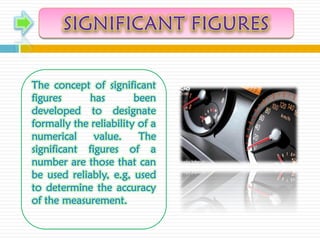
The concept of significant
figures      has        been
developed to designate
formally the reliability of a
numerical     value.     The
significant figures of a
number are those that can
be used reliably, e.g, used
to determine the accuracy
of the measurement.
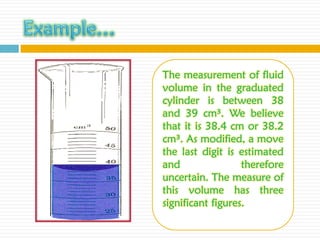
The measurement of fluid
volume in the graduated
cylinder is between 38
and 39 cm³. We believe
that it is 38.4 cm or 38.2
cm³. As modified, a move
the last digit is estimated
and                therefore
uncertain. The measure of
this volume has three
significant figures.
The concept of significant figures has two important implications for
                   the study of numerical methods.


            1
The numerical methods obtain approximate
results. Therefore, we must develop criteria to
specify how accurate are the results
obtained. A way to do it is in terms of
significant figures. For example, we can say
that the approach is acceptable to four
significant figures.
2

Although certain quantities such as π or e
represent specific numbers, they can’t to
express exactly with a finite number of digits.
                   For example:
   π = 3.14159265358973238462643... To
                      infinity.
The computers hold only a finite number of
significant figures, these numbers can never be
represented accurately.
1        All nonzero digits are significant:

         1,284 g  4 significant figures
           1,2 g  2 significant figures

With zeroes, the situation is particularly:

         Zeroes placed before other digits are
 2       not significant.


           0.046  2 significant digits.
3   Zeroes placed between other digits are
    always significant.


      4009 kg  4 significant digits.


     Zeroes placed after other digits
4    but behind a decimal point are
     significant.


         7,90  3 significant digits.
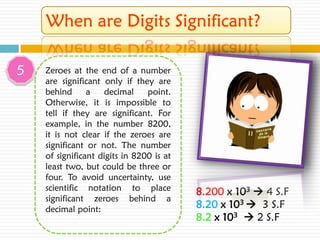
5   Zeroes at the end of a number
    are significant only if they are
    behind      a   decimal     point.
    Otherwise, it is impossible to
    tell if they are significant. For
    example, in the number 8200,
    it is not clear if the zeroes are
    significant or not. The number
    of significant digits in 8200 is at
    least two, but could be three or
    four. To avoid uncertainty, use
    scientific notation to place          8.200 x 10³  4 S.F
    significant zeroes behind a
    decimal point:                        8.20 x 10³  3 S.F
                                          8.2 x 10³  2 S.F
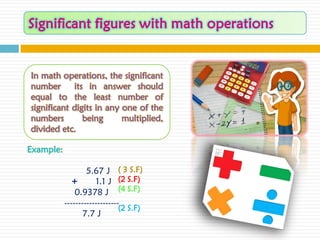
In math operations, the significant
number      its in answer should
equal to the least number of
significant digits in any one of the
numbers        being      multiplied,
divided etc.

Example:

                   5.67 J ( 3 S.F)
              +       1.1 J (2 S.F)
               0.9378 J (4 S.F)
           --------------------
                               (2 S.F)
                  7.7 J
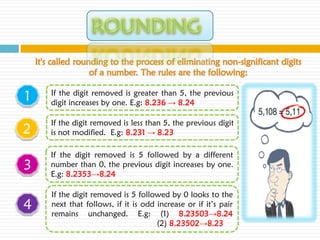
It's called rounding to the process of eliminating non-significant digits
                    of a number. The rules are the following:

1       If the digit removed is greater than 5, the previous
        digit increases by one. E.g: 8.236 → 8.24

        If the digit removed is less than 5, the previous digit
2       is not modified. E.g: 8.231 → 8.23

        If the digit removed is 5 followed by a different
3       number than 0, the previous digit increases by one.
        E.g: 8.2353→8.24

        If the digit removed is 5 followed by 0 looks to the
4       next that follows, if it is odd increase or if it’s pair
        remains unchanged. E.g: (1) 8.23503→8.24
                                        (2) 8.23502→8.23
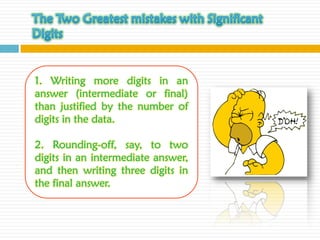
1. Writing more digits in an
answer (intermediate or final)
than justified by the number of
digits in the data.

2. Rounding-off, say, to two
digits in an intermediate answer,
and then writing three digits in
the final answer.
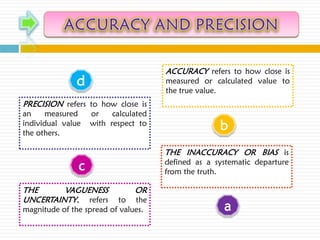
ACCURACY refers to how close is
              d                       measured or calculated value to
                                      the true value.
PRECISION refers to how close is
an     measured    or    calculated
individual value
the others.
                   with respect to
                                                    b
                                      THE INACCURACY OR BIAS is
               c                      defined as a systematic departure
                                      from the truth.

THE      VAGUENESS             OR
UNCERTAINTY, refers       to the
magnitude of the spread of values.                   a
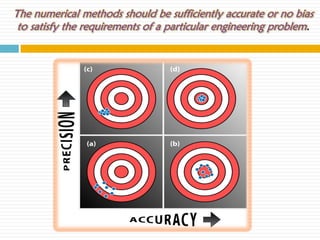
The numerical methods should be sufficiently accurate or no bias
 to satisfy the requirements of a particular engineering problem.
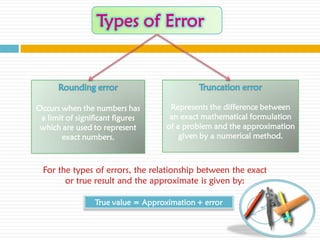
Rounding error                        Truncation error

Occurs when the numbers has          Represents the difference between
 a limit of significant figures      an exact mathematical formulation
 which are used to represent        of a problem and the approximation
       exact numbers.                   given by a numerical method.


  For the types of errors, the relationship between the exact
        or true result and the approximate is given by:

                 True value = Approximation + error
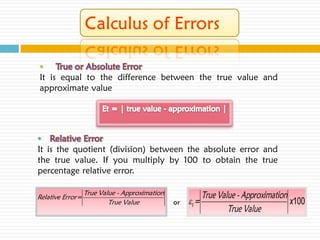
• True or Absolute Error
It is equal to the difference between the true value and
approximate value


• Relative Error
It is the quotient (division) between the absolute error and
the true value. If you multiply by 100 to obtain the true
percentage relative error.

                  True Value - Approximation               True Value - Approximation
Relative Error=
                          True Value           or   t =                              x100
                                                                   True Value
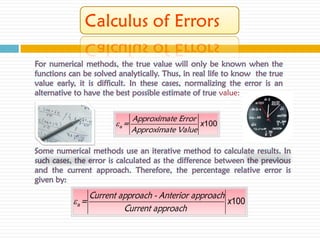
For numerical methods, the true value will only be known when the
functions can be solved analytically. Thus, in real life to know the true
value early, it is difficult. In these cases, normalizing the error is an
alternative to have the best possible estimate of true value:


                             Approximate Error
                       a=                     x100
                             Approximate Value

Some numerical methods use an iterative method to calculate results. In
such cases, the error is calculated as the difference between the previous
and the current approach. Therefore, the percentage relative error is
given by:

                 Current approach - Anterior approach
           a=                                        x100
                          Current approach
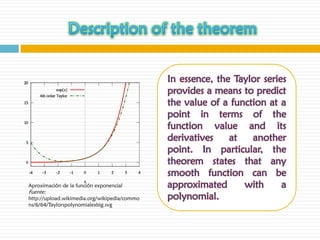
In essence, the Taylor series
                                              provides a means to predict
                                              the value of a function at a
                                              point in terms of the
                                              function value and its
                                              derivatives    at   another
                                              point. In particular, the
                                              theorem states that any
                                              smooth function can be
Aproximación de la función exponencial        approximated      with      a
Fuente:
http://upload.wikimedia.org/wikipedia/commo   polynomial.
ns/6/64/Taylorspolynomialexbig.svg
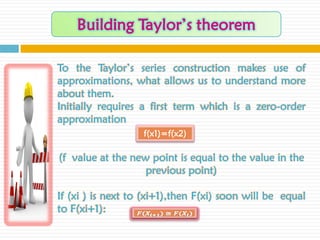
To the Taylor’s series construction makes use of
approximations, what allows us to understand more
about them.
Initially requires a first term which is a zero-order
approximation


(f value at the new point is equal to the value in the
                   previous point)

If (xi ) is next to (xi+1),then F(xi) soon will be equal
to F(xi+1):
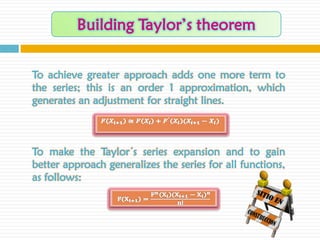
To achieve greater approach adds one more term to
the series; this is an order 1 approximation, which
generates an adjustment for straight lines.


To make the Taylor´s series expansion and to gain
better approach generalizes the series for all functions,
as follows:
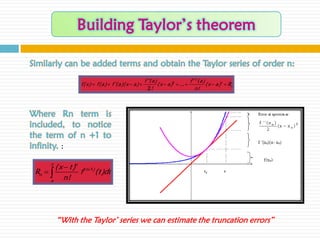
Similarly can be added terms and obtain the Taylor series of order n:
                                                        f ''(a )                    f ( n )(a )
                   f( x)  f(a )  f '(a )( x  a )             ( x  a )2  ...              ( x  a )n  Rn
                                                          2!                            n!


Where Rn term is
included, to notice
the term of n +1 to
infinity. :
       x
        ( x  t )n ( n1)
 Rn             f       (t )dt
      a     n!


           “With the Taylor’ series we can estimate the truncation errors”
Numerical approximation

Numerical approximation

  • 2.
  • 3.
    The concept ofsignificant figures has been developed to designate formally the reliability of a numerical value. The significant figures of a number are those that can be used reliably, e.g, used to determine the accuracy of the measurement.
  • 4.
    The measurement offluid volume in the graduated cylinder is between 38 and 39 cm³. We believe that it is 38.4 cm or 38.2 cm³. As modified, a move the last digit is estimated and therefore uncertain. The measure of this volume has three significant figures.
  • 5.
    The concept ofsignificant figures has two important implications for the study of numerical methods. 1 The numerical methods obtain approximate results. Therefore, we must develop criteria to specify how accurate are the results obtained. A way to do it is in terms of significant figures. For example, we can say that the approach is acceptable to four significant figures.
  • 6.
    2 Although certain quantitiessuch as π or e represent specific numbers, they can’t to express exactly with a finite number of digits. For example: π = 3.14159265358973238462643... To infinity. The computers hold only a finite number of significant figures, these numbers can never be represented accurately.
  • 7.
    1 All nonzero digits are significant: 1,284 g  4 significant figures 1,2 g  2 significant figures With zeroes, the situation is particularly: Zeroes placed before other digits are 2 not significant. 0.046  2 significant digits.
  • 8.
    3 Zeroes placed between other digits are always significant. 4009 kg  4 significant digits. Zeroes placed after other digits 4 but behind a decimal point are significant. 7,90  3 significant digits.
  • 9.
    5 Zeroes at the end of a number are significant only if they are behind a decimal point. Otherwise, it is impossible to tell if they are significant. For example, in the number 8200, it is not clear if the zeroes are significant or not. The number of significant digits in 8200 is at least two, but could be three or four. To avoid uncertainty, use scientific notation to place 8.200 x 10³  4 S.F significant zeroes behind a decimal point: 8.20 x 10³  3 S.F 8.2 x 10³  2 S.F
  • 10.
    In math operations,the significant number its in answer should equal to the least number of significant digits in any one of the numbers being multiplied, divided etc. Example: 5.67 J ( 3 S.F) + 1.1 J (2 S.F) 0.9378 J (4 S.F) -------------------- (2 S.F) 7.7 J
  • 11.
    It's called roundingto the process of eliminating non-significant digits of a number. The rules are the following: 1 If the digit removed is greater than 5, the previous digit increases by one. E.g: 8.236 → 8.24 If the digit removed is less than 5, the previous digit 2 is not modified. E.g: 8.231 → 8.23 If the digit removed is 5 followed by a different 3 number than 0, the previous digit increases by one. E.g: 8.2353→8.24 If the digit removed is 5 followed by 0 looks to the 4 next that follows, if it is odd increase or if it’s pair remains unchanged. E.g: (1) 8.23503→8.24 (2) 8.23502→8.23
  • 12.
    1. Writing moredigits in an answer (intermediate or final) than justified by the number of digits in the data. 2. Rounding-off, say, to two digits in an intermediate answer, and then writing three digits in the final answer.
  • 13.
    ACCURACY refers tohow close is d measured or calculated value to the true value. PRECISION refers to how close is an measured or calculated individual value the others. with respect to b THE INACCURACY OR BIAS is c defined as a systematic departure from the truth. THE VAGUENESS OR UNCERTAINTY, refers to the magnitude of the spread of values. a
  • 14.
    The numerical methodsshould be sufficiently accurate or no bias to satisfy the requirements of a particular engineering problem.
  • 16.
    Rounding error Truncation error Occurs when the numbers has Represents the difference between a limit of significant figures an exact mathematical formulation which are used to represent of a problem and the approximation exact numbers. given by a numerical method. For the types of errors, the relationship between the exact or true result and the approximate is given by: True value = Approximation + error
  • 17.
    • True orAbsolute Error It is equal to the difference between the true value and approximate value • Relative Error It is the quotient (division) between the absolute error and the true value. If you multiply by 100 to obtain the true percentage relative error. True Value - Approximation True Value - Approximation Relative Error= True Value or t = x100 True Value
  • 18.
    For numerical methods,the true value will only be known when the functions can be solved analytically. Thus, in real life to know the true value early, it is difficult. In these cases, normalizing the error is an alternative to have the best possible estimate of true value: Approximate Error a= x100 Approximate Value Some numerical methods use an iterative method to calculate results. In such cases, the error is calculated as the difference between the previous and the current approach. Therefore, the percentage relative error is given by: Current approach - Anterior approach a= x100 Current approach
  • 20.
    In essence, theTaylor series provides a means to predict the value of a function at a point in terms of the function value and its derivatives at another point. In particular, the theorem states that any smooth function can be Aproximación de la función exponencial approximated with a Fuente: http://upload.wikimedia.org/wikipedia/commo polynomial. ns/6/64/Taylorspolynomialexbig.svg
  • 21.
    To the Taylor’sseries construction makes use of approximations, what allows us to understand more about them. Initially requires a first term which is a zero-order approximation (f value at the new point is equal to the value in the previous point) If (xi ) is next to (xi+1),then F(xi) soon will be equal to F(xi+1):
  • 22.
    To achieve greaterapproach adds one more term to the series; this is an order 1 approximation, which generates an adjustment for straight lines. To make the Taylor´s series expansion and to gain better approach generalizes the series for all functions, as follows:
  • 23.
    Similarly can beadded terms and obtain the Taylor series of order n: f ''(a ) f ( n )(a ) f( x)  f(a )  f '(a )( x  a )  ( x  a )2  ...  ( x  a )n  Rn 2! n! Where Rn term is included, to notice the term of n +1 to infinity. : x ( x  t )n ( n1) Rn   f (t )dt a n! “With the Taylor’ series we can estimate the truncation errors”