This research paper analyzes the mathematical comparison between dynamic and static routing in computer networks, highlighting issues that arise from dynamic routing's reliance on imprecise information. Although dynamic routing typically yields better results, the paper concludes that its advantages can be marginal and can even be negated by minor errors in routing tables. Delays in building routing tables can significantly impact the performance of dynamic routing, suggesting it should not respond too quickly to traffic changes.

![Impact Of Computer Network Routing…
www.theijes.com The IJES Page 5
• Support for different distance metrics: physical,
delay etc.
• Dynamic algorithm that adapts to changes in the
topology automatically and quickly.
• Routing based on type of service (care about
real-time traffic).
• Bifurcated routing, splitting single stream of
packet along multiple routes, in appropriate per- centage. By 1990 it RFC 1268. The main difference between
the OSPF and BGP is that an interior gateway protocol has only to move packets as efficiently as possible, while
exte- rior gateway protocol routers have to worry about pol- itics. Different ASes are independent units and they
have to decide whose packets will they accept, whose packet will they forward, who has to pay for that etc. Such
policies are manually configured into each BGP router. From the point of view of a BGP router, the world
consists of other BGP routers and the lines connect- ing them. Networks can be stub networks with only one
connection to the BGP graph, multiconnected net- works that could be used for transit traffic and transit
networks (such as backbones) that are primarily used for transit traffic. BGP is distance vector protocol but with
signif- icant modifications. Each BGP router maintains not just the cost to each destination, but the exact path.
This prevents the count-to-infinity problem. was impossible for any router to know the entire topology.
• Security
OSPF supports three kinds of networks: point-to point between exactly two routers, multiaccess with
broadcastings (most LANs) and mutiaccess without broadcasting (most packet-switched WANs). It con- structs
a graph of the whole network where routers, networks and lines play the main role, not the hosts. For each type
of service it maintains separate graph with separate distance function. ASes are internally divided into areas and
routers can be internal (in one area), area border, backbone and AS boundary. Infor- mation is exchanged
between adjacent routers, which is not the same as neighboring (on LANs only one router is elected as
designated router). When a router boots it sends HELLO messages on all of its point-to-point lines and
broadcasts them on LANs. After that each router periodically floods LINK STATE UPDATE massages and
constructs the graph for its area and computes the shortest path.
4.6 BGP - The Exterior Gateway Routing Protocol
While OSPF is recommended within a single AS, be- tween ASes BGP (Border Gateway Protocol) is
used.It is defined in RFC 1654 and partially described in
• Support for hierarchical system.
V. PROBLEMS WITH DYNAMIC ROUTING
Highly dynamic optimal routing has been used in the Internet [1], [2], [3]. Expectations that it will give
much better results were not completely fulfilled, be- cause unexpected delays occurred often. Here and in [4],
[5], [6], [7], [8], [9] is presented an attempt to give some theoretical explanation for such behavior. To- day, this
problem is again interesting but in the context of wireless ad hoc mobile networks [10], [11], some- times using
evolutionary computing [12]. Here, for the routing problem we also have ac- cepted terminology to classify
routing as static versus dynamic or fixed versus adaptive. In practice, how- ever there is not a clear-cut between
the two: fixed or static routing is not fixed forever and dynamic or adaptive is not infinitely fast in its adjustment
to the situation on the network. As mentioned before, fixed routing has to accommodate for occasional link fail-
ures at least, and adaptive routing needs some time to collect and analyze the current traffic on the network. In
reality, routing adjustments are made, the question is how often. In can be done on a daily basis, or ev- ery hour,
every minute or every few seconds. If it is done every few minutes, it can be called fixed if com- pared to
adjustments every few seconds, or it can be called adaptive if compared to adjustments every few days. Often
terms like "semi-adaptive", "semi-fixed", "highly-dynamic" etc. are used.
There are problems with distributed optimal rout- ing algorithms. Kleinrock was the first [13] to point
out that "... uncontrolled alternate routing in a con- gested network can lead to chaos. Indeed, the tele- phone
company tends to limit (and even prohibit completely) alternate routing on unusually busy days (Mother's Day,
for example)." It takes significant time to calculate new routing tables, both to accumulate data in any node, and
to ex- change data among nodes. By the time the calculation is finished load may be sufficiently different to
make the tables obsolete, and the routing far from optimal. By working on the knees of sharply rising delay
curves, highly dynamic optimal routing can expend massive amounts of network resources for no bene- fit. It
will be shown that congestion can be avoided in a useful range of cases by quasi-static bifurcated routing with
conservative load estimates, and that the delay penalties for use of this, less then optimal, rout- ing are small.
There are cases where dynamic routing can offer significant performance improvements, but without full load](https://image.slidesharecdn.com/a027401012-130813052842-phpapp02/85/The-International-Journal-of-Engineering-and-Science-The-IJES-5-320.jpg)
![Impact Of Computer Network Routing…
www.theijes.com The IJES Page 6
information and without infinitesi- mal route calculation time the game theoretic "maxi- mal loss" is
not minimized. A complete mathematical analysis of a simple network will be done. It will show that dynamic
rout- ing offers an improvement over static routing that is smaller than expected. That minor theoretical gain can
easily be lost, and situation can actually become worse, if there is even a small error in the dynamic routing
tables. An interesting and somewhat surpris- ing solution is offered. Congestions can be avoided if optimization
is not tried too hard. Dynamic routing is good, but only if the tables can be recalculated very quickly. Static
routing is better then attempted, but unsuccessful optimal dynamic routing.
VI. MATHEMATICAL MODEL
A simple three node network and even simpler offered load will be examined. Nodes are A, B and C,
and all traffic is from A to B. There are two possible differ- ent routes: a direct path from A to B, and an indirect
path, of the length two, that goes through C. Let us assume that all three lines are of the same capacity µ bits
per second. Our routing problem is then reduced to making a decision about what fraction of the to- tal
offered traffic will be sent along the indirect path of the length two. The remaining fraction 1 of the total
load will be send along the direct path. Let us call a branching coefficient. Let offered load be bits per
second and will, as usually, denote utiliza- tion /µ. We will also assume a Poison input stream of messages,
and an exponential service time on lines. There are some limitations for the parameters that we introduced [4],
[9]. Parameter is a fraction (probability) so we certainly have 0 1. For this particular case, there
is an even stronger condition. We may have to send some traffic along the longer route, which is more
expensive, has longer wait time etc., only if the direct path is overloaded (whatever the definition of the
"overload" is). It is obvious, how- ever, that it never pays off to send more traffic along the indirect route than
along the direct route. If the lines were of different capacities, costs, reliabilities etc., this would not have to
be the case, but according to our assumptions, we get the limitation that reason-able interval for is 0
0.5 (this will formally follow from the requirement that utilization for each line must be less than 1). There may
be some additional limitations for . If the total offered load is less than the line capacity µ , then there are no
problems. The network, however, may withstand the total offered load of < 2µ or < 2 . The reason for this
is that we have two alternative paths, each of the capacity µ. It is obvious that when the total load approaches
2µ, there is no more freedom in selecting . It has to be equal to 0.5, or one path will become overloaded,
introducing infinite delays. The new set of limitations for can be calculated as follows. With the total load ,
line capacity µ, uti- lization , and the branching coefficient , the utiliza- tions of the direct path 1, and the
utilization of the indirect path 2 will be:
In order to keep the network in a stable state (to avoid infinite queues and delays), we have to avoid
overloading any of the two paths. By solving 1 < 1 and 2 < 1, we get an additional constraints >
11/ and < 1/. If we check the second constraint, we see that it is completely included in the previous
constraint < 0.5.
The left constraint in the last expression is differ- ent from zero for > 1.
6.1 Optimal Waiting Time
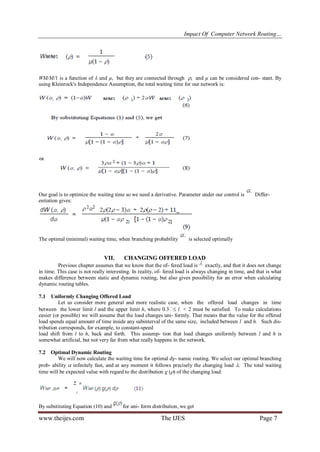
The waiting time (including service time) for an M/M/1 queuing system is:](https://image.slidesharecdn.com/a027401012-130813052842-phpapp02/85/The-International-Journal-of-Engineering-and-Science-The-IJES-6-320.jpg)
![Impact Of Computer Network Routing…
www.theijes.com The IJES Page 9
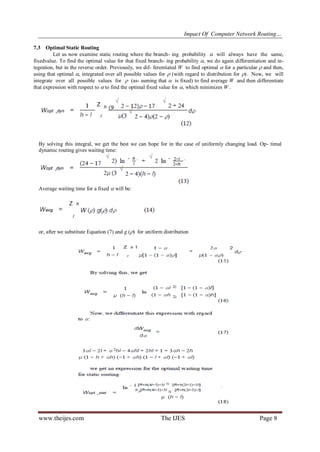
This case represents pure static routing if the boundaries l and h are fixed and never change. In
practice, we use a quasi-static routing where the boundaries l and h do change over time, but much
slower than the offered load . We adjust l and h, and corresponding opt stat , but we do it once every hour
or so. For shorter periods of time routing is static, while dynamic routing chases changing offered load
continuously.
7.4 Comparison
Now, we will compare optimal dynamic routing and optimal static routing. Formula that is used to
calcu- late improvement is
The following Table 1 shows improvement in per- cents (reduction of delays) when optimal static rout- ing
is replaced by optimal dynamic routing, for differ- ent intervals [l, h], where offered load is uniformly
changing.
Rows in the table give corresponding improvement for particular l, columns for h. Since l <
h, only the upper right triangle of the table is used, diago- nal excluded. First impression is surprisingly
small improvement that dynamic routing introduces. It al- lows us to make claim that too zealous optimization
is harmful. Even without any errors in calculating rout- ing tables, best improvement we can hope for, the up-
per limit, is given in Table 1. Average improvement is about 1%, maximal improvement is less than 3%. It is
not surprising that maximal improvement is achieved when interval [l, h] is wide. Traffic then varies a lot, and
if we can follow that wide variations, improve- ment will be more significant. When we look at this modest
improvement, we should keep in mind that we are dealing with a very simple model with only three nodes and
one source. In a larger network, it is possible that improvement would be better, but chances for an error in
the dy- namic routing tables would also be better. The com- bined effect would probably be the same. The
conclusion is that optimal dynamic routing gives modest improvement over optimal static rout- ing.
That small improvement can easily be annihi- lated, and actually dynamic routing can give larger de- lays
than static, if there are any errors in the dynamic routing tables. Such errors always exist, because it takes
significant time to calculate new routing tables, both to accumulate data in any node, and to exchange data
among nodes. By the time the calculation is fin- ished, load may be sufficiently different to make the tables
obsolete, and the routing far from optimal.
VIII. IMPRECISE ADAPTIVE ROUTING
Now, we show how that small advantage can be lost and why dynamic routing can become worse
than static, even for relatively minor errors in traffic esti- mate. The goal in this section is to quantitatively
exam- ine how imprecise (obsolete) traffic information used for calculating dynamic routing affects delays in
the network and when dynamic routing becomes imprac- tical because optimal static routing becomes better.](https://image.slidesharecdn.com/a027401012-130813052842-phpapp02/85/The-International-Journal-of-Engineering-and-Science-The-IJES-9-320.jpg)
![Impact Of Computer Network Routing…
www.theijes.com The IJES Page 11
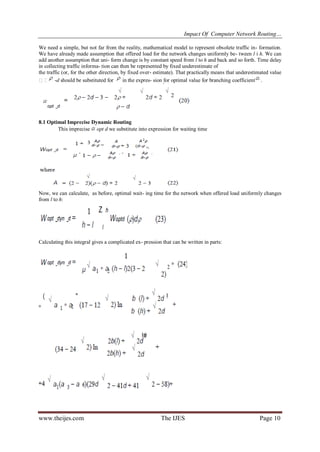
This formula for d = 0 reduces to formula for waiting time for optimal dynamic routing, Equation (13), that we
had before
8.2 Static and Imprecise Dynamic Routing
Now, we can compare imprecise dynamic routing with optimal static routing. As before, we will
calculate improvement in percents (reduced delays) when op- timal static routing is replaced by imprecise
dynamic routing. Improvement is calculated for different in- tervals [l, h] where offered load uniformly changes.
When d becomes large enough, improvement will be- come negative, i.e. static routing will become superior to
this sufficiently imprecise dynamic routing.
For d = 0.15 almost all elements are negative, which means that is better not to try dynamic routing](https://image.slidesharecdn.com/a027401012-130813052842-phpapp02/85/The-International-Journal-of-Engineering-and-Science-The-IJES-11-320.jpg)
![Impact Of Computer Network Routing…
www.theijes.com The IJES Page 12
with that size of error in traffic information. Static routing is better and error is only 7.5% of the
total capacity.
IX. CONCLUSION
Previous tables give an interesting and somewhat sur- prising solution. Congestions can be avoided if
we do not try to optimize too hard. Dynamic routing is good, but only if we can recalculate tables very fast.
Static routing is better than attempted, but unsuccessful op- timal dynamic routing.
REFERENCES:
[1] Mills, D. L.: Exterior Gateway Protocol formal specification, RFC 904, 1984
[2] Hedrick, C.: Routing Information Protocol, RFC 1058, 1988
[3] Blokzijl, R.: RIPE Terms of Reference, RFC 1181, 1990
[4] Tuba, Milan: Optimal Bifurcated Routing in Computer Networks, Proceedings of the 38th Conference ETRAN'94, Vol. 3, pp.
55-56, Niˇs, 1994
[5] Tuba, Milan: Dynamic Routing in Com- puter Networks Introduces Small Improvements, "Technology of Programming"
Conference, pp. 7, Matematiˇcki institut, Beograd, 1994
[6] Tuba, Milan: Conditions when Dynamic Rout- ing Becomes Worse than Static, PriM 94, IX Conference on Applied
Mathematics, pp. 81-82, Budva, 1994
[7] Tuba, Milan: Cost Function for Communication Links in Computer Networks, Bulletins for Ap- plied Mathematics (BAM),
LXXIII-1028/94, pp. 115-122, Budapest, 1994
[8] Tuba, Milan: Dynamic Routing Based on Obso- lete Traffic Information, Proceedings of the In- ternational Conference on
Technical Informatics ConTI'94, Vol. 4, pp.103-110, Timisoara, 1994
[9] Tuba, Milan: A Mathematical Model for Routing Comparison in Computer Networks, Bulletins for Applied athematics (BAM),
LXXXVI-A 1565/98, Arad, July 1998, pp. 493- 503
[10] Karavetsios, P., Economides, A.: Performance Comparison of Distributed Routing Algorithms in Ad Hoc Mobile Networks,
WSEAS Transac- tions on Communications, Vol. 3, Issue 1, 2004, pp. 317-321
[11] Sokullu, R., Karaca, O.: Comparative Perfor- mance Study of ADMR and ODMPR in the Context of Mobile Ad Hoc Networks
and Wire- less Sensor Networks, International Journal of Communications, Issue 1, Volume 2, 2008, pp. 45-53
[12] Kumar, D., Bhuvaneswaran, R.: ALRP: Scala- bility Study of Ant Based Local Repair Routing Protocol for Mobile Ad Hoc
Networks, WSEAS Transactions on Computer Research, Vol. 3, Is- sue 4, Apr 2008, pp. 224-233
AUTHORS:
Ashis Saklani: Received M.tech in Computer Science from Karnataka University, he has done MCA from
Graphic Era Institute of Technology (Now Graphic Era University) Dehradoon.He is CISCO And Microsoft
Certified Professional. He worked as a VPN Support Engineer at HCL Infinet, Noida.Presently he is working as
Assistant Professor, at H.N.B Garhwal Central University, Srinagar, Uttarakhand, India.
Dr.S.C.Dimri:.Is a Deep Researcher a scholar and a gem .He has builted many Milestones in the Horizon of
Network Security, Computer Networks and Operational Research. It brings Laurel For those who Gets
Opportunity to work with him. Presently he is working as HOD (Head of Department Graphic Era University,
Dehradoon, Uttarakhand, India
Praveen Tiwari: Received M.tech in Computer Science from G.B.P.E.C Pauri Garhwal,
And B.tech in 2008 from Priyadarshni College of Computer sciences.He worked in Infotech Enterprise Ltd
where he worked on Gps Navigation Softwares.His main domain is Cloud Computing.Presently he is working
as Assistant Professor, at H.N.B Garhwal Central University, Srinagar, Uttarakhand, India](https://image.slidesharecdn.com/a027401012-130813052842-phpapp02/85/The-International-Journal-of-Engineering-and-Science-The-IJES-12-320.jpg)


