IOSR Journal of Computer Engineering (IOSR-JCE)
e-ISSN: 2278-0661,p-ISSN: 2278-8727, Volume 18, Issue 1, Ver. III (Jan – Feb. 2016), PP 01-10
www.iosrjournals.org
DOI: 10.9790/0661-18130110 www.iosrjournals.org 1 | Page
E-Tailing: The Shifting Visage of Retail Business in India
Subhendu Kumar Rath1
, Bhagavan Behera2
, Rajani Trivedi3
1
Deputy Director of Examinations, Biju Pataik University Technology, Rourkella, Odisha, (India)
2
Assistant Professor in Mgt., Biju Patnaik Institute of IT & Management Studies, Bhubaneswar (Odisha)
3
Computer Science Teacher, Sai International School, Bhubaneswar (Odisha)
Abstract: E- Tailing has taken the business world by storm and mesmerized the psyche of the entire thumb
generation entrepreneurs with a collection of viable business and commercial models. The indispensable
motivating force on the flipside of the global economy is the vigor and ground-breaking panache of information
technology and India is at the cusp of such a digital uprising. The drift of online shopping in India is set to see
greater elevation in coming years because of the changes in the supporting ecosystem. The probable launch of
4G services is supposed to outstandingly bump up India’s Internet user base. Venture capital investors, who
were putting a ceiling on themselves to the tangential, are now enchanting a passionate interest in the country’s
e-tailing market. Given these developments, in this article, we seek to provide an insight into India’s e-retailing
market. The article pivots on the e-tailing ecosystem, the key growth drivers across these segments and the
contemporary scenario of M & A activities in E-Tailing business in India.
Keywords: Behavioral Analytics, Crypto-Currencies, Digital Convergence, Product Diversity, Venture Capital
I. Introduction
The internet has democratized the retail business and transformed it into a cutting edge business
segment. The commercial barricades continue to plummet as it becomes gradually more express and easy to set-
up, start on, host, re-host and modernize online stores. Accompanied by such a digital insurgency, e-tailing has
changed the visage of retail business in India changing the way people transact. The online landscape in the
country is mushrooming in terms of contributions ranging from travel, movies, hotel reservations and books to
the likes of matrimonial services, electronic gadgets, fashion accessories and even groceries. This growth is
fuelled by speedy technology espousal led by the increasing use of devices such as smartphones and tablets, and
access to the internet through broadband, 3G, 4G etc. Besides, favored demographics and a growing internet
user pedestal helped aid this growth.
E-tailing refers to retailing over the internet. It is an integrator of technology, logistics, and
infrastructure, and creates a relatively efficient marketplace for vendors and consumers. In India, there are 3,311
e-commerce hubs, 1,267 rural hubs, 391 export hubs and 2,217 import hubs. To make the most of the projected
growth potential, a horde of investors, including venture capital (VC) and private equity (PE) firms, are closely
eyeing opportunities in e-tailing start-ups. This article pivots on the e-tailing ecosystem, the key growth drivers
across these segments and the contemporary scenario of M & A activities in E-Tailing business in India.
The E-Tailing Evolution: Major Milestones
The idea of visualizing the internet as a viable sales channel was sensed almost four years after the
launch of the World Wide Web, way back in 1990. One of the first retailers to jump on the foray was US
departmental store, JC Penney, who envisioned an internet store as an annex of their catalogue retail channels.
Today, JC Penney is one of the largest and most successful e-tailers; it was the first online retailer to smack $1
billion in sales in 2005. Other milestones in the history of e-tailing include:
 Hollerith (1860–1929) sets up the forerunner of IBM (International Business Machines)
 1950s–1960s: IBM pioneers online transaction processing (OLTP): a way of handling money transactions
instantly (in "real-time") using sophisticated computerized systems.
 In 1969, IBM's transaction-processing software evolves into CICS (Customer Information Control System),
one of its least-known but most successful products.
 1970: US company Docutel invents the ATM (automated teller machine, also known as the "cashpoint"),
which works using online transactions made through bank computers.
 1980s: CompuServe, Prodigy, and AOL (America Online) let people shop from home using their computers
and telephone lines.
 1989: Tim Berners-Lee (1955–) invents the World Wide Web, unwittingly laying the foundations for an
explosive growth of e-commerce in the years that follow.
 1994: Jeff Bezos (1964–) founds Amazon.com, the iconic e-store.
 The launch of Amazon in 1995
E-Tailing: The Shifting Visage Of Retail Business In India
DOI: 10.9790/0661-18130110 www.iosrjournals.org 2 | Page
 Dell becomes the first company to make $1million in sales in 1997
 PayPal launches an alternative payment system in 1998
 Victoria‘s Secret debuts their web store with a video that gets 1 million views on Day One in 1999
 Wal-Mart introduces an order-online/pick-up-in-store program in 2000
 Apple launches iTunes in 2003
 One million Valentine‘s Day online shoppers crash Hallmark.com in 2005
 Google launches Google Checkout, to compete with PayPal, in 2006
 Online apparel sales outstrip computer sales for the first time ever in 2007
 M-Commerce – mobile commerce – the next phase in the e-tailing revolution begins in 2007.
 2009 Amazon.com and Overstock.com lose New York online sales tax battle
 2015: The US Census Bureau reports that US e-commerce retail sales for the second quarter of 2015 are
$83.9 billion (up from $51.2 billion for the same period of 2012, adjusted for seasonal variation). In 2Q
2015, e-commerce represents about 7.2 percent of total sales (up from 4.7 percent in 2012).
E-tailing has resulted in the augmentation of e-tailware -- software tools for creating online catalogs
and managing the business connected with doing e-tailing. A new trend is the price comparison site that can
quickly compare prices from a number of different e-tailers and link you to them.
II. The E-Tailing Ecosystem
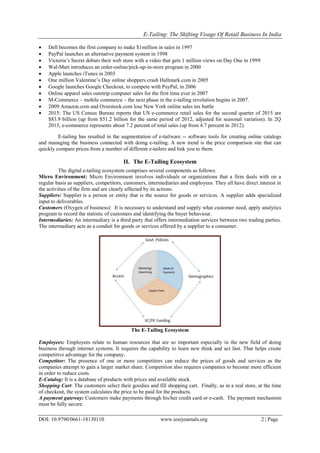
The digital e-tailing ecosystem comprises several components as follows:
Micro Environment: Micro Environment involves individuals or organizations that a firm deals with on a
regular basis as suppliers, competitors, customers, intermediaries and employees. They all have direct interest in
the activities of the firm and are clearly affected by its actions.
Suppliers: Supplier is a person or entity that is the source for goods or services. A supplier adds specialized
input to deliverables.
Customers (Oxygen of business): It is necessary to understand and supply what customer need, apply analytics
program to record the statistic of customers and identifying the buyer behaviour.
Intermediaries: An intermediary is a third party that offers intermediation services between two trading parties.
The intermediary acts as a conduit for goods or services offered by a supplier to a consumer.
The E-Tailing Ecosystem
Employees: Employees relate to human resources that are so important especially in the new field of doing
business through internet systems. It requires the capability to learn new think and act fast. That helps create
competitive advantage for the company.
Competitor: The presence of one or more competitors can reduce the prices of goods and services as the
companies attempt to gain a larger market share. Competition also requires companies to become more efficient
in order to reduce costs.
E-Catalog: It is a database of products with prices and available stock.
Shopping Cart: The customers select their goodies and fill shopping cart. Finally, as in a real store, at the time
of checkout, the system calculates the price to be paid for the products.
A payment gateway: Customers make payments through his/her credit card or e-cash. The payment mechanism
must be fully secure.
E-Tailing: The Shifting Visage Of Retail Business In India
DOI: 10.9790/0661-18130110 www.iosrjournals.org 3 | Page
Support Services in E-Retailing: The electronic retail business requires support services, as a prerequisite for
successful operations. These services are required to support the business, online or offline, throughout the
complete transaction-processing phases. The following are the essential support services:
 Communication backbone
 Payment mechanism
 Order fulfilment
 Logistics
Macro Environment: Macro environment involves factors outside of direct control of the business such as the
economy, government policy, and social change. Society is the factor that impacts on the consumers‘ habit the
most and influence on customer‘s belief and psychology that lead to decision of buying online or not. The speed
of developing internet and technology in each society, each country decides the method of doing business at the
modern time.
III. The E-Tailing Process
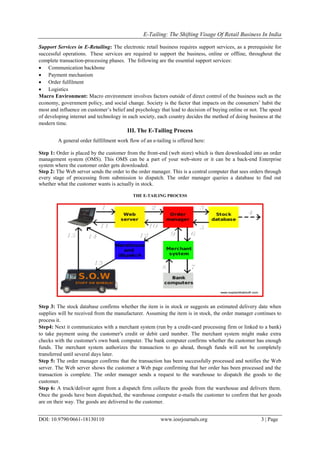
A general order fulfillment work flow of an e-tailing is offered here:
Step 1: Order is placed by the customer from the front-end (web store) which is then downloaded into an order
management system (OMS). This OMS can be a part of your web-store or it can be a back-end Enterprise
system where the customer order gets downloaded.
Step 2: The Web server sends the order to the order manager. This is a central computer that sees orders through
every stage of processing from submission to dispatch. The order manager queries a database to find out
whether what the customer wants is actually in stock.
THE E-TAILING PROCESS
Step 3: The stock database confirms whether the item is in stock or suggests an estimated delivery date when
supplies will be received from the manufacturer. Assuming the item is in stock, the order manager continues to
process it.
Step4: Next it communicates with a merchant system (run by a credit-card processing firm or linked to a bank)
to take payment using the customer's credit or debit card number. The merchant system might make extra
checks with the customer's own bank computer. The bank computer confirms whether the customer has enough
funds. The merchant system authorizes the transaction to go ahead, though funds will not be completely
transferred until several days later.
Step 5: The order manager confirms that the transaction has been successfully processed and notifies the Web
server. The Web server shows the customer a Web page confirming that her order has been processed and the
transaction is complete. The order manager sends a request to the warehouse to dispatch the goods to the
customer.
Step 6: A truck/deliver agent from a dispatch firm collects the goods from the warehouse and delivers them.
Once the goods have been dispatched, the warehouse computer e-mails the customer to confirm that her goods
are on their way. The goods are delivered to the customer.
E-Tailing: The Shifting Visage Of Retail Business In India
DOI: 10.9790/0661-18130110 www.iosrjournals.org 4 | Page
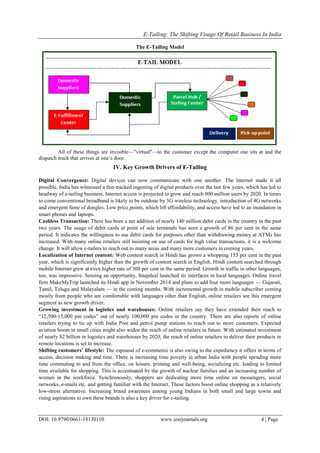
The E-Tailing Model
All of these things are invisible—"virtual"—to the customer except the computer one sits at and the
dispatch truck that arrives at one‘s door.
IV. Key Growth Drivers of E-Tailing
Digital Convergence: Digital devices can now communicate with one another. The Internet made it all
possible. India has witnessed a fast-tracked ingesting of digital products over the last few years, which has led to
headway of e-tailing business. Internet access is projected to grow and reach 800 million users by 2020. In times
to come conventional broadband is likely to be outdone by 3G wireless technology, introduction of 4G networks
and emergent fame of dongles. Low price points, which lift affordability, and access have led to an inundation in
smart phones and laptops.
Cashless Transaction: There has been a net addition of nearly 140 million debit cards in the country in the past
two years. The usage of debit cards at point of sale terminals has seen a growth of 86 per cent in the same
period. It indicates the willingness to use debit cards for purposes other than withdrawing money at ATMs has
increased. With many online retailers still insisting on use of cards for high value transactions, it is a welcome
change. It will allow e-tailers to reach out to many areas and many more customers in coming years.
Localization of Internet content: Web content search in Hindi has grown a whopping 155 per cent in the past
year, which is significantly higher than the growth of content search in English. Hindi content searched through
mobile Internet grew at even higher rate of 300 per cent in the same period. Growth in traffic in other languages,
too, was impressive. Sensing an opportunity, Snapdeal launched its interfaces in local languages. Online travel
firm MakeMyTrip launched its Hindi app in November 2014 and plans to add four more languages — Gujarati,
Tamil, Telugu and Malayalam — in the coming months. With incremental growth in mobile subscriber coming
mostly from people who are comfortable with languages other than English, online retailers see this emergent
segment as new growth driver.
Growing investment in logistics and warehouses: Online retailers say they have extended their reach to
―12,500-15,000 pin codes‖ out of nearly 100,000 pin codes in the country. There are also reports of online
retailers trying to tie up with India Post and petrol pump stations to reach out to more customers. Expected
aviation boom in small cities might also widen the reach of online retailers in future. With estimated investment
of nearly $2 billion in logistics and warehouses by 2020, the reach of online retailers to deliver their products in
remote locations is set to increase.
Shifting customers’ lifestyle: The espousal of e-commerce is also owing to the expediency it offers in terms of
access, decision making and time. There is increasing time poverty in urban India with people spending more
time commuting to and from the office, on leisure, priming and well-being, socializing etc. leading to limited
time available for shopping. This is accentuated by the growth of nuclear families and an increasing number of
women in the workforce. Synchronously, shoppers are dedicating more time online on messengers, social
networks, e-mails etc. and getting familiar with the Internet. These factors boost online shopping as a relatively
low-stress alternative. Increasing brand awareness among young Indians in both small and large towns and
rising aspirations to own these brands is also a key driver for e-tailing.
E-Tailing: The Shifting Visage Of Retail Business In India
DOI: 10.9790/0661-18130110 www.iosrjournals.org 5 | Page
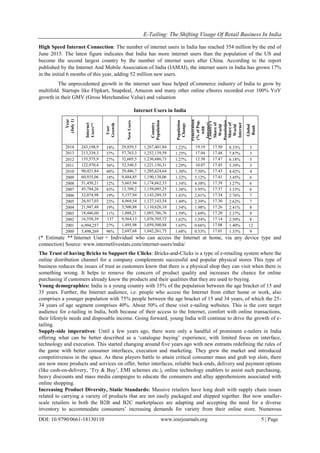
High Speed Internet Connection: The number of internet users in India has reached 354 million by the end of
June 2015. The latest figure indicates that India has more internet users than the population of the US and
become the second largest country by the number of internet users after China. According to the report
published by the Internet And Mobile Association of India (IAMAI), the internet users in India has grown 17%
in the initial 6 months of this year, adding 52 million new users.
The unprecedented growth in the internet user base helped eCommerce industry of India to grow by
multifold. Startups like Flipkart, Snapdeal, Amazon and many other online eStores recorded over 100% YoY
growth in their GMV (Gross Merchandise Value) and valuation
Internet Users in India
Year
(July1)
Internet
Users**
User
Growth
NewUsers
Country
Population
Population
Change
Penetration
(%ofPop.
with
Internet)Country's
Shareof
World
PopulationCountry's
Shareof
World
Internet
Users
Global
Rank
2014
*
243,198,9
22
14% 29,859,5
98
1,267,401,84
9
1.22% 19.19
%
17.50
%
8.33% 3
2013
*
213,339,3
24
37% 57,763,3
80
1,252,139,59
6
1.25% 17.04
%
17.48
%
7.87% 3
2012 155,575,9
44
27% 32,605,5
03
1,236,686,73
2
1.27% 12.58
%
17.47
%
6.18% 3
2011 122,970,4
41
36% 32,548,5
93
1,221,156,31
9
1.29% 10.07
%
17.45
%
5.39% 3
2010 90,421,84
9
48% 29,486,7
79
1,205,624,64
8
1.30% 7.50% 17.43
%
4.42% 4
2009 60,935,06
9
18% 9,484,85
9
1,190,138,06
9
1.32% 5.12% 17.41
%
3.45% 6
2008 51,450,21
0
12% 5,665,94
8
1,174,662,33
4
1.34% 4.38% 17.39
%
3.27% 6
2007 45,784,26
2
43% 13,709,2
81
1,159,095,25
0
1.38% 3.95% 17.37
%
3.33% 6
2006 32,074,98
1
19% 5,157,94
8
1,143,289,35
0
1.43% 2.81% 17.34
%
2.76% 7
2005 26,917,03
3
23% 4,969,54
5
1,127,143,54
8
1.49% 2.39% 17.30
%
2.62% 7
2004 21,947,48
8
19% 3,500,88
4
1,110,626,10
8
1.54% 1.98% 17.26
%
2.41% 8
2003 18,446,60
4
11% 1,888,21
0
1,093,786,76
2
1.59% 1.69% 17.20
%
2.37% 9
2002 16,558,39
4
137
%
9,564,13
8
1,076,705,72
3
1.62% 1.54% 17.14
%
2.50% 8
2001 6,994,257 27% 1,495,98
8
1,059,500,88
8
1.65% 0.66% 17.08
%
1.40% 12
2000 5,498,269 96% 2,697,68
0
1,042,261,75
8
1.68% 0.53% 17.01
%
1.33% 9
(* Estimate ** Internet User = Individual who can access the Internet at home, via any device type and
connection) Source: www.internetlivestats.com/internet-users/india/
The Trust of having Bricks to Support the Clicks: Bricks-and-Clicks is a type of e-retailing system where the
online distribution channel for a company complements successful and popular physical stores This type of
business reduces the issues of trust as customers know that there is a physical shop they can visit when there is
something wrong. It helps to remove the concern of product quality and increases the chance for online
purchasing if customers already know the products and their qualities that they are used to buying.
Young demographics: India is a young country with 35% of the population between the age bracket of 15 and
35 years. Further, the Internet audience, i.e. people who access the Internet from either home or work, also
comprises a younger population with 75% people between the age bracket of 15 and 34 years, of which the 25-
34 years of age segment comprises 40%. About 50% of these visit e-tailing websites. This is the core target
audience for e-tailing in India, both because of their access to the Internet, comfort with online transactions,
their lifestyle needs and disposable income. Going forward, young India will continue to drive the growth of e-
tailing.
Supply-side imperatives: Until a few years ago, there were only a handful of prominent e-tailers in India
offering what can be better described as a ‗catalogue buying‘ experience, with limited focus on interface,
technology and execution. This started changing around five years ago with new entrants redefining the rules of
the game with better consumer interfaces, execution and marketing. They grew the market and introduced
competitiveness in the space. As these players battle to attain critical consumer mass and grab top slots, there
are now more products and services on offer, better interfaces, reliable back-ends, delivery and payment options
(like cash-on-delivery, ‗Try & Buy‘, EMI schemes etc.), online technology enablers to assist such purchasing,
heavy discounts and mass media campaigns to educate the consumers and allay apprehensions associated with
online shopping.
Increasing Product Diversity, Static Standards: Massive retailers have long dealt with supply chain issues
related to carrying a variety of products that are not easily packaged and shipped together. But now smaller-
scale retailers in both the B2B and B2C marketplaces are adapting and accepting the need for a diverse
inventory to accommodate consumers‘ increasing demands for variety from their online store. Numerous
E-Tailing: The Shifting Visage Of Retail Business In India
DOI: 10.9790/0661-18130110 www.iosrjournals.org 6 | Page
businesses have made the move from stocking inventory, to utilizing drop-shipping to guarantee fulfilment.
What does this mean for smaller retailers who need to deal with the strict standards for shipments upheld by
carriers? Since carriers‘ terminals were designed to handle specific freight types, retailers are often forced to use
a variety of service providers to ship the diverse range of goods their stores now carry—introducing a large
amount of complexity into the average supply chain.
Demand-side drivers: The disruptive growth in the Indian e-tailing landscape will be supported by strong
demand side drivers including
 Increased discretionary spending by consumers
 Increased affordability and penetration of smart devices such as smart phones and tablets
 Increasingly innovative business models of mobile service providers resulting in their ability to sustainably
offer low internet tariffs
 Increased penetration of "plastic" money and "virtual" payment mechanisms
Regulatory drivers: It is also the view of industry watchers that with the new government in place, there may
be regulatory changes in the environment that will have a positive rub-off on e-Commerce. In addition to
possible relaxation of the FDI policy for investment into B2C e-Commerce companies and increased availability
of data spectrum, the following recent budget announcements also build a degree of confidence:
 Investment in infrastructure development - which will enhance logistical outreach
 Commitment to rolling out the goods and services tax (GST) from April 1, 2016 which will lead to
efficiencies in the logistics and warehousing costs
 Decision to incentivize debit and credit card transactions
 Allocation of Rs 1000 crore for start-ups and reduction of tax on royalty fees for technical services by 15
percent will also benefit entrepreneurs in this space
V. Technological Aspects Of E-Tailing
Escalating shopper buoyancy, swelling pay, consumption-based attitude and a big pool of shoppers
unlocks a plethora of openings for the e-tailers to tap. The fact that we have the youngest population in the
world, companies are poised for soaring on the growth scale. Retailers need to tap technology to stay in this
competitive environment. Technology aids retailers achieve top-line growth and bottom-line profits by
facilitating loss avoidance, curtailing retail shrinkage, increasing operational competency and facilitating best
practices in retail excellence through everyday solutions to business challenges. Technology is the backbone of
e-tailing starting from the platform on which e-tailing rests. A glimpse of some n technologies adopted by
players is as follows:
Mobile Computing: Mobile Computing is a technology that allows transmission of data, voice and video via a
computer or any other wireless enabled device without having to be connected to a fixed physical link. India is
the second largest mobile phone market in the world and is set for a record growth due to 3G and 4G wireless
technology. Mobile technologies are causing retailers to completely rethink the way in which sales personnel
interact with customers. As consumers continue to outsmart retailers, taking their smartphone everywhere they
go, retailers in addition to delivering product information can also look into the sales history to achieve higher
service levels with the adoption of mobile technology. As supply chain becomes more and more complex and
consumers becoming smarter, it is imperative that the retailers stay ahead with next generation technology.
Consumers can use their mobile phones to access information about product characteristics and price for related
products.
At the moment, most mobile devices are rectangular bricks of various sizes. These candy-bar shared
interfaces give shoppers access to just about anything on the web and millions of applications. But smartphones
and tablets will have to make room for other shapes of mobile devices including products like Google Glass,
Pebble Smartwatches, or even automobile-based mobile computing. These new form factors will mean that
shoppers may have a greater ability to shop, and could lead to new purchase pattern that impact how products
are sold. For example, think about what would happen when you combine a new mobile form factor like Google
Glass or similar with an emerging mobile functionality, mobile image recognition. In theory, a person could be
walking along a busy street, see a fashionably dressed person, touch the Google Glass, and instantly have the
ability to buy the outfit that person was wearing from a favorite ecommerce retailer.
Crypto-currencies: A crypto-currency (or crypto currency) is a medium of exchange using cryptography to
secure the transactions and to control the creation of new units. Crypto-currencies are a subset of alternative
currencies, or specifically of digital currencies. Bitcoin became the first decentralized crypto-currency in 2009.
While many online retailers are concerned that the electronic money may be too volatile, those stores that do
E-Tailing: The Shifting Visage Of Retail Business In India
DOI: 10.9790/0661-18130110 www.iosrjournals.org 7 | Page
accept it find it to be a viable, preferable alternative to credit cards that don‘t carry the same risk of fraud and
have lower transaction fees. Adding Bitcoin to an ecommerce site is very easy, and retailers that are nervous
about Bitcoin‘s rapidly changing value can instantly exchange Bitcoin for other currencies, like dollars. Perhaps
the least-known benefit of using Bitcoin is that there is almost no fraud — from the merchant‘s perspective —
or chargebacks, making it safer for ecommerce merchants to sell internationally even to nations with relatively
high rates of credit card fraud.
Omni-channel Retailing: Omni-channel retailing refers to the development of a seamless loom to the consumer
know-how through all on hand shopping channels, such as brick-and-mortar stores, smart phones, tablet
computers, personal computers, direct mail, catalog, and the like. There are a lot of retailers who have made an
attempt to establish the Omni-channel opportunity. Most have not thought enough about the overall customer
experience as he or she passes through the various phases of the day, and when that customer is likely to use
which device or visit which store, tying all of that together. Such channels include: retail stores, online stores,
mobile stores, mobile app stores, telephone sales and any other method of transacting with a customer. Social
media are the quintessence in the online purchase process. Transacting comprises browsing, buying, returning as
well as pre-sale and after-sale service.
Cloud computing: Cloud computing is the sharing of software by multiple users, without heavily investing on
the software. Data mining, data analysis greatly aid in DSS (Decision Support Systems) for effective inventory
and supply chain management. To influence purchasing decision and give time-pressed, on-the-go, digitally
connected customers what they value and expect, retailers today build detailed consumer profiles from multiple
sources, enriched by insights from advanced analytics. The advent of cloud computing now makes it possible
for retailers to meet 21st-century consumer expectations during all phases of their shopping experience. New
research divulges that two prime drivers—competition with online pure-plays and customer demand for a
seamless experience—will eventually breed increasingly faster adoption rates for cloud in the global retail
sector.
RFID in retail: RFID stands for Radio Frequency Identification — a technology whose use is growing fast and
which has major implications for consumers, particularly with regard to privacy. As its name implies, RFID is
an ID-identification-system. It relies on a small chip that is implanted in a tag. The chip can record and store
data, such as a serial number, price or purchase record. The tag can be attached to all sorts of things:
merchandise, shipping containers, vehicles, even pet or animal collars. Then, an electronic scanner can use radio
signals to read or track the ID tag.
RFID enabled services helps in tracking of information from supplier, logistics, distribution centre,
store, shelves and at the checkout point. It is greatly used in SCM (supply Chain Management). For a retailer
having operations in different cities and who sources products from a number of locations, to have real-time
data of the goods in the warehouses and at the outlets, RFID is a great boon.
Augmented Reality: Augmented reality (AR) is a live, direct or indirect, view of a physical, real-world
environment whose elements are augmented by computer-generated sensory input such as sound, video,
graphics or GPS data. It is related to a more general concept called mediated reality, in which a view of reality is
modified (possibly even diminished rather than augmented), by a computer. As a result, the technology
functions by enhancing one‘s current perception of reality. Put simply, augmented reality adds data to what we
see around us. Similar to mobile image recognition, augmented reality has the potential to turn everyday
activities like commuting to work or going to the park to play Frisbee into an opportunity to discover products
that we might like to buy. If augmented reality becomes a reality, it will certainly impact e-tailing.
Autonomous Vehicles: Google and Amazon have both been experimenting with same-day delivery services in
select markets. This same-day delivery trend is likely to have a significant impact on Internet retailing.
Of course, one of the greatest challenges to same-day delivery is cost. It is expensive to put a driver in a car and
drive to someone‘s house every time they place an online order. There are ways to help reduce the cost of on-
demand delivery, including optimizing delivery routes or distributing pick-up locations. Autonomous vehicles
could also help to reduce the cost of offering same-day delivery. And while the technology may be some
number of years off, the ability to deliver products to customers in hours instead of days will change
ecommerce.
3D Printing: Online merchants have begun taking a new interest in the manufacturing technique, finding it
allows them to slash prototyping costs and quickly customize items to shoppers‘ tastes. Recently Amazon
announced its new 3D printing store, which features items made on 3D printers. Amazon‘s approach to 3D
printing technology seems to focus on the technology‘s ability to decrease the time required to take a product
from design to market. The supply chain is almost unchanged in this approach. There is a manufacturer, perhaps
a distributor, and a retailer. The major difference is that the manufacturer can come up with new designs in
E-Tailing: The Shifting Visage Of Retail Business In India
DOI: 10.9790/0661-18130110 www.iosrjournals.org 8 | Page
hours or even create custom products for individual shoppers. It is also possible that some shoppers will have
their own 3D printers, and that they may wish to buy downloadable designs. To further the drawer pull example,
a shopper could have the option to order the product or download it for a slightly lower rate. Finally, some are
predicting the rise of 3D printing centers where consumers could bring a downloaded 3D design and print it out.
This trend, if it happened, could also create new ecommerce opportunities.
F-Commerce: F-commerce is face book commerce. It is a strategy that focuses on developing or designing e-
commerce content and storefront sites within the Face book networking site. Retailers are sending posts to the
respective face book accounts based on the interests of the customer and thereby individualizing the information
sent. F-commerce can take the shape of shopping tabs, which are part of a customized Face book application
that enables online retailers to publish a Face book storefront with add-to-cart buttons on Face book Business
Pages.
F-commerce can also apply to developing customized Face book Applications that drive leads or sales
to a company's online e-commerce site or options for ‗liking‘ specific products by Face book users to propagate
word-of-mouth interest in a company‘s products or services. Yet a different type of F-commerce is third-party
Face book shopping applications that launch virtual storefronts for companies within Face book. This option is
usually exploited by companies that are deficient in knowledge or time to craft complex Face book apps
themselves.
Search Engine: Retailing titanic Wal-mart has unveiled a new search engine to push sales on its website. Wal-
mart is the first brick and mortar retailer to cultivate a steadfast search engine and the machine with its ―machine
learning‖ know-hows empower predictive and natural analysis of shopper behavior. The search engines can
cartel manifold facets of key words used by shoppers which assist a great understanding of what the shopper is
eyeing for.
Drone Strike: Amazon.com is said to be testing drones with a range of 16 kms, would pick up customers‘
boxed orders from a centre and then use GPS to carry it to the customer‘s address and drop it in the front yard of
the house. It is still in the nascent stage and logistical issues needs to be addressed. Ankit Mehta of Mumbai-
based Ideaforge provided drones for flood relief in Uttarkhand. There are defies like range, weight load,
security, safety, drone technology and infrastructure etc. but these may not be a distant dream and may be a
reality in the years to come. The times are not too far, when drones may be transporting merchandises at the
customers‘ dwellings.
(M)E-Tail: Retailing is evolving into me-tailing. Going online now means immersing oneself in a rich,
personalized, social web. The increasing desire for personalized communication and offers from brands has
made me-retail a major trend. Me-retail aims to deliver an experience that is all about personalized shopping,
making use of social data to track information on customer shopping and behavioral analytics. Now, consumers
sit at the center (and indeed actively contribute to) a far richer and more deeply personal and personalized online
experience - meaning e-tail is increasingly (M) E-Tail.
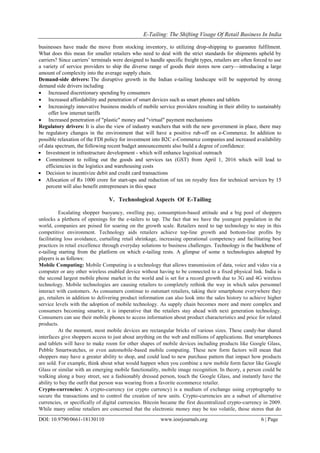
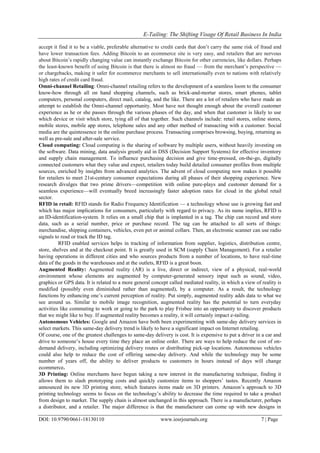
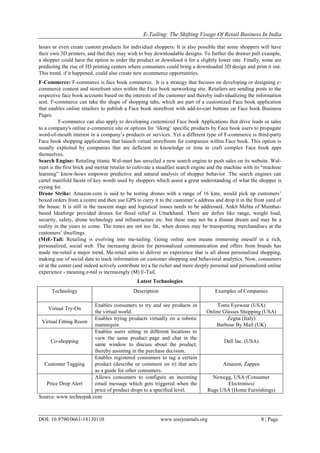
Latest Technologies
Technology Description Examples of Companies
Virtual Try-On
Enables consumers to try and see products in
the virtual world.
Toms Eyewear (USA)
Online Glasses Shopping (USA)
Virtual Fitting Room
Enables trying products virtually on a robotic
mannequin.
Zegna (Italy)
Barbour By Mail (UK)
Co-shopping
Enables users sitting in different locations to
view the same product page and chat in the
same window to discuss about the product,
thereby assisting in the purchase decision.
Dell Inc. (USA)
Customer Tagging
Enables registered consumers to tag a certain
product (describe or comment on it) that acts
as a guide for other consumers.
Amazon, Zappos
Price Drop Alert
Allows consumers to configure an incoming
email message which gets triggered when the
price of product drops to a specified level.
Newegg, USA (Consumer
Electronics)
Rugs USA (Home Furnishings)
Source: www.technopak.com
E-Tailing: The Shifting Visage Of Retail Business In India
DOI: 10.9790/0661-18130110 www.iosrjournals.org 9 | Page
VI. Contemporary M & A Activities in E-Tailing Industry In India
The Indian e-tailing industry has witnessed a lot of action in recent times with sites like Flipkart,
Bookmyshow, Makemytrip, Snapdeal becoming household names. Large players in the e-commerce business
are on an acquisition spree, in their quest to consolidate their position in the high growth cash-intensive sector.
Also, they wish to further boost their capabilities, with the right technology and talent.
After a fruitful wave of mergers and acquisitions in E-Tailing in 2014 and 2015, the momentum
continues to build up in 2016. With larger players like Flipkart and Snapdeal on a high after having received
record-breaking investments, they are looking to add more power to their engines through strategic acquisitions.
With the aim of expanding their portfolio, increasing their customer base, and providing a better user
experience, they all are on this game to be the best among the rest. Here‘s a summary of the top acquisitions in
contemporary times and the trends they portend for the future:
Flipkart- Myntra: Two of India's biggest e-commerce companies, Flipkart and Myntra, have merged to create
an entity with annualized sales of $1.5 billion, bringing them closer and in some cases rivalling the much older
offline retailers of those like Future Group, Aditya Birla, and Reliance. Their combined might also places them
in a better position to take on the likes of Amazon, which has become increasingly aggressive in India's
booming e-tailing market.
Snapdeal- Reduce Data: Indian e-commerce company Snapdeal.com has acquired Silicon Valley-based
advertising technology start-up Reduce Data. The acquisition will help Snapdeal to build a discovery platform
and tools for brands and over two lakh sellers on the marketplace. The engineering team at Reduce Data spread
across the U.S., the U.K. and India will now be part of Snapdeal.
Flipkart–Adiquity: In its first major acquisition this year, in March 2015, flipkart acquired mobile ad network
Adiquity. It is helping Flipkart into fee-based businesses such as online advertising and brand consulting for
vendors.
Flipkart–Appiterate: In keeping with its strategy of focusing on the mobile segment, online marketplace
Flipkart acquired Delhi-based mobile engagement and marketing automation company Appiterate. Flipkart is
giving it all it can to surge ahead in building the mobile ecosystem in India. With their innovative technology
and skilled employees Flipkart is all set to stand out in the clutter.
Flipkart -Wehive Technologies (Pvt) Ltd: Flipkart acquired WeHive Technologies Pvt. Ltd. This was done by
Flipkart to concentrate on mobile-focused companies. Obviously, these have helped them to get the grip of
dominating in the market share of the mobile business.
Mahindra–Babyoye: The Mahindra Group bought BabyOye, which is a leading brand of baby products sold
online. The acquisition happened in February 2015 with an intention to incorporate Mom & Me, an offline baby
care products store to online.
Foodpanda–Just Eat India: To give a tough competition to Zomato, Foodpanda bought JustEat India. With
this acquisition, Foodpanda is currently present in over 200 cities in India and partners with over 12,000
restaurants.
Ola Cabs–Taxiforsure: Ola bought TaxiforSure for $200 million in a cash-and-stock deal. As the city traffic is
increasing every day, the number of customers relying on taxi for their transportation has also improved largely.
This is quite a revolution in the taxi market. This acquisition has helped Ola as their demand was running out of
supply. Apart from adding a huge customer base, TaxiForSure added more than 15,000 cars to Ola‘s existing list
of huge number of cars.
Snapdeal-Freecharge: Snapdeal‘s acquisition of Freecharge was the biggest acquisition in the digital history of
India. The deal is estimated to be of around US$400 million. This acquisition was announced in April 2015.
Previously Freecharge used to have 10 million downloads and 1 million+ daily transactions. But after this
acquisition, both the companies now cherish 40 million+ customer base and a total of 30 million+ application
downloads.
Snapdeal-Letsgomo Labs: This startup provided end-to-end mobility solutions including design and strategy,
conceptualization of apps and mobile sites, and implementation and hosting. Its clients included major
ecommerce companies. This acquisition was announced in June 2015.
Snapdeal-MartMobi: This Hyderabad-based mobile technology startup built mobile sites and native apps for
ecommerce stores and small and medium-sized businesses. Snapdeal is strengthening its mobile platform for
merchant partners. This acquisition was announced in May 2015.
E-Tailing: The Shifting Visage Of Retail Business In India
DOI: 10.9790/0661-18130110 www.iosrjournals.org 10 | Page
Snapdeal-RupeePower: A financial distribution platform, RupeePower helps Snapdeal customers to apply for
loans through the ecommerce marketplace. RupeePower uses its credit comparison, matching, and processing
tech and its network of banks and financial institutions to find the loans best suited for those customers. This
acquisition was announced in March 2015.
Snapdeal-Exclusively: Snapdeal plans to build an online luxury mall where top fashion brands can open their
estores, and that‘s why it acquired luxury fashion e-store Exclusively. This buy was announced in February
2015.
VII. Conclusions
In India M&A initiative is ballooning in recent times as patronage is available from private equity
firms. So M&A activity will endure to lure backing from venture capital firms even when they consider that
valuations are over the top as long as they think they have a sound chance of cashing out before the inexorable
market correction.
The upcoming is looking good, since setting up an e-tailing company is not a very costly affair. Each
E-tailer is trying to seize as many customers as possible through paid marketing channels. When technology,
regulation and political changes open up markets, they not only create humungous opportunities for
entrepreneurs and established domestic players, they also attract foreign investors and bring in large capital
pools. As the back-end system develops with a better supply chain and logistics network in India; players will
increasingly move towards adoption of hybrid models, comprising direct selling and marketplace.
With Modi Government‘s much hyped projects viz. Digital India and Start-up India, Stand up India, E-
tailing is here to stay as a vehicle that will drive efficiency, create new capabilities and shun mediocrity. The
main aim of action plan is to give impetus to innovation and encourage the talent among young people and
remove onerous government regulations and red tape. It is time that retailers and companies redefine their
channel strategies and start looking at e-tailing as a vital channel for the future.
References
[1]. E.Turban, J. Lee, D. King and H.M. Chung, Electronic Commerce: A Managerial Perspective. Prentice Hall, 1999
[2]. Herb Sorrensen ―E-Book- Inside the Mind of the Shopper‖, from the Garrick Lee
[3]. http://businessowl.co.za/get_inspired/the-e-tailing-evolution
[4]. http://searchcio.techtarget.com/definition/e-tailing
[5]. https://www.internetretailer.com/2009/02/26/the-history-of-e-commerce
[6]. http://www.explainthatstuff.com/ecommerce.html
[7]. https://digitalmarketingtactic.wordpress.com/2012/06/15/macro-and-micro-environment-of-internet/
[8]. http://consultclub-iima.com/?tag=e-tailing
[9]. http://articles.economictimes.indiatimes.com/2015-09-08/news/66326795_1_e-tailing-e-commerce penetration/2
[10]. http://ijcsi.org/papers/IJCSI-9-2-2-569-574.pdf
[11]. http://www.ripublication.com/aeee_spl/aeeev4n6spl_19.pdf
[12]. http://arxiv.org/ftp/arxiv/papers/1211/1211.3148.pdf
http://www.business-standard.com/article/companies/5-factors-that-will-drive-e-commerce-growth-115021201785_1.html
[13]. http://ecommerceok.blogspot.in/2012/01/key-drivers-of-e-commerce.html
[14]. http://www.fibre2fashion.com/industry-article/29/2804/introduction-to-electronic-retailing1.asp
[15]. https://www.quora.com/What-are-the-main-drivers-for-successful-ecommerce-platforms
[16]. https://shiphawk.com/blog/supply-chain-diversity/
[17]. www.tutorialspoint.com/mobile_computing/
[18]. https://en.wikipedia.org/wiki/Cryptocurrency
[19]. http://en.wikipedia.org/wiki/Multichannel_retailing
[20]. http://www.accenture.com/in-en/Pages/insight-retail-cloud-computing.aspx
[21]. https://www.ic.gc.ca/eic/site/oca-bc.nsf/eng/ca02320.html
[22]. http://www.webopedia.com/TERM/F/f-commerce.html
[23]. http://mashable.com/category/augmented-reality/
[24]. E-tailing in India – unlocking the potential- White paper published by Technopak in May 2013
[25]. www.ijbmi.org Trends in Retail 34 | Page
[26]. http://www.practicalecommerce.com/articles/71645-Could-These-5-Technologies-Change-Ecommerce
[27]. http://www.firstpost.com/business/biztech/business-tech/big-data/10-game-changing-technology-trends-revolutionizing-retail-
1989317.html
http://yourstory.com/2015/06/ecommerce-acquisition-india-2015/
[28]. http://trak.in/tags/business/2014/10/21/top-10-indian-mergers-acquisitions-2014/
[29]. http://dazeinfo.com/2015/08/10/commerce-acquisitions-India-2014-2015flipkart-snapdeal-freecharge/
[30]. https://www.techinasia.com/indian-ecommerce-snapdeal-acquisition-spree
[31]. http://www.novonous.com/case-studies/analysis-ma-scenario-indian-e-commerce-market
[32]. http://www.iimb.ernet.in/node/4540
[33]. http://lyp.passionconnect.in/biggest-e-commerce-acquisitions-in-india-2015/

A018130110

  • 1.
    IOSR Journal ofComputer Engineering (IOSR-JCE) e-ISSN: 2278-0661,p-ISSN: 2278-8727, Volume 18, Issue 1, Ver. III (Jan – Feb. 2016), PP 01-10 www.iosrjournals.org DOI: 10.9790/0661-18130110 www.iosrjournals.org 1 | Page E-Tailing: The Shifting Visage of Retail Business in India Subhendu Kumar Rath1 , Bhagavan Behera2 , Rajani Trivedi3 1 Deputy Director of Examinations, Biju Pataik University Technology, Rourkella, Odisha, (India) 2 Assistant Professor in Mgt., Biju Patnaik Institute of IT & Management Studies, Bhubaneswar (Odisha) 3 Computer Science Teacher, Sai International School, Bhubaneswar (Odisha) Abstract: E- Tailing has taken the business world by storm and mesmerized the psyche of the entire thumb generation entrepreneurs with a collection of viable business and commercial models. The indispensable motivating force on the flipside of the global economy is the vigor and ground-breaking panache of information technology and India is at the cusp of such a digital uprising. The drift of online shopping in India is set to see greater elevation in coming years because of the changes in the supporting ecosystem. The probable launch of 4G services is supposed to outstandingly bump up India’s Internet user base. Venture capital investors, who were putting a ceiling on themselves to the tangential, are now enchanting a passionate interest in the country’s e-tailing market. Given these developments, in this article, we seek to provide an insight into India’s e-retailing market. The article pivots on the e-tailing ecosystem, the key growth drivers across these segments and the contemporary scenario of M & A activities in E-Tailing business in India. Keywords: Behavioral Analytics, Crypto-Currencies, Digital Convergence, Product Diversity, Venture Capital I. Introduction The internet has democratized the retail business and transformed it into a cutting edge business segment. The commercial barricades continue to plummet as it becomes gradually more express and easy to set- up, start on, host, re-host and modernize online stores. Accompanied by such a digital insurgency, e-tailing has changed the visage of retail business in India changing the way people transact. The online landscape in the country is mushrooming in terms of contributions ranging from travel, movies, hotel reservations and books to the likes of matrimonial services, electronic gadgets, fashion accessories and even groceries. This growth is fuelled by speedy technology espousal led by the increasing use of devices such as smartphones and tablets, and access to the internet through broadband, 3G, 4G etc. Besides, favored demographics and a growing internet user pedestal helped aid this growth. E-tailing refers to retailing over the internet. It is an integrator of technology, logistics, and infrastructure, and creates a relatively efficient marketplace for vendors and consumers. In India, there are 3,311 e-commerce hubs, 1,267 rural hubs, 391 export hubs and 2,217 import hubs. To make the most of the projected growth potential, a horde of investors, including venture capital (VC) and private equity (PE) firms, are closely eyeing opportunities in e-tailing start-ups. This article pivots on the e-tailing ecosystem, the key growth drivers across these segments and the contemporary scenario of M & A activities in E-Tailing business in India. The E-Tailing Evolution: Major Milestones The idea of visualizing the internet as a viable sales channel was sensed almost four years after the launch of the World Wide Web, way back in 1990. One of the first retailers to jump on the foray was US departmental store, JC Penney, who envisioned an internet store as an annex of their catalogue retail channels. Today, JC Penney is one of the largest and most successful e-tailers; it was the first online retailer to smack $1 billion in sales in 2005. Other milestones in the history of e-tailing include:  Hollerith (1860–1929) sets up the forerunner of IBM (International Business Machines)  1950s–1960s: IBM pioneers online transaction processing (OLTP): a way of handling money transactions instantly (in "real-time") using sophisticated computerized systems.  In 1969, IBM's transaction-processing software evolves into CICS (Customer Information Control System), one of its least-known but most successful products.  1970: US company Docutel invents the ATM (automated teller machine, also known as the "cashpoint"), which works using online transactions made through bank computers.  1980s: CompuServe, Prodigy, and AOL (America Online) let people shop from home using their computers and telephone lines.  1989: Tim Berners-Lee (1955–) invents the World Wide Web, unwittingly laying the foundations for an explosive growth of e-commerce in the years that follow.  1994: Jeff Bezos (1964–) founds Amazon.com, the iconic e-store.  The launch of Amazon in 1995
  • 2.
    E-Tailing: The ShiftingVisage Of Retail Business In India DOI: 10.9790/0661-18130110 www.iosrjournals.org 2 | Page  Dell becomes the first company to make $1million in sales in 1997  PayPal launches an alternative payment system in 1998  Victoria‘s Secret debuts their web store with a video that gets 1 million views on Day One in 1999  Wal-Mart introduces an order-online/pick-up-in-store program in 2000  Apple launches iTunes in 2003  One million Valentine‘s Day online shoppers crash Hallmark.com in 2005  Google launches Google Checkout, to compete with PayPal, in 2006  Online apparel sales outstrip computer sales for the first time ever in 2007  M-Commerce – mobile commerce – the next phase in the e-tailing revolution begins in 2007.  2009 Amazon.com and Overstock.com lose New York online sales tax battle  2015: The US Census Bureau reports that US e-commerce retail sales for the second quarter of 2015 are $83.9 billion (up from $51.2 billion for the same period of 2012, adjusted for seasonal variation). In 2Q 2015, e-commerce represents about 7.2 percent of total sales (up from 4.7 percent in 2012). E-tailing has resulted in the augmentation of e-tailware -- software tools for creating online catalogs and managing the business connected with doing e-tailing. A new trend is the price comparison site that can quickly compare prices from a number of different e-tailers and link you to them. II. The E-Tailing Ecosystem The digital e-tailing ecosystem comprises several components as follows: Micro Environment: Micro Environment involves individuals or organizations that a firm deals with on a regular basis as suppliers, competitors, customers, intermediaries and employees. They all have direct interest in the activities of the firm and are clearly affected by its actions. Suppliers: Supplier is a person or entity that is the source for goods or services. A supplier adds specialized input to deliverables. Customers (Oxygen of business): It is necessary to understand and supply what customer need, apply analytics program to record the statistic of customers and identifying the buyer behaviour. Intermediaries: An intermediary is a third party that offers intermediation services between two trading parties. The intermediary acts as a conduit for goods or services offered by a supplier to a consumer. The E-Tailing Ecosystem Employees: Employees relate to human resources that are so important especially in the new field of doing business through internet systems. It requires the capability to learn new think and act fast. That helps create competitive advantage for the company. Competitor: The presence of one or more competitors can reduce the prices of goods and services as the companies attempt to gain a larger market share. Competition also requires companies to become more efficient in order to reduce costs. E-Catalog: It is a database of products with prices and available stock. Shopping Cart: The customers select their goodies and fill shopping cart. Finally, as in a real store, at the time of checkout, the system calculates the price to be paid for the products. A payment gateway: Customers make payments through his/her credit card or e-cash. The payment mechanism must be fully secure.
  • 3.
    E-Tailing: The ShiftingVisage Of Retail Business In India DOI: 10.9790/0661-18130110 www.iosrjournals.org 3 | Page Support Services in E-Retailing: The electronic retail business requires support services, as a prerequisite for successful operations. These services are required to support the business, online or offline, throughout the complete transaction-processing phases. The following are the essential support services:  Communication backbone  Payment mechanism  Order fulfilment  Logistics Macro Environment: Macro environment involves factors outside of direct control of the business such as the economy, government policy, and social change. Society is the factor that impacts on the consumers‘ habit the most and influence on customer‘s belief and psychology that lead to decision of buying online or not. The speed of developing internet and technology in each society, each country decides the method of doing business at the modern time. III. The E-Tailing Process A general order fulfillment work flow of an e-tailing is offered here: Step 1: Order is placed by the customer from the front-end (web store) which is then downloaded into an order management system (OMS). This OMS can be a part of your web-store or it can be a back-end Enterprise system where the customer order gets downloaded. Step 2: The Web server sends the order to the order manager. This is a central computer that sees orders through every stage of processing from submission to dispatch. The order manager queries a database to find out whether what the customer wants is actually in stock. THE E-TAILING PROCESS Step 3: The stock database confirms whether the item is in stock or suggests an estimated delivery date when supplies will be received from the manufacturer. Assuming the item is in stock, the order manager continues to process it. Step4: Next it communicates with a merchant system (run by a credit-card processing firm or linked to a bank) to take payment using the customer's credit or debit card number. The merchant system might make extra checks with the customer's own bank computer. The bank computer confirms whether the customer has enough funds. The merchant system authorizes the transaction to go ahead, though funds will not be completely transferred until several days later. Step 5: The order manager confirms that the transaction has been successfully processed and notifies the Web server. The Web server shows the customer a Web page confirming that her order has been processed and the transaction is complete. The order manager sends a request to the warehouse to dispatch the goods to the customer. Step 6: A truck/deliver agent from a dispatch firm collects the goods from the warehouse and delivers them. Once the goods have been dispatched, the warehouse computer e-mails the customer to confirm that her goods are on their way. The goods are delivered to the customer.
  • 4.
    E-Tailing: The ShiftingVisage Of Retail Business In India DOI: 10.9790/0661-18130110 www.iosrjournals.org 4 | Page The E-Tailing Model All of these things are invisible—"virtual"—to the customer except the computer one sits at and the dispatch truck that arrives at one‘s door. IV. Key Growth Drivers of E-Tailing Digital Convergence: Digital devices can now communicate with one another. The Internet made it all possible. India has witnessed a fast-tracked ingesting of digital products over the last few years, which has led to headway of e-tailing business. Internet access is projected to grow and reach 800 million users by 2020. In times to come conventional broadband is likely to be outdone by 3G wireless technology, introduction of 4G networks and emergent fame of dongles. Low price points, which lift affordability, and access have led to an inundation in smart phones and laptops. Cashless Transaction: There has been a net addition of nearly 140 million debit cards in the country in the past two years. The usage of debit cards at point of sale terminals has seen a growth of 86 per cent in the same period. It indicates the willingness to use debit cards for purposes other than withdrawing money at ATMs has increased. With many online retailers still insisting on use of cards for high value transactions, it is a welcome change. It will allow e-tailers to reach out to many areas and many more customers in coming years. Localization of Internet content: Web content search in Hindi has grown a whopping 155 per cent in the past year, which is significantly higher than the growth of content search in English. Hindi content searched through mobile Internet grew at even higher rate of 300 per cent in the same period. Growth in traffic in other languages, too, was impressive. Sensing an opportunity, Snapdeal launched its interfaces in local languages. Online travel firm MakeMyTrip launched its Hindi app in November 2014 and plans to add four more languages — Gujarati, Tamil, Telugu and Malayalam — in the coming months. With incremental growth in mobile subscriber coming mostly from people who are comfortable with languages other than English, online retailers see this emergent segment as new growth driver. Growing investment in logistics and warehouses: Online retailers say they have extended their reach to ―12,500-15,000 pin codes‖ out of nearly 100,000 pin codes in the country. There are also reports of online retailers trying to tie up with India Post and petrol pump stations to reach out to more customers. Expected aviation boom in small cities might also widen the reach of online retailers in future. With estimated investment of nearly $2 billion in logistics and warehouses by 2020, the reach of online retailers to deliver their products in remote locations is set to increase. Shifting customers’ lifestyle: The espousal of e-commerce is also owing to the expediency it offers in terms of access, decision making and time. There is increasing time poverty in urban India with people spending more time commuting to and from the office, on leisure, priming and well-being, socializing etc. leading to limited time available for shopping. This is accentuated by the growth of nuclear families and an increasing number of women in the workforce. Synchronously, shoppers are dedicating more time online on messengers, social networks, e-mails etc. and getting familiar with the Internet. These factors boost online shopping as a relatively low-stress alternative. Increasing brand awareness among young Indians in both small and large towns and rising aspirations to own these brands is also a key driver for e-tailing.
  • 5.
    E-Tailing: The ShiftingVisage Of Retail Business In India DOI: 10.9790/0661-18130110 www.iosrjournals.org 5 | Page High Speed Internet Connection: The number of internet users in India has reached 354 million by the end of June 2015. The latest figure indicates that India has more internet users than the population of the US and become the second largest country by the number of internet users after China. According to the report published by the Internet And Mobile Association of India (IAMAI), the internet users in India has grown 17% in the initial 6 months of this year, adding 52 million new users. The unprecedented growth in the internet user base helped eCommerce industry of India to grow by multifold. Startups like Flipkart, Snapdeal, Amazon and many other online eStores recorded over 100% YoY growth in their GMV (Gross Merchandise Value) and valuation Internet Users in India Year (July1) Internet Users** User Growth NewUsers Country Population Population Change Penetration (%ofPop. with Internet)Country's Shareof World PopulationCountry's Shareof World Internet Users Global Rank 2014 * 243,198,9 22 14% 29,859,5 98 1,267,401,84 9 1.22% 19.19 % 17.50 % 8.33% 3 2013 * 213,339,3 24 37% 57,763,3 80 1,252,139,59 6 1.25% 17.04 % 17.48 % 7.87% 3 2012 155,575,9 44 27% 32,605,5 03 1,236,686,73 2 1.27% 12.58 % 17.47 % 6.18% 3 2011 122,970,4 41 36% 32,548,5 93 1,221,156,31 9 1.29% 10.07 % 17.45 % 5.39% 3 2010 90,421,84 9 48% 29,486,7 79 1,205,624,64 8 1.30% 7.50% 17.43 % 4.42% 4 2009 60,935,06 9 18% 9,484,85 9 1,190,138,06 9 1.32% 5.12% 17.41 % 3.45% 6 2008 51,450,21 0 12% 5,665,94 8 1,174,662,33 4 1.34% 4.38% 17.39 % 3.27% 6 2007 45,784,26 2 43% 13,709,2 81 1,159,095,25 0 1.38% 3.95% 17.37 % 3.33% 6 2006 32,074,98 1 19% 5,157,94 8 1,143,289,35 0 1.43% 2.81% 17.34 % 2.76% 7 2005 26,917,03 3 23% 4,969,54 5 1,127,143,54 8 1.49% 2.39% 17.30 % 2.62% 7 2004 21,947,48 8 19% 3,500,88 4 1,110,626,10 8 1.54% 1.98% 17.26 % 2.41% 8 2003 18,446,60 4 11% 1,888,21 0 1,093,786,76 2 1.59% 1.69% 17.20 % 2.37% 9 2002 16,558,39 4 137 % 9,564,13 8 1,076,705,72 3 1.62% 1.54% 17.14 % 2.50% 8 2001 6,994,257 27% 1,495,98 8 1,059,500,88 8 1.65% 0.66% 17.08 % 1.40% 12 2000 5,498,269 96% 2,697,68 0 1,042,261,75 8 1.68% 0.53% 17.01 % 1.33% 9 (* Estimate ** Internet User = Individual who can access the Internet at home, via any device type and connection) Source: www.internetlivestats.com/internet-users/india/ The Trust of having Bricks to Support the Clicks: Bricks-and-Clicks is a type of e-retailing system where the online distribution channel for a company complements successful and popular physical stores This type of business reduces the issues of trust as customers know that there is a physical shop they can visit when there is something wrong. It helps to remove the concern of product quality and increases the chance for online purchasing if customers already know the products and their qualities that they are used to buying. Young demographics: India is a young country with 35% of the population between the age bracket of 15 and 35 years. Further, the Internet audience, i.e. people who access the Internet from either home or work, also comprises a younger population with 75% people between the age bracket of 15 and 34 years, of which the 25- 34 years of age segment comprises 40%. About 50% of these visit e-tailing websites. This is the core target audience for e-tailing in India, both because of their access to the Internet, comfort with online transactions, their lifestyle needs and disposable income. Going forward, young India will continue to drive the growth of e- tailing. Supply-side imperatives: Until a few years ago, there were only a handful of prominent e-tailers in India offering what can be better described as a ‗catalogue buying‘ experience, with limited focus on interface, technology and execution. This started changing around five years ago with new entrants redefining the rules of the game with better consumer interfaces, execution and marketing. They grew the market and introduced competitiveness in the space. As these players battle to attain critical consumer mass and grab top slots, there are now more products and services on offer, better interfaces, reliable back-ends, delivery and payment options (like cash-on-delivery, ‗Try & Buy‘, EMI schemes etc.), online technology enablers to assist such purchasing, heavy discounts and mass media campaigns to educate the consumers and allay apprehensions associated with online shopping. Increasing Product Diversity, Static Standards: Massive retailers have long dealt with supply chain issues related to carrying a variety of products that are not easily packaged and shipped together. But now smaller- scale retailers in both the B2B and B2C marketplaces are adapting and accepting the need for a diverse inventory to accommodate consumers‘ increasing demands for variety from their online store. Numerous
  • 6.
    E-Tailing: The ShiftingVisage Of Retail Business In India DOI: 10.9790/0661-18130110 www.iosrjournals.org 6 | Page businesses have made the move from stocking inventory, to utilizing drop-shipping to guarantee fulfilment. What does this mean for smaller retailers who need to deal with the strict standards for shipments upheld by carriers? Since carriers‘ terminals were designed to handle specific freight types, retailers are often forced to use a variety of service providers to ship the diverse range of goods their stores now carry—introducing a large amount of complexity into the average supply chain. Demand-side drivers: The disruptive growth in the Indian e-tailing landscape will be supported by strong demand side drivers including  Increased discretionary spending by consumers  Increased affordability and penetration of smart devices such as smart phones and tablets  Increasingly innovative business models of mobile service providers resulting in their ability to sustainably offer low internet tariffs  Increased penetration of "plastic" money and "virtual" payment mechanisms Regulatory drivers: It is also the view of industry watchers that with the new government in place, there may be regulatory changes in the environment that will have a positive rub-off on e-Commerce. In addition to possible relaxation of the FDI policy for investment into B2C e-Commerce companies and increased availability of data spectrum, the following recent budget announcements also build a degree of confidence:  Investment in infrastructure development - which will enhance logistical outreach  Commitment to rolling out the goods and services tax (GST) from April 1, 2016 which will lead to efficiencies in the logistics and warehousing costs  Decision to incentivize debit and credit card transactions  Allocation of Rs 1000 crore for start-ups and reduction of tax on royalty fees for technical services by 15 percent will also benefit entrepreneurs in this space V. Technological Aspects Of E-Tailing Escalating shopper buoyancy, swelling pay, consumption-based attitude and a big pool of shoppers unlocks a plethora of openings for the e-tailers to tap. The fact that we have the youngest population in the world, companies are poised for soaring on the growth scale. Retailers need to tap technology to stay in this competitive environment. Technology aids retailers achieve top-line growth and bottom-line profits by facilitating loss avoidance, curtailing retail shrinkage, increasing operational competency and facilitating best practices in retail excellence through everyday solutions to business challenges. Technology is the backbone of e-tailing starting from the platform on which e-tailing rests. A glimpse of some n technologies adopted by players is as follows: Mobile Computing: Mobile Computing is a technology that allows transmission of data, voice and video via a computer or any other wireless enabled device without having to be connected to a fixed physical link. India is the second largest mobile phone market in the world and is set for a record growth due to 3G and 4G wireless technology. Mobile technologies are causing retailers to completely rethink the way in which sales personnel interact with customers. As consumers continue to outsmart retailers, taking their smartphone everywhere they go, retailers in addition to delivering product information can also look into the sales history to achieve higher service levels with the adoption of mobile technology. As supply chain becomes more and more complex and consumers becoming smarter, it is imperative that the retailers stay ahead with next generation technology. Consumers can use their mobile phones to access information about product characteristics and price for related products. At the moment, most mobile devices are rectangular bricks of various sizes. These candy-bar shared interfaces give shoppers access to just about anything on the web and millions of applications. But smartphones and tablets will have to make room for other shapes of mobile devices including products like Google Glass, Pebble Smartwatches, or even automobile-based mobile computing. These new form factors will mean that shoppers may have a greater ability to shop, and could lead to new purchase pattern that impact how products are sold. For example, think about what would happen when you combine a new mobile form factor like Google Glass or similar with an emerging mobile functionality, mobile image recognition. In theory, a person could be walking along a busy street, see a fashionably dressed person, touch the Google Glass, and instantly have the ability to buy the outfit that person was wearing from a favorite ecommerce retailer. Crypto-currencies: A crypto-currency (or crypto currency) is a medium of exchange using cryptography to secure the transactions and to control the creation of new units. Crypto-currencies are a subset of alternative currencies, or specifically of digital currencies. Bitcoin became the first decentralized crypto-currency in 2009. While many online retailers are concerned that the electronic money may be too volatile, those stores that do
  • 7.
    E-Tailing: The ShiftingVisage Of Retail Business In India DOI: 10.9790/0661-18130110 www.iosrjournals.org 7 | Page accept it find it to be a viable, preferable alternative to credit cards that don‘t carry the same risk of fraud and have lower transaction fees. Adding Bitcoin to an ecommerce site is very easy, and retailers that are nervous about Bitcoin‘s rapidly changing value can instantly exchange Bitcoin for other currencies, like dollars. Perhaps the least-known benefit of using Bitcoin is that there is almost no fraud — from the merchant‘s perspective — or chargebacks, making it safer for ecommerce merchants to sell internationally even to nations with relatively high rates of credit card fraud. Omni-channel Retailing: Omni-channel retailing refers to the development of a seamless loom to the consumer know-how through all on hand shopping channels, such as brick-and-mortar stores, smart phones, tablet computers, personal computers, direct mail, catalog, and the like. There are a lot of retailers who have made an attempt to establish the Omni-channel opportunity. Most have not thought enough about the overall customer experience as he or she passes through the various phases of the day, and when that customer is likely to use which device or visit which store, tying all of that together. Such channels include: retail stores, online stores, mobile stores, mobile app stores, telephone sales and any other method of transacting with a customer. Social media are the quintessence in the online purchase process. Transacting comprises browsing, buying, returning as well as pre-sale and after-sale service. Cloud computing: Cloud computing is the sharing of software by multiple users, without heavily investing on the software. Data mining, data analysis greatly aid in DSS (Decision Support Systems) for effective inventory and supply chain management. To influence purchasing decision and give time-pressed, on-the-go, digitally connected customers what they value and expect, retailers today build detailed consumer profiles from multiple sources, enriched by insights from advanced analytics. The advent of cloud computing now makes it possible for retailers to meet 21st-century consumer expectations during all phases of their shopping experience. New research divulges that two prime drivers—competition with online pure-plays and customer demand for a seamless experience—will eventually breed increasingly faster adoption rates for cloud in the global retail sector. RFID in retail: RFID stands for Radio Frequency Identification — a technology whose use is growing fast and which has major implications for consumers, particularly with regard to privacy. As its name implies, RFID is an ID-identification-system. It relies on a small chip that is implanted in a tag. The chip can record and store data, such as a serial number, price or purchase record. The tag can be attached to all sorts of things: merchandise, shipping containers, vehicles, even pet or animal collars. Then, an electronic scanner can use radio signals to read or track the ID tag. RFID enabled services helps in tracking of information from supplier, logistics, distribution centre, store, shelves and at the checkout point. It is greatly used in SCM (supply Chain Management). For a retailer having operations in different cities and who sources products from a number of locations, to have real-time data of the goods in the warehouses and at the outlets, RFID is a great boon. Augmented Reality: Augmented reality (AR) is a live, direct or indirect, view of a physical, real-world environment whose elements are augmented by computer-generated sensory input such as sound, video, graphics or GPS data. It is related to a more general concept called mediated reality, in which a view of reality is modified (possibly even diminished rather than augmented), by a computer. As a result, the technology functions by enhancing one‘s current perception of reality. Put simply, augmented reality adds data to what we see around us. Similar to mobile image recognition, augmented reality has the potential to turn everyday activities like commuting to work or going to the park to play Frisbee into an opportunity to discover products that we might like to buy. If augmented reality becomes a reality, it will certainly impact e-tailing. Autonomous Vehicles: Google and Amazon have both been experimenting with same-day delivery services in select markets. This same-day delivery trend is likely to have a significant impact on Internet retailing. Of course, one of the greatest challenges to same-day delivery is cost. It is expensive to put a driver in a car and drive to someone‘s house every time they place an online order. There are ways to help reduce the cost of on- demand delivery, including optimizing delivery routes or distributing pick-up locations. Autonomous vehicles could also help to reduce the cost of offering same-day delivery. And while the technology may be some number of years off, the ability to deliver products to customers in hours instead of days will change ecommerce. 3D Printing: Online merchants have begun taking a new interest in the manufacturing technique, finding it allows them to slash prototyping costs and quickly customize items to shoppers‘ tastes. Recently Amazon announced its new 3D printing store, which features items made on 3D printers. Amazon‘s approach to 3D printing technology seems to focus on the technology‘s ability to decrease the time required to take a product from design to market. The supply chain is almost unchanged in this approach. There is a manufacturer, perhaps a distributor, and a retailer. The major difference is that the manufacturer can come up with new designs in
  • 8.
    E-Tailing: The ShiftingVisage Of Retail Business In India DOI: 10.9790/0661-18130110 www.iosrjournals.org 8 | Page hours or even create custom products for individual shoppers. It is also possible that some shoppers will have their own 3D printers, and that they may wish to buy downloadable designs. To further the drawer pull example, a shopper could have the option to order the product or download it for a slightly lower rate. Finally, some are predicting the rise of 3D printing centers where consumers could bring a downloaded 3D design and print it out. This trend, if it happened, could also create new ecommerce opportunities. F-Commerce: F-commerce is face book commerce. It is a strategy that focuses on developing or designing e- commerce content and storefront sites within the Face book networking site. Retailers are sending posts to the respective face book accounts based on the interests of the customer and thereby individualizing the information sent. F-commerce can take the shape of shopping tabs, which are part of a customized Face book application that enables online retailers to publish a Face book storefront with add-to-cart buttons on Face book Business Pages. F-commerce can also apply to developing customized Face book Applications that drive leads or sales to a company's online e-commerce site or options for ‗liking‘ specific products by Face book users to propagate word-of-mouth interest in a company‘s products or services. Yet a different type of F-commerce is third-party Face book shopping applications that launch virtual storefronts for companies within Face book. This option is usually exploited by companies that are deficient in knowledge or time to craft complex Face book apps themselves. Search Engine: Retailing titanic Wal-mart has unveiled a new search engine to push sales on its website. Wal- mart is the first brick and mortar retailer to cultivate a steadfast search engine and the machine with its ―machine learning‖ know-hows empower predictive and natural analysis of shopper behavior. The search engines can cartel manifold facets of key words used by shoppers which assist a great understanding of what the shopper is eyeing for. Drone Strike: Amazon.com is said to be testing drones with a range of 16 kms, would pick up customers‘ boxed orders from a centre and then use GPS to carry it to the customer‘s address and drop it in the front yard of the house. It is still in the nascent stage and logistical issues needs to be addressed. Ankit Mehta of Mumbai- based Ideaforge provided drones for flood relief in Uttarkhand. There are defies like range, weight load, security, safety, drone technology and infrastructure etc. but these may not be a distant dream and may be a reality in the years to come. The times are not too far, when drones may be transporting merchandises at the customers‘ dwellings. (M)E-Tail: Retailing is evolving into me-tailing. Going online now means immersing oneself in a rich, personalized, social web. The increasing desire for personalized communication and offers from brands has made me-retail a major trend. Me-retail aims to deliver an experience that is all about personalized shopping, making use of social data to track information on customer shopping and behavioral analytics. Now, consumers sit at the center (and indeed actively contribute to) a far richer and more deeply personal and personalized online experience - meaning e-tail is increasingly (M) E-Tail. Latest Technologies Technology Description Examples of Companies Virtual Try-On Enables consumers to try and see products in the virtual world. Toms Eyewear (USA) Online Glasses Shopping (USA) Virtual Fitting Room Enables trying products virtually on a robotic mannequin. Zegna (Italy) Barbour By Mail (UK) Co-shopping Enables users sitting in different locations to view the same product page and chat in the same window to discuss about the product, thereby assisting in the purchase decision. Dell Inc. (USA) Customer Tagging Enables registered consumers to tag a certain product (describe or comment on it) that acts as a guide for other consumers. Amazon, Zappos Price Drop Alert Allows consumers to configure an incoming email message which gets triggered when the price of product drops to a specified level. Newegg, USA (Consumer Electronics) Rugs USA (Home Furnishings) Source: www.technopak.com
  • 9.
    E-Tailing: The ShiftingVisage Of Retail Business In India DOI: 10.9790/0661-18130110 www.iosrjournals.org 9 | Page VI. Contemporary M & A Activities in E-Tailing Industry In India The Indian e-tailing industry has witnessed a lot of action in recent times with sites like Flipkart, Bookmyshow, Makemytrip, Snapdeal becoming household names. Large players in the e-commerce business are on an acquisition spree, in their quest to consolidate their position in the high growth cash-intensive sector. Also, they wish to further boost their capabilities, with the right technology and talent. After a fruitful wave of mergers and acquisitions in E-Tailing in 2014 and 2015, the momentum continues to build up in 2016. With larger players like Flipkart and Snapdeal on a high after having received record-breaking investments, they are looking to add more power to their engines through strategic acquisitions. With the aim of expanding their portfolio, increasing their customer base, and providing a better user experience, they all are on this game to be the best among the rest. Here‘s a summary of the top acquisitions in contemporary times and the trends they portend for the future: Flipkart- Myntra: Two of India's biggest e-commerce companies, Flipkart and Myntra, have merged to create an entity with annualized sales of $1.5 billion, bringing them closer and in some cases rivalling the much older offline retailers of those like Future Group, Aditya Birla, and Reliance. Their combined might also places them in a better position to take on the likes of Amazon, which has become increasingly aggressive in India's booming e-tailing market. Snapdeal- Reduce Data: Indian e-commerce company Snapdeal.com has acquired Silicon Valley-based advertising technology start-up Reduce Data. The acquisition will help Snapdeal to build a discovery platform and tools for brands and over two lakh sellers on the marketplace. The engineering team at Reduce Data spread across the U.S., the U.K. and India will now be part of Snapdeal. Flipkart–Adiquity: In its first major acquisition this year, in March 2015, flipkart acquired mobile ad network Adiquity. It is helping Flipkart into fee-based businesses such as online advertising and brand consulting for vendors. Flipkart–Appiterate: In keeping with its strategy of focusing on the mobile segment, online marketplace Flipkart acquired Delhi-based mobile engagement and marketing automation company Appiterate. Flipkart is giving it all it can to surge ahead in building the mobile ecosystem in India. With their innovative technology and skilled employees Flipkart is all set to stand out in the clutter. Flipkart -Wehive Technologies (Pvt) Ltd: Flipkart acquired WeHive Technologies Pvt. Ltd. This was done by Flipkart to concentrate on mobile-focused companies. Obviously, these have helped them to get the grip of dominating in the market share of the mobile business. Mahindra–Babyoye: The Mahindra Group bought BabyOye, which is a leading brand of baby products sold online. The acquisition happened in February 2015 with an intention to incorporate Mom & Me, an offline baby care products store to online. Foodpanda–Just Eat India: To give a tough competition to Zomato, Foodpanda bought JustEat India. With this acquisition, Foodpanda is currently present in over 200 cities in India and partners with over 12,000 restaurants. Ola Cabs–Taxiforsure: Ola bought TaxiforSure for $200 million in a cash-and-stock deal. As the city traffic is increasing every day, the number of customers relying on taxi for their transportation has also improved largely. This is quite a revolution in the taxi market. This acquisition has helped Ola as their demand was running out of supply. Apart from adding a huge customer base, TaxiForSure added more than 15,000 cars to Ola‘s existing list of huge number of cars. Snapdeal-Freecharge: Snapdeal‘s acquisition of Freecharge was the biggest acquisition in the digital history of India. The deal is estimated to be of around US$400 million. This acquisition was announced in April 2015. Previously Freecharge used to have 10 million downloads and 1 million+ daily transactions. But after this acquisition, both the companies now cherish 40 million+ customer base and a total of 30 million+ application downloads. Snapdeal-Letsgomo Labs: This startup provided end-to-end mobility solutions including design and strategy, conceptualization of apps and mobile sites, and implementation and hosting. Its clients included major ecommerce companies. This acquisition was announced in June 2015. Snapdeal-MartMobi: This Hyderabad-based mobile technology startup built mobile sites and native apps for ecommerce stores and small and medium-sized businesses. Snapdeal is strengthening its mobile platform for merchant partners. This acquisition was announced in May 2015.
  • 10.
    E-Tailing: The ShiftingVisage Of Retail Business In India DOI: 10.9790/0661-18130110 www.iosrjournals.org 10 | Page Snapdeal-RupeePower: A financial distribution platform, RupeePower helps Snapdeal customers to apply for loans through the ecommerce marketplace. RupeePower uses its credit comparison, matching, and processing tech and its network of banks and financial institutions to find the loans best suited for those customers. This acquisition was announced in March 2015. Snapdeal-Exclusively: Snapdeal plans to build an online luxury mall where top fashion brands can open their estores, and that‘s why it acquired luxury fashion e-store Exclusively. This buy was announced in February 2015. VII. Conclusions In India M&A initiative is ballooning in recent times as patronage is available from private equity firms. So M&A activity will endure to lure backing from venture capital firms even when they consider that valuations are over the top as long as they think they have a sound chance of cashing out before the inexorable market correction. The upcoming is looking good, since setting up an e-tailing company is not a very costly affair. Each E-tailer is trying to seize as many customers as possible through paid marketing channels. When technology, regulation and political changes open up markets, they not only create humungous opportunities for entrepreneurs and established domestic players, they also attract foreign investors and bring in large capital pools. As the back-end system develops with a better supply chain and logistics network in India; players will increasingly move towards adoption of hybrid models, comprising direct selling and marketplace. With Modi Government‘s much hyped projects viz. Digital India and Start-up India, Stand up India, E- tailing is here to stay as a vehicle that will drive efficiency, create new capabilities and shun mediocrity. The main aim of action plan is to give impetus to innovation and encourage the talent among young people and remove onerous government regulations and red tape. It is time that retailers and companies redefine their channel strategies and start looking at e-tailing as a vital channel for the future. References [1]. E.Turban, J. Lee, D. King and H.M. Chung, Electronic Commerce: A Managerial Perspective. Prentice Hall, 1999 [2]. Herb Sorrensen ―E-Book- Inside the Mind of the Shopper‖, from the Garrick Lee [3]. http://businessowl.co.za/get_inspired/the-e-tailing-evolution [4]. http://searchcio.techtarget.com/definition/e-tailing [5]. https://www.internetretailer.com/2009/02/26/the-history-of-e-commerce [6]. http://www.explainthatstuff.com/ecommerce.html [7]. https://digitalmarketingtactic.wordpress.com/2012/06/15/macro-and-micro-environment-of-internet/ [8]. http://consultclub-iima.com/?tag=e-tailing [9]. http://articles.economictimes.indiatimes.com/2015-09-08/news/66326795_1_e-tailing-e-commerce penetration/2 [10]. http://ijcsi.org/papers/IJCSI-9-2-2-569-574.pdf [11]. http://www.ripublication.com/aeee_spl/aeeev4n6spl_19.pdf [12]. http://arxiv.org/ftp/arxiv/papers/1211/1211.3148.pdf http://www.business-standard.com/article/companies/5-factors-that-will-drive-e-commerce-growth-115021201785_1.html [13]. http://ecommerceok.blogspot.in/2012/01/key-drivers-of-e-commerce.html [14]. http://www.fibre2fashion.com/industry-article/29/2804/introduction-to-electronic-retailing1.asp [15]. https://www.quora.com/What-are-the-main-drivers-for-successful-ecommerce-platforms [16]. https://shiphawk.com/blog/supply-chain-diversity/ [17]. www.tutorialspoint.com/mobile_computing/ [18]. https://en.wikipedia.org/wiki/Cryptocurrency [19]. http://en.wikipedia.org/wiki/Multichannel_retailing [20]. http://www.accenture.com/in-en/Pages/insight-retail-cloud-computing.aspx [21]. https://www.ic.gc.ca/eic/site/oca-bc.nsf/eng/ca02320.html [22]. http://www.webopedia.com/TERM/F/f-commerce.html [23]. http://mashable.com/category/augmented-reality/ [24]. E-tailing in India – unlocking the potential- White paper published by Technopak in May 2013 [25]. www.ijbmi.org Trends in Retail 34 | Page [26]. http://www.practicalecommerce.com/articles/71645-Could-These-5-Technologies-Change-Ecommerce [27]. http://www.firstpost.com/business/biztech/business-tech/big-data/10-game-changing-technology-trends-revolutionizing-retail- 1989317.html http://yourstory.com/2015/06/ecommerce-acquisition-india-2015/ [28]. http://trak.in/tags/business/2014/10/21/top-10-indian-mergers-acquisitions-2014/ [29]. http://dazeinfo.com/2015/08/10/commerce-acquisitions-India-2014-2015flipkart-snapdeal-freecharge/ [30]. https://www.techinasia.com/indian-ecommerce-snapdeal-acquisition-spree [31]. http://www.novonous.com/case-studies/analysis-ma-scenario-indian-e-commerce-market [32]. http://www.iimb.ernet.in/node/4540 [33]. http://lyp.passionconnect.in/biggest-e-commerce-acquisitions-in-india-2015/