








TheoreticalAspectsandMarketResearch
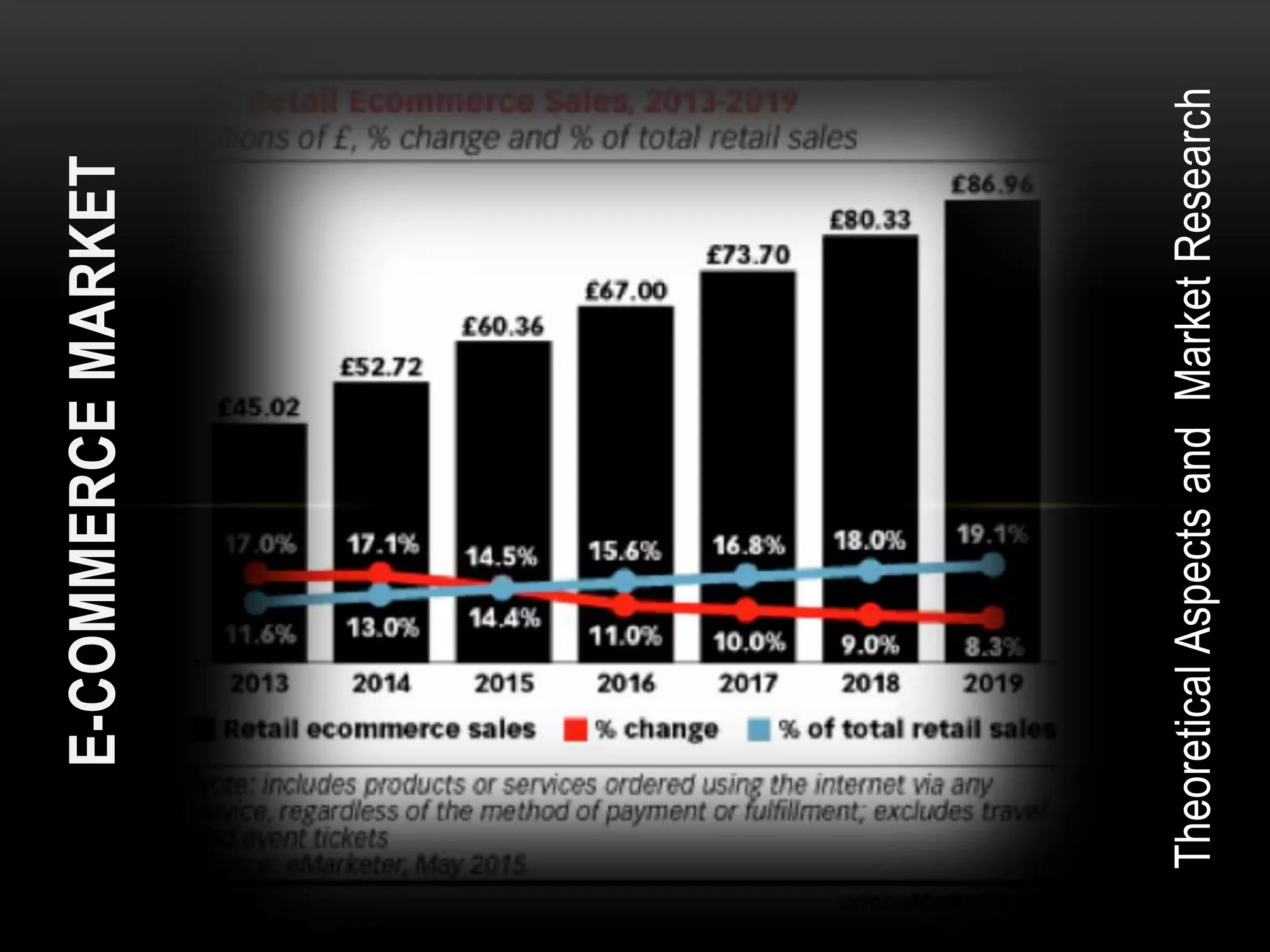
E-COMMERCEMARKET
CONTENT:
2
Theoretical Aspects of
Ecommerce Market Research of
US Ecommerce Market
GLABEX.COM
THEORETICAL ASPECTS OF US
E-COMMERCE MARKET
3GLABEX.COM
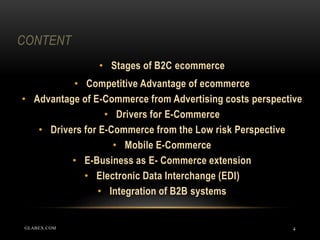
CONTENT
4
• Stages of B2C ecommerce
• Competitive Advantage of ecommerce
• Advantage of E-Commerce from Advertising costs perspective
• Drivers for E-Commerce
• Drivers for E-Commerce from the Low risk Perspective
• Mobile E-Commerce
• E-Business as E- Commerce extension
• Electronic Data Interchange (EDI)
• Integration of B2B systems
GLABEX.COM
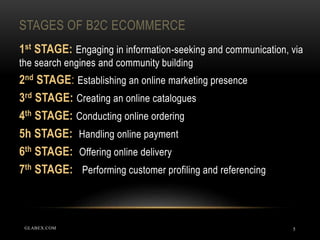
STAGES OF B2C ECOMMERCE
5
1st STAGE: Engaging in information-seeking and communication, via
the search engines and community building
2nd STAGE: Establishing an online marketing presence
3rd STAGE: Creating an online catalogues
4th STAGE: Conducting online ordering
5h STAGE: Handling online payment
6th STAGE: Offering online delivery
7th STAGE: Performing customer profiling and referencing
GLABEX.COM
COMPETITIVE ADVANTAGE OF ECOMMERCE
6
• Price competitiveness
• Timeliness
• Knowledge of Market
• Customer insights
• Social
GLABEX.COM
PRICE COMPETITIVENESS
7
Reduced transaction costs in automated ordering and
invoicing systems can lead to lower prices
GLABEX.COM
TIMELINESS
8
Faster ordering, delivery and invoicing can reduce the time to market for suppliers
Listing, pricing, payment and advertising could be automated
and processed with 1 button click
GLABEX.COM
KNOWLEDGE OF MARKET
9
Trading electronically provides additional methods for companies to acquire knowledge of the
market in which they operate
Access to Analytics
GLABEX.COM
CUSTOMER INFORMATION AND PROFILING
10
Know
WHO WHEN and WHY
GLABEX.COM
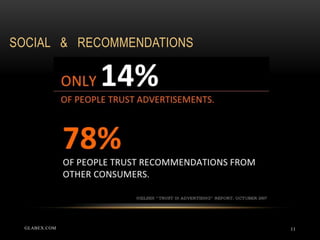
SOCIAL & RECOMMENDATIONS
11GLABEX.COM
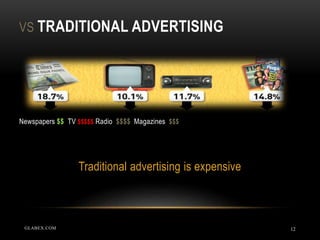
VS TRADITIONAL ADVERTISING
12
Newspapers $$ TV $$$$$ Radio $$$$ Magazines $$$
Traditional advertising is expensive
GLABEX.COM
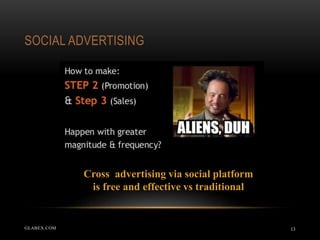
SOCIAL ADVERTISING
13
Cross advertising via social platform
is free and effective vs traditional
GLABEX.COM
EASY ACCESSES FROM ANY DEVICES
NO NEED FOR REBUILDING YOUR WEBSITE
14
Tablets, laptops allow fast access to
E-Business platform
GLABEX.COM
NON STOP WORKING
15
Once running, a online profile provides 24/7 access to
your company online presence, products across
GLABEX.COM
CUSTOMIZABLE DESIGN
16
Adopted the creativity and quality of television advertising
Individual design customization is available
Design could be changed as many times as you want
GLABEX.COM
DRIVERS FOR ECOMMERCE
17GLABEX.COM
COST
GLABEX.COM 18
The entry costs for participating in eComrnerce are relatively low.
Systems can be designed and implemented and a web presence can
be established cheaply.
The systems therefore offer a potentially fast return on the
investment.
FLEXIBILITY
GLABEX,COM 19
Organizations can select the appropriate level of participation
from simple access to the Internet through the creation of a Web
presence to full-blown transaction-handling systems.
The systems can be developed incrementally to add this
additional functionality.
DRIVERS FOR ECOMMERCE FROM THE LOW RISK
PERSPECTIVE
GLABEX.COM 20
 Protecting investment: In the Internet world, many common and open standards are
employed. The switching costs incurred when a business selects an alternative system
are, as a result, relatively low.
 Connectivity and communications opportunities: Internet technology brings an
accompanying range of opportunities, such as creating a local intranet or establishing
video-conferencing links.
 Technology perspectives: A critical mass of e-commerce participants already exists, and
the technology, although constantly developing.
 Government support: There are many government initiatives aimed at promoting e-
commerce, and there is a significant level of activity in educational institutions to provide
additional backup.
 Customer service: Improved customer service promotes relation- ships at a distance, the
Internet does also provide opportunities for businesses to work more closely with
customers.
MOBILE E-COMMERCE
21
Mobile e-commerce is a large opportunity for e-Commerce, but mobile browser sites and poor
apps leave several unmet needs open
 Today, e-commerce is not a popular activity on tablets (even less on mobile phones), rated as
one of the lowest use cases in surveys
 Tablet usage is still in early stages, and consumers are focusing on core use cases (e.g.,
reading, gaming) over other use cases more prevalent on PC
 E-commerce companies are not investing heavily in mobile, and so the experience on tablets
is subject to poor browser experience or uninventive one-off apps, and the lack of a hard
keyboard makes the check-out process cumbersome
In the current app-heavy environment, the need to download multiple apps from each e-
commerce retailer a user likes is cumbersome
To help solve the problems in mobile e-commerce, a few companies have quietly released early-
stage apps in 2011. They aggregate several retailers’ offline catalogs into one downloadable
app, and users can peruse catalogs, click-through to buy on retailers’ sites, and bookmark
favorite products
Source: http://www.slideshare.net/joshyang/ecommerce-landscape-2012#btnNext
EBUSINESS
GLABEX.COM 22
• Internet technology has fundamentally changed the environment
and structure of business. The marketplace for all vendors has
become potentially global;
• Execution and settlement of transactions can easily be
automated for small as well as large organizations. The trading
model has moved from 'normal business opening hours' to a 24
hours a day, seven days a week trading model;
• The interconnections throughout the supply chain are being
reconfigured.
EBUSINESS AS ECOMMERCE EXTENSION
GLABEX.COM 23
Organizational activity within electronic hierarchies, markets or
networks normally referred to as eBusiness or eCommerce.
eBusiness can be seen as a Superset of eCommerce.
eBusiness can be seen as the application of ICT in support
of all activities undertaken by a commercial organization.
eCommerce focuses on the use of ICT to enable the external
activities and relationships with individuals, groups and other
businesses.
ELECTRONIC DATA INTERCHANGE (EDI)
GLABEX.COM 24
• Companies, in their regular dealings with other trading partners,
such as suppliers and retail outlets, might establish electronic
communications to process the volume of transactions carried
out;
• EDI provides a standard protocol for encoding this data
exchange;
INTEGRATION OF B2B
GLABEX.COM 25
SystemsB2B eCommerce is an extension of the informatics
infrastructure of commercial organizations
- Such information systems are supplier-facing
Purchase order processing and payment processing systems
handle the settlement and execution stages of the commerce
cycle
- These information systems are an established part of the IS
infrastructure of most medium to large organizations,
Could be established and standardized for all organizations.
Such standardized system can enrich and simplify the majority of
B2B interrelations.
INTEGRATION OF B2B SYSTEMS
GLABEX,COM 26
• Pre-sale and after-sale stages of the commerce cycle have been the
most open to innovation in B2B eCommerce
• Requisitioning, request for quote and vendor selection are part of a
supplier relationship management information system
• Area in which most of the discussion of B2B eCommerce occurs.
• Procurement is the pre-sale activity of search, negotiate and order in the
supply chain Sometimes the term is used to refer to all the activities
involved in the supply chain
• It is an important business process in the value chain and involves the
purchasing of goods and services from suppliers at an acceptable
quality and price and with reliable delivery
MARKET RESEARCH OF US ECOMMERCE
MARKET WITH EXAMPLES
GLABEX.COM 27
CONTENTS:
28
 US E-Commerce Market;
 U.S. E-Commerce Market (2012-15) Chart;
 US E-Commerce Shopping Data (2011-13);
 Shift from physical stores to online stores;
 New Business Models;
 Planned purchases vs Impulse purchases business models;
 Survived eCommerce business models;
 New E-Commerce businesses;
 Not many new businesses are applied for Mass Market;
 UI features enrich customer experience and drive sales;
 Recent Trends in E-Commerce Business models
• Social Commerce;
• The Group buying / Couponing space;
• Flesh Sales;
• Recommendations;
• Personalization;
• Customization;
 C2C MarketPlaces
 C2C MarketPlaces Difficulties;
 Online Brands. Online Retail Models;
 Start-ups examples of Online Brands.
US E-COMMERCE MARKET
GLABEX,CIN 29
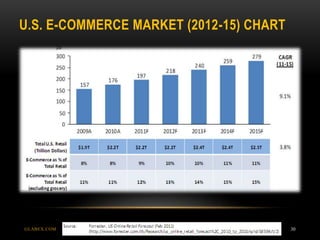
The U.S. e-commerce market is big ($200B+), getting bigger (9% CAGR through 2015), and still
early (only 9% of total retail) . Online shoppers in the United States will spend $327 billion in
2016, up 45% from $226 billion this year and 62% from $202 billion in 2011, according to a
projection released today by Forrester Research Inc. Market growth has been driven by
consumers becoming increasingly Internet-connected and credit card holding, and these
consumers being increasingly open to purchasing online:
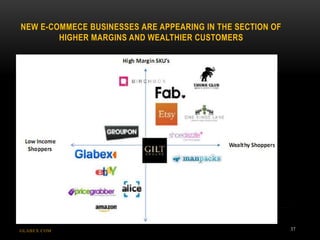
 In the last two years, several new business models have garnered VC attention and begun to
scale (e.g., group buying, flash sales, subscription, online brands);
 Consumers have shown willingness to test new e-commerce business models (such as
Fancy, ShoeDazzle, RenttheRunway, Gilt), but these are targeted primarily to wealthier
consumers;
U.S. E-COMMERCE MARKET (2012-15) CHART
GLABEX.COM 30
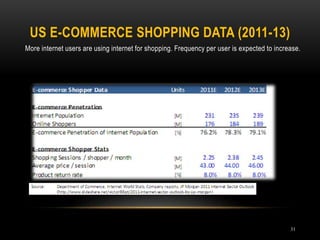
US E-COMMERCE SHOPPING DATA (2011-13)
31
More internet users are using internet for shopping. Frequency per user is expected to increase.
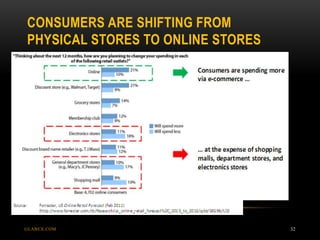
CONSUMERS ARE SHIFTING FROM
PHYSICAL STORES TO ONLINE STORES
GLABEX.COM 32
NEW BUSINESS MODELS
GLABEX.COM 33
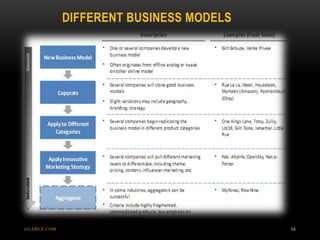
The only new e-commerce business model that has gained significant traction
with the mass consumer is group buying, - Groupon, LivingSocial ; many existing
well established companies have started to offer group buying.
There is also room for companies to clone or apply existing business models as
well as for new business models:
 Clones models are creating new product categories, and/or target to different
customer segments (e.g., low-end vs. high-end, male vs. female);
 New business models are customer personalization, companies like Trunk
Club and online brands like Warby Parker continue to bring offline models
into existence online.
Start-ups often take existing business models and apply a marketing pivot or
alternate strategy.
DIFFERENT BUSINESS MODELS
GLABEX.COM 34
PLANNED PURCHASES VS IMPULSE PURCHASES BUSINESS
MODELS
GLABEX.COM 35
1. Planned purchases business models make up the majority of
retail spend historically, older companies like Amazon seems to
have locked up planned purchasing on the web, as this revolves
more around search and catalog layouts than email digests.
2. Impulse E-commerce business models usually don’t provide real
long-term value to consumers. These models do not meet consumer
disenchantment and end up as just a passing trend. In general, the
newer business models that have emerged are subscription, C2C
marketplaces, flash sales. They are tend to be focused on impulse
purchases. Impulse purchases generally have higher rates of regret
after purchase and more returns.
TWO NEW BUSINESS MODELS WHICH SURVIVED
GLABEX.COM 36
1. Online brands are simply new brands/ or existing ones that have chosen online as the
marketing channel of choice over offline. Barriers to entry in online brands includes the
expertise required to build a vertically integrated supply chain, e-Commerce platform,
and user friendly interface.
2. Crowdsourced demand start-ups (e.g., Modcloth) also rely less on impulse
purchases, as do social bookmarking start-ups like Pinterest, where users create
product wishlists for “buy later”.
NEW E-COMMECE BUSINESSES ARE APPEARING IN THE SECTION OF
HIGHER MARGINS AND WEALTHIER CUSTOMERS
GLABEX.COM 37
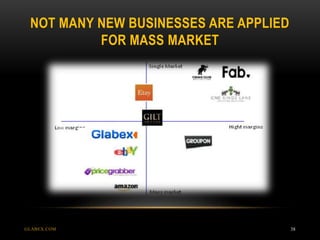
NOT MANY NEW BUSINESSES ARE APPLIED
FOR MASS MARKET
GLABEX.COM 38
UI FEATURES ENRICH CUSTOMER EXPERIENCE
AND DRIVE SALES
39
Forrester Research report says that much of the growth in U.S.
e-commerce sales comes from improved, advanced online
retailers web sites and services: “This is particularly true of
categories such as apparel and jewelry, which have integrated
rich selling tools such as zoom, color switching, and
configurations, as well as office supply stores, which have
broader payment options (e.g., small business purchase orders
online) and subscription plans for their buyers” (1)
(1) www.forrester.com
RECENT TRENDS IN E-COMMERCE BUSINESS
MODELS
GLABEX.COM 40
• Social Bookmarking, Analytics, Seeds, Commerce;
• Group Buying;
• Flesh Sales;
• Recommendations;
• Personalization;
• Customization;
• C2C MarketPlace;
• Online Brands;
• Mobile E-Commerce
SOCIAL COMMERCE
GLABEX.COM 41
• eBay is working on product recommendations based on Facebook data (acquired
Hunch) and a feature allowing users to solicit feedback from Facebook friends prior to
purchase; (1,2)
• Walmart makes an effort in social E-Commerce. Walmart has 22 million Facebook fans
and an innovative social media contest called "Get on the Shelf," that allowed Facebook
fans to vote for products they wanted to see offered at Walmart. The company is
leveraging advanced analytics to glean new insights from Twitter and Facebook data
streams. (3)
• The latest in-depth report from Nielsen concluded that: “Consumers continue to spend
more time on social networks than on any other category of sites—roughly 20% of their
total time online via personal computer (PC), and 30% of total time online via
mobile. Additionally, total time spent on social media in the U.S. across PCs and mobile
devices increased 37% to 121 billion minutes in July 2012, compared to 88 billion in July
2011.” (4)
(1) http://techcrunch.com/2011/05/15/connecting-the-dots-on-ebays-local-shopping-strategy/
(2) http://techcrunch.com/2011/06/15/milo-fetch-allows-local-retailers-to-upload-their-inventory-to-ebay/
(3) http://www.retailingtoday.com/article/walmart-touts-e-commerce-moves-annual-meeting
(4) Nielsen Consumer report for 2012
THE GROUP BUYING / COUPONING SPACE
42
Now, the group buying industry is facing rising disenchantment, both from
customers and merchants:
Reasons -
• Merchants complain that the long-term economics of doing group buying is not favorable, as Groupon does little for
customer retention;
• Groupon takes 50% of companies’ profit for their service of presenting deals online;
• Customers buying impulsively often don’t end up using the coupons, resulting in ~20% breakage upon expiry;
• Some customers buy and sell in second-hand markets, but 75% either breakeven or lose money on these deals
Daily deals sites have struggled to organically retain customers, and many have spent enormous amounts on
customer acquisition and are now struggling with profitability:
• According to Yipit, one-third of tracked daily-deal sites (170 of 530) have been shut down or sold so far in 2011
• Facebook launched a daily deals service in April of 2011, and then shut down it in August;
• Yelp cut its daily deals product team by half in August, citing users being unhappy with Yelp Deals;
Source: http://online.wsj.com/article/SB10001424053111904491704576575233025971542.html
FLESH SALES
43
 The flash sales model is under pressure on the supply side, as remnant inventory
levels are decreasing;
 While todays flash sales leaders (e.g., Gilt, Hautelook, Vente Privee) have grown
their businesses by selling luxury retailers remnant inventory, today they are looking
to change business models as unsold inventory supplies are lower;
 Gilt and competitors rode the wave of obscenely high inventory levels during the
recession (up to 10x normal levels, according to a former executive of Nieman
Marcus), but retailers have adjusted and inventory levels are going down –
Therefore, as flash sales supply is decreasing, supplies prices are increasing and
flash sales discounts are decreasing (Gilts average discount has decreased from
70% to 40-50%.
RECOMMENDATIONS
GLABEX.COM
44
 Product recommendation works particularly well in the fashion category as it
recognizes shopper behavior, patterns and recommends items of interest not only by
product type, but by brand as well;
 Recommendations could be integrated into social media, so recommendations can
take into account what the customer's friends have bought or viewed;
 This takes into account not only what the individual customer is doing on the site at
that moment in time, but what other shoppers who are similar in product views have
done before;
 Personal recommendations are the number one driver of consumer purchase
decisions at every stage in the purchase cycle across 10 product categories studied,
from banking to vacation travel and from subscription entertainment to retail
categories, such as apparel and personal are products.
(1) Source: http://econsultancy.com/us/blog/8904-recommendations-help-drive-27-9-holiday-sales-growth-at-john-lewis
(2) Source: http://www.forbes.com/sites/kellerfaygroup/2012/07/25/recommendations-are-what-drives-your-business-remember-to-
ask-for-them/
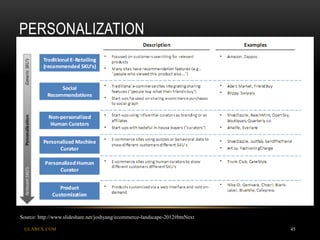
PERSONALIZATION
GLABEX.COM 45
Source: http://www.slideshare.net/joshyang/ecommerce-landscape-2012#btnNext
CUSTOMIZATION
GLABEX.COM 46
Customization has slowed as a trend, as the model has generally failed to gain traction and prove scalability
 Co-creation e-commerce isn’t new but has begun to enter the mainstream recently
 Co-creation sites allow consumers to design their own products for purchase and/or buy products others have
 Co-creation companies typically become cash-flow positive quickly because customized products sell at a
premium and are sold on-demand (i.e., there is no excess inventory)
 To date, start-ups riding the co-creation wave have primarily been e-commerce destination sites focused on a
particular product category (or group of categories), and employ one or more of several business models:
Several models exist:
1. Consumers design, then buy their own products (e.g., NikeID, BlueNile, Chocri, Blank-Label, Shirtsmyway,
etc.)
2. Consumers buy products designed by other consumers or indie designers (e.g., MyFab, ModCloth,
Threadless, etc.)
3. Consumers connect with manufacturers and co-design offline
Two problems the co-creation market faces today are scalability and design-manufacturing accuracy :
1. Scalability. Companies will need to be creative about how to scale their businesses as consumer demand
increases, since it will be harder for manufacturing to benefit from economies of scale
2. Design-manufacturing accuracy. Despite strong user interfaces allowing users to design their own products, a
fraction of users will be dissatisfied with how the product actually turns out (i.e., requires stronger, more
accurate UIs)
Source:
1) http://www.readwriteweb.com/start/2010/03/is-america-on-the-verge-of-a-co-creation-invasion.php
2) http://www.crunchgear.com/2010/07/21/new-wave-of-web-services-brings-customization-to-commerce
C2C MARKETPLACES
GLABEX.COM 47
Online C2C marketplaces can be broadly segmented into three buckets:
 Hard good purchases (e.g., eBay),
 Hard good rentals (AirBnB), and
 Services (Skillshare)
Traditionally, eBay is the preeminent online C2C marketplace and facilitated transactions on hard
good purchases. There are not major direct competitors doe eBay while niche players like Etsy
targeted only hand-crafted goods.
Meanwhile, Craigslist has traditionally served as the go-to portal for consumers looking for hard
good rentals/purchases and services online, but it does not offer money transactions, which
make the purchase process more complex.
C2C MARKETPLACES DIFFICULTIES
GLABEX.COM 48
Traditional models of online marketplaces (or intermediate solutions like Craigslist) leave
many unmet needs, which many start-ups are tackling but few have perfected.
Reasons:
1) Seller’s time spent uploading product information;
2) Trust in sellers shipping on- time (or at all);
3) Inaccurate representation of product quality / condition;
4) Rentals: Trust in both buyers and sellers, ease of working with insurance companies;
5) Services: safety and trust in sellers, ability of relationships to be taken offline after initial
transaction.
ONLINE BRANDS. ONLINE RETAIL MODELS.
GLABEX.COM 49
“Online brands” have grown in recent years, as consumers become more
comfortable discovering new products online. Online brands are start-up product
brands (typically apparel) that have decided to leverage the Internet as a channel
over traditional offline retail.
1. Brands have only recently been able to grow a large enough presence and
scale quickly using online as the channel instead of offline, due to the
proliferation of social media;
2. Key benefits for brands going online include ability to get consumer feedback
prior to production and better margins than offline retail, but requires
marketing and production competency;
3. Bonobos, ModCloth, 20x200, and Warby Parker are brands that have largely
begun online and gone mainstream.
Sources: http://www.slideshare.net/joshyang/ecommerce-landscape-2012#btnNext
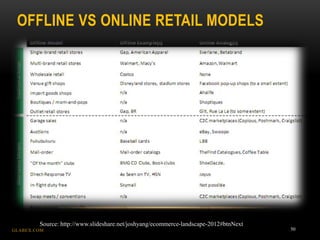
OFFLINE VS ONLINE RETAIL MODELS
GLABEX.COM 50
Source: http://www.slideshare.net/joshyang/ecommerce-landscape-2012#btnNext
START-UPS EXAMPLES OF ONLINE BRANDS
GLABEX.COM 51
 Net-a-Porter just partnered with Karl Lagerfeld to launch a new online fashion brand
called Karl
 Everlane has not even launched publicly (as of Nov 2011) and has generated a lot of
hype in Silicon Valley
 Betabrand is trying to bring the H&M model online, iterating quickly on new 4-6 new
SKU’s per month and introducing them in small batch sizes. They also crowdsource
design ideas
 WildFox, Nau, and Eliza Parker are just a few in a long list of smaller up-starts
There is also opportunity for influential online content producers (e.g., bloggers,
Youtube celebs) to pivot into manufacturing products, but many of these creative
people are scared off by the complexity of manufacturing operations
52
GLABEX.COM

E commerce market research

  • 1.
  • 2.
    CONTENT: 2 Theoretical Aspects of EcommerceMarket Research of US Ecommerce Market GLABEX.COM
  • 3.
    THEORETICAL ASPECTS OFUS E-COMMERCE MARKET 3GLABEX.COM
  • 4.
    CONTENT 4 • Stages ofB2C ecommerce • Competitive Advantage of ecommerce • Advantage of E-Commerce from Advertising costs perspective • Drivers for E-Commerce • Drivers for E-Commerce from the Low risk Perspective • Mobile E-Commerce • E-Business as E- Commerce extension • Electronic Data Interchange (EDI) • Integration of B2B systems GLABEX.COM
  • 5.
    STAGES OF B2CECOMMERCE 5 1st STAGE: Engaging in information-seeking and communication, via the search engines and community building 2nd STAGE: Establishing an online marketing presence 3rd STAGE: Creating an online catalogues 4th STAGE: Conducting online ordering 5h STAGE: Handling online payment 6th STAGE: Offering online delivery 7th STAGE: Performing customer profiling and referencing GLABEX.COM
  • 6.
    COMPETITIVE ADVANTAGE OFECOMMERCE 6 • Price competitiveness • Timeliness • Knowledge of Market • Customer insights • Social GLABEX.COM
  • 7.
    PRICE COMPETITIVENESS 7 Reduced transactioncosts in automated ordering and invoicing systems can lead to lower prices GLABEX.COM
  • 8.
    TIMELINESS 8 Faster ordering, deliveryand invoicing can reduce the time to market for suppliers Listing, pricing, payment and advertising could be automated and processed with 1 button click GLABEX.COM
  • 9.
    KNOWLEDGE OF MARKET 9 Tradingelectronically provides additional methods for companies to acquire knowledge of the market in which they operate Access to Analytics GLABEX.COM
  • 10.
    CUSTOMER INFORMATION ANDPROFILING 10 Know WHO WHEN and WHY GLABEX.COM
  • 11.
  • 12.
    VS TRADITIONAL ADVERTISING 12 Newspapers$$ TV $$$$$ Radio $$$$ Magazines $$$ Traditional advertising is expensive GLABEX.COM
  • 13.
    SOCIAL ADVERTISING 13 Cross advertisingvia social platform is free and effective vs traditional GLABEX.COM
  • 14.
    EASY ACCESSES FROMANY DEVICES NO NEED FOR REBUILDING YOUR WEBSITE 14 Tablets, laptops allow fast access to E-Business platform GLABEX.COM
  • 15.
    NON STOP WORKING 15 Oncerunning, a online profile provides 24/7 access to your company online presence, products across GLABEX.COM
  • 16.
    CUSTOMIZABLE DESIGN 16 Adopted thecreativity and quality of television advertising Individual design customization is available Design could be changed as many times as you want GLABEX.COM
  • 17.
  • 18.
    COST GLABEX.COM 18 The entrycosts for participating in eComrnerce are relatively low. Systems can be designed and implemented and a web presence can be established cheaply. The systems therefore offer a potentially fast return on the investment.
  • 19.
    FLEXIBILITY GLABEX,COM 19 Organizations canselect the appropriate level of participation from simple access to the Internet through the creation of a Web presence to full-blown transaction-handling systems. The systems can be developed incrementally to add this additional functionality.
  • 20.
    DRIVERS FOR ECOMMERCEFROM THE LOW RISK PERSPECTIVE GLABEX.COM 20  Protecting investment: In the Internet world, many common and open standards are employed. The switching costs incurred when a business selects an alternative system are, as a result, relatively low.  Connectivity and communications opportunities: Internet technology brings an accompanying range of opportunities, such as creating a local intranet or establishing video-conferencing links.  Technology perspectives: A critical mass of e-commerce participants already exists, and the technology, although constantly developing.  Government support: There are many government initiatives aimed at promoting e- commerce, and there is a significant level of activity in educational institutions to provide additional backup.  Customer service: Improved customer service promotes relation- ships at a distance, the Internet does also provide opportunities for businesses to work more closely with customers.
  • 21.
    MOBILE E-COMMERCE 21 Mobile e-commerceis a large opportunity for e-Commerce, but mobile browser sites and poor apps leave several unmet needs open  Today, e-commerce is not a popular activity on tablets (even less on mobile phones), rated as one of the lowest use cases in surveys  Tablet usage is still in early stages, and consumers are focusing on core use cases (e.g., reading, gaming) over other use cases more prevalent on PC  E-commerce companies are not investing heavily in mobile, and so the experience on tablets is subject to poor browser experience or uninventive one-off apps, and the lack of a hard keyboard makes the check-out process cumbersome In the current app-heavy environment, the need to download multiple apps from each e- commerce retailer a user likes is cumbersome To help solve the problems in mobile e-commerce, a few companies have quietly released early- stage apps in 2011. They aggregate several retailers’ offline catalogs into one downloadable app, and users can peruse catalogs, click-through to buy on retailers’ sites, and bookmark favorite products Source: http://www.slideshare.net/joshyang/ecommerce-landscape-2012#btnNext
  • 22.
    EBUSINESS GLABEX.COM 22 • Internettechnology has fundamentally changed the environment and structure of business. The marketplace for all vendors has become potentially global; • Execution and settlement of transactions can easily be automated for small as well as large organizations. The trading model has moved from 'normal business opening hours' to a 24 hours a day, seven days a week trading model; • The interconnections throughout the supply chain are being reconfigured.
  • 23.
    EBUSINESS AS ECOMMERCEEXTENSION GLABEX.COM 23 Organizational activity within electronic hierarchies, markets or networks normally referred to as eBusiness or eCommerce. eBusiness can be seen as a Superset of eCommerce. eBusiness can be seen as the application of ICT in support of all activities undertaken by a commercial organization. eCommerce focuses on the use of ICT to enable the external activities and relationships with individuals, groups and other businesses.
  • 24.
    ELECTRONIC DATA INTERCHANGE(EDI) GLABEX.COM 24 • Companies, in their regular dealings with other trading partners, such as suppliers and retail outlets, might establish electronic communications to process the volume of transactions carried out; • EDI provides a standard protocol for encoding this data exchange;
  • 25.
    INTEGRATION OF B2B GLABEX.COM25 SystemsB2B eCommerce is an extension of the informatics infrastructure of commercial organizations - Such information systems are supplier-facing Purchase order processing and payment processing systems handle the settlement and execution stages of the commerce cycle - These information systems are an established part of the IS infrastructure of most medium to large organizations, Could be established and standardized for all organizations. Such standardized system can enrich and simplify the majority of B2B interrelations.
  • 26.
    INTEGRATION OF B2BSYSTEMS GLABEX,COM 26 • Pre-sale and after-sale stages of the commerce cycle have been the most open to innovation in B2B eCommerce • Requisitioning, request for quote and vendor selection are part of a supplier relationship management information system • Area in which most of the discussion of B2B eCommerce occurs. • Procurement is the pre-sale activity of search, negotiate and order in the supply chain Sometimes the term is used to refer to all the activities involved in the supply chain • It is an important business process in the value chain and involves the purchasing of goods and services from suppliers at an acceptable quality and price and with reliable delivery
  • 27.
    MARKET RESEARCH OFUS ECOMMERCE MARKET WITH EXAMPLES GLABEX.COM 27
  • 28.
    CONTENTS: 28  US E-CommerceMarket;  U.S. E-Commerce Market (2012-15) Chart;  US E-Commerce Shopping Data (2011-13);  Shift from physical stores to online stores;  New Business Models;  Planned purchases vs Impulse purchases business models;  Survived eCommerce business models;  New E-Commerce businesses;  Not many new businesses are applied for Mass Market;  UI features enrich customer experience and drive sales;  Recent Trends in E-Commerce Business models • Social Commerce; • The Group buying / Couponing space; • Flesh Sales; • Recommendations; • Personalization; • Customization;  C2C MarketPlaces  C2C MarketPlaces Difficulties;  Online Brands. Online Retail Models;  Start-ups examples of Online Brands.
  • 29.
    US E-COMMERCE MARKET GLABEX,CIN29 The U.S. e-commerce market is big ($200B+), getting bigger (9% CAGR through 2015), and still early (only 9% of total retail) . Online shoppers in the United States will spend $327 billion in 2016, up 45% from $226 billion this year and 62% from $202 billion in 2011, according to a projection released today by Forrester Research Inc. Market growth has been driven by consumers becoming increasingly Internet-connected and credit card holding, and these consumers being increasingly open to purchasing online:  In the last two years, several new business models have garnered VC attention and begun to scale (e.g., group buying, flash sales, subscription, online brands);  Consumers have shown willingness to test new e-commerce business models (such as Fancy, ShoeDazzle, RenttheRunway, Gilt), but these are targeted primarily to wealthier consumers;
  • 30.
    U.S. E-COMMERCE MARKET(2012-15) CHART GLABEX.COM 30
  • 31.
    US E-COMMERCE SHOPPINGDATA (2011-13) 31 More internet users are using internet for shopping. Frequency per user is expected to increase.
  • 32.
    CONSUMERS ARE SHIFTINGFROM PHYSICAL STORES TO ONLINE STORES GLABEX.COM 32
  • 33.
    NEW BUSINESS MODELS GLABEX.COM33 The only new e-commerce business model that has gained significant traction with the mass consumer is group buying, - Groupon, LivingSocial ; many existing well established companies have started to offer group buying. There is also room for companies to clone or apply existing business models as well as for new business models:  Clones models are creating new product categories, and/or target to different customer segments (e.g., low-end vs. high-end, male vs. female);  New business models are customer personalization, companies like Trunk Club and online brands like Warby Parker continue to bring offline models into existence online. Start-ups often take existing business models and apply a marketing pivot or alternate strategy.
  • 34.
  • 35.
    PLANNED PURCHASES VSIMPULSE PURCHASES BUSINESS MODELS GLABEX.COM 35 1. Planned purchases business models make up the majority of retail spend historically, older companies like Amazon seems to have locked up planned purchasing on the web, as this revolves more around search and catalog layouts than email digests. 2. Impulse E-commerce business models usually don’t provide real long-term value to consumers. These models do not meet consumer disenchantment and end up as just a passing trend. In general, the newer business models that have emerged are subscription, C2C marketplaces, flash sales. They are tend to be focused on impulse purchases. Impulse purchases generally have higher rates of regret after purchase and more returns.
  • 36.
    TWO NEW BUSINESSMODELS WHICH SURVIVED GLABEX.COM 36 1. Online brands are simply new brands/ or existing ones that have chosen online as the marketing channel of choice over offline. Barriers to entry in online brands includes the expertise required to build a vertically integrated supply chain, e-Commerce platform, and user friendly interface. 2. Crowdsourced demand start-ups (e.g., Modcloth) also rely less on impulse purchases, as do social bookmarking start-ups like Pinterest, where users create product wishlists for “buy later”.
  • 37.
    NEW E-COMMECE BUSINESSESARE APPEARING IN THE SECTION OF HIGHER MARGINS AND WEALTHIER CUSTOMERS GLABEX.COM 37
  • 38.
    NOT MANY NEWBUSINESSES ARE APPLIED FOR MASS MARKET GLABEX.COM 38
  • 39.
    UI FEATURES ENRICHCUSTOMER EXPERIENCE AND DRIVE SALES 39 Forrester Research report says that much of the growth in U.S. e-commerce sales comes from improved, advanced online retailers web sites and services: “This is particularly true of categories such as apparel and jewelry, which have integrated rich selling tools such as zoom, color switching, and configurations, as well as office supply stores, which have broader payment options (e.g., small business purchase orders online) and subscription plans for their buyers” (1) (1) www.forrester.com
  • 40.
    RECENT TRENDS INE-COMMERCE BUSINESS MODELS GLABEX.COM 40 • Social Bookmarking, Analytics, Seeds, Commerce; • Group Buying; • Flesh Sales; • Recommendations; • Personalization; • Customization; • C2C MarketPlace; • Online Brands; • Mobile E-Commerce
  • 41.
    SOCIAL COMMERCE GLABEX.COM 41 •eBay is working on product recommendations based on Facebook data (acquired Hunch) and a feature allowing users to solicit feedback from Facebook friends prior to purchase; (1,2) • Walmart makes an effort in social E-Commerce. Walmart has 22 million Facebook fans and an innovative social media contest called "Get on the Shelf," that allowed Facebook fans to vote for products they wanted to see offered at Walmart. The company is leveraging advanced analytics to glean new insights from Twitter and Facebook data streams. (3) • The latest in-depth report from Nielsen concluded that: “Consumers continue to spend more time on social networks than on any other category of sites—roughly 20% of their total time online via personal computer (PC), and 30% of total time online via mobile. Additionally, total time spent on social media in the U.S. across PCs and mobile devices increased 37% to 121 billion minutes in July 2012, compared to 88 billion in July 2011.” (4) (1) http://techcrunch.com/2011/05/15/connecting-the-dots-on-ebays-local-shopping-strategy/ (2) http://techcrunch.com/2011/06/15/milo-fetch-allows-local-retailers-to-upload-their-inventory-to-ebay/ (3) http://www.retailingtoday.com/article/walmart-touts-e-commerce-moves-annual-meeting (4) Nielsen Consumer report for 2012
  • 42.
    THE GROUP BUYING/ COUPONING SPACE 42 Now, the group buying industry is facing rising disenchantment, both from customers and merchants: Reasons - • Merchants complain that the long-term economics of doing group buying is not favorable, as Groupon does little for customer retention; • Groupon takes 50% of companies’ profit for their service of presenting deals online; • Customers buying impulsively often don’t end up using the coupons, resulting in ~20% breakage upon expiry; • Some customers buy and sell in second-hand markets, but 75% either breakeven or lose money on these deals Daily deals sites have struggled to organically retain customers, and many have spent enormous amounts on customer acquisition and are now struggling with profitability: • According to Yipit, one-third of tracked daily-deal sites (170 of 530) have been shut down or sold so far in 2011 • Facebook launched a daily deals service in April of 2011, and then shut down it in August; • Yelp cut its daily deals product team by half in August, citing users being unhappy with Yelp Deals; Source: http://online.wsj.com/article/SB10001424053111904491704576575233025971542.html
  • 43.
    FLESH SALES 43  Theflash sales model is under pressure on the supply side, as remnant inventory levels are decreasing;  While todays flash sales leaders (e.g., Gilt, Hautelook, Vente Privee) have grown their businesses by selling luxury retailers remnant inventory, today they are looking to change business models as unsold inventory supplies are lower;  Gilt and competitors rode the wave of obscenely high inventory levels during the recession (up to 10x normal levels, according to a former executive of Nieman Marcus), but retailers have adjusted and inventory levels are going down – Therefore, as flash sales supply is decreasing, supplies prices are increasing and flash sales discounts are decreasing (Gilts average discount has decreased from 70% to 40-50%.
  • 44.
    RECOMMENDATIONS GLABEX.COM 44  Product recommendationworks particularly well in the fashion category as it recognizes shopper behavior, patterns and recommends items of interest not only by product type, but by brand as well;  Recommendations could be integrated into social media, so recommendations can take into account what the customer's friends have bought or viewed;  This takes into account not only what the individual customer is doing on the site at that moment in time, but what other shoppers who are similar in product views have done before;  Personal recommendations are the number one driver of consumer purchase decisions at every stage in the purchase cycle across 10 product categories studied, from banking to vacation travel and from subscription entertainment to retail categories, such as apparel and personal are products. (1) Source: http://econsultancy.com/us/blog/8904-recommendations-help-drive-27-9-holiday-sales-growth-at-john-lewis (2) Source: http://www.forbes.com/sites/kellerfaygroup/2012/07/25/recommendations-are-what-drives-your-business-remember-to- ask-for-them/
  • 45.
  • 46.
    CUSTOMIZATION GLABEX.COM 46 Customization hasslowed as a trend, as the model has generally failed to gain traction and prove scalability  Co-creation e-commerce isn’t new but has begun to enter the mainstream recently  Co-creation sites allow consumers to design their own products for purchase and/or buy products others have  Co-creation companies typically become cash-flow positive quickly because customized products sell at a premium and are sold on-demand (i.e., there is no excess inventory)  To date, start-ups riding the co-creation wave have primarily been e-commerce destination sites focused on a particular product category (or group of categories), and employ one or more of several business models: Several models exist: 1. Consumers design, then buy their own products (e.g., NikeID, BlueNile, Chocri, Blank-Label, Shirtsmyway, etc.) 2. Consumers buy products designed by other consumers or indie designers (e.g., MyFab, ModCloth, Threadless, etc.) 3. Consumers connect with manufacturers and co-design offline Two problems the co-creation market faces today are scalability and design-manufacturing accuracy : 1. Scalability. Companies will need to be creative about how to scale their businesses as consumer demand increases, since it will be harder for manufacturing to benefit from economies of scale 2. Design-manufacturing accuracy. Despite strong user interfaces allowing users to design their own products, a fraction of users will be dissatisfied with how the product actually turns out (i.e., requires stronger, more accurate UIs) Source: 1) http://www.readwriteweb.com/start/2010/03/is-america-on-the-verge-of-a-co-creation-invasion.php 2) http://www.crunchgear.com/2010/07/21/new-wave-of-web-services-brings-customization-to-commerce
  • 47.
    C2C MARKETPLACES GLABEX.COM 47 OnlineC2C marketplaces can be broadly segmented into three buckets:  Hard good purchases (e.g., eBay),  Hard good rentals (AirBnB), and  Services (Skillshare) Traditionally, eBay is the preeminent online C2C marketplace and facilitated transactions on hard good purchases. There are not major direct competitors doe eBay while niche players like Etsy targeted only hand-crafted goods. Meanwhile, Craigslist has traditionally served as the go-to portal for consumers looking for hard good rentals/purchases and services online, but it does not offer money transactions, which make the purchase process more complex.
  • 48.
    C2C MARKETPLACES DIFFICULTIES GLABEX.COM48 Traditional models of online marketplaces (or intermediate solutions like Craigslist) leave many unmet needs, which many start-ups are tackling but few have perfected. Reasons: 1) Seller’s time spent uploading product information; 2) Trust in sellers shipping on- time (or at all); 3) Inaccurate representation of product quality / condition; 4) Rentals: Trust in both buyers and sellers, ease of working with insurance companies; 5) Services: safety and trust in sellers, ability of relationships to be taken offline after initial transaction.
  • 49.
    ONLINE BRANDS. ONLINERETAIL MODELS. GLABEX.COM 49 “Online brands” have grown in recent years, as consumers become more comfortable discovering new products online. Online brands are start-up product brands (typically apparel) that have decided to leverage the Internet as a channel over traditional offline retail. 1. Brands have only recently been able to grow a large enough presence and scale quickly using online as the channel instead of offline, due to the proliferation of social media; 2. Key benefits for brands going online include ability to get consumer feedback prior to production and better margins than offline retail, but requires marketing and production competency; 3. Bonobos, ModCloth, 20x200, and Warby Parker are brands that have largely begun online and gone mainstream. Sources: http://www.slideshare.net/joshyang/ecommerce-landscape-2012#btnNext
  • 50.
    OFFLINE VS ONLINERETAIL MODELS GLABEX.COM 50 Source: http://www.slideshare.net/joshyang/ecommerce-landscape-2012#btnNext
  • 51.
    START-UPS EXAMPLES OFONLINE BRANDS GLABEX.COM 51  Net-a-Porter just partnered with Karl Lagerfeld to launch a new online fashion brand called Karl  Everlane has not even launched publicly (as of Nov 2011) and has generated a lot of hype in Silicon Valley  Betabrand is trying to bring the H&M model online, iterating quickly on new 4-6 new SKU’s per month and introducing them in small batch sizes. They also crowdsource design ideas  WildFox, Nau, and Eliza Parker are just a few in a long list of smaller up-starts There is also opportunity for influential online content producers (e.g., bloggers, Youtube celebs) to pivot into manufacturing products, but many of these creative people are scared off by the complexity of manufacturing operations
  • 52.