Electronic Commerce or eCommerce is often misunderstood as buying and
                      selling of goods and services over internet and financial transactions between
                      organizations and customers. Though mostly known, this definition doesn’t
                      cover all the business areas. In broad terms, eCommerce encompasses all
                      transactions that take place electronically – buying, selling,customer
                      service, inventory management, marketing, delivering, pre-sale and post-sales
                      activities.

                      “eCommerce is the exchange of information across electronic networks, at any
What is E-commerce?


                      stage in the supply chain, whether within an organization, between
                      businesses, between businesses and consumers, between the public and private
                      sector, whether paid or unpaid”
                                                                     – Cabinet Office, UK government
The Different perspectives of e-Commerce:
1. A Communication perspective – the delivery of information, product/services or payment by
electronic means.
2. A business process perspective – the application of technology towards the automation of
business transactions and workflows.
3. A service perspective – enabling cost cutting at the same time as increasing the speed and quality
of service delivery.
4. An online perspective – the buying and selling of products and information online.

We can look at those transactions from sell-side and buy-side.
Buy-side e-Commerce – This section involves the supplier, manufacturer, intermediaries and the
organization and its functional units
Sell-side e-Commerce – This section involves interactions between corporates, customers and the
organization.backb

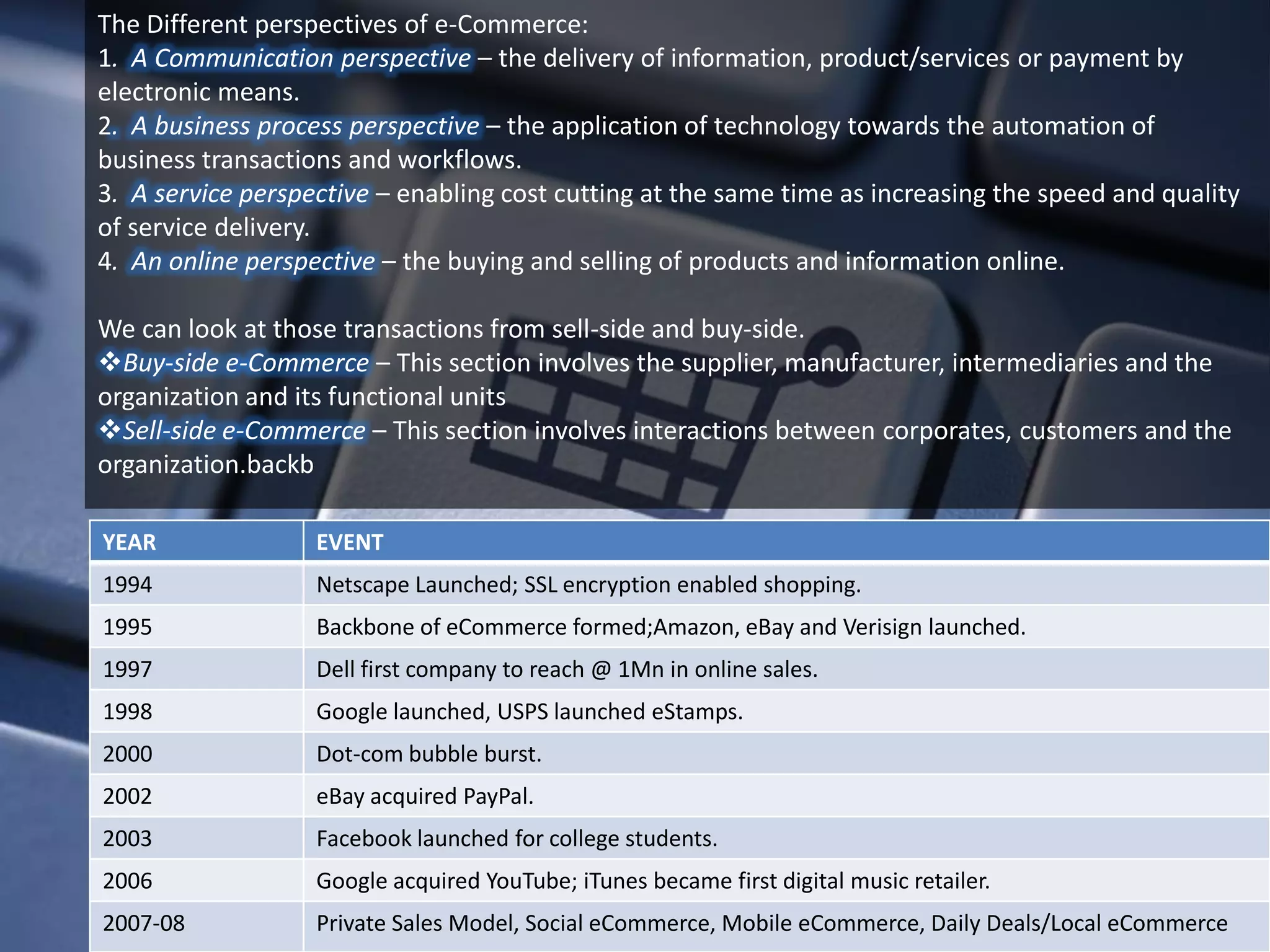
YEAR               EVENT
1994               Netscape Launched; SSL encryption enabled shopping.
1995               Backbone of eCommerce formed;Amazon, eBay and Verisign launched.
1997               Dell first company to reach @ 1Mn in online sales.
1998               Google launched, USPS launched eStamps.
2000               Dot-com bubble burst.
2002               eBay acquired PayPal.
2003               Facebook launched for college students.
2006               Google acquired YouTube; iTunes became first digital music retailer.
2007-08            Private Sales Model, Social eCommerce, Mobile eCommerce, Daily Deals/Local eCommerce
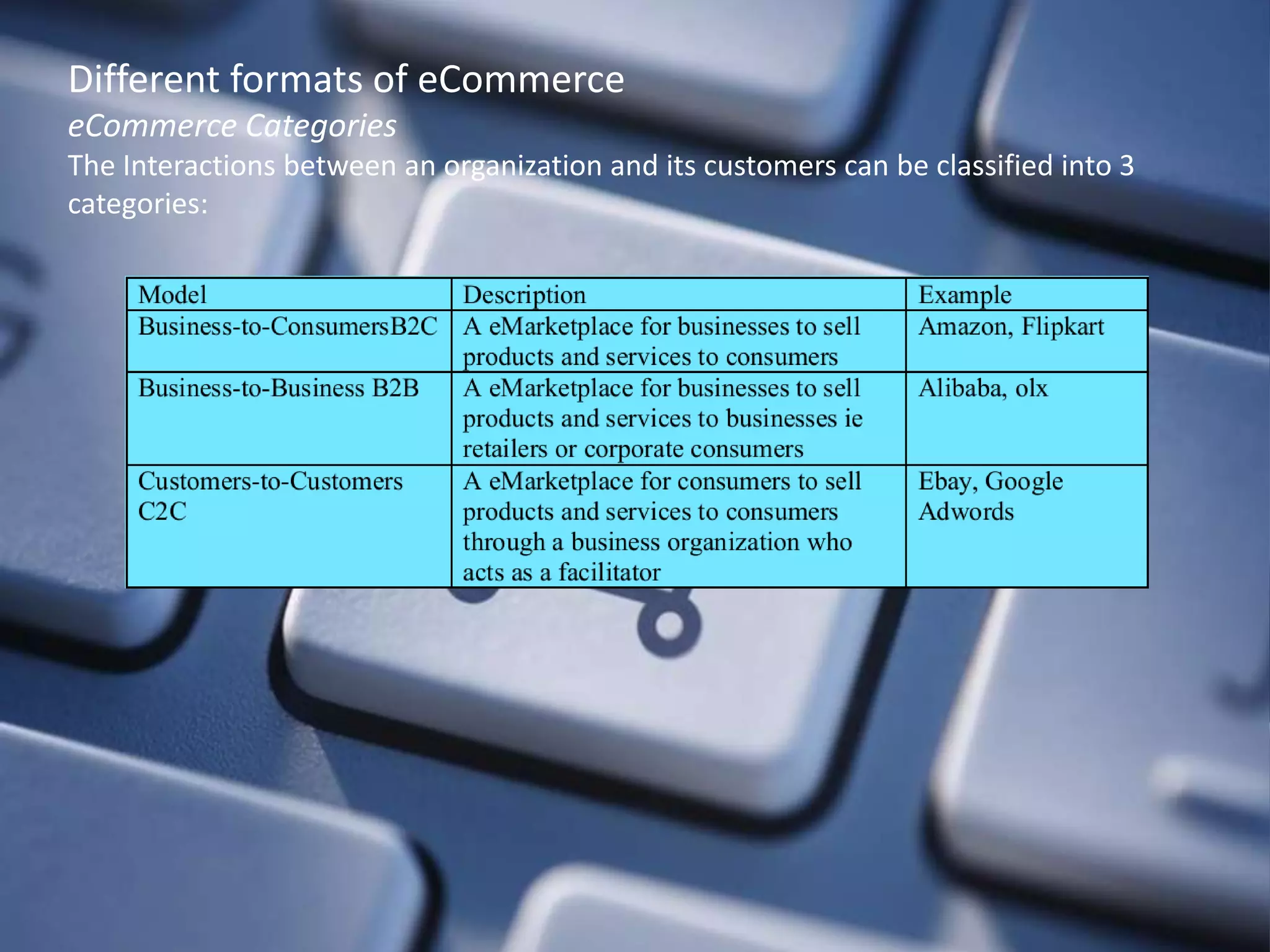
Different formats of eCommerce
eCommerce Categories
The Interactions between an organization and its customers can be classified into 3
categories:
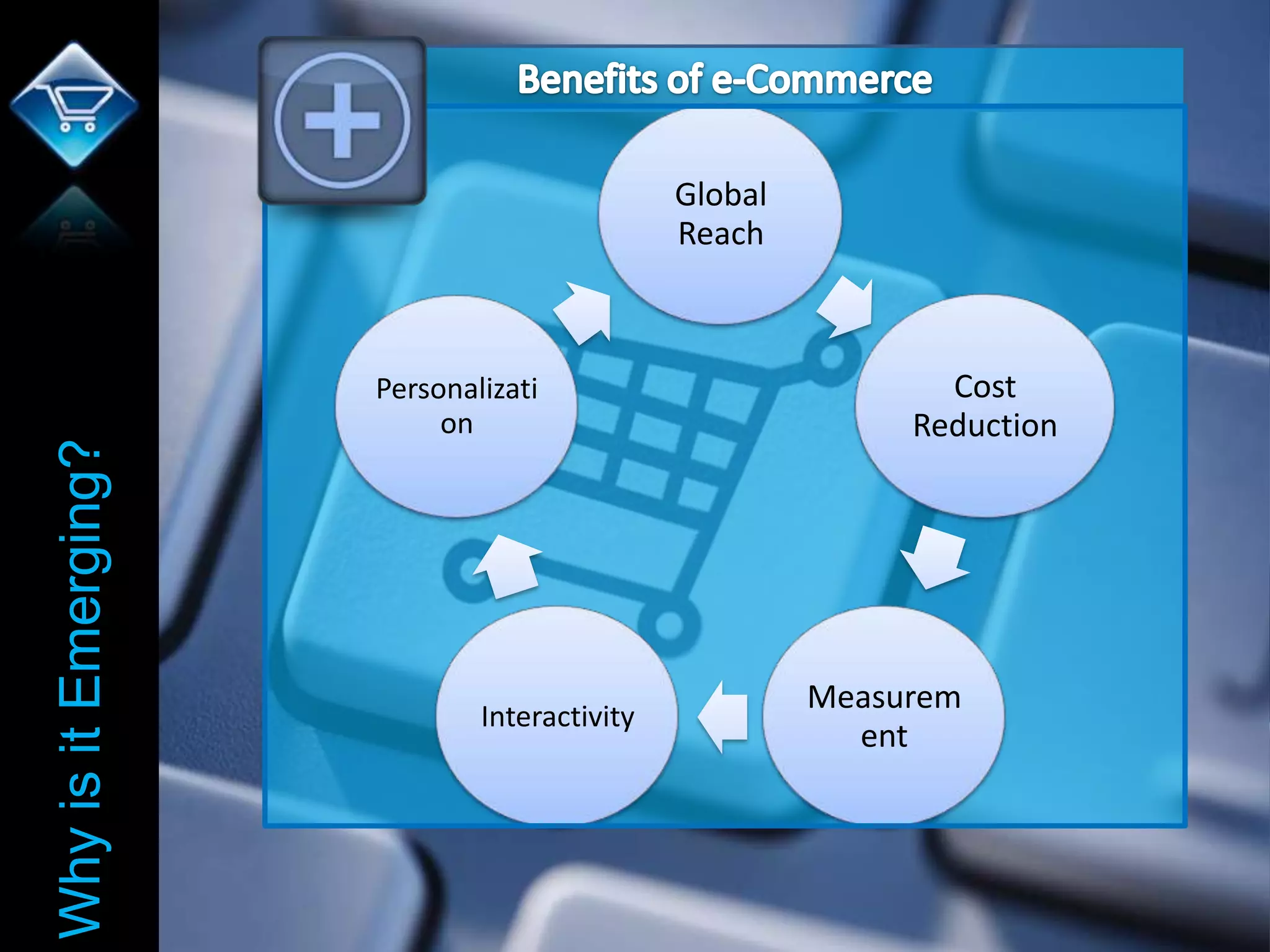
Global
                                              Reach


                      Personalizati                           Cost
                           on                               Reduction
Why is it Emerging?


                                                       Measurem
                              Interactivity
                                                         ent
Mobile
                                              Commerce
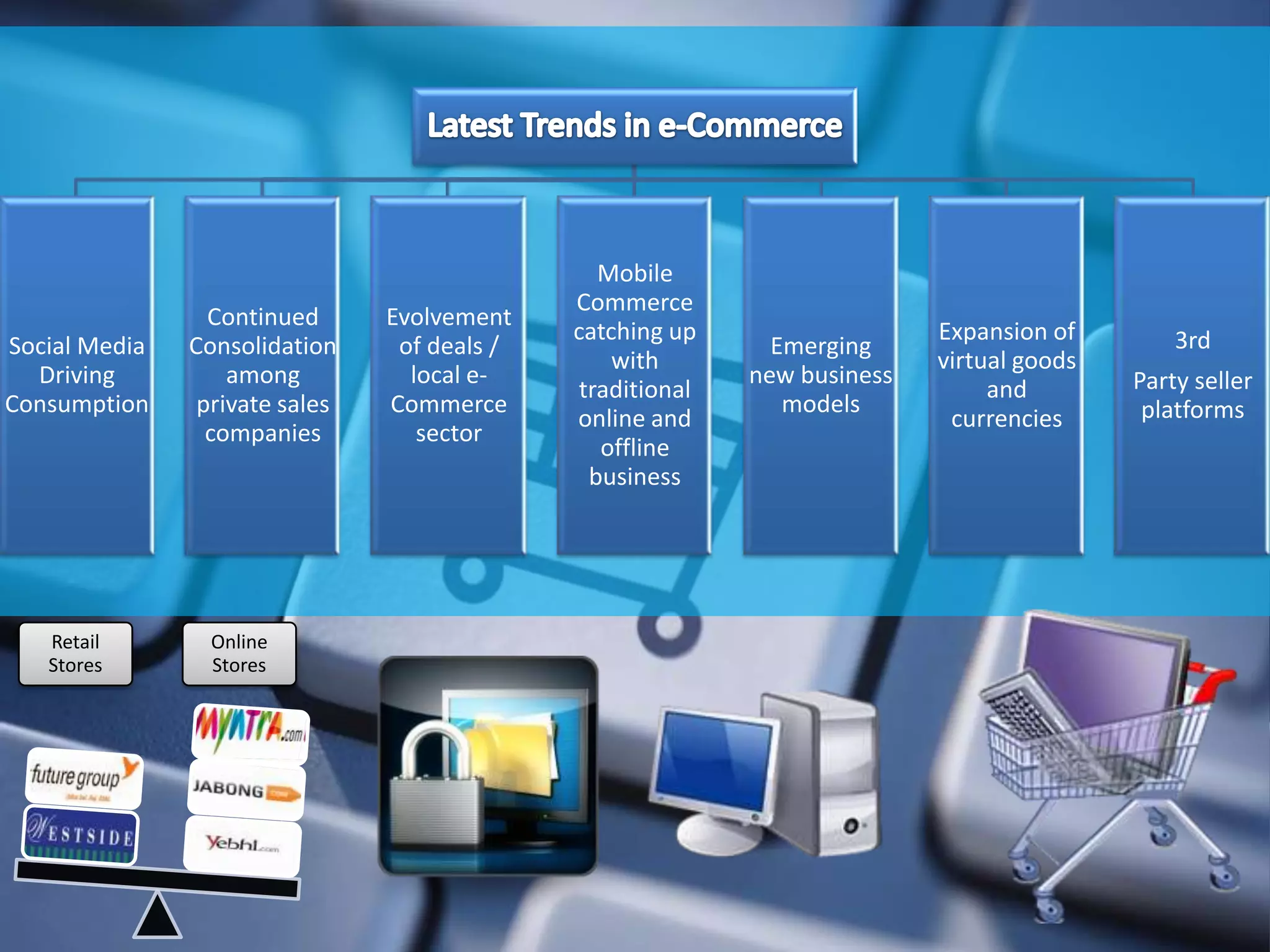
                 Continued      Evolvement
                                              catching up                   Expansion of        3rd
Social Media   Consolidation     of deals /                    Emerging
                                                  with                      virtual goods
  Driving          among          local e-                   new business                   Party seller
                                               traditional                       and
Consumption     private sales   Commerce                        models                       platforms
                                              online and                     currencies
                 companies         sector
                                                 offline
                                                business


   Retail        Online
   Stores        Stores
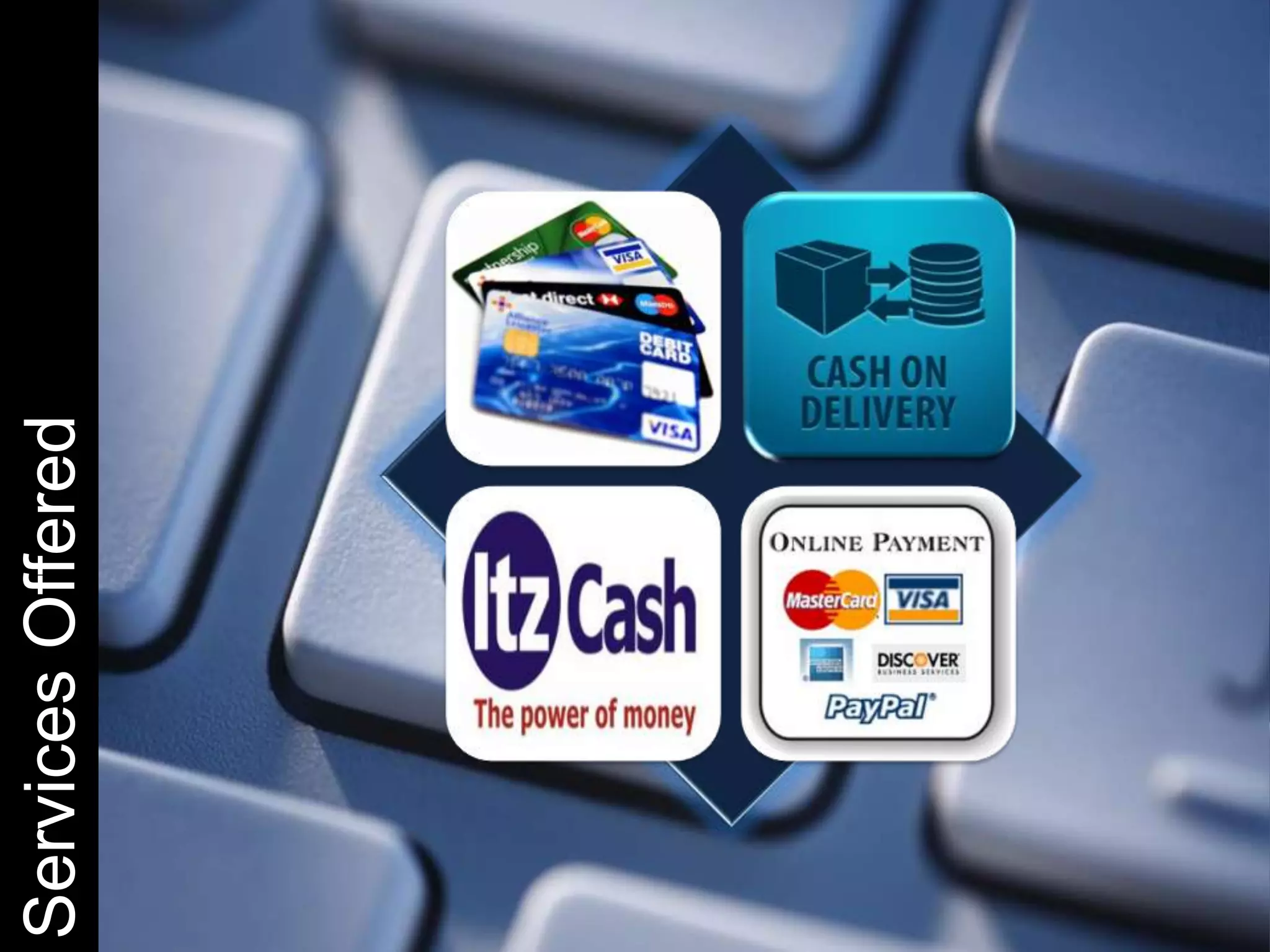
Services Offered
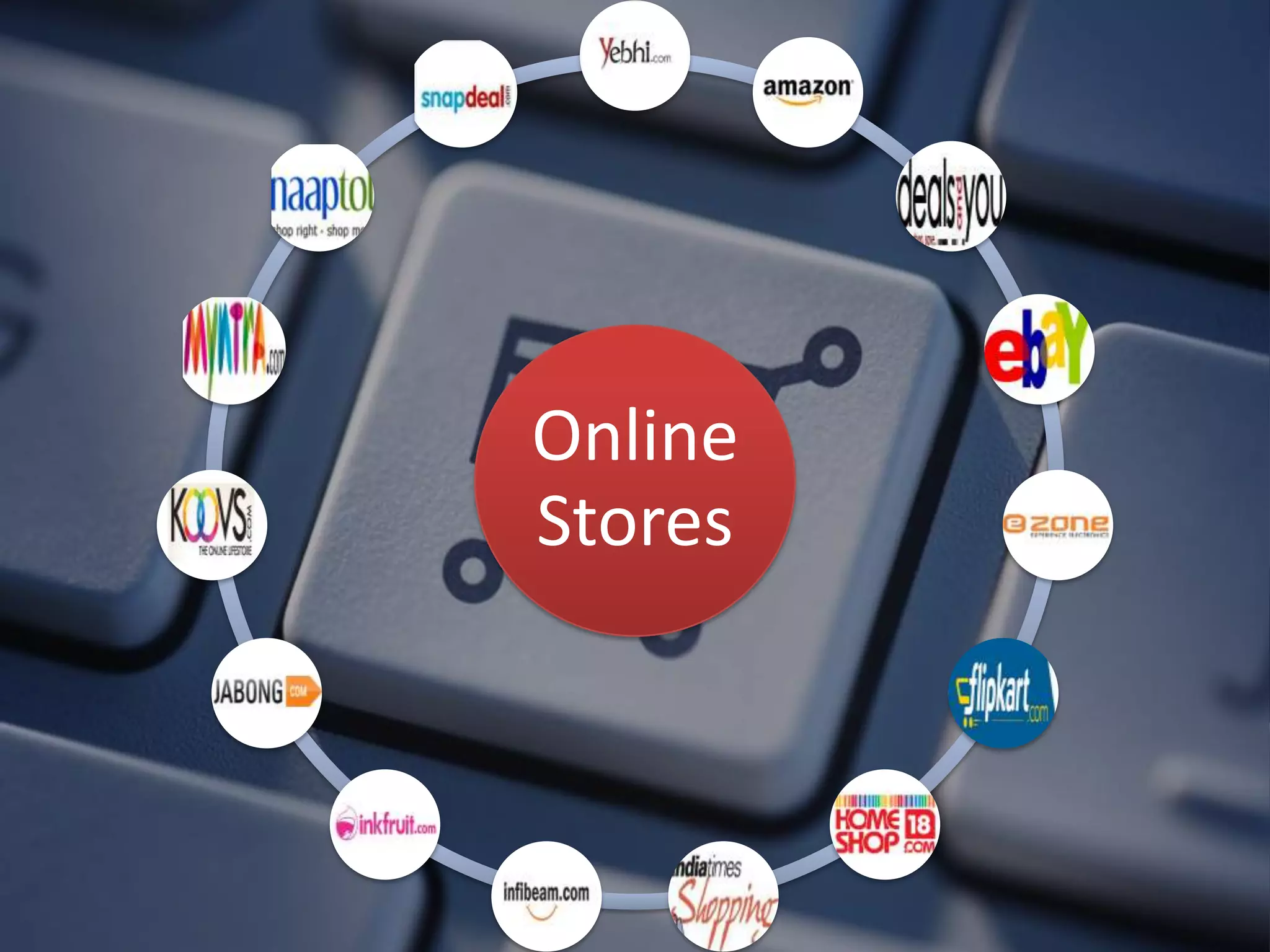
Online
Stores
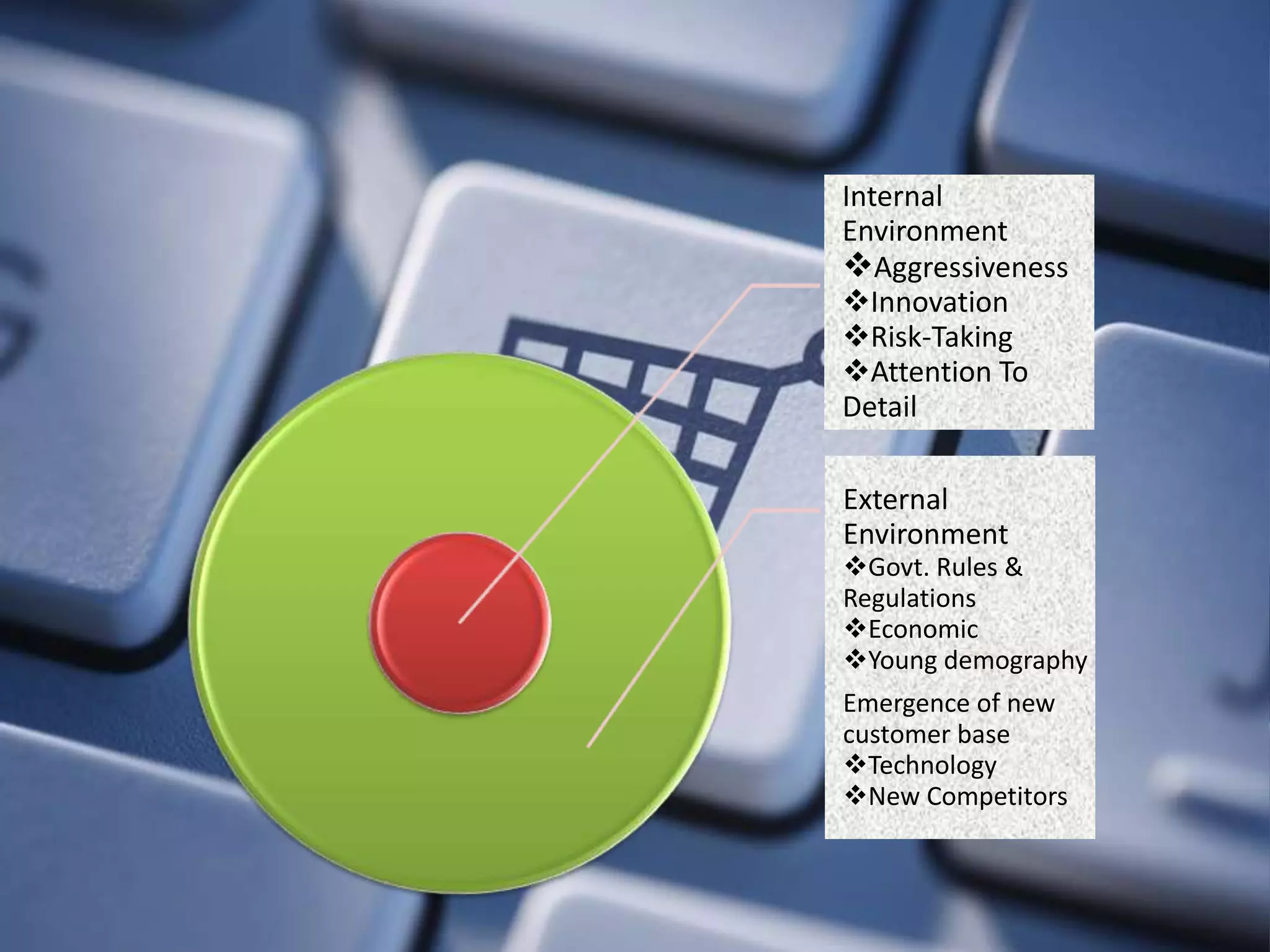
Internal
Environment
Aggressiveness
Innovation
Risk-Taking
Attention To
Detail

External
Environment
Govt. Rules &
Regulations
Economic
Young demography
Emergence of new
customer base
Technology
New Competitors
Govt. Rules and Regulation & Legal Aspect(IT LAWS)       

                            There are no specific e-commerce laws and regulations in India and they are still
                           evolving.
                            The Information Technology Act 2000 (IT Act 2000) governs the online issues of e-
External Environment


                           commerce in India.
                            IT Act 2000 is the sole cyber law of India. The cyber law of India mandates that
                           the e-commerce entrepreneurs and owners must ensure cyber law due diligence in
                           India.
                            E-commerce entrepreneurs and owners in India must understand that legal issues
                           of e-commerce in India are different for different categories of e-commerce.
                            The legal requirements for undertaking e-commerce in India also involve
                           compliance with other laws like contract law, Indian penal code, etc.
                            Further, online shopping in India also involves compliance with the banking and
                           financial norms applicable in India.
                            Perry4Law and Perry4Law Techno Legal Base (PTLB) recommend that all e-
                           commerce entrepreneurs and owners must do a proper techno legal due diligence
                           before opening an e-commerce website.
                            Further, e-commerce websites in India must ensure privacy protection, data
                           protection, data security, cyber security, confidentiality maintenance, etc as well.
 Economic Condition                                                      
 Total e-commerce revenue in India is expected to increase by more than
five times by 2016, from $1.6 billion in 2012 to $8.8 billion in 2016. In
2011, venture capitalists invested $ 177 million in e-Commerce in India

 (FDI) is limited to traditional brick-and-mortar stores. The entry of
foreign-owned virtual stores – online e-commerce platforms – continues to
be restricted

 Foreign firms, which are merely a “listing platform for brands”, are
welcome to operate in India. But, foreign firms that buy and sell any goods
or services are still banned from conducting their activities.

 e-commerce firms can though invest in warehousing and back end
infrastructure, which allows 100 per cent FDI

 e-commerce companies, which have FDI infusion, have created
corporate structures which technically enable them to receive FDI infusion
even while sticking to the regulatory guidelines.
 Social

Young Demography
•According to a 2007 report by McKinsey &
Co., “India is set to grow into the fifth largest
consumer market in the world by 2025”, McKinsey &
Co Report, 2007
•Today, over 35% of our population is below the age
of 20
•In 2020, the average Indian will be only 29 years
old, compared with 37 in China and the US, 45 in
West Europe
•By 2020, 325 million people in India will reach
working age, largest in the world. With a huge
working population there will be huge consumption
boom, as it has happened in China.
•India is and will remain for some time one of the
youngest countries in the world.
Emergence of new Customer base
          The 'bird of gold': The rise of India's consumer market
                       -By McKinsey Global Institute

“Who are the new consumers?...... The
Urban Indian Woman & The Youth
            The Indian Woman
“The Indian woman is perhaps less homogenous
and more conflicted as a consumer group
compared to the Indian man.” — jacob
kurian, neW silk route

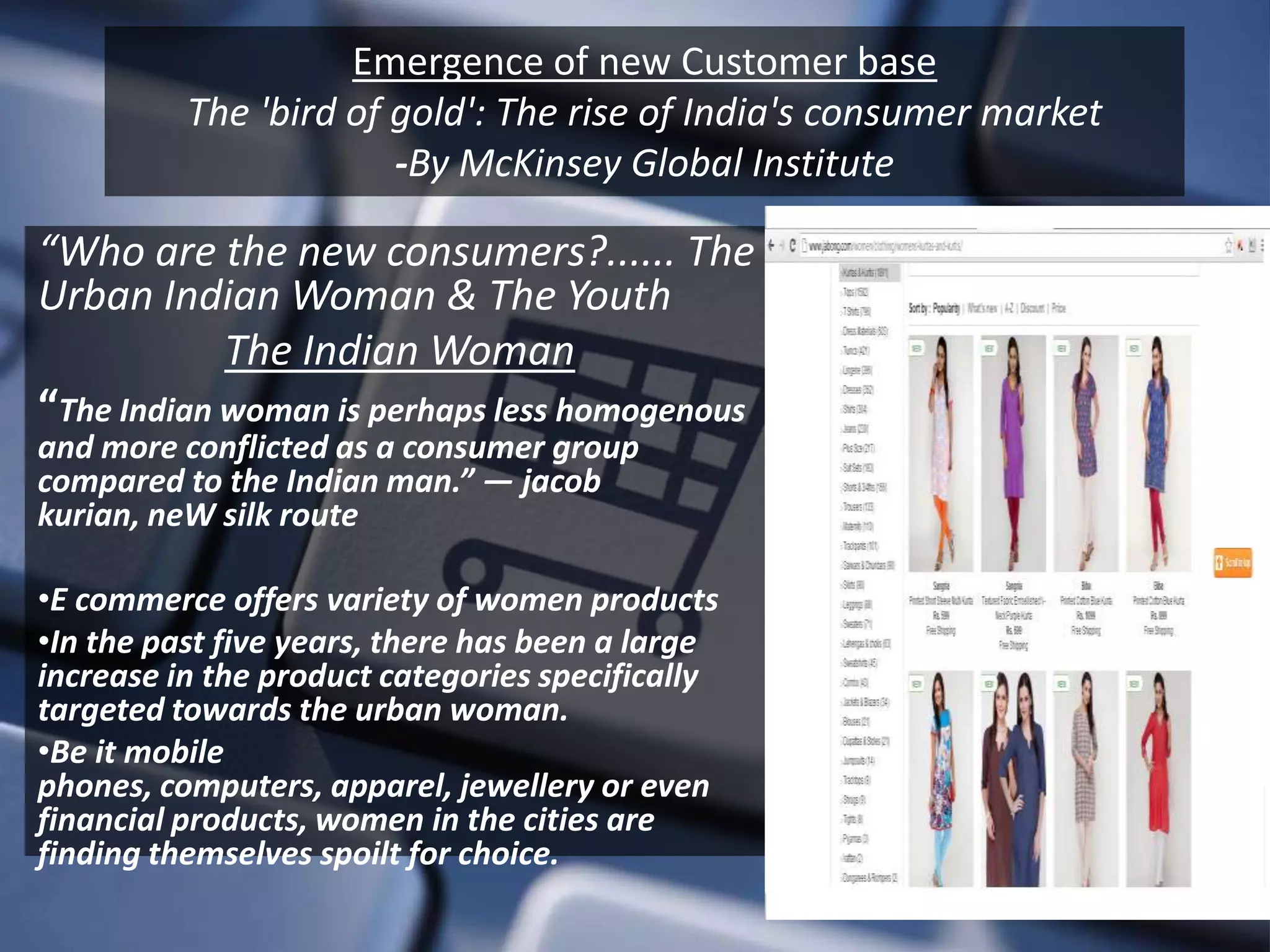
•E commerce offers variety of women products
•In the past five years, there has been a large
increase in the product categories specifically
targeted towards the urban woman.
•Be it mobile
phones, computers, apparel, jewellery or even
financial products, women in the cities are
finding themselves spoilt for choice.
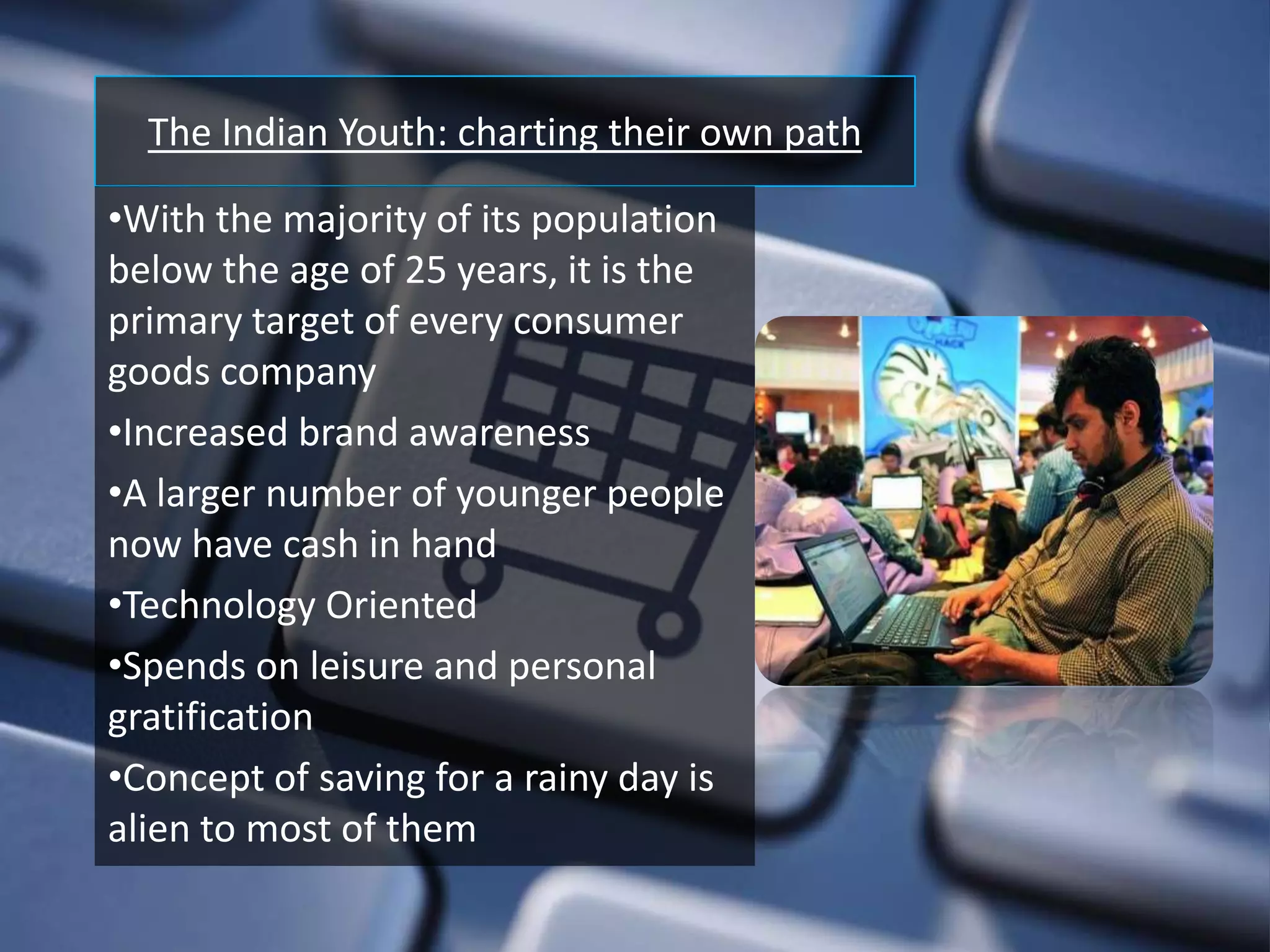
The Indian Youth: charting their own path

•With the majority of its population
below the age of 25 years, it is the
primary target of every consumer
goods company
•Increased brand awareness
•A larger number of younger people
now have cash in hand
•Technology Oriented
•Spends on leisure and personal
gratification
•Concept of saving for a rainy day is
alien to most of them
 Technology                                           
 “The rural consumer will have his debit card within
 his phone and will use the device to
 transfer funds between his and the seller’s
 accounts.”
 — Mr Vaghul, chairman, icici banking corporation

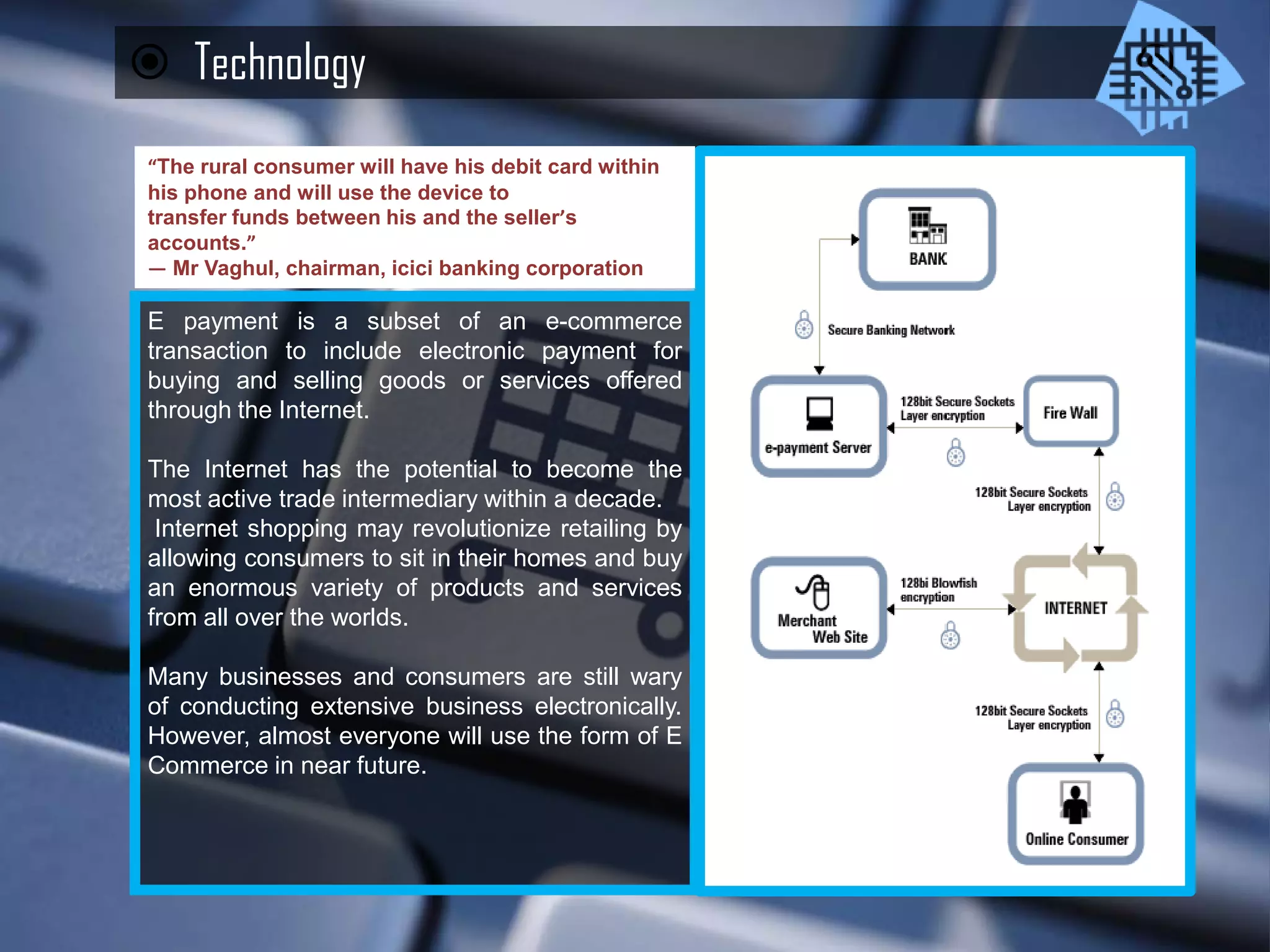
 E payment is a subset of an e-commerce
 transaction to include electronic payment for
 buying and selling goods or services offered
 through the Internet.

 The Internet has the potential to become the
 most active trade intermediary within a decade.
  Internet shopping may revolutionize retailing by
 allowing consumers to sit in their homes and buy
 an enormous variety of products and services
 from all over the worlds.

 Many businesses and consumers are still wary
 of conducting extensive business electronically.
 However, almost everyone will use the form of E
 Commerce in near future.
 Competition from New Competitors


                                                           In 2007, Walmart announced
                                                           an agreement with Bharti
                                                           Enterprises to establish a
                                                           Bharti Walmart Private
         100% commitment to quality
                                                           Limited, a wholesale cash-and-
         Most competitive price
                                                           carry and back-end supply
         Doorstep delivery of products under strict       chain management operations
         supervision
                                                           in India.
         Right weight/quantity
         100% disclosure policy across all products        A typical wholesale cash-and
         Convenience of phone shopping                    carry facility stands between
         State-of-the-art Quality Control labs in Delhi   50,000 and 100,000 square
         (NCR), Mumbai, Lucknow, Nagpur, Hyderabad, Kol    feet and sells a wide range of
         kata and Patna
                                                           fruits and vegetables, groceries
         Pan-India quality team of 800                    and
         people, comprising 50 Quality Experts and
         Associates, 150 Quality Control Executives, 30    staples, stationery, footwear, cl
         Quality Assurance Managers and 500 Quality        othing, consumer durables and
         Advisors                                          other general merchandise
         305 warehouses in 285 cities                     items.
                                                           The first Best Price Modern
                                                           Wholesale opened in 2009.
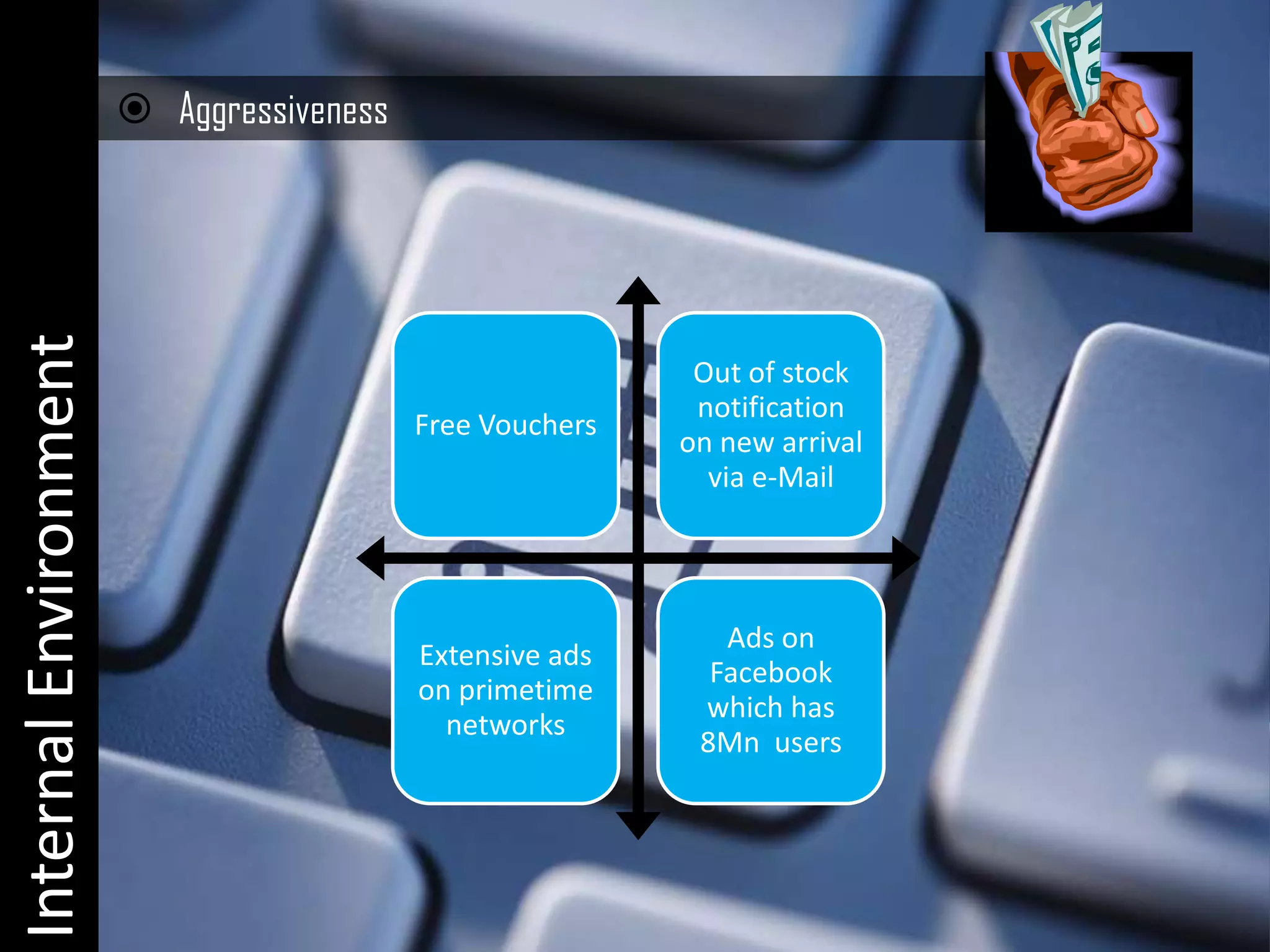
 Aggressiveness
Internal Environment


                                                           Out of stock
                                                           notification
                                          Free Vouchers
                                                          on new arrival
                                                            via e-Mail


                                                             Ads on
                                          Extensive ads
                                                            Facebook
                                          on primetime
                                                           which has
                                            networks
                                                           8Mn users
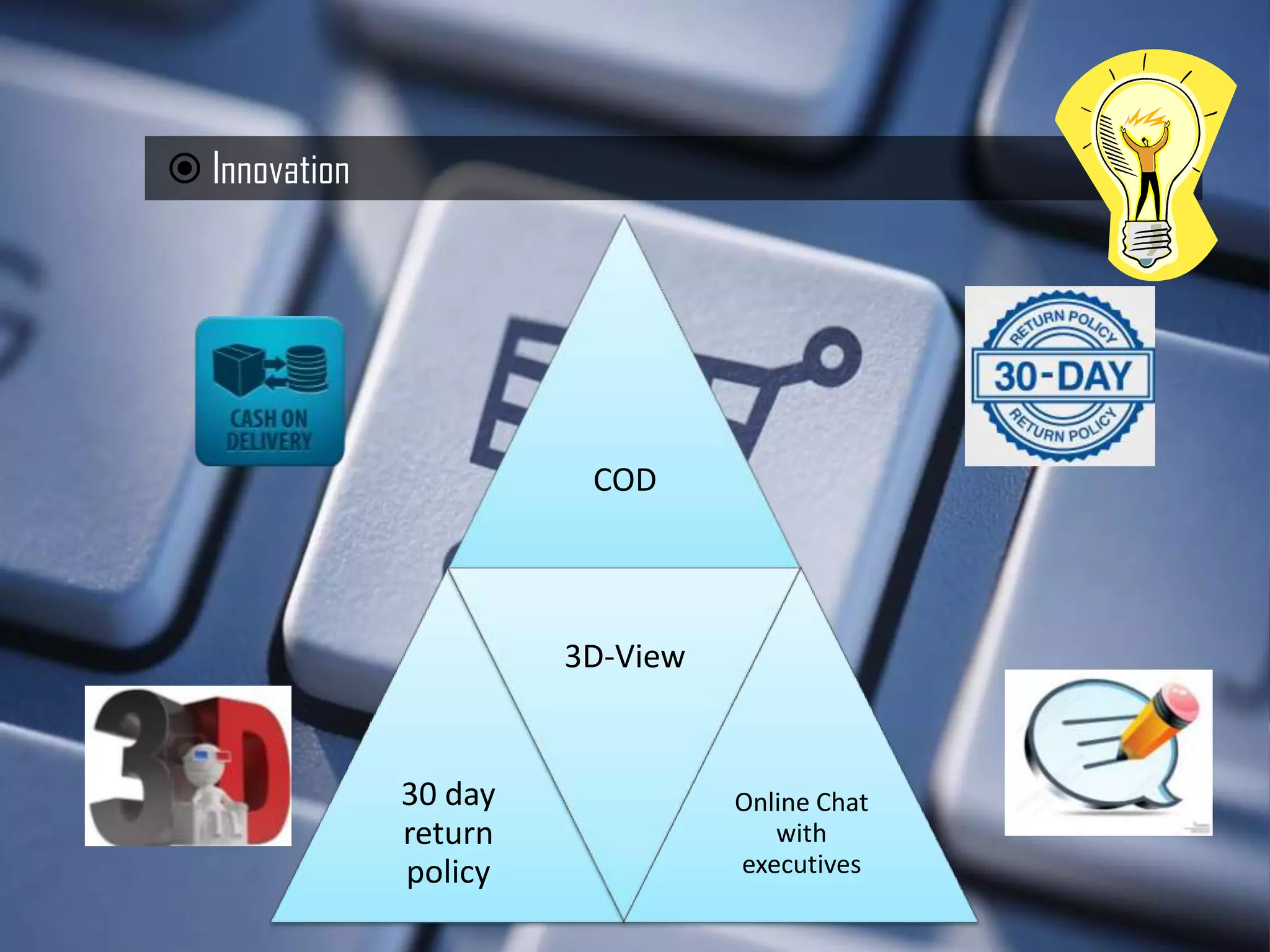
 Innovation


                         COD


                        3D-View


               30 day             Online Chat
               return                with
               policy             executives
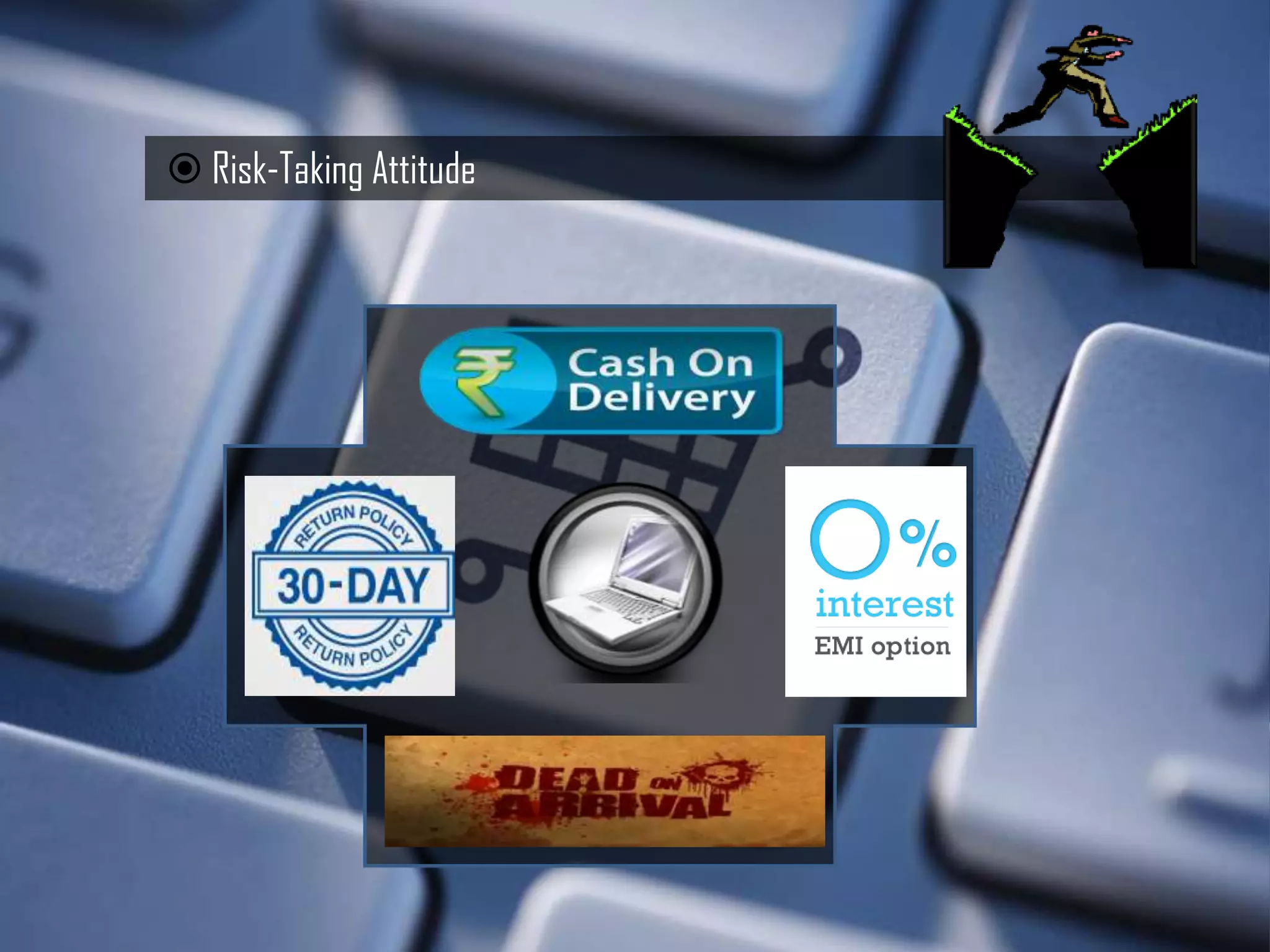
 Risk-Taking Attitude
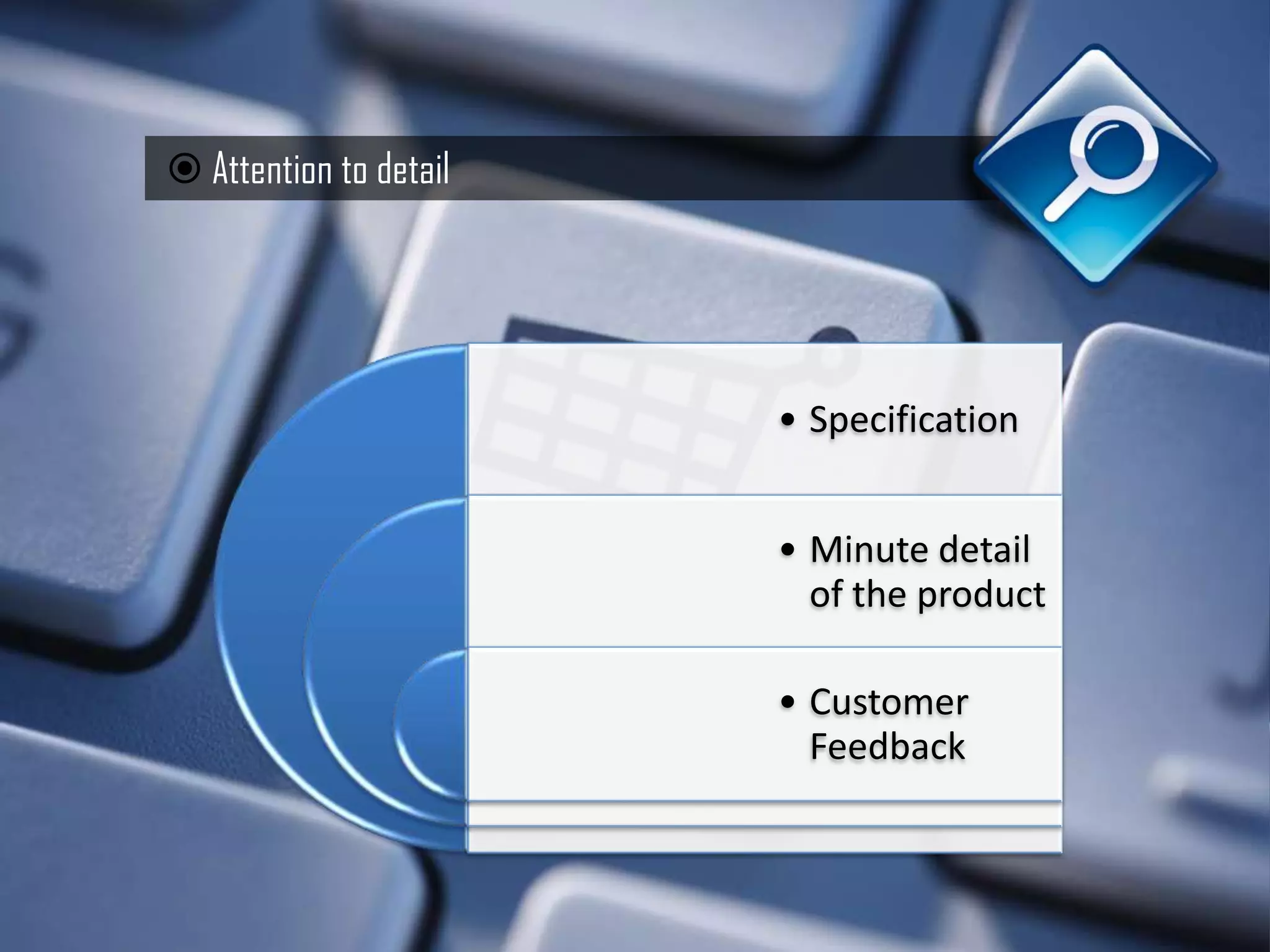
 Attention to detail


                        • Specification


                        • Minute detail
                          of the product

                        • Customer
                          Feedback
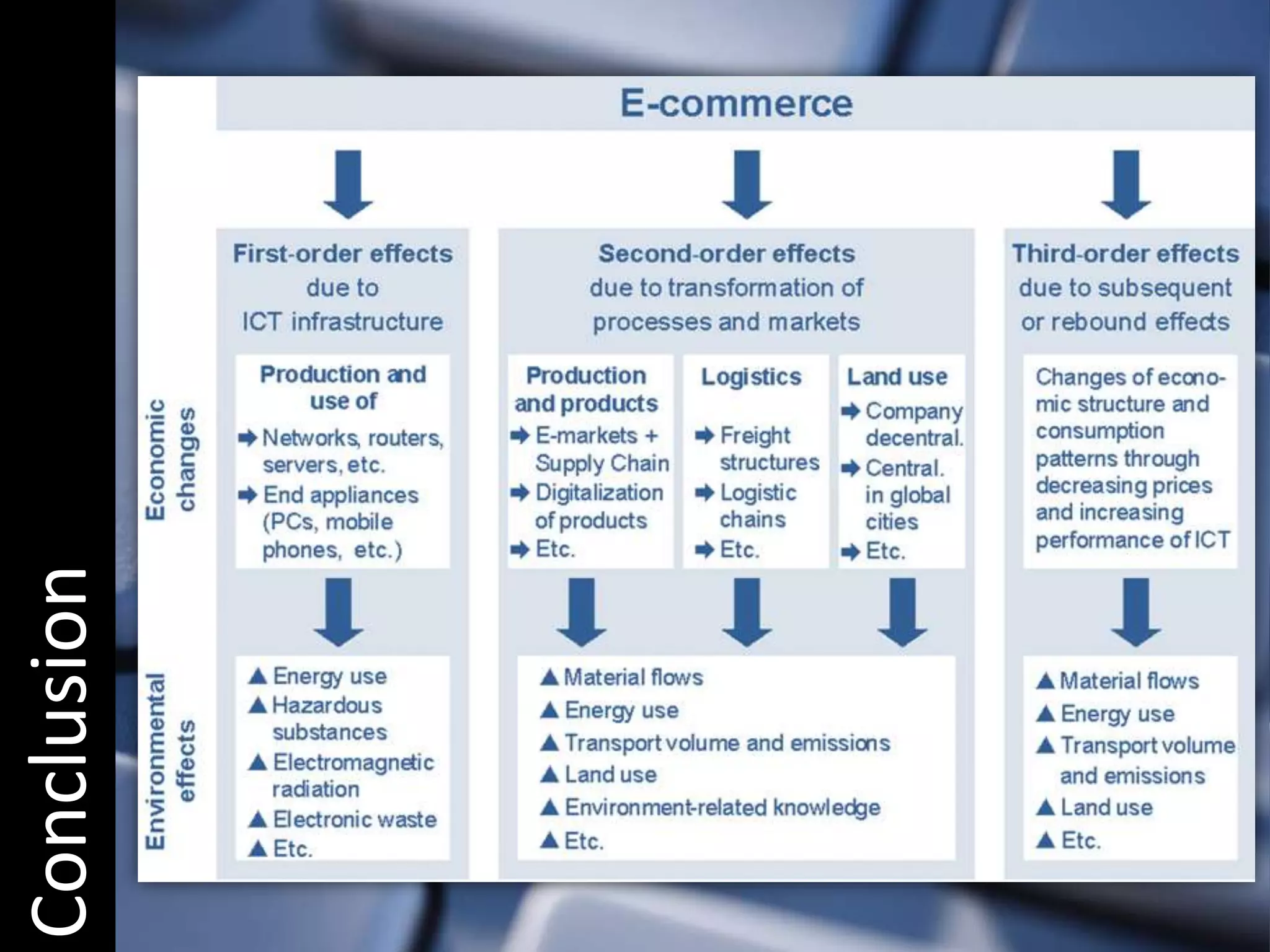
Conclusion
Impacts of e-commerce and e-business in developing
countries :

For SMEs in developing countries e-commerce poses the advantages of
      reduced information search costs and transactions costs .


 IFAT: Empowering the Agricultural Sector through B2C E-Commerce.


Offshore Data Processing Centres: E-commerce at Work in the Service
                              Sector


           E-Mail and the Internet in Developing Countries


 Women and Global Web-Based Marketing: The Case of the Guyanan
                    Weavers’ Cooperative
The main issues of concern that act as barriers to the
    increased uptake of information technology and e-
                        commerce.
 Lack of awareness and understanding of the value of e-
commerce.

Lack of ICT knowledge and skills.

Financial costs

 Infrastructure.

 Security

 Other privacy-security-related issues.
E-commerce in India

E-commerce in India

  • 2.
    Electronic Commerce oreCommerce is often misunderstood as buying and selling of goods and services over internet and financial transactions between organizations and customers. Though mostly known, this definition doesn’t cover all the business areas. In broad terms, eCommerce encompasses all transactions that take place electronically – buying, selling,customer service, inventory management, marketing, delivering, pre-sale and post-sales activities. “eCommerce is the exchange of information across electronic networks, at any What is E-commerce? stage in the supply chain, whether within an organization, between businesses, between businesses and consumers, between the public and private sector, whether paid or unpaid” – Cabinet Office, UK government
  • 3.
    The Different perspectivesof e-Commerce: 1. A Communication perspective – the delivery of information, product/services or payment by electronic means. 2. A business process perspective – the application of technology towards the automation of business transactions and workflows. 3. A service perspective – enabling cost cutting at the same time as increasing the speed and quality of service delivery. 4. An online perspective – the buying and selling of products and information online. We can look at those transactions from sell-side and buy-side. Buy-side e-Commerce – This section involves the supplier, manufacturer, intermediaries and the organization and its functional units Sell-side e-Commerce – This section involves interactions between corporates, customers and the organization.backb YEAR EVENT 1994 Netscape Launched; SSL encryption enabled shopping. 1995 Backbone of eCommerce formed;Amazon, eBay and Verisign launched. 1997 Dell first company to reach @ 1Mn in online sales. 1998 Google launched, USPS launched eStamps. 2000 Dot-com bubble burst. 2002 eBay acquired PayPal. 2003 Facebook launched for college students. 2006 Google acquired YouTube; iTunes became first digital music retailer. 2007-08 Private Sales Model, Social eCommerce, Mobile eCommerce, Daily Deals/Local eCommerce
  • 4.
    Different formats ofeCommerce eCommerce Categories The Interactions between an organization and its customers can be classified into 3 categories:
  • 5.
    Global Reach Personalizati Cost on Reduction Why is it Emerging? Measurem Interactivity ent
  • 9.
    Mobile Commerce Continued Evolvement catching up Expansion of 3rd Social Media Consolidation of deals / Emerging with virtual goods Driving among local e- new business Party seller traditional and Consumption private sales Commerce models platforms online and currencies companies sector offline business Retail Online Stores Stores
  • 10.
  • 11.
  • 12.
    Internal Environment Aggressiveness Innovation Risk-Taking Attention To Detail External Environment Govt. Rules& Regulations Economic Young demography Emergence of new customer base Technology New Competitors
  • 13.
    Govt. Rules andRegulation & Legal Aspect(IT LAWS)   There are no specific e-commerce laws and regulations in India and they are still evolving.  The Information Technology Act 2000 (IT Act 2000) governs the online issues of e- External Environment commerce in India.  IT Act 2000 is the sole cyber law of India. The cyber law of India mandates that the e-commerce entrepreneurs and owners must ensure cyber law due diligence in India.  E-commerce entrepreneurs and owners in India must understand that legal issues of e-commerce in India are different for different categories of e-commerce.  The legal requirements for undertaking e-commerce in India also involve compliance with other laws like contract law, Indian penal code, etc.  Further, online shopping in India also involves compliance with the banking and financial norms applicable in India.  Perry4Law and Perry4Law Techno Legal Base (PTLB) recommend that all e- commerce entrepreneurs and owners must do a proper techno legal due diligence before opening an e-commerce website.  Further, e-commerce websites in India must ensure privacy protection, data protection, data security, cyber security, confidentiality maintenance, etc as well.
  • 14.
     Economic Condition   Total e-commerce revenue in India is expected to increase by more than five times by 2016, from $1.6 billion in 2012 to $8.8 billion in 2016. In 2011, venture capitalists invested $ 177 million in e-Commerce in India  (FDI) is limited to traditional brick-and-mortar stores. The entry of foreign-owned virtual stores – online e-commerce platforms – continues to be restricted  Foreign firms, which are merely a “listing platform for brands”, are welcome to operate in India. But, foreign firms that buy and sell any goods or services are still banned from conducting their activities.  e-commerce firms can though invest in warehousing and back end infrastructure, which allows 100 per cent FDI  e-commerce companies, which have FDI infusion, have created corporate structures which technically enable them to receive FDI infusion even while sticking to the regulatory guidelines.
  • 15.
     Social Young Demography •Accordingto a 2007 report by McKinsey & Co., “India is set to grow into the fifth largest consumer market in the world by 2025”, McKinsey & Co Report, 2007 •Today, over 35% of our population is below the age of 20 •In 2020, the average Indian will be only 29 years old, compared with 37 in China and the US, 45 in West Europe •By 2020, 325 million people in India will reach working age, largest in the world. With a huge working population there will be huge consumption boom, as it has happened in China. •India is and will remain for some time one of the youngest countries in the world.
  • 16.
    Emergence of newCustomer base The 'bird of gold': The rise of India's consumer market -By McKinsey Global Institute “Who are the new consumers?...... The Urban Indian Woman & The Youth The Indian Woman “The Indian woman is perhaps less homogenous and more conflicted as a consumer group compared to the Indian man.” — jacob kurian, neW silk route •E commerce offers variety of women products •In the past five years, there has been a large increase in the product categories specifically targeted towards the urban woman. •Be it mobile phones, computers, apparel, jewellery or even financial products, women in the cities are finding themselves spoilt for choice.
  • 17.
    The Indian Youth:charting their own path •With the majority of its population below the age of 25 years, it is the primary target of every consumer goods company •Increased brand awareness •A larger number of younger people now have cash in hand •Technology Oriented •Spends on leisure and personal gratification •Concept of saving for a rainy day is alien to most of them
  • 18.
     Technology  “The rural consumer will have his debit card within his phone and will use the device to transfer funds between his and the seller’s accounts.” — Mr Vaghul, chairman, icici banking corporation E payment is a subset of an e-commerce transaction to include electronic payment for buying and selling goods or services offered through the Internet. The Internet has the potential to become the most active trade intermediary within a decade. Internet shopping may revolutionize retailing by allowing consumers to sit in their homes and buy an enormous variety of products and services from all over the worlds. Many businesses and consumers are still wary of conducting extensive business electronically. However, almost everyone will use the form of E Commerce in near future.
  • 19.
     Competition fromNew Competitors In 2007, Walmart announced an agreement with Bharti Enterprises to establish a Bharti Walmart Private 100% commitment to quality Limited, a wholesale cash-and- Most competitive price carry and back-end supply Doorstep delivery of products under strict chain management operations supervision in India. Right weight/quantity 100% disclosure policy across all products A typical wholesale cash-and Convenience of phone shopping carry facility stands between State-of-the-art Quality Control labs in Delhi 50,000 and 100,000 square (NCR), Mumbai, Lucknow, Nagpur, Hyderabad, Kol feet and sells a wide range of kata and Patna fruits and vegetables, groceries Pan-India quality team of 800 and people, comprising 50 Quality Experts and Associates, 150 Quality Control Executives, 30 staples, stationery, footwear, cl Quality Assurance Managers and 500 Quality othing, consumer durables and Advisors other general merchandise 305 warehouses in 285 cities items. The first Best Price Modern Wholesale opened in 2009.
  • 20.
     Aggressiveness Internal Environment Out of stock notification Free Vouchers on new arrival via e-Mail Ads on Extensive ads Facebook on primetime which has networks 8Mn users
  • 21.
     Innovation COD 3D-View 30 day Online Chat return with policy executives
  • 22.
  • 23.
     Attention todetail • Specification • Minute detail of the product • Customer Feedback
  • 24.
  • 25.
    Impacts of e-commerceand e-business in developing countries : For SMEs in developing countries e-commerce poses the advantages of reduced information search costs and transactions costs . IFAT: Empowering the Agricultural Sector through B2C E-Commerce. Offshore Data Processing Centres: E-commerce at Work in the Service Sector E-Mail and the Internet in Developing Countries Women and Global Web-Based Marketing: The Case of the Guyanan Weavers’ Cooperative
  • 26.
    The main issuesof concern that act as barriers to the increased uptake of information technology and e- commerce.  Lack of awareness and understanding of the value of e- commerce. Lack of ICT knowledge and skills. Financial costs  Infrastructure.  Security  Other privacy-security-related issues.