The Commerce of Today’s Era
 Introduction to e-business and e-commerce
 E-commerce fundamentals
 E-business infrastructure
 E-environment
 Supply chain management
 E-marketing
 Customer relationship management
 Change management
 Analysis and design
 M-Commerce
 Management of mobile commerce services
In the emerging global economy, E-Commerce
and E-Business have increasingly become a necessary
component of business strategy and a strong catalyst for
economic development.

       The    integration    of    information      and
communications technology (ICT) in business         has
revolutionized relationships within organizations   and
those between and among organizations               and
individuals.
Electronic Commerce or E-Commerce refers to a wide
range of online business activities for products and services.

       It also pertains to “any form of business transaction in
which the parties interact electronically rather than by
physical exchanges or direct physical contact”.


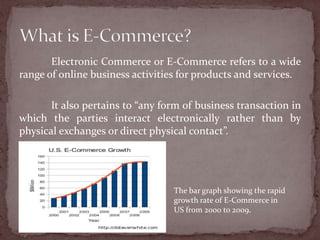
                                  The bar graph showing the rapid
                                  growth rate of E-Commerce in
                                  US from 2000 to 2009.
 Think Fast
    Speed has become less of a problem due to the penetration of broadband,
    but don't forget that a significant number of people still shop by a dialup
    connection. When creating a site framework, designers and e-commerce
    teams should ensure that the site is developed with pages loading in less
    than 9 seconds (over a dial-up connection).


Image is important
    Images are a very important aspect of selling online and are often
    neglected. All product images should be of the highest resolution possible,
    be much larger than the product page original, and have multiple views.
    Dynamic imaging capabilities can improve the user experience to an even
    higher level by increasing interactivity
 Be my guest
      Always offer the ability to checkout as a guest. You will see less customer
      leakage within the checkout process and can still offer the option to
      register when the sale is completed.


 Make sure its above the fold
    Your homepage is the most important page within your E-Commerce store.
    It sets the initial tone for the shopping experience and offers your best
    promotions and products to your visitors. Users typically visually scan a
    web page from top to bottom and then from left to right. All critical content
    and navigation options should be obvious to the shopper without having to
    scroll down. If you have your best promotions "below the fold" - you can bet
    that a large percentage of browsers are not scrolling down to see it.
In     E-Business,     the     Information    and
Communication Technology (ICT) is used to enhance
one’s business. It includes any process that a business
organization (either a for-profit, governmental or non-
profit entity) conducts over a computer-mediated
network.

    “The transformation of an organization’s processes to deliver
        additional customer value through the application of
   technologies, philosophies and computing paradigm of the new
                             economy.”
E-Commerce
   By intuition, it is the buying and selling of goods with
    the use of Internet.
   It should be electronically mediated financial
    transactions between organizations and customers.
E-Business
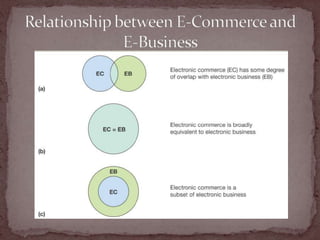
   E-Business is just a new label of E-Commerce – there is
    no distinction between the role of E-Business and the
    traditional Information Systems Management.
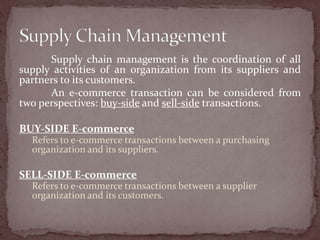
Supply chain management is the coordination of all
supply activities of an organization from its suppliers and
partners to its customers.
      An e-commerce transaction can be considered from
two perspectives: buy-side and sell-side transactions.

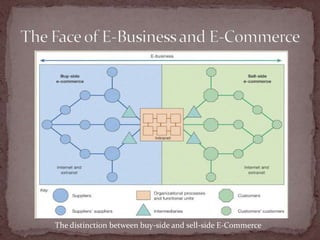
BUY-SIDE E-commerce
  Refers to e-commerce transactions between a purchasing
  organization and its suppliers.

SELL-SIDE E-commerce
  Refers to e-commerce transactions between a supplier
  organization and its customers.
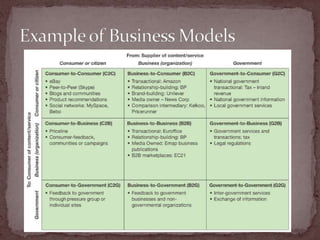
The distinction between buy-side and sell-side E-Commerce
 B2C – commercial transactions are between an
 organization and consumers

 B2B – commercial transactions are between an
 organization and other organizations.

 C2C – consumers transact directly with consumers
 (e.g. online auctions, community sites)
 Electronic communications are disruptive technologies –
  new technologies that prompt businesses to reappraise
  their strategic approaches.

 Electronic communications have also given rise to many
  exciting new business models and create potentials.

 All organizations operate within an environment that
  influences the way in which they conduct business.

 Strategy development is strongly influenced by considering
  the environment the business operates in.
CRM, or Customer Relationship Management, is a
company-wide business strategy designed to reduce costs
and increase profitability by solidifying customer loyalty.

According to one industry view, CRM consists of:
   Helping an enterprise to enable its marketing departments to
    identify and target their best customers, manage marketing
    campaigns and generate quality leads for the sales team.

   Assisting the organization to improve telesales, account, and
    sales management by optimizing information shared by
    multiple employees, and streamlining existing processes (for
    example, taking orders using mobile devices)
 Allowing the formation of individualized relationships
  with customers, with the aim of improving customer
  satisfaction and maximizing profits; identifying the
  most profitable customers and providing them the
  highest level of service.

 Providing employees with the information and
  processes necessary to know their customers,
  understand and identify customer needs and effectively
  build relationships between the company, its customer
  base, and distribution partners.
M-commerce (mobile commerce) is the buying
and selling of goods and services through wireless
handheld devices such as cellular telephone and
personal digital assistants (PDAs). Known as next-
generation e-commerce, m-commerce enables users to
access the Internet without needing to find a place to
plug in. The emerging technology behind m-
commerce, which is based on the Wireless Application
Protocol (WAP), has made far greater strides in
Europe, where mobile devices equipped with Web-
ready micro-browsers are much more common than in
the United States.
 Near Field Communication (NFC) chip—
      NFC chips enable mobile devices to send account
      information to contactless payment readers at customer
      checkouts and other points of sale. These NFC chips can
      also read information stored in contactless-enabled tags
      placed on objects such as advertising collateral and
      consumer products
 Secure element—
      The secure element is a smart card module (USIM,
      embedded secure element or separate secure element like a
      secure SD memory card) used for storing and accessing
      applications and data in a secure manner
 Electronic wallet application—
    Mobile phones also need to have a user interface (UI) that
    allows a user to manage accounts and initiate contactless
    payments. These UI applications turn a mobile phone into
    something like a wallet full of cards because a mobile phone
    can contain many “cards” (credit, debit, prepaid gift card,
    other special stored-value accounts, public transit tickets and
    merchant-specific loyalty cards, just to name a few).
 Personalized account information—
    In the same way that a credit card only works only after
    personalized account information is put onto the magnetic
    strip and embossed on the front of the card, a commerce-
    enabled mobile phone is just a phone until it is loaded with
    personal account information
This presentation was made by Melissa B. Carpio, a
4th year student of Bachelor of Science in Computer
Science under Mr. Nomelito Arquillano as part of the
   final requirement in Elective 4 – E-Commerce.

E-Commerce

  • 1.
    The Commerce ofToday’s Era
  • 2.
     Introduction toe-business and e-commerce  E-commerce fundamentals  E-business infrastructure  E-environment  Supply chain management  E-marketing  Customer relationship management  Change management  Analysis and design  M-Commerce  Management of mobile commerce services
  • 3.
    In the emergingglobal economy, E-Commerce and E-Business have increasingly become a necessary component of business strategy and a strong catalyst for economic development. The integration of information and communications technology (ICT) in business has revolutionized relationships within organizations and those between and among organizations and individuals.
  • 4.
    Electronic Commerce orE-Commerce refers to a wide range of online business activities for products and services. It also pertains to “any form of business transaction in which the parties interact electronically rather than by physical exchanges or direct physical contact”. The bar graph showing the rapid growth rate of E-Commerce in US from 2000 to 2009.
  • 5.
     Think Fast Speed has become less of a problem due to the penetration of broadband, but don't forget that a significant number of people still shop by a dialup connection. When creating a site framework, designers and e-commerce teams should ensure that the site is developed with pages loading in less than 9 seconds (over a dial-up connection). Image is important Images are a very important aspect of selling online and are often neglected. All product images should be of the highest resolution possible, be much larger than the product page original, and have multiple views. Dynamic imaging capabilities can improve the user experience to an even higher level by increasing interactivity
  • 6.
     Be myguest Always offer the ability to checkout as a guest. You will see less customer leakage within the checkout process and can still offer the option to register when the sale is completed.  Make sure its above the fold Your homepage is the most important page within your E-Commerce store. It sets the initial tone for the shopping experience and offers your best promotions and products to your visitors. Users typically visually scan a web page from top to bottom and then from left to right. All critical content and navigation options should be obvious to the shopper without having to scroll down. If you have your best promotions "below the fold" - you can bet that a large percentage of browsers are not scrolling down to see it.
  • 7.
    In E-Business, the Information and Communication Technology (ICT) is used to enhance one’s business. It includes any process that a business organization (either a for-profit, governmental or non- profit entity) conducts over a computer-mediated network. “The transformation of an organization’s processes to deliver additional customer value through the application of technologies, philosophies and computing paradigm of the new economy.”
  • 8.
    E-Commerce By intuition, it is the buying and selling of goods with the use of Internet.  It should be electronically mediated financial transactions between organizations and customers. E-Business  E-Business is just a new label of E-Commerce – there is no distinction between the role of E-Business and the traditional Information Systems Management.
  • 10.
    Supply chain managementis the coordination of all supply activities of an organization from its suppliers and partners to its customers. An e-commerce transaction can be considered from two perspectives: buy-side and sell-side transactions. BUY-SIDE E-commerce Refers to e-commerce transactions between a purchasing organization and its suppliers. SELL-SIDE E-commerce Refers to e-commerce transactions between a supplier organization and its customers.
  • 11.
    The distinction betweenbuy-side and sell-side E-Commerce
  • 12.
     B2C –commercial transactions are between an organization and consumers  B2B – commercial transactions are between an organization and other organizations.  C2C – consumers transact directly with consumers (e.g. online auctions, community sites)
  • 14.
     Electronic communicationsare disruptive technologies – new technologies that prompt businesses to reappraise their strategic approaches.  Electronic communications have also given rise to many exciting new business models and create potentials.  All organizations operate within an environment that influences the way in which they conduct business.  Strategy development is strongly influenced by considering the environment the business operates in.
  • 15.
    CRM, or CustomerRelationship Management, is a company-wide business strategy designed to reduce costs and increase profitability by solidifying customer loyalty. According to one industry view, CRM consists of:  Helping an enterprise to enable its marketing departments to identify and target their best customers, manage marketing campaigns and generate quality leads for the sales team.  Assisting the organization to improve telesales, account, and sales management by optimizing information shared by multiple employees, and streamlining existing processes (for example, taking orders using mobile devices)
  • 16.
     Allowing theformation of individualized relationships with customers, with the aim of improving customer satisfaction and maximizing profits; identifying the most profitable customers and providing them the highest level of service.  Providing employees with the information and processes necessary to know their customers, understand and identify customer needs and effectively build relationships between the company, its customer base, and distribution partners.
  • 17.
    M-commerce (mobile commerce)is the buying and selling of goods and services through wireless handheld devices such as cellular telephone and personal digital assistants (PDAs). Known as next- generation e-commerce, m-commerce enables users to access the Internet without needing to find a place to plug in. The emerging technology behind m- commerce, which is based on the Wireless Application Protocol (WAP), has made far greater strides in Europe, where mobile devices equipped with Web- ready micro-browsers are much more common than in the United States.
  • 18.
     Near FieldCommunication (NFC) chip— NFC chips enable mobile devices to send account information to contactless payment readers at customer checkouts and other points of sale. These NFC chips can also read information stored in contactless-enabled tags placed on objects such as advertising collateral and consumer products  Secure element— The secure element is a smart card module (USIM, embedded secure element or separate secure element like a secure SD memory card) used for storing and accessing applications and data in a secure manner
  • 19.
     Electronic walletapplication— Mobile phones also need to have a user interface (UI) that allows a user to manage accounts and initiate contactless payments. These UI applications turn a mobile phone into something like a wallet full of cards because a mobile phone can contain many “cards” (credit, debit, prepaid gift card, other special stored-value accounts, public transit tickets and merchant-specific loyalty cards, just to name a few).  Personalized account information— In the same way that a credit card only works only after personalized account information is put onto the magnetic strip and embossed on the front of the card, a commerce- enabled mobile phone is just a phone until it is loaded with personal account information
  • 20.
    This presentation wasmade by Melissa B. Carpio, a 4th year student of Bachelor of Science in Computer Science under Mr. Nomelito Arquillano as part of the final requirement in Elective 4 – E-Commerce.