A trip around the world
AIMS
• Our main aim is developing a project in
order to overcome geographical obstacles
and to enhance intercultural
understanding in the optic of INCLUSION.
AIMS
• Skills and knowledge to be developed are:
- European citizenship,
- knowledge of European and Extra-
European countries,
- communication in English,
- responsible use of ICT,
- team work,
- interaction with pupils from partner
schools,
- creativity and innovation.
WORK PROCESS
• Pupils introduce themselves, their countries and schools
(September-October).
• Pupils create groups to work in team with partners and
organize their work (November).
• Pupils choose European countries they want to learn about and
prepare presentations or videos (November-January).
• Pupils choose European countries they want to learn about and
prepare presentations or videos (February-April).
• The best works are collected in a common product (May).
TASKS
• Pupils can work alone or better
in team.
• Teams can be composed by
pupils from different schools.
• Pupils work on different
countries paying attention also
to cultural and social aspects.
• That’s why they have to look
for texts, songs and traditions
of the countries they choose.
• They have to use ICT and web
2.0 tools.
• Communication language can
be English or French.
EXPECTED RESULTS
• We want to share the
results of our work in
a public TwinSpace
and eventually in a
web site or a leaflet.
• The produced
material could be
used to prepare
lessons for next
classes.
A SIMILAR EXAMPLE
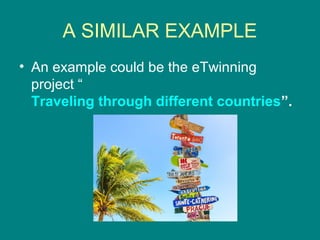
• An example could be the eTwinning
project “
Traveling through different countries”.

A trip around the world

  • 1.
    A trip aroundthe world
  • 2.
    AIMS • Our mainaim is developing a project in order to overcome geographical obstacles and to enhance intercultural understanding in the optic of INCLUSION.
  • 3.
    AIMS • Skills andknowledge to be developed are: - European citizenship, - knowledge of European and Extra- European countries, - communication in English, - responsible use of ICT, - team work, - interaction with pupils from partner schools, - creativity and innovation.
  • 4.
    WORK PROCESS • Pupilsintroduce themselves, their countries and schools (September-October). • Pupils create groups to work in team with partners and organize their work (November). • Pupils choose European countries they want to learn about and prepare presentations or videos (November-January). • Pupils choose European countries they want to learn about and prepare presentations or videos (February-April). • The best works are collected in a common product (May).
  • 5.
    TASKS • Pupils canwork alone or better in team. • Teams can be composed by pupils from different schools. • Pupils work on different countries paying attention also to cultural and social aspects. • That’s why they have to look for texts, songs and traditions of the countries they choose. • They have to use ICT and web 2.0 tools. • Communication language can be English or French.
  • 6.
    EXPECTED RESULTS • Wewant to share the results of our work in a public TwinSpace and eventually in a web site or a leaflet. • The produced material could be used to prepare lessons for next classes.
  • 7.
    A SIMILAR EXAMPLE •An example could be the eTwinning project “ Traveling through different countries”.