THE LIFE-CYCLE OF AN ETWINNING PROJECT
AND COLLABORATIVE ACTIVITY MODELS
Elizabeth Sauser-Monnig, French National Support Service
eTwinning Plus Contact Seminar
Tunis, 22-24 November 2013
THE LIFE-CYCLE OF AN
ETWINNING PROJECT
STAGE 1: GETTING A PROJECT IDEA
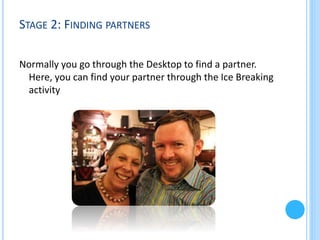
STAGE 2: FINDING PARTNERS
Normally you go through the Desktop to find a partner.
Here, you can find your partner through the Ice Breaking
activity
STAGE 3:
BUILDING THE PROJECT TOGETHER

1. Defining the project idea
2. Planning the project
3. Preparing the 1st activity for the pupils

4. Registering the project
STAGE 4: GETTING STARTED

Back home, you will …

1. Access your project Twinspace
2. Invite your pupils into the Twinspace
3. Launch a pupil-centered activity as an
ice-breaker
STAGE 5: RUNNING THE PROJECT

1. Communicate often and efficiently
2. Follow your planned phases
3. Be ready to adjust and adapt
STAGE 6: EVALUATING THE PROJECT
1. Reflection
- between the teachers
- with the pupils
4. Benefits for the school and community

3. Lessons learned and recommendations
4. Celebrating!
STAGE 7: SHARING AND DISSEMINATING
1. Presenting the project results+ benefits
2. Applying for a National Quality Label
3. Beyond the project: eTwinning teams, groups,
ambassadors
4. Training colleagues
SETTING UP A PROJECT
1.

Teachers connect on the eTwinning Desktop

2.

They develop and register the project on Desktop

3.

Both NSS approve project

4.

Then teachers can start work on the Twinspace with
pupils

10
TYPES OF PROJECTS
Documentary : research, collaborative reports and
experiments, biographies, travel journals, …
 Collaborative Fiction Writing : fairy tales, detective
stories…
 Pen pal: exchanging messages about a theme.
 Newspapers: writing about a theme.

THEMES FOR PROJECTS ABOUT WATER
Water and citizenship : water consumption, waste,
lifestyles
 Interdependancy around the Mediterranean: pollution,
currents…
 Water and economic, social development
 Water in its different states (solid, liquid, gas)

WATER CONSUMPTION ACTIVITY
Activity suggested by Eric Vayssié, eTwinning ambassador
1.

2.

3.
4.

5.

Define time period, measurements, parental
agreement
Pupils track water consumption daily/weekly using
water meter
Partners share data (on Twinspace, Google document)
Compare data and ask questions: find explanation for
similarities, differences
[Extension] Brainstorm between classes : collaborative
guidelines for responsible water use
ACTIVITY MODEL
Choose theme and goal with partners
1.
2.

Observe local environment: water use, flora/fauna
Collect data


3.
4.

Water meter, local weather, plant growth…

Compare data with partner countries
Find explanation for similarities, differences:
Small scale, individual explanation: baths for the whole
family vs. showers
 Large scale : geography, climate, local industries

21ST CENTURY PEN PALS
« Picture yourself », a project
for and about teenagers
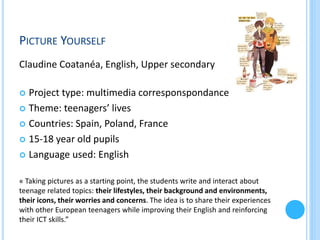
PICTURE YOURSELF
Claudine Coatanéa, English, Upper secondary
Project type: multimedia corresponspondance
 Theme: teenagers’ lives
 Countries: Spain, Poland, France
 15-18 year old pupils
 Language used: English


« Taking pictures as a starting point, the students write and interact about
teenage related topics: their lifestyles, their background and environments,
their icons, their worries and concerns. The idea is to share their experiences
with other European teenagers while improving their English and reinforcing
their ICT skills.”
PROJECT ACTIVITIES
A succession of activities over 8 months. For example :


Ice breaking activities, individual and group : « e-show
and tell », « our school »



« Story of my daily life » : photos montage, would you
like to be in my shoes.



« Let me show you how to… »: video tutorials



« The music we like »: debates using interactive wall,
collaborative European playlist
« STORY OF MY DAILY LIFE »
1. Take 7 pictures at different times of day (school day
mostly), record sound
2. Small groups (3-4): choose 1 photo for each time of day,
then explain why this photo, what moment it represents,
what you do and how you feel at that time of day. A time
you like? Why/why not?
Groups produce powerpoint presentations (Fanny and
Dina’s)
« STORY OF MY DAILY LIFE »
3. Compare routines between countries: would you like to
be in my shoes? Whose life is easier / harder? What is the
best/worst moment in our daily lives?
http://bit.ly/176M8IF

French schedule:
 Step 1 (indiv): Nov 7-8th
 Step 2 (groups): in class, Nov 21st
 Step 3 (on TwinSpace, forum): in class, Nov 28th
GOAL, « GO OUTSIDE AND LEARN ».
MATHS, ENGLISH
Siegfried Maillard (maths, lower secondary)
http://bit.ly/1ab0p8l

Concept: using maths to solve real life problems, …like
converting, translating and eating apple pie!

Pupils: 13-15
 Project type: documentary, problem solving
 Language: English
 Countries: France, Poland, Finland, Spain, Croatia,
Slovenia

VIRTUAL TRAVEL JOURNAL
A Simple Collaborative Project
PROJECT IDEA…
Idea: Present our school, city,… to our partners, and
vice versa
Problem: a little disappointing because there’s no
cooperation
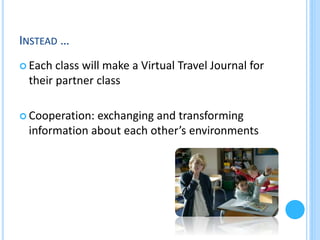
INSTEAD …
 Each

class will make a Virtual Travel Journal for
their partner class

 Cooperation:

exchanging and transforming
information about each other’s environments
BOTH CLASSES :
1.

Gather information and send it to their partners (mixed
nationality small groups…)

2.

Organize, interpret partners’ information

3.

Create a travel journal for their partners’ country

4.

Send their journal and receive the partners’ journal
MOTIVATION
1.

Research + data selection about our own
environment. Necessary for the partners, mustn’t let
them down!

2.

Need to receive info : waiting, discovering partners’
environment
MOTIVATION
3.

Creating Journals: discovering and understanding
information about partners’ environment, then
transforming it into something new

4.

Curiosity : how will the partners perceive and present
our environment? How will they perceive us?
ORGANIZATION


Length is up to you



Different possible focuses :


Environment: school/home/neighborhood/region…



Themes: history, environmental issues, music, literature…



Paths: daily path to school, local festivals, leisure…



Etc.
2 KINDS OF INFORMATION


Objective, general, macrosocial
History, famous people+events, literature…
 Statistics, maps, press clippings




Personal, subjective, microsocial


Pupils themselves
« What I like in my neighborhood… »
 « The city when my grandmother was young… »




Drawings, photos, texts
MATERIALS


Images: photos, maps, postcards, video



Texts: articles, collected data, literary texts



Objects: real objects, scanned/photographed



Sounds: from pupils’ environment, music
Have a great seminar!

Tunisie prez activity-project_pleniere

  • 1.
    THE LIFE-CYCLE OFAN ETWINNING PROJECT AND COLLABORATIVE ACTIVITY MODELS Elizabeth Sauser-Monnig, French National Support Service eTwinning Plus Contact Seminar Tunis, 22-24 November 2013
  • 2.
    THE LIFE-CYCLE OFAN ETWINNING PROJECT
  • 3.
    STAGE 1: GETTINGA PROJECT IDEA
  • 4.
    STAGE 2: FINDINGPARTNERS Normally you go through the Desktop to find a partner. Here, you can find your partner through the Ice Breaking activity
  • 5.
    STAGE 3: BUILDING THEPROJECT TOGETHER 1. Defining the project idea 2. Planning the project 3. Preparing the 1st activity for the pupils 4. Registering the project
  • 6.
    STAGE 4: GETTINGSTARTED Back home, you will … 1. Access your project Twinspace 2. Invite your pupils into the Twinspace 3. Launch a pupil-centered activity as an ice-breaker
  • 7.
    STAGE 5: RUNNINGTHE PROJECT 1. Communicate often and efficiently 2. Follow your planned phases 3. Be ready to adjust and adapt
  • 8.
    STAGE 6: EVALUATINGTHE PROJECT 1. Reflection - between the teachers - with the pupils 4. Benefits for the school and community 3. Lessons learned and recommendations 4. Celebrating!
  • 9.
    STAGE 7: SHARINGAND DISSEMINATING 1. Presenting the project results+ benefits 2. Applying for a National Quality Label 3. Beyond the project: eTwinning teams, groups, ambassadors 4. Training colleagues
  • 10.
    SETTING UP APROJECT 1. Teachers connect on the eTwinning Desktop 2. They develop and register the project on Desktop 3. Both NSS approve project 4. Then teachers can start work on the Twinspace with pupils 10
  • 11.
    TYPES OF PROJECTS Documentary: research, collaborative reports and experiments, biographies, travel journals, …  Collaborative Fiction Writing : fairy tales, detective stories…  Pen pal: exchanging messages about a theme.  Newspapers: writing about a theme. 
  • 12.
    THEMES FOR PROJECTSABOUT WATER Water and citizenship : water consumption, waste, lifestyles  Interdependancy around the Mediterranean: pollution, currents…  Water and economic, social development  Water in its different states (solid, liquid, gas) 
  • 13.
    WATER CONSUMPTION ACTIVITY Activitysuggested by Eric Vayssié, eTwinning ambassador 1. 2. 3. 4. 5. Define time period, measurements, parental agreement Pupils track water consumption daily/weekly using water meter Partners share data (on Twinspace, Google document) Compare data and ask questions: find explanation for similarities, differences [Extension] Brainstorm between classes : collaborative guidelines for responsible water use
  • 14.
    ACTIVITY MODEL Choose themeand goal with partners 1. 2. Observe local environment: water use, flora/fauna Collect data  3. 4. Water meter, local weather, plant growth… Compare data with partner countries Find explanation for similarities, differences: Small scale, individual explanation: baths for the whole family vs. showers  Large scale : geography, climate, local industries 
  • 15.
    21ST CENTURY PENPALS « Picture yourself », a project for and about teenagers
  • 16.
    PICTURE YOURSELF Claudine Coatanéa,English, Upper secondary Project type: multimedia corresponspondance  Theme: teenagers’ lives  Countries: Spain, Poland, France  15-18 year old pupils  Language used: English  « Taking pictures as a starting point, the students write and interact about teenage related topics: their lifestyles, their background and environments, their icons, their worries and concerns. The idea is to share their experiences with other European teenagers while improving their English and reinforcing their ICT skills.”
  • 17.
    PROJECT ACTIVITIES A successionof activities over 8 months. For example :  Ice breaking activities, individual and group : « e-show and tell », « our school »  « Story of my daily life » : photos montage, would you like to be in my shoes.  « Let me show you how to… »: video tutorials  « The music we like »: debates using interactive wall, collaborative European playlist
  • 18.
    « STORY OFMY DAILY LIFE » 1. Take 7 pictures at different times of day (school day mostly), record sound 2. Small groups (3-4): choose 1 photo for each time of day, then explain why this photo, what moment it represents, what you do and how you feel at that time of day. A time you like? Why/why not? Groups produce powerpoint presentations (Fanny and Dina’s)
  • 19.
    « STORY OFMY DAILY LIFE » 3. Compare routines between countries: would you like to be in my shoes? Whose life is easier / harder? What is the best/worst moment in our daily lives? http://bit.ly/176M8IF French schedule:  Step 1 (indiv): Nov 7-8th  Step 2 (groups): in class, Nov 21st  Step 3 (on TwinSpace, forum): in class, Nov 28th
  • 20.
    GOAL, « GOOUTSIDE AND LEARN ». MATHS, ENGLISH Siegfried Maillard (maths, lower secondary) http://bit.ly/1ab0p8l Concept: using maths to solve real life problems, …like converting, translating and eating apple pie! Pupils: 13-15  Project type: documentary, problem solving  Language: English  Countries: France, Poland, Finland, Spain, Croatia, Slovenia 
  • 21.
    VIRTUAL TRAVEL JOURNAL ASimple Collaborative Project
  • 22.
    PROJECT IDEA… Idea: Presentour school, city,… to our partners, and vice versa Problem: a little disappointing because there’s no cooperation
  • 23.
    INSTEAD …  Each classwill make a Virtual Travel Journal for their partner class  Cooperation: exchanging and transforming information about each other’s environments
  • 24.
    BOTH CLASSES : 1. Gatherinformation and send it to their partners (mixed nationality small groups…) 2. Organize, interpret partners’ information 3. Create a travel journal for their partners’ country 4. Send their journal and receive the partners’ journal
  • 25.
    MOTIVATION 1. Research + dataselection about our own environment. Necessary for the partners, mustn’t let them down! 2. Need to receive info : waiting, discovering partners’ environment
  • 26.
    MOTIVATION 3. Creating Journals: discoveringand understanding information about partners’ environment, then transforming it into something new 4. Curiosity : how will the partners perceive and present our environment? How will they perceive us?
  • 27.
    ORGANIZATION  Length is upto you  Different possible focuses :  Environment: school/home/neighborhood/region…  Themes: history, environmental issues, music, literature…  Paths: daily path to school, local festivals, leisure…  Etc.
  • 28.
    2 KINDS OFINFORMATION  Objective, general, macrosocial History, famous people+events, literature…  Statistics, maps, press clippings   Personal, subjective, microsocial  Pupils themselves « What I like in my neighborhood… »  « The city when my grandmother was young… »   Drawings, photos, texts
  • 29.
    MATERIALS  Images: photos, maps,postcards, video  Texts: articles, collected data, literary texts  Objects: real objects, scanned/photographed  Sounds: from pupils’ environment, music
  • 30.
    Have a greatseminar!