Clustering
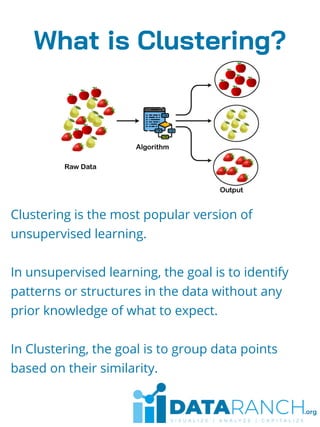
What is Clustering?
Clustering is the most popular version of
unsupervised learning.
In unsupervised learning, the goal is to identify
patterns or structures in the data without any
prior knowledge of what to expect.
In Clustering, the goal is to group data points
based on their similarity.
Why it is useful?
Suppose you are the head of a retail store and
wish to understand the preferences of your
customers. Can you look at the details of each
customer and devise a unique business strategy
for each one of them?
What you can do is cluster all of your customers
into, say 5 groups based on their purchasing
habits and use a separate strategy for each
group.
Desirable Properties of
a Clustering Algorithm
1. Scalability (in terms of both time and space)
2. Ability to deal with different data types
3. Minimal requirements for domain knowledge
to determine input parameters
4. Able to deal with noise and outliers
5. Insensitive to the order of input records
6. Incorporation of user-specified constraints
7. Interpretability and usability
Clustering Algorithms
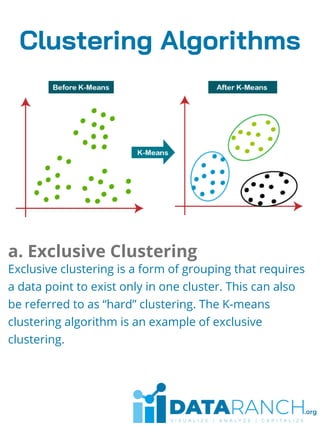
a. Exclusive Clustering
Exclusive clustering is a form of grouping that requires
a data point to exist only in one cluster. This can also
be referred to as “hard” clustering. The K-means
clustering algorithm is an example of exclusive
clustering.
Clustering Algorithms
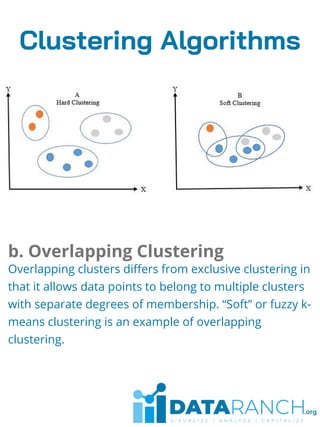
b. Overlapping Clustering
Overlapping clusters differs from exclusive clustering in
that it allows data points to belong to multiple clusters
with separate degrees of membership. “Soft” or fuzzy k-
means clustering is an example of overlapping
clustering.
Clustering Algorithms
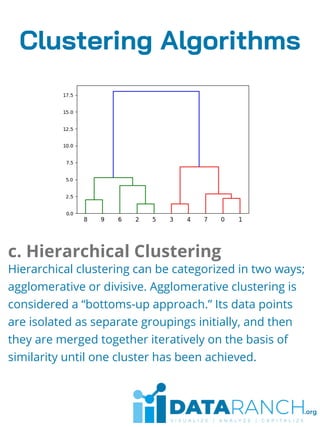
c. Hierarchical Clustering
Hierarchical clustering can be categorized in two ways;
agglomerative or divisive. Agglomerative clustering is
considered a “bottoms-up approach.” Its data points
are isolated as separate groupings initially, and then
they are merged together iteratively on the basis of
similarity until one cluster has been achieved.
Clustering Algorithms
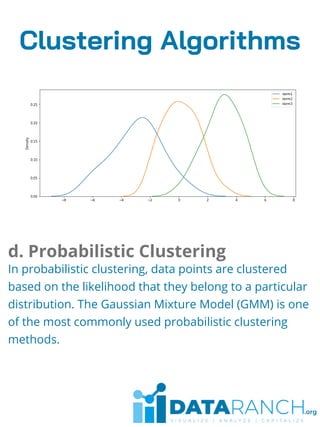
d. Probabilistic Clustering
In probabilistic clustering, data points are clustered
based on the likelihood that they belong to a particular
distribution. The Gaussian Mixture Model (GMM) is one
of the most commonly used probabilistic clustering
methods.
Applications of
Clustering
1. Marketing: To characterize & discover
customer segments for marketing purposes.
2. Biology: For classification among different
species of plants and animals.
3. Libraries: Clustering different books on the
basis of topics and information.
4. City Planning: To make groups of houses and
to study their values based on their geographical
locations and other factors present.
Challenges
1. Computational complexity due to a high volume
of training data.
2. Longer training times
3. Higher risk of inaccurate results
4. Human intervention to validate output variables
5. Lack of transparency into the basis on which
data was clustered
Follow #DataRanch on
LinkedIn for more...
info@dataranch.org
linkedin.com/company/dataranch

A simple intro to clustering basics.pdf

  • 1.
  • 2.
    What is Clustering? Clusteringis the most popular version of unsupervised learning. In unsupervised learning, the goal is to identify patterns or structures in the data without any prior knowledge of what to expect. In Clustering, the goal is to group data points based on their similarity.
  • 3.
    Why it isuseful? Suppose you are the head of a retail store and wish to understand the preferences of your customers. Can you look at the details of each customer and devise a unique business strategy for each one of them? What you can do is cluster all of your customers into, say 5 groups based on their purchasing habits and use a separate strategy for each group.
  • 4.
    Desirable Properties of aClustering Algorithm 1. Scalability (in terms of both time and space) 2. Ability to deal with different data types 3. Minimal requirements for domain knowledge to determine input parameters 4. Able to deal with noise and outliers 5. Insensitive to the order of input records 6. Incorporation of user-specified constraints 7. Interpretability and usability
  • 5.
    Clustering Algorithms a. ExclusiveClustering Exclusive clustering is a form of grouping that requires a data point to exist only in one cluster. This can also be referred to as “hard” clustering. The K-means clustering algorithm is an example of exclusive clustering.
  • 6.
    Clustering Algorithms b. OverlappingClustering Overlapping clusters differs from exclusive clustering in that it allows data points to belong to multiple clusters with separate degrees of membership. “Soft” or fuzzy k- means clustering is an example of overlapping clustering.
  • 7.
    Clustering Algorithms c. HierarchicalClustering Hierarchical clustering can be categorized in two ways; agglomerative or divisive. Agglomerative clustering is considered a “bottoms-up approach.” Its data points are isolated as separate groupings initially, and then they are merged together iteratively on the basis of similarity until one cluster has been achieved.
  • 8.
    Clustering Algorithms d. ProbabilisticClustering In probabilistic clustering, data points are clustered based on the likelihood that they belong to a particular distribution. The Gaussian Mixture Model (GMM) is one of the most commonly used probabilistic clustering methods.
  • 9.
    Applications of Clustering 1. Marketing:To characterize & discover customer segments for marketing purposes. 2. Biology: For classification among different species of plants and animals. 3. Libraries: Clustering different books on the basis of topics and information. 4. City Planning: To make groups of houses and to study their values based on their geographical locations and other factors present.
  • 10.
    Challenges 1. Computational complexitydue to a high volume of training data. 2. Longer training times 3. Higher risk of inaccurate results 4. Human intervention to validate output variables 5. Lack of transparency into the basis on which data was clustered
  • 11.
  • 12.