




2020/08/28
Centernet: Object as Points
Arithmer Dynamics Div. Christian Saravia
Self-Introduction
Christian Martin Saravia Hernandez
● Graduate School
○ Universidad Peruana de Ciencias Aplicadas
○ Bs. Software Engineering
● Former Job
○ Ficha Inc
■ Algorithm Development Engineer
● Research & application of deep learning in computer vision problems
● Current Job
○ Application of machine learning / deep learning to computer vision problems
■ Object detection
■ Object classification
Purpose
Purpose of this material
● Understand an anchor free approach object detection algorithm
Agenda
Agenda
● Current object detection approaches
● Centernet approach
● Object as Points
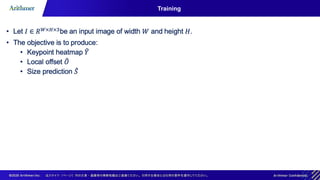
● Training
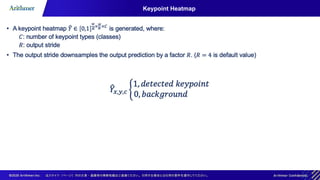
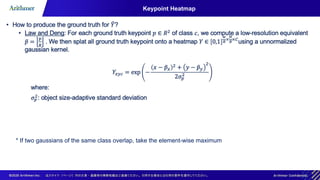
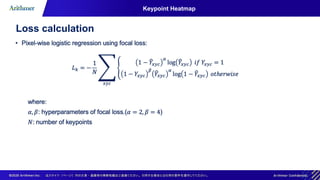
○ Keypoint heatmap
○ Local offset
○ Size prediction
○ Loss function
● Network Architecture
○ DLA
○ Modified DLA
● Inference
● Results
Background
Current approaches
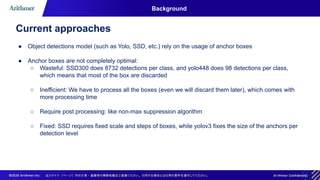
● Object detections model (such as Yolo, SSD, etc.) rely on the usage of anchor boxes
● Anchor boxes are not completely optimal:
○ Wasteful: SSD300 does 8732 detections per class, and yolo448 does 98 detections per class,
which means that most of the box are discarded
○ Inefficient: We have to process all the boxes (even we will discard them later), which comes with
more processing time
○ Require post processing: like non-max suppression algorithm
○ Fixed: SSD requires fixed scale and steps of boxes, while yolov3 fixes the size of the anchors per
detection level
Centernet
Centernet approach
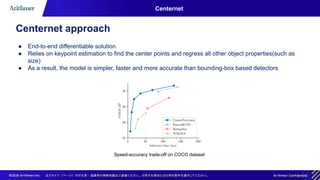
● End-to-end differentiable solution
● Relies on keypoint estimation to find the center points and regress all other object properties(such as
size)
● As a result, the model is simpler, faster and more accurate than bounding-box based detectors
Speed-accuracy trade-off on COCO dataset
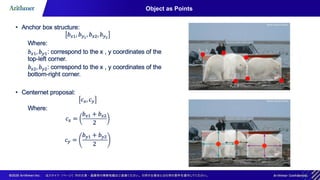
Object as Points
Training
Keypoint Heatmap
Keypoint Heatmap
* If two gaussians of the same class overlap, take the element-wise maximum
Keypoint Heatmap
Loss calculation
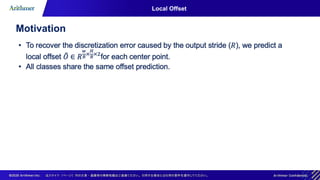
Local Offset
Motivation
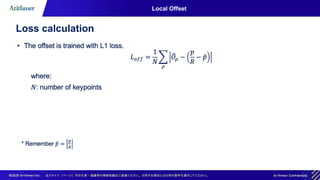
Local Offset
Loss calculation
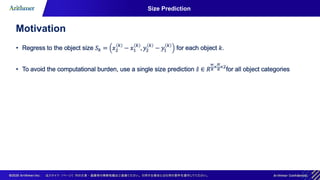
Size Prediction
Motivation
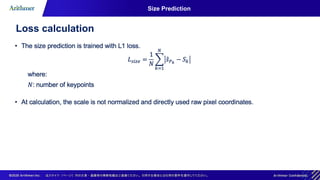
Size Prediction
Loss calculation
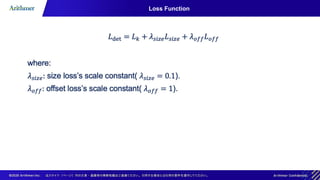
Loss Function
Network Architecture
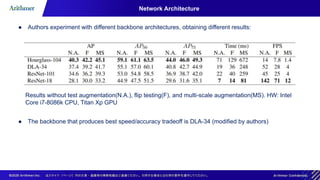
● Authors experiment with different backbone architectures, obtaining different results:
● The backbone that produces best speed/accuracy tradeoff is DLA-34 (modified by authors)
Results without test augmentation(N.A.), flip testing(F), and multi-scale augmentation(MS). HW: Intel
Core i7-8086k CPU, Titan Xp GPU
Network Architecture
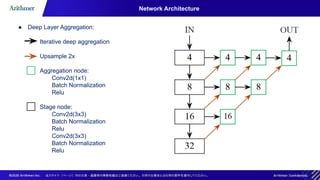
● Deep Layer Aggregation:
Iterative deep aggregation
Upsample 2x
Aggregation node:
Conv2d(1x1)
Batch Normalization
Relu
Stage node:
Conv2d(3x3)
Batch Normalization
Relu
Conv2d(3x3)
Batch Normalization
Relu
Network Architecture
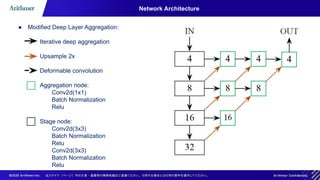
● Modified Deep Layer Aggregation:
Iterative deep aggregation
Upsample 2x
Deformable convolution
Aggregation node:
Conv2d(1x1)
Batch Normalization
Relu
Stage node:
Conv2d(3x3)
Batch Normalization
Relu
Conv2d(3x3)
Batch Normalization
Relu
Inference
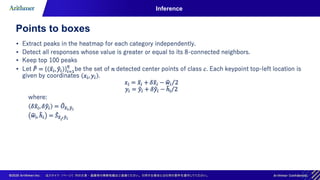
Points to boxes
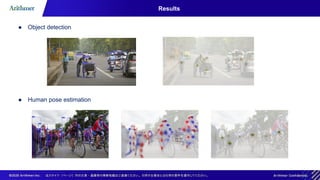
Results
● Object detection
● Human pose estimation
Results
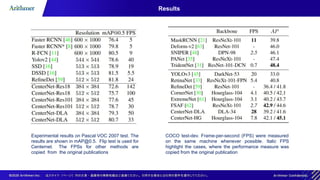
Experimental results on Pascal VOC 2007 test. The
results are shown in mAP@0.5. Flip test is used for
Centernet. The FPSs for other methods are
copied from the original publications
COCO test-dev. Frame-per-second (FPS) were measured
on the same machine whenever possible. Italic FPS
highlight the cases, where the performance measure was
copied from the original publication
23

Centernet

  • 1.
    2020/08/28 Centernet: Object asPoints Arithmer Dynamics Div. Christian Saravia
  • 2.
    Self-Introduction Christian Martin SaraviaHernandez ● Graduate School ○ Universidad Peruana de Ciencias Aplicadas ○ Bs. Software Engineering ● Former Job ○ Ficha Inc ■ Algorithm Development Engineer ● Research & application of deep learning in computer vision problems ● Current Job ○ Application of machine learning / deep learning to computer vision problems ■ Object detection ■ Object classification
  • 3.
    Purpose Purpose of thismaterial ● Understand an anchor free approach object detection algorithm
  • 4.
    Agenda Agenda ● Current objectdetection approaches ● Centernet approach ● Object as Points ● Training ○ Keypoint heatmap ○ Local offset ○ Size prediction ○ Loss function ● Network Architecture ○ DLA ○ Modified DLA ● Inference ● Results
  • 5.
    Background Current approaches ● Objectdetections model (such as Yolo, SSD, etc.) rely on the usage of anchor boxes ● Anchor boxes are not completely optimal: ○ Wasteful: SSD300 does 8732 detections per class, and yolo448 does 98 detections per class, which means that most of the box are discarded ○ Inefficient: We have to process all the boxes (even we will discard them later), which comes with more processing time ○ Require post processing: like non-max suppression algorithm ○ Fixed: SSD requires fixed scale and steps of boxes, while yolov3 fixes the size of the anchors per detection level
  • 6.
    Centernet Centernet approach ● End-to-enddifferentiable solution ● Relies on keypoint estimation to find the center points and regress all other object properties(such as size) ● As a result, the model is simpler, faster and more accurate than bounding-box based detectors Speed-accuracy trade-off on COCO dataset
  • 7.
  • 8.
  • 9.
  • 10.
    Keypoint Heatmap * Iftwo gaussians of the same class overlap, take the element-wise maximum
  • 11.
  • 12.
  • 13.
  • 14.
  • 15.
  • 16.
  • 17.
    Network Architecture ● Authorsexperiment with different backbone architectures, obtaining different results: ● The backbone that produces best speed/accuracy tradeoff is DLA-34 (modified by authors) Results without test augmentation(N.A.), flip testing(F), and multi-scale augmentation(MS). HW: Intel Core i7-8086k CPU, Titan Xp GPU
  • 18.
    Network Architecture ● DeepLayer Aggregation: Iterative deep aggregation Upsample 2x Aggregation node: Conv2d(1x1) Batch Normalization Relu Stage node: Conv2d(3x3) Batch Normalization Relu Conv2d(3x3) Batch Normalization Relu
  • 19.
    Network Architecture ● ModifiedDeep Layer Aggregation: Iterative deep aggregation Upsample 2x Deformable convolution Aggregation node: Conv2d(1x1) Batch Normalization Relu Stage node: Conv2d(3x3) Batch Normalization Relu Conv2d(3x3) Batch Normalization Relu
  • 20.
  • 21.
    Results ● Object detection ●Human pose estimation
  • 22.
    Results Experimental results onPascal VOC 2007 test. The results are shown in mAP@0.5. Flip test is used for Centernet. The FPSs for other methods are copied from the original publications COCO test-dev. Frame-per-second (FPS) were measured on the same machine whenever possible. Italic FPS highlight the cases, where the performance measure was copied from the original publication
  • 23.