NADAR SARASWATHI COLLEGE OF ARTS & SCIENCE
Submitted by
G.Keerthika
II M.Sc (cs)
Image Compression Model in Digital Image Processing
Unlocking Efficiency: The
Power of Image
Compression in Digital
Image Processing
In the realm of Digital Image Processing (DIP), image compression is the
art and science of reducing the data needed to represent an image. This
process is crucial for efficient storage and transmission of visual
information.
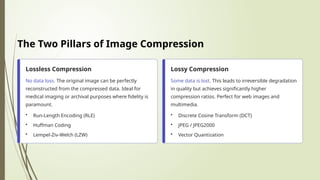
The Two Pillars of Image Compression
Lossless Compression
No data loss. The original image can be perfectly
reconstructed from the compressed data. Ideal for
medical imaging or archival purposes where fidelity is
paramount.
• Run-Length Encoding (RLE)
• Huffman Coding
• Lempel-Ziv-Welch (LZW)
Lossy Compression
Some data is lost. This leads to irreversible degradation
in quality but achieves significantly higher
compression ratios. Perfect for web images and
multimedia.
• Discrete Cosine Transform (DCT)
• JPEG / JPEG2000
• Vector Quantization
Deep Dive: JPEG – The Everyday Compression Standard
JPEG (Joint Photographic Experts Group) is a widely adopted lossy compression model. It efficiently reduces file sizes of
digital images, especially photographs, by leveraging the human eye's lower sensitivity to high-frequency color variations.
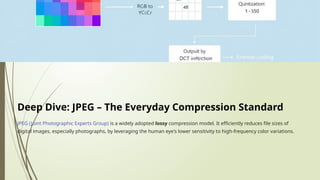
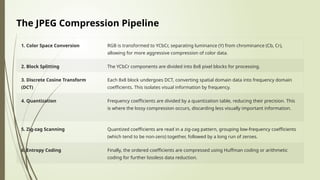
The JPEG Compression Pipeline
1. Color Space Conversion RGB is transformed to YCbCr, separating luminance (Y) from chrominance (Cb, Cr),
allowing for more aggressive compression of color data.
2. Block Splitting The YCbCr components are divided into 8x8 pixel blocks for processing.
3. Discrete Cosine Transform
(DCT)
Each 8x8 block undergoes DCT, converting spatial domain data into frequency domain
coefficients. This isolates visual information by frequency.
4. Quantization Frequency coefficients are divided by a quantization table, reducing their precision. This
is where the lossy compression occurs, discarding less visually important information.
5. Zig-zag Scanning Quantized coefficients are read in a zig-zag pattern, grouping low-frequency coefficients
(which tend to be non-zero) together, followed by a long run of zeroes.
6. Entropy Coding Finally, the ordered coefficients are compressed using Huffman coding or arithmetic
coding for further lossless data reduction.
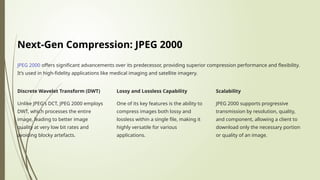
Next-Gen Compression: JPEG 2000
JPEG 2000 offers significant advancements over its predecessor, providing superior compression performance and flexibility.
It’s used in high-fidelity applications like medical imaging and satellite imagery.
Discrete Wavelet Transform (DWT)
Unlike JPEG's DCT, JPEG 2000 employs
DWT, which processes the entire
image, leading to better image
quality at very low bit rates and
avoiding blocky artefacts.
Lossy and Lossless Capability
One of its key features is the ability to
compress images both lossy and
lossless within a single file, making it
highly versatile for various
applications.
Scalability
JPEG 2000 supports progressive
transmission by resolution, quality,
and component, allowing a client to
download only the necessary portion
or quality of an image.
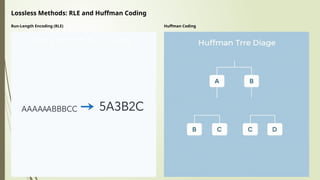
Lossless Methods: RLE and Huffman Coding
Run-Length Encoding (RLE) Huffman Coding
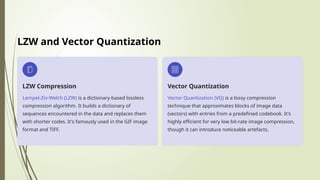
LZW and Vector Quantization
LZW Compression
Lempel-Ziv-Welch (LZW) is a dictionary-based lossless
compression algorithm. It builds a dictionary of
sequences encountered in the data and replaces them
with shorter codes. It's famously used in the GIF image
format and TIFF.
Vector Quantization
Vector Quantization (VQ) is a lossy compression
technique that approximates blocks of image data
(vectors) with entries from a predefined codebook. It's
highly efficient for very low bit-rate image compression,
though it can introduce noticeable artefacts.
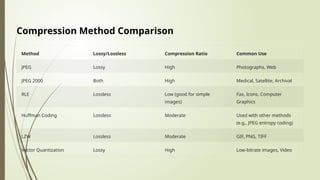
Compression Method Comparison
Method Lossy/Lossless Compression Ratio Common Use
JPEG Lossy High Photographs, Web
JPEG 2000 Both High Medical, Satellite, Archival
RLE Lossless Low (good for simple
images)
Fax, Icons, Computer
Graphics
Huffman Coding Lossless Moderate Used with other methods
(e.g., JPEG entropy coding)
LZW Lossless Moderate GIF, PNG, TIFF
Vector Quantization Lossy High Low-bitrate images, Video
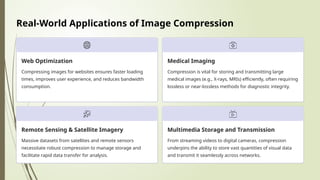
Real-World Applications of Image Compression
Web Optimization
Compressing images for websites ensures faster loading
times, improves user experience, and reduces bandwidth
consumption.
Medical Imaging
Compression is vital for storing and transmitting large
medical images (e.g., X-rays, MRIs) efficiently, often requiring
lossless or near-lossless methods for diagnostic integrity.
Remote Sensing & Satellite Imagery
Massive datasets from satellites and remote sensors
necessitate robust compression to manage storage and
facilitate rapid data transfer for analysis.
Multimedia Storage and Transmission
From streaming videos to digital cameras, compression
underpins the ability to store vast quantities of visual data
and transmit it seamlessly across networks.
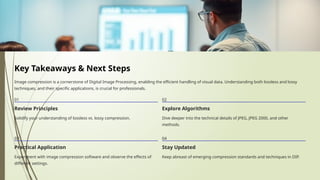
Key Takeaways & Next Steps
Image compression is a cornerstone of Digital Image Processing, enabling the efficient handling of visual data. Understanding both lossless and lossy
techniques, and their specific applications, is crucial for professionals.
01
Review Principles
Solidify your understanding of lossless vs. lossy compression.
02
Explore Algorithms
Dive deeper into the technical details of JPEG, JPEG 2000, and other
methods.
03
Practical Application
Experiment with image compression software and observe the effects of
different settings.
04
Stay Updated
Keep abreast of emerging compression standards and techniques in DIP.
THANK YOU

Unlocking-Efficiency-The-Power-of-Image-Compression-in-Digital-Image-Processing.pptx

  • 1.
    NADAR SARASWATHI COLLEGEOF ARTS & SCIENCE Submitted by G.Keerthika II M.Sc (cs) Image Compression Model in Digital Image Processing
  • 2.
    Unlocking Efficiency: The Powerof Image Compression in Digital Image Processing In the realm of Digital Image Processing (DIP), image compression is the art and science of reducing the data needed to represent an image. This process is crucial for efficient storage and transmission of visual information.
  • 3.
    The Two Pillarsof Image Compression Lossless Compression No data loss. The original image can be perfectly reconstructed from the compressed data. Ideal for medical imaging or archival purposes where fidelity is paramount. • Run-Length Encoding (RLE) • Huffman Coding • Lempel-Ziv-Welch (LZW) Lossy Compression Some data is lost. This leads to irreversible degradation in quality but achieves significantly higher compression ratios. Perfect for web images and multimedia. • Discrete Cosine Transform (DCT) • JPEG / JPEG2000 • Vector Quantization
  • 4.
    Deep Dive: JPEG– The Everyday Compression Standard JPEG (Joint Photographic Experts Group) is a widely adopted lossy compression model. It efficiently reduces file sizes of digital images, especially photographs, by leveraging the human eye's lower sensitivity to high-frequency color variations.
  • 5.
    The JPEG CompressionPipeline 1. Color Space Conversion RGB is transformed to YCbCr, separating luminance (Y) from chrominance (Cb, Cr), allowing for more aggressive compression of color data. 2. Block Splitting The YCbCr components are divided into 8x8 pixel blocks for processing. 3. Discrete Cosine Transform (DCT) Each 8x8 block undergoes DCT, converting spatial domain data into frequency domain coefficients. This isolates visual information by frequency. 4. Quantization Frequency coefficients are divided by a quantization table, reducing their precision. This is where the lossy compression occurs, discarding less visually important information. 5. Zig-zag Scanning Quantized coefficients are read in a zig-zag pattern, grouping low-frequency coefficients (which tend to be non-zero) together, followed by a long run of zeroes. 6. Entropy Coding Finally, the ordered coefficients are compressed using Huffman coding or arithmetic coding for further lossless data reduction.
  • 6.
    Next-Gen Compression: JPEG2000 JPEG 2000 offers significant advancements over its predecessor, providing superior compression performance and flexibility. It’s used in high-fidelity applications like medical imaging and satellite imagery. Discrete Wavelet Transform (DWT) Unlike JPEG's DCT, JPEG 2000 employs DWT, which processes the entire image, leading to better image quality at very low bit rates and avoiding blocky artefacts. Lossy and Lossless Capability One of its key features is the ability to compress images both lossy and lossless within a single file, making it highly versatile for various applications. Scalability JPEG 2000 supports progressive transmission by resolution, quality, and component, allowing a client to download only the necessary portion or quality of an image.
  • 7.
    Lossless Methods: RLEand Huffman Coding Run-Length Encoding (RLE) Huffman Coding
  • 8.
    LZW and VectorQuantization LZW Compression Lempel-Ziv-Welch (LZW) is a dictionary-based lossless compression algorithm. It builds a dictionary of sequences encountered in the data and replaces them with shorter codes. It's famously used in the GIF image format and TIFF. Vector Quantization Vector Quantization (VQ) is a lossy compression technique that approximates blocks of image data (vectors) with entries from a predefined codebook. It's highly efficient for very low bit-rate image compression, though it can introduce noticeable artefacts.
  • 9.
    Compression Method Comparison MethodLossy/Lossless Compression Ratio Common Use JPEG Lossy High Photographs, Web JPEG 2000 Both High Medical, Satellite, Archival RLE Lossless Low (good for simple images) Fax, Icons, Computer Graphics Huffman Coding Lossless Moderate Used with other methods (e.g., JPEG entropy coding) LZW Lossless Moderate GIF, PNG, TIFF Vector Quantization Lossy High Low-bitrate images, Video
  • 10.
    Real-World Applications ofImage Compression Web Optimization Compressing images for websites ensures faster loading times, improves user experience, and reduces bandwidth consumption. Medical Imaging Compression is vital for storing and transmitting large medical images (e.g., X-rays, MRIs) efficiently, often requiring lossless or near-lossless methods for diagnostic integrity. Remote Sensing & Satellite Imagery Massive datasets from satellites and remote sensors necessitate robust compression to manage storage and facilitate rapid data transfer for analysis. Multimedia Storage and Transmission From streaming videos to digital cameras, compression underpins the ability to store vast quantities of visual data and transmit it seamlessly across networks.
  • 11.
    Key Takeaways &Next Steps Image compression is a cornerstone of Digital Image Processing, enabling the efficient handling of visual data. Understanding both lossless and lossy techniques, and their specific applications, is crucial for professionals. 01 Review Principles Solidify your understanding of lossless vs. lossy compression. 02 Explore Algorithms Dive deeper into the technical details of JPEG, JPEG 2000, and other methods. 03 Practical Application Experiment with image compression software and observe the effects of different settings. 04 Stay Updated Keep abreast of emerging compression standards and techniques in DIP.
  • 12.