A Practical Approach to
Raw Material Sourcing and
Management
Cell Culture World Congress, Munich Germany
Marlin Frechette
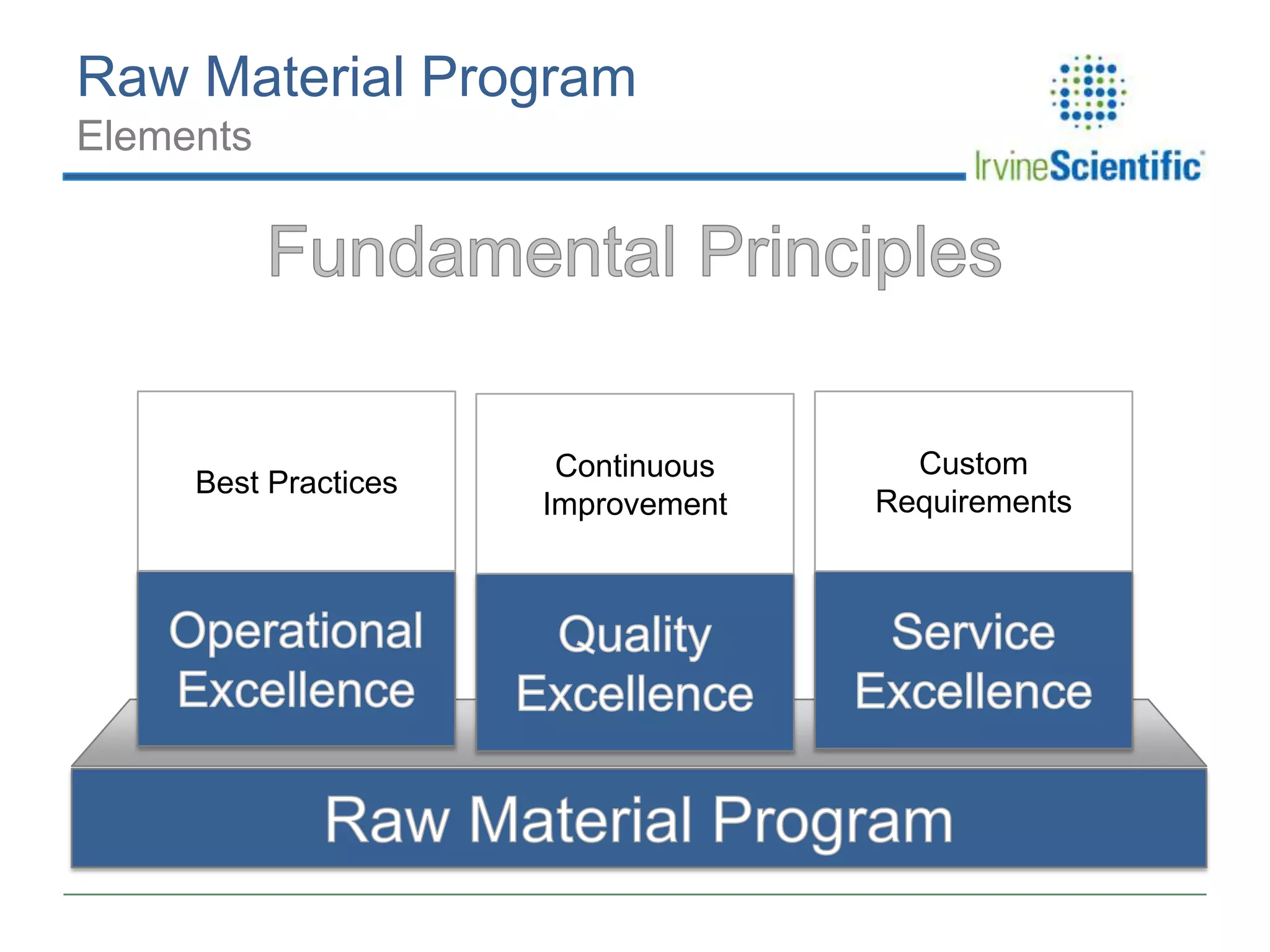
Director, Quality Systems and Regulatory Affairs
Irvine Scientific
Outline


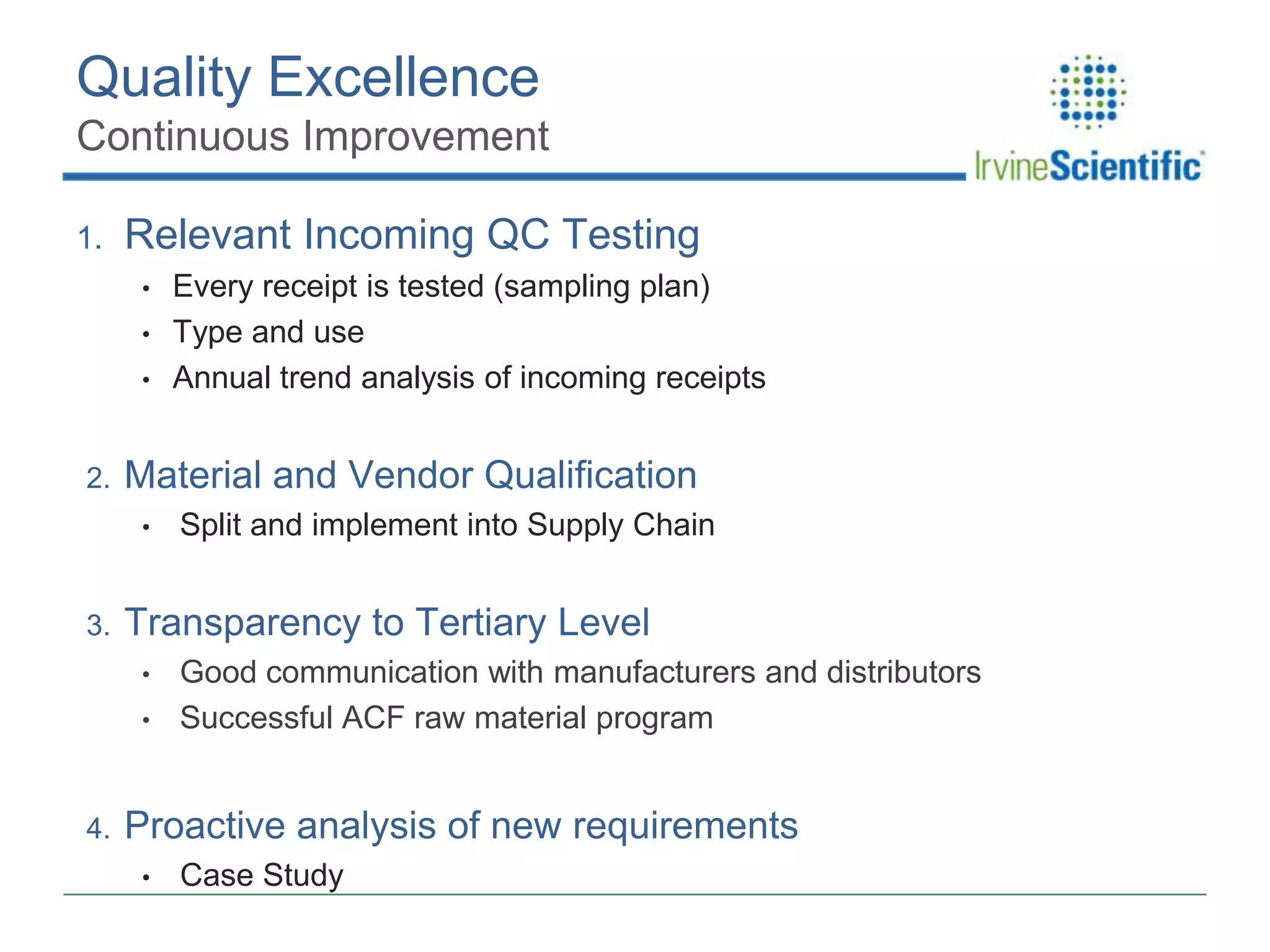
Introduction

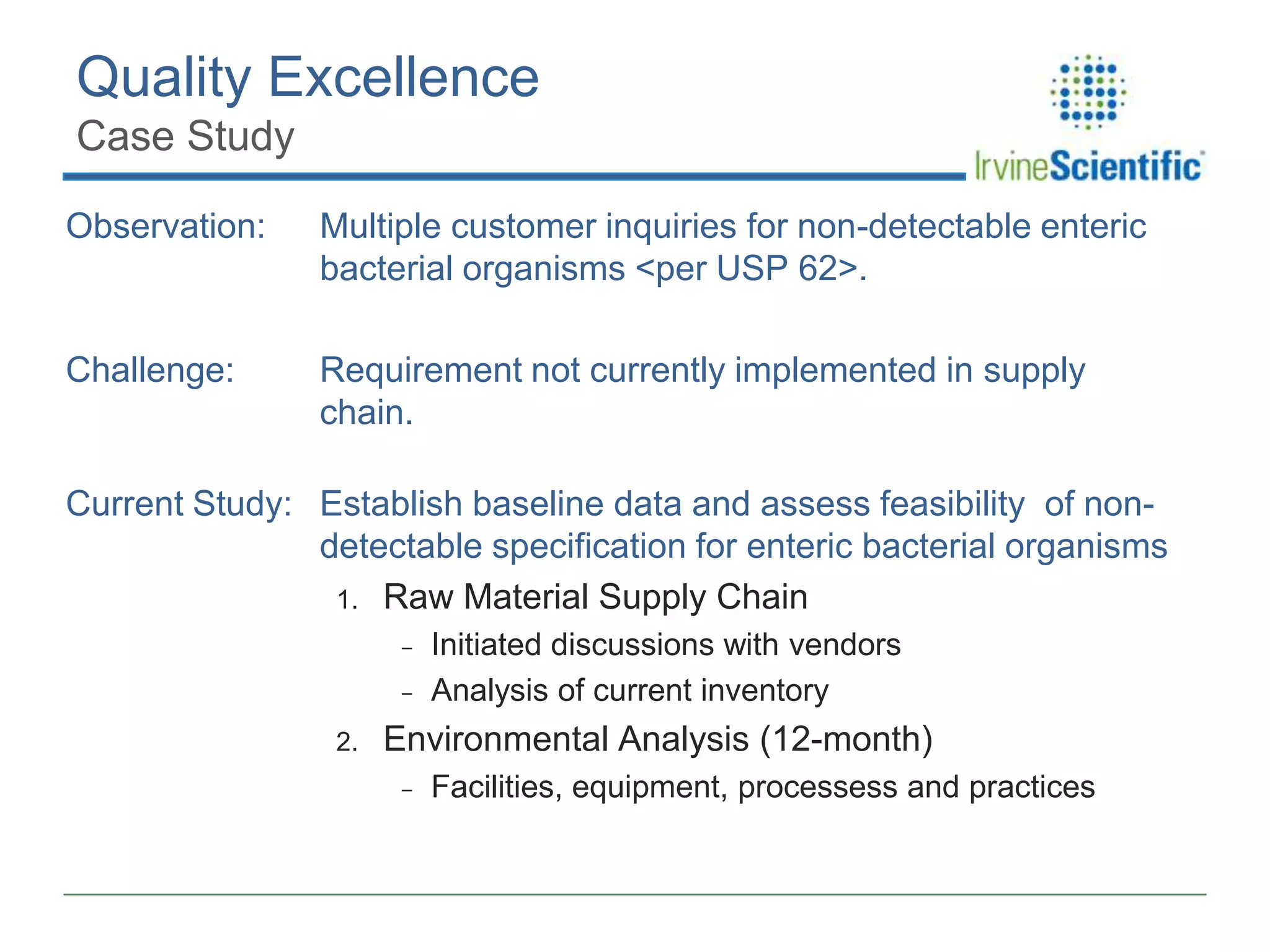


Raw Material Program
•
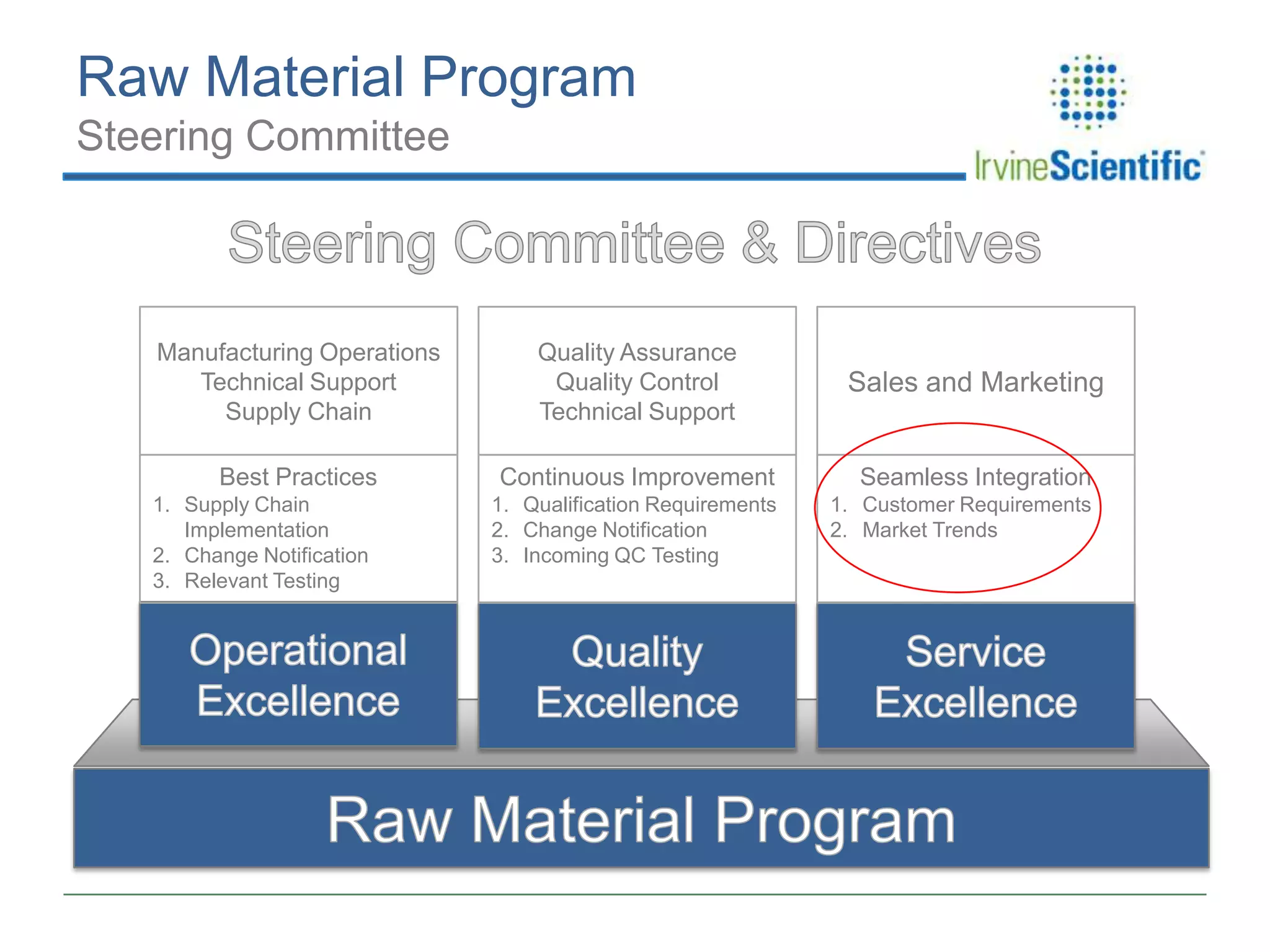
•

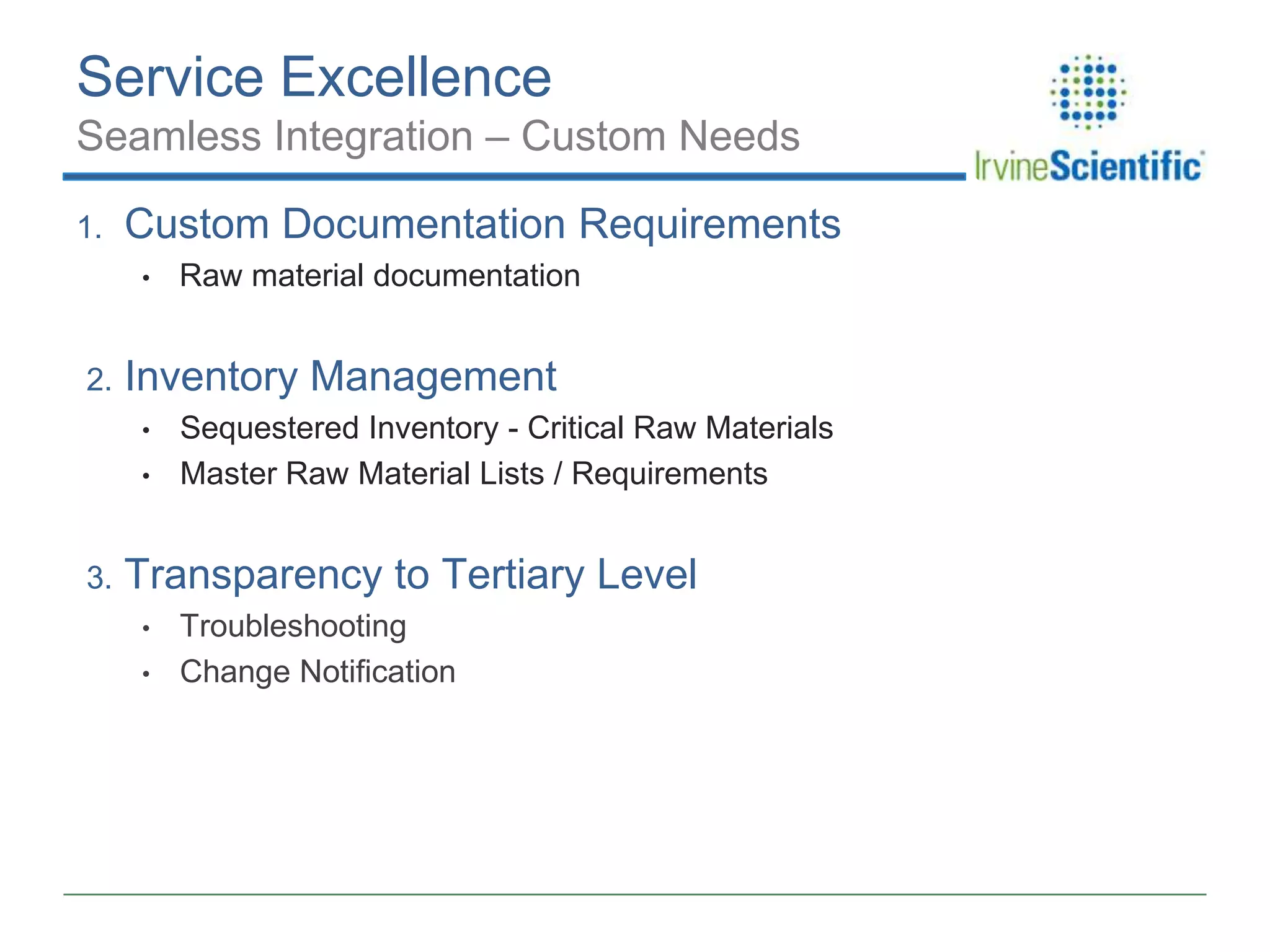
Historical Events
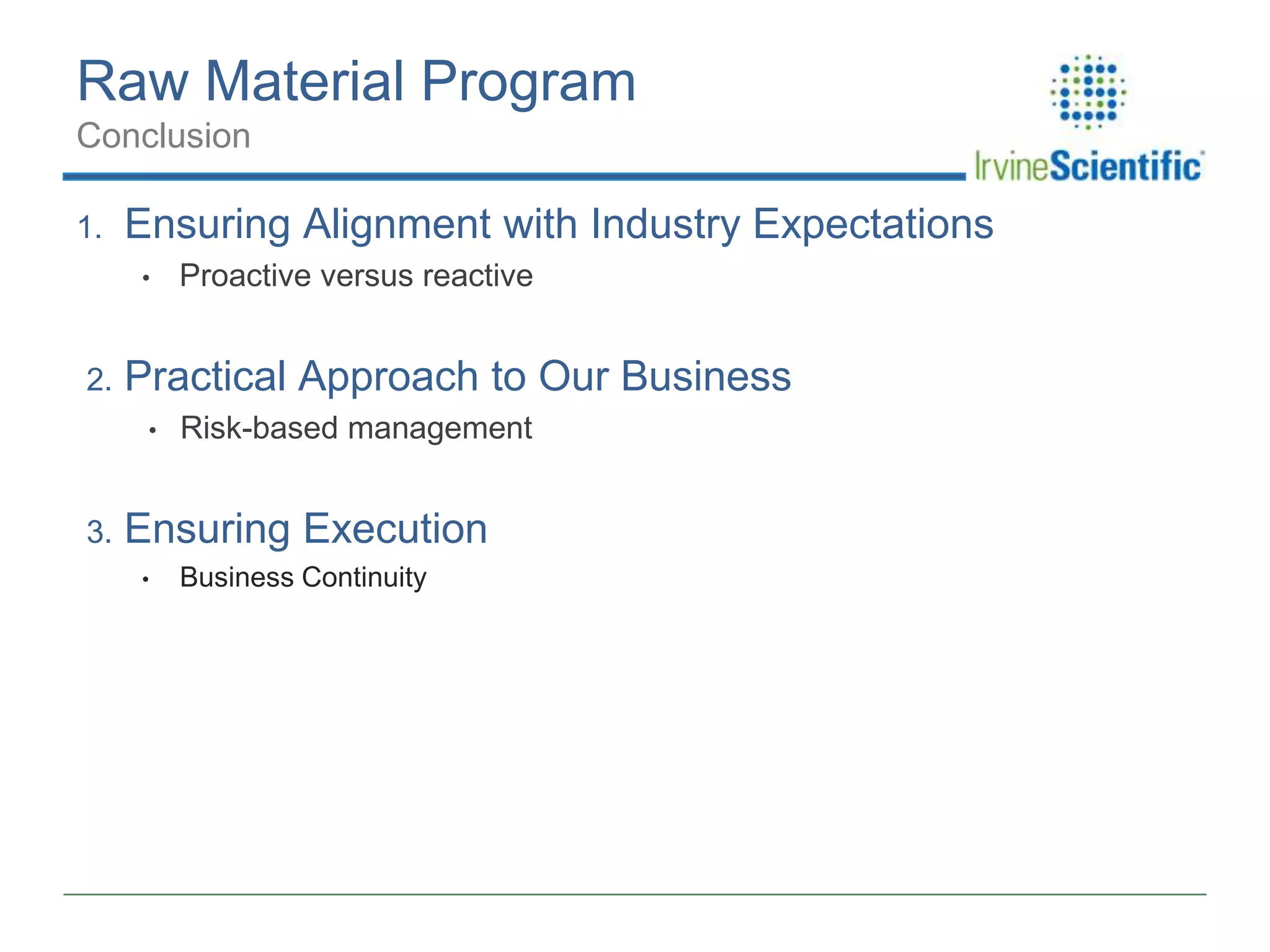
Program Elements
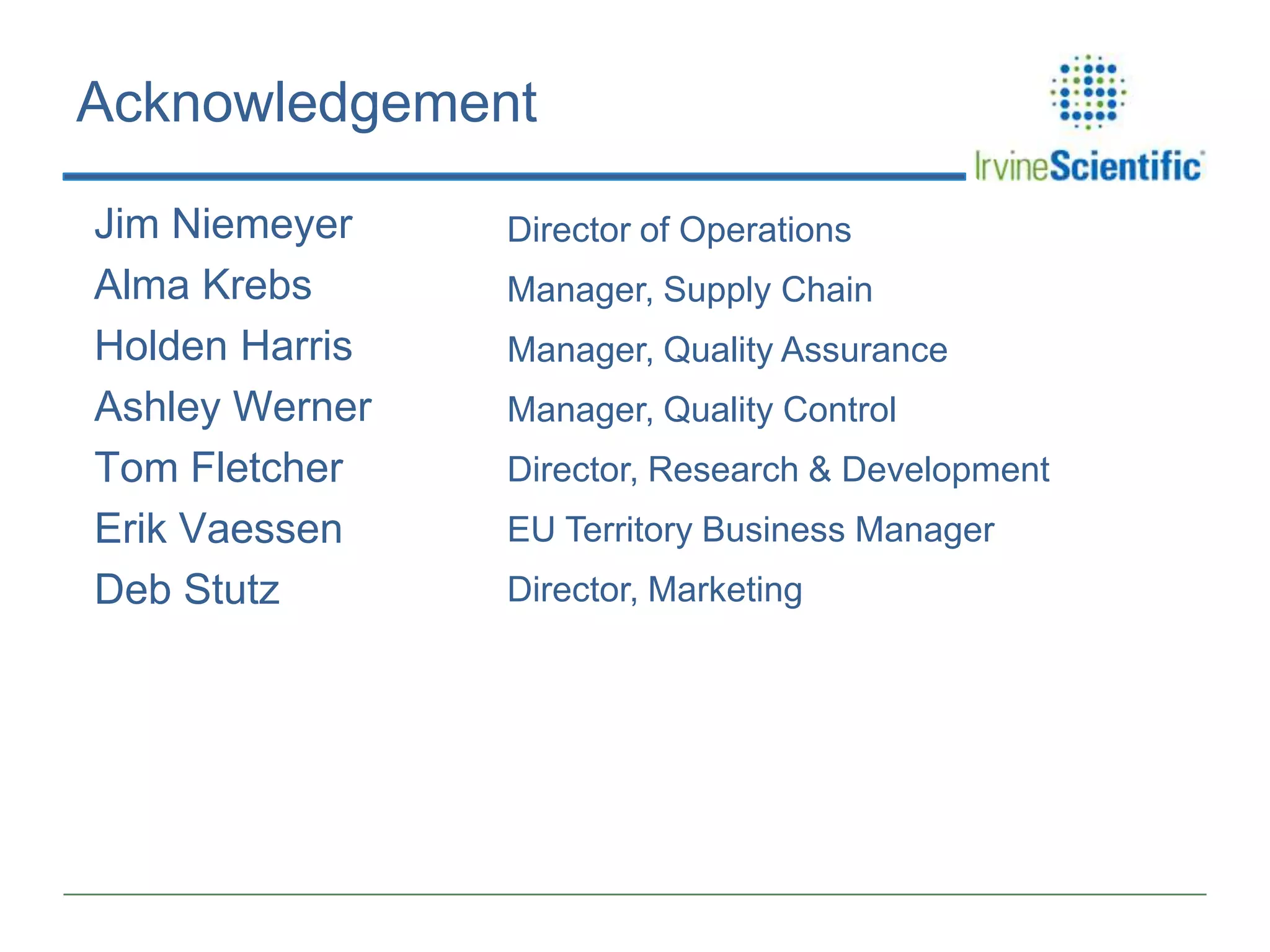
-

•

Operational Excellence
Quality Excellence
Service Excellence

Conclusion
Irvine Scientific
Introduction



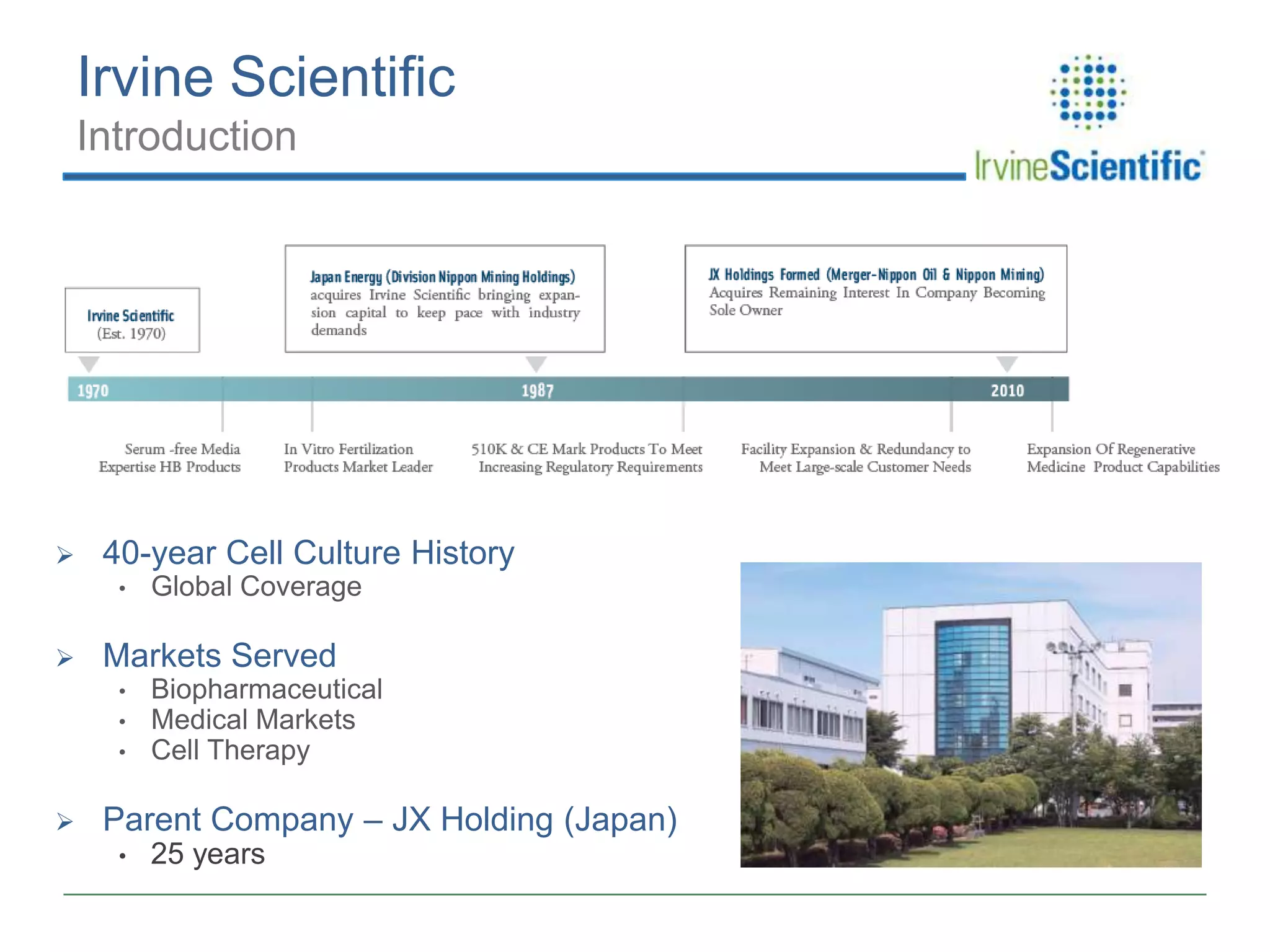
40-year Cell Culture History
•



Markets Served
•
•
•



Global Coverage

Biopharmaceutical
Medical Markets
Cell Therapy

Parent Company – JX Holding (Japan)
•

25 years
Raw Material Program
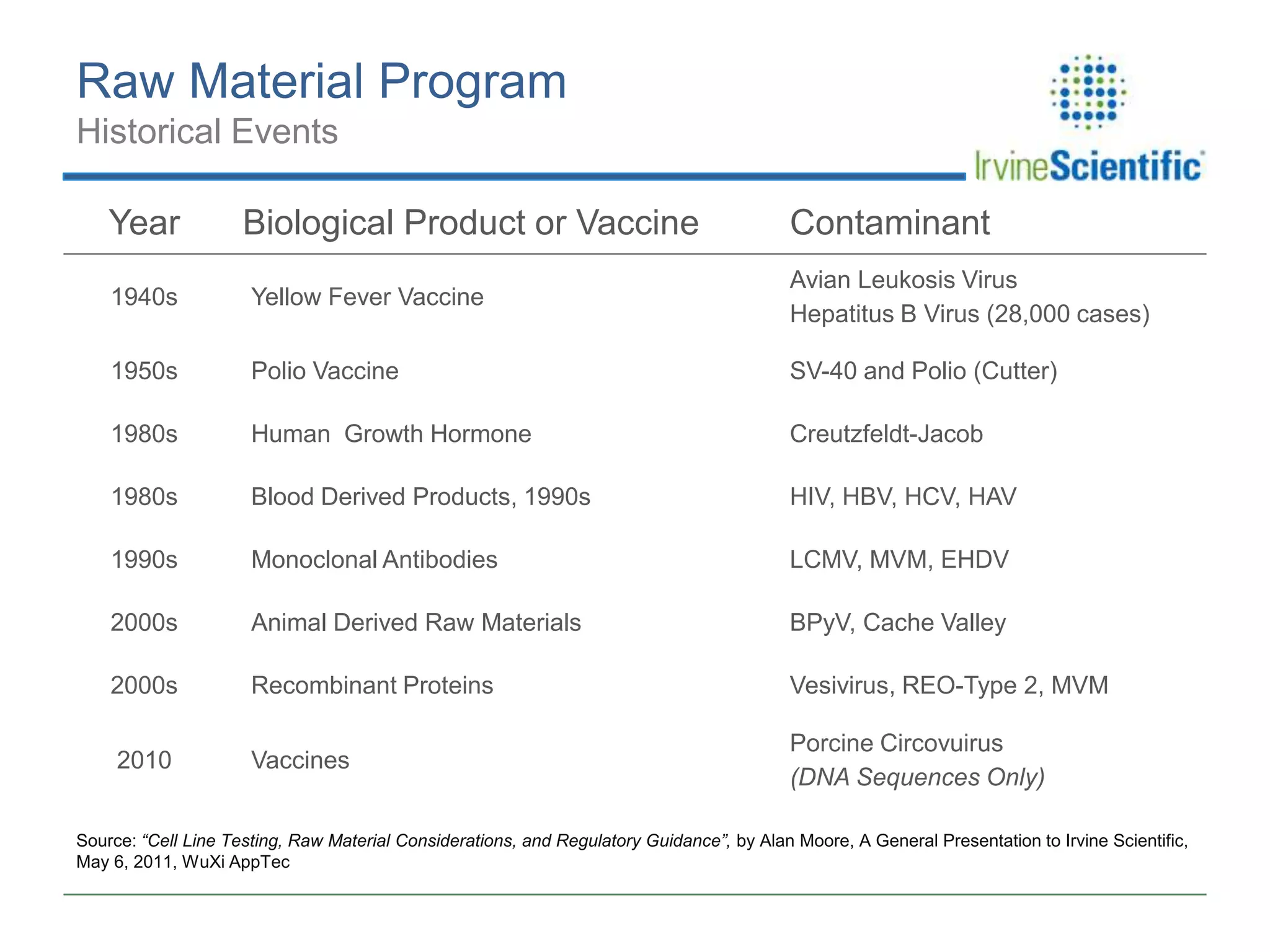
Historical Events
Year

Biological Product or Vaccine

Contaminant

1940s

Yellow Fever Vaccine

Avian Leukosis Virus
Hepatitus B Virus (28,000 cases)

1950s

Polio Vaccine

SV-40 and Polio (Cutter)

1980s

Human Growth Hormone

Creutzfeldt-Jacob

1980s

Blood Derived Products, 1990s

HIV, HBV, HCV, HAV

1990s

Monoclonal Antibodies

LCMV, MVM, EHDV

2000s

Animal Derived Raw Materials

BPyV, Cache Valley

2000s

Recombinant Proteins

Vesivirus, REO-Type 2, MVM

2010

Vaccines

Porcine Circovuirus
(DNA Sequences Only)

Source: “Cell Line Testing, Raw Material Considerations, and Regulatory Guidance”, by Alan Moore, A General Presentation to Irvine Scientific,
May 6, 2011, WuXi AppTec
Raw Material Program
Elements

Best Practices

Continuous
Improvement

Custom
Requirements
Operational Excellence
Industry Best Practices
1.

Sourcing Strategy
•

Influences Supply
Chain Transparency

Suppliers
Total

Standar
Custom
d
Part #
Part #

Total

Percent
(%)

51

-

24

11

28

55%

Distributors

•

27

Manufacturer

Baseline

46

22

16

23

45%

Direct Manufacturer

52%

40%

-

-

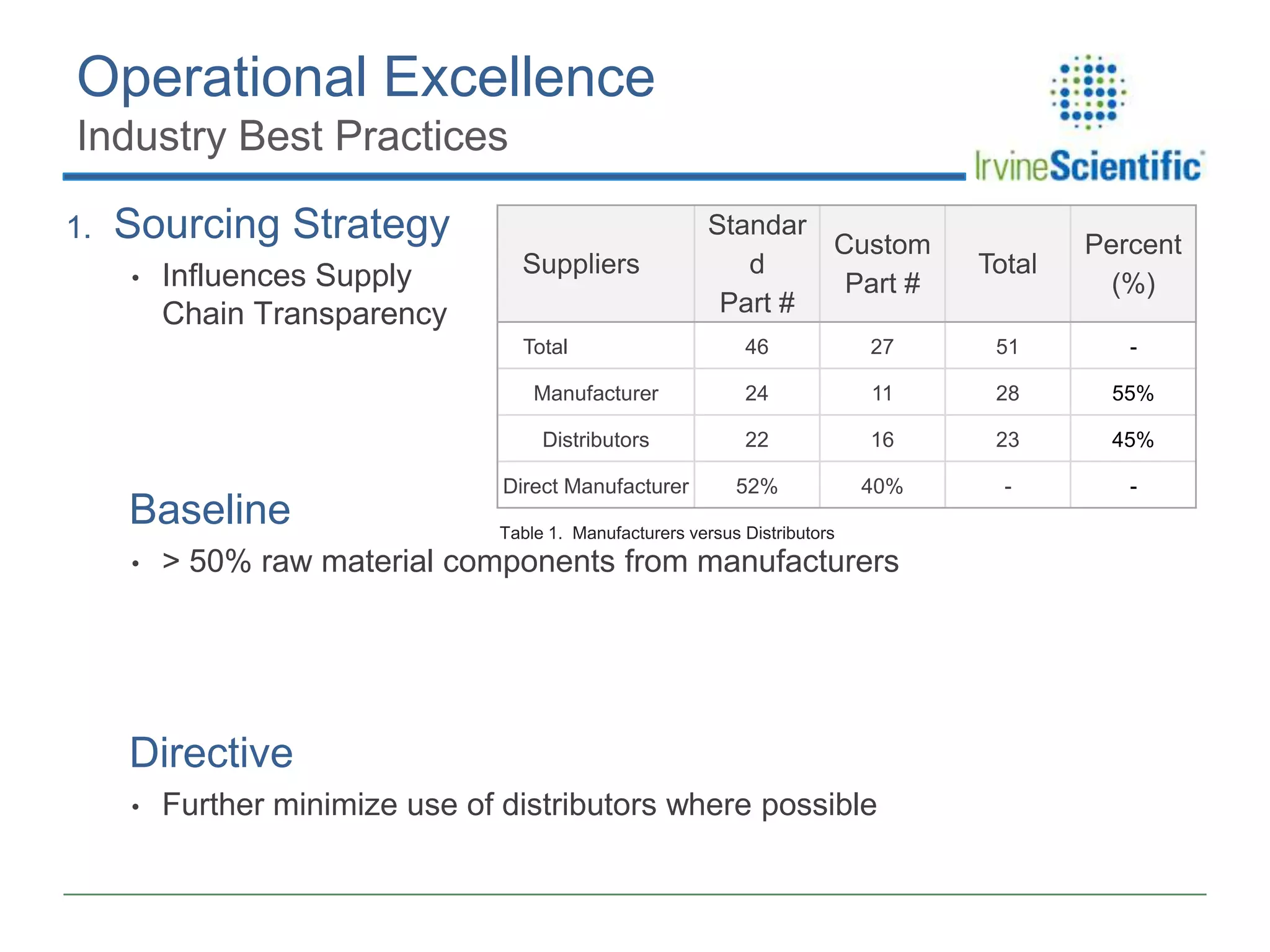
Table 1. Manufacturers versus Distributors

> 50% raw material components from manufacturers

Directive
•

Further minimize use of distributors where possible
Operational Excellence
Industry Best Practices

•

Supply Continuity
Risk Mitigation

Baseline
•

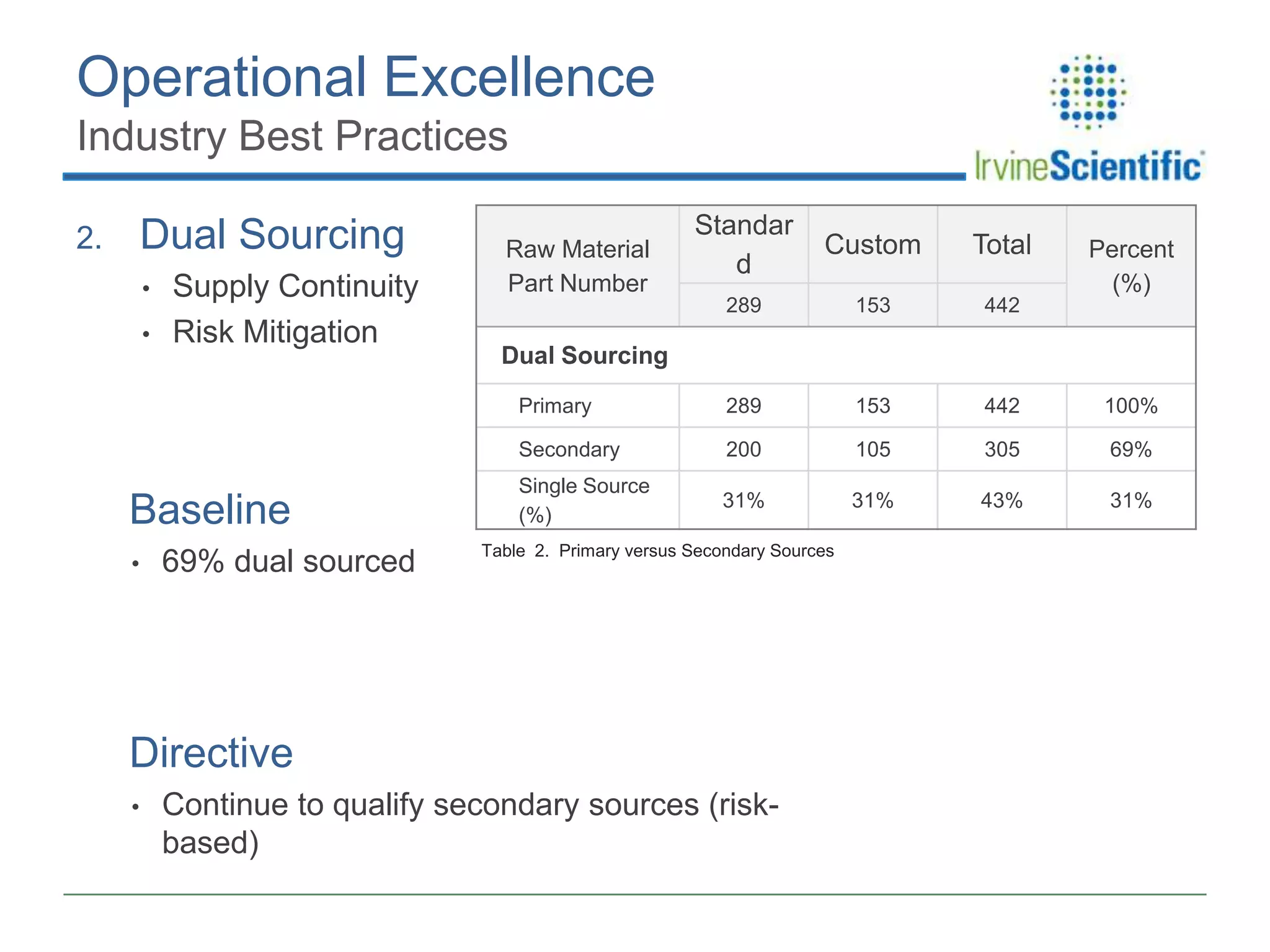
69% dual sourced

Custom

Total

289

153

442

289

153

442

100%

Secondary

•

Standar
d

Primary

Dual Sourcing

2.

200

105

305

69%

Single Source
(%)

31%

31%

43%

31%

Raw Material
Part Number
Dual Sourcing

Table 2. Primary versus Secondary Sources

Directive
•

Percent
(%)

Continue to qualify secondary sources (riskbased)
Operational Excellence
Industry Best Practices
3.

Supply Chain
•
•

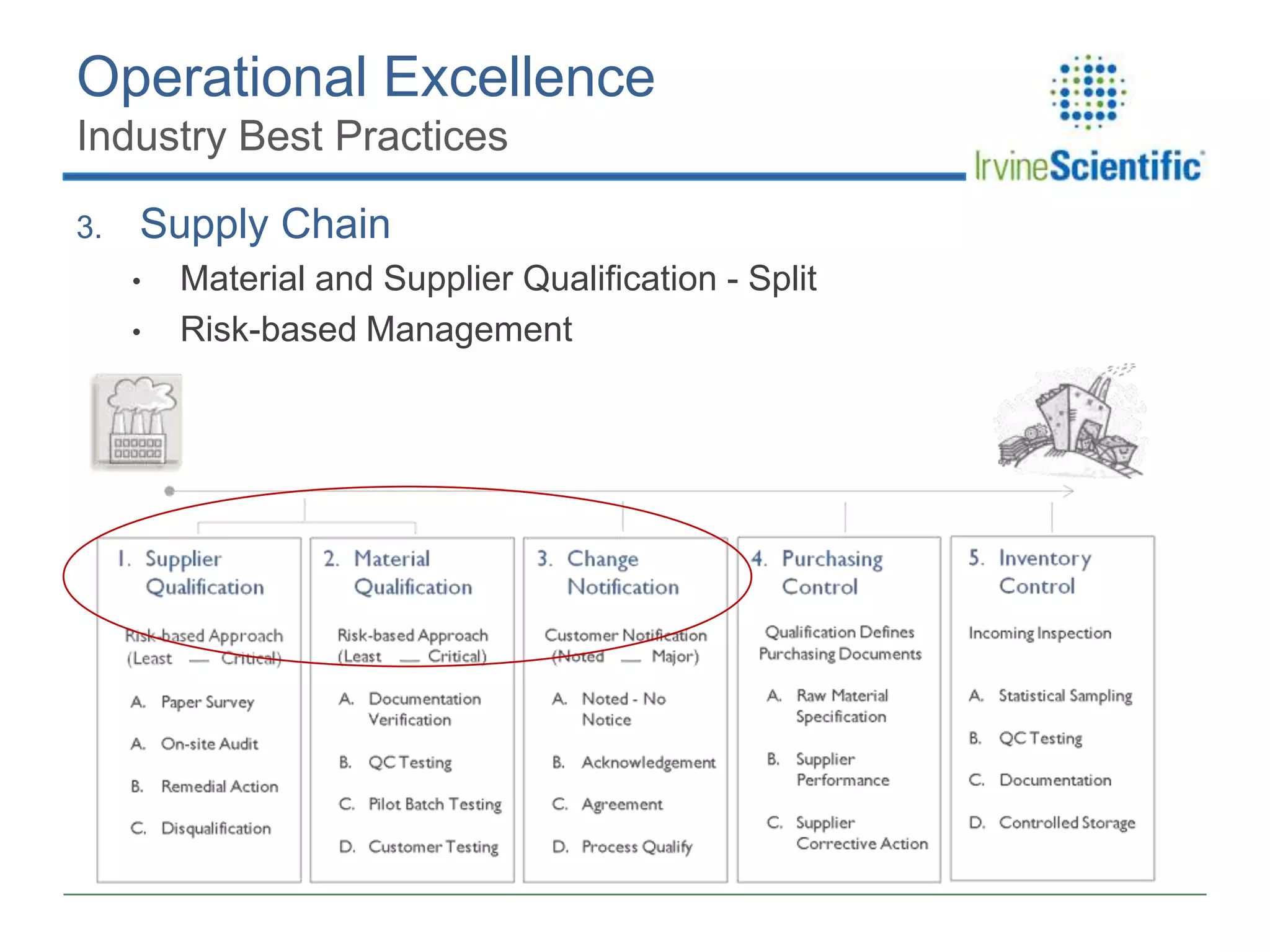
Material and Supplier Qualification - Split
Risk-based Management
Quality Excellence
Continuous Improvement
1.

Relevant Incoming QC Testing
•

•
•

2.

Material and Vendor Qualification
•

3.

Split and implement into Supply Chain

Transparency to Tertiary Level
•
•

4.

Every receipt is tested (sampling plan)
Type and use
Annual trend analysis of incoming receipts

Good communication with manufacturers and distributors
Successful ACF raw material program

Proactive analysis of new requirements
•

Case Study
Quality Excellence
Case Study
Observation:

Multiple customer inquiries for non-detectable enteric
bacterial organisms <per USP 62>.

Challenge:

Requirement not currently implemented in supply
chain.

Current Study: Establish baseline data and assess feasibility of nondetectable specification for enteric bacterial organisms
1. Raw Material Supply Chain
-

2.

Initiated discussions with vendors
Analysis of current inventory

Environmental Analysis (12-month)
-

Facilities, equipment, processess and practices
Quality Excellence
Case Study
Lots

Lots w/
Bioburde
n Counts

Lots w/
Enteric +

Lots w/
Bioburden
Counts (%)

Fermentation

101

23

0

Extraction

15

1

0

6.7%

Synthetic

73

9

0

Study Strategy

22.8 %

12.3%

Production
Method

1.

Raw Material Assessment
- Production Method
- Supplier
- Number of Lots

2.

Baseline Data
- Where to look
- Rationale for next steps

3.

Directive
- Begin routine monitoring

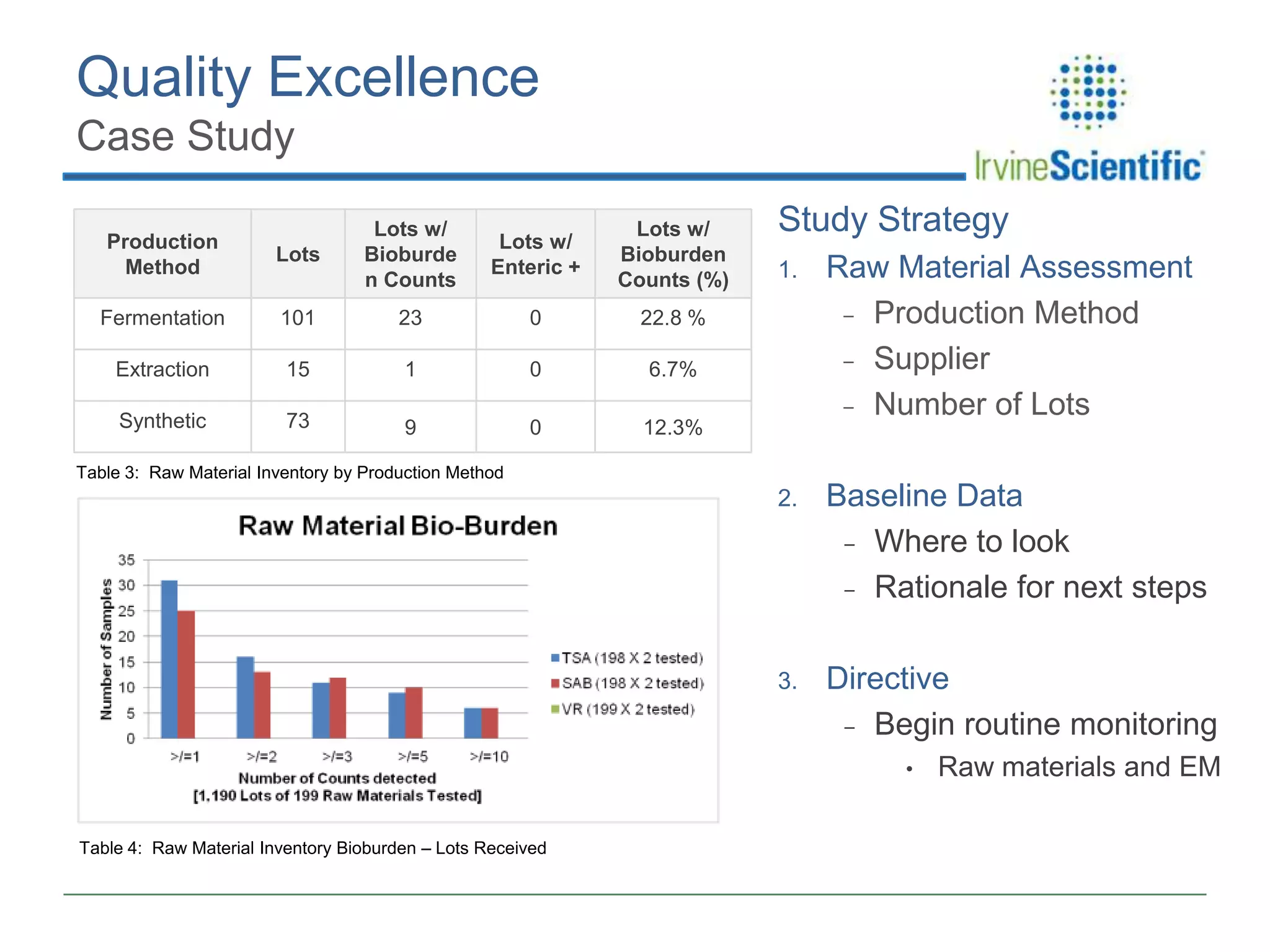
Table 3: Raw Material Inventory by Production Method

•

Table 4: Raw Material Inventory Bioburden – Lots Received

Raw materials and EM
Raw Material Program
Functionality

Quality Group
1.

Operational Group

Material & Vendor Qualification

1.

• Sourcing Strategy
• Dual Sourcing
• Risk-based Management
2.

Change Notification

Challenge

Supply Chain Implementation
• Sourcing Strategy
• Dual Sourcing
• Risk-based Management

2.

Change Notification

Must Talk
Must Respond

Steering
Committee

Execution
Raw Material Program
Steering Committee

Manufacturing Operations
Technical Support
Supply Chain

Quality Assurance
Quality Control
Technical Support

Sales and Marketing

Best Practices

Continuous Improvement

Seamless Integration

1. Qualification Requirements
2. Change Notification
3. Incoming QC Testing

1. Customer Requirements
2. Market Trends

1. Supply Chain
Implementation
2. Change Notification
3. Relevant Testing
Service Excellence
Seamless Integration – Custom Needs
1.

Custom Documentation Requirements
•

2.

Inventory Management
•
•

3.

Raw material documentation

Sequestered Inventory - Critical Raw Materials
Master Raw Material Lists / Requirements

Transparency to Tertiary Level
•
•

Troubleshooting
Change Notification
Raw Material Program
Conclusion
1.

Ensuring Alignment with Industry Expectations
•

2.

Practical Approach to Our Business
•

3.

Proactive versus reactive

Risk-based management

Ensuring Execution
•

Business Continuity
Acknowledgement
Jim Niemeyer
Alma Krebs
Holden Harris
Ashley Werner
Tom Fletcher
Erik Vaessen
Deb Stutz

Director of Operations
Manager, Supply Chain

Manager, Quality Assurance
Manager, Quality Control
Director, Research & Development
EU Territory Business Manager
Director, Marketing

A practical approach to raw material sourcing and management in cell culture

  • 1.
    A Practical Approachto Raw Material Sourcing and Management Cell Culture World Congress, Munich Germany Marlin Frechette Director, Quality Systems and Regulatory Affairs Irvine Scientific
  • 2.
    Outline  Introduction  Raw Material Program • • HistoricalEvents Program Elements - • Operational Excellence Quality Excellence Service Excellence Conclusion
  • 3.
    Irvine Scientific Introduction  40-year CellCulture History •  Markets Served • • •  Global Coverage Biopharmaceutical Medical Markets Cell Therapy Parent Company – JX Holding (Japan) • 25 years
  • 4.
    Raw Material Program HistoricalEvents Year Biological Product or Vaccine Contaminant 1940s Yellow Fever Vaccine Avian Leukosis Virus Hepatitus B Virus (28,000 cases) 1950s Polio Vaccine SV-40 and Polio (Cutter) 1980s Human Growth Hormone Creutzfeldt-Jacob 1980s Blood Derived Products, 1990s HIV, HBV, HCV, HAV 1990s Monoclonal Antibodies LCMV, MVM, EHDV 2000s Animal Derived Raw Materials BPyV, Cache Valley 2000s Recombinant Proteins Vesivirus, REO-Type 2, MVM 2010 Vaccines Porcine Circovuirus (DNA Sequences Only) Source: “Cell Line Testing, Raw Material Considerations, and Regulatory Guidance”, by Alan Moore, A General Presentation to Irvine Scientific, May 6, 2011, WuXi AppTec
  • 5.
    Raw Material Program Elements BestPractices Continuous Improvement Custom Requirements
  • 6.
    Operational Excellence Industry BestPractices 1. Sourcing Strategy • Influences Supply Chain Transparency Suppliers Total Standar Custom d Part # Part # Total Percent (%) 51 - 24 11 28 55% Distributors • 27 Manufacturer Baseline 46 22 16 23 45% Direct Manufacturer 52% 40% - - Table 1. Manufacturers versus Distributors > 50% raw material components from manufacturers Directive • Further minimize use of distributors where possible
  • 7.
    Operational Excellence Industry BestPractices • Supply Continuity Risk Mitigation Baseline • 69% dual sourced Custom Total 289 153 442 289 153 442 100% Secondary • Standar d Primary Dual Sourcing 2. 200 105 305 69% Single Source (%) 31% 31% 43% 31% Raw Material Part Number Dual Sourcing Table 2. Primary versus Secondary Sources Directive • Percent (%) Continue to qualify secondary sources (riskbased)
  • 8.
    Operational Excellence Industry BestPractices 3. Supply Chain • • Material and Supplier Qualification - Split Risk-based Management
  • 9.
    Quality Excellence Continuous Improvement 1. RelevantIncoming QC Testing • • • 2. Material and Vendor Qualification • 3. Split and implement into Supply Chain Transparency to Tertiary Level • • 4. Every receipt is tested (sampling plan) Type and use Annual trend analysis of incoming receipts Good communication with manufacturers and distributors Successful ACF raw material program Proactive analysis of new requirements • Case Study
  • 10.
    Quality Excellence Case Study Observation: Multiplecustomer inquiries for non-detectable enteric bacterial organisms <per USP 62>. Challenge: Requirement not currently implemented in supply chain. Current Study: Establish baseline data and assess feasibility of nondetectable specification for enteric bacterial organisms 1. Raw Material Supply Chain - 2. Initiated discussions with vendors Analysis of current inventory Environmental Analysis (12-month) - Facilities, equipment, processess and practices
  • 11.
    Quality Excellence Case Study Lots Lotsw/ Bioburde n Counts Lots w/ Enteric + Lots w/ Bioburden Counts (%) Fermentation 101 23 0 Extraction 15 1 0 6.7% Synthetic 73 9 0 Study Strategy 22.8 % 12.3% Production Method 1. Raw Material Assessment - Production Method - Supplier - Number of Lots 2. Baseline Data - Where to look - Rationale for next steps 3. Directive - Begin routine monitoring Table 3: Raw Material Inventory by Production Method • Table 4: Raw Material Inventory Bioburden – Lots Received Raw materials and EM
  • 12.
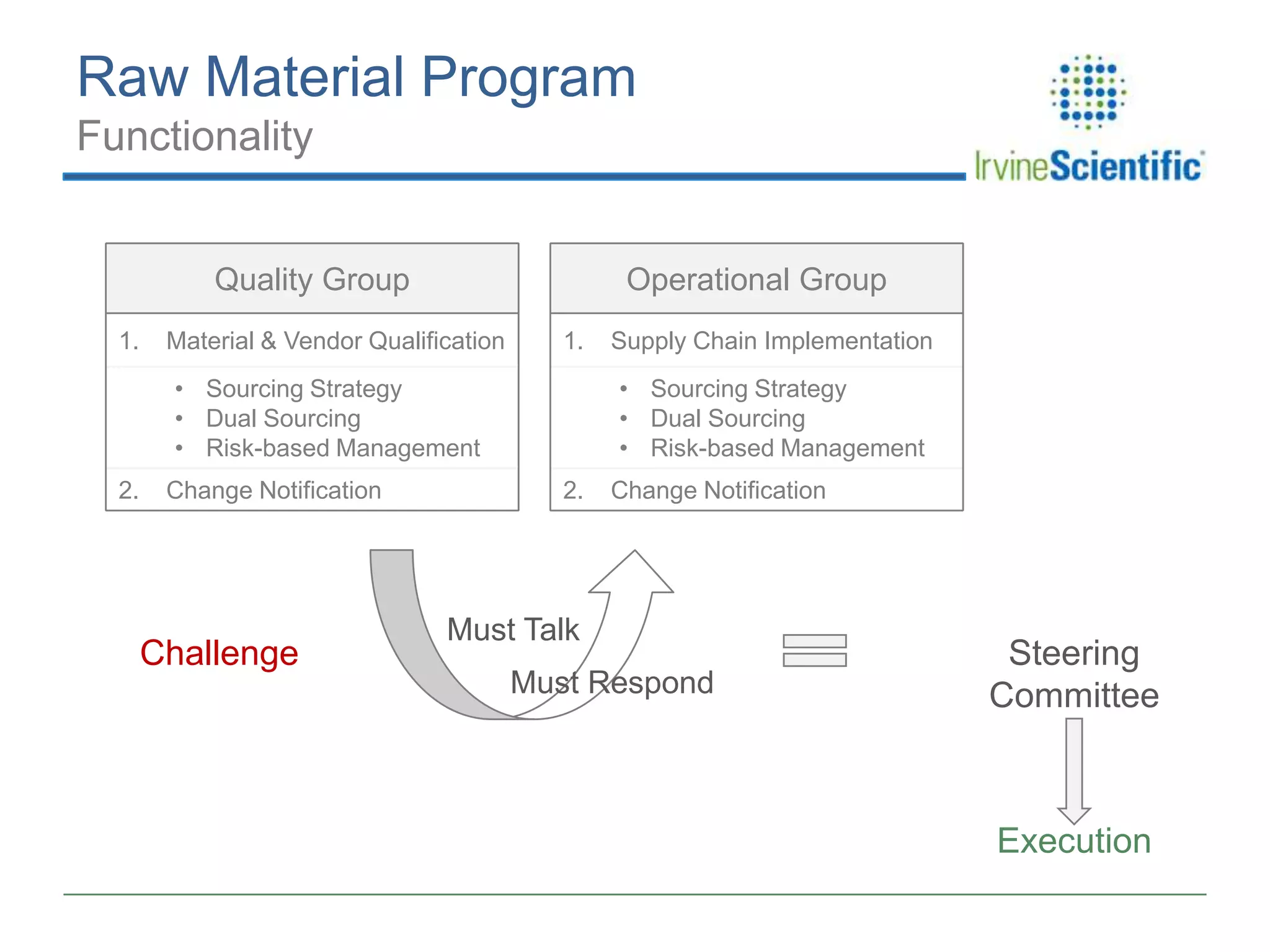
    Raw Material Program Functionality QualityGroup 1. Operational Group Material & Vendor Qualification 1. • Sourcing Strategy • Dual Sourcing • Risk-based Management 2. Change Notification Challenge Supply Chain Implementation • Sourcing Strategy • Dual Sourcing • Risk-based Management 2. Change Notification Must Talk Must Respond Steering Committee Execution
  • 13.
    Raw Material Program SteeringCommittee Manufacturing Operations Technical Support Supply Chain Quality Assurance Quality Control Technical Support Sales and Marketing Best Practices Continuous Improvement Seamless Integration 1. Qualification Requirements 2. Change Notification 3. Incoming QC Testing 1. Customer Requirements 2. Market Trends 1. Supply Chain Implementation 2. Change Notification 3. Relevant Testing
  • 14.
    Service Excellence Seamless Integration– Custom Needs 1. Custom Documentation Requirements • 2. Inventory Management • • 3. Raw material documentation Sequestered Inventory - Critical Raw Materials Master Raw Material Lists / Requirements Transparency to Tertiary Level • • Troubleshooting Change Notification
  • 15.
    Raw Material Program Conclusion 1. EnsuringAlignment with Industry Expectations • 2. Practical Approach to Our Business • 3. Proactive versus reactive Risk-based management Ensuring Execution • Business Continuity
  • 16.
    Acknowledgement Jim Niemeyer Alma Krebs HoldenHarris Ashley Werner Tom Fletcher Erik Vaessen Deb Stutz Director of Operations Manager, Supply Chain Manager, Quality Assurance Manager, Quality Control Director, Research & Development EU Territory Business Manager Director, Marketing

Editor's Notes

  • #2 Thank you all for being here today, I am very excited to be here, to present our raw material sourcing and management program. As Quality Director, I am very passionate about this subject and I know from experience that many in the cell culture industry share the same passion with me. We deeply believe that raw material and it’s management play a very critical role at the reducing risk during the manufacturing of biopharmaceuticals.
  • #3 Many of you are familiar with Irvine Scientific and some might not be, so I will present a brief introduction of our company and an overview of our recently formalized raw material program, historical events, program elements, which includes quality, operational and Service and I will conclude with an explanation as to why we decided to formalized our raw material program.
  • #4 IS is a cell culture media company. Established in 1970 originally as a serum supplierwithin a few years expanded the product offering to include cell culture productsToday, we are cell culture media supplier and that is what we do, it is the sole business of our organizationAs a media company we serve three markets the Biopharmaceutical for Industrial Cell Culture applications, the medical market with ART products, and the cell therapy with specialty media. Our parent company JX Holding with headquarters in Japan.
  • #5 Many of us are familiar with the historical events that have taken place with contaminated products by an unexpected contaminants.We know that the evolution with the raw material requirements have been driven by industry impacting events. We recognized the importance to address risk whether actual or potentialWe have gain perspective and understanding basically not only what can go wrong, but learning what can we do to prevent it. Those responsible for Cell Culture manufacturing process are concerned with the risk of process contamination and we as media supply partner play a role at minimizing the risk.
  • #6  I was talking about raw materials controls and concerns over 10 years ago… Issues associated with raw materials and the supply chain is a topic here to stay. Last year we decided to take a more integrated approach to managing current and potential challenges with raw material supply (both for us and our customers) by creating an internal program called ‘The Raw Material Program. While we have always had the operational and quality elements as they relate to raw material management, our program now takes a more integrated approach. I’ll now walk you through each of the three major components of our program which incorporates best practices, a continuous improvement approach, and integration of custom requirements.
  • #7 Operational: I am going to talk about three top priority. The first priority we identified, was sourcing strategy, which impacts our ability to manage toward this transparency and is therefore our first priority within the program. The first thing we did was assess how the status of manufacturers vs. distributors with our raw materials We manage our raw materials in two categories – Irvine Scientific’s general inventory and inventory dedicated to specific customer requirements. This table provides an example of our approach, which was to have a clear understanding of what we had in terms of direct manufacturers and distributors. Knowing where we were starting, our internal directive is to further our use of direct manufacturers where possible.
  • #8 The second operationalstrategy:Dual sourcing, ensures supply continuity and is a preventive measure to avoid production delays. It was very important to understand where we were at in terms of single and secondary sources, a analysis was completed to understand our base line.
  • #9 The supply chain is the third critical priority in our program it was something in existing and for this part we are very strong, this operational functionality if is very robust5 key elements: Supplier qualification, material qualification, Change notification, purchasing controls and inventory controls. While they currently exists and operates in a robust manner, the objective of our program is to continue to focused in a risk based management.
  • #10 Relevant Incoming QC: testing by type and how the raw material is used, it’s impact in the final product, Industry accepted sampling plan ANSI.Z1.4 Normal of ISO 2859Material and vendor qualification:Transparency to Tertiary LevelGood Communication with manufactures and distributors That is what allowed us to implement a succesfull ACF raw material program, part of the program is to certified all the components have to be certified by the suppliers free of animal component to the tertiary level of exposure. TL= Primary animal tissue, secondary animal enzyme in the mfg process, tertiary exposure, the enzyme is not animal derived, but there was exposure during the production of the enzyme As a custom media partner we have a very unique advantage, we received many request from our customers and with this have the opportunity to learn new requirements. In a moment I will present a case study that was generated from a custom request. At times some industry requirements are real and sometimes might not be feasible or value added, but this is our responsibility to know.
  • #11 Inquiries enteric free media. An assessment had to be done, since this type of testing was not normally performed on all raw materials and final products. Our challenge was in the supply chain, as we investigated our suppliers informed us that they were not testing for this specific organism. Steps were taken to determine current conditions of raws, environment, associated equipment and practices. Once we found where we were at we can make decisions on how to move forward.
  • #12 Raw materials were chosen based on their prevalence in ICC formulations. These were tested for standard bioburden in addition to enteric bioburden.Studies showed some materials (fermentation) were more susceptible to bioburden in general, Enteric was not seen in the raw materials at all.What we learned is that some were more susceptible and that we should continue to monitor these more. The message is that for this customer their formulations we were able to implement Enteric free specification.TSAT= Trypticase Soy AgarSAB= Sabouroud Dextrose AgarVR= Violet red Bile Glucose Agar
  • #13 RM functionality:Quality created a directive for the operational group, in terms of material and vendor qualification. (Sourcing strategy, dual sourcing,….) operational group must execute and integrate the direction into the supply chain.While the functionality was always there, the challenge was that the priorities were not always in alignment, therefore the execution is not always in alignment. How did we solved the challenge? We included an additional piece to the functionality technical and sales and marketing and created an internal steering committee to improve execution.
  • #14 The steering committee includes operations, quality, technical, sales and marketing groups. This committee is going to assess the needs of our business, will determine priorities and strategies and ensures alignment with industry requirements and a very critical piece a seamless integration of our customer requests.
  • #15 Here are some examples seamless integration of our customer requirement for custom products.
  • #16 At the end of our day, we want our business to be in alignment with industry expectations. Want to take a practical approach to our business utilizing risk based and value added strategies. Ultimately our goal is to ensure business continuity and no interruption of our supply from our suppliers to our customers.
  • #17 I would like to Acknowledge the steering committee team for collaborating tirelessly to the success of our Raw material program