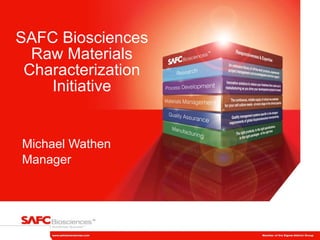
SAFC Biosciences Raw Materials Characterization Initiative Michael Wathen Manager
Why Are We Here? Raw Materials Characterization was identified as the highest priority by our customers Produce a quality product with minimal variability Understand impact of raw material changes We value customer input SAFCB has major raw material initiatives in several areas Raw Materials Characterization Initiative in R&D Coordinating with Supply Chain and Quality initiatives Key issues for market Reduced variability in media performance Improved response to technical inquiries Improved ability to resolve investigations Reduced customer resources spent on raw materials
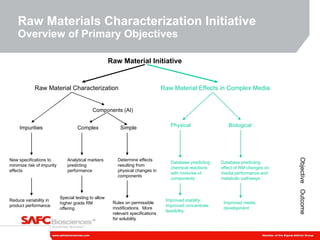
Raw Materials Characterization Initiative Overview of Primary Objectives Raw Material Initiative Objective Outcome Raw Material Characterization Raw Material Effects in Complex Media Components (AI) Complex Simple Impurities New specifications to minimize risk of impurity effects Reduce variability in product performance Analytical markers predicting performance Special testing to allow higher grade RM offering Determine effects resulting from physical changes in components Rules on permissible modifications.  More relevant specifications for solubility Physical Biological Database predicting chemical reactions with mixtures of components Database predicting effect of RM changes on media performance and metabolic pathways Improved stability.  Improved concentrate feasibility Improved media development
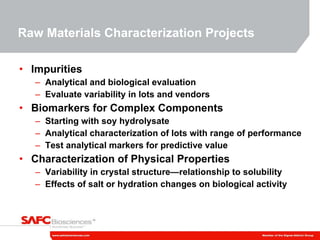
Raw Materials Characterization Projects Impurities Analytical and biological evaluation Evaluate variability in lots and vendors Biomarkers for Complex Components Starting with soy hydrolysate Analytical characterization of lots with range of performance Test analytical markers for predictive value Characterization of Physical Properties Variability in crystal structure—relationship to solubility Effects of salt or hydration changes on biological activity
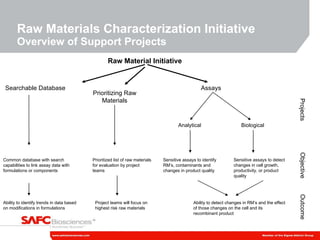
Raw Materials Characterization Initiative Overview of Support Projects Raw Material Initiative Projects Objective Outcome Searchable Database Assays Analytical Biological Common database with search capabilities to link assay data with formulations or components Ability to identify trends in data based on modifications in formulations Sensitive assays to identify RM’s, contaminants and changes in product quality Sensitive assays to detect changes in cell growth, productivity, or product quality Ability to detect changes in RM’s and the effect of those changes on the cell and its recombinant product Prioritizing Raw Materials Prioritized list of raw materials for evaluation by project teams Project teams will focus on highest risk raw materials
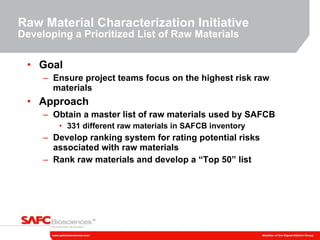
Raw Material Characterization Initiative Developing a Prioritized List of Raw Materials Goal Ensure project teams focus on the highest risk raw materials Approach Obtain a master list of raw materials used by SAFCB 331 different raw materials in SAFCB inventory Develop ranking system for rating potential risks associated with raw materials Rank raw materials and develop a “Top 50” list
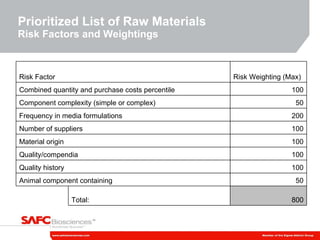
Prioritized List of Raw Materials Risk Factors and Weightings 800 Total: 50 Animal component containing 100 Quality history 100 Quality/compendia 100 Material origin 100 Number of suppliers 200 Frequency in media formulations 50 Component complexity (simple or complex) 100 Combined quantity and purchase costs percentile Risk Weighting (Max) Risk Factor
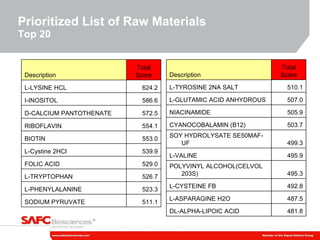
Prioritized List of Raw Materials Top 20 511.1 SODIUM PYRUVATE 523.3 L-PHENYLALANINE 526.7 L-TRYPTOPHAN 529.0 FOLIC ACID  539.9 L-Cystine 2HCl 553.0 BIOTIN 554.1 RIBOFLAVIN 572.5 D-CALCIUM PANTOTHENATE  586.6 I-INOSITOL 624.2 L-LYSINE HCL Total Score Description 481.8 DL-ALPHA-LIPOIC ACID  487.5 L-ASPARAGINE H2O 492.8 L-CYSTEINE FB 495.3 POLYVINYL ALCOHOL(CELVOL 203S) 495.9 L-VALINE 499.3 SOY HYDROLYSATE SE50MAF-UF 503.7 CYANOCOBALAMIN (B12)  505.9 NIACINAMIDE 507.0 L-GLUTAMIC ACID ANHYDROUS 510.1 L-TYROSINE 2NA SALT Total Score Description
Raw Materials Characterization Initiative Assay Development Analytical assays Raw material identification assays Impurity profiling and identification Biological assays—Sensitive cell assays to detect differences in: Growth Productivity Product quality
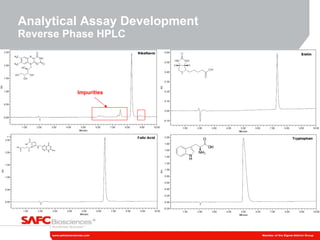
Analytical Assay Development Reverse Phase HPLC Impurities
Raw Materials Characterization Initiative Impurity Profiling and Identification What are the major impurities in each RM? What is the lot-to-lot variability in these impurities? Does the impurity profile change with different vendors? What is the “no-effect” range for the major impurities relative to growth, productivity and product quality? Will the impurities effect biological activity within the range of concentrations observed in the raw material
Raw Materials Characterization Initiative Considerations for Biological Assays Cell lines Multiple cell lines relevant to biopharmaceutical industry Robust with low variability Sensitive to differences in raw materials Media Chemically defined preferred Rich vs. lean? Assay systems Balance high throughput and low variability Assay parameters What is the most sensitive parameter for growth? What are the useful product quality parameters?
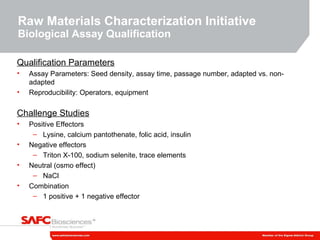
Raw Materials Characterization Initiative  Biological Assay Qualification Qualification Parameters Assay Parameters: Seed density, assay time, passage number, adapted vs. non-adapted Reproducibility: Operators, equipment  Challenge Studies Positive Effectors Lysine, calcium pantothenate, folic acid, insulin Negative effectors Triton X-100, sodium selenite, trace elements Neutral (osmo effect)  NaCl  Combination 1 positive + 1 negative effector
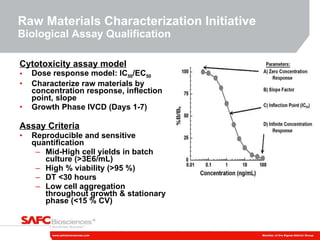
Raw Materials Characterization Initiative  Biological Assay Qualification Cytotoxicity assay model Dose response model: IC 50 /EC 50 Characterize raw materials by concentration response, inflection point, slope Growth Phase IVCD (Days 1-7) Assay Criteria Reproducible and sensitive quantification Mid-High cell yields in batch culture (>3E6/mL) High % viability (>95 %) DT <30 hours Low cell aggregation throughout growth & stationary phase (<15 % CV)
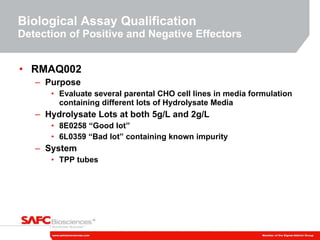
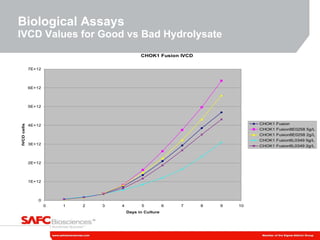
Biological Assay Qualification Detection of Positive and Negative Effectors RMAQ002 Purpose Evaluate several parental CHO cell lines in media formulation containing different lots of Hydrolysate Media Hydrolysate Lots at both 5g/L and 2g/L 8E0258 “Good lot” 6L0359 “Bad lot” containing known impurity System TPP tubes
Biological Assays IVCD Values for Good vs Bad Hydrolysate
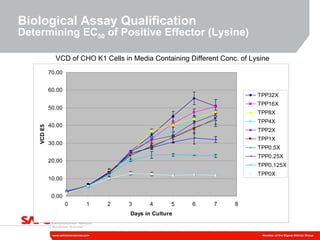
Biological Assay Qualification Determining EC 50  of Positive Effector (Lysine) VCD of CHO K1 Cells in Media Containing Different Conc. of Lysine
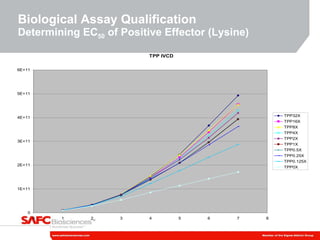
Biological Assay Qualification Determining EC 50  of Positive Effector (Lysine)
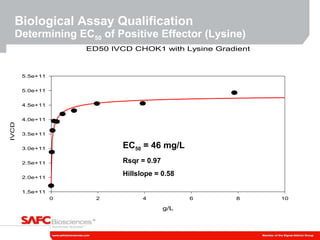
Biological Assay Qualification Determining EC 50  of Positive Effector (Lysine) EC 50  = 46 mg/L Rsqr = 0.97 Hillslope = 0.58
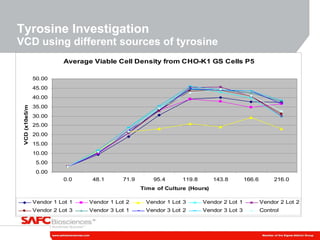
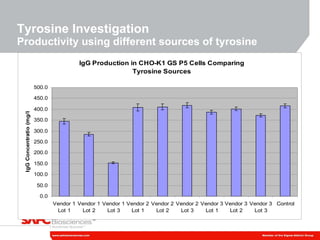
Example of Raw Material Characterization Tyrosine Investigation Customer complaint of poor media performance linked to specific vendor (Vendor 1) of tyrosine by analysis of batch records.  Media using alternative vendor (Vendor 2) performed to expectations No differences observed by RP-HPLC, SEC or UPLC-MS Review of manufacturing process indicated difference between vendors in final drying method Spray drying vs. tray drying Multiple lots of L-Tyrosine from 3 different vendors were evaluated for differences in biological effects
Tyrosine Investigation VCD using different sources of tyrosine
Tyrosine Investigation Productivity using different sources of tyrosine
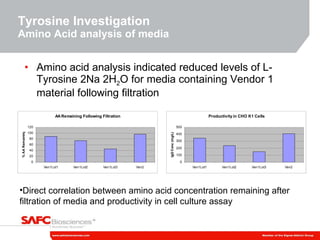
Tyrosine Investigation Amino Acid analysis of media Amino acid analysis indicated reduced levels of L-Tyrosine 2Na 2H 2 O for media containing Vendor 1 material following filtration Direct correlation   between amino acid concentration remaining after filtration of media and productivity in cell culture assay
Tyrosine Investigation Analytical Characterization of Crystal Structure Observed differences in solubility of L-Tyrosine from different vendors led to evaluation of physical properties Pharmorphix, division of Sigma-Aldrich specializing in pharmaceutical properties, did analysis Evaluated 3 lots each from Vendors 1 and 2 X-ray particle diffraction (XRPD) for crystal structure Differential scanning chromatography (DSC) for melting point of crystals Ion chromatography for quantitation of Na +  ions
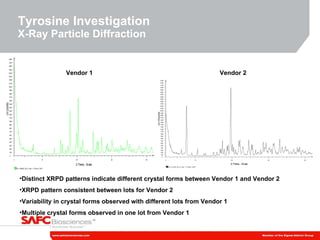
Tyrosine Investigation   X-Ray Particle Diffraction Vendor 1 Vendor 2 Distinct XRPD patterns indicate different crystal forms between Vendor 1 and Vendor 2 XRPD pattern consistent between lots for Vendor 2 Variability in crystal forms observed with different lots from Vendor 1 Multiple crystal forms observed in one lot from Vendor 1
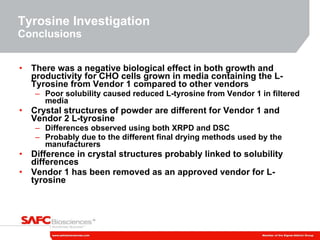
Tyrosine Investigation Conclusions There was a negative biological effect in both growth and productivity for CHO cells grown in media containing the L-Tyrosine from Vendor 1 compared to other vendors Poor solubility caused reduced L-tyrosine from Vendor 1 in filtered media Crystal structures of powder are different for Vendor 1 and Vendor 2 L-tyrosine Differences observed using both XRPD and DSC  Probably due to the different final drying methods used by the manufacturers Difference in crystal structures probably linked to solubility differences Vendor 1 has been removed as an approved vendor for L-tyrosine
Raw Material Characterization Program  Summary This is a long-term, ongoing initiative Involves complex scientific issues Will utilize both biologists and chemists Goals of initiative Industry leaders in knowledge of our products Translate knowledge into value for our customers

Safc Bioscience Raw Materials Initiative

  • 1.
    SAFC Biosciences RawMaterials Characterization Initiative Michael Wathen Manager
  • 2.
    Why Are WeHere? Raw Materials Characterization was identified as the highest priority by our customers Produce a quality product with minimal variability Understand impact of raw material changes We value customer input SAFCB has major raw material initiatives in several areas Raw Materials Characterization Initiative in R&D Coordinating with Supply Chain and Quality initiatives Key issues for market Reduced variability in media performance Improved response to technical inquiries Improved ability to resolve investigations Reduced customer resources spent on raw materials
  • 3.
    Raw Materials CharacterizationInitiative Overview of Primary Objectives Raw Material Initiative Objective Outcome Raw Material Characterization Raw Material Effects in Complex Media Components (AI) Complex Simple Impurities New specifications to minimize risk of impurity effects Reduce variability in product performance Analytical markers predicting performance Special testing to allow higher grade RM offering Determine effects resulting from physical changes in components Rules on permissible modifications. More relevant specifications for solubility Physical Biological Database predicting chemical reactions with mixtures of components Database predicting effect of RM changes on media performance and metabolic pathways Improved stability. Improved concentrate feasibility Improved media development
  • 4.
    Raw Materials CharacterizationProjects Impurities Analytical and biological evaluation Evaluate variability in lots and vendors Biomarkers for Complex Components Starting with soy hydrolysate Analytical characterization of lots with range of performance Test analytical markers for predictive value Characterization of Physical Properties Variability in crystal structure—relationship to solubility Effects of salt or hydration changes on biological activity
  • 5.
    Raw Materials CharacterizationInitiative Overview of Support Projects Raw Material Initiative Projects Objective Outcome Searchable Database Assays Analytical Biological Common database with search capabilities to link assay data with formulations or components Ability to identify trends in data based on modifications in formulations Sensitive assays to identify RM’s, contaminants and changes in product quality Sensitive assays to detect changes in cell growth, productivity, or product quality Ability to detect changes in RM’s and the effect of those changes on the cell and its recombinant product Prioritizing Raw Materials Prioritized list of raw materials for evaluation by project teams Project teams will focus on highest risk raw materials
  • 6.
    Raw Material CharacterizationInitiative Developing a Prioritized List of Raw Materials Goal Ensure project teams focus on the highest risk raw materials Approach Obtain a master list of raw materials used by SAFCB 331 different raw materials in SAFCB inventory Develop ranking system for rating potential risks associated with raw materials Rank raw materials and develop a “Top 50” list
  • 7.
    Prioritized List ofRaw Materials Risk Factors and Weightings 800 Total: 50 Animal component containing 100 Quality history 100 Quality/compendia 100 Material origin 100 Number of suppliers 200 Frequency in media formulations 50 Component complexity (simple or complex) 100 Combined quantity and purchase costs percentile Risk Weighting (Max) Risk Factor
  • 8.
    Prioritized List ofRaw Materials Top 20 511.1 SODIUM PYRUVATE 523.3 L-PHENYLALANINE 526.7 L-TRYPTOPHAN 529.0 FOLIC ACID 539.9 L-Cystine 2HCl 553.0 BIOTIN 554.1 RIBOFLAVIN 572.5 D-CALCIUM PANTOTHENATE 586.6 I-INOSITOL 624.2 L-LYSINE HCL Total Score Description 481.8 DL-ALPHA-LIPOIC ACID 487.5 L-ASPARAGINE H2O 492.8 L-CYSTEINE FB 495.3 POLYVINYL ALCOHOL(CELVOL 203S) 495.9 L-VALINE 499.3 SOY HYDROLYSATE SE50MAF-UF 503.7 CYANOCOBALAMIN (B12) 505.9 NIACINAMIDE 507.0 L-GLUTAMIC ACID ANHYDROUS 510.1 L-TYROSINE 2NA SALT Total Score Description
  • 9.
    Raw Materials CharacterizationInitiative Assay Development Analytical assays Raw material identification assays Impurity profiling and identification Biological assays—Sensitive cell assays to detect differences in: Growth Productivity Product quality
  • 10.
    Analytical Assay DevelopmentReverse Phase HPLC Impurities
  • 11.
    Raw Materials CharacterizationInitiative Impurity Profiling and Identification What are the major impurities in each RM? What is the lot-to-lot variability in these impurities? Does the impurity profile change with different vendors? What is the “no-effect” range for the major impurities relative to growth, productivity and product quality? Will the impurities effect biological activity within the range of concentrations observed in the raw material
  • 12.
    Raw Materials CharacterizationInitiative Considerations for Biological Assays Cell lines Multiple cell lines relevant to biopharmaceutical industry Robust with low variability Sensitive to differences in raw materials Media Chemically defined preferred Rich vs. lean? Assay systems Balance high throughput and low variability Assay parameters What is the most sensitive parameter for growth? What are the useful product quality parameters?
  • 13.
    Raw Materials CharacterizationInitiative Biological Assay Qualification Qualification Parameters Assay Parameters: Seed density, assay time, passage number, adapted vs. non-adapted Reproducibility: Operators, equipment Challenge Studies Positive Effectors Lysine, calcium pantothenate, folic acid, insulin Negative effectors Triton X-100, sodium selenite, trace elements Neutral (osmo effect) NaCl Combination 1 positive + 1 negative effector
  • 14.
    Raw Materials CharacterizationInitiative Biological Assay Qualification Cytotoxicity assay model Dose response model: IC 50 /EC 50 Characterize raw materials by concentration response, inflection point, slope Growth Phase IVCD (Days 1-7) Assay Criteria Reproducible and sensitive quantification Mid-High cell yields in batch culture (>3E6/mL) High % viability (>95 %) DT <30 hours Low cell aggregation throughout growth & stationary phase (<15 % CV)
  • 15.
    Biological Assay QualificationDetection of Positive and Negative Effectors RMAQ002 Purpose Evaluate several parental CHO cell lines in media formulation containing different lots of Hydrolysate Media Hydrolysate Lots at both 5g/L and 2g/L 8E0258 “Good lot” 6L0359 “Bad lot” containing known impurity System TPP tubes
  • 16.
    Biological Assays IVCDValues for Good vs Bad Hydrolysate
  • 17.
    Biological Assay QualificationDetermining EC 50 of Positive Effector (Lysine) VCD of CHO K1 Cells in Media Containing Different Conc. of Lysine
  • 18.
    Biological Assay QualificationDetermining EC 50 of Positive Effector (Lysine)
  • 19.
    Biological Assay QualificationDetermining EC 50 of Positive Effector (Lysine) EC 50 = 46 mg/L Rsqr = 0.97 Hillslope = 0.58
  • 20.
    Example of RawMaterial Characterization Tyrosine Investigation Customer complaint of poor media performance linked to specific vendor (Vendor 1) of tyrosine by analysis of batch records. Media using alternative vendor (Vendor 2) performed to expectations No differences observed by RP-HPLC, SEC or UPLC-MS Review of manufacturing process indicated difference between vendors in final drying method Spray drying vs. tray drying Multiple lots of L-Tyrosine from 3 different vendors were evaluated for differences in biological effects
  • 21.
    Tyrosine Investigation VCDusing different sources of tyrosine
  • 22.
    Tyrosine Investigation Productivityusing different sources of tyrosine
  • 23.
    Tyrosine Investigation AminoAcid analysis of media Amino acid analysis indicated reduced levels of L-Tyrosine 2Na 2H 2 O for media containing Vendor 1 material following filtration Direct correlation between amino acid concentration remaining after filtration of media and productivity in cell culture assay
  • 24.
    Tyrosine Investigation AnalyticalCharacterization of Crystal Structure Observed differences in solubility of L-Tyrosine from different vendors led to evaluation of physical properties Pharmorphix, division of Sigma-Aldrich specializing in pharmaceutical properties, did analysis Evaluated 3 lots each from Vendors 1 and 2 X-ray particle diffraction (XRPD) for crystal structure Differential scanning chromatography (DSC) for melting point of crystals Ion chromatography for quantitation of Na + ions
  • 25.
    Tyrosine Investigation X-Ray Particle Diffraction Vendor 1 Vendor 2 Distinct XRPD patterns indicate different crystal forms between Vendor 1 and Vendor 2 XRPD pattern consistent between lots for Vendor 2 Variability in crystal forms observed with different lots from Vendor 1 Multiple crystal forms observed in one lot from Vendor 1
  • 26.
    Tyrosine Investigation ConclusionsThere was a negative biological effect in both growth and productivity for CHO cells grown in media containing the L-Tyrosine from Vendor 1 compared to other vendors Poor solubility caused reduced L-tyrosine from Vendor 1 in filtered media Crystal structures of powder are different for Vendor 1 and Vendor 2 L-tyrosine Differences observed using both XRPD and DSC Probably due to the different final drying methods used by the manufacturers Difference in crystal structures probably linked to solubility differences Vendor 1 has been removed as an approved vendor for L-tyrosine
  • 27.
    Raw Material CharacterizationProgram Summary This is a long-term, ongoing initiative Involves complex scientific issues Will utilize both biologists and chemists Goals of initiative Industry leaders in knowledge of our products Translate knowledge into value for our customers