Universal Design
Brooke Grinstead
Definition
 Universal design is the design of products and
environments to be usable by all people, to the
greatest extent possible, without the need for
adaptation or specialized design (Center for Universal
Design)
 In education, using UD helps children who are not
seen as the “average” student and those with a wide
variety of characteristics and reduces disabilities in
the classroom
UD Principles
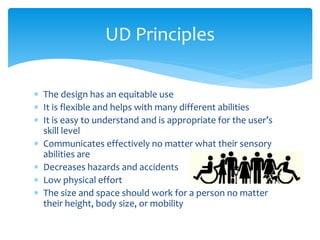
 The design has an equitable use
 It is flexible and helps with many different abilities
 It is easy to understand and is appropriate for the user’s
skill level
 Communicates effectively no matter what their sensory
abilities are
 Decreases hazards and accidents
 Low physical effort
 The size and space should work for a person no matter
their height, body size, or mobility
UD Technology in Classroom
 ULTimate Reader is an electronic textbook that help
students who need reading support
 Adds visuals or spoken voice
 Helps students to eventually develop more independence and
motivation

 Teachers and students have positive feedback about UD
approach but it is very hard to integrate in classroom
 Tips for teachers
 Developed technology skills
 Flexible curriculum
 Supervise students on computers
Examples of UD
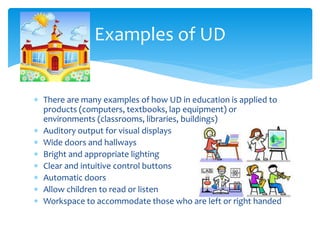
 There are many examples of how UD in education is applied to
products (computers, textbooks, lap equipment) or
environments (classrooms, libraries, buildings)
 Auditory output for visual displays
 Wide doors and hallways
 Bright and appropriate lighting
 Clear and intuitive control buttons
 Automatic doors
 Allow children to read or listen
 Workspace to accommodate those who are left or right handed

Universal Design

  • 1.
  • 2.
    Definition  Universal designis the design of products and environments to be usable by all people, to the greatest extent possible, without the need for adaptation or specialized design (Center for Universal Design)  In education, using UD helps children who are not seen as the “average” student and those with a wide variety of characteristics and reduces disabilities in the classroom
  • 3.
    UD Principles  Thedesign has an equitable use  It is flexible and helps with many different abilities  It is easy to understand and is appropriate for the user’s skill level  Communicates effectively no matter what their sensory abilities are  Decreases hazards and accidents  Low physical effort  The size and space should work for a person no matter their height, body size, or mobility
  • 4.
    UD Technology inClassroom  ULTimate Reader is an electronic textbook that help students who need reading support  Adds visuals or spoken voice  Helps students to eventually develop more independence and motivation  Teachers and students have positive feedback about UD approach but it is very hard to integrate in classroom  Tips for teachers  Developed technology skills  Flexible curriculum  Supervise students on computers
  • 5.
    Examples of UD There are many examples of how UD in education is applied to products (computers, textbooks, lap equipment) or environments (classrooms, libraries, buildings)  Auditory output for visual displays  Wide doors and hallways  Bright and appropriate lighting  Clear and intuitive control buttons  Automatic doors  Allow children to read or listen  Workspace to accommodate those who are left or right handed