International Journal of Power Electronics and Drive System (IJPEDS)
Vol. 9, No. 1, March 2018, pp. 8~16
ISSN: 2088-8694, DOI: 10.11591/ijpeds.v9.i1.pp8-16  8
Journal homepage: http://iaescore.com/journals/index.php/IJPEDS
A Novel Control Strategy for Compensation of Voltage Quality
Problem in AC Drives
Syed Suraya1
, P. Sujatha2
, P. Bharat Kumar3
Department of Electrical and Electronics Engineering, JNTUA, Ananthpur, AP, India
Article Info ABSTRACT
Article history:
Received Aug 23, 2017
Revised Sep 2, 2017
Accepted Jan 13, 2018
This paper presents a novel control strategy for the compensation of voltage
quality issues in power system networks with AC drives. Voltage quality is
one of the key parameter for power engineers and to deliver the power with
good quality should be given at most priority. Voltage quality mitigation in
power system network is done by employing dynamic voltage restorer
(DVR). DVR consists of power switches and power switches are to be
controlled. DVR in this paper is controlled using a novel control strategy. A
novel control strategy can effectively control DVR by improving voltage
quality reducing the adverse effects of voltage sag and voltage swell in
power system networks. The paper presents the DVR controlled with novel
control strategy for electrical machine (induction motor) drive load
application.
Keyword:
Voltage quality
Compensation
Novel control
AC drives
Copyright © 2018 Institute of Advanced Engineering and Science.
All rights reserved.
Corresponding Author:
Syed Suraya,
Research Scholar,
Departement of Electrical and Electronics Engineering,
JNTUA, Ananthpur, AP, India.
Email: syedsuraya143@gmail.com
1. INTRODUCTION
Consistency is a key word for utilities and their customers in general, and it is crucial to companies
operating in a highly competitive business environment, because it affects profitability, which definitely is a
driving force in the industry. Although electrical transmission and distribution systems have reached a very
high level of reliability, disturbances cannot be totally avoided [1-3]. Power quality issues are not new to
power system but their existence creates new problems due to advancements in power electronic sector.
Voltage quality is the main concern on load side and power engineers should ensure that the load voltage is
same throughout the conditions in power system. Custom power devices might be a solution to eliminate or
reduce power quality problems caused from many loads. FACTS devices are type of custom power devices
employed to reduce the risk of power quality problems using power electronics circuits [4-6].
DVR is one such device used to address voltage sag and swell issues in power system. The DVR is a
power quality device, which can protect these industries against the bulk of these disturbances, i.e. voltage
sags and swells related to remote system faults. A DVR compensates for these voltage excursions, provided
that the supply grid does not get disconnected entirely through breaker trips. DVR [7-8] is power electronic
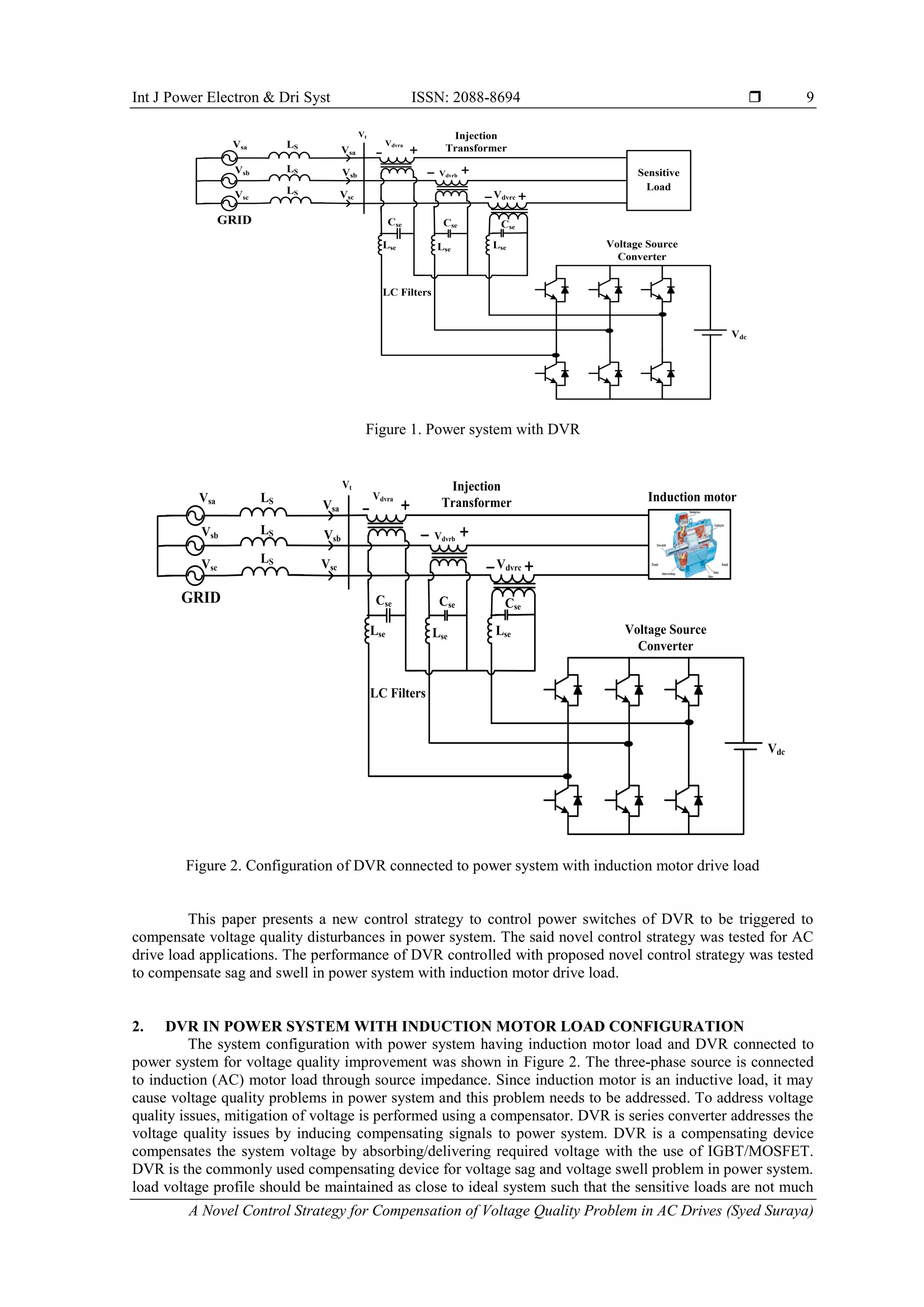
voltage source converter placed in series to power line as in figure 1 and power switches in DVR is to be
controlled by employing a suitable control strategy to produce gating signals to power switches of DVR [9-
11].
Int J Power Electron & Dri Syst ISSN: 2088-8694 
A Novel Control Strategy for Compensation of Voltage Quality Problem in AC Drives (Syed Suraya)
9
Vsa
Vsb
Vsc
LS
LS
LS
Vsa
Vsb
Vsc
Vdvra
Vdvrb
Vdvrc
Lse Lse Lse
Vt
Cse Cse Cse
Sensitive
Load
LC Filters
Injection
Transformer
Voltage Source
Converter
GRID
Vdc
Figure 1. Power system with DVR
Vsa
Vsb
Vsc
LS
LS
LS
Vsa
Vsb
Vsc
Vdvra
Vdvrb
Vdvrc
Lse Lse Lse
Vt
Cse Cse Cse
LC Filters
Injection
Transformer
Voltage Source
Converter
GRID
Vdc
Induction motor
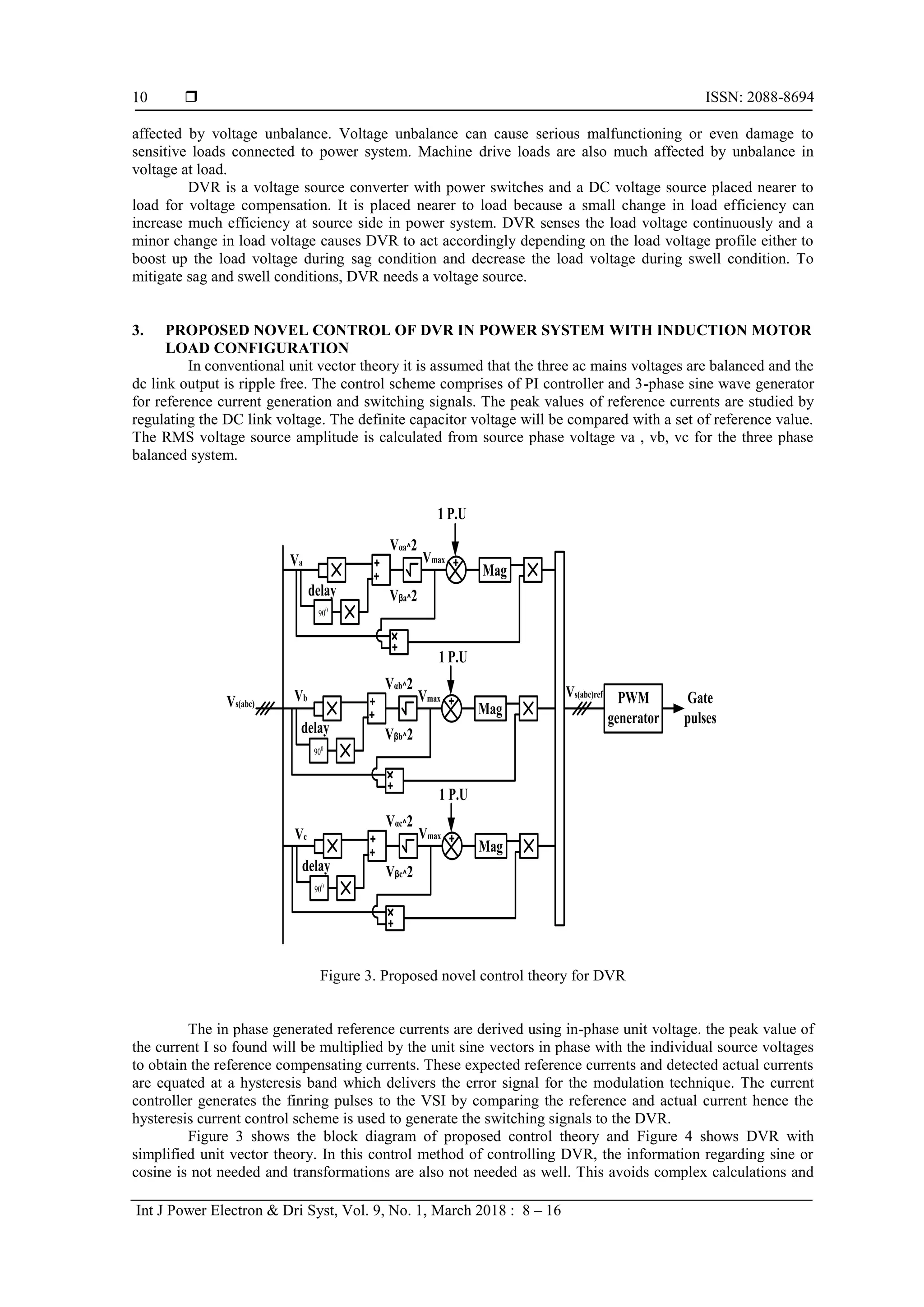
Figure 2. Configuration of DVR connected to power system with induction motor drive load
This paper presents a new control strategy to control power switches of DVR to be triggered to
compensate voltage quality disturbances in power system. The said novel control strategy was tested for AC
drive load applications. The performance of DVR controlled with proposed novel control strategy was tested
to compensate sag and swell in power system with induction motor drive load.
2. DVR IN POWER SYSTEM WITH INDUCTION MOTOR LOAD CONFIGURATION
The system configuration with power system having induction motor load and DVR connected to
power system for voltage quality improvement was shown in Figure 2. The three-phase source is connected
to induction (AC) motor load through source impedance. Since induction motor is an inductive load, it may
cause voltage quality problems in power system and this problem needs to be addressed. To address voltage
quality issues, mitigation of voltage is performed using a compensator. DVR is series converter addresses the
voltage quality issues by inducing compensating signals to power system. DVR is a compensating device
compensates the system voltage by absorbing/delivering required voltage with the use of IGBT/MOSFET.
DVR is the commonly used compensating device for voltage sag and voltage swell problem in power system.
load voltage profile should be maintained as close to ideal system such that the sensitive loads are not much
 ISSN: 2088-8694
Int J Power Electron & Dri Syst, Vol. 9, No. 1, March 2018 : 8 – 16
10
affected by voltage unbalance. Voltage unbalance can cause serious malfunctioning or even damage to
sensitive loads connected to power system. Machine drive loads are also much affected by unbalance in
voltage at load.
DVR is a voltage source converter with power switches and a DC voltage source placed nearer to
load for voltage compensation. It is placed nearer to load because a small change in load efficiency can
increase much efficiency at source side in power system. DVR senses the load voltage continuously and a
minor change in load voltage causes DVR to act accordingly depending on the load voltage profile either to
boost up the load voltage during sag condition and decrease the load voltage during swell condition. To
mitigate sag and swell conditions, DVR needs a voltage source.
3. PROPOSED NOVEL CONTROL OF DVR IN POWER SYSTEM WITH INDUCTION MOTOR
LOAD CONFIGURATION
In conventional unit vector theory it is assumed that the three ac mains voltages are balanced and the
dc link output is ripple free. The control scheme comprises of PI controller and 3-phase sine wave generator
for reference current generation and switching signals. The peak values of reference currents are studied by
regulating the DC link voltage. The definite capacitor voltage will be compared with a set of reference value.
The RMS voltage source amplitude is calculated from source phase voltage va , vb, vc for the three phase
balanced system.
0
90
+
+
+
1 P.U
Mag
Vmax
+
Vαa^2
Vβa^2
0
90
+
+
+
Mag
Vmax
+
Vαb^2
Vβb^2
1 P.U
0
90
+
+
+
Mag
Vmax
+
Vαc^2
Vβc^2
1 P.U
PWM
generator
Gate
pulses
Va
Vb
Vc
delay
delay
delay
Vs(abc)
Vs(abc)ref
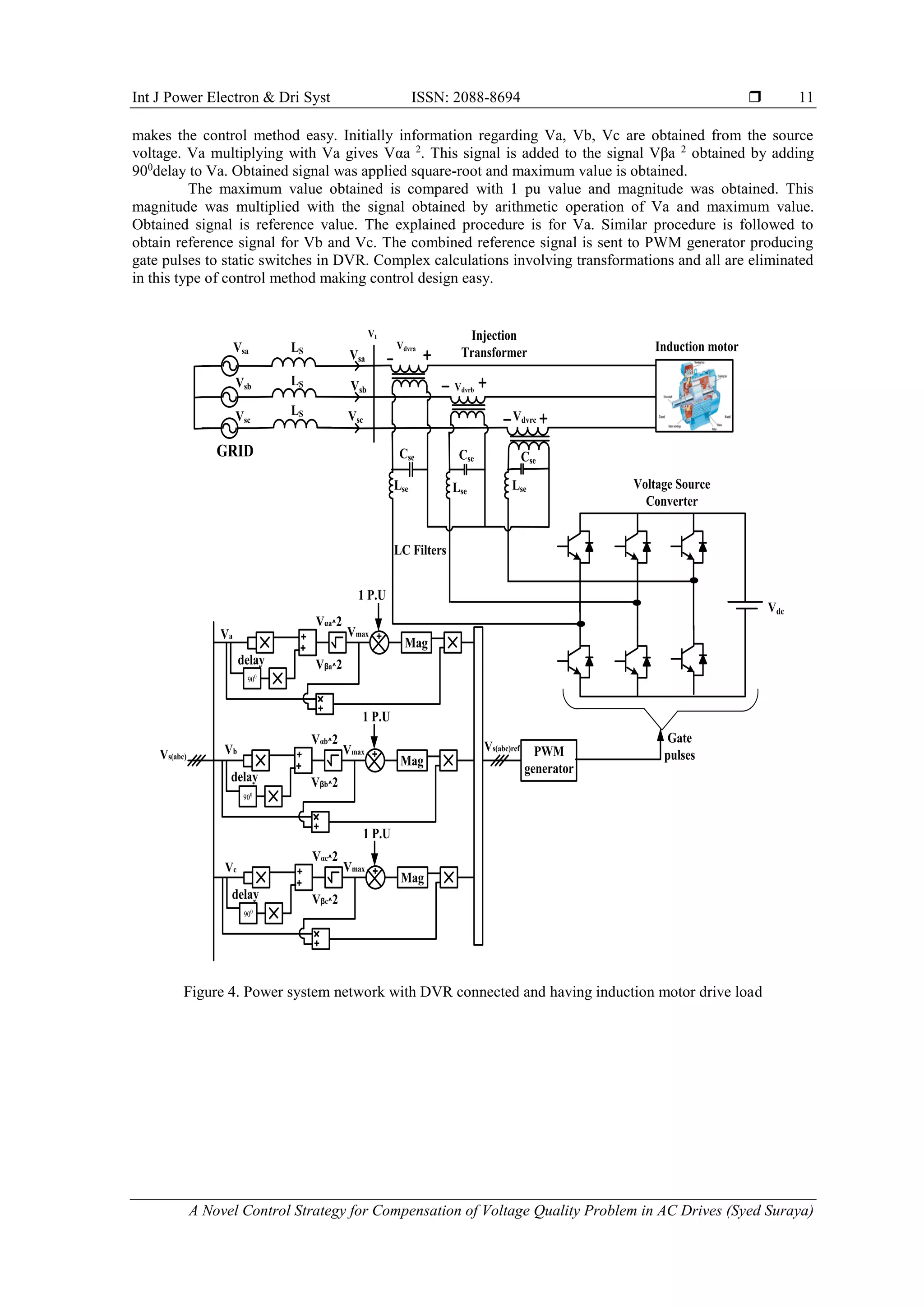
Figure 3. Proposed novel control theory for DVR
The in phase generated reference currents are derived using in-phase unit voltage. the peak value of
the current I so found will be multiplied by the unit sine vectors in phase with the individual source voltages
to obtain the reference compensating currents. These expected reference currents and detected actual currents
are equated at a hysteresis band which delivers the error signal for the modulation technique. The current
controller generates the finring pulses to the VSI by comparing the reference and actual current hence the
hysteresis current control scheme is used to generate the switching signals to the DVR.
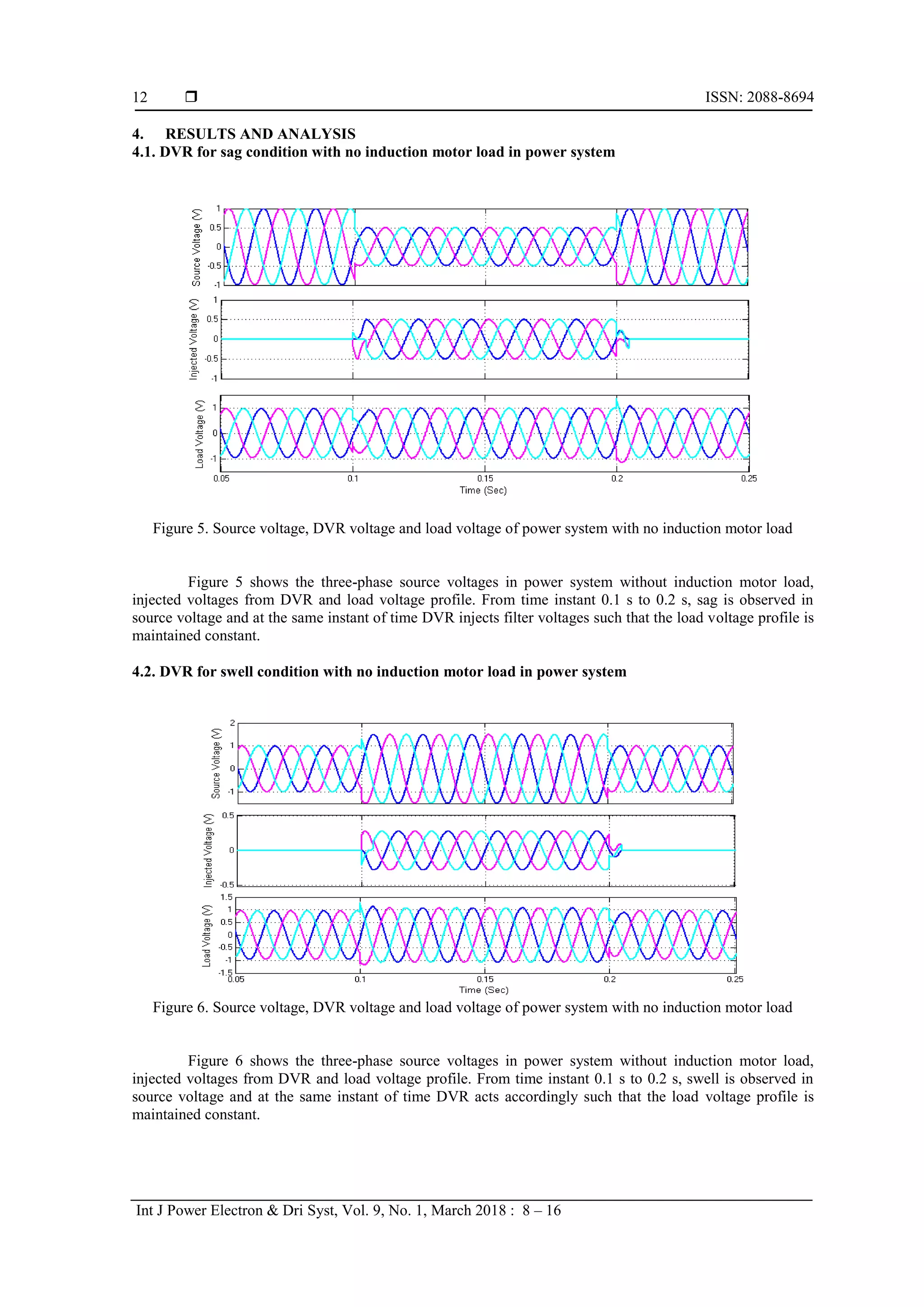
Figure 3 shows the block diagram of proposed control theory and Figure 4 shows DVR with
simplified unit vector theory. In this control method of controlling DVR, the information regarding sine or
cosine is not needed and transformations are also not needed as well. This avoids complex calculations and
Int J Power Electron & Dri Syst ISSN: 2088-8694 
A Novel Control Strategy for Compensation of Voltage Quality Problem in AC Drives (Syed Suraya)
11
makes the control method easy. Initially information regarding Va, Vb, Vc are obtained from the source
voltage. Va multiplying with Va gives Vαa 2
. This signal is added to the signal Vβa 2
obtained by adding
900
delay to Va. Obtained signal was applied square-root and maximum value is obtained.
The maximum value obtained is compared with 1 pu value and magnitude was obtained. This
magnitude was multiplied with the signal obtained by arithmetic operation of Va and maximum value.
Obtained signal is reference value. The explained procedure is for Va. Similar procedure is followed to
obtain reference signal for Vb and Vc. The combined reference signal is sent to PWM generator producing
gate pulses to static switches in DVR. Complex calculations involving transformations and all are eliminated
in this type of control method making control design easy.
Vsa
Vsb
Vsc
LS
LS
LS
Vsa
Vsb
Vsc
Vdvra
Vdvrb
Vdvrc
Lse Lse Lse
Vt
Cse Cse Cse
LC Filters
Injection
Transformer
Voltage Source
Converter
GRID
Vdc
Induction motor
0
90
+
+
+
1 P.U
Mag
Vmax
+
Vαa^2
Vβa^2
0
90
+
+
+
Mag
Vmax
+
Vαb^2
Vβb^2
1 P.U
0
90
+
+
+
Mag
Vmax
+
Vαc^2
Vβc^2
1 P.U
PWM
generator
Gate
pulses
Va
Vb
Vc
delay
delay
delay
Vs(abc)
Vs(abc)ref
Figure 4. Power system network with DVR connected and having induction motor drive load
 ISSN: 2088-8694
Int J Power Electron & Dri Syst, Vol. 9, No. 1, March 2018 : 8 – 16
12
4. RESULTS AND ANALYSIS
4.1. DVR for sag condition with no induction motor load in power system
Figure 5. Source voltage, DVR voltage and load voltage of power system with no induction motor load
Figure 5 shows the three-phase source voltages in power system without induction motor load,
injected voltages from DVR and load voltage profile. From time instant 0.1 s to 0.2 s, sag is observed in
source voltage and at the same instant of time DVR injects filter voltages such that the load voltage profile is
maintained constant.
4.2. DVR for swell condition with no induction motor load in power system
Figure 6. Source voltage, DVR voltage and load voltage of power system with no induction motor load
Figure 6 shows the three-phase source voltages in power system without induction motor load,
injected voltages from DVR and load voltage profile. From time instant 0.1 s to 0.2 s, swell is observed in
source voltage and at the same instant of time DVR acts accordingly such that the load voltage profile is
maintained constant.
Int J Power Electron & Dri Syst ISSN: 2088-8694 
A Novel Control Strategy for Compensation of Voltage Quality Problem in AC Drives (Syed Suraya)
13
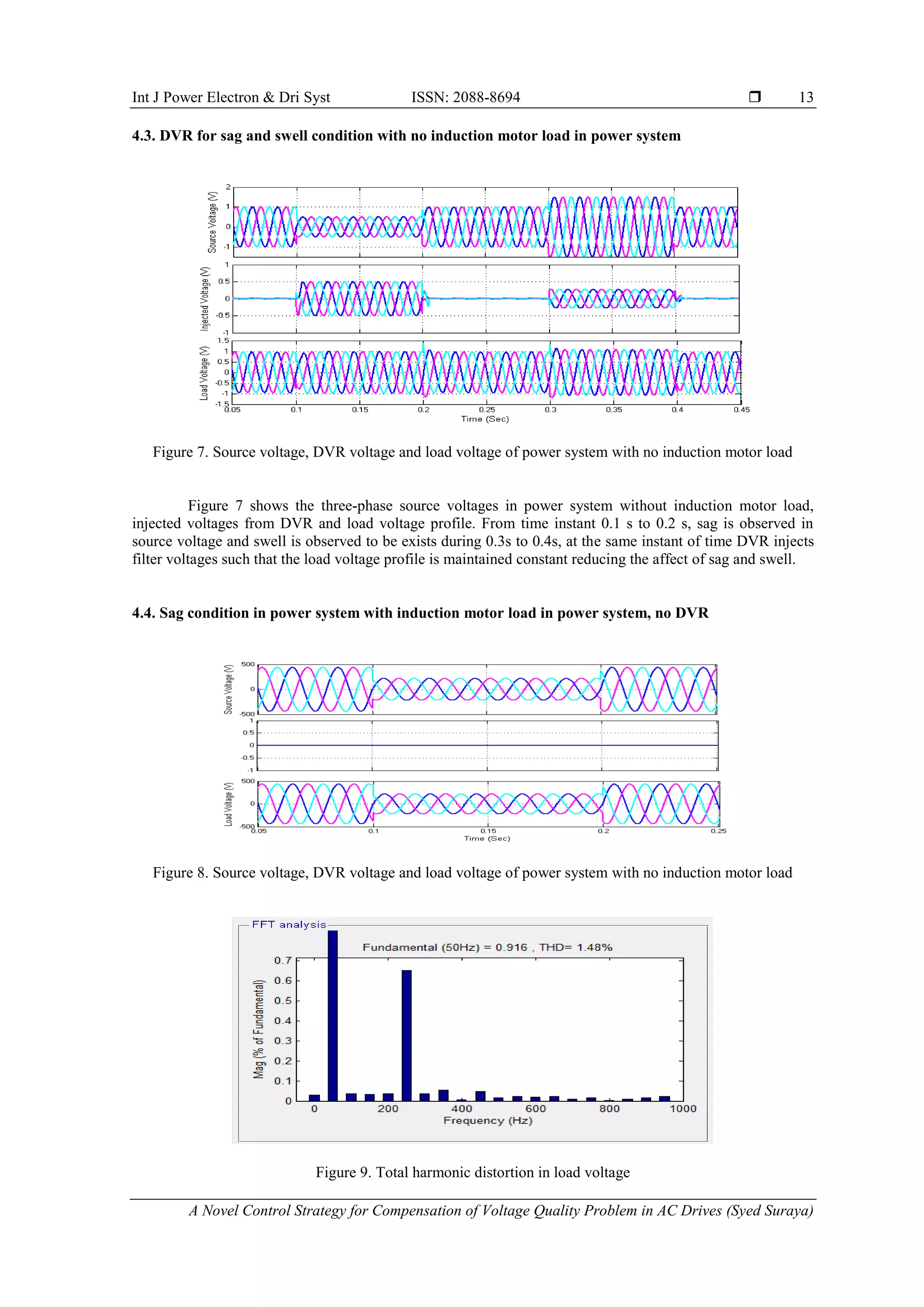
4.3. DVR for sag and swell condition with no induction motor load in power system
Figure 7. Source voltage, DVR voltage and load voltage of power system with no induction motor load
Figure 7 shows the three-phase source voltages in power system without induction motor load,
injected voltages from DVR and load voltage profile. From time instant 0.1 s to 0.2 s, sag is observed in
source voltage and swell is observed to be exists during 0.3s to 0.4s, at the same instant of time DVR injects
filter voltages such that the load voltage profile is maintained constant reducing the affect of sag and swell.
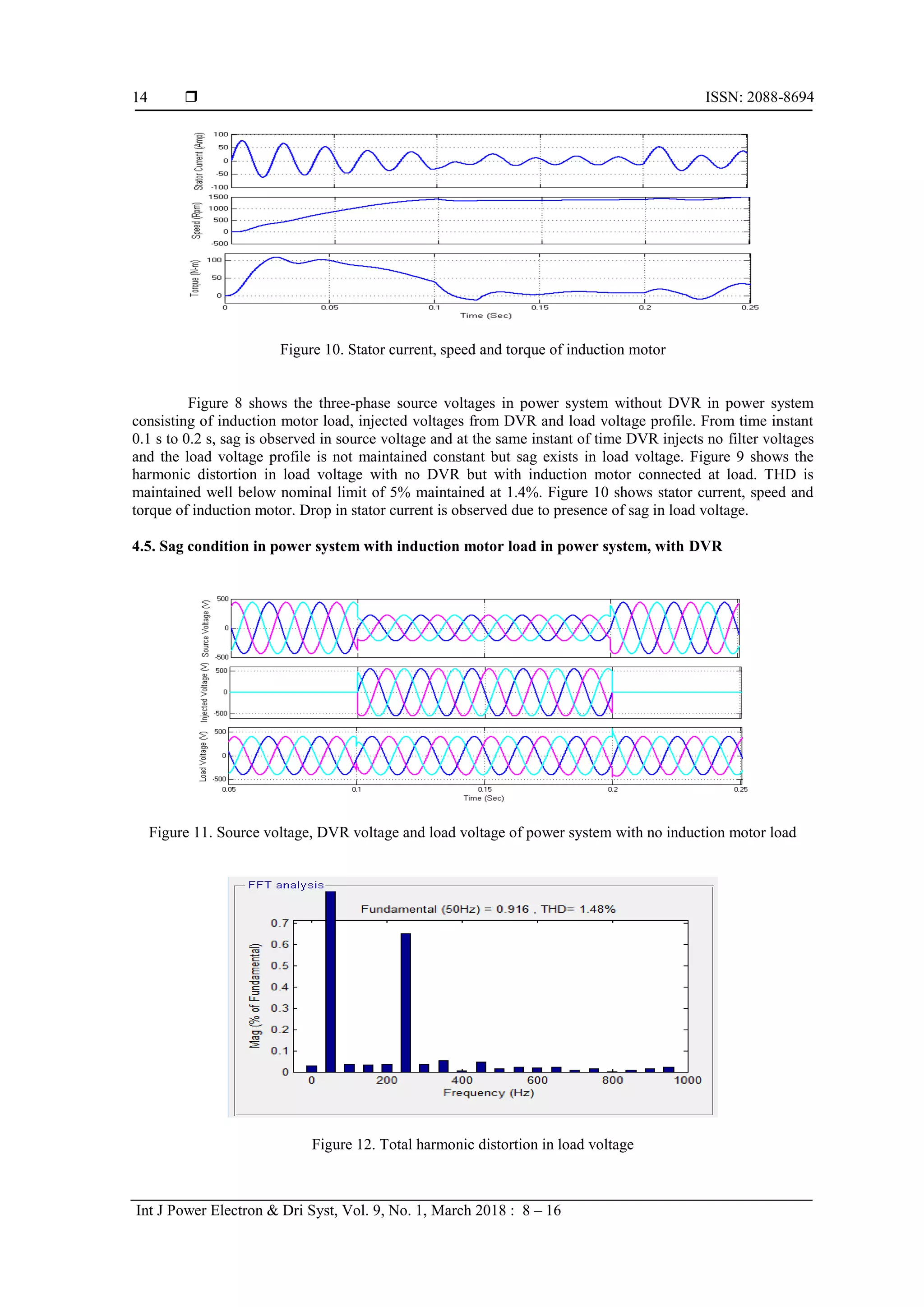
4.4. Sag condition in power system with induction motor load in power system, no DVR
Figure 8. Source voltage, DVR voltage and load voltage of power system with no induction motor load
Figure 9. Total harmonic distortion in load voltage
 ISSN: 2088-8694
Int J Power Electron & Dri Syst, Vol. 9, No. 1, March 2018 : 8 – 16
14
Figure 10. Stator current, speed and torque of induction motor
Figure 8 shows the three-phase source voltages in power system without DVR in power system
consisting of induction motor load, injected voltages from DVR and load voltage profile. From time instant
0.1 s to 0.2 s, sag is observed in source voltage and at the same instant of time DVR injects no filter voltages
and the load voltage profile is not maintained constant but sag exists in load voltage. Figure 9 shows the
harmonic distortion in load voltage with no DVR but with induction motor connected at load. THD is
maintained well below nominal limit of 5% maintained at 1.4%. Figure 10 shows stator current, speed and
torque of induction motor. Drop in stator current is observed due to presence of sag in load voltage.
4.5. Sag condition in power system with induction motor load in power system, with DVR
Figure 11. Source voltage, DVR voltage and load voltage of power system with no induction motor load
Figure 12. Total harmonic distortion in load voltage
Int J Power Electron & Dri Syst ISSN: 2088-8694 
A Novel Control Strategy for Compensation of Voltage Quality Problem in AC Drives (Syed Suraya)
15
Figure 13. Stator current, speed and torque of induction motor
Figure 11 shows the three-phase source voltages in power system with DVR in power system
consisting of induction motor load, injected voltages from DVR and load voltage profile. From time instant
0.1 s to 0.2 s, sag is observed in source voltage and at the same instant of time DVR injects filter voltages and
the load voltage profile is maintained constant. Figure 12 shows the harmonic distortion in load voltage with
no DVR but with induction motor connected at load. THD is maintained well below nominal limit of 5%
maintained at 1.48%. Figure 13 shows stator current, speed and torque of induction motor. Drop in stator
current is not observed as DVR compensated for sag in source voltage and load voltage.
5. CONCLUSION
The paper presents a novel control strategy to control DVR connected to power system with
induction motor load. The control strategy was tested for sag condition with and without induction motor and
found suitable to control DVR in different test conditions discussed in results. During sag conditions without
and with induction motor, DVR with proposed control strategy injects compensating voltages to maintain
constant load profile.
REFERENCES
[1] Benachaiba, C. and B. Ferdi, 2008. Voltage quality improvement using dynamic voltage restorer. Elect. Power
Quality Utiliz. J., 14: 39-46.
[2] Bollen, M., 1999. Understanding Power Quality Problems: Voltage Sags and Interruptions. 1st Edn., IEEE Press,
Piscataway, NJ., ISBN: 13: 978- 0780347137, pp: 672.
[3] Djokic, S. and J. Milanovic, 2006. Advanced voltage sag characterization. Part I: Phase shift. IEEE Proc. Generat.
Transm. Distribut., 153: 423-430. DOI: 10.1049/ip-gtd:20050350
[4] A. V. Ital and S. A. Borakhade, "Compensation of voltage sags and swells by using Dynamic Voltage Restorer
(DVR)," 2016 International Conference on Electrical, Electronics, and Optimization Techniques (ICEEOT),
Chennai, 2016, pp. 1515-1519
[5] B. P. Ganthia, S. Mohanty, P. K. Rana and P. K. Sahu, "Compensation of voltage sag using DVR with PI
controller," 2016 International Conference on Electrical, Electronics, and Optimization Techniques (ICEEOT),
Chennai, 2016, pp. 2138-2142
[6] S. Singh, V. Rai, A. Kumar and K. B. Sahay, "Simulation and comparison of DVR and D-STATCOM for voltage
sag mitigation," 2016 IEEE 6th International Conference on Power Systems (ICPS), New Delhi, 2016, pp. 1-6.
[7] T. AppalaNaidu, "The Role Of Dynamic Voltage Restorer (DVR) in improving power quality," 2016 2nd
International Conference on Advances in Electrical, Electronics, Information, Communication and Bio-Informatics
(AEEICB), Chennai, 2016, pp. 136-141.
[8] S. Deepika, M. Saranya and V. Poorani, "PI controller based dynamic SAG compensator with PV PANEL: PI
controller based DVR," 2015 International Conference on Advanced Computing and Communication Systems,
Coimbatore, 2015, pp. 1-6.
[9] G. Ramya, V. Ganapathy, P. Suresh, “Power Quality Improvement Using Multi-Level Inverter Based DVR and
DSTATCOM Using Neuro-Fuzzy Controller,” International journal of power electronics and drive systems
(IJPEDS), Vol 8, No 1: March 2017, pp 316-324.
[10] Brahim Ferdi, Samira Dib, Brahim Berbaoui, Rachid Dehini, “Design and Simulation of Dynamic Voltage Restorer
Based on Fuzzy Controller Optimized by ANFIS,” International journal of power electronics and drive systems
(IJPEDS), Vol 4, No 2: June 2014, pp 212-222.
 ISSN: 2088-8694
Int J Power Electron & Dri Syst, Vol. 9, No. 1, March 2018 : 8 – 16
16
[11] D.K. Tanti, M.K. Verma, Brijesh Singh, O.N. Mehrotra, “Optimal Placement of Custom Power Devices in Power
System Network to Mitigate Voltage Sag under Faults,” International journal of power electronics and drive
systems (IJPEDS), Vol 2, No 3: September 2012, pp 267-276.
BIOGRAPHIES OF AUTHORS
Syed Suraya received B.Tech degree in Electrical & Electronics Engineering from
JNTU,Hyderabad in 2002 and M.Tech degree in Energy systems from JNTU,Hyderabad in
2007.She is currently working towards Ph.D degree in Electrical Engineering at JNTUA,
Ananthapuramu.
Her research interests are Non-Conventional Energy, Energy Conservation.
Dr. P. Sujatha presently working as a Professor in Electrical & Electronics Engineering, JNTUA
College of Engineering, Ananthapuramu. She received B. Tech degree in Electrical &
Electronics Engineering from JNTU College of Engineering, Anantapur in 1993, M. Tech degree
in Electrical Power Systems from JNTU College of Engineering, Anantapur in 2003 and Ph. D
in Electrical Engineering from JNTUA, Ananthapuramu in 2012.
Her research interests are: Power Systems, Energy Management and Renewable Energy.
P. Bharat Kumar received B. Tech degree in Instrumentation and Control Engineering from
JNTU Hyderabad in 2007 and M. Tech degree in Control Systems from JNTUA Anantapur. He
is currently working towards the Ph. D. degree in Electrical Engineering at JNTUA
Ananthapuramu.
His research interests include Controllers design using AI techniques, nonlinear control and
Robust Control.

A Novel Control Strategy for Compensation of Voltage Quality Problem in AC Drives

  • 1.
    International Journal ofPower Electronics and Drive System (IJPEDS) Vol. 9, No. 1, March 2018, pp. 8~16 ISSN: 2088-8694, DOI: 10.11591/ijpeds.v9.i1.pp8-16  8 Journal homepage: http://iaescore.com/journals/index.php/IJPEDS A Novel Control Strategy for Compensation of Voltage Quality Problem in AC Drives Syed Suraya1 , P. Sujatha2 , P. Bharat Kumar3 Department of Electrical and Electronics Engineering, JNTUA, Ananthpur, AP, India Article Info ABSTRACT Article history: Received Aug 23, 2017 Revised Sep 2, 2017 Accepted Jan 13, 2018 This paper presents a novel control strategy for the compensation of voltage quality issues in power system networks with AC drives. Voltage quality is one of the key parameter for power engineers and to deliver the power with good quality should be given at most priority. Voltage quality mitigation in power system network is done by employing dynamic voltage restorer (DVR). DVR consists of power switches and power switches are to be controlled. DVR in this paper is controlled using a novel control strategy. A novel control strategy can effectively control DVR by improving voltage quality reducing the adverse effects of voltage sag and voltage swell in power system networks. The paper presents the DVR controlled with novel control strategy for electrical machine (induction motor) drive load application. Keyword: Voltage quality Compensation Novel control AC drives Copyright © 2018 Institute of Advanced Engineering and Science. All rights reserved. Corresponding Author: Syed Suraya, Research Scholar, Departement of Electrical and Electronics Engineering, JNTUA, Ananthpur, AP, India. Email: syedsuraya143@gmail.com 1. INTRODUCTION Consistency is a key word for utilities and their customers in general, and it is crucial to companies operating in a highly competitive business environment, because it affects profitability, which definitely is a driving force in the industry. Although electrical transmission and distribution systems have reached a very high level of reliability, disturbances cannot be totally avoided [1-3]. Power quality issues are not new to power system but their existence creates new problems due to advancements in power electronic sector. Voltage quality is the main concern on load side and power engineers should ensure that the load voltage is same throughout the conditions in power system. Custom power devices might be a solution to eliminate or reduce power quality problems caused from many loads. FACTS devices are type of custom power devices employed to reduce the risk of power quality problems using power electronics circuits [4-6]. DVR is one such device used to address voltage sag and swell issues in power system. The DVR is a power quality device, which can protect these industries against the bulk of these disturbances, i.e. voltage sags and swells related to remote system faults. A DVR compensates for these voltage excursions, provided that the supply grid does not get disconnected entirely through breaker trips. DVR [7-8] is power electronic voltage source converter placed in series to power line as in figure 1 and power switches in DVR is to be controlled by employing a suitable control strategy to produce gating signals to power switches of DVR [9- 11].
  • 2.
    Int J PowerElectron & Dri Syst ISSN: 2088-8694  A Novel Control Strategy for Compensation of Voltage Quality Problem in AC Drives (Syed Suraya) 9 Vsa Vsb Vsc LS LS LS Vsa Vsb Vsc Vdvra Vdvrb Vdvrc Lse Lse Lse Vt Cse Cse Cse Sensitive Load LC Filters Injection Transformer Voltage Source Converter GRID Vdc Figure 1. Power system with DVR Vsa Vsb Vsc LS LS LS Vsa Vsb Vsc Vdvra Vdvrb Vdvrc Lse Lse Lse Vt Cse Cse Cse LC Filters Injection Transformer Voltage Source Converter GRID Vdc Induction motor Figure 2. Configuration of DVR connected to power system with induction motor drive load This paper presents a new control strategy to control power switches of DVR to be triggered to compensate voltage quality disturbances in power system. The said novel control strategy was tested for AC drive load applications. The performance of DVR controlled with proposed novel control strategy was tested to compensate sag and swell in power system with induction motor drive load. 2. DVR IN POWER SYSTEM WITH INDUCTION MOTOR LOAD CONFIGURATION The system configuration with power system having induction motor load and DVR connected to power system for voltage quality improvement was shown in Figure 2. The three-phase source is connected to induction (AC) motor load through source impedance. Since induction motor is an inductive load, it may cause voltage quality problems in power system and this problem needs to be addressed. To address voltage quality issues, mitigation of voltage is performed using a compensator. DVR is series converter addresses the voltage quality issues by inducing compensating signals to power system. DVR is a compensating device compensates the system voltage by absorbing/delivering required voltage with the use of IGBT/MOSFET. DVR is the commonly used compensating device for voltage sag and voltage swell problem in power system. load voltage profile should be maintained as close to ideal system such that the sensitive loads are not much
  • 3.
     ISSN: 2088-8694 IntJ Power Electron & Dri Syst, Vol. 9, No. 1, March 2018 : 8 – 16 10 affected by voltage unbalance. Voltage unbalance can cause serious malfunctioning or even damage to sensitive loads connected to power system. Machine drive loads are also much affected by unbalance in voltage at load. DVR is a voltage source converter with power switches and a DC voltage source placed nearer to load for voltage compensation. It is placed nearer to load because a small change in load efficiency can increase much efficiency at source side in power system. DVR senses the load voltage continuously and a minor change in load voltage causes DVR to act accordingly depending on the load voltage profile either to boost up the load voltage during sag condition and decrease the load voltage during swell condition. To mitigate sag and swell conditions, DVR needs a voltage source. 3. PROPOSED NOVEL CONTROL OF DVR IN POWER SYSTEM WITH INDUCTION MOTOR LOAD CONFIGURATION In conventional unit vector theory it is assumed that the three ac mains voltages are balanced and the dc link output is ripple free. The control scheme comprises of PI controller and 3-phase sine wave generator for reference current generation and switching signals. The peak values of reference currents are studied by regulating the DC link voltage. The definite capacitor voltage will be compared with a set of reference value. The RMS voltage source amplitude is calculated from source phase voltage va , vb, vc for the three phase balanced system. 0 90 + + + 1 P.U Mag Vmax + Vαa^2 Vβa^2 0 90 + + + Mag Vmax + Vαb^2 Vβb^2 1 P.U 0 90 + + + Mag Vmax + Vαc^2 Vβc^2 1 P.U PWM generator Gate pulses Va Vb Vc delay delay delay Vs(abc) Vs(abc)ref Figure 3. Proposed novel control theory for DVR The in phase generated reference currents are derived using in-phase unit voltage. the peak value of the current I so found will be multiplied by the unit sine vectors in phase with the individual source voltages to obtain the reference compensating currents. These expected reference currents and detected actual currents are equated at a hysteresis band which delivers the error signal for the modulation technique. The current controller generates the finring pulses to the VSI by comparing the reference and actual current hence the hysteresis current control scheme is used to generate the switching signals to the DVR. Figure 3 shows the block diagram of proposed control theory and Figure 4 shows DVR with simplified unit vector theory. In this control method of controlling DVR, the information regarding sine or cosine is not needed and transformations are also not needed as well. This avoids complex calculations and
  • 4.
    Int J PowerElectron & Dri Syst ISSN: 2088-8694  A Novel Control Strategy for Compensation of Voltage Quality Problem in AC Drives (Syed Suraya) 11 makes the control method easy. Initially information regarding Va, Vb, Vc are obtained from the source voltage. Va multiplying with Va gives Vαa 2 . This signal is added to the signal Vβa 2 obtained by adding 900 delay to Va. Obtained signal was applied square-root and maximum value is obtained. The maximum value obtained is compared with 1 pu value and magnitude was obtained. This magnitude was multiplied with the signal obtained by arithmetic operation of Va and maximum value. Obtained signal is reference value. The explained procedure is for Va. Similar procedure is followed to obtain reference signal for Vb and Vc. The combined reference signal is sent to PWM generator producing gate pulses to static switches in DVR. Complex calculations involving transformations and all are eliminated in this type of control method making control design easy. Vsa Vsb Vsc LS LS LS Vsa Vsb Vsc Vdvra Vdvrb Vdvrc Lse Lse Lse Vt Cse Cse Cse LC Filters Injection Transformer Voltage Source Converter GRID Vdc Induction motor 0 90 + + + 1 P.U Mag Vmax + Vαa^2 Vβa^2 0 90 + + + Mag Vmax + Vαb^2 Vβb^2 1 P.U 0 90 + + + Mag Vmax + Vαc^2 Vβc^2 1 P.U PWM generator Gate pulses Va Vb Vc delay delay delay Vs(abc) Vs(abc)ref Figure 4. Power system network with DVR connected and having induction motor drive load
  • 5.
     ISSN: 2088-8694 IntJ Power Electron & Dri Syst, Vol. 9, No. 1, March 2018 : 8 – 16 12 4. RESULTS AND ANALYSIS 4.1. DVR for sag condition with no induction motor load in power system Figure 5. Source voltage, DVR voltage and load voltage of power system with no induction motor load Figure 5 shows the three-phase source voltages in power system without induction motor load, injected voltages from DVR and load voltage profile. From time instant 0.1 s to 0.2 s, sag is observed in source voltage and at the same instant of time DVR injects filter voltages such that the load voltage profile is maintained constant. 4.2. DVR for swell condition with no induction motor load in power system Figure 6. Source voltage, DVR voltage and load voltage of power system with no induction motor load Figure 6 shows the three-phase source voltages in power system without induction motor load, injected voltages from DVR and load voltage profile. From time instant 0.1 s to 0.2 s, swell is observed in source voltage and at the same instant of time DVR acts accordingly such that the load voltage profile is maintained constant.
  • 6.
    Int J PowerElectron & Dri Syst ISSN: 2088-8694  A Novel Control Strategy for Compensation of Voltage Quality Problem in AC Drives (Syed Suraya) 13 4.3. DVR for sag and swell condition with no induction motor load in power system Figure 7. Source voltage, DVR voltage and load voltage of power system with no induction motor load Figure 7 shows the three-phase source voltages in power system without induction motor load, injected voltages from DVR and load voltage profile. From time instant 0.1 s to 0.2 s, sag is observed in source voltage and swell is observed to be exists during 0.3s to 0.4s, at the same instant of time DVR injects filter voltages such that the load voltage profile is maintained constant reducing the affect of sag and swell. 4.4. Sag condition in power system with induction motor load in power system, no DVR Figure 8. Source voltage, DVR voltage and load voltage of power system with no induction motor load Figure 9. Total harmonic distortion in load voltage
  • 7.
     ISSN: 2088-8694 IntJ Power Electron & Dri Syst, Vol. 9, No. 1, March 2018 : 8 – 16 14 Figure 10. Stator current, speed and torque of induction motor Figure 8 shows the three-phase source voltages in power system without DVR in power system consisting of induction motor load, injected voltages from DVR and load voltage profile. From time instant 0.1 s to 0.2 s, sag is observed in source voltage and at the same instant of time DVR injects no filter voltages and the load voltage profile is not maintained constant but sag exists in load voltage. Figure 9 shows the harmonic distortion in load voltage with no DVR but with induction motor connected at load. THD is maintained well below nominal limit of 5% maintained at 1.4%. Figure 10 shows stator current, speed and torque of induction motor. Drop in stator current is observed due to presence of sag in load voltage. 4.5. Sag condition in power system with induction motor load in power system, with DVR Figure 11. Source voltage, DVR voltage and load voltage of power system with no induction motor load Figure 12. Total harmonic distortion in load voltage
  • 8.
    Int J PowerElectron & Dri Syst ISSN: 2088-8694  A Novel Control Strategy for Compensation of Voltage Quality Problem in AC Drives (Syed Suraya) 15 Figure 13. Stator current, speed and torque of induction motor Figure 11 shows the three-phase source voltages in power system with DVR in power system consisting of induction motor load, injected voltages from DVR and load voltage profile. From time instant 0.1 s to 0.2 s, sag is observed in source voltage and at the same instant of time DVR injects filter voltages and the load voltage profile is maintained constant. Figure 12 shows the harmonic distortion in load voltage with no DVR but with induction motor connected at load. THD is maintained well below nominal limit of 5% maintained at 1.48%. Figure 13 shows stator current, speed and torque of induction motor. Drop in stator current is not observed as DVR compensated for sag in source voltage and load voltage. 5. CONCLUSION The paper presents a novel control strategy to control DVR connected to power system with induction motor load. The control strategy was tested for sag condition with and without induction motor and found suitable to control DVR in different test conditions discussed in results. During sag conditions without and with induction motor, DVR with proposed control strategy injects compensating voltages to maintain constant load profile. REFERENCES [1] Benachaiba, C. and B. Ferdi, 2008. Voltage quality improvement using dynamic voltage restorer. Elect. Power Quality Utiliz. J., 14: 39-46. [2] Bollen, M., 1999. Understanding Power Quality Problems: Voltage Sags and Interruptions. 1st Edn., IEEE Press, Piscataway, NJ., ISBN: 13: 978- 0780347137, pp: 672. [3] Djokic, S. and J. Milanovic, 2006. Advanced voltage sag characterization. Part I: Phase shift. IEEE Proc. Generat. Transm. Distribut., 153: 423-430. DOI: 10.1049/ip-gtd:20050350 [4] A. V. Ital and S. A. Borakhade, "Compensation of voltage sags and swells by using Dynamic Voltage Restorer (DVR)," 2016 International Conference on Electrical, Electronics, and Optimization Techniques (ICEEOT), Chennai, 2016, pp. 1515-1519 [5] B. P. Ganthia, S. Mohanty, P. K. Rana and P. K. Sahu, "Compensation of voltage sag using DVR with PI controller," 2016 International Conference on Electrical, Electronics, and Optimization Techniques (ICEEOT), Chennai, 2016, pp. 2138-2142 [6] S. Singh, V. Rai, A. Kumar and K. B. Sahay, "Simulation and comparison of DVR and D-STATCOM for voltage sag mitigation," 2016 IEEE 6th International Conference on Power Systems (ICPS), New Delhi, 2016, pp. 1-6. [7] T. AppalaNaidu, "The Role Of Dynamic Voltage Restorer (DVR) in improving power quality," 2016 2nd International Conference on Advances in Electrical, Electronics, Information, Communication and Bio-Informatics (AEEICB), Chennai, 2016, pp. 136-141. [8] S. Deepika, M. Saranya and V. Poorani, "PI controller based dynamic SAG compensator with PV PANEL: PI controller based DVR," 2015 International Conference on Advanced Computing and Communication Systems, Coimbatore, 2015, pp. 1-6. [9] G. Ramya, V. Ganapathy, P. Suresh, “Power Quality Improvement Using Multi-Level Inverter Based DVR and DSTATCOM Using Neuro-Fuzzy Controller,” International journal of power electronics and drive systems (IJPEDS), Vol 8, No 1: March 2017, pp 316-324. [10] Brahim Ferdi, Samira Dib, Brahim Berbaoui, Rachid Dehini, “Design and Simulation of Dynamic Voltage Restorer Based on Fuzzy Controller Optimized by ANFIS,” International journal of power electronics and drive systems (IJPEDS), Vol 4, No 2: June 2014, pp 212-222.
  • 9.
     ISSN: 2088-8694 IntJ Power Electron & Dri Syst, Vol. 9, No. 1, March 2018 : 8 – 16 16 [11] D.K. Tanti, M.K. Verma, Brijesh Singh, O.N. Mehrotra, “Optimal Placement of Custom Power Devices in Power System Network to Mitigate Voltage Sag under Faults,” International journal of power electronics and drive systems (IJPEDS), Vol 2, No 3: September 2012, pp 267-276. BIOGRAPHIES OF AUTHORS Syed Suraya received B.Tech degree in Electrical & Electronics Engineering from JNTU,Hyderabad in 2002 and M.Tech degree in Energy systems from JNTU,Hyderabad in 2007.She is currently working towards Ph.D degree in Electrical Engineering at JNTUA, Ananthapuramu. Her research interests are Non-Conventional Energy, Energy Conservation. Dr. P. Sujatha presently working as a Professor in Electrical & Electronics Engineering, JNTUA College of Engineering, Ananthapuramu. She received B. Tech degree in Electrical & Electronics Engineering from JNTU College of Engineering, Anantapur in 1993, M. Tech degree in Electrical Power Systems from JNTU College of Engineering, Anantapur in 2003 and Ph. D in Electrical Engineering from JNTUA, Ananthapuramu in 2012. Her research interests are: Power Systems, Energy Management and Renewable Energy. P. Bharat Kumar received B. Tech degree in Instrumentation and Control Engineering from JNTU Hyderabad in 2007 and M. Tech degree in Control Systems from JNTUA Anantapur. He is currently working towards the Ph. D. degree in Electrical Engineering at JNTUA Ananthapuramu. His research interests include Controllers design using AI techniques, nonlinear control and Robust Control.