International Research Journal of Engineering and Technology (IRJET) e-ISSN: 2395 -0056
Volume: 04 Issue: 03 | Mar -2017 www.irjet.net p-ISSN: 2395-0072
© 2016, IRJET | Impact Factor value: 4.45 | ISO 9001:2008 Certified Journal | Page 1637
“Minimizing Penalty in Industrial Power Consumption By
Engaging APFC Unit”: A Review
Nidhi A. Ganatra1 Swati C. Chotaliya2 Prof Vishal N. Jogidas3
1.2B.E in Electrical Engineering, DSTC, Junagadh, Gujarat, India
3. Assistant Professor in Electrical Engineering Department, DSTC, Junagadh, Gujarat, India
---------------------------------------------------------------------***---------------------------------------------------------------------
Abstract-In the industrial sectorthevariousmotoringloads
are continuously running and increasing the inductiveload. So
the power factor in this system get reducesduetotheinductive
reactive power. But the electricity board has a standard limit
regarding the power factor values and if the powerfactorgoes
below the specified limit the electricity company charges the
penalty to the industrial consumers. APFC device reads power
factor from line voltage and line current by determining the
delay in the arrival of the current signal with respect to
voltage signal from the function generator with highaccuracy
by using an internal timer. This time values are the calibrated
as phase angle and corresponding power factor. Then the
values are displayed in Liquid crystal display modules. Then
the motherboard calculates the compensation requirement
and accordingly switches on different capacitor banks. This is
developed by using AVR microcontroller.
KEYWORDS: Power factor, Penalty, AVR microcontroller,
capacitor bank, contactors and current transformer, potential
transformer
1. INTRODUCTION
The low power factor leads to the increase in the load
current, increase in power loss, and decrease in efficiency of
the overall system. In previousvariousmethoduseforpower
factor correction in all this method, the switching of the
capacitor is manual. In this paper we are using a method of
the reactive power compensation by capacitor switching
with automatic control using AVR microcontroller [1].
1.2 POWER FACTOR
Fig -1: Power Triangle
The power factor is the ratio of the active power to the
apparent power .The active power is the real power
delivered to the loads such as motors,lampsetc. Thereactive
power is used just for the purpose of producing magnetic
field for the flow of active power. The apparent power is the
combination of the active and reactive power. The load
current of any motor consist of the resistive component and
inductive component. The inductive component consists of
leakage current and magnetizing current. The leakage
current is totally dependent on the load current but the
magnetizing component is nearby 20 to 60% of the full load
current. The capacitors are employed to reduce inductive
reactance in the induction motor thereby reducing losses in
the supply [2].
Reactive
power
Active power
Apparent
power
Imag current
Motor
current
Work current
International Research Journal of Engineering and Technology (IRJET) e-ISSN: 2395 -0056
Volume: 04 Issue: 03 | Mar -2017 www.irjet.net p-ISSN: 2395-0072
© 2016, IRJET | Impact Factor value: 4.45 | ISO 9001:2008 Certified Journal | Page 1638
Fig -2: Inductor Current Vector Diagram
1.3 SOURCES OF REACTIVE POWER (INDUCTIVE
LOADS) DECREASE THE POWER FACTOR [3]
-Transformers
-Induction Motors
-Induction generators (wind mill generators)
-High Intensity (HID) lighting
1.4 BENEFITS OF POWER FACTOR CORRECTION
The advantages that can be achieved by applying the
power factor correction are [4]:
 Environmental benefit-reduction of power
consumption due to improved energy efficiency.
Reduced power consumption means less
greenhouse gas emissions and fossil fuel depletion
by power stations.
 Reduction of electricity bills.
 Extra kVA available from the existing supply.
 In transformers and distribution equipment I2R
losses decrease.
 In long cables reduction of voltage drop.
 Extended equipment life- reduced electrical burden
on cables and electrical
Component.
2. PROPOSED SYSTEM
An AVR microcontroller is used in this project as a central
processing unit to calculate the power factor and to switch
the capacitors. The working of this project is explained with
the help of the below block diagram.
Fig -3: Block diagram of PFC using AVR microcontroller
It uses a potential transformer to supply the voltage to the
Resistor divider network (like zero voltage crossing circuit),
which detects the zero crossing of the voltage wave form.
These voltage pulses from the operational amplifier are
applied to the AVR microcontroller as interrupt signals.
Similarly, a current transformer is used here to give the
current wave to the Resistor divider network wherein the
operational amplifier output is enabled for every 10 ms by
comparing the zero position of the current with the
predefined setting. This signal is also applied to the AVR
microcontroller as an interrupt signal. The microcontroller
finds time elapse between these two interrupts and
substitutes it in a certain equation for calculating the power
factor. If this power factor value is above 0.96 then the AVR
doesn’t send any command signals to the relay driver to
switch the capacitors on. But, if it is less than 0.96, then the
AVR sends command signals to the relay driver so that the
capacitor bank on. Therefore, these capacitors reduce the
lagging nature of the load by giving leadingcurrentstoit. The
number of capacitors’ switching depends on the value of the
power factor – very low power factor needs all the capacitor,
whereas high power factor needs none of those.
2.1 HARDWARE
Fig -4: Hardware setup
The proposed work can be explained in the form of block
diagram as shown in figure 3. It comprises of following 9
blocks [1],
 CT & PT
 Comparator unit
International Research Journal of Engineering and Technology (IRJET) e-ISSN: 2395 -0056
Volume: 04 Issue: 03 | Mar -2017 www.irjet.net p-ISSN: 2395-0072
© 2016, IRJET | Impact Factor value: 4.45 | ISO 9001:2008 Certified Journal | Page 1639
 Resistor divider network
 AVR
 LCD
 Relay
 Capacitor bank
2.1.1 Voltage & current measurement unit
Current transformer (CT) is connected series with line, and
Potential transformer (PT) is connected parallel withsupply
line. CT & PT are used to step down the voltage and current
for resistor divider network.
2.1.2 Comparator unit
It compares the value of voltage and current from CT and
PT and gives this value to microcontroller.
2.1.3 Resistor divider network
Resistor voltage dividers are commonly used to create
reference voltages, or to reducethemagnitudeofa voltageso
it can be measured. A simple example of a voltage divider is
two resistors connected in series, with the input voltage
applied across the resistor pair and the output voltage
emerging from the connection between them.
2.1.4 AVR
The ATmega328 is a single-chip microcontroller created by
Atmel in the mega AVR family. The ATmega328 is commonly
used in many projects and autonomous systems where a
simple, low-powered, low-cost micro-controller is needed.
2.1.5 LCD
A microcontroller program must interact with the outside
world using input and output devices that Communicate
directly with a human being. One of the most common
devices attached to a microcontroller is a Liquid crystal
display. Some of the most common LCDs connected to the
microcontroller are 16x2 and 20x2 displays.
2.1.6 Relay
Relay outputs are provided which operate to connect or
disconnect the capacitor banks dependinguponofthe power
factor conditions.
2.1.7 Capacitor bank
Capacitor bank is an assembly of numberofcapacitorswhich
are used to contribute KVAr in the electrical system and
finally improve the power factor. Shunt capacitors bank are
arrangements of series/paralleled connected units.
2.1.8 SOFTWARE REQUIREMENT
Arduino sketch software
2.3 RESULT
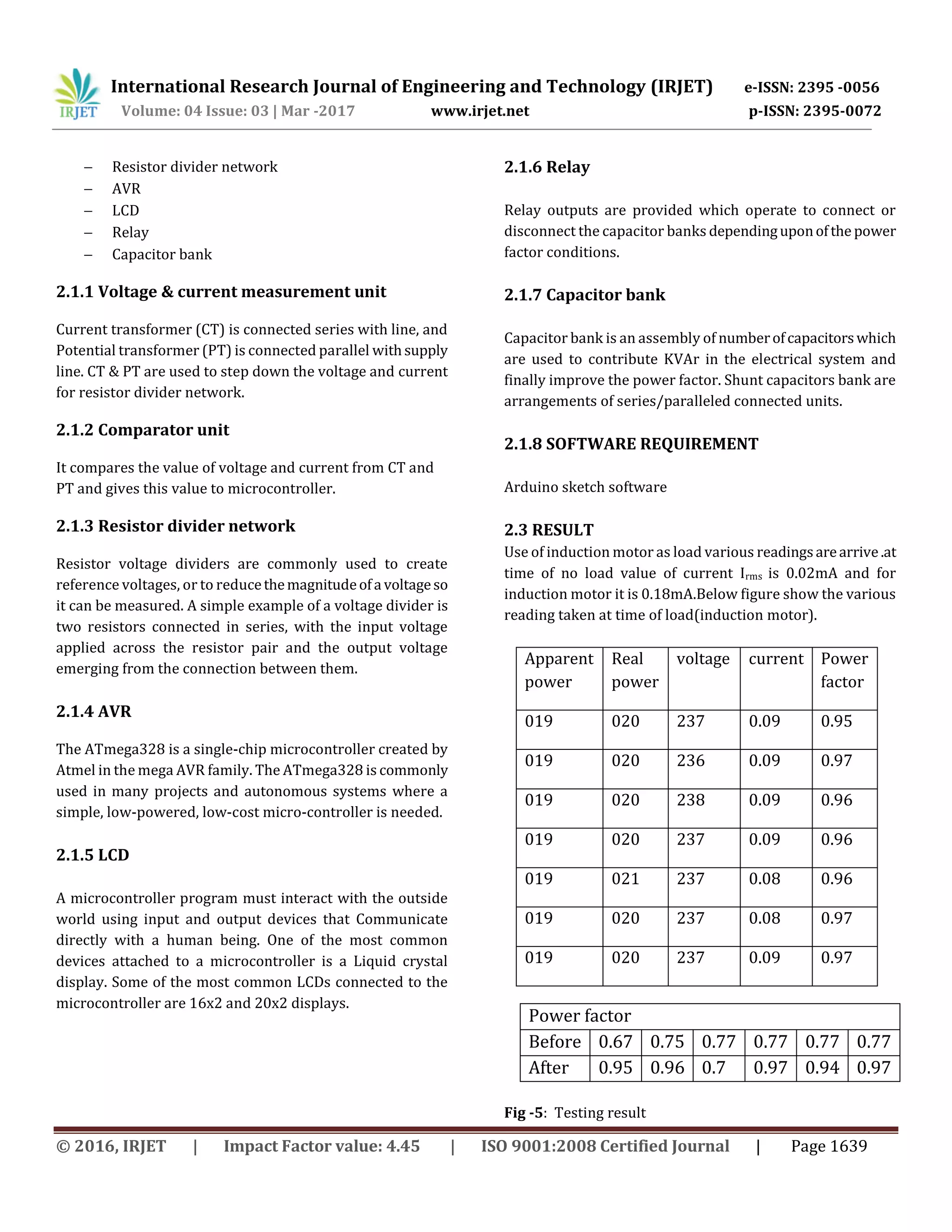
Use of induction motor as load various readingsarearrive.at
time of no load value of current Irms is 0.02mA and for
induction motor it is 0.18mA.Below figure show the various
reading taken at time of load(induction motor).
Apparent
power
Real
power
voltage current Power
factor
019 020 237 0.09 0.95
019 020 236 0.09 0.97
019 020 238 0.09 0.96
019 020 237 0.09 0.96
019 021 237 0.08 0.96
019 020 237 0.08 0.97
019 020 237 0.09 0.97
Fig -5: Testing result
Power factor
Before 0.67 0.75 0.77 0.77 0.77 0.77
After 0.95 0.96 0.7 0.97 0.94 0.97
International Research Journal of Engineering and Technology (IRJET) e-ISSN: 2395 -0056
Volume: 04 Issue: 03 | Mar -2017 www.irjet.net p-ISSN: 2395-0072
© 2016, IRJET | Impact Factor value: 4.45 | ISO 9001:2008 Certified Journal | Page 1640
3. CONCLUSION
In our project “Minimizing Penalty in Industrial Power
Consumption by Engaging APFC Unit” in whichtheadvanced
method of the power factor correction by using the AVR and
Automatic power factor correction unit which has the many
advantages over the various methods of the power factor
correction. The switching of capacitorsisdoneautomatically
by using the contactors and thus the power factor correction
is more accurate. Thus in this paper presented the possible
advanced method for the correction of the power factor.
REFERENCE
[1] Sagar Jundare,PranavUkkadgaonkar,MinimizingPenalty
in Industrial sector By Engaging Automatic powercorrection
panel using microcontroller.
[2] https://en.wikipedia.org/wiki/Power_factor
[3]http://www.electricaltechnology.org/2013/10/causes-
of-low-power-factor.html
[4] Power factor correction By John Ware
[5]Muhammad Ali Mazidi and Janice Gillespie Mazidi,
“Microcontroller and Embedded Systems”.
[6] IEEE TRANSACTIONSON INDUSTRIAL ELECTRONIC VOL
NO 3FEBRUARY 1990 77A Microprocessor-Based Adaptive
Power Factor Corrector for Nonlinear Loads H. M.
ELBOLOK,M. E. MASOUD, AND M. M.MAHMOU
[7] P. N. Enjeti and R artinez “A high performance single
phase rectifier with input power factor correction”, IEEE
Trans. Power Electron…vol.11, No.2, Mar.2003.pp 311-317
BIOGRAPHIES
I, Nidhi Ganatra, am a
final year student of
Electrical. Dept. in Dr.
Subhash technical
campus Junagadh.
I, Swati Chotaliya, am
a final year student of
Electrical. Dept. in Dr.
Subhash technical
campus Junagadh.
I, Vishal N. jogidas am a,
Assistant Professor in
the Department of
Electrical Engineering,
Dr. Subhash Technical
campus Junagadh.

Minimizing Penalty in Industrial Power Consumption by Engaging APFC Unit : A Review

  • 1.
    International Research Journalof Engineering and Technology (IRJET) e-ISSN: 2395 -0056 Volume: 04 Issue: 03 | Mar -2017 www.irjet.net p-ISSN: 2395-0072 © 2016, IRJET | Impact Factor value: 4.45 | ISO 9001:2008 Certified Journal | Page 1637 “Minimizing Penalty in Industrial Power Consumption By Engaging APFC Unit”: A Review Nidhi A. Ganatra1 Swati C. Chotaliya2 Prof Vishal N. Jogidas3 1.2B.E in Electrical Engineering, DSTC, Junagadh, Gujarat, India 3. Assistant Professor in Electrical Engineering Department, DSTC, Junagadh, Gujarat, India ---------------------------------------------------------------------***--------------------------------------------------------------------- Abstract-In the industrial sectorthevariousmotoringloads are continuously running and increasing the inductiveload. So the power factor in this system get reducesduetotheinductive reactive power. But the electricity board has a standard limit regarding the power factor values and if the powerfactorgoes below the specified limit the electricity company charges the penalty to the industrial consumers. APFC device reads power factor from line voltage and line current by determining the delay in the arrival of the current signal with respect to voltage signal from the function generator with highaccuracy by using an internal timer. This time values are the calibrated as phase angle and corresponding power factor. Then the values are displayed in Liquid crystal display modules. Then the motherboard calculates the compensation requirement and accordingly switches on different capacitor banks. This is developed by using AVR microcontroller. KEYWORDS: Power factor, Penalty, AVR microcontroller, capacitor bank, contactors and current transformer, potential transformer 1. INTRODUCTION The low power factor leads to the increase in the load current, increase in power loss, and decrease in efficiency of the overall system. In previousvariousmethoduseforpower factor correction in all this method, the switching of the capacitor is manual. In this paper we are using a method of the reactive power compensation by capacitor switching with automatic control using AVR microcontroller [1]. 1.2 POWER FACTOR Fig -1: Power Triangle The power factor is the ratio of the active power to the apparent power .The active power is the real power delivered to the loads such as motors,lampsetc. Thereactive power is used just for the purpose of producing magnetic field for the flow of active power. The apparent power is the combination of the active and reactive power. The load current of any motor consist of the resistive component and inductive component. The inductive component consists of leakage current and magnetizing current. The leakage current is totally dependent on the load current but the magnetizing component is nearby 20 to 60% of the full load current. The capacitors are employed to reduce inductive reactance in the induction motor thereby reducing losses in the supply [2]. Reactive power Active power Apparent power Imag current Motor current Work current
  • 2.
    International Research Journalof Engineering and Technology (IRJET) e-ISSN: 2395 -0056 Volume: 04 Issue: 03 | Mar -2017 www.irjet.net p-ISSN: 2395-0072 © 2016, IRJET | Impact Factor value: 4.45 | ISO 9001:2008 Certified Journal | Page 1638 Fig -2: Inductor Current Vector Diagram 1.3 SOURCES OF REACTIVE POWER (INDUCTIVE LOADS) DECREASE THE POWER FACTOR [3] -Transformers -Induction Motors -Induction generators (wind mill generators) -High Intensity (HID) lighting 1.4 BENEFITS OF POWER FACTOR CORRECTION The advantages that can be achieved by applying the power factor correction are [4]:  Environmental benefit-reduction of power consumption due to improved energy efficiency. Reduced power consumption means less greenhouse gas emissions and fossil fuel depletion by power stations.  Reduction of electricity bills.  Extra kVA available from the existing supply.  In transformers and distribution equipment I2R losses decrease.  In long cables reduction of voltage drop.  Extended equipment life- reduced electrical burden on cables and electrical Component. 2. PROPOSED SYSTEM An AVR microcontroller is used in this project as a central processing unit to calculate the power factor and to switch the capacitors. The working of this project is explained with the help of the below block diagram. Fig -3: Block diagram of PFC using AVR microcontroller It uses a potential transformer to supply the voltage to the Resistor divider network (like zero voltage crossing circuit), which detects the zero crossing of the voltage wave form. These voltage pulses from the operational amplifier are applied to the AVR microcontroller as interrupt signals. Similarly, a current transformer is used here to give the current wave to the Resistor divider network wherein the operational amplifier output is enabled for every 10 ms by comparing the zero position of the current with the predefined setting. This signal is also applied to the AVR microcontroller as an interrupt signal. The microcontroller finds time elapse between these two interrupts and substitutes it in a certain equation for calculating the power factor. If this power factor value is above 0.96 then the AVR doesn’t send any command signals to the relay driver to switch the capacitors on. But, if it is less than 0.96, then the AVR sends command signals to the relay driver so that the capacitor bank on. Therefore, these capacitors reduce the lagging nature of the load by giving leadingcurrentstoit. The number of capacitors’ switching depends on the value of the power factor – very low power factor needs all the capacitor, whereas high power factor needs none of those. 2.1 HARDWARE Fig -4: Hardware setup The proposed work can be explained in the form of block diagram as shown in figure 3. It comprises of following 9 blocks [1],  CT & PT  Comparator unit
  • 3.
    International Research Journalof Engineering and Technology (IRJET) e-ISSN: 2395 -0056 Volume: 04 Issue: 03 | Mar -2017 www.irjet.net p-ISSN: 2395-0072 © 2016, IRJET | Impact Factor value: 4.45 | ISO 9001:2008 Certified Journal | Page 1639  Resistor divider network  AVR  LCD  Relay  Capacitor bank 2.1.1 Voltage & current measurement unit Current transformer (CT) is connected series with line, and Potential transformer (PT) is connected parallel withsupply line. CT & PT are used to step down the voltage and current for resistor divider network. 2.1.2 Comparator unit It compares the value of voltage and current from CT and PT and gives this value to microcontroller. 2.1.3 Resistor divider network Resistor voltage dividers are commonly used to create reference voltages, or to reducethemagnitudeofa voltageso it can be measured. A simple example of a voltage divider is two resistors connected in series, with the input voltage applied across the resistor pair and the output voltage emerging from the connection between them. 2.1.4 AVR The ATmega328 is a single-chip microcontroller created by Atmel in the mega AVR family. The ATmega328 is commonly used in many projects and autonomous systems where a simple, low-powered, low-cost micro-controller is needed. 2.1.5 LCD A microcontroller program must interact with the outside world using input and output devices that Communicate directly with a human being. One of the most common devices attached to a microcontroller is a Liquid crystal display. Some of the most common LCDs connected to the microcontroller are 16x2 and 20x2 displays. 2.1.6 Relay Relay outputs are provided which operate to connect or disconnect the capacitor banks dependinguponofthe power factor conditions. 2.1.7 Capacitor bank Capacitor bank is an assembly of numberofcapacitorswhich are used to contribute KVAr in the electrical system and finally improve the power factor. Shunt capacitors bank are arrangements of series/paralleled connected units. 2.1.8 SOFTWARE REQUIREMENT Arduino sketch software 2.3 RESULT Use of induction motor as load various readingsarearrive.at time of no load value of current Irms is 0.02mA and for induction motor it is 0.18mA.Below figure show the various reading taken at time of load(induction motor). Apparent power Real power voltage current Power factor 019 020 237 0.09 0.95 019 020 236 0.09 0.97 019 020 238 0.09 0.96 019 020 237 0.09 0.96 019 021 237 0.08 0.96 019 020 237 0.08 0.97 019 020 237 0.09 0.97 Fig -5: Testing result Power factor Before 0.67 0.75 0.77 0.77 0.77 0.77 After 0.95 0.96 0.7 0.97 0.94 0.97
  • 4.
    International Research Journalof Engineering and Technology (IRJET) e-ISSN: 2395 -0056 Volume: 04 Issue: 03 | Mar -2017 www.irjet.net p-ISSN: 2395-0072 © 2016, IRJET | Impact Factor value: 4.45 | ISO 9001:2008 Certified Journal | Page 1640 3. CONCLUSION In our project “Minimizing Penalty in Industrial Power Consumption by Engaging APFC Unit” in whichtheadvanced method of the power factor correction by using the AVR and Automatic power factor correction unit which has the many advantages over the various methods of the power factor correction. The switching of capacitorsisdoneautomatically by using the contactors and thus the power factor correction is more accurate. Thus in this paper presented the possible advanced method for the correction of the power factor. REFERENCE [1] Sagar Jundare,PranavUkkadgaonkar,MinimizingPenalty in Industrial sector By Engaging Automatic powercorrection panel using microcontroller. [2] https://en.wikipedia.org/wiki/Power_factor [3]http://www.electricaltechnology.org/2013/10/causes- of-low-power-factor.html [4] Power factor correction By John Ware [5]Muhammad Ali Mazidi and Janice Gillespie Mazidi, “Microcontroller and Embedded Systems”. [6] IEEE TRANSACTIONSON INDUSTRIAL ELECTRONIC VOL NO 3FEBRUARY 1990 77A Microprocessor-Based Adaptive Power Factor Corrector for Nonlinear Loads H. M. ELBOLOK,M. E. MASOUD, AND M. M.MAHMOU [7] P. N. Enjeti and R artinez “A high performance single phase rectifier with input power factor correction”, IEEE Trans. Power Electron…vol.11, No.2, Mar.2003.pp 311-317 BIOGRAPHIES I, Nidhi Ganatra, am a final year student of Electrical. Dept. in Dr. Subhash technical campus Junagadh. I, Swati Chotaliya, am a final year student of Electrical. Dept. in Dr. Subhash technical campus Junagadh. I, Vishal N. jogidas am a, Assistant Professor in the Department of Electrical Engineering, Dr. Subhash Technical campus Junagadh.