Power Factor:
Causes, Costs, Case Study
      Michael Wrinch, P.Eng.(Canada)


                         Slide: 1 of 20
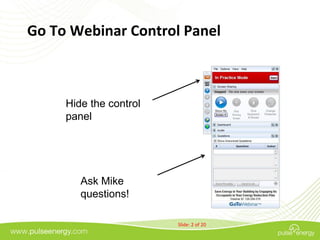
Go To Webinar Control Panel


     Hide the control
     panel


        Ask Mike
        questions!

                        Slide: 2 of 20
Power Factor Agenda
•   Background on Electricity
•   What is Power Factor?
•   What it can cost you
•   How it effects your buildings
•   How to fix it
•   Case Study
•   Software Demo


                                    Slide: 3 of 20
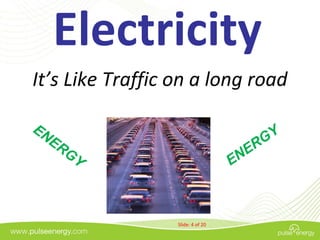
Electricity
It’s Like Traffic on a long road


                  Slide: 4 of 20
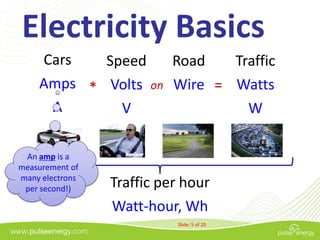
Electricity Basics
    Cars   Speed    Road   Traffic
    Amps * Volts on Wire = Watts
     A       V               W

 An amp is a
measurement of
many electrons
 per second!)    Traffic per hour
                 Watt-hour, Wh
                           Slide: 5 of 20
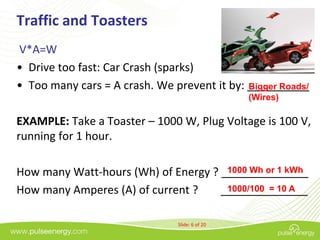
Traffic and Toasters
V*A=W
• Drive too fast: Car Crash (sparks)
• Too many cars = A crash. We prevent it by: __________
                                             Bigger Roads/
                                                (Wires)

EXAMPLE: Take a Toaster – 1000 W, Plug Voltage is 100 V,
running for 1 hour.

How many Watt-hours (Wh) of Energy ? ______________
                                      1000 Wh or 1 kWh

How many Amperes (A) of current ?    ______________
                                      1000/100 = 10 A


                               Slide: 6 of 20
Unfortunately,

       this is not completely true….


                      Slide: 7 of 20
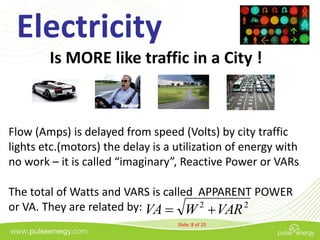
Electricity
        Is MORE like traffic in a City !


Flow (Amps) is delayed from speed (Volts) by city traffic
lights etc.(motors) the delay is a utilization of energy with
no work – it is called “imaginary”, Reactive Power or VARs.

The total of Watts and VARS is called APPARENT POWER
or VA. They are related by: VA  W 2  VAR 2
                                   Slide: 8 of 20
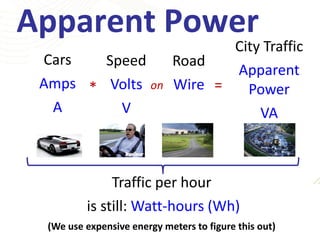
Apparent Power
                                     City Traffic
 Cars   Speed                 Road
                                     Apparent
 Amps * Volts on              Wire =   Power
  A       V                              VA


               Traffic per hour
          is still: Watt-hours (Wh)
  (We use expensive energy metersofto figure this out)
                             Slide: 9 20
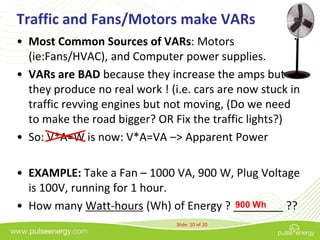
Traffic and Fans/Motors make VARs
• Most Common Sources of VARs: Motors
  (ie:Fans/HVAC), and Computer power supplies.
• VARs are BAD because they increase the amps but
  they produce no real work ! (i.e. cars are now stuck in
  traffic revving engines but not moving, (Do we need
  to make the road bigger? OR Fix the traffic lights?)
• So: V*A=W is now: V*A=VA –> Apparent Power

• EXAMPLE: Take a Fan – 1000 VA, 900 W, Plug Voltage
  is 100V, running for 1 hour.
• How many Watt-hours (Wh) of Energy ? ________ ??
                                       900 Wh

                                Slide: 10 of 20
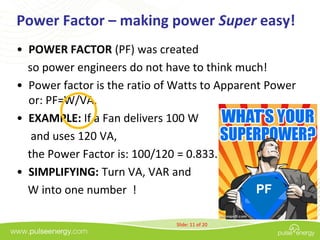
Power Factor – making power Super easy!
• POWER FACTOR (PF) was created
  so power engineers do not have to think much!
• Power factor is the ratio of Watts to Apparent Power
  or: PF=W/VA.
• EXAMPLE: If a Fan delivers 100 W
   and uses 120 VA,
  the Power Factor is: 100/120 = 0.833.
• SIMPLIFYING: Turn VA, VAR and
  W into one number !                          PF

                              Slide: 11 of 20
Slide: 12 of 20
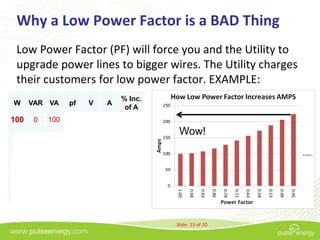
Why a Low Power Factor is a BAD Thing
 Low Power Factor (PF) will force you and the Utility to
 upgrade power lines to bigger wires. The Utility charges
 their customers for low power factor. EXAMPLE:
                               % Inc.
W     VAR VA     pf   V    A
                                of A
100    0   100   1    1   100 100%
                                         Wow!
      60   117 0.86   1   116.6 117%


      120 156 0.64    1   156.2 156%


      180 206 0.49    1   205.9 206%


                                        Slide: 13 of 20
Why Would You Have a PF Issue?
• Competitive bidding: will commonly leave out power
  factor correction kits as it adds to the cost of
  construction (and your monthly power bill).
• Building Improvements: may not take into
  consideration the additional VARs. Examples include
  heat pumps and geothermal upgrades
• Old buildings: with malfunctioning, inappropriate or
  non existent power factor correction systems.


                              Slide: 14 of 20
How Do You Know if You Have a Problem?
• It will show up on your electricity bill as “Power Factor
  Charges”.
• Charge Examples:
   – BC Hydro: penalty charge on monthly PF average. Penalty
     ranges from 2% to 80% of your kWh charge. Starting at PF
     less than 0.9.
   – California PG&E: charges on monthly PF average. Ranging
     from +1% credit to a -2.1% penalty of your kWh charge.
     Penalty starts at PF less than 0.85.


                                   Slide: 15 of 20
Case Study: Community Center
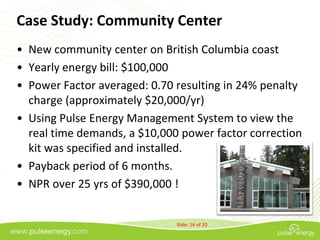
• New community center on British Columbia coast
• Yearly energy bill: $100,000
• Power Factor averaged: 0.70 resulting in 24% penalty
  charge (approximately $20,000/yr)
• Using Pulse Energy Management System to view the
  real time demands, a $10,000 power factor correction
  kit was specified and installed.
• Payback period of 6 months.
• NPR over 25 yrs of $390,000 !


                              Slide: 16 of 20
How You Can Identify and Correct for PF
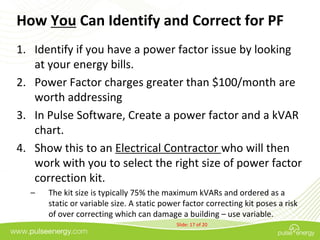
1. Identify if you have a power factor issue by looking
   at your energy bills.
2. Power Factor charges greater than $100/month are
   worth addressing
3. In Pulse Software, Create a power factor and a kVAR
   chart.
4. Show this to an Electrical Contractor who will then
   work with you to select the right size of power factor
   correction kit.
  –   The kit size is typically 75% the maximum kVARs and ordered as a
      static or variable size. A static power factor correcting kit poses a risk
      of over correcting which can damage a building – use variable.
                                            Slide: 17 of 20
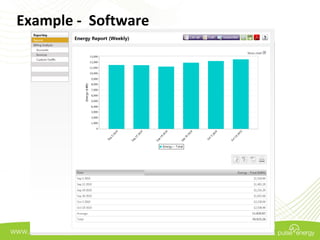
Example - Software


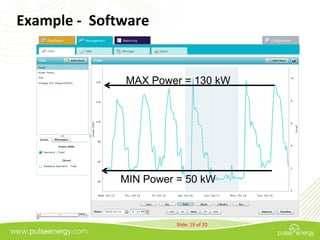
              MAX Power = 130 kW



              MIN Power = 50 kW


                        Slide: 18 of 20
Example - Software


              MAX Power = 130 kW


              MIN Power = 50 kW


                        Slide: 19 of 20
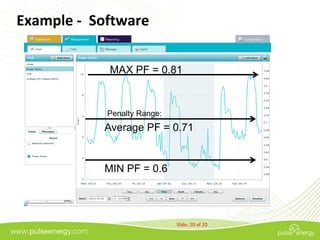
Example - Software

            MAX PF = 0.81


            Penalty Range:
           Average PF = 0.71


           MIN PF = 0.6


                             Slide: 20 of 20
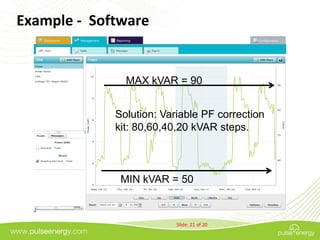
Example - Software


               MAX kVAR = 90


             Solution: Variable PF correction
             kit: 80,60,40,20 kVAR steps.


              MIN kVAR = 50


                          Slide: 21 of 20
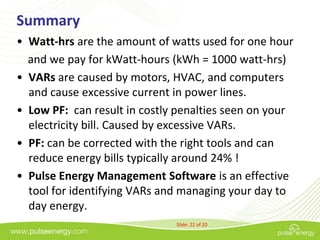
Summary
• Watt-hrs are the amount of watts used for one hour
  and we pay for kWatt-hours (kWh = 1000 watt-hrs)
• VARs are caused by motors, HVAC, and computers
  and cause excessive current in power lines.
• Low PF: can result in costly penalties seen on your
  electricity bill. Caused by excessive VARs.
• PF: can be corrected with the right tools and can
  reduce energy bills typically around 24% !
• Pulse Energy Management Software is an effective
  tool for identifying VARs and managing your day to
  day energy.
                              Slide: 22 of 20
Q&A


      Slide: 23 of 20
Q&A


      Slide: 24 of 20
Q&A


      Slide: 25 of 20
Q&A


      Slide: 26 of 20
Q&A


      Slide: 27 of 20
Q&A


      Slide: 28 of 20
Q&A


      Slide: 29 of 20
Q&A


      Slide: 30 of 20
Q&A


      Slide: 31 of 20
Q&A


      Slide: 32 of 20
Q&A


      Slide: 33 of 20
Q&A


      Slide: 34 of 20
Q&A


      Slide: 35 of 20
Q&A


      Slide: 36 of 20
Q&A


      Slide: 37 of 20
Q&A


      Slide: 38 of 20
Q&A


      Slide: 39 of 20
Q&A


      Slide: 40 of 20
Thank you!
 Additional questions?
      Contact Pulse Energy at: 1-877-331-0500 or at
     info@pulseenergy.com
 Look for future and archived webinars on our website:
  www.pulseenergy.com/resources/webinars
 Look for the webinar summary and further discussion on our
  blog: http://blog.pulseenergy.com/
 Sign up for our news updates:
  http://www.pulseenergy.com/news-updates/


                                       Slide: 41 of 20

Power Factor: what it is, how to measure it and how to improve it to reduce utility fees.

  • 1.
    Power Factor: Causes, Costs,Case Study Michael Wrinch, P.Eng.(Canada) Slide: 1 of 20
  • 2.
    Go To WebinarControl Panel Hide the control panel Ask Mike questions! Slide: 2 of 20
  • 3.
    Power Factor Agenda • Background on Electricity • What is Power Factor? • What it can cost you • How it effects your buildings • How to fix it • Case Study • Software Demo Slide: 3 of 20
  • 4.
    Electricity It’s Like Trafficon a long road Slide: 4 of 20
  • 5.
    Electricity Basics Cars Speed Road Traffic Amps * Volts on Wire = Watts A V W An amp is a measurement of many electrons per second!) Traffic per hour Watt-hour, Wh Slide: 5 of 20
  • 6.
    Traffic and Toasters V*A=W •Drive too fast: Car Crash (sparks) • Too many cars = A crash. We prevent it by: __________ Bigger Roads/ (Wires) EXAMPLE: Take a Toaster – 1000 W, Plug Voltage is 100 V, running for 1 hour. How many Watt-hours (Wh) of Energy ? ______________ 1000 Wh or 1 kWh How many Amperes (A) of current ? ______________ 1000/100 = 10 A Slide: 6 of 20
  • 7.
    Unfortunately, this is not completely true…. Slide: 7 of 20
  • 8.
    Electricity Is MORE like traffic in a City ! Flow (Amps) is delayed from speed (Volts) by city traffic lights etc.(motors) the delay is a utilization of energy with no work – it is called “imaginary”, Reactive Power or VARs. The total of Watts and VARS is called APPARENT POWER or VA. They are related by: VA  W 2  VAR 2 Slide: 8 of 20
  • 9.
    Apparent Power City Traffic Cars Speed Road Apparent Amps * Volts on Wire = Power A V VA Traffic per hour is still: Watt-hours (Wh) (We use expensive energy metersofto figure this out) Slide: 9 20
  • 10.
    Traffic and Fans/Motorsmake VARs • Most Common Sources of VARs: Motors (ie:Fans/HVAC), and Computer power supplies. • VARs are BAD because they increase the amps but they produce no real work ! (i.e. cars are now stuck in traffic revving engines but not moving, (Do we need to make the road bigger? OR Fix the traffic lights?) • So: V*A=W is now: V*A=VA –> Apparent Power • EXAMPLE: Take a Fan – 1000 VA, 900 W, Plug Voltage is 100V, running for 1 hour. • How many Watt-hours (Wh) of Energy ? ________ ?? 900 Wh Slide: 10 of 20
  • 11.
    Power Factor –making power Super easy! • POWER FACTOR (PF) was created so power engineers do not have to think much! • Power factor is the ratio of Watts to Apparent Power or: PF=W/VA. • EXAMPLE: If a Fan delivers 100 W and uses 120 VA, the Power Factor is: 100/120 = 0.833. • SIMPLIFYING: Turn VA, VAR and W into one number ! PF Slide: 11 of 20
  • 12.
  • 13.
    Why a LowPower Factor is a BAD Thing Low Power Factor (PF) will force you and the Utility to upgrade power lines to bigger wires. The Utility charges their customers for low power factor. EXAMPLE: % Inc. W VAR VA pf V A of A 100 0 100 1 1 100 100% Wow! 60 117 0.86 1 116.6 117% 120 156 0.64 1 156.2 156% 180 206 0.49 1 205.9 206% Slide: 13 of 20
  • 14.
    Why Would YouHave a PF Issue? • Competitive bidding: will commonly leave out power factor correction kits as it adds to the cost of construction (and your monthly power bill). • Building Improvements: may not take into consideration the additional VARs. Examples include heat pumps and geothermal upgrades • Old buildings: with malfunctioning, inappropriate or non existent power factor correction systems. Slide: 14 of 20
  • 15.
    How Do YouKnow if You Have a Problem? • It will show up on your electricity bill as “Power Factor Charges”. • Charge Examples: – BC Hydro: penalty charge on monthly PF average. Penalty ranges from 2% to 80% of your kWh charge. Starting at PF less than 0.9. – California PG&E: charges on monthly PF average. Ranging from +1% credit to a -2.1% penalty of your kWh charge. Penalty starts at PF less than 0.85. Slide: 15 of 20
  • 16.
    Case Study: CommunityCenter • New community center on British Columbia coast • Yearly energy bill: $100,000 • Power Factor averaged: 0.70 resulting in 24% penalty charge (approximately $20,000/yr) • Using Pulse Energy Management System to view the real time demands, a $10,000 power factor correction kit was specified and installed. • Payback period of 6 months. • NPR over 25 yrs of $390,000 ! Slide: 16 of 20
  • 17.
    How You CanIdentify and Correct for PF 1. Identify if you have a power factor issue by looking at your energy bills. 2. Power Factor charges greater than $100/month are worth addressing 3. In Pulse Software, Create a power factor and a kVAR chart. 4. Show this to an Electrical Contractor who will then work with you to select the right size of power factor correction kit. – The kit size is typically 75% the maximum kVARs and ordered as a static or variable size. A static power factor correcting kit poses a risk of over correcting which can damage a building – use variable. Slide: 17 of 20
  • 18.
    Example - Software MAX Power = 130 kW MIN Power = 50 kW Slide: 18 of 20
  • 19.
    Example - Software MAX Power = 130 kW MIN Power = 50 kW Slide: 19 of 20
  • 20.
    Example - Software MAX PF = 0.81 Penalty Range: Average PF = 0.71 MIN PF = 0.6 Slide: 20 of 20
  • 21.
    Example - Software MAX kVAR = 90 Solution: Variable PF correction kit: 80,60,40,20 kVAR steps. MIN kVAR = 50 Slide: 21 of 20
  • 22.
    Summary • Watt-hrs arethe amount of watts used for one hour and we pay for kWatt-hours (kWh = 1000 watt-hrs) • VARs are caused by motors, HVAC, and computers and cause excessive current in power lines. • Low PF: can result in costly penalties seen on your electricity bill. Caused by excessive VARs. • PF: can be corrected with the right tools and can reduce energy bills typically around 24% ! • Pulse Energy Management Software is an effective tool for identifying VARs and managing your day to day energy. Slide: 22 of 20
  • 23.
    Q&A Slide: 23 of 20
  • 24.
    Q&A Slide: 24 of 20
  • 25.
    Q&A Slide: 25 of 20
  • 26.
    Q&A Slide: 26 of 20
  • 27.
    Q&A Slide: 27 of 20
  • 28.
    Q&A Slide: 28 of 20
  • 29.
    Q&A Slide: 29 of 20
  • 30.
    Q&A Slide: 30 of 20
  • 31.
    Q&A Slide: 31 of 20
  • 32.
    Q&A Slide: 32 of 20
  • 33.
    Q&A Slide: 33 of 20
  • 34.
    Q&A Slide: 34 of 20
  • 35.
    Q&A Slide: 35 of 20
  • 36.
    Q&A Slide: 36 of 20
  • 37.
    Q&A Slide: 37 of 20
  • 38.
    Q&A Slide: 38 of 20
  • 39.
    Q&A Slide: 39 of 20
  • 40.
    Q&A Slide: 40 of 20
  • 41.
    Thank you!  Additionalquestions?  Contact Pulse Energy at: 1-877-331-0500 or at info@pulseenergy.com  Look for future and archived webinars on our website: www.pulseenergy.com/resources/webinars  Look for the webinar summary and further discussion on our blog: http://blog.pulseenergy.com/  Sign up for our news updates: http://www.pulseenergy.com/news-updates/ Slide: 41 of 20