Appreciative Inquiry
A New Approach to
Organizational Change
S. Thilaganathan
 AI is one of the most significant innovative Method of
changing social or Organizational system
What is AI
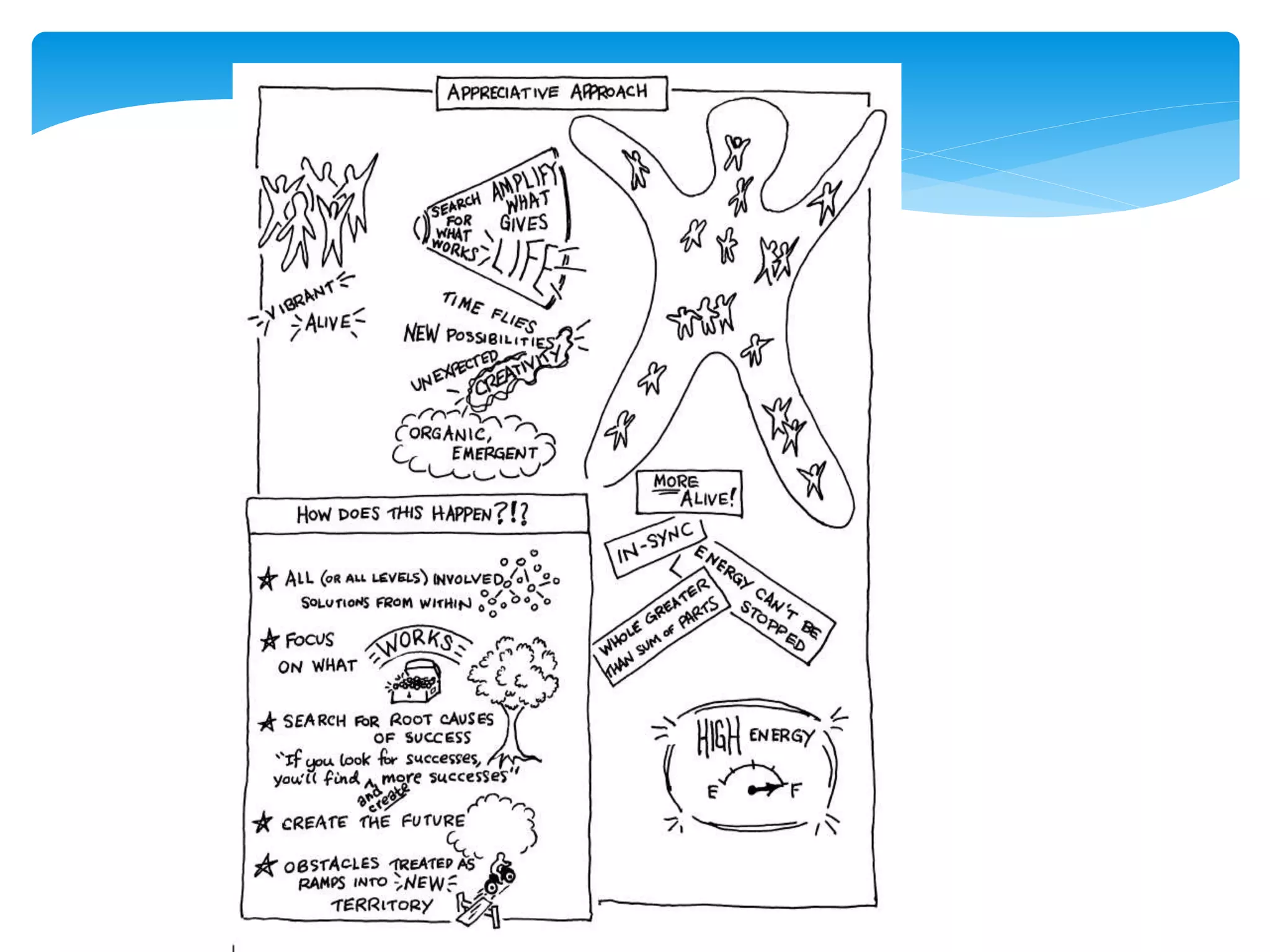
 AI focuses on what you want more of already
exists, even if on small quantities
 It is easier to create change by amplifying the
positive qualities than trying to fix the negative
qualities
 AI does not focus on changing people, Instead of
engage in building an organisation they want to
live in
Appreciative Focus
 By focusing on what’s right, rather than what is
wrong AI gives us access to the kind of energy that
can be transformative
 Having kind of energy to work with gives us the
confidence to develop and pursue a new image of the
future
A I gives Access to Energy
 AI gives a way to bring possibilities to our life and
develop our capabilities
 Through a process of dialogue, we uncover stories of our
peak “experiences” those moments in our lives when
we felt most effective, most connected, most alive
The Appreciative Process
 Oraganisation are not machines-
 Organisations are social reality
 We create social system through our interaction
 Changes are effected by interaction and not by
application any particular technique
Organisational Change
 Appreciative Inquiry was developed by David
Cooperrider and Suresh Srivastva in the 1980s.
Primary Contributors
 AI is the Method of changing social system such as-
 Societies, clubs
 Organizations, Institutions
 Families, Groups
 Schools
What is AI
 General Perception
 Organizations are constrained by limited resources
 Similarly Home, Family units are constrained by
Resources
 The Reality is:
 There is no limitation in:
 Human Imagination
 Vision
 Enterprise Determination
The Perception and Reality
 Our Power is greater money and material
 The assets and capabilities are overlooked or undervalued -
- i.e., the ones they already have.
 We need to turn the world's attention toward strengths
and possibilities.
 We must liberate ourselves from permanent victim
mentality’’
Our Power is Under-valued
 We must become awareness of the value, strength
and potential of ourselves and others
 We must overcome the limits that we impose, often
unconsciously, on our own and others capacities.
Self-Imposed Limits
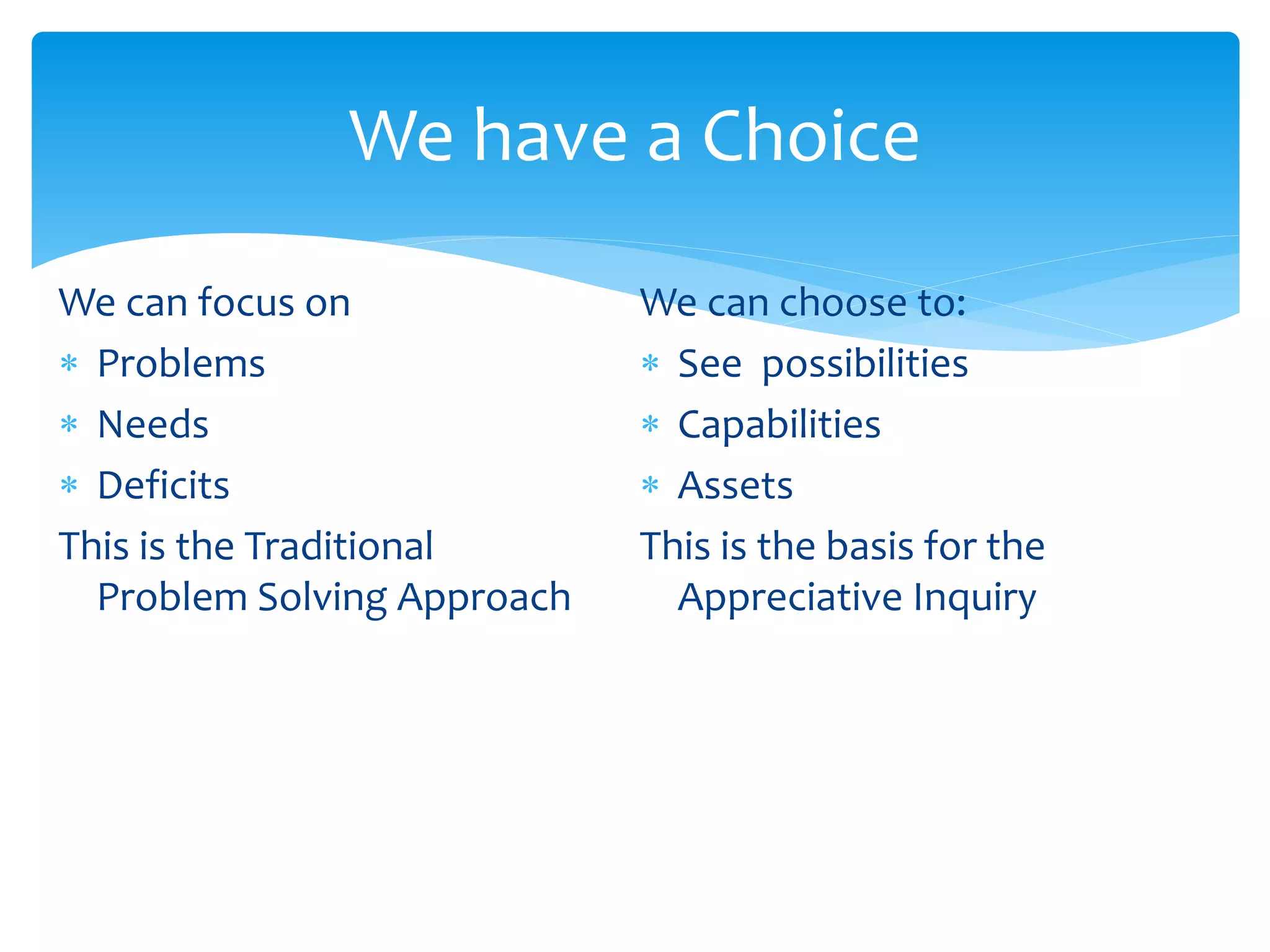
We have a Choice
We can focus on
 Problems
 Needs
 Deficits
This is the Traditional
Problem Solving Approach
We can choose to:
 See possibilities
 Capabilities
 Assets
This is the basis for the
Appreciative Inquiry
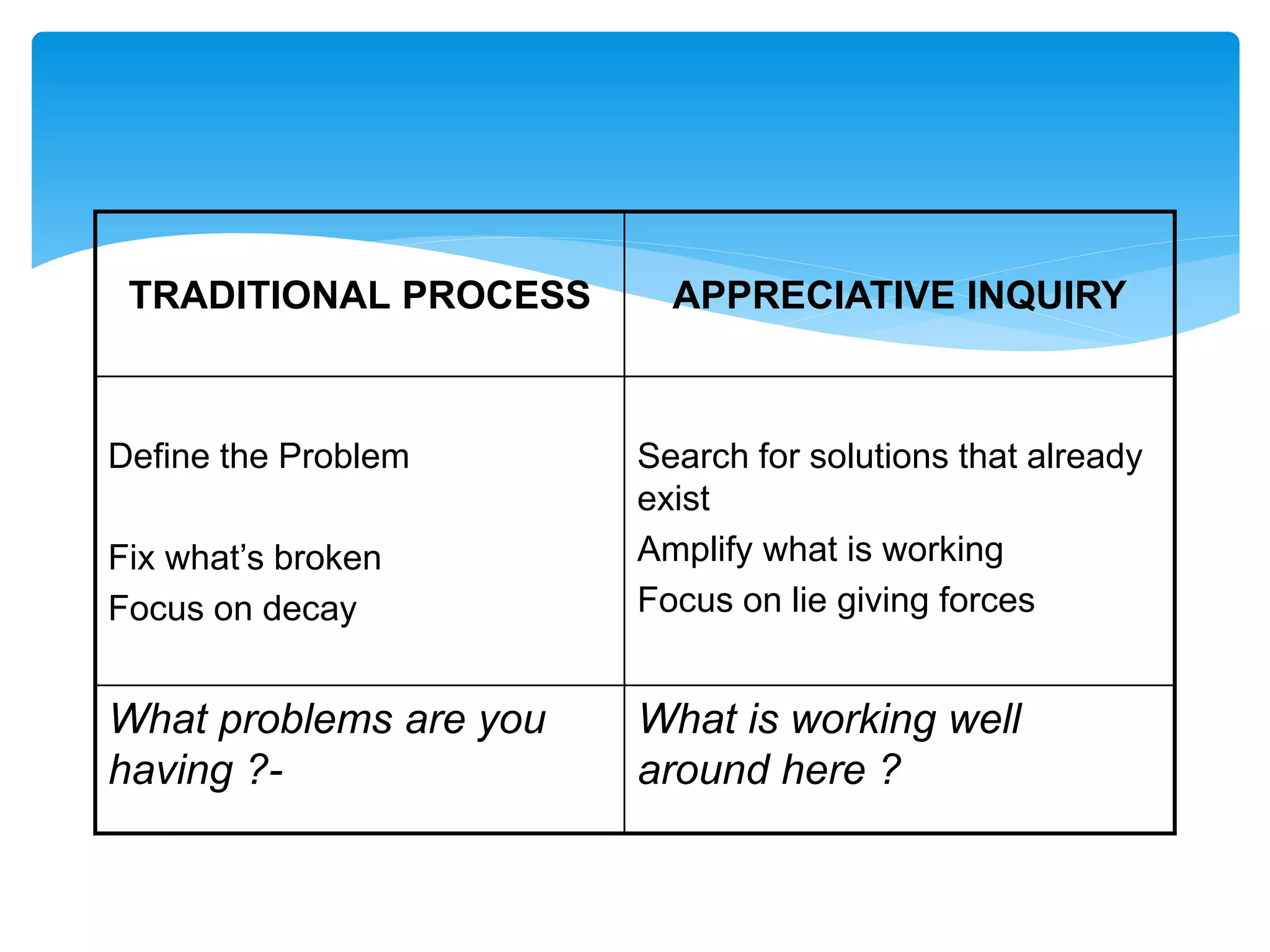
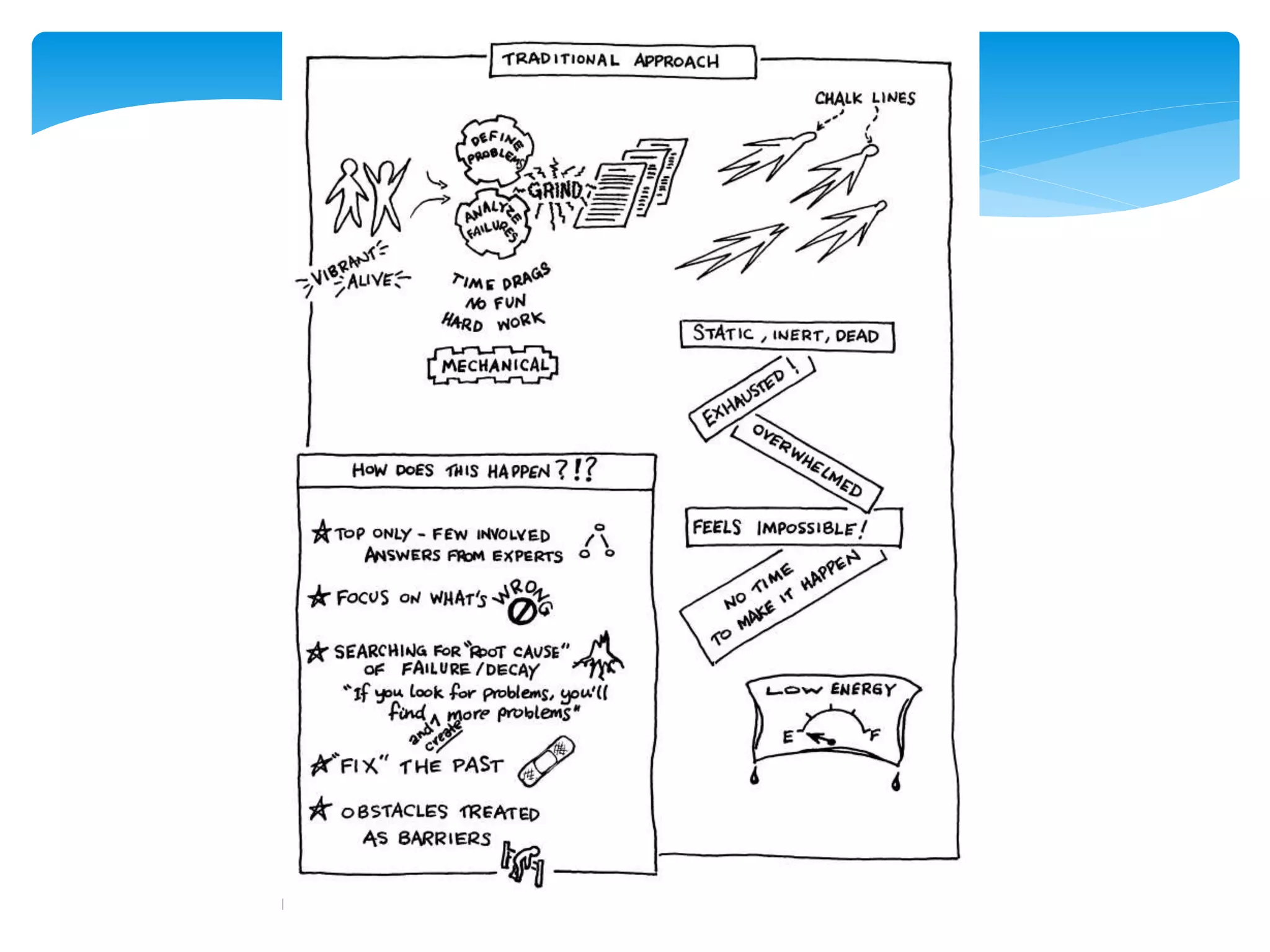
TRADITIONAL PROCESS APPRECIATIVE INQUIRY
Define the Problem
Fix what’s broken
Focus on decay
Search for solutions that already
exist
Amplify what is working
Focus on lie giving forces
What problems are you
having ?-
What is working well
around here ?
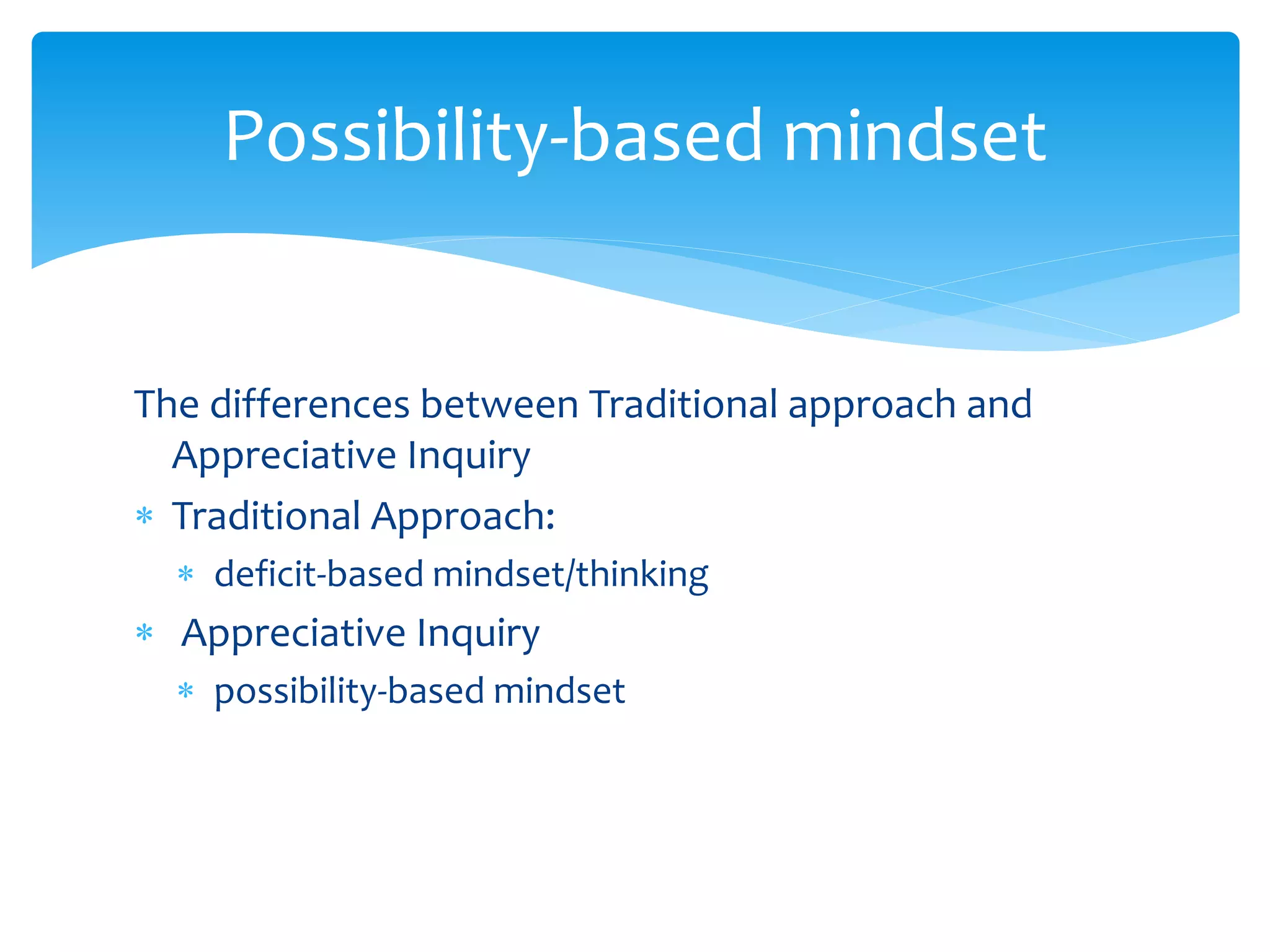
The differences between Traditional approach and
Appreciative Inquiry
 Traditional Approach:
 deficit-based mindset/thinking
 Appreciative Inquiry
 possibility-based mindset
Possibility-based mindset
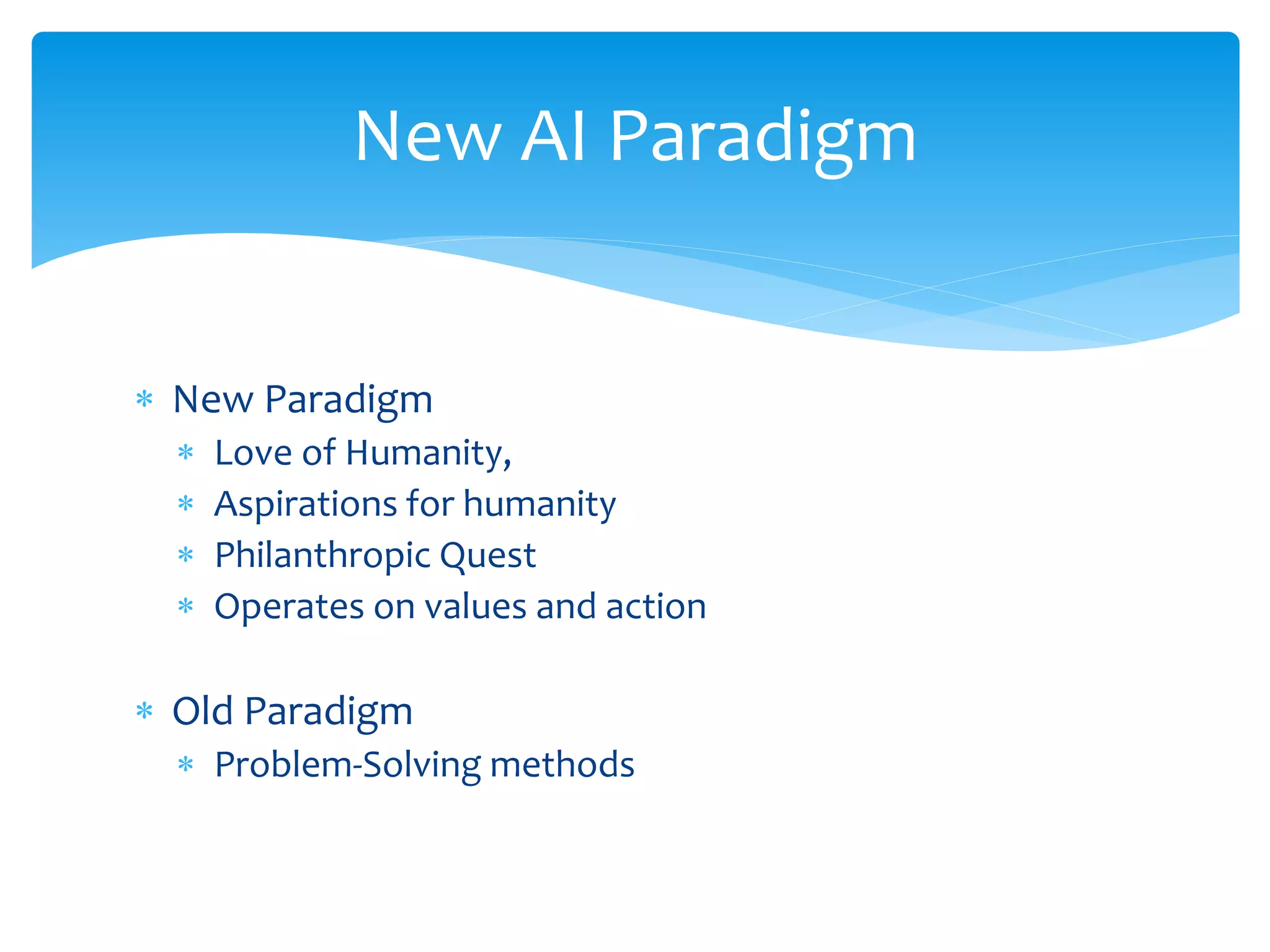
 New Paradigm
 Love of Humanity,
 Aspirations for humanity
 Philanthropic Quest
 Operates on values and action
 Old Paradigm
 Problem-Solving methods
New AI Paradigm
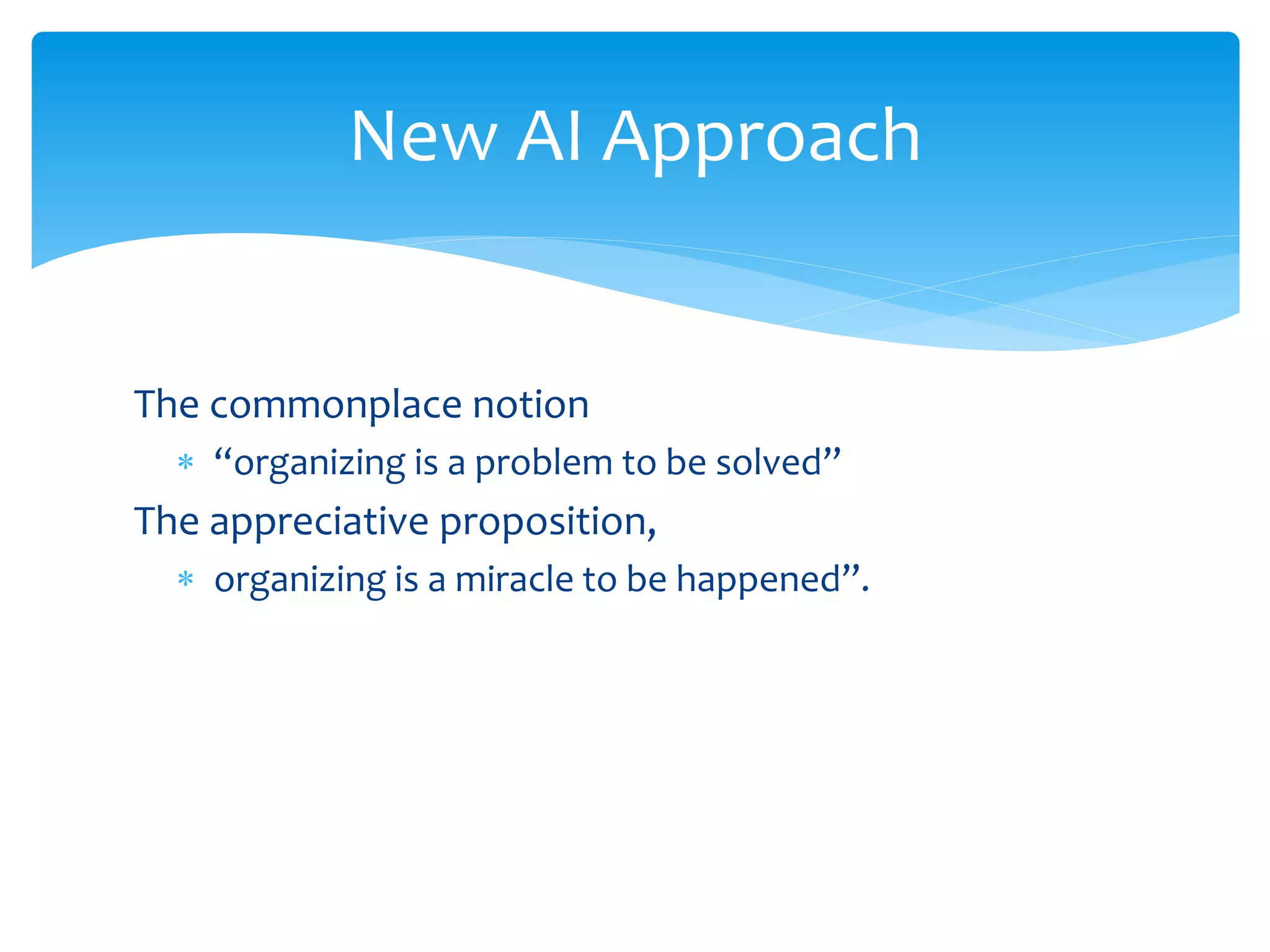
The commonplace notion
 “organizing is a problem to be solved”
The appreciative proposition,
 organizing is a miracle to be happened”.
New AI Approach
 "The problem-solving approach directs attention to
the "worst of what is," constantly examining what is
wrong with the organization.
 The assumption is that if the problems are fixed, then
the desired future will automatically come out"
Problem-solving Approach
 For the same situation we may see two different type
of questions
 Q#1
 “What problems are you having?” or
 Q#2
 “What is working around here?”
 These two questions underline the difference
between traditional change management and
Appreciative Inquiry.
Two Question ?
 Most of us are trained to see problems only
 And when we see the problem, we isolate it from the
rest of the situation, diagnose it and find a solution.
 The unfortunate side effect of this approach is that
we amplify the problems and keep finding more.
Q#1
What problems are you having?
 Appreciative Inquiry focuses on
 What is working around here ;
 what works in an organization and
 Creating a series of statements that describe where
the organization wants to be, based on the high
points of where they have been.
 Because these statements Appreciative Inquiry is an
approach to thinking that works from the
propositions of affirmative action and visions of the
possible, rather than problem solving, finding what is
wrong and looking for difficulties.
Q#2
What is working around here?”
 Appreciative Inquiry is based on dialogue. The first step is
to collect opinions and observations of everyone involved
through telling stories of what has been and is successful.
 These observations are then shared in a workshop format
to identify the themes and topics that run through the
stories.
 Finally, a selection of the most important of these themes
forms the basis for building a series of provocative
proposition that describes how the organization will be.
What is working around here?
 These powerful images -- of ourselves, our
organizations and the world can inspire action and
innovation.
 We pay special attention to "the best of the past and
present" -- in order to "ignite the collective
imagination of what might be."
The Best of Past and Present
 Focus on what you want more of already exists, even
if on small quantities
 It is easier to create change by amplifying the positive
qualities than trying to fix the negative qualities
 AI does not focus on changing people, Instead of
engage in building an organisation they want to live in
Our Focus
 To Inspire, Mobilize and Sustain human energy most
effective way we need to focus on
 Possibilities rather than
 Problems
Pursuing on Possibilities
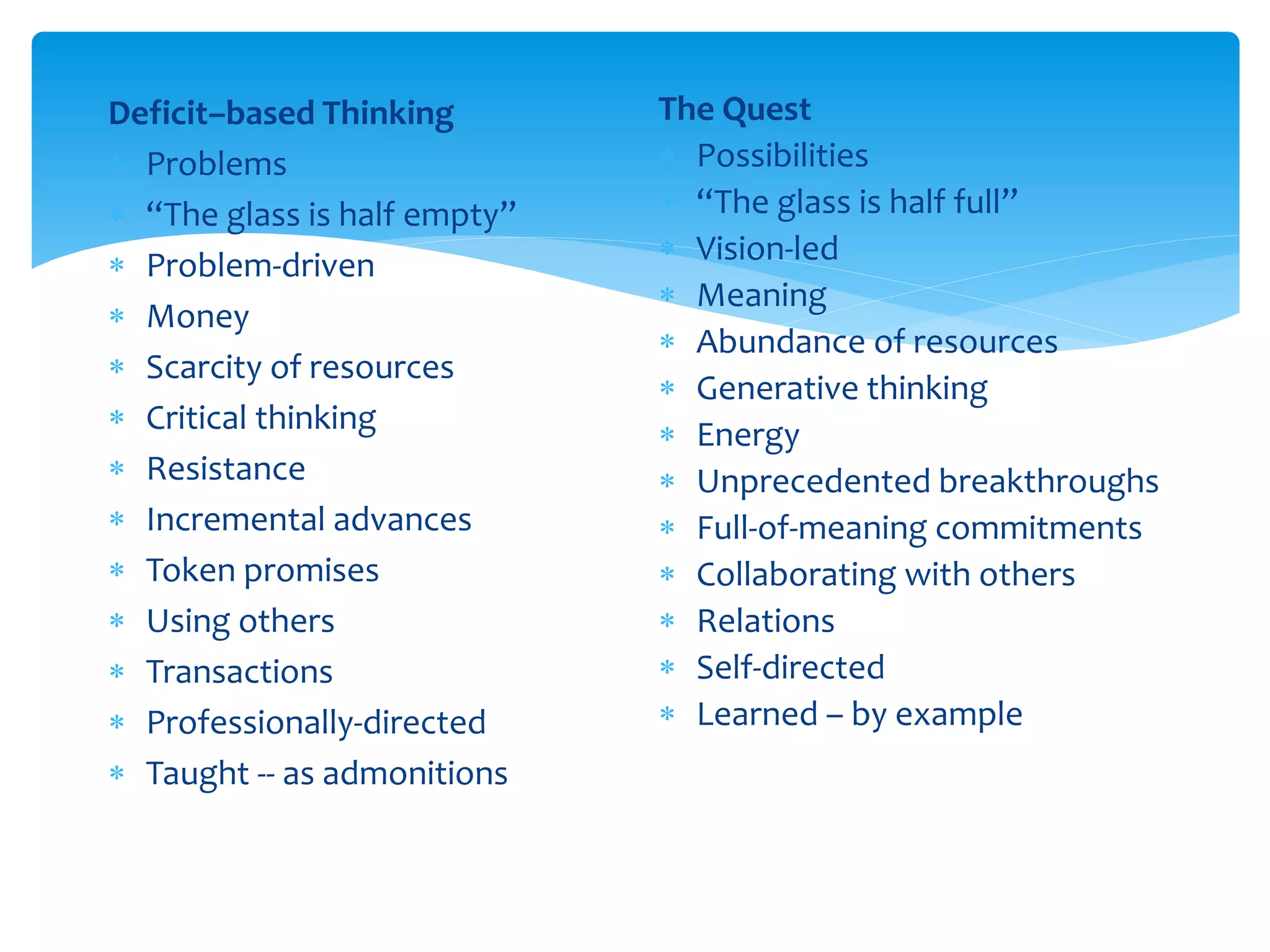
Deficit–based Thinking
 Problems
 “The glass is half empty”
 Problem-driven
 Money
 Scarcity of resources
 Critical thinking
 Resistance
 Incremental advances
 Token promises
 Using others
 Transactions
 Professionally-directed
 Taught -- as admonitions
The Quest
 Possibilities
 “The glass is half full”
 Vision-led
 Meaning
 Abundance of resources
 Generative thinking
 Energy
 Unprecedented breakthroughs
 Full-of-meaning commitments
 Collaborating with others
 Relations
 Self-directed
 Learned – by example
 AI was developed by Dr. David Cooperrider
 New Paradigm
 Love of Humanity,
 Aspirations for humanity
 Philanthropic Quest
 Operates on values and action
 Old Paradigm
 Problem-Solving methods
Philanthropic Quest
 By focusing on what’s right, rather than what is
wrong AI gives us access to the kind of energy that
can be transformative
 Having kind of energy to work with gives us the
confidence to develop and pursue a new image of the
future
AI gives Access to Energy
 Oraganisations are not machines-
 Organisations are social reality
 W create social system through our interaction
 Changes are effected by interaction and not by
application any particular technique
Organisation
 AI is a capacity building process that begins with
valuing the strengths
Capacity Building Process
Capacity building honors
 Honors local capabilities and indigenous wisdom
 Demonstrates an identifiable configuration of
characteristics and conditions; such enterprises
 Generate cooperative consciousness based on the
values about the past, followed by a desirable, positively
valued future.
Appreciative Capacity Building
 Elevating the collective self-esteem of the
community.
 Draw a community’s attention back to its own
resources.
 View the circumstances as possibilities calling to be
realized rather than as problems to be solved.
 Engage in expanding circles of inquiry and
dialogue around possibility.
Appreciative Capacity Building
 AI is true to human nature and encourage
different way of thinking
 AI allows
 Emotional response
 Intellectual analysis
 Imagination and Rational thought
 Inquiry and change are not separate moments,
but occur together
 The behaviour is guided by images of future
Why it Works
 Because leadership is a function and not a position.
 People assume leadership when it is needed and
appropriate to their skills and interest.
 World leaders highly skilled not only in their areas of
expertise, but also in the human processes of
organizing.
Leadership
 Be the change you want to see in the world.
— Gandhi
Change yourself First, Change others
Later
 As we are liberated from our own fears,
our presence automatically liberates others.
Liberate Our Fears
 "Imagination is more important than knowledge."
 Albert Einstein
Power of Imagination

A new approach to organizational change appreciative inquiry

  • 1.
    Appreciative Inquiry A NewApproach to Organizational Change S. Thilaganathan
  • 2.
     AI isone of the most significant innovative Method of changing social or Organizational system What is AI
  • 3.
     AI focuseson what you want more of already exists, even if on small quantities  It is easier to create change by amplifying the positive qualities than trying to fix the negative qualities  AI does not focus on changing people, Instead of engage in building an organisation they want to live in Appreciative Focus
  • 4.
     By focusingon what’s right, rather than what is wrong AI gives us access to the kind of energy that can be transformative  Having kind of energy to work with gives us the confidence to develop and pursue a new image of the future A I gives Access to Energy
  • 5.
     AI givesa way to bring possibilities to our life and develop our capabilities  Through a process of dialogue, we uncover stories of our peak “experiences” those moments in our lives when we felt most effective, most connected, most alive The Appreciative Process
  • 6.
     Oraganisation arenot machines-  Organisations are social reality  We create social system through our interaction  Changes are effected by interaction and not by application any particular technique Organisational Change
  • 7.
     Appreciative Inquirywas developed by David Cooperrider and Suresh Srivastva in the 1980s. Primary Contributors
  • 8.
     AI isthe Method of changing social system such as-  Societies, clubs  Organizations, Institutions  Families, Groups  Schools What is AI
  • 9.
     General Perception Organizations are constrained by limited resources  Similarly Home, Family units are constrained by Resources  The Reality is:  There is no limitation in:  Human Imagination  Vision  Enterprise Determination The Perception and Reality
  • 10.
     Our Poweris greater money and material  The assets and capabilities are overlooked or undervalued - - i.e., the ones they already have.  We need to turn the world's attention toward strengths and possibilities.  We must liberate ourselves from permanent victim mentality’’ Our Power is Under-valued
  • 11.
     We mustbecome awareness of the value, strength and potential of ourselves and others  We must overcome the limits that we impose, often unconsciously, on our own and others capacities. Self-Imposed Limits
  • 12.
    We have aChoice We can focus on  Problems  Needs  Deficits This is the Traditional Problem Solving Approach We can choose to:  See possibilities  Capabilities  Assets This is the basis for the Appreciative Inquiry
  • 13.
    TRADITIONAL PROCESS APPRECIATIVEINQUIRY Define the Problem Fix what’s broken Focus on decay Search for solutions that already exist Amplify what is working Focus on lie giving forces What problems are you having ?- What is working well around here ?
  • 14.
    The differences betweenTraditional approach and Appreciative Inquiry  Traditional Approach:  deficit-based mindset/thinking  Appreciative Inquiry  possibility-based mindset Possibility-based mindset
  • 15.
     New Paradigm Love of Humanity,  Aspirations for humanity  Philanthropic Quest  Operates on values and action  Old Paradigm  Problem-Solving methods New AI Paradigm
  • 16.
    The commonplace notion “organizing is a problem to be solved” The appreciative proposition,  organizing is a miracle to be happened”. New AI Approach
  • 17.
     "The problem-solvingapproach directs attention to the "worst of what is," constantly examining what is wrong with the organization.  The assumption is that if the problems are fixed, then the desired future will automatically come out" Problem-solving Approach
  • 19.
     For thesame situation we may see two different type of questions  Q#1  “What problems are you having?” or  Q#2  “What is working around here?”  These two questions underline the difference between traditional change management and Appreciative Inquiry. Two Question ?
  • 20.
     Most ofus are trained to see problems only  And when we see the problem, we isolate it from the rest of the situation, diagnose it and find a solution.  The unfortunate side effect of this approach is that we amplify the problems and keep finding more. Q#1 What problems are you having?
  • 21.
     Appreciative Inquiryfocuses on  What is working around here ;  what works in an organization and  Creating a series of statements that describe where the organization wants to be, based on the high points of where they have been.  Because these statements Appreciative Inquiry is an approach to thinking that works from the propositions of affirmative action and visions of the possible, rather than problem solving, finding what is wrong and looking for difficulties. Q#2 What is working around here?”
  • 22.
     Appreciative Inquiryis based on dialogue. The first step is to collect opinions and observations of everyone involved through telling stories of what has been and is successful.  These observations are then shared in a workshop format to identify the themes and topics that run through the stories.  Finally, a selection of the most important of these themes forms the basis for building a series of provocative proposition that describes how the organization will be. What is working around here?
  • 24.
     These powerfulimages -- of ourselves, our organizations and the world can inspire action and innovation.  We pay special attention to "the best of the past and present" -- in order to "ignite the collective imagination of what might be." The Best of Past and Present
  • 25.
     Focus onwhat you want more of already exists, even if on small quantities  It is easier to create change by amplifying the positive qualities than trying to fix the negative qualities  AI does not focus on changing people, Instead of engage in building an organisation they want to live in Our Focus
  • 26.
     To Inspire,Mobilize and Sustain human energy most effective way we need to focus on  Possibilities rather than  Problems Pursuing on Possibilities
  • 27.
    Deficit–based Thinking  Problems “The glass is half empty”  Problem-driven  Money  Scarcity of resources  Critical thinking  Resistance  Incremental advances  Token promises  Using others  Transactions  Professionally-directed  Taught -- as admonitions The Quest  Possibilities  “The glass is half full”  Vision-led  Meaning  Abundance of resources  Generative thinking  Energy  Unprecedented breakthroughs  Full-of-meaning commitments  Collaborating with others  Relations  Self-directed  Learned – by example
  • 28.
     AI wasdeveloped by Dr. David Cooperrider  New Paradigm  Love of Humanity,  Aspirations for humanity  Philanthropic Quest  Operates on values and action  Old Paradigm  Problem-Solving methods Philanthropic Quest
  • 29.
     By focusingon what’s right, rather than what is wrong AI gives us access to the kind of energy that can be transformative  Having kind of energy to work with gives us the confidence to develop and pursue a new image of the future AI gives Access to Energy
  • 30.
     Oraganisations arenot machines-  Organisations are social reality  W create social system through our interaction  Changes are effected by interaction and not by application any particular technique Organisation
  • 31.
     AI isa capacity building process that begins with valuing the strengths Capacity Building Process
  • 32.
    Capacity building honors Honors local capabilities and indigenous wisdom  Demonstrates an identifiable configuration of characteristics and conditions; such enterprises  Generate cooperative consciousness based on the values about the past, followed by a desirable, positively valued future. Appreciative Capacity Building
  • 33.
     Elevating thecollective self-esteem of the community.  Draw a community’s attention back to its own resources.  View the circumstances as possibilities calling to be realized rather than as problems to be solved.  Engage in expanding circles of inquiry and dialogue around possibility. Appreciative Capacity Building
  • 34.
     AI istrue to human nature and encourage different way of thinking  AI allows  Emotional response  Intellectual analysis  Imagination and Rational thought  Inquiry and change are not separate moments, but occur together  The behaviour is guided by images of future Why it Works
  • 35.
     Because leadershipis a function and not a position.  People assume leadership when it is needed and appropriate to their skills and interest.  World leaders highly skilled not only in their areas of expertise, but also in the human processes of organizing. Leadership
  • 36.
     Be thechange you want to see in the world. — Gandhi Change yourself First, Change others Later
  • 37.
     As weare liberated from our own fears, our presence automatically liberates others. Liberate Our Fears
  • 38.
     "Imagination ismore important than knowledge."  Albert Einstein Power of Imagination