How to Make Stress Work for You or  Stress Management Tips By S. Thilaganathan
Good News Anybody can reduce the stress up to 85%  or more in the long term You can reduce 15%-20% of your stress immediately
Stress is Necessary - 1  Stress is necessary for life Life is interesting, enjoyable and exciting because of stress. We are surviving because of stress Stress is crucial for higher level of achievement
Stress is Necessary - 2 Stress can generate the impetus and help to convert thoughts into actions Procrastinators work very efficiently in the last minutes because of the stress they get.  In the crisis situation people achieve the goal because of the stress.
Stress is Beneficial Stress is exiting to people E.g..Horror movie, Mountain Climbing, Motor Sports etc. Stress is a happy medium Stress provide  dynamism to our life  Because of stress we become stimulated, thrilled and lively
Having Stress is Normal Stress itself is not bad or good sign Stress is a fact of life. It is inevitable. Having stress is perfectly normal and healthy Stress is part of day to day existence
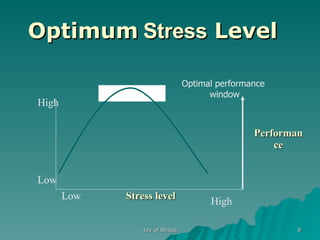
Having  Too  Much or Too Little  Stress is Bad Too much stress is detrimental Too Little stress can be disastrous Boring Life, Retired Life, unutilized worker-partner Absence of stress (Zero level of stress) is an indication of   death Without stress life is boring, and that is stressful The optimum point will result in efficiency, productivity and better health
Optimum  Stress  Level High High Low Stress level Low Optimal performance  window Performance
Stress is  Mismanaged Managing Stress is Managing Self Vast majority of the people  mismanaged  the  life  and  Stress
Benefits have become as Drawbacks Technologically we are in a very advanced stage Biologically human being are far behind the time Our Bio Chemical machine is not programmed for present day life Our system originally designed for survival in primitive period now incapable of handling today’s level of stress.
Benefits have become as Drawbacks Today’s there is no nature threats – But other type of threats are there: School Admission, Employment, Interview, Losing things etc More energy is produced but not utilized When we are under stress more energy (hormones) is produced  If the energy is not used by the system it will be harmful Original responses which were beneficial at times, now become as drawbacks New skills to be learned to overcome stressful situation
Managing Stress Stress management strategies can be classified into three time frames Long Term Medium Term Short Term [This Presentation covers Short Term Stress Management Tips]
Stress Management Tips Short Term
35 Tips to Reduce Your Stress
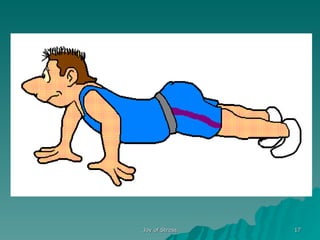
1. Try Physical Activity Reduce your pressure through physical activity. Physical activity  Reduces pressure Refresh you. Energize you. Examples: Walking, Running, Gardening, Cleaning  etc.
 
 
2. Shift Your Work When we do the samework for  a long time, we will get tired Changing work/task reduces stress
3. Give a Break   Give a break to re-equip the system Give time to re-charge or repair your body. Give your body a chance to heal itself Give yourself a break to just relax Temporarily remove yourself from stressful situation Seek recovery every 90 to 120 minutes
Need for a Break Increased stress produces increased performance, initially.  Once you pass a certain point (the hump), any more stress results in decreased performance.  Trying harder at this point is unproductive or even counterproductive.  The only sensible move is to take a break.
4. Focusing one at a time Do not overwhelm yourself with entire workload Pick out few things & deal with them Concentrate on one activity Finish one by one. It is the last straw that breaks the  camel’s back
5. Take a Deep Breath Inhale and exhale in an appropriate way to reduce stress. Deep breathing brings additional oxygen to body. It improves the functions of the body. Poorly oxygenated blood brings anxiety, irritability, fatigue and depression .
    Deep Breathing   Deep breathing - taking deep, slow breaths rather than the shallow, fast breathing we feel when we are stressed. This really works physiologically to help shut off the danger alarm.
6. Reduce your Workload Cancel/avoid/give-up unnecessary and unwanted activities/tasks. Postpone your activities. Delegate some of your work. Find alternative. Change your method of doing the job. Reduce your working hours
7. Match work with Your Body Clock Identify your Body Clock Discover your peak performance time - Morning, evening, night. Assign the work to match your body clock.
8. Eliminate Distraction Deliberately reduce all the distraction. Telephone calls. Visitors Paper work Unnecessary noise/lights .
9. Learn to Relax Each of us have innate capacity to calm stress response Only few of us regularly make use of it Many of us don’t give enough time to use nature’s most guaranteed heal energizer Learning to relax is like learning a new skill
10. Work-leisure Balance Leisure time and levels of distress are inversely proportional  the less leisure, the more stress.  Plan your leisure time
11. Muscular Relaxation Muscular relaxation - tensing and relaxing various muscle groups can work wonders. Try your neck and shoulders, your shoulder blades, your forehead and eyes, tensing these groups for a few seconds, then relaxing them .
12. Visualization Visualization is another technique for relaxation Steps: Cultivate & collect positive images of success & happy situations Move to peaceful & comfortable setting Imagine a scene, place or event that you remember peaceful, restful, beautiful and happy memory. You can bring all senses ie; Sound, Smell,Taste,Warmth etc
13. Learn to Accept If a problem is beyond your control and cannot be changed, don’t fight. Accept it at that moment and later you may change it.
14. Learn to Forget Do not remember bad memories Do not amplify hurts/worries Imagine nothing happened You can deceive your mind
15. Learn to Lose Practice to take-up defeat. Life is Game to Play Allow others to win Win-Win or Lose Win
16. Laugh a Lot Learn to Smile Laugh a lot and make others laugh With laughter stress will fade away Wherever appropriate smile Smile cost nothing Humor is a wonderful stress reducer, an antidote to upsets. Laughter relieves tension.
17. Share your Feelings Talk to someone about your worries. Share your feelings with the person closer to you in a limited way Develop support group
18. It is o.k. to Cry   A good cry can be a healthy way to bring relief. It may prevent headache or other physical consequences.
19. Be Realistic Be good to yourself Do not fix un-achievable targets Be more realistic
20. Not to become too Perfectionist We do not need to become a perfectionist Give up the fallacious assumption that you have to be perfect
21. No Need to Become No #1 No need to become no.1 in everything Settle with second or third best Purchasing  Your partner Reduce pressure of becoming first. Happy with second/third best.
22. Non-Competitive Life is not a contest Never compete with others Don’t compete unnecessarily Compete with yourself
23. No need to React No need to react to everything No need to listen to all or watch all  TV programs. No need to read all the newspapers. No need to have more friends. Reduce material things and items.
24. No need to Control Eliminate the temptation of control. Lack of control is not a failure You don’t need to control all the people, events, activities all the time.
25. Minimize External Pressures Avoid or eliminate external  pressures Learn to say “no”
26. Reward yourself Even for small successes, celebrate. Promise yourself a reward for completing each task. Indulging reward- Indulge yourself and reward Review your success
27. Prioritize Things Reduce the un-important and urgent from 80% to 20%. Discriminate important and unimportant things Allocate more time for important things and not urgent things
28. Check your Ego Learn not to get angry Admit Mistakes Accept criticism
Learn not to get angry When encounter problem, Do not get angry Take steps to solve the problem
Admit Mistakes Do not defend You have to learn to admit mistakes Many people admire your honesty Accepting  your mistakes will give positive impact
Accept Criticism Successful people know how to accept and learn from criticism in a way that earns you respect They know how to deal with justified criticism and unjustified criticism
29. Avoid Bad Responses to Stress Smoking Coffee Alcohol
30. Get Enough Sleep Lack of rest aggravates stress Go to bed early and wake up early Maintain Consistent bedtime  and wake-up time
31. Developing Support Group Find your mentor Establish your network There is an old saying that "a problem shared is a problem halved."  People who keep things to themselves carry a considerable and unnecessary burden.
32 Right to Make Mistakes You have the right to make mistakes as a human being No need to give excuses- Enjoy making mistakes You are taking the responsibility and meet the consequences When you want you can correct it
33. Meditate Meditate .  Just ten to twenty minutes of quiet reflection may bring relief from chronic stress as well as increase your tolerance to it.  Use the time to listen to music, relax and try to think of pleasant things or nothing.
34. Develop Hobbies Take a break from your worries by doing something you enjoy.  Whether it’s gardening or painting, schedule time to indulge your interest
Use the Method that Suit You There is no universally accepted method to reduce stress.  All tips are not same and work well for different people. Identify the best method that suits you and practice that. By strictly practicing the above methods you might reduce your stress level by 15% to 20% immediately.
35. Seek Professional Help If your stress level exceeds the control, go for professional help If you find yourself in an unmanageable stage seek professional help
This is the end of Short Term Stress Management Tips [Medium and Loan Term Stress Management Strategies will be dealt in the next presentations]
 

Stress Management Tips

  • 1.
    How to MakeStress Work for You or Stress Management Tips By S. Thilaganathan
  • 2.
    Good News Anybodycan reduce the stress up to 85% or more in the long term You can reduce 15%-20% of your stress immediately
  • 3.
    Stress is Necessary- 1 Stress is necessary for life Life is interesting, enjoyable and exciting because of stress. We are surviving because of stress Stress is crucial for higher level of achievement
  • 4.
    Stress is Necessary- 2 Stress can generate the impetus and help to convert thoughts into actions Procrastinators work very efficiently in the last minutes because of the stress they get. In the crisis situation people achieve the goal because of the stress.
  • 5.
    Stress is BeneficialStress is exiting to people E.g..Horror movie, Mountain Climbing, Motor Sports etc. Stress is a happy medium Stress provide dynamism to our life Because of stress we become stimulated, thrilled and lively
  • 6.
    Having Stress isNormal Stress itself is not bad or good sign Stress is a fact of life. It is inevitable. Having stress is perfectly normal and healthy Stress is part of day to day existence
  • 7.
    Having Too Much or Too Little Stress is Bad Too much stress is detrimental Too Little stress can be disastrous Boring Life, Retired Life, unutilized worker-partner Absence of stress (Zero level of stress) is an indication of death Without stress life is boring, and that is stressful The optimum point will result in efficiency, productivity and better health
  • 8.
    Optimum Stress Level High High Low Stress level Low Optimal performance window Performance
  • 9.
    Stress is Mismanaged Managing Stress is Managing Self Vast majority of the people mismanaged the life and Stress
  • 10.
    Benefits have becomeas Drawbacks Technologically we are in a very advanced stage Biologically human being are far behind the time Our Bio Chemical machine is not programmed for present day life Our system originally designed for survival in primitive period now incapable of handling today’s level of stress.
  • 11.
    Benefits have becomeas Drawbacks Today’s there is no nature threats – But other type of threats are there: School Admission, Employment, Interview, Losing things etc More energy is produced but not utilized When we are under stress more energy (hormones) is produced If the energy is not used by the system it will be harmful Original responses which were beneficial at times, now become as drawbacks New skills to be learned to overcome stressful situation
  • 12.
    Managing Stress Stressmanagement strategies can be classified into three time frames Long Term Medium Term Short Term [This Presentation covers Short Term Stress Management Tips]
  • 13.
  • 14.
    35 Tips toReduce Your Stress
  • 15.
    1. Try PhysicalActivity Reduce your pressure through physical activity. Physical activity Reduces pressure Refresh you. Energize you. Examples: Walking, Running, Gardening, Cleaning etc.
  • 16.
  • 17.
  • 18.
    2. Shift YourWork When we do the samework for a long time, we will get tired Changing work/task reduces stress
  • 19.
    3. Give aBreak Give a break to re-equip the system Give time to re-charge or repair your body. Give your body a chance to heal itself Give yourself a break to just relax Temporarily remove yourself from stressful situation Seek recovery every 90 to 120 minutes
  • 20.
    Need for aBreak Increased stress produces increased performance, initially. Once you pass a certain point (the hump), any more stress results in decreased performance. Trying harder at this point is unproductive or even counterproductive. The only sensible move is to take a break.
  • 21.
    4. Focusing oneat a time Do not overwhelm yourself with entire workload Pick out few things & deal with them Concentrate on one activity Finish one by one. It is the last straw that breaks the camel’s back
  • 22.
    5. Take aDeep Breath Inhale and exhale in an appropriate way to reduce stress. Deep breathing brings additional oxygen to body. It improves the functions of the body. Poorly oxygenated blood brings anxiety, irritability, fatigue and depression .
  • 23.
       DeepBreathing Deep breathing - taking deep, slow breaths rather than the shallow, fast breathing we feel when we are stressed. This really works physiologically to help shut off the danger alarm.
  • 24.
    6. Reduce yourWorkload Cancel/avoid/give-up unnecessary and unwanted activities/tasks. Postpone your activities. Delegate some of your work. Find alternative. Change your method of doing the job. Reduce your working hours
  • 25.
    7. Match workwith Your Body Clock Identify your Body Clock Discover your peak performance time - Morning, evening, night. Assign the work to match your body clock.
  • 26.
    8. Eliminate DistractionDeliberately reduce all the distraction. Telephone calls. Visitors Paper work Unnecessary noise/lights .
  • 27.
    9. Learn toRelax Each of us have innate capacity to calm stress response Only few of us regularly make use of it Many of us don’t give enough time to use nature’s most guaranteed heal energizer Learning to relax is like learning a new skill
  • 28.
    10. Work-leisure BalanceLeisure time and levels of distress are inversely proportional the less leisure, the more stress. Plan your leisure time
  • 29.
    11. Muscular RelaxationMuscular relaxation - tensing and relaxing various muscle groups can work wonders. Try your neck and shoulders, your shoulder blades, your forehead and eyes, tensing these groups for a few seconds, then relaxing them .
  • 30.
    12. Visualization Visualizationis another technique for relaxation Steps: Cultivate & collect positive images of success & happy situations Move to peaceful & comfortable setting Imagine a scene, place or event that you remember peaceful, restful, beautiful and happy memory. You can bring all senses ie; Sound, Smell,Taste,Warmth etc
  • 31.
    13. Learn toAccept If a problem is beyond your control and cannot be changed, don’t fight. Accept it at that moment and later you may change it.
  • 32.
    14. Learn toForget Do not remember bad memories Do not amplify hurts/worries Imagine nothing happened You can deceive your mind
  • 33.
    15. Learn toLose Practice to take-up defeat. Life is Game to Play Allow others to win Win-Win or Lose Win
  • 34.
    16. Laugh aLot Learn to Smile Laugh a lot and make others laugh With laughter stress will fade away Wherever appropriate smile Smile cost nothing Humor is a wonderful stress reducer, an antidote to upsets. Laughter relieves tension.
  • 35.
    17. Share yourFeelings Talk to someone about your worries. Share your feelings with the person closer to you in a limited way Develop support group
  • 36.
    18. It iso.k. to Cry A good cry can be a healthy way to bring relief. It may prevent headache or other physical consequences.
  • 37.
    19. Be RealisticBe good to yourself Do not fix un-achievable targets Be more realistic
  • 38.
    20. Not tobecome too Perfectionist We do not need to become a perfectionist Give up the fallacious assumption that you have to be perfect
  • 39.
    21. No Needto Become No #1 No need to become no.1 in everything Settle with second or third best Purchasing Your partner Reduce pressure of becoming first. Happy with second/third best.
  • 40.
    22. Non-Competitive Lifeis not a contest Never compete with others Don’t compete unnecessarily Compete with yourself
  • 41.
    23. No needto React No need to react to everything No need to listen to all or watch all TV programs. No need to read all the newspapers. No need to have more friends. Reduce material things and items.
  • 42.
    24. No needto Control Eliminate the temptation of control. Lack of control is not a failure You don’t need to control all the people, events, activities all the time.
  • 43.
    25. Minimize ExternalPressures Avoid or eliminate external pressures Learn to say “no”
  • 44.
    26. Reward yourselfEven for small successes, celebrate. Promise yourself a reward for completing each task. Indulging reward- Indulge yourself and reward Review your success
  • 45.
    27. Prioritize ThingsReduce the un-important and urgent from 80% to 20%. Discriminate important and unimportant things Allocate more time for important things and not urgent things
  • 46.
    28. Check yourEgo Learn not to get angry Admit Mistakes Accept criticism
  • 47.
    Learn not toget angry When encounter problem, Do not get angry Take steps to solve the problem
  • 48.
    Admit Mistakes Donot defend You have to learn to admit mistakes Many people admire your honesty Accepting your mistakes will give positive impact
  • 49.
    Accept Criticism Successfulpeople know how to accept and learn from criticism in a way that earns you respect They know how to deal with justified criticism and unjustified criticism
  • 50.
    29. Avoid BadResponses to Stress Smoking Coffee Alcohol
  • 51.
    30. Get EnoughSleep Lack of rest aggravates stress Go to bed early and wake up early Maintain Consistent bedtime and wake-up time
  • 52.
    31. Developing SupportGroup Find your mentor Establish your network There is an old saying that "a problem shared is a problem halved." People who keep things to themselves carry a considerable and unnecessary burden.
  • 53.
    32 Right toMake Mistakes You have the right to make mistakes as a human being No need to give excuses- Enjoy making mistakes You are taking the responsibility and meet the consequences When you want you can correct it
  • 54.
    33. Meditate Meditate.  Just ten to twenty minutes of quiet reflection may bring relief from chronic stress as well as increase your tolerance to it. Use the time to listen to music, relax and try to think of pleasant things or nothing.
  • 55.
    34. Develop HobbiesTake a break from your worries by doing something you enjoy. Whether it’s gardening or painting, schedule time to indulge your interest
  • 56.
    Use the Methodthat Suit You There is no universally accepted method to reduce stress. All tips are not same and work well for different people. Identify the best method that suits you and practice that. By strictly practicing the above methods you might reduce your stress level by 15% to 20% immediately.
  • 57.
    35. Seek ProfessionalHelp If your stress level exceeds the control, go for professional help If you find yourself in an unmanageable stage seek professional help
  • 58.
    This is theend of Short Term Stress Management Tips [Medium and Loan Term Stress Management Strategies will be dealt in the next presentations]
  • 59.